






Abstract
Research on digital inclusion increasingly focuses on vulnerable groups, with the prevailing idea that social exclusion leads to digital exclusion. The role of the socio-spatial context is often faded into the background due to user-centric (individual) approaches. This article explores how a vulnerable group, Gypsy-Travelers in the Netherlands, deals with digital developments within their socio-spatial context. Contrary to prevailing theories, the analysis shows that Gypsy-Travelers are digitally engaged, despite their social exclusion. An advantage of the Gypsy-Traveler culture is that extended families on the sites provide a large potential of proxy users for support. Many of the Gypsy-Travelers are digitally engaged, but they engage and participate on their own terms. Furthermore, the digital engagement of Gypsy-Travelers is not a panacea for their social exclusion. In fact, their problematic relation with the settled society is mirrored in online activities. This research shows that digitalization has added a new layer to the interaction between Gypsy-Travelers and settled society. It also demonstrates that more socially and spatially contextualized research approaches can add insights to the debate on social and digital exclusion.
Introduction
Everyday activities increasingly demand both Internet connectivity and an understanding of the use of ICT applications (Van Dijk and Hacker, 2003; Selwyn, 2004). This requires the availability of sufficient resources, both on an individual and a community level (Halford and Savage, 2010; Livingstone and Helsper, 2007; Rogers, 2003). These resources, however, are unequally divided among people, communities, and over space, creating unequal conditions for social and digital inclusion (Gilbert, 2010; Helsper, 2012). This article explores how Gypsy-Travelers 1 in the Netherlands, a vulnerable group, deal with these unequal conditions. It builds on existing trust relations with gatekeepers from several Gypsy-Traveler communities, allowing for the collection of data which is difficult to obtain (Sibley, 1998).
Still many people and communities are excluded from digital life, with a risk of being even further excluded as new digital developments evolve (Mariën and Prodnik, 2014; Robinson, 2009; Witte and Mannon, 2010). The prevailing idea is that people who are socially excluded will also be digitally excluded. Therefore, digital inequalities research is increasingly focusing on the digital inclusion of vulnerable and socially excluded groups (Gilbert, 2010; Selwyn, 2004; Van Dijk, 2005). So far, this research interest has mainly resulted in strongly theorized attempts to understand how social exclusion and digital exclusion are related, with little empirical work to test these attempts (Gilbert, 2010; Helsper, 2012). Therefore, there is a call within the field for more empirical research to gain more insights into the complexities of this relation between processes in “the offline social” and “the digital” (Helsper, 2012: 404; Mariën and Prodnik, 2014).
Spatial factors are considered to be of great importance in mechanisms of exclusion, yet in the field of digital inequalities space is still an under-researched element (Crang et al., 2007; Gilbert, 2010; Halford and Savage, 2010). This article argues that digital inequalities are strongly affected by socio-spatial contexts. Contemporary digital developments are situated in a given, reproduced, and yet contingent social and spatial context, within which new developments accumulate. The offline and the digital therefore should be viewed as intertwined, connected and reciprocally affecting one another (DiMaggio et al., 2001; Gilbert et al., 2008; Hargittai, 2004).
Availability of digital connectivity is essentially spatial; the classic dichotomous view of haves and have-nots is still valid in the case of poor and rural areas (Townsend et al., 2013). The negotiation of digital developments—which eventually defines the degrees of engagement and usage—takes place within specific socio-spatial contexts, such as neighborhoods and village communities (Gilbert et al., 2008; Tsatsou, 2011). Digital inequalities research needs to take the highly spatial character of inequalities into account, along with the disadvantaging or advantaging effects they can have on people. To provide insights into the role of space, this article will study the specific socio-spatial and cultural characteristics of Gypsy-Travelers in the Netherlands, and how this affects their digital inclusion.
Gypsy-Travelers generally live in deprived and marginal places, on the edge of society (Sibley, 1995). In the Netherlands, they are now sedentarized due to decades of restrictive policies (Lucassen et al., 1998). Their disadvantaged spatial context makes them vulnerable to further exclusion (Powell, 2011, 2013a), but so far their vulnerability to digital exclusion has not been researched. Based on fieldwork in several Gypsy-Traveler communities in the Netherlands, this article discusses the extent to which the socio-spatial excluded position of Gypsy-Travelers in the Netherlands affects their degree of digital inclusion and, conversely, how their degree of digital inclusion affects their social inclusion.
By examining how Gypsy-Traveler communities in the Netherlands deal with ongoing digital developments, this article adds to the debate on the complex and problematic relation between Gypsy-Travelers and settled society (Powell, 2008; Sibley, 1998; Vanderbeck, 2005). It highlights the “offline” embeddedness of dealing with “online” developments. Furthermore, the article addresses the important role of socio-spatial factors in digital exclusion. As a corollary, the article advocates for including the socio-spatial context more strongly in future research on digital inequalities.
Digital inequalities and vulnerable groups: Beyond the dichotomy
From the digital divide to the individual user
The current debate on digital inequalities addresses both material and social inequalities, of which the latter is assumed to be of greater importance for the user’s inclusion (Van Deursen and Van Dijk, 2013). It moves beyond the classic “digital divide” of haves and have-nots regarding access to ICTs (DiMaggio et al., 2001; Hargittai, 2004; Van Dijk and Hacker, 2003). In Western societies, ubiquitous Internet connectivity is regarded as a given circumstance—or about to be a given—except in remote rural areas (Townsend et al., 2013). This assumption of ubiquity implies that socioeconomic factors play the dominant role in people’s non-use or limited use of digital applications.
The research agenda that has followed from this is one of a user-centered capabilities approach. It puts the user at the center of the issue, that is, the extent to which the user is able to gain access to digital applications and to use them for his or her own benefit (Mariën and Prodnik, 2014). The social position of the user is assessed to determine how the capabilities are influenced by social structures and social stratification processes. Gender, race, ethnicity, class, and power relations are regarded as influential factors in determining an individual’s capabilities and resources; ethnic minorities, for example, are assumed to be less able to learn how to use new ICT applications due to language issues and poverty (Gilbert, 2010; Halford and Savage, 2010). When these factors play a role, and potentially compromise the developments of certain capabilities, then the idea is that the user should be empowered through training (Mariën and Vleugels, 2011). This focus on the capabilities of the user, and user self-reliance, has resulted in a somewhat narrow view on digital inclusion, effectively individualizing the issues (see also critiques by Gilbert, 2010; Mariën and Prodnik, 2014). Mariën and Prodnik (2014) are even more critical when it comes to policies, stating that “digital inclusion policies tend to individualize problems that are in fact social in their nature” (35).
Macro-level research concerning marginalized people shows that vulnerable groups are at relatively great risk of becoming digitally excluded (Courtois and Verdegem, 2014; Michailidis et al., 2011; Park, 2008). On the other hand, micro-level research demonstrates that—with extensive public support—there are exceptions of people breaking the cycle by becoming digitally engaged to some extent (see, for example, studies on indigenous people by Lindberg and Úden, 2010; Rennie et al., 2013). Other studies highlight the importance of social networks and social support in relation to digital exclusion (Crang et al., 2007; Gilbert et al., 2008; Hardill and Olphert, 2012), with proxy users and neighborhood ties as important social resources (Crang et al., 2006). The highly spatial nature of these resources (Naughton, 2013), however, are often faded into the background of the debate (see also the critique by Gilbert, 2010). Studies on these “capabilities by proxy” are still scarce, making it an under-researched feature of digital inequalities (Tsatsou, 2011).
“Online” and “Offline”: Digital exclusion and the socio-spatial context
To understand the social and digital exclusion of vulnerable groups, it is important that analyses take a comprehensive perspective, including both offline and online factors (Courtois and Verdegem, 2014; Witte and Mannon, 2010). Digital inclusion is not a secluded phenomenon; it is embedded in the offline social realm (Robinson, 2009). Analyses of digital exclusion should be grounded in this offline social realm. For example, Gilbert et al. (2008) stated that the spatialities and “the embeddedness of people in place-based communities” (923) require more attention, whereas Tsatsou (2011) put forward the notion of co-existing divides and calls for further contextualization to provide a more comprehensive view on various interrelated inequalities. In general, scholars call for more comprehensive studies on digital inequalities. This article contributes to this literature by providing an empirical study, which specifically includes the socio-spatial context to further contextualize digital inequalities.
Based on Bourdieu (1990), Helsper (2012) has put forward a “corresponding fields model,” connecting offline and digital fields of exclusion: the social, cultural, economic, and personal field (Helsper, 2012: 406). These different fields are “social arenas” in which interactions and developments take place (Bourdieu, 1990). They offer particular resources to individuals which—in the context of this article—they can utilize for gaining access to or learning how to use digital applications. The social field comprises various social networks offering people knowledge and the support of others through social relations. Cultural field resources are based on identity markers, such as certain norms, values, and traditions. Resources in the economic field depend on employment, financial capital, income, poverty, and access to financial services. The personal field offers resources on the micro level of an individual’s personality, such as skills, attitudes, aspirations, and personal preferences (Helsper, 2012: 406–409).
Helsper (2012) follows the prevailing idea from the literature that social exclusion implies digital inequalities, leading to digital exclusion, which then results in further social exclusion, continuously reinforcing each other (405). This suggests that once social or digital exclusion mechanisms have occurred, deficiencies in various areas will accumulate. This is in line with the observations of Van Dijk (2005) with regards to social and digital inclusion. Van Dijk states that digitalization entails a clear case of the “Matthew effect”: the rich get richer and the poor get poorer. Or, more specifically in the case of this article, the resource-rich gain access to more resources while the resource-poor remain deprived of these resources (see also Robinson, 2009). This seems valid for macro-level developments, but it cannot explain the observations, which were made by Lindberg and Úden (2010) and Crang et al. (2007: 2419). Their research has shown that vulnerable people can get digitally engaged, or in other words, break the vicious cycle of exclusion and become, in Helsper’s words (2012: 28), “the unexpectedly included.”
Examples of such unexpectedly included people are still scarce, yet potentially vulnerable groups should enable researchers to generate the most insights into the relation between social and digital exclusion. One of the variables, social exclusion, is definitely present and if members of these groups manage to overcome their barriers to digital inclusion, then this provides insights into useful resources and contextual factors (Gilbert, 2010; Helsper, 2012). According to the prevailing theories on digital exclusion, a marginal and socially excluded position in society ought to result in digital exclusion. This article therefore studies to what extent the prevailing theories of social and digital exclusion apply to a vulnerable group like Gypsy-Travelers in the Netherlands. It uses Helsper’s corresponding fields model to structure the findings. The scope of the four corresponding fields provides a useful initial guiding tool for exploring how Gypsy-Travelers use certain resources to negotiate the impact of digitalization. Furthermore, the fields allow for an in-depth analysis into the role of contextual factors, such as the socio-spatial context.
Dutch Gypsy-Travelers: A socially excluded group
Gypsy-Travelers as “the other”
Throughout history, Gypsy-Travelers have been stigmatized by and excluded from settled European societies (Cottaar et al., 1992; Powell, 2008). According to Sibley (1995), the majority of settled people see those who travel, i.e. nomadic communities, as “the other,” a deviant and untrustworthy group that threatens the way of life of “the self.” In the words of Simmel (1908), Gypsy-Travelers are “strangers” to members of the dominant group. When the strangers start to mix in and become part of everyday life in a community, small disputes can generate conflict, and eventually lead to exclusion (Sibley, 1998; Simmel, 1908). From that moment on, Gypsy-Travelers are forced into a marginal position, with limited access—or no access at all—to essential services like health care and education (Powell, 2013a). Interaction between the groups will continue to exist, but the dominant settled community will only turn to the Gypsy-Travelers when undesirable jobs need doing (Sibley, 1995, 1998); for example, by the “rag-and-bone men” in the United Kingdom and the “kiepenkerls” (itinerant traders) in the Netherlands and Germany.
The disapproving attitude toward non-settled people is manifest in Heidegger’s (1954) work Building, Dwelling, Thinking. Heidegger argues that settling in a fixed place should be the norm, a superior form of dwelling, while he views the unrootedness of nomadic people as undesirable. This view was the basis for many national policies for Gypsy-Travelers in Europe (Powell, 2011; Vanderbeck, 2005). Settled majorities have attempted to sedentarize or remove them to keep “the Gypsy problem” under control, with the persecution of Gypsy-Travelers in World War II by the Nazis as the most harrowing example (Lucassen et al., 1998).
The reining in by and oppressive attitude of settled society has created great distrust among Gypsy-Travelers. Governments and related institutions are seen as untrustworthy “opponents” with sedentarization agendas (Vanderbeck, 2005, 2009). Gypsy-Travelers tend to avoid any kind of interventions by them, because again they state that these interventions are intolerant to their culture (Powell, 2011; Vanderbeck, 2005, 2009). This attitude makes it difficult for example for welfare and social workers to address the often intractable social problems that persist in the communities (Powell, 2011; Sollie et al., 2013). Both the cause of and the solution to the social problems seem to lie in the relationship between the settled society and Gypsy-Travelers.
While many national policies currently focus on integration—based on “sedentarist thinking” (Shubin, 2011)—Gypsy-Travelers chose rather “to mix without integrating” (Sibley, 1998), applying their own terms on which they want to interact with settled society (see also Powell, 2008). According to Sibley (1998: 99), Gypsy-Traveler culture, and its norms and values, includes a “hidden economy,” which would become inoperable if they would integrate into “the larger society.” Through this, Sibley shows that the excluded and marginalized position is partly caused by the larger—or settled—society, and partly a consequence of the Gypsy-Travelers’ choice to preserve their culture and maintain their economic independence.
The complex and problematic relation between the settled society and Gypsy-Travelers has resulted in social and spatial exclusion of the latter. This spatial exclusion, i.e. physically situated on sites on the edge or outside towns and villages, plays an important role in the reproduction of social exclusion (Powell, 2013a; Sibley, 1995, 1998).
The Gypsy-Traveler site: Social and spatial exclusion of sedentarized Dutch Gypsy-Travelers
The historic developments in the Netherlands largely reflect the general European story of Gypsy-Travelers and governmental attempts to sedentarize them (Vanderbeck, 2005), but they are further characterized by specific national policy developments. A key aspect is the continuous effort on the part of the Dutch government to sedentarize the Gypsy-Travelers, attempting to control them (Vanderbeck, 2005, 2009) or “civilize” them (Powell, 2013b). In this article, the non-traveling society is, therefore, referred to as “the settled society,” that is, settled in a fixed abode.
Four periods with specific sedentarizing policy agendas have played a significant role (Cottaar et al., 1992; Khonraad and Veldhuijsen, 2009). The first is the period up until 1945. In this period, the Dutch government mainly focused on controlling the traveling through the Woonwagenwet (Caravans Act or “Gypsy Carts” Act, introduced in 1918) (Khonraad and Veldhuijsen, 2009). The government had a strict system of administering the whereabouts of families and the family ties in the communities. The Nazi regime used this system during the war years (1940–1945) for the persecution of Gypsy-Travelers. The role of the Dutch government in enabling Nazi practices resonates even today in dialogues between governments and Gypsy-Travelers. The latter use the issue as an instrument in disputes with institutions (Sollie et al., 2013).
Second, in the period 1945–1980, the Dutch government tried to improve the social conditions in the communities through a “civilizing offensive” (Powell, 2013b). To achieve this, Gypsy-Travelers had to become sedentary. The national government organized and forced them to move to large regional sites (up to 160 households) providing services specifically intended for the community, such as education, welfare, and sports. Site schools were founded specifically for children from the communities to overcome educational deficiencies and literacy problems. However, with local authorities lacking the competencies to govern sedentarized traveling communities, the concentration policy resulted in sites being ruled by the powerful families (Khonraad and Veldhuijsen, 2009).
Once again, the government “lost control” over the Gypsy-Travelers. So in the third period, 1980–2000, the focus of policy was on breaking up the big regional sites into smaller sites, aiming for a shift in the power balance and the government reclaiming control. Dominant families resisted, and the relationship with governments became more frustrated. Powerful community gatekeepers used their influence to make sure the communities would oppose the governmental actions (Sollie et al., 2013).
This process of breaking up and reclaiming control was only partly completed when the Caravans Act was abolished in 1999, marking the beginning of the fourth period. With this abolition, Gypsy-Travelers lost their specific policy position. The government now sees them as “regular Dutch citizens.” It argues that they have become sedentary and are no different from other citizens (any longer). This means that there are no specific policy programs to tackle socioeconomic problems.
The current governmental approach has not effaced the long history of discrimination and exclusion. Dutch Gypsy-Travelers still live in marginal places and are socially excluded from “settled” Dutch society (FRANET, 2012). Reports point out that they are generally poorly equipped to individually overcome their deficiencies due to poor education and literacy problems (FRANET, 2012; MOVISIE, 2013; Timmermans and Van den Hurk, 2002). Improving educational and literacy levels has proved to be difficult, because many Gypsy-Travelers regard formal education as not essential for their originally nomadic way of living (Weller, 2005).
Research methods and approach
Characteristics of the resident respondents from Dommelen, Opende, and Buitenpost.
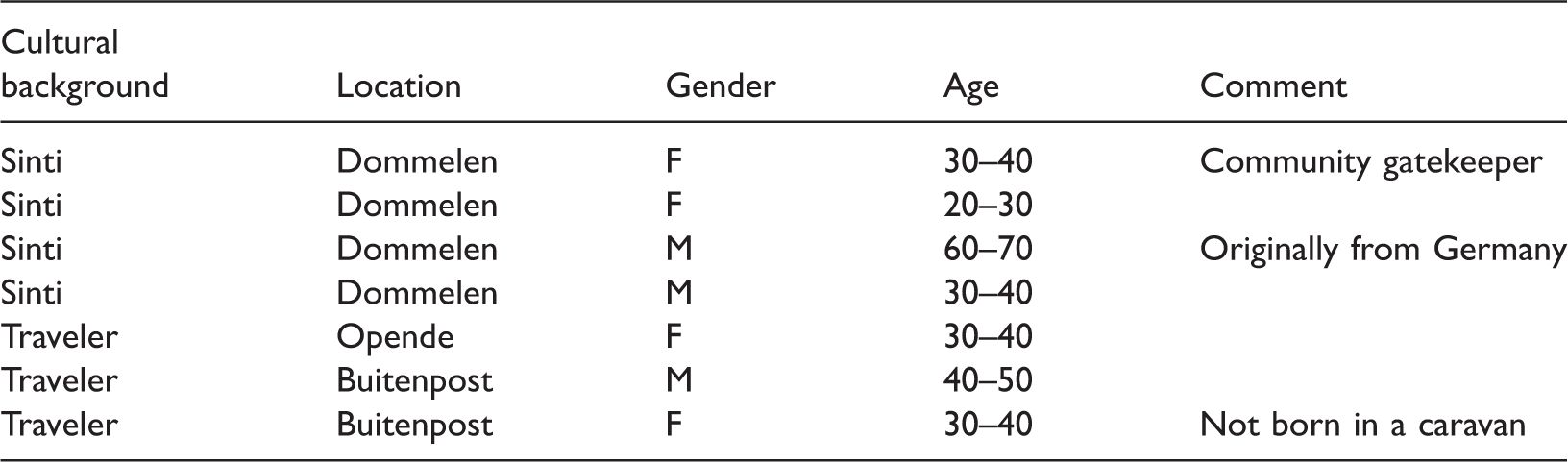
The second part of the data collection took place in Emmen. Here, the researcher was allowed to join the team Woonwagenzaken (Gypsy-Travelers affairs) of the municipality for 10 full working days from September to December 2013. The team consists of a policy maker and a social worker, both specifically appointed to work with Gypsy-Travelers. Together with the social worker, 14 families on five Gypsy-Traveler sites—inhabited mainly by Travelers—were visited in the municipality of Emmen (Drenthe). The researcher was allowed to make observations about the role of digital applications and communication in the life of the Travelers, and it was possible to interview members of the families. During the conversations between the project manager and the social worker, the researcher was allowed to interrupt and interview them about issues relevant for this research.
It was agreed with both the social worker and a gatekeeper from the Gypsy-Traveler community that conversations with residents would not be recorded. They assessed that people from the community had had unsatisfactory experiences with interview recordings by researchers and journalists. It was strongly advised not to record the conversations, because otherwise residents would be likely to abort the interview and would not grant permission for using it. Attempts to obtain permission to record the interviews could also jeopardize the still brittle relationship that the social worker was building with the community. 2 Before starting conversations and interviews during the visits to the sites, the researcher was introduced to the residents, and the researcher himself explained his research interests. The respondents were asked whether they agreed to have a confidential and anonymous conversation with the researcher. A written agreement on this was not necessary according to the residents, since “oral agreements are part of the Gypsy-Traveler culture” (see also Lucassen et al., 1998).
Instead of recording the interviews, a fieldwork diary was created. The fieldwork diary includes the accounts of the interviews with people who agreed to take part in the research. In addition, it includes accounts of the observations made at the Gypsy-Traveler sites. The diary also contains the accounts of the interviews with the employees of the municipality, who agreed to the use of their quotes in this article. In total, this document consists of 17 entry days—10 full working days with the employees and seven other visits to the sites.
Digital life of Dutch Gypsy-Travelers
Social exclusion and marginalization of Gypsy-Travelers in the Netherlands persists (FRANET, 2012; MOVISIE, 2013), yet they are largely an outcome of “offline” developments from the past. Many members of the communities that were studied are digitally engaged and to some extent included in digital society, despite the social exclusion and marginalization. Once digitally engaged they keep up with digital developments, but they engage on their own terms. There were no specific digital inclusion projects which could help the Gypsy-Travelers either prior to or during the fieldwork.
Material digital inequalities are currently less prominent for Dutch Gypsy-Travelers. Having a good quality connection at a reasonable price was a key issue at the beginning of the digital inclusion debate (Mariën and Vleugels, 2011). Gypsy-Traveler sites are located near areas that are attractive for telecommunication companies markets, i.e. densely populated towns and large villages. The fieldwork sites have coaxial cable connections and new plans for deploying fiber optics were being formed. In Emmen, for example, two sites in South Emmen are included in the deployment of the new Fiber to the Home network. According to the project manager of Gypsy-Travelers affairs, however, the municipality had to actively promote the inclusion of the sites in the plans to ensure that the telecommunications companies would not ignore them. This way, further marginalization was prevented.
Moreover, most Gypsy-Travelers own PCs, laptop/notebooks, tablet PCs, and smartphones. During the visits to families in their homes, there were continuous sounds of digital devices, such as incoming messages and other notifications, showing the importance of these devices for communication and social relations.
It is important to note here that the specific sedentarized character of Gypsy-Travelers in the Netherlands makes them different from communities in other countries, where they are not sedentarized. In the United Kingdom, groups of Gypsy-Travelers are still (semi)nomadic and traveling (Shubin, 2011), and the sites they visit do not offer broadband connections. This is also the case in Flanders (Belgium) on the municipal controlled sites (observations during a visit to a site in Ghent, Belgium, on 27 June 2014). Mobility requires mobile broadband to remain adequately connected.
The organization of the following subsections is inspired by the Bourdieusian corresponding fields model of Helsper (2012), discerning between the social, cultural, economic, and personal fields. The results comprise the problems that the respondents experience in usage and obtaining access, and the resources that are available to them—in their specific socio-spatial context—to overcome these problems.
Digital social life: In-group and out-group communication
Social media such as Facebook and messaging services like WhatsApp serve as a means for
Gypsy-Travelers to maintaining social contacts in their extended families. The use of such
digital applications is common among the residents of the sites researched. The interviews
show that the dominant figures in the communities—in the Sinti community a mater
familia and in the Traveler communities a pater familia (Lucassen et al., 1998)—recognize
the contributions of social media to maintaining a close-knit Gypsy-Traveler culture.
However, a Sinti in his 20 s from Dommelen explained the downside of these close-knit ties: It has advantages and disadvantages you know [Gypsy-Traveler culture]. The
disadvantage is that you sit together all the time. I am the youngest so then everyone
is watching me. And with Facebook and WhatsApp these days they can keep an eye on me
even better. In our line of work it is important to stay in touch with the residents. The
Gypsy-Traveler culture is largely based on oral communication. “Stick to your word” is
what they tell us. We as representatives of the municipality are gatekeepers to the
truth for them. We continuously have to repeat our information, avoid
misunderstandings. We have to make sure there is the right buzz on the sites. To
create this buzz, we have to communicate by telephone, text messages, and even
WhatsApp messages these days.
This “buzz” on the sites shows the importance of this specific spatial context. It is a place of strong ties in extended families living closely together on that location (Khonraad and Veldhuijsen, 2009). Resources from the social field are available and easily accessible.
An empowering dimension of social media is that they have a mobilizing power through
intensifying existing social relations. In the social field, digital applications and
social media provide channels through which Gypsy-Travelers can send out their voice to
representatives of institutions. The amount of “likes” that messages or statements on
Facebook get indicate the prevailing opinion in the Gypsy-Traveler community, according to
the policy maker in Emmen: It’s getting more common for Travelers to create Facebook pages with political
statements on them. We are becoming more alert to these developments. And not just to
tackle them, but because they are a good indication of the views in the
communities.
In this light, the empowerment that social media potentially provide is very much needed to overcome the persistent exclusion by settled society; however, the question of whether digital inclusion can solve this matter, remains unanswered.
Gypsy-Traveler culture in the digital age: Norms, values, and gender roles
Social media can function as an accessible stage for expressions of Gypsy-Traveler culture. The policy maker of the municipality of Emmen showed examples of pages on Facebook, on which the history of Gypsy-Travelers in the Netherlands is discussed. There are also more entertainment-focused pages with links to YouTube movies on aspects of Gypsy-Traveler culture. Social media potentially play a role here as a bonding element.
Both the Gypsy-Travelers and the professionals of the municipality pointed out the gender
differences—a cultural marker—regarding the use of digital applications. From the
interviews with the gatekeeper of the Sinti community in Dommelen and the policy maker of
the municipality of Emmen, it became clear that Sinti women, and to a lesser extent the
Traveler women, usually adopted new technologies earlier than men. According to the policy
maker, this can be explained by the traditional gender roles in the Sinti community—men
are traveling for work, women take care of the housekeeping (Lucassen et al., 1998)—which provided women with
the opportunity to learn how to use new technologies in a safe environment at home: Women are further developed than men. The man lives for traveling, well at least he
used to. He was always on the road peddling, selling. And the women, they ruled the
house, also the household and the budget. So they are just further developed, they
needed to learn how to do new things, and they had the time to do
it. Yes, better than my husband [able to write]. It’s just the generation. And you do
notice that with us, well, every twenty years, regarding education. I had less
education than my daughters, so that goes on and on. It’s getting more and more
important. … The boys used to go along with their dad, collecting scrap-metal and such, but that’s
getting less [common]. If they now want to start up a demolition company or something
else they can start up more or less independently, they need diplomas and stuff,
paperwork; they have to work for that.
In light of the cultural field, the Gypsy-Traveler culture provides resources—the proxy users—to negotiate digitalization. Observations showed that children and grandchildren were often needed to assist the older generations in filling in paper and digital forms (observations made during fieldwork with social worker in Emmen, September to December 2013). The social worker commented on this that to avoid difficulties, older people postpone using digital forms for as long as possible: “paper forms cause enough problems.” However, the children, grandchildren, and cousins play the role of proxy users and assist in the use of technologies.
Digital livelihoods: Online trade and labor market chances
Recent reports on the Dutch situation have shown that Gypsy-Travelers have poor labor market chances, and many of them decide—to some extent out of necessity—to become self-employed (FRANET, 2012; MOVISIE, 2013). The use of websites for business, trade, and consumption purposes is common in the communities. For consumption, the main reason is to find online bargains. For business and trade purposes, trading websites such as eBay.com or marktplaats.nl (Dutch equivalent of eBay) can create a larger market. So for economic reasons, Gypsy-Travelers are willing to mix selectively with settled society (see also Sibley, 1998). However, the success of this mixing depends on the willingness of the settled society to engage in a transaction with people from a Gypsy-Traveler site.
The interviews and observations show that trading through the Internet does not efface
differences and exclusion from the offline world. Some Gypsy-Travelers claim to experience
exclusion in the economic field when they offer their trade online. When potential buyers
find out that the trade is offered from a Gypsy-Traveler site, the deal is sometimes
cancelled. A Traveler from Buitenpost explains, Well, if everyone who promised to actually showed up, I could have some good Chinese
food! It happened to me [buyers not showing up]. Saying “we could not find you” and
such. They don’t trust it or are afraid they’ll make a bad buy… but most of it we just
sold from here directly at the caravan. Sometimes I get the feeling if I sell
something again, I will do it from the house of my parents-in-law [not Travelers]. If
customers are put off because the trade is from a Gypsy-Traveler site, you
know.
In Emmen, the Traveler men often led a mobile working life to make a living, for example, for car and metal trade. While on the road, they use smartphones to take orders and make sales. For these men, their way of making a living required to become digitally engaged. Through this, “travelling as a way of being” (Shubin, 2011) fueled the motivation to become digitally engaged.
The levels of digital skills and literacy affect the position of Gypsy-Travelers in the
labor market. A lack of education and literacy has been a problem among Gypsy-Travelers
since the early 20th century, long before digitalization, which has resulted in a
relatively weak labor-market position (Timmermans and Van den Hurk, 2002). Or as Sibley (1998: 99) concluded, Gypsy-Travelers experience
difficulties once they try to leave their own “hidden economy” and become part of the wage
labor force. Many professions currently require basic literacy, and without it people are
seen as unable to fulfill the requirements. As a Sinti from Dommelen describes it, I am actually a car painter and a cabin builder; I can learn to do everything
hands-on. I have done that for four, five years. But nowadays you have to read
everything from books, and that doesn’t work for me. To be honest, I have some trouble with using digital stuff. I can call someone, and
that’s enough for me. All the rest I can’t do. On the computer I watch movies on
YouTube. I can do all that, but how you have to type and all that, I don’t know. What
someone else does in five minutes, I might need twenty minutes
for.
The digital individual: Skills, literacies, and experiences
Financial resources to acquire access do not seem to be a problem at any of the fieldwork sites, even though on every site some households are placed in debt management programs. Even though it is not formal policy, a fixed Internet connection is usually seen as essential for households (interview with social worker in Emmen, November 2013). Smartphone ownership is common, except for older people. However, some Gypsy-Travelers mentioned that it is hard for them to get permanent mobile data subscriptions for smartphones. Based on a postcode check, mobile phone providers often refuse to supply the requested subscription, claiming they expect problems with payments. Gypsy-Travelers have “contaminated postcodes,” as a Traveler in Emmen formulated it. Their place—in this case their physical location—limits their digital engagement, because mobile phone providers have labeled it as not creditworthy. Again, Gypsy-Travelers are stigmatized because of their marginal place of residence (see also Powell, 2008). In both the personal field and the economic field (online trading), the Gypsy-Traveler site is viewed by the settled society as untrustworthy. The meaning of the sites as a specific place plays an exclusionary role in both the personal and the economic field.
Although there are Gypsy-Travelers who are digitally literate, there are those who are poorly digitally literate and do not use digital applications. These less digitally literate persons are often older people who are often poorly literate in general, indicating that their reluctant attitude toward education (Timmermans and Van den Hurk, 2002; Weller, 2005) has led to digital exclusion.
Motives to become digitally literate vary from one individual to the next, but it is commonly driven by activities or cultural practices already performed in everyday life, such as hobbies, volunteering, and everyday practicalities in the household. In Emmen, a Traveler showed his check-in system for his incoming homing pigeons. He explained that before he had this digital system, he was losing time in competition flights due to the telephone check-in system. The telephone system consisted of making a telephone call to the organization and going through a time-consuming check-in process. By adopting the digital system, he is now more competitive. His hobby drove him to become digitally engaged.
A Sinti in Dommelen, mother of a child with diabetes, showed another example of how an
efficiency improvement in an everyday practice has been a motive for learning how to use
digital applications: I use my smartphone especially for e-mails. Particularly for e-mails from the
pediatrician and school and such. [child’s name] has diabetes. She has an insulin
pump, and I connect it to the laptop, and then it starts uploading. All the data is in
that pump, like how high the sugar level is, and that goes directly to the
pediatrician. And then he [pediatrician] sends an e-mail back saying what I should
change. Yeah, that’s the easiest.
The mother whose child has diabetes was an exceptional case in the fieldwork. In the context of the personal field, Gypsy-Travelers mainly use digital applications for recreational and entertainment purposes; purposes which are commonly embedded in the extended family (several interviews and observations in Emmen, September to December 2013, and interviews in Dommelen, Opende and Buitenpost). Access to digital platforms and digital information did not seem to bring about an urge to become more informed or educated in a broader sense. In this light, digital inclusion does not seem to change the existing behavior and civic engagement. Also in the digital fields, the Gypsy-Travelers “mix on their own terms” (Sibley, 1998). The lack of “offline” literacy resonates in online behavior, perpetuating the information deficit of Gypsy-Travelers (see also Weller, 2005). The digital personal field is a continuation of the offline personal field.
Reconsidering Gypsy-Travelers’ social and digital exclusion
Overcoming digital inequalities: Place and culture matter
The growing potential and the continuous development of new ICT applications, combined with digital inequalities, imply growing differences among people regarding using or benefiting from digital applications (Gilbert et al., 2008; Helsper, 2012). Among Gypsy-Travelers, digitalization also leads to growing differences. Although poor digital literacy and engagement is found more often among older Gypsy-Travelers—often due to poor literacy in general—the fieldwork shows that there are many Gypsy-Travelers who are to a large extent digitally engaged. However, due to a long history of exclusion they engage on their own terms and actual inclusion is not taking place (Sibley, 1998). The out-group communication is a good example of the selective engagement, since it seems to take place only when it is of use to the Gypsy-Travelers.
The culture of Gypsy-Travelers provides an advantage for those who are less digitally engaged, which could help prevent growing digital inequalities. Since the everyday life for a large part still revolves around the extended families on sites (Khonraad and Veldhuijsen, 2009; Shubin, 2011), there are many potential proxy users available for those who are struggling with the use of digital applications. On several visits residents pointed out that, if they experienced problems using digital devices or applications, there was usually a neighbor or family member around to assist. Such help by proxy users prevents further negative consequences. In such cases, a lack of digital engagement on the part of an individual does not automatically lead to further digital or social exclusion, contrary to the prevailing user-centric theories (Mariën and Prodnik, 2014).
For some activities from the personal field, however, Gypsy-Travelers find asking for help from a proxy user to be more difficult or shameful. Examples of this are personal and household paperwork and online banking, in particular when there are financial problems or payment arrears. Even though there is hope for those who are digitally excluded, the practice of some digital everyday activities cannot be supported by proxy users.
Gypsy-Travelers are not unique in this (see, for example, Crang et al., 2007), but their relatively large network of proxy users shows that the effects of a lack of individual digital engagement on social exclusion can be limited. Their place of residence, the Gypsy-Traveler site, hosts many of these resources. This shows that the socio-spatial context plays an important role in negotiating the digital developments and limiting the negative impacts for those who cannot keep up. In the process of negotiating, the strong in-group relations intensify even further. The building of out-group relations, on the other hand, is frustrated by offline mutual avoidance, social exclusion, and marginalization.
Most interviewees experienced positive effects of digital life, with social media as prominent examples. The use of social media, however, shows the ambiguous meaning of digitalization for Gypsy-Travelers, and the problematic relation between them and the settled society (Powell, 2008; Sibley, 1998). Using social media can add to recreational activities in a positive sense, enabling contacts with distant relatives. On the other hand, digital engagement was often merely recreational and social in character, and based on the family and community network, resembling offline engagements and literacies. These types of engagement are often not beneficial for people’s overall social inclusion, whereas interaction with members of the settled society and informational and learning-oriented engagement would be (Helsper, 2012; Selwyn, 2003). It can be argued that many Gypsy-Travelers are digitally engaged and included into the ongoing digitalization process, but to achieve benefits for their overall social inclusion, they need to engage in more empowering purposes as well. Yet again, these digital developments are embedded in the complex and problematic relation between Gypsy-Travelers and the settled society, with persistent offline social exclusion mechanisms, a lack of education, and the Gypsy-Travelers’ own terms on how to engage and interact as constraining factors (Powell, 2008, 2013b; Sibley, 1998; Weller, 2005).
Toward a more contextualized debate
In the digitalizing everyday life of Gypsy-Travelers, space is more than just the marginalizing factor as is commonly assumed (Powell, 2013a; Sibley, 1995). Space plays an important facilitating role in their strategies to become digitally engaged. These strategies are determined by the physical proximity of family members, either close or distant relatives, in the specific spatial setting of the site. The marginal space of the Gypsy-Traveler site has proven that it provides some of the support that is needed to deal with ICT-related change and problems.
Prevailing theories on digital and social exclusion state that social exclusion leads to digital exclusion (Gilbert et al., 2008; Livingstone and Helsper, 2007). This article provides a more nuanced understanding of the relation between social and digital exclusion. Inequalities in the offline context do not necessarily preclude resourceful behavior for online purposes. Socially excluded and marginalized Gypsy-Travelers can become digitally engaged, and are to a certain degree included into digital developments. However, all digital developments are embedded in offline social and spatial contexts (Helsper, 2012; Robinson, 2009; Selwyn, 2004). In line with the conclusions of Mariën and Prodnik (2014), the positive impact of digital inclusion on social inclusion remains limited, since “inequalities continue to be reproduced at a wider social level, which, again, leads to mechanisms of individual exclusion” (44). This article shows that it are, in fact, the wider social and spatial level which reproduce the inequalities for Gypsy-Travelers.
The limited impact becomes clear in the case of the Gypsy-Travelers’ activism in the social and cultural field through social media. Digital messages resonate in the offline social world. The political statements and cultural expressions reproduce othering processes between Gypsy-Travelers and settled society (Sibley, 1995), resembling the community’s problematic relationship with the media and publicity (Richardson, 2006). While those statements and expressions reinforce the cultural consciousness of Gypsy-Travelers, it can also provide the settled society with material to emphasize or accentuate differences, and eventually reinforce exclusion and marginalization (Powell, 2008, 2013a; Robinson, 2009). For members of the settled society, the Gypsy-Traveler site remains a place to avoid, also in the digital age. Once the online starts interacting with the offline, marginalization from the social realm is reproduced (see also “Digital livelihoods: Online trade and labor market chances”).
In general, the current axiom in the digital inequalities debate does not explain the findings in Dutch Gypsy-Travelers communities. This article shows that context matters for the impact of digitalization, especially spatial, social, and cultural context. The generic theoretical assumption that social exclusion automatically leads to digital exclusion should be adjusted. The attention paid to vulnerable groups in the digital inequalities debate should be complemented with attention to specific in-group and place-dependent mechanisms. The increasing attention for vulnerable groups can only be meaningful if group-specific characteristics are taken into account. For other vulnerable groups or excluded people (see, for example, Crang et al., 2007; Lindberg and Úden, 2010; Rennie et al., 2013), in-group dynamics can be expected to play an important role as well in dealing with change. The Gypsy-Travelers case is an example of this, but findings from this group are not generally transferable to other vulnerable groups. It can be concluded, though, that a group-specific perspective—or community perspective—adds insights to the debate on the relation between social and digital inclusion; insights which would not come naturally with a user-centered approach.
Research into the digital engagement and inclusion of Gypsy-Travelers shows their persistent social exclusion in the offline world and their selective mixing without actually integrating (Sibley, 1998; Powell, 2008). They are not digitally excluded per se, but for digital developments to become an opportunity for them, there should be continuous attention to the overall social inclusion of Gypsy-Travelers. Gypsy-Traveler communities are in themselves resilient and self-reliant, but nevertheless still dependent on settled society to overcome longstanding inequalities, also in the digital age. Their case shows that digital inclusion is part of a wider and highly spatial, but mostly offline-based constellation, which as a whole shapes the inclusionary and exclusionary mechanisms. At best, digital inclusion is a first step toward social inclusion, yet it is not a panacea for social exclusion.
Footnotes
Acknowledgements
The author would like to thank the respondents for showing their homes and (digital) everyday lives, and the professionals at the municipality of Emmen for showing their everyday work. Also many thanks to Meike Kompaan for her contribution to the data collection, and to Debbie Lager, Ilse Mariën, Dirk Strijker, and Britta Restemeyer for their comments on earlier versions of this article.
Declaration of conflicting interests
The author(s) declared no potential conflicts of interest with respect to the research, authorship, and/or publication of this article.
Funding
The author(s) disclosed receipt of the following financial support for the research, authorship, and/or publication of this article: This research would not have been possible without the financial support of the EU Interreg IVB North Sea Region Programme.