







Abstract
Drawing on Gernot Grabher’s work on projects and project ecologies, there has developed a significant literature concerned with project-based organisations, recognising the fluid, transient, skills-based and localised nature of such forms. Yet, despite the inherent need within projects to draw on highly skilled labour, such literature has tended to overlook the importance of freelance, mobile labour within project ecologies, instead focusing on localised labour pools. In this paper, through a unique case study of transnational freelancing in the music recording industry, we provide a critique and development of Grabher’s conceptualisation of projects. Specifically, we focus on freelance labour to reveal the ways in which transnational mobility can reproduce social processes that have assumed to be localised, and thus the ways in which project work can stimulate mobility. Emphasising the very high degrees of ephemerality and latency with social networks, we argue that the social context in which projects operates needs to be considered well beyond local geographical contexts, with mobility acting to bridge extended periods of latency and reproduce project networks. Further, we extend the notion of social proximity within projects by considering how new ecologies of physical and virtual mobility are redefining freelance labour in the music recording industry.
Introduction
Within the social sciences, and economic geography in particular, a significant body of literature has developed concerned with project-based organisation across a range of different economic sectors. Much of this literature finds its origins in the seminal work of Gernot Grabher (2001a, 2001b, 2002a, 2002b, 2002c) on ‘project ecologies’ involving a diverse set of skilled actors, firms, networks, localities and institutions. Through research on advertising and new media, Grabher has highlighted not only the fluid, transient and skills-based nature of these organisational forms but also their increasing prevalence as a strategy for organising economic activity. Grabher has also emphasised the need for a body of collective knowledge and diverse skills operating within a shared geographical and societal context. Such findings resonate with other geographical studies of localised knowledge sharing and ‘buzz’ within project-based creative and knowledge-intensive industries (see Bathelt et al., 2004; Bryson, 2002; Gertler, 2003; Gluckler and Armbruster, 2003; Grabher, 2002a; Jones, 2008; Storper and Venables, 2004).
Yet, despite the recognition of fluidity, ephemerality and embodied skills, Grabher’s analysis of projects, in placing such an emphasis on localised labour pools and social networks, overlooks the complex patterns of national and transnational mobility made necessary by project work, and the ways in which travel can support the reproduction of project networks This is somewhat surprising, given that (a) mobile embodied knowledge would seem to be inherent to Grabher’s notion of project ‘ecologies’; and (b) mobility has been a growing area of research in human geography, as part of a wider ‘new mobilities’ paradigm being formed across the social sciences (Sheller and Urry, 2006; also, Elliott and Urry, 2010; Larsen et al., 2006; Urry, 2003). More generally, there is a dearth of research focusing on the nature and purpose of mobility in project-based industries where projects are ephemeral in nature and carried out mainly in the external ‘market’ of the firm, that is to say, outside of the firm and involving freelance labour who may be self-employed or part of ‘micro-businesses’ (Mould et al., 2014). There has been relatively little recognition within economic geography of the importance of freelance labour to the knowledge economy, due to the continued centrality of the ‘firm’ within the sub-discipline (Maskell, 2001; Taylor and Asheim, 2001; Yeung, 2003). This neglect is despite these types of freelance projects being increasingly common and almost universal in many cultural and media industries (see Cook et al., 2011; Davenport, 2006; Mould et al., 2014; Saundry and Nolan, 1998; Storey et al., 2005; Ursell, 2000), which have undercut the integrity of the firm as key unit of collective commercial agency (Grabher, 2002a). Indeed, it is to the economic geography literature on these industries that one has to look to find critical engagement with issues around freelance labour; see Christopherson (2002) and Pratt (2000) on new media, Coe (2000) on the indigenous film industry in Vancouver, Vinodrai (2006) on designers in Toronto, Watson (2013) on freelance record producers and engineers and Mould et al. (2014) on freelance labour in London’s creative industries.
In this paper, we begin to address this gap in the literature by presenting the first geographical analysis of transnational freelance mobilities in the creative industries. The aim and contribution of our paper is to critique and extend Grabher’s (2001a, 2001b, 2002a, 2002b, 2002c) conceptualisation of project ecologies to take account of the function and importance of mobilities within project ecologies, focusing specifically on freelance labour. In order to do this, we undertake an original case study of the transnational mobilities of record producers working in ephemeral networks of music production in the global music industry. This is an industry that has received increasing attention from economic geographers (see Hracs, 2012; Leyshon, 2014; Power and Hallencreutz, 2002; Power and Jansson, 2004; Scott, 1999). Using this case study as a lens to examine the newly emerging international ecologies of mobility associated with freelance work in the creative industries, we make four important contributions to advance Grabher’s conceptualisation of projects. First, we focus on the development of emotive trust in creative project settings to reveal the ways in which transnational mobility reproduces social and labour-matching processes that have been assumed to be local. Second, we highlight the very high degrees of latency with social networks, and the role of mobility in bridging extending periods of latency and reproducing project networks over geographical distance. Third, related to the above, we emphasise how mobility is a strategy to cope with the precarity of freelance work. Finally, we consider how new ecologies of physical and virtual mobility are redefining ideas of proximity in freelance labour.
The remainder of this paper is divided into four main sections. First, we provide a brief review of the literature on project work and freelance labour, engaging especially with the work of Gernot Grabher, to highlight gaps in the study of freelance project-based mobilities, and argue for the need to better understand the crucial role of mobility of skilled labour within project ecologies. Second, we set the context for our case study by outlining the nature and scope of project work in the global music industry, highlighting in particular how projects are undertaken ‘in the market’ in order to draw on the required core competencies for each project. Third, we consider the need for transnational physical mobility and face-to-face contact in music production, emphasising the large degree of latency in the social networks around music recording. Finally, we examine emerging technologies for ‘networking’ recording studios that are resulting in new forms of virtual mobility and stretching the geographical.
Freelance project-based work and mobility
Projects represent particular forms of temporal and spatial actor networks, involving sequences of discrete episodes of collaboration and bridged periods of latency (Manning and Sydow, 2011). They can be defined as systems of production that are constituted by a variety of different economic, social and cultural agents, often with specialised and complementary competencies collaborating over a predetermined period in order to complete a pre-specified and usually complex task (Lundin and Söderholm, 1995). The complexity of the task necessitates the coordination of multidisciplinary skills that are not economically efficient to bring together on a permanent basis (Lorenzen and Frederiksen, 2005). Such temporary project systems are not a new phenomenon, having always been present in certain industries (Asheim, 2002). However, the development of innovative new technologies now allow for even more flexible arrangements for project-based working (see Christopherson, 2002). Project-based work is becoming increasingly widespread as an organisational form and many economic sectors are now following a trajectory that is resulting in an increase in freelance work, temporary jobs, self-employment and greater job mobility (Blair et al., 2001; DeFillippi and Arthur, 1998; Ekstedt et al., 1999; Gann and Salter, 2000; Jones, 1996).
The work of Gernot Grabher (2001a, 2001b; 2002a, 2002b, 2002c) has been at the forefront of academic research on the economic geography of projects. Grabher (2001b) emphasises that projects represent highly fluid, market responsive, yet transient organisational forms, which challenge some of the key assumptions of organising economic activity. Furthermore, Grabher (2001b: 1329) notes that projects, ‘depend on an elaborate body of collective knowledge and diverse skills’, whilst at the same time recognising the importance of the societal context in which networks operate. In his now seminal works on the British advertising industry (Grabher, 2001a, 2002a) Grabher provides an in-depth analysis of project organisation within large global advertising firms co-located together in Soho, London. Grabher emphasises the importance of Soho’s localised creative and highly skilled labour pool to the success of these firms. In particular, he emphasises the convenience of localised labour pools for these firms, local attitudes and ‘pace of action’, and the development of localised ‘communities of practice’ (see Amin and Cohendet, 2000; Gertler, 2001). Subsequently, the importance of local established pools of labour and regionally embedded organisation fields to the reproduction of project networks has become a common theme across the wider literature on projects; see for example Manning and Sydow (2007) on the project networks of television movies in Germany.
Yet, Grabher’s consideration of the global dimensions of projects in advertising is limited to an assessment of how, ‘localised concentrations of specialist professionals’ (2002a: 253) feed the needs of globalised project-based advertising groups. Such an approach, we suggest, does not sufficiently account for the complex patterns of transnational mobility made necessary by project work, instead focusing predominantly on the clustering of economic activity and specialised skilled labour pools within geographical localities. To maintain such a narrow view of labour markets is somewhat surprising, given that mobilities would seem to be inherent to Grabher’s (2001a, 2002a, 2002b) notion of project ‘ecologies’: fluid, ephemeral and dependent upon often unique skill sets. Indeed, in his later analysis of project ecologies in new media, Grabher recognises that, ‘capabilities are embodied in highly mobile project members who typically collaborate simultaneously with a broad range of firms’ (2002b: 1915). Yet, once again his analysis of labour circulation and mobility is grounded in, and limited to, the establishment of local skilled labour pools in particular metropolitan areas, a limitation which has subsequently been reproduced in other work on creative industries and media (see for example Vinodrai (2006) on the circulation of creative workers in Toronto’s design ecology).
Such pools are undoubtedly of crucial importance. However, evidence drawn from a range of studies across advertising (Faulconbridge et al., 2011), architecture (Faulconbridge et al., 2009) and legal services (Beaverstock, 2004) all note the significance of project work or ‘project assignments’ (Welch et al., 2007) in stimulating the compulsion for mobility in the form of business travel beyond localised clusters, and in turn the importance of mobility in reproducing project networks. Further Aguilera’s (2008), study of business travel and mobile workers, observes that the rise of project and team working relationships – with team members who may be independent and distributed outside of the firm – not only requires an intense need for communication, but also mobility in order to facilitate face-to-face contact and physical proximity. Such studies provide conceptual and empirical evidence that project work often stimulates and compels labour to engage in one-off or irregular (ephemeral), regular or repeat mobility associated with ‘global work’ (Jones, 2008).
Furthermore, Grabher’s analysis of projects, we argue, greatly underplays the importance of freelance labour to project working. In his works on advertising ecologies (2001a, 2002a), there are only the most cursory of references to ‘external collaborators’, which may be freelance or employees of other firms. Rather, the focus of his analysis centres squarely on the ways in which large advertising firms, with significant internal labour resources, manage and organise predominantly internally constituted project teams. Returning again to his later analysis of projects in new media – a sector particularly marked for its freelance and insecure workforce (see Christopherson, 2002; Pratt, 2000) – Grabher (2002b) recognises that freelance labour provides, ‘a diverse spectrum of specialised technical and artistic skills’, yet emphasises that the formation of new media firms revolves around the importance of having internal capabilities and competencies.
Thus, although Grabher recognises that projects challenge the integrity of the firm as the basic analytical unit in economic geography, his work focuses predominantly on interdependencies between firms and projects, with freelance labour relegated to a largely supporting role. International and global projects are situated squarely in the context of the intra- and inter-organisational networks of global firms (Grabher, 2002a). While we do not suggest the ‘end of the firm’, even in these most highly flexible of industries, we do suggest that such a perspective does not give sufficient recognition to the ways in which project working involving freelancers often takes place mainly within ‘the market’ rather than in the firm, often crossing national borders. We return to this issue shortly in our discussion of project working in the recorded music industry, an industry which is characterised by such market-based projects.
As a basic definition, one can consider a freelancer as an individual who, ‘works on a contractual or temporary basis offering their skills, knowledge and/or expertise to others (people, firms or governments) looking to outsource (and/or add value to) a particular labour cost’ (Mould et al., 2014: 2438–2442). Thus, in freelance work a particular kind of relationship exists between employee and employer, in which employers no longer accept responsibility for the employment and development of the workforce, but rather have a relationship with the employee that is transactional, contractual and short term (Du Gay et al., 1996), reflecting a shift from organizational to market-based employment relationships (Storey et al., 2005).
In freelance work, therefore, social mechanisms are considered to assume an important role in the allocation of work (Baumann, 2002) due to the high levels of uncertainty prevailing regarding employment. For freelancers, the development of a good network of personal contacts is considered vital in finding work, as when work is scarce the quality of these networks may determine whether a freelance career continues or ends (Randle and Culkin, 2009). In ‘an economy of favours’ (Ursell, 2000: 822) it is often personal networks, rather than formal firm contractual networks, that provide the basic social infrastructure for putting together a project team. For example, in a study of new media, Christopherson (2002: 2011) highlights how media workers, ‘overwhelmingly depend on personal networks to make employment matches'. As such the ability of freelancers to build and maintain these networks is critical to their performance as competitive economic agents (Mould et al., 2014). Freelancers are highly sensitive to market opportunities, and develop good working relations with clients by, ‘tailoring their exchanges and styles’ to individual demand (Storey et al., 2005: 1052).
Thus, as Christopherson (2002) argues, in the creative and media industries, there exists a strong social network basis for job matching, that is to say that freelance workers have a dependence on local, personal networks in order to gain work. This, Christopherson argues, supports the highly regional character of new media labour markets. As personal networks are more likely to be highly local, she suggests, there are particular implications for the geography of project-based work. Such a perspective echoes strongly with Grabher’s emphasis of the importance of networks and localities in project work, albeit that his work emphasises the firm over the individual. However, the focus on the localisation of social-networking practices, we argue, overlooks the fact that the social-networking activities of freelancers may reach beyond local clusters to be global in scope. As Sydow et al. (2004) note, project-based organisational activity, like any social activity in the social realm, should be conceived as socially embedded in time and space. These social systems can become ‘stretched’ across time and space. Thus, where the building of social networks in the search for work opportunities stretches over space, this may drive and often necessitate transnational mobility as part of global ephemeral project work. In particular, we argue, mobility can act to reproduce at the transnational scale the types of social processes and contexts that both Grabher and Christopherson have emphasised as locally fixed, and thus mobility can act as an important mechanism for the reproduction of project networks. In the following sections of the paper, we provide empirical support for this through a case study of the music recording industry, one which is marked by transnational freelance working and ephemeral projects undertaken in the market; a market which is more often than not, international in scope and function.
Project work in the music recording industry
In inter- and intra-firm contexts, project work gives rise to particular forms of mobility which are often recurrent, and sometimes, long term, as employees move between firm offices located in particular territories. In the music industry, projects similarly serve the purpose of fulfilling a particular need for labour at a particular production location. Musical recordings are, however, exclusively ‘one-off’ projects that bring together, temporarily in space and time, a group of skilled professionals to undertake a project with the definite end product (a music track or full album). They resemble a conventional form of ‘managed’ project, in that they tend to have a budget allocated by the record company, who also appoints a manager who oversees the project (often, the producer). But unlike project work within firms, in ‘market-based’ projects participating skill holders are often freelancers, and as such projects transcend the boundaries of firms (Lorenzen and Frederickson, 2005). In the recording industry, developments in recording technologies and practices, along with changing music tastes, have negatively impacted on large company-owned studios, many have which have closed to be replaced with smaller ‘project’ and home studios (see Leyshon, 2009). Alongside this, we have seen the rise of temporary and flexible patterns of freelance-based project work, and the music recording industry is now one in which working relations between freelance labour and firms are highly complex and ephemeral.
Further, as in most other sectors of the creative economy, the industry has seen the development of new relationships between employee and employer, where employers no longer accept responsibility for the employment and development of the workforce, but rather have a relationship with the employee that is transactional, contractual and short term (Du Gay et al., 1996). In 2006, for example, Air Studios, a major studio in North-West London, took all of their recording engineers off the studio payroll, effectively forcing them to become freelance. As Leyshon (2009) describes, many engineers, particularly in larger studios, are now classed as ‘retained’ staff, getting paid a small salary to be available to work for the studio, with their pay increasing when there is work to do, which is funded out of the fees paid by the client. When not working at the studio at which they are retained, they act as freelance engineers, obtaining work at other studios.
Such fluid project working based around freelance labour challenges the idea of core competencies existing as internal resources (DeFillippi and Arthur, 1998), and the knowledge base required to produce a recorded musical product is largely external to the record company, and often is not internal to the industry (Power and Jansson, 2004). Record companies, as well as often musicians, make choices for themselves regarding the cost and location of production (Jones, 2002) and the producers and engineers who will work on their recording project, a decision that will be down to a combination of previous experience on projects, personal and professional networks, and the individual reputation of producers and engineers. Projects are generally short term and intense, lasting from a matter of hours or days, to weeks or months, with long working days of up to 16–20 h commonplace (Watson, 2013).
It is widely recognised that activities in temporary projects are dominated by individual knowledge embodied in project members (see Asheim, 2002; Grabher, 2002b). If one considers the process of recording, it is one that requires skilled labour in the form of studio producers and engineers, with the appropriate technical skills, tacit knowledge and appropriate aesthetic appreciation for a project. It is these individuals, with a unique set of technical skills, tacit knowledge, and high levels of creativity, that are the main prerequisite for the maintenance and renewal of these creative networks (Törnqvist, 2004) and thus for project-based working in the music industry. These producers and engineers are no longer typically employed on a permanent basis by a single recording studio, and as such have no long-term association with any one recording studio or any one record company. Rather, as their embodied creative knowledge are for sale on the labour market, any competitor can potentially draw on competencies they have developed (see Lam, 2000). In such external labour markets, these highly embodied knowledge-rich workers must be highly mobile to seek new work and make themselves available for project work, whether local, regional, national or international, which can be driven by a multitude of different clients (buyers) in ‘the market’. As we have previously noted, we recognised that there is a dearth of attention focused on the role of mobilities in freelance work, particularly those which are transnational, which we consider to be vital labour market processes in the structure and function of contemporary freelance work in the creative and cultural economy.
Methodology
Employment details of interviewees.
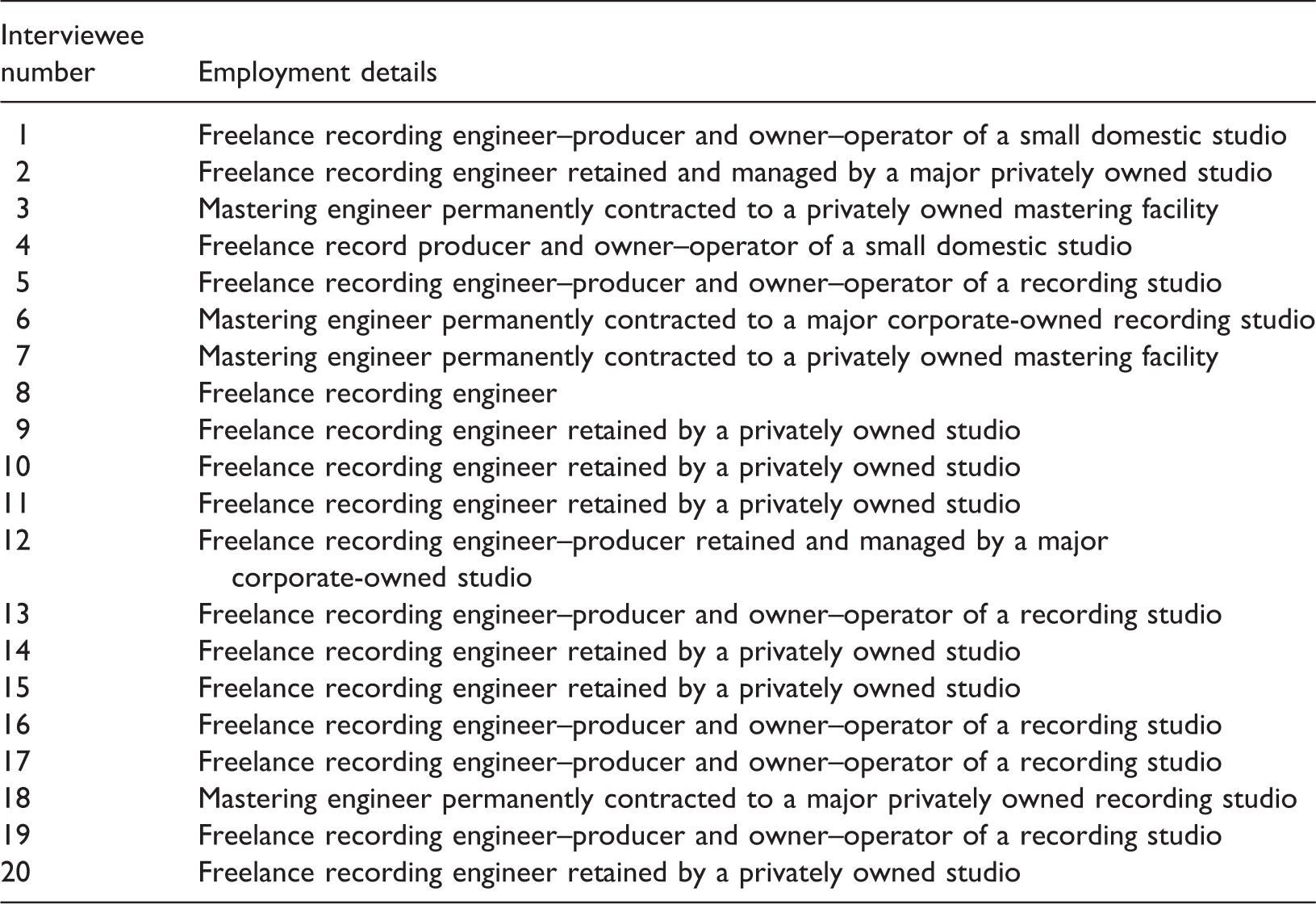
These qualitative data are supplemented by a questionnaire distributed to London-based producers and engineers, to which there were 64 responses.
The need for international mobility and face-to-face collaboration in ephemeral music projects
The results of the questionnaire survey regarding mobility specifically (full results are published elsewhere) support the assertion that the work of record producers (and in some cases, engineers) is often highly transnational in nature, and that certain studio workers are highly mobile, involving cross-border work. Of a total of 64 respondents, 30 (47%) had worked abroad at some point during their career. Deeper analysis of these results suggests that level of mobility is strongly related to employment status. Of those studio workers in our sample who were of freelance employment, 65% had travelled to work overseas on projects; conversely of those studio workers employed on a permanent contract with a studio, 75% had not travelled overseas for their work. As such, our results suggest that the need for overseas travel can be equated with the need for mobility to take up work opportunities as and when they are available. Where freelance workers do not travel, it is often due to the fact that retaining arrangements with particular studios keep them ‘locked’ to particular studios and become reliant on them for the majority of their work.
Respondents were asked to provide location details of the overseas studios at which they
had worked. Figure 1 demonstrates
that the geographic mobility of these engineers and producers is truly global in nature.
These networks of physical movement stretch out from London across Western and Eastern
Europe, North America, Pacific Asia, Australasia and Africa. The highest densities of
connections through physical travel exist with Western Europe and North America. The most
frequently cited destination for project work outside of the UK was Los Angeles (six
responses) and New York (five responses), demonstrating the important networks of
transnational mobility between three major centres of musical recording for Anglophone
markets, (see Watson, 2012) as
well as Paris (five responses). The cities of Sydney (three responses) and Berlin (three
responses) also both received multiple responses, as well as Munich, Brussels and Rome (all
two responses). Geographic mobility of a sample of London-based recording
engineers.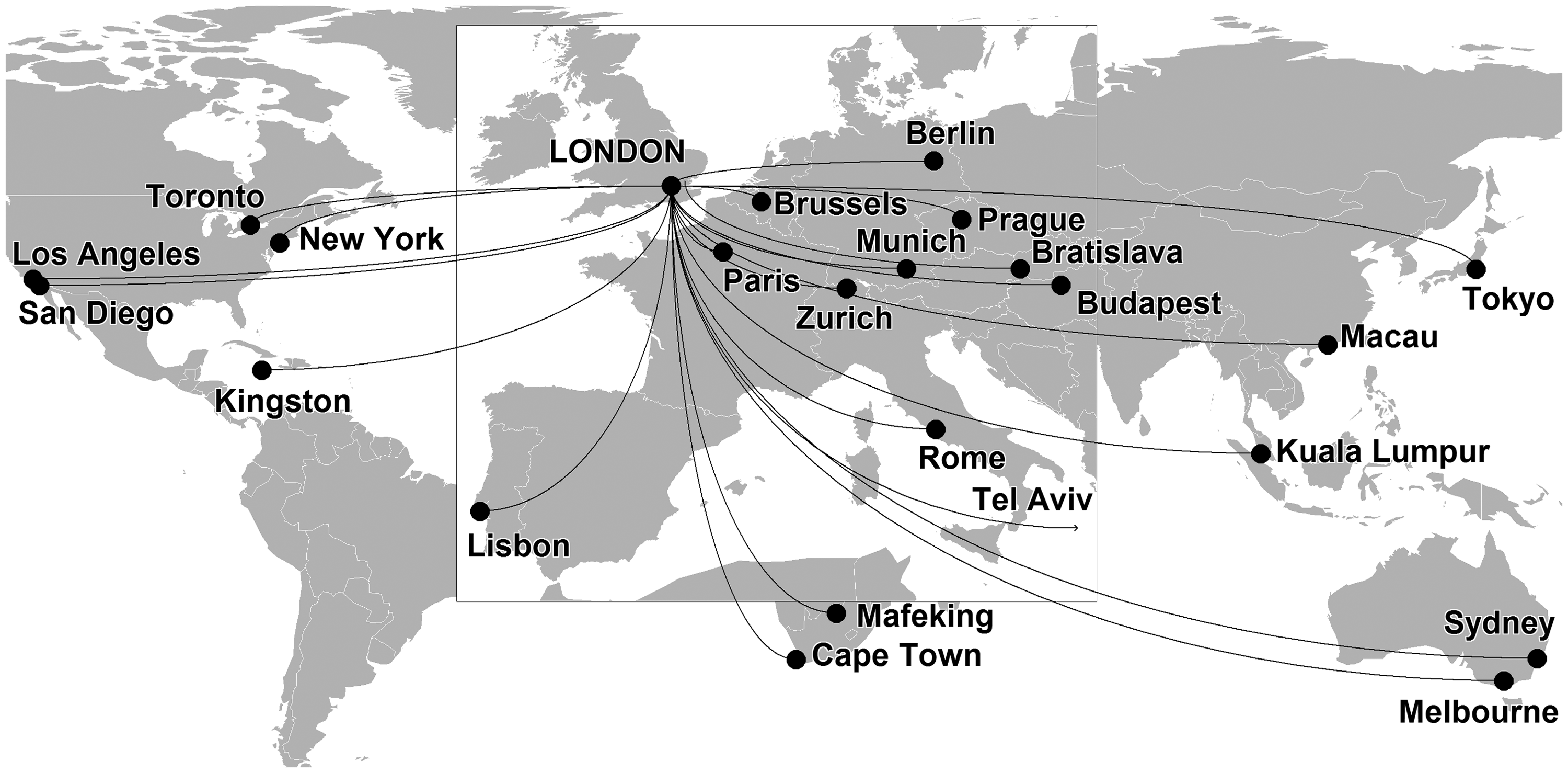
Our qualitative data suggest that in project-based creative work, the nature and purpose of face-to-face interaction is rather different to that found in business travel mobilities in professional service firms (see Faulconbridge et al., 2009). Jones (2007) suggests that face-to-face encounters amongst employees of law firms, for example, are essential in the operation and control of a firm, and in the creation of a shared organisation culture. In the music industry however, in which projects are not undertaken within firms, but rather in the market by freelance workers, this does not apply. Hence, the purpose and importance of face-to-face interactions need to be considered within the context of the work being undertaken. Recording projects differ from business projects in their duration and location of production. In this respect, unlike in business travel between offices in firms, face-to-face interactions are rarely meetings to discuss the progress of projects or the development of future projects. Rather, they tend to be the very moment of production. This places a different emphasis on what must be achieved through the interaction.
As noted earlier, the nature of music production is such that it takes place under
conditions of intense collaboration, with production lasting from a day or two to a number
of months, with working days of up to 16–20 h common. Further, creative work in the studio
is inherently relational; it is predominantly face to face, collaborative and emotive, and
the emotions of performances and relations at the moment of production are experienced in a
very insulated, confined space. In this regard, Watson and Ward (2013) emphasise the importance of
the emotional labour of record producers and engineers to the ‘performative engineering’ of
musical creativity and performance. They assert that the recording studio is not only a
physical setting, but also a social setting which determines the meanings being generated by
the performance, and in this sense the atmosphere that producers and engineers work to
create is important – what they term ‘creating the right vibe’ to facilitate and elicit an
emotional performance from an artist. This emotional labour relies on face-to-face contact
within a shared creative context, making the act of music making a very personal one: [Music making is] a very, very personal thing for some people … a lot of the artists I
work with are really looking to build a relationship massively with a studio and with an
engineer. (Interview 10, engineer) … you build up a rapport with an artist; you get quite close over the few months that
you’ve been working together, or even a week of working together. (Interview 11,
engineer)
Similarly, physical face-to-face interaction also plays a vitally important role in the development of inter-personal trust. It has been widely recognised in the literature on mobilities that face-to-face interaction provides people with the visual cues and embodied interactions of face to face that are considered to be vital to the development of trust (see Urry, 2003). Yet, once again it is important to consider how the context of the work, and also how the ephemeral nature of mobility in creative projects, determine the importance of trust and the mechanisms through which it is developed. In professional service firms, it is considered that regular face-to-face interaction through business travel allows for the social ‘bonding’ of project team members who may not be physically proximate in their day-to-day work. Multiple and regular face-to-face meetings, supplemented with digital communication in between meetings, allow for the development of trust (see Bathelt and Henn, 2014) prior to and during projects. However, as is noted in the previous section, in music production project work face-to-face contact usually occurs for the first and only time at the moment of production. Therefore, the dynamics of trust development are crucially different, because there is typically not an opportunity to engage in the usual forms of confidence-building activities that contribute to the development of trust in more traditional, enduring forms of organisation (Grabher, 2002b, 2002c).
Rather, trust must be developed quickly from the moment of meeting. Grabher (2002b, 2002c) describes the development of ‘swift trust’ as
a category-driven trust where actors can deal with one another more as
roles than as individuals (see Meyerson et al., 1996). Short project cycles, he
argues, ‘hardly leave time to develop personalized trust based on shared experience,
familiarity or social coherence’ (Grabher, 2004: 116). The case of music recording, however, challenges such an
assertion. Even in very short duration projects, studio clients look not only to develop
‘swift’ or ‘capacity’ trust in a producer or engineer based on their ability, but also,
given the intense and emotional nature of music creation and recording, ‘emotive’ trust (see
Ettlinger, 2003). Emotive trust
is rooted in experience with an individual and involves a range of cognitive, emotive and
communicative factors (Murphy,
2006): The moment I meet [a client] … I’ve got to try and work out, understand them, read all
their body signals, read what they’re up to, what they’re thinking about … From the
moment I meet them I’m always having to … I’m having to get their trust straight away.
(Interview 2, engineer–producer)
Producers and engineers may travel not only to undertake projects, but also to renew and
‘solidify’ their relationships with clients. As one interviewee described: People always need to travel … Yes I think it makes a massive difference, I think in
terms of building relationships, which is what it is all going to be about. It is
really, really important to just solidify your contacts for starters. (Interview 9,
engineer–producer)
But perhaps even more significant with regard to the freelance networks is Vorley et al.’s (2012) conceptualisation of ‘not-working’, where the disassociation of actors can result in the reduction of networks. While, as Vorley et al. (2012) argue, in intra-firm and inter-firm projects it may be difficult to sever dysfunctional relationships due to organisational obligations in the contractual agreements, in ephemeral project networks that are undertaken in the market, once a project is completed the contractual obligation is filled and ties can be easily broken. Correspondingly, if a freelance worker is lacking in either technical skills – that is to say does not achieve capacity trust with a client, or has poor empathetic and expressive abilities – does not achieve emotive trust, then potential future lines of work, and subsequently mobility, may become cut off: ‘.. that’s what a lot of people fall down on. Personal skills. They might be able to do the job properly, but if they’re argumentative or whatever, then forget it. No one’s going to work with you again’ (Interview 5, producer–engineer). Thus, for studio workers the emotional aspects of face-to-face collaboration become about more than just the moment of production; they also have become a part of the, ‘intensification of the self-commodification processes by which each individual seeks to improve his/her chances of attracting gainful employment’ (Ursell, 2000: 807).
The ‘networked’ studio and the newly developing ecologies of transnational mobility
The physical mobility of producers and engineers, however, forms only one part of an ‘ecology of mobility’ (Faulconbridge et al., 2009) through which ephemeral projects are brought to life and through which relationships are built. Grabher (2002c) suggests that the imperatives of face-to-face interaction do not necessarily imply co-location at a particular geographical place for the entire duration of a project, and that some elements of projects are becoming increasingly disembedded from specific project places through virtual communications. These technologies, he argues, do not substitute for, but act as means for compressing, cycles of face-to-face interaction at project sites. In the case of recording projects, there exist complex patterns of both physical mobility – the movement of producers, engineers and/or artists as they travel between studios; and virtual mobility – the movement of recordings as they are transferred digitally; as well as the transfer of ideas (see Urry, 2007). In recent years, various forces within and outside the music industry, in particular hardware and software suppliers and internet service providers, have created techniques and tools that allow recording studios in remote locations to be networked in, ‘ever more complex and intimate ways’ (Théberge, 2004: 759). This has given rise to ‘network studios’, which in their attempt to service a highly mobile clientele (recording artists, producers and engineers) have, ‘ … increasingly adopted recording technologies and practices that enable them to expand and co-ordinate their activities on a global scale’ (Théberge, 2004: 761).
Each individual recording project may involve a range of different studios, often in geographically dispersed locations. The effect of this is to bring studios together in shared project networks. Two developments have been particularly important in this respect. First, the spread of high-speed internet and the development of the File Transfer Protocol (FTP) for the transfer of files from one computer to another over the internet now allow for digital files to be shared remotely between studios in geographically dispersed locations. One interviewee, a mastering engineer and owner–operator of a mastering studio in London, explained how there had been a distinct shift in the way work was coming in to the studio, such that the percentage of their work now being received via digital networking was: ‘Quite high, it’s got to be like 95, 96 per cent of the stuff that I’m working on is either going via our FTP server or is coming in as You Send It, digital deliver files’ (Interview 3, mastering-engineer). Second, the development of Digital Audio Workstations (DAW), and in particular the commonality of these DAWs, means that not only can files be shared, but sent in a common format which allows files to be opened and worked on in most studios, before being saved and then transferred on, opening up new possibilities for project work across geographical space. Furthermore, these technologies are not exclusive to professional recording studios. With the increasing availability of high-speed broadband in personal homes, networking technologies are now also available to producers and musicians working in home studios, linking even the smallest of studios into geographically dispersed networks of production.
Aside from FTP, perhaps the most significant development in networking technology that has
impacted on the work of recording studios is Integrated Services Digital Network (ISDN).
ISDN is a set of communication standards for the simultaneous digital transmission of voice,
video, data and other network services over the traditional circuits of the public switched
telephone network. For recording studios, the key feature of ISDN – the integration of
speech and data on the same lines – has enabled the development of technologies for
simultaneous recording that allow musicians, producers and engineers to collaborate in real
time and at distance. An interviewee working in a large London studio with ISDN technologies
gave an example of simultaneous collaborative working at distance: So I’m there in London, I’ve got an audio feed that’s going to three places … got the
audio feed and we’ve got then a Skype call or an iChat call where we can talk to each
other … so we can have a conversation in just about real time about the music … I can be
recording something for somebody in London and there can be three different people have
a conversation about it. (Interview 2, engineer) I’ll use the time zone, so I’ll use people in New York or LA. So I go to bed they
continue, wake up in the morning, pick it up again, and that’s great, that’s a really
expedient way of working. (Interview 12, engineer–producer) It’s not ideal, but it does mean that they don’t have to fly over. That’s the thing
with a big film score, you’re getting composer, composer assistant, music editor, music
assistant, director, director’s assistant, two or three producers so there can be twelve
people coming over from America to do a project sometimes, and now you don’t have to do
it anymore. (Interview 2, engineer)
Second, these developments have resulted in new forms of collaboration, that rather than
being face to face, are at distance and virtual. Perhaps the most significant disadvantage
of remote working – whether this be simultaneous real-time working or working via file
transfer – is that it is inherently unsatisfactory to many producers and engineers when
compared to face-to-face working in the space of the recording studio. Cunningham (1998) notes that the use of ISDN appears
to be isolated at least in part due to the human need to be in the same room as each other
and the intimate level of communication required between musicians to create music. Such an
assertion was supported by two interviewees: A lot of them [recording studios] use ISDN to do their stuff. But I’m never really
happy utilising that technology because, number one, you want to see the person and
interact with them face to face. (Interview 5, engineer) … ultimately I much prefer to being face to face, I think there’s something about
communication that is so difficult when you’re not in the presence of the person who is
ultimately looking to you to turn their work into a masterpiece … essentially I much
prefer working with someone and therefore I would say the face to face communication
aspects and the travel aspects is quite important. (Interview 10,
engineer)
Yet, while working at distance presents particular challenges in terms of creativity and communication, it is undoubtedly becoming more prevalent in music production. With recording budgets falling due to the downturn in the global music industry (see Leyshon, 2014), and enabled by new technologies for file transfer such as FTPs, most recording studios and freelance engineers now offer online services for mixing and mastering as a way of expanding their client base. Because of this, despite the unsatisfactory nature of these technologies, the need to build and maintain strong relationships with clients at distance is becoming increasingly important, especially in terms of winning repeat work from clients. Without the face-to-face interactions and mobility which, as highlighted in the previous section are key to creative collaboration and the building and maintaining of relationships in the studio, remote collaboration has required studio workers to develop new strategies for collaborative working and communication with clients. A number of interviewees noted that, alongside the sending and receiving of a series of working files between studios, to compensate for the lack of face-to-face interactions collaboration on remote projects also involves a constant stream of communication via e-mail and phone.
Through these communications, producers and engineers are performing a distanciated form of emotional labour (Bryson, 2007) to build relationships of creativity and trust, despite the absence of the physical and emotional cues of face-to-face contact. Where these personal relationships are successfully developed, they often lead to further work, and often to travel and mobility. For example, while particular tasks such as mixing and mastering are now commonly undertaken at distance, the activity of recording is still most commonly undertaken in a studio because of its creative, intimate and emotional nature. An overseas client may therefore request that a freelance producer or engineer who they have built up a relationship with remotely travel to work with them at a particular recording studio say in Los Angeles, New York or Paris. Thus, in this way, virtual mobility and physical transnational mobility exist as two parts of an ‘ecology of mobility’ (Faulconbridge et al., 2009), with virtual mobility actually increasing the need for physical mobility rather than diminishing it. Indeed, Haynes (2010) suggests that those business sectors which seem ideally placed to substitute ICT for travel and mobility (such as seems to be the case in the music recording industry) are actually generating more physical travel than other sectors, which is certainly also a trait of ‘global work’ in knowledge-intensive business services (Faulconbridge et al., 2009; Jones, 2008).
Conclusions
In this paper, our over-arching contribution has been to provide the first geographical account of transnational freelancing in the creative industries, in order to advance existing conceptualisations of mobile project-based work. Through a unique case study of freelance labour drawn from the music economy, we have provided a critique and extension of Grabher’s (2001, 2002a, 2002b) seminal work on projects and project ecologies, through revealing the role of mobilities, and the transnational in particular, within Grabher’s project ecologies, which have to date exclusively been considered within the context of local clusters of economic activity.
Freelancers, we have argued, operate in both local and global networks and workspaces, and the social networks on which they rely for gaining work extend well beyond local clusters. Thus, we have argued that the work of seminal project scholars such as Grabher, Sydow, Manning and Christopherson, in emphasising the localised nature of labour markets, presents a limited picture of the social context in which projects operate. These social contexts need to be considered well beyond particular local geographical contexts. We have emphasised that in freelance work, working and networking are often one and the same activity, whether local, regional, national or international. Mobility reproduces at the transnational scale social and labour processes – such as the relational proximity and emotive trust developed through collaborative experiences, which are considered as important drivers of repeated partner selection (Manning and Sydow, 2011) – that have been assumed to be highly localised in the majority of project literature.
Further, we have argued that recording projects differ from many business projects in their high level ephemerality, this is to say that between projects, there are significant periods of ‘non-working’ (Vorley et al., 2012), resulting in very high degrees of latency within social networks. Relationships built through previous collaboration may lie dormant for significant periods of time before they are reactivated, often rekindled through physical travel. Freelance project work then is both global and local, and social networks do form and persist across space and time. When re-activated following a period of latency, these relations may drive or necessitate international yet ephemeral mobilities, of varying temporality. Thus, while Grabher’s work has strongly emphasised geographical proximity and ‘dense’ patterns of face-to-face interaction as a necessary criterion for the development of relationships of trust, we suggest that in freelance work, non-proximate relations, which can provide an important source of work for freelancers, can be maintained, at a variety of scales. Extended periods of latency can be bridged by travel, in such a way as to renew and reproduce project networks over geographical distance.
Related to the above, we have sought to emphasise how mobility relates to the precarity of freelance work, and how freelance workers in particular need access to mobility as a strategy to cope with this precarity. Developing good working relations with clients is seen as an absolute priority, so as to create, or at the very least not to cut off, future lines of work. As in other industries, travel and mobility is important due to the way it facilitates face-to-face encounters, as well as leading to reputational advantage through the development of a ‘transnational portfolio’ of projects. It is now widely recognised that for freelancers, personal networks are key in gaining both new and repeat work, and where these networks are geographically dispersed, that national and, or transnational mobility is necessary in order to facilitate the face-to-face encounters so important in maintaining these networks. Freelancers in music production need to be mobile and have access to recording studios across the globe to ensure their own survival from one project to another.
Further, we have considered how new ecologies of physical and virtual mobility are emerging through the increasing use of ICT and how these ecologies are redefining ideas of proximity and labour. Through our case study, we have shown that in a time when networking technologies allow for remote creative collaboration, transnational mobility remains important. There was significant feeling amongst our interviewees that virtual proximity was an unsatisfactory substitute for collaborative face-to-face working with clients, in situ. Yet, there is also evidence to suggest that they are finding new ways to adapt to the ‘narrow social bandwidth environment’ of virtual communication technologies (Faulconbridge et al., 2009) and ways of performing a distanciated emotional labour (Bryson, 2007) that allows for the building of collaborative and trusting relationships. Such virtual relationships may lead to future collaboration and the need or opportunity for physical travel. In this way, as technologies allow for the stretching relationships across geographical space, virtual mobility may actually increase the need for physical mobility, rather than diminishing it. This is an important avenue for further research into the mobilities of the increasingly freelance-based global knowledge and creative economies.
Finally, beyond our analysis of transnational freelancing, we have made a significant contribution to understanding the mechanics and processes of project-based work in stimulating mobilities involving micro-businesses and the self-employed. Thus, the wider significance of our study of transnational freelancing is that it demonstrates that mobilities can be created and sustained in the external ‘market’, just as it can in the internal labour market and client networks of the traditional multi-locational firm which dominates many studies of corporate mobility.
Footnotes
Acknowledgments
The authors are grateful to three anonymous referees and to the editor, Trevor Barnes, for their insightful and constructive suggestions for improving earlier versions of this paper.
Declaration of conflicting interests
The author(s) declared no potential conflicts of interest with respect to the research, authorship, and/or publication of this article.
Funding
The author(s) received no financial support for the research, authorship, and/or publication of this article.