






Abstract
This paper builds on post-Keynesian macroeconomics, the French Regulation Theory and a Neo-Gramscian International Political Economy approach to class analysis to propose an International post-Keynesian Political Economy approach that is used to offer an empirical analysis of European growth models and working class restructuring in Europe between 2000 and 2008. We will distinguish between the ‘East’, the ‘North’ and the ‘South’ and structure our analysis around industrial upgrading, financialisation and working class coherence. We find an export-driven growth model in the North, which came with wage suppression and outsourcing to the East. In the East, the growth model can be characterised as dependent upgrading, which allowed for high real wage growth despite declining working class coherence. The South experienced a debt-driven growth model with a real estate bubble and high inflation rates resulting in large current account deficits. Our analysis shows that class restructuring forms an integral part in the economic process that resulted in European imbalances and the Euro crisis.
Introduction
European countries have had quite different crises. While the Greek economy descended into depression, and Spain and Italy are struggling to get out of recession, Austria and Germany had short sharp recessions followed by recovery. Germany's unemployment rate is below that of 2007, whereas Spain and Greece have unemployment rates well above 20%. Today, divergence is obvious. In contrast, the decade before the crisis is often regarded as one of convergence among European economies (European Commission, 2008). This paper questions this view. We argue, firstly, that European growth models had been on different trajectories in the decade before the crisis and we identify three models. Second, we argue that these growth models were intimately linked with different forms of working class restructuring.
Diverging dynamics in Europe prior to the crisis was pointed out in the literature, based on a distinction between debt-driven and export-driven growth models (Hein, 2013; Heyes et al., 2012; Stockhammer, 2011, 2016b), a subordinated integration of the Eastern periphery (Bohle and Greskovits, 2012; Nölke and Vliegenhart, 2009) or resulting from diverse specialisation paths between North and South (Boyer, 2013). The contribution of this paper is, first, that it outlines an International post-Keynesian Political Economy (IPKPE) approach. We build on post-Keynesian (PK) macroeconomics, neo-Gramscian notions of class struggle and hegemony and the idea of interdependent transnational and international accumulation dynamics derived from International Political Economy and economic geography. Second, the paper then offers an empirical analysis of the articulation of European growth models in the decade preceding the crisis. This analysis allows for different working class experiences in different country groups. We highlight that nation states are themselves structured along class lines, and that class struggles are integral part of the processes that led to European imbalances. These struggles do take place locally and thus will take different forms, which will be shaped by the position and trajectory of a country in the international division of labour and the differential transformations of the capitalist economies; in particular, the process of financialisation has had different impacts in different countries.
The paper thus asks two sets of questions. First, what have been the pattern and drivers of European growth models? And secondly, how are these growth models reflected in the changes in working class coherence? We use the term working class coherence to denote the unity and organisational ability of the working classes to assert their (economic) interests. We will distinguish three country groups. We argue that export orientation in the ‘North’ came with a retreat of the working class, which is reflected in weak real wage growth, increasing wage dispersion and union decline and a heavy reliance on outsourcing to the eastern periphery. In the ‘East’, the catching up process driven by dependent integration into global value chains (GVC) has allowed high real wage growth, while other indicators show that working class coherence has suffered. Wage dispersion has widened, and there has been a strong decline in union density. Catching up has allowed for rapid real wage growth despite a disintegration of working class coherence. In the ‘South’, the debt-driven boom has come with moderate increases in real wages, a stable wage dispersion and comparatively moderate decline in union density. This was a regime of an implicit social compromise, which was economically based on a bubble, but which differs from the Anglo-Saxon experience of the financial bubble, which came with a deterioration of working class coherence. We systematically compare several countries for each group by using indicators for the three dimensions: financialisation, industrial upgrading and working class coherence.
The paper is structured as follows. The section Economic Geography and VoC on European Integration reviews the contributions of economic geography and the Varieties of Capitalism (VoC) approach. The section Toward an International Post-Keynesian Political Economy discusses Post-Keynesian Economics (PKE), neo-Gramscian International Political Economy (NGIPE) and the French Regulation Theory (FRT), and how we combine them into an IPKPE approach. The section Neoliberalism and Growth Models in Europe: A Stylised Story of the East, North and South During the Pre-crisis Boom (ca 2000–2008) presents a stylised description of the growth models of the North, East and West and their interrelations. The section Operationalising Our Categories operationalises the concepts working class coherence, financialisation and industrial upgrading and explains how they will be measured. The empirical analysis for these dimensions is presented in section Financialisation, Industrial Upgrading and Working Class Coherence, in the North, South and East. The following section discusses working class restructuring in the three growth models and characterises the hegemonic regime. Finally, a conclusion of this study is given.
Economic geography and VoC on European integration
Debates about European convergence and monetary integration in economic geography have been framed by the theory of Optimum Currency Areas (OCA). OCA analyses the conditions under which a set of regions can be considered an OCA assuming asymmetric exogenous shocks. The relevant conditions include labour mobility and similar industrial structure and the regions that form the Euro area are not fulfilling these. New Economic Geography adds that regional specialisation can lead to economies of scale that will result in (regional) divergence. Against these analyses, the endogenous OCA theory (e.g. De Grauwe and Mongelli, 2005) argues that monetary union itself would create the conditions for OCA and thus predicts convergence.
This prediction has been discussed empirically. Fingleton et al. (2015) present a careful analysis of convergence and divergence (of employment rates) of European regions before and after 2008. They conclude that while there was weak convergence prior to the crisis, there has been a pronounced divergence since the crisis. Martin's (2001) study on the 1975–1998 period finds weak evidence of convergence of regional output. Rodriguez-Pose (1999) reports some evidence of convergence (for the period 1977–1993) but argues that national units do not play a key role in explaining economic performance. Rather a region's characteristics critically influence its growth trajectory. In contrast, Fingleton et al. (2015) show that divergence dynamics (since 2008) clearly follow national pattern and closely match the countries in our North and South group.
Overcoming the OCA approach's emphasis on exogenous shocks, economic geography offers a rich account of super and sub-national forces in economic and social development that can lead to divergence. However, it downplays the national scale and thereby runs the danger of losing sight of key macroeconomic mechanisms: socio-political compromises crystallise in national institutions that underpin demand formation regimes and idiosyncratic configurations of the financial and the productive systems.
In contrast to economic geography, the VoC approach emphasises the institutional features of capitalist economies and their complementarities at the national level. VoC takes a relational view of the firm, where the skills, pay and motivation of workers as well as financial relations play an important role. It stresses the institutional functionality of corporate governance structures, labour relations, education and financial systems (Hall and Soskice, 2001; Hancké et al., 2007) in creating incentives and constraints for firms. The distinction between liberal and coordinated market economies has become a hallmark of the approach, but it has been extended to include Mediterranean or mixed market economies (Amable, 2003; Hassel, 2014) and, borrowing some insights from NGIPE, dependent market economies for Central Eastern European countries (Nölke and Vliegenthart, 2009).
VoC proponents analyse the developments in Europe leading up to the crisis as the result of the interaction of the core countries with coordinated wage bargaining and the periphery countries with weak bargaining coordination in a fixed exchange rate regime without central (European) fiscal policy (Hall, 2014; Johnston et al., 2013, see Nölke, 2015 as a survey). The loss of competitiveness of the periphery is explained as the result of lack of wage restraint in the non-tradeable sectors among which the public sector wages are singled out as the main culprit. Current account imbalances are analysed as result of cost differences, and there is little concern for financialisation.
VoC has been criticised for overemphasising the functionality and the stability of the regimes (Hay, 2005; Heyes et al., 2012; Peck and Theodore, 2007; Streeck, 2012). We share these criticisms. VoC puts competitiveness at the core of its analysis of institutions, where we highlight class compromises at its basis. VoC has a strong focus on supply-side factors, albeit in a much richer form than mainstream economics, but has no systematic analysis of demand formation. Peck and Theodore (2007) conclude their critique of the VoC approach by saying “…what we are lacking, (…), are institutional theories of uneven development of capitalism. We (…) might find them in some form of three way marriage between neo-Marxist concepts of combined and uneven development, regulationist treatments of the geographies of accumulation and regulation, and Polanyan (rather than Granovetterian) notions of socio-institutional embeddedness” (Peck and Theodore, 2007: 762). This paper puts forward an account of the decade prior to the crisis by proposing a new theoretical framework that suggests a solution to Peck and Theodore's challenge by highlighting the role of working class restructuring, demand formation and financialisation.
Toward an IPKPE
We build on PKE, FRT, NGIPE and economic geography to offer an IPKPE to analyse national growth models based on a demand analysis, how they interact and complement each other productively and financially and what social compromises and power balances they are based on. Through an original combination of their respective achievements, it helps to overcome the weaknesses of each of these approaches. Let us consider our building blocks in turn.
PKE is a non-mainstream economic approach that gives central role to the principle of effective demand, fundamental uncertainty and social conflict (King, 2002; Lavoie, 2009). Its macroeconomic analysis is premised on a class division, but PKE does not provide a framework for the analysis of class relations. Rather it focuses on the economic outcomes of changing class relations. Post-Keynesians have long criticised the macroeconomic policy regime of the European Union. They have highlighted that reliance on wage flexibility will not be sufficient for adjustment and indeed wage flexibility can be destabilising.
The interaction of income distribution and demand formation features prominently in PKE, which distinguishes between wage-led and profit-led demand regimes (Bhaduri and Marglin, 1990). As regards the actual growth drivers under neoliberalism, Hein (2013) and Stockhammer (2011, 2016b) identify debt-driven and export-driven growth models. Both highlight the deflationary bias of the European economic policy package and recommend ECB backing for member states public debt, expansionary fiscal policy and sustained wage growth; both do not analyse the implications of the growth models for working class restructuring, and they do not include Eastern European countries in their analysis.
The FRT proposes an historical and institutional macroeconomic analysis. It stresses that macroeconomic dynamics (accumulation regimes) are shaped by institutional arrangements produced by social balance of power and material force of ideas. The mode of regulation, in FRT's classical version, consists of labour relations, competitive relations, the monetary regime, the forms of state intervention and the insertion into the international regime. Boyer (2000) allows for a changing hierarchy of institutional forms accompanying EU integration. While labour relations were dominant during the Fordist period, afterwards competition and money have taken dominance. This fuels disruptive dynamics between socio-economic demands raised by national democratic polity and technocratic supranational settings at the EU level (Durand and Keucheyan, 2015) resulting in a rising polarisation between a highly competitive northern Europe which was able to maintain a strong manufacturing export basis and a South specialised in domestic services (Boyer, 2013). One key manifestation of these discordant modes of regulation between southern and northern countries is a misalignment of real exchange rates in the Euro's fixed (nominal) exchange rate system (Duwicquet et al., 2012). The overvaluation of most of the South and the undervaluation of the North led to considerable ‘implicit transfers’ from the former to the latter (Mazier and Petit, 2013). Overall, for FRT the inability of European integration to cope with the north-south divide in terms of competitiveness and the vanishing of the monetary adjustment mechanisms fuelled the euro crisis and revealed the fragility of the European polity.
NGIPE combines a concern for class struggles and the establishment of hegemony within the nation state with an interest in international relations shaped by power relations. NGIPE has posited the emergence of a transnational ruling class and analysed class interests in European integration, notably in the context of the post-socialist transformation (Bohle and Greskovits, 2007, 2012). Becker and Jäger (2012) inspired by NGIPE and the original Marxist roots of FRT analyse the interaction of European capitalisms and their regulation at different spatial scales. While their work deals in large part with the aftermath of the crisis and lacks a quantitative empirical analysis, they emphasise uneven economic development trajectories and distinguish between the core of Europe, which is characterised by active extraversion and productive accumulation, and the peripheral countries, which has passive extraversion and financial accumulation, without distinguishing between the eastern and southern periphery.
Our IPKPE approach takes from PKE its analysis of demand regimes and of the role of finance and debt. However, PKE lacks a theory of the state and while it is based on class analysis, it has a narrow concept of class conflict. Moreover, most of its analyses treat national economies in isolation. We draw on the insight of FRT important works from the 1970s and 1980s as they offered an understanding of institutions based on social compromises as the source of macroeconomic regularities, but depart from their mostly nation state-centric perspective. Finally, we are very close to the ambitions of NGIPE and the variegated capitalism framework. These approaches have furthered our understanding of the conflictive nature of capitalist economies and taken into account social forces within nation states as well as international interdependencies. However, they have so far failed to propose an operationalisation at the macroeconomic level that would allow to empirically analyse the economic and social mechanisms that it has theorised and explain the pattern of demand formation, which is a central feature of the framework we proposed. Recently, the term variegated capitalism has been used to formulate an ambitious research programme that builds on Marxist theory, FRT and NGIPE (Brenner et al., 2010; Jessop, 2011; Peck and Theodore, 2007), but there are as of yet few empirical applications of this approach (see Heyes et al., 2012). Our approach is thus fully consistent with a notion of variegated capitalism, but we have stronger concern for the pattern of demand formation.
Our aim in the remainder of this paper is to apply this framework to a historically specific case, the decade before the crisis in Europe. We discuss the trajectories of different country groupings in the period of neoliberalisation in the early 2000s when western European countries established a single currency and eastern countries emerged out of the institutional shake-up of the post-soviet transformation. In doing so, we want to analyse the interaction of macroeconomic dynamics with changes in working class coherence. Unlike VoC, we do not aim to establish a general typology of capitalist economies, but rather describe in the FRT spirit historically specific development trajectories. Our project is ambitious in that we try to combine a macroeconomic comparative analysis that takes into account demand formation as well as supply side (production) concerns with an analysis of class restructuring. As the pattern of capital accumulation changes, so will typically the structure of the working class, partly as the result, partly as the cause.
Neoliberalism and growth models in Europe: A stylised story of the East, North and South during the pre-crisis boom (ca 2000–2008)
Neoliberalism brought about a rise in inequality, financialisation, globalisation and privatisation (e.g. Harvey, 2005). Our analysis focuses on the first two aspects. Rising inequality has taken the form of an increase in top incomes (Atkinson et al., 2011) and a fall in the wage share (Stockhammer, 2016a). It is based on welfare state retrenchment, globalisation and financialisation and reflects a shift in the power relations between capital and labour. Financialisation has affected financial institutions as well as households (e.g. through rising household debt) and firms (e.g. shareholder value orientation). However, the specific modalities of its implementation, its relation to existing social structures and the asymmetric international economic positions mean that neoliberalisation can have different outcomes (Fourcade-Gourinchas and Babb, 2002).
With respect to its macro-economic dynamics, neoliberalism has fuelled debt-driven as well as an export-driven growth models. Both growth models are unsustainable: they rely on increasing debt ratios. In the debt-driven case, this is domestic household debt; in the export-driven case, it is external debt of the trade partners (Hein, 2013; Stockhammer, 2011). The two growth models are complementary as the export-driven model relies on trade partners with current account deficits. The debt-driven model is facilitated by capital inflows. This analysis only covers what we call the North and South. We extend this analysis to include the East.
Figure 1 gives a stylised depiction of the key features and the interaction of growth regimes and working class restructuring in the East, the North and the South in Europe. Post-socialist transformation in the East was a large-scale restructuring of social relation. It involved privatisations on an unprecedented scale (Drahokoupil and Myant, 2011), which allowed for a process of primitive accumulation in which former regime technocrats and foreign corporations benefited from the political release of assets. It also created a huge pool of cheap labour as workers lost the job security they enjoyed in the former Soviet economies. In central Eastern Europe, foreign capital played a key role by outsourcing elements of the value chain. In particular, important parts of the German automotive industry now rely on inputs from Poland, the Czech Republic, Slovakia and Hungary. According to Drahokoupil and Myant (2015), these countries are part of a group of FDI-based Market economies characterised by their integration in the European Union and exports structures built around manufactured goods produced by foreign-owned multinational corporations. Overall, the export-industrialising economies of Central Eastern Europe experimented a subordinate integration into GVC allowed to consolidate (a moderate) industrial sector. King and Szelényi (2005) have called this ‘capitalism from without’. Shields (2012) stresses the active role of the domestic state and national social forces in endorsing economic – but also political and cultural – internationalisation, propelling the hegemony of an emerging transnational capitalist class.
Key features and interactions of growth regimes and working class restructuring in the East, the North and the South in Europe. GVC: global value chains.
The North experienced a real devaluation as prices and unit labour costs were growing more slowly than the EU average. This was, at least in part, the result of two strategies of northern capital. First, there was wage suppression in the North. German wages have in real terms stagnated in the decade prior to the crisis. Through a series of welfare reforms, the so-called Hartz reforms, Germany has created a low wage sector (Giannelli et al., 2013). In labour relations, there was an erosion of collective bargaining (Dustmann et al., 2014). Starting from a high coverage of collective bargaining agreements, this coverage has declined sharply as capitalists increasingly opted out of collective bargaining. In addition, firm-level modifications of sectoral wage agreements and concession bargaining have contributed to low wage growth and to the emergence of a segmented labour market. These developments are closely linked to German unification as capitalists in Eastern Germany did not have the corporatist traditions and increasingly opted out of employer federation membership and thus of collective bargaining agreements. Second, German capital expanded by outsourcing elements of the value chain. Important parts of the German automotive industry now rely on inputs from Eastern Europe, which put a downward pressure on domestic wages. These developments resulted in sluggish domestic demand and an increasingly export-oriented growth model.
The South experienced a property and financial bubble fuelled by rapid credit growth, which were made possible by financial liberalisation and low real interest rates related to the introduction of the Euro. This has come in some cases with an economic boom (Spain and Ireland had above average growth rates, but Portugal and Italy average ones) and, in all cases, with high inflation rates. Competitiveness decreased, the industrial sector was squeezed and large current account deficits resulted. At the same time, the South had massive capital inflows that helped sustain (or ignite) the bubble and support domestic consumption growth. Budgetary conditions were rather relaxed and most Southern countries expanded the welfare state. Class struggle was partially suspended by welfare state expansion and an economic boom driven by non-tradable sectors. The working class was restructured: moderate, but non-trivial wage increases despite deindustrialisation and an increasing financialisation of households (the levels of household debt started at very low levels and increased massively).
Capital inflows have to be equal to the current account deficit (for each country). The direction of causality can go either way: trade surpluses (of the North) could have driven the process with surpluses being transferred to the South to finance their imports. But one can equally argue that property bubbles and strong growth in the South attracted capital inflows and enabled the export surpluses of the North. Similarly, one could think about the East as largely being shaped by the strategies of northern multinationals; or one could locate the source of European dynamics in the vast expansion of the industrial reserve army that eastern European transformation meant for European capital. Our analysis does not privilege any specific causal chain, but highlights the interrelatedness of domestic processes within a structured international system.
The first important fact highlighted by our analysis is that class restructuring played a part in the economic process that resulted in European imbalances. Our second key finding is that class struggle has proceeded very differently in the different blocks in Europe. There has been no convergence in class struggles. This de-synchronisation of class struggles of Europe may help understand why it is so difficult to develop a progressive working class vision for Europe.
Operationalising our categories
In order to map the transformation of capitalist societies and economies in the decade prior to the crisis, we analyse changes in three dimensions: working class coherence, financialisation and industrial upgrading. These dimensions are understood to be an integral part of the mode of regulation of an accumulation process. Working class coherence and financialisation are close relatives to categories of the FRT, which identifies the labour-capital nexus and the monetary regime. All growth models will register changes in all three dimensions, but one of the premises of our research is that different growth models may have been the main driver of transformations in one of the dimensions. For the decade before the crisis, we hypothesise that working class restructuring was key in the North, dependent industrial upgrading in the East and financialisation in the South. However, a detailed analysis of the feedbacks from changes in one dimension to another, the identification of the main driver of changes and the articulation of different growth models is not the main subject of this paper.
We use the term working class coherence to denote the unity and organisational ability of the working classes to assert its (economic) interests. 1 Our empirical measures describe the relative development of living conditions of the working classes. We will measure this by the growth of real and nominal wages. The dispersion of wages is used as a measure of the degree of division and segmentation of the working class. The strength of the welfare state is measured by the share of social expenditures relative to GDP; it measures the extent to which the reproduction of the working class is supported by the state. Finally, we use the organisational density of labour unions as a measure for the organisational strength of the labour movement. Our concept of working class coherence thus is close to the Regulationist analysis of the wage labour nexus, which is typically concerned with the extent of productivity indexation of wages, the extent of collective bargaining and the control regime at the workplace. However, our approach differs in that we offer more dimensions and that we have a greater concern for working class segmentation (see Gordon et al., 1982 for a seminal analysis of the role of segmentation in the USA).
Financialisation refers to the rise of financial claims and incomes relatively to the size of the real sector. Financialisation has affected non-financial business, the financial sector and households in different ways. Our aim is not a comprehensive description of these phenomena, but an analysis of the decade prior to the crisis. In this period, the financialisation of households has played the most important role. Domestic credit (and in particular its growth in recent years) has been driven by mortgage credit, not credit to businesses, and securitisation has played a minor role compared to the USA experience. We are specifically concerned with the impact on demand formation and the extent to which it has allowed for a debt-driven consumption growth model. Thus, our analysis of financialisation focuses on household debt and property prices. We will measure this by the debt-to-income ratio for households, by real property prices (i.e. property prices relative to consumer prices) and real share prices. 2 The key variable for our purposes is the level and change in household debt. This is measured relative to income and indicates the extent of financialisation of households. The key variable determining changes in household debt is property prices. We also look at a broader measure of credit growth, which is private credit growth. This includes credit to firms. In the relevant period, business debt has had moderate rates of increase. Real stock prices are a measure of financial asset prices. Finally, we report the net international investment position (NIIP) as measure of the financial position of the country vis-à-vis the rest of the world. Financialisation as used here has some overlaps with the Regulationist concept of the monetary regime, which depicts the forms of money creation and financing of the economy and how they impact upon the economy.
We use the category industrial upgrading to describe the extent and nature of industrial formation of the economy. Thus, this includes the rate of growth of productivity as well as the extent to which it is driven by external factors and what its position within a given international division of labour is. This will be proxied by the growth of labour productivity, the share of manufacturing in value added and the inward FDI stock. With all our variables, we are primarily interested in the medium-term changes. The discussion of the different levels for each of the variables would be interesting in their own right, but beyond the scope of this paper. This category cuts across some Regulationist categories as it includes elements of what the FRT calls the technological paradigm as well as elements of what it discusses under insertion into the international regime.
We will group countries in the North, the South and the East. The North will be Germany (DEU), Austria (AUT) and the Netherlands (NLD). These are countries of the Germanic block within the Euro area. They share a similar structure in labour relations, a comparatively developed welfare state and a strong industrial sector. The South will consist of Greece (GRE), Ireland (IRL), Italy (ITA), Portugal (PRT) and Spain (ESP). These are the peripheral countries within the Euro area that were hit hard by the crisis. Their industrial base is weaker, but in many cases has improved over the past decades. The East consists of Poland (POL), the Czech Republic (CZE), Slovakia (SVK), Hungary (HUN) and Slovenia (SVN). These are post-communist economies that had a relatively strong industrial base, but have only integrated into the capitalist world economy in the 1990s. They have historically strong welfare states that have been restructured and weak labour relations.
The grouping of the countries is motivated by an understanding of European economic relations as encompassing economies with quite different economic developments that may have a differential experience of processes like globalisation, financialisation or European monetary integration. In particular, we hypothesise that there are at least two peripheral models. Our grouping of countries is intended to be useful and serves the purpose of illustration. There are several potential issues. First, the delineation of groups is arbitrary at the border. We include the Euro area export-oriented countries, but could also have included non-Euro area countries (Denmark, Sweden). The North has one member of paramount importance: Germany. One could argue that the North ultimately is Germany. We prefer to use a small group for the North in order to not dilute Germany's contribution to the average data of the group. 3 Within this group, the Netherlands is an interesting intermediate case that has elements of an export-driven as well as of a debt-driven economy. As regards the South, the question is whether Italy should be included or not. For the East, we decide to distinguish what is essentially the Visegrad group of countries. One could add another group of Bulgaria, Romania and the Baltic countries. All these are issues of implementing our grouping.
The country groupings are based on our explanation of the socio-economic trajectories in the decade before the crisis. They are very similar to those offered by the recent VoC literature. Amable (2003) and Hassel (2014) extend the basic coordinated and liberal market economy groups by a Mediterranean or Mixed Market group, which is almost identical to our South, and Nölke and Vliegenthart (2009) use Dependent Market Economy group, which corresponds to our East. The motivation for the country groups, however, is different. While VoC offers a general classification of models of capitalism, our analysis offers a historically specific group based on our analysis of the dynamics of financialisation, working class restructuring and dependent upgrading. 4
A final issue are countries that do not fit our categorisation. The most important case among these is France, which would occupy an intermediate position (Hein, 2012 classifies France as ‘domestic demand led regime’). The UK we would include in a distinct group of Anglo-Saxon countries (characterised by a high level of development and a strong financialisation experience).
Financialisation, industrial upgrading and working class coherence, in the North, South and East
Financialisation
Changes in financialisation, 2000–2008.
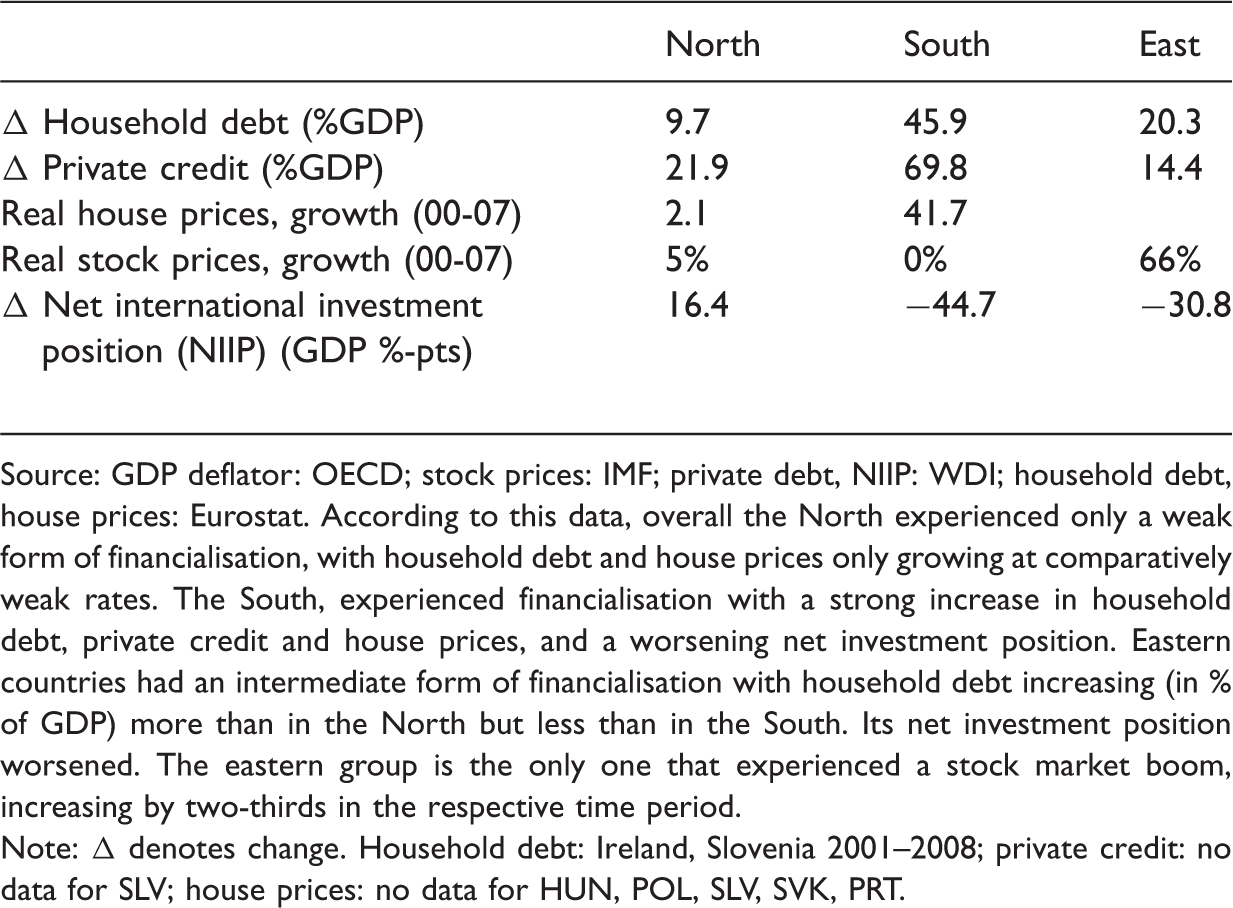
Source: GDP deflator: OECD; stock prices: IMF; private debt, NIIP: WDI; household debt, house prices: Eurostat. According to this data, overall the North experienced only a weak form of financialisation, with household debt and house prices only growing at comparatively weak rates. The South, experienced financialisation with a strong increase in household debt, private credit and house prices, and a worsening net investment position. Eastern countries had an intermediate form of financialisation with household debt increasing (in % of GDP) more than in the North but less than in the South. Its net investment position worsened. The eastern group is the only one that experienced a stock market boom, increasing by two-thirds in the respective time period.
Note: Δ denotes change. Household debt: Ireland, Slovenia 2001–2008; private credit: no data for SLV; house prices: no data for HUN, POL, SLV, SVK, PRT.
Increase in household debt, 2000–2008 (in % GDP).
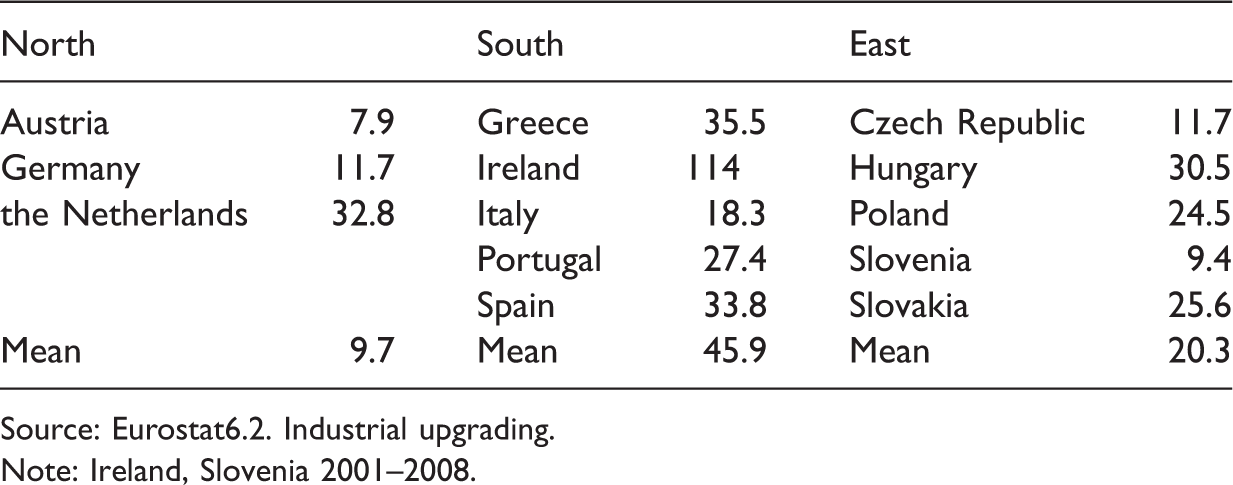
Source: Eurostat6.2. Industrial upgrading.
Note: Ireland, Slovenia 2001–2008.
Industrial upgrading, 2000–2008.
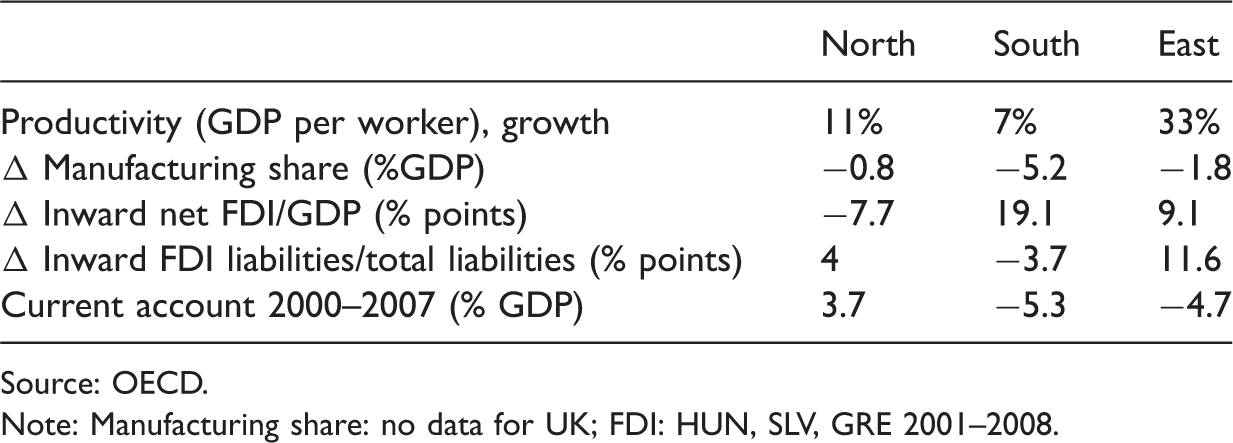
Source: OECD.
Note: Manufacturing share: no data for UK; FDI: HUN, SLV, GRE 2001–2008.
Productivity growth, 2000–2008 (in %).
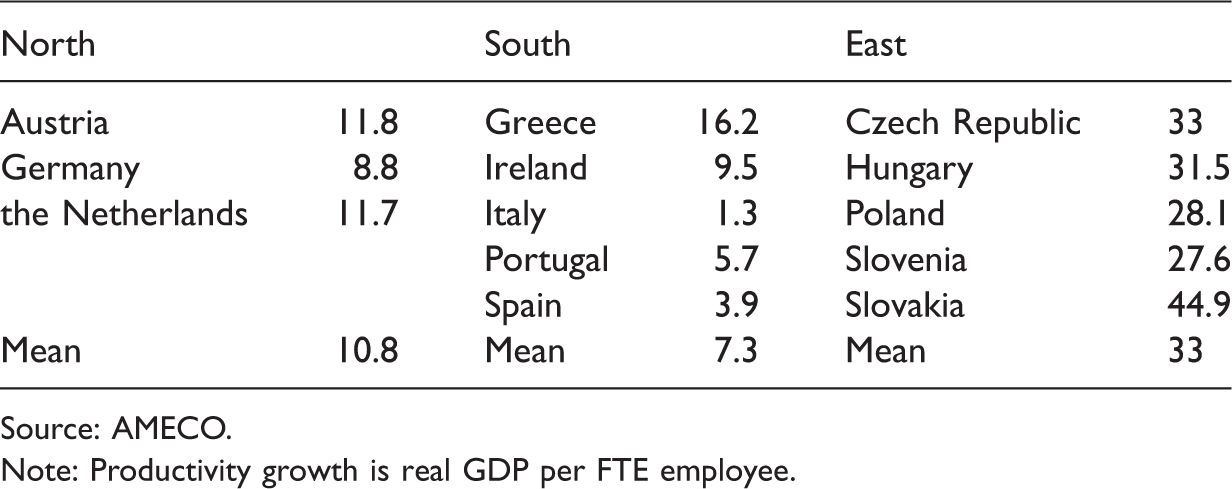
Source: AMECO.
Note: Productivity growth is real GDP per FTE employee.
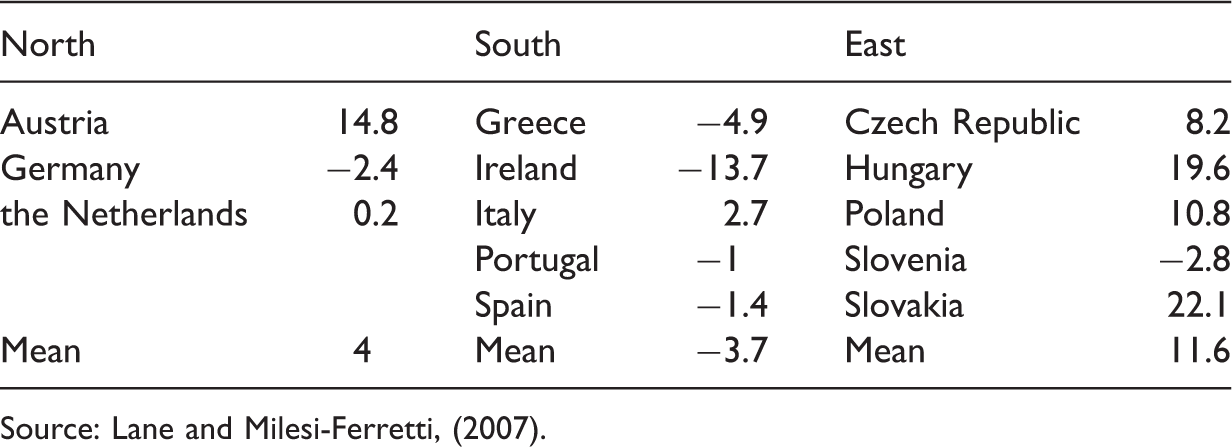
A sharp contrast between the South and the East becomes clear when looking at the ratio of FDI liabilities to total liabilities. This indicator captures the evolution of the quality of financial inflows. It shows that the East clearly has experienced a big increase in FDI liabilities (11.6%-pts) as share of total liabilities, confirming a dynamic of modernisation of goods and service provisions thanks to foreign investment, whereas the South faced a decrease (−3.7%-pts) which presumably reflects a rise in debt and portfolio liabilities related to asset and real estate transactions. The North saw an increase of the ratio by 4%-pts. The North has had substantial current account surpluses in the decade prior to the crisis, where the South and the East had, on average substantial deficits (−5.3 and −4.7, respectively). The North and the South fit the PK distinction of export-driven and debt-driven growth models well; the East would be an intermediate case.
Change in inward FDI liabilities/total liabilities (% points).
Source: Lane and Milesi-Ferretti, (2007).
The variation of the share of FDI liabilities over total liabilities shows a sharp contrast for most of the countries between the East and the South. All Eastern countries except Slovenia experienced a strong increase in FDI inflows relative to other capital inflows. In the South, all countries experienced a decline of FDI in capital inflows, which was particularly pronounced in Ireland. Only in Italy did the FDI share grow moderately (+2.7%). The dynamics within the North are quite heterogeneous. In Austria, the share of FDI grew rapidly which probably reflect a limited opening to portfolio investment while in Germany it diminishes moderately and in Netherlands it stayed stable.
The northern countries consolidated their industrial position. They experienced a rise in productivity, paired with a very small decline in industrialisation and a rise in FDI received. Interestingly, they also experienced at the same time a reinforcement of their position of FDI net exporter and higher current accounts surpluses. In contrast, the current account position of both East and South deteriorated over the same period. However, the underlying dynamic is very different in each group. Productivity in the East rose strongly, while de-industrialisation was moderate and FDI experienced a very high increase in terms of GDP as well as in terms of stock of capital liabilities, contributing to the modernisation of the productive apparatus. Southern countries had lower increases in productivity, and a stronger de-industrialisation. Their FDI performance was also weaker in terms of GDP share and even deteriorates in terms total liabilities.
Working class restructuring
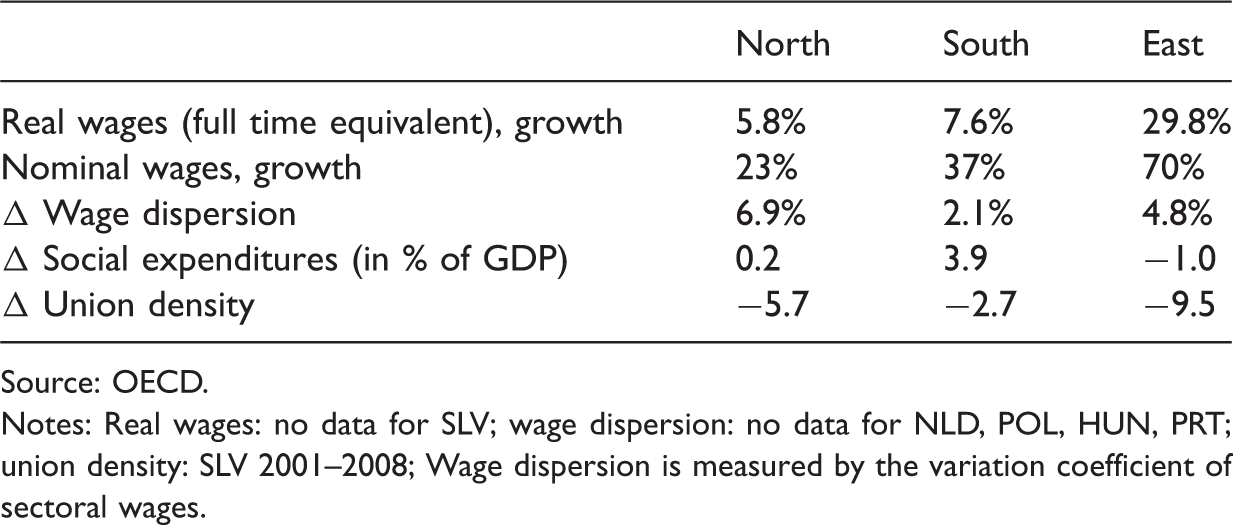
Changes in working class coherence.
Source: OECD.
Notes: Real wages: no data for SLV; wage dispersion: no data for NLD, POL, HUN, PRT; union density: SLV 2001–2008; Wage dispersion is measured by the variation coefficient of sectoral wages.
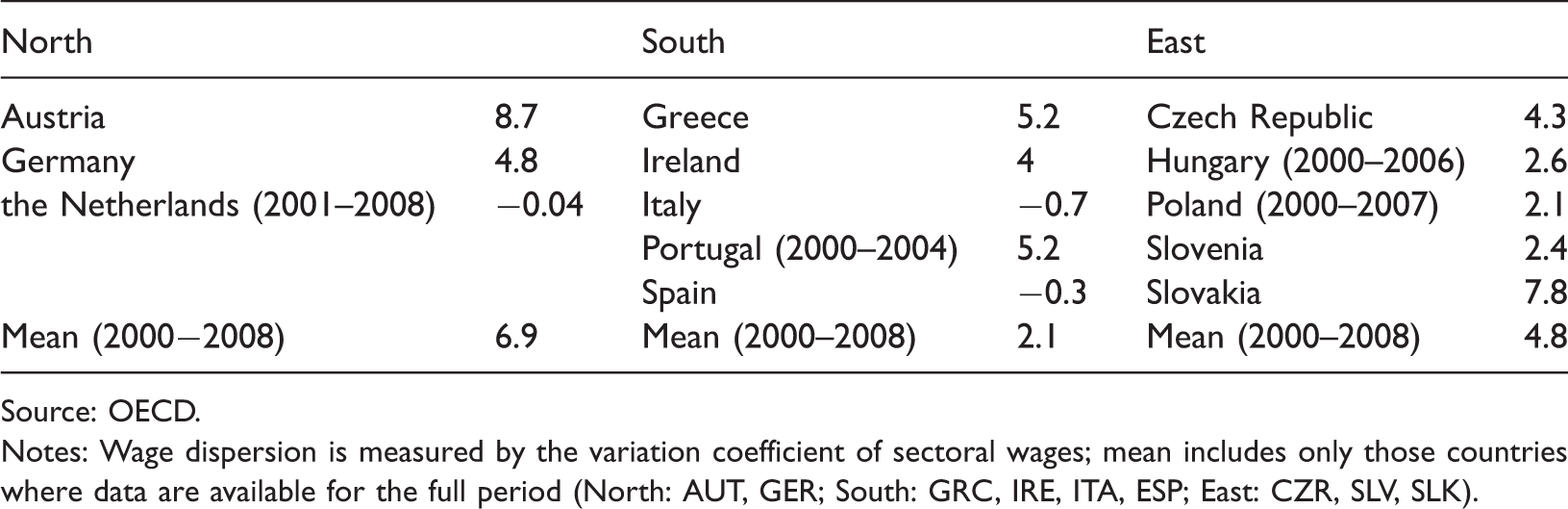
Change in wage dispersion 2000–2008.
Source: OECD.
Notes: Wage dispersion is measured by the variation coefficient of sectoral wages; mean includes only those countries where data are available for the full period (North: AUT, GER; South: GRC, IRE, ITA, ESP; East: CZR, SLV, SLK).
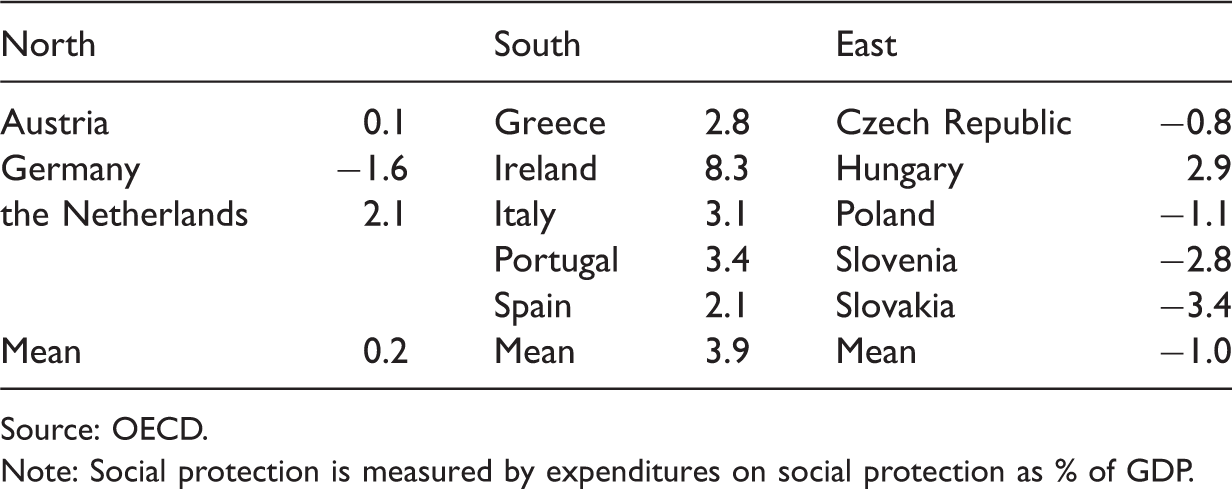
Changes in social protection in % of GDP 2000–2008.
Source: OECD.
Note: Social protection is measured by expenditures on social protection as % of GDP.
Overall, the North shows a picture of working class retreat with a low increase in wages and a strong increase in wage inequality and a pronounced decline in union density, while the welfare state has remained stable in size. In the South, labour experienced a moderately higher increase in wages, but this was more evenly spread among the working class with wage dispersion almost stable. At the same time, there is consolidation of the welfare state and it has the most moderate decline in union density. Eastern countries show an uneven picture. They experienced a very high increase in wages, while at the same time having the strongest increase in wage income inequality, a sharp decline in union density and a shrinking size of the welfare state.
Discussion
This paper put forward the hypothesis that already during the boom preceding the Euro crisis there has been a divergence in working class experiences across Europe. We suggest grouping European countries into groups of the North, the South and the East and find that countries had different experiences in terms of their growth driver, in terms of the degree of financialisation they experienced and how their working classes fared.
The northern growth model starts from a high level of development. It developed an export orientation and, with the exception of the Netherlands, relatively weak dynamics of financialisation. It maintained its industrial sector and experienced solid productivity growth. With the exception of the Netherlands, the increase in household debt and in property prices was low. While real wages grew moderately, wage dispersion grew substantially and union density declined. This is a case of a retreat of labour (in Germany more so than in other northern countries).
The southern countries experienced a strong wave of financialisation with sharply increasing levels of household debt and a property price boom. This resulted in moderately high levels of growth, but at the same time an accelerated de-industrialisation. Real wage growth was moderate, and wage dispersion was comparatively stable. Union density declined, but substantially less than in other country groups and the size of the welfare state increased relative to GDP. The financial bubble was used to generate improvements for the working classes that went beyond better access to credit. We call this a social compromise backed by financialisation. It is instructive to contrast this with the experience of the Anglo-Saxon countries. In the latter, there was a much more pronounced increase in wage inequality and a weaker real wage growth. There was also more welfare state retrenchment. We would refer to the Anglo-Saxon constellation as hegemony by financialisation as it does not contain genuine working class improvement.
The Eastern countries experienced a strong industrial upgrading and a medium wave of financialisation. This had contradictory effects on the working classes: while real wages grew much faster than in other countries, it also experienced an increase in wage dispersion and it suffered a decline in welfare expenditures and sharp decline in union density. We call this disintegration of the working class coherence hegemony by catching up. High productivity gains allowed rising living standards while most other indicators of working class conditions deteriorated sharply.
We think that our country groups do capture important differences in the dynamics across countries. For most indicators, the variation across groups is larger than within groups. In this sense, our groups are useful. However, there is a substantial amount of variation across countries that cannot be easily reduced to our groupings. For example, Germany is an extreme case of what we refer to as northern model, whereas the Netherlands has some characteristics similar to the hegemony by finance model, in particular, a strong increase is household debt and slightly expanding social expenditures.
Our main finding is that the divergence of working class experience across European countries is not merely a result of the different economic performance during the Euro crisis, but pre-dates it. Indeed, the decade from the introduction of the Euro to the crisis affected working classes in quite different ways: while there was an erosion of working class cohesion in the northern countries, the boom of financialisation in the southern countries also allowed for a consolidation of the welfare state and came with relatively little increase in wage dispersion. The East experienced an erosion of working class cohesion (decline in union density, increase in wage differentials) while at the same time experiencing a strong increase in real wages. Working classes in these three country groups also have different degrees of financialisation.
Let us compare our argument to that in the economic geography and VoC. As regards economic geography there is a difference in the framework, but a complementarity in the findings. Fingleton et al. (2015) take the OCA theory and its criticism as their theoretical reference point. OCA asks whether given initial disparities across regions or countries there will be convergence and how regions will react to asymmetric shocks. However, OCA does not offer a theory of these shocks, and the financial crisis 2008 and the Euro crisis that followed thereafter are thus essentially treated as exogenous shocks. Our approach highlights the endogenous forces, such as financialisation and current account imbalances, that gave rise to the crisis, but our analysis does imply the same picture of observed income convergence prior to the crisis, while instability was increasing. Our approach does give primacy to national over regional factors; however, this does not mean that it is inconsistent with the economic geography approach. First, we argue that in the relevant period, i.e. the decade before the crisis, national forces were relatively more powerful than regional divergence forces in driving economic developments. This is a historically specific statement that need not hold in other periods. Second, our reading of the available evidence from economic geography is that is consistent with our argument. Fingleton et al. (2015) do report convergence across European regions until the crisis and a divergence thereafter. This divergence has very strong national pattern (see Fingleton et al.'s Figure 11).
As regards VoC, there are differences in the analytical framework and some agreements as well as some disagreements regarding the assessment of the pre-crisis period. While VoC requires internal coherence and external competitiveness for a viable model, our grouping makes no claim of generalised validity and internal coherence. In contrast, we regard the debt-driven and export-driven growth models as unstable in the longer term. There is no requirement of a competitive performance, but we do analyse the growth regime. We use country groups that are almost identical to those used by recent VoC literature, but for different reasons: VoC describes models of capitalism, we summarise potentially unstable development trajectories. VoC regards labour relations as the key institutional structure that shapes models of capitalism, whereas we highlight that financialisation has played the key role the South and we interpret labour relations as the outcome of class compromises rather than efficient institutions.
Conclusion
This paper has a contribution both at the theoretical and at the empirical level. We have suggested IPKPE, which offers a fusion of PK macroeconomics, neo-Gramscian understanding of class conflict and forces of divergences that draw on selected analyses in economic geography. IPKPE can be subsumed under the variegated capitalism approach, but has a stronger PK element. We have offered an analysis that highlights the importance of the nation state as locus of institutionalised class compromises and of demand regimes. This does allow for sub-national as well as super-national forces of development, but we argue that in the pre-crisis decade the national forces were stronger.
Our macroeconomic analysis of the North and South incorporates and extends those of Hein (2013) and Stockhammer (2011, 2016b), but we go beyond their analysis in that we also cover Eastern Europe and that we highlight the close link between growth models and working class restructuring. Our approach builds on NGIPE, but we have a greater concern for demand formation and focus more on the (fragile) complementarity of the diverse accumulation regimes than on the dynamic of European integration as such. There is a substantial overlap with the analyses by Nölke and Vliegenthart (2009) and by the regulationists (Boyer, 2013; Mazier and Petit, 2013). We are even closer to Becker and Jäger (2012) and Heyes et al. (2012), but our main contribution is a more comprehensive empirical analysis in identifying one export-driven model at the core and two dependent models: an Eastern model of subordinate catching up and a Southern one with debt-driven growth. Our empirical analysis has served to illustrate how the IPKPE can be fruitfully applied and has provided a richer and more comprehensive analysis than the comparable literature. However, it clearly needs further refinement and raises several questions for future research. First, in terms of the foundations of the analysis, a more precise formulation of the notion that different dimensions have been key for the overall dynamics in different country groups is required. Second, our analysis is based on the premise that these three growth models are complementary. Given that we reject competitiveness as the benchmark for performance, the conditions under which demand regimes are complementary need to be clarified. Finally, this paper has focussed on developments in Europe, but the IPKPE approach would require an extension to include the USA and the global South.
Footnotes
Acknowledgements
Earlier versions of this paper have been presented at the International Labour Process Conference, London, April 2014 and the Conference of the Association of Heterodox Economics, London, June 2014. We are grateful to Dorothee Bohle, Yanis Dafermos, Andreas Nölke, Rafael Wildauer and three anonymous referees for helpful comments. All remaining mistakes are ours.
Declaration of conflicting interests
The author(s) declared no potential conflicts of interest with respect to the research, authorship, and/or publication of this article.
Funding
The author(s) disclosed receipt of the following financial support for the research, authorship, and/or publication of this article: Engelbert Stockhammer and Ludwig List acknowledge support through INET grant INO013-00012 “Rising inequality as a structural cause of the financial and economic crisis”.