







Abstract
The growth of community-based Transition Town initiatives in countries like the UK, USA and Canada is popularly perceived to represent a broad, socially inclusive and grounded approach to tackling environmental problems in place-based communities. In focusing on resilience as a core theme, so-called re-localisation initiatives attempt to adopt consensus based approaches to decision making and to highlight the need for an ‘inner transition’ of the self that encourages closer connections between individuals and nature. In this way, Transition has been framed as a new form of social and environmental movement that is re-casting community and political relations for a low carbon and post ‘Peak oil’ future. Yet despite these emergent philosophies of Transition and the considerable scholarship being generated on the role and success of such initiatives, there is an urgent need to situate and analyse Transition within broader understandings of environmental activism. Using data from a two year research project on ‘Values in Transition’, this paper argues that the praxis and spatial complexity of Transition can be understood more deeply through a narrative lens. In mobilising critical scholarship on environmental activism, the paper calls for a ‘Transition Geographies’ that views re-localisation as a dynamic and complex coalescence of competing narratives that sit between traditional forms of environmental activism and directive initiatives for individual behaviour change. As such, the paper highlights the ways in which this new form of environmental activism is shaping praxis across space, and the implications this has for those advocating re-localisation as a strategy for tackling climate change and resource scarcity.
Introduction
Attempts to progress sustainable development and to deal with specific environmental dilemmas like climate change have, in the past 40 years, resulted in a number of different political and civic responses at a range of scales (Connelly and Smith, 2012; Dobson, 2010). Although the trajectory of such responses is by no means linear, Connelly and Smith (2012) and Roberts (2011) have highlighted the tendency for a gradual reduction in conventional activist responses to environmental problems (such as environmental protest and forms of direct action) as states have attempted to galvanise citizen involvement in issues like sustainable development. This has often been undertaken through the adoption of ‘Citizen-consumer’ led initiatives that attempt to co-create policies with individual citizens and encourage changes in ecologically damaging practices (Whitehead et al., 2011). In this way Slocum (2004: 765) refers to such moves as ‘… an outgrowth of classical liberal theory that universalises the logic of the market for all institutions’, creating ‘passive’ citizens. Accordingly, concepts of the ‘Citizen-consumer’ have been heavily critiqued as a means by which states can narrowly define environmental citizenship, ecological responsibility and the potential for low carbon futures (Barr et al., 2011; Dobson, 2010; Johnson, 2008; Seyfang, 2005).
By contrast, in outlining the ways in which civic responses to problems like climate change and sustainable development might be (re)imagined, Seyfang (2005: 303) argues that: … to build a social context consistent with an enabled ecological citizenry, governments must look to the alternative perspective to sustainable consumption which aims to provide this context through radical changes to lifestyles, infrastructure and social and economic governance institutions, in order to redirect development goals and reduce absolute consumption levels – thereby reducing ecological footprints. … inspire, encourage, connect, support and train communities as they self-organise around the transition model, creating initiatives that rebuild resilience and reduce CO2 emissions.
The recent development of Transition and its focus on forms of community resilience (Barr and Devine-Wright, 2012) has sparked considerable interest in the social science community, with specific research being focused on assessing the role of such re-localisation projects in responding to Peak Oil and climate change (Feola and Nunes, 2014; North, 2010), the geographical spread and concentration of Transition Town groups (Bailey et al, 2010; Seyfang, 2009; Shawki, 2013), the role and function of ‘community’ as a key construct in transition discourses (Aiken, 2012; Bay, 2013; Graugaard, 2012; Neal, 2013) and the theory and practice of Transition (Brown et al., 2012; Haxeltine and Seyfang, 2009; Seyfang and Haxeltine, 2012). However, an over-arching question is the extent to which it represents new and transformative ways of ‘living and being’ (Giddens, 1991) that are re-casting modes of environmental activism in the 21st-century. Put another way, does Transition represent a new way of doing environmental politics and practice that creates a new space between traditional forms of contentious political activism (Leitner et al., 2008) and the passivity of directed behavioural change (Bailey et al., 2010)? To address this question, we argue that those researching Transition need to engage with debates in human geography that have charted the development of environmental activism in the 20th and early 21st centuries, where focus has been placed on the role of praxis (Chatterton and Pickerill, 2010; Pink, 2008) and spatiality (Leitner et al., 2008; Mason, 2014). Specifically, we argue for a new intellectual framework for studying Transition that focuses on the critical role of narrative, through which we are able to chart the routeways participants have travelled into Transition and which shape both the praxis and spatial configuration of re-localisation movements.
The paper is structured in the following way. First, we consider the ways in which social scientists have theorised the emergence of environmental activist movements since the 1960s and in so doing chart the ways in which new forms of activism have emerged recently alongside (national and local) state-led sustainability initiatives focused on individualistic notions of environmental behaviour change. Second, we then explore the ways in which social scientists have begun to explore the Transition Town Movement and the concepts used in its analysis (North, 2010). In doing so, we explore how a greater connection between this literature and that on environmental activism is needed to provide a theoretical engagement on Transition Towns. We then go on to outline the research on which this paper is based, drawing on a series of in-depth interviews with members of Transition groups in three communities in the county of Devon UK. The analysis of these interviews suggests that Transition represents a coalescence of narratives that represents divergent and sometimes conflicting views about the history and future of the environmental movement. In this way, we argue that Transition is a historically and politically embedded movement that draws heavily on the traditions and practices of its members’ life histories, with geography becoming central to an analysis of Transition in specific place settings. Accordingly, we contend that Transition represents a spatially complex outworking of environmental activism that exemplifies a tension between often competing priorities and imaginaries of the future (Leitner et al., 2008).
Environmental activism: Protest, passivism and community
The place and role of citizens within environmental politics is one that has shifted since the emergence of modern environmentalism in the 1960s (Pepper, 2003). Characteristically, the role of citizens as agents of change for environmental protection has been viewed from two standpoints: citizens as activists, who are embedded within communities of interest (Chatterton and Pickerill, 2010); and individual citizens as ‘atomised’ responsible consumers (Whitehead et al., 2011). Indeed, these two approaches have emerged through radically different processes. To view citizens as intimately connected activists is to acknowledge the legacy of popular environmentalism during the 1960s and 1970s, in which publications like Carson’s (1962) Silent Spring and Garrett Hardin’s (1968) evocative Tragedy of the Commons highlighted to publics the apocalyptic consequences of environmental pollution and resource exploitation, respectively. Indeed, capturing the essence of social liberalisation that was partly connected to the emergent civil rights movements in the United States, popular science writers like Paul Ehrlich (1971) and Barry Commoner (1972) traded views on the consequences of economic growth and increasing populations. As McCormick (1995) highlights, this popularisation of environmental issues (as an umbrella term) led to the strengthening of grassroots environmentalist groups like the Sierra Club, as well as bolstering support for emergent organisations like Greenpeace and the Campaign for Nuclear Disarmament. Such organisations were and are necessarily characterised by forms of political and direct action, which seek to overtly challenge hegemonic discourses of economic growth, consumerism, networks of power and social inequality and access to resources. Typically these forms of action are high profile and active in the physical sense (Chatterton et al., 2013), relying on collective movement to instigate protest and prevent or disrupt practices (Anderson, 2004; Leitner et al., 2008). In essence, they are often embodied forms of protest that require a form of kinaesthetic awareness and in so doing, bring the whole person into connexion with the object of protest (O’Lear, 2010).
It is without doubt that such forms of embodied protest are less common now than in the 1960s and 1970s, an era which many authors have referred to as the ‘environmental crisis’ (Connelly and Smith, 2012; Roberts, 2011). What has replaced or developed since this period of highly charged activism is a form of passive citizen ‘engagement’ with the environment that has emerged from the major shifts in political economy in Western nations (Schlosberg and Coles, 2016). Various commentators (e.g. Etzioni, 1993; Giddens, 1991) have highlighted the ways in which the process of neo-liberalisation has re-configured the relationship between the state and citizens, most notably through the dismantling of state owned industries, services and the welfare state. Through the process of rolling back the state (Jessop, 2002; Rose and Miller, 1992) and de-regulation, individuals have been upheld as agents of change through their ability to exercise greater freedom of choice. As Clarke et al. (2007) have argued, the state has created an architecture to manage such choices through the tool of the citizen-consumer (Slocum, 2004), in whom is embodied freedom of choice and encouragement to consume, but exercised through a framework of responsibility. In this way, nation states have enabled the valorisation of individualism through the promise of individual freedom and choices. Yet as Johnson (2008) and Barr and Prillwitz (2014) have highlighted, such choices are tightly restricted, resulting in ‘… an outgrowth of classical liberal theory that universalises the logic of the market for all institutions’ (Slocum, 2004: 765), creating ‘passive’ citizens who are less politically engaged.
Within the environmental realm, the pacifying of collective activism has reflected these broader trends and has largely been condensed into a set of policies that are focused on behavioural change. The logic, from the state’s perspective, is that it is individuals who make consumption choices and it is on them that responsibility lies for making what the UK Government has termed ‘better choices’ (HM Government, 2005: 25). How to ‘influence’ such choices has been the subject of considerable research and investment (DEFRA, 2008) and has led to the adoption of neo-liberal forms of public engagement to encourage shifts in specific and individualised behaviours, such as personal car use, energy use and water consumption. In so doing, forms of social marketing (Peattie and Peattie, 2009) and Nudge (Thaler and Sunstein, 2008) have emerged as preferred ways to frame the choice architecture of individual decisions. As the House of Lords Science and Technology Committee (2011) noted in its report on behaviour change, the question of who decides what constitutes ‘right’ choices is unanswered and has been the subject of considerable geographical scholarship in recent years as political geographers seek to grapple with the ways in which the state has re-configured pro-environmentalism.
One way in which scholars have conceptualised this fundamental shift has been through the lens of what Jones et al. (2011) term Libertarian Paternalism, in which the state emphasises and promotes freedom of choice, but does so through severely restricting the choices architecture for individuals (without any room for collective forms of choice). Both Barr and Prillwitz (2014) and Whitehead et al. (2011) highlight how these forms of paternalistic choice restrictions crowd out creative, democratic, participatory and ultimately fundamental questions about the political economy on which many scholars (e.g. Dobson, 2010; Seyfang, 2005; Shove, 2003, 2010) argue that dominant social practices rest; practices which are not only about individualised choices, but are reflections of economic structures, spatial configurations and the norms established through progressive marketing campaigns that encourage consumption. In this way, the political framing of the citizen has radically shifted from one dominated by collective activism to a situation where behavioural change has pacified the majority of citizens into belief that anthropogenic climate change and its impacts can be tackled through incremental and individualised behaviours (Crompton and Thøgersen, 2009; Peattie and Peattie, 2009), a process which has been documented as a form of de-politicisation (Kenis and Mathijs, 2014).
Geographies of Transition and contemporary environmental activism
The dualism that has been formed between citizen activism and the passivity of behavioural change has been in part responsible for a third approach towards framing the citizen within the context of the environment, although we do not wish to argue here that it is a middle ground (Schlosberg and Coles, 2016). As Aiken (2012) has noted, one of the appeals of the new ‘eco-localism’ has been its ability to encompass membership from both the activist community and from those who have traditionally been politically conservative and unwilling to engage in collective forms of (political) activism. However, the nature of grassroots eco-localism is complex and a central argument we wish to pursue in this paper is that drawing many generalisations beyond the local context is problematic because such groups are often reflective of the specific political, class and social relations in a given community (Chatterton and Pickerill, 2010). Nonetheless, there are some important commonalities that bear scrutiny and thus far the literature has tended to focus on the proliferation of eco-localism initiatives and the forms of practice in which they engage and promote.
First, as Bailey et al. (2010) note, the so-called re-localisation ‘movement’ is concentrated in the English speaking developed world, being particularly popular in the UK and North America. In these geographical areas, there has been particular emphasis on the role of reduced consumption alongside the production of ‘local’ food as a means of supporting local economies (Seyfang, 2005). Indeed, as North (2010) has argued, re-localisation has been advocated by groups as diverse as the Green Party, opponents of major developments, promoters of local currency and exchange schemes and anti-globalisation movements (Graugaard, 2012). However, since the middle part of the last decade, re-localisation has come more and more under the umbrella of the Transition Movement, which began life as a permaculture project in Ireland under the direction of Rob Hopkins, author of the now widely used Transition Handbook (Hopkins, 2008).
A second characteristic of the re-localisation agenda is that it represents a response to the dual challenges of ‘Peak Oil’ and anthropogenic climate change (Brown et al., 2012). In essence, Transition accepts the argument that the world has or is about to reach the peak of economically viable oil exploitation (Deffeyes, 2006) and in so doing needs to simultaneously ‘power down’ its energy use (Heingberg, 2004) and find ways for communities to become resilient in the face of oil price rises and shortages (an argument that has recently been placed into an appropriate political context by Bettini and Karaliotas, 2013). Such a transition is given greater resonance by the likely onset of more pronounced changes to the climate and the external shocks this could expose communities to in the near future. As such, Hopkins (2008) draws on the notion of resilience through group and community working to achieve the goals of sustainable development (Barr and Devine-Wright, 2012), with the highly contested and often problematic notion of community being a central component of Transition’s conceptual foundation (Aiken, 2012).
Third, Haxeltine and Seyfang (2009) and Seyfang (2009) further demonstrate that the Transition Movement has been most popular within the context of small or market towns, where focus has been placed on building local resilience through awareness raising, local food growing projects and strengthening group governance. Pragmatically, Bailey et al. (2010) argue that most of Transition’s current activities are non-radical and often focus on developing projects that meet specific local needs. At a deeper level, Barr and Devine-Wright (2012) discuss the philosophy lying behind Transition of being one that rejects party political working in favour of consensus decision making approaches through discussion. Techniques like Open Space are often utilised as ways of generating ideas and forming spaces for listening. Indeed, Barr and Devine-Wright (2012) also highlight the role that inner-transition plays within the movement, noting the influence of New Age thinking in certain contexts.
As Bailey et al. (2010) note, the Transition Movement is still in its infancy and although there is a growing range of scholarship on the spatial configuration of Transition and analyses of the practices engaged with by constituent groups, there is a need to explore the broader narratives underlying Transition as a movement that can be an effective promoter of social change in the 21st-century. In other words, what are the contexts, situations, histories and politics that members of such groups bring to their local setting and how do these become reflected in the way that re-localisation is practiced? This arises from three intellectual concerns that lie at the heart of this paper. First, as Schlosberg and Coles (2016) have argued, the literature on Transition has tended to be highly technical in nature and has lacked a theoretical positioning within the wider social science literature. In particular, we draw inspiration from Mason’s (2014: 141) assertion that ‘… environmentalism, as at least a convergence of goals if not world views … is failing to contribute theoretically to a transformative politics’. Our first call, therefore, is for Transition researchers to consider and utilise the insights from literatures on environmental activism to begin the process of constructing theoretical insights for analysing Transition that move beyond assessments of its success or failure, but instead offer lenses through which to analyse and theorise Transition alongside existing scholarship on environmental activism.
Second, in seeking to begin the process of theorising Transition, we draw inspiration from Chatterton’s (2010) insightful question: ‘what does it mean to be anti-capitalist?’ In the context of Transition, we might re-frame this question to: what does it mean to be ‘in transition’? As Pink (2008) has argued, we need to question where the agency that drives activism is located. Indeed, in an analysis of everyday activism, Chatterton and Pickerill (2010) problematise the notion that activists adopt exclusionary labels, calling for research to understand ‘… what it actually means to be simultaneously against and beyond the capitalist present, while at the same time dealing with being very much in it’ (p. 477). Accordingly, literatures on environmental activism provide valuable insights into what Anderson (2004: 122) has framed as the ‘style and substance’ of participation, concluding that in relation to direct action, there is a ‘… imbroglio of premises, practices, and identities that intertwine with places and models of organisation’. Such concerns are of direct relevance to Transition researchers, given the apparently diverse nature of Transition (Macy and Gahbler, 2013; Macy and Johnstone, 2012) and concerns over agency, power and sustainability (Barr and Devine-Wright, 2012). This is important not least because of Chatterton and Pickerill’s (2010: 479) assertion that identities within a group setting are formed through everyday practices in particular projects, rather than ‘fully formed’ political identities. Our second call, therefore, is for researchers to analyse Transition in the context of identity politics and the realities of everyday praxis (Pickerill and Maxey, 2009).
Third, we are concerned to draw upon the wealth of geographical literature that has analysed the role of space within environmental activism. Chatterton et al. (2013) and Pickerill and Chatterton (2006: 730) have explored the ways in which different forms of activism can be multi-scalar in nature ‘… that weave together spaces and times, constituting in-between and overlapping spaces …’. This leads to questions concerning the ways in which networks like Transition function and the role that place plays in creating and/or mediating differently configured forms of activism. In turn this highlights the important role of scale, positionality and mobility (Leitner et al., 2008), but perhaps most importantly the role of place. Calling for more insights and case studies of how transitions towards post-capitalist worlds are being outworked, Chatterton and Pickerill (2010) explore the experimental, messy and context-dependent nature of localised activism, highlighting the importance that Leitner et al. (2008: 161) assign to places: They have a material environment that is historically constructed … This materiality regulates and mediates social relations and daily routines within a place, and is thus imbued with power … Social movements often seek to strategically manipulate, subvert and resignify places that symbolise priorities and imaginaries they are contesting; to defend places that stand for their priorities and imaginaries; and to produce new spaces where such visions can be practice, within that place and beyond …
Values in Transition: A Devon case study
The research on which this paper is based was undertaken as part of a research project entitled ‘The role of values in responding to major social change’, which explored the emergence and development of four Transition Town initiatives in the South West of England. The project was a collaboration between two theologians and two geographers and aimed to examine the role of values in major social change. In particular, the research sought to explore the narratives which were brought into the Transition Movement by its members and to place these alongside the ways in which Transition is being practiced in different communities. The research was conducted through a two year ethnographic study, during which time a researcher was embedded with Transition Exeter, Sustainable Crediton, Sustainable Ottery and Transition Plymouth. The choice of groups to work with was guided by the personal connections of the researchers involved and sought to gather representation from different sized communities, from a major industrial port city (Plymouth) to a small rural market town (Crediton). However, the location of the research in Devon is significant because it is the county where the Transition movement started (in the market town of Totnes) and is part of a region (South West England) that has a popular reputation for both green technological innovation and small communities that live according to broadly New Age principles. Accordingly, there is a rich heritage of both what Naess (1973) has referred to as shallow and deep ecology.
Interviewee characteristics.
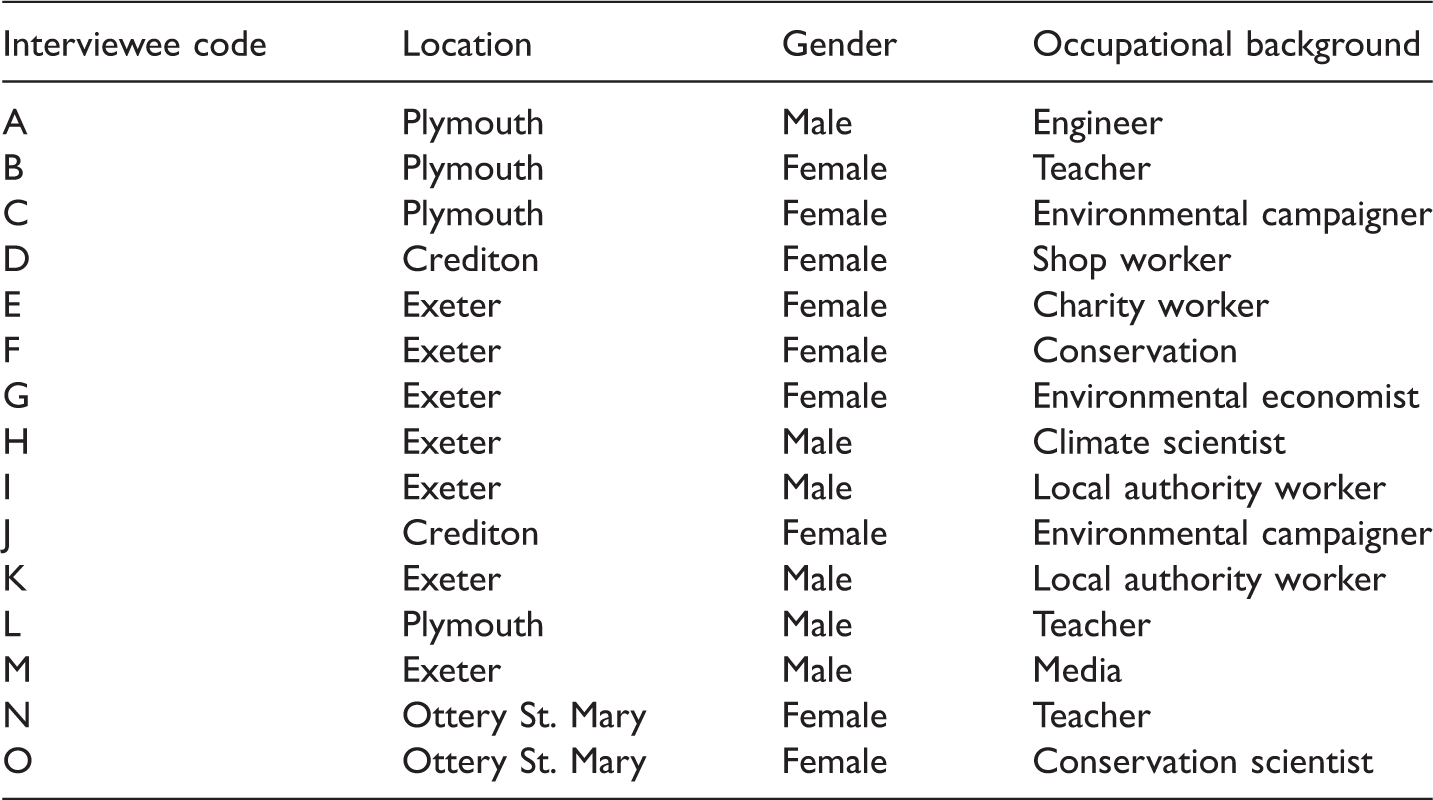
The data presented in the analysis were analysed as narratives and were initially coded using descriptive techniques, but a series of axial codes were applied to the data, given our interest in identifying key points in the narratives of participants. In particular, we focused on understanding the interactions between participants and other members of Transition, both within and between groups.
Entering in: Journeys into Transition
Although Transition is avowedly non-political in the context of everyday party politics and political campaigning, those entering into the movement as leaders and active members often hold a set of values that can be traced back to a period when citizen environmental activism was highly politicised and defined by protest and anti-establishment discourses. In particular, the interests of those interviewed tended to focus on their affinity to and membership of the Green Party: I was a, sort of, lefty until the Green Party, which was … when I first was interested in that – it was the Ecology Party, but prior to that had been the People’s Party, actually. So I was quite active in the Green Party. It ended up, actually, 1990, I stood as a candidate for the local election. (C, Plymouth) I was very active in CND [Campaign for Nuclear Disarmament] and I was interested in Greenpeace and Friends of the Earth and all the environmental groups. In the end, I got involved with The Green Party because that seemed to cover all the things that I was concerned about and interested in … With some colleagues, we actually started a Greenshop, a co-operative, and that somewhat deflected us from Green Party things, actually, because it was a lot of work doing the shop, so I just used to volunteer in my spare time because I worked part-time. (D, Crediton) I’d always been, sort of, active in working towards social justice and environmental justice. I think it was something, I suppose, a bit of a background to what I was doing and I thought that was crucial and important, and it was a great concern of mine but it had more presence in my life … I knew that’s what I wanted to be involved in, being part of a change; helping towards being part of the solution for the global problems that we are facing. So, when I was 21 I was working for a big pharma company and I was really unhappy about their ethics and what I was doing. So I gave that up to do a degree in ecology and conservation. Then I did a PhD in Ecology and pursued a career in conservation, worked in the third world on conservation issues … And so for my, kind of, personal wellbeing I needed to do something environmental in the evening that fitted in with, yeah, having a job that pays the mortgage and puts food on my child’s table. (F, Exeter) I met Rob when I was working at Schumacher. So he’s been a teacher when I’ve been a facilitator two or three times at Schumacher and I respected him. I respected his permaculture background. (G, Exeter) There was a guy on the bus who was distributing little leaflets … about energy reduction for Exeter and it clicked with me quite rapidly that I had not been paying attention to all these issues about fighting for oil, so the politics came into it; fighting for oil, sustainable growth …[F]or one reason or another we … a group of us started to look at in what way can we make Exeter aware of its energy consumption for sustainability. (K, Exeter) … at that time we were being threatened with a Waitrose supermarket right bang slap in the centre of the town on top of … well it was a car park site, actually. We already had two supermarkets, so Waitrose came along and it was supposed to be a pioneering store because it was the furthest Waitrose west, at that time. So we had quite a big campaign to try and stop that but we didn’t stop it. (O, Ottery St. Mary) We’ve got the nuclear subs and these incinerator things … We had a lot of discussion whether the nuclear thing should come into it but in the end we decided it had to because it was just such an important thing, really. If you think about transitioning to a better world, you know, it has to exclude nuclear. (C, Plymouth) The important thing for us about transition was to find the widest constituency that was able to plan for a future which was going to be tougher, so it’s completely different from any other form of campaigning and certainly completely different from any attachment to a political party. (K, Exeter)
Working through and working out: Transitions in practice
Just as those entering into Transition groups bring their own set of political values, learning experiences and place-based interests, the working through and working out of Transition in the day to day running of a group highlights how different identities come to bear on the process of negotiating practices. In the first instance, interviewees highlighted the variable role of personal transformation, or inner transition, and its relationship to the pragmatic activities of the groups. Transition has a strong affinity to what Hopkins (2008) has termed an ‘inner transition’ (Macy and Brown, 2014), although the ways in which this is practiced and interpreted by members is variable. For some, changes at the individual level were about re-configuring the very basis of our understanding of the environmental issues that Transition discusses: … for me, environmentalism doesn’t go deep enough and so I’m looking for a foundational shift that environmentalism comes out of and activism comes out of and spiritualism comes out of and maybe lots of other things. But, for me, most environmentalism stuff that I come across, I don’t think [is] making enough fundamental changes in the operating system. (G, Exeter) I wouldn’t class myself as new agey at all. In fact, I get a bit fed up with people who think that all they have to do is sit and meditate and everything will be alright. I think you need to do activism as well … I don’t go to any spiritual groups anymore. I haven’t found any of the ones that I have been to satisfactory so I just go out in the garden and appreciate nature and things like that. (D, Crediton) … the main criticism I’d make of Transition is it’s either an activists movement in part where a few people are very passionate about a whole load of themes and Transition seems to fit into it perfectly, but, notoriously, such people don’t connect with ordinary people, they just connect … they are streets ahead in their arguments and they find it very difficult to go back to this, sort of, first principles because they are so keen on the latest evil that is stalking the world …. (L, Plymouth) The trouble with consensus … is that that can lead to a kind of PC [politically correct] style of discussion in which everybody says the right thing rather than the true thing, if you like, or at least true to their heart and so you don’t really learn very much about why things aren’t happening. (L, Plymouth) There is such an individual focus. It feels like Transition draws edgy individuals, and those individuals don’t seem to be very good at working together. (G, Exeter)
Discussion: Placing Transition narratives
In responding to calls for research on the re-localisation of environmental politics and praxis, we wish to set an agenda for research that more deeply explores the narratives that are at play in (re)producing the lived experiences of those involved in local environmental movements. In so doing, we wish to highlight the historical and political origins of Transition Town members and the ways in which these act as influences of heritage on contemporary praxis and therefore shape the transformative capacity of such groups. Indeed, we argue that these influences are themselves moulded by geography, recognising the ways in which place can be mobilised to enact (often contested) forms of Transition that ‘… symbolise priorities and imaginaries’ of members (Leitner et al., 2008: 161). In this way, we argue for a narrative understanding of re-localisation agendas that recognises three components: the embodied heritage of re-localisation, negotiated dialogues of identity and praxis, and the spatialities of negotiating Transition.
In the first instance, to understand the geographies of re-localisation (Bailey et al., 2010; Shawki, 2013) there needs to be recognition that what is mapped out as a spatial distribution of groupings is underlain by a place-based heritage of activism. Such geographies of activism are defined by the individual politics and attendant social networks that have emerged in places over time and which have resonances with activism of the so-called environmental crisis. Bailey et al. (2010) argue that Transition invokes Woods et al.’s (2008) notion of an ‘underground’ network, which is comprised of a loose web of connections which are heterogeneous in nature. Whilst we would agree that there is a certain level of heterogeneity in the groups we have studied, the networks on which they are built are likely to be firmer than previous research has suggested; our participants embodied a past that was often grounded in a heritage of protest, activism and green politics (McCormick, 1995). To this extent, Transition’s hope to be a representative ‘community’ movement needs further examination, because it seems likely that the cores of such groups are comprised of a relatively narrow set of personal narratives and values that have a heritage in the environmental politics of the 1960s to the 1980s. Critically, we see these values as ones that are dominated by a ‘middle class’ approach to environmentalism (readily acknowledged by our participants) that may favour and prioritise certain forms of practice over others (Bay, 2013; Pink, 2008). In this way, Transition acts as a particular form of middle class environmentalism that translates the political struggles of the past into the contemporary politics of scarcity through the lens of re-localisation. In so doing, it leads to particular and class-dependent definitions of community (Aiken, 2012; Bay, 2013; Neal, 2013), which we argue here are historically contingent.
This translation of past political struggles into the present serves to illustrate some of the divergences in praxis that we observed in the groups and how this connects to forms of identity amongst members of Transition. Indeed, what is noteworthy from the burgeoning literature on Transition (Bailey et al., 2010; Haxeltine and Seyfang, 2009; North, 2010; Seyfang, 2009; Seyfang and Haxeltine, 2012) is the focus that has been placed on the outward manifestations of Transition through attention paid to ‘activity’. This is often conceptualised as representative of the success of Transition groups, for example the number of groups with food growing initiatives, energy working groups or those exploring the underlying causes of over-consumption (Schlosberg and Coles, 2016). Yet our research highlights the importance of how Transition groups work through and work out their governance and the conflicts that can emerge in this process. Critically, underlying the objectification of activities as one measure of success are the different approaches groups and constituent members take to a focus on the self and the community, what we have characterised here as the difference between inner transition as a spiritual discourse and the often opposing discourse of pragmatism. Such differences evidently emerge partly because of the differing heritage contexts from which participants emerge. However, it also points to a much deeper dis-connection that we have observed in some groups between those advocating spiritually-led participation and the sense of elitism that this can foster amongst those who advocate pragmatic change that delivers projects and ‘results’. In this way, Transition can be seen as a precarious coalescence of interests that, as Brown et al. (2012) note, is about trying to ‘hold the future together’ in the face of competing prescriptions of how to deal with the challenge of neo-liberal over-consumption (Pink, 2008). Moreover, our research highlights how Transition is an example of Chatterton and Pickerill’s (2010) argument that participants in post-capitalist organisations do not conform to fully formed and coherent political identities. Rather, those in the groups we worked with faced many and varied forms of identity conflict between the values inspired by Transition and the realities of working out and working through action ‘on the ground’. As such, Transition may represent a space of heightened tension for individual members, as they simultaneously work within Transition but live within a system that they believe requires urgent change.
This leads us to highlight perhaps the most important characteristic of Transition, which is defined by the spatial politics of re-localisation. Both in our analysis of personal narratives of ‘entering in’ and then ‘working through and working out’, we have demonstrated how different members bring to bear their own priorities and imaginaries (Leitner et al., 2008) on what places should be like. In trying to ‘hold futures together’ (Brown et al., 2012), we identify the ways in which place is mobilised to advocate often contested visions; some may be incremental and pragmatic, whilst others may be viewed as transformational for both individuals and places. Moreover, we see these processes acting at a range of scales, where visions of Transition can be cast between groups, within places and within management structures. In this way, we argue that Transition comprises narratives of complex and inter-connected relations in and through space, scale and time (Leitner et al., 2008). Accordingly, Transition is a fundamentally geographical concern both within and between individual groups; one which reflects the particular characteristics of their setting and regulates the emergence of specific practices across space (Neal, 2013) to become something that is deeply locationally embedded and also trans-local (Mason, 2014).
Conclusion: Narrating geographies of Transition
Transition has been heralded in both the academic literature and by activists as a new form of activism to deal with the coupled challenges of anthropogenic climate change and ‘peak oil’. Indeed, it appears to be distinct from both direct action and different from individualised behaviour change campaigns (Schlosberg and Coles, 2016). The characteristics of Transition are well known, relating to re-localisation of energy and food sources, de-carbonisation of the local economy, energy descent management, promoting resilience through tighter social networks, encouraging consensus based decision making and fostering ‘inner transition’ of the self to effect lasting change (Barr and Devine-Wright, 2012). Social scientists have documented both the spread of such initiatives (Haxeltine and Seyfang, 2009; Shawki, 2013) and the characteristics and challenges faced by Transition initiatives (Bailey et al., 2010; Connors and McDonald, 2011), along with the ways in which the emphasis on community resilience has been framed (Aiken, 2012; Neal, 2013). We argue here that Transition’s development also needs to be understood and situated through the geographies in which particular initiatives are emerging. This is because our analysis of the life histories of Transition members and the ways in which Transition is being outworked in particular places connects to a rich heritage of environmental activism, which is shaping praxis differently across space.
In advocating the importance of these kinds of geographies, we want to argue that the Transition movement constitutes a coalescence of narratives that represent divergent and sometimes conflicting views about the history and future of the environmental movement (Pink, 2008). In this way, we argue that Transition is a historically and politically embedded movement that draws heavily on the traditions and practices of its members’ life histories, with spatiality becoming central to an analysis of Transition in specific place settings (Leitner et al., 2008). Indeed, Transition connects to wider analyses of social and environmental movements that suggest contemporary activist responses to environmental change are crafting identities that are neither fully formed nor discrete in nature, but which are deeply contextual (Chatterton and Pickerill, 2010). Accordingly, we contend that Transition represents a spatially complex outworking of environmental activism that exemplifies a tension between often competing priorities and imaginaries of the future between and within particular places (Leitner et al., 2008).
So what does it mean to be ‘in transition’? Our analysis demonstrates that Transition cannot neatly be categorised as a coherent ‘third way’, lying somewhere between individualistic behaviour change initiatives and forms of direct action (Schlosberg and Coles, 2016). As our analysis has demonstrated, Transition is creating new spaces of tension and negotiation between apparently transformative imaginaries of the future and the goal-led pragmatism of everyday group working. And it is this tension that poses major questions for those advocating a Transition-based approach, for even though it has received considerable popular acclaim, the success or otherwise of such initiatives is likely to be at least partly determined by the core of Transition members, who bring to bear priorities and visions that have been fostered over many years of activism and which will continue to narrate Transition for years to come.
Footnotes
Acknowledgements
The authors would like to thank all those who participated in the research in the case study areas.
Declaration of conflicting interests
The author(s) declared no potential conflicts of interest with respect to the research, authorship, and/or publication of this article.
Funding
The author(s) disclosed receipt of the following financial support for the research, authorship, and/or publication of this article: This research was funded by an Arts and Humanities Research Council (AHRC) research grant (AH/H038574/1) entitled The Role of Values in Responding to Major Social Change: Christian Churches and the Transition Town Movement (November 2010 – October 2012).