







Abstract
In this paper, we show that the economic crisis commencing in 2007 had different impacts across US Metropolitan Statistical Areas, and seek to understand why differences occurred. The hypothesis of interest is that differences in industrial structure are a cause of variations in response to the crisis. Our approach uses a state-of-the art dynamic spatial panel model to obtain counterfactual predictions of Metropolitan Statistical Area employment levels from 2008 to 2014. The counterfactual employment series are compared with actual employment paths in order to obtain Metropolitan Statistical Area-specific measures of crisis impact, which then are analysed with a view to testing the hypothesis that resilience to the crisis was dependent on Metropolitan Statistical Area industrial structure.
Introduction
This paper builds on the work of Fingleton et al. (2012), Martin (2012), Fingleton et al. (2015), and Martin et al. (2016), who analyse the impact of recessionary shocks to UK or EU regions, by applying a dynamic spatial panel model (DSPM) estimator, following Baltagi et al. (2014). This allows us to construct a counterfactual employment series for Metropolitan Statistical Areas (MSAs) of the United States, which then provides a yardstick for assessing the depth of the MSA-specific shock impact and the extent of subsequent recovery in each MSA. The underlying theoretical basis for the DSPM specification is Verdoorn’s law (Verdoorn, 1949), which is a cornerstone of Kaldorian and post-Keynesian economics, and which has been applied to enhance the understanding of persistent regional and national economic disparities (Dixon and Thirlwall, 1975; León-Ledesma, 1999, 2000; McCombie and Roberts, 2007). In the DSPM specification, the level of employment in each MSA depends on MSA-specific output levels. In addition, employment depends on its temporal and spatial lags. The temporal lag can be thought of as an outcome of market failure, whereby there is non-instantaneous adjustment to economic change, so that the level of employment in an MSA partially depends on the level in the previous period, the assumption being that the economy has some form of memory. The spatial lag follows from earlier extensions of Verdoorn’s law which also consider contemporaneous spatial spillovers across locations to be important (Bernat, 1996; Fingleton and McCombie, 1998; Pons-Novell and Viladecans-Marsal, 1999). The level of employment also undoubtedly depends on unobserved factors, and important among these is inter-MSA heterogeneity. These we attempt to capture by the presence of (spatially interdependent) individual-specific random effects in the model.
The DSPM specification leads to a prediction equation which generates counterfactual employment series based on an assumption that output growth across all MSAs is equal to national output growth. Using this, we measure the resilience of each MSA by comparing its predicted employment with the actual level over the post-shock period from 2008 to 2014. These resilience measures are treated as the dependent variables in regression models which are used to test the hypothesis of interest, that MSA resilience depends on the industrial structure of the MSA.
The hypothesis that resilience to economic shocks is shaped by, and shapes, industrial structure, broadly defined, has been considered elsewhere in the literature (Combes, 2000; Doran and Fingleton, 2014; Fingleton and Palombi, 2013; Glaeser, 2005; Glaeser et al., 2014; Holm and Østergaard, 2015; Martin, 2012; Quigley, 1998). For example, Capasso et al. (2014) highlight the importance of industry structure in explaining the evolution of regions’ growth paths over time, while Holm and Østergaard (2015) emphasise the importance of regional industrial structure in explaining a region’s susceptibility to shocks and its ability to better recover following shocks. Likewise the differentiated impact of industry structure on resilience has been discussed by Martin et al. (2016) as a possible explanatory factor for regional divergence, with a region’s ability to resist and recover from shocks impacting its long run growth path.
There are some novel aspects to our paper that we would like to highlight. First, our modelling approach, involving both dynamic and spatial interaction, is relatively unusual and a clear advance on static spatial panel approaches which do not take account of time-dependency in spatio-temporal series. Secondly, and somewhat unusually, our DSPM estimation takes account of the potential endogeneity of the regressor, output, with respect to employment. Thirdly, our focus is essentially on city-region (i.e. MSA) resilience, in contrast to the more usual region- or country-specific estimates of resilience found in the literature. Fourthly, we seek to avoid omitted variables bias by introducing covariates, and allow for endogeneity in our regression analysis, in an attempt to obtain consistent causal effects of industrial structure on resilience.
The remainder of this paper is structured as follows. Section “Resilience and the industrial structure hypothesis” provides an overview of our industrial structure hypothesis and how this relates to regional resilience. The data used are discussed in Section “Data”. The Verdoorn’s law model and estimation strategy is outlined in Section “Model specification”. Section “Empirical estimation” gives our estimates. The prediction methodology utilised is discussed in Section “Prediction and generating a counterfactual employment series”. Section “MSA resilience to the 2007 economic crisis” describes our resilience indices. Section “Testing the industrial structure hypothesis” gives the regression analysis and interpretation. The final section concludes.
Resilience and the industrial structure hypothesis
Martin et al. (2016) note that in economic geography the concept of resilience describes regions’ reactions to, and recovery from, negative economic shocks. This concept has been widely used in the engineering and ecological sciences and has been increasingly adopted in economic geography [see Grinfeld et al. (2009), Christopherson et al. (2010), Cross et al. (2010), Simmie and Martin (2010), Doran and Fingleton (2015), and Palaskas et al. (2015) among others]. Martin (2010) suggested three variations of resilience: (i) engineering, (ii) ecological, and (iii) adaptive resilience (our preferred conceptualisation). Engineering resilience relates to an economy’s ability to regain equilibrium after a shock (Fingleton et al., 2012; Martin, 2010), the assumption being the existence of self-correcting forces typified by Friedman’s (1964, 1993) plucking model. Ecological resilience differs in that it assumes that systems are characterised by multiple equilibria. In ecological resilience, shocks push the system beyond its recovery threshold to a new domain rather than allowing it to return to the same equilibrium path. This is similar to the concept of hysteresis whereby a shock permanently affects the subsequent growth path of an economy (Romer, 2001). Essentially the memory of the shock is left behind in the economy even after the shock has faded away. Finally, our preferred concept, adaptive resilience, relates to the capacity of a regional economy to adapt its structure in response to external shocks (Martin et al., 2016; Nyström, 2017). Martin et al. (2016) also identify four dimensions of resilience; risk, resistance, reorientation, and recovery, noting that these four dimensions are influenced by a myriad of factors including, but not limited to, economic structure. In this paper we focus on the effect on resistance and recovery of an MSA’s economic structure controlling for other factors.
The focus in this paper is on the question of whether the response of US MSAs to the 2007 economic crisis can be affected, at least in part, by differences in industrial structure. The adaptive resilience concept supposes that the relationship between shock-impact and industrial structure is complex and two-way, so that a shock-effect depends on industrial structure, but also industrial structure may change as a consequence of a shock. Given this potentially endogenous relationship, we attempt to tease out the causal effect of industrial structure in the remainder of the paper.
Data
Our analysis is based on data for 377 US MSAs,1 as defined for use by Federal statistical agencies involved in collecting, tabulating, and publishing Federal statistics. The MSAs considered are mapped in Appendix 1 and each contains a core urban area of 50,000 or more population plus any adjacent counties with a high degree of social and economic integration (as measured by commuting to work) with the urban core (United States Census Bureau, 2012). MSAs are by their nature not necessarily contiguous to other MSAs, with some clustered in relative geographic proximity to others and some relatively isolated.
Employment and GDP data for 2001 to 2014 come from the Bureau of Economic Analysis (BEA) regional economic accounts (Bureau of Economic Analysis, 2016); in our analysis MSA GDP is the market value of all final goods and services produced within an MSA in each year. The BEA MSA employment series we utilize comprises estimates of the number of jobs, both full time and part time, by place of work.
When considering the determinants of resistance and recover in Section “Testing the industrial structure hypothesis” we employ data from the American Community Survey on (i) the number of individuals employed in 12 broad sectors, (ii) the number of individuals over the age of 24 with a third level education, and (iii) the population density of each MSA. The data are obtained through the American FactFinder service for the years 2005–2014 for MSAs.
Model specification
Theoretical framework
The empirical analysis rests on a fundamental theoretical assumption, that of increasing returns to scale. Increasing returns has found much favour within regional economics and economic geography as a basis for regional and urban disparities. From a post-Keynesian economics perspective increasing returns are embodied within the so-called Verdoorn law (Verdoorn, 1949) which, in its so-called dynamic form, gives the exponential growth of labour productivity (

This equation forms an integral part of Dixon and Thirlwall’s (1975, 1978) model of circular causation and is very much in the demand oriented tradition of economic growth analysis involving increasing returns to scale, with productivity growing in response to output growth, as implied by the typically estimated value of

As shown by Thirlwall and McCombie (1994), Fingleton (2001a, 2001b), Dall’erba et al. (2009), Le Gallo and Páez (2013) and Britto and McCombie (2015), among others, various other specifications exist, and most relevant from the perspective of the current paper is the static Verdoorn law written as a regression equation, hence,

In equation (3), yt is an N by 1 vector of employment levels in N MSAs at time t, ln denotes the natural log, and xt is an N by 1 vector of output levels,2 α is a constant term and β is a scalar coefficient. Other unobserved factors are captured by the error term
Spatial and temporal lags
Extending the model by including a contemporaneous spatial lag as well as a temporal lag of the dependent variable gives:

The temporal lag is denoted by the N × 1 vector
With regard to the spatial lag, connectivity between MSAs is assumed to be a diminishing function of distance, so that

In which

The matrix WN is symmetrical with
With regard to the dynamic element of the model, with
Spatially autoregressive disturbances
A second potential source of spatial interdependence involves the error term
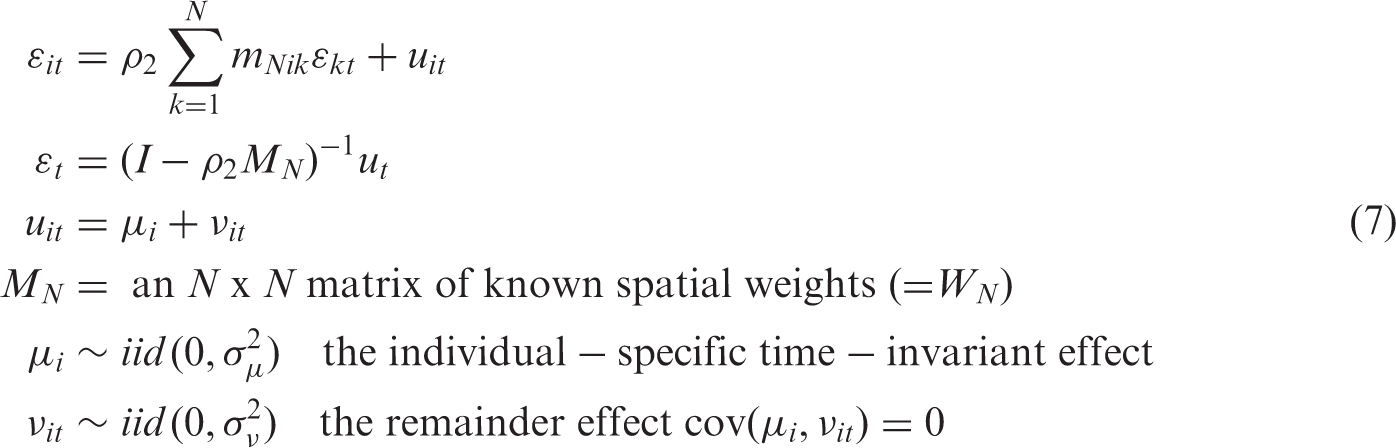
Notice here that the autoregressive error process is governed by
Empirical estimation
GMM-SL-SAR-RE estimation
An estimation method for dynamic spatial panel data with random effects is given by Baltagi et al. (2014). The significant advantages of this estimator are that it allows us to incorporate a large number of regions in our analysis. In comparison, vector autoregressive (VAR) and vector error correction (VEC) modelling as applied by Papanyan (2010), Fingleton et al. (2012) and Doran and Fingleton (2014) becomes highly impractical once one extends beyond about a dozen regions and would certainly be prohibitive given 377 MSAs.
This ‘Generalized Method of Moments-Spatial Lag-Spatial Autoregressive-Random Error’ or GMM-SL-SAR-RE estimator detailed in Baltagi et al. (2014) is based on Arellano and Bond (1991), but contains additional moments to take full account of the spatial dimension of the model. It is important to mention one difference between the estimator in Baltagi et al. (2014) and the application here. In the former, the regressor(s) are assumed to be exogenous, with the exception of the endogenous lags. These then become instruments facilitating consistent estimation. However, it is unclear whether output can realistically be treated as exogenous to employment, as is evident in the exchange between Kaldor (1975) and Rowthorn (1975a, 1975b). In this paper, we assume that the regressor,

Estimates
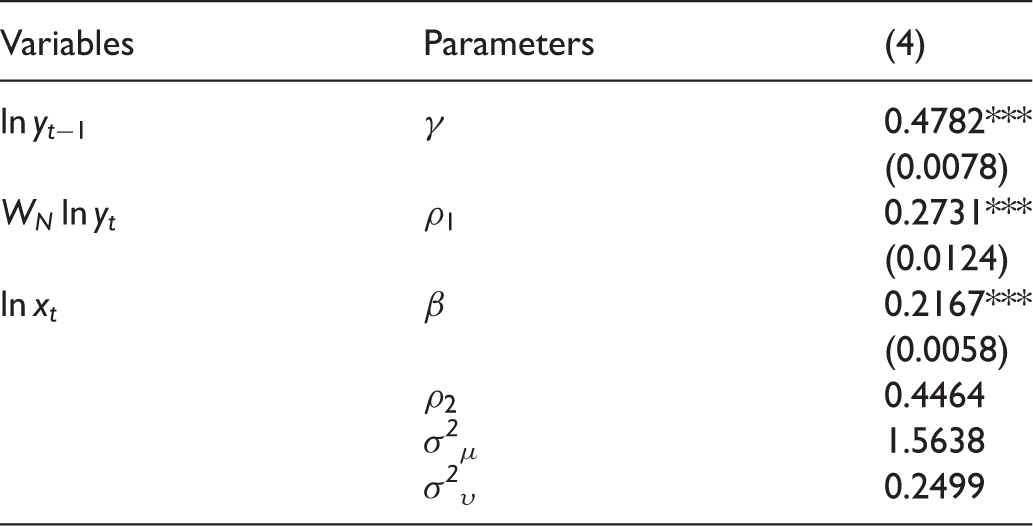
Parameter estimates.
Standard errors in parentheses.
p < 0.01.
The estimated
The positive association between output and employment is consistent with the theoretical model presented previously, and indicates that, controlling for endogeneity, there exists a positive causal impact of output with regards to employment. The positive spatial lag parameter (
The estimates in Table 1 suggest that the constant elasticity of employment with respect to output is quite small, as indicated by
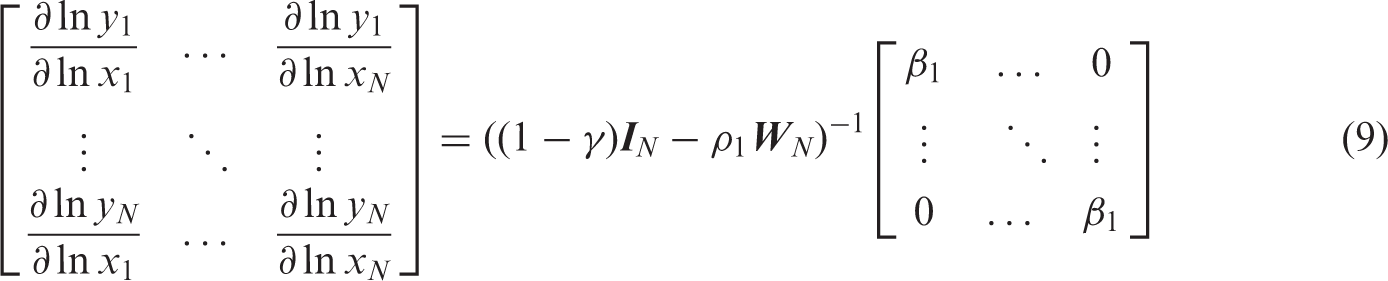
It is now standard practice to acknowledge that the effect of a variable should equal the true derivative of 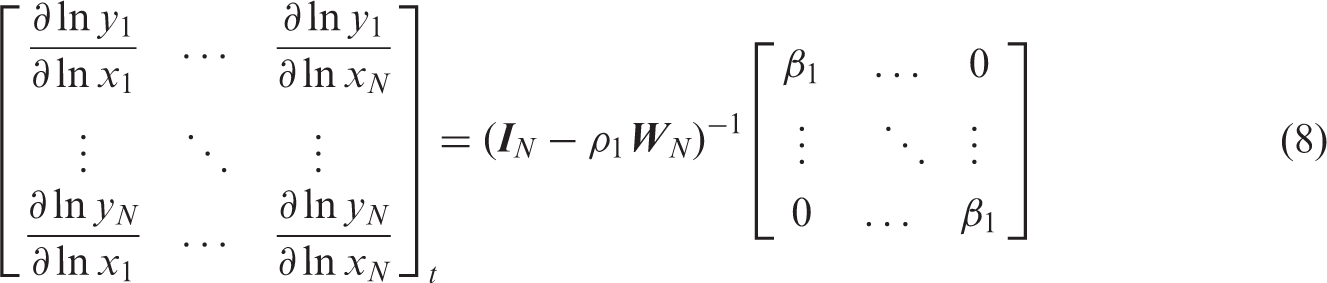
And the long run effects are given by
Short and long run effects (two-step estimates).
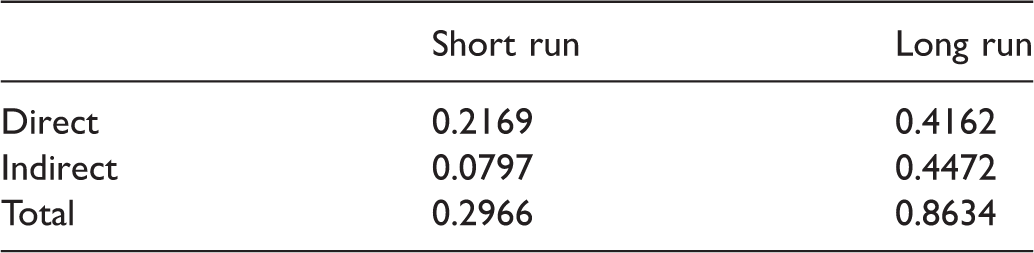
Table 2 indicates that the direct short run effect (0.2169) is slightly larger than
Prediction and generating a counterfactual employment series
Methodology
The prediction methodology involves using the parameter estimates given in Table 1, which relate to the model set out as equation (4), in order to simulate counterfactual employment levels across the 377 MSAs. Equation (4) is repeated here, but as a recurrent equation in matrix format, as equation (10),

In which
Following Chamberlain (1984), Sevestre and Trognon (1996) and Baltagi et al. (2014), the linear predictor is given by equation (11).


Equation (11) is the same as equation (10) but with expectations E[·], and this leads to equation (12) which gives the estimated expectations of (log) employment (
Generating the counterfactual series
Given equation (12), the counterfactual employment series (
MSA resilience to the 2007 economic crisis
Measuring elements of resilience
We focus on two elements of resilience; resistance and recovery (Martin, 2010; Martin et al., 2016; Palaskas et al., 2015). Resistance is the ability of a regional economy to resist the initial impact of the crisis; recovery is the ability to recover following the shock (Han and Goetz, 2013). Following, broadly, Han and Goetz (2013) and Martin et al. (2016), resistance and recovery are defined here by equations (13) and (14), respectively.


In (13),
Testing the industrial structure hypothesis
To explain inter-MSA variation in 


In equations (15), and (16), i refers to MSA i in 2007. Also
The Krugman index
Given that the indices
Subsequent analysis treats
Four instrumental variables are employed. Firstly, we use the spatial lag of
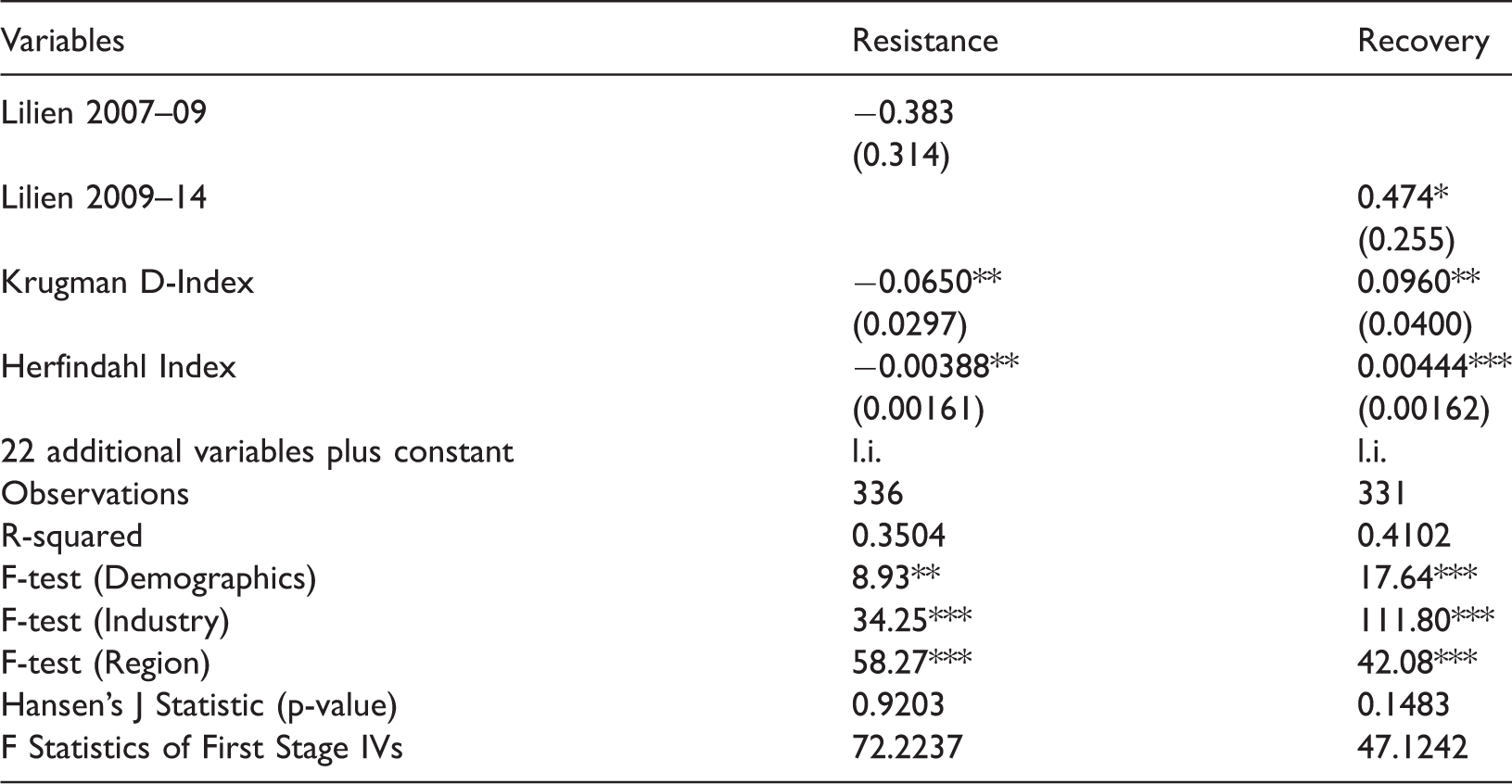
Additional regressors (see also Han and Goetz, 2013) are introduced to avoid omitted variable bias, bias which may come about if the industrial structure indices also capture the impact of correlated variables not included explicitly in a regression specification. Consequently, we control for population density, educational attainment, sectoral composition, and the Region12 of the US in which the MSA is located to give the model

In (18), Ri denotes either
Industry structure controls and resistance and recovery.
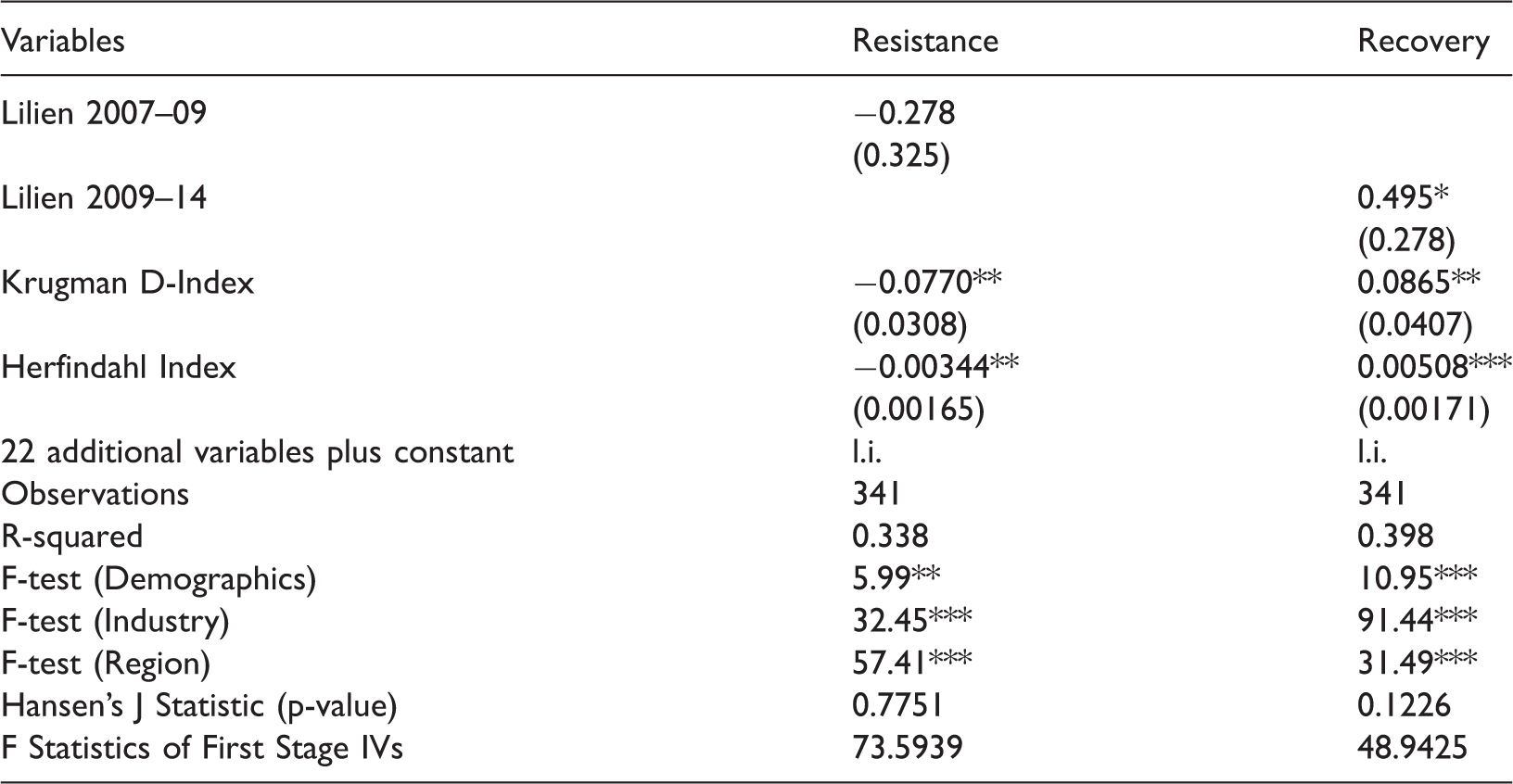
l.i. denotes of limited interest.
Note 1: Robust standard errors in parentheses.
Note 2: ***p < 0.01, **p < 0.05, *p < 0.1.
Note 3: Hansen’s (1982) J statistic chi-squared test is reported. A statistically significant test statistic always indicates that the instruments may not be valid.
Note 4: Following Stock et al. (2002) instrument relevance is indicated via F statistics greater than 10.
Table 3 indicates that the Krugman index and the Herfindahl index both have a negative effect on resistance, indicating that specialization increases susceptibility to shocks. In contrast post-crisis, specialisation appears to positively aid recoverability. Also the significant positive effect of the Lilien index suggests that shifts in industrial employment following a shock have a beneficial effect on post-shock recovery. This may reflect MSAs reorienting themselves away from impacted sectors to sectors which were not impacted by the crisis.
With regard to the control variables, our estimates indicate that MSAs with a higher percentage of the population with Bachelor degrees, or higher, are better able to resist and recover following the crisis. This points to the importance of an educated workforce, ceteris paribus, in improving an MSA’s resilience.
MSAs with a higher proportion of their workforce in construction, manufacturing, finance and insurance or other services possess lower resistance indices ceteris paribus. However, MSAs with a higher proportion of their workforce in educational services, arts, entertainment and recreational services or public administration exhibit poorer recovery post-shock. This suggests that sectoral employment differences may aid in explaining the susceptibility of MSAs, hence regions, to shock and impact their speed of recovery post-shock.
Having controlled for the above factors we still observe significant regional variations in our resistant and recovery indices. Relative to New England (the reference category) MSAs in the Middle Atlantic, West North Central, and West South Central regions have higher resistance indices ceteris paribus. When considering recovery New England and the Middle Atlantic are the regions where MSAs possess the lowest recovery indices while MSAs in the West South Central and East South Central exhibit the highest recovery indices.
The robustness of the Table 3 inferences is predicated on error distribution assumptions. Figure 1 shows approximately normality for both Residuals of IV regression model. Box plot of residuals to identify outliers. IV regression of resistance and recovery (with outliers trimmed). l.i. denotes of limited interest. Note 1: Robust standard errors in parentheses. Note 2: ***p < 0.01, **p < 0.05, *p < 0.1. Note 3: Hansen’s (1982) J statistic chi-squared test is reported. A statistically significant test statistic always indicates that the instruments may not be valid. Note 4: Following Stock et al. (2002) instrument relevance is indicated via F statistics greater than 10.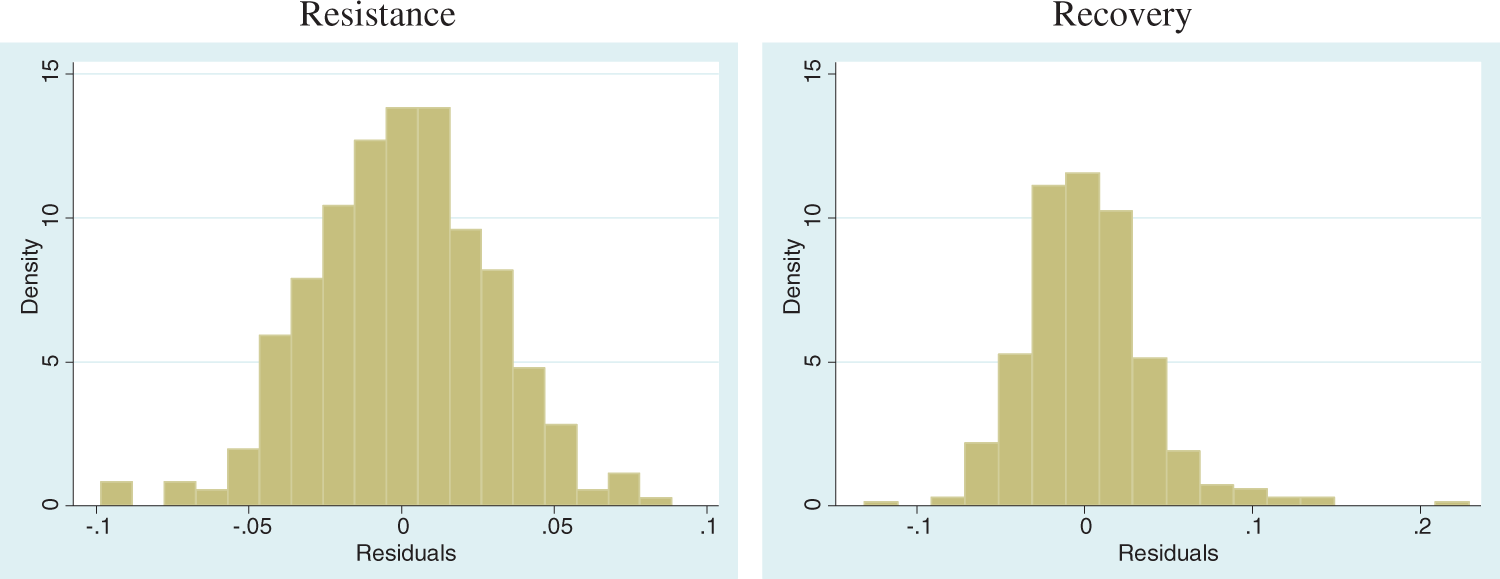
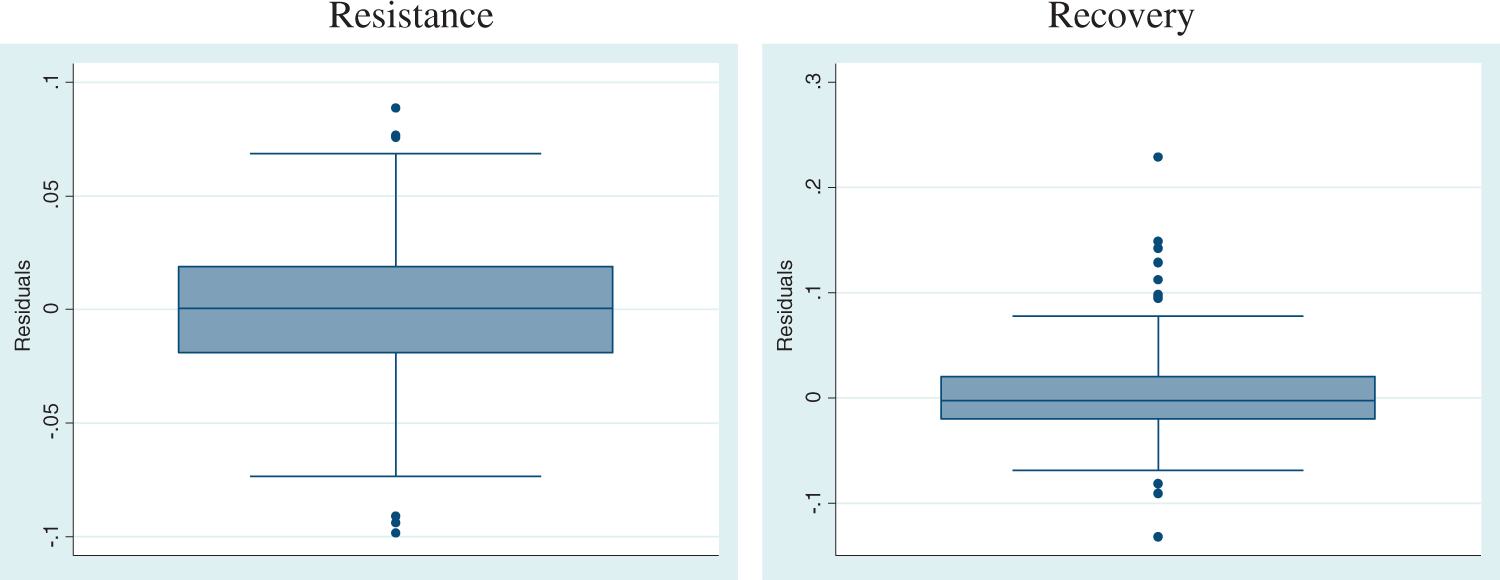
To allow for the possible presence of error dependence among the residuals, we also estimate the model with the same specification as the Table 3 model but also with an additional spatial autoregressive error term. Following Arraiz et al. (2010) and Drukker et al. (2013), via the use of instrumental variables and GMM, we obtain similar estimates to those of Tables 3 and 4, with no evidence of significant residual autocorrelation. To save space they are omitted here.
To summarize, the regression estimates show that a more specialised MSA is less resistant to shocks than a diverse MSA, and that, post-crisis, specialisation appears to positively impact an MSA’s recoverability. Also, the significant positive impact of structural change suggests that the reorientation of industrial structure following a shock aids post-shock recoverability.
Conclusions
This paper studies the effect of economic structure on the resilience of US MSAs to the 2007 economic crisis, and in doing so is one of a growing but small number of papers which analyses of resilience at a city, rather than country or regional, level [for an example of a city levels analysis see Wrigley and Dolega (2011)]. Our key findings are that MSAs which were more specialised were more adversely affected by the crisis and less able to resist it. But during the recovery phase post-crisis, we find evidence that being specialised positively affected recovery. In addition, structural change during the recovery period also had a positive effect on recovery. We also find that MSA’s sectoral composition affects resistance and recovery, but this by itself does not explain the significant regional effects. Thus, controlling for sectoral effects, the region in which an MSA is located still has an effect on resistance and recovery, although at this juncture we do not speculate about the underlying cause of the regional effects.
These interpretations are however provisional and are open to revision as longer series become available for analysis. In addition, it would be useful to look retrospectively at earlier recessions to see if more evidence could be gained regarding the determinants of resilience, taking account also of the type, strength and duration of that shock. In the past, we have seen major events such as the 1861–63 Cotton Famine, which had a major adverse impact on the towns of the Lancashire cotton district, the great stock market crash of 1929, and indeed the two World wars of 1914 and 1939, each having its own particular consequences for local, regional, national and global economies.
Footnotes
Declaration of conflicting interests
The author(s) declared no potential conflicts of interest with respect to the research, authorship, and/or publication of this article.
Funding
The author(s) received no financial support for the research, authorship, and/or publication of this article.