







Abstract
In this study, we investigate the shifting of modes of governing municipal waste, from disposal (waste-to-landfill) to waste as a resource (sustainable recycling). To this end, we frame this study combining the modes of governing approach developed by Bulkeley, Watson and Hudson with Bruno Latour’s sociology of translation approach (or Actor-Network Theory). Within this double framework, we investigate practices that emerge from the attempts made by multiple stakeholders to shift modes of governing waste. This study contributes to the modes of governing waste in particular and, to environmental policy implementation studies in general. We posit that shifting governing modes involves (i) the construction of human–non-human networks that support the stabilization of a particular governing mode; (ii) consideration of the role of non-humans, their agency and materiality and; (iii) the acknowledgement that counter-networks and unintended consequences are likely to emerge. When we add to this view the role of politics, a more complex, dynamic and rich picture of the phenomenon surfaces.
Introduction
As in Gabriel Garcia Marquez’s One Hundred Years of Solitude, shifting modes of governing waste in a small Brazilian city involved the participation of a range of actors, who willingly or unwillingly, associated to form networks that produced both intended and unintended outcomes. The formation of a network to support a new waste recycling system was a drama with all the ingredients of a magnificent novel. Grand plans, emerging counter plans, anonymous heroes, the poor and oppressed, the well intentioned and the evil characters, as well as an audience eagerly anticipating the outcome of it all.
Addressing household waste is a global issue with multiple dimensions. It involves major shifts in how government policies, resources and regulations are deployed (Davies, 2009; Davoudi, 2009; Gutberlet, 2015; Lederer et al., 2015). Shifting governing modes however, is a complex process encompassing dealings with a range of public, private and non-government organizations, which usually have diverse agendas. Gaps between high-level policies and local-level resources make policy implementation an issue (Nilsson et al., 2009). To date, the experience of shifting modes of governing municipal waste has been ‘socially contested, politically contentious, technologically challenging and, environmentally uncertain’ (Davoudi, 2009: 136). Last, but not least, is the fact that the members of individual households, constantly instructed to properly manage their own waste, are often uncertain of its further fate (‘Don’t they burn it together at any rate?’). Hence, there is a need to understand and explain how action plans designed to shift municipal waste governing modes are turned into reality. This need has been highlighted many times (e.g. see Bull et al., 2010; Guimarães et al., 2015; Petts, 1995), but the task remains unfulfilled.
In this article, we focus on a major shift in waste governance at the municipal level. We examine the intricacies involved in a shift in governing modes from a disposal (waste-to-landfill) mode to waste as a resource (sustainable recycling) mode. We frame this study by combining the modes of governing approach developed by Bulkeley et al. (2007) with Latour’s (1984, 2005) sociology of translation approach (or actor-network theory – ANT). Within this double framework, we investigate practices that emerge from the attempts made by multiple stakeholders who intend to shift modes of governing waste.
The framework of Bulkeley et al. (2007) focuses on the regimes of practice by which government technologies, rationalities, authorities and subjectivities are created and sustained, including how citizens contest and challenge those regimes of practice (Bulkeley et al., 2007: 2737). From the sociology of translation perspective, modes of governing waste can be seen as arrangements in which humans (community, local government leaders, private entrepreneurs) interact with non-humans (e.g. conceptual tools, laws and regulations, equipment and material objects) to build networks to either stabilize or destabilize certain ordering processes. ANT is suitable for comprehending shifts in governing modes because it accounts for the emergence and competition of heterogeneous networks of humans and non-humans that interact and engage in negotiations, discussions, consensus-building, actions and counter actions to either establish or block the implementation of a particular waste governing mode (Gregson and Crang, 2010; Magnani, 2012; Parker and Wragg, 1999).
This article is part of a larger research project aiming to implement a household waste recycling system in Florestal, a small regional city in Brazil. Shifting modes of governing waste involved the incorporation of the local waste-pickers association (Astriflores) into the formal waste management system of Florestal. The incorporation of Astriflores helps to address poverty, a fundamental issue in developing countries (Sasaki and Araki, 2013). In this sense, this project also responds to Gidwani’s (2015: 592) call to take up the political challenge of creating safer, less exploitative and more stable forms of employment for millions of waste-pickers. As part of a team of University researchers, one of the authors (MMS), acted as a facilitator between the main stakeholders: Astriflores, Florestal City Council, truck collection company and community representatives.
This study contributes to the governance of waste literature in particular (e.g. Bulkeley and Gregson, 2009; Howell, 2015; Lawhon, 2012; Pollans, 2017), and to environmental policy implementation studies in general (e.g. May, 2015; Switzer, 2017). The combination of the Bulkeley et al. (2007) framework with ANT provides a novel understanding of the dynamics of shifting modes of governing. We posit that shifting governing modes involve the construction of dynamic human–non-human networks that support the stabilization of a particular governing mode; the consideration of the role of non-humans, their agency and materiality. The prevailing governing mode and unexpected events play a significant role in shaping those networks and emerging counter-networks.
In the next section, we explain our framework in more detail. We show how the modes of the governing framework can benefit from ANT, and we share our reflections concerning the simultaneous use of action research and ANT. In what follows, we present the setting of our study. The next section contains two narratives: One is the story of the construction of a network to support the establishment of a new waste management system, and the other illustrates efforts made by humans and non-humans to destabilize the same network. Finally, we scrutinize the role played by non-humans, unexpected events and, the politics of governing modes in both narratives and conclude with the theoretical implications of our findings.
Modes of governing municipal waste through actor-network theory lenses
The modes of governing approach focus on how governing unfolds. A mode of governing is ‘a set of governmental technologies deployed through particular institutional relations through which agents seek to act on other people in order to attain distinctive objectives in line with particular kinds of governmental rationality’ (Bulkeley et al., 2007: 2739). Modes of governing entail both structure and processes, simultaneously engaging government rationalities, governing agencies, institutional relations, management models and the entities governed. These components dynamically interact to either form new modes or disintegrate existing ones (Bulkeley et al., 2007: 2737–2739). This framework, therefore, considers the network relations shaping outcomes, the individuals contesting their governance and, how these aspects translate programs of government.
Under ANT lenses, shifting waste governing modes is seen as a process in which humans and non-humans interplay to form networks that support particular social outcomes or, counter networks that undermine the same social effect (Callon, 1986; Latour, 1984). Both humans and non-humans can have agency since non-humans may act or cause others (human or non-human) to act. In order to act, humans need non-humans as much as non-humans need humans (Sayes, 2014). Rather than looking solely at people, technology or objects, ANT helps to understand how the connections among them are developed through processes of translation (Czarniawska, 2009). In translation processes, materials, information and people’s identities change their roles to fit the network. The idea of translation helps to understand how things come to be; how relationships between humans and non-humans emerge, compete and are negotiated and how the resultant social ordering processes are established, normalized or interrupted. As we see it, adding ANT to the modes of governing framework enriches the framework by adding the non-humans, the activity of translation and a relational view of waste.
Firstly, as mentioned previously, the modes of governing framework overlooks non-human actants such as artefacts, machinery and/or materials that interact with the generation, interpretation and treatment of waste. The framework also favours government agencies at the expense of private and non-governmental (not-for-profit) organizations, and other human actors that might affect shifting of waste governing modes (Howell, 2015). ANT suggests that humans and non-humans should be given the same attention, that is should be studied symmetrically. Symmetry should also be applied when studying those who govern and those who are governed.
Secondly, even when the governing modes approach includes various human actors (e.g. authorities, regulators, waste contractors), and a limited number of non-human actants (e.g. programmes, government technologies, waste), they seem to play well-defined and static roles. Conversely, ANT assumes that humans and non-humans play varied roles due to translation. They can become (i) intermediaries that simply transport another force or meaning without changing it – helping to either attach people to groups or detach them; (ii) mediators that modify, transform or distort the form/meaning in the elements they are to conduct; and (iii) immutable mobiles if they become solid enough to act at a distance, extending the power of a network into new spaces. An aligned set of human and non-humans that form a concrete entity is an assemblage (Fenwick and Edwards, 2010).
Thirdly, in their empirical analysis Bulkeley et al. (2007) produced a detailed historical account of how local governments shifted their modes of dealing with waste. They emphasized the role of government rationalities, policies and organizational templates, but did not pay attention to the multiple translations necessary between these non-humans. ANT helps to untangle this multiplicity by differentiating among what Callon (1986) called four moments of translation: problematization, when a common idea or a definition of problem arises, relating entities in a particular way; interessement, when these entities begin to see why it is in their interest to be included in the emerging network; enrolment, when roles are defined and entities accept to interact with them; and, finally, mobilization, when the network becomes stabilized and starts acting.
Fourthly, the modes of governing approach treats waste simply as something that can be manipulated, categorized and managed with no opposition (Gregson and Crang, 2010). This assumption is different from the relational view of waste, which approaches it as a constitutive element of social and economic processes (Gidwani, 2015). The changing nature of waste, the societal relations that interpret waste in diverse ways, and the distributed human–non-human agency of waste that may lead to ambivalent outcomes (Bennett, 2005; Gille, 2010; Moore, 2012), are overlooked aspects in the governing modes framework. From an ANT perspective, waste is a socially constructed hybrid of objects, legislation, economics and human interpretations (Latour, 2005). An object’s material features might affect others’ actions, as its material characteristics define its robustness, permanence and feasibility to be moved in space and time, affecting the extent to which it can activate, intermediate and bear actions (Kallinikos, 2012). This means that ‘there is no such as thing as a material that is inherently “waste”’ (MacKillop, 2009: 182). ANT, in contrast, permits an extended understanding of the relationships between materiality of waste and agency. Following Latour (1984), Bennett (2005) suggested that the locus of agency is always a human–non-human assemblage, in which objects have affordances – that is what they can allow or limit in regards to potential actions. Thus, ‘waste’ can be considered a focal actant since it can make ‘a difference to the direction of the larger assemblage without that difference being reducible to an efficient cause; actants collaborate, divert, vitalize, gum up, twist, or turn the groupings in which they participate’ (Watson, 2013: 149).
Hence, the addition of ANT concepts strengthens the analytical power of the modes of governing framework, as governing modes entail ‘a complex picture of competing governmental objectives, practices, institutional arrangements and power dynamics’ (Bulkeley et al., 2007: 2749). ANT provides the conceptual tools to examine the processes of shifting modes. By combining the two frameworks, we are able to address two key analytical aspects pinpointed by Bulkeley et al. (2007: 2749): ‘the need to engage simultaneously with the structures and processes of governing, and the need to recognize the plurality and multiplicity of governing sites and activities’.
Methodological strategy and field material
Action research was applied as the methodological strategy (Smith et al., 1997; Whyte, 1991). Following this strategy, the university team and practitioners jointly designed the project, participated in the development of action plans and in decision-making processes, and performed actions to attempt to shift Florestal’s mode of dealing with waste. The practical character of action research fits well with the ANT focus on tracing practices.
Action research usually involves modifications of relations, as it intends to re-work the politics of the project during its implementation. Because university researchers were direct participants rather than mere observers of social life, they, together with project members, performed political actions to advance the project’s goals (e.g. the enrolment of key actants (see narrative 1)). Importantly, the whole process of shifting modes of dealing with waste was a political endeavour, as it entailed modification of power relations in the networks that supported the established waste management assemblage (e.g. Munro, 2009). This modification generated forces that worked against the setup and stabilization of the new waste recycling system (see narrative 2).
Field material was collected through a variety of methods, including facilitation sessions (33 meetings); participant observation (continuous, twice per week); formal semi-structured interviews, document analysis and informal interviews. The setting was Florestal, a regional city of 7000 inhabitants, which generates approximately 150 tons of household waste per month. In Brazil, landfill is the conventional waste management mode. Despite environmental and health risks, in 2014, approximately 42% of all household waste in Brazil was disposed of in informal landfills (ABRELPE, 2014). Another relevant contextual characteristic is the power associated with traditional landowner families in Brazil. This scenario is historically quite common in regional Brazil, where public and private interests have blurred boundaries (Faoro, 2001).
The 2010 National Policy of Solid Waste influenced the shift in governance mode at Florestal. The policy (i) introduced the idea of ‘shared responsibility’ among major stakeholders involved in solid waste management; (ii) recognized recyclable solid waste as an economic resource of social value, generator of employment and income; (iii) legalized waste picking as a professional activity and; (iv) made the selective collection of waste in all Federal government departments compulsory (IPEA, 2013). The implementation of this policy, however, is constrained by the lack of resources and coordination between State and local levels of government – and the associated tensions and difficulties (Lima et al., 2011).
The project lasted 3 years, from February 2014 to December 2016. During the planning stage of the project, the university team applied participative management methods to promote the involvement of key stakeholders and develop action plans through collective dialogue and high-level collaboration (see Table 1). Some action plans were generated at the planning stage of the project while others were developed during project deployment to address emerging challenges.
Sample of action plans.
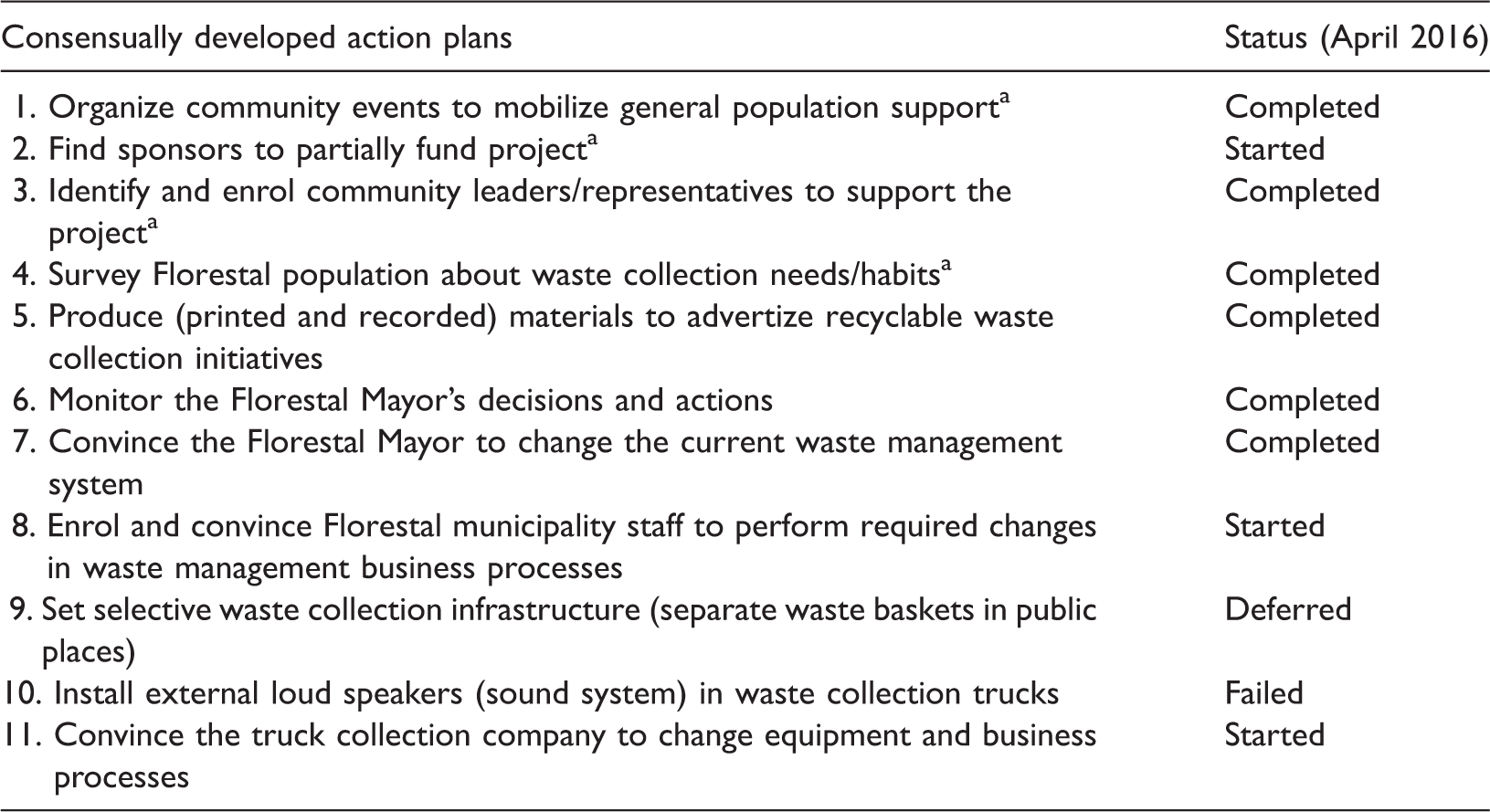
aGenerated in the planning stage.
In ANT terms, this set of action plans represents the initial attempts to build a new waste management system in Florestal. Action plans constitute the visible dimension of assemblages of human and non-human actants that are sustained by a moving network of human–non-human linkages. In Florestal, this assemblage consisted of Florestal’s Mayor, Florestal City Council technical staff, the truck collection company manager, Astriflores staff, the university team, community representatives, households and the former Mayor as well as non-humans such as the, 2010 National Policy of Solid Waste, loud speakers, banners and Astriflores equipment.
During network construction, human and non-human actants go through continuous translation processes, changing their roles and producing diverse effects. The truck company’s role for example has shifted from a mere intermediary (taking waste from households to Astriflores) to that of a mediator, as it was in charge of enforcing recycling and non-recycling collection days (see narrative 1). The networked character of linkages between actants was observed during its construction as they evolved in a chain-reaction style. The establishment of separate days to collect recyclable and non-recyclable waste for example triggered the need for households to sort waste, the need to install banners and loud speakers in the collection trucks and the need for the truck company to amend their business process.
To make sense of the research findings we used a narrative approach as it helps provide coherence to the empirical data and create new understandings of the phenomena being studied (Czarniawska, 2004). In the next section, the research findings are presented in two narratives. The first narrative describes the attempts to construct and stabilize a waste management recycling system while the second presents the attempts made to undermine the construction of the newly emerging waste management recycling system.
Narrative 1: Building a household waste-recycling network
At the beginning of the project (February 2014), the project aim was to improve the working conditions and efficiency at Astriflores. Astriflores was an assemblage of 12 people, regulations, machines and a small plant responsible for sorting materials considered to be recyclable. A network composed of Astriflores associates, community representatives and the university team sustained this assemblage. All household waste from Florestal city was transported to Astriflores, making Astriflores an obligatory point of passage (Callon, 1986) in Florestal’s waste management system. Its processing capacity was approximately 4.0 tons per day while the Florestal daily waste production was 5.0 tons per day.
Astriflores sorted recyclable materials into 18 classes – different kinds of paper, plastic, glass and metal. These sorted materials were packed into large parcels and sold to the recycling industry (Astriflores’ income comes from the sale of the parcels). Non-recyclable materials were transported from Astriflores to the landfill by the truck collection company. This truck company was a key intermediate. It was an assemblage of one truck, three workers and one owner-manager, hired by Florestal’s City Council to collect household waste. In this study, we focus on two time brackets, before and during the Action Research project.
Before the project’s start, Astriflores received large amounts of material considered waste by households; including dead animals, perforating objects and other unpleasant items. Working conditions were hard. As waste deteriorates, it attracts mosquitos and other pest species, making the workplace smelly and unsafe. Waste deterioration also resulted in lower economic value, as organic materials contaminated recyclable ones. It needs to be added that some materials deteriorate over time (e.g. tin cans rust), while others remain valuable (e.g. copper wires). In this sense, the ever-changing materiality of waste unveils the temporality of its recycling potential and, consequently, its economic value. Thus, being recyclable is not a fixed property attached to objects. Rather, it is a relational category seen ‘as historically mutable, geographically contingent, and both expressive of social values and sustaining to them’ (Gregson and Crang, 2010: 1027). The consideration of the materiality of waste therefore opens new research questions worth pursuing (Kallinikos, 2012). For example how does the materiality associated with unwanted products affect the formation of networks and/or counter networks? How does network configuration affect the materiality of waste?
During the first year of the project, project members quickly realized that to improve working conditions and efficiency at Astriflores, they needed to expand the scope of the project – the integration of Astriflores into the formal waste management system of Florestal. Such an expanded network required the enrolment of additional human and non-human actants; Florestal’s Mayor, City Council staff, the truck collection company staff and manager, and loudspeakers for the collection truck. The use of participative methods was useful during the project planning stage to convince and include community leaders and Astriflores associates (problematization and interessement) in the project. However, participative methods were not sufficient to interest and enrol the Florestal Mayor, Florestal’s City Council staff and the truck company manager. Political forces were at play (see narrative 2).
Participative methods were also useful in generating public support from households (problematization). This was realized by reframing Florestal’s waste management from a technical to a public issue. While households accepted the new idea, political support from the City Council was uncertain. According to Hird et al. (2014), translating waste from a technical issue to a matter of public concern is itself a political enterprise that is fundamental in stabilizing a new waste management system. Participative methods helped to politicize waste issues, but they were limited in effect when dealing with political resistance.
Network construction also entailed the role change for two key actants – households and the truck company – from intermediaries to mediators. Households became the first ‘waste translators’. On Tuesdays and Thursdays, they needed to put out only recyclable materials. Non-recyclable waste was only collected on Mondays, Wednesdays and Fridays. Similarly, the truck collection company helped to translate waste by collecting specific types of materials on particular days. The company also helped to educate the local community and enforce this behaviour by only collecting recyclable materials on Tuesdays and Thursdays. In this way, the truck company was no longer only an intermediary simply transporting waste to Astriflores, it became a mediator, reinforcing enrolment of households as waste translators.
In addition to collecting different waste types on different days, the truck collection company started to take non-recyclable materials directly to the city’s landfill. As a result, Astriflores staff did not need to separate recyclable from non-recyclable materials; they had additional time to sort recyclable materials and, decomposing organic material did not contaminate recyclable materials. This immediately improved working conditions and efficiency in the Astriflores’ network. Astriflores was no longer an obligatory point of passage in Florestal’s waste management network.
Despite the efficiency gains at Astriflores, the average income at Astriflores did not increase as expected. Tracing back the network’s construction, we found multiple explanations for this unexpected outcome. Firstly, households were not sorting their waste adequately with a lot of recyclable materials seen as waste and ending up in the landfill. This meant that households’ acceptance of their new role as mediators was not a straightforward process. Experience showed that households needed to be reminded on a regular basis about waste sorting to sustain the newly created linkages within the new recycling network. Then, project members had to activate new intermediaries, such as pamphlets and volunteers, to inform and engage households. I asked ‘Guys, how are the materials are arriving here [at Astriflores]?’ An associate answered: ‘Cardboard boxes are arriving more than the other materials. The best part is still going to the landfill’. (University team facilitator, field diary, 25 February 2016)
Secondly, the most valuable recyclable materials, such as aluminium cans and plastic bottles, were ‘disappearing’. Florestal’s citizens suggested that the truck collection staff was illegally selling those materials to increase their income. They also reported that informal waste-pickers (i.e. waste-pickers not associated with Astriflores or arriving from nearby cities), were collecting recyclable materials from households before the collection truck arrived. As a result, the income of Astriflores staff was similar to that of previous months or even lower.
These developments illustrate the dynamism and fragility of the process of constructing and stabilizing a newly created network to sustain a new assemblage (in this case, a waste recycling system). Project members had to continuously work to sustain new linkages among households, truck collection staff and Astriflores associates, which is a political endeavour. A key aspect in this narrative, however, is the project team’s realization that the integration of Astriflores into Florestal’s (formal) waste management system represented a shift in the City Council’s governing mode. This, in turn, involved changes in power relations and explains why a counter-network was starting to emerge, challenging the stabilization of the newly created mode.
Narrative 2: Counter-network undermining the new waste-recycling system
Parallel to the intentional efforts made by project members to build and stabilize a network to support the new waste recycling system, a network of loosely connected actants emerged, apparently without a central plan, and started to undermine the new system. The truck collection loudspeakers, local political groupings, and a private entrepreneur sustained this counter-network.
The idea of installing external loudspeakers in collection trucks (action plan 10) came about early in the project (July 2014), but failed after 2 years of trying to implement it. Here is a short version of this development. As part of the efforts to build a network to support waste recycling, Astriflores, Florestal City Council and community representatives agreed to change the appearance of the truck to differentiate recyclable from non-recyclable collection days. This was to be achieved by putting different banners on the truck, and installing external loudspeakers on it. The City Council paid for the banners and the owner of a local supermarket agreed to sponsor the purchase of the loudspeakers (which involves a sound system). On Tuesdays and Thursdays, the truck would roam Florestal streets with two large colourful banners, playing music and advising it was collecting recyclable materials only. The idea seemed great and involved human actors to put it into action. The truck sound system could be considered an immutable mobile (i.e. a device that can act at distance), and it therefore should extend the network’s influence. Households would hear its advice twice a week, wherever they were in the city. Music would build a conditioning behaviour for engaging the local community in the new waste management network.
Because Florestal is a small city, the sound system had to be bought from a larger nearby city. It was acquired, but at first nobody from the City Council or the collection truck company had time to pick it up. After 3 months, a City Council staff member brought it to Florestal and delivered it to a workshop to be installed. The manager of the collection company promised to take the truck to the workshop to install the sound system the following week. After several weeks, the sound system was still not installed because it turned out that extra devices were needed, such as a custom-made timber box, wires and other electrical components. Project members paid for these extra devices, and the City Council’s staff assured them that the sound system would be installed. Eight months later the sound system was still not installed. The City Council and workshop staff said that the manager of the truck company was refusing to take the truck to the workshop. The manager claimed that the extra devices were not ready and that he could not afford to remove the truck from its regular operation until he was sure that the sound system was ready to be installed. I tried to call the Mayor and the manager, but none of them answered. I went to talk with the workshop staff to try to solve the sound system mystery. […]. It seems like it is not very simple. There are a lot of little devices. (University team facilitator, Field diary, 3 October 2014) … We decided to resume the sound system issue. So, I passed by the workshop and the guy told me everything was ready to install but the collection company’s manager didn’t bring the truck yet. (University team facilitator, Field diary, 15 May 2015)
Secondly, local politics affected the project. Local households told us that the manager of the truck company could be opposing the new waste management system because he was a political ally of the former mayor. Any failure of the current City Council would favour the former mayor’s candidature in the next election. This behaviour is common in regional Brazilian cities (Faoro, 2001). It is all a big political sabotage…the truck collection company’s manager and the City Council should be responsible for that [sound system installation]. (Community representative, 3 October 2014) If we rely on the City Council only, we won’t be able to do anything. The Mayor has already run out of funds. He is suffering a boycott from Mr. D, the previous mayor. (City Council staff, 14 October 2014)
Examination of how this counter-network emerged provides nuanced explanations about how and why events that destabilized the newly created governing mode unfolded. The emergence of a private entrepreneur changed the role of Florestal’s Mayor from a firm supporter of Astriflores to a potential detractor. The truck company manager moved from a supporter of Astriflores (see narrative 1) to a non-supportive role, attracted by two elements of the counter-network: the fact that loudspeakers would monitor his company’s performance, and the political actions of the former mayor of Florestal. The sound system, an immutable mobile, became a latent mediator playing a double role – educating households about recycling days and monitoring the truck company’s performance. While the first role supported network construction, the second one undermined it.
This narrative shows that the construction of counter-networks can result from a combination of intentional, unplanned and emergent actions. More importantly, it highlights the political rationality underpinning counter-networks. Power and politics are fundamental to understanding how networks and counter-networks are constructed, supported or undermined (Courpasson et al., 2012). Particularly, power and politics help to explain actions (and non-actions) taken by actants to produce particular outcomes to the detriment of others (Bull et al., 2010; Hird et al., 2014; Magnani, 2012). ANT’s explanations however, differ from mainstream critical social science (see Discussion section).
The Astriflores project formally ended in December 2016. While the main goals of the project were achieved, the network supporting the new waste governing mode was not stabilized – the mobilization moment of translation has not occurred. Twelve months after the project ended the waste recycling system was running, Astriflores was incorporated into the Florestal waste management system and Astriflores staff income was similar to the Brazilian minimum wage. Still, there was a latent threat. Rumours circulating in Florestal say the next Mayor will privatize the entire waste management system. Waste would continue to be recycled and the private company would hire Astriflores staff to avoid breaching the national waste policy. The Astriflores staff, however, does not believe they will be hired by the private company. A counter-network was emerging with new actors – a new Mayor, a new private firm and a new interpretation of the national waste policy. Despite the counter-network, an empowered Astriflores association of waste-pickers and a community sensitive to waste recycling have kept the emerging network alive, even if the university team was no longer at the centre of this network.
The outcome of the Astriflores project reminded us of Pollans’ (2017) insight on the entrenched character of conventional governing modes. Old habits embedded in the original human-non-human network of policy rationalities, local infrastructure, household disposal practices and local government actions protect the status quo. The networks may be new, or renewed, but the established governing modes persist.
Discussion: Intricacies and uncertainties of changing things when governing modes do not shift
The narratives help us to further understand how changing waste management systems may unfold. At the municipal level, it provoked the emergence of both networks and counter-networks, containing both humans and non-humans. While network construction is usually deliberate, a shift in the governing mode can be intentional and/or unintentional. In this way, local level developments are always taking place in the context of ongoing competition between governing modes (Nilsson et al., 2009). As a result, any project involving permanent change is full of intricacies and uncertainties. In this section we elaborate on three aspects that we consider important: the role played by non-humans; unexpected events (contingency) and politics in shifting governing modes.
The role of nonhumans is well demonstrated in narrative 2, in which non-humans affected humans and other non-humans. Furthermore, the narrative highlighted that the outcomes of non-human actions can simultaneously support and undermine network construction. The loudspeakers (an immutable mobile) were to support the new network (reminding households about recyclable and non-recyclable collection days), yet turned out to play an undermining role (by threatening to monitor the performance of the truck collection company). Similarly, as seen in narrative 1, the waste itself has agency, as it affected the extent to which Astriflores staff were able (or unable) to properly translate waste (i.e. to value-add by sorting out materials). Whether the staff could translate the waste depended on the type and degree of deterioration of the received materials, as well as on the degree of organic contamination. While the literature has already highlighted the crucial role materiality plays in waste governing modes (e.g. Gregson and Crang, 2010; Pikner and Jauhiainen, 2014), there is still scope to investigate how waste’s materiality affects, and/or is affected by, diverse modes of governing.
This is in line with Latour’s (2005) view of agency of non-humans, as acting or causing other humans or non-humans to act. To fully understand non-human agency, however, it is necessary to recognize, as Sayes (2014) noted, that neither humans nor non-humans are usually able to act by themselves. The loudspeakers, for example, needed other non-humans (the truck, the sound system) and humans (the truck driver, the inhabitants) to be able to act. This means that agency is not only individual but also collective.
The role of unexpected events (contingency)
The narratives showed that the emergence of counter-networks does not necessarily stem from deliberate actions. Rather, counter-networks can emerge as a result of unexpected actions, events, or the unintended consequences of planned actions. The monitoring capability of the truck loudspeakers and the truck company staff illegally selling collected materials were not planned or anticipated. Similarly, the upcoming electoral ballot in Florestal and the sudden appearance of an entrepreneur were unexpected events that disturbed network stabilization. The electoral ballot sensitized the truck collection manager to the future of his company, which partly explains his changed stance regarding his support of the project. The entrepreneur did not intend to undermine the project, but this was the result of his actions. Taken together, the unexpected events and the unintended consequences, along with the changing materiality of waste as illustrated in narrative 1, help to explain the uncertainty associated with network building that may be at cross-purposes with the modes of governing.
The politics of shifting modes of governing waste
Shifting modes of governing waste involves quests for dominance and/or resistance (Courpasson et al., 2012). That is changing the waste treatment from disposal to waste-as-a-resource entailed the threat of a shift in governing mode, by diminishing the power of the local government authorities and increasing the power of the set of actors affected by the new waste management system. This apparently simple change in waste management system involves the reconfiguration of existing power relations and the replacement of the current mode of governing by a new governing mode (Machiavelli, 1975). While the standard normative accounts of power relations in critical social sciences are useful to interpret situations (e.g. Fleming and Spicer, 2014), those accounts ‘treat power, domination, and exploration as explanatory concepts rather than phenomena requiring explanation’ (Czarniawska, 2017: 164). Conversely, by describing how power effects are constructed, ANT helps to understand the politics of shifting modes of governing waste. Power effects stem from the construction of human and non-human linkages into a network. When this network becomes naturalized, taken-for-granted and stabilized, a particular social order has been established – and power has been exercised (Latour, 2005; Munro, 2009).
By deconstructing power effects, ANT enables to simultaneously observe the big-p politics that contextualizes this study and the little-p concept of everyday politics, showing they are two different angles of the same phenomena. Moreover, after deconstructing power effects, one can interpret power relations using normative accounts. At the risk of exaggeration, one may claim that the change of waste management system at Florestal threatened to change the prevailing mode of governing, from a domination mode (i.e. attempts to make power relations appear inevitable and natural via consent and conformity with institutions) to a subjectification mode (i.e. attempts to shape sense of self, experiences and emotions) by shaping the interests of involved actors, regulatory processes and enrolling civil society (Fleming and Spicer, 2014).
On the one hand, the prevailing governing mode is the macro actor that contextualizes any action and counter-actions that take place under its rule (Howell, 2015; Pollans, 2017; Yates and Gutberlet, 2011). This means that during the formation of networks, linkages among actants are constantly evaluated based on their utility to the prevalent mode of governing, which could be sustaining or undermining the stabilization of the new network (e.g. Porsander, 2005). At Florestal, before the action-research project, the prevailing governing mode was a more or less stable network of city council’s regulations, administrative procedures, employees’ practices, suppliers’ operations, unnecessary materials begging for its disposal, households without recycling alternatives, an inefficient recycling plant, city council’s (limited) financial resources, the 2010 National policy of solid waste and, Federal laws bestowing elected members of the community (Major) the right of decision-making. In Florestal, waste management was seen as a public service and a liberal economic trend supporting privatization of municipal waste services. This governing mode though, is neither natural; inevitable; nor the result of the given order of things (Alcadipani and Hassard, 2010).
Then, we can interpret that, before the action-research project, domination power effects were embedded in the prevailing mode of governing waste. Waste overflow was ‘natural’; inefficiency of recycling plant was ‘inevitable’; recycling of materials was a non-issue to the general community and city council authorities; and administrative procedures were structured in such a way to maintain the ‘given order of things’. The procurement process of waste management, for example, was approached as a ‘technical’ issue and controlled by the council’s solicitors. The waste collection service was not questioned. This means that the whole governing mode was taken-for-granted.
On the other hand, during the action-research project, the everyday actions played by human and nonhuman actants, intentionally or unintentionally supported either the emergent network or the counter-network. But actions are rarely neutral, as political projects, supporting or constraining particular ends, are always embedded in actions (Clegg, 2009; Courpasson et al., 2012). The idea of agencement, the processes by which humans and non-humans continuously interact and reformulate their resulting agency (Callon et al., 2007), is useful to explain the everyday politics at Florestal. Community leaders helped to convince households about sorting waste; waste collection of recyclables and non-recyclables was deliberately re-scheduled into in separate days; city council staff accepted to change collection routines. But each of these individual achievements was only possible due to the other ones. Almost in parallel, a counter-network worked against shifting the existing mode of governing waste. The negative of the truck company manager to further translate the truck (via installing a sound system), the sudden appearance of an entrepreneur keen to be responsible for the whole waste management system and, a Major with changing allegiances formed a counter-network.
While the prevailing governing mode continuously undermined the stabilization of the emerging network, the latter has been slowly progressing, although it has not been yet fully stabilized. This progress can be credited to what Latour called ‘powers of association’. Even 1 year after the action-research project ended, the lingering powers of association continued performing. By December 2017, Astriflores was already translated from a group of waste-pickers dealing with waste solely inside their small plant, to a group of activist citizens with established links to university researchers, community leaders, city council staff and households. Astriflores became a focal actant with voice and able to continue translating other actants. Waste became an active actant – both general community and city council recognized there was a ‘waste problem’. Waste was denaturalized. Community leaders became active actors legitimately raising community concerns. The university team continued supporting Astriflores occasionally. Linkages between the emerging governing mode and households continued intermittent. From time to time, the households still required to be reminded of the need to sort materials.
Then, we can interpret that, after the action-research project ended, subjectification power effects were associated to the emerging governing mode. Through the new network, civil society was enrolled (e.g. households, community leaders); common interests were shaped (e.g. waste became a ‘public’ issue) and; in response to civil society pressures, regulatory processes were modified. The content of the tender notice for managing waste, for example, became a political issue. The newly elected Major opened its discussion to the general community.
From an ANT perspective, the uncertainty and precariousness associated to shifting governing modes, is explained by the nature of translation processes. During the establishment of linkages heterogeneous actants are translated in different extends as they had diverse interests, materiality and therefore ‘hold’ in the network with different strengths (Czarniawska, 2009; Law, 2009). Further, whenever there was a conflict between any of Callon’s (1986) four moments of translation and the prevailing governing mode, the emerging network was destabilized. During the problematization stage, waste was translated from a technical to a political issue, therefore putting it under the umbrella of governing mode. Mobilization occurred unevenly. Some actants were fully mobilized (Astriflores); others were partially mobilized (city council staff) and; others were not mobilized as they seemed to have a volatile interessement (e.g. truck collection manager). That is, they seemed to easily change their support for network construction depending on their changing perception of how the new network would affect them. As a result, enrolment of key actants was uncertain. This was the case of the now former Florestal Mayor, who kept changing his allegiances to the new waste-recycling project, uncertain of how the new assemblage would affect his administration and future political position.
Concluding remarks – Beyond shifting modes of governing waste
In this study, we combined the modes of governing of Bulkeley et al. (2007) with Latour’s (2005) ANT to understand the fate of a project intended to change the waste management system. By focussing on the practices that human and non-human actants enact to build and stabilize a new network that promotes and supports the change, ANT helped us understand how networks and counter-networks were constructed in the field. The modes of governing approach helps explain why the network did not become stabilized, and why a counter-network emerged. We have shown a moving network of social and political relations underpinning the new assemblage, not just a self-reproducing system of exchange among actors in the network. Indeed, the bottom-up ANT examination of shifting governing modes enables to look at the practices in which power relations evolve, instead of focussing on the effects of power relations (e.g. Clegg, 2009; Samra-Fredericks, 2005).
In this sense, ANT helps address two main analytical challenges to shifting governing modes highlighted by Bulkeley et al. (2007) – the simultaneous engagement of structures of governing and processes and, the recognition of the plurality of governing actions. Yet, there are open research questions that can further advance some of these analytical challenges: What type of network configuration is likely to grow and stabilize and which ones are likely to fail? How silent non-humans actants (e.g. organizational templates, standard practices and classifications) shape network formation? How emerging networks deal with unexpected events?
The contribution of this study goes beyond understanding the ways of changing municipal waste systems (e.g. Bulkeley and Gregson, 2009; Howell, 2015; Pollans, 2017). We address calls from environmental policy implementation studies (e.g. Hupe and Hill, 2016; May, 2015; Switzer, 2017) to understand the role of local governments, and the ambiguity and conflict related to the encounters between apparently technical solutions and the dominant modes of governing. We can say that environmental policy implementation involves the painstaking construction of human–non-human networks that support the existence of a particular assemblage; it requires the consideration that counter-networks are likely to emerge (sometimes including those that co-author the policy itself), and it requires serious consideration of the role of non-humans, their agency and materiality, together with well-improvised reactions to unexpected events and unintended consequences. When we add to this view the role of the prevalent governing mode, a more complex, dynamic, and rich picture of environmental policy implementation surfaces.
Finally, unlike Garcia Marquez’s novel, this was a chain of real events, with anonymous waste-pickers trying to make a living, local politicians trying to survive until the next election, university researchers attempting to do the right thing and advance their careers, and households who needed to deal with both unwanted materials and the emerging new waste recycling system. The saga of changing waste management modes at Florestal continues, but is framed in a larger, older saga of how governing takes place.
Footnotes
Acknowledgements
We would like to recognize Jamie Peck, Editor in Chief of Environment and Planning A, and to the three anonymous referees who provided in-depth insights and useful feedback. We also benefited greatly from the comments made by Barbara Czarniawska on drafts of this manuscript. To all, our profound gratitude. Any remaining omission or error is entirely responsibility of us.
Declaration of conflicting interests
The author(s) declared no potential conflicts of interest with respect to the research, authorship, and/or publication of this article.
Funding
The author(s) disclosed receipt of the following financial support for the research, authorship, and/or publication of this article: The empirical component of this study was supported by CAPES Foundation, Brazil, under grant number 99999.006991/2015–07 2015 and, Federal University of Viçosa (UFV), Brazil.