







Abstract
This paper contributes to an expanding concern with the urban geographies of advertising. The paper outlines the need to investigate the difference the material logics of advertising technology (hardware, software and code) make to the bodies and spaces of urban life. Through an intensified capacity to selectively open up to and interact with urban space, I argue, technological advancements in outdoor advertising launch the advertising object into a more compatible relation with urban space. I exemplify this by pulling out and detailing the recent development of image-recognition technology, anti-hacking features and thermal management systems, each of which are becoming central to the contemporary material conditions of outdoor advertising. Through the lens of Gilbert Simondon's notion of ‘concretisation', these technological advancements are conceptualised as resolving particular commercial incompatibilities in the relation between advertising object and excessive environments. Taken together, they leverage the outdoor advertising object’s control over its capacities to affect and be affected, that is, over its affective affordance. I suggest this has significant implications for how we engage and intervene into the politics of advertising geographies.
Introduction
In a silver car stationed in front of traffic lights, waiting for the lights to switch, I am suddenly drawn to the large digital billboard facing me. Hello you, in the silver hatchback, it reads. I look around – one other hatchback, black. I read on as I drive off, surprised. I spy something stylish beginning with Mmmmm… and before I slip around the corner, I catch the words snapping into a new verse. Hello you…
This campaign, rolled out in July 2016 by the car manufacturer Renault, wields but one of a swath of technological advancements entering the field of outdoor advertising over the last decade (Koeck and Warnaby, 2014). This paper is concerned with investigating the difference the material logics of technological advertising advancements (hardware, software and code) make to the bodies and spaces of urban life. Through an intensified capacity to selectively open up to, integrate and interact with urban spatiality, I argue, contemporary advertising technologies become increasingly capable of dealing with and resolving commercial incompatibilities such as indifferent human bodies, destructive non-human forces and illicit human interventions. In attaining this ability, advertising objects heighten their control over their capacities to affect and be affected. Here, as Ash (2013) suggests, ‘affect’ is not simply that which operates in-between bodies and environments on a non-conscious level. Rather, it pertains to the active creation of relations which include but exceed cognition and signification, and which trigger, drive and sustain the corporeal and material becoming of commercially compatible bodies, thought and action (see also Lapworth, 2016).
In developing the argument, the paper primarily contributes to an expanding geographical interest in advertising and outdoor advertising more specifically. Geographers are starting to challenge the notion of advertising as an inert backdrop to contemporary life, or as the manipulative injection of semiotics into passive bodies (see for instance Jhally, 1990; Williamson, 1978) to consider, in a more nuanced fashion, the multi-layered urban (Cronin, 2008a, 2008b; Iveson, 2012; Young, 2014), temporal (Cronin, 2006) and embodied (Cronin, 2010; Sedano, 2016) lives of outdoor advertising. Following in this vein, I echo Cronin who approaches outdoor advertising ‘representations not as immaterial shadows or mirrors of reality, nor as mere semantic resources’ (Cronin, 2010: 95). What this insight underscores, but which Cronin does not pursue in her work, is the salience of advertising’s specific material conditions in the playing out of outdoor advertising encounters.
The material geographies of outdoor advertising cannot be taken for granted. On the one hand, we need to consider the manifold forms outdoor advertising objects take. Following Koeck and Warnaby (2014) and Cronin (2010), we might distinguish four categories: billboards, posters (e.g. on bus shelter panels, free standing panels), transport advertising (e.g. inside buses, covering trains, on metro platforms), and ambient advertising (e.g. in public toilets, on petrol pumps, covering park benches, on pavements). Each individual outdoor advertising object in these categories is, in turn, informed by peculiar composites variously enrolling steel, ink, paper, glue, glass, light bulbs, cables, locking mechanisms, tubes; as well as increasingly LED screens, loud speakers, internet modems, face-recognition cameras and various software packages. On the other hand, we need to reflect on how outdoor advertising encounters are co-constituted by the specific human bodies and nonhuman materialities (e.g. rain, cars, wind, heat, rubbish, buildings, sun light, lamps, trees, street furniture) that make up urban space. The encounter between an advertising object and its environment is often marked by what, in the eyes of advertisers, is perceived as a relation of incompatibility. These are the excessive moments when an advertising object encounters its more-than-human environment in ways that are not productive of a commercially-relevant outcome: an advertising message reaches an irrelevant audience member (what the industry calls ‘wastage’, Ocean Outdoor, 2016b), a car crashes into a bus stop shelter, heavy wind blows rip a poster loose, a passer-by writes onto a billboard with a paint marker, or humidity disrupts a digital advert. In this paper I argue that it is here, in the field of incompatibility, that technological advancements in the outdoor advertising industry come to intervene and make a difference. This marks a shift in advertising’s relationship to urban space. By becoming sensitive to and integrating the urban environment, they increase the industry’s control over outdoor advertising objects’ ‘affective affordance’, 1 that is, over their capacity to affect and be affected by urban bodies and spaces. As a result, they supply outdoor advertising with an expanded capacity to facilitate thoughts, affects, and behaviour that are commercially-compatible, and to exclude those that are commercially-disruptive.
To help further understand how technological advancements alter the industry’s control over advertising’s affective affordance, I will attend to three particular technological advancements. Through an engagement with the thought of Gilbert Simondon, particularly his notion of ‘concretisation’ (Simondon, 2017: 20), I explore how these operate by finding new ways to regulate the interaction between a technological object and its environment. As such, they each resolve particular problems of commercial incompatibility: image-recognition hardware and software are concerned with indifferent human bodies, anti-hacking features engage resistant human bodies and thermal management systems respond to extreme weather conditions.
By giving particular attention to three technological advancements, this paper also offers a response to geographers’ call for an expansion of geographical studies grounded in materiality (Dodge and Kitchin, 2005; Kinsley, 2014; Thrift and French, 2002). My approach to outdoor advertising therefore starts from the assertion that ‘to understand the type of affect a media object generates, one needs to pay detailed attention to its material specificity’ (Ash, 2015a: 120). Gilbert Simondon’s philosophy, and its non-reductionist approach to the complex becomings of bodies and technologies, has proven particularly fruitful in this regard. Particularly following Simondon’s concept of concretisation, I expand on geographers’ engagement with technological materiality by taking advertising objects as technological objects in their own right, worthy of critical scrutiny, rather than as functionalities of technological objects such as social media platforms, online shops, digitised television and mobile devices (see for instance Kitchin and Dodge, 2011).
The paper unfolds across three sections. In the section that follows, I offer a brief overview of existing work on the urban geographies of outdoor advertising, and highlight the lack of engagement with the ways technological specificities affect the relation between advertising objects and urban space. Section ‘The concretisation of outdoor advertising’ conceptualises outdoor advertising as an increasingly ‘concrete’ technological object finding new ways for organising the interaction between itself and its environment to resolve commercial incompatibilities arising in urban space. As I suggest in section ‘The affective promise of concretisation’, it fulfils this desire along at least three unique paths. In the conclusion, I offer reflections on the extent of concretisation’s effects on the relationship between urban space and outdoor advertising objects.
Outdoor advertising and the city
A diverse collection of writings from geography and beyond excavates the relationships between outdoor advertising and urban space. For the purpose of clarity, these accounts can be organised around two overlapping concerns.
The first strand attends to advertising-city relations in largely unitary, causal terms. The denouncement of outdoor advertising’s effects on urban space takes multiple forms: it is an unruly assault on the ‘proper appearance of the city’ (Gudis, 2004: 168) and its ordered nature (Chmielewski et al., 2016); it accelerates the ‘growing uniformity of landscape’ (Jana and De, 2015; Relph, 1976: 120); it furthers the ghettoisation of particular urban areas (Kwate and Lee, 2006); it extends the emergence of a mode of ‘civil indifference’ in response to sensory over-stimulation (Giddens, 1991 cited in McQuire, 2008: 133; Simmel, 1971); it disproportionately excludes racialized, classed and gendered groups from urban space (see Rosewarne, 2005, 2007 on the role of highly sexualised imagery); and it signals the further prioritisation of private interest over public debate (Baker, 2007; Iveson, 2012). The latter concern with privatisation has received particular attention. Scholars have offered an important critique of the acceleration of public private partnerships between city councils and outdoor advertising companies (Iveson, 2012) and advertising’s expansion onto surfaces previously not lawfully available to advertisers (from pavements, to benches and lampposts; see Saucet and Cova, 2015). The result, for these writers, is a narrowing of public access. As Kurt Iveson writes, ‘access to outdoor media is increasingly restricted to those who can afford to purchase space from commercial outdoor advertising companies’ (Iveson, 2012: 162).
A second strand of literature argues that to conceive of advertising-city relations we need to start from outdoor advertising as a situated process, one that unfolds as a complex, more-than-representational encounter between multiple bodies, times and spaces (Cronin, 2010; Sedano, 2016; Young, 2014). On a first level, this signals an attempt to move beyond those accounts taking outdoor advertising as primarily textual objects (such as Iveson, 2007; Kwate and Lee, 2006; Rosewarne, 2007) and uniform objects (including Chmielewski et al., 2016; Relph, 1976). On a second level, this conceptual shift complicates accounts that take human beings as homogeneously and consistently susceptible to advertising texts and images (see, for instance, Rosewarne, 2005, 2007). Instead, as Sedano (2016) tells us, such understanding involves attending to human bodies as variously co-constituting the advertising encounter. Each body attends to and experiences urban advertising differently because it is uniquely ‘imbricated by the action and energy of memory, thought, and feeling’ (Sedano, 2016: 227). Not only are different bodies unevenly susceptible to advertising affects, each body’s susceptibility fluctuates with shifting moods, bodily needs, movements, desires, mental tendencies, and spatial arrangements (see for instance Bull, 2005 on the impact of listening to music). On a third level, thinking outdoor advertising in terms of a situated process begs us to conceive of urban space as a ‘lived concept’ (Koeck and Warnaby, 2014: 1416), as a spatio-temporally specific set of relations that co-constitutes the advertising encounter, rather than as an already-performed and static backdrop that advertising intervenes into (Cronin, 2008a, 2008b). In short, our attendance to advertising encounters must take the peculiarity of the human and non-human bodies of urban space into consideration.
Importantly, against those who consider ordered ‘public space’ as smothered by advertising (Chmielewski et al., 2016), here urban space is taken as that which is always-already ‘processual excess’ (Amin and Thrift, 2002: 46), a messy field of (non-)human relations that ‘consists of multiple pasts and futures differentially actualised in the present in unpredictable and open-ended ways’ (Latham et al., 2009: 121). If urban space is always excessive, always outside of the reach of human control, then outdoor advertising unavoidably affects human-city relationships beyond the grasp of advertiser intentionality (Cronin, 2006: 623; Cronin, 2010, 2013). Outdoor advertising is a permeable, unfinished and unpredictable assemblage that is open to a range of (non-)human interventions and effects, both intentional and unintentional. Cronin (2010, 2011) and urban scholar Brian Rosa (2015) maintain that attempts at controlling and delimiting (non-)human intervention through legal, material and social constitutions are always bound to founder: security systems falter, internal components overheat, paste fails to keep the edges of a poster in place, illicit posters find their way through security systems or find a second life online beyond the control of legal systems, cars crash into advertising structures, stickers remain unnoticed by maintenance crews, and outdoor media frames take on alternative affective potential when reworked into the shelter for a homeless person. This is the unavoidable excess of urban space that produces commercially incompatible relations between advertising objects and their environment: ‘advertising campaigns often do not deliver, consumers refuse to be impressed, sales are unpredictable, commercial research on people and spaces is tenuous and even the industry is sceptical of its accuracy’ (Cronin, 2013: 268).
In acknowledging the complex encounters that make up outdoor advertising’s affective capacity, literature on outdoor advertising as situated process offers a necessary corrective to existing accounts of the linear effects of outdoor advertising on the spatial formations of urban life. What, however, remains absent from these accounts of outdoor advertising is an active consideration of its varying technological and material conditions (see Koeck and Warnaby, 2014 for an exception). 2 Outdoor advertising media technologies are by no means uniform. Bus shelter ‘six sheet’ advertising posters, large road-side LED billboards, phone-booth adverts and advertisements covering moving buses each operate according to their own material, spatial and temporal logics. Little conceptual differentiation is thus granted to the multiple technological properties (surfaces, data-networks, textures, software, hardware) informing the capacities of an outdoor advertising encounter to affect spaces and bodies, and to be affected by them. This paper, in response, takes media materiality as itself content, not just as a neutral vehicle or channel (Mitchell and Hansen, 2010). Here, it becomes necessary to consider outdoor advertising unfinished not only in ontological terms, but equally in the sense of industry-led and state-led accelerations of technological-material advancement. To frame the specificities of the hardware/software/data mixtures that co-produce recent outdoor advertising objects and the ways those may mark distinctly new scales of commercial affective affordance, I now turn to the concept of ‘concretisation’ (Simondon, 2017). As I will show, the dimension of incompatibility the literature on outdoor advertising as situated process speaks of is exactly the field of intervention for the contemporary objects of outdoor advertising.
The concretisation of outdoor advertising
The philosophy of Gilbert Simondon, often through its implicit and explicit uptake in the oeuvre of Gilles Deleuze and Bernard Stiegler, has seen a recent upsurge in geographical discussions (Ash, 2012, 2015b; Dodge and Kitchin, 2005; Kinsley, 2014; Kitchin and Dodge, 2011; Lapworth, 2016; Roberts, 2017; Woodward et al., 2015). Simondon’s ontological intervention is original in that it starts from biological, mental, social and technological ‘beings’ as processes of ‘individuation’ rather than as ‘individuals’ (Simondon, 2009). From the perspective of individuation, ‘individuals’ not only exist in relation with others (biological, mental, social, technological), they are in fact the result of those relations attaining a certain level of consistency. They can therefore not be given in advance; they are becomings that emerge out of interactions between spheres that were, before individuation took place, marked by a fundamental difference and therefore an incompatibility (Simondon, 2009: 5; see also Deleuze, 2004: 87). The partial resolution of incompatibility, individuation’s modus operandi, is enacted either through an internal triggering or through an influence coming from the environment (Mills, 2016: 47).
To specifically name technological individuation, Simondon conceived the term ‘concretisation’. Concretisation is a process of making-compatible a technological object and its environment by allowing them to interact in new ways through a series of technological advancements (Simondon, 2017: 20). As a mode of individuation, concretisation remains forever unfinished: it is an open-ended process that can never fully resolve all incompatibilities. To follow Simondon’s terms, a technological object untouched by concretisation can be said to be an ‘abstract’ object (Simondon, 2017: xv). An ‘abstract’ object (a tool, utensil, an object functioning only in a controlled laboratory setting) is a technological object made up of components that are each limited to a single function, that do not interact with one another in any significant manner, and that need to be closed off from the object’s environment in order to function (Simondon, 2017). A ‘concrete’ object, conversely, engages and integrates more thoroughly its environment into its functionality, and is made up of components that have multiple functions and that interact intensely with one another (Simondon, 2017). A series of technological advancements in the outdoor advertising industry are, from this perspective, indicative of the progression towards the concretisation of the outdoor advertising object.
Despite the contemporary taken-for-granted-ness of its omnipresent form, to speak of outdoor advertising is to speak of an ever-emergent geography; with a technological materiality that shifted from wall inscriptions performed by slaves for businessmen in ancient Rome, to wall and rock paintings in 19th-century America, and finally, to the largely standardised print-based medium recognisable across most cities in the world today (for a more detailed history of outdoor advertising, see McDonald and Scott, 2007). Following Simondon’s abstract-concrete framing (see Table 1), we might say that wall inscriptions and wall paintings are abstract advertising objects given that they are marked by a low degree of concretisation: they had few components that had more than one function or that were designed to interact with one another, and given that, as objects, they held few mechanisms for dealing with being affected by the environment (for instance in the form of human interventions such as being painted over, or in the form of erosion through the impact of rain). Shifting up the scale of concretisation, through particular technological advancements including print production, billboards became less prone to commercially-undesirable influences from the environment (include weather-related influences). With the emergence of bus shelter advertising, outdoor advertising objects became more multi-functional and self-sustainable. Bus shelter advertising glass, for instance, is both vandal-proof (making graffiti easy to remove) and weather-proof (protecting the printed poster from rain and wind). In the last decade, through a series of large financial investments (Wilson, 2018), the further concretisation of outdoor advertising involves the ‘digitisation’ of advertising space, where technological advancements, as we will see, produce more multi-functional components that interact intensely with one another and, importantly, with the spatio-temporal environment.
Outdoor advertising and concretisation.
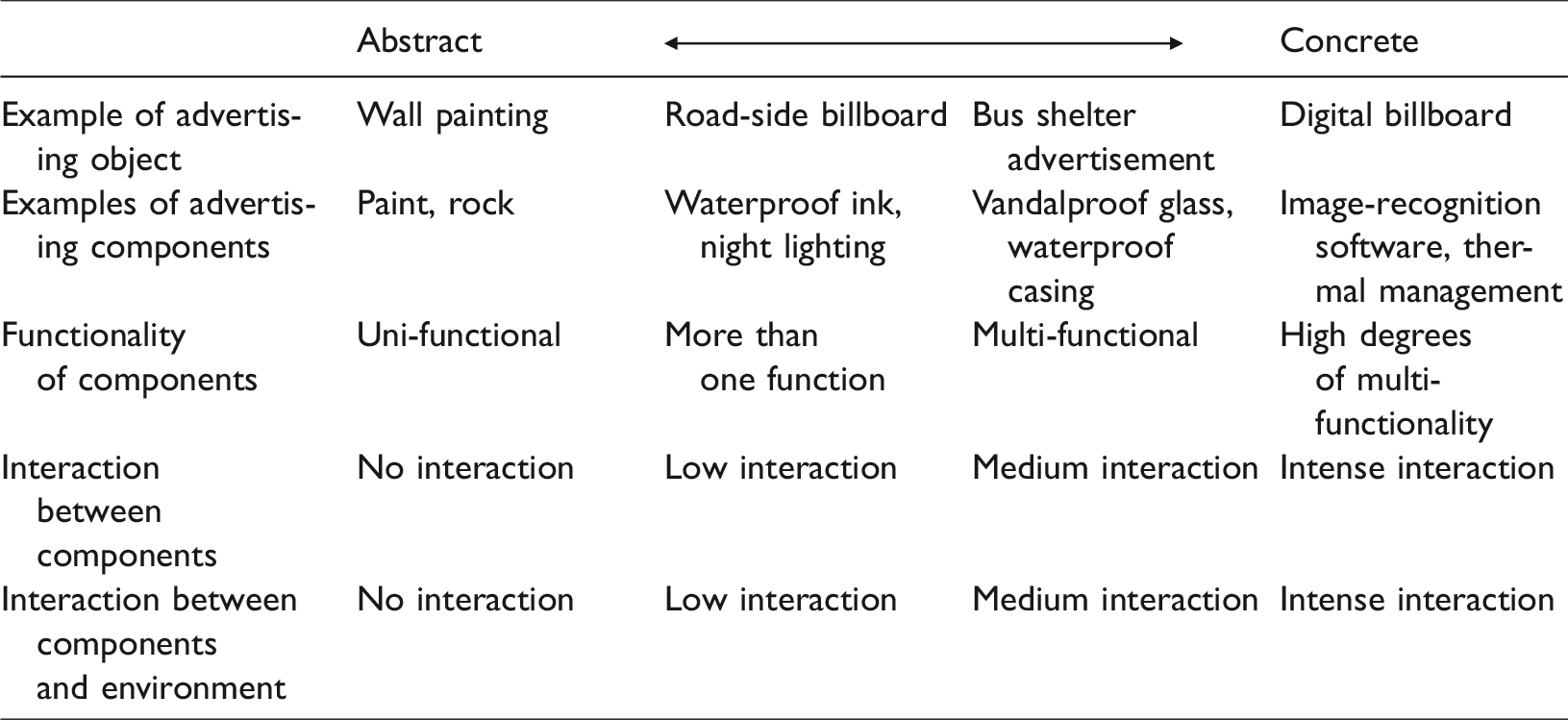

Concretisation signals a shift in an (advertising) object’s relation to its environment. This is not a case of becoming more ‘open’ to the environment per se, since a more ‘abstract’ outdoor advertising object (e.g. a billboard poster, a digital bus shelter advert without image-recognition) always held capacities for being affected by more-than-human forces. It is rather an instance of designing advertising objects that draw urban space into their actual functioning, flourishing and self-maintenance. As such, concretisation renders urban space ever more commercially compatible with advertising objects. In establishing a responsive relation to the incompatibilities of urban space, and therefore in becoming capable of aligning itself more carefully with the particularities of urban life, concrete outdoor advertising objects hold significant control over their affective affordance. More specifically, they attain greater control over how they affect passing bodies (avoiding indifferent bodies by drawing information of them into personalised advertising material), over how they are affected by resistant human bodies (in the form of undesirable and illegal advertising interventions) and disruptive non-human bodies (in the form of harsh weather conditions). To unpack this further, in the following section I investigate three particular technological advancements of the concretising outdoor advertising object, and how these resolve specific incompatibilities for the purpose of intervening into and facilitating more forcefully particular modes of thought, behaviour and affect: ones that propel away from indifference or resistance, and towards a particular commercial sensibility, the sharing of a brand story, the visiting of a website, a life lived differently.
The affective promise of concretisation
Image-recognition
In July 2016, car manufacturer Renault introduced image recognition hardware, software and code into its outdoor advertising campaign. As vehicles temporarily rested in front of traffic lights, the image-recognition technology scanned and identified license plates. The algorithms of image-recognition software, which it accessed through WiFi connectivity, then matched the numbers and characters with corresponding data derived from the Automated Number Plate Recognition database (as accessible through the United Kingdom’s Driver & vehicle Licensing Agency). Upon receiving this data, the image-recognition software brought up the make, model and colour of the relevant vehicle, and linked it to the relevant version of a series of pre-programmed advertising messages and images on a connected online platform. Together, these coded infrastructures – each of which hold, transfer and belong to variously composed materialities and energies – then translated this data into ‘personalised’ messages on a digital LED screen. This process was largely automated: little human oversight was required once the software and hardware were adequately pre-programmed and connected into a state of continuous communication, until something broke or the campaign ran to an end. The software-enabled image-recognition technology integrated external operations (such as installing posters, undertaking urban research) by bringing the environment into the technical structure of the advertising object, allowing it to fuel its own functioning.
While the majority of outdoor advertising objects globally currently still lack image-recognition technology akin to the one enrolled by Renault, many cities are starting to see the arrival of the technology on their streets and in their shopping malls (including New York, Seoul, Melbourne, Tokyo, London and Oslo). Across sixty-nine towns and cities in the United Kingdom, for instance, at least two thousand image-recognition-enabled advertising spaces populate the cities’ streets, 3 with many more advertising spaces available for short-term technological updates for image-recognition advertising campaigns.
The arrival of image-recognition technology signals a movement of concretisation for outdoor advertising objects. Through interaction with the camera, image-recognition software, WiFi-enabled content transmission and an online platform, the screen display of an image-recognition advertising object takes up new functions of displaying different types of content in a quick succession. As a more ‘abstract’ outdoor advertising object, a print billboard, for instance, holds components that are less multi-functional and less capable of interacting amongst one another. Such object remains incapable of resolving what the industry terms ‘wastage’ (Ocean Outdoor, 2016b). Wastage arises when an advertisement is not seen by the specified target audience: a billboard reaches people with the wrong gender, people in the wrong age-group, people with the wrong income, and so forth. If advertising media – including magazines and digital media (including social media advertising and Google advertising) – are able to target (by varying degrees) particular audiences on the basis of particular socio-demographic and psychological variables, then print-based outdoor advertising is generally considered a ‘mass medium’ in the sense that it holds this personalisation potential to the smallest degree (Cronin, 2010: 172). With limited levels of interaction between its components and with its environment, the print-based billboard is an abstract object that is indicative of outdoor advertising’s commonly high levels of wastage, and therefore, of its inability to establish far-going personalisation of commercial content on the basis of the particularities of urban bodies. The advertising encounter therefore remains tied up in what Georg Simmel terms the ‘blasé attitude’ of indifference, a state of ‘non-responsive disposition’ arguably characteristic of outdoor advertising encounters (and urban encounters more broadly) (Cronin, 2010: 82).
In response, image-recognition signals an attempts at making the outdoor advertising object more ‘responsive’ to the human bodies of the urban (Brown, 2017), not only by including the make and colour of cars driving past (as with the Renault campaign), but also by engaging the gender of passers-by, their age, and, with ‘mood-aware’ advertising objects, their emotional state (Ocean Outdoor, 2016a). In drawing out past and present individuations, bodies as ‘personal repositories of information’ (Sedano, 2016: 227) effectively become part of the functioning of the advertising object. In the case of the Renault billboard, it is past consumer habits that inform the displayed advertising content. In the case of a facial recognition bus shelter advertisement for another car brand (see Brown, 2017), it is one’s gender and age combined with one’s present gestures and facial expression (surprise, laughter) that determines which of a series of thirty pre-programmed advertising messages one receives. But how, exactly, does such responsiveness move towards reducing wastage? By opening up bodies’ susceptibility to being affected on at least two interrelated levels.
First, advertising content that responds to one’s particular ways of buying, acting, or feeling may trigger an encounter of surprise or astonishment. With print billboards, print bus shelters adverts, or with their digital equivalents without personalisation capacities, one might expect that a car advertisement speaks to a broad audience category (e.g. adventurous male, environmentally-conscious parent, hip young professional). It is commonly acknowledged within the advertising industry that such generic advertising content often fails to tear bodies away from their urban blasé attitude and from what the advertising planner Martin Weigel (2013) calls the ‘general indifference’ that marks their relationship to advertising. When this advertising content becomes adapted on what might feel like a personal level, human bodies experience a disjunction between what is anticipated (the generic) and what is perceived (the personalised). As such, personalised messages addressing passers-by with their name (Feder, 2007), 4 responding to their current mood (Brown, 2017) or noting the particular car they drive, cause astonishment among people (Koeck and Warnaby, 2014: 1415). The astonishment or surprise that emerges with unexpectedly experiencing affect that is personalised may shake the passer-by out of her urban blasé attitude and expand her willingness to pay attention to the advertisement. This is not to argue that it renders a non-susceptible person susceptible, but rather to recognise that through its various individuations, the body’s degrees of susceptibility are non-static and more or less open to technological modulation (see Bissell, 2009).
Second, once the encounter is marked by a certain level of attention, personalised content further expands a person’s susceptibility in becoming relatable. A print-based equivalent of the Renault campaign cannot distinguish between an existing Renault customer and a non-customer; between someone who recently bought a new sports vehicle, and someone who drives a twelve-year-old Peugeot; between an SUV driver and a sports vehicle owner. The differences are significant from an advertiser standpoint since they affect the way someone relates to the vehicle, brand and product category, and the way in which this affects how that person will (not) respond to particular promotional material. Having a sense of these differences helps an advertiser answer the following question: should the work outdoor advertising content undertakes be aimed at enhancing what the industry calls ‘brand loyalty’ or at triggering ‘customer acquisition’? As such, Renault’s image-recognition billboard shifts away from generically addressing passers-by to speaking directly and specifically to a particular consumer position with a tonality and message that is relevant to it.
Drawing on technologies of image-recognition is, however, not a simple case of establishing interaction between urban bodies and advertising objects where interaction lacked beforehand. The print outdoor advertising object lacking image-recognition components interacts with a passing body in terms of the social, geographical and cultural research that informed the particular campaign (see Cronin, 2006). We should instead speak of an expanded capacity to regulate the interaction between the advertising object and the human bodies specific to a certain urban environment, heightening the advertising object’s potential for affecting urban bodies along commercially-favourable paths.
Anti-hacking feature
As I have shown, the concretisation of outdoor advertising signals the semi-automatic integration of urban bodies into the advertising object’s functioning. This increases the advertising object’s control over how it affects human bodies. But concretisation further alters the object’s relation to its urban environment by extending the advertising object’s control over how it is affected by human bodies. As a designer and manufacturer of digital outdoor advertising screens, LG-MRI produces patented technological advancements to address what it refers to as ‘vandalism’ (LG-MRI, 2015a). The type of ‘vandalism’ they are particularly concerned with is the unauthorised sending of messages to the advertising display by artists, activists, and pranksters. One technological advancement addressing this illicit activity is a networked hardware-software patent titled ‘Visual Identifier for Images on an Electronic Display’. The technology involves a sensor that detects variations in light exposure. This light sensor is positioned in-between the display surface and the internal display assembly, allowing it to read a ‘unique identifier’. The unique identifier is generated by and embedded into the screened content by external software. If the expected light sensor data differs from the detected data, depending on the chosen software settings, it automatically transfers an electronic signal towards a centralised online platform to inform maintenance staff of inappropriate content who can, in response, perform a ‘remote power interrupt’ (OAAA, 2016), or more importantly, send a signal to the displaying device itself, informing it to shut down instantly. What this allows is not only a mechanism for determining whether video/images are displayed with the right format or colour calibrations, it can also, as the designers of the feature write, ‘be especially useful when trying to prevent tampering or “hackers” from sending unauthorized video/images to the display’ (Dunn et al., 2013: 5).
The latest models of the largest advertising display manufacturers each include their own anti-hacking features operating according to a similar logic of automated prevention. 5 Given the digitisation of outdoor advertising objects (replacing existing print-based advertising objects with digital ones, and installing new digital objects) that drives companies such as JCDecaux, Exterion Media and Clear Channel (see Wilson, 2018), anti-hacking technologies such as LG-MRI’s are likely to become standard practice in the outdoor advertising industry. This is important as it considerably reduces the potential for material incompatibility in the form of what the industry calls vandalism and what scholars, less derisively, term ‘subvertising’ (Bearder, 2012; Klein, 1997).
Subvertising refers to a series of unsolicited material interventions into advertising space by human actors, including spray-painted messages, destruction, stencilled images, stickers, acts of sabotage, removed advertising posters, hacked digital billboards and the installation of political posters. LG-MRI’s ‘Visual Identifier for Images on an Electronic Display’ marks the latest addition to a long history of anti-subvertising methods. Directly accessible to passers-by, print billboards were and are highly prone to graffiti interventions, stickers or even illicit installations of billboard-sized posters. One of the few anti-subvertising methods available was to wrap the ladders of billboards installed high up into ‘anti-climbing devices’ (Zukin, 2017). With bus shelter advertising arrived more anti-subvertising options, including vandal-proof glass (making it easy to remove spray paint (Iveson, 2012) and hard to wreck the glass) and locking mechanisms (making it less easy for subvertisers to remove posters or install their own). Sparked by the realisation that ‘a successful cyber-vandalism attack against a digital billboard will be very apparent’, ‘will have a financial impact to operators or agencies who own any attacked billboard’ and will ‘also generate unflattering publicity’, the digitisation of billboards and bus shelter advertising further accelerated the industry’s interest in anti-subvertising methods (OAAA, 2016). National trade associations (OAAA, 2016), outdoor advertising companies (Signkick, 2017; Times OOH Media, 2016) and individual outdoor advertising professionals (Ripp, 2016; Zukin, 2017) are therefore suggesting new methodologies for avoiding unauthorised texts and images from being displayed on the advertising object, including secured physical structures and internet-based security protocols.
The history of anti-subvertising features does not only reveal an expanding list of options, but a transformation in the relation between advertising object and resistant bodies in urban space. The anti-hacking technological components of print-based (and some digital) advertising objects are limited by their abstract qualities, and more specifically, by their limited capacity to establish interaction with the environment and with other components in the advertising object. Because they are insensitive to subvertising activity (in the sense of lacking technological capacities for registering them), they miss the ability to notify outdoor advertising staff when unauthorised access has been gained, let alone the capacity to automatically shut down the digital object or restore the original content. For instance, with a subvertised bus shelter object, an outdoor advertising company is dependent on its maintenance crews for detecting and removing subvertising traces such as stickers, illicit posters and spray paint, which are often left untouched for days and weeks. With the LG-MRI anti-hacking feature, multiple components of the concrete advertising object (light sensor, unique identifier, internet-linked software, and electronic display) interact with one another on a primarily automated level to minimise the interruption caused by unauthorised access. Further delimiting the time an advertising object remains outside of the grasp of anti-hacking prevention, door alarms and trespass cameras are installed to automatically shut down the advertising object upon registering unauthorised access (OAAA, 2016). If a subvertiser were even able to physically gain access to the billboard site and break into the internal monitor unnoticed, then with the LG-MRI technology the subvertiser’s unauthorised content would unlikely be displayed for longer than a few seconds. The rhythms of advertising content automatically return to their everyday routines. Here, subvertising fails to leave a mark, leaving the subvertiser frustrated, and the advertising space seemingly contestation-free in the eyes of passers-by. The anti-hacking feature thus hopes to steer thought, perception, and behaviour away from the realm of subvertising and into the world of consumption. Together then, these automated anti-hacking features mark a concrete advertising object that is self-sustainable by becoming sensitive and responsive to resistant subvertising actors on an almost ‘real-time’ basis, directly transforming commercially incompatible relation between advertising object and subvertising activity into ‘new compatible orders of material relation’ (Lapworth, 2016: 136).
Thermal management system
Manufacturers of outdoor advertising objects are developing methods for dealing with, amongst other non-human forces, extreme temperatures affecting the hardware and software of its digital outdoor advertising objects. 6 LG-MRI (2015b) designed a thermal management system that automatically transfers heat out of the advertising infrastructure before it builds up. The CoolVu hardware mechanism operates through two ‘flow paths’, one which is sealed off from air flows and passes through essential components of the advertising object, and another which channels air coming in through an aperture. These two flow paths are connected only through a ‘heat exchanger’, which allows the first flow path to release temperature into the second one, with the latter then carrying the heat outside of the advertising infrastructure. Fans control the temperatures of the first flow path, and push heated air out of the second flow path. As such, CoolVu automatically excludes the advertising object from the pejorative effects of extreme temperatures arising from the environment.
As with the anti-hacking feature, this is not a case of circumventing a force in urban space as such, but rather of developing a technological component that allows this force to be regulated so that it intersects with the advertising object along a desirable path. The technological component takes one dimension of weather conditions (wind flows) to render non-resistant another (temperature). Through this renewed relation, air flows are effectively ‘integrated into the functioning of the whole’ (Simondon, 2017: 39), allowing the ongoing endurance of the advertising object without the need for human intervention. A more abstract digital outdoor advertising object without thermal management system is much more vulnerable to forces that destabilise its functioning in a way that is commercially undesirable. When such advertising object undergoes a prolonged exposure to high temperatures, it either shuts down and fails to display any content (what the industry calls ‘downtime’, Williams, 2011) or it continues to function but the screen display is visually distorted (blackened, whitened, skewed). An advertiser’s content is then either not shown at all or it is shown in a fashion that associates the advertiser with a broken piece of technology (Williams, 2011). The problem for advertisers is not only that these two issues occur, but that they persist ‘for long periods before anybody notices, and all that time the screen is losing money’ (Williams, 2011). On top of this, they also enact lasting material damage, causing the rapid deterioration of the materials that make up the screen (Williams, 2012). Incapable of self-sufficiently engaging urban space along a path that neutralises these dangers of temperature excess, the more abstract digital outdoor advertising is heavily reliant on human maintenance. In interacting with the urban environment in a way that integrates it, CoolVu promises the self-sufficient prevention of screen downtime, screen distortion and lasting screen damage.
But other thermal management systems go further in their insistence on the outdoor advertising object’s self-sufficiency. Rather than offering purely hardware-based solutions to issues due to extreme temperatures, they establish internet-connected networks of hardware and software. The digital outdoor advertising manufacturer Amscreen, for instance, developed a technological feature called Smart Environmentals (Amscreen, 2016c). This thermal management system is composed of ‘Environmental Sensors’ which are sensitive to and register – amongst other variables arising from urban space – air temperature and humidity (Amscreen, 2016a, 2016b, 2016c). Connected through wireless internet connectivity to a central online platform, these sensors provide a constant overview of the general functioning of an outdoor advertising company’s network of advertising objects and of the individual components that compose the individual advertising objects in that network. If the hardware solution ceases to be capable of (or signals that it might soon become incapable of) responding to extreme temperatures in a fashion that allows the ongoing functioning of the advertising object along lines that are commercially compatible (e.g. the display panel drops beneath its minimum operating temperature), then outdoor advertising staff receive an automated update requiring either, depending on the particular failure, a remote software response or a visit by maintenance staff (Amscreen, 2016a). Decreasing the need for physical check-ups and maintenance repairs, Smart Environmentals thus expands the autonomy of outdoor advertising objects from how it merely tries to prevent issues with extreme temperatures (as with CoolVu) towards how it recognises and resolves them when they do occur. As such, it regulates both how and for how long the advertising object is affected by the nonhuman incompatibilities of urban space. From this perspective, the outdoor advertising industry not only resolves incompatibilities with its environment to open up bodies’ susceptibility to advertising content (as with image-recognition technologies), it is also increasingly concerned with resolving resistant affects, human and nonhuman, orienting them away from damaging individuations that intervene into and destabilise the commercial dreams of advertisers.
Conclusion
In this final section, I briefly reflect on the extent of the effects technological advancements have on the relationship between urban space and outdoor advertising. In this paper, I have sought to move beyond conceptions of outdoor advertising in terms of its causal, unitary relations to the city, instead paying attention to outdoor advertising as complex, situated encounters unfolding within particular spatial and temporal environments. Making this movement, I have followed those recent accounts of advertising in urban space concerned with people as variously susceptible to external stimuli (Sedano, 2016; Young, 2014) and with urban materialities as dynamic, unpredictable contributors to the advertising encounter (Cronin, 2010; Rosa, 2015). However, I have intervened into these debates in two inter-related ways. First, I suggested that beyond acknowledging the human and nonhuman situatedness of urban space, we need to further consider the particular technological components that co-constitute situated advertising encounters. Second, and related, I argued that the unavoidable excess, unpredictability and complexity that marks the situatedness of urban space should not be taken as a sufficient conceptual endpoint to discussions on urban advertising’s efficacy. 7 Taking exactly excess as their field of intervention, technological advancements beg us to dig deeper. They work away urban messiness by integrating it into their functioning in a fashion that enacts more susceptible human bodies. But technological advancements are not merely enrolled to expand advertising’s capacity to serve its central intention of bringing in human bodies into circuits of consumption. They are equally concerned with producing self-stabilising advertising objects capable of integrating and dissolving resistant urban forces. This double intentionality to control how the advertising object affects and is affected, I have suggested, conveys a shift in advertising’s relation to urban space, one that integrates urban space by becoming more sensitive and responsive to, amongst other forces, passing people, subvertising actions and high temperatures. This shift in relations to urban space is politically compelling: outdoor advertising becomes more proficient at pushing bodies along paths that lead to profitable ways of relating to certain products, brands, people, images, words, ideas. But how far do the effects of technological advancements travel? Can they be pre-determined and performed along a straightforward, narrow path?
Using absolute phrasings such as ‘zero wastage’ (Ocean Outdoor, 2016b), ‘zero maintenance’ (LG-MRI, 2015b) and ‘extreme durability’ (LG-MRI, 2018) to describe the qualities of technological advancements, the industry itself is, unsurprisingly, keen to promote the inimitable efficacy of its new methodologies to personalise advertising content and to protect against disruptions. Some scholars take advertisers’ self-promotional blurbs for facts. Bernard Stiegler, for instance, declares in his up-take of Simondon’s philosophy that recent ‘psychotechnologies’ of advertising are qualified to ‘synchroniz[e] individuals' activities into mass behaviors motivated by business plans’ (Stiegler, 2010: 38; Stiegler, 2015). Left out here in this statement, however, are two dimensions central to Simondon’s notion of concretisation that complicate a narrow, non-situated conception of advertising’s effects. Advertising effects are simultaneously more limited, and more excessive.
First, as Dodge and Kitchin note (2005: 178), concretisation cannot but effectuate partial solutions to problems of incompatibility: maintenance staff fall ill, network failures take down security, passers-by remain indifferent, and so forth. With the Renault billboard, for instance, a rich and important swath of social, cultural, mental, material and economic dimensions that influence the driver’s susceptibility remain outside of the grasp of image-recognition technology: what is the passer-by thinking or desiring at this very moment? Where is she or he coming from? Did she or he just lose their job or gained purchasing power? Are they hungry or cold? Even where a certain compatibility between object and environment is established, the commercial messages are pre-loaded into the image-recognition software and triggered not on a fully individualised basis, but on the grounds of shared characteristics grouped into profiles (each of which, in turn, rely on an assumed understanding of the effects of certain socio-demographic variables). Drivers are only given ‘the impression that the system is responding to them personally’ (Stiegler, 2011: 4).
Second, technological advancements unavoidably enact unforeseen effects. An invention, Simondon suggests, ‘is initiated concerning a problem; but the effects of invention are more than just resolving the problem’ (Simondon, cited in Hui, 2016: 103). Technological advancement always yield unexpected relations of incompatibility and compatibility, creating new problems on its paths. As such, heightened interactions amongst components of an object and between those components and the environment opens up new paths into a critical space for intervention. From this perspective, paying attention to technological advancements does more than reveal the complex, intimate interactions between technologies, spaces, times and bodies that co-constitute contemporary outdoor advertising power. It is also a method for intervention: getting closer to technological advancements allows us to identify unforeseeable, politically-fertile entanglements that could be exploited. For instance, if multiple advertising objects connect through online connectivity into a software-enabled control hub, then successful subvertising destabilisations of this site or an essential layer of connectivity – through for instance an act of social engineering (see Tottenkoph et al., 2008) – can affect a high range of outdoor advertising objects simultaneously, on a scale much greater than that afforded by print billboards and bus shelter spaces. Technological advancements therefore render advertising objects simultaneously more effective and more susceptible. Félix Guattari (2013: 27) writes: New technologies foster efficiency and madness in the same flow. The growing power of software engineering does not necessarily lead to the power of Big Brother. In fact, it is way more cracked than it seems. It can blow up like a windshield under the impact of molecular alternative practices. (Guattari, 2013: 27)
Footnotes
Declaration of conflicting interests
The author(s) declared no potential conflicts of interest with respect to the research, authorship, and/or publication of this article.
Funding
The author(s) received no financial support for the research, authorship, and/or publication of this article.