







Abstract
Optimists contend that crowdfunding, in which project backers use online campaigns to assemble numerous small donations, can democratize access to finance, but there are legitimate concerns that this funding approach remains discriminatory. Drawing on recent readings emphasizing the geographic components of Bourdieu’s field theory, we argue the relationship between crowdfunding teams’ resources and crowdfunding success is mediated by spatial capital—the ability to draw capital from other social spaces due to geographic context. We use logistic regressions predicting success rates for 134,098 campaigns launched in the USA on the Indiegogo platform between 2009 and 2015, combined with other spatial data, to model the relationship between spatial capital and other success predictors. Our models suggest spatial context mediates the relationship between resources and success. Rural areas, in particular, have lower success rates than urban areas, and affluent areas have the highest success rates. Given that only around 10% of Indiegogo campaigns are fully funded, spatial inequalities place significant limits on who can benefit from crowdfunding campaigns, suggesting crowdfunding may not democratize access to finance, as optimists hope.
Introduction
Some writers expect the “platform economy” to democratize socioeconomic relations (Stevenson et al., 2019); others warn it can create new types of exploitation and exclusion (Ettlinger, 2016). The degree to which these new technologies disrupt—or reinforce—previous economic geographies thus represents an important emerging question. In order to address this question, we utilize the case of crowdfunding in the USA, where crowdfunding platforms represent an increasingly common source of innovation finance. These platforms, where project developers tap numerous small backers to support a campaign (Belleflamme et al., 2014), 1 are sometimes held up as democratic access to economic capital (Sorenson et al., 2016). Yet in spite of this there is evidence that racial hierarchies (Younkin and Kuppuswamy, 2018), personality and linguistic habits (Davidson and Poor, 2015; Mitra and Gilbert, 2014; Parhankangas and Renko, 2017), and spatial biases (Agrawal et al., 2015; Guenther et al., 2018; Lin and Viswanathan, 2016; Mollick, 2014) shape campaigns’ successes in ways familiar to venture capital (VC). Extant quantitative geographic research, however, generally addresses only whether or not people prefer local crowdfunding campaigns over more distant ones (e.g. Agrawal et al., 2015; Guenther et al., 2018; Lin and Viswanathan, 2016; Mollick, 2014), despite that qualitative studies suggest crowdfunding could reinforce spatial inequalities (Bieri, 2015; Langley and Leyshon, 2017a).
A charitable reading of crowdfunding optimists’ claims might be that it helps people monetize resources ignored by traditional VC markets (Brown et al., 2018; Langley and Leyshon, 2017a; Mollick and Robb, 2016), changing what can function as capital. Bourdieu’s (1986, 1990a, 1990b; see also Bourdieu and Wacquant, 1992) social field theory and its spatial extension, elaborated in particular by Loïc Wacquant (2008; Wacquant et al., 2014; see also Bourdieu, 1999), is helpful here, as it provides a general model for how particular attributes can be mobilized as capital in specific social contexts. In Bourdieu’s model of capital, different social contexts, which he calls social spaces, 2 allow people to use different resources as capital to get what they want, and which resources serve as capital depends on the social space (Bourdieu, 1986). While geographers often find Bourdieu’s account of space lacking (Cresswell, 1996, 2002; Painter, 2002), we draw on more recent readings to develop field theory’s engagement with geographic space. 3
Field theory reframes crowdfunding’s inclusiveness as a question of, first, whether the resources serving as capital in crowdfunding differ from those driving VC finance and, second, what geographies emerge from these resources’ distribution. Using data documenting crowdfunding campaigns on Indiegogo, a large reward-based 4 crowdfunding site, we find that resources that serve as capital on the platform are unevenly distributed and spatially contextual. Indiegogo presently is insufficiently autonomous from dominant social spaces to avoid reproducing extant economic geographies.
We first outline our approach to Bourdieu’s field theory and, following this, discuss how this model intersects with other geographic discussions of crowdfunding and financial geographies more broadly. We then explain the data and methods we use to model success on Indiegogo before presenting our results. We conclude with a reflection on what must, at a minimum, be done to improve crowdfunding’s inclusiveness.
Social spaces and crowdfunding
Bourdieu’s field theory turns on three key intertwined concepts: habitus, social space, and capital. Capital is “a collection of goods and skills, of knowledge and acknowledgements” that one “can mobilize to develop influence, gain power, or bargain” (Neveu, 2018: 1–2; see also Bourdieu and Wacquant, 1992: 97). A social space is one of many broad social contexts, like education, the economy, or the state, featuring distinct social practices and relevant forms of capital. Writers (Bourdieu included) often use the closely related term “field” to refer to any social space with established hierarchies in which groups compete for social goods or status (Spigel, 2017; Wacquant, 2018b). Habitus, finally, are “systems of durable, transposable dispositions” to respond to social situations in particular ways (Bourdieu, 1990b: 53), learned by trial and error over time but generally reflecting one’s class origins (Bourdieu, 1990a: 11, 1990b: 13; Wacquant, 2016).
Geographers often discuss habitus (Casey, 2001; Cresswell, 2002: 381; Holt, 2008; Thrift, 2008: 115, 129–131) but less frequently social space or capital (Hadjimichalis, 2006; Holt, 2008; Ley, 2003; Spigel, 2017). As Spigel (2017) demonstrates, however, the latter two concepts are critical to Bourdieu’s account of how habitus connects to broader contexts. Bourdieu’s (1990a: 21) social spaces are a “plurality of worlds” where people engage in social action. Historical struggles produce boundaries between and hierarchies within and across these domains, which are so diverse that researchers must model them empirically on a case-by-case basis (Bourdieu and Wacquant, 1992: 100). Actors construct more encompassing social spaces from existing ones, which may continue to exist within them, creating a complex net of interconnected social spaces (Bourdieu, 1998: 104–105, 2005: 6–13).
Hierarchies reflect differential access to capital (Bourdieu, 1990a: 101, 2000: 102–105), but what counts as capital varies across social spaces (Bourdieu, 2000: 102–105). As Bourdieu (1998: 112) provocatively puts it, “For Duchamp to be Duchamp, the field had to be constituted in such a way that he could be Duchamp” (Bourdieu, 1993: 35–36, 111; Bourdieu and Wacquant, 1992: 94). Interconnections between diverse social spaces can provide a way for people to leverage different kinds of capital to further their ends. From any individual’s perspective, the social spaces in which they engage form a “space of possibles capable of orienting their expectations and their projects” (Bourdieu, 2000: 116). What is possible or advisable for any given individual depends on what is possible for all others, and these possibilities, in turn, depend on what sorts of characteristics, resources, and social positions serve as capital in interconnected social spaces (Bourdieu, 1990a: 161).
Field theory complements Langley and Leyshon’s (2017a) financial ecologies account of crowdfunding. Like field theory, Langley and Leyshon (2017a) frame diverse forms of crowdfunding as semi-autonomous domains, or ecologies, within global capitalism, an account of economic life developed in Leyshon et al. (2004, 2006) and elsewhere. Leyshon et al. (2004, 2006) use the ecological metaphor to deconstruct large-scale economic systems into everyday practices, which the authors study through close observation. This approach helps trace how these systems function, identify intervention points where changes could improve people’s lives, and clarify how people enact different economic subjectivities (Coppock, 2013; Hall, 2011; Langley, 2008). Beaverstock et al. (2013), for example, study the emerging private wealth management ecology in the UK, an elite space with its own rules and procedures (Harrington, 2016) that nevertheless exists due to its connection to London, in particular, as a key geographic center for individuals of high net worth.
Field theory differs from financial ecologies, however, in emphasizing how the interconnections between diverse social spaces affect people’s ability to use capital generated in one social space to affect another. Not only are there diverse forms of finance, but finance, as one social space among others, is relationally constituted. Using field theory’s conceptual toolkit, the optimists’ case might be expressed as a claim that crowdfunding allows new types of skills and resources to serve as capital, allowing them to be converted into economic capital through crowdfunding pledges, which then could be invested in other social spaces. Crowdfunding could thus be a novel and potentially equitable social space, focusing more on values than the bottom line (Allison et al., 2015; Gerber and Hui 2013; Mollick and Robb 2016) and creating novel financial geographies alongside VC (Stevenson et al., 2019). For skeptics, conversely, crowdfunding’s social space “functions with the apparent impartiality of a chance drawing that is actually systematically biased” (Bourdieu, 1996: 288), allowing people to use capital already valued in dominant social spaces to support further accumulation (Bourdieu and Wacquant, 1992).
Forms of capital and geographic space
One reason geographers have been less interested in Bourdieu than have researchers in other disciplines is that he discusses space “in an almost entirely metaphorical way” (Cresswell, 1996: 236) in his most-cited writings. Though his account of geographic space is underdeveloped, Bourdieu (1999, 2018) nevertheless argues that social spaces shape geographic space, with people low in capital excluded from prestigious and beneficial geographic spaces (Bourdieu, 1999, 2018). Reciprocally, geographic spaces shape social spaces. “Proximity in physical space,” Bourdieu (1999: 127) argues, “allows the proximity in social space to deliver all its effects by […] fostering the accumulation of social capital.” Reflecting on these points, Wacquant (2018a: 96) argues that “social distance and power relations are both expressed in and reinforced by spatial distance.”
Several studies have used the concept of spatial capital to translate Bourdieu into a geographic context (Mace, 2017). While capital differs across social spaces, Bourdieu (1986) argues three fundamental forms of capital emerge in most fields. First, cultural capital involves possessing habitus that includes valuable skills or a demeanor to which others often defer (Bourdieu, 1990b). Just as some social habits facilitate access to high-powered professions (Cook et al., 2012; Faulconbridge and Hall, 2014; Harrington, 2016; Spigel, 2017), reputation and language use affect crowdfunding campaigns’ success (Agrawal et al., 2014; Mitra and Gilbert, 2014; Parhankangas and Renko, 2017). Second, social capital arises from access to groups with capital to mobilize for one’s own ends (Bourdieu, 1986). Thus, social media contacts (Mollick, 2014) and networking on the platforms themselves (Colombo et al., 2015) support crowdfunding campaigns’ success. Third, economic capital is simply wealth (Bourdieu, 1996, 1998, 2005).
Spatial capital extends these basic forms. Huang et al. (2018) and Sen and Quercia (2018) conceptualize spatial capital as a location’s access to desirable resources and activities. Forsberg (2019), in contrast, makes it a property of people, rather than locations, incorporating predispositions to mobility as a second dimension of the concept. Others use spatial capital to designate the way power in social spaces affects geographic patterns (Mace, 2017). As Mace (2017) points out, however, the ways geographic space functions as capital depend on how it is connected to various social spaces, so spatial capital interweaves with other forms of capital active in other social spaces. Mosselson’s (2019: 12) conceptualization is similar, using spatial capital to refer to “the ability to engage with day-to-day realities of a space and understand its inner workings and multiple worlds.”
In contrast to definitions of social capital based primarily on accessibility, Mosselson (2019) invites us to consider connections between qualitatively distinct social spaces, such as education and work, via geographic space. These kinds of relationships emerge in several studies demonstrating that habitus and capital affect urban geographies, as people consume urban space in part due to expected benefits in terms of both cultural and economic capital (Boterman, 2012; Bridge, 2006; Galster and Turner, 2017; Hochstenbach, 2018). On a grander scale, Pan et al. (2016) find that Beijing and Shenzhen are much more well positioned than Shanghai in VC terms, suggesting that access to important sites in China’s political field factor into locational decisions.
There are several reasons to expect spatial capital to affect crowdfunding geographies. In principle, crowdfunding is a knowledge sector, subject to agglomeration economies and information-sharing benefits (Huggins and Thompson, 2017). VC firms in the USA, for example, agglomerate in San Francisco, Boston, and New York (Chen et al., 2010). Concentration tends to persist over time (Mason and Harrison, 2002) and, in the USA, appears to be increasing (Medcalfe and Thompson, 2017). Indeed, as Langley and Leyshon (2017a: 1032) argue, “crowdfunding ecologies would actually seem to depend on the intersections of digital networks and place-based clusters.” Home bias, the tendency for crowdfunding funders to direct pledges to local campaigns, is a good example (Lin and Viswanathan, 2016). Because of home bias, campaigns launching in more affluent areas should have higher success rates. Furthermore, Rodriguez-Ricardo et al. (2018) report that individuals with strong desires for interpersonal connectivity and to help others are more likely to support crowdfunded campaigns. Combined with home bias, this means areas with higher levels of social cooperation should be more likely to support crowdfunding campaigns.
Methods
While Kickstarter is widely studied (Mollick, 2014; Parhankangas and Renko, 2017; Younkin and Kuppuswamy, 2018), the second-largest crowdfunding platform, Indiegogo, has received less attention (e.g., Copeland, 2015; Stadler et al., 2014; Stern, 2013). This is unfortunate. Differences in rules and procedures across platforms can affect who benefits from crowdfunding (Hornuf and Schweinbacher, 2018; Stadler et al., 2014). Like Kickstarter, Indiegogo is a reward-based system; individuals pledge money, and if the campaign is successfully funded, they receive a tangible reward—a product or service (Indiegogo, 2016). The platform differs from Kickstarter in a critically important way: It allows campaigns to accept funds even if they do not reach their funding goal. This model, which Indiegogo refers to as flexible funding, lowers the bar for receiving benefits from the market, making the platform potentially more inclusive than its peers. Indeed, comparing the two platforms directly, Stadler et al. (2014) find Indiegogo to exhibit a more even distribution of pledges across campaigns than Kickstarter, where pledges tend to cluster around 0% or 100% of the goal. Evidence of substantial inequalities here, therefore, should be particularly troubling.
We use logistic regression to analyze the relationship between capital and success on Indiegogo, but we apply it in a way more reflective of field theory’s relationality. In addition, we use our models for a counterfactual analysis clarifying how spatial capital shapes Indiegogo’s field-specific cultural, social, and economic capital’s relationship with crowdfunding success.
Data and variables
We acquired data on campaigns launched on Indiegogo on or after April 6, 2009, and completed by February 26, 2015, from Innovacer, a web-data firm (Innovacer, 2016). The data consist of all publicly available pages on the site during this time period, scraped in accordance with Indiegogo’s terms of use, as verified independently by the authors in direct communication with Indiegogo representatives. While Indiegogo campaigns are found around the globe, we use data only on the USA due to the availability of spatial capital measures.
Our primary dependent variable is whether or not a campaign is fully funded—in other words, whether or not the funding received meets or exceeds the campaign goal. We take meeting the campaign’s stated requirements as a clear indicator of success. This is a rare event, occurring for only 8.5% of campaigns with complete data.
Each campaign page includes location information. In the USA, this is usually at the level of the city or the zip code. As they are entered by individuals, however, locations are non-standard. Using text processing in R 3.5.0 (R Core Team, 2018), we standardized the locations and then geocoded them using the Texas A&M Geocoder (Texas A&M Geoservices, 2015). Since some location information was missing, ambiguous, or referred to multiple locations, not all campaigns could be successfully geocoded. Following Mollick (2014), we further restricted our analysis to campaigns seeking a consequential but realistic goal, in our case at least US$1000 and no more than US$1 million, resulting in a total of 134,098 campaigns with complete data geocoded at the subcounty division or city level, approximately 42.5% of the 315,882 campaigns for which data were scraped, or 67.7% of all 197,950 campaigns with funds denominated in US dollars.
Logistic regression models
We modeled whether or not campaigns reached their funding goals using logistic regression. Concerned that heteroskedastic errors might result from non-normally distributed independent variables, we decided to use a bootstrapping method to compute clustered standard errors, described in the Supplemental Material. We conducted all computations in R 3.5.0 (R Core Team, 2018). For each model, we computed the area under the receiver operating characteristic curve (AUC), which measures improvement in classifying outcomes using the model predictions, with perfect prediction scoring 1 and random chance 0.5. We used ggplot2 (Wickham, 2009) and tmap (Tennekes, 2018) to create figures aiding model interpretation.
To investigate field-specific cultural capital, we used Indigogo’s unique user IDs to create a list of all campaigns in which each crowdfunding team member registered on the site participated. Using this list, we computed for each campaign the total number of other campaigns in which at least one team member had participated at the time the campaign was launched (Prior Campaigns). Because habitus is tacit knowledge, we selected a measure of field-specific experience as an indicator of cultural capital. In addition, as an indicator of reputation, we computed the number of these prior campaigns receiving full funding (Funded Prior Campaigns).
To investigate social capital, we calculated, first, the total additional campaigns a given campaign’s team members worked on in the year the campaign in question was started and the year prior. This provides a measure of a given team’s level of connectivity within the community of teams launching campaigns on Indiegogo. Focusing on the platform itself, the measure identifies social capital specific to Indiegogo as a field. Adopting the terminology of social network analysis, this is the team’s degree in the network of connections between campaign teams. For estimation purposes, we calculated this measure’s natural logarithm (Teammember Degree (ln)).
As a measure of field-specific economic capital, we used the natural logarithm of the total size of the campaign team, as reflected on the campaign page (Team Size (ln)). 5 We consider this a measure of field-specific economic capital because larger teams imply more person-hours and greater capacity to deliver, regardless of these members’ social networks.
We used two primary measures to investigate spatial capital. First, we estimated the median income within a 5 km radius of each campaign’s geocoded location by aggregating block-level 2010 US Census data (Minnesota Population Center, 2011) within 5 km circular buffers using an approach explained in more detail in the Supplemental Material, producing the variable Median Income (ln). Second, we used the Northwest Regional Center for Rural Development’s county-level social capital index (Rupasingha and Goetz, 2008), which provides an aggregate indicator of a range of types of organizational and social engagement, to measure cooperation in the community at large, assigning campaigns the social capital score of the county where they launched (Social Capital). To be clear, this measure does not reflect social capital in Bourdieu’s sense, but rather community features that, combined with home bias, should support local crowdfunding success.
In addition to these key variables, we calculated measures of neighborhood context as controls. First, to model the geography of Indiegogo campaign markets, we constructed two variables using inverse distance weighting to estimate the local intensity around each campaign of funded campaigns (Funded in Region) and campaigns in the same Indiegogo category (Same Type in Region; see Supplemental Figure 1 for the distribution of types) launched in the current and previous year around each campaign. We selected appropriate decay terms for the weighting by estimating several models using different weights and selecting the model with the highest AUC. For interpretability, we scaled these values in standard deviations by subtracting the mean value and dividing by each variable’s standard deviation. Further details can be found in the Supplemental Material.
We also included three additional control variables for the 5 km circular buffers around campaigns: total population (Total Population (ln)) and the percentage of non-white population (Non-White Population (%)) as recorded in the 2010 US Census, as well as the percentage of the population between 18 and 39 years old (Population 18–39 (%)), as recorded in the 2006–2010 American Community Survey five-year estimates (Minnesota Population Center, 2011). As with median income, we aggregated these variables to 5 km circular buffers using a technique described in the Supplemental Material. Because campaigns seeking higher dollar amounts are necessarily less likely to be funded (Barbi and Bigelli, 2017), we controlled for the natural logarithm of the campaign goal, in US dollars (Campaign Goal (ln)). We also estimated separate intercepts for campaigns with a Team Member Degree of zero (Isolate), and those using flexible funding (Flexible Funding). Finally, we estimated fixed effects by campaign type and campaign launch year. Summaries of all variables used in modeling are presented in Supplemental Table 2.
While the logistic regression model helps us picture relationships in the emerging Indiegogo field, field theory reminds us that considering the variables individually can obscure our model’s practical implications. To provide a clearer picture of how spatial capital interacts with field-specific capital’s association with success on Indiegogo, we visualized the estimated associations between capital and success, conditional on spatial capital. First, we grouped campaigns into different types of neighborhoods based on the values of their Median Income (ln), Social Capital, Total Population (ln), Non-White Population, and Percent 18–39 variables using finite mixture models as implemented in the mclust package (Scrucca et al., 2017). This approach allowed us to use the Bayesian information criterion (BIC), which measures model fit with a penalty for additional model terms, to select an appropriate number of clusters. We estimated models with 2–10 clusters, selecting the number of clusters beyond which there was no substantial improvement in the BIC. Supplemental Figure 3 presents the distributions of modeled variables for each of the four neighborhood categories we identified with this technique.
To examine the relationship between spatial context and measures of capital, we first estimated separate logistic regression models for each of the four neighborhood categories. Finding substantively important differences in the estimated coefficients across these categories (see Supplemental Figure 4), we then estimated a logistic regression model in which we interacted all the variables with the neighborhood categories. Using this model, we computed the predicted probability that each campaign would be funded, if its value on each of a selection of our most important variables were fixed at the 50th, 75th, 90th, and 99th percentile values of the respective variable. The distribution of predicted probabilities across these simulated values, grouped according to the neighborhood categories, shows how the model estimates capital to be associated with crowdfunding success, conditional both on common neighborhood characteristics and the distribution of the other modeled variables.
Results
Funding on Indiegogo is very uneven. While the vast majority of campaigns fail to reach their targets, and the bulk attract less than 50% of requested funds, a few campaigns receive significantly more pledges than requested. In the modeled data, the top 10% of campaigns by pledge receipts account for nearly 80% of funds pledged to campaigns in the sample, with campaigns in the decile below accounting for the majority of the remainder (see Supplemental Figure 2).
Figure 1 visualizes changes in the predicted probability that a typical campaign is fully funded across the ranges of the key variables of interest in our best-fitting logistic model. With one exception, all the measures of capital used in the model are positively associated with funding success with high confidence. Notably, while the number of prior funded campaigns to which a campaign team is connected has a strong, positive association with success, the total number of prior campaigns to which they are connected has a negative association. 6 Overall, however, field-specific economic, social, and cultural capital manifest as large, well-connected teams with experience on successful campaigns is strongly associated with success. Across these variables’ ranges, we estimate the effect to be rather more sizable than the effect across the range of Median Income (ln) and Social Capital, our spatial capital variables, for a typical campaign. Nevertheless, the spatial capital variables appear to have substantively meaningful associations with success, associated in the scenario above with approximately a doubling of the probability of funding success for a typical campaign across their ranges.
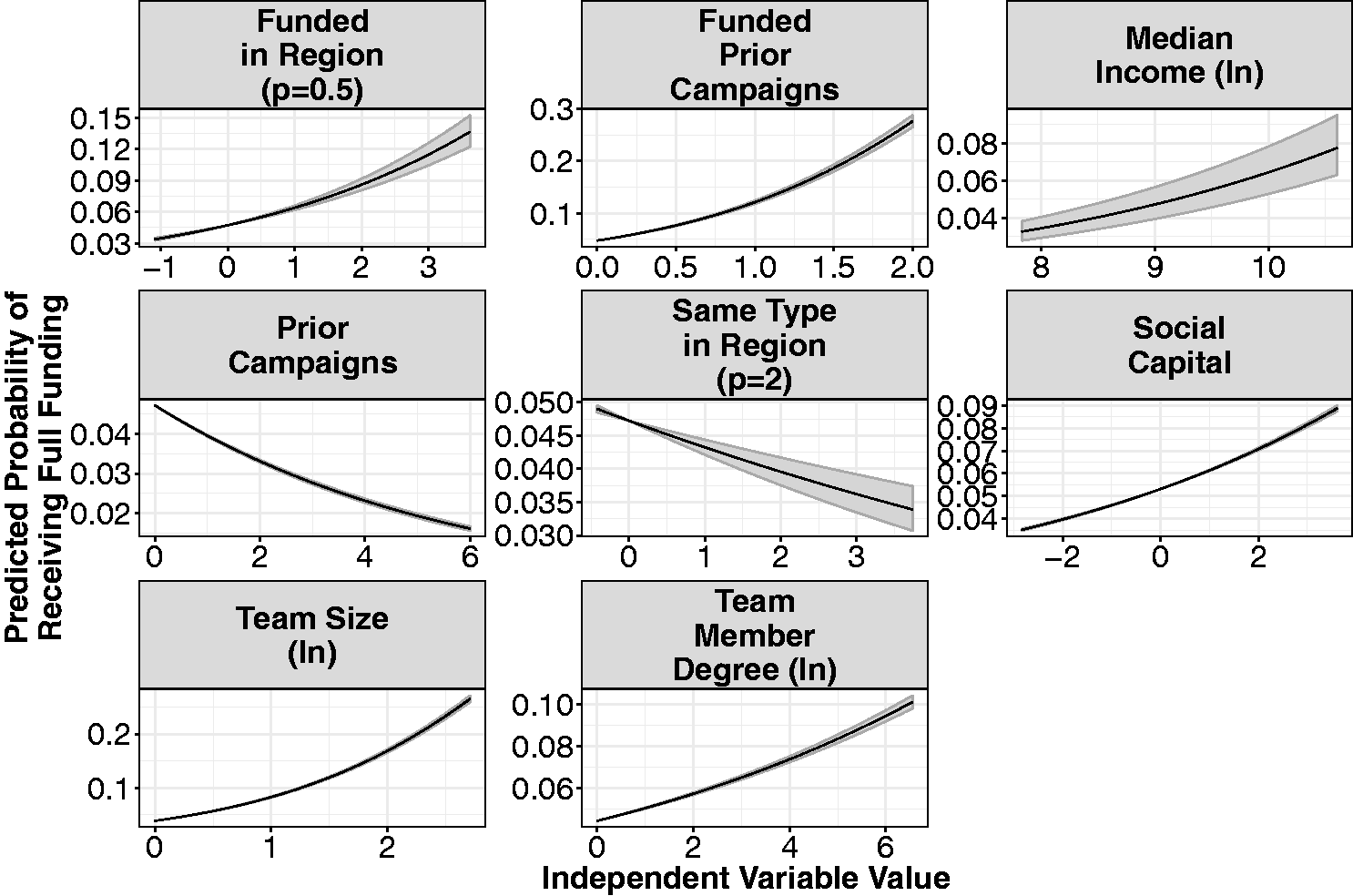
Predicted probability plots based on the best-fitting logistic regression model for cultural, social, economic, and spatial capital variables, along with Indiegogo market area variables. Prior Campaigns and Prior Funded Campaigns set to zero. Year set to 2014. Campaign type set to Creative Arts and Isolated set to zero. All other variables, except the one being altered in each panel, set at their means. p is the decay term for the inverse distance weighting measures. Gray bands show 95% bootstrapped confidence intervals clustered on commuting zones (Cameron, et al., 2011; United States Department of Agriculture Economic Research Service, 2012). Independent variables range from the 0.001 to the 0.999 quantile to avoid extreme outliers. See Supplemental Material for calculation details and Supplemental Table 3 for all model coefficients (Robin, et al., 2011). AUC = 0.808. N = 134,098.
Funded in Region and Same Type in Region deserve special attention. Our best-fitting model has different decay terms for the two variables, 0.5 for Funded in Region and 2 for Same Type in Region. As lower distance decay terms mean that more distant campaigns are weighted more highly in the calculation (see Supplemental Material), this finding suggests competition between similar campaigns is relatively local, while the benefits of starting up in an area with many successful campaigns is regional. A campaign at a distance of 5 km, for example, would receive an inverse distance weighting of only 0.04 for the Same Type in Region term, while the campaign would need to be 625 km away to receive such a low weight for the Funded in Region term. Second, colocation benefits outweigh competition. Across its range, Funded in Region is predicted to be associated with as much as a fivefold increase in the probability of funding success for a typical campaign, while Same Type in Region is associated with a bit less than a 50% reduction in the probability.
While these results are intriguing, field theory reminds us not just to look at individual variables in isolation. In particular, we are interested in how Indiegogo’s field-specific capital interacts with spatial context to shape crowdfunding success. In Figure 2, we present results from a logistic regression model in which we interacted all our variables except year and campaign type with the type of campaign’s neighborhood cluster, identified by finite mixture modeling. For ease of interpretation, we identify each neighborhood category by its most distinctive characteristic. Thus, the Affluent category features places that tend to have the highest median income, the Diverse category places where a higher percentage of the population is non-white, the Youthful category places with a higher percentage of the population in the 18–39 age bracket, and the Rural category places with a lower population. We present a more complete visualization of variables’ distribution across categories in Supplemental Figure 3 and coefficient estimates and 95% confidence intervals in Supplemental Figure 5.
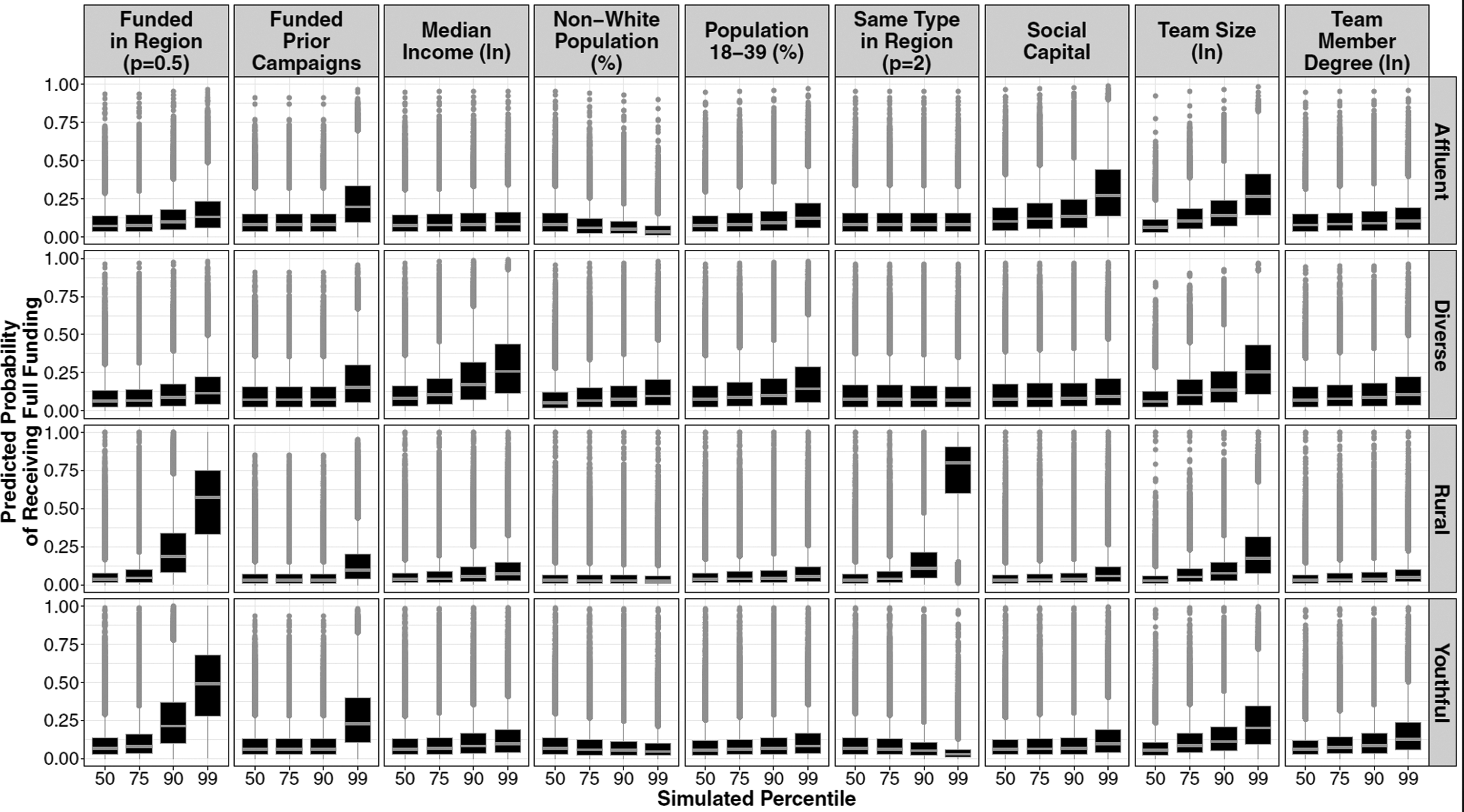
Boxplots showing the distribution of predicted probabilities of receiving full funding based on a logistic regression model interacting all independent variables with neighborhood categories (AUC = 0.813) when each variable is set to the stated percentile level of that variable across all campaigns. Boxes show the lower and upper quartiles of the distribution, the line in the middle of the box shows the mean, whiskers show 1.5 times the interquartile range, and dots show values outside this range. Predicted probabilities are grouped into neighborhood categories identified using finite mixture modeling. Supplemental Figure 5 presents model coefficients and 95% confidence intervals.
From this model, we computed each campaign’s predicted probability of being funded when each field-specific variable is set to percentiles calculated from the modeled data, keeping all other variables at their measured values for that campaign. We then used boxplots to show how the distribution of these probabilities change for different percentiles, grouped by neighborhood type. The boxplot in the 50th percentile column for the Rural box in the Funded in Region (p = 0.5) row, for example, shows the distribution of the predicted probabilities of funding for all Rural campaigns, if their Funded in Region (p = 0.5) variable is set to the median for the dataset. It is important to keep in mind that these are simulated values, based on the fitted model coefficients, and in some cases, such as Rural areas with high values of the Funded in Region variable, are counterfactual.
Figure 2 reveals some intriguing nuance. First, field-specific capital, such as Team Size (ln), Team Member Degree (ln), and Funded Prior Campaigns, are all positively associated with campaign success across the neighborhood categories, with some minor differences. Funded Prior Campaigns and Team Size (ln) appear to be slightly less important in Rural areas than other places, while Team Member Degree (ln) has a more positive association with success in Youthful areas. Our spatial capital measures show rather more complex patterns. In some cases, the variables that the neighborhood category lacks drive these relationships. In Affluent areas, for example, Median Income (ln) is not associated with success, but Social Capital, in which Affluent areas are relatively poor (see Supplemental Figure 3), has a strong association. In Diverse areas, Median Income (ln) is lower (see Supplemental Figure 3) and has a stronger association with full funding.
Other nuances merit comment. Non-White Population (%) is strongly positively associated with success in Diverse areas but negatively elsewhere, particularly Affluent areas. Population 18–39 (%) is positively associated with success in all categories, but it is rather more important in Affluent and Diverse areas. Some of the most pronounced differences across neighborhood categories come from the spatial market interaction variables. We find, for example, that the level of prior funded campaigns in the region is positively associated with success across all categories, but this relationship is much stronger for Rural and Youthful areas. These areas also respond differently to campaign specialization. While Rural area campaigns benefit from having more campaigns of the same type in their region, Youthful area campaigns suffer.
Capital and the limits of crowdfunding
Our models identify two ways Indiegogo is stratified. First, only a few teams with high field-specific cultural, social, and economic capital have reasonable chances of success. Second, campaigns’ location shapes their fortunes. Areas that are more affluent, have higher levels of local association and cooperation, and have a younger population have a particular advantage. For our modeled campaigns, for example, 47% of pledged funds accrued to the top five commuting zones, Los Angeles (17.9%), New York City (17.5%), San Francisco (4.9%), Boston (3.6%), and Austin, Texas (3.1%); New York City alone accounts for 20% of fully funded campaigns (United States Department of Agriculture Economic Research Service, 2012). The geography of crowdfunding success mirrors the agglomerations that financial geographers have identified in VC for some time (Chen et al., 2010; Mason and Harrison, 2002). However, we should point out that rankings among these top cities differ from their rankings in terms of VC investments (Florida and Mellander, 2016), a finding that partially supports optimists’ claims that crowdfunding geographies are not identical to those of VC (Stevenson et al., 2019).
The ways context shapes capital’s effectiveness, however, are an even more important result. That Rural campaigns benefit less from direct platform connections, as measured by Team Member Degree (ln), but more from a local community of campaigns, for example, says much about the nature of cooperation and innovation in these places. Similarly, that the non-white percentage of the population in the campaign area is positively associated with success in Diverse areas but negatively associated in Affluent and Youthful areas seems consistent with evidence of implicit racial bias on crowdfunding platforms (Younkin and Kuppuswamy, 2018).
While spatial context limits who benefits from crowdfunding, it is worth remembering that our field-specific capital measures have associations with success across neighborhood categories, with the exception of Team Member Degree (ln) in Rural areas. This point, and that the distribution of team size, connectivity, prior experience, and prior success is similar across categories (see Supplemental Figure 6), supports the case that Indiegogo is emerging as a field with its own particular forms of capital, a point in optimists’ favor. Nevertheless, as clearly demonstrated in Figure 2, these variables tend only to be associated with substantively important increases in the probability of success at about the 90th percentile of their values across our data sample. As with financial services more broadly (Bunyan et al., 2016), successful crowdfunding relies on prior capital. Given the association between prior and future success, while some lucky campaigns may move on to other financial ecologies (Langley and Leyshon, 2017b), successful teams often return to crowdfunding (Signori and Vismara, 2018).
Quantitative studies identify several habits that can improve crowdfunding-seekers’ chances, including providing images and videos, regularly updating, and using particular types of language (Barbi and Bigelli, 2017; Mitra and Gilbert, 2014; Mollick 2014; Parhankangas and Renko, 2017). Training in these skills might help spread crowdfunding’s benefits, but there are limits. First, that only prior successful campaigns are associated with increased odds of success might indicate that, like other forms of elite habitus (Cook et al., 2012; Faulconbridge and Hall, 2014; Harrington, 2016), platform economy skills are largely tacit (Zook, 2004). Second, given evidence that racial biases affect crowdfunding outcomes (Younkin and Kuppuswamy, 2018), a pattern consistent with our data, training likely will benefit some groups more than others. Third, despite optimists’ aspirations that crowdfunding might democratize finance across space, geography remains critical. Figure 3 maps the predicted probability that a campaign is fully funded, using the same model as Figure 2. It shows population density cuts a clear divide in the odds of success; campaigns in west coast cities and the northeast megalopolis have better prospects than elsewhere. While our model suggests rural areas can benefit from agglomeration, jumpstarting agglomeration is not easy.
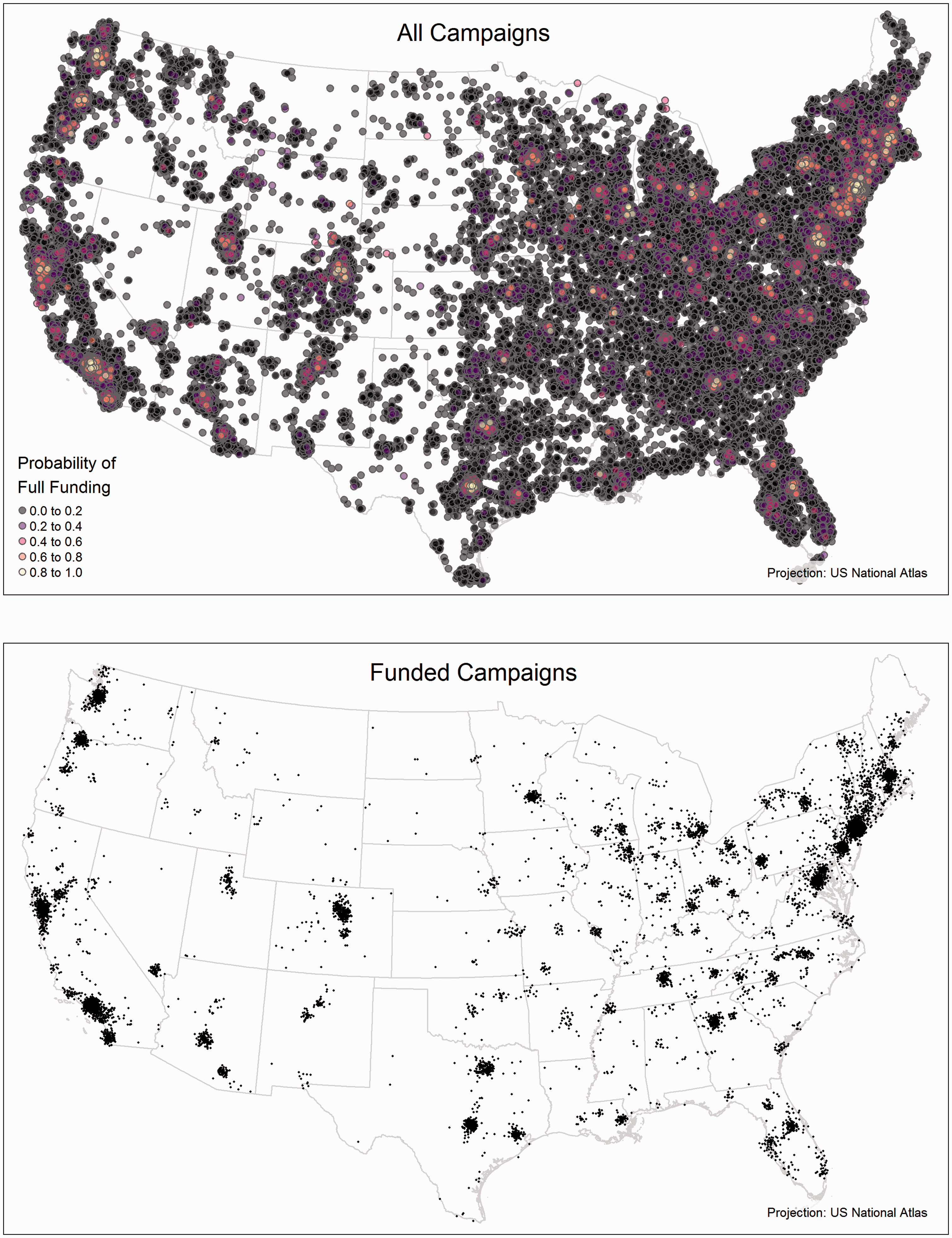
Predicted probabilities that campaigns are fully funded. Campaign locations jittered to minimize overplotting. Model coefficients presented in Supplemental Figure 5.
Spatial capital is one way to refine field theory’s relationship with geographic space. It is, however, different from the other common forms of capital in that it is relative not to a specific social space, but, rather, to the interaction between social spaces. Because they are abstract, relatively bounded relational topologies, field theory’s social spaces only can interact via people’s practices, which take place through geographic space. Consider the relationships modeled in Figures 2 and 3. We could interpret spatial capital variables like Median Income (ln) and Social Capital to indicate capital availability in social spaces other than Indiegogo, connected by people’s practices, to campaigns’ neighborhoods. People’s abilities to draw on resources from other social spaces, therefore, vary with how those social spaces relate to geographic space and, through geographic space, to each other. That means spatial capital arises from the ability to connect social spaces, rather than any one social space considered in isolation. Furthermore, geographic space and related field-specific cultural, social, and economic capital shape campaigns’ digital presences. Thus, while the platform economy may expand opportunities for interaction, our study suggests existing forms of capital may also shape platforms’ social spaces, translating, in our case, into the likelihood of funding success.
While we find patterns of agglomeration similar to those identified in the financial geography literature on VC (Chen et al., 2010; Mason and Harrison 2002; Medcalfe and Thompson 2017), we also find that agglomeration is only part of the story. While Indiegogo success does appear to cluster in particular places, just being in those places is insufficient to substantially boost one’s success. Rather, the right kind of capital—where the “right” capital is determined by local sociospatial conditions—interacts with agglomeration in generating opportunities. For example, success appears to become less likely in affluent areas as the non-white share of the population increases, but in diverse areas we see the opposite relationship, and a greater concentration of projects of the same type appears to support success in rural areas but leads to overcrowding and competition in youthful ones. This complex interaction between aspects of local contexts highlights capital’s inconsistent effects across different social and geographic spaces, a contribution distinct from the insights of the financial ecologies literature.
Our findings also suggest that even in the platform economy, success is often dependent on physical location, despite the very low transaction costs offered by the internet. Thus, spatial capital can act as a moderator independent of capital generated in other social spaces that shapes how and when people can mobilize capital from one social space in another. From a theoretical perspective, we must contend with the fact that not only does capital, perhaps unsurprisingly, influence success and geographic space, but also that the effectiveness of these various forms of capital rely on connections between social spaces via geographic space, generating spatial capital.
Conclusion
Building on Bourdieu’s field theory, we have further developed the evolving concept of spatial capital to focus on capital arising from the connection between diverse social spaces via geographic space. While, consistent with field theory, we admit Indiegogo could become an autonomous field allowing people to use novel resources as capital, we find that at present spatial capital arising from access to traditional sites of VC agglomeration in the USA, alongside forms of capital valued in several other social spaces, acts as a major determinant of success on Indiegogo. Indeed, while crowdfunding optimists often point to its potential to democratize finance across space, our modeling suggests uneven development across geographies is in fact a primary barrier to financial democratization via crowdfunding. While this does not necessarily mean crowdfunding cannot be inclusive, it certainly means that it cannot be assumed to be so. We find evidence both of spatial disadvantages, with rural areas struggling to benefit from crowdfunding, and racial biases, with more diverse areas also negatively affected in certain cases. Furthermore, we find that success tends to concentrate in already affluent areas, where access to other social spaces is easier. While crowdfunding has, to some degree, democratized the opportunity to fund projects, Indiegogo, at least, faces challenges in democratizing access to funds.
Supplemental Material
Supplemental material for The uneven geography of crowdfunding success: Spatial capital on Indiegogo
Supplemental Material for The uneven geography of crowdfunding success: Spatial capital on Indiegogo by Caleb Gallemore, Kristian Roed Nielsen and Kristjan Jespersen in EPA: Economy and Space
Footnotes
Acknowledgments
We would like to thank three anonymous reviewers for their helpful comments.
Declaration of conflicting interests
The author(s) declared no potential conflicts of interest with respect to the research, authorship, and/or publication of this article.
Funding
The author(s) disclosed receipt of the following financial support for the research, authorship, and/or publication of this article: This paper was partly funded by the Department of Management, Communication and Society (Copenhagen Business School) Department Fund 2016 and from the European Union's Seventh Framework Programme for Research and Technological Development and demonstration under grant agreement no. 613194, as part of the EU-InnovatE project.
Notes
References
Supplementary Material
Please find the following supplemental material available below.
For Open Access articles published under a Creative Commons License, all supplemental material carries the same license as the article it is associated with.
For non-Open Access articles published, all supplemental material carries a non-exclusive license, and permission requests for re-use of supplemental material or any part of supplemental material shall be sent directly to the copyright owner as specified in the copyright notice associated with the article.
