







Abstract
For a generation, post-industrial US cities acted as entrepreneurs, deploying a suite of economic development policy tools to lure jobs, investment, visitors and residents. Taking New York’s rejection of Amazon HQ2 as a point of departure, I argue that exponential housing cost growth has undermined the political and economic foundations of the entrepreneurial model, leading cities to simultaneously inflate housing costs and manage the ensuing crisis of social reproduction. Updating Harvey’s four areas of entrepreneurial statecraft (production, social reproduction, collective consumption and intergovernmental transfers), I identify a humanitarian turn in the governance of urban development, focused on short-term aid, crisis management and political stability. Driven by structural conflict in the entrepreneurial model, the humanitarian turn both expands the limits of politically viable economic intervention and falls far short of resolving the underlying crisis of runaway housing costs and precarious work.
Introduction
In 2018, New York City won the competition to host Amazon’s second headquarters, seemingly completing the once-bankrupt city’s ascent to the pinnacle of entrepreneurial economic development. What happened next revealed the growing political importance of housing costs in urban governance, and an acute tension at the centre of the entrepreneurial model. Following the standard playbook for big-ticket corporate recruitment, New York promoted Amazon’s job opportunities and knock-on tax benefits. But residents, unions and community organisations read HQ2 as a threat to affordable housing and the proposed subsidies to Amazon as threats to the city’s strained social services budget. These supposed beneficiaries of the HQ2 recruitment organised and won, leading Amazon to cancel its plans for the would-be crown jewel of New York’s entrepreneurial renaissance (DeFilippis and Stein, 2023).
Equally revealing, New York’s pursuit of Amazon went hand in hand with the city enacting a range of policies that write down the rising costs of living generated by the Amazon recruitment and similar real estate deals. Like his counterparts in other large cities, then-mayor Bill de Blasio took an outwardly contradictory approach to development. On the one hand. New York offered Amazon $1.5 billion in subsidies, and de Blasio’s campaign commitments to affordable housing did not materialise as policy (Stein, 2019). On the other, his administration presided over the city’s first minimum wage and earned sick time legislation, 1 added domestic workers to its human rights law, and instituted free meals for all public-school students (Jackson, 2017). This routine conflict between policies that alternately drive up and push down the cost of living repeats across U.S. cities. From Chicago’s Lincoln Yards development, to organisers in the eventual HQ2 landing spot of Northern Virginia centering housing costs in their campaign against the retailer, neither targeted community benefits agreements nor a broad policy turn towards redistributive economic policy deterred community-based political coalitions from reading development as a housing threat rather than an employment boon (Curran, 2022; Liss and McClure, 2019). This poses two key questions for the study of urban politics and economies: Why has the entrepreneurial model broken down? And do municipal economic policies such as the minimum wage and cash transfers replace entrepreneurialism, or reinforce it?
In what follows, I examine jobs-housing conflicts like New York’s HQ2 battle and the steady advance of municipal redistributive economic policy as responses to a growing conflict at the core of the entrepreneurial approach to development (Harvey, 1989). Drawing on my own recent research on progressive electoral coalitions and expanding municipal labour, housing and social policy, I argue that the rise of redistributive social and economic policy in cities (1) responds to voter discontent with runaway housing prices, and inequality more broadly, (2) repositions existing policies, and creates new ones, in an effort to ensure social reproduction amidst a growing wage-rent gap and (3) constitutes a crisis-driven humanitarian attempt to mitigate the harms of a flawed economic model without resolving them. Following recent critical scholarship on the subject, I define humanitarianism not as a broad turn towards aid, but rather as a form of crisis management designed to shore up existing systems (Archer and Dodman, 2017; Pallister-Wilkins, 2020; Reid-Henry, 2014). Seen this way, progressive urban policies, like humanitarian aid abroad, tamp down systemic crisis, ensuring the continued operation of an economic development regime threatened by runaway housing costs. The conflict over HQ2 thus responded both to the chronic housing cost inflation at the core of the entrepreneurial model, and crucially, to the failure of ambitious municipal economic policy to bridge the gap between pay and rent.
Conceptualising the progressive policy wave as a humanitarian adaptation within the entrepreneurial approach achieves multiple goals. Practically, it provides a framework for evaluating the origins, limits and functions of novel and experimental social and economic policy. The main axes of Harvey’s initial entrepreneurial model – production, social reproduction, collective consumption and transfers – help to organise and interrogate these policies, highlighting the role of policy preemption (Kim et al., 2021), fiscal federalism (Xu and Warner, 2024) and political coalitions (Doussard and Schrock, 2022) in shaping the parameters of humanitarian policy. Above all, understanding these developments as humanitarian adaptations within the entrepreneurial approach explains the dual, and unstable character of urban policies that simultaneously, or alternately, subsidise runaway housing costs and basic subsistence. Locating humanitarianism within the entrepreneurial model also explains why these policies respond principally to in-work poverty, and reconciles their co-existence with punitive anti-homeless and anti-immigration policies focused on subjects at the fringes of the labour market.
The paper achieves this first by reviewing the entrepreneurial approach to urban development and the widespread challenge exponentially growing housing costs pose to balancing production and social reproduction. Drawing on my own recent work, I then detail the rise of progressive governing coalitions and the steady growth of redistributive social and economic policy. I then introduce the concept of humanitarianism, treating it as a pragmatic, crisis-mitigating project different from lay associations with aid simply delivered. I then revisit the four planks of Harvey’s initial entrepreneurial model, identifying humanitarian adaptations as discreet crisis responses to mounting problems with the entrepreneurial approach to development.
Too successful: Runaway housing costs threaten entrepreneurial development
The entrepreneurial mode of urban development Harvey first identified in 1989 has proven resilient both in scholarship and practice (Harvey, 1989). Noting the widespread economic and physical losses (deindustrialisation, population flight, disinvestment) cities faced, and the aggravating nosedive in federal funding to cities, Harvey likened cities to entrepreneurs seeking windfall gains. Poorly equipped to do the work once assigned to the national state, entrepreneurial cities scrambled to deploy their limited fiscal and legal resources in the hope of renewing growth – through a mix of industrial recruitment, real estate development, downtown placemaking and transfers from large federal agencies, particularly defense (Harvey, 1989: 10). Entrepreneurialism combined the two core features of what quickly ossified into the standard script of urban economic development, a twin focus on luring businesses and inflating asset values in the built environment (Christophers, 2022; Malizia et al., 2021; Weber, 2019).
The entrepreneurial model’s return of heavily polarised growth offered a kind of Faustian bargain: Cities could trade job quality for job growth, on the understanding that exploding low-wage service sectors constituted a tolerable cost for renewal (Bluestone and Harrison, 2001; Madland, 2015). For decades, the strategy succeeded within these very limited terms. Cities, scholars and civil society organisations treated systematically inequitable growth as a normative problem, not a practical threat to entrepreneurialism’s viability.
After the Great Recession, the ratchet of housing prices turned the entrepreneurial model’s internal contradictions into foundational fissures. The scope and scale of housing-cost appreciation and what Wetzstein (2017) termed the ‘Global Urban Housing Affordability Crisis’ was staggering years before the Covid-19 pandemic. This century, the total valuation of the U.S. housing market has risen from $10 trillion to $50 trillion (Katz and Zhao, 2024) 2 – exponential growth that can be pictured as literally pulling away from linear, sclerotic wage growth (Figure 1).
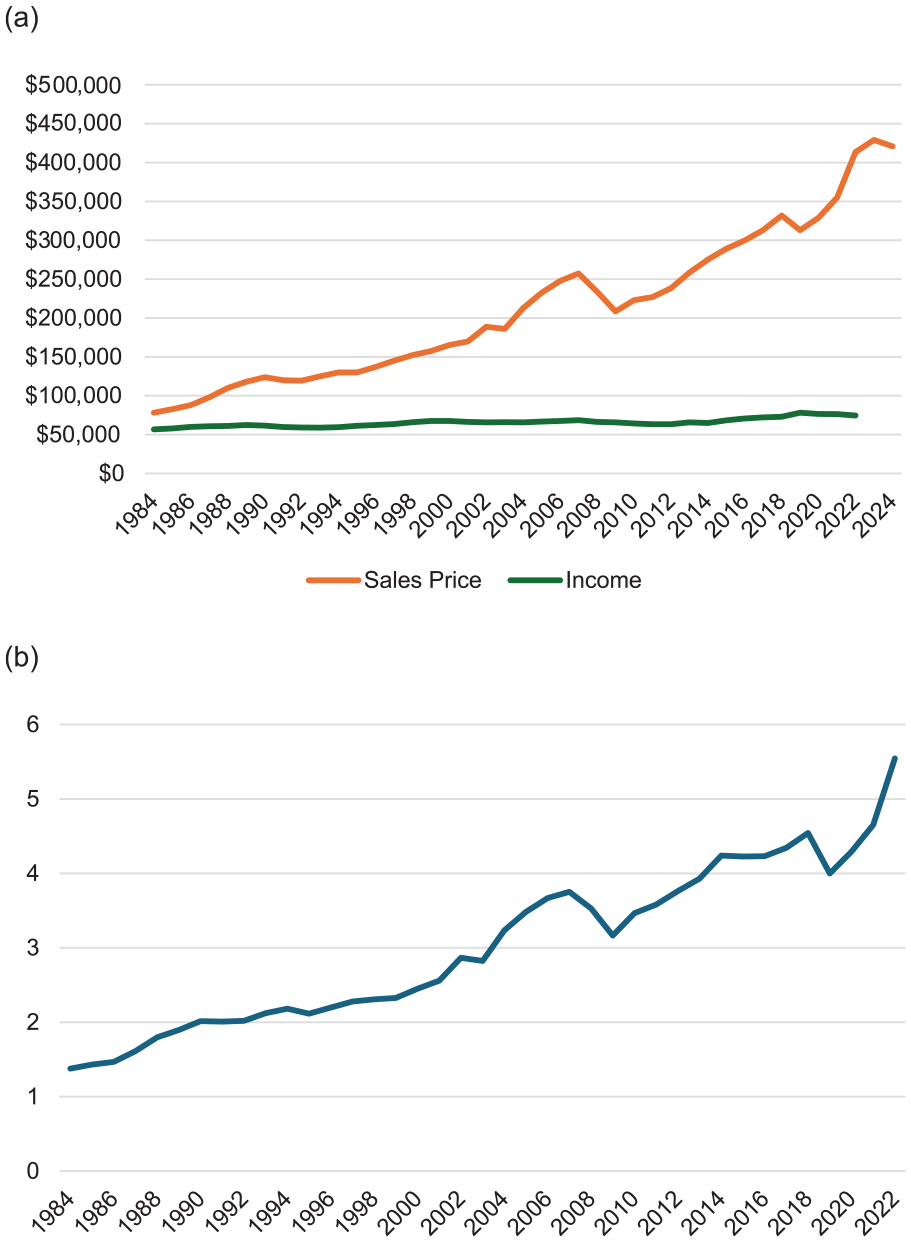
Median household income versus median home sale price, 20 largest U.S. metros. (a) Prices and income in nominal dollars. (b) Sales price-to-income ratio.
The scale of housing cost appreciation is highest in metro areas with 5 million or more residents, but by a smaller margin than the common focus on the U.S.’s coastal cities suggests. Nationwide, the ratio of median housing costs to median wages has grown by at least 80% across all metro areas of 2 million or more residents (Figure 2), and housing cost crisis drives the political agenda in Nashville and Denver (e.g.) in addition to New York and Los Angeles.
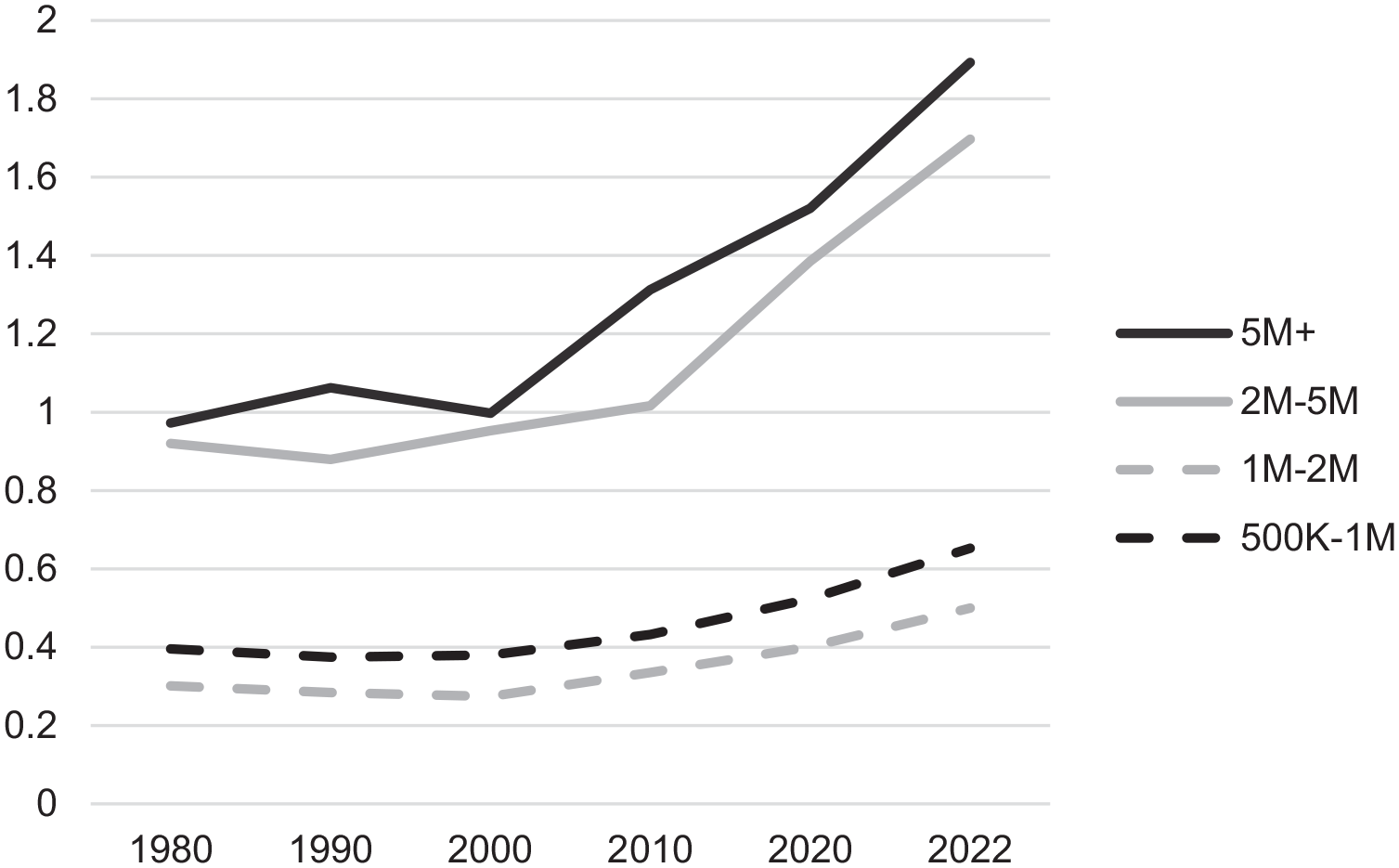
Housing-cost to income ratio by metro size, 1980–2022.
Surging housing prices, and rising asset valuations more generally, have spurred significant theoretical innovation in the understanding of currently existing capitalism. Formulations as varied as planetary gentrification (Lees et al., 2015), rentier capitalism (Christophers, 2020, 2023a), asset-manager capitalism (Adkins et al., 2021; Braun and Christophers, 2024) and, more straightforwardly, a ‘real estate state’ (Stein, 2019), emphasise different aspects of housing price appreciation, the local state’s responsibility for securitising land value and the political-economic destabilisation rising property values cause.
Changes in technology, financial markets and the organisation of finance industries have made housing a preferred class of asset for global investors. Real estate investment platforms (such as Zillow and Redfin) and a boom in both firms and technologies for managing rental properties have effectively brought economies of scale to managing housing (Christophers, 2023b; Fields, 2018, 2022). The resulting growth in real estate investment has pushed the market capitalisation of U.S. Real Estate Investment Trusts (REITs) to $1.3 trillion, a full $1 trillion more than at the peak of the 2007 housing bubble and more than 1000 times the 1989 value (Nareit, n.d.) (see Note 2). Capital accumulation on this scale rightly suggests an economic transformation more substantial than anything cities could hope to achieve with their modest land use and fiscal powers. Yet as will be seen, city government is the main target for citizens outraged at housing costs, and cities inherit the responsibility to make their economies work, regardless of their role in authoring the wage-housing cost gap.
Continuously compounding interest drives a substantial portion of the housing cost increase, but so too does deliberate action by the local state. The individual, deal-making actions Harvey noted when defining entrepreneurialism are now part of the everyday machinery of local government. Widespread adoption of Tax Increment Financing and related incentives, intensifying investment in value-enhancing public amenities, and the sidelining of affordable housing investment constitute defining features of what Stein (2019) terms the real-estate state, local government built around the goal of enhancing property values. Early in the entrepreneurial era, Peck and Tickell (1992, 1994) identified the threat that deregulation and concentrated capital investment would lead to economic ‘overheating’, particularly in global cities. Thirty years later, both deregulation and investment capital stocks have grown so robustly that housing affordability problems have spread far beyond global cities. Today, the ensuing crisis – a widening mismatch between linear wage growth and exponential housing-cost growth – has become so generalised as to compromise job-growth strategies predicated on the U.S.’s trademark high interregional population mobility (Chapple and Jeon, 2021; Martin et al., 2025).
The resulting skirmishes disrupt entrepreneurial growth plans in surprising ways. In Chicago, $1 billion in planned subsidies for a near North Side housing development led to a civil rights lawsuit and reform of the city’s long-contested, developer-friendly Tax Increment Financing programme to include citizen input (Doussard, 2021). In Austin, soaring housing costs led the city’s professional and middle classes to embrace housing construction and densification, reshuffling politics built around the city’s long-term racial fault lines (Tretter et al., 2022). 3 As this synopsis makes clear, housing’s status as an intersectional issue amplifies its power to upend existing political relationships (Parker and Leviten-Reid, 2022; Wolifson et al., 2023). Layered on top of long-term inequities in work, public space, public spending and the built environment, rising housing costs lead citizens and civil society to act in ways that confound areas of politics and planning previously managed without regard to housing.
Social reproduction crisis, political pressure and policy response
Two decades into the 21st century, entrepreneurial urban development has flourished on its own terms: Most major cities are adding population (Frey, 2024); even stagnant cities have pockets of deep investment; housing valuations are rising seemingly everywhere; and the transition from an industrial economic base to advanced and consumer services appears complete. Cities’ embrace of directly redistributive policies, even amidst growing fiscal stress, thus poses a puzzle: How can a growing policy commitment to equity be squared with the triumph of growth, an ideology and practice directly opposed to distributional concerns?
The answer lies in organised politics, where individual voters and the community organisations who structure political participation have translated anger over housing costs and the broader problem of economic inequality into support for progressive politicians and distributive policies that run against the preferences of entrenched growth machines (Stone, 2015, 2017). This shift in preferences delivered the surprising result of government by self-declared progressive politicians becoming the rule, rather than the exception, in large cities. In the past decade, political progressives have been elected to city hall in major cities including New York, Chicago, Los Angeles, Boston, Philadelphia, Seattle, Denver, Minneapolis and St. Paul. They preside, or presided, over progressive cities councils whose members included growing ranks of Democratic Socialists of America affiliates (Doussard and Schrock, 2025).
What these politicians have done with their power remains open to substantial debate. The austerity urbanism perspective views city government through the lens of fiscal constraint and service erosion, arguing that post-Great Recession budget pressures constrain city government’s power and finances nearly absolutely (Peck, 2012). Pointing to the fiscally and politically uneven landscape of cities, Kim and Warner (2021) identify the alternative of pragmatic municipalism, in which cities act strategically within their limited powers to preserve services and make investments in equity.
My own collaborative research (Doussard, 2024; Doussard and Schrock, 2022; Doussard and Schrock, 2025) points to cities embracing labour policy, cash transfers and universal public services as austerity pressured their budgets. Major developments include the institution of more than 65 municipal minimum wage laws and related legislation on paid sick time, wage theft and scheduling; a raft of housing programmes, including affordable housing trust funds and Housing First pilot programmes; and broad-based transfers and services, including basic income trials and universal pre-kindergarten programmes (Doussard and Yenigun, 2024).
The result appears as a paradox: Squeezed by austerity, city governments are simultaneously throwing their support to developers and gentrification and rolling out programmes that seemingly overturn their long-term commitment to support private-sector growth.
The humanitarian turn in entrepreneurial development
Cities are responding to housing crisis and the limits of the entrepreneurial model 4 with policies that direct resources towards meeting the immediate needs of households who cannot cover basic social reproduction on paltry wages. Outside the wealthy world, such crisis-driven material aid is understood as humanitarian (Maniatis, 2018; Reid-Henry, 2014). Critical rather than normative, the term humanitarianism refers to pragmatic state techniques of crisis management embodied in targeted aid. The humanitarian turn in entrepreneurial development is driven by chronic inequality and the acute crisis of housing costs, a crisis fuelled by the success of entrepreneurial approaches and compound interest in inflating property values. 5
Humanitarianism has two defining traits of high relevance to diagnosing the ongoing evolution of urban governance. First, it operates as a form of crisis management (Pallister-Wilkins, 2020; Reid-Henry, 2014). Globally, humanitarian aid secures, in the sense of managing as well as making safe, precarious populations exposed to the hard edge of war, displacement, famine and poverty (Maniatis, 2018). The fit with urban political economy is straightforward. After all, social scientists already understand recent urban history as a series of crises compelling cities to respond to problems beyond their direct control: Deindustrialisation, population loss, disinvestment, globalisation, the Great Recession, austerity, the Covid-19 pandemic and now chronically unaffordable housing. Crisis-driven disruption and unpredictability leads elected officials, civil servants and political appointees to place a high value on resources that smooth the return to economic and population growth – the basic outcomes the entrepreneurial model promised to deliver.
Second, humanitarianism rationalises and renders governable the underlying political order responsible for creating recurrent crises (Reid-Henry, 2014). Globally, humanitarian interventions provide emergency food, shelter and medicine without challenging the conflicts that created hunger, displacement and ill health (Pallister-Wilkins, 2020; Redfield, 2012; Sparke and Anguelov, 2020). Cities’ recent economic interventions follow suit, treating the figurative symptoms at the expense of the underlying disease and, somewhat literally, focusing on shelter, food and basic health (Doussard and Schrock, 2022; Sparke and Williams, 2022). Regardless of the federal system or tax structures in which they operate, cities fundamentally lack both the statutory power and fiscal resources needed to remedy the problems – principally asset inflation – driving current crises of affordability.
Before establishing the analytical advantages of a humanitarian lens, it is important to address possible objections to my approach. The first regards the recency and depth of the humanitarian turn, which might reasonably be understood as a fleeting response to the Covid-19 pandemic. Indisputably, desperation to limit the virus’s damage led cities to enact a range of social and economic interventions far beyond the bounds of previous political acceptability, including restrictions on landlords, publicly run food banks and city-financed cash transfers (Doussard, 2024; Raitilla and Bollain Urbieta, 2021). Yet a longer view clarifies that Covid accelerated policy changes already in full swing. The minimum wage, labour standards, Housing First programmes and land banks, among other policies, first swept cities in the mid-2010s or earlier. Similarly, Covid-era humanitarian interventions such as basic income and non-eviction orders diffused quickly because early-stage adopters and policy advocates had already softened the ground for new policies (Benfer et al., 2023; Doussard, 2024).
Next, tracing the origins of the humanitarian turn to politics and crisis does not preclude it generating developmental effects. However coherently or indifferently it is coordinated, development happens (Aglietta, 1998). Extensively studied, the policy changes comprising the humanitarian turn have indeed shifted the ways employers and industries develop (with the professionalisation of food-service occupations following minimum wage hikes fashioning a prime example – see Lester, 2020). However, the presence of some developmental effects does not signal a human-developmental approach to urban economic development. Originating in politics and crisis, humanitarian interventions unfold ad hoc, unevenly and with little evident coordination. Seen in these terms, the humanitarian turn curbs entrepreneurialism’s excesses without overhauling the system. With these qualifications in place, emphasising the humanitarian character of the current shift in urban governance draws attention to several significant and overlooked features of contemporary urban politics and development.
First, humanitarianism provides an expansive analytical container in which to collect, organise and taxonomise policy innovations unfolding at near-breakneck speed. The current roster of experimental and market-interventionist policies is dizzying. Cities are buying out medical debt, rehabbing and flipping housing at price points below market rates, issuing baby bonds and providing emergency housing in hotels and skyscrapers. Policy experiments are so numerous and varied that they cannot be adequately accounted for without an underlying conception of the changing pressures and logic of public policy. Focusing on aid, rather than development, helps. For example, when Chicago Mayor Brandon Johnson announced plans to open a publicly owned and operated supermarket, he justified them by invoking systemic food insecurity among the city’s communities of colour – a direct, humanitarian framing (City of Chicago, 2023). Similarly, Los Angeles officials justified the city’s experimental, $1,000 per month basic income trial as a way of helping families ‘to meet basic needs and eliminate the stress of living paycheck to paycheck’ (Chan et al., 2021). The disorganised pieces of the humanitarian turn are united by the underlying logic of aid, not economic development.
Second, humanitarian adaptations both modify and restructure the entrepreneurial model, mainly by elevating the importance of collective goods and intergovernmental transfers relative to interventions focused on work and housing. Before the Covid-19 pandemic, cities had begun to experiment with universal public services, most typically universal pre-kindergarten programmes, a form of publicly financed childcare (City Health and the National Institute for Early Education Research, 2019; Cohen-Vogel et al., 2022). Efforts like these redirect entrepreneurial energy previously focused on building and securing the central business districts and urban amenities vital to establishing a city as a command-and-control node in the global economy (Harvey, 1989; Scott, 2014). Understanding the humanitarian goals of these policy adaptations, and the underlying need for cities to somehow bridge the gap between pay and housing costs, argues for immediate scholarly attention to this growing area of municipal policy.
Third, humanitarianism’s high price tag requires cities to lobby other government jurisdictions, including counties and state legislatures, for the resources necessary to finance large-scale aid. This realisation steers attention to evolving political relationships between cities and other units of government. Beyond pat characterisations of cities in ‘red’ and ‘blue’ states, these relationships alternately constrain and enable humanitarianism, and thus cities’ capacity to shore up the entrepreneurial model, in materially consequential ways.
These applications of humanitarian aid rationalise, rather than break from, the entrepreneurial model. Even as they finance emergency homeless solutions, land banks, housing trust funds and other measures designed to soften the blow of high housing costs, cities leverage their authority over land use and discretionary control over taxes and financial incentives to securitise and increase the value of their housing stocks. Likewise, high minimum wages and labour standards attempt to make entry-level service jobs compatible with basic subsistence, a substantial departure from cities’ past efforts to incentivise the creation of mid-wage and comparatively skilled jobs (Markusen, 2004). This is the humanitarian turn: A pivot towards using aid and social assistance, broadly conceived, to fill the growing gap between low pay and rising housing costs.
Crisis and humanitarian response within the entrepreneurial model
The humanitarian turn responds to crisis within the entrepreneurial approach to urban development. Accordingly, the entrepreneurial model itself provides an accounting mechanism for identifying and evaluating, both individually and in relationship to one another (1) current entrepreneurial practices, (2) the sources of entrepreneurial crisis and (3) humanitarian adaptations to the model (Figure 3). Tracing the evolution of entrepreneurialism through these events makes it clear that humanitarianism modifies rather than replaces the entrepreneurial approach, and that humanitarian adaptations will fall short of fashioning a rival approach to growth.
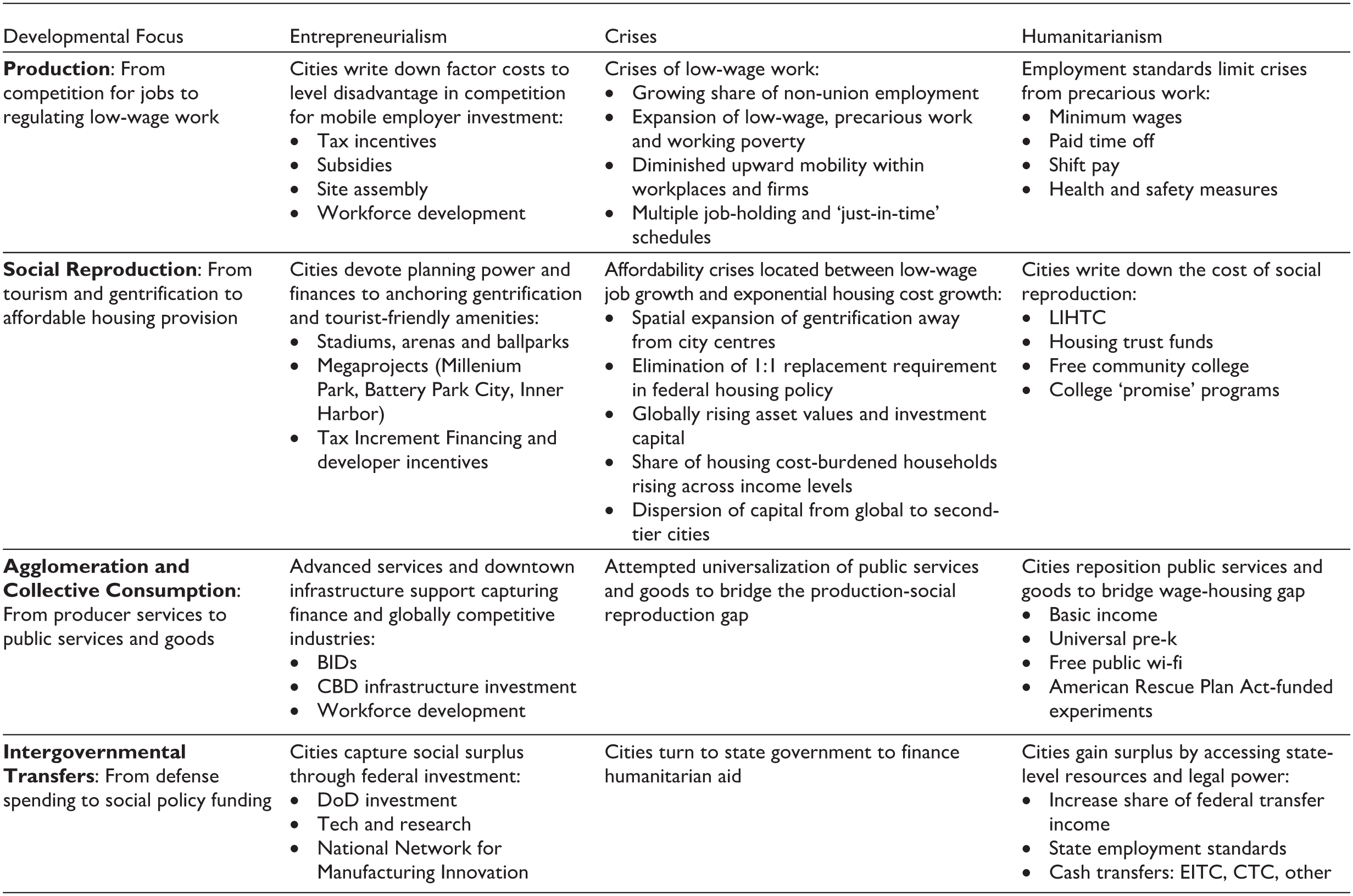
Crisis, adaptation and the humanitarian turn to entrepreneurial development.
Organising analysis of the humanitarian turn in terms of Harvey’s initial, four-plank model of entrepreneurialism, has the added advantage of linking humanitarian interventions to underlying political-economic problems (production, social reproduction, collective consumption) and making clear the changing emphasis of cities’ economic strategies over time. Harvey’s four-part taxonomy of entrepreneurialism separated entrepreneurial activity by the key goals of attracting production (business establishments and jobs), consumption (tourism, entertainment and incipient gentrification), agglomeration (via advanced and supportive services) and surplus (transfers from other government units). Where entrepreneurial cities used every tool available to draw people and resources back into cities, humanitarian cities use the tools of collective consumption and transfers to service resource-intensive action on production and social reproduction, a politically consequential reworking of the entrepreneurial model. The outwardly experimental policies cities have implemented post-Covid may in time develop into durable responses to the underlying mismatch between pay and shelter. That is a question for the future. The immediate task is to relate these experiments to the political crisis of runaway housing costs.
The humanitarian turn to the entrepreneurial model is especially easy to discern in the 2020s, when rapid housing price appreciation on the one hand, and the availability of substantial, Covid-related federal stimulus funds on the other, provided both the need and the means for cities to expand humanitarian action (Xu and Warner, 2024). Centering humanitarianism makes two features of cities’ recent spending clear. First, it substantially exceeded the limits of prior redistributive and social spending. Second, it is nonetheless wholly inadequate to the size of the problem.
Production: From service-sector promotion to labour regulation
Entrepreneurial strategies yielded significant shifts to work and its rewards. Cities played the role of labour brokers, linking manufacturers and other mobile employers to a growing non-union workforce (Harvey, 1989). When low-wage workers delivered productivity commensurate with their pay, cities convened public-private workforce development boards to provide subsidised job training to bridge low pay with moderate skill (Fitzgerald, 2004). At the same time, cities actively supported tourism and entertainment industries, who pay low wages and offer short-term, part-time and seasonal work with little prospect for advancement.
The unlikely outcome of low-wage workers somehow subsisting on very low hourly pay 6 rested on a series of unsustainable supports, including unprecedented job growth and pay increases in the late 1990s and a reserve supply of low-cost (and -quality) housing to help workers stretch their wages. The rise of municipal minimum wages and related employment standards reflects an underlying governance shift towards ensuring the quality of service-sector jobs, instead of (or in addition to) the long-time policy focus on business recruitment.
By the time the Covid-19 pandemic hit, minimum wages of $15 and higher were on the books in large cities such as Los Angeles, Seattle, Denver and Chicago; smaller cities such as Tucson, Albuquerque and Portland, Maine and a growing number of high-population counties, most notably Los Angeles, Cook (Illinois) and Montgomery and Prince Georges in Maryland (UC Berkeley Labor Center, 2023). Local minimum wages stand at the forefront of a much broader transformation in the regulation of work, including mandatory sick days and paid time off, regulations on working conditions such as extreme heat and cold, and increasingly, limits on employers’ use of ‘just-in-time’ – constantly changing – work schedules (Doussard and Schrock, 2022).
Cities’ embrace of labour standards legislation far exceeds anything political economists or political activists imagined a decade ago. Yet even the most aggressive of these interventions falls far short of remedying the underlying problem of the mismatch between production and social reproduction. The minimum wage in West Coast cities now approaches three times the federal floor – yet soaring housing costs have effectively eaten the entire increase (Chapple and Jeon, 2021). Not only is the regulatory quiver near-empty, the emergence of gig-economy work on Uber, Door Dash and other platforms introduces problems beyond any current regulatory capacity in cities (Wells et al., 2021). Wage labour, no matter how heavily regulated, can only match housing price appreciation up to a point.
From consumption to social reproduction: Affordable housing supplements systemic gentrification
Like municipal labour regulations, the current cutting edge of city housing policy developed in response to the inequities of the entrepreneurial model. City support for gentrification and housing intensification treated housing as a form of consumption and a means of fighting the tide of continued population loss and disinvestment (Wyly and Hammel, 1999). Faced with runaway housing costs and a renewed influx of people into the urban core, cities are pivoting, episodically and unevenly, to engaging housing as a key factor in social reproduction.
The analytical framework of humanitarianism helps to identify, aggregate and analyse the disparate elements of cities’ attempts to produce affordable housing amidst underlying conditions of continued housing cost growth. Two pressures in particular drive the uptake of humanitarian housing approaches: the ‘creep’ of housing affordability problems from the working poor into the middle and professional classes (Martin et al., 2025), and high-visibility homelessness, which creates immediate pressure on mayors to somehow limit the population of unhoused people now visible in so many cities (Margier, 2023a, 2023b). Confusingly, humanitarian policies to house the homeless coincide or alternate with increasingly punitive anti-homeless measures: The coincidence of these outwardly opposed responses to homelessness points to the underlying imperative to manage the problem of homelessness politically, with humanitarianism functioning as a kind of provisional, emergency politics for defanging the underlying crisis (Reid-Henry, 2014).
Housing supply measures respond principally to the first pressure. In the entrepreneurial era, the low-income housing tax credit (LIHTC) programme marginally expanded affordable housing stock, by trading tax exemptions for modest developer promises to build reduced-cost units. The LIHTC programme succeeded far beyond expectations, with annual unit production quintupling over the past 30 years. Yet the ratchet of housing price escalation renders the programme’s annual output of (at most) 50,000 units essentially irrelevant to the underlying problem (Freemark and Scally, 2023).
As housing prices began to exceed pre-Great Recession levels in the late 2010s, cities adopted a range of increasingly interventionist housing supply measures, starting with land banking (Bollwahn, 2019; Mischiu, 2019), which expanded significantly in high-vacancy municipalities after the Great Recession, and expanding to community land trusts, which take the additional step of designating land for a not-for-profit organisation’s exclusive control (DeFilippis et al., 2017; Thompson, 2020). A third intervention, affordable housing trust funds, enhances these land controls with fiscal capacity. Today, 48 of 50 states and an unknown number of cities have Housing Trust Funds, which draw funding from public revenue sources, most commonly linkage fees attached to new development as part of zoning ordinances (Brooks, n.d.). More recently, cities have turned to inclusionary zoning ordinances, which promise to narrow the income-housing gap by steering the supply of new housing towards smaller, and thus more affordable, units (Wang and Balachandran, 2023). At least $1.8 billion and tens of thousands of net new, officially ‘affordable’ housing units have been created by these ordinances (Wang and Fu, 2022).
More recent interventions centre cash and focus on the acute problem of homelessness. They have a clear humanitarian orientation, providing resources for directly housing or servicing housing-insecure and homeless populations. A very partial list of recent, cash-based housing interventions includes a U.S. Department of Housing and Urban Development programme converting housing vouchers into cash; Philadelphia granting cash stipends to members of the lengthy waitlist for public housing units; Minneapolis rolling out emergency cash assistance for renters; Denver financing a homeless-focused basic income and Santa Barbara, California paying to house its growing homeless population in a downtown hotel (Doussard, 2024). Befitting the omnipresence of housing problems and the creeping challenges housing poses for other policy areas (such as schools), these measures respond to a variety of pressing housing crises, from the political crisis of visible homelessness (Denver) to overwhelmed public housing programmes (Philadelphia) to schools undone by the challenges of homeless students (Chicago and Minneapolis).
Like municipal employment regulations, cities’ increasingly aggressive interventions for affordable housing simultaneously exceed anything imaginable a decade ago, and fall far short of addressing the core problems driving affordability crises. These measures by definition cannot match asset inflation; When humanitarian means of temporarily displacing the crisis fail, cities turn punitive, as evidenced by the upsurge of laws criminalising homeless since the Covid-19 pandemic (Diamond et al., 2022).
Recognising the shortcomings of housing policy as a means for addressing housing problems helps to explain the concurrent embrace of other recent novel policies seemingly unattached to housing: Unable to address chronic affordability problems through housing supply, cities supply public goods and services to shrink the gap between pay and housing costs.
From agglomeration to collective consumption: Public goods and services repositioned to bridge the pay-housing gap
As neither labour standards nor housing supply measures can close the wage-housing gap, cities have turned towards public services and goods to chip away at the problem. In doing so, they repurpose state powers previously focused on building central business districts to capture command-and-control economic functions (and build agglomerations) to managing the jobs-housing gap. In the end, this still constitutes devoting resources to command-and-control centres, albeit indirectly: As New Yorkers’ rejection of HQ2 demonstrates, securing command-and-control functions requires politically viable answers to affordability problems.
A first innovation entails cities reducing, or simply waiving, costs for previously means-tested and fee-based public services. In the 2010s, this consisted of no-cost community college programmes and growing adoption of free college ‘promise’ programmes covering tuition for city residents (Billings, 2018; Jones et al., 2020). Today, the menu includes eliminating fees for school lunches, funding increasingly large-scale and well-funded pilots for universal childcare services, increased funding for elder care services, community energy transition programmes and free public broadband (Doussard and Yenigun, 2024).
Abundant federal stimulus payments to cities during and after the Covid-19 pandemic provided resources to test policies that make bigger and more functionally substantive commitments to development. More than 30 U.S. cities used ARPA to fund basic income trials or demonstration projects. Cities also used stimulus funds to buy out residents’ medical debt; to finance free public broadband; to retrofit energy-inefficient buildings; fund alternative policing strategies; fund universal pre-kindergarten programmes and invest in public health and infrastructure.
Each of these interventions promises to support households in expanding their assets and capabilities and hence, potentially, their economic contributions. The impetus to experiment, however, is distinctly political. Denver’s homeless-focused basic income (a measure that falls under both housing remedy and public good) gained public financing due to its promise to move the city’s high-visibility, politically contested homeless population off the streets (Doussard, 2024). Medical debt buyouts enhance the formerly indebted’s ability to contribute to the economy over the long term, but mayors undertake them for explicitly humanitarian rationales of debt relief (Gold, 2023; Holpuch, 2022).
The political and ad hoc roll-out of these programmes is emphasised by the fact that they rarely appear in cities’ economic development plans. The small handful of exceptions merits considerable further study as the potential site of less haphazard solutions to the wage-housing gap. For example, St. Paul, Minnesota founded the Office of Financial Empowerment (OFE) in 2019, with an explicit and coordinated mission of asset building for systemically disinvested neighbourhoods. In the past 5 years, OFE has experimented with baby bonds, multiple basic income trials and college payment programmes and has brokered the diffusion of basic income in particular into the city’s not-for-profits (Doussard, 2024). Coordinated efforts like these carry the potential to render otherwise humanitarian interventions greater than the sum of their parts.
Intergovernmental transfers: Spatially and politically uneven support for the humanitarian turn
Humanitarianism carries a price tag too great for cities to finance on their own. Accordingly, humanitarian governance has repurposed the intergovernmental bargaining relationships that played a key role in entrepreneurial development. In the entrepreneurial era, cities bargained for large-scale federal investments, usually in defense (Harvey, 1989). Like tourism, gentrification and orthodox industrial development strategies, cities used this area of policy to draw in resources from elsewhere (Markusen, 1996; Markusen et al., 1991).
Military-driven development and the broader growth of the U.S. sunbelt developed the spatialised political polarisation that today shapes cities’ capacity to secure humanitarian resources. Policy capacity, fiscal capacity and supportive State-level policy vary substantially from one U.S. state to the next, usually in the same direction (Kim and Warner, 2018; Xu and Warner, 2016). After the Cold War, the key bargaining nexus for cities shifted from the federal government to states. Today, the political geography of pre-emption and state power runs orthogonally to the familiar spatial divisions of the Rustbelt-Sunbelt divide, or those of putatively red versus blue states (Doussard and Schrock, 2022). Instead, the fundamental fault line concerns urbanised electorates’ influence in state houses: Urbanised states whose electorates generate majority-democratic ruling coalitions (e.g. Illinois, Minnesota, Colorado) elect governors and legislators whose legislative programmes enhance city powers and finances, whereas cities whose voters are locked out of state-level power increasingly face pre-emption (Kim et al., 2021).
At stake are both the capacity for cities to pursue a humanitarian agenda, and gradual divergence in the ways urban economies develop and curb their own inequalities. States with well-represented urbanised electorates typically feature high minimum wages, Medicaid expansion, better-financed Housing Trust Funds, enabling legislation to support basic income trials, higher levels of transportation funding and many other measures that support humanitarian interventions (Brooks, n.d.; Kim and Warner, 2018). Hostile legislatures, by contrast, remove cities’ authority on an extensive array of issues. Thus, then rise of city-level minimum wages in the 2010s was accompanied by state laws, generally in the South and Mountain West, pre-empting cities’ authority to regulate the minimum wage, work shifts, employer abuse and a range of working conditions (Goodman and Hatch, 2024). Pre-emption covers a surprisingly broad swath of city powers, with recent targets including rent control, free public broadband, inclusionary zoning, basic income trials, housing first programmes and even regulation on bedbugs (Kim and Warner, 2018; Wang and Fu, 2022).
City access to supportive state-level legislation furnishes another mechanism of divergent development. States that allow cities to regulate low-wage work, housing and social services often take the additional step of regulating those areas themselves, and further transferring resources to cities through social and fiscal policy. As a first benefit, state-level legislation softens some of the boundary effects cities face when they unilaterally change policy. To take the minimum wage as an example, cities face the (real, but overstated) threat of capital flight to adjacent suburbs when they unilaterally raise the minimum wage; states that pass minimum wage laws eliminate this disadvantage. State laws also alter political bargaining in cities when they pass legislation on which coalitions of unions and community organisations no longer need to expend their limited political capital and organisational resources.
States also possess the power and fiscal resources to do some things that cities simply cannot. The impact of state attention on cities’ humanitarian capacities became especially clear following the Covid-19 pandemic, when budget surpluses, federal stimulus money and hundreds of billions in unrestricted financial aid via the American Rescue Plan Act led provided a policy window for local and state governments to experiment with equity (Diaz Torres and Warner, 2024). The scale of these increases can surpass that of city-initiated humanitarian efforts by a substantial margin. For example, Colorado increased Earned Income Tax Credit funding and initiated two new refundable tax credit programmes, which when combined can pay a family of four up to $18,000 annually (Butkus, 2024). Funding and legal authorisation for Medicaid expansion, food assistance programmes, low-income heat and energy assistance programs (LIHEAP) and other basic social supports continue to diverge across states. Given that transfers account for a growing share of personal income for lower-income households, state-level differences in programme funding result in humanitarianism developing unevenly across cities (Auten and Splinter, 2024).
Given that the capacity to limit inequality’s negative effects on development constitutes an important resource, these real and growing differences in cities’ access to legal and fiscal resources should lead to progressively uneven development. Political geography already shapes the scope of humanitarian interventions, and the experience of low-wage and precarious populations in urban economies that systemically produce low pay and high housing costs.
Conclusions
Rising housing valuations threaten the entrepreneurial model of economic development by making social reproduction unaffordable for an ever-growing share of the urban population. Systemic affordability problems, and the constantly widening gap between pay and housing costs, create political crisis for elected officials who find themselves accountable for the gap at the core of the entrepreneurial approach. Recognising the scope of this crisis, and its roots in an intractable problem, helps in discerning and interpreting a significant shift in urban governance over the past decade. Policies such as high minimum wages, housing trust funds and basic income trials at first glance appear to represent a pivot towards a developmental approach that reverses entrepreneurialism’s focus on external investment by developing the capacities of a city’s existing population. Tracing these policies to the political crisis of affordability indicates a harder and more difficult truth: These policies work as tactical humanitarian interventions, simultaneous means of tamping down crisis and shoring up a system that systematically produces crisis. Dramatic but not exceptional, the battle over New York’s pursuit of Amazon’s second headquarters points to the high-wire balancing act of a modified entrepreneurial approach that alternately inflates and attempts to defray the cost of housing.
The humanitarian character of these interventions reveals several important features of current urban political economies. First, it points to the unresolvable tension at the core of the entrepreneurial model, and the unpredictable damage that tension inflicts on politics and economic development. Even if the core components of entrepreneurialism – recruiting employers and developing real estate – worked equally well, compound interest means the returns to the real estate arm of entrepreneurialism will always be greater. We should thus expect this conflict to increase, and with it pressure on city politics and economic policy.
Second, the gap between pay and affordable shelter is experienced daily by voters and community organisations long engaged in the Sisyphean work of ensuring social reproduction for the chronically underpaid. This makes the economic problems of rentierisation, political. Even before the Covid-19 pandemic, rising housing costs inaugurated the significant, underrecognised change of progressive politicians sweeping into office in record numbers (Doussard and Schrock, 2025). After the pandemic, widespread and highly visible homelessness raised pressure on elected officials to solve a structural crisis beyond their immediate control. In terms of both the volume and types of assistance provided, humanitarian responses indicate public servants’ willingness to confront inequality in ways conventional urban political economy habitually rules out. The increasingly routine measures cities take to curb inequality’s excesses reflect both unignorable pressure at the ballot box, and, as the conflict over HQ2 typifies, the chaos runaway housing cost inflict on previously routine acts of entrepreneurial governance.
Third, the lens of humanitarianism explains both the fervency and the failure of cities’ interventions on inequality. Internationally, humanitarian interventions take place when the ill effects of social and economic pressures grow too great for governments and citizens to ignore. In this sense, humanitarian aid appears when the figurative genie has exited the bottle and the biproducts of successful entrepreneurialism reach crisis level. Humanitarian interventions by definition can only (partially) mitigate the symptoms of these problems: Attention to the core determinants of crisis must come from elsewhere.
Fourth, centring humanitarianism clarifies that the entrepreneurial model is being modified, not supplanted. As a crisis-response tactic, humanitarianism can neither repair nor replace the entrepreneurial model. This raises the question of what effects humanitarianism has beyond crisis management. Several possibilities stand out and deserve future research. The political effectiveness of humanitarianism is an open and important question. On the one hand, individual pieces of the humanitarian agenda, particularly employment standards, enjoy widespread popularity. On the other, elected officials only turn to humanitarian interventions after the inequalities of entrepreneurial growth have escaped containment. Here, research can trace the work humanitarian interventions and discourses do in allowing elected officials to retain office and continue entrepreneurial governance.
Additionally, humanitarian interventions have some impact on the processes and outcomes of economic development. To take one example, basic income programmes, related cash transfers and state-level refundable tax credits allow poor households to resolve long-standing and previously unresolvable problems, such as poor health, lack of vehicle access and difficulty securing enough childcare hours to work (more than) full-time. Clearly spelling out humanitarianism’s developmental effects, both intended and inadvertent, is crucial to understanding how cities’ economies are currently developing.
All of these developments point to the need to scrutinise urban politics, and the current wave of progressive ruling coalitions, as a response to the omnipresent tension between rent and pay. On the one hand, recent work on urban politics has begun to spell out the agenda-setting and policy-making powers progressive advocacy organisations have built for themselves (Doussard and Schrock, 2022). This work makes it clear that cities have and use the capacity to enact progressive policy measures historically deemed off the table for municipalities operating under the threat of capital flight. Moving beyond stock-taking accounts of which cities pass certain policies to the more fundamental question of the status of alternative, progressive political regimes – their political durability and the powers with which their principals aim to conjure a systematic, rather than reactive, response to the wage-housing gap – is essential.
Whatever the status and stability of these provisional political responses, cities are currently gaining or losing regulatory powers in ways that shape their adaptation to entrepreneurialism’s contradictions. For cities in states with legislatures dominated by urban electorates, state government functions as an appendage to city government, by passing labour standards that put cities and their suburbs on equal footing, adding basic rights for non-payroll employees, supporting universal public services and authorising (and funding) affordable housing measures (Doussard and Schrock, 2022; Doussard and Yenigun, 2024). Cities impeded by hostile legislatures do not just miss out on these resources – they face the constant diminishment of the scant legal powers and fiscal resources at their disposal to manage the economy (Kim et al., 2021). The result will be a new stimulus to uneven development, in which cities develop highly uneven and differently effective approaches to managing, displacing and mitigating the escalating problem of housing costs.
Footnotes
Acknowledgements
I wish to thank Jason Spicer, Jessica Greenberg and three highly engaged reviewers for comments on previous versions of this article.
Declaration of conflicting interests
The author declared no potential conflicts of interest with respect to the research, authorship, and/or publication of this article.
Funding
The author received no financial support for the research, authorship, and/or publication of this article.
