







Abstract
As the COVID-19 pandemic unfolded, the U.S. Congress appropriated nearly $50 billion for Emergency Rental Assistance (ERA) to stabilize tenant housing, while the Centers for Disease Control (CDC) issued temporary protections against eviction. Real estate industry groups responded by mounting an aggressive legal campaign to overturn the CDC’s eviction protections—a campaign that succeeded when the U.S. Supreme Court ended the order less than a year after its issuance. By that point, however, less than $8 billion—approximately 17%—of the ERA funds had been disbursed. This paper develops a structural explanation for this pattern of collective property-owner behavior: the rapid mobilization to restore eviction authority alongside comparatively limited effort to access unprecedented public compensation. Drawing on Michal Kalecki’s analysis of capitalist opposition to full employment policy, the paper argues that landlords, like employers, operate within a hierarchy of class priorities in which profit-making is contingent on, and when the two come into tension, subordinate to, the preservation of mechanisms of control. Engaging the Black radical tradition and Black geographies, the analysis situates this prioritization of control within racialized systems of political domination and their spatial organization through land, housing, displacement, and mobility. Through illustrative analyses of U.S. public housing policy and the COVID-era ERA response, the paper shows how eviction-based rental systems operate as economic traps that foreclose durable exits from market dependence. The paper thus offers an explanation for persistent landlord resistance to what it terms “full housing” policy—the housing analogue to full employment—and argues that housing justice requires confronting, rather than accommodating, the mechanisms of control that underwrite profit-making in rental housing markets.
Pandemic housing policy and landlord resistance
As the COVID-19 pandemic unfolded, US Congress appropriated nearly $50 billion for Emergency Rental Assistance (ERA) to help tenants pay rent and utility debt and avoid eviction. The Centers for Disease Control (CDC) issued a set of tenant protections against eviction, which, after a series of various extensions and legal challenges, were nullified by the US Supreme Court (SCOTUS) in a ruling delivered in August 2021. By the time SCOTUS ruled, less than $8 billion had been spent or about 17% of the total ERA funds Congress appropriated, amid estimates of total rental debt in the tens of billions (National Equity Atlas, 2021). Systematic analyses of emergency rent relief programs indicate that while these programs were effective at keeping people housed, their effectiveness was quite varied (Hepburn et al., 2023). These sometimes dramatic differences in policy implementation have yet to be adequately explained, even though reporting about the delays and unevenness in getting emergency funds to tenants and landlords cited the inexperience of state and local governments in administering large-scale aid quickly, administrative burdens, and landlord resistance to accepting funds conditioned on limits to their discretion to evict (Parker, 2021; Reina et al., 2021; Thrush and Dougherty, 2021). More generally, observers often explain landlord recalcitrance toward public policy as a response to administrative burdens and unpredictable enforcement of conditions attached to subsidies (Aiken et al., 2023; Garboden et al., 2018). Indeed, as the National Apartment Association (NAA) describes, “it’s not the source, it’s the strings,” highlighting how landlords perceive policy that may constrain their prerogatives as unworkable and/or unprofitable compared to their imagined ideal (Applewhite, 2019).
And so it would appear that landlords left billions of dollars on the table while the industry simultaneously raised the prospect of the inadequacy of the ERA funds to meet outstanding rental debts, as the National Apartment Association argued in a July 2021 lawsuit when about $5 billion or 11% of ERA funds had been disbursed (National Apartment Association, 2021). To be sure, industry groups like the National Association of Realtors, the National Apartment Association, and the National Multifamily Housing Council (NMHC) publicly supported rent relief during the pandemic. In June 2020 congressional testimony, NAA and NMHC identified emergency rental assistance as a “top priority” (Schwartz, 2020). By September 2021, however, the same organizations were urging Congress to “reject eviction moratorium provisions” in proposed ERA reform legislation (Schwartz, 2021). These groups also used their considerable resources and political power to mount a relentless legal campaign to repeal the CDC protections, in which they ultimately prevailed with the US Supreme Court’s decision to end the protections within a year of the CDC issuing the order (National Association of Realtors, 2021).
This paper develops an explanation of this evident collective property owner behavior—decidedly oriented toward eliminating tenant protections and with comparatively little effort in gaining access to billions in funds. The paper argues that this episode illustrates a hierarchy of class priorities of landlords and property owners: specifically, owners preserve their control over assets and tenants as the condition of profit because they understand their profits—and the continuation of profits into the future—depend on exercising their powers to (1) hoard housing by accumulating property and the discretion that comes with ownership to rent it or keep it vacant, (2) gatekeep who receives housing through tenant screening, and (3) exclude people from housing by eviction. These dynamics point toward a structural explanation of landlord behavior: because eviction is a core mechanism of housing rule, landlords may rationally resist forms of relief that weaken that mechanism, even when such policies promise substantial revenue.
To examine this hierarchy of class priorities, the paper first relies on the economist Kalecki’s (1943) analysis of the politics of full employment policy in which he identified business owner resistance to policies that would curtail their control of workers, which I then apply to housing and the tenant-landlord relation. To situate this hierarchy in historical and geographic context, the paper draws on two distinct but complementary bodies of scholarship to deepen Kalecki’s insights. The Black radical tradition provides a theory of racial capitalism and political domination, foregrounding how economic systems rely on coercion and unfreedom. Black geographies theorizes how such domination is spatially organized through displacement, containment, and the control of mobility. The analysis that follows relies on both traditions, but assigns them different analytical tasks.
By reevaluating the hierarchy of class priorities through this perspective, the paper offers an alternate explanation of ongoing landlord resistance to what I call “full housing” policy, the analogous housing policy paradigm to full employment, the structure of current housing policy, and ongoing transformations in housing markets as oriented toward greater control over territory, markets, assets, and people. Developing the full employment analogy in housing is valuable because it turns attention to the mechanisms and relations that maintain control and how those might be rearranged to advance housing justice.
Full employment and the hierarchy of capitalist class interests
Famously, John Maynard Keynes contributed the key insight that private enterprise could not, by itself, fully mobilize people and productive resources in society, overturning orthodox economics that up until that point had assumed private investment would maximize employment. Rather, Keynes showed how some level of unemployment was not due to a malfunction of the market mechanism but rather a direct result of its functioning and failure to create effective demand (Harcourt and Riach, 2005). And therefore, as Keynes and others would argue, “full employment,” a policy approach of public control and investment in the economy, would be required. Michal Kalecki situated unemployment not only as a macroeconomic phenomenon, but as a defining feature of relations between business owners and workers. Specifically, in The Political Aspects of Full Employment, Kalecki argues that full employment policies face capitalist opposition because they undermine owners’ discretion to set the terms of employment, which are key to profit-making.
This section develops Michal Kalecki’s analysis of the politics of full employment policy to illustrate an alternate understanding of the priorities of the capitalist class. In this discussion, full employment refers to the public goal of providing a job with a living wage to everyone and the panoply of policies designed to achieve this goal. 1 Full employment, and specifically the role of the state in securing good jobs for all, historically emerges from Keynes’ work to address the Great Depression, although Keynes, like Kalecki, argued for maintaining full employment policy across the business cycle and not just during economic downturns (Tcherneva, 2012). As articulated by Keynes, Kalecki, and others, achieving full employment would require a combination of state regulation of businesses and labor relations, public subsidization of consumption, and direct public investment in the economy. The anticipated results would not only be an effective “job guarantee” and the benefits to households of a living wage, but concomitant aid to business from a smoothing of the business cycle, providing a more stable and higher demand for goods and services than private enterprise could achieve on its own, and thus likely raising profits on average over time (Kriesler, 1997).
Kalecki, however, found capitalist class resistance to full employment despite the higher economic output, and thus higher profits, that full employment scenarios anticipated. Kalecki explained this somewhat paradoxical opposition as rooted in capitalists’ ideological hostility to government intervention in employment, public investment, and the subsidization of consumption, as well as to the social and political changes associated with the maintenance of full employment. Crucially, for Kalecki, these ideological objections were not merely matters of belief, but reflected underlying concerns about the erosion of capitalist control over labor and policy-making that full employment would entail.
In his essay Political Aspects of Full Employment, Kalecki explains that full employment, realized by a combination of regulation, public spending, and subsidizing consumption, is particularly threatening to capitalist class power because it fundamentally alters the relationship between capital and the state and between capital and labor. Kalecki argued that if economic growth and therefore employment is dependent on private investment, then policy-making is constrained by investor “confidence” and capital effectively has control over policy in a way so that it doesn’t impinge on a “good business climate.” Instead of relying on private investment to create economic growth and employment, direct public investment effectively breaks or at least attenuates the connection between private investor confidence and employment. Moreover, full employment also changes the capital and labor relationship by removing, or at least diminishing, the potency of the threat of unemployment as a labor-disciplining mechanism. Kalecki writes, Indeed, under a regime of permanent full employment, the “sack” would cease to play its role as a disciplinary measure. The social position of the boss would be undermined, and the self-assurance and class-consciousness of the working class would grow . . . “discipline in the factories” and “political stability” are more appreciated than profits by business leaders. Their class instinct tells them that lasting full employment is unsound from their point of view, and that unemployment is an integral part of the “normal” capitalist system. (Kalecki, 1943: 326)
Kalecki’s analysis establishes what I call a hierarchy of class priorities: a structural ordering in which profit-making is contingent on, and when the two come into tension, subordinate to, the capitalist-class maintenance of control over policy, labor, and as the paper later argues, tenants. The claim here is not that capitalists always choose control over profit in every instance, but that the relation between them is ordered. Control is the condition of profit, and when that condition is threatened, the class will act to preserve it even at apparent cost to short term returns. Sotiropoulos (2011) makes the stronger claim that Kalecki’s analysis indicates that “Rentiers, capitalists, and managers are in the final analysis united around the single objective of reproducing hegemony over labor even at the expense of business profitability and the expansion of production. In this sense, power relations have attained priority over distribution relations” (p. 106). Capitalists will oppose policy that curtails their power over labor, even at the expense of short-term profit, and this opposition makes the hierarchy visible. The relation defines their class position, which they understand as necessary to maintaining the ultimate source of their profit: control of assets, labor, and surplus.
From full employment to “full housing”
Turning from full employment to housing, the hierarchy of class priorities Kalecki identified is directly relevant for understanding property owners’ and investors’ collective behavior. While the tenant–landlord relationship has not traditionally been analyzed as a class relation, Kerrigan (2024) argues that landlords exercise class power through eviction by controlling tenants’ means of reproduction—namely, access to shelter. Indeed, for housing, eviction is analogous to Kalecki’s analysis of the role of the “sack.” That is, just as the threat of firing is the basis for owners’ control over labor and their ability to impose working conditions, the threat of eviction has a similar function of disciplining tenants to accept landlords’ terms for access to shelter. Additionally, just as the “reserve army of the unemployed” strengthens owners’ use of the sack because they know there will always be someone else in need of a job, the analogous “reserve army of the unhoused” empowers landlords in their use of eviction because there remain so many in need of housing. Consequently, observed landlord resistance to policies that limit eviction power is what the hierarchy predicts: the landlord power being the threat of homelessness, the bosses’ power the threat of unemployment, each defended precisely because they are the mechanisms through which owners exercise control.
If we imagine the “full employment” scenario as analogous to “full housing,” then we can extend the analysis to property owner resistance to Emergency Rent Relief specifically, as well as broader policy that seeks to achieve public goals by underwriting owner profit. If the hierarchy of class priorities orders the landlord–tenant relation as it orders the employer–labor relation, then it makes sense that landlords would eschew cash payment when those funds come with “strings” that curtail their discretion to raise rent and to evict. A full housing scenario would stabilize tenancy and reduce risk, potentially increasing property owner profits on average, 2 and it would change property owners’ relationship to the state and to tenants. Just as when employment is dependent on private investment and therefore policy is constrained by investor “confidence,” if housing production is left to private investment, then housing policy will be similarly constrained by conditions that support investor confidence in building housing. Direct public investment and control in housing, such as in various forms of public or social housing, would loosen the constraints of investor confidence on housing production, therefore undermining the control of owners over policy. Furthermore, “full housing” also lessens the threat of eviction, which is the material basis for landlords’ ability to generate profits by enforcing rent collection with the threat of homelessness. Therefore, just as Kalecki found business owner resistance to full employment policy, so should we anticipate property owner opposition to “full housing” policy. The task that follows is to specify how such projects of discipline are organized beyond the workplace—through racialized rule and spatial control—an analytic move for which the Black radical tradition and Black geographies provide essential but distinct tools.
Placing capitalist control within racialized geographies: From the planter to rentier
This section brings two scholarly traditions to bear on Kalecki’s insight, assigning them distinct analytical tasks. If the Black radical tradition explains why coercive power is central to capitalist accumulation, Black geographies explains how that power is spatially implemented—through the control of land, mobility, and displacement. The Black radical tradition is an assemblage of scholarship, theories, and movements “honed by the history of racialized, permanent, hereditary, and chattel slavery that formed the contours of civic and social life in the Americas, Europe, and Africa,” which produce “an enduring vision of a shared future whose principal promise is the abolition of all forms of oppression” (Johnson and Lubin, 2017: 10). Hawthorne and Lewis (2023) explain that Black geography “builds on the concerns” of “Marxian analyses of the relationship between capitalism and the production of space . . . by putting them into conversation with analyses of racial capitalism” (pp. 6–7). These scholarly traditions inspire my approach in this paper, which begins with Kalecki’s somewhat abstract analysis of capitalist priorities and relies on scholarship in the Black radical tradition and in Black geographies, as well as scholarship on race, space, and power to more concretely ground Kalecki’s insights within specific historical-geographic context of control, and in particular racial control, executed as collective-class projects.
Across the democratic capitalist economies during the Great Depression, Kalecki documented capitalist resistance to full employment policy. Nazi Germany was his exception: fascism achieved full employment through state support for war production, and by replacing economic coercion (Kalecki’s “the sack”) with political oppression, “which ranges from the suppression of the trade unions to the concentration camp,” defused the capitalist opposition to full employment otherwise provoked (Kalecki, 1943: 327). What the fascist case revealed, for Kalecki, was the condition under which capital accepts full employment: when disciplinary authority over labor is secured by the state through political means outside the labor market itself. Kalecki recognized this but did not develop it further; he did not theorize how such disciplinary authority might be institutionally reproduced in non-fascist capitalist states, where the overt apparatus of authoritarianism is absent but the need for continuous labor discipline remains. This analytic gap is what racial capitalism scholarship fills.
Where Kalecki observed that capital accepts full employment only when the state enforces labor discipline, the Black radical tradition and Black geographies specify what such discipline has historically looked like in the US context and how it has been spatially organized. Racial capitalism names the condition—coercive power as constitutive of capitalist accumulation, not external to it—and Black geographies shows its material organization through the control of land, housing, mobility, and displacement. This specification is what allows Kalecki’s analysis of labor to extend to housing: if labor discipline outside the labor market is organized racially and spatially, then so is the analogous housing discipline. Woods’s analysis of plantation economies brings these insights into relation by showing how racialized systems of control are spatially entrenched and how they have consistently generated both “organized attempts to reorder plantation relations” and the construction of “communities independent of the plantation monopoly” (Woods, 1998: 20, 86).
In his examination of the political, cultural, and economic geography of the Mississippi Delta, Woods (1998) describes the key actor of the “plantation bloc,” “an ethnoclass grouping engaged in the monopolization of resources, power, historical explanation and social action” (p. 29). The plantation bloc is connected both historically and in its political-economic aims to the planter class from Du Bois’ analysis in Black Reconstruction. Wright (1997) further draws this comparison and connection, describing the post-bellum political-economic transformation in the US as a shift from “laborlords” to landlords because “when slavery was abolished, investment strategies, entrepreneurial designs, and political schemes whose end purpose was to increase the productivity of land came to the fore” (p. 174). Securing monopoly power is the purpose of the plantation bloc, accomplished through establishing and maintaining a system of racial-spatial control, which Woods referred to as “trap economics”: Throughout history, social-spatial enclosures have been used by dominant social movements to establish stable control over specific territories and their populations . . . Enclosures are maintained by a system of militarized regulation, physical boundaries, and social, political, and economic traps, referred to here as trap economics. These boundaries are also defended by a representational system that provides intellectual justification for, and naturalizes, this form of social conflict. Capitalist societies in particular have developed though the establishment of multiple forms of social-spatial enclosures: colonization, slavery, reservations, ghettos, company towns, redlining, benign neglect, suburbs, gated communities, and prison complexes. Each capitalist society has its own regionally specific version of trap economic and representational grids. Wealth is extracted from these enclosures through multiple mechanisms. (Woods, 1998: 774–775)
Here Woods describes trap economics as a system in which access to a non-optional good is governed through non-exitability, enforced dependence, and coercive discipline rather than voluntary exchange. In housing markets, eviction functions as the trap’s enforcement mechanism, securing compliance through the threat of homelessness. Woods explains that capitalism in particular requires “social-spatial enclosures” over land and labor; such enclosures are maintained by economic traps; and these social-spatial enclosures facilitate asset stripping to extract wealth. Woods includes key historical urban enclosures like redlining, describing the exertion of economic and political control to develop market conditions favorable to owners. Woods’ work shows how the specific relation that Kalecki described between owners and workers and owners and the state is maintained by a broad array of geographical actors, institutions, and logic in the “plantation bloc.”
In his analysis, Woods is clear that the plantation economy sustained by the plantation bloc is not a result of a lack of development or capitalism, but rather represents a highly racialized and authoritarian capitalism (i.e. racial capitalism). As such, it is also expansionary: Woods suggests that “the entire United States is rapidly becoming the ‘Delta writ large’” (p. 15). This more generalized diffusion of the plantation bloc to wider geographies encompassing greater shares of social life resonates with Hal Baron’s concept of the “racialist culture of control”—the enduring yet shifting modes of racial regulation in US society that correspond to distinct political economic eras and geographies (Planey, 2023). Baron drew attention to the post-1960s era racial control in the US “located within the major metropolitan institutional networks” (Baron, 1985: 52), which generalizes Woods’ plantation bloc to a geographical system of “racialist control.”
The continuity between plantation control and contemporary rentierism—both grounded in monopoly power exercised through racialized spatial rule—is what makes it possible to trace their transformation without collapsing their historical contexts. Such regimes of racial control are central to understanding the monopolistic goals and tendencies of capitalist political economy and housing in particular (Christophers, 2019; Ward, 2024; Zacarés, 2024). Land and housing as an income producing asset presents the basis for rentierism, the extraction of rent, which is facilitated by monopoly control. Christophers (2019) defines the conditions necessary for rent as twofold: control over the asset, and control over the market in which the rentier monetizes the asset. Crucially, Christophers connects the monopoly power to the exploitation of workers, and more generally, to non-owners of assets, returning us to the economic traps and racialist culture of control that make such exploitation possible.
Furthermore, scholarship has detailed the mechanisms of control that characterize this contemporary regime, including the role of rent and rentierism, technology, and policing. Ferrer (2022) empirically examines the geography of rent extraction in Los Angeles, showing how rent relations are one pillar of trap economics as landlords establish monopoly market spaces within LA neighborhoods. Technological innovation also characterizes recent developments in rental markets, and Fields’ (2022) “automated landlord” is more than an emerging technologically-driven rental business model, but represents the cutting edge in the pursuit of control—in assembling vast new territories of assets like Single Family Rentals and more fine-grained tools of tenant discipline and surveillance.
In more overt and blunt fashion, the state uses policing and legal tools like nuisance abatement lawsuits to exert control over property and people to enforce racialized norms of property-making, as Graziani et al. (2022, 2024) detail in their examination of policing tactics in LA rental properties. Such mechanisms of control are a means to enact racial banishment (Roy, 2017), a process of containment and removal with a genealogy that traces to practices of colonial settlement and the establishment of racial control in property claims (Bhandar, 2018; Fields and Raymond, 2021; Park, 2021). McElroy (2023) writes that “logics of possession and dispossession arbitrate evictions rather than simply those of accumulation” (p. 56), once again suggesting that collectively owners reproduce the logic and mechanisms of dispossession/possession central to property—even when dispossession may not immediately or directly generate accumulation. These observations now direct our attention to empirical examples of the priority of control that I detail in the next section.
Power-maximization as profit-maximization: Housing policy and housing market transformation
This section advances the argument that the hierarchy of class priorities structures landlord and real estate behavior—with control preserved and expanded even at the expense of short-term revenue—by examining two illustrative cases. The first is U.S. public housing, analyzed not as a comprehensive policy history but as a recurring site where public intervention was selectively reorganized to stabilize, rather than dismantle, eviction-based rental markets. Read through the analytic trajectory developed above—from Kalecki’s hierarchy of class priorities to Woods’s concept of trap economics—public housing emerges as a moment in which the state briefly opened a non-eviction-based exit from rental dependence. Because capitalist spatial organization relies on the foreclosure of exit through racialized enclosure (Bledsoe and Wright, 2019), even a residual “home of last resort” posed a threat to eviction-based discipline and the rule of housing through insecurity. The section then turns to Emergency Rental Assistance during COVID-19 as a contemporary illustration of this same structural logic.
Historical real estate industry resistance to “full housing” and the structuring of housing policy
Public housing has long been a central site of struggle over the terms of housing tenure in the United States. From the standpoint of “full housing,” public provision represented a direct challenge to landlord power because it weakened eviction as the mechanism through which access to shelter is disciplined. Even in minimal form—as a home of last resort—public housing threatened eviction-based market dependence by undermining the credibility of homelessness as an enforcement threat.
Critical analyses of U.S. public housing emphasize that the central issue has never been whether the state intervened in housing, but how that intervention was structured. Marcuse (1995), and from a slightly different perspective, Vale and Freemark (2019), argue that the category of “public housing” often presumes a degree of public control that was rarely realized in practice. Rather than standing in simple opposition to public provision, property owners and industry organizations selectively engaged state power to shape housing policy in ways that preserved landlord discretion over markets, assets, and tenants. From the outset, federal involvement in housing was constrained by the demands of the real estate industry, producing a trajectory of selective privatization that preserved landlord discretion, reproduced tenant dependence on private markets, and foreclosed non-expulsion-based tenures. These arrangements therefore did not represent a failure of public provision, but a successful reconfiguration of state intervention that stabilized eviction-based housing rather than dismantling it.
From the perspective of the Black radical tradition, the significance of public housing lies not only in its material provision of shelter but in its capacity to support forms of collective political life that exceed market dependence. While not reducible to the Black radical tradition itself, scholarship on public housing has illuminated how such institutions operated as sites of political capacity for Black communities. Rodriguez (2021) shows, for example, that in Atlanta public housing functioned as a political opportunity structure for Black collective governance well before formal enfranchisement, enabling durable residence, organizational capacity, and forms of autonomy that surpassed its narrow designation as residual shelter. These capacities help explain why public housing posed a political challenge to eviction-based housing systems: by stabilizing residence, it weakened the credibility of homelessness as a disciplinary mechanism and threatened to become more than a marginal supplement to private rental markets. As Black geographies scholarship emphasizes, such stabilization of place can operate as a spatial strategy of freedom and home-making rather than mere housing consumption (Domosh, 2025), underscoring why public housing was repeatedly constrained, stigmatized, and reorganized rather than allowed to scale.
This political challenge posed by public housing was met not through outright rejection of state involvement, but through the institutional reconfiguration of public intervention itself. Once public housing was introduced as federal policy in the 1930s, landed capital moved quickly to curtail its funding and to ensure that any revival would preserve private control over land, tenure, and markets. As Weiss (1980) recounts, competing legislative visions for urban renewal made this struggle explicit: planners proposed keeping land under public ownership, leasing it to private developers, and funding ongoing public housing operations, while the Urban Land Institute (ULI)—then the research arm of the National Association of Real Estate Boards (NAREB), the predecessor to today’s National Association of Realtors (NAR)—advanced a model in which the state cleared land, sold it to private owners, and subsidized construction without assuming long-term responsibility for housing provision. It was this ULI–NAREB vision that prevailed and was ultimately codified in the 1949 Housing Act, ensuring that federal urban renewal and public housing policy would subsidize market formation while foreclosing public housing as a durable, non-eviction-based tenure. Importantly, this episode clarifies that public spending on housing is not inherently threatening to property interests: publicly subsidized models structured around private ownership and accumulation—such as later tax-credit programs—are fully compatible with eviction-based housing, while direct public provision that stabilizes tenure is not. This outcome reflects a successful re-engineering of the housing trap, in which state power was mobilized to stabilize accumulation while preserving eviction-based dependence rather than dismantling it.
The significance of this history does not end with the contraction of large-scale public housing construction in the early 1970s. Once public housing ceased to function as a scalable federal alternative—following sustained industry opposition and the early-1970s moratorium on new public housing subsidies—the structural problem it posed for eviction-based housing did not disappear. Instead, the same priorities reasserted themselves through subsequent rounds of housing policy that reorganized public intervention around privately owned, market-mediated forms. As Taylor (2019) documents, even reformist efforts within the post-1968 fair housing regime—most notably under HUD Secretary George Romney, who sought to leverage federal programs such as Section 236 to challenge entrenched patterns of segregation—were met with coordinated political and industry resistance and reshaped in implementation to preserve private ownership prerogatives. These episodes do not represent a withdrawal of the state from housing, but a recomposition of state involvement that redirected public resources toward subsidizing market participation while foreclosing durable, non-eviction-based tenure.
Drawing explicitly on the Black radical tradition, Fields and Raymond (2021) argue that contemporary housing financialization must be situated within an unbroken lineage of racialized land and housing regimes, in which accumulation by dispossession operates through socio-spatial differentiation. From this perspective, processes often treated as novel policy transformations appear instead as successive “race for profit” schemes in land and housing (Taylor, 2019), extending from the frontier and the plantation into contemporary urban housing markets (Woods, 1998, 2017). Read through this lens, post-1970s housing policy shifts can be understood as part of a longer historical sequence that preserves market dependence even as institutional forms evolve—a dynamic that helps clarify why later interventions that stabilize tenure directly remain threatening to property interests, while those that reinforce market-mediated access do not.
Landlord resistance to COVID-era emergency renter protections
This section advances the argument that landlords and real estate interests prioritize preserving and expanding control—even at the expense of short-term revenue—by examining Emergency Rental Assistance during the COVID-19 pandemic as a contemporary illustrative case. ERA is analyzed as a moment in which emergency public intervention briefly disrupted eviction-based housing by providing revenue without expanding landlord discretion. Read through the analytic trajectory developed above—from Kalecki’s hierarchy of class priorities to Woods’s concept of trap economics—ERA posed a distinctive challenge to the housing system by weakening eviction as the mechanism through which market dependence is enforced. By loosening the immediacy of eviction while stabilizing tenant residence, ERA temporarily weakened the housing trap itself, opening a non-eviction-based pathway for addressing rent arrears and threatening the rule of housing through insecurity. The analysis that follows examines how landlords, both collectively and individually, responded to this disruption, revealing patterned resistance when policy undermined eviction-based control rather than merely redistributing revenue.
The collective orientation of landlords during the pandemic is most clearly visible through the organizations that represent and act on their behalf, particularly the National Apartment Association (NAA) and the National Association of Realtors (NAR), the successor to the National Association of Real Estate Boards. With more than a million members organized through state and local affiliates, NAR constitutes one of the most influential real estate lobbying forces in U.S. housing policy, operating at both state and federal levels. As in earlier moments of housing policy formation, these organizations functioned not merely as trade associations but as vehicles for coordinated political action aimed at preserving landlord control over housing markets and tenancy. During the COVID-19 pandemic, national organizations and their state affiliates actively engaged emergency housing policy by mounting legal challenges to measures that temporarily constrained landlords’ authority to evict. These interventions framed eviction power as a core institutional prerogative to be defended collectively, casting emergency renter protections not as temporary adjustments to crisis conditions but as unacceptable intrusions into property.
At the onset of the COVID-19 pandemic, Congress enacted the CARES Act, which included a 120-day eviction moratorium limited to multifamily properties receiving federal subsidies or federally related financing. The Act also provided modest emergency assistance that states could use to address mounting rental debt and required mortgage servicers to grant forbearance for covered multifamily properties. After the CARES Act moratorium expired, a nationwide, temporary federal eviction moratorium was issued in September 2020, applying to tenants who met income eligibility criteria and faced a high risk of homelessness if evicted. Crucially, these interventions did not eliminate rent obligations or displace landlords’ underlying claims over property and tenancy: protections were conditional, time-limited, and required affirmative tenant action. The effect was therefore not to suspend market relations, but to temporarily constrain eviction authority as the mechanism through which landlords govern tenure during crisis.
To address the mounting rental and utility arrears produced by widespread COVID-related job loss, Congress appropriated a total of $46.55 billion in emergency funds to stabilize rental housing. In December 2020, Congress authorized the first $25 billion and established the Emergency Rental Assistance program under the administration of the U.S. Department of the Treasury, followed in March 2021 by a second allocation through the American Rescue Plan Act (U.S. Department of the Treasury, 2021). ERA allowed for the payment of up to 15 months of rent—covering 12 months of arrears and 3 months prospectively—creating an unprecedented policy paradigm for landlords to recover more than a year of delinquent rent through public funds. Crucially, however, this compensation was not paired with any expansion of landlord control over tenure: ERA addressed revenue shortfalls while leaving intact the temporary constraints on eviction authority imposed during the public health emergency.
Between the issuance of the federal eviction moratorium in September 2020 and the appropriation of Emergency Rental Assistance funds 3 months later, landlords and their trade organizations moved rapidly to challenge the restrictions through coordinated litigation. The case that ultimately terminated the moratorium at the U.S. Supreme Court, Alabama Association of Realtors v. Department of Health and Human Services, brought together individual landlords alongside state Realtor associations in Alabama and Georgia, exemplifying the collective defense of eviction authority across multiple judicial venues (Alabama Association of Realtors, et al. v. Department of Health and Human Services, et al., 2021). Across these filings, plaintiffs argued that barring eviction for nonpayment prevented them from monetizing their property by replacing non-paying tenants with paying ones, treating eviction not as a response to default but as the central mechanism through which rental markets—and landlord control over tenure—are governed. Estimates of tens of billions of dollars in alleged losses rested on this assumption that eviction authority is indispensable to profitability. In this framing, the injury was not delayed revenue per se, but the temporary disruption of landlords’ capacity to govern tenure through eviction.
These legal challenges and their repeated claims of economic loss must be situated alongside the contemporaneous availability of public compensation designed to address precisely such rental nonpayment (Figure 1). Central to the plaintiffs’ arguments was the assertion that eviction authority was necessary to restore profitability by replacing non-paying tenants with paying ones. Yet the plausibility of this claim was strained under pandemic conditions, when normal market functioning was severely disrupted: 45% of renter households reported at least one adult experiencing COVID-related job loss, and 68% reported income loss, according to the U.S. Census Household Pulse Survey (Manville et al., 2020). More importantly, while the lawsuits consistently invoked foregone rental income, they did so without accounting for the extensive public compensation made available through Emergency Rental Assistance, federal mortgage forbearance for multifamily properties, and Paycheck Protection Program grants. Although most cases challenged the CDC order on statutory grounds rather than as unconstitutional takings, their repeated emphasis on loss without engagement with these compensatory measures is revealing. Taken together, these filings treated eviction as the primary—and effectively exclusive—mechanism for resolving nonpayment, even as the state moved to absorb rental losses through multiple public channels (Bradshaw, 2021).
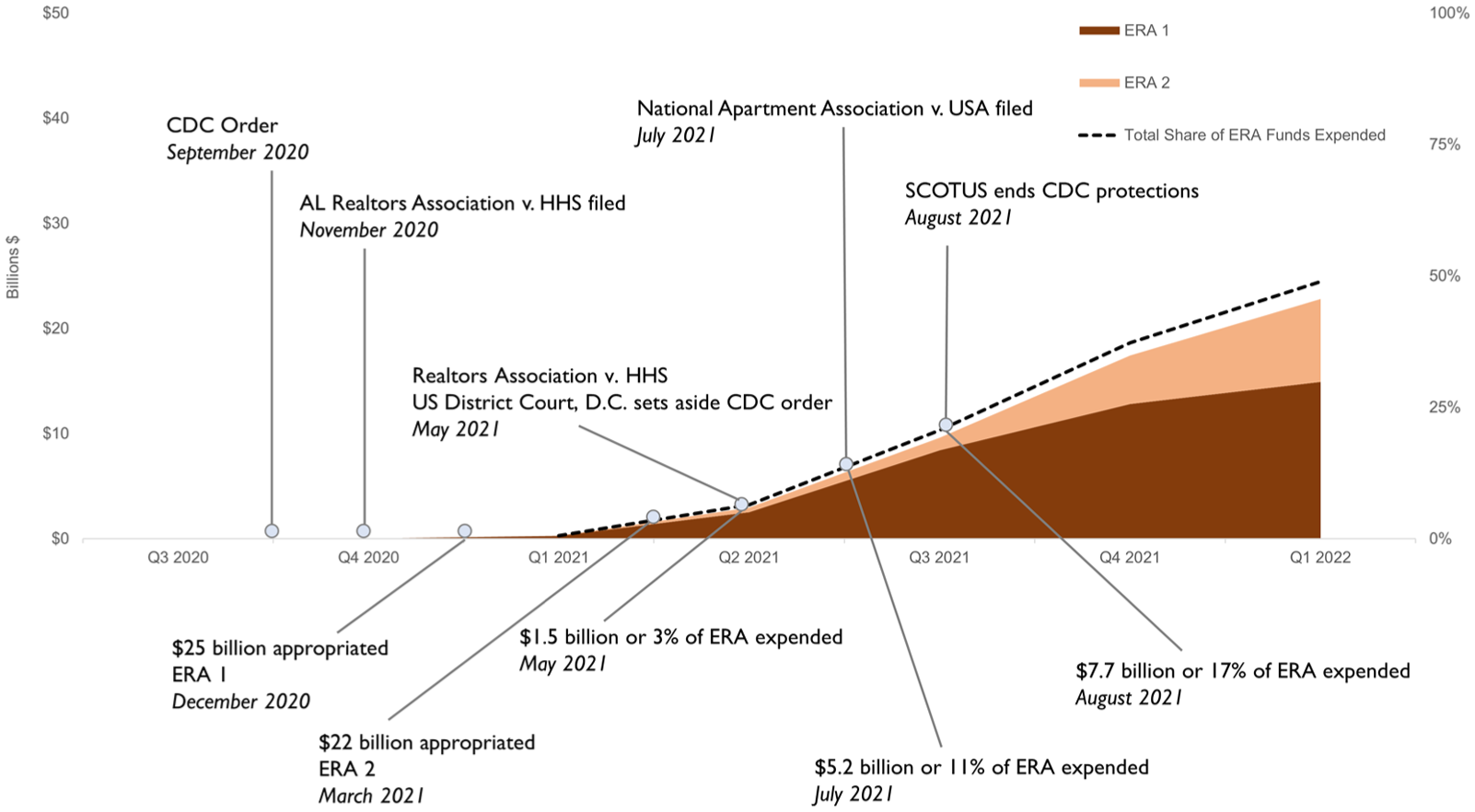
Timeline of real estate industry legal action against the CDC tenant protections alongside expenditures of Emergency Rental Assistance.
Notably, the plaintiffs in Alabama Association of Realtors v. HHS filed their challenge in November 2020, before Congress created and funded the Emergency Rental Assistance program. However, neither the Alabama plaintiffs nor landlords pursuing parallel cases withdrew or narrowed their claims once nearly $50 billion in ERA funding was appropriated beginning in December 2020. Instead, legal efforts to terminate the federal eviction moratorium persisted and intensified. The industry brought additional challenges even after funds were made available—for example, when the National Apartment Association filed suit in July 2021 arguing that ERA was inadequate, at a moment when approximately 89%, or more than $40 billion, of allocated funds remained undistributed. Whether landlords viewed ERA as sufficient is ultimately secondary to the sequence of events: litigation to restore eviction authority advanced more rapidly than efforts to access public compensation. When the Alabama plaintiffs received a favorable district court ruling in May 2021, roughly $1.5 billion, or 3%, of ERA funds had been disbursed. By the time the Supreme Court signaled in July 2021 that the challenge would likely succeed, about 11% of funds had been spent, and when the moratorium was ultimately struck down in August 2021, only 17% had been disbursed. It would take many additional months before even half of ERA funds reached households. This timing demonstrates that restoring eviction authority was treated as a more urgent priority than rapidly accessing public compensation.
ERA posed a distinctive threat because it offered revenue without expanding landlord control over tenure and weakened eviction as the mechanism that converts nonpayment into displacement. In interrupting this linkage, ERA temporarily loosened the housing trap by disrupting a core modality of racialized accumulation. Drawing in part on Bledsoe and Wright’s (2019) account of the racialized character of the spatial fix, Dantzler (2021) argues that eviction operates as a spatial mode through which dispossession is translated into displacement. The eviction-based organization of housing thus depends not simply on insecurity in the abstract, but on the active circulation of tenants through eviction-driven churn. ERA’s interference with this process threatened not only income streams, but a racialized system of control in which eviction sustains accumulation by preserving the displaceability of Black renters and neighborhoods.
The spatial dimension of landlord resistance to ERA is not incidental. Woods (1998) emphasizes that racial capitalism operates through regionally organized political-economic blocs, historically rooted in plantation geographies and reconstituted through contemporary institutions and markets. The legal challenge that ultimately dismantled the federal eviction moratorium was itself regionally anchored, led by landlord and Realtor organizations in Alabama and Georgia and advanced through coordinated state and national networks. If eviction-based rule is spatially organized in this way, resistance to policies that weaken eviction authority should likewise exhibit regional patterning rather than appearing as a collection of isolated state-level outcomes. The analysis that follows therefore examines the geography of ERA disbursement not to identify causal determinants or administrative failures, but to assess whether resistance to trap-loosening interventions aligns with broader regional formations of eviction-based political power.
There was significant variation in the disbursement of ERA funds across states, consistent with the expectation that resistance to interventions weakening eviction-based control would be unevenly distributed in space. To examine these differences systematically, I constructed a weighted measure of quarterly ERA disbursement shares (2021Q1–2022Q2) for each state’s total allocation (ERA 1 + ERA 2), placing greater weight on earlier quarters to distinguish rapid uptake from delayed participation. Standardized Z-scores were then calculated to capture each state’s disbursement trajectory relative to the national average, and a k-means cluster analysis grouped states into four categories ranging from slower to faster uptake. States were subsequently organized by Census-defined regional divisions to assess whether these patterns exhibited spatial coherence.
Figure 2 shows how states cluster according to the pace of ERA uptake: 11 states in the slowest group, 20 in below-average uptake, 12 in above-average uptake, and 8 in the fastest group. The purpose of this comparison is to visualize how landlord cooperation and resistance—particularly in response to perceived constraints on eviction authority—shaped the timing and distribution of funds. Most states fell below the national average in early disbursement, while only a smaller subset moved rapidly to distribute funds. Importantly, these clusters are not evenly distributed across Census regions. Some regions, including the East South Central and West North Central divisions, contain no states in the higher-uptake categories, reflecting regionally coherent patterns of delayed participation rather than isolated state-level outcomes. Other regions exhibit internal differentiation: for example, the West South Central division is generally characterized by slow uptake, yet Texas stands out as a clear outlier, disbursing funds far more rapidly than neighboring states and elevating the regional average.
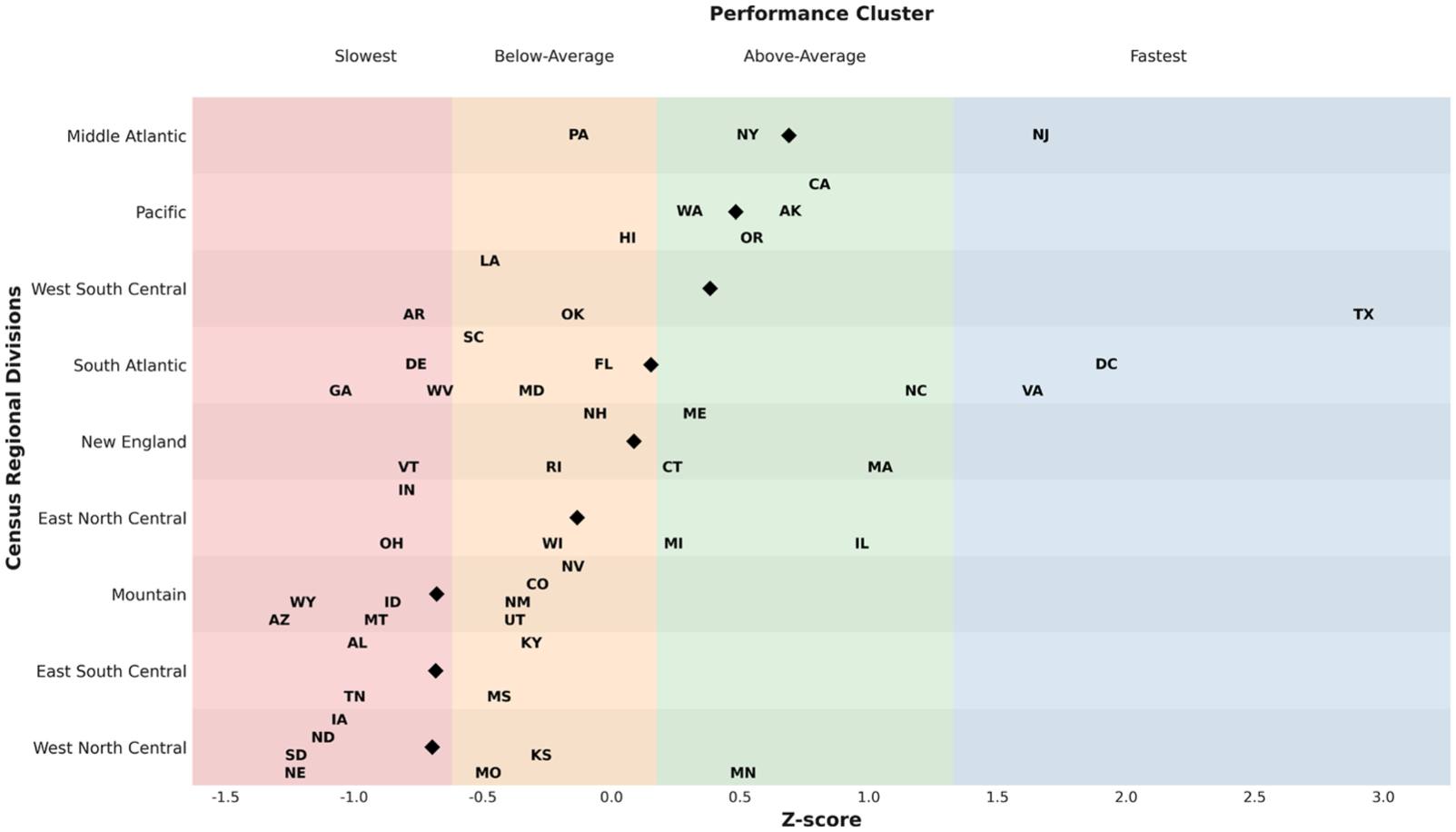
States are grouped into four performance clusters (Slowest, Below-Average, Above-Average, Fastest) based on Z-scores derived from weighted quarterly disbursement shares, with earlier distributions given greater weight. State abbreviations are positioned by Z-score within their Census regional division, and diamonds indicate regional means.
These spatial patterns align with earlier evidence of regionally anchored legal mobilization against federal eviction protections. By mid-2022—more than a year after ERA funds were first authorized—23 states had still not disbursed 50% of their allocations. Among states from which landlords and Realtor organizations led legal challenges to the CDC eviction moratorium, Alabama fell into the slowest uptake cluster and never crossed the 50% threshold, while Georgia also remained below that mark. In public communications, member guidance, and congressional testimony, trade associations representing landlords consistently advocated for direct-to-landlord ERA models and opposed program conditions that limited eviction authority or imposed additional requirements. Although national landlord organizations initially expressed qualified support for limited eviction moratoria, by mid-2021 they were calling for the termination of federal eviction protections and insisting that relief be “paid directly to housing providers,” a position amplified by Realtor affiliates in Georgia, Alabama, Louisiana, Florida, and Texas (Oppler, 2021; Schwartz, 2020, 2021). These patterns indicate property owners’ collective and strategic engagement with the state to preserve control over tenure and enforcement. Resistance to ERA thus took the form not of opposition to public spending as such, but of efforts to ensure that public intervention reinforced, rather than weakened, the eviction-based organization of housing.
Once ERA funds did begin flowing, how did landlords engage this unprecedented opportunity to be compensated for their claimed economic losses? While federal ERA guidance did not itself prohibit eviction as a condition of participation, many state and local programs implementing ERA did so. Jurisdictions varied in how they structured these constraints, with some requiring eviction forbearance only for the covered period and others extending protections for months or a full year after assistance. In New York State, for example, landlords accepting ERAP funds agreed to “not evict the household on behalf of whom the ERAP payment is made for reason of expired lease or holdover tenancy for one year from the receipt of the ERAP payment” (New York State Office of Temporary and Disability Assistance, 2021). A nationwide tracker compiled by the National Low Income Housing Coalition documents this variation across jurisdictions, with many programs conditioning ERA payments on eviction restrictions during the covered period, during specified post-assistance months, or both (National Low Income Housing Coalition, 2022). Other program conditions—rent freezes, arrears forgiveness, registration, and licensing compliance—added further constraints on landlord discretion. Together, these provisions did not eliminate landlords’ access to public funds, but they conditioned access on the temporary surrender of the single authority landlords had organized collectively to defend: the power to evict.
In these terms, ERA provisions constituted trap-loosening constraints: they temporarily disrupted the eviction-based mechanism through which access to shelter is disciplined. Evaluation research on Emergency Rental Assistance documents the consequences of these constraints in terms of administrative burden and delayed uptake. In their review of state-level ERA implementation, Reina et al. (2021) find that programs imposing stronger tenant protections and compliance requirements were “associated with a lower mean ratio of households served to households expected to be served, especially as time went on,” with similar effects observed for increasing stringency of requirements (p. 12). Approximately half of the programs surveyed identified landlord resistance to participation as a common constraint, situating ERA within a broader pattern of dual take-up challenges that extend beyond the pandemic context. As Reina et al. observe, “perhaps the most fundamental barrier was that the vast majority of programs required both tenants and landlords to cooperate to receive assistance,” reproducing participation problems long documented in non-emergency rental assistance programs such as Housing Choice Vouchers (p. 118).
Practitioner and qualitative accounts of ERA implementation corroborate this programmatic evidence. In structured interviews with administrators across fifteen ERA programs, Aiken et al. (2021) found that a subset of landlords preferred to evict tenants rather than accept assistance. Legal aid practitioners were more direct about the mechanism: Jack Newton, director of the Public Benefits Unit at Bronx Legal Services, explained that “if the landlord does accept the funds from ERAP, he cannot evict a tenant for 12 months” and added that “landlords don’t like to be told what to do” (Karthikeyan, 2021). Investigative reporting tracking ERA implementation across states documented the same pattern across multiple states, with landlords refusing participation specifically when acceptance foreclosed eviction (Kleiner et al., 2021). These converging accounts from program administrators, legal practitioners, and investigative reporting make visible what individual-level behavior can otherwise obscure: that landlord refusal of ERA funds was not, in many cases, a response to paperwork complexity but to the specific condition of non-eviction that accepting the funds entailed.
Read through the analytic trajectory developed in this paper—from Kalecki’s account of the hierarchy of class priorities to Woods’ concept of trap economics—these findings take on a more specific meaning. Kalecki emphasized that capitalists will accept public intervention only insofar as it does not threaten their capacity to discipline and retain control, while Woods theorized traps as systems of political and economic incorporation that reproduce dependence by constraining mobility and foreclosing exit rather than through outright exclusion. At the level of policy implementation, this framework highlights how participation itself can function as a mechanism of containment. From this perspective, the administrative frictions documented in ERA implementation are not merely technical failures, but mechanisms through which landlord cooperation is conditioned on the preservation of eviction-based control. Even where substantial public compensation is available, participation becomes contingent on whether program rules constrain landlords’ authority over tenure and enforcement.
This pattern of selective engagement is well documented in earlier housing policy research. In her analysis of landlord participation in the Housing Choice Voucher program in Baltimore, Rosen (2014) shows that landlords do not simply accept or reject public subsidies, but strategically use program rules to maximize control over assets and tenants. Landlords participate by “(1) selecting and recruiting certain types of tenants, (2) sorting them into certain properties and types of neighborhoods within their portfolios, and (3) selectively retaining tenants through methods of entrapment” (Rosen, 2014: 334). If you read through Woods’ concept of trap economics, Rosen’s use of entrapment is especially revealing: it captures the micro-level practices through which exit is foreclosed even in contexts of formal assistance. Participation in public programs does not dissolve the housing trap, but can instead reconfigure it, reproducing dependence and constraint through selective retention rather than outright exclusion. Entrapment, in this sense, operates as one mechanism through which eviction-based systems of control are stabilized across changing policy regimes.
These analyses show that landlord resistance to ERA operated not through uniform refusal, but through selective cooperation structured around the defense of eviction discretion. Program administrators were often aware of these dynamics and attempted to work around landlord nonparticipation by modifying program rules or developing alternative distribution pathways. Notably, while landlord organizations routinely attributed low ERA uptake to administrative complexity or misaligned incentives, they devoted far greater political and legal resources to challenging eviction protections than to reforming program design. The pattern of landlord refusal is not well explained as a response to program-specific compliance burdens. As noted above, ERA’s basic mechanical operation—converting arrears into paid rent—disrupted the nonpayment-to-displacement linkage even in jurisdictions without explicit eviction-forbearance conditions. Moreover, because ERA participation required landlord cooperation, the program forced the retention of tenants whose accumulated arrears would have normally placed them in the category that landlord screening practices select against (Garboden et al., 2018; Rosen, 2014). ERA therefore threatened two of the three powers through which landlordism operates: expulsion, by interrupting the eviction-for-nonpayment mechanism, and gatekeeping, by compelling the retention of tenants the screening apparatus would have filtered out. The hierarchy of class priorities predicts that both—as mechanisms of control rather than of revenue—will be defended even at the cost of substantial cash. This also helps explain why states from which the most aggressive challenges to the federal moratorium originated, such as Alabama and Georgia, were among the slowest to disburse ERA funds: landlord class mobilization operated at the scale of the general prerogatives of property, across the full range of moments at which ERA threatened them.
From idealized markets to labor relations and housing tenure
This paper reconstructs Kalecki’s analysis of business owners’ opposition to full employment policy on the terrain of housing, theorizing property owners’ opposition to “full housing” policy. The hierarchy of class priorities orders the employer–labor relation and the landlord–tenant relation in structurally parallel ways: just as business owners preserve control over labor and the state as the condition of future profits, property owners preserve control over state policy and tenants for the same reason. Specifically, Kalecki identified the “sack” or the threat of unemployment as the key disciplining mechanism that owners wield; landlords similarly deploy eviction to discipline tenants to accept their terms for access to shelter. The paper demonstrated the salience of this collective prioritization of control through historical examples in public housing policy and recent experience in landlord opposition to COVID-era housing policy. The failure of incentive-based housing policy under eviction-based rental systems is not contingent or accidental. It follows logically from a system in which access to shelter is governed through coercive enforcement.
Bringing Kalecki’s insight into conversation with the Black radical tradition moves the analysis beyond analogy and toward a structural homology between labor and housing under racial capitalism. While Kalecki identifies the hierarchy of class priorities as a defining feature of capitalist class power, the Black radical tradition situates this hierarchy within enduring histories of racialized domination and political rule. Black geographies complements this move by showing how such relations of control are spatially organized through land, housing, and mobility. Together, these traditions expand Kalecki’s insight by detailing the enduring but shifting regimes and factions for whom the prioritization of racialized control over urbanization, economic growth, labor, and tenants constitutes the means of accumulation—an interdependence that Black political movements have historically confronted as a unified problem of domination rather than as separate policy domains. The hierarchy of class priorities is therefore central not only to COVID-era emergency housing policy, but also to broader housing movements that envision “Abundant Housing,” “Housing for All,” or a “Housing Guarantee.” Because these projects—whether market-based or socialized—ultimately seek to diminish the class power of property owners, full housing cannot be achieved by enticing owners with cash alone, but requires a political response capable of confronting organized class resistance.
Engagement with the Black radical tradition underscores the political nature of the housing question because these scholarly traditions understand the hierarchy of class priorities as a problem of power, not merely of economic interest. Additionally, this scholarship emphasizes critical analysis of and engagement with historical struggles against specific economic traps and broader movements that sought alternatives to the rule of the plantation bloc and its racialist culture of control. Within this tradition, historical movements are not invoked as models to be replicated, but as concrete struggles that reveal how coercive political–economic systems have been collectively contested. One clear implication of this work is that labor and housing function as intertwined dimensions of domination under racial capitalism, a relationship made visible in the political practice of the Southern Tenant Farmers’ Union (STFU). Members of sharecropper unions like the STFU experienced the coercive control of labor and tenancy together as mutually-reinforcing dimensions of trap economics and therefore mounted political resistance to them as intertwined problems (Kelley, 2015; Woods, 1998).
If eviction cannot serve as the basis of the housing order without reproducing insecurity, then the political question becomes one of tenure: what institutional forms can secure access to housing without relying on eviction-based coercion? There is no way around landlord opposition to full housing policy, and their strategically selective engagement with state power, and so policy-making should not avoid the inevitable conflict but should anticipate and confront it directly. Therefore, policy-making will require a more robust and wider-ranging approach to enforcement than traditional policy compliance has considered. A key component of full housing policy is building state/collective capacity that provides alternatives to private ownership which directly challenge landlords’ control over markets and their ability to set the terms for access to shelter. Such capacity would also undermine capital’s threat of exit or strike as a means to influence policy. Given the intense landlord opposition to such a paradigm, policy will need to facilitate and channel social pressure of organized non-owners, such as tenant unions. For example, some legal scholars and tenant organizers have called for a “Wagner Act for housing,” once again analogizing from labor relations to housing tenure, which would establish the right for tenants to collectively bargain and protect collective action like rent strikes (Kennedy et al., 2023). While there is a vigorous debate about enlisting the state in this way given the historical role of the Wagner Act in defusing militant labor action through bureaucracy (Baltz and Rahman, 2023), nonetheless these proposals represent the relevant terrain for developing policy that augments social pressure to realize housing justice. Ultimately, capitalist class resistance to full housing policy will mean that those who prioritize meeting the housing needs of people must make value questions explicit. That is, policymakers and others must straightforwardly argue that the mechanisms of control that are central to profit-making from housing are fundamentally antithetical to a society free of domination and they must be curtailed in favor of other approaches to providing housing.
The implications of this analysis are therefore not primarily technocratic but political. The insights discussed in this paper about the order of class priorities seemingly contradicts the last 50 years of economic orthodoxy, as economists from Milton Friedman to Edward Glaeser have argued that if government just got out of the way, profit-maximizing rationality would create the perfect outcome. The hierarchy of class priorities—profit-making contingent on, and when the two come into tension, subordinate to, the maintenance of class power—troubles this façade of (neo)liberal policy-making: if policy can design a profitable market as a way to meet public goals, then there will be actors willing to operate in that market (Akers, 2013). Of course, despite how its avatars present neoliberalism, it has always entailed enlisting the state in developing coercive powers of control to undergird profit-making. As Christophers (2019) explains about the nature of monopoly control, “such a regime represents not so much the corruption of capitalism as—from capital’s standpoint—its perfection” (p. 323). Indeed, we should expect continued reliance on and expansion of despotism, as Woods (2009) notes: “the plantation social-economic model is the neoliberal ideal” (p. 776).
If any faction of capital—industrial, financial, or landed—prioritizes maintaining class power as a condition of doing business, then ensuring capitalist profit as a way to achieve public policy goals is a dead letter (and always has been). This does not mean that housing policy is futile, but that policies which leave eviction-based rental housing intact are structurally limited in their capacity to resolve housing insecurity. Under such conditions, efforts to induce landlord cooperation through subsidies or compensation encounter a fundamental constraint: landlords may accept public funds so long as doing so does not weaken the mechanisms of control—most centrally eviction—through which access to shelter is disciplined and future profitability secured. When policy conditions threaten those mechanisms, landlords can and do withhold cooperation, even at the expense of foregone revenue. In this sense, landlords cannot be reliably “bribed” into full housing through incentive-based policy alone, because their collective capacity to resist reforms that curtail eviction authority limits the effectiveness of such strategies.
The implication is not simply that landlords oppose particular policies, but that landlordism itself constitutes a social relation organized around hoarding, gatekeeping, and expulsion as the means of rent production. As Stone (1993) observed over three decades ago, “private rental housing is an anachronism,” and so “the era of landlordism should be brought to a responsible close” (p. 228). Read through the analytic framework developed in this paper, this conclusion follows not as a moral indictment but as a structural diagnosis: a housing system premised on expulsion-based enforcement is incompatible with securing housing as a social necessity rather than a disciplinary instrument. Ultimately, the goal is to transform landlordism from a system of hoarding, gatekeeping, and eviction into what it now speciously claims to be: a housing provider.
Footnotes
Acknowledgements
I thank Alex Ferrer and Ananya Roy for their support and commentary on an earlier version of the paper presented at the 2023 annual conference of the American Association of Geographers in Denver, Colorado. I thank Camilla Hawthorne for her generous engagement. Finally, I thank the EPA editor and referees for their comments which helped to significantly improve the paper.

Funding
The author received no financial support for the research, authorship, and/or publication of this article.
Declaration of conflicting interests
The author declared no potential conflicts of interest with respect to the research, authorship, and/or publication of this article.