







Abstract
This paper advances a geographic research agenda for the service transition, the global shift from manufacturing and agriculture toward services. Drawing on feminist geography and economic history, we show how low-end services expand across the Global North and South because they operate as a “double fix”: they absorb surplus labor to stabilize mass employment while sustaining strained systems of social reproduction. Our framework explains the core economic and social functions of low-end services, while highlighting their crisis tendencies—rooted in slow growth and labor restructuring—and the potential for service work to support more life-affirming futures.
Introduction
Amid escalating geopolitical tensions, a climate emergency, and the resurgence of ethnonationalism, global elites and academics are rallying around new policy imaginaries such as reindustrialization, AI, and degrowth. Yet a quieter transformation has already restructured the foundations of work and life: the relentless expansion of the service sector. Today, services account for the majority of employment across regions as varied as North America, Europe, East Asia, and Latin America; even where (neo)colonial legacies inhibited industrialization, such as South Asia or Sub-Saharan Africa, the service sector is gradually breaking through, accounting for more than a third of total jobs (World Bank Group, 2025). Some of this expansion is high-end, as in finance or consulting, but much of it enlists laboring bodies, mostly female, often racialized and migrant, to perform essential but invisible tasks across the globe: cleaning, caregiving, teaching, and serving (Fernandes et al., 2023; McDowell, 2009; Nagar et al., 2002). Labor platforms accelerate matters by creating new masses of “life workers” available “anywhere, anytime, which comes to mean everywhere, all the time” (Winders and Smith, 2019: 879). We are living through a planetary service turn, digitized and uneven, but convergent in deepening worker precarity while commodifying care.
This paper seeks a framework to explain the service transition, its locally varying origins, asymmetric feedbacks, and historic import. Our foundation rests on two contributions from feminist geography. The first is to name the preconditions that produced a global, low-end service workforce: the mass entry of women into waged labor and the heightened mobility of transnational migrants (Sassen, 2008). The second recognizes that, as these relatively subordinate groups came to form a “servicing class,” work itself has become more susceptible to degradation, informality, and casualization (Smith, 2016). Feminist geography has thus long been clear that studying low-end services is key to understanding contemporary inequality, a proposition we agree with and seek to extend. We wish to continue to raise a priori questions: why did low-end services expand, albeit unevenly, on a planetary scale? Why have they unleashed so much inequality? How do they fit into the global political economy?
One promising answer comes from labor historian Winant (2021), who analyzes Pittsburgh’s transition from steel to health care, with a central argument that the care sector served as a “fix” to the woes of deindustrialization, drawing surplused populations to work into hospitals, legitimizing new “eds and meds” development models, and delivering care to a region made more precarious by industrial collapse. This represents a theoretical advance in understanding the sector’s significance, but a single historical case cannot explain the global service transition or the drivers, unevenness, or breadth of low-end services beyond care. We take from Winant the metaphor of “the fix” to understand the services as a structural resolution to crisis that is improvised, capital-led, people-resisted, and contradictory (Harvey, 1982).
This paper offers a feminist-informed political economy of low-end service expansion as a kind of fix. We do not intend to establish a totalizing approach that overwhelms contextual complexity across world regions, but rather to highlight common patterns and dialectically connect them to offer new research paths. We begin with the observation that low-end services are distinct for their dual role as engines of employment and providers of care, and argue services expand globally because they function as a “double fix.” First, they address crises of job creation. Amid global deindustrialization and an international division of labor that surpluses parts of the Global South, 1 services sustain large-scale employment and absorb displaced workers. Second is a crisis in care, punctuated by time-poverty, chronic exhaustion, aging populations, and the intensification of domestic responsibilities, which low-end services seek to address amid state withdrawal, platformization, and financial enclosure. Rather than separating the productive and reproductive functions of services, we insist they be taken together. If we consider how, across the globe, capital, workers, and the state have claimed, occupied, and contested each space—services as worksite and services as care—then we can begin to articulate how services fit—and expand—in a political economy where they are often miscast as marginal.
Our second theoretical move is to probe the new crises the double fix might generate. A key tension is that labor-intensive, low-end services are structurally resistant to productivity gains (Winant, 2021). As margins stagnate or decline, a contradiction emerges: the sector that has the greatest capacity to sustain mass employment has the least inherent capacity to maintain decent livelihoods. By the same token, the sector that has the greatest responsibility in sustaining daily life has the least inherent capacity to maintain price affordability. No sooner does the double fix attempt to resolve one set of crises than another quietly intensifies, this time over limits to growth.
Yet another service-based political economy is also possible. We use the double fix framework not to reify contradictions from above, but to recenter the agency of poor and working people in shaping service-based space economies, not just as passive recipients of structural shifts, but as active, if uneven and unwitting, participants in their making. Across diverse geographies, popular mobilizations have pushed care and education onto political agendas, framing them as rights rather than residual welfare functions. These struggles, from campaigns for universal education to national health systems, have institutionalized parts of the service economy that were once thrown back onto women, the family, or coerced labor. Beyond formal rights, equally powerful forms of agency emerge in the informal architectures of everyday life, such as the street markets that mix sale, barter, childcare exchanges, and mutual aid (Gago, 2014). Communities assemble the reproductive and employment functions of the service economy from the ground up.
So too may these communities fight for a different kind of service transition. Our final intervention foregrounds the dynamics of class de- and re-composition that accompany the global service turn across varied geographies. In absorbing vast labor surpluses, the service sector draws in some of the most precarious constituencies, particularly women, migrants, and racialized populations, reshaping not just who works but how class is experienced and politicized. At the same time, neoliberal restructuring has withdrawn the state from the provision of collective goods (Smith, 2015), often deepening inequality while strategically fragmenting solidarities, dividing service workers from service users through gendered and racialized discourses that cast service workers as unskilled or undeserving (Cooper, 2025). One paradox at the heart of the double fix is that the sector most essential to everyday survival also becomes a flashpoint for moral panic and strife. Yet precisely because the double fix is forged through struggle, it remains open to contestation.
Our article follows an unconventional structure. We begin by presenting secondary data on service-sector growth across regions to understand the rhythms of global tertiarization. We then dive into Winant’s (2021) case study to introduce our double fix framework through a direct extension of Winant’s arguments about Pittsburgh. Services as Double Fix presents national evidence from the U.S. that, beyond care, the wider world of low-end services also operates as an unstable double fix. The Double Fix in a Dependent Economy turns to Argentina, another illustrative case that shows how the double fix framework may apply to a fragile, dependent economy of the Global South. We conclude by outlining a research agenda for geographers who take seriously the magnitude of the sectoral transformation that has ensued, as services have grown countercyclically wherever other industrial drivers have either fallen or faltered, a shift that has “meted out severe social consequences” (Winant, 2021: 3) yet holds untapped possibilities to which geography has yet to awaken.
The global geographies of the service transition
Before we return to our conceptual discussion, we highlight two empirical realities that motivate our study. The first is that, contrary to what the comparative capitalism literature suggests (e.g. Wren, 2013), the service transition—that is, the steady shrinkage of economic output and employment in the “traditional” sectors and their replacement with services—is not just a Global North phenomenon. Activities such as wholesale and retail trade, restaurants and hotels, transport, storage, communications, financing, insurance, real estate, business services, community, social, and personal services 2 have expanded significantly, everywhere. According to World Bank Development Indicators, services far and away account for most jobs not just in the EU (73%) or North America (79%), but in Latin America (66%) and Eastern Europe (61%). In East Asia and the Pacific, the primary sector has declined by roughly 1% annually, while the secondary and tertiary sectors have grown by 7% and 13%, respectively (World Bank Group, 2025). The transition has intensified in the past decade, especially in regions historically less reliant on services, such as the Middle East and North Africa, where employment in the sector increased from 56.7% to 60.2% between 2015 and 2023. Even in regions where (neo)colonial legacies hindered industrialization, such as Central and Western Africa (44% in services as of 2023), Sub-Saharan Africa (38.5%), and South Asia (34%), the service economy is gradually emerging 3 (World Bank Group, 2025). Across divergent development trajectories, a generalized sectoral transformation seems to be propelling secular, rather than temporary, tertiarization. There is much variation, of course, to be studied. The data from the World Bank Group, while more comprehensive than that of other agencies, 4 lumps together low-end service work with business, finance, consulting, and related services. The aggregate data almost certainly mask variation in what service fields are most developed in different world regions. So too do aggregate numbers conceal global diversity. Service sector growth in countries that are net “exporters” of service workers (e.g. the Philippines, Indonesia, Nepal) is certainly a different story from that of service growth in Nordic European countries with extensive welfare states. Our argument is not that the “servicification” of the global economy is a homogenizing force, but that profound and diverse processes seem to be driving service growth in places where they have not been well studied or understood.
Second, while geography has studied the high-end of servicing (e.g. finance, tech), evidence suggests low-end services may matter more for understanding uneven development and the possibilities for global growth. We can see this in comparing Figure 1 to the aggregate World Bank data we calculate above. Services may be adding jobs across world regions, but our calculations in Figure 1 reveal services have, in recent years, contributed only to GDP growth in East Asia and the Pacific (1.5%) and South Asia (1.1%). Elsewhere, service sector productivity is either stagnant or declining. Baumol et al.’s (2012) classic argument holds that it is the sluggish “low-end” human service industries that are dragging down overall growth. Too labor-intensive to achieve the efficiency gains of more technology-intensive sectors, these services face downward pressure on their margins and thus undercut total productivity numbers. Yet if this is what is unfolding, then it seems that low-end services may be locking contemporary capitalism into a low-growth, high-precarity equilibrium. This weighty proposition deserves more attention. We address the matter conceptually in the next section, “Feminist Perspectives on Service Expansion” by reviewing key but select contributions from the part of our discipline that has, for many years, sought to foreground low-end services: feminist economic geography.
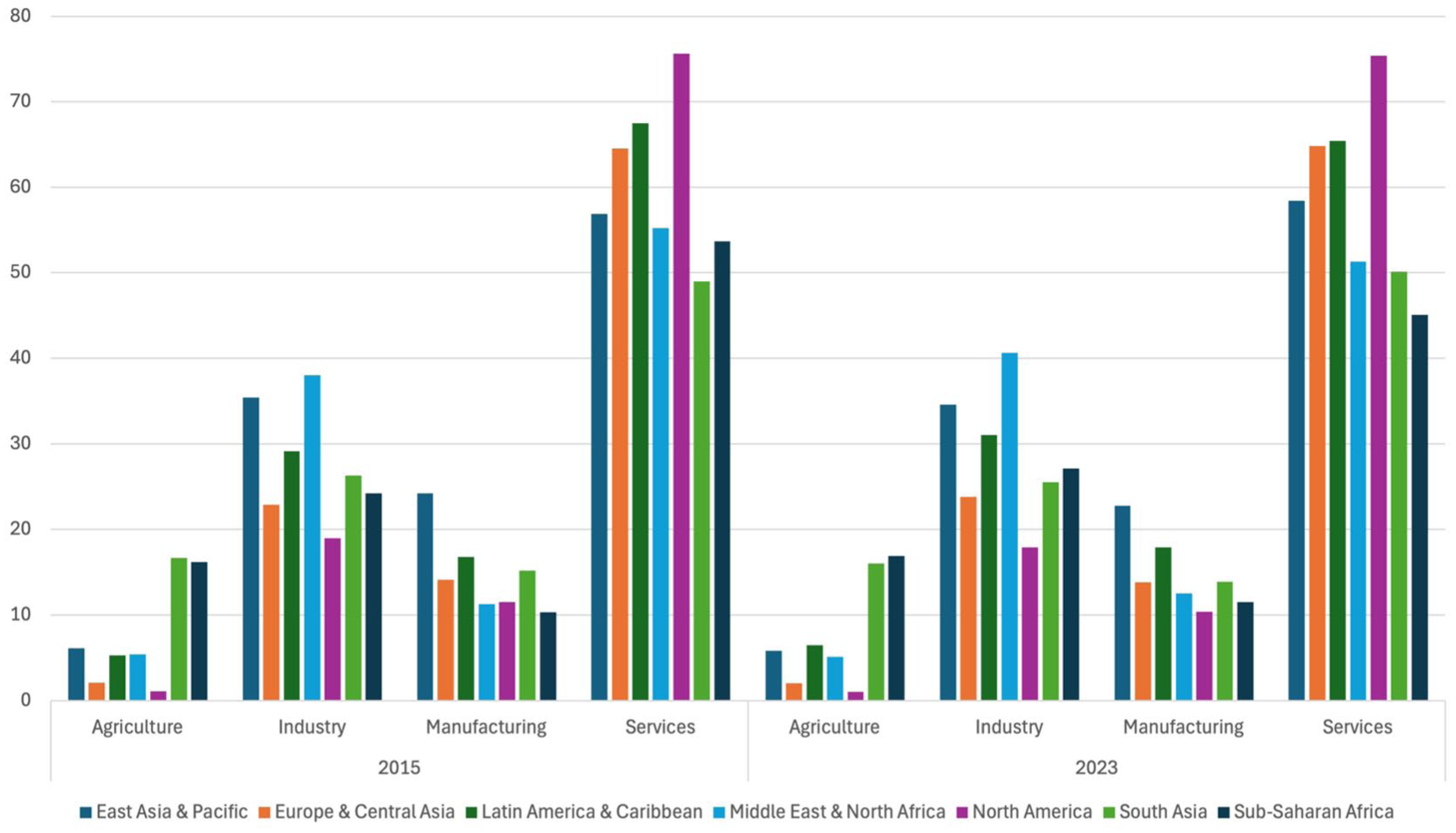
Structure of value added by large sector and World region (percent of GDP).
Feminist perspectives on service expansion
Feminist economic geography digs its roots in the second-wave feminist movements of the 1960s and 1970s. Feminists at the time debated the value of domestic work, casting it as the “unpaid labor . . . that is necessary if the entire system is to function” (Benston, 1969: 13; Federici, 1975). Others were more dubious (Davis, 1983). These debates lost steam in the 1980s and 1990s as the economic terrain underwent tectonic shifts. Fordism, the family wage, and full male employment wound down in the industrialized core. Western countries marched toward a service economy (Wren, 2013). Men lost jobs. Women (re)-entered the workforce. Divorce rates increased, demographic trends changed, and “non-traditional” household and family forms proliferated (Martin, 2010; Ruddick, 2003). Prescient observers like Massey (1984) saw that places with large numbers of women, particularly married women, had a locational advantage in drawing on a “reserve army” of female labor to fill emerging low-paid service jobs. At the same time, McDowell (1991), Hochschild (1983), and others raised the alarm that these same women were stretched to the brink, completing “double shifts” at work and home, shoring up production as much as reproduction, with ever blurrier lines demarcating the two (Winders and Smith, 2019). The argument that capitalism depended on the unwaged domestic labor of women needed reworking, not because female labor was any less essential to the system—arguably it was more so—but because both male and female labor were assuming new forms.
This was true in the Global South as well. The loss of subsistence economies, structural adjustment, and dependency destroyed indigenous communal practices and created pervasive and deeply gendered informal markets. In Latin America, Segato (2025) defines this process as dueñidad, a renewed accumulation strategy based on the dispossession of the most vulnerable communities. Here, political and transnational corporate powers come together—sometimes underpinned by crime—to promote extractivism, with substantial impacts on the environment and people, who are forced to migrate to other countries (within Latin America or beyond). The violence, Segato (2025) argues, is deeper for women, whose communal and familial supports are uprooted and whose labor power is newly absorbed and marginalized in various parts of the informal economy, from illegal sweatshops to domestic work (Gago, 2014; Montero, 2012).
In her seminal paper Father and Ford, McDowell (1991) threw down the gauntlet: the question for feminist political economy, indeed all political economy, was not a “woman’s question”—it was a question of gender relations, which were now, as always, necessary to explain occupational sorting, wage polarization, spatial restructuring, and the sturdiness of any given social formation. The service turn was recomposing the working class, albeit without upending racial, gendered, or North/ South hierarchies. If anything, sexist and racist tropes were reified as women and people of color were cast as ideal candidates for all manner of high-touch and low-waged employment in retail, hospitals, education, care, and informal markets (McDowell, 1999, 2009, 2016). These same tropes weakened the political power of the female and non-white workforce, as when managers laughed off women’s demands for raises as a campaign for “lipstick money” (Wright, 1997) or, when right-wing U.S. thinkers dismissed high unemployment numbers for women and African-Americans, claiming these were constituencies with no real attachment to the wage (Cooper, 2025).
On the flipside, as men’s employment declined, so did their union power and political clout (Bluestone and Harrison, 1982; McDowell, 2003). Smith (2015) observed that class de- and re-composition were fomenting nostalgia for an era of hegemonic masculinity, which, she warned, could lead whole regions into reactionary politics. This was in part because, as Phillips and Taylor (1980) had presciently claimed, the proliferation of various logistics, retail, and care “sweatshops” (Cooper, 2025) was turning all workers into women workers, whatever their gender.
The service transition shored up new migration patterns that reinforced uneven development. As service sector employers stalled in their domestic recruitment of sufficiently flexible labor, they turned to migrants. In the 1980s, Southeast Asian countries like the Philippines and Indonesia “began aggressively promoting the ‘export’ of . . . women workers” (Silvey, 2012: 423) who migrated to fill care shortages in wealthier urban locales or overseas (Silvey, 2006; Wee and Sim, 2004; Yeoh and Huang, 1998). To do this, however, migrant caretakers had “to transfer their own familial and community responsibilities to other, still poorer caregivers, who in turn [did] the same—and on and on” (Fraser, 2016). Migration did not solve the shortage of care; it moved it around. Katz (2001) framed these movements of migrants as a transfer of variable capital from poor to rich places, akin to political control through debt.
More recently, the rise of platforms has solidified the services as a site of surplus extraction via mass precarization. To the extent that platforms enable new value creation at all, they do so not precisely without workers, but through their continual marginalization. That is, when labor platforms enclose the urban infrastructure and reproductive services by moving the labor for these services onto the platform, their main goal is not to extract “monetary rent” for the services that workers provide (e.g. food delivery). Rather, they extract “data rent” from the information that gig workers input “before, during, and after” every service transaction (van Doorn and Badger, 2020: 1475). Horton makes a similar argument about private equity firms purchasing long-term care facilities. These firms increase margins not by improving labor productivity or innovating care, but by “buying up, restructuring, and selling on companies” (Horton, 2022: 145). To maximize what the firms direct toward financial acquisition at the top, they hold down labor costs and hike fees for customers at the bottom (Strauss, 2023). Can a system that ratchets up precarity hold steady? To this question, Winant (2021) provides an answer.
The services as double fix
A crisis of production and reproduction
Winant’s (2021) The Next Shift tells the story of Pittsburgh, PA’s transition from a steel to health care. Winant begins at the height of steelworker power in the U.S., when steelworker unions were regularly striking across the country, paralyzing single-industry cities like Pittsburgh. Steelworkers had steadily expanded the wage, so much so that by 1973, their earnings outstripped company profits for the first time. Steelworkers had also expanded the social wage, notably by using the New Deal legal framework to bargain for welfare benefits not just for themselves, but their families. From the late 1930s onward, employers and unions across a range of industries agreed to cost-sharing partnerships to purchase private insurance, thereby birthing the American insurance and hospital systems. “The hospital,” writes Winant (2021), “was transmogrified from a place where the poor went to die into a house of science and care” (p. 136).
Following a 1949 strike, steelworkers won a nationwide contract with a master insurance plan, turning them into the largest consumer bloc in the regional health care market. But “as access and expectations [to care] increased, so did prices” (Winant, 2021: 132), increasingly shutting out the urban poor and sparking unrest and campaigns for a more universal, nationalized form of healthcare. The United Steelworkers considered joining. But, for union workers well covered by private insurance, the current compromise approximated decommodification of care. Workers paid very little for generous benefits; costs were the same whether workers and family members were sick or healthy; and as union members, they had extracted concessions to rarefied services such as semiprivate hospital rooms.
Yet by the late 1970s, worker militancy would collide headfirst with declining manufacturing profits. Layoffs in the steel industry, initially temporary, proved permanent. An exodus of younger Pittsburghians followed. Older steelworkers increasingly turned to health care to manage illnesses and injuries contracted over a lifetime of difficult work, as well as the general dis-ease felt amid a secular crisis of employment. Un- and underemployed workers were simply sicker than their employed counterparts, prone to diseases ranging from heart attacks and strokes to alcoholism and addiction.
Thanks to retirement healthcare provisions in union contracts, laid-off, predominantly male workers were able to seek institutional care at the same time as “women, increasingly pushed out of the non-waged domestic sphere by economic pressure, were pulled into a booming market in care work” (Winant, 2021: 17). African American women whose steelworker husbands had been laid off first took early jobs as nursing and medical assistants, reproducing in waged form the “labor of love” they had been expected to perform at home (McDowell, 2016). Eventually, as white steelworkers suffered layoffs too, white women also filled the ranks of health care workers, particularly in nursing, which the industry had crafted as a more elite and (at the time) white profession (Glenn, 1992).
So great was the demand for care that, in the late 1970s and throughout the 1980s, even as the U.S. government imposed cuts to other parts of the public sector, it continued to subsidize health, particularly through Medicare and Medicaid, which provided modest coverage for the poor and elderly. These public programs were a boon to many parties. Hospital utilization and reimbursement rates skyrocketed after the legislation was passed. Patients could get care. Doctors and insurers could get paid. As other industries contracted, hospitals could count on steady streams of federally backed revenue. Investors (i.e. bondholders) took note, directing capital in unprecedented volumes to the sector. Not even the Fed’s decision to hike interest rates during the Volcker shock of 1979 could slow the flow of dollars into Pittsburgh’s hospitals. That year, investment reached $230 million, up from $85 million in the early 70s. That the Midwest’s population would become older and sicker over the following years only added to the boom. Winant (2021) concludes: “the rise of the health care industry offered an economic fix to the social crisis brought about by deindustrialization, channeling public expenditure and state power into the management of surplus population, generating employment, profits, and social stability” (p. 18). By the late 1980s, Pittsburgh’s world-class hospitals and the research universities to which they were attached were the city’s largest and most prestigious employers. They had grown counter-cyclically as the industrial economy collapsed all around them. Out-migration from the city reversed as the economy stabilized around “eds and meds.”
We would modify Winant’s (2021) formulation slightly to argue that the rise of health care functioned as a double fix, simultaneously addressing crises of production and reproduction. Health care emerged as a site of accumulation and labor absorption, providing a new gravitational center for employment and a fresh outlet for public and private investment. Just as crucially, it responded to intensifying reproductive crises precipitated by the erosion of the family wage, the neoliberal rollback of redistributive state policy (outside of health), and growing needs to outsource care beyond the family. This second aspect of the fix, often treated as derivative, demands closer scrutiny. What we find innovative in Winant’s account is that it refuses to treat the expansion of the care economy as merely a demographic inevitability due to rising incomes or an aging population. Instead, Winant traces its genealogy back to worker struggles for state support and rising expectations for a more dignified infrastructure of social reproduction. What appears today as a sprawling, depersonalized care economy has roots in popular demands for the social wage. That some of these demands were institutionalized, even as they were refracted through market-mediated forms, reminds us that reproduction, too, has been a terrain of struggle. The fix came from both above and below. So did its challenges, to which we turn next.
How well can the double fix hold?
Winant’s second theoretical move is to explore the constraints of the care economy. To do so, he emphasizes the anomaly of the present conjuncture. In the Global North, the industries that once motored entire space economies, whether steel or otherwise, had myriad opportunities for technological advancement. These regimes of accumulation were driven by self-sustaining productivity gains, in effect giving organized labor space for the militant demands it made on an expanded (social) wage. A high-growth manufacturing society could afford it.
What of a service-based economy? This, Baumol et al. (2012) noted, is a different beast. Low-end services are labor-intensive, like manufacturing once was, but, unlike manufacturing, labor is precisely the point, the commodity being sold, and it can neither be fully sped up nor mechanized.
“Unable to achieve steady advances in efficiency of production, high-employment, low profit industries . . . sustain themselves financially by increasing prices and suppressing wages,” writes Winant (2021: 2). Counterfactual scenarios are possible, though none is, from the vantage point of the capitalist democracy, entirely desirable. The choice is between three types of class bargains: (1) societies may choke off low-end service jobs to accommodate higher wages, accepting high unemployment as the flipside of the arrangement; (2) they may push down wages “to encourage job creation,” (Winant, 2021: 3) accepting high precarity as the tradeoff; or (3) they may reroute more of the economy through the public sector, embracing costly public investment to sustain both jobs and wages. Social scientists speak of the “trilemma: a three-way choice between unemployment, low wage growth, or high public spending” (Winant, 2021: 3). Each path shapes the contours of inequality (Wren, 2013).
Winant (2021) draws on decades of feminist thought to explain why the U.S.’s approach to the trilemma has involved expanding low-wage, private-sector employment. Care industries played a major role, accounting, in the 2000s, for 74% of all job growth in the bottom quintile of the American wage structure (Winant, 2021). Why was this? Let us revisit the ways that health care was functioning as a double fix. The cost of care was rising, as Baumol had predicted, but the state was willing to cover the bill. For patients, investors, and politicians, the fix was working, delivering care while stabilizing the economy. “The only constituency forced to bear the cost of the bargain directly,” notes Winant (2021: 170), “was the health care workforce, whose wage growth had to be contained if costs were to be managed at all.”
Care workers protested their low pay. But this was an economy with a vast reserve army of women and people of color surplused under the previous industrial compact. A mobile, migrant workforce was growing in the background. And even the standard Fordist subject of the white blue-collar male was “traumatized” by job loss (Greenspan, 1997). In the health care industry, where so much of the work was framed as low-skill and low-prestige, workers were readily shown the door. In tandem, U.S. federal law moved to restrict care worker union rights. As judges argued in the courts, nurses and caretakers did not have an inherent right to strike the way that blue-collar industrial workers did: industrial workers performed a job, care workers were delivering an essential community service. 5 Today, it is apparent that, in the U.S., care workers have never achieved the political muscle of their industrial counterparts. Surely, that care has historically been ascribed to the “working bodies” (McDowell, 2009) of women, particularly women of color, has something to do with the continued precarity of the workforce. More broadly, though, it can be said that, while the Baumolian constraint bears down on health care from above, flattening the industry’s margins over time, the U.S.’s pathway through the trilemma was also overdetermined from below, through the availability of this vast, disempowered, feminized, and racialized workforce. Jobs were to become plentiful, if poorly paid.
The wider world of low-end services in the U.S.
At this point, we must expand the frame. Winant (2021) focuses on care, but, with modest modifications, the double fix can explain the emergence of a vast, low-margin service sector. This sector generates the majority of so-called “low-skill” jobs in the country (Dwyer and Wright, 2019), turning the gears of employment to such a degree that, as Autor and colleagues note in an autopsy of 2008, the U.S. would long ago have faced a crisis of unemployment had it not been for “jobs that involve assisting or caring for others, for example, food service workers, security guards, janitors and gardeners, cleaners, home health aides, child care workers, hairdressers and beauticians, and recreation occupations” (Autor and Dorn, 2013: 1555). Or, as Storm (2017) put it in another financial crisis post-mortem, debt-fueled consumption and toxic mortgages had masked stagnating real wages in the lead-up to the crash. But this was not so much a generalized as a localized crisis of low pay in the “stagnant” labor-intensive sectors of healthcare, education, retail, food service, and hospitality.
An open question is what sustains consumption of these services, especially if wages are cratering at the bottom of the labor market. Sassen (2013) and others (e.g. Farris and Bergfeld, 2022) have argued that demand comes from the polarization of the global economy, where the high-income and high-consumption lifestyles of professionals in the advanced producer services (e.g. finance) create a need for a servicing class of private school tutors, tourism workers, errand runners, personal drivers, etc. Surely there is a grain of truth to this, and it is likely that spending on services has simply become normalized across the wage structure. However, as decades of feminist research remind us, not all services are frivolous; care, education, and transportation meet real social needs. Many are services that poor people’s movements have fought for, and resilience in demand also underscores their indispensability to working-class life (Bassens et al., 2025).
So too might services be self-expanding. That is, the more workers accumulate in low-productivity, low-prestige service sector jobs “far from profits” (Winant, 2021: 2), the more precarious and time-poor a society becomes (Fraser, 2016). Workers who stitch together survival strategies through multiple exhausting jobs must outsource their own care and social reproduction to commodified services. Needs and demand increase all the way down the care chain.
Briefly, during COVID-19, another world could be glimpsed. Previously invisibilized service workers were called essential (Stevano et al., 2021). Major consultancies, such as Boston Consulting, argued that a crisis that placed such a burden on care systems should be followed by care-led recovery packages (Nadasen, 2023) and marshaled evidence that investing in child- and elder-care could yield job multiplier effects beyond those achieved through infrastructure investment, all while improving the status of women (De Henau and Himmelweit, 2021). These arguments found a sympathetic ear, of all places, in the White House, where Biden’s first attempt at a recovery package, Build Back Better, included precedent-shattering investments in care industries, and regulations such as childcare price caps, public preschool, and paid parental leave (Elrod, 2024). Yet, once the package emerged from Congress, its care provisions were laid to waste, replaced with “an amalgamation of business tax credits, targeted technology grants, and long-delayed infrastructure modernization” (Elrod, 2024).
The Biden administration would celebrate that it created 800,000 new manufacturing jobs, although, as Elrod (2024) notes, 650,000 of these “represent recovery to the levels of February 2020.” Moreover, manufacturing’s share of total employment shrank during the Biden years. Meanwhile, service sector employment grew. Over three-quarters of employment growth was in high-end business services, with consultants leading the group. The rest, at the bottom pole of the economy, was concentrated in three sectors: education, health, and transportation and warehousing (Elrod, 2024). Services acted as a fix despite themselves, despite the lack of political clout of their workers or intentional investment or coordination, growing, grinding, sustaining the churn of labor, capital, and care in the U.S. economy.
The double fix in a dependent economy: Argentina
To illustrate how the double fix can also illuminate service expansion in the more fragile, dependent, and prematurely deindustrialized countries of the Global South, we turn to Argentina. Today, the country is the IMF’s largest debtor, and 31.6% of the population lives below the poverty line, relying heavily on the informal service market to sustain employment (Instituto Nacional de Estadística y Censos, 2025). This comes after decades of upheavals following the social and economic expansion of the 1940s, when, under General Perón, the country industrialized and diversified beyond agricultural exports weakened by the Great Depression. Perón’s government implemented a successful Import Substitution Industrialization (ISI) strategy, enlarging the manufacturing base, nationalizing key industries, and achieving full employment. Between 1945 and 1955, Perón’s government introduced union-run social welfare organizations, that is, health insurance linked to workers’ unions, while building more than 4000 health centers and opening 35 public hospitals, which resulted in the cure of infectious diseases, reducing infant mortality and improving the country’s life expectancy (Bovino and Rubio, 2022). However, the Cold War—and specifically the U.S.-backed Operation Condor—shifted the political terrain. In 1955, Perón went into exile after a successful coup, opening a decade of successive putsches and economic crises.
The situation worsened when General Videla seized power in 1976. The dictatorship is remembered primarily for its brutal repression, and the many ways in which it dismantled industrial protections, banned unions, privatized public services (and the unions’ welfare organizations), and gutted Argentina’s public health system (Basualdo, 2006). This regime mimicked the Chicago school neoliberal and autocratic ideas of neighboring Chile under Pinochet. Those years were also marked by the elimination of the ISI strategy. Business oligarchs once again concentrated their power in the country and plunged Argentina into a new fiscal and economic crisis.
After more than 30,000 Argentinians were left dead or missing, and a war failed to recover the Malvinas Islands from the UK, the return to democracy in 1983 only partially revived public investment. Debt service obligations crowded out welfare spending. Hyperinflation was the norm until the 1990s, when inflation was controlled, and deindustrialization advanced (Krikorian, 2010). Against this backdrop, the care economy grew in the private and public sectors, particularly as deepening neoliberal reforms dismantled manufacturing industries, weakened worker protections, and welcomed new IMF loans. However, debt interest piled up faster than the economy could grow, with unemployment and poverty soaring to new heights. In 2001, amid mass demonstrations, Argentina defaulted on its debt and imposed a corralito, freezing bank withdrawals—a trauma that permanently eroded trust in the banking system and the peso as the national currency. The economy shifted: informal service jobs proliferated to absorb displaced workers, and de facto dollarization spread to all major transactions (Basualdo, 2006; Levitsky and Murillo, 2008).
The Peronist Kirchner administrations that followed (2003–2015) turned Argentina into one of the fastest-growing economies in the region; the 2008 global financial crisis barely scraped the country. With a neo-Keynesian approach, the Kirchners renegotiated IMF debts, selectively defaulted on private creditors, renationalized energy companies, fostered the development of domestic industries, and expanded fiscal and social programs to restore employment and alleviate poverty (Wylde, 2011). When Nestor Kirchner took office, public spending on the health system was at 3.7% of the country’s GDP; by the time Cristina Fernández de Kirchner left in 2015, the figure had grown to 6.8%. Central to this strategy was improving the obsolete public healthcare infrastructure to guarantee universal healthcare as well as creating low-wage public employment through programs like Plan Jefes y Jefas de Hogar, which absorbed unemployed workers into care, education, and social service activities. These programs reduced unemployment and sustained basic social reproduction but entrenched a segmented labor market anchored in low-margin service work (Neffa, 2009). It also managed to resurface many jobs from the informal market, a broader survivalist strategy in all sectors during the Kirchner administrations (Table 1). Yet unions never fully regained their strength, and inflationary pressures and currency crises persisted, benefiting Western corporations exploiting Argentina’s resource wealth in mining, oil, and gas (López et al., 2015).
Percent of people working in the informal market by economic sectors (2004–2022).
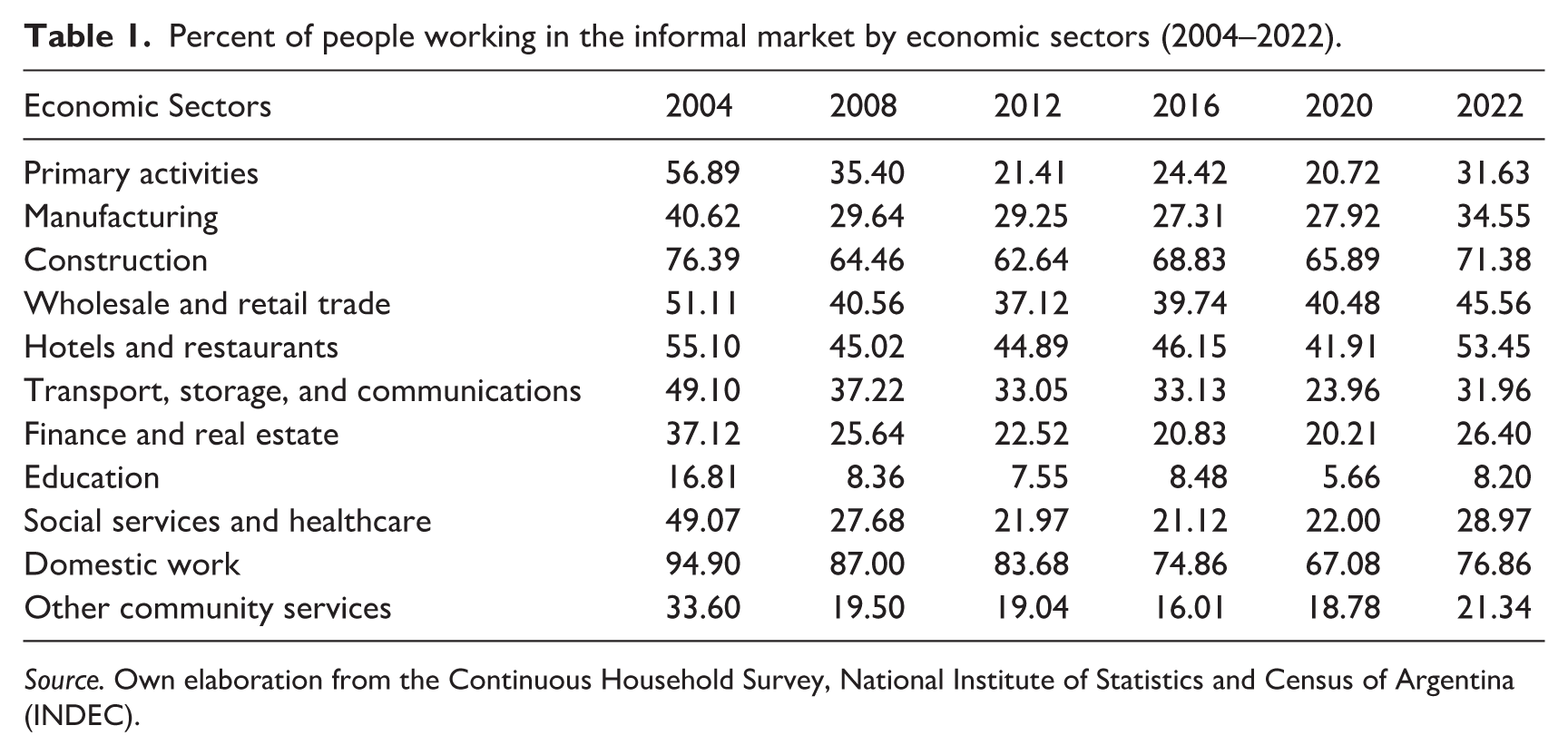
Source. Own elaboration from the Continuous Household Survey, National Institute of Statistics and Census of Argentina (INDEC).
The COVID-19 pandemic and the austerity measures of President Javier Milei have exacerbated these dynamics, leading to public-sector layoffs, rollbacks of labor protections, and renewed privatization. The informal market is growing again on all fronts (Table 1), while the Milei administration is facing off against unions in its attempts to shut down public hospitals in Buenos Aires. Rollbacks on public spending have deepened amid collapsing consumption, rising unemployment, and poverty. Job growth, however, is still more dependent than ever on services. We are reminded here that the very characteristic that makes services sluggish—the fact that they are labor-intensive but capital-light—is also what makes them so easy to grow, so easily seized by relatively surplused workers with nothing to sell but their labor and time. This is a “survivalist sector,” indeed (Storm, 2017).
The conditions of the labor market, shaped by decades of high- and low-intensity neoliberalism, have also helped. “The path to entrepreneurship is one of crawling . . . crying and . . . continuing to crawl, but it’s a good thing because you feel in control of your life. I can’t imagine being 40 years old and only having one job,” says a 24-year-old part-time nail polisher, part-time nanny interviewed in a documentary (Fernández, 2024). This illustrates the normalization of precarity and instability, the romanticization of flexibility, and the country’s class recomposition. In this context, digital platforms (e.g. carpooling, food delivery, care) now absorb a growing share of the workforce, up to 8% of all workers according to a recent report, though some estimates are higher (Aguilar et al., 2022; Viego and Fernández-Massi, 2024). Research has also found that workers turn to these platforms as a last resort, and that the conditions are more precarious as labor protections are thin or nonexistent (Beccaria et al., 2020; Garavaglia, 2022). Struggles over land, labor, and migration are intensifying.
Argentina’s experience illustrates a crisis-prone variant of the double fix. Part of Argentina’s service economy was born in the state, from social struggles to realize an anticolonial vision of democratic prosperity. But in the wake of successive crises, Argentine governments have also sought policies to increase employment, even at the cost of low wages and precarious conditions, which disproportionately affect the most marginalized workers, such as women in care, especially migrants (Ceriani et al., 2009; Rosas et al., 2015). As Winant (2024) notes in a more recent essay, to the extent that the expansion of low-wage service employment intensifies a “crisis of care,” that crisis “occurs not first for capital, which evades the problem with relative ease, but for living labour, as a deficit experienced in everyday life” (p. 22). In turn, it falls to workers to improvise a resolution. Here, Gago (Gago and Mason-Deese, 2017) shows how in Buenos Aires’ La Salada, the largest informal market in Latin America, migrant women from Argentina’s northern rural villages and Bolivia self-organize a microeconomy that mixes production, trade, consumption, barter, debt, and informal childcare exchange. This creates a thick labor market whose end goal is, to be sure, subsistence, but also represents a women-led, creative compensation for missing institutional supports amid constraints on public investment.
Service jobs have been among the easiest to grow, even if their productivity and ability to generate decent employment are lackluster. It is striking that, despite having fundamentally different aims, both the neo-Keynesian Kirschners and the ultraliberal Milei have ended up multiplying low-end service work. This is not to discount that Milei’s government is, with the support of the U.S., far more deliberately raining down punishment on the working class, intentionally increasing precarity and informality. It is simply to point out that the forces that grow the services as double fix—whether the need to absorb surplused workers or the demand for institutional scaffolding and care—are larger than any one political vision. In this sense, Argentina highlights both the global reach of the double fix and the uneven, fragile trajectories the fix might take across different countries, especially in the Global South.
Taken together, the U.S. and Argentine cases illustrate how service-led economies have emerged through different paths of crisis management, but with convergent outcomes: expanded care sectors, mass precarity, and the hardening of structural constraints on growth. These cases also underscore how capitalist economies, when faced with falling employment, have increasingly relied on expanding the service sector as a contradiction-ridden fix rather than as a foundation for a good life or an inclusive economy. Recognizing this sharpens the stakes for geography. Despite clear empirical trends, the service transition has too often been treated as residual to the main headlines of capitalist restructuring. Beyond feminist economic geographers and Winant (2021), few have accorded services the theoretical heft they deserve. Fewer still have mobilized the comparative tools necessary to trace how variegated political economies deal with the service transition at different scales and latitudes. This must change if geography is to grasp both the underlying predicaments of the present conjuncture and the future contours of global inequality. In the next section, “A New Agenda,” we outline key research pathways.
A new agenda
For the past four decades, services have grown worldwide, becoming the major engines of employment and economic output. Low-end services seem to have expanded most globally, meeting an insatiable demand for “direct and indirect services to develop and sustain human capacities” (Winant, 2021: 3). Since the 1980s, labor has been accumulating in low-margin, low-status jobs that are back-breaking and high-touch but rarely perceived as such. 6 As digitization and financial growth increase opportunities for debt-financed buyouts and real estate speculation on service-providing firms, workers are asked to absorb not just the pressures of a low-growth global economy but of finance itself. In contexts where economic informality is common and public service provision is thin, such as the Global South, the expansion of platforms has increased in tandem with the service economy, along with labor precarity and gender disparities (Aguilar et al., 2022; Arriagada et al., 2023). Services are a double fix, addressing employment and reproduction, but their crisis tendencies are on display for all to see.
Were geography to attend closely to these dynamics—that is, to the geographically differentiating evolution of the service transition, the global movements of labor underpinning it, and the social consequences it has meted out—the field would be better positioned to consider the underlying tensions of the current conjuncture. For us, this means building on and stress-testing our double fix framework, which argues that what drives low-end service growth is its dual function as the engine of jobs and care. It also means reckoning with the fact that where care industries have grown exponentially, they have done so, if not within the public sector, then only a degree from it, for these industries are, as Winant (2021) reminds us, “a delegated arm of state power” (p. 3). Finally, it means taking stock of the contradictions that rattle low-end services, some of which are objective, such as low internal capacity for productivity gains, and others subjective, such as their continual extraction of surplus labor from some of the most marginalized subjects, including women and migrant workers. Taking these dynamics seriously, we have the grounds for a sharpened economic geographical agenda that should prioritize (in no particular order):
Charting and explaining how the political economy of the service transition has varied across space and time, shaped by conditions of possibility and institutional particularities rooted in and exceeding place-based relations.
Examining how the service transition has grown vis-à-vis digitalization. Contrary to common perception, platform capitalism does not only come from technological change but has developed in a context where the service-led economy has primed consumers to be comfortable purchasing services, including care.
Teasing out the long geohistories shaping labor struggles over the service economy. Labor historians influenced by Winant (2021) argue that low-end service workers are today’s functional equivalent of the industrial working class. They have raised serious debate about why these workers have not, even in moments of labor militancy, achieved the political clout of industrial workers (c.f. also Winant, 2024). Economic geography and its subfield, labor geography, would be stronger for engaging these debates and examining its biases in (still) cleaving to a (real or imagined) male-led, industrial past.
Interrogating, in a similar vein, what makes the reproduction of the large, insecure workforce of the service economy possible, especially in the low-growth and loss-making industries of education, health care, and social services. What pushes and pulls people to this work, and where? How do different space-economies fill worker shortages in these industries? How does this sharpen or mitigate uneven development dynamics within and between territories? Theories of migration and global care chains have long dominated this research. But the global service workforce is not just made of migrants, and we need to attend far more to recruitment, precarity, stability, skilling, deskilling, and segmentation within the whole workforce.
Documenting how service economies are connected between places and across scales. These connections become more important as globalization fragments, with some countries continuing to pursue globalization through North Americanization (e.g. Argentina) while others rally around new policy imaginaries.
Attending to the role of the state in directly and indirectly producing, sustaining, and containing the service economy. Understanding roll-out and roll-back patterns of regulation, as well as investment and disinvestment, will help us better make sense of the current functions and reach of state power.
As the world shifts to a multipolar order, which some have characterized as “new state capitalism” (Alami et al., 2023), keying into how societies are struggling over decisions to invest in capital versus labor-intensive sectors. This requires analyzing what Fraser (2016) called “boundary struggles,” struggles that are not per se in the domain of social reproduction but rather at the porous border between reproduction and production. These are struggles, often, over redistribution. For the past four decades, the focus has been more squarely on the domain of production and reviving general profitability, whether through AI or green industrial policy. But there are subaltern movements peeking through, such as the important work by the foundational economy school, the just transitions school, and the degrowth school, all of which have argued that if: (1) capitalism is “running low” on growth; and (2) the planet cannot sustain infinite economic expansion, then the time is right for state investment in a dignified, livable service economy that shores up the industries most essential to daily life (Bassens et al., 2025; Bentham and Bowman, 2013).
Analyzing the entangled effects of environmental and economic crises on the production of the service workforce, with special focus on its relationship with forced migration caused by the virulent search for new sources of oil, gas, or metals such as lithium or coltan (which are crucial for so-called green or sustainable transitions) in Global South countries.
Examining the rise of heteropatriarchal ethnonationalism as, at least in part, a reaction to the service transition, which has brought millions of women and men into precarious, high-touch, “feminized” work, shaking up geographies at every scale, from the body to the home to supra-national regions.
Coda
As we concluded this paper, several new articles on tertiarization reached our desk. Some concerned China, where the service transition is accelerating despite the Xi administration’s attempts to preserve manufacturing dominance (The Economist, 2025). Others focused on the U.S. and the widening productivity gap between low- and high-end services (Azenui et al., 2025). Both offered vague nods to AI as a possible solution to lackluster growth.
What has not pierced the mainstream is policy discussion about improving, rather than shunning or substituting low-end service jobs. It is true that low-end services cannot fix profitability, and their thin margins leave little inherent capacity for wage growth. But it does not follow that service-based economies must resign themselves to a high-precarity, low-growth bargain built on the (already strained) backs of low-end service workers. A different set of compromises could yield not just more equality, but a more life-affirming reorganization of the services that are so “foundational” to collective life (Bassens et al., 2025). A non-exhaustive list would include: more public spending on loss-making enterprises to raise the wages of workers; wealth taxes to bolster redistribution; stricter policy regulation of platforms and private equity; regulation of shareholder buyouts; enshrinement of migrant rights; and a refusal to cave to the lobbying of employers for whom care shortages are a tool to discipline the entire labor structure. The future will be organized in no small part around these policy fights. Geography might stand on the sidelines, or it could weigh in.
Footnotes

Funding
The authors disclosed receipt of the following financial support for the research, authorship, and/or publication of this article: Research supported by the Ministry of Science of Spain through the grant number RYC2024-050520-I.
Declaration of conflicting interests
The authors declared no potential conflicts of interest with respect to the research, authorship, and/or publication of this article.
Data availability statement
The datasets used are publicly available through the World Bank, the World Health Organization, and the Argentine Statistics Office (INDEC) websites.