







Abstract
Various conceptualisations of identity development emphasise the internal world of adolescents while others place more emphasis on the social world. Previous findings highlight the impact of stigmatisation and how this may hinder positive identity development in adolescents in foster care; the significance of peer interactions has also been underlined. Anecdotal evidence suggests that young people in care do not want to be made to feel different from others but there appears to be an absence of empirical research confirming this. Interviews were carried out with nine 12–16-year-olds currently residing in foster care to explore their representations of ‘feeling the same or feeling different’. Interpretative Phenomenological Analysis (IPA) guided how data were analysed and super-ordinate themes were identified. This article reports on one of these themes: difference. This is explored through four subordinate themes that relate to participants not wanting others to know they were in care, feeling alienated due to their foster care status, perceiving that others viewed them differently and, at times, noticing differences themselves. The dynamic nature of these experiences is emphasised and the findings are considered in relation to the extant literature. Practice and research implications are discussed.
Introduction
Adolescent identity development
The period of adolescence is considered to be a particularly important time in the development of identity (Erikson, 1968; Flavell, 1985; Marcia, 1966) and adapting to the cognitive, social and physical changes occurring around this time can be challenging. Koepke and Denissen (2012) reviewed identity development literature and concluded that the most frequently referenced model remains the psychosocial life-span model offered by Erikson (1968). This presents identity formation as the main task of the developmental stage of adolescence, which involves the resolution of conflict between identity synthesis and confusion. Identity synthesis refers to the extent to which various aspects of one’s identity fit together and is proposed to predict psychosocial functioning. Identity confusion refers to feeling ‘mixed up’ and lacking a clear sense of direction (Erikson, 1968). McKinney (2011) discusses how Erikson’s model implies behaviours that are an overflow of one’s inner self and attributable to the individual and that the source of self is innate, predetermined and discovered over time within a person’s mental life.
Criticisms of Erikson’s theory are that it represents a western, male, middle-class ideological pathway to adult identity, paying too little attention to socialisation, the significance of interpersonal relationships and the variety of family constellations (Gilligan, 1982; Sorrell and Montgomery, 2001). As a consequence, it has been proposed that identity formation is less linear (Biggart and Walther, 2006), multidimensional rather than one-dimensional, disparate rather than coherent and fluid rather than static (Brekhus, 2008). Similarly, Bosma and Kunnen (2001) emphasise the dynamic nature of identity and argue that previous conceptualisations are too cognitivist and static. It has been proposed that rather than being pre-existing and discovered over time, selves are formative and develop (McKinney, 2011) in a more transactional process (Bruner, 1990; Gauntlett, 2007).
Woodhouse (1996) emphasises how adolescents develop identity through comparisons between themselves and others. This is reminiscent of the symbolic interactionists who claimed that identity is contingent upon the reactions and behaviours of others (Cooley, 1902, as cited in McMurray, et al., 2008). As McAdams (2001: 116) states: ‘the person and the person’s social world co-author identity’. Young people are also more vulnerable to these social interactions due to the re-wiring of the brain that occurs in adolescence (Perry, 2006). Specifically for groups of adolescents who may feel marginalised or stereotyped (Kools, 1997; McMurray, et al., 2008) by their peers and society, the impact on identity development can be significant. Children in foster care may represent one of these groups.
Impact of foster care
For young people in foster care, adverse experiences such as abuse and neglect, family dysfunction, low income and attachment difficulties are prevalent and have an impact on development (Richardson and Lelliott, 2003). Physical and psychological abuse in early life have been associated with neuropsychological changes (e.g. Perry, 2001), which, as with neglect (Miller, et al., 2000), can have long-lasting and profound effects on child development. Poor attachment formation, under stimulation, developmental delay, poor physical development and antisocial behaviour can result. These factors may generate various problems in behaviour and educational performance, which can affect peer-group friendships and may result in social isolation (Kerfoot, 2005).
Attachment refers to the behavioural propensity to seek proximity to an attachment figure in times of anxiety (Bowlby, 1984) and the attachment relationship teaches children to regulate emotions and relate to others. A child’s internal mental representation of self develops through interactions with this attachment figure (Fonagy and Target, 1997). Children in foster care who may not have experienced accepting and nurturing caregiving may have negative working models of themselves and lack enabling role models through which to support the development of positive identities (Lasson, 2002). Further, Kim and Cicchetti (2009) have described how the ability to emotionally regulate is crucial in the development of positive peer relationships. Multiple foster placements can reinforce attachment difficulties and have been found to negatively correlate with young people’s reported self-esteem in relationship to their peers (Fernandez, 2008).
Foster care and identity development
Much less is known about identity development specifically for young people in foster care placements. A number of studies exist with foster children from minority ethnic backgrounds (e.g. White, et al., 2008) but the potential confounds and predominant focus on ethnicity limit the generalisability of these findings. Winter and Cohen (2005) highlight the impact that lack of knowledge regarding personal histories, and the accompanying sense of loss, can have on identity development in children who are fostered. Kools (1997) interviewed adolescents in group homes who had experienced multiple placements in foster care and found that this had a negative impact on identity development. Specifically, the diminished status of foster care and the stereotypical view of the foster child contribute to the devaluation of the adolescent's self by others. Sampling bias represents a significant limitation of this study and the experiences described are not representative of young people living solely in foster care. Vojak’s analysis (2009) complements some of Kools’s findings, suggesting that in an individualistic society people tend to attribute responsibility for their predicaments to themselves rather than structural inequalities and that stigmatising language can reinforce these inequalities.
McKinney (2011) carried out observations of 23 young people in therapeutic foster care over four months, examining how identity is ‘co-constructed’ and highlighting the formation of a ‘bad’ social identity. While the methodology of this study limits the conclusions that may be drawn, McKinney highlighted the need for more research within the foster family setting. McMurray and colleagues (2011) interviewed 13 young people in care and their social workers and emphasised how identity is shaped by relationships, can be a protective mechanism and can be deferred or put on standby, resembling Kools’s (1997) and Vojak’s (2009) findings relating to rejection of identity that may lead to social stigmatisation.
Anecdotal evidence suggests that young people in care do not want to be made to feel different from others (e.g. Barnardo’s, 2007; McMurray, et al., 2011; Ofsted, 2009) but there appears to be an absence of empirical studies confirming this. The current study contributes to our understanding of the impact of the context of foster care on young people’s representations of ‘feeling the same or feeling different’ and considers how this relates to the extant literature on identity development.
Method
Interpretative Phenomenological Analysis (IPA)
IPA was the chosen ‘stance’ (Larkin and Griffiths, 2004) to adopt due to its focus on sense-making activity (Smith, 2009), texture of experience (Willig, 2008), emphasis on the individual and because phenomenological approaches are recommended for exploring the lived experience of groups of people (Chenail, 2011). Guidelines specific to IPA (Smith, 2011a) were followed as well as those for achieving rigour in qualitative research (Willig, 2008) to ensure transparency of the process as well as the stance of the researcher (Chenail, 2011). The aim is not to establish ‘truths’ but to make sense of the young people’s representations of their experiences.
Ethics and inclusion criteria
Following ethical approval and an examination of the ethics involved in interpretation (Brinkmann and Kvale, 2008; Holloway and Jefferson, 2005; Willig, 2012), nine 12–16-year-olds in foster care were recruited through a social work service in Scotland. Young people were eligible for participation if they were 12 to 16 years old, currently residing in foster care and considered competent to participate by their social worker. Those in residential homes or with a diagnosis of a learning disability were excluded.
Participants
In total 23 young people were invited to take part and nine responded. Of the nine participants, five were male and four female. Eight were living in full-time foster care at the time of interview and one was living in foster care during the week and with birth parents at the weekend. Placement length varied from seven months to four years. Four participants discussed having experienced multiple placements.
Interviews
Prior to interviews, the researcher met with a care leaver who acted as a consultant to the study and provided feedback on the interview guide and procedural issues. The interviews lasted between 30 minutes and one hour and took place in social work premises. At the beginning of the interview the researcher clarified that the young person knew what participation involved and that they did not have to answer questions they did not want to. The researcher reminded the young person that the interview would be recorded and that in the write-up of the research direct extracts would be used but anonymity would be ensured. Written consent was obtained from the young person, as parental or guardian consent is not a legal requirement in Scotland (Children’s Act Scotland, 1995; Medical Research Council, 2004). After the interview an opportunity to debrief was offered. Consistent with IPA, extensive field notes were made following interviews and supervision was used to reflect and attempt to ‘bracket’ any expectations. Following analysis, the researcher offered the young people an opportunity to provide feedback as to whether or not they found the themes meaningful.
Analysis
Following transcription, interviews were read and re-read alongside listening to the audio recordings. Descriptive, linguistic and conceptual comments were made (Smith, 2009), followed by documentation of identified emergent themes. Recurring themes, contradictions and particularly emotive parts of the interviews were noted. This was done for each case independently and then cross-case analysis took place. Smith (2011) proposes that with nine participants, themes should consist of three or four participants per theme.
Results
Overview of super-ordinate themes
Super-ordinate themes emerged regarding: participants’ representations of feeling different; attempts to make sense of their experiences; the importance of predictability; and the significance of relationships. A sense of agency was emphasised throughout and the dynamic nature of experiences was evident. To address in detail the current research question one super-ordinate theme, ‘Difference’, and its sub-themes will be presented (see Figure 1).
Diagram of the super-ordinate theme, ‘Difference’, and the four sub-ordinate themes.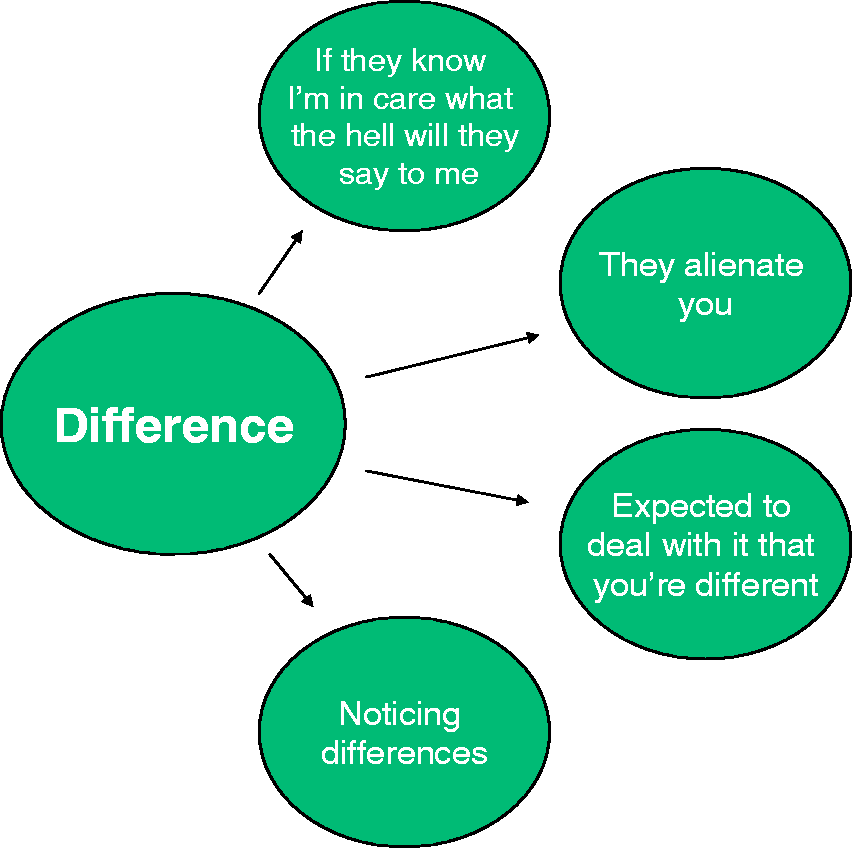
‘If they know I’m in care, what the hell can they say to me’
Six participants discussed current or previous concerns regarding others knowing they were in care. These appeared to relate to past experiences of being made fun of and feeling fearful of future responses. Participants discussed how sometimes when people did ‘find out’, what they feared might happen did not happen, but they appeared to discount this information. There was a sense that participants felt they had something to ‘disclose’.
Participant 7 talked about referring to her foster father on a social networking site as ‘dad’ to prevent her friends from knowing she was in care and viewing her as a ‘looked after child’: [They would think] like my mum’s a bad mum … there was a guy that joined our friends who had just been put into foster care and he told us all, and my pals were like, ‘your life is totally fucking wasted now, you’re not going to get to do nothing [sic]’ … it’s just like ‘Oh no,’ then I was put into care three weeks after, I was just like ‘nah’, if they can say that, then what the hell can they say to me?
On being asked about her friends who did know she was in care, she stated that they ‘were not bothered’ but appeared to discount this information. Perry and Szalavitz (2006) discuss stress responses and how the brain is naturally set at suspicion rather than acceptance, and more focused on threat rather than safety. Participant 2 also discussed how people did not respond in the way that he feared they might. He described how he used to be worried about people knowing he was in care but how this changed for him: I’m a lot more open with people, like I didn’t like to tell people about my life to start off with cos I thought they’d just take the mince [colloquial slang for take the mickey of], but I’ve grown in confidence and I could tell really anybody, and dinnae ken ey? … cos I feel more secure, like in foster care, and if something did go wrong then I’ve got somewhere [sic] that I could tell.
Participant 2 described what could be understood as the psychological ‘secure base’ (Ainsworth, et al., 1978) in attachment literature (Bowlby, 1984). Fonagy and colleagues (1994) describe that with a secure base present one can explore the world with confidence. The secure base can be viewed as a ‘blueprint’ in the child’s mind, which is known as an ‘internal working model’ (Howe, 2001). This mental representation of the caregiver enables children to broaden their attachments and develop healthy relationships (Hart and Blincow, 2007). Interestingly, the concept that something could go wrong is still present but his ‘internal working model’ appears to help him feel more able to cope. This is congruent with research suggesting that more positive attachment styles grow, but only alongside old patterns; new and more positive representations develop but do not automatically transform pre-existing representations (Hodges, et al., 2003). Participant 2 talked of his displeasure when people asked him questions about care and it is possible his sense of control relates to him choosing who to disclose information to (Perry and Szalavitz, 2006). The desire to have a sense of control in their lives was common across participants and corroborates findings from other qualitative research with children in care (McMurray, et al., 2011).
Participant 3 shared concerns about people knowing she was in care and was anxious about telling a friend in case she ‘blurbs’ it out to everyone because of previous experiences: … at the start of high school this boy was saying I came from a dump and that I’m a rat, and stuff like that, just making really bad out of me, so I told [name of foster carer] and I went and told my guidance teacher and he has not said anything since.
‘They alienate you’
Seven participants talked about difficult interactions with other young people, having been bullied and witnessing others being so threatened. Participant 1 spoke about her perception that people alienated her for being in care: They alienate you, and like it’s difficult for me to make friends, cos I used to get bullied a lot, so I’m not really that confident when it comes to other kids, and it’s been a real struggle. I had hardly any friends in first year, but now I’ve been able to make friends … I feel like they alienate you because we’re in care but they don’t make it obvious that it’s because of that cos we’re different. When people call me names, I don’t know what to say back, I just start to cry, and they’re like, ‘Yeah I’ve made her cry, I can do it again … and it’s just like, I feel really small.
Participant 8 described the time when children at school found out that she was in care and started laughing at her. She said that she felt guilty as a result of this, because in the past she had laughed at people for being in care. She talked about how she didn’t used to know what care was, that she used to think, ‘Ha ha, you’re in care!’ Throughout the interviews the young people placed emphasis on the limited understanding of other young people with regards to ‘foster care’.
Participant 5 was the only person who did not talk about ‘not wanting people to know’ or about bullying. There seemed to be a discrepancy between the participant’s description of how he was feeling and his facial expressions and affect. This may have related to his acknowledged difficulties in talking to adults. A similar theme discussed in research regarding identity with looked after children (McMurray, et al., 2008) was ‘presented identity as a protective mechanism, not the real them’, which both social workers and participants discussed.
‘People expect you to deal with it, that you’re different’
This theme highlights the young people not wanting others to treat or view them differently. Five participants talked about this topic. Participant 1 discussed her interpretations of people’s responses to her: People always feel like sympathetic; I don’t need sympathy cos that kinda set me back. I need people to understand what I’ve been through but not kind of hold it against me, like ‘Oh, what a shame, she’s in care.’ Interviewer: Mmm … you just want people to understand. Participant 1: … and just get on with it.
Participant 2 described his representation that people were overly cautious and had a ‘different mindset’ around him, wishing they would just be ‘normal’. He discussed teachers being more lenient with him and how he would prefer this not to happen. Participant 3 also experienced and disliked a friend being overprotective of her. Participant 7 described teachers shouting at her and exposing her ‘looked after’ status to her peers: They said they can’t properly exclude me because I’m a looked after child, but then kicked me out anyway and told me not to come back. Interviewer: So what did it feel like when they gave you that label then? Participant 7: I went mental … I was like ‘everybody’s a fucking looked after child [very angry tone]
Participant 1 talked of people at school thinking you were different and not normal due to living with non-family members and how this was a disadvantage of being in care, ‘and people like just expect you to deal with that you’re different’. Her tone of voice and language suggested frustration and anger at having to ‘deal’ with being different. Her representation of ‘others’ is somewhat cold and unkind in this specific scenario; they expect her just to ‘deal’ with it. She discussed how she didn’t see her life as ‘bad’, giving the impression that she perceived that others had done. This echoes Participant 7’s claims regarding others thinking your life is wasted.
There appeared to be something about ‘being’ what people view you to be. The excerpt above indicates that the young person felt that if people see her as different, she is different. She elaborated on this: ‘It’s hard cos if people think you’re different then you’re different and there’s nothing you can do about it.’ The importance of peer responses in terms of developing identity seems apparent. Participant 1 found this hard and reported that ‘there is nothing you can do about it’. ‘Self-agency’ was a recurring theme for this young woman, so was likely to be challenging for her. She then expressed opinions contrary to those she perceived as adopted by her peers, talking about how it is a positive thing to be different and important to be individual. She said her foster carers encouraged this: ‘If they like you they like you, if they don’t they know where the door is.’ There was a real sense that she was attempting to make sense of who she was, of how people viewed her and her thoughts and feeling about this.
Noticing differences
Five young people discussed times when they felt different from others. Participant 1 spoke about watching classmates’ parents meeting them from school and being ‘marched’ off by her aunt and feeling upset and jealous, and of being forced to grow up quickly, and how she felt more mature and sensitive than her peers. She attributed this to earlier experiences of having had to be constantly attuned to her birth father’s mood to protect herself: I’m still so different … with what I’ve been through I’m a bit maturer … I’ve been forced to grow up that bit quicker, whereas they’ve been able to like grow up at their own stage … I wasn’t allowed to be a child … and I don’t find what they find funny funny, so they think I’m weird and different and that also kinds of makes it worse because I’m in care as well.
Participant 7 talked of feeling different from her peers because she did not live with her birth parents and how she felt ‘weird’ and ‘not normal’. She also spoke about feeling different from her foster carers and how she constantly felt ‘out of place’: It feels really weird … not normal … all my friends are with their family and can do things with their family and be happy and stuff … like when I went on holiday with my foster parents, it was weird, I just feel like out of place all the time … like they’re posh and all that and I’m like more of a ‘chav’.
1
The content of the discourse, as well as non-verbal cues, suggested that beneath the anger lay intense sadness and fear. On a number of occasions the participant stated: ‘I don’t want to talk about this anymore.’ She reported not feeling included but how she distanced herself from others by physically separating herself from them and not making any effort with people. She talked of having been let down her whole life and how this had made her cut herself off from people to avoid it happening again. She referred to hating the loving things her carers said to her and how one of them told her positive things about her character but that ‘I just think it’s a load of shit’. Participant 7 elaborated: I don’t do well with positive stuff cos at school and like at home I’ve always been given like negative attention and been told negative stuff and so that’s what I’m used to. I get to the point where I’m like, ‘My group of pals are a bunch of fannies’ [stupid or wimps]. I’m kinda glad like I don’t see them all the time, ‘cos I’d just get roped into all their shit.
Other participants discussed representations of what life was like for young people living with birth parents and that they would be happier, and that life would be easier because they did not have to adapt to new environments, talking about it being more ‘natural’. The word ‘natural’ conjures up positive connotations which imply opposing notions of ‘abnormality’ and ‘difference’. However, three participants spoke about how life for people with their birth parents was probably not too different from life in care.
Expressions of difference by other participants related to difficulties with school work. Participant 6 talked about feeling stupid when he struggled with it. He described how this could make him feel ‘like I’m hopeless, I’m stupid, I’m rubbish … . I can’t be bothered doing it, I’m no good at it.’ He felt there was a link between his father’s lack of support and his difficulties with school work but the outcome was that he internalised this and concluded that he was hopeless, stupid and ‘rubbish’. For this young man, the negative emotional impact of struggling with peer-appropriate tasks was powerful. Participant 3 also reported feeling ashamed of her educational ability when she entered care. However, she expressed feeling extremely proud of her progress since and reflected that it was not her fault because she had missed so much school when living with her birth parents.
Discussion
Summary
Participants discussed representations of how being in care affected how others viewed them and their own sense of who they were. The emotional experiences associated with these representations were powerful. Feelings of powerlessness, sadness, anger, jealousy, hopelessness, feeling ‘weird’ and feeling out of place were described. It is important to acknowledge that this picture only reflects part of these young people’s lives. They also discussed very positive friendships and foster care placements. The impact of ‘feeling different’, however, was very evident and common across nearly all participants at some point in their journeys. These findings corroborate the anecdotal evidence that being made to feel different is a significant concern for young people in foster care.
Extant literature
The findings also support previous research regarding the presence of social stigmatisation (Kools, 1997; McMurray, et al., 2011; Vojak, 2009) and with Kools’s (1999) findings that young people in foster care guard their foster care status to avoid further devaluation by others. The significance young people appeared to place on interactions with others emphasises the importance of interpersonal relationships and complements the more dynamic and transactional conceptualisations of identity development (Bosma and Kunnen, 2001; Gauntlett, 2007; McKinney, 2011). The dynamic nature of the participants’ experiences also complements the less static and predetermined conceptualisations (McKinney, 2011). Further, the finding that ‘if people think you’re different, you’re different’ illuminates the symbolic interactionist theories regarding how identity is contingent upon the reactions and behaviours of others (Cooley, 1902, as cited in McMurray, et al., 2008). Attachment theory clearly plays a significant role in how young people form representations of who they are (Fonagy, Steele and Higgett, 1994) but the significance of social interactions appears also to be crucial. While early experiences may lay the foundation that either facilitates or jeopardises identity development (Kools, 1997), identity appears to be socially bound (Harter, 1990).
Clinical and systemic implications
The lack of understanding regarding ‘foster care’ and lack of acceptance of ‘difference’ appeared to be prevalent in participants’ peers, suggesting that more education and awareness are needed. Perry and Szalavitz (2006) explore how children, like adults, react badly to the unknown and that social rejection and bullying often begin with fear of the unfamiliar. They acknowledge that social hierarchies are not always easy to influence but that adults, teachers and parents may have more influence than they realise – especially with younger children who are more affected by cues of rejection and acceptance from adults. These cues may set the tone for children’s status systems; teachers and parents can either minimise or maximise bullying by either strongly discouraging or tolerating the scapegoating of those who are ‘different’ (Perry and Szalavitz, 2006). Additionally, providing opportunities for young people in foster care to meet positive role models who are care leavers and to spend time with other young people in care or groups of other young people experiencing ‘feeling different’ may allow them to integrate their ‘foster care status’ or ‘difference’ into their identity and promote positive identity development. Smith (2011b) writes about ‘gems’ in qualitative research, which are relatively rare utterances in the data that are particularly resonant. In relation to the current research question, one participant talked about her foster care status in a celebratory and positive manner and exclaimed that she was ‘a foster auntie’. Something enabled this participant to integrate her foster care status into her identity and feel proud and positive about this. Future research examining these processes further would be valuable.
Health care professionals and foster carers need to be aware of the potential significance of ‘feeling different’, so that young people have opportunities to make sense of this, and so can be encouraged to develop positive feelings about themselves. Some participants perceived that they had missed out on a great deal in comparison to their peers and subsequently may need to grieve. Children need to be supported to deal with others’ responses to their care status. For those who are likely to have experienced neglect or abuse, imagining numerous ways of coping with situations may be difficult due to lack of development in the part of the brain responsible for this kind of cognition (Miller, et al., 2000; Perry, et al., 1995). This may be even more difficult when stress responses are activated during questioning by peers about care or being made fun of. Children need help to feel confident and more in control when managing these interactions.
Limitations
Despite attempts to bracket knowledge in the initial stages of analysis, the main researcher’s background in psychology, experience of clinical work with foster children and having family members who were fostered might possibly have influenced how data were approached. However, IPA does acknowledge the researcher’s perspective and knowledge as a strength in terms of making informed interpretations in the latter stages of analysis. The ‘knowledge’ this research generated was also limited by the fact that the interviews took place on only one occasion and would clearly have been influenced by the choice of questions. On reflection, there were also times when the researcher could have asked for more detail about the emotional texture of participants’ experiences. A further limitation is that 15 of the young people invited to take part did not respond. It is possible, too, that they may have had different perspectives regarding feeling the same or feeling different. In future, the researcher would include in the initial letter to participants, a section offering the opportunity to outline reasons for not participating, to try and obtain a clearer understanding of this. Despite limitations, value lies in the involvement of a care leaver in the initial stages of the research and that the researcher offered participants an opportunity to feedback how meaningful they found the themes. The feedback provided suggested that the themes were very relevant and meaningful, although the majority of participants requested a written summary of the research rather than a face-to-face meeting to provide their own feedback.
Conclusions
Young people who are already likely to have experienced early trauma that can affect their developing sense of self are further challenged by how systems around them respond to their foster care status. Health, social and educational settings have long been required to label groups of people and are structured in a way to facilitate their functioning, not necessarily the functioning of the groups being labelled. Young people in care need opportunities to develop a positive identity despite the challenges this process may entail. Promoting acceptance of ‘difference’, providing positive role models and offering opportunities for the young people to develop ways to cope with peer interactions may be valuable. Some young people clearly adapt well to their lives in foster care. Research examining this, specifically in relation to identity development, may provide a more sophisticated understanding of the role of resilience.