Abstract
The background literature outlines the positive impact that life story work can have for children in care, but there is scant published research to support these claims and, to date, none exploring both carers’ and children’s experiences of engaging in collaborative memory work, which can form an important component of a child’s life story. This article explores the experiences of foster carers and looked after children in carrying out such work using the memory store approach, focusing on what their talk could tell us about how using this approach had affected the carer–child relationship, the child’s self-perception, aspects of the child’s thinking and learning, and their emotions. The participants were five foster carers and the four children in their care. Two to three months after a one-day training course for carers in using the memory store approach, semi-structured interviews were carried out with the carers and a board game session took place with each of the children to explore their views. Interpretative Phenomenological Analysis (IPA) was used to guide both the data generation and its subsequent analysis. Carers’ and children’s talk suggested that using the memory store approach has a number of perceived benefits, emotionally, relationally and in terms of the child’s self-perception and learning. A memory store approach model was postulated on the basis of these findings. One of the conclusions of this research is that using the memory store approach (or similar) should be a statutory requirement of foster carers, not only because of the potential benefits highlighted through this research but also because of the ethical necessity to safeguard the memories of a child’s time in care.
Keywords
Introduction
Evidence suggests that there is little consistency, even within UK local authorities, as to how life story work is carried out with looked after children and there are wide variations in terms of what it constitutes (Happer, McCreadie and Aldgate, 2006; Harper, 1996; Willis and Holland, 2009). Recent research highlights how there are still looked after children for whom few tangible memories from various placements are kept (Gallagher and Green, 2012; Willis and Holland, 2009). The National Minimum Standards for adoption services (Department for Education, 2011) specify that in preparing a child for adoption, his or her social worker should be gathering their views in relation to their life experiences to date, including construction of a life story book. While this is in place for children being prepared for adoption, there is no statutory requirement for life story work to be carried out with children who are being looked after.
The Children's Workforce Development Council (CWDC) Training Support and Development Standards for Foster Care (CWDC, 2011) expresses minimum standards of best practice for foster carers. Standard 4 (section 5d) outlines that foster carers should know how to enable children and young people to participate in record-keeping and keep their own memorabilia. This is a step in the right direction, but while there is an expectation that all foster carers complete the standards within 12 months of approval, there is still no statutory obligation to safeguard memories of a child’s time in care.
The memory store approach
Some practitioners argue for more coherent, consistent practice in life story work (Cook-Cottone and Beck, 2007; Nicholls, 2003). Nicholls (2003) describes such a model, a key part of which is the preservation of children’s memories using memory boxes and age-appropriate memory books. A new memory book/box is started for each new temporary placement experienced by the child.
This aspect of Nicholls’s model is very similar to the memory store approach we have trained carers to use in Northumberland (Shotton, 2010). A key difference is that in Nicholls’s (2003) model the child is not an active participant. The work is done for as opposed to with the child, whereas using the memory store approach, foster carers are trained to engage with the child in collecting and reflecting on memories of their time together, using a person-centred approach (Murray and Sanderson, 2007).
The memory store approach training is a one-day course that helps foster carers to appreciate the importance of collecting and sharing memories of the child’s time in their care, as well as giving them the necessary skills to use the approach.
Many carers may use similar approaches with the children in their care but experience suggests that these tend to vary widely, often influenced by the carer’s own upbringing and experience (Shotton, 2010). Training in the memory store approach means that all the carers have had the same input on how to use this method, which utilises an elaborative reminiscence style. The benefits of this style are discussed later in this article.
Key aspects of the memory store approach are:
getting the child involved in collecting, recording and regularly reflecting on their memories; the form of the memory store is usually a book or box or, most commonly, both -- sometimes digital media is used; talking frequently about the past using the photos and other items (e.g. tickets, etc.) as helpful reminders/inroads; listening carefully and summarising the child’s words using an active listening approach; engaging in detailed conversations about what happened using lots of ‘wh’ questions; expanding on the child’s sometimes minimal responses to provide a rich picture of the past; referencing possible emotions that were experienced.
The thinking behind the memory store approach is not that it replaces the full chronology of a child’s life but that it forms an important part of that story. There is still a need for the child to receive an account of his or her life prior to their present placement, including the reasons for them coming into care. This role is most helpfully undertaken by a social worker, family placement worker or psychologist trained in carrying out life story work. This involves a division of labour: the social worker/family placement worker/psychologist undertaking life story work with the child to help them understand the reasons for them coming into care and their life prior to the present foster placement; and the foster carer/residential worker collaboratively recording and reflecting on the child’s time in the current placement using the memory store approach.
Previous research
Life story work
A systematic review of research into life story work revealed only five articles where a research process was explicitly outlined to explore/evaluate life story work with looked after children (Backhaus, 1984; Gallagher and Green, 2012; Happer, McCreadie and Aldgate, 2006; Shotton, 2010; Willis and Holland, 2009) and only three of these articles explored life story work as the primary intervention (Backhaus, 1984; Shotton, 2010; Willis and Holland, 2009). There are some studies exploring the views of teenagers and adults on their experiences of life story work (Gallagher and Green, 2012; Willis and Holland, 2009) and my previous research (Shotton, 2010) gives insight into the carers’ experiences of carrying out collaborative memory work with the child in their care.
Carer–child reminiscence
A substantial body of research has explored individual differences in, and developmental outcomes of, carer–child reminiscence, though not specifically with looked after children. Most research projects have focused on mother–child reminiscence in the pre-school years, (e.g. Van Bergen and Salmon, 2010; Wang, 2001) but some have focused on older children, (e.g. Fivush, et al., 2009; Fivush and Sales, 2006; Wenner, et al., 2008) and other family members, (e.g. Kulkofsky and Koh, 2009; Reese and Fivush, 1993).
The available studies have established clear and consistent individual differences in the ways in which parents talk with their children about the past. Carers vary along a dimension from a high to low elaborative style (e.g. Fivush and Fromhoff, 1988; Nelson and Fivush, 2004), the former characterised by speaking frequently about the past, engaging in detailed conversations about what happened and using lots of ‘wh’ questions. The parent tends to follow up and expand on the child’s sometimes minimal responses to provide a rich picture of their history.
Longitudinal evidence suggests that carers are consistent over time and with siblings in their elaboration level (Haden, 1998; Reese, Haden and Fivush, 1993). Reminiscing conversations have a unique role to play in how carers use language with their children (Laible, 2004). Additionally, reflecting on memories using an elaborative, emotionally referenced reminiscing style has a number of benefits. Using this approach on a regular basis can:
help to strengthen the carer–child relationship (Fivush and Vasudeva, 2002; Gallagher and Green, 2012; Laible, 2010; Shotton, 2010); help children to develop a better understanding of themselves and promote emotional well-being (Fivush and Sales, 2006; Willis and Holland, 2009); facilitate learning, particularly developing children’s ability to recount rich stories and develop their understanding of different people’s perspectives (Fivush and Sales, 2006; Shotton, 2010).
The memory store approach training includes helping carers to develop an elaborative, emotionally referenced reminiscing style. In light of the background research, the aims of the current investigation were to explore what the carers’ and children’s talk could tell us about how using the memory store approach had affected:
the carer–child relationship; the child’s self-perception; aspects of the child’s learning; the carers’ and children’s emotions.
Method
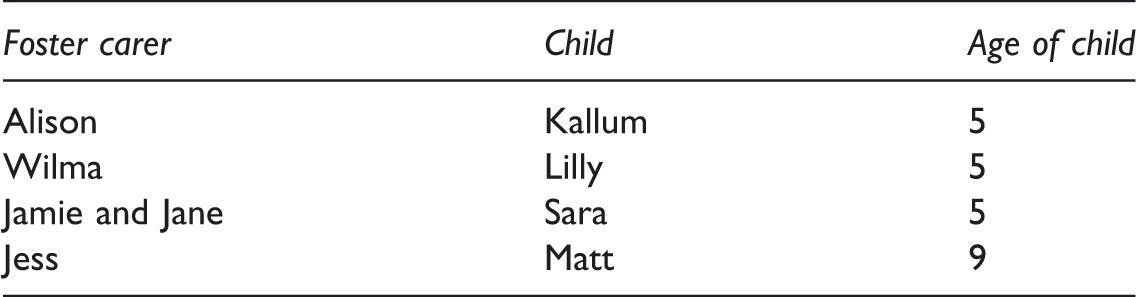
In order to gain a comprehensive understanding of the views and perceptions of the carers and children, Interpretative Phenomenological Analysis (IPA, e.g. Smith, Flowers and Larkin, 2009) was used to guide the data generation and analysis. IPA offers a systematic set of steps for analysing qualitative data on a number of different levels, which I felt would result in more thorough appreciation of the experiences expressed by both parties. IPA fitted with my critical realist perspective, in acknowledging that the analytic process could never achieve a genuinely first-person account, the account being a co-construction between the participant and the researcher (Larkin, Watts and Clifton, 2006). The participants comprised five carers and four looked after children from the north-east of England. Pseudonyms were assigned for reasons of confidentiality. These are shown in Table 1 alongside the ages of each child.
Semi-structured interviews were used to explore the foster carers’ experiences of using the memory store approach. To devise a set of questions I drew on examples of the format of open-ended questions from other IPA research articles and texts (e.g. Flowers, et al., 1997; Smith, Flowers and Larkin, 2009), adapting the content to fit my research questions.
I planned that the child’s memory store would be available to refer to during the sessions to use as a focus for many of the questions. My rationale was that the visual material contained in the memory store would give both the participant and myself a visual focus that would elicit richer stories of their experiences of using the memory store approach (Harper, 2002; Woolner, et al., 2010). I also felt that using the store in this way had the potential to be empowering for the participants. Both carers and children would be talking about something which they had created, were familiar with and were often proud of.
Data generation with the children
A semi-structured interview relying solely on oral questioning might not engage the children sufficiently to obtain a rich account of their experiences. I therefore decided to design a board game (see Figure 1) that would contain questions as a means of exploring their views about using the memory store approach.
Board game created for the sessions with the children.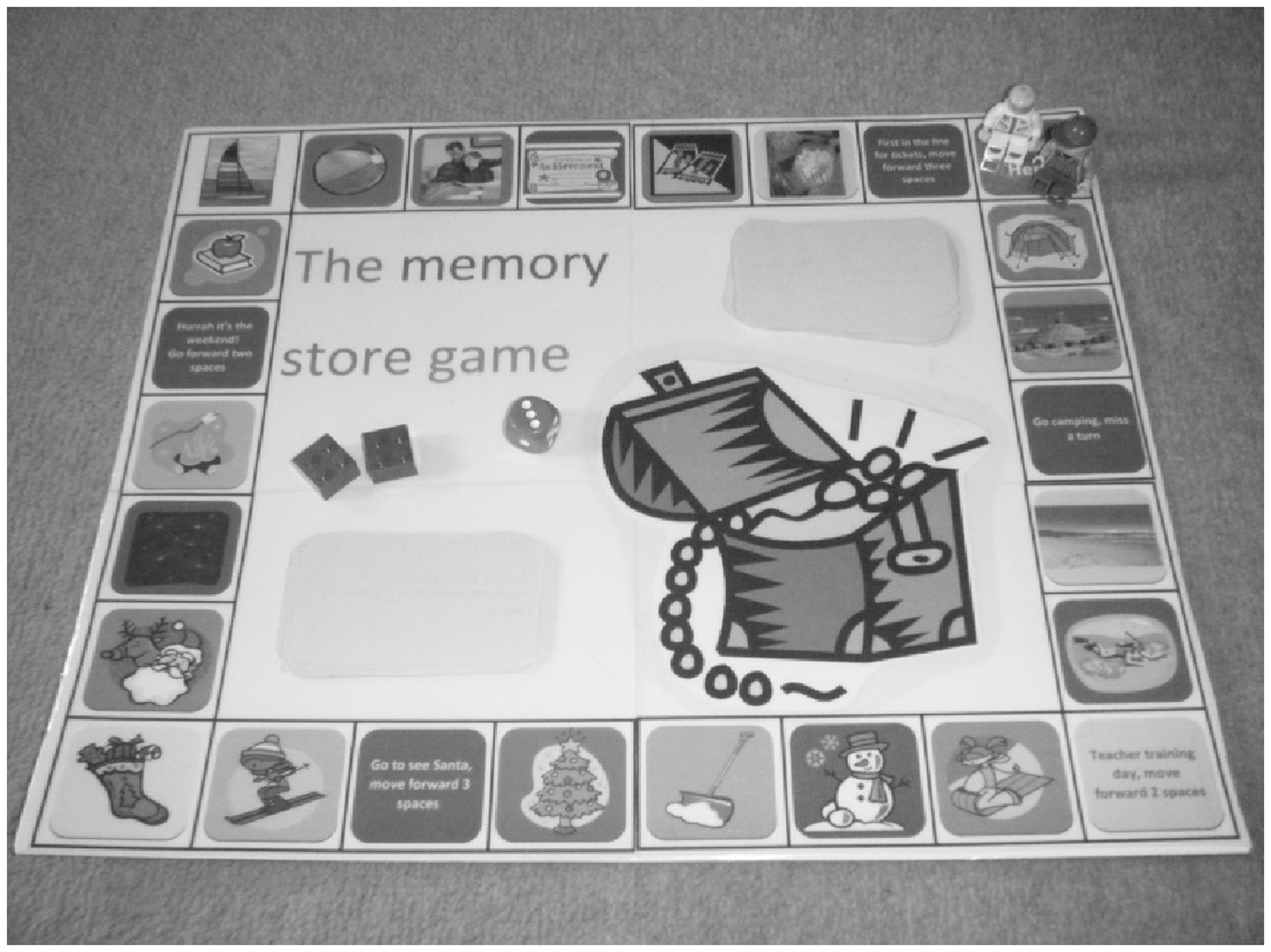
A board game is instantly recognisable to most children, needing little explanation. This familiarity is thought to lower their anxiety and help to establish a relaxed atmosphere that enables free-flowing conversation (Hemmings, 1996). It allowed the session to be more of a reciprocal experience. Pre-pilot and pilot interviews helped me to refine the questions, the game and interviewing techniques.
The research was outlined to foster carers at a training day on the memory store approach. They were also given an information sheet and leaflet to share with their child. A consent form was enclosed with a SAE for them to send back to me if they were willing to participate in the research. The carers were assured of confidentiality and anonymity. They were also informed (both at this stage and at the start of the interview) of the study aims, their right to withdraw at any time and how the research would probably be reported.
For the sessions with the children I used the Bear cards (Veeken and Harman, 1995) and the Feelings Diary illustrations (Shotton, 2002) to encourage the children to express their emotions. The sessions were audio-recorded, transcribed and then analysed, which included analysing each transcript on three different levels (Smith, Flowers and Larkin, 2009):
Descriptive: comments that focused on the content of what the carer/child had said, the subject of their talk; Linguistic: comments that explored their use of language; Interpretative: comments where I had imposed some sort of interpretation on what had been said, focusing on the possible meanings behind the words or actions recorded. I also recorded any questions or wonderings that I had.
Findings
As the analysis went on, case by case, common themes began to emerge within and across transcripts. In the process of identifying constituent themes, master ones also began to emerge as useful ‘umbrella’ categories under which a group of themes could comfortably sit. When all the transcripts had been analysed I created a mind map charting the master and constituent themes. A second mind map, shown in Figure 2, was then created to display the themes that had direct relevance to my research questions.
Mind map of themes with direct relevance to the research questions.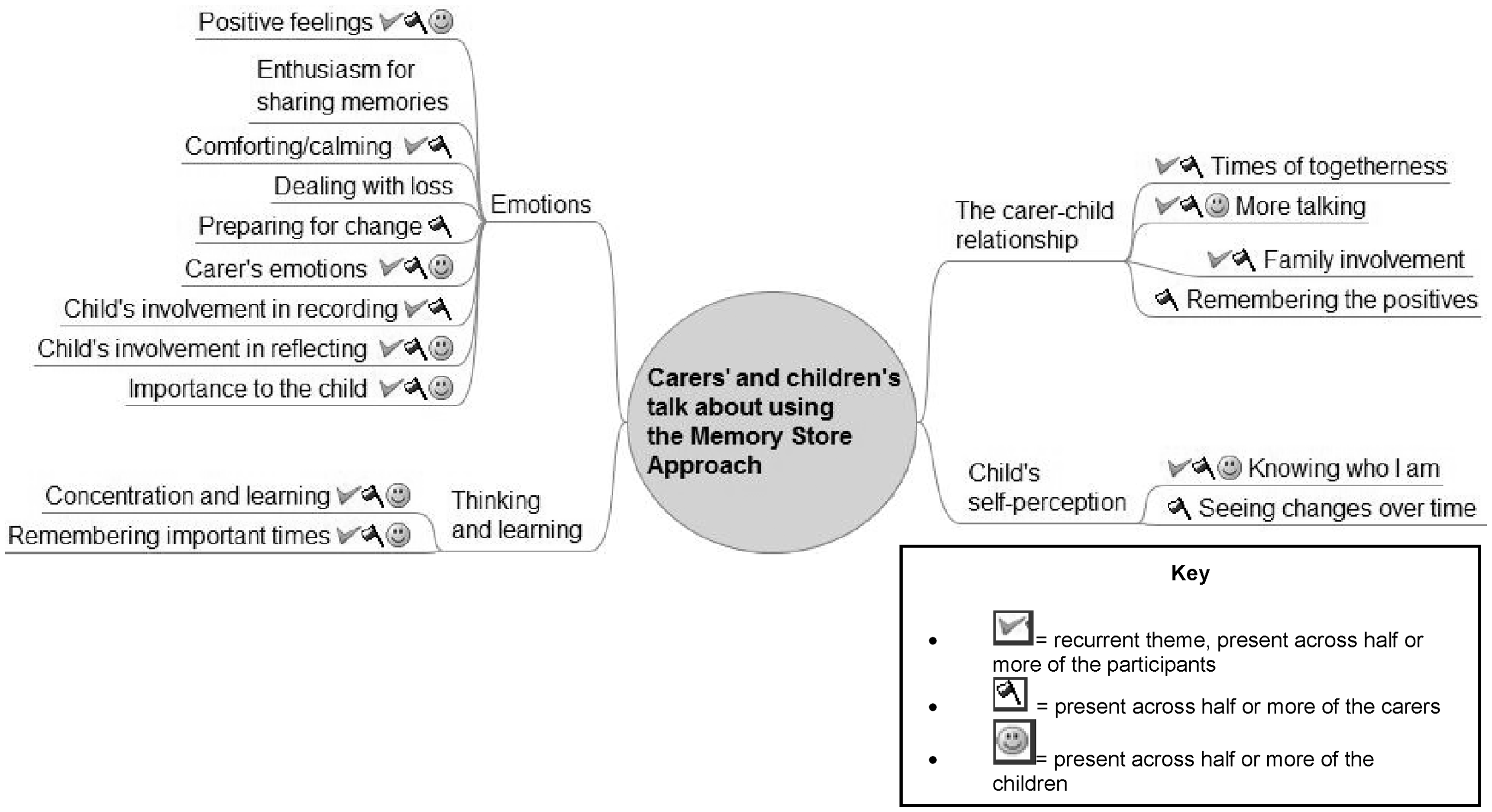
Due to word count limitations it is not possible to outline all the quotations and comments for each theme, but I have tried to give a flavour of the content in the next section.
Master theme: the carer–child relationship
Constituent theme: times of togetherness
All the carers felt that using the memory store approach had brought them closer to their child. They talked about it being an intimate experience, often accompanied by close physical proximity, sitting side by side and focusing on the same thing together. To quote Wilma: It’s something that you share together, and it’s time you spend together. And we’ve both enjoyed doing it, and she knows that we do it together. I write, and after, ‘What will I put here? Who is in this story?’ and she’ll tell the story. And I would say, yes, it’s brought you [sic] a little bit close together.
Sara’s talk illustrated how reflecting on items in her memory store reminded her of her carer’s love for her, thus strengthening their relationship as well as providing evidence of that love even when her carer was not there directly. For instance, picking up a card from her store, she said: ‘And my mummy gave me this because she loves me very much.’
Constituent theme: more talking
The theme of increased interaction is supported by the talk of the carers and the children. All carers spoke about occasions when using the memory store approach had facilitated interaction with the child in their care. Alison related how looking through the memory store with Kallum resulted in conversations around significant events for him: And I’ll say, ‘Do you remember that we had some sweets?’ and he’ll say, ‘What did I have again?’ and I’ll say, ‘Oh, I can’t remember. Was it jelly beans?’
Alison’s voice is lively as she relates the way she interacts with Kallum. The fun they have reminiscing about these times is apparent. Wilma also described how the store acts as a conduit for conversations, with Lilly often initiating interaction as a result of looking through her store and wanting to share memories with Wilma and her husband: ‘Then she’ll say, “Can I show you?” and she’ll come up and she’ll show us.’
Constituent theme: family involvement
The use of the memory store approach often involved other family members. Three of the carers’ accounts suggest that in this way, use of the memory store approach helped to strengthen relationships between the child and wider family. Jane outlined twice how the memory store approach had facilitated interaction between Sara and her foster siblings: But then she likes to run off, ‘Sean [foster brother], come and look at this,’ or, ‘Molly, have you seen these such and such?’ So it sort of involves everybody which is nice.
There seemed to be a sense of pride and satisfaction in Jane’s voice as she talked of the children interacting positively and sharing memories together.
Constituent theme: remembering the positives
Two carers indicated that use of the memory store approach helped them to recall positive characteristics of the child they were looking after. For Alison, looking through the memory store during our interview evoked memories of events that prompted her to tell stories of Kallum’s strengths and achievements, such as a trip to the cinema to see Toy Story 3, where he surprised her with his empathy: And he was sitting next to me and he said, ‘Are you alright Alison?’ and I went, ‘Yeah, yeah, I’m fine. I’m just sad, it’s just sad isn’t it?’ and he couldn’t really understand why it was sad, but he realised that I was sad and he was like patting my leg, and I thought, ‘Ahh.’
When Kallum first arrived to live with the family, Alison related how he seemed emotionless and unaware of others’ feelings but here he was, some months later, able to express compassion and empathy towards her.
Master theme: the child’s self-perception
Constituent theme: knowing who I am
This theme was supported by the talk of three carers and all the children. Jamie and Jane felt that Sara looking through photos of family outings and events helped to reinforce that she was part of the family, that she belonged. Jess also felt that using the memory store approach contributed to Matt feeling secure. She spoke three times of how having the store to look back on had encouraged this by giving Matt tangible evidence of his history, knowing who looked after him from an early age: Gillian: What do you think that they get out of doing that? [Matt and his brother looking though the memory store together] Jess: Probably, well it’s a security thing, isn’t it, I think? Um well, just the start of where their life began with us.
Certificates and achievements were also evident in all the children’s memory stores, helping to reinforce and thicken positive narratives the children have and tell about themselves, thus contributing to a positive self-perception and helping to answer a key question in relation to identity: ‘Who am I?’ (Henry, 2005).
Lilly was keen to show me lots of memories from her fifth birthday party. This was especially significant for her as it was the first birthday party she had ever had where friends had been invited and they had had games and a party tea. She had kept all the cards from this event as well as there being lots of photos. Her favourite memory of all was the birthday badge that she wore on the day. There was a real note of pride in her voice and in the way she sat upright and showed me everything from the party – cards, photos, etc. All of this seemed to be her way of asking me to look at her life, to take notice of the presence of friends, to notice that her carer had taken the time and trouble to prepare a party for her, to look at the evidence that she is loveable and valuable.
Constituent theme: seeing changes over time
The talk of one of the carers and two of the children highlighted a relationship between the child seeing their progress over time and their self-perception. Jane used the memory store to highlight Sara’s progression to her: Because, look, this was when you could write your name last year, and now you’re writing sentences. And that’s all that you could write, that was your first word wasn’t it?
Master theme: aspects of the child’s learning
Constituent theme: concentration and learning
Three carers’ and three children’s talk contributed to this theme. As the items in the store had direct relevance and emotional significance to the children, it was something that would hold their attention. For Kallum and Lilly in particular this was significant, as both had concentration difficulties. Lilly had a Statement of Special Educational Need for behaviour and learning issues and Kallum had a diagnosis of ADHD. In Alison’s words, ‘It’s probably one of the things he will concentrate longer on, especially if you engage him in conversation about different pictures.’
The sessions with Lilly and Sara highlighted examples of them practising their reading skills using the memory store. They were motivated to try to read the words because of the emotional relevance of the material. Lilly, on five occasions, made attempts to read the words off a number of cards that she had in her store from her birthday party. Lilly has not found letter and word recognition easy but is now making progress with these skills. The memory store provides useful stimulus material that she is motivated to read.
Constituent theme: remembering important times
It seems that the memory store approach affects the clarity with which children and carers are able to remember events and place them in some sort of chronological order. This theme was supported by the talk of all carers and children. There were numerous events outlined in the children’s memory stores, e.g. outings to the cinema, sports day, parties, etc. There were also many significant milestones recorded, such as first days at school or first time on a bike. In looking through the store both carers and children were able to flesh out each memory with details of when it occurred or who else was there. It was clear that the pictorial information was very powerful in taking the participants back to the time and place when it occurred. Kallum related a memory of walking the family dog (Henry) on the beach. Gillian: What are you doing there? [Photo of the family down on the beach with the dog] Kallum: We’re on the beach. Gillian: … And how do you feel when you look back on that one and you remember doing that? Kallum: [points to the happy bear] Gillian: Happy. You feel happy? Why do you feel happy? Kallum: Because I loved taking my dog for a walk.
Master theme: carers’ and children’s emotions
Constituent theme: positive feelings
All participants’ talk contributed to this theme. The carers described the children as often expressing positive emotions when they record or reflect on memories together. They talked about how the children would smile and seem happy, pleased and interested to look back on memories, showing their pleasure and enjoyment of the activity overtly. As Jess said of Matt, ‘He’s always happy … to look at it or add things. He often asks to look back through the memory book.’
Lilly told me that she felt happy and excited when she first received her memory store, whereas Kallum said he felt proud. Kallum said three times how he felt both pride and happiness when looking back on memories in his store: Gillian: How do you feel when you see your car bed in your book and you look at that? Kallum: Proud and happy. Because I love my car bed.
Constituent theme: enthusiasm for sharing memories
All the children’s talk contributed to this theme. During the game-playing sessions they all became excited at times, wanting to show me particular memories from their stores. Their voices were often quite animated and full of enthusiasm and pleasure. Matt generally appeared a quiet and thoughtful boy but he too became excited about showing me items in his store: ‘Oh, there’s me and my brother. Oh there’s me and my cousin in the car.’
Constituent theme: calming/comforting
Alison described how she and Kallum share looking through the memory store together as a calming activity, often as part of their bedtime routine, suggesting this helped him to feel secure and safe.
Wilma noticed that Lilly often calmed down and became very still when looking through her memory store, sometimes pointing things out to her and her husband. Wilma described Lilly as being ‘intrigued’ by her memory store.
Constituent theme: dealing with loss
While this was not a theme supported by the talk of many of the participants it did emerge as significant in Matt and Jess’s talk. Matt highlighted some photos that cause him to feel sad when he looks at them as they depicted his friends/cousins who were about to emigrate. Having photos in his store had become an important way of him remembering people and seemed to be helpful to him in dealing with this future loss: Gillian: Have you got any memories … that make you feel a bit sad? Matt: Well, my cousins are going to Australia. Gillian: Are they? Right. Matt: And I won’t see them anymore. Gillian: Oh right, so that’s a bit sad. Matt: ‘Cos they’re going to see their cousins … They’re in my book, this book. [Matt finds the relevant photos to show]
Jess also talked of Matt and his brother endeavouring to make sure that all the photos of these relatives were present in their memory stores. It seemed important to them both to be able to remember them in this way.
Constituent theme: preparing for change
Alison, Jess and Kallum’s talk highlighted how the memory store approach had been helpful in preparing the children for transitions. Kallum had received the store in his previous placement as a way of helping him know what to expect in the next one. It helped to build anticipation about positive aspects of the change ahead. As a consequence of the book, Kallum had some very positive emotions about his change of placement: ‘Well, when I first saw Alison and Sam [in the memory store before arriving] I felt proud.’
Constituent theme: carers’ emotions
Looking through and sharing memories from the child’s memory store in the interview session evoked a range of emotions for all the carers. Joy, pleasure, delight and sadness were expressed through words, tone of voice and non-verbal communication. Three carers described how much pleasure they gained from looking at memories in the child’s store, either with the child or sometimes by themselves. To quote Wilma: ‘It’s enjoyment really, what enjoyment we’ve both had, and what enjoyment she’s had really.’
At other times, looking through the memory store provoked sadness that seemed to reflect the carers’ compassion for the children. In the session with Jamie and Jane we had been looking at a photo of Sara before she came into care, where she looked rather frightened and bewildered. Jamie outlined how reflecting on some memories could prompt a variety of emotions: Jamie: You know, so from our point of view, seeing photographs of history, in some respects it can give you sort of mixed feelings, you know. Jane: Well, that’s right, yeah. Gillian: Some sadness there as well as … ? Jamie: Well, yeah.
Constituent theme: child’s involvement in recording
The talk of all carers and one child contributed to this theme. The carers described the level of involvement the children had in recording memories. Wilma, Jane and Jess all highlighted how it was often things they were proud of – achievements, awards, etc. – which the children would request to put in. This suggests the children had learned how to notice their achievements and feel comfortable with allowing themselves to celebrate their accomplishments by asking for them to be recorded. In Jane’s words: Well, she’s quite pleased to have the bag [memory store]. And now if, um … last week she got this certificate at school. ‘Right, is that going in my bag then? And can we have a look through my bag?’ She likes to get everything out and have a look at it, and have a chat about it and ask questions.
Constituent theme: child’s involvement in reflecting
All the carers talked of how the children were motivated to ask to look through their store. Sometimes the children liked to do this on their own and sometimes in conjunction with their carers. For example, Alison commented: Sometimes I say, ‘What do you want to read?’ and he says, ‘Can I read my book?’ And I’ll say, ‘OK then,’ and it gives us an alternative to reading a story.
Constituent theme: importance to the child
This theme was supported by the talk of three carers and all the children. Both Matt and Lilly were very careful with their memory stores, having special places for each item, and went to great efforts to keep them looking nice, which suggests that their memory stores were important to them.
Discussion
The memory store approach model
To help conceptualise the findings I postulated a memory store approach model (see Figure 3) suggesting how this approach seems to be working given the findings from this study. I will now go on to explain the parts of the model, their theoretical basis and links to other research.
The memory store approach model.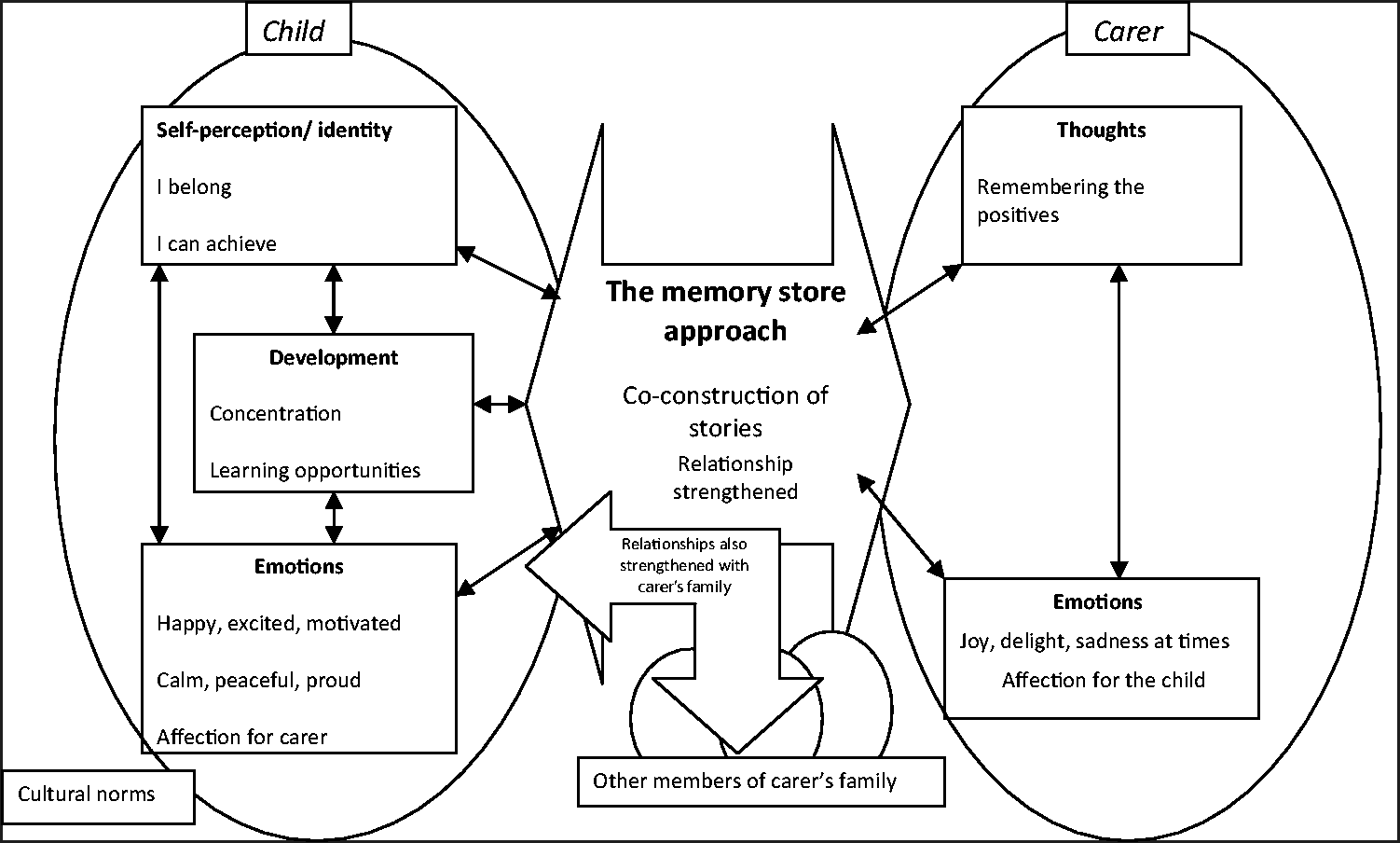
The central process of the model is the ‘memory store approach’ (symbolised by the large central arrow) which, through the co-construction of stories, strengthens the relationship between the carer and child and affects outcomes for each. The approach offers them times of intimacy engaged in joint activity that the child often experiences as enjoyable, interesting and relevant. It communicates care and value from the carer to the child, the underlying message being that the carer thinks the child is worth spending time with and that their experiences are important and worthy of recording.
The smaller white arrow from the child through the ‘memory store approach’ to the additional circles indicates how using the approach also serves to strengthen relationships between the child and other family members.
The black arrow from the ‘memory store approach’ to the child’s ‘self-perception/identity’ section indicates how, through the co-construction of stories, the child begins to see how the carer perceives them, thus contributing to the ongoing development of a sense of self. Their perception of how others see them influences how they see themselves: ‘the looking glass self’ (Cooley, 1902, para. 184). The strengthening of the relationship between carer and child may also influence the continual development or adaptation of the child’s internal working model. Early relationships are seen as fundamental in forming the template for this model, but later relationships are also thought to be capable of shaping its development (Bowlby, 1988).
Research suggests that through the development of a positive, secure attachment, after one year of being in a secure adoptive placement, maltreated children develop more positive representations of adults (Hodges, et al., 2003). The memory store approach has the potential to facilitate such adaptations to the child’s internal working model through strengthening the carer–child relationship and, in doing so, have a positive impact on the child’s beliefs about themselves, others and the world (Fivush and Vasudeva, 2002; Laible, 2010; Wareham and Salmon, 2006). The arrow is bi-directional as, in turn, the child’s security in knowing who they are – facilitated by understanding how their carer sees them – means that they invest further in the relationship, which is consequently strengthened.
Inclusion of the child in stories of family events and photographs over time contributes to their sense of belonging and security. A fundamental need is to feel we belong within a social group (Maslow, 1954). The co-construction of stories around their achievements and certificates contributes to their perception of themselves as someone who can achieve. As they reflect with their carer and look together at how they have been in the past, they are able to co-construct stories about their progress and see themselves as someone who can grow and change in positive ways. From a narrative perspective, it is through the co-construction of stories about their achievements, about how they belong in the family and are loved and valued, that dominant narratives are built up. These dominant narratives not only affect the child in the present but also have implications for future actions as they affect the interpretation of future events (Freeman, Epston and Lobovits, 1997; Morgan, 2000). The stories are strengthened or ‘thickened’ through carer–child reminiscence, using the memory store approach on a regular basis.
Evidence within the store of children’s particular preferences helps them to see that their opinions matter and are worth recording and talking about, thus contributing to their sense of identity and self-worth.
The bi-directional arrows from ‘the memory store approach’ to the ‘emotions’ sections for both carer and child, indicate how the co-construction of stories affects the child's and carer’s feelings, often triggering positive emotions but sometimes sadness as well (Willis and Holland, 2009). Reflecting on memories in the store engenders feelings of affection from the child towards the carer and the carer towards the child, again strengthening the relationship (Fivush and Vasudeva, 2002; Laible, 2010).
The arrow from the ‘memory store approach’ to the ‘development’ section for the child indicates how the enjoyment of looking through the store increases the child’s motivation to attend for longer periods, contributing to the development of their concentration. Both recording and reflecting on memories provides opportunities for learning, particularly with regard to literacy skills. Previous research highlighted how the memory store approach can facilitate learning in other areas, such as knowledge of colours and shapes (Shotton, 2010). The approach allows the child to develop a greater clarity of memories as they co-construct stories with their carer/other family members about previous times (Farrant and Reese, 2000; Reese and Newcombe, 2007; Wang, 2007).
The bi-directional arrow from the ‘memory store approach’ to the carer’s ‘thoughts’ section indicates how using the approach triggers particular thoughts about the child, helping them to remember positives about him or her alongside their care over time. Recalling memories of positive times can also be helpful to the carer when they might be going through difficult periods with the child, as it assists them to remember positive characteristics about the child and the good times that they have been able to share together. In this way, both the thoughts and emotions experienced by the carer serve to strengthen the relationship between carer and child, indicated by the arrows in the model being two-way (Fivush and Vasudeva, 2002).
The external box labelled ‘cultural norms’ represents the limitations of the generalisability of these findings, perhaps similar to the larger cultural context identified in Bronfenbrenner’s ecological systems theory (1979). The sample of carers and children cannot be seen as representative of all foster carers and looked after children, but rather as representing the commonalities and differences of the participants’ experiences. Subsequent studies may be able to add to the findings so that gradually more general claims might be made. The aim was to provide rich, contextualised analysis of the accounts of the carers and children, which would then allow readers to evaluate the transferability of the findings to others in particular contexts that are more or less similar (Smith, Flowers and Larkin, 2009).
Significance and implications of the findings
The memory store approach seems to have a number of benefits for both carers and children, emotionally, relationally and in terms of their self-perception and learning. Its use also means that looked after children have an ongoing record of their time in care rather than having gaps of time unaccounted for. The potential of the approach to build and strengthen the relationship between carer and child has implications for adaptations to the child’s internal working model (Bowlby, 1988). Through this strengthened relationship and the stories that are co-constructed, the child can come to see themselves, others and the world around them in more positive ways. From a narrative perspective it can help the child to thicken positive counter-narratives impacting on the dominant stories the child has and is able to tell about themselves, particularly thickening stories around their strengths, worth and belonging. It also has the potential to facilitate learning, particularly developing literacy skills and concentration.
Given the benefits found in this and my previous study (Shotton, 2010), it would be beneficial if the memory store approach, or similar, was in place for the majority of children in care. The approach could also be used more widely, to strengthen carer–child relationships, help children to co-construct positive stories about themselves and develop their narrative skills.
There will be differences between each child’s experience of using the approach with their carer, but it is also likely that there will be similarities in terms of the perceived effects of employing it. Some children may not feel motivated to engage with the method. However, even if they show little or no interest, the carer should continue to collect memories of the child’s time with them so that memories of that placement are safeguarded. In the future the child may eventually come round to participating and, even if they do not, they may at a future date want to reflect back on their time in that placement. Knowing that those memories have been safeguarded communicates to the child that their time is important and that they matter.
Implications for policy development
Policy needs to be developed which specifies that training for foster carers in using the approach, or similar, should be part of their induction to fostering. This would raise their awareness and help them feel equipped to use the approach from the start of a child’s placement with them.
Creating a memory store about the family in preparation for the child’s arrival should also be used routinely as an effective way of preparing the child emotionally for the placement as well as helping the receiving family prepare for the child’s arrival. When the child needs to move on, the memory store can be used to prepare them for transition, helping them know what to expect and then going with them to their next placement to share with their new carers. Social workers and family placement workers should receive training, so they feel confident in supporting carers to use this approach as well as being trained to carry out life story work, which explains the reasons for a child coming into care and their life prior to the current placement.
Pseudonyms of carers and children.