






Abstract
Late-adopted children have often suffered a wide range of deprivations in their pre-adoption lives. These early adverse experiences can have a negative effect on children’s attachment representations even after they have been adopted. This study assesses the attachment representations of 61 late-adopted children over the first year of placement, exploring the risk and protective factors of age at placement, length of adoption and gender. The attachment representations were captured using the Manchester Completion Attachment Story Task (MCAST), a doll-play narrative that provides four different attachment classifications – secure, avoidant, ambivalent and disorganised – and three global scorings for disorganisation, mentalising and coherence of mind.
The age of adoption was negatively associated with disorganisation, while length of placement was positively correlated with mentalising. Males seemed to be more vulnerable to insecurity and disorganisation than females. The data also suggested that for children placed after the attachment-sensitive phase, the longer the time spent in the adoptive families and being female were protective factors. Moreover, attachment narratives seemed to be a useful tool to explore the inner world of late-adopted children from the first year of placement.
Introduction
Adoption is a specific measure aimed at providing a family to children whose biological families are not able to care for them. In the literature on adoption within the attachment framework (Howe, 2003; Pace, Zavattini and D’Alessio, 2012; van den Dries, et al., 2009) there is a distinction between early and late-adopted children.
Early adopted children are those adopted as babies and placed during their first year of life, so forming their first normative attachment relationship with adoptive parents. Research on the developmental outcomes of these children has shown good cognitive, behavioural and affective catch-up and they were as securely attached as their non-adopted peers (Juffer, et al., 2011; van den Dries, et al., 2009). Late-adopted children are those placed after 12 months, having previously been exposed to an array of adversities and suffered at least one rupture in their primary attachments.
Over the last 20 years most Western European countries (Selman, 2009) – and predominantly Italy – have seen an increase in the age of children being placed internationally for adoption to the extent that they form the majority of adopted children. For the most part, their ages range from three to nine years, with an average age at adoption of five years and 11 months (Commissione per le Adozioni Internazionali, 2012).
Research on the developmental outcomes of late-adopted children shows conflicting results. Some studies highlight that an older age is associated with problems of later cognitive, emotional and behavioural development (Howe, 2001; Palacios and Sánchez-Sandoval, 2005). In contrast, other studies have not found any such associations (Farina, Leifer and Chasnoff, 2004; Rosnati, Montirosso and Barni, 2008; Rosnati, Barni and Montirosso, 2010). However, some attachment research does suggest that late-adopted children show less attachment security and more disorganised attachments compared with their non-adopted peers (van den Dries, et al., 2009).
Some of these inconsistent findings can be explained by the types of samples involved – e.g. good vs. poor quality of pre-adoption child care (Gleitman and Savaya, 2011) or the characteristics of adoptive parents (Farina, Leifer and Chasnoff, 2004) – or by the measures used to collect data, e.g. self-report questionnaires vs. observational measures.
Finally, although some studies indicate that older age at adoption increases the risk of adjustment problems (Gunnar, van Dulmen and the International Adoption Project Team, 2007), a meta-analysis of the literature (Juffer and van IJzendoorn, 2005) found that at least for children placed from overseas, this is not a consistent predictor of adjustment and behavioural difficulties, irrespective of pre-adoption risk experiences.
In attachment theory (Bowlby, 1988) late adoptions represent a special lens to observe the interaction between ‘old’ and ‘new’ attachment representations. Day-to-day interactive early experiences between the child and caregiver are incorporated in attachment representations or Internal Working Models (Bowlby, 1969), which are representations of the self, the other and the relationship between the two. Attachment representations are initially relationship specific but then come to be generalised, becoming filters for understanding close relationships and a guide for behaviour, attention, perception, memory and language of attachment-related experiences (Cassidy and Shaver, 2008).
Children available for adoption have usually suffered a wide range of negative experiences that have influenced the development of insecure and/or disorganised attachment. This is characterised by harmful representations of caregivers (e.g. as rejecting, unpredictable, frightening), the self (e.g. as incompetent, unworthy, vulnerable, helpless) and attachment relationships (e.g. as unsatisfying, a source of anxiety, a source of fear) (Pace, Zavattini and Tambelli, 2013; Vorria, et al., 2006). Insecure and/or disorganised attachment representations could be a powerful predictor of a range of later social and cognitive difficulties and psychopathology, as indicated by a number of studies (Green and Goldwyn, 2002; Wai Wan and Green, 2010).
On the other hand, some authors have described late adoption as a ‘natural experiment’ that could, more than other types of social interventions, alter the course of the lives of traumatised children by offering them a completely new affective context (Palacios and Brodzinsky, 2010). It could represent a dramatic and significant alteration to the caregiving environment, capable of changing their attachment representations (Steele, et al., 2008).
In light of these contrasting views, it would be useful to capture the attachment representations of late-adopted children in order to inform evidence-based practice and facilitate their adjustment in the new adoptive family. Adoption services apply two different methods for assessing children’s attachment: behavioural observations and narrative tasks. The first include modified Strange Situation Procedure (Farnfield, 2009; Pace and Zavattini, 2011) and Attachment Q-Set (Verissimo and Salvaterra, 2006) used for infants and pre-school children, while the latter comprises story-stem battery (Kaniuk, Steele and Hodges, 2004; Roman, et al., 2012) and completion task (Barone and Lionetti, 2012; Pace, Zavattini and D’Alessio, 2012) that have been shown to be particularly adept at capturing the inner world of pre-school and school-aged adopted children.
In addition, it seems that it would be useful to investigate the correlations between attachment representations of late-adopted children and factors that imply risks of or protection from later difficulties, such as age at adoption, duration of placement and child’s gender.
Age at adoption
Age at adoption may represent a risk factor for the development of a new relationship with the adoptive parent, but there is relatively little research on the adoption of older children and what there is shows little consensus. While some studies have shown that this group is at greater risk of developing insecure attachment (van den Dries, et al., 2009), others have found that being adopted at an older age did not affect children’s attachment patterns (Verissimo and Salvaterra, 2006; Pace, Zavattini and D’Alessio, 2012). Longitudinal studies have also suggested that children placed after the age of four show a progressive improvement in their attachment representations after adoption, in the sense of being more positive and benevolent with an increase in internal consistency (Kaniuk, Steele and Hodges, 2004; Steele, et al., 2008, 2010).
Duration of placement
Duration of placement is also generally considered a protective factor. The length of time that the children have lived in their new adoptive family is likely to affect attachment patterns because children who have spent longer with stable and usually nurturing parents have had more time to recover from adverse experiences, as confirmed by a meta-analysis by Juffer and van IJzendoorn (2005).
Gender
Research has indicated that gender should be considered as a potentially influential factor. Studies on attachment patterns in middle childhood have presented gender as a moderator of the attachment representations among non-adopted children, but the evidence is conflicting. Some research based on clinical and non-clinical samples found that insecure and disorganised attachment representations are more common among boys (Granot and Mayseless, 2001; Green, Stanley and Peters, 2007), while others have found no such differences (Farina, Leifer and Chasnoff, 2004; Pace and Zavattini, 2011).
In line with the literature, this study analyses the quality of attachment representations of a group of late-adopted children, with the aim of capturing useful information for adoption practice, such as the weaknesses and strengths of the internal world of late-adopted children during their first years of placement. Moreover, it seeks to verify whether secure attachment representations: (1) decrease with the age at adoption; (2) increase with the duration of placement; and (3) are less common among boys.
Method
Participants
The study group consisted of 61 late-adopted children (34 boys and 27 girls) who had been placed in adoptive families after 2.3 years of age. They were all without any diagnosis of psychiatric disorders, mental retardation or physical disabilities. Only five children were domestic adoptions; 56 were internationally adopted from various continents – South America, Eastern Europe, Africa and Asia – by Italian parents.
Child demographic and adoption characteristics.

The pre-adoption histories of the children generally revealed multiple difficulties in the family of origin including serious neglect, abuse and maltreatment, as well as psychiatric problems, alcoholism and psychosocial problems among the biological parents. In addition, 59% of children had experienced institutionalisation before being adopted. These children had been institutionalised from birth to the age of 6 years and 7 months (M = 3.1 years, SD = 2.2 years) and the duration of these placements ranged from 7 months to 5 years and 7 months (M = 2.5 years, SD = 1.6 years). All of the 41% non-institutionalised children had lived in foster families prior to adoption.
No differences among these variables (age, duration of adoptive placement, institutionalisation, etc.) were found when boys and girls and domestic and international adoptees were compared.
Measures
Socio-demographic Questionnaire
This is an ad-hoc questionnaire developed for this research and completed by adoptive mothers to collect personal data concerning the details of adoption.
Attachment representations: Manchester Child Attachment Story Task (MCAST)
The children’s attachment representations were classified using the Manchester Child Attachment Story Task (MCAST), a doll-play vignette completion method created for assessing attachment in children aged between four and eight years (Green, et al., 2000–2005). The interviewer presents to the child a doll’s house and a set of dolls, and asks him or her to choose the two that best represent themselves and their mother.
The task is organised into six stories for completion, but only the four central ones are used for activating the motivational system attachment and classifying children’s attachment. The vignettes follow a fixed order:
Breakfast: the alarm goes off in the morning. Nightmare: the child wakes up alone in the night from a bad dream. Knee injury: the child plays in the garden, falls and his or her knee starts to bleed. Stomach ache: the child is watching television and has a sudden severe abdominal pain. Getting lost in a shopping centre: the child becomes lost while out shopping with his or her mother in a busy shopping centre. Conclusive vignette: the child is free to complete a pleasure story (deactivation of the attachment system).
After the child has completed each story, the interviewer asks specific questions about the internal mental states of child doll and mother doll (i.e. ‘And now, what is the child doll feeling?’ ‘And now, what is the child doll thinking?’ ‘And now, what is the mother doll feeling?’ ‘And now, what is the mother doll thinking?’). The administration of each MCAST takes between 20 and 30 minutes.
In contrast to other attachment completion tasks, such as Attachment Story Completion Task (Bretherton, Ridgeway and Cassidy, 1990) and Attachment Doll-Play Interview (Oppenheim, 1997), the MCAST has a number of features aimed at maximising the sensitivity and specificity of the method. It focuses only on one child and one caregiver rather than a range of family and non-family members. It also uses a range of scenarios designed to be specific and age appropriate in eliciting attachment-related play, allowing for a sophisticated analysis of attachment representation. It emphasises child identification with the doll figures rather than asking the child to offer comments on a scene involving other children (as in the MacArthur story stems). In addition, it induces a degree of anxiety and distress in the child before the story is completed in order to mobilise specific attachment-related thoughts and behaviours in a way analogous to the use of separation in the Strange Situation procedure or the ‘five adjective question’ in the Adult Attachment Interview (Main, Goldwyn and Hesse, 2008).
Coding system
The approach to coding is also rather different from the one used in other methods in that it draws on the observation of reunion behaviour in infancy and discourse analysis in the Adult Attachment Interview (Main, Goldwyn and Hesse, 2008). There is a consequent emphasis on the detailed classificatory coding of attachment behaviours represented in the story completions, as well as on the rating of narrative coherence using Grice’s (1975) maxims and on the analysis of disorganisation in representation. A lot of recent attachment research, especially in clinical groups (Cassidy and Shaver, 2008; Oppenheim and Goldsmith, 2007), has stressed the importance of ‘disorganised’ or ‘controlling’ attachment patterns in developmental psychopathology. To be clinically useful, any methodology used for children of this age will need to be able to identify such disorganised strategies in detail and establish that they are not confounded by other developmental variables (Green, et al., 2000–2005). In addition, the coding system is aimed at assessing the level of mentalisation of children in terms of their ability to understand and speak about their own and others’ mental states, such as feelings and thoughts, which a great deal of research has identified as a protective factor in the development of emotion regulation and later well-being (Greenberg, Cicchetti and Cummings, 1993).
On the basis of scores on 33 scales, the global MCAST of each child was rated on the following four global dimensions (Green, et al., 2000–2005):
Predominant strategy of assuagement (categories): global rating of attachment-related behaviours in the vignette (e.g. proximity seeking, self-care behaviours, displacement activities, assuagement, exploratory play); Coherence of mind (1–9 point scales): ratings of narrative coherence modelled on Grice’s four maxims of discourse (1975): quality, quantity, relevance and manner; Mentalising skills (0–3 point scales): mental state attributions or descriptions made by the child during the completion task; Disorganisation phenomena (1–9 point scales): episodic disorganised or disorientated behaviour, complete chaos, multiple incompatible strategies, controlling patterns of caregiving from the child and highly bizarre themes without resolution.
Finally, according to a majority rule, if two or more vignettes receive the same classification this becomes the MCAST’s overall category.
The result for each child was then allocated to a fourfold attachment classification as follows:
B (secure): the child clearly represents an interpersonal transaction that results in the assuagement of distress. A (avoidant): the child represents predominantly a non-interpersonal strategy to assuage discomfort, involving a focus towards self-care or displacement or denial of the original distress. C (ambivalent): the child represents an interpersonal contact but in an ambivalent way, such that the caregiver causes an increase in, and prolonging of, unease. D (disorganised): the child could represent a complete absence of strategy, the presence of multiple internally contradictory strategies, control of the caregiver, strong episodic disorganisation or highly bizarre themes. Primary D coding is assigned an alternate classification (A, B and C). As mentioned above, compared with other attachment assessment tools, the MCAST seems particularly able to capture and discern different types of disorganisation and this sophisticated differentiation may be relevant for planning specific clinical interventions.
Studies on the MCAST have shown good content validity, concurrent validity, short-term stability and acceptable psychometric properties, especially with respect to disorganisation and coherence scales (Barone, et al., 2009; Goldwyn, et al., 2000; Green, et al., 2000–2005; Green, Stanley and Peters, 2007). In this study, 28 of the MCASTs were independently coded by two raters trained and checked for reliability by Jonathan Green. Inter-rater agreement was 89% (Cohen’s k = .82) for four-way classification (A, B, C and D).
Procedure
All the participants were recruited via social health services and authorised international adoption agencies. Participation in the study was voluntary and written parental permission was obtained. Children were individually assessed, while their adoptive mothers filled out a sheet on socio-demographic information. The whole child session was video-recorded and each MCAST narrative transcribed verbatim.
Data analysis
Statistical analyses were performed using Statistical Package for the Social Sciences (SPSS, Version 19.0). We used parametric tests to compare independent groups on variables on equivalent intervals scales and non-parametric tests to compare independent groups on ordinal and categorical variables. The four classifications (A, B, C and D) were split into two main groups: secure (B) vs. insecure (A, C and D). The level of significance for all analyses was p < .05.
Results
We obtained the full MCAST narratives for 60 of the 61 children studied. Using the fourfold classification just described, it was found that 28 (47%) of the children were classified as secure (B), 22 (37%) as disorganised (D), nine (15%) as avoidant (A) and only one as ambivalent (C).
Means and standard deviations of global scales MCASTs.
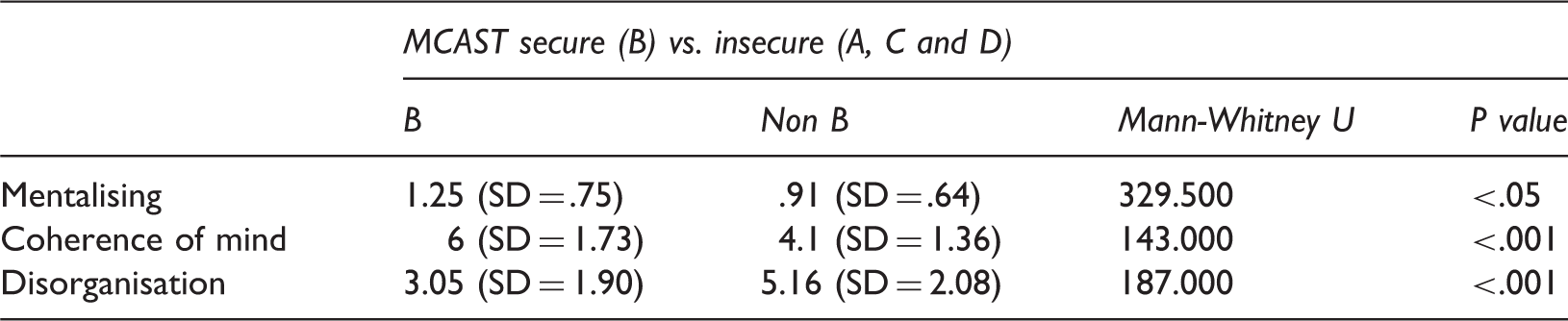
The MCAST secure/insecure classifications did not present any significant associations with any of the following variables: children’s age at MCAST, children’s level of schooling, presence/absence of siblings, age of adoptive mothers and maternal level of education (all p values between .28 and .92).
Examples of attachment classifications by MCAST: secure, avoidant and disorganised vignettes
Examples of secure, avoidant and disorganised classifications of the ‘stomach ache’ MCAST vignette.

When children’s attachment representations were analysed in the light of the three variables discussed earlier, the following results emerged.
Attachment representations and age at adoption
The secure/insecure groups did not present any significant differences in relation to the age at adoption. The results showed a negative correlation between age at adoption and disorganisation score (Spearman’s r = −32. p < .01) but no significant correlations either between age at adoption and mentalising, or between age at adoption and coherence of mind.
Attachment representations and duration of placement
There were no significant differences in the duration of placement experienced by the secure and insecure groups, but a positive correlation was found between duration of placement and mentalising score (Spearman’s r = .37. p < .01).
Attachment representations and gender
Significant differences were revealed between males and females in relation to attachment secure/insecure categories. Specifically, boys were rated more insecure (Fisher’s Exact. p = .01) and disorganised (χ2 = 9.75. df = 3. p = .01) than girls. Comparisons on the three MCAST global ratings, a significant higher disorganisation (U Mann-Whitney = 293.000. p = .03) and a trend for lower coherence of mind scores (U Mann-Whitney = 334.000. p = .05) were found among boys. However, no significant differences emerged between boy and girls with respect to mentalising scores (U Mann-Whitney = 425.500. N.S.)
Discussion
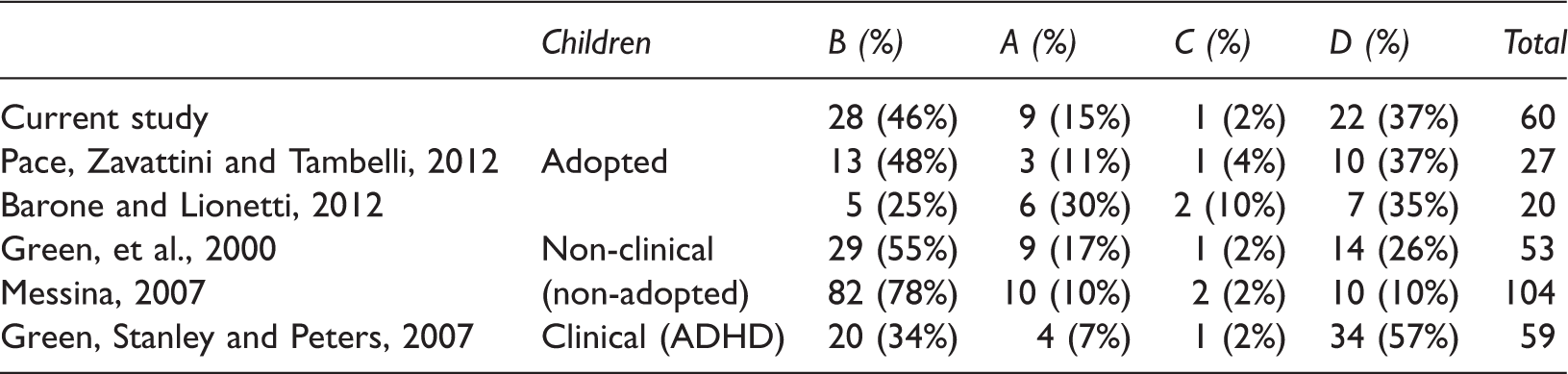
Distributions of MCAST’s categories in various attachment studies.
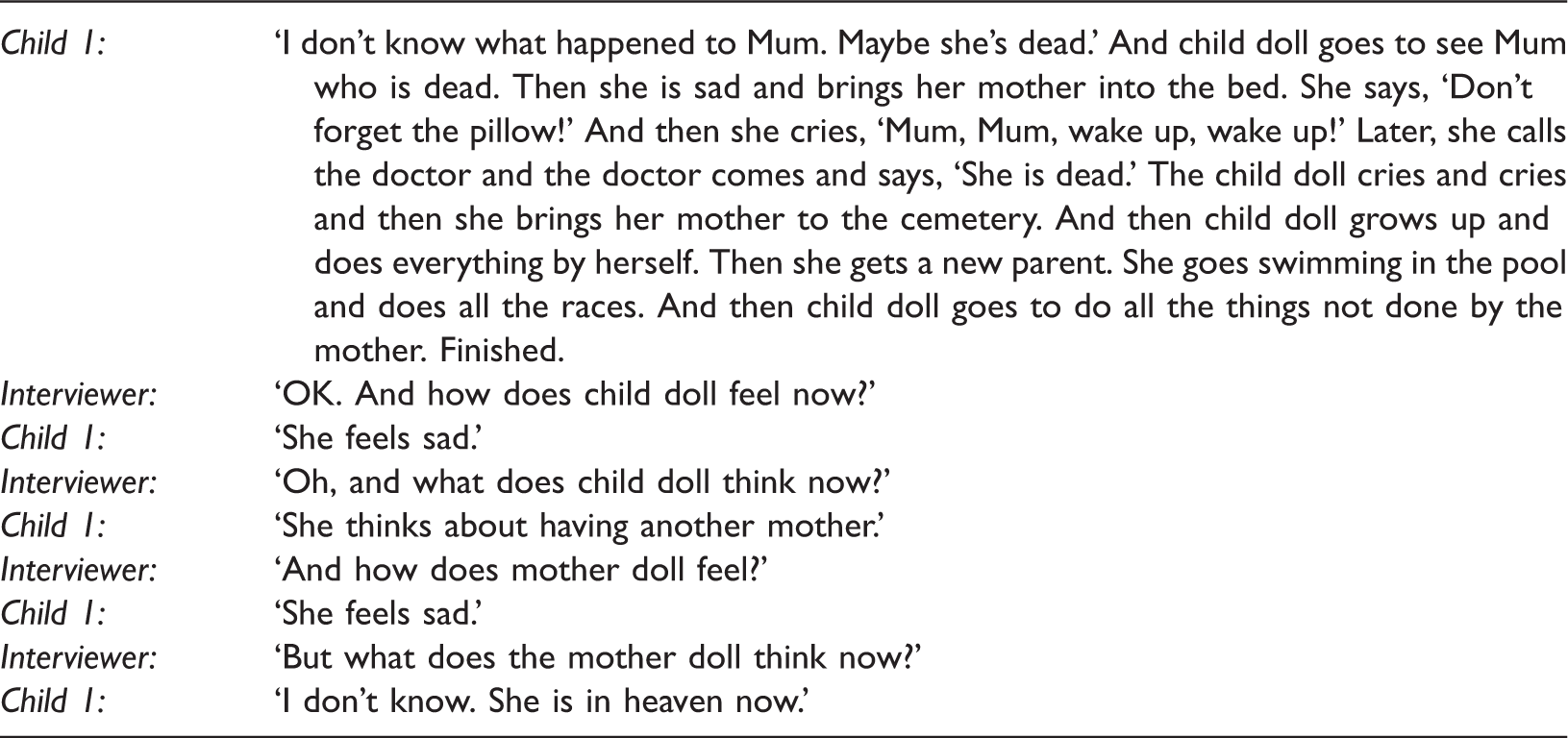
Examples from MCAST ‘getting lost in a shopping centre’ vignette.
However, we did not find any association between age at adoption and secure/insecure attachment classifications. Hence, for older late-adopted children, being placed later (e.g. at 6, 7 and 8 years old) rather than at an early age (2, 3 and 4 years) may not be a specific risk factor for insecurity. In fact, we found that the earlier the age of adoption, the higher the disorganisation scores, a result that runs against the usual trends and merits further investigation.
A number of possible explanations for this outcome may be considered. One could focus either on selection bias towards children with less disorganisation within the group of older children (6, 7 and 8 years old) or potential weaknesses in the methodological tool, namely that MCAST’s coding system may assess older children as more coherent and less disorganised as a consequence of their developmental maturation (Green, et al., 2000–2005).
But a different explanation could be that children who were adopted at the age of two or three years might have experienced more severe traumas early in their lives (e.g. institutionalisation at a very young age) than children who were adopted later, and this could have a more disorganising impact (Smyke, et al., 2007). As researchers in the adoption field have suggested (Howe, 1998; Lacher, Nichols and May, 2005), the predictive power of the age of placement cannot be considered in isolation but must be combined with the nature of the children’s early experiences, including the age of trauma. As Lacher and colleagues (2005) have suggested, young children (2–3 years old) believe they are the centre of the universe and may fail to recognise the role that others play in traumatic events, altering their ability to resolve traumatic experiences. Consequently, younger and older children who went through the same trauma could arrive at different conclusions about what had occurred. Children at an earlier stage of development (younger than 4–5 years) may attribute responsibility for the neglect and eventual abandonment in an orphanage to themselves, believing that if they had behaved better they would not have been rejected by their birth family. In contrast, older children (over 4–5 years) may conclude that their birth parents’ negative behaviours were not their fault, recognising that alcoholism and drug use were pervasive in their country, and so avoid taking responsibility for the disruption of their families. Thus, it can be hypothesised that the high disorganisation among younger late-adopted children, marked by complete chaos, use of multiple strategies and coercive vs. solicitous control by caregivers, could most likely be attributed to the precocious traumatic experiences in their lives.
Regarding duration of placement, the results of this study only partially confirmed existing data. We did not find an association between time spent by children with their adoptive parents and their attachment security. This could be because children who were adopted beyond two years of age need a longer time (more than 28 months) to fully benefit from the new family environment. The meta-analysis by Juffer and van IJzendoorn (2005) suggests that children who had spent a long time (more than 12 years) in their adoptive family showed a greater catch-up in terms of emotional and behavioural problems than those who had lived in their adoptive homes for a shorter period.
On the other hand, length of placement could be positively correlated with the mentalising skills of the late-adopted children, suggesting that the new family environment is able to improve the abilities of children to explore their and others’ internal world, thereby leading to mental state attributions and descriptions of self and mother (Palacios and Brodzinsky, 2010; Steele, et al., 2010). This finding would confirm the positive effect of the late adoptions from a clinical point of view, especially as the literature on attachment and mentalisation (Allen and Fonagy, 2006; Allen, Fonagy, and Bateman, 2008; Fonagy and Target, 2001) has highlighted the reciprocal influence and inverse relationship between mentalisation skills and early traumatic attachments.
But it could also be the case that abuse and maltreatment suffered during infancy and childhood at the hands of birth parents (original attachment figure) may inhibit children’s reflective functioning: for these children to explore and think of the mind of frightening/frightened, and therefore hostile and harmful, parents would become an extremely dangerous activity, so they block their ability to reflect, implicitly assuming malignity in other people’s actions and applying this perspective to new relationships. High mentalisation has been revealed as an indication of resilience among abused, neglected and maltreated children, reducing the possibility of developing psychiatric disorders during adolescence and adulthood (Fonagy and Target, 2001). Therefore, adoptive parents – and specifically those who are sensitive to their child’s emotions and ability to identify and express feelings appropriately – seem to be able to provide their late-adopted children with a ‘secure base’ from which they can start the exploration of the inner and external world among new attachment relationships (Allen, Fonagy and Bateman, 2008). This ‘new’ secure base allows children to re-activate their inhibited reflective functioning, which is likely to be a strong protective factor for later developments, increasing the possibility of modifying internal representations and facilitating the children’s adjustment in the new adoptive family.
In terms of the gender of late-adopted children, our results confirm the hypothesis that males are less secure and more vulnerable to insecurity and disorganisation than females. From this perspective, late-adopted children seem to behave like non-adopted children, as other studies on clinical and non-clinical samples have found (Granot and Mayseless, 2001; Green, Stanley and Peters, 2007). This result would suggest that being female can be a specific protective factor that may buffer the negative effects of the risks caused by negative pre-adoption experiences. In line with this finding, we suggest that social workers and clinicians working with adoptive families pay specific attention to boys in late adoptive placement.
Suggestions for practice
In conclusion, we propose some practice implications for adoption regarding the MCAST as a clinical tool. First, we would suggest that it would be very useful to administer the MCAST to children before their adoption, when they are placed in foster or institutional care, to assess their early attachment representations so that a starting line can be established to compare with later development. Moreover, early identification of aspects such as low/high disorganisation, mentalising or coherence could provide an analysis of the strengths or weaknesses of the children’s internal world, which can be useful both for giving specific advice to adoptive parents (i.e. working on ‘reflective dialogue’ to implement a child’s mentalising skills) and planning professional interventions (Lacher, Nichols and May, 2005).
Second, the MCAST, which is an easy-to-administer and suitable tool with a sophisticated and clinically oriented coding system, could be used to chart the development of children’s attachment representations regarding their predominant strategy of assuagement (i.e. does the child change a non-interpersonal strategy into an interpersonal one?) as well as patterns of disorganisation, mentalising and coherence of mind. This would allow the monitoring of subtle changes in the children’s inner worlds.
Third, we propose that attachment narrative tasks such as MCAST could be useful for helping parents and clinicians to understand a child’s own wishes and to assist late-adopted children to connect with their past, present and future relying on coherent and unique (non-unique) internal working models. To illustrate this, look at how a six-year-old girl responded to the ‘getting lost in a shopping centre’ vignette (Table 5).
Limitations and future directions
Several limitations of the present study should be noted. First of all, the sample size is small and exhibits an internal variability with respect to age of adoption and continent of origin. Second, the duration of placement in the adoptive families of children ranging from seven to 28 months might possibly be insufficient to highlight a significant recovery of attachment level, considering that all our children were placed after the age of 27 months – that is after the sensitive period for developing primary attachment relationships. Third, and most important, we measured only the children’s attachment and focused just on the associations between ‘internal attachment representations’ and on the protective and risks factors affecting children. Attachment in adoptive families (as in blood-related ones) is essentially about interaction and relationship between children and caregivers and we are aware that the impact of the child’s social/emotional relationship difficulties with the adopters and other family members, and evidence of how adopters meet challenges posed by their children, are both missing from this study. Thus, our findings could be considered only a ‘partial picture’ of developing attachments in adoptive families. We hope that further research will include assessments of adopters regarding their characteristics, such as the child’s growth of attachment security, as this would complement the MCAST (Rushton, Dance and Quinton, 2000) and the parental attachment states of mind (Barone and Lionetti, 2012; Pace, Zavattini and D’Alessio, 2012; Steele, et al., 2008) that can affect a child’s attachment classification.
Finally, to understand further the attachment representations of late-adopted children through their childhood, adolescence and adulthood, there is a need for a long-term follow-up study using a larger sample that includes an assessment of parents.