






Abstract
Foster parents often feel irresolvable grief when a child they have loved and nurtured is removed from their home. Their grief response is frequently unrecognised and misunderstood, and can lead to problems regarding the retention of the carers on which the system relies. This article examines the challenge of retaining foster parents and describes the development of a grief awareness training programme for foster care and adoption workers as an effort to improve recruitment and retention. A one-group pre-test/post-test design was used to examine the difference in knowledge enhancement and understanding about foster parent grief after the training was administered to a sample of foster care and adoption workers.
Introduction
Best practices in the field of child welfare focus on safety, permanency and child and family well-being. When children have to be removed from their birth parents due to extreme risks of abuse and neglect, substitute carers who can provide the most home-like environment are seen as the best option for ensuring the child’s safety, permanency and well-being. The foster care system is primarily responsible for meeting the needs of these children. Data collected in the US through the Adoption and Foster Care Analysis and Reporting System (AFCARS) for the fiscal year 2012 indicated that across the whole country there were 399,546 children in substitute care. Almost half (47%) of them were placed in a non-relative foster family home (Child Welfare Information Gateway, 2013: 1), i.e. a family licensed by the state to provide a home environment for the child in need. Placement with family members is preferred, but not always an option, and non-relative placements are favoured over residential settings (Child Welfare Information Gateway, 2011).
The challenges in trying to meet the needs of a growing foster care population as the availability of foster homes is shrinking are well documented (Barbell and Freundlich, 2005; McHugh, et al., 2004; Thompson and McArthur, 2009; Twigg and Swan, 2007). This situation requires urgent attention as foster parents are currently the most valuable resource in finding permanency for many children in the care system. On average, 80% of children for whom parental rights have been terminated will be adopted by their foster parents (Child Welfare Information Gateway, 2013). However, there is also a high turnover of carers, and between 47% and 62% of foster parents exit the system or close their home within a year of their first placement (Gibbs and Wildfire, 2007: 597). As children at risk of abuse and neglect continue to enter the care system, retaining qualified, experienced and trained foster families helps to ensure that such children will experience greater placement stability (Stone and Stone, 1983; U.S. Department of Health and Human Services, 2005).
This article addresses the complex issue of retaining foster placements to meet the needs of children coming into care as a result of the risk for abuse and neglect in their family home. Foster parent retention literature is reviewed and reveals the factors associated with attrition. We maintain a primary interest in the impact on carers of the loss felt when a child leaves the foster home. Our previous research indicated that foster parents experience significant grief in these situations (Hebert and Kulkin, 2013). Results from our sample of carers, who had been fostering for an average of nine years, showed that close to half of them reported feelings related to grief, including ‘missing’ their foster children, ‘having periods of tearfulness’, ‘not planning for the future’ and other emotions synonymous with a grief reaction (Hebert and Kulkin, 2013: 259). A concern for the well-being of foster families and the challenge of retaining them led us to develop a grief training model for foster care and adoption workers. This is described along with an evaluation following its delivery to a group of care and adoption workers.
Changes in foster care practice
The shortage and retention of foster families are affected by a number of variables, one being the nature of their position in current child welfare systems. Foster parents are expected to fill numerous roles. In addition to nurturing, supporting, guiding and disciplining the children placed with them, they often have to advocate for the children, mentor birth parents and even assist in the recruitment of new carers (Dougherty, 2001). Additional responsibilities and challenges were added to foster families with the passage of federal legislation in the US. This includes: the Adoption and Safe Family Act of 1997 (ASFA), which encouraged foster parents to become dually certified as foster/adoptive parents (U.S. Department of Health and Human Services, 1997); the Federal Adoption and Assistance Act of 1980, which made adoption subsidies available to parents adopting children from foster care (Proch, 1981); and the Fostering Connections to Success and Increasing Adoption Act of 2008 (110th United States Congress, 2008), which encourages states to connect children with permanent families. The current child welfare system expects certified non-relative foster parents to take vulnerable children into their own homes and love and nurture them as if they were their own, yet be willing to give them up when the agency or the court system decides that the birth parents are able to resume looking after them. One unexpected outcome of this shift in roles has been to place foster parents at risk for recurring experiences of grief (Edelstein, Burge and Waterman, 2001; Hebert and Kulkin, 2013; Twigg and Swan, 2007).
In addition, there are proponents who advocate professionalisation of the service, or treating foster parents as quasi- or para-professionals (Christian, 2002; Lutz and Agosti, 2005; Miedema and Nason-Clark, 1997; Waldock, 1996). As part of the professional team, foster parents are encouraged to work concurrently with social workers to reunify the child and birth parents. Different motivations behind fostering can make fulfilling these new roles more challenging for carers. While the majority identify a love of children and wanting to make a difference in children’s lives as a key motivation, a number of studies have found that wanting to provide a brother or sister for a birth child and/or adoption as a motivating factor (Cole, 2005; Roger, Cummings and Leschied, 2006). Changes in foster care practice have, therefore, not only added to the difficulties foster parents experience in their role as substitute caregivers but also increased the challenge of recruiting foster families who are willing to take the emotional risk of becoming a substitute parent for children entering care (D’Andrade and Berrick, 2006; Frame, Berrick and Coakley, 2006). As a result, retention has joined recruitment as a major issue and the literature is reviewed to consider the factors that affect this, with a primary interest in the impact of the loss and grief that foster parents feel when a child they have looked after leaves their home.
The challenge of retaining foster parents
Retaining foster parents is a complicated task. A review of the literature reveals numerous factors affecting the ability to recruit and maintain good foster homes. Unfortunately, as implicated, the very nature of the system presents challenges for these activities. Naturally, many homes close after foster parents successfully adopt the children in their care (Triseliotis, Borland and Hill, 1998) and in 2011, 54% of the children in foster care went through this process (U.S. Department of Health and Human Sciences, 2011: 2). One might also expect that the difficulties of caring for a child from an abusive or neglectful home would be a primary factor affecting the ability to retain foster parents and Farmer, Lipscombe and Moyers (2005) describe the emotional strain that foster parents feel when looking after a child with serious behaviour problems. However, one of the most commonly cited factors for discontinuing is linked to agencies. Foster parents have been noted to quit or close their homes for reasons such as poor communication with case workers, lack of recognition, dissatisfaction with agency relationships and feeling inadequately supported (Farmer, Lipscombe and Moyers, 2005; Jones and Morrissette, 1999; Murray, Tarren-Sweeney and Frances, 2011; Rhodes, Orme and Buehler, 2001; Roger, Cummings and Leschied, 2006; Triseliotis, Sellick and Short, 1998; U.S. Department of Health and Human Services Administration for Children and Families, 1993).
System variables affecting the motivation and withdrawal of carers have been highlighted in numerous other studies. In the UK, researchers at the University of York have linked successful fostering outcomes to the complicated interaction between the characteristics of the child, the foster family and the context of care; for example, help from social workers, involvement with the birth family and support within the foster family (Wilson, Petrie and Sinclair, 2003). Specific internal factors or family strengths, such as resilience, have also been identified as affecting retention (Hendrix and Ford, 2003). One study compared 720 closed to 804 continuing foster homes to test a model predicting continuance of placements. A number of agency factors were found to be significant, including negative perceptions of agency procedures, having more than one social worker and perceiving them as unavailable. In addition, they identified a history of a significant personal loss in the foster family as a predictor of home closure (Denby, Rindfleish and Bean, 1999). The findings of all these studies concur that foster parents need more support in the role they play in caring for children.
A driving force behind the current study was the finding that relationships with social workers were consistently identified as being important in the decision to continue or to cease fostering. In an effort to classify foster parents who were thinking of discontinuing, Roger, Cummings and Leschied (2006) found that 58.3% of their study participants had considered withdrawing and that the majority of the reasons for doing so were related to ‘challenging aspects of fostering’. In the same light, they found that foster parents who had not considered quitting (40.6%) were more likely to have a positive relationship with their social workers (p. 1140). A number of other studies have developed this point and examined the perceived needs of foster parents and foster parent satisfaction. Carers report that they need a good working relationship with their case worker, specifying ‘a reliable social worker who is perceived as trustworthy, caring and competent’ (Brown and Calder, 2000; Fees, et al., 1998; Hudson and Levasseur, 2002; Murray, Tarren-Sweeney and France, 2011). Similarly, Lutz and Agosti (2005) found that agencies that treated foster parents as partners and viewed them as members of the professional child welfare team were more satisfied and tended to provide care for longer periods. They also noted that agencies that lack open communication have foster families that are less satisfied and more likely to discontinue providing care, whereas parents who perceived that case workers gave them the information they needed and approved of their efforts reported high levels of satisfaction (Denby, Rindfleisch and Bean, 1999).
Fortunately, research identifying the emotional needs of foster families and the recognition of grief and loss is growing (Buehler, et al., 2006; Edelstein, Burge and Waterman, 2001; Murray, Tarren-Sweeney and France, 2011; Thomson and McArthur, 2009; Twigg and Swan, 2007). Early studies have suggested that separation when a foster child leaves the home is one of the most difficult aspects of the role (Babcock, 1965). Later, Urquhart (1989) determined that the issues of separation and loss were linked to agency–foster parent interaction and foster parent training, particularly when carers felt they were ill prepared and not supported during the departure of the child. A foster family which receives more intense agency contact at the time of removal, more preparation of both the carers and the child at removal time, and greater involvement in the decision-making process may be more likely to remain open to further placements. Open homes reported more pain and loss at removal times but also more support from their worker, particularly an understanding of the need to grieve (Urquhart, 1989). Reasons for a removal can vary from reunification with birth parents to a foster parent requesting the child’s departure, but feelings of grief can arise in all these situations and can be especially intense if the foster parent feels guilt about asking for the child to be taken away (Edelstein, Burge and Waterman, 2001). Overall, foster parents report needing support and training to help them maintain their own physical and mental health needs (Buehler, et al., 2006; Murray, Tarren-Sweeney and France, 2011).
A review of the main reasons for carers deciding to quit indicated that the difficulty of seeing a child leave was ranked second, as reported by 46% of the participants (U.S. Department of Health and Human Services Administration for Children and Families, 1993). Hebert and Kulkin (2013) found that foster parents reported feelings indicative of grief, such as tearfulness, missing the children, not planning for the future and believing that no one would ever take the place of those who had left; one foster parent even compared the experience to that of bereavement. Having children come and go, or even the thought of one being taken away, are noted to be major stressors for foster parents (Buehler, Cox and Cuddeback, 2003; Twigg and Swan, 2007). The loss they feel when a child departs is seen as complicated due to the ambiguous nature of the foster care system (Thomson and McArthur, 2009). Foster parents are often denied the ability to grieve the loss in a healthy manner, because it is not recognised by society and support to deal with these feelings is lacking.
Among the many things we expect from foster parents is an ability to help children cope with the loss they experience after being separated from their birth parents. A foster parent who is struggling with his or her own grief issues will naturally find it difficult to help a child dealing with their own feelings of loss. Thus, foster parents need help dealing with loss and separations so that they can properly care for the children in their homes. One study examining why carers had given up found that many foster parents were never prepared for a child’s removal; an even greater number indicated they were never told how their former charges were doing in their new placements and were rarely helped to stay in touch with them (Baring-Gould, et al., 1983). The inability of foster parents to obtain follow-up information on the welfare of children they have nurtured and cared for presents obstacles to the healthy resolution of grief.
Current and past research on foster parent retention demonstrates that foster parent grief and support from agency workers are clearly important variables in retaining carers. Prior to this study, foster care workers in Louisiana received education and training on the grief that children experience when they are separated from home but received nothing on the grief that might affect them when a child leaves. The local child protection agency therefore supported the development and implementation of a training designed to educate foster care and adoption workers about these issues.
The training: A Special Kind of Grief: A foster child leaves the home
The literature on foster parent retention, foster parent grief and grief education formed the basis for the training. It was titled A Special Kind of Grief: A foster child leaves the home and was modelled after a series of grief training workshops designed to raise awareness and provide knowledge to inform practice. Although there is a general lack of grief training across professions in the US (Walsh, 2001), models that seek to educate practitioners about the various stages of grief are sometimes used (Randhawa, 1998; Watters, McKenzie and Wright, 2011; Williams, 2008). As a result, the authors developed an approach often used in grief education; this includes the presentation of brief didactic information (knowledge) accompanied by experiential activities such as role-plays and the sharing of personal experiences (Servaty-Steib and Taub, 2008; Vickio, 2008). These activities were designed in a way to help the child welfare worker identify with the feelings of the foster parents.
Two primary objectives guided the development of the training: (1) to increase child welfare workers’ knowledge of how foster parents experience grief when a child leaves; and (2) to develop child welfare workers’ understanding of the importance of their role in helping a foster parent manage grief. A guiding principle in developing the training was an understanding of the link highlighted in the research literature between grief experienced by foster parents and the recruitment and retention of carers.
Four goals were incorporated into the training design. They included that participants would: (1) understand the basic theories of grief and loss; (2) recognise that foster parents have to deal with feelings of grief and loss when a child is removed, regardless of the reason; (3) learn that certain obstacles often hinder carers’ ability to grieve (based on theories of disenfranchised grief, ambiguous loss and anticipatory grief); and (4) appreciate that their relationship with the foster parent and the ability to help them grieve can affect retention.
Foster care workers were introduced to the idea of foster parent grief through the trainer’s account of conversations about this held with local carers, as well as some description of the supporting research. The training then entailed an experiential component in which workers were asked to recall the loss of a significant relationship and write a letter to the lost one. After workers had volunteered to share their letters with the group, the facilitator validated the feelings expressed and related the workers’ feelings to the stages of grief originally delineated by Kübler-Ross (1969), including shock and denial, anger, bargaining, sadness or depression and acceptance. This part of the training was designed to help the workers understand normal reactions to loss and identify with the foster parents’ experience. Kübler-Ross’s original grief theory has naturally been expanded by modern thanatologists, but the theory was perceived as fitting well with the particular circumstance of foster parent grief. Indeed, Kübler-Ross’s grief model is still the most referenced by grief counsellors (Breen, 2011). More recent theories, including the work of Worden (1991) and Neimeyer (2001), were brought in towards the end of the training when social workers were taught how to help foster parents overcome their feelings.
The second phase of the training was based on specific grief theories that explain the difficulties foster parents may have in resolving their grief, as well as the work of Edelstein and colleagues (Edelstein, 1981; Edelstein, Burge and Waterman, 2001). Systemic factors embedded in the foster care system, which can create barriers to a healthy resolution of grief, were identified. For instance, as stated previously, foster parents often lack support in dealing with their feelings when a child leaves (disenfranchised grief). Professionals, family members and friends may assume that the relationship was not strong enough to elicit a grief response or that the foster parent knew all along that the placement would not be permanent; therefore, the foster parent is denied the right to grieve. Specific information was also provided on how foster parents experience grief on many levels (ambiguous loss).
The training proceeded with education on the four tasks of grieving that need to be accomplished for foster parents to be able to mourn the loss and work towards acceptance. As prescribed by Worden (1991), the griever must accept the reality of the loss, work through the pain of the grief, adjust to an environment without the child, emotionally relocate the lost one and move on with life. Workers were encouraged to listen to their foster parents and to inquire about their feelings following a removal. They were also advised to encourage foster parents to reach out to other carers who could identify with their feelings. Primarily, they were encouraged to validate their foster parents’ grief and provide support. Workers were also encouraged to help foster parents find ways to comprehend their loss, based on the work of Neimeyer (2001), who asserts that being able to make meaning out of the symptoms of grief is the central process of resolution. The training concluded with a discussion of the problems that can result when foster parent grief is not recognised and the effects this has on the quality of care and decisions to continue. The training was presented by a university professor with grief work experience and a relationship with the child welfare agency. An outline of the course is provided in Appendix 1 (supplementary material is available online).
Methodology
The training was provided to one public child protection office. Study participants comprised a convenience sample of foster care and adoption social workers. A Measurement and Enhancement questionnaire was administered by the author who presented the training. It used a Likert Scale (1–5 positive to negative) to judge the validity of 14 statements (Losby and Wetmore, 2012). As the aim of the evaluation was to explore whether training about foster parent grief increases social workers’ knowledge and understanding of the issues, it was hypothesised that:
There would be a significant decrease (i.e. more positive than negative ratings) in post-test item scores, thereby indicating an increase in knowledge enhancement and understanding concerning issues pertaining to foster parent grief. There would be a significant decrease in post-test item scores, indicating that foster care workers understood that foster parents experience grief when a foster child leaves their home.
Evaluation design
A one group pre-test and post-test design was used. This design is helpful in examining how much improvement occurs after an intervention (Dudley, 2009; Royse, et al., 2010). Thus, pre-test scores were collected prior to the training and post-test scores thereafter. A scrutiny of significant mean differences between pre- and post-test scores reveals any changes in knowledge enhancement and understanding about foster parent grief.
Participants
The participants in this study included 23 foster care workers employed by the state of Louisiana. The majority of them were female (95%) with a mean age of 39.6 years (SD = 9.11). Participants reported working for child welfare for an average of 11 years (SD = 6.64) and working in foster care for an average of 7 years (SD = 6.15).
Data collection
All participants were asked to complete demographic questionnaires and pre-test Measurement of Enhancement Scales (MES) prior to the start of the training. Afterwards, they were asked to complete post-test Scales and the two scores were matched by means of a code number.
Instruments
Demographic questionnaire
A four-item socio-demographic questionnaire was developed to obtain the following information: age, gender, number of years working in child welfare and number of years working in the division of foster care.
Pre-test and post-test measures
The MES was constructed by the researchers and validated by piloting it with students to measure social workers’ knowledge and understanding as it related to specific items dealing with foster parent grief, based on the Special Kind of Grief training. All 14 questions were positively worded as mixing positively and negatively worded items can create more problems than it solves (Barnette, 2000). Cronbach’s alpha was calculated for the 14-item Scale for both pre-test and post-test data separately. Results indicated excellent reliability of the scale (.94 pre-test; .88 post-test).
Results
t-test results for pretest and post-test scores on the Measurement of Enhancement Scale (MES).
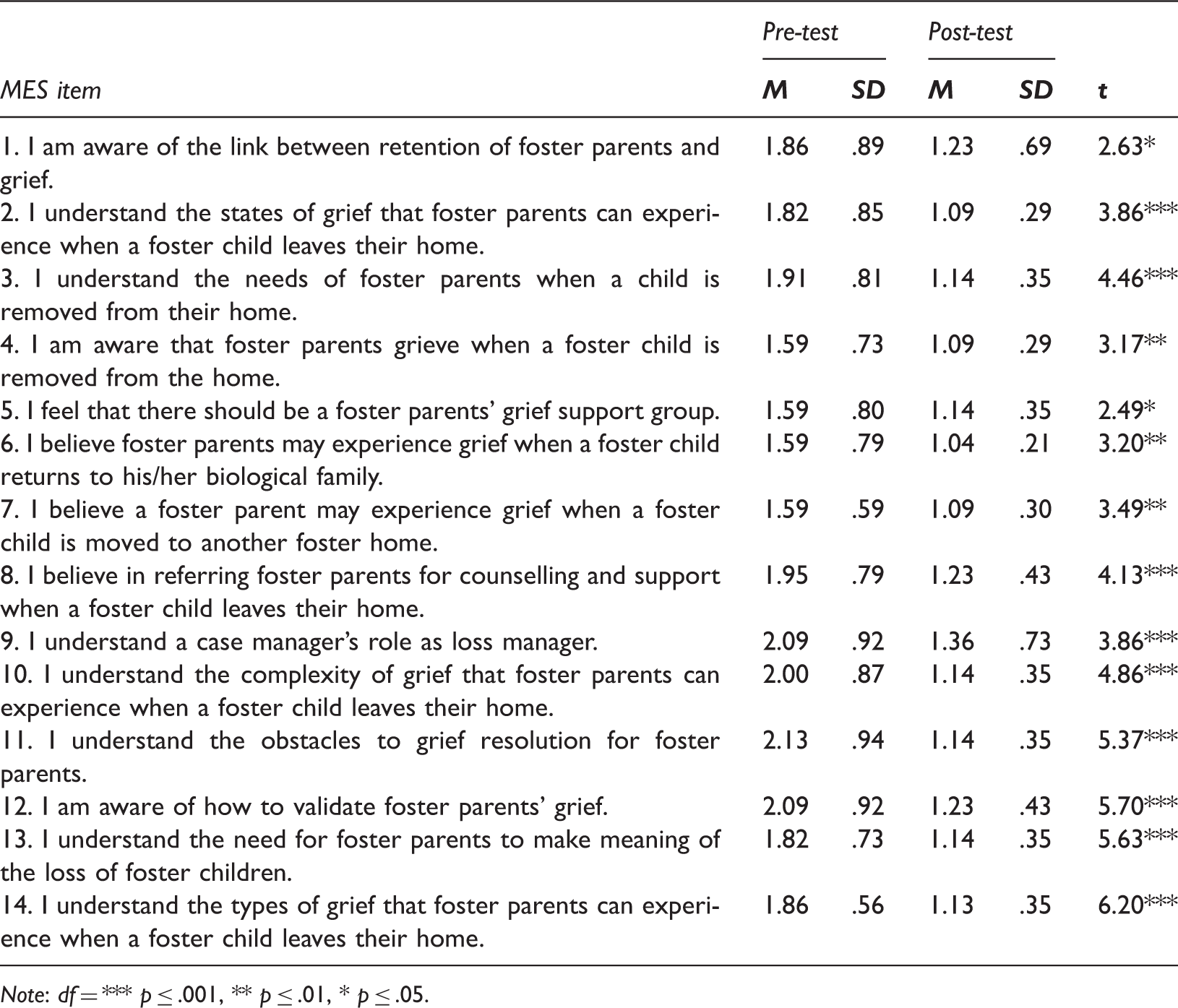
Note: df = *** p ≤ .001, ** p ≤ .01, * p ≤ .05.
Discussion
The aims of this study were to examine the challenges of retaining foster parents, describe the development and implementation of the training, A Special Kind of Grief, and examine the hypotheses that there would be a significant decrease in post-test item scores, thereby indicating increased knowledge and understanding concerning issues pertaining to foster parent grief, and that there would be a significant decrease in post-test item scores, indicating that workers understood that foster carers experience grief when a child leaves their home.
The primary aim of the grief training appears to have been achieved, as highlighted above. As noted in the literature, the relationship between the worker and the foster parent, their communications and the attention given to the carer’s potential grief are all factors that influence the retention of foster families (Babcock, 1965; Baring-Gould, et al., 1983; Hunter, Kelsey and McCabe, 1977; Lutz and Agosti, 2005; McCoy, 1962; Rindfleish, Bean and Denby, 1998; Urquhart, 1989). The authors recognise that foster care workers are already burdened by heavy caseloads and the stress of dealing with families in crisis on a daily basis. The aim of the training was not to make additional work but to heighten their awareness of what foster parents experience in their roles and how they could be better supported.
Ultimately, regardless of the extra time it may cost the worker, the efforts he or she puts towards having a strong, supportive relationship with the foster parent may make the job easier in the long run. Retaining good foster parents means that agencies will have more placement options and are better able to match the needs of both the child and foster family.
Limitations and future directions
The current study sheds light on an important area of research; however, the results should be viewed in consideration of its limitations as they cannot be generalised from a small non-random sample. Future studies should seek to engender a larger sample by administering the training to a bigger group of randomly selected participants using different methods (e.g. online).
While the MES is a reliable measure, there may be inherent biases because it relies on self-report data (Rubin, 2013). The credibility of self-report data is strengthened by the use of a pilot test group (Hadley and Mitchell, 1995) (as was the case in this study). Additionally, further development of the instruments and training is warranted. It may be beneficial for future work to triangulate the data by adding qualitative questions to the instrument to explore whether respondents believed that the training was likely to affect their practice and the extent to which it did.
Conclusions
Recruitment and retention of foster homes is a continuing challenge. It is affected by a variety of factors, all of which deserve attention considering the important role that foster families play in keeping children safe and enhancing their well-being. Child welfare agencies are overwhelmed with the growing needs of the population and the shrinking resources available to meet them. Unfortunately, agencies also face big challenges in workforce retention and in meeting the training needs when turnover is high (Barbell and Freundlich, 2005). In addition to new worker training, the U.S. General Accounting Office (1989) identified pre-service training for carers that prepares them for the challenges of looking after children as this is seen as likely to improve foster parent retention. However, for stretched training divisions, the demands of training new workers can naturally push the training needs of foster families to a lower priority.
As federal and state funding for child welfare continues to shrink, universities can be a valuable resource to agencies through the sharing of faculty resources. Many departments provide extensive research in the area of child welfare and can contribute their knowledge through partnerships with local child welfare agencies by developing and implementing training courses designed to meet the specific needs of foster parents. The results of this study support the inclusion of training material on the grief felt by foster parents when a child in their care leaves their home. Furthermore, child welfare workers were receptive to the training being administered by a university professor with experience in grief work. In this age of consolidation and budget reductions, greater efforts should be made towards partnerships between child welfare agencies and teaching institutions in order to improve outcomes for children. All resources need to be explored and developed in an effort to meet the best interests of the child.
Footnotes
References
Supplementary Material
Please find the following supplemental material available below.
For Open Access articles published under a Creative Commons License, all supplemental material carries the same license as the article it is associated with.
For non-Open Access articles published, all supplemental material carries a non-exclusive license, and permission requests for re-use of supplemental material or any part of supplemental material shall be sent directly to the copyright owner as specified in the copyright notice associated with the article.
