






Abstract
The increasing emphasis on outcomes for children in care has prompted much research and drawn attention to the importance of harnessing users’ views on the services they receive. However, this awareness is still limited in some areas, one of which is the loyalty conflict experienced by children in foster care who have to negotiate living with a new family while also retaining their birth family membership. This study assesses the extent to which they experience such conflict and how they cope with the challenges it presents. A qualitative methodology, involving semi-structured interviews with 15 children was employed and grounded theory used to inform the data analysis and construction of a theoretical model. The model comprises five core categories: new realities; considering position; making sense; relating emotionally; and working out loyalties. A sixth category, considering others’ perspectives, emerged from respondent validation and an overarching perspective, self-determination, was found to permeate all other processes and contributed to highlighting complexity. New knowledge is gained through seeking the voices of the children and exploring the position they hold by being within and between two families. Implications for practice and future research are also discussed.
Keywords
Introduction
The number of children in foster care has increased steadily in England over the past decade and in March 2017, 53,420 (74% of all those in care) were so placed (Department for Education, 2017). A third of these children had experienced at least one placement move during the course of a year and a third who ceased to be looked after returned to their birth families, highlighting the continual transience experienced by many of those involved.
It is well established that looked after children are more likely than those not in care to have undergone adverse childhood experiences and to display more mental health issues and poorer educational achievements (Turney and Wildeman, 2017). It is also known that past trauma has a negative impact on development (Cook, et al., 2003) with the result that children in care are more likely to have insecure and disorganised attachments that affect their social-emotional competence, cognitive functioning and physical and mental health (Ponciano, 2010; Ranson and Urichuk, 2008). These disadvantages have also been found to continue through the life course, becoming manifest in the raised levels of mental health problems for adults who have been in foster care (Zlotnick, Tam and Soman, 2012).
Given their early experiences, it is understandable that children may reject their foster carers, possibly believing that adults cannot be trusted to meet their needs (Levy and Orlans, 2006). Equally, foster carers may inadvertently avoid becoming too attached in an attempt to reduce the emotional impact of an inevitable loss, especially when placements are short term (Waterman, 2001). It is concerning that many children who experience multiple placements report not feeling part of any family, with implications for all domains of their lives (e.g. Jones and Kruk, 2005; Rostill-Brookes, et al., 2011).
Attachment is a two-way process and will depend upon the emotional capacity of the carer as well as the child. Gabler and colleagues (2014) have shown that increased foster carer sensitivity and reduced parenting stress were both predictive of the child’s attachment security and lower rates of internalising problems, so it is encouraging that some children are able to form secure attachments within their new families (Ponciano, 2010), which attests to the child’s capabilities to adjust and develop resilience. These can represent a strong foundation for improved mental health and contribute to a process of positive adaptation to adversity (Rutter, 1999).
In considering what makes placements work, foster carers have indicated the importance of the child adjusting, feeling comfortable and ‘like part of the family’ (Brown and Campbell, 2007). Rock and colleagues (2015) found that placement stability increased when a child had fewer externalising problems and was placed with birth siblings or relatives, suggesting the importance of the genetic bond and commitment to birth families for these children. The best outcomes were achieved when children and young people became firmly established members of their foster families and continued to experience them as a secure base long after they had left care (Levy and Orlans, 2006; Schofield and Beek, 2009). This illustrates the importance of therapeutic interventions which have been developed around building attachment relationships, such as Dyadic Developmental Psychotherapy (Hughes, 2011) and Theraplay (Booth and Jernberg, 2009), a need reiterated in official attachment guidelines (NICE, 2015).
The Children Act 1989 and the Care Planning, Placement and Case Review (England) Regulations 2010 state that birth family contact for children in care should be promoted and maintained when it is consistent with the child’s welfare. However, research yields mixed results regarding its impact. Children have expressed that birth family contact is important to them (Chapman, Wall and Barth, 2004) and acceptable arrangements have been linked to lower rates of depression and externalising problems (McWey, Acock and Porter, 2010), stronger attachments to birth families (McWey and Mullis, 2004), increased self-esteem, stronger senses of identity and reduced feelings of loss and rejection (Loxterkamp, 2009). Conversely, birth family contact has also been linked to behavioural problems (Browne and Moloney, 2002), greater distress and difficulties with expressing emotion, all increasing the risk of placement breakdown (Moyers, Farmer and Lipscombe, 2006). A recent systematic review (Boyle, 2017) found that outcomes were noticeably positive where there was a collaborative approach between the birth and foster families, the worst consequences occurring when children had ongoing contact with maltreating birth parents or when necessary social work support was lacking (Moyers, Farmer and Lipscombe, 2006).
A useful concept in understanding these relationships is ‘loyalty’ which can be considered as a feeling or attitude of devoted attachment, even where it may not be deserved. When loyalties conflict it can result in poorer adjustment within the foster family and increased emotional and behavioural problems for the child (Leathers, 2003; Linares, Rhodes and Montalto, 2010), factors that are closely associated with placement instability (Brown and Bednar, 2006). Leathers (2003) further highlights the wider significance of children’s relationships by showing that where strong ties with biological mothers are combined with weak foster family allegiance, or where relationships are robust in both contexts, high levels of loyalty conflict are likely. This is echoed by Ponciano (2010) who found that the most secure relationships with foster mothers were with children who had less contact with their biological families. Similar tensions have been found among other groups affected by separation, such as children experiencing parental divorce where conflicting loyalty has been linked to lower subjective well-being and strained relationships with parents (Amato and Afifi, 2006). Children living in stepfamilies face similar difficulties; Jensen and colleagues (2017) found that the nature and quality of children’s relationships with resident parents have the greatest impact on their well-being, with the highest stress levels occurring among those reporting to be close to both biological parents. All of these findings confirm the difficulties faced by separated children in maintaining dual allegiances.
In the light of this evidence, Baker and colleagues have developed training to help carers better understand and overcome these difficulties (Baker, Mehta and Chong, 2013). However, the content of their programme is largely based on the perspectives of professionals, with no input from the children. Indeed, although children and young people’s voices are now heard as a matter of course and the difficulties of maintaining birth family contact are universally acknowledged, no dedicated research has been published that specifically focuses on the process of engaging with two families. Exploring children’s position in these situations will, therefore, enable a clearer understanding of these dynamics and support the development of clinical interventions and further research in this area.
Method
Participants
Participants comprised 15 children and young people who were recruited via children’s services in two London boroughs. They were aged between 7 and 14, were under full care orders, had been in their current non-kinship foster care placement for a year or more (in short- or long-term placements) and were not at risk of imminent placement breakdown. Fourteen of them were in care owing to abuse and neglect in their birth family and one due to parental illness. They had at least annual face-to-face contact with a birth parent. The demographic characteristics of the participants are presented in Table 1. Ethical approval was obtained from the University of Surrey (reference 600-PSY-11 RS).
Participant information.
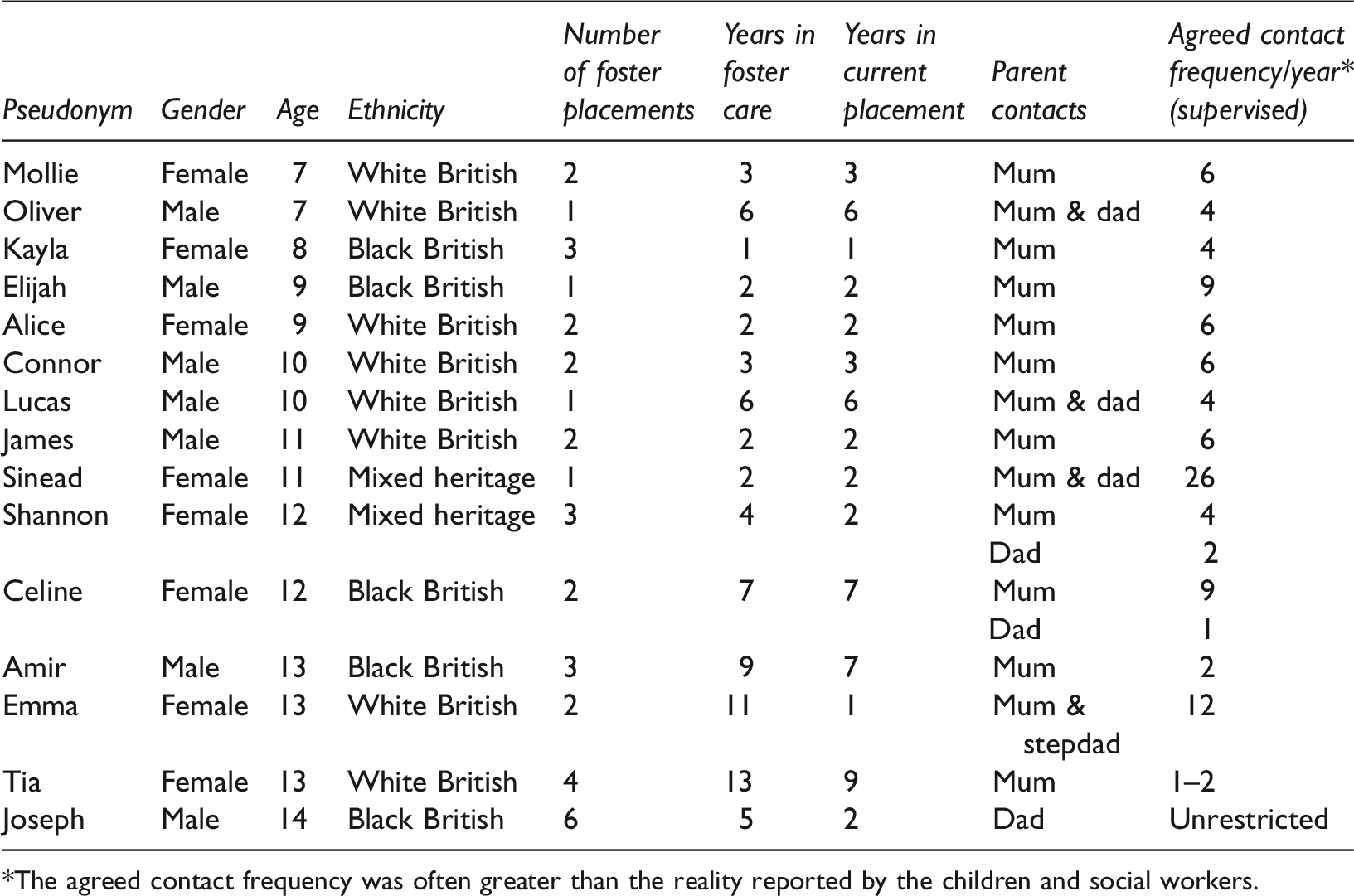
*The agreed contact frequency was often greater than the reality reported by the children and social workers.
Social workers identified potential participants based on the selection criteria, the stability of the child’s current placement and his or her emotional well-being. They provided informed consent as the person representing the local authority, which held parental responsibility. Following discussion, social workers determined whether information should also be shared with birth parents. Agreement was then sought from foster carers before inviting the children to give written consent, in response to receiving an information leaflet and a subsequent discussion. Participants were invited to terminate the interview at any time or to decline answering any questions, breaks were offered and a known adult was available to support them if needed.
Procedure
A semi-structured interview was conducted with each child, lasting 60 to 90 minutes. The children were invited to describe their experiences of being in care and seeing their birth families. Interviews were audio-recorded and transcribed by the interviewer. In line with Charmaz’s (2006) social constructivist grounded theory, theoretical sampling was used whereby additional selective information was sought to answer questions arising in order to refine the analytical categories (Willig, 2008). Data collection continued until it appeared that theoretical saturation had been achieved.
Transcription and data analysis
The information obtained was analysed in line with Charmaz (2006). Each transcript was coded line by line and the resulting categories and relationships between them explored with the aid of written and diagrammatic memos. Categories were developed through the process of constant comparative analysis whereby comparisons were made within and between all levels of data. These were repeatedly built up and broken back down to fully explore complexity. Theory was generated by deconstructing and reconstructing theoretical categories, which were then reduced down to the core categories in the data. Processes around refining analytical categories and theoretical saturation were adopted from Willig (2008) and Yardley’s (2000) principles were followed to enhance credibility. Three participants were involved in reviewing and providing feedback on the proposed model.
Results
The Model of Processes Informing Loyalty
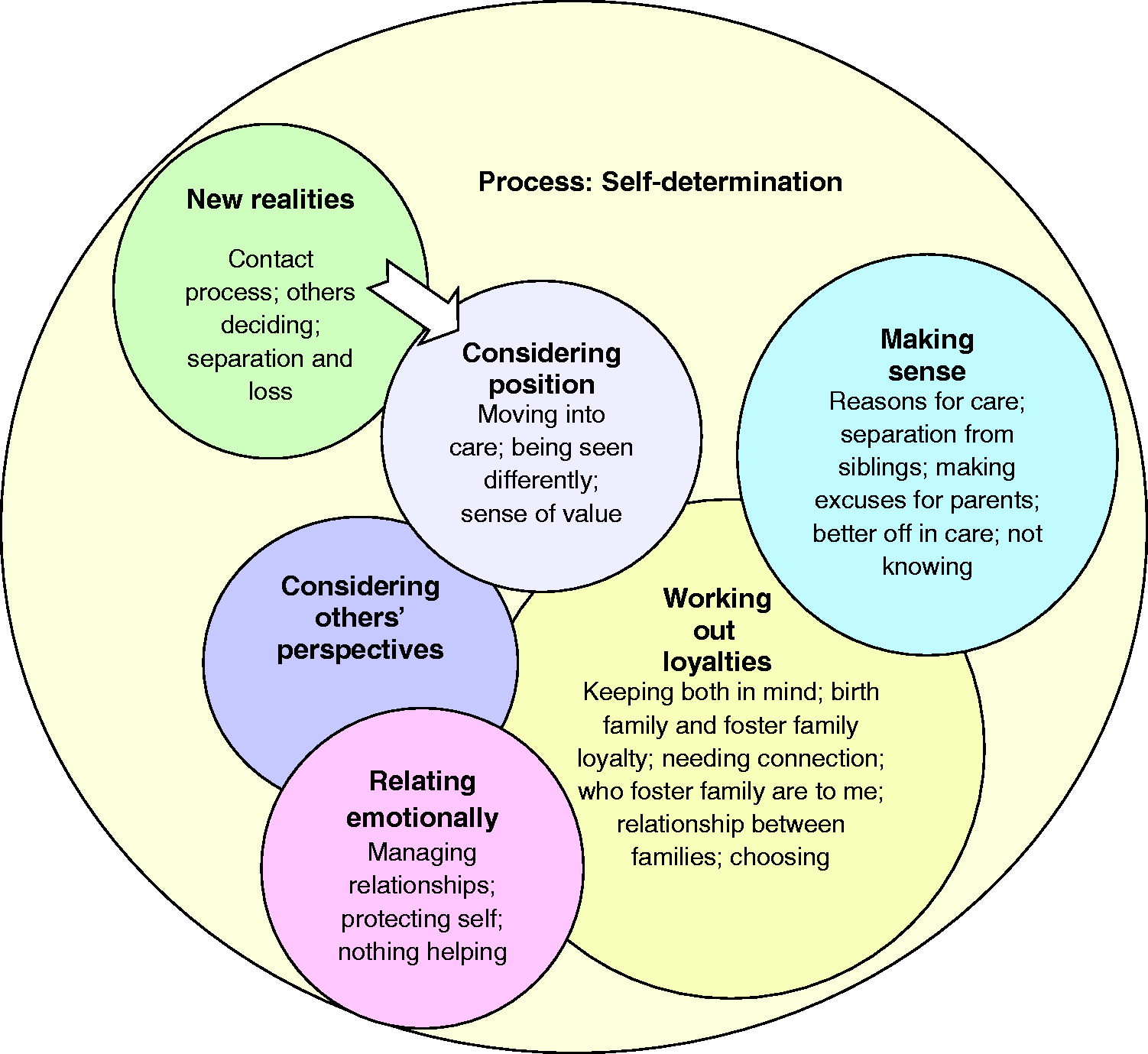
The emerging ‘Model of Processes Informing Loyalty’ (Figure 1) encompasses seven core theoretical categories: new realities; considering position; making sense; relating emotionally; working out loyalties; considering others’ perspectives; and the overarching category, self-determination.
The Model of Processes Informing Loyalty.
It begins with the child facing their new reality at the moment they enter care, which leads them to consider their position in relation to the other elements in the model that now come into play, all permeated by a continual process of self-determination. The relative scale of the model is not representative and the positioning of each element is in relation to the key issue of the child ‘working out loyalties’.
New realities
This describes what children are facing the moment they enter foster care. They spoke about how their relationships and interactions changed because of social worker and court-based decisions. ‘Separation’ was a fundamental loss weighing heavily for many children. In the words of Sinead (11): ‘I felt scared coz I didn’t know how long I would stay apart from my mum and dad for.’
This was followed by the loss of ‘normality’, moving in with a new and unknown family, seeing their birth families in ‘contact’ and becoming a ‘foster child’. Reactions to these changes spanned a continuum from anger, powerlessness and resistance, to sadness, passive acceptance, looking on the bright side and relief.
Considering position
This reflects the processes of how children recognise and contemplate their new position and reconceptualise their sense of value.
Some children felt unwanted and let down by their families: If she did love me then she wouldn’t like, put me in care, she would look after me, give me clean clothes, feed me every day. (James, 11) Well, I got used to it, coz if I got used to it and I settled down quickly … if I didn’t, I would be in another place right now. (Celine, 12) I think they would say, ‘I’m not going to be your friend any more’, just because you’re in foster care. (Sinead, 11)
Making sense
This category highlights the processes whereby children attempt to understand their situation, determining their sense of loyalty and how they relate.
Some children could give no reasons for what had happened to them or found that it was impossible to make sense of it all, some accepted or refused to accept their situation and many switched positions constantly. Many did not want to ask questions. Some children gave explanations that captured their parents’ perceived inabilities or unwillingness to care: My family was like a war. It was like we didn’t have a mum, because she didn’t do anything, just drunk. (Connor, 10) Er, because mum wasn’t looking after us. Well, she was kind of looking after us but she just felt a bit tired. (Shannon, 12) Mum wants to stay with me, like me living with her again and me not being fostered, but then she keeps saying stuff like, ‘Oh, it will be better someone can look after you.’ (Elijah, 9)
Relating emotionally
The fourth category encompasses the ways in which children maintain their relationships and attempt to protect themselves. For these children, sometimes ‘nothing helps’; nothing can alleviate the pain of abuse and neglect, separation or the difficulties of living in care and maintaining contact. Hoping to be reunited with their families enabled some of them to keep the connection alive and knowing others in foster care seemed helpful, as did having understanding friends. Worrying about and trying to take responsibility for parents was common, although there was also relief in being looked after in the foster family. While many shared feelings, others kept things to themselves or distanced themselves from their emotions, as in ‘Don’t even know really, I just don’t want to think about it’ (Amir, 13). Others worked hard to convey that there were no difficult feelings: ‘Just not too bovvered, honestly, I’m not bovvered, don’t bovver me’ (Lucas, 10).
Lucas built up what he referred to as ‘immunity to pain’: I’m actually happy that I was actually left on the bus, coz now, being left so many places on my own, I am not scared of anything now … every accident that has happened has made me immune to being scared of anything now.
Working out loyalties
This represents a process of weighing up and choosing, even when there may not be a choice. Overwhelmingly, children remained loyal to their birth families, despite problems: ‘I did hear from [social worker] that she was a bad mum but I don’t think so’ (Oliver, 7). Loyalty to foster families was often less apparent and after talking positively about her foster family, Emma (13) laughed that she would dismiss them if she could return to her birth family: ‘Forget them, forget them. I am with my family now.’
The enjoyment of foster care often seemed marred by missing family, although other children wished to permanently separate from theirs and regain a sense of control: I imagine a computer in my head and a little mouse and a little hand and then lots of big files and pictures of my birth family and then the invisible hand uses the mouse, clicks on the file and deletes it. (James, 11) None of them know Mum’s name so they won’t be able to talk to her. There is no way people are going to talk to her … Well, people will talk to her … they might. (Connor, 10) She just didn’t like it, she said, ‘They are not your parents so why are you calling them Mum and Dad?’ (Lucas, 10) Um, I was hoping … the two mums and dads would join up together coz then there would just be one house. (Oliver, 7)
Self-determination
The overarching category recognises the active coping of the children, despite their seemingly powerless positions. Some attempted to take control of the situation and problem-solve and others tried to focus on their own goals: Don’t be stuck in the middle…think what you would like to do; it is not their decision in life, it is your decision that you have to make. (Tia, 13)
Considering others’ perspectives
This emerged from respondent validation. It captures what children imagine or believe that others think or feel and how this influences their own position, loyalties and responses: Here it feels like they want me to stay who I am, they don’t want me to grow up too fast. My mum doesn’t mind me growing up too fast, she doesn’t… well, she cares but… (Celine, 12)
The application of grounded theory to these findings enabled the research team to construct the model described. It provides a framework that contributes to a theoretical understanding of children’s situations and offers new knowledge about managing separations.
Discussion
Throughout the interviews there was evidence that the children wanted warmth and affection from others. For the most part, they had allegiances to their biological as well as foster families and loyalty was a salient theme around which they organised their thoughts and feelings and how they related to people. In sharing their experiences, many children spoke about their ‘new realities’ beginning when they found out they were coming into care. Children’s reactions were broad ranging and set the tone for how they conceptualised their position. The response will no doubt be affected by how these transitions are managed. Careful attention is needed to both the loss of the birth family and changed interactions through ‘contact’ and the processes of joining another family. Schools and peer networks may be pivotal here, possibly remaining a secure base for these children when everything else is in flux.
In ‘considering position’, the model shows how children perceive themselves to be seen more negatively once they enter care. Perceptions of stigma and experiences of bullying were found in some cases to result in the practice of keeping foster care secret. This is concerning given the potential negative implications on the child’s sense of self-identity and shame, as well as possibly reducing the depth and authenticity of their social and emotional connections with others. Rogers (2017) established that foster children choose to deal with this challenge by carefully managing the disclosure of their ‘in care’ status and actively drawing upon the support of their social relationships, which act as a protective factor. Talking to children and exploring the dilemma of what they share will be an important step, alongside addressing stigma and bullying.
Narrative processing has been proposed as central to identity development, with the ability to produce coherent narratives linked to a stronger self-concept (Habermas and Bluck, 2000). Coherent narratives were, however, lacking in the children’s accounts, which revealed numerous contradictions, confusion and ‘not knowing’. Deriving meaning and coming to terms with difficult life events may be particularly important for the development of a positive self-concept and well-being (Mansfield, McLean and Lilgendahl, 2010). Given the experiences of those in care, this is likely to be even more important. Children particularly struggled with giving an account of why they were in care, possibly indicating how unprocessed these events were. The ambivalence, inconsistencies and contradictions, especially in relation to birth parents, may have resulted from repeated patterns of learning or in response to their ongoing experiences, including placement breakdowns and challenges regarding managing contact. This is likely to directly affect the child’s sense of identity and worth to others. Believing they have little value to others will reduce self-worth for all but the most resilient children. Ambivalent attachment in relation to a parent is also likely to influence their attachment behaviour to other key adults in their lives, including their social worker, teachers and foster carers. Conflicting loyalties are likely to further reduce a child’s ability to develop a coherent narrative. Smart (2006) found similar multi-layered and ambivalent accounts from children in families following divorce, highlighting the impact of divided relationships.
The processes of ‘making sense’ were central and highlight how children tried to work out loyalties and create a coherent narrative. Family culture is likely to be an important influence here, both in terms of how the child has experienced and perceived their own and their foster family’s culture and how they might compare and relate within and between the two. The reality for the children who have been removed due to abuse and neglect is that they should be moving to a home that is able to meet their material, social and emotional needs. However, owing to the recognised shortage of foster placements, attendance to issues associated with difference and diversity is often secondary to finding a place of safety. Some children referred to the differences in material possessions, levels of care, presence or absence of alcohol and shouting, although many avoided making overt comparisons. For children, ‘choosing’ between the families seemed to relate to the perceived primacy of the genetic bond and sense of belonging, and can be seen as integral to how they considered their position. What the children could and could not say may also have been underpinned by their sense of loyalty.
‘Relating emotionally’ and the experiences reported can be understood within a psychological defence mechanisms theoretical framework. Children who have experienced adversity may come to rely on systems of defences to manage intolerable affective states (Lemma, 2003). The current model suggests that these may protect against confusing and painful feelings, which were prevalent for most children and as such may demonstrate a level of resilience. ‘Not knowing’ in particular was seen as a self-protective strategy and a defence against the challenges of seeking to ‘know’. For these children, holding narratives fraught with mixed feelings, inconsistencies and contradictions, struggling to make sense and to relate may mirror their early and ongoing experiences. ‘Splitting’, or conceptualising a birth parent as all good or all bad and the foster carer as the opposite, might help children to separate opposing feelings. This was evident in many of the accounts. It may also avoid feelings of dependence on a foster carer who may be temporary. Idealising birth parents may also protect against the pain of reality and maintain family loyalty, which may remain powerful even when the subject is seemingly undeserving. Relating to two families with very different styles of emotional functioning can also be particularly confusing and difficult to manage. The suppression and dismissing of emotions evident in this research has also been identified in other studies of children in care (Mitchell, et al., 2010; Rostill-Brookes, et al., 2011) and may be a more pervasive coping mechanism for these children. While defences have been framed as adaptive in avoiding pain and enabling feelings of greater safety and security (Alvarez, 1992), they were of concern here when they seemed to be applied indiscriminately to foster carers and others. Lemma (2003) recognises that when used too rigidly or exclusively, defences can become part of the character structure. The early signs of the defence of denial was evident in this study as ‘not caring’ had become quite pervasive for some children.
‘Working out loyalties’ was a salient, constantly shifting and evolving process for the children and could be interpreted as them attempting to make some coherent sense of what was happening. ‘Choosing’ was a key theme within this, which often highlighted conflicts of loyalty. These can be implicated in emotional and behavioural problems and could play a part in placement breakdowns (Brown and Bednar, 2006; Leathers, 2003; Linares, Rhodes and Montalto, 2010). Birth family bonds appeared broadly to be seen by children as permanent, genetic, emotional and irrefutable, whereas for many of them foster placements were viewed as temporary or indiscriminate. However, these beliefs were often complicated by experiences of maltreatment and ongoing contact problems, which generated confused and conflictual feelings and difficulties in creating coherent narratives. The context of uncertainty around the idea of returning to their birth family, or at some point possibly moving to other placements, no doubt added to this. Believing they were ‘better off’ in care was common, although this did not seem to ameliorate against the pull of the birth family ‒ both a sense of identity and a wish for connection and belonging. Children commonly decided what they would call their foster carers based on what they believed their birth parents felt about this. This represents the ways in which the birth family directly or indirectly dictated what position the foster family could hold for the child, either as an additional or a substitute family, even though many tried to be loyal to both. There may also be implications around how foster carers’ perceptions of children’s loyalties might influence the extent to which the carer chooses to invest and the impact this has on their developing attachment relationship.
The relationship between the two families was seen as important and could add to uncertainty and discomfort when children struggled to develop a narrative around this. Boyle’s systematic review (2017) also underscores the importance of this, identifying more positive outcomes for children where there was a collaborative approach between the families. This review also highlights harm caused to children from having contact with a maltreating birth parent; this applies to two of the children in this study who were vehement about not wanting contact due to the abuse they had experienced. The potential for loyalty conflict also needs to be considered when weighing up whether contact is indeed consistent with a child’s emotional welfare. While training has been piloted for foster carers around loyalty conflict (Baker, Mehta and Chong, 2013), this has been developed solely around adult perspectives and would benefit from incorporating the voices of children and young people. It may also be beneficial to consider interventions used to support children following divorce, based on the parallels here.
‘Considering others’ perspectives’ describes how children attempted to imagine what others might think and feel within their attempts to make sense, relate to others and work out their loyalties. The same incoherence and contradictions were present here, which may indicate the use of defensive strategies, although it could also relate to a reduced capacity for mentalizing, which has been identified for children who have experienced maltreatment and lack secure attachments (Fonagy, Gyorgy and Jurist, 2004). Few children showed awareness of the broader context within which decisions about their care were made.
‘Self-determination’, the overarching theoretical category, is therefore best understood as being underpinned by resilience. This encapsulated children actively creating their own meanings and negotiating systems of power and even acting to protect themselves through the use of their defences. Ungar (2004) conceptualised resilience as a personal process occurring in negotiation with the environment and this certainly seemed to be the case for these children.
In considering how this research relates to the outcomes for children and young people in care, it is worth taking into account the broader context and its association with policy. While improving placement stability is a key national objective for children in care (Department for Education, 2014) and is linked to better outcomes, it is also recognised as a significant challenge (NICE, 2015). This study suggests that loyalty conflict may be a key factor in determining placement stability. The model described shows how many children experiencing conflicting loyalties struggle to achieve the emotional, attitudinal and behavioural understanding auspicious for a successful placement and positive mental health and well-being. It is therefore important that research further explores these links to show how children can best be helped to develop their narratives, build their self-esteem and extend their social networks to achieve optimal outcomes.
Limitations
The generalisability of the model may be limited due to the relatively small sample size and specific age range. There is a need for further investigation of its broader applicability as it is not yet known whether the model can be applied to a wider population, including older and younger children and those living in different arrangements. There are also additional factors and elements that would have been interesting to explore but were beyond the scope of the study, such as the impact of the culture, identity and composition of each family. While in many ways a diverse group, all the participating children were permanent UK residents, living in stable placements and not known to be experiencing mental health difficulties. Those in other circumstances may have very different experiences.
Within a social constructivist model, the theory that is generated is seen as only one interpretation or construction of reality and can be influenced by the interpretation of the data. Within grounded theory, the focus is also on the emergence of themes rather than attempts to quantify participants’ experiences. This makes it harder to know the extent to which the views of each individual child are shared more widely.
Future research
It is interesting that themes of culture and diversity did not emerge from the young people’s narratives. This may be important to explore, especially given the increased numbers of asylum-seeking young people and those in placements that may not match the ethnicity, religion or culture of their birth family. The issue of stigma with the dual aspects of difference and devaluation placed on an individual (Bos, et al., 2013) is another area to investigate, particularly in the context of diversity among foster children. The extent and impact of loyalty conflict also requires further study.
The model presented in this article highlights how specific attention to children’s narratives could be of benefit in their developing sense of identity and self-esteem and the extent to which children are using psychological defences and the potentially broader implications of these. But this is very general and much deeper enquiries are needed for each of these issues. For example, it is important to investigate not only stigma but also how children are responding to and trying to manage this and the possible implications for other areas of their lives. It was also apparent that children are experiencing dilemmas around their loyalties, which is leading them to debate and independently feel the need to choose between the two families. This needs to be more clearly understood so that children can be given the most appropriate support in this regard.
Conclusion
This article has presented the Model of Processes Informing Loyalty and illuminates the complexities facing children and young people separated from their birth families. Those in the current study reported valuing the experience of being heard through their interviews and in contributing to validating the model. With appropriate supports, it is hoped that more research can be focused in this way. The area of loyalty conflict seems to be inextricably linked with a child’s attachment relationships within their birth family and those that develop in their foster families. It potentially plays a part in determining the outcomes for these children, through multiple processes around attachment, cognitive, social and emotional functioning. This is especially important given the protective value that social capital has for children and young people. These processes need to be better understood from both the children’s perspectives and those around them. In addition, the model highlights numerous implications for practice for the benefit of social workers, foster carers, clinicians and the many others in the networks endeavouring to support looked after children.
Footnotes
Acknowledgements
We would like to thank the placement support teams and children’s specialist services in the two boroughs for their support of the project; the social workers and foster carers who enabled and supported participants to take part; and most of all, the children and young people who were so willing to share their thoughts, feelings and experiences with us, with the aim of helping others in their position.