






Abstract

1. Introduction
We are pleased to present this collection of essays to our teacher, Carol A. Newsom, on the occasion of her 65th birthday. Over her impressive career, Newsom has consistently produced erudite scholarship that has expanded, deepened, and rearranged the content and boundaries of biblical scholarship. We hope that this collection of essays will serve not only to honor her but also to contribute to her ongoing intellectual program set forth in her 2011 SBL Presidential Address. 1 At that time, Newsom called for ‘a renewed examination of the various notions of the self in the Hebrew Bible and Second Temple Judaism by focusing on the issue of moral agency’. 2 The essays collected here respond to Newsom's call. They examine moral subjectivity in the Writings, which have been the subject of much of Newsom's scholarly work as it relates to the Hebrew Bible proper.
2. Newsom: ‘Models of the Moral Self’
In her Presidential Address, Newsom identifies what she calls ‘the default model of moral agency in the Hebrew Bible’ and then shows how that model is extended and transformed in the literature of the Second Temple period. Newsom's theoretical framework derives in part from the ethnopsychological work of Paul Heelas and Andrew Lock, who provide a model for categorizing various local (‘indigenous’) psychologies related to human moral agency. 3 Heelas and Lock categorize indigenous psychologies along two primary vectors: control (along the x-axis in the figure below) and location (along the y-axis). Newsom describes these two vectors as follows:
Location refers to the differentiation every society makes between the perceiver and his or her environment. Roughly speaking, this is a differentiation between self and other or between internal and external, though how these terms are given specific cultural realization can admit of considerable difference. The second vector, control, is a way of conceptualizing activity or passivity, that is, whether a person is seen as ‘in control’ or ‘under the control’ of someone or something else. 4
The vectors of control and location produce a grid with four quadrants, labeled A, B, C, and D in the figure below. The two dominant quadrants are Quadrant A, which represents a self in control through internalized conceptions, or what Heelas and Lock call an ‘idealist’ psychology. In this conception the self is represented as being in control of its own moral actions through the exercise of capacities conceptualized as internal to the self (e.g. ‘mind’, ‘heart’, ‘will’, ‘conscience’, etc.). At the opposite extreme, Quadrant B represents a self under control of external forces, called a ‘passiones’ psychology, which views the self as controlled by spirits, demons, or other external forces. Quadrant C, or ‘modified passiones’, represents the self as being under the control of internal forces, such as the four humors. Finally, Quadrant D, or ‘modified idealist’, represents the self in control through externalized conceptions, such as an ‘external soul’. 5
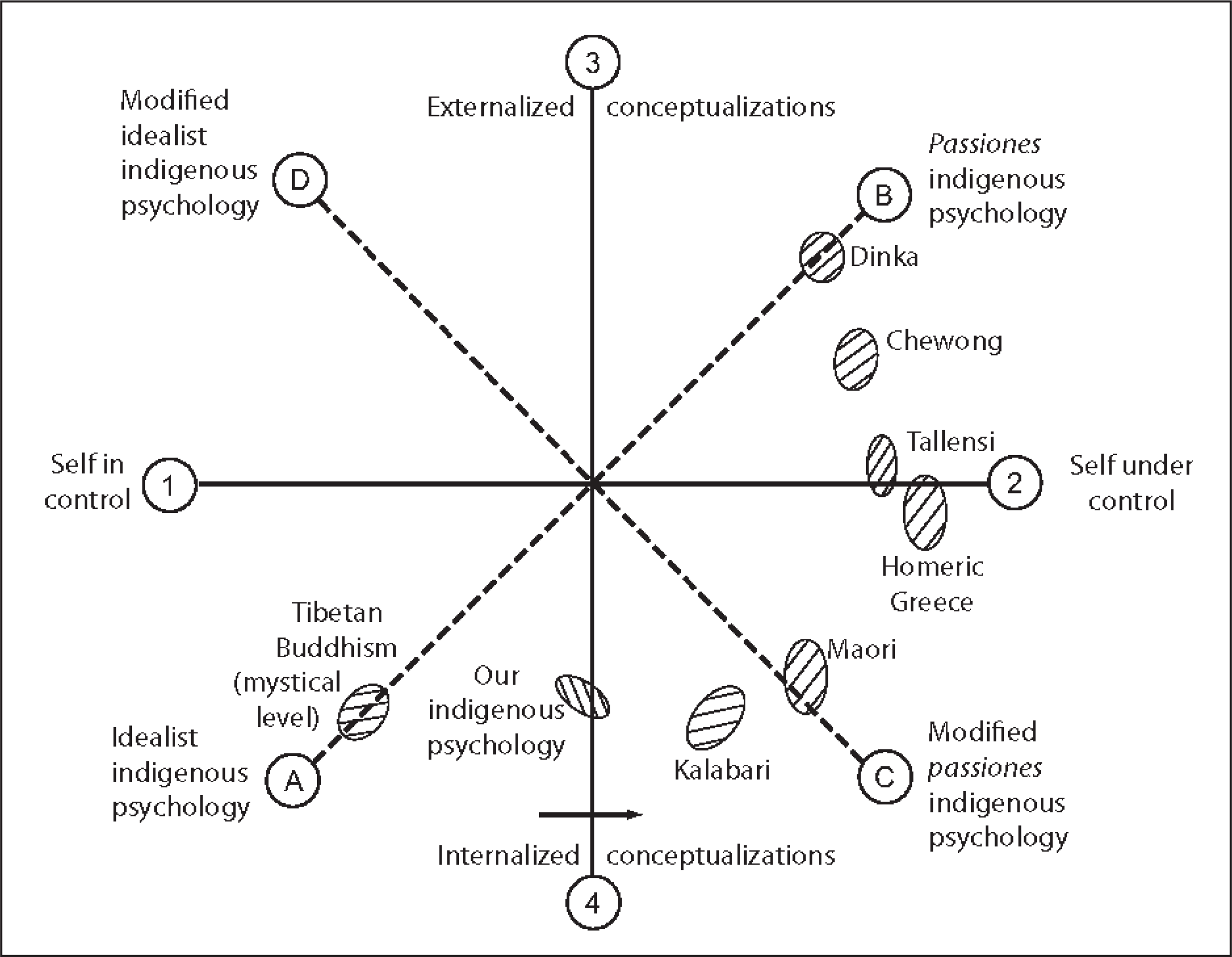
Examples of Indigenous Psychologies. From Paul Heelas and Andrew Lock (eds.), Indigenous Psychologies: The Anthropology of the Self (Language, Thought, and Culture; London: Academic Press, 1981), p. 41. Used by Permission.
Newsom argues that ‘the common Israelite conception of the self would be in quadrant A—an internalized conceptualization of the self in control’. 6 She identifies the ‘heart’ (בל) as ‘the organ that is responsible for a person's words and actions’, with the ‘spirit’ (חור) also playing an important role. 7 Within this overall framework of the self in control, Newsom identifies a ‘fundamental grammar of the moral self in the Hebrew Bible’, consisting of three elements: ‘desire, knowledge, and the discipline of submission to external authority’. 8 She explains,
The interaction of the three elements and their ratios construct a dynamic model that accounts in a flexible way for the experience of both good and bad moral decision making. The human being is in no sense ontologically defective—the capacity for moral agency is presumed—but neither is a person innately moral. Reliable moral decision making is a project accomplished between the individual and her community, as desire and knowledge are both shaped in relation to reliable external authority. 9
In the remainder of her address, Newsom examines the various conceptions of moral subjectivity in Second Temple Judaism before calling for a continued study of the conceptions of moral subjectivity in both the Hebrew Bible and Second Temple Judaism in an effort to ‘come as close as possible to recovering the subjective experience of selfhood in Jewish antiquity’. 10 The essays collected here respond to that call.
Footnotes
1.
Carol A. Newsom, ‘Models of the Moral Self: Hebrew Bible and Second Temple Judaism’, JBL 131 (2012), pp. 5–25.
2.
Newsom, ‘Models’, p. 25.
3.
Paul Heelas and Andrew Lock (eds.), Indigenous Psychologies: The Anthropology of the Self (Language, Thought, and Culture; London: Academic Press, 1981).
4.
Newsom, ‘Models’, pp. 7–8.
5.
Newsom, ‘Models’, p. 10.
6.
Newsom, ‘Models’, p. 10.
7.
Newsom, ‘Models’, pp. 10–11.
8.
Newsom, ‘Models’, p. 12.
9.
Newsom, ‘Models’, p. 13.
10.
Newsom, ‘Models’, p. 25.