






Abstract
The copying of a manuscript involves a number of complex cognitive processes that are important for understanding the nature of ancient textual transmission. Although the cognitive sciences have been productively applied to a number of other areas in biblical and classical studies, this cognitive dimension of copying has received almost no attention in textual scholarship of the Hebrew Bible. This article provides an example of how basic concepts from the cognitive sciences can be applied to aspects of ancient textual transmission. Using a well-known variant in Exod. 22.4 as an example, it explores the implications that cognitive psychology can have for understanding the copying error of haplography; it identifies two previously unknown constraints on this phenomenon: (1) haplography is caused by the repetition of words, not single letters; (2) haplography does not result in the loss of large portions of text.
Keywords
1. Introduction
Although textual scholarship on the Hebrew Bible has seen a number of important advances in recent decades, 1 there is a dimension of textual transmission that has been largely overlooked: the cognitive processes that are involved in copying. While some scribes may have preserved and transmitted their sacred traditions by memory, Vorlage-based copying was still a significant part of a scribe's responsibilities in the ancient world. 2 Copying, however, involves a number of cognitive processes that are important for understanding the nature of such transmission. Scribes were not automatons who mechanically recreated on a blank page what their eyes saw on their Vorlage. Copying involves a constant alternation between reading on the one hand and writing on the other, each of which demands a number of complex cognitive processes. The field of cognitive psychology has a vast history of research on each of these activities that has significant implications for understanding the nature of ancient textual transmission; there are even a number of studies that specifically examine the cognitive processes involved in the act of copying. 3 Although the cognitive sciences have been productively applied to a number of other areas in biblical and classical studies, 4 to my knowledge none of this research has been brought to bear on ancient copying, within Hebrew Bible scholarship orotherwise. 5
In this article I will provide an example of how basic concepts from cognitive psychology can be productively applied to aspects of ancient copying. Specifically, I will explore the implications these concepts have for understanding the copying error of haplography. Although these implications are relevant to any field that studies ancient manuscript transmission, I will focus on the problem of haplography in the transmission of Hebrew Bible manuscripts. First, I will provide an overview of current approaches to the phenomenon of haplography in textual studies of the Hebrew Bible. Second, I will illustrate these approaches with a much-discussed variant in Exod. 22.4. Third, some concepts from cognitive psychology that are significant for understanding haplography will be introduced. Finally, I will apply those concepts to the current understanding of haplography (using the example of Exod. 22.4); here I will identify two previously unknown constraints on haplography: (1) haplography is only caused by the repetition of words, not single letters; (2) haplography does not typically result in the loss of large portions of text.
2. The Phenomenon of Haplography
According to standard text-critical definitions, haplography (sometimes referred to as homoeoteleuton, homoeoarcton, parablepsis, or simply ‘eyeskip’) is a scribal error that occurs when a scribe's eye erroneously misses a section of text in his Vorlage that falls between repeated material and, as a result, fails to copy one of the repeated elements along with the intervening text. 6 This error, according to most text critics, can be caused by the repetition of a phrase, word, or letter. 7 It is frequently used to explain the omission of sizable chunks of text. 8
The challenge that text critics typically face when it comes to haplography is that, in many cases, a single variant that can be explained as a haplographic omission can also be explained as a secondary scribal insertion. Yet one of the most important tasks of the text critic is to distinguish between the errors that occur in the process of transmission, and the intentional and creative changes that scribes made while transmitting their sacred traditions. This distinction is particularly important in textual criticism of the Hebrew Bible since the Dead Sea Scrolls have revealed that scriptural traditions were pluriform in the Second Temple period; a single tradition (such as Jeremiah or the Torah) could exist in multiple forms. 9 In many cases, when a variant can be explained as either a secondary insertion or an accidental omission, text-critical judgments become arbitrary; conclusions can be determined according to each scholar's assumptions about the nature of scriptural transmission. When there is no clear indication one way or the other, then those who esteem the MT can argue for its priority, those who assume that the transmission of scripture was linear and textually constrained can argue for scribal error, and those who argue that scribes participated in the process of composition can argue for scribal creativity. 10
3. Exodus 22.4 as a Test-Case
This problem of deciding whether a variant should be explained as an erroneous omission or a creative addition can be demonstrated with Exod. 22.4. Here, a large plus is found in several witnesses when compared to the MT:
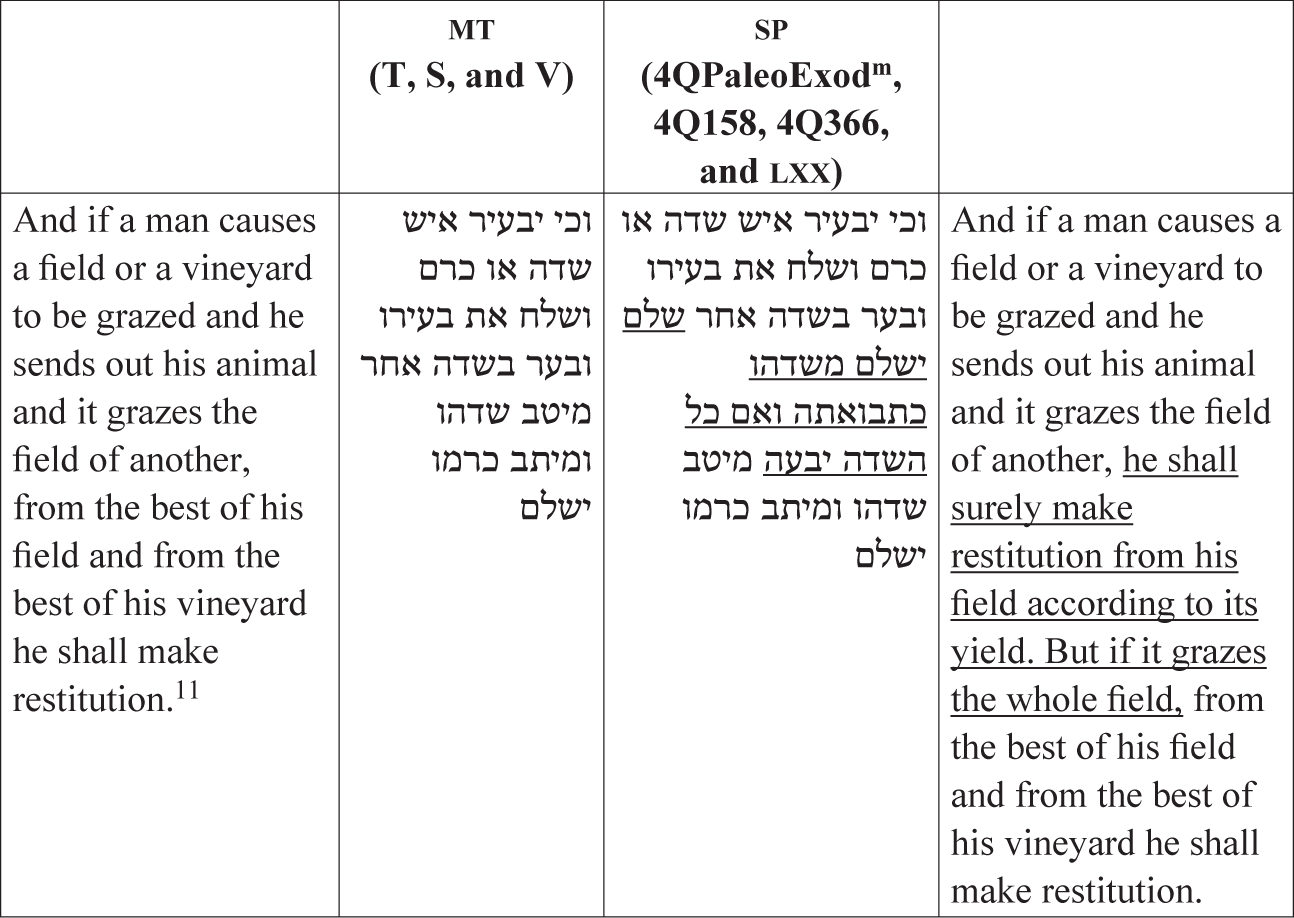
Although there are minor differences between all the witnesses, I am concerned with the large plus that is fully preserved in the SP (and generally agrees with LXX and three Qumran scrolls) when compared to the MT (which agrees with T, S, and V). For present purposes it will suffice to focus on the difference between the MT and the SP.
Numerous scholars have argued that the MT's text was shortened due to haplography, in which case SP preserves the preferable reading. 12 According to this explanation, העבי in SP should be reconstructed to רעבי, which corresponds to the verbs in the MT; it is assumed that a later scribe corrected the unusual use of רעבי in this verse (when compared to v. 5). 13 Following this reconstruction, it is reasoned that after the scribe finished copying the ר on the word רחא, he mistakenly thought he had finished copying the ר on רעבי, which resulted in an accidental omission of the intervening material (רעבי הדשה לכ םאו התאובתכ והדשמ םלשי םלש); his eye erroneously skipped from one ר to the next. 14 Furthermore, the longer text of SP (and other witnesses) makes better sense in the mišpātîm corpus (Exod. 21.1–22.16), where the repeated term םלש in the piel stem reflects precise reciprocity between an offense and its resolution; 15 it is odd that the offender would have to repay the damage from the best of his produce, rather than a repayment that is proportionate to the loss. Thus the uncharacteristically severe punishment in the MT must have been the result of a scribal corruption.
Alternatively, other scholars have explained this variant as a creative scribal insertion, in which case the MT preserves the earlier reading. 16 According to this explanation, since the severity of the MT's text is uncharacteristically harsh, it ought to be considered the lectio difficilior. A later scribe found a creative solution to correct the harsh punishment in his Vorlage, whereby the offender's penalty was proportional to the loss. The requirement to repay from the best of his field would only apply under a specific offense, namely if his animal destroyed the entire crop. Thus the same evidence (the uncharacteristically severe punishment in the MT) is used for opposite conclusions (priority of the MT or priority of the SP). It is further noted, however, that the plus of SP only mentions damage to a field, while the beginning and end of the verse mention both the field and the vineyard. This discrepancy may indicate that the plus in SP is secondary. Additionally, Teeter has recently noted that the plus in SP is composed of phrases and lexemes from other Pentateuchal laws, which to him suggests that a later scribe added the material found in the SP according to a process of ‘inner-scriptural textual hermeneutics’. 17
The issue I want to highlight is the fact that, in the end, adjudication of this variant, like so many others, is—at least to some degree—arbitrary. According to the standard account of haplography, the scribe's eye may very well have skipped from one ר to the next. The fact that the plus in the SP brings the law of v. 4 into legal agreement with the law of v. 5 does not indicate one way or the other as to its priority. It may have been legally consistent with v. 5 from the very beginning and later corrupted; by the same token, however, the legal inconsistency may have been creatively corrected by a later scribe. Similarly, although the SP's plus does not mention the vineyard, the mišpātîm corpus (Exod. 21.1–22.16) as a whole varies in its use of specific terms (like the goring ox of 21.28–32), lists of terms (like the list of body parts in the lex talionis of 21.23–25), and general all-encompassing terms (like ‘any lost thing’ in 22.8). 18 The absence of the specific term ‘vineyard’ in the SP's plus may or may not be original; the vineyard is certainly implied either way. Furthermore, the fact that the SP's plus is composed of lexemes from other scriptural laws says nothing about whether it was original or secondary—the MT's version of the law is also composed of lexemes that can be found in other mišpātîm laws; repetition of terms and reuse of tropes is simply part of scribalism, whether they are composed by a single hand or by successive scribes.
This variant is but one of countless others where scribal error and scribal creativity have vied as equally plausible explanations. To name a few others that have drawn attention, haplography or scribal creativity have competed as explanations for the plus in Isa. 40.7–8 that is found in LXX and (supra-linearly in) 1QIsa,
19
the plus of Lev. 15.3 that is found in 11QPaleoLeva and
In what follows, I will suggest that an answer can be found in the cognitive sciences. When the cognitive processes involved in copying are identified, it becomes apparent that haplography should be eliminated from consideration in many variants.
4. Cognitive Psychology and Copying
In order properly to identify the cognitive processes involved in the copying process, the various activities involved in Vorlage-based copying must be identified.
a. A Breakdown of the Copying Process
There are six steps involved in the copying process, which are repeated until the entire Vorlage is reproduced. These are easily identifiable once one observes two facts: (1) copying involves constant alternation between reading and writing; (2) human eyes cannot simultaneously focus on two spatially distinct objects. When these facts are recognized, then the six steps can be properly identified.
Scribes had to:
Identify the appropriate place on their Vorlage (where they last left off).
Select the next unit of text to be transferred to the new copy (a ‘transfer unit’). 23
Hold that unit of text to their short-term memory.
Turn their eyes from the Vorlage to the new copy while retaining the memory of that transfer unit.
Convert the transfer unit from memory to writing on the new copy.
Turn their eyes back to the Vorlage while still retaining the memory of that text unit. 24
Repeat (locate that transfer unit on the Vorlage—the place they left off).
Although scholars from other fields have identified some of these steps (they have received little attention in Hebrew Bible scholarship), they are essential to all manner of Vorlage-based copying (i.e. they do not apply to dictation-based copying). 25
Once these steps are recognized, the cognitive dimension to copying becomes apparent. A number of questions can be raised. For example, in step 2, how did scribes select and process transfer units on their Vorlage? Was it just lines and squiggles, clusters of letters or whole words and/or phrases? Similarly, steps 3–6 require the use of short-term memory, which also raises a set of questions: What are the constraints on short-term memory? How much text could a scribe store in his memory and for how long? 26 Steps 1 and 6 also raise questions concerning how a scribe would find the place where he left off when his eye would return to his Vorlage. I submit that some basic concepts from cognitive psychology can help answer these important questions, particularly those related to word recognition and short-term memory.
b. Concepts from Cognitive Psychology
In order to shed light on the nature of copying, particularly as it relates to the problem of haplography, there are two concepts from the field of cognitive psychology that are particularly helpful: (1) word recognition, and (2) working memory.
(1) Word Recognition
Word recognition is an important, complex, and much-discussed issue in cognitive psychology. 27 Research began in 1886, when James McKeen performed a series of tests in which he recorded the time it took for subjects to recognize various objects. One of the most significant findings was that the time it took for them to recognize words was no greater than the time it took to recognize individual letters. 28 This observation led to what is known as the whole-word theory, according to which the basic unit of perception in the task of reading is the word, not the letter. 29 While this theory went unchallenged for several decades, it has since been disproved; there has been a recognition that individual letters are, in fact, an integral part of word recognition. 30 The letters, however, are all processed simultaneously and in parallel. 31 While all of the cognitive processes involved in recognizing letters and words are extremely complex, and are the subject of much research, they need not be explored here. 32 One generally agreed upon (and fairly intuitive) point is important for present purposes: 33 word recognition does not occur with the sequential recognition of each letter; all letters are processed simultaneously.
(2) Working Memory
The second concept from the field of cognitive psychology is working memory (also known as short-term memory). While early memory research assumed that short-term memory was simply a passive storehouse of information, a major innovation came in 1974, when Alan D. Baddeley and Graham Hitch suggested that short-term memory was dynamically involved in basic cognitive processing. 34 For example, they suggested that the same cognitive processes involved in reading are directly connected with the short-term retention of that which is read; in other words, short-term memory is an essential part of the cognitive processes involved in reading in the first place; hence the term ‘working memory’. The working memory model has proven to be the best means of understanding how short-term memory functions. 35
While a full explanation of working memory goes well beyond the scope of the present study, a brief description of two of its most important components is helpful. These are: (1) the phonological loop; (2) the visuospatial sketchpad.
First, the phonological loop has to do with the manner in which the brain processes verbal information, such as words on a page. When one reads, the brain encodes the phonemes of each word, and then repeats them internally through an ‘inner-speech’ rehearsal loop that can be accessed and manipulated for specific goals (such as higher order thinking, problem solving, or, in a manuscript culture, copying). The phonological loop is defined in A Dictionary of Psychology as:
A subsystem of working memory that functions as a buffer store, holding information with the help of inner speech, as when a person mentally rehearses a telephone number over and over while searching for a pen and paper to write it down. It contains two components, a short-term phonological buffer store, holding phonologically coded information for very short periods only, and a subvocal rehearsal loop that maintains information by repeating it mentally from time to time. 36
According to the working memory model, this internal rehearsal is an essential part of the cognitive processes involved in reading; it continues until the next bit of information is encoded (i.e. the next group of words are read, heard, or copied), and the process repeats. 37
In contrast to the phonological loop, the visuospatial sketchpad has to do with the processing of non-verbal information; this includes both visual and spatial information. 38 Visual information has to do with the memory of objects that are seen (such as their shape, texture, color etc.). When it comes to physical handwritten manuscripts, such visual information might include the shape of a word (such as small, crammed, or messy handwriting), as well as any distinct markings on the scroll (such as lacunae, tears, scuffs, smears etc.).
Spatial information, on the other hand, has to do with where an object is perceived in space. The short-term retention of spatial information is essential to copying since it has to do with the memory of where an object (like a word on a scroll) is perceived in space. Its relevance is easily illustrated by an experiment performed on monkeys. When a monkey is briefly shown an object on a grid, such as the one shown below, it can later point to where that object appeared on a blank grid.
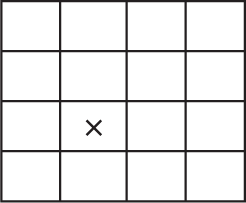
Thus the monkey is able to retain the spatial location of that object for a short period of time (just as humans can). 39 While there is a vast body of research that investigates the nature of spatial working memory, only one universally agreed upon point is important for the present study: when an object is perceived in space, whether letters on a page or a UFO in the sky, the brain retains the memory of its spatial location for short periods of time. 40
5. Putting It All Together: Word Recognition, Working Memory, and Haplography
Having explored these two concepts from the cognitive sciences, a more complete picture of the copying process can be drawn. First, in step 2, when the scribe selects his transfer unit from his Vorlage, he reads words, not just letters or letter clusters. While there is no way of knowing exactly how many words a transfer unit may consist of, it is, at a minimum, a whole word. 41 Then, throughout steps 3–6 he retains that text with the internal rehearsal mechanism of his phonological loop, when he alternates his field of vision from the Vorlage to the new copy, writes the transfer unit on the new text, and turns his attention back to the Vorlage. The information stored during that period (the transfer unit) is accessed for two purposes in the copying process: (1) to commit the transfer unit to writing on the new copy—step 5; (2) to locate the place on his Vorlage where he left off—step 1/7—so he can find the next unit of transfer for copying.
While a host of additional questions can be raised, this picture of the copying process has profound implications for haplography. Two conclusions can be made: (1) haplography does not occur with the repetition of individual letters; (2) haplography does not typically result in the loss of large chunks of text.
a. Word Recognition, the Phonological Loop, and Single Letter Haplography
As was noted above, those who argue that the MT of Exod. 22.4 was shortened due to haplography argue that the scribe's eye skipped from the ר on the word רחא to the ר on רעבי, and thus failed to copy the intervening material. From the perspective of the cognitive sciences, however, this explanation must be rejected. First of all (before even drawing from cognitive psychology), the mechanics of copying precludes the possibility for a scribe's eye simply to ‘skip over’ text on his Vorlage; the scribe's eyes are constantly moving back and forth between the Vorlage and the new copy. Were haplography to occur, it would happen in step 6 of the copying process; that is, after/while copying down a transfer unit, haplography occurs when the scribe's eye returns to the wrong place on his Vorlage and continues copying from there.
Were haplography to occur in Exod. 22.4, then the scribe's eye would return to the wrong ר on the Vorlage (not simply skip from one to the next). That scenario, however, is impossible given the nature of word recognition and the phonological loop. When a scribe selects a transfer unit from his Vorlage, the basic unit of perception is a word, not individual letters. When a word is read, the letters are all simultaneously processed in parallel; reading a word does not occur by serially sounding out each letter (that only happens when one learns to read). Once a unit of transfer is selected it is stored for quick recall by the phonological loop; its phonemes are repeated internally (or possibly out loud) 42 while the scribe turns his field of vision to the new copy and commits the unit to writing. Then, while the unit is still being repeated within the phonological loop, the scribe would turn his gaze back to the Vorlage to locate that same unit, the place where he left off. The important point is that when the scribe looks for that text, he is not looking for individual letters; he is looking for the word(s). Thus it is simply not possible for a scribe to finish copying the ר on רעבי, and then turn back to the ר on רחא in his Vorlage; the eye would not return to a single letter. 43
It might be suggested that the scribe's eye could return to a single letter if he was not fluent in Hebrew, since word recognition in language learners involves the serial processing of each letter. 44 However, the phonological loop rehearses (at a minimum) syllabic phonemes, not individual letters. Thus, when a language learner copies text, the unit of perception is, at a minimum, the syllable, not the letter. This is demonstrated by a study in which children of various ages were asked to copy text; it was discovered that the younger children tended to alternate their field of vision between their Vorlage and their copy at syllable divisions, not at individual letters. Older children who had more advanced literacy skills, on the other hand, only alternated their field of vision between words. 45 Thus even if the scribe was not fluent in Hebrew, his field of vision would not have returned to a single letter; he would at least look for a syllabic unit in step 6 of the copying process. It can therefore be concluded that haplography does not occur on account of the repetition of single letters; it typically occurs with the repetition of whole words. In rare cases it may happen with repeated syllabic units; but such a scenario would be difficult to identify positively, since it involves an unknowable (and unlikely) assumption about a well-trained scribe's linguistic competence.
The significance of this observation can hardly be overstated, since it precludes countless text-critical explanations that have been made in the past involving the repetition of single letters. Obviously these cannot be catalogued here. Some comment on haplography in Jeremiah is worth mentioning, however. Jack Lundbom has recently argued that LXX Jeremiah is significantly shorter than the MT because its Hebrew Vorlage suffered from extensive haplographic errors (favoring the priority of the MT); he argues that haplography can account for the loss of 1715 words of the approximated 2700 word-shortage in the Hebrew Vorlage of the LXX (when compared to the MT). 46 He identified a total of 330 instances of haplography. 47 Of those 330 cases, however, only 63 involve whole word repetition. Thus Lundbom's case for the priority of the MT is seriously called into question; most of his cases of haplography involve the repetition of individual letters, which is not possible given the nature of word recognition and the phonological loop.
b. The Visuospatial Sketchpad and Large Haplographic Loss
In addition to the phonological loop and word recognition, the visuospatial sketchpad has significant implications for understanding haplography. Once a scribe selects his transfer unit (step 2 of the copying process), his spatial working memory will retain the location of that unit on his Vorlage. In steps 6 and 7 (and 1) of the copying processes, when, after copying a transfer unit, the scribe's eye returns to his Vorlage to find the place on the page where he left off, he would have a fairly good idea of where to look (assuming they did not use their finger to hold their place, in which case haplography would be very rare). This observation is somewhat intuitive; if the scribe does not retain the location of his transfer unit, then he would have to reread the entire column on his Vorlage each time his eyes return to the page until he finds the place where he left off, a rather implausible scenario. The scribe would also look for any non-verbal visual information he might retain from his Vorlage (distinct handwriting or markings on the scroll). Thus, when the scribe's eyes would return to his Vorlage, they would return to an area of the page that is in close proximity to the location from which his eyes first departed. Within that small area the scribe would search for the transfer unit that was just copied, which is accessed via his phonological rehearsal loop. This search would be aided by any non-verbal information pertaining to his transfer unit.
The implication of the visuospatial sketchpad for the process of copying is that it makes the omission of any substantial amount of text rather implausible. In the case of Exod. 22.4, the plus in SP is eight words (or 32 letters plus spaces). Supposing that the scribe's eye did return to the wrong ר—which, cognitively speaking, is virtually impossible—then such an explanation would also imply that the scribe's eye returned to a substantially different location on his Vorlage than where he left off. Such a scenario does not seem plausible given what is known about spatial working memory. Rather, haplography should primarily be considered for small variants, like the loss of one or two words, such that a scribe's eye would return to a relatively similar spatial location on his Vorlage from where he left off.
The only way a scribe might miss a chunk of text the size of the plus in SP Exod. 22.4 would be if the column from the scribe's Vorlage had a very specific alignment. This can be demonstrated with a variant found in Lev. 15.3, where a large plus is found in SP, 11QPaleoLeva, and the LXX.
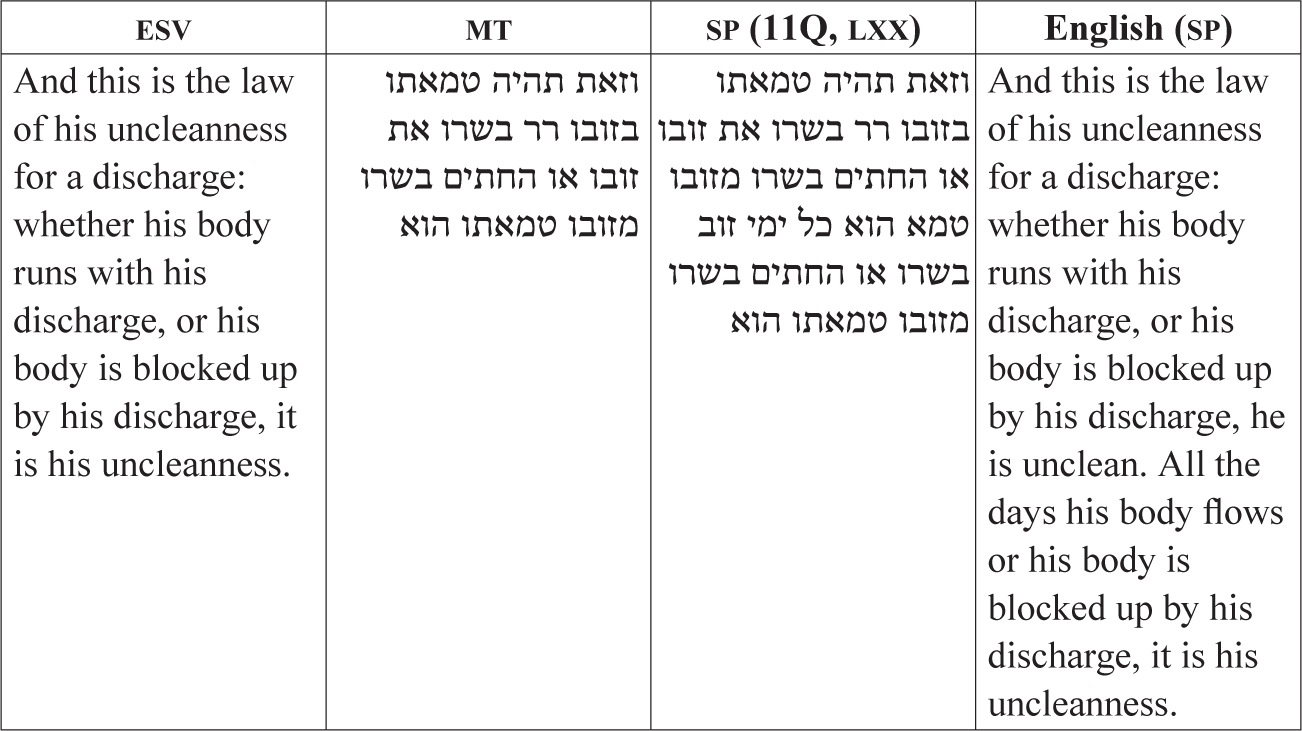
In this variant the repeated text (the supposed trigger for haplography) is four words rather than a single letter (ובוזמ ורשב םיתחה וא). Given the nature of spatial working memory, haplography is only plausible if the repeated material in MT's Vorlage is aligned vertically.
Consider the following two possibilities for how the column on the MT's Vorlage may have been arranged (the repeated material is underlined):
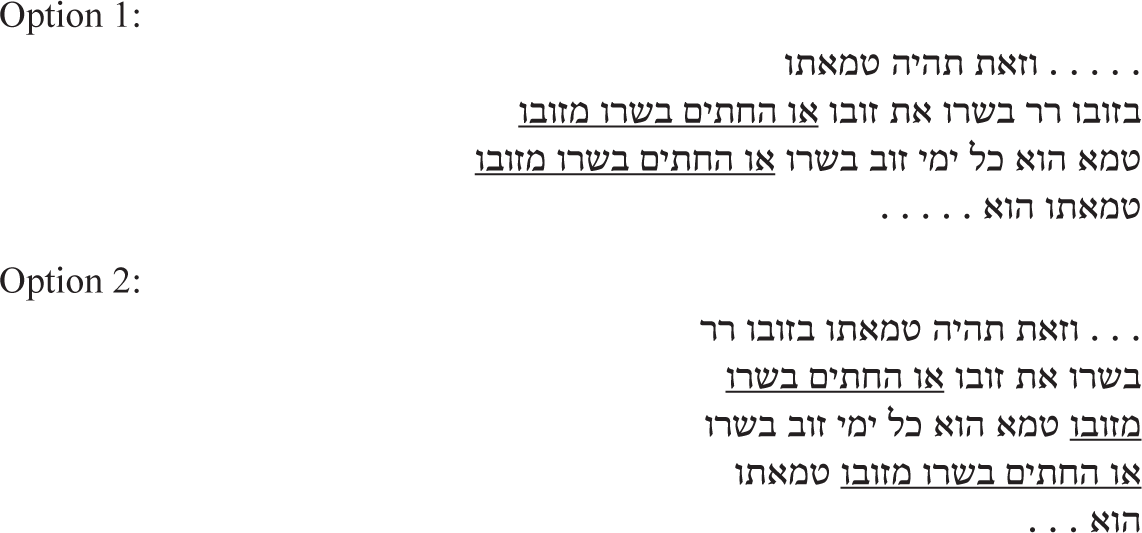
Haplography is only plausible with the first option. After the scribe had finished writing the first occurrence of ובוזמ ורשב םיתחה וא (which he would have mentally retained with his phonological rehearsal loop), he would have turned his visual focus back to the Vorlage in search of that transfer unit (the place where he left off). On account of his spatial working memory, he would search for that unit in the same area on the Vorlage from where he left off. Thus haplography is a strong possibility in option 1; the scribe's eye could easily mistake the second occurrence of ובוזמ ורשב םיתחה וא for the first, since they are in very close proximity (to one another). This is less likely in option 2, however, where the repeated words are further apart. Of course there is a degree of variability in each scribe's visuospatial competence, and there is no way of knowing the size of the area in which each scribe would look for the place where they left off. Nevertheless, for haplography to be a plausible explanation for any variant, one must assume a very specific alignment of the Vorlage’s column. Since no two scrolls were alike, it would only be by chance that they did so align. 48
The memory of the spatial location of a transfer unit has been entirely overlooked by text critics of the Hebrew Bible. Most scholars use haplography to explain large variants among the witnesses. For example, McCarter writes, ‘Parablepsis is an especially important phenomenon … because … it frequently resulted in an extensive loss of material’. 49 Similarly, Freedman and Overton write, ‘Haplography is often much more devastating than the occasional omission of a word or two … [E]ntire paragraphs can be lost.’ 50 Lundbom even argues that a scribe's eye could skip over an entire column, which he suggests is the reason for the loss of 15 verses from Ezekiel 36 in papyrus 967. 51 When the nature of the spatial working memory is recognized, then the possibility of such large omissions becomes very improbable, since it requires a very specific alignment of a Vorlage’s column; in the case of papyrus 967, haplography is virtually impossible.
In some cases there are large variants that have strong arguments for the priority of the longer text. In those instances, I suggest that the possibility of an intentional omission should be considered, rather than haplography. Juha Pakkala has recently dedicated an entire monograph to arguing that intentional omissions were a normal part of scribal transmission.
52
For example, following Trebolle Barrera, he argues that 1 Kgs 10.23 originally included a long reference to worshipers of Y
6. Conclusion
In this article I have shown that some basic concepts from the cognitive sciences have significant implications for how scholars should understand the copying error of haplography. Two assumptions about haplography should be revised significantly (if not rejected entirely). First, haplography does not occur with the repetition of individual letters; it is only possible with the repetition of words. Second, haplography should only be considered a viable text-critical explanation for small variants; it should not be used to account for large differences among a text's witnesses.
My larger goal in this article, however, is to demonstrate the value that the cognitive sciences can have for understanding ancient textual transmission. This article has focused on its implications for the issue of haplography. However, I suggest that a more complete picture of the copying process informed by insights from cognitive psychology can help advance textual scholarship of the Hebrew Bible, as well as a host of other fields that study ancient texts.
Footnotes
1.
One major advance in textual criticism of the Hebrew Bible resulted from the discovery of the Dead Sea scrolls; they reveal that scriptural texts were pluriform in the Second Temple period and that no sharp dividing line can be drawn to distinguish between a text's composition, transmission, and interpretation. For a recent overview, see Hans Debel, ‘Rewritten Bible, Variant Literary Editions and Original Text(s): Exploring the Implications of a Pluriform Outlook on the Scriptural Tradition’, in H. von Weissenberg et al. (eds.), Changes in Scripture: Rewriting and Interpreting Authoritative Traditions in the Second Temple Period (Berlin: de Gruyter, 2011), pp. 65–91. Another innovation came from the application of insight from oral/memory studies on ancient textual transmission. David Carr has been important for this advance in the field. See David M. Carr, The Formation of the Hebrew Bible: A New Reconstruction (New York: Oxford University Press, 2011), pp. 13–36; idem, Writing on the Tablet of the Heart: Origins of Scripture and Literature (Oxford: Oxford University Press, 2005), pp. 3–14. Additionally, three new editions of the Hebrew Bible are in the works, each of which—according to their unique methodologies—will further advance the field: (1) The Hebrew University Bible Project (The Hebrew University/Magnes Press); (2) Biblia Hebraica Quinta (Eisenbrauns); (3) The Hebrew Bible: A Critical Edition (SBL).
2.
David M. Carr has convincingly argued that biblical ‘long-duration’ texts were typically memorized by scribes as part of a process of elite education/enculturation. Although these texts were often reproduced by memory, Carr recognizes that Vorlage-based copying should still account for a significant part of textual transmission. See Carr's ‘Torah on the Heart: Literary Jewish Textuality within its Ancient Near Eastern Context’, Oral Tradition 25 (2010), pp. 28–32. Aside from Carr's theory of the development of biblical literature, most scholars accept that the text of the Hebrew Bible was transmitted with Vorlage-based copying. See the discussion in Emanuel Tov, Scribal Practices and Approaches Reflected in the Texts Found in the Judean Desert (STDJ, 54; Leiden: Brill, 2004), pp. 7–28.
3.
Within the last decade, see Marie-Line Bosse et al., ‘Does Visual Attention Span Relate to Eye Movements During Reading and Copying?’, International Journal of Behavioral Development 38 (2014), pp. 81–85; Eric Lambert et al., ‘Dynamics of the Spelling Process During a Copy Task: Effects of Regularity and Frequency’, Canadian Journal of Experimental Psychology 65 (2011), pp. 141–50; Joachim Grabowski et al., ‘Second and Fourth Graders’ Copying Ability: From Graphical to Linguistic Processing’, Journal of Research in Reading 33 (2010), pp. 39–53; and Sonia Kandel and Sylviane Valdios, ‘Syllables as Functional Units in a Copying Task’, Language and Cognitive Processes 21 (2006), pp. 432–52.
4.
In classical studies, see, for example, David C. Rubin, Memory in Oral Traditions: The Cognitive Psychology of Epic, Ballads, and Counting-out Rhymes (New York: Oxford University Press, 1995); and Jocelyn Penny Small, Wax Tablets of the Mind: Cognitive Studies of Memory and Literacy in Classical Antiquity (London: Routledge, 1997). In biblical studies, see, for example, Dermot Nestor, Cognitive Perspectives on Israelite Identity (LHBOTS, 519; New York: T&T Clark International, 2010); on memory and oral transmission, see István Czachesz, ‘Rethinking Biblical Transmission: Insights from the Cognitive Neuroscience of Memory’, in István Czachesz and Risto Uro (eds.), Mind, Morality and Magic: Cognitive Science Approaches in Biblical Studies (Durham: Acumen, 2013), pp. 43–61.
5.
I distinguish between textual transmission, which refers to copying, and the more broad phenomenon of the transmission of traditions, which involves both copying and memory/oral transmission. For a recent application of the cognitive sciences to the transmission of traditions, see the collection of essays in Czachesz and Uro (eds.), Mind, Morality and Magic, particularly the section on memory and the transmission of biblical traditions (pp. 24–119). Most notably, see Czachesz, ‘Rethinking Biblical Transmission’.
6.
Haplography refers to ‘writing once’ (that which actually appears twice), parablepsis refers to that which is wrongly seen (missing the second occurrence of a repeated element), homoeoteleuton refers to the repetition of material at the end of words, and homoeoarcton refers to repetition that occurs at the beginning of words (both of which are the supposed trigger for haplographic loss). Each term describes different aspects of the same basic phenomenon. In this study I prefer the term haplography.
7.
See Emanuel Tov, Textual Criticism of the Hebrew Bible (Minneapolis: Fortress Press, 2001), pp. 237–41; and Paul D. Wegner, A Student's Guide to Textual Criticism of the Bible: Its History, Methods and Results (Downers Grove: IVP, 2006), pp. 46–47; David Noel Freedman and David Miano, ‘Is the Shorter Reading Better? Haplography in the First Book of Chronicles’, in Shalom M. Paul, Robert A. Kraft, and Lawrence H. Schiffman (eds.), Emanuel: Studies in Hebrew Bible, Septuagint, and Dead Sea Scrolls in Honor of Emanuel Tov (Boston: Brill, 2003), pp. 685–86; and P. Kyle McCarter Jr, Textual Criticism: Recovering the Text of the Hebrew Bible (Philadelphia: Fortress, 1986), pp. 38–41. See also the recent discussion in Jack R. Lundbom, Writing Up Jeremiah: The Prophet and the Book (Eugene: Wipf & Stock, 2013), pp. 1–5.
8.
See below for an example from Exod. 22.4.
9.
Thanks to the work of Eugene Ulrich, this point has been amply demonstrated and widely agreed upon. See for example the collection of essays in Peter W. Flint, Emanuel Tov, and James C. VanderKam (eds.), Studies in the Hebrew Bible, Qumran, and the Septuagint Presented to Eugene Ulrich (VTSup, 101; Leiden: Brill, 2006).
10.
Typically scholars will not admit to applying any of these assumptions to their text-critical practices. However, David Noel Freedman has explicitly stated his assumption that scribes were textually constrained and his preference to account for as many variants as possible as scribal errors. He writes, ‘Reproduction was a scribe's chief task. Sentence after sentence, page after page, book after book, manuscript after manuscript … It is sometimes forgotten that the most common causes of textual corruption are accidental, not intentional’ (David Noel Freedman and David Miano, ‘Slip of the Eye: Accidental Omission in the Masoretic Tradition’, in Glen G. Scorgie et al. [eds.], The Challenge of Bible Translation: Communicating God's Word to the World (Grand Rapids: Zondervan, 2003], pp. 273–302 [273]). See also idem, ‘Haplography in the First Book of Chronicles’, pp. 685–95; and David Noel Freedman and Shawna Dolansky Overton, ‘Omitting the Omissions: The Case for Haplography in the Transmission of the Biblical Texts’, in David M. Gunn and Paula M. McNutt (eds.), ‘Imagining’ Biblical Worlds: Studies in Spatial, Social, and Historical Constructs in Honor of James W. Flanagan (JSOTSup, 359; London: Sheffield Academic Press, 2002), pp. 99–116.
11.
All translations of the
12.
See William Henry Propp, Exodus 19–40: A New Translation with Introduction and Commentary (AB, 2A; New York: Doubleday, 1999), p. 124; Cornelis Houtman, Exodus (trans. Johan Rebel and Sierd Woudstra; 4 vols.; Historical Commentary on the Old Testament; Kampen: Kok, 1993), III, pp. 194–95; Judith E. Sanderson, An Exodus Scroll from Qumran: 4QPaleoExodm and the Samaritan Tradition (HSS, 30; Atlanta: Scholars Press, 1986), p. 76; Brevard S. Childs, The Book of Exodus: A Critical, Theological Commentary (OTL; Philadelphia: Westminster, 1974), p. 449.
13.
See Propp, Exodus 19–40, p. 124. For a full explanation of the use of העבי and רעבי in vv. 4–5, see the judicious treatment by David Andrew Teeter, Scribal Laws: Exegetical Variation in the Textual Transmission of Biblical Law in the Late Second Temple Period (FAT, 92; Tübingen: Mohr Siebeck, 2014), pp. 35–39, 44–49.
14.
See Sanderson, Exodus Scroll from Qumran, pp. 76–77.
15.
See David Daube, Studies in Biblical Law (New York: KTAV, 1969), pp. 135–44, and Jonathan Vroom, ‘Recasting Mišpātîm: Legal Innovation in Leviticus 24:10–23’, JBL 131 (2012), pp. 27–44 (39).
16.
See Anneli Aejmelaeus, ‘What Can We Know about the Hebrew Vorlage of the Septuagint?’, ZAW 99 (1987), pp. 82–83; Yair Zakovitch, ‘Ancient Variants and Interpretations of Some Laws of the Book of the Covenant as Reflected in Early Prophets’ Narratives’, Jewish Law Annual 11 (1994), pp. 57–62; and Teeter, Scribal Laws, pp. 34–58.
17.
Teeter, Scribal Laws, pp. 56–58.
18.
Numerous scholars have noted how the
19.
For an analysis, see Eugene Ulrich, ‘The Developmental Composition of the Book of Isaiah: Light from 1QIsaa on Additions in the
20.
This variant is often explained as a case of haplography. See, for example, David Noel Freedman, ‘Variant Readings in the Leviticus Scroll from Qumran Cave 11’, CBQ 36 (1974), pp. 528–29; Jacob Milgrom, Leviticus 1–16: A New Translation with Introduction and Commentary (AB, 3; New York: Doubleday, 1991), pp. 908–909; and John E. Hartley, Leviticus (WBC, 4; Dallas: Word Books, 1992), p. 203. For a recent argument for scribal creativity, see Teeter, Scribal Laws, pp. 94–99.
21.
For those who argue for haplography, see Freedman, ‘Variant Readings in the Leviticus Scroll from Qumran Cave 11’, p. 529; and John William Wevers, Notes on the Greek Text of Leviticus (SBLSCS, 44; Atlanta: Scholars, 1997), pp. 261–62. For a recent argument for scribal creativity, see Teeter, Scribal Laws, pp. 76–94.
22.
See Frank Moore Cross, ‘The Ammonite Oppression of the Tribes of Gad and Reuben: Missing Verses from 1 Samuel 11 Found in 4QSama’, in Hayim Tadmor and Moshe Weinfeld (eds.), History, Historiography, and Interpretation: Studies in Biblical and Cuneiform Literatures (Jerusalem: Magnes Press, 1983), pp. 148–58.
23.
The term ‘transfer unit’ is borrowed from M.B. Parkes, Their Hands before Our Eyes: A Closer Look at Scribes—The Lyell Lectures Delivered in the University of Oxford, 1999 (Aldershot: Ashgate, 2008), pp. 63–65.
24.
A recent study on parallel processing suggests that steps 5–6 overlap. See Lambert et al., ‘Dynamics of the Spelling Process During a Copy Task: Effects of Regularity and Frequency’.
25.
For example, in New Testament studies, Metzger and Ehrman posit four in copying operations: (1) reading a portion of the Vorlage; (2) committing it to memory; (3) dictating this out loud; (4) writing down the text. See Bruce M. Metzger and Bart D. Ehrman, The Text of the New Testament: Its Transmission, Corruption, and Restoration (New York: Oxford University Press, 2005), pp. 26–27. For Medieval texts Eugene Vinaver posits four steps for the process of copying: (1) reading the text; (2) moving the eye to the copy; (3) writing the copy; (4) moving the eye back to the text. See Eugene Vinaver, ‘Principles of Textual Emendation’, in Studies in French Language and Medieval Literature, Presented to Professor Mildred K. Pope, by Pupils, Colleagues, and Friends (Manchester: Manchester University Press, 1969), p. 354. Other scholars demonstrate an awareness of these steps, even though they do not list specific steps. See for example, Parkes, Their Hands before Our Eyes, pp. 63–69; and M.L. West, Textual Criticism and Editorial Technique Applicable to Greek and Latin Texts (Stuttgart: Teubner, 1973), pp. 21–22.
26.
Since female scribes in early Judaism were not common, throughout this article I use the male pronoun when referring to ancient scribes. See Carr, Writing on the Tablet of the Heart, pp. 11–12.
27.
For a helpful overview of the basic issues, see Manuel Carreiras et al., ‘The What, When, Where, and How of Visual Word Recognition’, Trends in Cognitive Sciences 18 (2014), pp. 90–98.
28.
James McKeen Cattell, ‘The Time it Takes to See and Name Objects’, Mind 11 (1886), pp. 63–65.
29.
For a recent summary and critique of the evidence that supports this theory, see Stanislas Dehaene, Reading in the Brain: The Science and Evolution of a Human Invention (New York: Viking, 2009), pp. 222–25.
30.
For the first set of tests that called this theory into question, see George A. Miller et al., ‘Familiarity of Letter Sequences and Tachistoscopic Identification’, Journal of General Psychology 50 (1954), pp. 129–39. For a detailed history of the early debate, see Frank R. Vellutino, ‘Theoretical Issues in the Study of Word Recognition: The Unit of Perception Controversy Reexamined’, in Sheldon Rosenberg (ed.), Handbook of Applied Psycholinguistics: Major Thrusts of Research and Theory (Hillsdale, NJ: L. Erlbaum Associates, 1982), pp. 40–79.
31.
This is generally accepted in the field. For a recent study that confirms this observation (because it actually tracked eye-movement during reading), see James Adelman et al., ‘Letters in Words Are Read Simultaneously, Not in Left-to-Right Sequence’, Psychological Science 21 (2010), pp. 1799–1801.
32.
Many tests have been performed to help understand this issue. For example, psychologists have noted that word recognition is faster when written in lowercase letters, letter recognition is faster when they occur in words and pronounceable non-words, and much slower when they occur in unpronounceable words, and letter clusters are much more difficult to remember when they do not follow regular phonological patterns (such as pernd versus jwbvliy), and the speed of word recognition of words that are misspelled varies depending on certain letter patterns. Technological advances have also helped illuminate this issue; scholars can now track eye movement when subjects are reading and have found that the eye does not track a word's letters from left-to-right (or right-to-left depending on the language), but jumps to (somewhere around) the centre of each word. There are also studies that measure brain activity during reading. Numerous models have been put forward that account for the array of evidence that these and other studies support. For a recent overview, see Dennis Norris, ‘Models of Visual Word Recognition’, Trends in Cognitive Sciences 17 (2013), pp. 517–24.
33.
The only psychologist that promoted this theory is Gough, who is often cited and rejected. See the review in Vellutino, ‘Theoretical Issues in the Study of Word Recognition: The Unit of Perception Controversy Reexamined’, pp. 51–56.
34.
Alan D. Baddeley and Graham Hitch, ‘Working Memory’, in Gordon H. Bower (ed.), The Psychology of Learning and Motivation (New York: Academic Press, 1974), pp. 47–89.
35.
For a brief history on short-term memory research and the success of the working memory model, see Edward E. Smith and Stephen Michael Kosslyn, Cognitive Psychology: Mind and Brain (Upper Saddle River, NJ: Pearson, 2007), pp. 242–50.
36.
Andrew M. Colman, ‘Phonological Loop’, in Andrew M. Colman (ed.), A Dictionary of Psychology (Oxford: Oxford University Press, 2008), p. 573.
37.
For a helpful overview of the phonological loop, see Lucy Henry, The Development of Working Memory in Children (Discoveries & Explanations in Child Development; Los Angeles: Sage, 2012), pp. 4–15.
38.
The visuospatial sketchpad is defined as ‘A sub-system of working memory that functions as a buffer store for visually coded information’, in Colman, ‘Phonological Loop’, p. 805. It is worth noting that the processing of verbal information is not entirely independent of the visuospatial sketchpad. Recent research suggests that that visual processing does play a role in reading and copying. See Bosse et al., ‘Does Visual Attention Span Relate to Eye Movements During Reading and Copying?’, pp. 81–85. Their study demonstrates that visual processing plays an important role in a copying task, which is independent of reading ability (the processing of verbal information). While these findings are worth further exploration, they are not immediately relevant to the issue of haplography, and therefore cannot be explored further here.
39.
David A. Washburn and Robert S. Astur, ‘Nonverbal Working Memory of Humans and Monkeys: Rehearsal in the Sketchpad?’, Memory and Cognition 26 (1998), pp. 277–86.
40.
For a helpful introduction to the visuospatial sketchpad, see Henry, Development of Working Memory, pp. 15–21; and Daniel Kolak, Cognitive Science: An Introduction to Mind and Brain (London: Routledge, 2006), pp. 128–29.
41.
It is probably worth exploring the manner in which a scribe's long-term memory may affect the size of his transfer units; if he knew a text very well, he may choose large transfer units, which would blend David Carr's distinction between good memory variants and visual copying errors. See Carr, Formation of the Hebrew Bible, pp. 17–18.
42.
This reflects a debate in classical studies on whether or not silent reading existed. This debate has been helpfully informed by cognitive psychology. For a recent overview, see Alessandro Vatri, ‘The Physiology of Ancient Greek Reading’, The Classical Quarterly 62 (2012), pp. 633–47.
43.
This is confirmed in a recent study on reading and copying among children, which correlated the number of gaze lifts children of various ages took during a copying task. Their reading skill was correlated with children's ability to process letters simultaneously. See Bosse et al., ‘Does Visual Attention Span Relate to Eye Movements During Reading and Copying?’, pp. 81–85.
44.
It does seem somewhat possible (though unlikely) that a scribe who copied Hebrew texts in the late Second Temple period may not have been fluent in Hebrew. For comments on the linguistic make-up of Palestine in this period, see Bernard Spolsky, ‘Triglossia and Literacy in Jewish Palestine’, International Journal for the Sociology of Language 42 (1983), pp. 95–109, esp. pp. 99–100; and idem, ‘Jewish Multilingualism in the First Century: An Essay in Historical Sociolinguistics’, in Joshua A. Fishman (ed.), Readings in the Sociology of Jewish Languages (Leiden: E.J. Brill, 1985), pp. 34–50.
45.
Kandel and Valdios, ‘Syllables as Functional Units in a Copying Task’, pp. 432–52.
46.
He argues this in several publications. See, most recently, Lundbom, Writing Up Jeremiah, pp. 24–25.
47.
These haplographies are tallied in a 14-page appendix. See Lundbom, Writing Up Jeremiah, pp. 28–42.
48.
For comments on the variability in scroll size and column length, see Emanuel Tov, ‘The Copying of a Biblical Scroll’, in Emanuel Tov (ed.), Hebrew Bible, Greek Bible and Qumran: Collected Essays (Tübingen: Mohr Siebeck, 2008), pp. 110–12.
49.
McCarter Jr, Textual Criticism, p. 40.
50.
Freedman and Overton, ‘The Case for Haplography’, p. 107.
51.
See Lundbom, Writing Up Jeremiah, pp. 6–7.
52.
Juha Pakkala, God's Word Omitted: Omissions in the Transmission of the Hebrew Bible (FRLANT, 251; Göttingen: Vandenhoeck & Ruprecht, 2013).
53.
Pakkala, God's Word Omitted, pp. 234–37.
54.
A similar argument for intentional omission has also been suggested for Samuel. See the comments by Robert P. Gordon, ‘The Problem of Haplography in 1 and 2 Samuel’, in George J. Brooke and Barnabas Lindars (eds.), Septuagint, Scrolls and Cognate Writings: Papers Presented to the International Symposium on the Septuagint and its Relations to the Dead Sea Scrolls and Other Writings (Atlanta: Scholars Press, 1992), pp. 149–50, and Stephen Pisano, Additions or Omissions in the Books of Samuel: The Significant Pluses and Minuses in the Massoretic,
55.
Of course no sharp dividing line can be drawn to distinguish between large and small variants. Rather, scholars must keep the size of each variant in mind when evaluating variants.