






Abstract
Hypothesizing that Jehu was a scion of the royal family founded by Omri, as the inscriptions of Shalmaneser of Assyria suggest, this article aims at clarifying the way the ancient sources referring to Jehu's coup present the accompanying bloodshed as affecting ‘the House of Ahab’ alone. Jehu's identification as Ahab's kinsman clarifies the positions he held under the Ahabites—bodyguard and general—presupposing royal personal trust. Jehu's status as an Omride may explain his decision to leave Jezreel, the capital of the Ahabites, not to establish a new capital, but to rule from Samaria, the capital founded by Omri, who is suggested to have been their common forefather.
Introduction
Ascending the throne of the kingdom of Israel in the mid-ninth century, 1 Jehu annihilated—according to the book of Kings—'the House of Ahab’, including Joram, the king of Israel, and his kinsmen, and Jezebel, Ahab's wife, and Ahaziah, king of Judah and grandson of Ahab, as well as Ahaziah's kinsmen. It is well known that Ahab was the son of Omri, thus ‘the House of Ahab’ was the continuation of the royal dynasty founded by his father. Jehu appears in the Bible as ‘son of Jehoshaphat, son of Nimshi’, 2 and in the inscriptions of Shalmaneser III of Assyria he appears as ‘son of Omri’. 3 Taken together, this evidence suggests that Jehu was a descendant of Omri, apparently, of a family branch other than that of Ahab, and that his coup was an inner manoeuvre within the ruling family. The only difficulty left unsolved by this reconstruction is why this lineage of Jehu is not explicated in the Bible; this, however, may be solved in several satisfactory ways. 4
Nevertheless, the consensus in scholarly literature is that Jehu was not part of the royal family. Rather, the titles ‘son of Jehoshaphat, son of Nimshi’ and ‘son of Omri’ are occasionally presented as seemingly contradicting each other, 5 and what seems to be the simple reading of the sources is virtually silenced. 6 Scholars often attribute to Jehu the annihilation of the entire ‘House of Omri’, although, according to the evidence, the burden of proof should rest on those proposing this hypothesis. 7 They should explain the title ‘Jehu son of Omri’ in the inscriptions of Shalmaneser, on the one hand, 8 and the insistence of the Bible on ‘the House of Ahab’, whenever relating the victims of Jehu's coup, on the other. 9 However, these questions are often neglected by scholars, but even when they are referred to, and even when satisfactory solutions are offered for them, they do not seem more persuasive than the simple reading that does not raise the problem.
In this article I seek to revalidate the simple reading of the sources, according to which Jehu was a scion of Omri, by means of fine-tuning the considerations presented in the past and offering some new ones. I will first discuss the reports of the end of the Israelite dynasty in the Bible and in the Moabite Stone, as well as the meaning of the titles ‘Jehu son of Omri’ in the inscriptions of Shalmaneser III and ‘Jehu son of Jehoshaphat son of Nimshi’ in the Bible. Then I will examine the bearing of the evidence concerning Jehu's life before his coup, and his political decisions following it, on the question of his lineage.
The End of the House of Ahab in the Bible and the Moabite Stone
The bloody political manoeuvre of Jehu's coup is described in detail in the book of Kings in a unit that concludes the account of Ahaziah of Judah and opens that of Jehu (2 Kgs 9.1–10.28). His actions are portrayed as the execution of the divine mission Jehu received through Elisha's messenger (2 Kgs 9.1–10), repeatedly anchored in Elijah's judgment against Ahab (1 Kgs 21.19; 2 Kgs 9.26–26, 36; 10.10, 17). 1 Kings 19.15–18 relates that the bloodshed that accompanied the coup was foretold in the theophany Elijah experienced at Horeb, and, many years later, the prophet Hosea (1.4) recalled the blood shed in Jezreel, and assigned it to the house of Jehu.
Now in all the accounts of the event, as well as the prophecies foretelling it, the object of the murder is always ‘the House of Ahab’. In Elijah's prophecy to Ahab he says: ‘I will make your house like the house of Jeroboam the son of Nebat, and like the house of Baasha the son of Ahijah’ (1 Kgs 21.22; also 29), 10 while the full phrase ‘the House of Ahab’ occurs in Elisha's instruction to his servant (2 Kgs 9.7–9), in Jehu's reference to it (2 Kgs 10.10), in the account of its execution (2 Kgs 10.11), and in God's blessing of Jehu for his deeds thereafter (2 Kgs 10.30). The limitation of the liquidation to the House of Ahab alone is evidently explained by the reasoning applied to it: it was the House of Ahab that led Israel to worship the Baal and that committed the murder of Naboth; both the king and his wife Jezebel. Accordingly, the phrase ‘the House of Omri’ never occurs in the Bible.
Outside the Bible these events are reported in the Moabite Stone. 11 The wording of the Moabite report suggests that its author knew that the Israelite royal house that met its end during Mesha's reign was the House of Ahab:
Omr(5)i, the king of Israel, oppressed Moab for many days, for Chemosh was
angry with his cou(6)ntry.
Then his son succeeded him,
and he too said: ‘I will oppress Moab';
in my days he said s[o].
P) Nevertheless, I witnessed his defeat and that of his dynasty.
(The Moabite Stone, lines 4–7) 12
This passage summarizes Israelite–Moabite relations during Mesha's father's reign as well as the first part of his own, prior to Moab's release from the Israelite yoke; the latter event is described in detail later in the inscription. The grammatical subject of the first sentence is ‘Omri, the king of Israel’, while from the second sentence on, the subject is Omri's son: his son replaced him; he also planned to subjugate Moab; he planned it during Mesha's reign. In line 7, the grammatical subject changes to the first-person speaker, that is Mesha, and the two objects appear with the third person singular suffix -h, recalling the figure mentioned in the last sentence as well as the preceding two, that is, Omri's son. This suggests that Mesha witnessed the death of Ahab and the decimation of his dynasty, that is, ‘the House of Ahab’. 13 That the phrase ‘his dynasty’ (bth) relates to the dynasty to which Ahab belonged, that is, the House of Omri, is improbable. The House of Omri would have probably been named in this context as ‘the house of his father’ (bt ⁾bh), as this is the pattern used to mark when someone belongs to either family or dynasty, but the described person is not its founder. 14 The Moabite Stone is therefore an extra-biblical historical source that like the Bible calls the Israelite dynasty that came to its end during the reign of Mesha ‘the House of Ahab’. 15
‘Jehu son of Omri’ in the Inscriptions of Shalmaneser III of Assyria
While Jehu's coup and the end of the House of Ahab is not reported in the contemporary Assyrian royal documentation, it is apparently reflected in the report of a coincident change in the Israelite policy toward Assyria. Whereas Ahab, and probably his sons, contributed to the joint military force that blocked Shalmaneser Ill's southwestward campaigns toward central Syria and beyond for more than a decade, Jehu's first appearance in history was in the Assyrian report of his submission, unresistingly paying his tribute at the beginning of his reign. 16 Jehu's submission is mentioned in four royal inscriptions and in all four he is called mIa-ú-a mār (dumu) mḪu-um-ri-i, ‘Jehu son of Omri’: in three annals editions— the one that survived on paper squeezes copied from some stone object probably from Kalḫu (841 BCE or slightly thereafter); 17 the one carved on a stone tablet from the wall of the city Assur (839 BCE); 18 and the one inscribed on the statue of the king dedicated to Adad of Kurbail, and found broken in Kalḫu (839 or 838 BCE) 19 —and in the epigraph of the relief describing Jehu on the Black Obelisk (825 BCE). 20 The Akkadian meaning of the (originally Sumerian) cuneiform sign [dumu] is ‘son'— māru in Akkadian, and in the phrase ‘PN1 son of PN2’ it may relate that PN2 is the biological father of PN1, but also that PN1 belongs in either a family or a dynasty whose name is bῑt PN2, ‘the House of PN2’. Of these three options, the second one seems to suggest itself for Jehu.
In the Assyrian royal inscriptions, a ruler of a state that is referred to according to the pattern ‘the House of PN2’ often appears as ‘PN1 son of PN2’. For example, Arame son of Agūsi, mentioned in the inscriptions of Shalmaneser III, was the ruler of the land of Yaḫan, that is called also ‘the House of (A)gūsi’, 21 after (A)gūsi, its former ruler, who is mentioned in the inscriptions of Assurnaṣirpal II (883–589 BCE), father of Shalmaneser; 22 in this case, Arame was apparently also Agūsi's biological son. 23 However, Ḫayanu son of Gabbari, mentioned in Shalmaneser's inscriptions, 24 was the ruler of the land of Sam'al (y⁾dy in the local inscriptions), 25 and is called ‘son of Gabbari’, after someone who ruled his country several generations earlier. Thus, Gabbari was not Ḫayanu's biological father, but rather either the founder of the dynasty to which Ḫayanu was affiliated, or the one who ruled Sam'al when it entered the Assyrian political horizon. 26 The supposed title ‘the house of Gabbari’ is not documented, but the way in which this state is referred to in its first occurrence in the Assyrian inscriptions (Shalmaneser III's Kurkh Monolith) suggests that Gabbari is a toponym: ‘I received the tribute of Ḫayanu “son of Gabbari, that is at the foot of Mount Ḫamani'; 27 the description of the topographic location of Gabbari forces reading this phrase as a name of a state, and reading the word ‘son’ as meaning ‘king (of the house) of PN’. These two cases leave room for the hypothesis that ‘Jehu son of Omri’ in Shalmaneser's inscriptions means ‘Jehu, the king of the House of Omri’. 28 And indeed, in some later Assyrian inscriptions the kingdom of Israel is called ‘the House of Omri’. 29 Nevertheless, the feasibility of this reading does not make it the only possible one, and does not exclude the option that Jehu was a direct scion of Omri.
Another interpretative approach to understanding Jehu's title in the Assyrian inscriptions emerges from its juxtaposition with titles applied to other persons in this corpus. In the inscriptions of Shalmaneser, Haza'el, Jehu's Aramean counterpart, usually appears as ‘of Damascus’ (ša māt imērišu, lit. ‘of the land of his donkey’), 30 is once referred to as ‘son of nobody’ (mār [dumu] lā mammāna):
Hadad-ezer (Adad-idri) passed away (and) Haza'el, son of nobody, took the throne. He mustered his numerous troops (and) moved against me to wage war and battle. I fought with him (and) defeated him. I took away from him his walled camp. He fled to save his life (and) I pursued (him) as far as Damascus, his royal city. 31
The book of Kings describes both Jehu and Haza'el as ascending the throne not in accordance with the rules of legitimate succession: both served in the courts of the former kings, and, following their untimely deaths, both ascend to their thrones; and in both cases, the events are presented as a fulfillment of the prophecies of Elijah and Elisha. Now, unlike the similarity between the two figures in the book of Kings, the authors of the Assyrian royal inscriptions chose to present them in different ways: ‘son of Omri’ as opposed to ‘son of nobody’. This difference is best explained when reasonably 32 supposing that the authors of the royal inscriptions knew that Jehu was a member of the current Israelite royal family, and that Haza'el could not boast a similar Aramean genealogy. 33
Alternatively, Nadav Na'aman suggests seeing the titles ‘son of Omri’ and ‘son of nobody’ as two polar phrases designated by the Assyrian propagandists to express the attitude of the Assyrian monarch toward these two new kings: Haza'el has maintained the Damascene resistance policy toward Assyria, and, therefore, ‘won’ the negative and disrespectful title ‘son of nobody’, while Jehu has abandoned this policy replacing it with subjugation to Assyria, and was, therefore, granted the honorable title ‘son of Omri’, affiliating him to the kingdom he has started to rule. The latter is understood to be an expression of legitimation granted by the supreme political authority. 34 This interpretation may fit the current situation and, to a lesser degree, may solve the alleged contradiction between the Assyrian and biblical designations of Jehu; nevertheless, it does not accord with other uses of the title ‘son of nobody’ in the Assyrian inscriptions.
Juxtaposing the title ‘son of PN’ with the title ‘son of nobody,’ that is, the specification of a certain person (PN, that is somebody) with the absence of such a person (nobody), suggests that the point at issue is domestic lineage rather than international politics. Accordingly, Haza'el is entitled ‘son of nobody’ in the Assyrian note of his ascent to the throne presented above, but he is described as heading the Damascene armies as a (legitimate) king, and the city of Damascus is presented as ‘his royal city’. This account raises no doubts concerning his status as the head of the kingdom; rather, it concerns his lineage. 35 A similar case is found in the inscriptions of Assurnasirpal II, father of Shalmaneser:
While (i 75) I was in the land Katmuḫu this report was brought back to me: ‘The city Sūru, which belongs to BTt-Ḫalupê, has rebelled. They have killed Ḫamatāya, their governor, (and) appointed Aḫi-yababa, son of a nobody, whom they brought from the land Bīt-Adini, as their king.’ With the assistance of Aššur (and) the god Adad, the great gods who made my sovereignty supreme, I mobilized my chariotry (and) troops (and) made my way to the banks of the River Habur… (in lines 77b-79a the receiving of tributes on the road is reported) I approached the city Sūru, which belongs to Bīt-Ḫalupê. The awe of the radiance of Assur, my lord, overwhelmed them. The nobles (and) elders of the city came out to me to save their lives. They submitted to me and said: ‘As it pleases you, kill! As it pleases you, spare! As it pleases you, do what you will!’ I captured Aḫi-yababa, son of a nobody, whom they brought from the land Bīt-Adini. With my staunch heart and fierce weapons I besieged the city. All the guilty soldiers were seized and handed over to me. I sent my nobles into his palace (and) temples (lines 83b-94a enumerate the booty taken and the execution of Aḫi-yababa at Nineveh is described). 36
Like Haza'el in Shalmaneser's inscription from the city Assur, Aḫiyababa is presented in this Assurnaṣirpal inscription as ‘son of nobody’. Unlike Haza'el, however, in this case the personal background of the new king is presented as well: his origin is the kingdom of Beth Eden, and he was crowned over Bīt-Ḫalupê by the locals. This situation, encapsulated in the phrase ‘son of nobody’, did not prevent the authors from describing Aḫi-yababa as one whose rule is valid, and the royal palace and the local temples as his. The title ‘son of nobody’, thus, denotes the link between the new king and the previous local ruler, rather than the Assyrian disapproval of him.
Haza'el and Aḫi-yababa were enemies of their contemporary Assyrian king, and it is not easy to separate the hostility expressed toward them in the inscriptions and the objective note that they had no lineage. It is, however, easier to make this differentiation in the following case in which the title ‘son of nobody’ is attached in some inscriptions of Tiglath-pileser III (745–727 BCE) to a ruler that the Assyrian monarch himself is said to have placed on his throne:
[W]assurme of the land Tabal acted as if he were the equal of Assyria and he did not come before me. [I sent] a eunuch of mine, the chief [eunuch, to the land of Tabal…]. I placed [Ḫu]llî, son of nobody, on his royal throne. [I received] 10 talents of gold, 1,000 talents of silver, 2,000 horses, […(and) mules as his audience gift]. 37
The Assyrian king presents the ascent of the submissive Ḫullî to the throne, instead of the rebellious Wassurme, as a regime change in the land of Tabal that occurred on his behalf. And even though the new Tabalite king presented his tribute to the Assyrian monarch's satisfaction, he is presented as ‘son of nobody’. He has apparently gained this title only for not being affiliated to the previous royal dynasty. Thus, it seems that the title ‘son of nobody’ was designated to denote a new king that was not affiliated to the previous ruling house, expressing nothing of the attitude of the Assyrian monarch toward its bearer.
It therefore appears that it is better to suppose that the choice of the Assyrian authors to present Jehu with the title ‘son of Omri’, is based on their knowledge that he was part of the previous royal family in his land. The Assyrian evidence, then, suggests that Jehu was indeed a descendant of Omri, and that the book of Kings and the Moabite Stone are accurate in insisting that he eliminated only ‘the House of Ahab’.
Jehu's Familial Background
The little that is known of Jehu's family and career prior to his coup may also suggest his proximity to Ahab. Jehu's lineage occurs in the Bible in two forms: with the name of both father and grandfather, ‘Jehu, son of Jehoshaphat, son of Nimshi’ (2 Kgs 9.2, 14), and with the name of the grandfather alone: ‘Jehu, son of Nimshi’ (1 Kgs 19.16; 2 Kgs 9.20; 2 Chron. 22.7). Usually in the Bible the name of the father is sufficient, and only seldom is the name of the grandfather added or presented alone. Few other persons share the same pattern of double-form lineage: ‘Mephibosheth, son of Jehonathan, son of Saul’ (2 Sam. 9.6; 11.7) is presented also as ‘Mephibosheth, son of Saul’ (2 Sam. 19.25), and ‘Zachariah, son of Berechiah, son of Iddo’ (Zech. 1.1) is also referred to as ‘Zechariah, son of Iddo’ (Ezra 5.1). Different is the case of Athaliah who is once referred to by the name of her grandfather alone: ‘Athaliah, daughter of Omri, the king of Israel’ (2 Kgs 8.26), and once with the name of her father ‘as the daughter of Ahab was his wife’ (2 Kgs 8.18). 38 In light of these examples from biblical prose, it is possible to deduce that people who are referred to with a patronymic of two generations share the virtue of high lineage. 39 These parallel cases strengthen the hypothesis that Nimshi, who is always mentioned in Jehu's patronymic presentation, was a famous figure. 40
Supposing that Jehu was a descendant of Omri, it can be assumed that Nimshi (Jehu's grandfather) was a son of Omri and brother of Ahab, and that Jehoshaphat (Jehu's father) was of the generation of Ahaziah, Joram, and Athaliah (see chart). 41 This genealogy fits perfectly in the chronology of the period as well as the biographies of the people involved. According to the common chronology, Omri passed away around 871 BCE. Supposing that he lived 60 years (c. 930–871 BCE), 42 he may have fathered Nimshi at the age of 20 (c. 910 BCE), and the latter may have fathered Jehoshaphat at the age of 20 (c. 890 BCE), and the latter may have fathered Jehu at the age of 20 (c. 870 BCE). In this case, Jehu could have served as Ahab's bodyguard (2 Kgs 9.25) at the age of 18, before the death of the latter around 852 BCE. At the age of 28, Jehu could have been a general in Joram's army (2 Kgs 9.5; 842BCE). Finally, Jehu could reign over Israel for 28 years (2 Kgs 10.36), dying in the year 814 BCE at the age of 56. If Omri lived longer than 60 years, the lines may be spaced a bit, and even if he lived a bit less, this reconstruction may still be maintained. 43 If Nimshi had indeed been a son of Omri and a brother of Ahab, he would have been a known public figure in Israel, which may well explain why it was sufficient to mention his proper name alone; there would have been no need to mention any further patronymic identification. Hence, presenting Jehu as ‘son of Nimshi’ juxtaposes the two Omride branches: the winning one, to which Jehu belongs, as opposed to the rejected one, that of the descendant of Ahab.
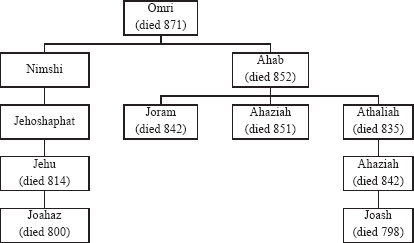
The Omride Dynasty Reconstructed
Except for the names of his father and grandfather, the Bible offers no details concerning Jehu's origins. As mentioned above, prior to his coup, Jehu apparently served in the personal guard of Ahab, as is reflected in 2 Kgs 9.25, and during the reign of the latter's son, Joram, Jehu was a (possibly high) officer in his army, as described in 2 Kgs 9.5. The offices of bodyguard and general demand the personal trust of the king, presupposing priority would be given to family members. 44 This indeed is the case in several examples from the days of David: Abner, the general of Saul, was his cousin (1 Sam. 14.50); Joab, the general of David, was the son of Zeruiah, his master's sister (2 Chron. 2.16); 45 Amasa, another general of David, was a son of another sister, Abigail (2 Chron. 2.17). 46 Admittedly, some of these examples of close familial link between the king and his general may be artificial; nevertheless, it may testify that the ancient author presupposed this link as well. It thus seems that Jehu's career allows for the supposition that he was a close kinsman of Ahab.
This, in turn, may explain why Jehu's origins are neither reported, nor hinted at, which is unlike other Israelite usurpers, 47 such as Jeroboam son of Nebat ‘the Ephrathite’ (1 Kgs 11.26), and Baasha son of Ahijah ‘of the House of Issachar’ (1 Kgs 15.27). Shallum ‘son of Jabesh’ was possibly from Jabesh of the Gilead (2 Kgs 15.10); 48 Menahem ‘son of Gadi’ may have been from the tribe of Gad (2 Kgs 15.17); 49 and Pekah son of Remaliah has a close link with the Gileadite (2 Kgs 15.25), possibly reflecting familial link with this location.
The supposed kinship of Ahab and Nimshi is possibly reflected in the epigraphic findings from ninth-century kingdom of Israel. The name nmš is found in two sites at the Beth-shean Valley: in two different layers at Tel Rehov (lnmš [layer v]; lšqy(?) nmš [layer iv]; dated to the turn of the tenth and the second quarter of the ninth century BCE, respectively), 50 and at Tel ‘Amal (lnmš; in a layer dated to the turn of the tenth century BCE). 51 And now, at Tel el-Ḥama, some 10 km to the south of Tel Rehov, a contemporary jar was found engraved with the name ⁾ḥ⁾b (Ahab). 52 Therefore, it is possible that the various branches of the royal family, the Omrides, held private estates in this region. 53 Be that as it may, it seems that the signs of kinship between Ahab and his sons, on the one hand, and Jehu, on the other, together with the absence of any information concerning the latter's origins, leave room for the supposition that Jehu was part of the royal family, and that, consequently, the biblical authors saw no need to note it.
Leaving Ahabite Jezreel and Ruling from Omride Samaria
Jehu's link with Omri may also be reflected in his choice to rule over Israel from the city of Samaria. Though the accounts of regime change and dynasty founding in Israel differ from each other, a common pattern seems to be almost imperative: the new ruler establishes his seat in a new capital. Saul, the founder of the Israelite kingship, ruled from Gibeah, his hometown, and it was named after him, Gibeah of Saul (1 Sam. 15.34). David, following his coronation over all Israel, settled at the Citadel of Zion, that became ‘the City of David’, Jerusalem (2 Sam. 5.9). Jeroboam son of Nebat built Shechem, the natural and historical capital of the northern hill-country: ‘And Jeroboam built Shechem in the hill country of Ephraim and settled therein. Then he left it and built Penu'el’ (1 Kgs 12.25); in this context ‘settled therein’, referring to Shechem rather than Penuel, may be rendered ‘ruled from it’. 54 The account of the return of Jeroboam's wife from the bleak visit to Ahijah of Shiloh suggests that Jeroboam finally settled at Tirzah (1 Kgs 14.17). After Baasha who ruled from Tirzah, which seems to have maintained the status it had gained in the late days of Jeroboam, 55 Omri, in overpowering Zimri, who had overthrown the House of Baasha, renewed the pattern: he bought ‘the mountain (to be) Samaria’ from Shemer, building on it a new capital: Samaria (1 Kgs 16.24). 56 The texts report all these moves of the royal residence and offer no reason for them, and relating them to the political needs of the new kings of no royal lineage is a speculative interpretation; it has, nevertheless, the virtue of consequential evidence.
Thus, it could have been expected, that Jehu, had he indeed founded a brand new royal dynasty, would have chosen a new political center, like the majority of his predecessors, and refrained from using the place that served the king he had overthrown. Now, Jehu did refrain from using Jezreel that had served the kings of the House of Ahab as an additional, 57 or arguably only, 58 capital city; nevertheless, Jehu did not refrain from establishing his rule at the city of Samaria (2 Kgs 10.36), built by Omri their forefather. It is thus possible that in abandoning Jezreel and establishing his capital at Samaria, Jehu sought to express his lineage as a scion of the House of Omri, and, at the same time, to repudiate the House of Ahab and all that it connoted.
The supposition that Jehu was a scion of the family of Omri thus solves the problems of the documentation of his reign, yet nonetheless it creates a new question: why is Jehu's being a descendant of Omri not explicitly mentioned? This problem is further accentuated if we consider that the biblical account of Jehu's coup was authorized by him or by his royal descendants. 59 Indeed, this was left as a riddle by the authors of the book of Kings: on the one hand, they maintained that the murdered family was ‘the House of Ahab’, while on the other they refrained from explicitly stating that his lineage was from Omri. In order to clarify the background of this position, one should consider what was gained by creating such an uncertainty. On the one hand, the authors of the book of Kings may have been interested in omitting these data. Even if they knew from their sources that Jehu was a descendant of Omri, the omission of this lineage would fit their ideological needs. An account of Israel as an unstable state, in which no dynasty held power for more than five generations, may support the effort to highlight the achievement of the Davidic dynasty, whose eternal rule is a central theme in the book of Kings. 60 It is noteworthy that this difficulty already exists in the current situation, as these authors were forced—probably by their sources—to live with an account of a divine promise to Jehu of five generations on the throne (2 Kgs 10.30; 15.12).61 Exposing the Omride lineage of Jehu would have enlarged this achievement to eight generations spanning over a century and a half. This consideration may not have qualified the continuity achieved by the House of David, but it may have reduced the counter impression of instability in the northern kingdom, nonetheless. Nevertheless, it seems that the omission of data that was found in their sources was not the way of the authors of the book of Kings, even when it makes the transmission of their message more difficult. Thus it is possible that the absence of reference to Omri is the inheritance of the source from which their information came. It is possible that the authors and transmitters of this source were interested in omitting the forefather common to both Jehuites and Ahabites. Supposing that the contemporary audience knew that Nimshi was a son of Omri, it was sufficient to relate Jehu to him, which clarified his claim to the throne, on the one hand, and emphasized the division between him and the house of Ahab instead of their kinship, on the other.
Conclusion
If we suppose that Jehu was son of Jehoshaphat, son of Nimshi, son of Omri, there appears to be no contradiction between the biblical testimony reporting he was ‘son of Jehoshaphat, son of Nimshi’, and the Assyrian testimony referring to him as ‘son of Omri’. Identifying Jehu as a scion of the royal family founded by Omri, of a branch other than that of Ahab, clarifies the way the ancient sources relating Jehu's coup—the book of Kings and the Moabite stone—present the accompanying bloodshed as affecting the House of Ahab only. From the aspect of the historical reality, Jehu's identification as Ahab's kinsman, clarifies the positions he held under Ahab and his sons—bodyguard and general, positions presupposing royal personal trust. Understanding that Jehu was one of the Omrides is in line with the pattern of change of the royal residence when a new dynasty takes the rule: Jehu decided to leave Jezreel, the capital of the Ahabites, and to rule from Samaria, the capital founded by Omri, who is suggested to have been their common forefather.
Footnotes
1.
The chronology, here and below, follows H. Tadmor, Encyclopedia Biblica, IV, pp. 245–310 (Hebrew).
2.
E.g. 2 Kgs 9.2 and see more below.
3.
See A.K. Grayson, Assyrian Rulers of the Early First Millennium BC. Part II. 858–745 BC (Royal Inscriptions of Mesopotamia—Assyrian Periods, 3; Toronto: University of Toronto Press, 1996), pp. 48, 54, 60, and see more below.
4.
See more below.
5.
E.g. ‘Such a designation [i.e. “Jehu son of Omri”—ABU] contradicts the information provided by the OT and has confounded scholars for almost a century’. See J.K. Kuan, ‘Jehu’, Eerdmans Dictionary of the Bible (Grand Rapids: Eerdmans, 2000), p. 682
6.
This reading was first suggested by T.J. Schneider, ‘Did Jehu Kill his Own Family? New Interpretation Reconciles Biblical Text with Famous Assyrian Inscription’, BAR 21 (1995), pp. 26–33; idem, ‘Rethinking Jehu’, Bib 77 (1996), pp. 100–107; and later followed by F. Capek, ‘Jehu, the King of Israel who Repaid and Paid—“Last” King of Omride Dynasty according to Neo-Assyrian, Aramaean and Biblical Historiography’, in P. Charvát and P.M. Vlčková (eds.), Who Was King? Who Was Not King? The Rulers and the Ruled in the Ancient Near East (Prague: Institute of Archaeology of the Academy of Sciences of the Czech Republic, 2010), pp. 95–112. Among the few scholars who have grappled with this suggestion, it is worth mentioning Nadav Na'aman, who rejects it leaving room for the possibility that Jehu was a remote relative of Joram: N. Na'aman, ‘Legitimizing a Loyal Vassal by his Overlord’, IEJ 48 (1998), pp. 236–38 (237). Shigeo Yamada rejects it for genealogical considerations (for which see below). See S. Yamada, The Construction of the Assyrian Empire: A Historical Study of the Inscriptions of Shalmaneser III (859–824 B.C.) Relating to his Campaigns to the West (CHANE, 3; Leiden: E.J. Brill, 2000), p. 192 n. 402.
7.
E.g. H. Reviv, From Clan to Monarchy (Jerusalem: Magnes Press, 1981), p. 196 (Hebrew); B. Oded, in I. Eph'al (ed.), The History of the Land of Israel. II. Israel and Judah in Biblical Period (Jerusalem: Yad Ben Zvi & Keter, 1984), pp. 145–46 (Hebrew); N. Na'aman, ‘The Story of Jehu's Rebellion—Hazael's Inscription and the Biblical Narrative’, IEJ 56 (2006), pp. 160–66 (164); M.A. Sweeney, First and Second Kings: A Commentary (OTL; Louisville, KY: Westminster/John Knox Press, 2007), pp. 11, 26; Finkelstein and Silberman hold the common opinion, but are rather precise in relating that ‘the liquidation of the family of Ahab’ caused ‘the Omride dynasty [to be] extinguished forever and the terrible prophecy of Elijah was fulfilled to its last word’. See I. Finkelstein and N.A. Silberman, The Bible Unearthed: Archaeology's New Vision of Ancient Israel and the Origin of its Sacred Texts (New York: Free Press, 2001), p. 175
8.
This problem is solved in one of two ways: (1) reading an Israelite king other than Jehu in the Assyrian inscriptions (e.g. P.K. McCarter, ‘Yaw Son of‘Omri: A Philological Note on Israelite Chronology’,BASOR216 [1974], pp. 5–7), and (2) the supposition that the Assyrian made a mistake (e.g. JA. Montgomery, A Critical and Exegetical Commentary on the Books of Kings [ed. H.S. Gehman; ICC; Edinburgh: T. & T. Clark, 1951], p. 284; B. Halpern, ‘Yaua, Son of Omri, Yet Again’, BASOR 265 [1987], pp. 81–85). And see more below.
9.
Tomoo Ishida, for example, states that for some reason the House of Omri was called ‘the House of Ahab’. See T. Ishida, ‘The House of Ahab’, IEJ 25 (1975), pp. 135–137; and an updated version in his History and Historical Writing in Ancient Israel: Studies in Biblical Historiography (Leiden: Brill, 1999), pp. 97–100.
10.
The House of Omri is referred to as ‘the house of your father’ in a similar context (1 Kgs 18.18), and see more below n. 14.
11.
The Aramaic inscription found at Tel Dan mentions ‘[Jeho]ram son of [Ahab]’. possibly reporting his death, constituting the end of the current Israelite dynasty; its name is, however, not mentioned. See S. Aḥituv, Echoes from the Past: Hebrew and Cognate Inscriptions from the Biblical Period (Jerusalem: Carta, 2008), p. 468.
12.
Aḥituv, Echoes from the Past, pp. 389–418
13.
Hasegawa meticulously deals with these sentences, but reads them all as if the grammatical subject is Omri. See S. Hasegawa, Aram and Israel during the Jehuite Dynasty (BZAW, 434; Berlin: de Gruyter, 2012), p. 51.
14.
The Omri dynasty is referred to in Elijah's word to Ahab as byt ⁾byk, lit. ‘the house of your father’ (1 Kgs 18.18), and the David dynasty is referred to in God's word to Ahaz in the same way (Isa. 7.13,17); Eli's dynasty (byt ⁽ly, lit. ‘the house of Eli’ [1 Sam. 3.14; 1 Kgs 2.27]) is entitled byt ⁾byw (lit. ‘the house of his father’ [1 Sam. 22.11]) of Ahimelek, and in his presence—byt ⁾byk (lit. ‘the house of your father’ [Hasegawa, Aram and Israel, p. 16]). The title byt yrb⁽m (‘the House of Jeroboam’ [Amos 7.9]) probably refers to the Israelite monarchy, either after its founder (Jeroboam son of Nebat), or after the contemporary king (Jeroboam [II] of Jehu dynasty). See M. Weiss, The Book of Amos (Jerusalem: Magnes Press, 1992), p. 233 (Hebrew), with earlier literature and different opinions. Reading the phrase as a reference to Ahab, Andrέ Lemaire states that referring to someone other than the founder of the dynasty in this phrase is ‘unusual in Semitic of this period’, which, nonetheless, accords with the biblical pattern in this specific case. See A. Lemaire, ‘The Mesha Stele and the Omri Dynasty’, in L.L. Grabbe (ed.), Ahab Agoniste: The Rise and Fall of the Omri Dynasty (ESHM, 6; LHBOTS, 421; London/New York: T&T Clark International, 2007), pp. 135–44 (138).
15.
For his own reason, the author of the Moabite inscription refrained from mentioning Ahab by name. Later in the inscription Mesha reports that Omri had conquered ‘the land of Madaba’, and that his own offspring ruled over it (lines 7–10). Here also the author refrained from mentioning the name(s) of the offspring, using the ambiguous term bnh, which may be read as either ‘his son’, or ‘his sons’. It appears that the author aimed at obfuscating the fact that Mesha won the Moabite freedom from the Israelite yoke a long while after his ascent to the throne. See N. Na'aman, ‘Royal Inscription versus Prophetic Story: Mesha's Rebellion according to Biblical and Moabite Historiography’, in Grabbe (ed.), Ahab Agoniste, pp. 145–83 (156).
16.
See, e.g., G. Galil, ‘Shalmaneser III in the West’, Revue Biblique 109 (2002), pp. 40–56 (53); N. Na'aman, ‘The Contribution of Royal Inscriptions for a Re-evaluation of the Book of Kings as a Historical Source’, JSOT 82 (1999), pp. 3–17 (7–8).
17.
A.0.102.8 11. 26“-27”; Grayson, RIMA 3, p. 48.
18.
A.0.102.10 iv 11–12; Grayson, RIMA 3, p. 54.
19.
A.0.102.12 11. 29–30; Grayson, RIMA 3, p. 60.
20.
A.0.102.88; Grayson, RIMA 3, p. 149.
21.
A.0.102.11. 94’ p. 11; Grayson, RIMA 3, p. 11.
22.
A.0.101.1 iii 77–78; A.K. Grayson, Assyrian Rulers of the Early First Millennium BC. Part I. 1114–859 BC (RIMA, 2; Toronto: Toronto University Press, 1991), p. 218.
23.
R. Mattila and K. Radner, ‘Abi-Rāmu’, in The Prosopography of the Neo-Assyrian Empire. I, Part I (Helsinki: Neo-Assyrian Text Corpus Project, 1998), pp. 12–13.
24.
A.0.102.2 ii 24; Grayson, RIMA 3, p. 18.
25.
A.0.102.1 67'; Grayson, RIMA 3, p. 10.
26.
The inscription of Kilamuwa, son of Ḫayanu (Sam'alite: Ḫy’) (KAI24; H. Donner and W. Röllig, Kanaanäisch und Aramäisch Inschriften, Band 1 [Wiesbaden: Harrassowitz, 5th edn, 1995], p. 5) suggests the following sequence of rulers: Gbr—Bmh—Ḫy'—Š1/Klmw (the last two are brothers, and the proceeding one is their father). Landsberger suggested that these five rulers represent three different royal dynasties. See B. Lansberger, Sam ‘ah Studien zur Entdeckung der Ruinenstätte Karatepe (Veröffentlichungen der Türkischen Historischen Gesellschaft—Serie, 7/16; Ankara: Türkische Historische Gesellschaft, 1948), p. 47 n. 118.
27.
A.0.102.2 ii 24; Grayson, RIMA 3, p. 18.
28.
This solution was suggested over a century ago by Ungnad and was followed by many. See A. Ungnad, ‘Jaua, mar Humri’, OLZ 9 (1906), pp. 224–26 with further examples. For other solutions suggested for the alleged contradiction between the testimony of the Assyrian royal inscriptions and that of the Bible, all of which treat the Assyrian sources, see above n. 8.
29.
It should be noted that Jehu is the only king of Israel who is titled ‘son of Omri’ in the inscriptions. Earlier, Ahab was titled ‘the Israelite’ (sir-⁾a-la-a-a; A.0.104.8 1. 12; Grayson, RIMA 3, p. 23). The following Israelite kings are usually referred to after their capital: Samaria, and it is their kingdom that is called ‘the House of Omri’. In one inscription of Adad-nīrārī III (810–783 BCE) the kingdom of Israel is called ‘the Land of Omri’ (kur Ḫu-um-ri-i; A.0.104.81. 12; Grayson, RIMA 3, p. 212), while the full version, ‘the House of Omri’, first occurs as late as the inscriptions of Tiglath-pileser III (745–727 BCE). For a collection of all of the titles of the kingdom of Israel and its rulers in the Assyrian royal inscriptions, see B.E. Kelle, ‘What's in a Name? Neo-Assyrian Designations for the Northern Kingdom and Their Implications for Israelite History and Biblical Interpretation’, JBL 121 (2002), pp. 639–66 (640); see also Schneider, ‘Rethinking Jehu’, p. 106.
30.
A.0.102.9 right side 2’ (Grayson, RIMA 3, p. 49); A.0.102.10 iii 46 (p. 54); A.0.102.12 1. 51 (p. 60); A.0.102.14 11. 97–98, 103 (p. 67); A.0.102.16 1. 155’ (p. 76); A.0.102.921. 3–4 (p. 151).
31.
On a royal statue from Assur: A.0.102.40 i 25–ii 1 (Grayson, RIMA 3, p. 118).
32.
There is no doubt about the Assyrian familiarity with the internal affairs of their subjected states. For the information-collecting network and the areas of concern of Assyrian intelligence, see P. Dubovský, Hezekiah and the Assyrian Spies: Reconstruction of the Neo-Assyrian Intelligence Services and its Significance for 2 Kings 18–19 (BibOr, 49; Rome: Pontificio Istituto biblico, 2006), as well as some of the cases discussed below. In contrast, Jonathan M. Robker finds ‘it highly improbable that Shalmaneser's scribes spent their afternoons researching genealogical graphics in an attempt to understand whether the filial relations of various Syro-Palestinian kings justified their accessions’. See J.M. Robker, The Jehu Revolution: A Royal Tradition of the Northern Kingdom and its ramifications (Berlin: de Gruyter, 2012), pp. 217–18.
33.
The question of Haza'el's origins is pivotal in the discussion concerning the identity of the author of the Aramaic inscription from Tel Dan (see above n. 11). The fact that Haza'el was not of royal origin makes it difficult to identify him with the author of the inscription, who refers to his father as the previous king of his land. For a suggestion to identify Ben-Hadad son of Haza'el with the author, which involves a rearrangement of the fragments, see Galil, ‘A Re-arrangement’. In order to maintain the attribution of the inscription to Haza'el, Na'aman supposes that Haza'el was indeed of royal origin but from an Aramean state other than Damascus. See N. Na'aman, ‘Hazael of ‘Amqi and Hadadezer of Beth-rehob’, UF 27 (1995), pp. 381–94. For the phrase ‘son of nobody’, see further I. Eph'al, ‘On the Common Literary Expressions of the Ancient Semites’, in C. Cohen, A. Hurvitz, and S.M. Paul (eds.), Sefer Moshe—The Moshe Weinfeld Jubilee Volume: Studies in the Bible and the Ancient Near East, Qumran, and Post-Biblical Judaism (Winona Lake, TN: Eisenbrauns, 2004), pp. 25–32 (27 n. 6).
34.
Cf. Na'aman, ‘Legitimizing a Loyal Vassal'; idem, ‘The Contribution of Royal Inscriptions’, p. 7–8.
35.
It is noteworthy that Aram-Damascus was called ‘the House of Haza'el’ (kurbīt Ḫaza⁾ili) in later Assyrian royal inscriptions. See RINAP 1 no. 49 rev. 3; no. 42 1. 7; no. 50 rev. 3; H. Tadmor and Sh. Yamada, The Royal Inscriptions of Tiglath-pileser III (744–727 BC) and Shalmaneser V (726–722 BC), Kings of Assyria (Royal Inscriptions of the Neo-Assyrian Periods, 1; Winona Lake, TN: Eisenbrauns, 2011), pp. 131, 105, 134. And cf. Amos 1.4.
36.
A.0.101.1 i 76–83; Grayson, RIMA 2, p. 198–99.
37.
RINAP 1 no. 47 rev. 14'–15'; no. 49 rev. 27–29; Tadmor and Yamada, RINAP 1, pp. 123, 133.
38.
M. Cogan and H. Tadmor, II Kings—A New Translation with Introduction and Commentary (AB, 11; Garden City: Doubleday, 1988), p. 99, with literature. See also, e.g., Sweeney, First and Second Kings, p. 323.
39.
See, e.g., the instances from the book of Kings: (1) Kings: Ben-Hadad, son of Tabrimmon, son of Hezion, king of Aram who rules at Damascus (1 Kgs 15.18); Joash, son of Joahaz, son of Jehu (2 Kgs 14.8); Amaziah, king of Judah, son of Joash, son of Ahaziah (2 Kgs 14.13); (2) Non-royal figures: Shaphan, son of Azaliahu, son of Meshullam, the treasurer (2 Kgs 22.3); Shallum, son of Tiqwa, son of Harhas (the husband of Huldah the prophetess; 2 Kgs 22.14); Gedaliahu, son of Ahiqam, son of Shaphan (2 Kgs 25.22); Ishmael, son of Netaniah, son of Elishama’ who was of royal seed (2 Kgs 25.25).
40.
In order to explain Jehu's double genealogy, Tadmor suggested seeing Nimshi as a family name. However, this family is not documented otherwise. See H. Tadmor, ‘Jehu, son of Jehoshaphat son of Nimshi’, in Encyclopedia Biblica, III, p. 437 (Hebrew). Ehrlich suggested that the name of the grandfather was added in order to prevent confusion between Jehoshaphat father of Jehu, and Jehoshaphat father of Joram king of Judah. However, this may explain the two-generation genealogy, but not the one that mentions only the grandfather. See A.B. Ehrlich, Randglossen zur hebräischen Bibel: Textkritisches, sprachliches und Sachliches. VII Hohes Lied, Ruth, Klagelieder, Koheleth, Esther, Daniel, Esra, Nehemia, Könige, Chronik Nachträge und Gesamtregister (Leipzig: Hinrichs, 1914), p. 298.
41.
Cf. Schneider, ‘Did Jehu Kill?’, p. 33; Jehu ‘Rethinking Jehu’, p. 101. Interestingly, this reconstruction of the Omri family and its branches exhibits some uniformity in naming style. All of the members of the third generation bore names with the theophoric element y(h)w—Joram, Ahaziah, and Athaliah, the sons and daughter of Ahab, along with Jehoshaphat son of Nimshi—while the members of the earlier generations—Omri, Ahab, and Nimshi—are of other naming patterns. It may possibly reflect the religious tendencies of the second generation of this family, correcting the initial negative impression about those of Ahab as portrayed in the biblical stories, and further emphasizing Jezebel's part in introducing and sponsoring Baal worship. See, e.g., J. Gutman, ‘Ahab son of Omri’, in Encyclopedia Biblica, I, p. 199 (Hebrew).
42.
This assumption is based on the average life expectancy of the kings of Judah who enjoyed a natural death, concerning whom the book of Kings provides us with such information.
43.
Cf. Yamada at n. 6 above.
44.
Cf. Schneider, ‘Did Jehu Kill?’, pp. 33–34; idem, ‘Rethinking Jehu’, pp. 101–102.
45.
Yeivin suggested that Joab was named ‘after his mother, as this is what links him to David’. S. Yeivin, ‘Clerical’, in Encyclopedia Biblica, VI, pp. 540–75 (559) (Hebrew).
46.
The symmetry of this genealogy in Chronicles is suspicious. The Masoretic version of 2 Sam. 17.25 suggests that Abigail and Zeruiah were the daughters of Nahash, while the Septuagint has Jesse instead of Nahash, which seems to be harmonistic as well.
47.
For the suggestion that the form Nimshi is the result of a transmission accident, or phonetic metathesis of the tribal name Menashe (in accord with Rashi for Gen. 68.9), see Y. Baruchi, ‘Reconstruction of the Chronicle used by the Author of the Book of Kings in Light of Mesopotamian Chronicles’ (unpublished MA thesis; Ramat-Gan, Bar-Ilan University, 2006), p. 32 n. 132 (Hebrew). This is unnecessary as names from the root nmš were rather common in the area, and beyond the inheritance of this tribe as well. The form nmš occurs, for example, as a first name on the seals of two different people, which are probably from the kingdom of Judah (lnmš bn mkyhw; lnmš bn nryhw). See N. Avigad, Corpus of West Semitic Stamp Seals (rev. and completed by B. Sass; Jerusalem: The Israel Academy of Sciences and Humanities, 1997), no. 266, no. 574.
48.
‘2. Shallum’, in Encyclopedia Biblica, VII, p. 684 (Hebrew).
49.
J. Liver, ‘Menahem’, in Encyclopedia Biblica, V, p. 31 (Hebrew).
50.
S. Aḥituv and A. Mazar, ‘The Inscriptions from Tel Rehov and their Contribution to the Study of Script and Writing during Iron Age IIA’, in E. Eshel and Y. Levine (eds.), ‘See, I Will Bring a Scroll Recounting What Befell Me’ (Ps 40:8): Epigraphy and Daily Life from the Bible to the Talmud Dedicated to the Memory of Professor Hanan Eshel (Journal of Ancient Judaism Supplements, 12; Göttingen: Vandenhoeck & Ruprecht, 2014), pp. 39–68, with literature.
51.
S. Levy and G. Edelstein, ‘Cinq Annέes de Fouilles à Tel ‘Amal (Nir David)’, RB 79 (1972), pp. 325–67 (336).
52.
Mazar and Aḥituv, ‘The Inscriptions from Tel Rehov’, p. 57.
53.
Note, that at Tel ‘Amal ajar was found bearing the broken inscription l'h[] (Levy and Edelstein, ‘Tel ‘Amal’, p. 341), which, according to the interpretation offered here, may be restored: l⁾ḥ[⁾b], ‘belonging to Ahab’. Note also that Nimshi and his family possibly held estates also in the Samaria hill-country, as emerges from the occurrence of this name in Samaria Ostracon no. 56. For nmš in proper names from northern Samaria during either the tenth or ninth century BCE, see A. Lemaire, ‘A propos “une inscription de Tel ‘Amal”’, RB 80 (1973), p. 559. For different interpretation of the distribution of these inscriptions, see N. Na'aman, ‘Naboth's Vineyard and the Foundation of Jezreel’, JSOT 33 (2006), pp. 197–218 (213). Note, however, that proper names with the element nmš also occur outside of the territory of the kingdom of Israel; for Judah see above, n. 47; for Ugarit, see C.H. Gordon, Ugaritic Textbook (AnOr, 38; Rome: Pontifical Biblical Institute, 1965), p. 444 n. 1653.
54.
M. Cogan, I Kings—A New Translation with Introduction and Commentary (AB, 10; New York: Doubleday, 2004), p. 357.
55.
For the possibility of attributing to Baasha, Tirzah's elevation to the status of Israelite capital, see J. Gray, I and II Kings (OTL; Philadelphia: SCM Press, 2nd edn, 1970), p. 339; Y. Aharoni, The Land of the Bible: A Historical Geography (Philadelphia: Westminster Press, 1979), p. 327; S. Talmon, ‘The Signification of Jerusalem in Biblical Thought’, in Jerusalem in Judaism (Jerusalem: The Presidential Residence, 1997), pp. 13–39 (26) (Hebrew). This is based on the fact that Tirzah is not mentioned in the building account preserved from the days of Jeroboam I: it says that the latter ‘settled’ at Shechem—possibly meaning that he ruled from there—and then ‘left’ it, moving to Penu'el (1 Kgs 12.25). Tirzah is mentioned in the days of Jeroboam only at the end of the story of the latter's wife visiting Ahijah of Shiloh (14.17), which would then be an anachronism. See J. Robinson, The First Book of Kings (The Cambridge Bible Commentary; Cambridge: Cambridge University Press, 1972), pp. 168–69. This option lacks positive evidence, however. The story of the war between Ba'asha and Asa of Judah (15.21) says that he ‘settled’ at Tirzah, in what seems to have been a routine rather than an innovative move (the Septuagint and Vulgate even read here ‘return’, which matches the Masoretic consonantal text as well). Accordingly, the note concerning the duration of the reign of Ba'asha testifies to his dwelling at Tirzah throughout the period (15.33).
56.
For the trend of ancient Near Eastern usurpers abandoning the former capital city, see H. Tadmor, ‘Some Aspects of the History of Samaria’, in his M. Cogan (ed.), With my many chariots I have gone up the heights of mountains ‘: Historical and Literary Studies on Ancient Mesopotamia and Israel (Jerusalem: Israel Exploration Society, 2011), pp. 823–33 (823).
57.
For the various suggested functions of Jezreel in the (early) days of the Omrides, see D. Ussishkin, ‘Jezreel, Samaria and Megiddo: Royal Centres of Omri and Ahab’, in Grabbe (ed.), Ahab Agoniste, pp. 293–309 (293).
58.
Cf. B.D. Napier, ‘The Omrides of Jezreel’, VT 9 (1959), pp. 366–78. Napier suggested that Jezreel served the Omrides during the long building process of Samaria. The analysis he offers of the relevant accounts in the book of Kings, judging many of the references to Samaria in these accounts as secondary, may even suggest that, for some reasons, the Ahabites did not use Samaria at all.
59.
For the supposition that the account of Jehu's rise to power was composed by circles close to the royal family, see, e.g., M.C. White, The Elijah Legends and Jehu's Coup (BJS, 311; Atlanta, GA: Scholars Press, 1997); cf. Cogan and Tadmor, II Kings, pp. 117–19, with literature.
60.
F.M. Cross, ‘The Themes of the Book of Kings and the Structure of the Deuteronomistic History’, in Canaanite Myth and Hebrew Epic (Cambridge, MA: Harvard University Press, 1973), pp. 281–84. Review of the history of the kingdom of Judah reveals that it was in this specific period, parallel to the days of the Jehuites in the kingdom of Israel, that regicide became routine (cf. the sons of Joram [2 Kgs 11.1], Athaliah [2 Kgs 11.16], Joash [2 Kgs 12.21], and Amaziah [2 Kgs 14.19]). It is possible that in the very days of Jehu, a doubt arose concerning the continuity of the Davidic dynasty. Mario Liverani raised such a doubt concerning the real origins of Joash of Judah as the setting of what he calls his apology, that is, the story of his rescue and ascent to the throne (2 Kgs 11). See M. Liverani, ‘L'histoire de Joas’, VT 24 (1974), pp. 438–53 (442).
61.
Cogan, I Kings, pp. 97-98,