







Abstract
While ‘neoliberalization’ is increasingly used to conceptualize concrete realities of China’s economic development, it is not employed in dialectical relation with China’s prevailing developmental ideology – ‘socialism with Chinese characteristics’. This paper offers a fresh framework and research agenda from which to examine this relation. It argues that neoliberalization across China is a variegated process, formed and fractured by actually existing uneven state spatiality and the Communist Party of China’s (CPC) ostensibly contradictory historicization of a Marxian socialist end-state. How neoliberalization works simultaneously in/through multiple sites in China and consequently reproduces the CPC’s ideological legitimacy has become a theoretically significant question for research on geographical political economy.
Keywords
We must integrate the universal truth of Marxism with the concrete realities of China, blaze a path of our own and build a socialism with Chinese characteristics – that is the basic conclusion we have reached after reviewing our long history. (Deng, 1982: n.p.) [P]erhaps the most interesting aspect of neoliberalization arises out of the complex interplay of internal dynamics and external forces. (Harvey, 2005a: 177)
I Introduction
In November 2010, the United States (US) Treasury Secretary Timothy Geithner proposed to his G20 counterparts that their respective governments adopt current account deficit or surplus targets of less than 4% of GDP. This proposal drew an intriguing response from China’s Vice-Foreign Minister Cui Tiankai: ‘The artificial setting of a numerical target cannot but remind us of the days of a planned economy’ ( Bloomberg, 2010). At one level, Cui was probably offering a witty counterpoint: indeed, it was China that had operated as – and some might argue it still is – a centrally planned economy. On closer reading, however, there might be a more profound underlying meaning to Cui’s remarks that exemplifies a scalar differentiation within the Chinese state apparatus’s politico-economic ideology: freedom of financial and commodity flows across the global economy is strongly preferred, while the notion of ‘a planned economy’ at this scale – led by a hegemonic US government that heavily influences the terms of market exchange – is deemed an undesirable barrier to capital accumulation. This outlook strongly suggests China is not unlike what Harvey (2005a: 64) terms a ‘neoliberal state’, within which ‘the freedom of businesses and corporations (legally regarded as individuals) to operate within [an] institutional framework of free markets and free trade is regarded as a fundamental good’. Juxtaposed against this outlook, however, is the fact that the Communist Party of China (CPC) continues to weave socialist principles – in particular what Deng Xiaoping (1982) refers to as the ‘universal truth of Marxism’ 1 – through its domestic socioeconomic policies. This apparent contradiction raises a theoretically significant question that remains unaddressed in politico-economic studies of China: what is the function of neoliberalization in the CPC’s quest to secure ‘common affluence’ (gongtong fuyu) within/for a ‘harmonious society’ (hexie shehui)?
To address this question, it is necessary first to understand that neoliberalization in and through Chinese state space does not occur in a post-ideological vacuum. Neoliberalization, as Zhang and Ong (2008: 10) observe, has taken on the appearance of ‘an inexorable process that renders all national spaces intelligible or commensurable in accord with predetermined universal norms’. This perception of inexorability in turn engendered formalistic conceptualizations in the social sciences that ‘assess whether particular nation-states are more or less “neoliberal” in terms of a preconceived collection of attributes’, assessments that ‘tend to give short shrift to the role of situated phenomena in shaping outcomes’ (p. 10). In China, however, the increasing influence of neoliberal logics within Chinese policy-making circles is entwined with – if not subsumed under – the national strategy to actualize ‘socialism with Chinese characteristics’. For this reason, the apparent willingness of Chinese policy-makers to embrace the logic of a self-regulatory ‘free’ market at the global scale does not – or, indeed, cannot – translate into a wholesale adaptation of neoliberal logics at the national scale. Taking the constitutive role of this ‘situated phenomenon’ into account, this paper raises an equally plausible proposition: geographically variegated neoliberalization, driven and cushioned by the Chinese state, could function as the precondition of/for a historicized totality known as ‘socialism with Chinese characteristics’.
The subsequent discussion aims to achieve two interrelated objectives. First, it explains why ‘socialism with Chinese characteristics’ is not an absolute entity that can be neatly periodized and packaged into a geographically uniform ‘variety of capitalism’ (pace Hall and Soskice, 2001); neither does this ideological vision reflect, in spatial practice, received notions of the ‘capitalist developmental state’. Rather, China’s contemporary socialistic evolution is expressed through different sociospatial forms, in tandem with variegated modes of neoliberal regulation. The inclusion of neoliberal logics in politico-economic governance necessitates a recurring series of territorialized reinstitutionalization (cf. Brenner et al., 2010). This proactive reorganization of state space is aimed at directing new capital investments into poorer areas (particularly in the western interior) while sustaining, at the same time, the rates of capital accumulation in more affluent coastal city-regions. Through ameliorating the pronounced interprovincial income disparities, 2 the CPC’s primary policy intention is to obviate the emergence of sociospatial crises that may destabilize its control over the national political economy. Territorialized reinstitutionalizations thus do not simply function as economic tools that deepen the application of market logics; they are social countermovements that pre-empt revolutionary ruptures that could potentially become, in Marxian terms, new ‘locomotives’ that power historical evolution.
Second, the paper presents a fresh conceptual framework and research agenda that examines how the external pressures to reshape Chinese economic geographies paradoxically negate and fortify the CPC’s similarly paradoxical approach to create ‘Chinese characteristics’ to complement ‘the universal truth of Marxism’ (after all, if Marxian ‘truth’ is really ‘universal’, would it be necessary to place it in relation to unique characteristics?). The proposed framework and agenda explore how the selective differentiation of state spatiality in relation to actually existing sociospatial inequality – an emergent process this paper identifies as ‘decentralization as centralization’ (yidianweizhong) – works to legitimize the CPC’s grasp on politico-economic power. It does appear, indeed, that the Marxian ‘locomotives’ that power history in and through China are being geo-institutionally reconfigured to power a timeless engine – that engine is the CPC.
To foreground the theoretical significance of this reconfiguration process, this paper argues that China’s economic transformations must be conceptualized as a cross-scalar sociospatial dialectic. This dialectic is defined and expressed as the dynamic interplay of ostensibly oppositional processes, originating in and/or occurring at different geographical scales, within a spatially delimited social formation (e.g. the population living within a city-region). ‘Socialism with Chinese characteristics’, as will be argued, is a geographic tension: the permeation of (putatively) non-socialist practices (e.g. increasing privatization of production, the growing role of financialization, expanding industrialization and the concomitant proleterianization of farmers, etc.) fuse dynamically with the quest for a classless and prosperous society across Chinese state space. 3 It is this threefold placement of socialistic principles in relation to highly varied domestic sociospatial contexts; the (neoliberal) institutional guidelines of the ‘Washington Consensus’; and the profit-maximizing strategies of TNCS – now including many Chinese state-owned enterprises (SOEs) – that determines the ‘Chinese characteristics’ of what Deng conceives as the ‘universal truth of Marxism’. 4
The paper will be organized in three parts. Section II places the growing global-scale hegemony of neoliberalism in relation to China’s post-1949 politico-economic development. The sociospatial expressions that emerge from the dialectical fusion of socialistic policies with neoliberal logics in China will be presented in section III. Strategies emergent at two scales over the past decade – the delineation of three cross-provincial regional developmental programmes and six intra-urban ‘nationally strategic’ new areas – are foregrounded as theoretically significant research platforms. The section explains how these strategies are symptomatic of the sociospatial tensions that arise from earlier rounds of selective neoliberalization. The importance of examining variegated neoliberalization as a sociospatial function of ‘socialism with Chinese characteristics’ – and, more crucially, as pre-emptory geo-institutional leaps that consolidate the CPC’s state power – is re-emphasized in the conclusion.
II The (im)possibility of totalizing neoliberalization
1 Neoliberalization as neo-developmentalism?
The global system of capitalism is constituted by a cyclical process of boom (resulting in overaccumulation) and bust (resulting in massive devaluation). This tendency is intensified following the dollar’s de-link with gold in 1971, which precipitated a rapid and colossal increase in short-term global financial flows, mostly for speculative purposes rather than to fund trade and foreign direct investments (FDIs). The quest for a reduction of geographical barriers to financial flows and trade, in conjunction with what is now known as the new international division of labour (Fröbel et al., 1980), contributed to the contemporary hegemony of ‘neoliberalism’, a political-economic governance ideology that (1) entails individual states to effect market-like rule to protect private property and ownership rights regardless of citizenship, and (2) minimizes, if not eradicates, ‘price-distortions’ through the abolishment of regulations that impede market access for private individuals.
The principal and most influential proponent of neoliberal reason is arguably the late University of Chicago economist Milton Friedman (see Crouch, 2011; Klein, 2007; Peck, 2010). Once concretized as a developmental ideology, neoliberalism became an engine set off to shape economic policies. While the ideology was put into practice – with the participation of Friedman and his allied economists known as the ‘Chicago Boys’ – with mixed success in South America in the 1970s, it came to historical prominence worldwide through the policies of Margaret Thatcher (Prime Minister of the UK, 1979–1990) and those of Ronald Reagan (President of the USA, 1981–1989). Friedman advised both leaders. Interestingly, Deng Xiaoping, another of Thatcher’s contemporaries and then newly appointed leader of China, also received a crash course from Friedman in 1980, but the Deng administration opted not to go down the path of Latin American economies by selling off state-owned assets and opening up the entire national territory to the transnational flows of capital. For this reason, China’s national-scale developmental trajectory is an apposite arena from which to theorize how neoliberalism works as a flexible developmental ideology that generates geographically variegated impacts.
As is now clear, a national state apparatus, in its integrated position as the absolute sovereign power over social formations within state territory and as the driver of transnational financial flows through its independent ability to implement monetary policy, remains a central generator and mediator of neoliberalizing strategies. This point was obscured by the post-1989 euphoria in advanced capitalist economies, notably by neoliberal proponents in the Anglophone world. Writing just after the collapse of the Soviet Union and the publication of Francis Fukuyama’s (1992) highly influential ‘end of history’ thesis, Johnson (1993: 63) laments that ‘[t]he seeming victory of the state-as-referee conception has given American social science in particular an ethnocentrism and an ideological quality that seem to have erased all Western memory of the state from Plato’s Republic to Hobbes’s Leviathan’. A keen believer in how economic activities are inextricably entwined with the ‘guiding hand’ of the ‘plan rational’ state, Johnson (1982) is unconvinced that the putative ‘free market’ could self-regulate for the common good. Japan’s post-war economic development, to Johnson, was propelled by the industrial policies of what is now widely known as the ‘capitalist developmental state’.
While China’s developmental approach – particularly the enlargement of domestic spaces for market exchange after 1978 – appears similar to Johnson’s (1982) conceptual prototype, key differences are observed through two critical geographical perspectives (pace Beeson, 2009; Xia, 2000). First, at the national level, the presupposition of the ‘developmental state’ as ‘capitalist’ overlooks a crucial function of the state apparatus – its capacity to rescale capital allocation and the accumulation process to ameliorate uneven economic-geographical development. The state apparatus and its socioeconomic policies are assessed by developmental state theorists at the national level without ascertaining the redistributive intents and effects of spatial strategies implemented at the subnational scales (cf. Brenner, 2004; section III.2). National-level capital redistribution takes two forms in China: direct form, through the reallocation of fiscal revenue by the central government, and indirect form, through state spatial strategies that designate where SOEs’ capital investments and FDIs are (al)located. The second redistributive form occurs because the predetermined socialist goal of ‘Common Affluence’ impels the Chinese state to ensure capital flows and fixity are as balanced as possible across state space (more in section III).
Second, the conceptualization of developmental statism is not extended dialectically to the global scale to show how they exist in tension with other states that advocate the construction of a self-regulatory global ‘free’ market. It is not inadvertent that Japan’s economic development stagnated after a currency appreciation agreement (the Plaza Accord) was signed in September 1985. Similarly, the economy of South Korea – another state commonly held to be an exemplary developmental state – spun into crisis in 1997–1998 after its government believed transnational financial market liberalization would enhance the performance of domestic Korean firms. Over the last decade, the relevance of the developmental state concept vis-a-vis intensifying neoliberalizing processes is increasingly called into question (see, inter alia, Beeson and Islam, 2005; Glassman, 1999; Low, 2004). The rationale of this critical evaluation is clear: the ability of these economies’ ‘national champions’ (e.g. Toyota, Samsung) to shift and/or stretch production networks overseas – and hence the need for ‘free’ market access to foreign product and labour markets – has intensified global-scale neoliberalization. While this phenomenon appears at first glance to be analogous to China’s recent ‘Go Abroad’ (zouchuqu) developmental approach (to be elaborated in section III), the ideological basis is distinct in the Chinese context: China’s developmentalist orientation, bound a priori within Marxian temporal parameters and a single-party political system (see section II.2), necessitates the proactive differentiation of state involvement in economic activities at different scales (now including the global scale) to accommodate the demands of the neoliberally oriented ‘Washington Consensus’. 5 A focus on China’s state spatial strategies over the past decade, specifically how these strategies accommodate and/or reignite neoliberalizing impulses in relation to the global economy, would thereby offer a more incisive platform from which to theorize the developmentalist orientation of the CPC.
This approach begins with the presupposition that state intervention drives and cushions the global-scale neoliberalization process. If the market is self-regulatory anywhere, there should not be macroeconomic intervention at the intra- and interstate levels. As the aforementioned ‘Geithner Proposal’ indicates, neoliberalization is an impossibility without proactive state intervention. It is even plausible that states are inherently anti-market because they do not believe in self-regulating markets in the first place; what counts as ‘markets’ – and, indeed, as ‘free’ markets – to individual states is thus open to interpretation. Peck (2010) sums up this dialectic incisively: Neoliberalism … has only ever existed in ‘impure’ form, indeed can only exist in messy hybrids. Its utopian vision of a free society and free economy is ultimately unattainable. Yet the pristine clarity of its ideological apparition, the free market, coupled with the endless frustrations borne of the inevitable failure to arrive at this elusive destination, nevertheless confer a significant degree of forward momentum on the neoliberal project. Ironically, neoliberalism possesses a progressive, forward-leaning dynamic by virtue of the very unattainability of its idealized destination. (Peck, 2010: 7, emphases in original) [T]he stake of social-ideological fantasy is to construct a vision of society which does exist, a society which is not split by an antagonistic division, a society in which the relation between its parts is organic, complementary … The notion of social fantasy is therefore a necessary counterpart to the concept of antagonism: fantasy is precisely the way the antagonistic fissure is masked. In other words, fantasy is a means for an ideology to take its own failure into account in advance. (Žižek, 1989: 142, emphases in original)
The more successful the primitive accumulation process, the broader the pool of ‘industrial reserve army’. This outcome, which suppresses wages and deepens uneven development, leads Harvey (2005a: 19) to interpret neoliberalization ‘as a utopian project to realize a theoretical design for the reorganization of international capitalism or as a political project to re-establish the conditions for capital accumulation and to restore the power of economic elites’. The notion of utopianism, Harvey adds, ‘primarily worked as a system of justification and legitimation for whatever needed to be done to achieve this goal. The evidence suggests, moreover, that when neoliberal principles clash with the need to restore or sustain elite power, then the principles are either abandoned or become so twisted as to be unrecognizable’ (p. 19). Wade (2003) succinctly describes this ‘twisting’ in his critical discursive analysis of the ‘Washington Consensus’: What [it] does not include are proactive industrial policies to nurture new industries and new technologies and to diffuse innovations to established industries – that might have the unwanted consequence of raising the competitive pressure on industries in the industrialized countries. This is definitely not on today’s development agenda. Indeed, words like ‘technology’, ‘national innovation system’, ‘entrepreneurship’, ‘competitiveness’, and ‘universities’ are conspicuously missing from the thinking of development organizations like the World Bank and the bilateral donors. So too are words like ‘distribution of power’, ‘elite capture’, ‘trade unions’, and even ‘freedom of association’. The poor are to be lifted up by supplying them with missing assets and by gaining the knowledge with which to manage them better, not through their own engagement in collective action. Thus lifted up, they will be as good-natured as the sheep they tend. (Wade, 2003: xliv) other forms of economy (not to mention noneconomic aspects of social life) are often understood primarily with reference to capitalism: as being fundamentally the same as (or modeled upon) capitalism, or as being deficient or substandard imitations; as being opposite to capitalism; as being the complement of capitalism; as existing in capitalism’s space or orbit. (Gibson-Graham, 1996: 6)
Indeed, there seems to be an implicit concession in Wade’s comment that these developmental discourses have come to represent the eternal-cum-ecumenical new normal; that ‘utopianism’ is now strictly defined by neoliberal parameters. Perhaps, in the heady days of the early 1990s, neoliberal policy-makers in Washington forgot about their Beijing counterparts’ resolute resolve to contextualize the ‘universal truth of Marxism’ across (and possibly beyond) Chinese state space.
2 China after 1949: (already) living in different times
The CPC’s attempt to resolve developmental contradictions in the contemporary conjuncture foregrounds – and is arguably undergirded by – a unique interpretation of a major tenet of Marxian historical materialism, namely, how ‘modes of production’ succeed one another chronologically through social revolution. The ultimate socioeconomic end-state of Marxian historical evolution is an upper-stage ‘socialist mode of production’ – communism – ruled directly by the proletariat, with the state functioning in a faded capacity. Much has been written on this classic prediction over the last century, and the aim of this paper is not to review this extensive literature. Rather, this paper explores a dialectical phenomenon not fully addressed by received historical-materialist conceptualizations of China: it is Chinese policy-makers’ simultaneous affirmation and negation of Marxian historical materialism that drives the reinstitutionalization of state space in China.
This spatial dialectic evolved in three ways. First, former CPC Chairman Mao Zedong’s attempt to introduce ‘socialism’ to a newly unified China (which essentially was a territorial patchwork of diverse economies) in itself contradicted Marx’s formulation: it was the weak (rather than strong, as Marx determined) and geographically uneven existence of the capitalist mode of production that provided both the conditions for the successful CPC-led revolution prior to 1949 and the obstacles to fully realize, in Marxian determination, a proletarian-led socialist mode of production across the country thereafter. This led to a second contradiction: a socialist epoch first emerged before it had the opportunity to develop its existential preconditions (through the capitalist mode of production). Following an extensive review of historical resources, Li (2006: 64–65) explains how Joseph Stalin, the former leader of the Soviet Union and a fervent advocate of policy radicalism in the 1920s and 1930s, advised Chinese policy-makers in 1948 to keep the economic status quo of China unchanged should they emerge victorious in the civil war with the Nationalists. Gradualism, rather than radicalism, was the recommended developmental approach to socialist transformation. It was arguably because of Stalin’s advice – which took into account the economic-geographical foundations that the CPC inherited – that Mao (1949) initially decided to engage capitalists in his quest to build a socialist mode of production: China’s private capitalist industry, which occupies second place in her modern industry, is a force which must not be ignored. Because they have been oppressed or hemmed in by imperialism, feudalism and bureaucrat-capitalism, the national bourgeoisie of China and its representatives have often taken part in the people’s democratic revolutionary struggles or maintained a neutral stand. For this reason and because China’s economy is still backward, there will be need, for a fairly long period after the victory of the revolution, to make use of the positive qualities of urban and rural private capitalism as far as possible, in the interest of developing the national economy. (Mao, 1949: n.p.)
For this reason, the declaration of a socialist epoch in China became at once a social totality and a spatial process. The political act of Marxian temporal framing produced its own socioeconomic necessity and geographical contingency: to be in and of a socialist epoch, it would be necessary to launch socioeconomic policies that were aligned to Marxist-Leninist principles, but this alignment was (and still is) a contingent process – its success depended on whether socialist ideals and policies can be smoothly implemented across a highly disparate and geographically uneven national social formation. It was this eagerness to accelerate the transposition of ‘social fantasy’ into reality (i.e. universalize the Marxist-Leninist model of socialism across Chinese state space) that led Mao Zedong to turn to Stalin’s Short Course
7
for guidance (Li, 2006). The outcome – which unfortunately generated catastrophic consequences – was radical economic Stalinization in the immediate years following the establishment of ‘new China’: Between 1950 and 1953, Mao consciously and deliberately sought to repeat Stalin’s actions between 1921 and 1925 as described in the Short Course. Mao almost literally relied upon this work as a do-it-yourself handbook for building socialism. Mao’s general line, which summarized Stalin’s basic ideas on how to build socialism, became a mini handbook for building socialism in China in the 1950s. He was more radical than most other Chinese leaders in pursuing a Stalinist vision of China, and more so than conventional wisdom would have us believe. There was no place in Mao’s vision of a socialist economy for market forces or a private economy (Li, 2006: 186–187).
The rolling series of contradictions generated by the socialistic historicization of China from 1949 thus exemplifies the paradoxical interpretation of Marxian historical materialism by Chinese policy-makers. On one hand, the temporal logic of historical evolution is indeed what Deng made it to be – a ‘universal truth’. It was, as aforementioned, through a decisive round of revolution in 1949 that Mao launched a socialist epoch in/for China, following which he fortified the ‘superstructure’
8
(i.e. new social institutions and ideas) to cement state-society relations. Addressing the geographical contingency associated with socialistic historicization, on the other hand, would prove to be a greater challenge. Under the Mao administration, the necessary push for sociospatial egalitarianism was paradoxically built upon the contingency it sought to extinguish – uneven development. As such, Whyte (2005: 6) correctly problematizes the conventional account that portrays Deng Xiaoping as trading off social equality for economic efficiency: this account ‘diverts attention from other features of the stratification system of Mao-era China, many of which were decidedly not egalitarian either in intent or consequences’. Rather, Whyte adds: in China the combination of virtually total suppression of markets in favor of bureaucratic allocation as well as of voluntary changes in residence and employment makes the dominance of one’s bureaucratic location rather than one’s individual human capital or other social background traits (and one’s resulting ‘market position’) much greater as a general rule. (Whyte, 2005: 6)
Recent social-scientific research shows how ‘Mao’s invisible hand’ – e.g. socioeconomic foundations laid during the Mao era, the hukou (household registration) institution that undergirds rural-urban differentiation, geographically sensitive ‘adaptive governance’ – continues to extend deep into the Chinese political economy (e.g. Chan and Buckingham, 2008; Heilmann and Perry, 2011; Kueh, 2008; Lin, 2006). As outgoing Chinese President Hu Jintao emphasizes in his valedictory speech at the 18th Party Congress, Mao’s Marxian historicization of China as a priori socialist has not effaced the contingent determinants of an advanced socialist stage: We must be soberly aware that China is still in the primary stage of socialism and will long remain so. This basic condition of China has not changed; nor has the principal problem in our society, that is, how we can meet the ever-growing material and cultural needs of the people with backward social production; nor has China’s international position as the largest developing country in the world. (
Global Times, 2012)
Hu and Wen’s comments, this paper argues, are historic; they effectively marked the CPC’s conclusive interpretation of Marxian historical materialism. The future of ‘socialism with Chinese characteristics’ is now; socialism in China is the evolving present, driven in motion by seemingly contradictory neoliberalizing impulses and the CPC’s ‘eternal’ reforms (which, because of neoliberalization, now has a growing global reach). The discursive substitution of ‘revolution’ with ‘reform’ strongly suggests that the Chinese state apparatus’s primary political goal is existential timelessness. To achieve this, it must do everything it can to pre-empt the emergence of revolutionary ruptures across state space. Yet, precisely because Deng’s government decided against Mao-styled geo-economic insulation, it became increasingly difficult for the Chinese state to draw a coherent sociospatial reform blueprint for the entire country. The pre-emptory process is thus predicated on relational geo-institutional differentiation: tailored to actually existing economic-geographical contexts across and beyond Chinese state space, the CPC’s economic reforms – beginning first with four Special Economic Zones in southeastern China (Shantou, Shenzhen, Xiamen and Zhuhai) in 1980, and, over the past decade, through an expanding series of ‘nationally strategic new areas’ across the country – are evidently intended to produce locomotives of contemporary and future flows, fixity and redistribution of capital.
A more incisive theorization of the Chinese state’s ‘authoritarian resilience’ thus needs to incorporate the selective and seemingly contradictory spatialization of neoliberal logics for socialism (cf. Nathan, 2003). So long as China remains an integral component of the (neoliberalizing) global system of capitalism, it is clear that a Marxian-styled socialist mode of production can never be a spatiotemporal straightjacket. Stressing ‘the impossibility of fully formed totalities’ within states, Jones and Jessop (2010: 1122–1123, emphases in original) argue that analyses of contemporary states should instead theorize ‘coherence and incoherence, zones of stability and instability, deferrals and displacements’. As Figure 1 illustrates, the inherent geographical incoherence of capital fixity and flows in and through China makes it imperative to theorize ‘socialism with Chinese characteristics’ as processes that simultaneously involve neoliberal initiatives to create bigger, self-regulatory and borderless ‘free markets’ and redistributive mechanisms that ensure capital investments flow to less developed regions. These processes resulted in the (re)production of uneven economic geographies, a development arguably turned on its head by the CPC through a rolling series of strategic territorial (re)institutionalizations over the past decade.
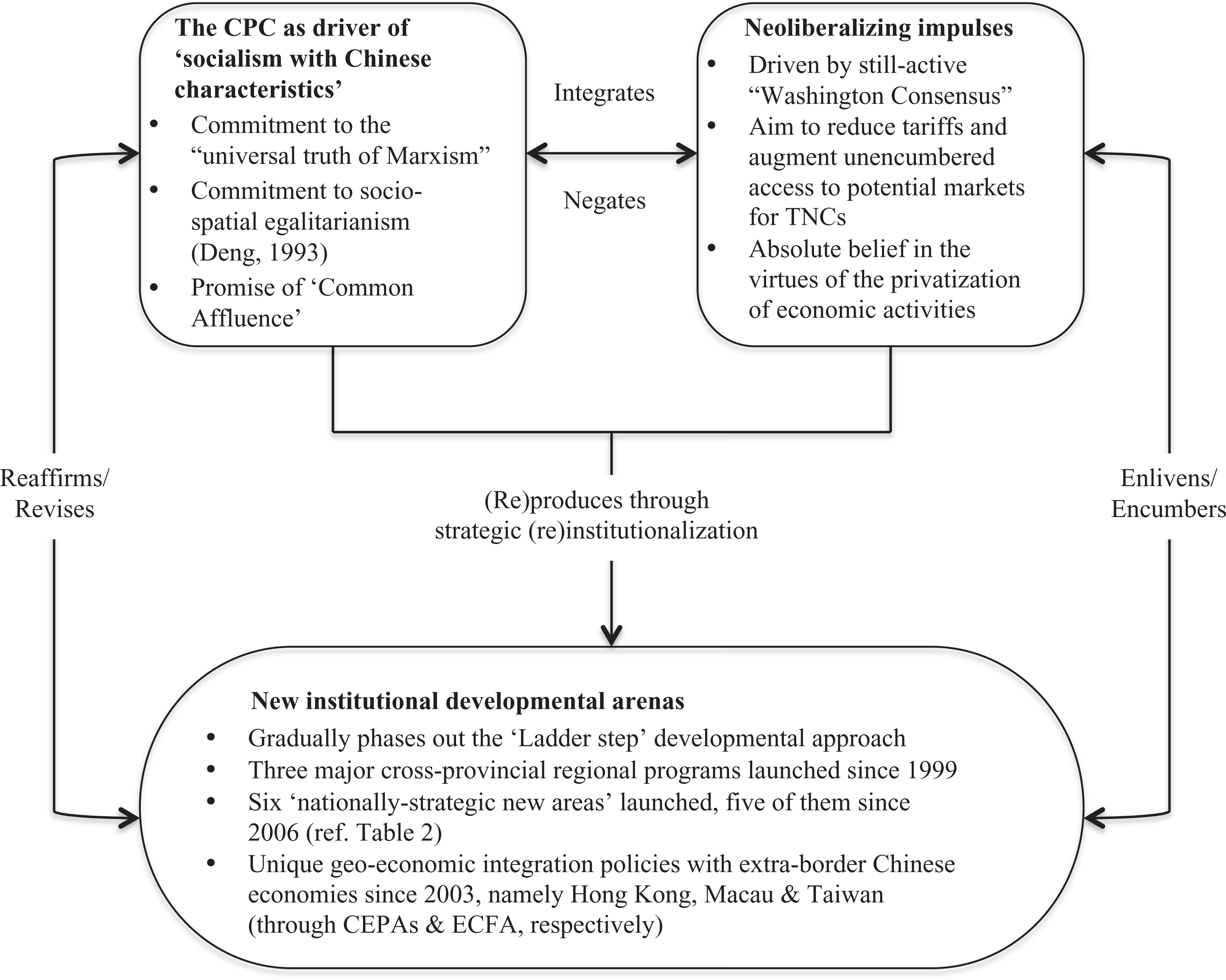
‘Socialism with Chinese characteristics’ as a cross-scalar sociospatial dialectic.
III Chinese socialism as a geographic tension
1 Neoliberalization in and through Chinese state space
Post-Mao reforms in China have been associated simultaneously with fast-paced economic growth – China’s GDP growth rate averaged ∼10% annually between 1979 and 2011 – and uneven economic-geographical development. This phenomenon has its roots in Deng Xiaoping’s willingness to accept uneven economic-geographical development as a trade-off for opening Chinese borders to transnational capital flows. The spatial expression of Deng’s economic policies was guided by a distinct geographical theory – the ‘ladder step’ approach (tidu lilun). This approach delineated Chinese state spatiality into three economic belts: the eastern (coastal), central, and western. Deng gave one belt (the eastern seaboard) the priority in ascending the development ‘ladder’. He assumed that the fruits of development in the ‘first mover’ belt would diffuse downwards to other rungs of the ladder (see Fan, 1995; Wang and Hu, 1999). In a 1988 speech entitled ‘Two Big Pictures’ (liangge dajü), Deng summed up his time-oriented theoretical approach to economic-geographical development: the coastal area must accelerate its opening up to enable this broad region of 200 million people to first develop, from which it will stimulate even better development in the interior. This is a matter that involves a big picture. The interior must understand this big picture. (Deng, 1993: 277–278; author’s translation from Mandarin) upon attaining a certain level of development, the coastal areas are requested to give more energy to assist in the development of the interior, this is also a ‘big picture’ … It is an obligation for economically advanced areas to help those that are more backward, and it is also a major policy. (Deng, 1993: 277–278; author’s translation)
An expanding literature reveals how primitive accumulation – a distinct precondition and expression of neoliberalization (see section II.1) – has become a prevalent driver of economic development in China. Looking at transformations in the Shanghai rural landscape, Buck (2007) shows how primitive accumulation is related to the subsumption of labour to capital. Lin (2009b: 441) highlights how major city governments in Guangdong province ‘scaled up’ their development policies through the ‘forceful annexation of suburban cities and counties’. While Webber (2008a, 2008b) believes there are economic and non-economic logics that underpin the primitive accumulation process, Walker (2006: 1) views the violent captures of rural space and resources, which have triggered ‘a tidal wave of peasant protest’ over the past two decades, as a clear reflection of ‘gangster capitalism’ at work. Against these varied interpretations of the causes and implications of primitive accumulation across China, one pattern is clear: Deng’s (1993: 64) fear that post-1978 Chinese social formations would split into distinct ‘haves’ and ‘have-nots’ (liangji fenhua) was certainly not unfounded.
Indeed, as neoliberalization across China intensifies, the concomitant exacerbation of uneven development has meant that, if Deng’s (1993: 277–278) injunction to balance out socioeconomic disparities is to remain valid, the deferment of socialistic development in time is insufficient per se; something must be done to change space. One key challenge must be taken into consideration, however: China’s public and private economic sectors intermesh in place-specific ways that are probably not found elsewhere. To be sure, private capital investments have become more important in China’s domestic economy and, over the past three years, rules have been relaxed to permit foreign venture capitalists to operate within China. But one characteristic stays unchanged: the major economic actors within the Chinese economy remain the SOEs.
9
Interrelated to the SOEs’ economic practices is a sprawling state-controlled financial system. As Walter and Howie (2011) explain, complex off-budget arrangements, SOE borrowings and a non-convertible exchange rate sustain a financial system that looks increasingly internationalized but remains undergirded by older arrangements that directly affect the allocation of domestic capital. Also, to take the CPC’s recent indication as a guide, the intertwined activities of Chinese state-linked economic actors will remain integral to the ‘socialist market economy’: We should unwaveringly consolidate and develop the public sector of the economy; allow public ownership to take diverse forms; deepen reform of state-owned enterprises; improve the mechanisms for managing all types of state assets; and invest more of state capital in major industries and key fields that comprise the lifeline of the economy and are vital to national security. We should thus steadily enhance the vitality of the state-owned sector of the economy and its capacity to leverage and influence the economy. (President Hu Jintao;
Global Times, 2012)
As Figure 1 shows, these ‘contradictory and complex patterns of state behaviour’ can be seen through the Chinese government’s selective endorsement of neoliberalization at the global and subnational scales. At the global level, the central government’s push for global free trade and investments is accompanied by its staunch refusal to succumb to US-led pressures to alter its fixed exchange rate regime, an arrangement which ensures China-based producers enjoy propitious terms of trade and economic stability (cf. Broz, 2002; Lim, 2010). Indeed, well-capitalized China-based firms, particularly the national sovereign wealth fund (China Investment Corporation) and large SOEs (e.g. CNOOC and SINOPEC), need the ‘freedom’ at the global scale if they are to expand into new markets and successfully fulfil the state’s ‘Go Abroad’ market expansion programme. The launch of this programme – which Gonzalez-Vicente (2011) identifies as an extra-territorial expression of ‘state entrepreneurialism’ – was primarily due to the large overaccumulation 10 of US dollars under China’s fixed exchange rate system (Lim, 2010; Nolan, 2012). Given the US government’s preferred post-subprime crisis strategy of printing and injecting dollars into money markets (known as ‘quantitative easing’), China’s surplus capital stock needs to be quickly and regularly reinvested to preclude future devaluation. Chinese firms launching outward FDI – which surged from US$2.7 billion in 2002 to US$60.07 billion in 2011 ( China Daily, 2012a) – would thus benefit directly from less regulatory barriers imposed by foreign states and/or supranational institutions. This quest for unfettered market access overseas is arguably the main reason why China joined the WTO in 2001 and, more importantly, willingly became bound to the WTO’s goal of reducing barriers to market access at the global scale. 11 Contrary to popular zero-sum conceptions of Sino-US relations, then, US (neoliberal) hegemony is in fact not unwelcomed by the Chinese state. If anything, US hegemony – expressed and effected through the ‘Washington Consensus’ – has, in a most intriguing twist, become the sine qua non of China’s socialistic development (cf. Figure 1).
The Chinese state’s global-scale endorsement of neoliberal logics generated new vulnerabilities, however. After the US government announced its plan to launch a second round of ‘quantitative easing’ in November 2010, the Chinese Vice Finance Minister Zhu Guangyao expressed immediate concerns about this intervention by the US government in global money markets: As a major reserve currency issuer, for the United States to launch a second round of quantitative easing at this time, we feel that it did not recognize its responsibility to stabilize global markets and did not think about the impact of excessive liquidity on emerging markets. (
Reuters, 2010)
Vis-a-vis this global-scale vulnerability, the importance and urgency of crafting capital accumulation opportunities from within Chinese state space became more pronounced. While the Chinese state has been cautious in its ‘down-scaling’ of neoliberal logics in order to preclude further sociospatial inequality, it appears increasingly keen to overcome the limitations of this ‘down-scaling’ process. Indeed, it now appears to be in the interests of the Chinese state to differentiate the institutionalization of neoliberal governance logics at the subnational scale in order to produce new (re)investment opportunities for global circulatory capital (of which it is now an integral part; cf. Figure 1). The emergence of Chinese state space as a relational and reflexive entity (in relation to neoliberal ideology) in turn reinforces Peck’s (2010: 10, emphasis in original) observation that neoliberalization is a process that ‘denotes the form of state/economy relations, not a linear path towards a purely free-market state’. As Wang Hui (2009) puts it, state-capital co-evolution is fundamental to the post-1978 neoliberalization in/of China: Chinese neoliberalism has at times expressed its contradictions with the state in an anti-political (or anti-historical, or even anti-socialist – in its traditional sense) way. But these oppositions seem incapable of really concealing neoliberalism’s intimate connections with state-directed economic policy. For neoliberalism, in truth, relies … upon its inherent links to the state. (Wang, 2009: 19)
Through reinforcing the ability to shield Chinese sociospatial formations from the very process – neoliberalization – it allows and (selectively) endorses, the CPC has begun channelling new capital investments to less developed areas, particularly the western interior. This process is inherently dialectical: on one hand, the Chinese state apparatus – directly through its macroeconomic and spatial strategies and indirectly through its aforementioned arsenal of SOEs – appears to be producing a differentiated pattern of reinstitutionalization to embed ‘free market’ logics and produce spatiotemporal fixes for targeted investments, while, on the other hand, it simultaneously negates some of these logics (in the name of ‘rebalancing’ economic-geographical development) through broadening and deepening state involvement in economic practices within the targeted spatiotemporal fixes (cf. Deng, 1993: 277–278). An analysis of variegated neoliberalization in and through China could thus begin from the place-specific intersections of politico-economic processes that originate from and flow across different scales, namely (a) the global economy, (b) the nation state, (c) individual provinces and (d) prefectures and counties. Space, as section III.2 shows, is not an epiphenomenon when it comes to the interplay between neoliberalizing dynamics and the developmental parameters of ‘socialism with Chinese characteristics’ – its role is central.
2 China’s new ‘national strategy’ of/for socialism: decentralization-as-centralization?
In the build-up to the 12th Five-Year Plan (2011–2015), China’s central government candidly acknowledged the gamut of current challenges engendered by the market-oriented reforms and development of the past three decades, one of which is uneven development (see Table 1). The analysis of ‘state spatial strategies’, which Brenner (2004: 94) defines as the use of ‘political strategies oriented towards the reproduction, modification, or transformation of inherited frameworks of state spatial intervention at various scales’, offers a fertile launchpad from which to understand how Chinese policy-makers turn the challenges of uneven economic-geographical development into strategic advantage. As Brenner (2004) observes, insofar as a national political economy is positioned vis-a-vis the global system of capitalism, modification to/in state space is at once contingent and necessary: The restructuring of state spatiality rarely entails the complete dissolution of entrenched political geographies … [it] is uneven, discontinuous, and unpredictable: it is best conceived as a layering process in which newly emergent state spatial projects and state spatial strategies are superimposed upon entrenched morphologies of state spatial organization. Thus conceived, the spatiality of state power is at once a presupposition, a medium, and a product of the conflictual interplay between inherited geographical parcelizations of state space and emergent political strategies intended to instrumentalize, restructure, or transform the latter towards particular sociopolitical ends. (Brenner, 2004: 107, emphases in original)
China’s 10 economic challenges, identified in the proposal of the 12th Five-Year Plan
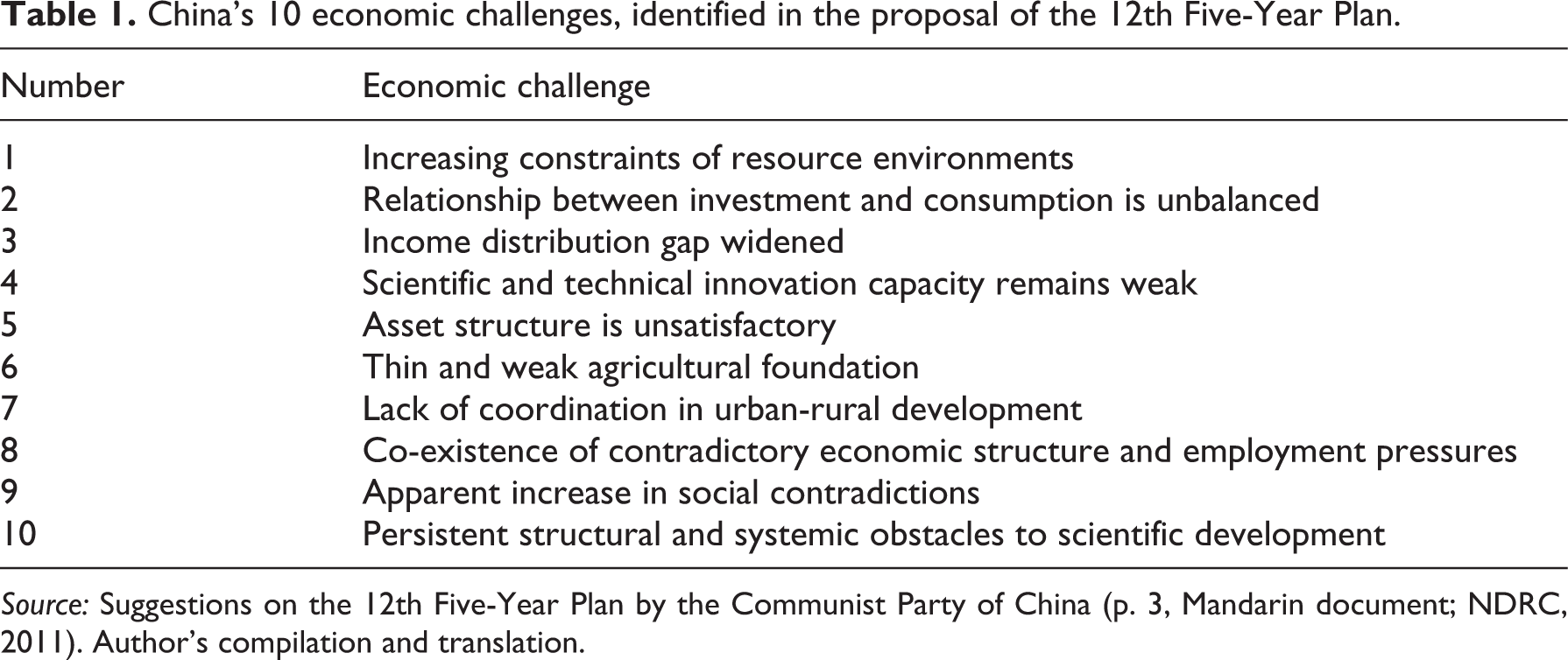
Source: Suggestions on the 12th Five-Year Plan by the Communist Party of China (p. 3, Mandarin document; NDRC, 2011). Author’s compilation and translation.
The domestically variegated regulatory experiments – which remain undertheorized in the social-scientific literature – are currently evident at two scales: cross-provincial regions and intra-urban economic zones. Proactive cross-provincial spatial planning only became more prominent in the decade following 1999, during which the Chinese state launched three broad regional development programmes, namely the Great Western Opening Up (xibu dakaifa), the Northeast Revitalization (dongbei zhenxing) and the Rise of the Central (zhongbu jueqi). While fiscal monies have been redistributed to the provinces involved to launch concrete developmental projects, these programmes entailed no specific institutional (re)formulations at the provincial level (for a detailed overview, see Li and Wu, 2012; Liu et al., 2012). The more crucial goal of these programmes appears to be the production of cross-provincial geographical imaginations. This goal is to materialize through a discursive-ideological strategy: the name of each programme began to be included in individual provinces’ policy documents, while the mass media began to discuss province-specific economic development policies in relation to the broader regional strategy (e.g. how the urbanization of capital and labour power in Chongqing is connected to and helps drive the Great Western Development programme). Developing regional consciousness is important as individual provincial governments have been working disparately, particularly since the early 1990s, and interprovincial (and, by extension, interurban) collaboration has proved very difficult (author’s personal communications with Chinese urban planners, 2012). Intriguingly, the delineation of three major regions of development bears striking similarity to Mao’s ‘Three Front’ 12 spatial developmental approach in the mid-1960s (cf. Li and Wu, 2012); the key difference is that these regions’ developmental programmes are to be crafted with their respective positions in the global capitalist – rather than geopolitical – system in mind.
Geographically targeted (re)institutionalizations were and are expected to be implemented at the intra-urban level, with six ‘nationally strategic new areas’ (guojia zhanlüe xinqu) identified as bordered zones within selected cities to ‘move first, experiment first’ (xianxing xianshi). The ‘new area’ concept is actually not novel, although its scale of implementation has widened considerably since 2006 (see Table 2). Following the success of the first four Special Economic Zones in the provinces of Guangdong and Fujian, the world-renowned Pudong New Area in Shanghai was approved for development in 1990, and has since been transformed into a city-regional ‘motor’ of China’s economic growth. This intra-urban (re)institutionalization was not extended elsewhere in China for 14 years until the Binhai industrial region adjacent to the northeastern city of Tianjin was designated China’s second ‘nationally strategic new area’ in 2006. From 2009 to 2012, four more ‘new areas’ were demarcated. Two ‘new areas’ are in the western interior, namely Liangjiang New Area in the city of Chongqing and Lanzhou New Area, which overlaps the city of the same name in Gansu province. The other two are located along the coast, namely Zhoushan Archipelago New Area, based offshore in Zhejiang province, and Nansha New Area, strategically positioned between two specialized new zones (Hengqin, in Zhuhai, and Qianhai, in Shenzhen) in the Pearl River Delta. It appears that several more of these ‘nationally strategic new areas’ will be identified across the country in the coming years ( Xinhua, 2012). The unfolding of this seemingly patterned development raises two major research questions. (1) What does it mean, in both ideological and practical terms, to speak of a place as ‘nationally strategic’? (2) If a place is ‘strategic’ in the ‘national’ sense, what is the ‘national strategy’?
China’s ‘nationally strategic new areas’, 1990–2012.
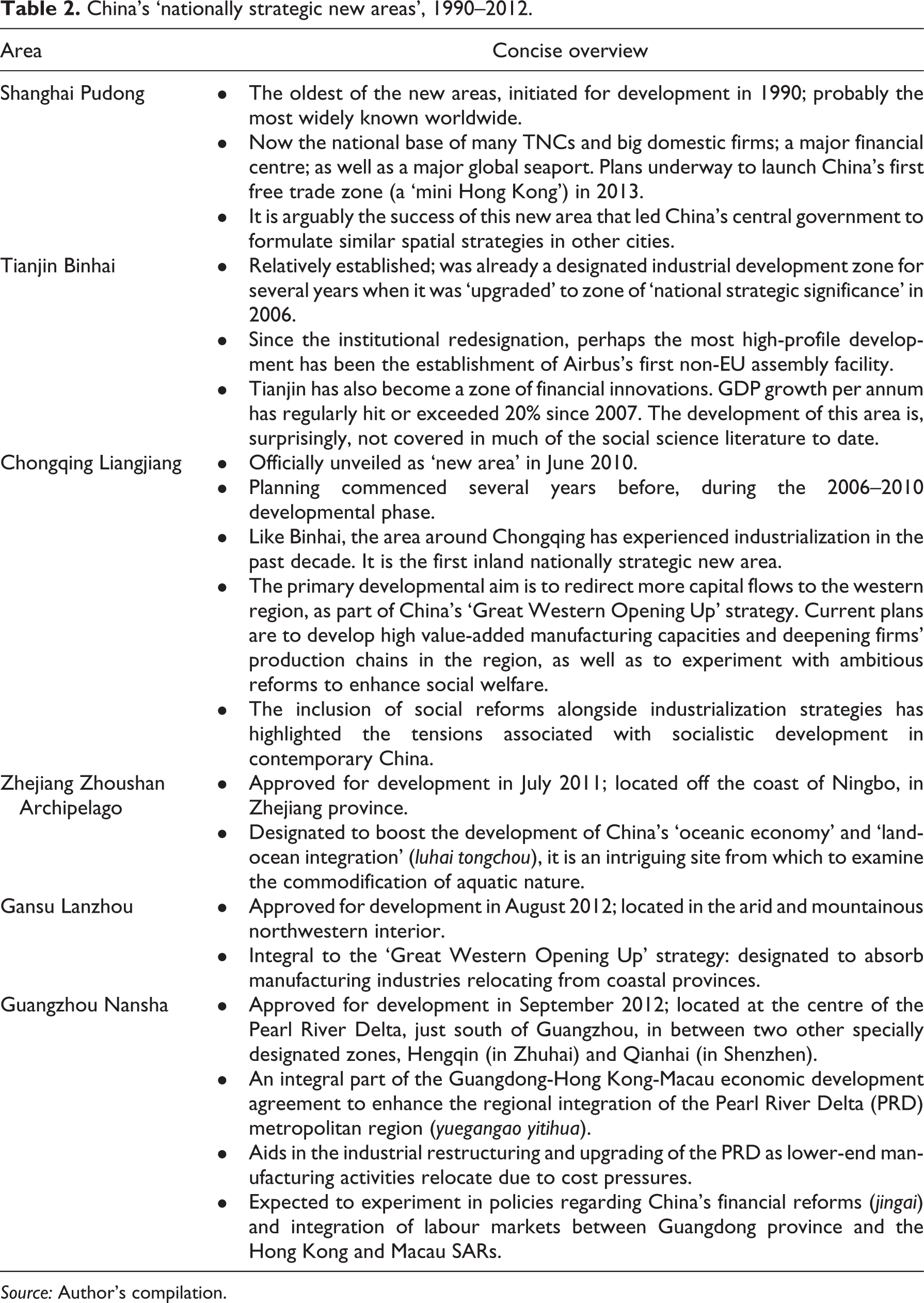
Source: Author’s compilation.
To arrive at an understanding of what a ‘national strategy’ of economic development might look like, it would be helpful to begin with the pre-existing state spatial form of the contemporary conjuncture. This brings to question the causal effect of economic-geographical unevenness. The last decade of high economic growth has been based on what Chinese president Hu Jintao terms ‘unbalanced, uncoordinated and unsustainable development’ ( Global Times, 2012). A national strategy thus inevitably builds on – and attempts to change – this uneven spatiality. A critical examination of how actually existing uneven geographies complement one another offers useful insights on how the CPC addresses and absorbs the contradictory pressures associated with global economic integration. So long as the targeted zones of reinstitutionalization are ascertained to be ‘nationally strategic’, the spatial logic goes beyond that of interurban competitiveness. These ‘new areas’ are possibly designated to circumvent – if not overturn – the oft-debilitating, race-to-the-bottom competition by local governments (see section III.1; cf. Howell, 2006). Thus fortified with new (centrally approved) institutions tailored to their pre-existing economic-geographical positioning within national state space, China’s ‘nationally strategic new areas’ are intended to be more competitive at the global scale. In other words, unevenness is harnessed by the central government, with the place-specific competitive impulses directed outwards to the global economy. Each designated ‘nationally strategic new area’ could thus become a central competitive node for the country because its positional importance has been ‘scaled up’ to the global level. Decentralization, in this regard, transposes into a new form of centralization that propels and reproduces China’s ‘socialist market economy’.
At the national level, the Chinese central government’s emergent decentralization-as-centralization strategy transcends dichotomous conceptualizations of politico-economic centralization and decentralization. Putting into practice the power to reconfigure national state space, the central government appears to be effecting a more balanced domestic allocation of capital (and, by extension, labour power). This in turn reinforces its control over local practices that may deviate from national goals. Furthermore, as one planner in China remarked, ‘whenever the central government launches a project, many people at the local level automatically respond with much fervour. There is no problem getting people [at the local scale] to do things’ (personal communication, Beijing, 2012; author’s translation). This insight strongly suggests how interprovincial and intercity competition have not devalued perceptions of the central government’s importance; rather, relations with the central government are highly valued because it is through the central government that a locality ‘jumps scale’ and, almost instantly, assumes a propitious economic-geographical position globally. The formation and evolution of the ‘nationally strategic new areas’ thus brings into focus a new central-local dynamic that shows, on closer reading, how ‘developmentalism’ is constituted in and through Chinese state space (cf. Beeson, 2009; Howell, 2006).
There are three interrelated dimensions to the emergent decentralization-as-centralization dynamic, namely politics, policy and practicality. First, the act of redrawing administrative boundaries involves cross-scalar spatial politics. The identification and designation of ‘new areas’ takes place in what Peck and Theodore (2010: 169) refer to as ‘fields of power’. These ‘fields’ are intersections of ‘adaptive connections, deeply structured by enduring power relations and shifting ideological alignments’; they foreground the ‘intrinsic politics to the policy transfer process’ (p. 169). Given that the Chinese state apparatus is a heterogeneous entity within which exist different perspectives on development (see, for example, Kuhn, 2010; McGregor, 2010), it is expected that the spatial politics will play out before and after the ‘new areas’ are designated ‘nationally strategic’. It is currently unclear what kind of central-local relations lead to the choice of a location as ‘nationally strategic’ while others are passed over. The decision-making process could be totally top-down, with provincial policy-makers having little influence, or it could be an outcome of aggressive lobbying of the central government by provincial and metropolitan policy-makers. Ascertaining the nature of this process is methodologically challenging, to be sure, as it is hard to penetrate policy-making circles (especially at the central level) to obtain first-hand data, but there might be alternative sources of information (e.g. interviews with senior members of enterprises, local urban planners, reporters) from which solid inferences could be made. Given that the potential outcome of this research approach is a clearer understanding of the macro spatial logic underpinning the CPC’s strategies to actualize ‘socialism with Chinese characteristics’, it is certainly worth trying.
The next research focal point is a critical assessment of the policies introduced in each ‘new area’ and how these policies are discursively (re)presented. It is certain that the designation of an intra-urban area as ‘nationally strategic’ would be accompanied by a fresh set of policies. The primary aim of policy analysis is to ascertain how new regulatory processes and parameters – particularly how they facilitate market exchange and/or more extensively involve private producers in the organization of everyday social life – differ from the pre-existing ones. If the new policies are designated to ‘move first, experiment first’, how long these experiments last and whether they are retained or discontinued become further points of inquiry. Apart from policy content, a correlated research focal area is the discursive justification of the new policies and the statistics that are made public. To follow newly appointed Chinese President Xi Jinping’s ( Nanfang Ribao, 2012) philosophy that ‘empty talk harms the nation, practical work leads to national flourish’ (kongtanwuguo, shiganxingbang), public discourses and statistics are critical materials against which evaluations of policy rationale and effectiveness in the new areas can be made. Specifically, discourses by policy-makers offer another avenue to explore how market-oriented reforms (e.g. the ‘financial reforms’, or jingai, to be launched in Nansha New Area and two other zones in the Pearl River Delta; see Table 2) are to nurture a socialist mode of production. At the theoretical level, the integrated focus on new policy contents and their accompanying political discourses facilitates an investigation of how ‘deepening neoliberalization’ – which Brenner et al. (2010: 209) define as the ‘the growing interdependence, inter-referentiality and co-evolution of market-oriented reform efforts among territorial jurisdictions, spatial scales and policy fields’ – plays out in and through the ‘nationally strategic new areas’ vis-a-vis enduring socialist principles.
This leads to the third interrelated dimension – practicality. The objective of combining market-deepening reforms with socialist ideals within the ‘new areas’ is not to produce nationwide institutional homogeneity; the aim is to engender patterned variants of developmental permutations that, working in tandem, help to propel the entire political economy. Indeed, the concentration of processes in the ‘new areas’ are not random; the act of ‘bordering’ – and the new policies implemented within the bordered zones – are deliberately crafted to create a driving effect towards a macro potentiality (in China’s context, a ‘Harmonious Society’ constituted by balanced, coordinated and sustainable development). This said, there is every possibility that the desired actuality will not materialize; that these spaces will constantly remain spaces of socialist potential, in need of reintervention. Put another way, the processes emerging in and through the ‘new areas’ are purposive and propulsive, but not definitely transformative.
In summary, the geo-institutional differentiation of ‘nationally strategic new areas’ in China is the latest round of spatial reconfiguration aimed at resolving tensions arising from neoliberal and socialist practices. Yet it must be emphasized that these strategies are deontological; they provide a preview of emergent sites and, by extension, the macro spatial logic of development. Corresponding to what Lefebvre (1991: 33) terms ‘spaces of representation’, they are notional determinations that designate what spaces should become in order to be fully ‘real’. The primary underlying link between these strategies is the role of the state as a producer and mediator of neoliberal logics; through formulating geographically differentiated regulations of/for capital accumulation and then directly participating in the actualization of these differentiated spaces through SOE investments, Chinese policy-makers essentially aim to create different ‘spatial fixes’ for transnational capital flows, driven by both private firms and SOEs. This is proactively leavened by the twofold redistribution of state finance and the power to make mistakes (shicuoquan). These new state spaces in China are hence tentative amalgams of (market-oriented) productive forces and place-based social relations.
IV Conclusion: from the geographically impossible to the geographically inevitable?
In contemporary China, only socialism with Chinese characteristics can develop China, benefit people and revitalize the nation. (Xi Jinping, newly appointed Chinese president; China Daily, 2012b)
Every child in China is schooled in the ‘universal truth of Marxism’ from the moment s/he attends primary school. Despite China’s deepening integration into the global system of capitalism, the central importance of Marxism is such that it remains enshrined in the national education law: ‘In developing the socialist educational undertakings, the state shall uphold Marxism-Leninism, Mao Zedong Thought and the theories of constructing socialism with Chinese characteristics as directives and comply with the basic principles of the Constitution’ (Chapter 1, Article 3). 13 However, the ways in which Marx’s ‘universal truths’ now co-exist and co-evolve in China with neoliberalism, the reigning global governance ideology, receives almost no focus. While the curriculum admirably espouses the virtues of sociospatial egalitarianism, the concrete realities of socialism in China are shaped by capitalistic demands – the majority of which originate from the SOEs and foreign investors – that in turn produce variegated sociospatial consequences. Specifically, it is not clear how neoliberalization in and through China – which, according to Marxian logic, has already moved beyond the capitalist mode of production (see section II.2) – fortifies and fractures simultaneously the putatively ‘universal’ status of Marxian logics (cf. Deng, 1982). This paper is an attempt to add conceptual clarity to this ideological interpenetration through a critical geographical perspective.
‘Socialism with Chinese characteristics’ demands but simultaneously defies geographical definition. The selective institutional differentiation of state spatiality and the concomitant accommodation of neoliberal logics epitomize a seemingly unending cause-effect relationship. While the Chinese state’s decision to actively (re)produce economic-geographical unevenness within its territory may, at first glance, suggest neoliberalization has gained further traction in China, this decision must be assessed as a dynamic, place-specific negotiation of what appear to be oppositional forces (i.e. socialism and neoliberalism). The unfolding of this negotiation in and through Chinese state space offers distinct contextual springboards to theorize what Brenner et al. (2010: 211) call ‘the uneven development of neoliberalization, and the neoliberalization of regulatory uneven development’. These springboards potentially challenge an increasingly pervasive interpretation of China’s development as a triumph of neoliberalism over socialism/communism; as ‘neoliberalism with Chinese characteristics’ (pace Coase and Wang, 2012; Harvey, 2005a; cf. Ma, 2009; Nonini, 2008).
Challenging this interpretation involves addressing two distinct but crosscutting questions. (1) Has neoliberalism really become the ideology par excellence in China, or has it become a precondition of socialist/communist development? (2) If there really is ‘neoliberalism with Chinese characteristics’, (how) are these ‘Chinese characteristics’ socialist in practice? As this paper has argued, it is more apposite to interpret variegated neoliberalization as a precondition of – rather than an alternative to – ‘socialism with Chinese characteristics’ because the production of a ‘socialist market economy’ entails a deepening structuring of everyday social life within China around market exchange on one hand and the Chinese state’s consolidation-cum-expansion of SOEs’ economic influence on the other. Section II.1 has shown how neoliberalization is intrinsically undergirded by an ‘antagonistic fissure’ – uneven development (cf. Žižek, 1989: 142). This ‘antagonistic fissure’ is, interestingly, what Deng sought to defer to the future as he put into practice the ‘ladder step theory’ of economic-geographical development in the early 1980s (cf. section III.1). Evidence over the past decade suggests, however, that the CPC is ready to make even development a prominent spatial issue. Its rationale is not surprising: to follow Žižek (1989: 143), the key to identifying and overcoming ideological limitations is ‘to detect, in a given ideological edifice, the element which represents within it its own impossibility’. For the CPC to get closer to its goal (i.e. ‘socialism with Chinese characteristics’) while it simultaneously negotiates the pressures of neoliberalization, this ‘element’ has to be uneven development (see Table 1; Deng, 1993).
That uneven development would become the prominent source of China’s socialistic advancement was unimaginable during the Mao era (and possibly today); as China deepens its integration within the global system of capitalism, however, this phenomenon has become a geographical inevitability. ‘If capitalism survives through uneven development … if capitalism is uneven development, then, surely, we need to search out an adequate theoretical framework to encompass this fact’ (Harvey, 2005b: 88, emphasis in original). Increasingly central to the evolution of the contemporary global system of capitalism (and its prevailing governance ideology, neoliberalism) and yet simultaneously striving to enhance a historicized socialist totality, China presents a contextually rich but contradiction-ridden arena from which to ‘search out’ this theoretical framework. Taking up and extending Harvey’s (2005b) cue, this paper has proposed a conceptual framework that takes, as its basis, ‘socialism with Chinese characteristics’ as a geographic tension. The actualization of this historicized end-state is encumbered by the ‘antagonistic fissure’ that is uneven development, yet it is this unevenness that enlivens both the Chinese state and, indeed, the ‘Washington Consensus’ (see section III.1). While it cannot be determined a priori whether the Chinese state’s ‘move first, experiment first’ policies in the strategically reinstitutionalized areas will succeed, it is, ironically, this potential for failure that justifies new rounds of geographically variegated institutional experimentations. Every round of institutional experimentation is, indeed, an exemplification of a Beckettsian ‘try again, fail again, fail better’ spirit.
In an interesting twist, it could be China’s ‘national strategy’ of state-driven policy experimentations, rather than TNCs operating separately from and against national governments, that cause what Crouch (2011) terms ‘the strange non-death of neoliberalism’. Aided by its national monetary policy and a strong ‘invisible hand’ over SOEs’ corporate strategies, CPC-driven territorial reconfigurations reflect the paradoxical integration of uneven regulatory development as an intrinsic driver of its multiscalar ‘eternal reforms’. A new research challenge for geographical political economy, then, is to understand how sociospatial contradictions in China are transposed, through geo-institu-tional differentiation, into new developmental preconditions in relation to the global (neoliberalizing) context (cf. Figure 1; Table 2). Specifically, the challenge is to ascertain how – or, indeed, whether – uneven development can be transposed from a developmental effect to a developmental source. The empirical outcomes of the recursive cause-effect relationship between actually existing uneven development and state spatial strategies are of significance because, as aforementioned, it remains unclear how market-based regulations and practices can fulfil the CPC’s integrated socialist goal of ‘Common Affluence’ and ‘Harmonious Society’.
What is clear, for now, is that the days of a centrally planned economy are not over in China. The major difference from the Mao era is how this central planning is reconfigured through the dialectical differentiation of Chinese state spatiality and the variegated adaptation of neoliberal logics across different scales. Rather than allow private, non-state capitalists to shape uneven development in an ad hoc and potentially socially debilitating manner (which in turn foments conditions for social revolutions), the inclusion of private capitalists in the CPC and the central government’s tight grip over the national capital account (which concentrated a huge amount of foreign currency reserves in Beijing) creates colossal leverage for the CPC to shape the domestic and (increasingly) global allocation of financial investments (the allocative power applies, to a lesser extent, to the flows and fixity of Chinese labour power as well). This leverage helps to pre-empt socioeconomic crises intrinsic to neoliberalization and, by extension, sustains the CPC’s sociopolitico legitimacy. As such, the production of economic-geographical unevenness is, in the Chinese context, not what Myrdal (1957: 26) refers to as a ‘historical accident’; it is not an outcome of the abstract laws of transnational capital and labour flows; rather, it is an ideologically driven, institutionally differentiated and inevitably recursive spatial tool that generates pre-emptory territorial leaps towards an as-yet-unknown future known as ‘socialism with Chinese characteristics’.
Footnotes
Acknowledgements
I have benefited tremendously from the comments of Jamie Peck, Henry Yeung and Xiaobo Su on earlier drafts of this paper. My sincere gratitude also goes to the anonymous referees for providing very insightful feedback, and to Professor Noel Castree for his encouraging comments and editorial assistance. All responsibility for the arguments presented in this paper remains solely mine. Over the two years it took to transpose thoughts into text, the support from Stephanie Lim, my dearest wife, has been the proverbial still point of the turning world – thank you.
Funding
This research received no specific grant from any funding agency in the public, commercial, or not-for-profit sectors.