







Abstract
The study investigates how the arts and humanities facilitate the recovery of places following catastrophe. It contends that personal engagements with humanistic activities enable place-making by helping to restore relations among mind, body, and environment at an individual scale while also producing forms that circulate to help reinstate place at collective scales. Evidence from research conducted in and on Haiti following its 2010 earthquake supports the argument.
I Introduction
This paper contends that the arts and humanities can and do play a role in post-disaster place-making. To make my argument, I situate an examination of artistic and humanistic responses to the 2010 Haiti earthquake within current geographical discussions of imagination, representation, place, health, and resilience, and the role of the arts and humanities in them. My analytical aim is to demonstrate that persons who are traumatized by catastrophe participate in the arts and humanities because such engagements, what I loosely term ‘humanistic activities’, foster the restoration of health and place at an individual scale and that the products of these activities circulate among observers to facilitate a similar recovery at collective scales, in both mental and material registers. My normative aim is to demonstrate that humanistic activities, particularly in their popular and informal versions, deserve increased acknowledgment and support from disaster relief programs for their capacity to facilitate the recovery of both people and places that have been devastated by disaster. By making these arguments, I offer support to a more general one: that humanistic activity is not a ‘superficial ornament’ of society but an essential part of it (Bate, 2011: 12).
II Geographical imagination, representation, place, health, and resilience
I start by examining the geographical discussions on imagination, representation, place, health, and resilience to identify points of connection among them, including intersections with the arts and humanities. The geographical imagination is understood as a ‘persistent universal instinct’ that commingles nature and culture through creative art (Prince, 1962) with a visual and aesthetic sensibility (Cosgrove, 1984). It is also a ‘powerful ingredient … a way of envisioning the world, experiencing and reshaping it too’ (Daniels, 2011: 182). Traditionally, the key modes through which the geographical imagination was accessed, stimulated, and expressed were narrative description and cartographic depiction, pursuits once considered to be secondary to interpretation and explanation but then later understood to be essential precursors to them, as the act of representation itself emerged as a subject of investigation (Daniels, 2011). Subsequent discussions of the geographical imagination lifted the arts of representation from being simple tasks that were preliminary to geographical study to serving as complex components of it that were as fundamental to the work as the geographical phenomena they portrayed (Daniels, 2011; Tomaney, 2010). Even in the geographic tradition the arts of representation have long been implicated in understandings of the geographic imagination.
The idea of geographic imagination is central to the concept of place, particularly as it relates to the self. Place exists between the objective and the subjective (Entrikin, 1991), the physiographic and the imagined (Daniels, 1992), and the mythical and the mundane (Daniels, 2011). It is the realm of location and locale but also sense of place (Agnew, 2002), the latter component having a distinctly imaginary quality. Through ‘imaginative geographies’ a subject can ‘“map” the self into the world’ (Cosgrove, 2011: xxiii), thereby at least partially dissolving the line between dweller and dwelling. The self is immersed, supported and contained within these ambivalent matrices as well as being a maker of them. Accordingly, for some geographers place is essential to the formation of the self, a relation in which both place and subject are in a constant state of becoming (Pred, 1984). Some geographers have argued the need to connect the social and geographical imaginations (Agnew and Duncan, 1989) to better unite habitant and habitat, a part of a larger effort to move the discourse on place from one that is ‘explanatory and diagnostic’ to one that is ‘anticipatory and utopian’ (Gregory, 2010: 285). The tasks of explaining existing places and of anticipating new ones rely on the power of the imagination to mediate the relation not only among past, present, and future dimensions but also between cognitive and material domains and individual and collective registers. Places develop first in the imagination before they obtain material form but the imagination also works in constant dialog with the place in which it is immersed and which it pursues.
Geographical imaginations and the instruments and practices that facilitate them in the creation and transformation of places have also been destructive in nature, as evidenced by the roles they have played in the waging of war, the founding of empire, and the establishment of colonialism (Daniels, 2011). They have also been essential to acts of recovery. For example, the geographical imagination is the realm where medical care and landscape meet to create ‘therapeutic imaginaries’, some of which are more effective than others depending upon the economic, political, social, cultural, historical, technological, and environmental factors that inform and influence them (Pope, 2012: 1157). People also engage their geographical imaginations to reconstruct place-based identities in order to transform their old internal mappings to conform to their new external ones, such as when governing elites disrupt them through the act of redistricting (Zhu et al., 2011). The geographic imagination provides an essential link between people and the places in which they reside, in all of their human and material complexity.
Additional studies enrich the discussion. Place sets the conditions within which societies determine the parameters of health (Philo, 2007). In a more clinical sense, it fosters the formation of a child’s self because it provides a purchase for his or her imagination in its integrated social and material infrastructure (Spencer and Blades, 2008). For persons with learning disabilities, attachment to place contributes to their emotional and social wellbeing, a dynamic that ‘conventional biomedicine and health policy have failed to address’ (Hall, 2010: 277). This relation is also apparent in disaster settings where ‘people with lower levels of social capital tend to perceive higher risks from climate change impacts’ (Jones et al., 2012: 33), a finding that supports the more general insight that cognitive, social, and cultural practices must be included in any model of environmental or health assessment (Holmén and Furukawa, 2002; Kuruppu and Liverman, 2011; Nightingale, 2003; Nyqvist et al., 2008; Patterson, 2008). Individual, social, and material phenomena and processes commingle in space and single and collective geographic imaginations hold them together to create places that mediate both function and meaning.
A key function of the imagination is the invocation and manipulation of the future. The distinction between the perceived present and the imagined future is often uncertain, however, especially when these two dimensions serve as fields for potential intervention. For instance, the destruction of the Twin Towers spurred residents to prepare for possible similar events. These preparations required projections into a Manhattan of the future, but since material interventions into future space are as impossible as those into past space, actors had to resort to manipulating present space rather than attending to ‘conditions of possibility’ that exist only in the imagination and always lie beyond physical engagement in a future time dimension (Aradau and Van Munster, 2012: 98). Given that future space is inaccessible in material terms, a default to interventions into present space is necessary. Past, present and future dimensions collapse into one another as memory, perception, and anticipation collide and commingle in a single geographical imaginary. The strength of art is that it allows for interventions into future space by facilitating the expression of ‘conditions of possibility’ within the imaginative domain. In this way it partly resolves the dilemma posed by future place-making by substituting imagined interventions into future space for material interventions into present space.
A review of the literature on resilience offers further possibilities for the mingling of imagination and place in post-disaster settings. Resilience was defined by C.S. Holling as ‘the ability of a social system to respond and recover from disasters and includes those inherent conditions that allow the system to absorb impacts and cope with an event’ (Holling, 1973, quoted in Ainuddin, 2012: 26; see also Cutter et al., 2008; Pike et al., 2010).
Resilience also exists to a strong extent in a place’s institutions, making harmonization among them vital. Such harmonization relies not only upon the financial aspects of institutional relations but also upon the mutual senses of trust and affinity they share (Adger, 2000). Therefore, because social capital is as important as financial capital, an activity that develops and operates outside of political, historical, cultural and psychological contexts loses efficacy (Morrice, 2013; Ainuddin, 2012; MacKinnon and Derickson 2012; Nerlich and Jaspal, 2012; Munt, 2012; Cote and Nightingale, 2012; Tobin et al., 2011; Wolf et al., 2011; Lowry, 2009; Furedi, 2007; Birch and Wachter, 2006; Folke, 2006). Resilience thus emerges from ‘a complex web of social interactions, characteristics and capacities that enable a community to live with the hazards they face’ (Crowley et al., 2012: 209).
A humanistic reading of these statements reveals ample room for the role of the geographical imagination in their interpretation. For instance, given the cognitive-material nature of place, the geographical imagination can be easily conceived as one of the ‘inherent conditions’ of systemic adaptability mentioned by Holling (1973), as an essential element in the development of institutional trust and inclusion noted by Adger (2000), and as an essential tool for the political, historical, cultural, and psychological contextualization cited by several scholars (Ainuddin, 2012; Birch and Wachter, 2006; Cote and Nightingale, 2012; Folke, 2006; Furedi, 2007; Lowry, 2009; MacKinnon and Derickson, 2012; Morrice, 2013; Munt, 2012; Nerlich and Jaspal, 2012; Tobin et al., 2011; Wolf et al., 2010). Another opportunity emerges in a list of factors that DiGiano and Racelis (2012) consider to be essential to resilience, namely social memory, a kind of collective historical context and emotional state that facilitates the interpretation of the past, the perception of the present, and the imagination of the future. Resilience exists as a function of personal and collective cognition as well as social and material infrastructure. Read as pieces on resilience, the studies on risk assessment cited earlier support this claim with imagination viewed as a kind of ‘social capital’ (Jones et al., 2012: 33; see also Holmén and Furukawa, 2002; Kuruppu and Liverman, 2011; Nightingale, 2003; Nyqvist et al., 2008; Patterson, 2008). Precisely on this point, a recent survey of studies details how imagination influences the perception of climate change (Yusoff and Gabrys, 2011). My claim here is that the imagination offers a resilient mode and domain for place-making, particularly in cases where disaster has caused severe social and material disruption, and that the arts and humanities facilitate individual and collective access to it.
III Haiti: art-making as place-making after the 2010 earthquake
The aim of my research in Haiti is to investigate how art-making serves as a form of place-making following a disaster, one that works across imaginative and material domains as well as individual and collective registers. In making the link between art-making and place-making, I use the term ‘humanistic activities’ to refer to practices that are neither explicitly artistic nor obviously geographical but that are nonetheless implicated in recovering the health and integrity of both people and places following a disaster in ways that are attentive to both aesthetics and space. They exhibit creativity, energy, and form, qualities that facilitate wellbeing and place-making in that they stimulate the mind, exercise the body, and express the imagination. These activities are particularly vital following a disaster because they retain the roots of place-making within the cognitive self after the social and physical infrastructure of a place has been disrupted, an observation that finds support in some of the earliest and most fundamental geographical understandings of place-making and imagination (Agnew and Duncan, 1989; Cosgrove, 1984; Daniels, 1992; Entrikin, 1991; Pred, 1984; Prince, 1962). While disasters destroy old places, they also necessitate the growth of new ones and thereby serve as catalytic events (Alexander, 2000; Philo, 2007; Puleo, 2010). So, while post-disaster art-making and place-making are creative activities, they emerge within the fields of destruction that made them both necessary and possible and therefore develop in close relation with them. As I demonstrate below, this tension is evident in post-earthquake Haiti, as the chaos created by the earthquake implicated itself into the recovery that followed, an inherently conflicted relation that humanistic activities help mediate and resolve.
Before I argue for the involvement of humanistic activities in place-making in post-earthquake Haiti, I offer a short critique of current uses of the arts and humanities in disaster relief. International relief programs engage the arts and humanities in various forms and to various degrees, usually as instruments that carry particular public health messages (skits that demonstrate safer sexual practices, for example) rather than as activities in which the public participates for their own active benefit (see Gupta and Singh, 2011; see also Doctors Without Borders, www.doctorswithoutborders.org; Oxfam, www.oxfam.org; USAID, www.usaid.gov). One partial exception to this general trend is a project in Haiti that provides a venue for performances that range from speeches by renowned artists and writers to talent shows for local performers. The impetus behind the initiative is to create a place that facilitates the peaceful accommodation of the many migrants from Port-au-Prince who flowed into the small suburb of St Marc following the earthquake (USAID Haiti, 2012). The venue, Le Troquet, is a good example of the use of the arts and humanities to restore a place to a state of health following a catastrophe, but it is only one example of the relation between post-disaster art-making and place-making. I suggest that the use of the arts and humanities is more extensive and common than what occurs in such institutional settings and I privilege these complex but informal engagements with humanistic activities here.
Descendants of history’s only successful slave revolt, Haitians are proud of their country and still evince high levels of independence and perseverance, particularly as personal qualities. In a country where most institutions are poorly developed, individual initiative is vital to social and material wellbeing (Farmer et al., 2011). I visited the island-nation on two separate research trips, one in June 2010 and another in January 2011, and have followed its recovery through media sources and personal contacts since the day of the event. With the assistance of American and Haitian research partners, I conducted multiple landscape observations, media surveys and personal interviews. I draw on the first two methods for this study while reserving the personal interviews for future publications. Unlike the USAID effort, the two cases I examine involve strictly private endeavors that were aimed at restoring order to shattered persons and places, what Lollini and Bouchard (2007: 22), in a Mediterranean rather than Caribbean context, refer to as ‘simple, natural gestures … (for) finding a meaning in the disasters of war, hate, and violence’. Specifically, the statement describes how a Croatian woman lays out figs to dry in the sun, and how another woman collects mint in the hills above Ramallah, each of these acts serving as rhythmic performances that create peaceful spaces amid violent chaos (Consolo, 2007a, 2007b). They are humanistic activities that increase resilience in economic, physiological, and nutritional terms as well as in psychological and emotional respects through their aesthetic reconstitutions of order. I change the interpretation of Lollini and Bouchard’s statement somewhat to emphasize the capacity of these gestures, not to provide meaning so much as to restore it or make it more legible by reordering and rehabilitating the elements that turn chaotic space into habitable place. This is not ‘restoration’ in the sense of returning a landscape to an original ‘predisturbance state’ as criticized by Lowenthal (2011: 219) but the restoration of a new place ecology as described by Philo (2007), one that naturally occurs across psychological, physiological, and environmental domains.
The first case concerns an artist named Jerry Moise Rosembert, a man in his early thirties, who is much better known by only his first name. He has become widely known for his iconic drawings of post-earthquake Haiti as a distraught cartographic representation, with a rough outline of the country forming a cracked face with tearful eyes and a pair of pleading hands in front of it (Figure 1). The phrase ‘We Need Help’ often accompanies the image. Using cans of spray paint he created the first six versions in his Port-au-Prince neighborhood of Bois Verna, but before long they appeared all over the city (Bhatia, 2010; Daniel, 2010; Kay, 2010; Stephenson, 2011). Whether Jerry created all of them is uncertain. What is certain is the impact that the artwork had on the local, national, and global understandings of the crisis. The international press captured the image and used it to illustrate the first reports that emerged from a landscape that offered an overwhelming number of depictions of distress. What began as a single impulsive gesture, the solitary expression of one person, generated first an image, then a phrase, and then an icon that travelled digitally throughout the world, to weave a collective impression at multiple scales (Serres and Latour, 1995). As I describe in the paragraphs that follow, Jerry’s work increases his own resilience in the face of disaster and then contributes to a greater ‘systemic adaptability’ as described by Holling (1973) as others become aware of his art at local, national, and global scales.
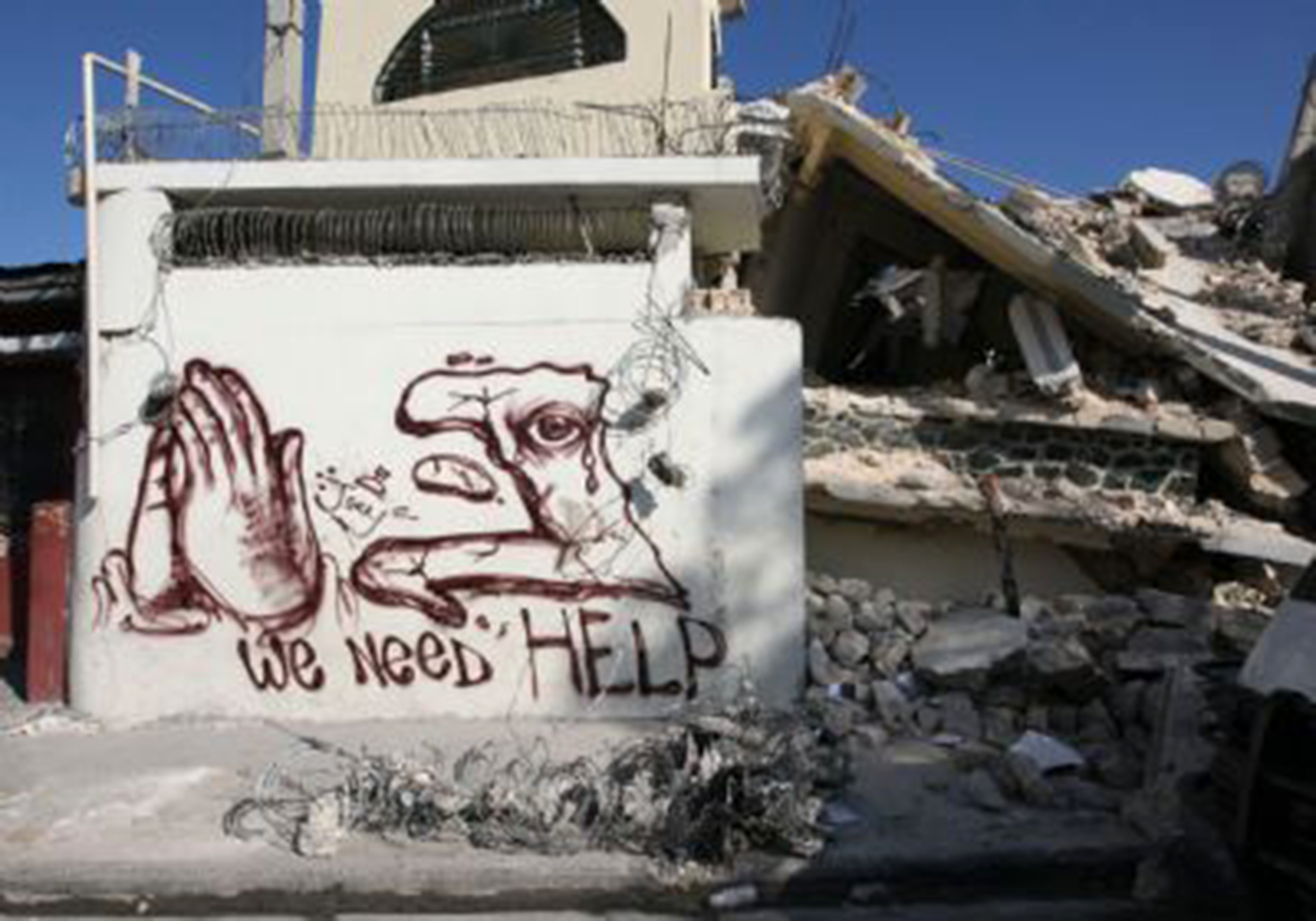
Iconic drawing by Jerry Moise Rosembert (Walter Michot/Miami Herald Staff, 2010).
Street art and graffiti have a long history in Haiti. They are often religious in content but just as frequently they engage secular political, social, and cultural themes (Bhatia, 2009; Butcher, 2010; Gordon, 2010; Rodman, 1988). The Creole word spre (as in spray paint) refers to street art and is a common phenomenon in Port-au-Prince. It has been particularly prevalent since the earthquake that dramatically increased the need, content, opportunity, and space for it. The ornate tap-taps, privately owned shuttles that ply Port-au-Prince’s streets, carry designs that are similar in theme but more sophisticated in technique and execution and much more expensive to produce. The elaborate decoration of a tap-tap indicates the competence and reliability of its owner-operator because it represents that he or she is willing and able to make a sizable monetary investment in an ostensibly non-essential aspect of the business. In fact, potential passengers know that a tap-tap driver who can afford to spend a significant percentage of his or her revenue on decoration is successful enough also to afford regular mechanical maintenance.
Jerry produces his art to help himself as well as his fellow Haitians. In a country that offers little hope for advancement, Jerry felt that art was his only way toward success. Shai Stephenson reveals some of the artist’s personal motivation: Rosembert was a shy child who always liked to draw. He saw violence and suffering in the streets and heard about it on the news. With no way of changing his actual surroundings, Rosembert escaped into fantasy, creating a world different from the one he knew – ‘a world without fighting, a world without trouble, a world where everything is OK’. (Stephenson, 2011: 24) There are a lot of people suffering in Haiti, and the government does not care. When I spre, it’s to show them that someone does care, that someone notices. Haitians get up early, you know, and when they see it first thing in the morning, it’s like a surprise. (Bhatia, 2009: 6)
Jerry’s work, while not fine art, was immediately recognized as something different from the regular spre that consists mostly of simple political slogans that are crudely sprayed onto walls at the behest of politicians for a small fee (Bhatia, 2009; Stephenson, 2011). Jerry’s motivation seems to arise more out of a sense of social responsibility and artistic inspiration than monetary gain. He says: Sometimes I go into the ghettos … There are a lot of people who live in bad situations in Haiti. I try to transmit their feelings. What they feel, I paint on the walls. That’s what made me start drawing so many people crying. A lot, a lot, a lot of people crying. (Stephenson, 2011: 27)
Jerry has applied his art to institutional efforts, particularly those of non-governmental organizations, such as when he depicted on latrine doors people washing their hands, to communicate the importance of personal hygiene in the midst of a cholera outbreak. His commissions generally attend to concerns that are more social than political, such as when the United Nations Office of Project Services paid him to decorate 500 new shelters to make them more personal and inviting (Stephenson, 2011). He creates his art with aims that are grander and more abstract than those which these rooted instrumental deployments suggest, however, addressing both the world: ‘We are not mean or hostile because of the things that have happened to us,’ Rosembert says of Haitians. ‘Haiti is a beautiful country … people can come and see it for themselves. Don’t just listen to what others say; see Haiti with your own eyes.’ (Stephenson, 2011: 27)
Such populist applications of the arts and humanities stand in contrast to at least one understanding of them within geographic literature. While the capacity of the humanities to foreground the author is evident (Cosgrove, 2011), the elitism and social apathy ascribed to them are not, contesting at least in part Denis Cosgrove’s (2011: xxiv) claim that ‘The individualistic, reflective and pedagogical concerns of the Humanities remain distinct from the collectivist, interventionist and scientific research concerns of Social Sciences’. While Jerry is not and would never claim to be engaged in pedagogy or scientific research, his art has clear collectivist and interventionist aims. Cosgrove seems to have been referencing a particular form, tradition, or practice of the arts and humanities that privileges private over public aims and perspectives. Jerry’s work is of a more socially oriented kind which is of ‘a grounded, culture and society model (of) lesser-known, more vernacular works … concerned with recording and commemorating the everyday world’ (Daniels et al., 2011: xxviii). This is an artistic practice characterized by ‘mental reverie as well as material reality, of conflict and uncertainty as well as creativity and possibility’ (Daniels et al., 2011: xxvii). In this mode, art fulfills ‘conditions of possibility’ (Aradau and Van Munster, 2012: 98). It also fulfills one of the key aims of geography, which is to provide ‘a form of practical wisdom, concerned with changing the world as well as interpreting it, and for many cultural geographers the discipline is connected to forms of intervention and activism from urban planning to community participation’ (Daniels et al., 2011: xxx).
The second case involves a man named Levy Azor who goes by the sobriquet of Du Du (Figure 2). Dressed in a Jordanian army uniform, with a whistle in his mouth and a purple wand taken from a game of horseshoes in his hand, he directs the traffic that flows through the chaotic intersection of Borgela and Sans-Fil Streets. Just as Jerry was a street artist before the tragedy, Du Du directed traffic at this intersection for 23 years until the earthquake caused a utility pole to fall and injure his legs (Cave, 2010). After a period of recuperation, he returned to his usual place, spinning, gesticulating, and blowing his whistle in rhythm with the flow of traffic. He lives solely off the tips that truck drivers give him and he does the work voluntarily and independently, avoiding enrollment in both the military and police forces of a government that he claims does little for its people. Through these actions he restores order not only to his own life but also to the lives of everyone who sees him. Damien Cave likens Du Du’s performance to a conductor ‘with a passion for order’ who turns ‘roads overrun with tents, rubble, pedestrians and peddlers; tap-tap taxis stopping suddenly, dump trucks coughing black exhaust, few stoplights, 99-degree heat, no air-conditioning, dust, beggars and angry drivers blaring horns’ into a ‘symphony orchestra’. As noted by one observer, his activities ripple beyond the scale of his body: ‘He’s working for the country’, said Michelle Anthony, 38, as she watched him recently from a food stand a few feet away. ‘He is working for us’ (Cave, 2010).
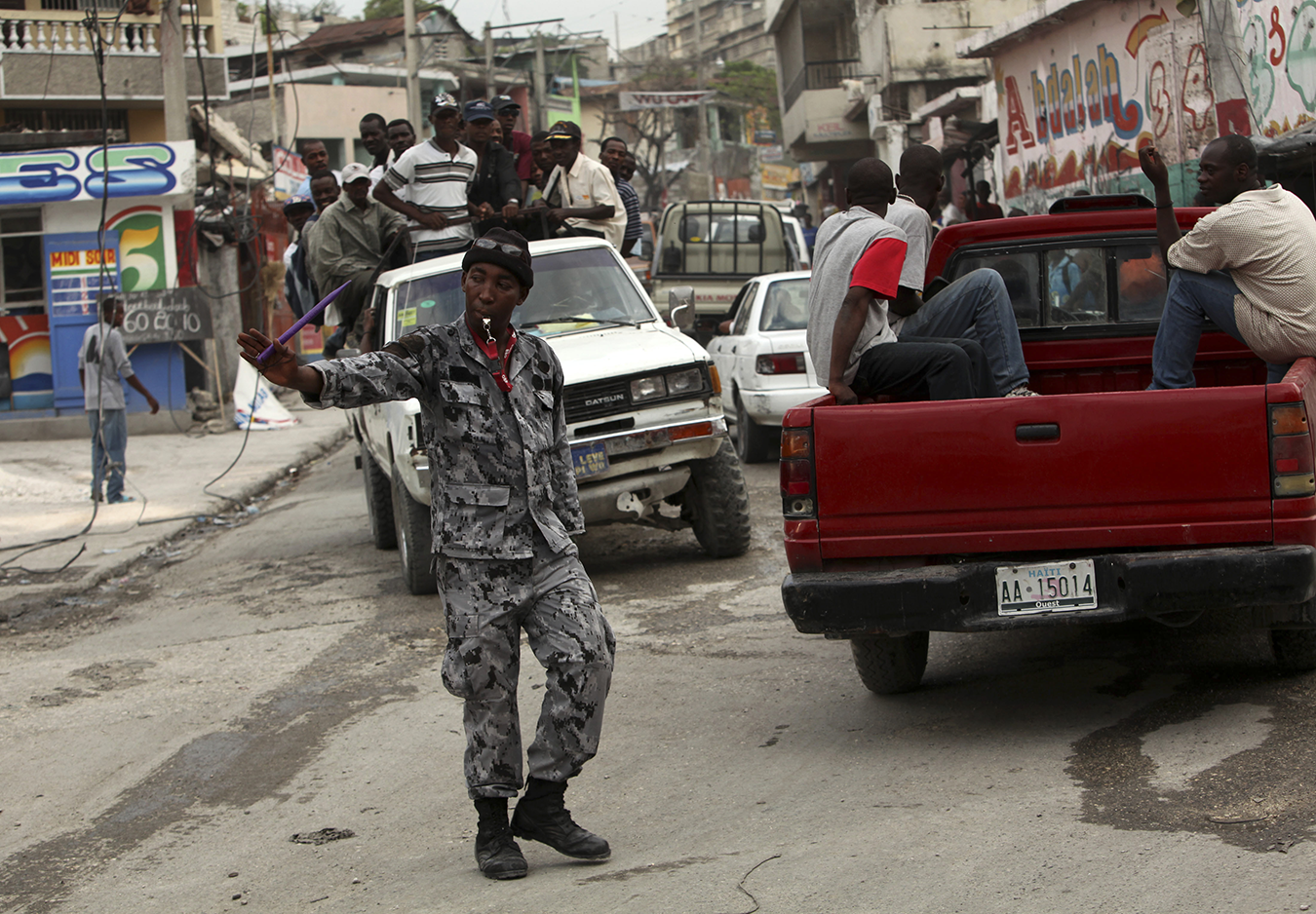
Levy Azor, better known as Du Du, directs traffic (James Estrin/The New York Times/Redux, 2010).
Acting in the present, Du Du gives no indication that he is attending to ‘conditions of possibility’ (Aradau and Van Munster, 2012: 98). His work of reordering the present nonetheless instills hope for the future in those who see him, just as spatial manipulations of downtown Manhattan alleviated the fears of residents who suffered the shock of the 9/11 attacks. It is a display of ‘life reasserting itself without language’ (Gregory, 2011: 16). While Gregory uses the phrase to describe the re-emergence of animal life in a bombed-out urban landscape of postwar Germany, I find it an apt description of a kind of performative place-making that relies not on word but gesture, more conscious, articulate and aesthetic than instinctual, but still infused with the urgency that catastrophe instills, rooted in the basic stirrings of life as denizens move toward re-establishing order to their disordered landscape, restoring their personal health by forming new relations with their altered surroundings (Philo, 2007). In the same piece, Gregory (2011: 13) relates the tale of an author who complains that the bombed landscape ‘cried out for more eloquence than he could muster’. The power of performance as a place-making technique is exactly the capacity to succeed in environments where words fail. Gregory makes the point that places and landscapes that have been so thoroughly destroyed can be so incomprehensible as to render ordinary language useless, with sentences emerging as broken as the streets of the bombed city. Under conditions of catastrophic disruption, still and moving images convey the scene while language fails, with the curve of a line, the sweep of an arm, and the tweet of a whistle restoring order to disrupted minds and landscapes.
Performance blends and blurs the relation between movement and representation. The iconic photos of Jackson Pollock dripping and splashing paint onto a large canvas that he has lain flat on the floor are perhaps greater representations of his work than the paintings themselves (Ketchum, 2011a). The artist who works with images rather than words is in a sense much more free as his medium of expression is less restricted by social convention. Visual artists therefore are better positioned to be innovators because visual expression is more easily produced and circulated and more durable in its expressive capacity under catastrophic conditions. Culture exists as much in its making as in the product that is made, with meaning emerging from representations as well as their performance and circulation, which is also a kind of performance, as it imbues a ‘violently unbuilt’ landscape with import only as it passes through places and memories that that are still intact (Ketchum, 2011b: 173).
IV Conclusion
All the culture that is most truly native centers round things which even when they are communal are not official – the pub, the football match, the back garden, the fireside, and the ‘nice cup of tea’ (Orwell, 1970 [1946]).
While relief institutions have deployed the arts and humanities in certain instances, mostly as instruments of communication, I hold that individual uses reveal their broader strengths. By producing works of art in public places in response to the 2010 Haitian earthquake, Jerry expresses his own subjectivity as well as the subjectivities of the others he observes. Those who in turn observe the images he produces recognize both individual and collective responses to the tragedy, a form of engagement that helps build collective and individual trust through the inclusion that informed it and that it represents. Du Du’s work, which acts more through performance than object production, also restores order to torn lives and landscapes. Having suffered ruptures to both his body and place, Du Du heals by operating in both individual and collective registers, his single recovery fostering collective recovery through an activity that is nothing less than an artful performance but still of great instrumental value as it re-establishes his and others’ local material order. Given that place derives partly from subjective engagement, that imagination is a key facet of subjectivity, and that the relation between subject and place is essential to resilience at both individual and collective scales, humanistic activities such as those performed by Jerry and Du Du emerge as essential to the post-disaster recovery process.
In any place that has been broken by human or natural catastrophe, people consciously and instinctively start working toward restoring order to their disrupted lives. Contrary to a common post-disaster narrative, survivors of catastrophic events are not so traumatized that they can do little but wait for outside assistance, but are quite capable of acting on their best instincts and ideas for survival. Art-making emerges as a form of place-making that works even and perhaps especially in the ruin and despair produced by catastrophe.
Footnotes
Funding
This research was supported by a grant from the Institute for Humanities Research at Arizona State University.