







Abstract
Human geographers actively studied ports in past decades. However, the extent to which port geography constituted a specific research stream within human geography remained largely unanswered. By reviewing 399 port papers published in major geography journals, the authors critically investigated the trends and changing tides of port geography research. The findings point out the emergence of the core community shifting from mainstream geography research to increasing connection with other disciplines, notably transport studies. The paper offers a progressive view on human geographers’ abilities to form a research community on port development, while identifying opportunities in the pursuit of collaboration between different academic disciplines.
I Introduction
Being the point of interaction between land and sea, ports traditionally served as the economic and cultural centres of cities and surrounding regions. However, the contemporary technological advancement in shipping, increase in international trade and the global division of labour had fundamentally transformed the nature of ports. Notably, the ‘terminalization’ of port operations greatly modified their roles in transport networks and global supply chains, which implied an increased spatial and functional segregation between port, urban and regional activities (Ng, 2012; Olivier and Slack, 2006). In this regard, human geographers were active in the description of ports’ evolution and development, providing numerous theoretical/conceptual models and empirical cases in the past decades. The publication of influential books (e.g. Hall et al., 2011; Hoyle and Hilling, 1984; Hoyle and Pinder, 1992; Notteboom et al., 2009; Pinder and Slack, 2004; Wang et al., 2007) and scholarly papers (to be further discussed) by transport geographers became increasingly important in defining the evolution and research trends of port geography alongside other academic disciplines, such as economics, operational research, management, to name but a few. Indeed, ports, as seen by Shaw and Sidaway (2011), are one of the potential sub-tracks through which transport geography can possibly improve its position within future human geography research. In 2012, a special issue, entitled ‘The Geography of Maritime Transportation: Space as a Perspective in Maritime Research’ was featured in Maritime Policy & Management (volume 39, number 2), a flagship journal in port and shipping research. This strengthened the proposition that human geographers, as well as geographical theories and concepts, could offer important contributions to port research, and that the experiences from ports could significantly contribute to progress discussions and debates in contemporary issues within human geography (Ng and Wilmsmeier, 2012). Several other special issues dedicated to ports were also published in mainstream geography journals, such as Tijdschrift voor Economische en Sociale Geografie (TESG) in 1996, GeoJournal in 1986 and 2009, and Environment and Planning A in 2006 about the interrelations between economic and transport geographies, including a number of port articles at centre stage.
Despite such abundance, several challenging research questions have yet to be answered satisfactorily: to what extents do port geographers constitute a specific research body, and how have they adapted to changes in both port development and research? Were they, as claimed by Keeling (2007), stuck in the narrow confines of network structure and flows? While acknowledging the existence of previous reviews on port research, those overwhelmingly focused on the economic, management and performance aspects of ports and did not explicitly identify port geography papers as a distinct research arena (for example, Heaver, 2006; Pallis et al., 2010, 2011; Suykens and van de Voorde, 1998; Woo et al., 2011), 1 despite the fact that port geography often (tried to) distinguished itself from port studies within other disciplines (Ng, 2013). Hence, despite the featuring of nearly 400 port papers in major (human) geography journals since the 1950s, until now, there are inadequate systematic investigations on the nature, evolution and research trends of port geography, with Ng (2013) being the only notable exception to date. However, while he had reviewed the historical evolution of port geography papers since the late 1960s, important research gaps are yet to be filled: how did port geographers identify themselves? What was the nature and structure of the port geography research community? What were the impacts of their works on human geography and other scientific disciplines? To what extent were they receptive to the ideas and contribution from other scientific disciplines, and how was such influence reflected in their research works? More importantly, there is an urgent need to assess whether diversification exists in authorships and citations throughout geography and other scientific disciplines, and whether port geography has a trend of following the latter, especially given the increasing interdisciplinary nature of port research through collaboration between scholars from diversified academic backgrounds (Rigg et al., 2012). The extent of the influences and diffusion of the research works by port geographers to human geography and other scientific disciplines – their ‘social network’ within the scholarly community – would be pivotal to provide a comprehensive insight to existing and future port geographers on a future research direction.
Understanding such a necessity, this paper analyses the changing tides of port geography through a bibliometric analysis of 399 port geography papers published in major international scholarly geography journals between 1950 and 2012. It provides a general picture of the terrain of port geographyresearch, highlighting its key characteristics and transformation. Second, it applies social network analysis (SNA) methods to investigate the cohesiveness of the port geography papers community internally and in relation to both human geography and other scientific disciplines, mainly based on citations and co-authorships. This study is a prompt response to the work by Ng (2013), who calls for further research on citation analysis so as to comprehensively understand the dynamics between port geographers, (non-port) geographers and scientists from other academic disciplines. By doing so, one can understand what the scope and influence of port geography research has been, while highlighting the most central publications and their linkages. It provides human geographers, and other researchers, with a clearer view of their abilities to form a research community and to tackle crucial issues on port development, while identifying weaknesses and new opportunities in the pursuit of increased interactions between scholars from different scientific disciplines. The rest of the paper is structured as follows. The study sample, methodology and results are described and illustrated in sections II and III, respectively, while the analytical discussion and conclusion can be found in section IV.
II Study sample
To investigate the stated research questions, we reviewed a sample of most of the important peer-reviewed port geography papers published in internationally recognized geography journals. The journals listed in Table 1 are those that had featured at least one port geography paper between 1950 and 2012, recognizing that fundamental transformation of contemporary shipping and ports started to take root in the 1950s (cf. Heaver, 2002).
Distribution of port geography papers by journal and period, 1950–2012.
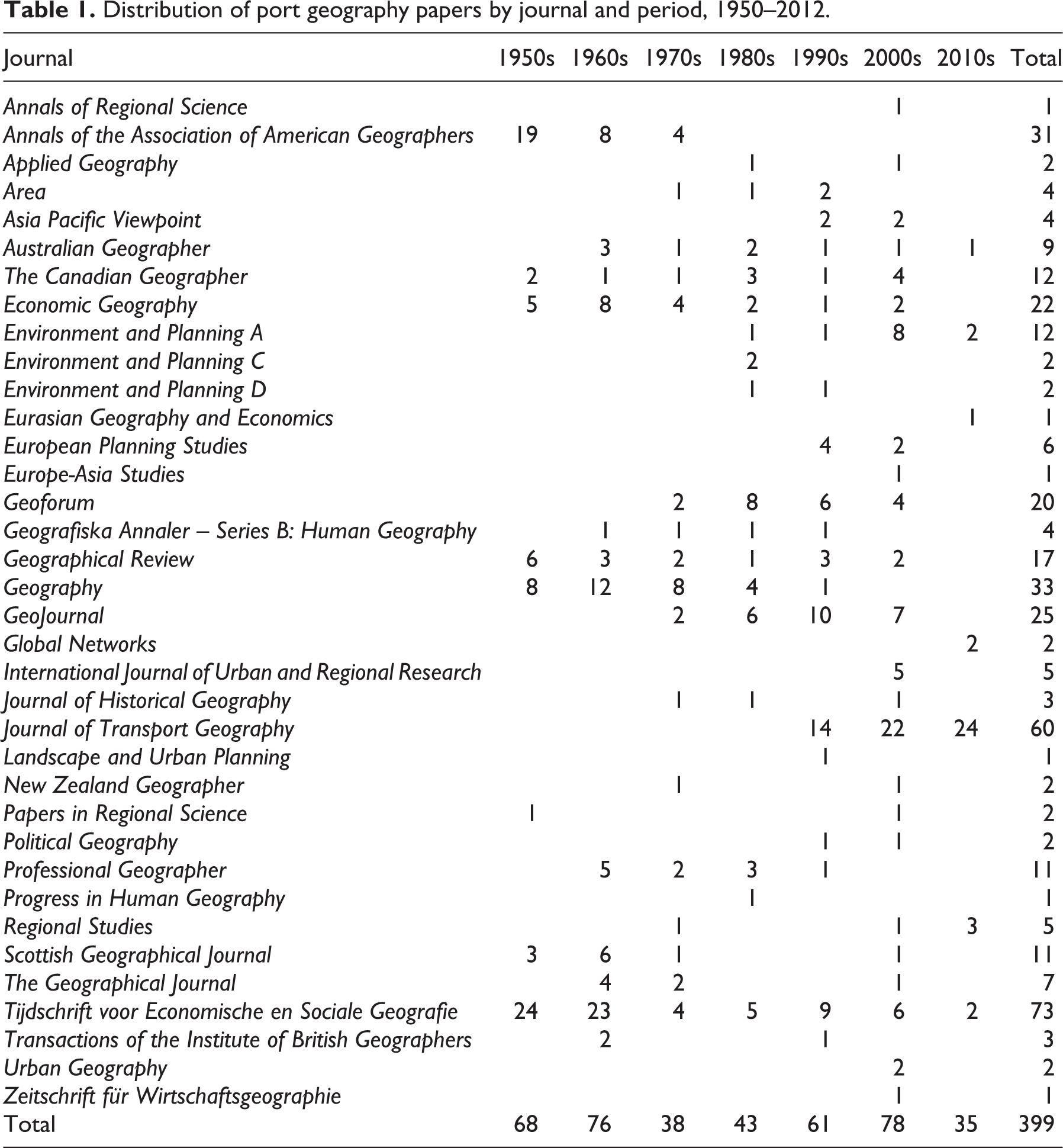
Together the journals listed in Table 1 featured 399 papers (co-)authored by 328 authors in 36 (human) geography scholarly journals. See Appendix I for the full list of port geography papers included in this study. Also, the list only consisted of papers published in English, while other types of publications (e.g. books, conference papers, book chapters, theses, professional magazines) were excluded.
Papers were chosen for their central focus on port-related issues while geography journals are those listed in the ISI Web of Knowledge to which we have added GeoJournal, due to its international character. Papers addressing port-related issues in a very secondary manner were excluded, as in the case of some about shipping trends or urban waterfronts where ports themselves were not discussed in detail. Due to the fact that many papers about ports have been published in non-geographical journals, thus making the boundaries of port geography rather fuzzy, an ‘extended port geography’ corpus of 329 papers has been selected on the basis of the following inclusive criteria:
at least one citation of and/or by a core port geography paper;
a central interest on port-related issues;
the recognition of differences across space between locations.
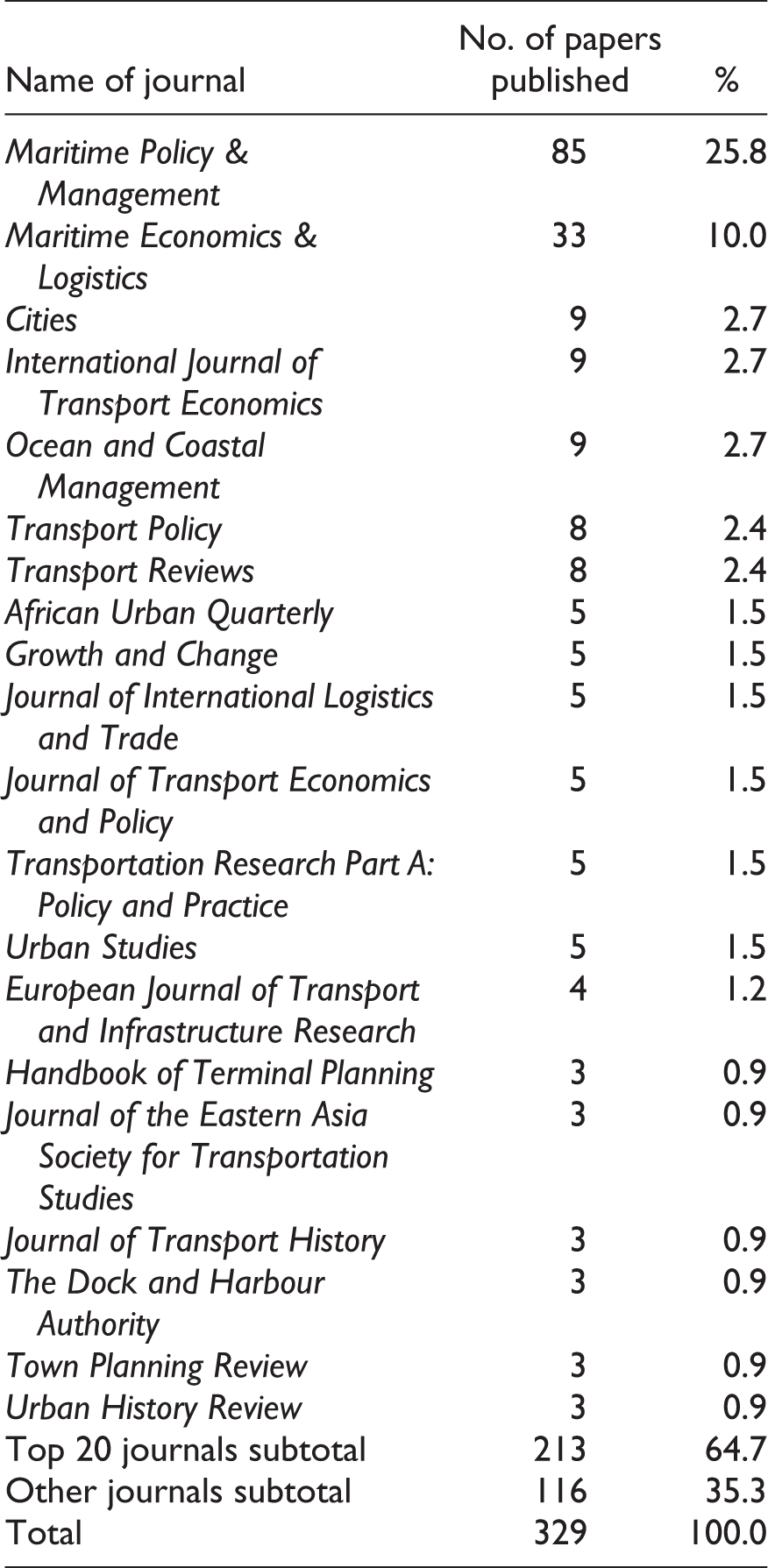
A main difference between core and extended port geography is the importance given to geographical elements in the review process. Yet some extended port geography papers may in reality more strongly develop spatial and/or geographical issues than some core geography papers, while giving privilege to other aspects such as policy, governance and operations. The major journals that have published extended port geography papers in our study period are listed in Appendix II. Here it was not difficult to find that the extended port geography papers concentrated on (maritime) transport (e.g. Maritime Policy & Management, Maritime Economics & Logistics, Transport Policy) and urban/regional planning journals (e.g. Cities, Growth and Change, Urban Studies). Over the entire period under our consideration, 107 journals published 279 extended port geography papers, of which 50% were concentrated in 10 journals only, in which Cities and Growth and Change are the only non-transport journals. All the disciplines are represented, from history to planning, economics, business management and even anthropology.
To facilitate the analysis, the study period was divided either by decades or into four ‘subperiods’ (1950–1974, 1975–1990, 1991–2001 and 2002–2012). Generally speaking, the former and latter two periods can be understood as the ‘classical’ and ‘contemporary’ ages in port geography papers research, respectively (cf. Ng, 2013). Such a division was also supported by Pallis et al. (2010) who indicated that the early 1990s served as a watershed in which research interests in the port sector (both geography and non-geography) had grown substantially. The approach applied to our sample rests on collaboration (co-authorship) and citation analysis within and between papers. Collaborations are analysed on the basis of authors having written together some of the articles, which allows for measuring the rate of single-authored papers and representing the network of co-authors at different periods so as to verify its underlying community structure. Although admittedly there are different reasons for a paper to be cited, still, citations provide highly useful data to measure and map the evolution of inbound and outbound influences of a given corpus (Newman, 2010).
III Results
1 Production of port geography papers
Figure 1 illustrates the trend of port geography papers published in major geography and other journals between 1950 and 2012. Following a period of prominent activities in the 1950s and 1960s, there is a noticeable drop in the number of core port geography papers since the 1970s, while the production level goes back to that of the 1960s only in the 2000s. This trend occurs in parallel with a regular growth of extended port geography papers, thereby making the total reach unprecedented volumes in the last decade. Indeed, papers published outside geography journals have increased their share from about 4% in the 1950s to 58% in the 2010s, thereby becoming dominant in the total. In fact, core port geography has remained somewhat stable along the period in comparison with extended port geography. This underlines a very important shift with port geographers moving towards more specialized journals and a lesser interest in major geographical thought from other port specialists.
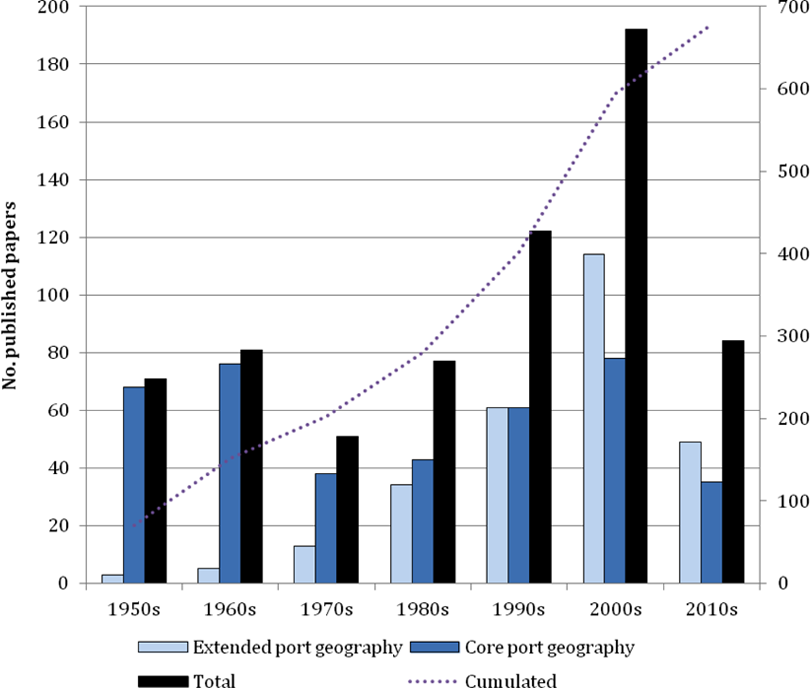
Production trend: core port geography versus extended port geography papers, 1950–2012.
Certain geography journals published port geography papers only during the early years (before 1990). Among them, AAG had 31 such papers between 1950 and 1979, while GEG had 33 between 1950 and 1989. On the contrary, some geography journals featured more port geography papers recently, such as EPA, EPS, GEF and GEJ, to name but a few. Since 1980, EPA and GEJ had featured 12 and 23 such papers, respectively. Despite a certain decline, there was a rather stable distribution of port geography papers in particular geography journals, such as TEG, GRV and ECG. For example, a roughly even distribution of port geography papers could be found in TESG between 1950 and 2012. When this study took place, it had 73 papers on port geography research. ECG and GRV have 22 and 17 papers, respectively, throughout the indicated period. Also, it was interesting to note that JTG possessed the largest number of port geography papers. Though only being established in 1993 (very recent when compared to most other geography journals), it featured 60 port geography papers, and had become one of the most important geography outlets for port geography papers in the past two decades. The rest appear to have had a relatively minor role in port geography papers production, except for EPA (of which, as mentioned earlier, a special issue dedicated to port geography was published in 2006), PRG (until the 1990s) and CAG. This suggests a retreat of port geography papers from major ‘general’ (human) geography journals that cover a wide diversity of issues and focus on innovative research, and a concentration upon more specialized journals keeping a demand for more port-dedicated topics. As seen from Table 1, geography journals were more advanced in the production about ports but they have become quantitatively secondary compared with the total of other journals since the 1980s. In this regard, JTG is largely credited for the maintained production of core port geography papers and its slight ‘recovery’ during the 2010s, without which this field would may have simply disappeared from geography journals, as it concentrated 23%, 28% and 69% of all core port geography production since the 1990s. Such a trend may be explained by three main (and complementary) factors:
Geographers once interested in ports have diverted their interest towards other topics more in accordance with mainstream geography, notably with the decline of the quantitative turn during the 1980s affecting transport geography in general (Waters, 2006), and the increasing preference for other transport modes such as railway and aviation, urban mobility, communication and the more ‘virtual’, rather than freight, flows (Hall and Hesse, 2012). Some renowned scholars are identified in the core port geography corpus in the early period, such as a paper by the French geographer Jean Gottmann (1961) on the port of Baltimore, published in the same year as his seminal work where the concept of megalopolis was first proposed based on the case of the US northeastern seaboard urban concentration.
Geographers interested in ports have increasingly emphasized the applied dimension of their works by publishing in other journals, such as transport journals, with a tendency to address spatial and territorial issues in a secondary manner compared with economic and management issues, while promoting spatial and territorial issues towards other non-geographical fields. This trend occurred in parallel with the former whereby most geographers once interested in ports shifted their focus toward wider urban and mobility issues, while others such as James Bird led a radical ‘crusade’ against the ignorance of port activities and functions by urban spatial models such as the central place theory, and proposed general books where the port received foremost attention alongside other locally grounded activities (see Bird, 1977).
Perhaps, this also implies that port geographers have found it increasingly difficult to innovate in human geography itself while getting closer to their specific industry of interest. In relation with the former factors, the growing specialization of port specialists and the growing distance from general discussions on mobility, flows, space and scale, for instance, accelerated their retreat from mainstream geography journals that in the mean time had to strengthen their audience, with a growing importance of impact factors and innovative approaches.
Alongside such trends, there also has been an evolution of the geographical coverage of the corpus both in terms of affiliations and study focus (Figure 2). One noticeable tendency is the decrease and increase of African and Asian research, respectively, while Europe has gained ground compared with the Americas and Oceania. Europe constitutes about 70% of affiliations and 50% of research foci in the early 2010s. This situation is the inverse of the one in the 1950s, with the notable exception that North American ports have never attracted as much attention as European ports. Europe has indeed been a fertile ground for studies of port competition but also supply chain management in relation to ports, as well as urban waterfront redevelopments. Another explanation is the wider context of those studies: decolonization (mostly completed in the early 1980s) is largely responsible for the decline of port-related African studies, while many theories and models used by geographers originate from African regions, such as the ideal-typical sequence model of corridor development by Taaffe et al. (1963). The growing interest for Asia mainly comes from the close connection of export-oriented and free zone policies (like China's Open Door Policy) with port development across the region that includes many of the world’s major ports such as Hong Kong and Singapore, but also South Korea and China. Such trends indicate that the evolution of port geography well illustrates the evolution of the world economy and of human geography as a whole, notwithstanding certain gaps to be further addressed in the following sections.
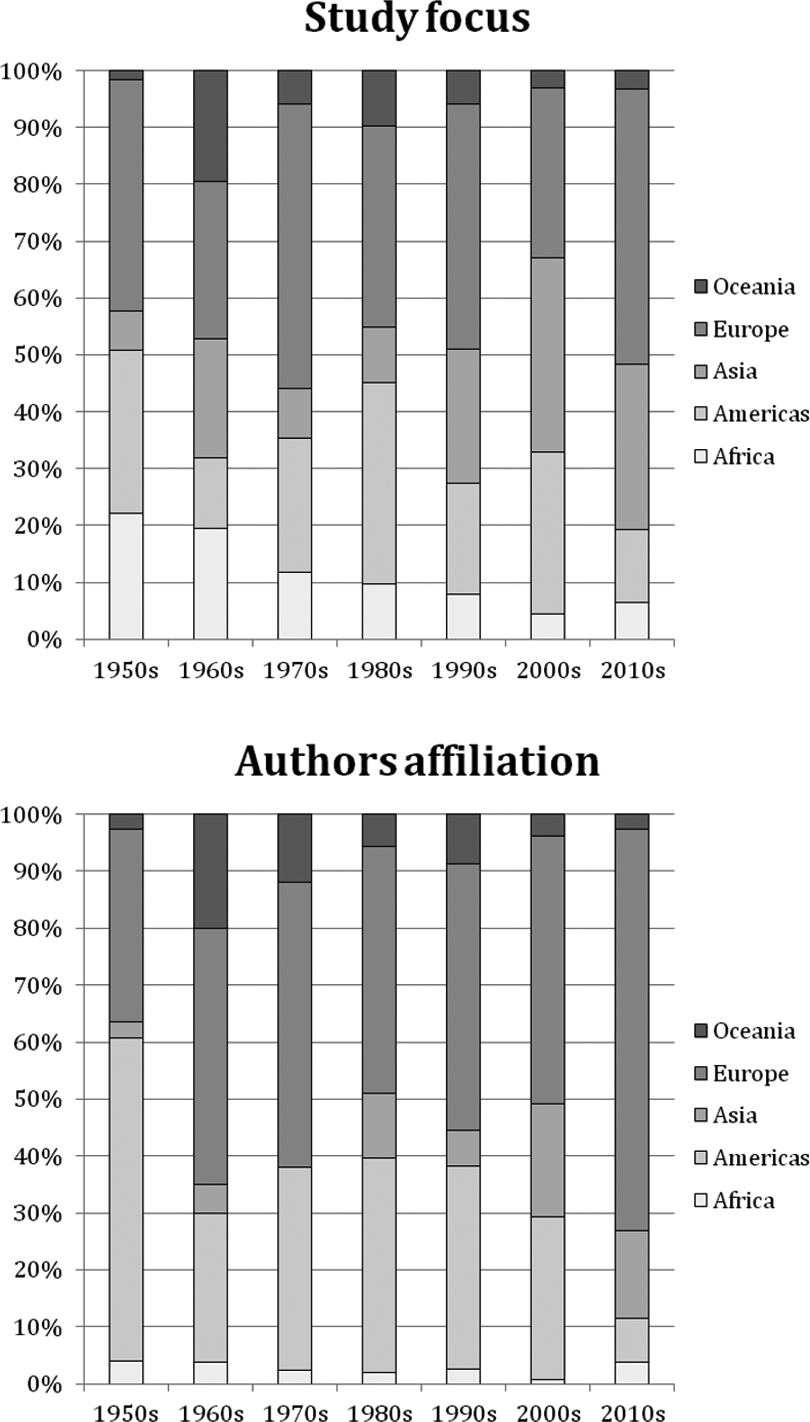
The geographical coverage of port geography papers, 1950–2012.
2 Collaborations: the emergence of a community?
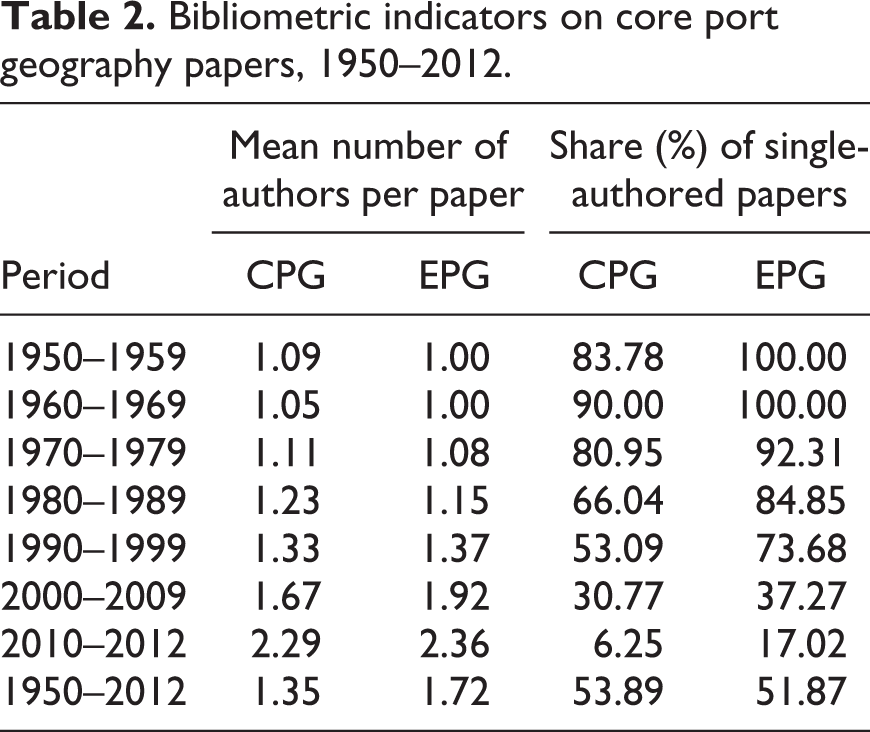
As suggested by Newman (2004), the mean number of authors per paper, as well as the percentage of single-author papers, is an interesting indicator to look at when considering a given scientific corpus and its collaboration dynamics. In the case of port geography papers (Table 2), there has been a continuous increase in the total and average number of authors since the 1950s as well as a continuous decrease in single-authored papers. However, still in the 1980s, 66% of all port geography papers were single-authored, half in the 1990s, before a sudden drop in the 2000s (to 31%) and the 2010s (to 6%). In fact, such a trend is comparable among core and extended port geography, with a slightly more collaborative profile for extended port geography due to its higher average number of authors, but core port geography keeps a lower share of single-authored papers than the latter along the period.
Bibliometric indicators on core port geography papers, 1950–2012.
Mapping the collaborations (Figure 3) among authors at distinct periods confirms the fragmentation of research during the first phases (1950–1974, 1975–1990) where collaborations are the exceptions rather than the rule, followed by the emergence of larger – albeit still small and isolated – subgroups in 1991–2001, and of a giant component connecting the majority of researchers in 2002–2012. In the latter period, 45 of the 102 authors are connected directly or indirectly, thus forming a community. The rest of the authors form separated cliques (or isolates), as they have never formally collaborated with the central community.
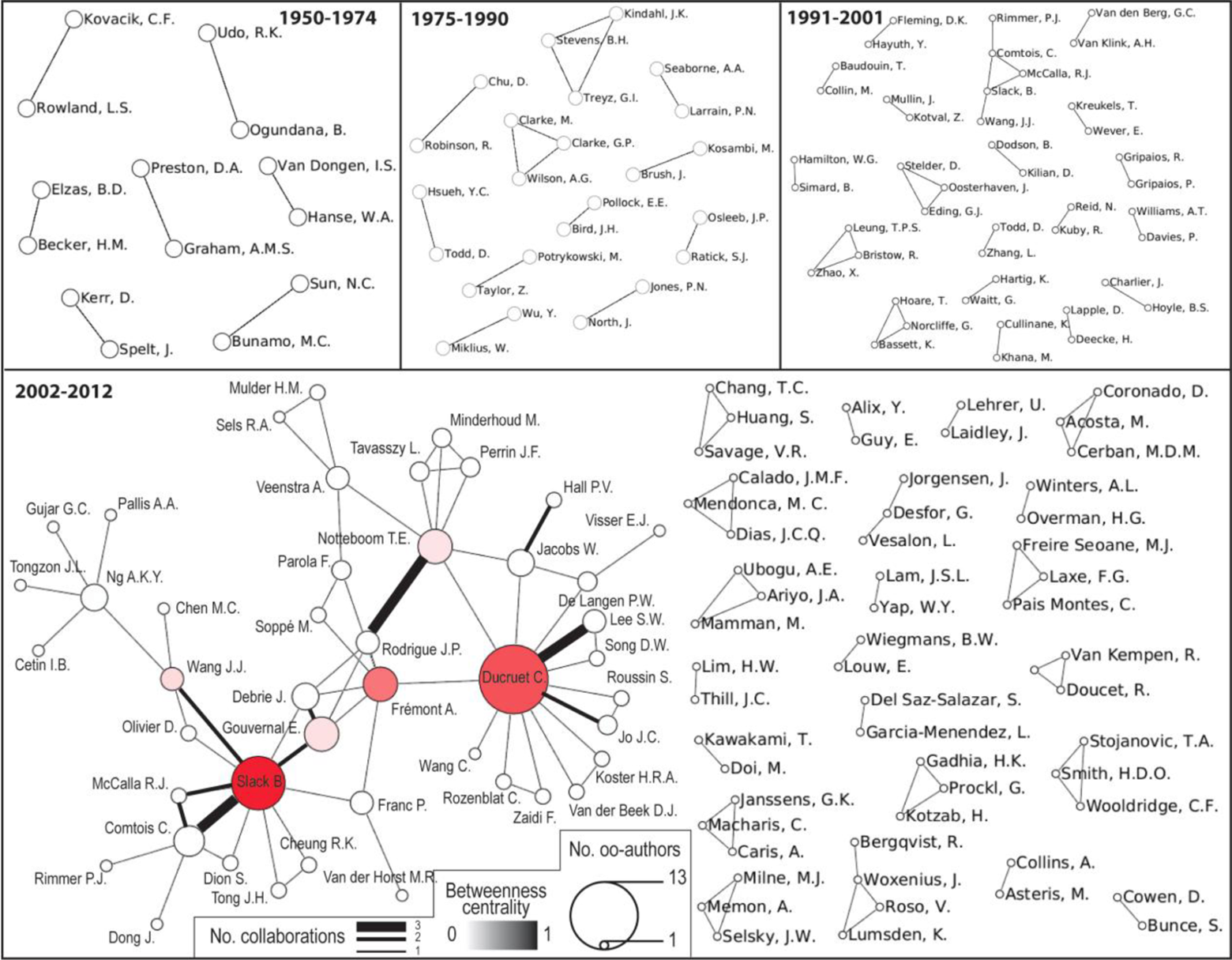
Graph illustrating co-authorships across core port geography papers, 1950–2012.
An interesting trend is that the largest – albeit very small – component in 1991–2001 rests on some Canadian authors being well represented in the second period (i.e. Slack, Rodrigue and Comtois). This Canadian clique forms in the second period a larger ensemble connected directly with Asian and French colleagues. Calculating the ‘betweenness’ centrality of authors in the network (greyscale in Figure 3) confirms the strong correlation with the number of collaborations (size) as well as identifying the main brokers (Newman, 2004). While Slack, Ducruet and Notteboom are the most collaborative, the overall structure is strongly dependent upon the ‘brokering’ role of Frémont between those three subgroups. The latter author has notably pioneered a biannual meeting of port geographers welcoming most of the connected researchers (Le Havre in 2003, Hong Kong in 2005, Antwerp and Rotterdam in 2007 and Montréal in 2009). This community is largely French-speaking, though it collaborates mostly in English and the three aforementioned main poles broadly correspond to France-Canada-Asia (Slack and Frémont), Belgium-Netherlands (Notteboom) and Europe-Asia (Ducruet). The extent to which this community will be maintained, further integrated or disintegrated will depend on upcoming publications in the field as well as on further collaborative efforts. At present, the relatively strong density of the core community as reflected by an average clustering coefficient of 0.64 is in fact dependent upon a few large nodes having distinct subgroups and limited transversal linkages.
3 Port geography papers citing: background and imports
The counting and classification of citations by port geography papers by decade clearly underlines a trend of background diversification (Figure 4). The first period is characterized by a dominance of geographical inspiration, but from the 1970s onwards the share of geography journals of which core port geography papers are a part is constantly dropping, from 85% of all citations in the 1950s and 1960s to about 35% in the 2010s. Transport journals have become dominant in the last period, from 8% in the 1960s to 28% in the 2010s. Although citations of core port geography papers have dropped from 43% in the 1950s to 22% in the current decade, the combined share of core and extended port geography papers remains somewhat stable along the period, from 48% in the 1950s to 39% in the 2010s. On the one hand, port geographers shifted their knowledge sources towards more specialized works in various fields (e.g. economics, management, transport and logistics), but on the other hand they have valued port geography papers themselves and the spatial approach to ports outside their original nest (geographical journals). It may have become necessary for port geographers to confront their own views with the ones of transport specialists while adopting concepts and methods from other mainstream research arenas. Such results are largely influenced by the aforementioned shift of port geographers towards transport journals.
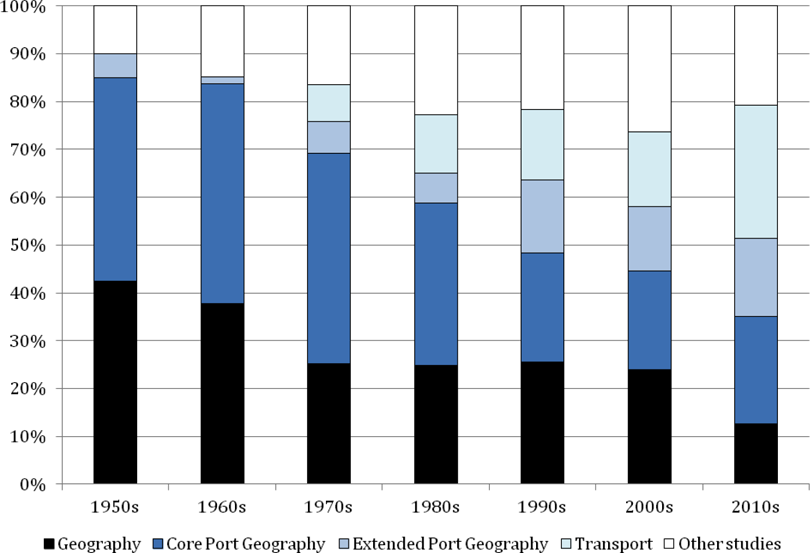
Distribution of journal papers under different disciplines cited by core port geography papers, 1950–2012.
Another way to better understand the changing scope and nature of port geography papers is to build a database of papers cited by port geographers. Choosing papers as the unit of analysis rather than authors (or journals) avoids the problems of multiple authors. The resulting directed graph of citations based on port geography papers citing other papers contains 2698 papers and 4507 links among them when the whole period (1950–2012) is considered. However, in the graph, citations between core port geography papers were removed so as to better understand the connecting role of other papers between them. This operation also makes the graphs more readable, lowers the probability of self-citations in the corpus that would inflate papers’ centralities, and tests whether the citations graph remains connected and how, despite the removal of internal links. Papers are differentiated by a different colour according to their main research areas as in the previous figures, and the size of nodes represents the betweenness centrality of the papers, i.e., their overall accessibility as measured by the number of occurrences on the shortest possible paths across the entire network. This indicator has been preferred to in-degree (the number of times a paper is cited) in order to better identify bridge positions: it better expresses whether a paper is pivotal in the circulation of knowledge within the entire corpus, regardless of its volume of citations, as the top papers are usually known by scholars in the field. However, betweenness centrality may be artificially inflated in the case of papers being at the edge of the network while being the only access to it for a few other papers. A Gem-Frick visualization algorithm (TULIP software) is applied to represent the results with most central papers in the middle of the figures and less-connected papers at its periphery, while topological proximity in the graph might in fact illustrate other proximities such as geographical and/or disciplinary. This analysis is useful to detect key papers and to verify the role of disciplinary belonging in network formation and knowledge diffusion: how are port geography papers dependent on other scientific disciplines as well as on their own, and how homogenous are their scientific backgrounds?
The four stated periods are compared in Figure 5. In the first period (1955–1974), most connected papers forming two important subgroups belong to core port geography and constitute the backbone of the network, among which are the two seminal essays of Weigend (1956, 1958) on port geography and the spatial model of port evolution provided by Rimmer (1967) with an application to Australia as well as his work on port classification (1966). The fact that the largest component is centred upon a geography paper, the ideal-typical phased model of corridor development by Taaffe et al. (1963), is emblematic of this ‘classic’ period during which port studies were well integrated with wider geographical approaches. The rest of the network, however, which still comprises the majority of works, remains rather dispersed. A distinct community appears, however, with the works of Hanse and Van Dongen (1956, 1958) on African ports. The works of Mayer (1955) on Chicago, Bird (1965) on Australia and on theoretical aspects (1970), and Hilling (1969) and Ogundana (1972) on Africa also tend to have developed in relative autarchy. There seems to be a strong regional specialization among port geographers in complement to a number of general approaches, reflecting upon Figure 2 with a high share of research on Africa during this period. Even the same authors’ papers remain disconnected, such as Hoyle’s work on African ports (1967, 1968). Other isolates are better explained by their original approach outside the ‘mainstream’, such as the work on images of colonial Port Royal by Kovacik and Rowland (1973) and the one of Fordham (1970) on port-airport interactions. Interestingly, there is a tendency for isolated papers to focus more on non-geographical sources than on port geography itself.

Graph illustrating citations by core port geography papers, 1950–2012.
The second period (1975–1990) provides a similar network pattern with a core community centred upon port geography papers and some isolates or peripheral papers with a more diversified background. The model of Taaffe et al. (1963) remains central to port geography papers for the aforementioned reasons. Most papers are still general surveys and discussions, such as the one of Bird (1980) on gateways, Hayuth (1981) on load centres, Hilling (1983) on developing countries, and Hoyle (1989) on the port-city interface, and Slack (1980) on technological changes in sea transport. Future evolutions of port geography papers seem to have given privilege to the second influence, namely the economic dimension rather than spatial analysis. Some papers remain rather central although they barely connect with other port geographical works, such as Hoare (1986) on British ports and Miklius and Wu (1988) on forecasts, while some other papers are not connected at all. The latter are, again, characterized by case studies on developing countries such as Hoyle (1978, 1986), Omiunu (1989) and Stanley (1990) on African ports, as well as McCalla (1990) on free zones. Another characteristic of isolates is their dominant economic focus, such as Slack (1989) on the port service industry, but also Wallace (1975) on Canadian ports, Kinsey (1981) and Stevens et al. (1981) on impact multipliers and economic effects of port activities, West (1989) on economic rents, and Suykens (1989) on port-city economic relationships, while others are more characterized by historical approaches (Pred, 1984) and recreational issues (Sant, 1990). Most case studies still remain very much western-focused, such as Slack (1990) on US inland load centres, Hayuth (1988) on the US container port system, and O’Connor (1989) on Australia, with the exception of Marti (1985) on Chilean ports.
The third period (1991–2001) is defined by a significant reduction in the number of isolates and by an overall diversification of papers’ background (Figure 4). One dominant community contains the majority of papers. One drastic change is the highest centrality of case studies on ports outside western countries, such as East Africa (Hoyle and Charlier, 1995), Hong Kong (Airriess, 2001; Wang, 1998) and Singapore (Airriess, 2001), but also China outside the largest component (Todd, 1993, 1997). Other core papers continue to develop classical issues such as urban waterfronts (Hoyle, 2000; Norcliffe et al., 1996) with a focus on western ports such as Notteboom (1997) and Charlier (1996) on the European and Benelux port systems, respectively. General papers are not the most central but keep important positions, as seen with the discussion by Van Klink and Van den Berg (1998) on gateways and intermodalism, Van Klink (1998) on port networks, and Cullinane and Khana (2000) on the geographical implications of growing vessel sizes. As in the previous periods, the ‘peripheral’ papers are those having a distinct focus, such as geohistorical (Castree, 2000; Herod, 1997, 1998; Waitt and Hartig, 1997) and cultural (Stevenson, 1999), or discussing specific issues such as clusters and spillovers (Oosterhaven et al., 2001) without sharing references with other port geography papers. Important papers outside the port geography paper category are in fact the work of port geographers, such as Charlier and Ridolfi (1994) on intermodalism. Friedmann (1986) on the world city hypothesis is one of the rare non-geographical works to stand out, but it remains at the periphery.
Finally, the fourth period (2002–2012) is marked by high network complexity due to the large number of papers being considered and their intricate relations. The main trend is the highest centrality of papers offering a synthesis to port geography papers; they innovate by either providing new concepts, such as Lee et al. (2008) on global hub port cities, Lee and Ducruet (2009) on spatial glocalization, Notteboom (2010) on multi-port gateway regions, Ng and Pallis (2010) on institutions and port governance, and Jacobs and Notteboom (2011) on evolutionary perspectives, or through large-scale empirical applications of classical methods such as Ducruet and Notteboom (2012) visualizing and measuring the worldwide maritime network of container shipping. Papers standing out while being well connected with the core are thus those making links with other fields outside port geography papers, other examples being Fowler (2006) on networks, Ng and Tongzon (2010) on dry ports, O’Connor (2010) on global city regions and logistics, Franc and Van der Horst (2010) on hinterland service integration, and Wang and Ducruet (2012) on the emergence of the Shanghai-Yangshan multi-layered gateway hub. A major difference with the former period is the highest centrality score attributed to an extended port geography paper about port regionalization (Notteboom and Rodrigue, 2005). Transport papers have gained enormous importance in the network compared with previous periods, such as Robinson (2002) on ports in value-driven chain systems, Slack et al. (2002) on strategic alliances, and Notteboom and Winkelmans (2001) on the challenges of ports when facing structural changes in logistics. Most ‘peripheral’ port geography papers are in fact much closer to urban-related issues as they principally focus on waterfronts (e.g. Oakley, 2009) or on specific issues such as remote sensing (Kaiser, 2009). The graph is in fact organized by regions, with waterfront and social issues on the left having more connections with geographical issues and fewer with the transport field, and transport issues on the right being less connected with geography and other fields. By no means has port geography evolved from a scattered community to a more tightly connected one in terms of shared ideas and concepts, but undeniably the reference to geography has shifted to the periphery while transport studies have become more central in the graph.
4 Port geography papers cited: diffusion and exports
The distribution of papers citing port geography papers exhibits a very similar trend with the previous analysis, with an increasing share of transport and other journals compared with geography and port geography papers (Figure 6). Yet the proportion of transport journals has reached only 13.5%, and geographical journals of which core port geography papers are a part are still occupying a 41% share in the 2010s. There is clearly a significant imbalance between citing and being cited by others, and this suggests that port geography has widened its scope (previous analysis) in greater ways than its influence towards other disciplines. Another difference with the previous analysis is the growing interests for port geography papers by geographical research until the late 1970s, which decreases gradually since the 1980s. This can be attributed to the behavioural turn in geography having increasingly disregarded transportation issues due to their close affinity with spatial analysis (Waters, 2006). Except from the 1970s, port geography as a whole (core and extended) oscillated at around 45–50% of all citations, which is far above the 34–39% level for the previous analysis. This imbalance between imports and exports remains a weakness of port geography research since its papers are more cited by itself than by other fields.
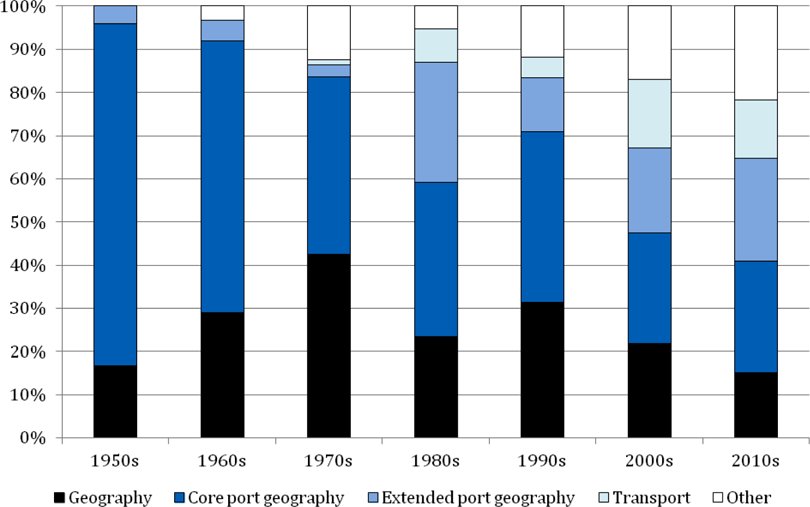
Distribution of papers under different disciplines citing core port geography papers, 1950–2012.
The network analysis of papers citing port geography papers is applied in the same way as the previous analysis. It excludes, however, citations from port geography papers because this would provide similar results. Each port geography paper has been retrieved through the use of Scopus and Google Scholar, and all citations to those papers were compiled while keeping only the peer-reviewed journals. As a complement to the previous analysis in the last subsection, it aims to reveal which papers have attracted most attention from other disciplines at different periods as well as the existence of one or several communities with shared issues and backgrounds (Figure 7). Periods are identical to the previous analysis and they are based on the publication year of citing papers.
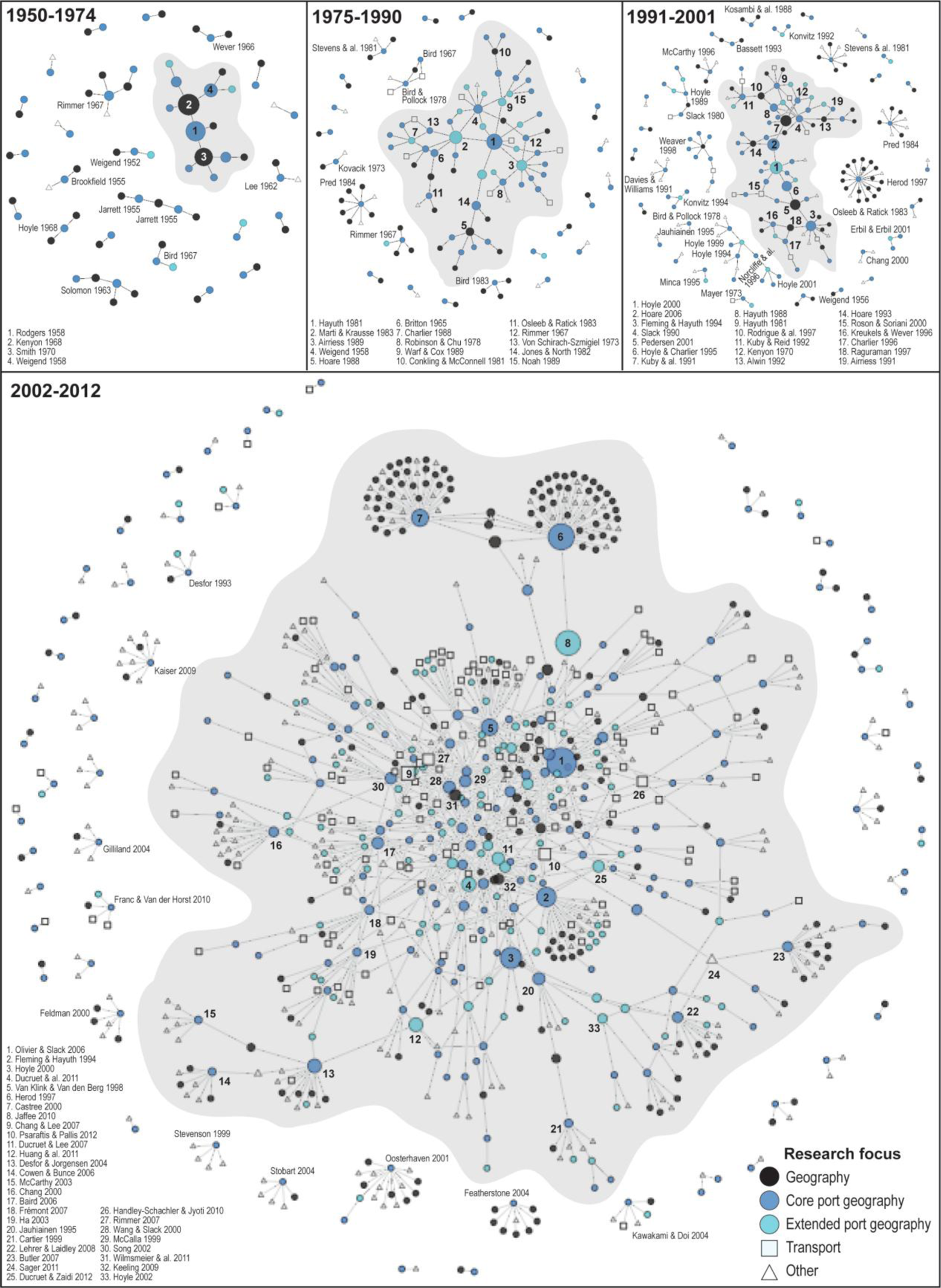
Graph illustrating citations of core port geography papers, 1950–2012.
During the first period (1955–1974), the network of citations remains rather small and fragmented, containing mostly geography journals. The group of connected papers is a chain-like structure thus having few transversal linkages. The most central paper by Smith (1970) concerns commodity flow analysis and it quotes a bunch of port geography papers about hinterland and foreland traffics having in common methodological issues. Isolates are characterized by groups of papers focusing on a specific terrain, such as New Zealand (Rimmer, 1967), Australia (Solomon, 1963) and Sierra Leone (Jarrett, 1955). This period thus shares a similar structure with the one of citing papers: a core composed of theoretical/methodological papers and isolates specialized on specific areas of the world (developing countries).
Another similarity with the previous analysis is the emergence of a larger core community during the second period (1975–1990). Most central papers outside port geography papers are, in fact, published by port geographers (Airriess, 1989; Marti and Krausse, 1983), focusing on modelling, while Airriess (1989) and Robinson and Chu (1978) connect principally papers on Asian and African ports outside port geography papers. The seminal works of Weigend (1958) on theoretical aspects and Hayuth (1981) on load centres have a pivotal position. Specialization also appears around the works of Hoare (1988) on British ports and on ports’ forelands and external relations (Britton, 1965; Von Schirach-Szmigiel, 1973). At this period, port geography papers had thus been attractive due to their focus on developing countries and their provision of concepts and methods. Isolates are, in general, original contributions on historical geography (Pred, 1984), gateways (Bird, 1983), economic impacts (Stevens et al., 1981) and European ports (Bird, 1967), or the work of Rimmer (1967) drawing attention to issues other than ports.
Despite the growth in citations and papers, the third period (1992–2001) consists of a less integrated network. Most central papers are connected by very few links, which denotes a dispersion of research interests due to the lack of central themes: globalization and transport in Africa (Pedersen, 2001), waterfronts (Hoyle, 2000) and trading flows (Hoare, 1993), notwithstanding the stability (Hayuth, 1981) and emergence (Fleming and Hayuth, 1994) of theoretical discussions on transport hubs with a strong focus on ports, as well as a noticeable shift towards behavioural aspects of port selection and port strategies (Slack, 1990). Among the isolates, the work of Weaver (1998) about the historical geography of trade competition and route development quotes port geography papers on Africa, while Hoyle (1999) and Stevens et al. (1981) have their respective subgroups focused on waterfront redevelopment, economic impacts, cultural aspects and port-city economic relations. This period is a transition phase focusing on works ranging from case studies, theoretical and methodological works to policy issues.
The fourth period (2002–2012) provides a complex network of citations structured by a large connected component and few isolates. While most of the core papers are port geography papers, a good number of them are from transport journals and locate near the centre; geographical papers remain more central in the graph than in the previous analysis of outward citations, while ‘other’ papers locate more at the fringe of the figure, thereby suggesting the existence of specialized communities. Yet transport journals had a central role in forging this scientific community rather than other journals. Among the most central port geography papers there is a wide diversity of approaches, with a mix of classic, theoretical works (Hayuth, 1981; Olivier and Slack, 2006), general discussions on transport hubs and gateways (Fleming and Hayuth, 1994; Van Klink and Van den Berg, 1998) and waterfronts (Hoyle, 2000), but also empirical studies of global networks (Frémont, 2007). Strong connections with geography journals are the result of transport geographers (Ducruet et al., 2011) notably through general discussions on the trends affecting transport geography itself (Keeling, 2009). Unsurprisingly, the strong position of some transport papers is generally explained by the fact that most are published by port geographers as well through papers focusing on ports, which confirms the shift of port geography papers towards transport journals. The absence of port geographers from non-geographical journals also reinforces the proposition that transport journals have been privileged by port geographers, and are perhaps more accessible and opened to their views than other journals (e.g. management, economics, planning, history, operational research, etc.).
Hence, there are significant disparities between the first (1950–1990) and final (1991–2012) two periods. In the first two periods, port geography research was still largely knitted by generally accepted (port) geography theories and models, and applied to different parts around the world. Complementing Ng’s (2013) argument, port geography research during this period closely followed the focus and approach of mainstream human geography, largely being geographers who focused on port-related problems. In the third period, a transitory process took place where old theoretical models started to become obsolete while port geography research began to move away from geography to transport and other disciplines. Yet the ratio between the respective numbers of inward and outward citations has remained highly unbalanced: port geography always imports more than it exports. This suggests a follower rather than a proactive, or even innovative, profile of port geography, notably towards transport and other non-geographical journals. Over the whole period, transport papers have the widest discrepancy between inward and outward citations in terms of both number (0.48) and share (0.67), followed by other studies (0.50 and 0.71), geography (0.73 and 1.03), core port geography (0.90 and 1.26) and extended port geography (1.03 and 1.44). Thus, the affinity for transport is largely imbalanced, as this field does not seem to compensate port geographers for their repeated efforts to make their work more practical and applied. Core port geography is thus its own biggest importer, and this is partly explained by the migration of same scholars to non-geography journals citing their works published in geography journals. Yet such measurements do not include citations of extended port geography papers by transport (and other) journals. It is thus logical that the gradual shift of port geographers towards non-geographical journals had the effect of lowering the influence of geography journals towards other fields when it comes to port research. Given that the most influential port geography papers were published in geography journals, such results remain valid in pointing at a certain weakness of this corpus towards non-geographers. In some way, core port geography remains closer to geography because geographers who do not publish about ports still recognize port geography (almost) as much as port geography recognizes them.
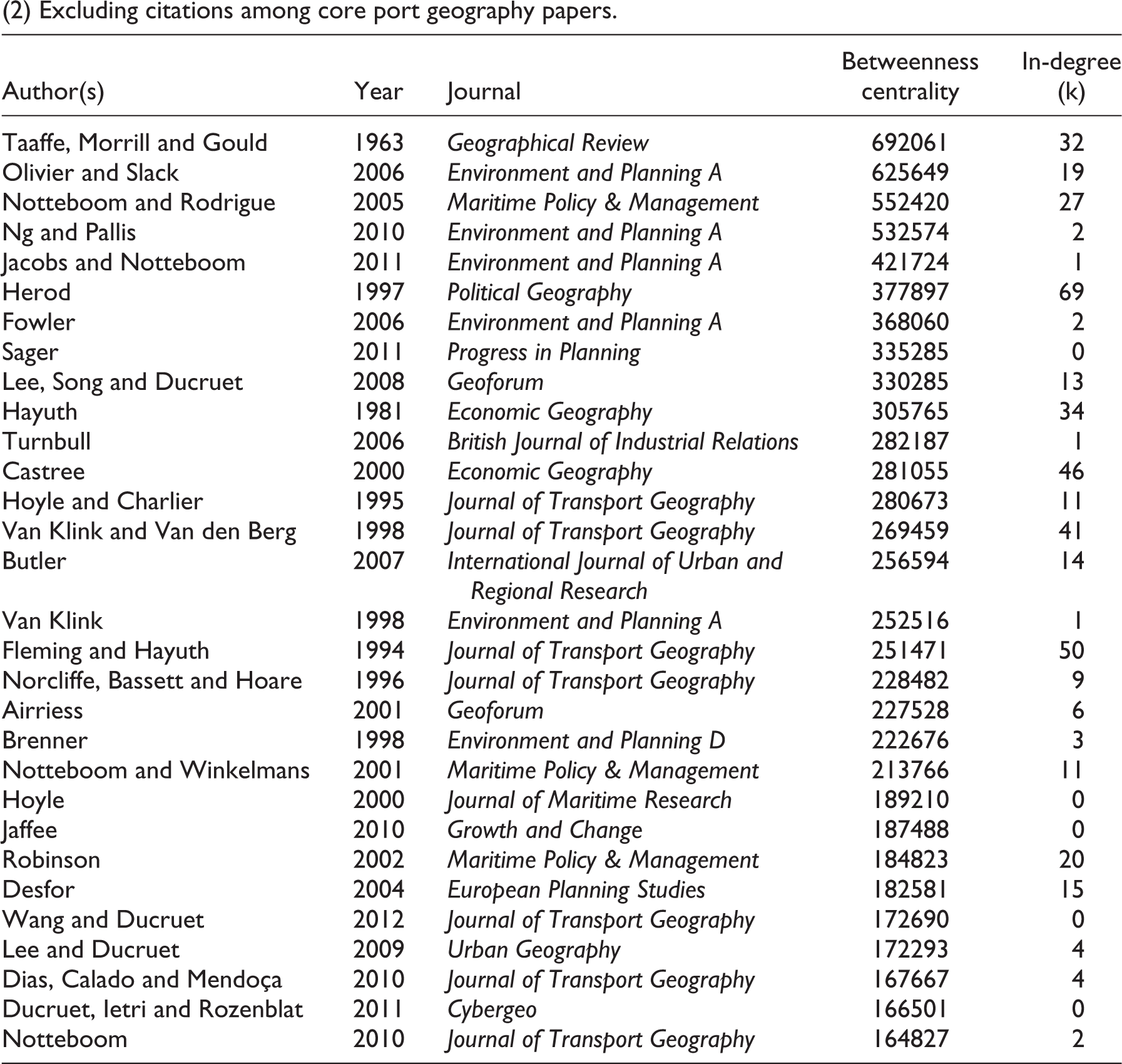
Analysing the changing share of port-related citations in the total of all citations made by geography and other papers was impossible due to obvious constraints of data collection and availability over the whole academic spectrum. However, such a trend denotes the ability and necessity to borrow concepts and methods from a vast panel of research fields due to the inherent transdisciplinary nature of port research. Another positive dimension to be underlined is the regularly growing ratio between the respective cited and citing shares of other journals, from 0.21 in the 1960s to 1.04 in the 2010s, which could suggest a growing recognition of core port geography towards other social and natural sciences outside the transport field. One example is the study by Frémont (2007) of the port network of Maersk, the world’s largest shipping line, being cited by a physics paper (Hu and Zhu, 2009). This is part of a wider trend by which natural sciences increasingly took over classical research fields of social sciences, such as transport network analysis, due to stronger computational and modelling techniques, but often without quoting the original works done, among others, by geographers (Ducruet and Beauguitte, forthcoming). In the total citations network comprising all inward and outward citations over the entire study period (Appendix III), most central papers are compared by their betweenness centrality and in-degree centrality, while each table includes (1) or excludes (2) citations between core port geography papers themselves. In the first table, the work by Olivier and Slack (2006) ranks first, as it addresses profound changes in the meaning of the concept of the port itself following the reorganization of terminal operations by global players. It is followed by papers offering large syntheses as well, such as Lee et al. (2008) adding an Asian variation to the mostly western-focused models of ports’ spatial evolution, and Ng and Pallis (2010) discussing the impacts of institutions on port reform and governance. Unsurprisingly, only a few papers in this top 30 come from outside core or extended port geography, such as Sager (2011) on neoliberal planning policies, Turnbull (2006) on the power relations within the port industry, and Notteboom and Rodrigue (2005) about port regionalization. The second table offers a relatively identical list of papers despite some changes in their ranking, with Taaffe et al. (1963)’s classic model ranking first and Notteboom and Rodrigue (2005) ranking third. Both papers mainly focus on the concept of the ‘port system’, which still nowadays continues to occupy a very central role in port geography (Wang and Ducruet, 2013), but in relative isolation from similar concepts such as cities systems or systems of cities developed in urban geography (see, for instance, Bretagnolle et al., 2009). Papers outside core or extended port geography differing from the previous list are those of Notteboom and Winkelmans (2001) and Robinson (2002) on strategic changes in logistics and value chains. Although the position of papers in such a graph can be anachronical due to the intermingling of periods, it confirms how port geography, as a whole, remains fragmented between social, planning, economic and transport issues, as well as somewhat self-sufficient due to the rarity of centrally located papers from outside this specific research field.
IV Discussion and conclusion
Despite the rapid transformation of the maritime industries posing significant implications on the roles and functions of ports, there is a scarcity of analysis on the research trend of port geography papers. Recognizing such deficiencies, through a bibliometric analysis on 399 ‘core’ port papers featured in 36 geography journals (co-)authored by 328 researchers between 1950 and 2012, supplemented by 329 ‘extended’ port papers featuring in non-geography journals, this paper investigated the changing waves of port geography research.
A number of observations can be identified. First, after a period of relative slowdown, there has been an increasing production of port geography papers in recent decades, which demonstrates that port geography is far from a fading research field. On the contrary, it has expanded, reached new frontiers and diversified its horizons, notwithstanding certain weaknesses. In fact, ‘core port geography’ has not increased as fast as ‘extended port geography’. Second, the analysis of citations demonstrates the co-existence of three systems within port geography papers: a ‘traditional’ system composed of core papers addressing classical issues of transport flows and networks but without strong recognition from outside; a ‘specialized’ system with high recognition from outside but weak linkage with the traditional system and transportation; and an ‘innovative’ system more concerned with societal and methodological issues connecting other social sciences and having wider external impacts. Such imbalance between inward and outward citations suggests a recurrent weakness of port geography – that is, it imports from other research fields and disciplines more than it exports to them. Yet other methods such as co-citations could be applied to refine the analysis of imports and exports, where two or more papers are linked in the network when they cite the same papers (Newman, 2004). This is subject to further research. Nevertheless, our results point at the difficulty for port geography to attract non-port specialists, which results in a certain lock-in among the port geography research community.
This lock-in is about to change given the recent publication of many papers connecting wider theoretical fields (e.g. governance, networks, globalization) that may attract further attention from outside. The shift from the port as a place to the port in networks of all kinds (firms, flows) has been identified as a crucial meeting point with wider concerns in economic geography and transport studies, also backed by the renewal of network analysis conceptually and methodologically since the late 1990s (Ducruet and Lugo, 2013). However, port geographers increasingly struggled to re-identify their core research direction, or ‘culture’. This was exemplified by the fact that papers that investigated the philosophy and epistemology of ports, which constituted the fundamentals of the subdiscipline, were written almost entirely in 1950–1974 (Table 3). Although sporadic attempts were made to fill in this gap in the past two decades (e.g. Fleming and Hayuth, 1994), the migration of port geographers to other disciplines had clearly weakened its self ‘bonding’. This process was completed during the fourth period where the bond between port geographers seemed to be even more remote, especially with increasing collaboration between geography and non-geography researchers. As noted by Ng (2013), there was yet a general consensus on the appropriate theoretical replacements for port geography research in view of this migration process, especially within human geography. Hence, port geography is in danger of being relegated to a normal science (Kuhn, 1962) rather than an innovative contribution to paradigm shifts. Still, given the right circumstances, there are reasons to be optimistic that port geography can evolve and contribute to human geography and other disciplines. This was exemplified by the inversed trends for ‘catchment areas and supply chain linkages’ published by core and extended geography papers, as illustrated in Table 3. At a time when the concept of supply chains did not exist, core port geography research developed considerable studies on the industrial linkages of ports in the early period under a context of booming industrial developments. Although the latter had faded away, alongside the fading spatial fix of port activities, this topic has attracted much more attention in recent years from extended port geography research due to its significant role in developing new theories and concepts that satisfied another group of audiences, such as value and logistics chains and production networks.
The research themes of port geography papers published in geography and non-geography journals, 1950–2012.
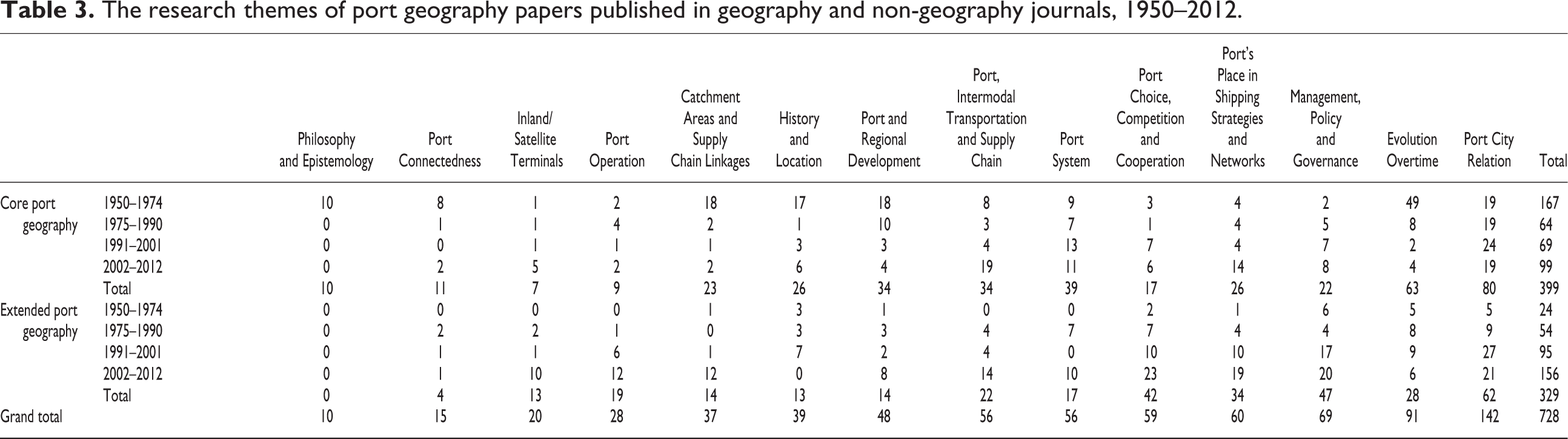
Moreover, there was a worrying trend that the increasing popularity of the so-called ‘innovative system’ would lead to the gradual decline of certain traditional areas, notably the inter-dynamics between port, development and well-being of its surrounding regions with the core geography journals. In fact, except for port-city relationship, all the most popular topics in port geography research during the ‘classical’ period had declined dramatically in the past two decades. Also, it was surprising to find that there was an increasing number of port-city relationship and port-regional development papers – traditionally important topics within human and transport geographies – being published in non-geography journals, with a significant decline in the number of port-regional development papers being published in geography ones. Instead, geography journals are increasingly dominated by ‘innovative’ topics (a trend similar to non-geography journals), notably intermodal transportation and supply chain, inland terminals, as well as port management, policy and governance (Table 3). 2
The change in research theme is a reflection of the redefinition of what (in human geography terms) ‘the relations of and across space and place’ mean among port geographers nowadays, i.e. from the relationship and interaction between human activities (port) and the (built) environment to the more ‘functional’ meaning between port and other transport modes, production process and inter-port relationship. From a spatial perspective, port geography research further highlights the gradually segregated relationship between ports and their surrounding areas (and spatial planning), being replaced by a more practical (from the functional perspective), profit-making and efficiency-oriented meaning, such as ‘trade corridors’, ‘supply chains’ and ‘competitiveness’. Simultaneously, the study approach and methodologies tend to be more positivist and quantitative, respectively.
However, this should not be surprising. Technological revolution, notably the use of containers, and the persistent increase in international trade and globalization, had transformed port evolution and development, like the increasing intensity of inter-port competition. It is well documented that, especially since the 1980s, shipping lines often pressurized ports to enhance efficiency (Hayuth and Hilling, 1992; McCalla, 1999). Slack (2004) argued that such fundamental changes had led to the growing similarity between shipping lines, leading to the situation that while winners won more, losers would lose even more. Facing such development, ports were forced to identify ways to sustain and enhance their competitiveness (Meersman and van de Voorde, 1998), notably through enhancing their performance, service quality and network position (Ducruet, 2013), and identifying major port choice factors (Ng, 2006; Sanchez et al., 2011). Strengthened by neoliberalism in pushing economic policy and development in the same period (Felli and Castree, 2012; Harvey, 2005), ports were expected to be ‘responsive’ to user requirements, thus forcing them to focus on efficiency enhancement (within port itself, and between ports and other transport modes), devolution, public-private partnership of port/terminal operations (Heaver, 2002; Ng and Pallis, 2010; Wang et al., 2004), and the search for quick rewards (thus causing over-emphasis on quantitative, easily measurable indicators). All these had transformed ports’ role and functions so much that significant challenges were posed to port researchers, including geographers, to conceptualize and interpret them (Wang et al., 2007).
In addition, this study strengthened Ng’s (2013) earlier proposition that the ‘geography’ identity of port geography research had been significantly diluted in the past decade. The morphology from core geographical research towards transport due to an increased specialization of port geography papers on transport issues, however, does not necessarily contradict the emergence of a new phase with more diversified goals and perhaps, more fundamental ones. Indeed, it had evolved from encyclopedic (as illustrated by the high number of monographs on individual ports during the early period under the ‘history and location’ and ‘evolution overtime’ categories; see Table 3), secondary research interests by human geography researchers to become more specialized and primary research interests. The emergence of a connected community in the last decade or so could have been a positive factor for port geographers to exchange ideas faster than in the former period of isolation and fragmented collaborations. The formation of a single, well-connected community clearly paves the way towards further innovation, although the future of this community will depend on maintained scientific interactions and the development of more transversal linkages among port geographers. New ways of linking port/transport issues with wider theoretical and methodological backgrounds, and perhaps with a new paradigm of conducting port geography research, will profit both the port industry and mainstream scholarly research.
Hence, further research is required to comprehensively understand the extent to which port geography papers interact with other scientific disciplines, and to search for the aforementioned new ways. Important topics include the analysis of knowledge interactions between locations through the port geography papers corpus – are these papers offering a different pattern than other sciences? Also, further analysis of citations and co-citations based on the categorization of port geography research would allow one to verify whether papers discussing similar topics have formed distinct communities, and the ‘bridges’ between them, in relation with the homophily concept in social networks. Internal trends may reflect the evolution of certain ‘schools’, such as the French one more focused on maritime forelands and the Dutch one better discussing hinterland distribution, towards more global and transversal approaches, but such a study shall integrate domestic journals (often in local languages) and book publications. Also, clustering methods could be applied to verify the influence of geographic or other proximity among authors in the pattern of collaborations and citations, as well as other graph-theoretical approaches such as bipartite (or two-mode) networks and multi-level networks where author, paper and journal levels are considered. Finally, there is an equally important need to investigate whether port geography papers research has increasingly focused on the major ports along the major international trade axis, rather than secondary or regional ones. This will help to verify the proposition on whether international trade and globalization has ‘bent’ the focus of port geographers towards the ‘cores’ while missing out the ‘peripheries’. While the definition of the core port geography corpus posed some difficulties in the application of strict delineations, the sample of 399 papers may be enlarged to additional works mentioning ports but with a more central focus on waterfronts and logistical systems.
Despite its relatively small field, this paper has clearly advanced the debate of the role of transport geography in human geography. The analysis strengthens the applicability of the rather ‘ghettoized’ dimension of transport geography (cf. Goetz et al., 2003; Keeling, 2007) in general to port geography papers given the somewhat limited impact of its core papers externally and its growing specialization within transport research moving away from mainstream geographical research, except for the top cited papers that have actually limited connections with classical port geography papers. Yet this study has identified a recent production of more innovative papers connecting both classical port geography papers and wider research fields, backed by the emergence of a connected community of port specialists. Thanks to such collaborations and investigations, port geographers have added a spatial dimension, and an appreciation of institutions and place, to port and other aspects of maritime studies, that otherwise would be largely dominated by operational research and business approaches. While port geography still evolves in a relative autonomous environment that creates disconnection with wider approaches in human geography, it has been able to integrate major conceptual and methodological shifts such as globalization and networks. To sum up, this paper helps researchers in preparing future research agendas in searching for their new identity as a valuable subtheme within the human geography, transportation and other academic disciplines.
Footnotes
Appendix I: Port geography papers included in this study
Appendix II: List of major journals which have published extended port geography papers,1950–2012
| Name of journal | No. of papers published | % |
|---|---|---|
| Maritime Policy & Management | 85 | 25.8 |
| Maritime Economics & Logistics | 33 | 10.0 |
| Cities | 9 | 2.7 |
| International Journal of Transport Economics | 9 | 2.7 |
| Ocean and Coastal Management | 9 | 2.7 |
| Transport Policy | 8 | 2.4 |
| Transport Reviews | 8 | 2.4 |
| African Urban Quarterly | 5 | 1.5 |
| Growth and Change | 5 | 1.5 |
| Journal of International Logistics and Trade | 5 | 1.5 |
| Journal of Transport Economics and Policy | 5 | 1.5 |
| Transportation Research Part A: Policy and Practice | 5 | 1.5 |
| Urban Studies | 5 | 1.5 |
| European Journal of Transport and Infrastructure Research | 4 | 1.2 |
| Handbook of Terminal Planning | 3 | 0.9 |
| Journal of the Eastern Asia Society for Transportation Studies | 3 | 0.9 |
| Journal of Transport History | 3 | 0.9 |
| The Dock and Harbour Authority | 3 | 0.9 |
| Town Planning Review | 3 | 0.9 |
| Urban History Review | 3 | 0.9 |
| Top 20 journals subtotal | 213 | 64.7 |
| Other journals subtotal | 116 | 35.3 |
| Total | 329 | 100.0 |
Appendix III: Top 30 papers in the graph combining core port geography’s inward and outward citations,1950–2012
(2) Excluding citations among core port geography papers.
| Author(s) | Year | Journal | Betweenness centrality | In-degree (k) |
|---|---|---|---|---|
| Taaffe, Morrill and Gould | 1963 | Geographical Review | 692061 | 32 |
| Olivier and Slack | 2006 | Environment and Planning A | 625649 | 19 |
| Notteboom and Rodrigue | 2005 | Maritime Policy & Management | 552420 | 27 |
| Ng and Pallis | 2010 | Environment and Planning A | 532574 | 2 |
| Jacobs and Notteboom | 2011 | Environment and Planning A | 421724 | 1 |
| Herod | 1997 | Political Geography | 377897 | 69 |
| Fowler | 2006 | Environment and Planning A | 368060 | 2 |
| Sager | 2011 | Progress in Planning | 335285 | 0 |
| Lee, Song and Ducruet | 2008 | Geoforum | 330285 | 13 |
| Hayuth | 1981 | Economic Geography | 305765 | 34 |
| Turnbull | 2006 | British Journal of Industrial Relations | 282187 | 1 |
| Castree | 2000 | Economic Geography | 281055 | 46 |
| Hoyle and Charlier | 1995 | Journal of Transport Geography | 280673 | 11 |
| Van Klink and Van den Berg | 1998 | Journal of Transport Geography | 269459 | 41 |
| Butler | 2007 | International Journal of Urban and Regional Research | 256594 | 14 |
| Van Klink | 1998 | Environment and Planning A | 252516 | 1 |
| Fleming and Hayuth | 1994 | Journal of Transport Geography | 251471 | 50 |
| Norcliffe, Bassett and Hoare | 1996 | Journal of Transport Geography | 228482 | 9 |
| Airriess | 2001 | Geoforum | 227528 | 6 |
| Brenner | 1998 | Environment and Planning D | 222676 | 3 |
| Notteboom and Winkelmans | 2001 | Maritime Policy & Management | 213766 | 11 |
| Hoyle | 2000 | Journal of Maritime Research | 189210 | 0 |
| Jaffee | 2010 | Growth and Change | 187488 | 0 |
| Robinson | 2002 | Maritime Policy & Management | 184823 | 20 |
| Desfor | 2004 | European Planning Studies | 182581 | 15 |
| Wang and Ducruet | 2012 | Journal of Transport Geography | 172690 | 0 |
| Lee and Ducruet | 2009 | Urban Geography | 172293 | 4 |
| Dias, Calado and Mendoça | 2010 | Journal of Transport Geography | 167667 | 4 |
| Ducruet, Ietri and Rozenblat | 2011 | Cybergeo | 166501 | 0 |
| Notteboom | 2010 | Journal of Transport Geography | 164827 | 2 |
Acknowledgements
The authors would like to thank the editor and anonymous reviewers for their constructive advice, and the research assistant, Ellie Chow, for her efforts. An earlier version of this paper was presented during the Annual Conference of the International Association of Maritime Economists (IAME) 2012 (see Ng and Ducruet, 2012). The usual disclaimers apply.
Funding
This study is partly funded by the University of Manitoba VPRI and the I.H. Asper School of Business Research Funds (314942). The research leading to these results has received funding from the European Research Council under the European Union’s Seventh Framework Programme (FP/2007-2013)/ERC Grant Agreement n. [313847] ‘World Seastems’.