







Abstract
Despite the persistence of Malthusian arguments that human population will grow to outstrip the Earth’s capacity and resources, current demography actually foretells the impending end of growth in the next half century. We are approaching a global baby bust. What does this mean for global political labor economies, regional resource economics, and local struggles over gender and power? This paper concludes, through a survey of current research, that geographers already have the conceptual equipment to answer these enormously important questions. We further argue that the fundamental underpinnings of much contemporary economic and social theory, having been developed in times of rapid population growth and labor surplus, must be reconsidered as we enter a period of different material conditions. Reviewing recent developments in population geography and feminist geopolitics, global geographies of labor and aging, and emerging patterns of resource intensification and disintensification, we suggest that – if infused with an explicit political economy – attending to the baby bust can show the way forward to help revitalize our understanding of bodies and materiality in critical and human geography.
I Introduction
Walking in the shade of towering silver oak trees on a large plantation in Chikmaglur District, in the Indian state of Karnataka, we are engaging a coffee grower on the pressures that make him change how he manages his land, uses or abandons pesticides, and selects his crops. The answers we expect him to provide include things like farm gate prices, fertilizer costs, and turbulent shifts in international markets. His answer, however, is ‘people’: workers these days, he explains, are ‘lazy’, demand more wages, take longer cigarette breaks and request all kinds of amenities, like electricity. There are simply too few workers and the bargaining power of those remaining in the countryside is rising. While the conditions for working people here remain brutal, their situation is mediated by a scarcity of people.
We stop and reflect. Certainly there are reasons to have anticipated this. Competition from the Gulf States for laborers is strong. Urbanization in the region is 38% and is rising. But the more obvious reason is sitting in plain sight. Southern India is running out of surplus workers. The fertility rate in the southern state of Karnataka is 1.8, well below the replacement rate, and this figure has been descending for years. Indeed, many states in India – some notable ones excluded – have shrinking populations resulting in negative natural growth. In short, rural Karnataka is running out of workers; there aren’t enough people in India.
How could we have not anticipated this central economic fact? Perhaps it is because the principal investigator on this project is a man, or because we do not pick coffee for a living, or – most pressing – because we are trained to avoid demographic questions.
Whatever the reason for our surprise, this paper seeks to explore the larger implications of this demographic trend, now observed worldwide, for human geography and allied social sciences. Pointing to the relative absence of demographic considerations in most critical social science, the paper further identifies specific areas of current, relevant, analytical opportunity and ongoing geographic research: 1) the ethnopolitics and intimate geopolitics of demography; 2) the impacts and implications of aging and depopulation on economic geography and socio-environments. The conclusions that follow call for a more vigorous engagement of critical human geography with issues of demographic change, but one that is explicitly and self-reflexively political.
First, however, a brief review of current demographic trends is warranted to put the remarkable case of southern India in general context, since it is part of a global trend. The facts likely will be familiar to most contemporary geographers, as they consist of three elementary statistics. First, the current global population growth rate is roughly 1.14% per annum, its lowest since the early 20th century (US Central Intellegence Agency, 2014). This rate will fall towards further lows near 0.5% per annum by the middle or end of this century, a growth rate that mirrors that of the pre-industrial world. That the population will have risen to between 9 and 12 billion by that time is unquestionable (United Nations, 2013), and that the rates and locations of decline in growth are radically uneven across the globe is also clear, but growth will end.
Second, the central force behind this decline in growth is the rapid decline in fertility rates in many regions worldwide. Global Total Fertility is currently 2.3, down from 4.95 in 1950. In 2014, 52% of all nation-states reported fertility lower than the replacement rate. Just as in much of India, moreover, national fertility rates are at or below replacement in many countries that were fast-growing in their recent history, including Tunisia, Iran and Vietnam, among others (United Nations, 2013). Fertility rates do remain relatively higher in many regions, and with notable variability between nations; though Bangladesh has a fertility rate of 2.4, Pakistan’s fertility is close to 3.3. Even here, however, the trend continues to be downward. The end of demographic growth is evident in many parts of the world and will be widespread (indeed, ubiquitous) within current lifetimes.
Finally, the causes of this transition are well understood. The central drivers of declining fertility have long been established to include women’s education (Martin, 1995; Levine et al., 1991; Axinn and Barber, 2001; Kravdal, 2002), women’s household equity and power (McDonald, 2000), women’s employment (Bloom et al., 2009), women’s autonomy (Dharmalingam and Morgan, 1996), availability of birth control on demand (Gulati et al., 2008; Mwaikambo et al., 2011), as well as health care and child care, among several other resources (Rosenzweig and Schultz, 1982). Indeed, combinations of these factors have been repeatedly observed in action for decades (Gertler and Molyneaux, 1994; Dreze and Murthi, 2001), making the chief causes of this change a matter of little debate in the literature. The status of women, where it changes in specific ways, has resulted in changes in fertility. These trends are unlikely to reverse direction, at least not at a global, or even regional, scale.
Despite these overall trends, diversity prevails and population geography predicts, appropriately, that the process of fertility decline is context-specific, varies over space and time, and is given to fluctuation (Riley, 1997; Newbold, 2014). In some contexts, women’s labor force participation is critical, where in others it matters little (Beguy, 2009). As Nast (forthcoming) has observed, moreover, the causes of declining fertility in one region may be radically different from another: post-industrial countries see a decline in childbirth owing to declining labor force demand, whereas poorer countries may experience such a transition owing to acute poverty and gendered migration. Even amongst this consensus, there is disagreement on the precise ending date for population growth worldwide, with UN models for cessation by the middle of the century (Raftery et al., 2012) competing with models that set that date back by decades (Gerland et al., 2014).
For our purposes, however, debates on the causes or ending date of population growth are largely irrelevant. Even population ‘pessimists’ (who point to numerous specific countries like Nigeria as ongoing sites of unrelenting growth) agree that population growth has halted in many parts of the world, that many Asian nations are reaching zero population growth as Latin American countries did before them, that fertility rates have fallen below the replacement rate in regions where they were historically very high, and that population decline is in evidence in many contexts (Gerland et al., 2014). We’re in the middle of a ‘baby bust’.
Accepting this overall trend, we hold that the implications of this fact – and its accompanying anxieties, struggles, and reconfiguration of politics and economics – have been greatly understated in the human geographic literature, especially in critical human geography, where not ignored altogether. The reasons that demographic change has been overlooked, especially in historical materialist and political economy traditions, are numerous and justified, and linked to a resistance to a Malthusian legacy, one that attributes catastrophic effects of demographic growth and that reinforces patriarchal and capitalist logics of human and household behavior. Not only has Malthusian logic been unable to adequately predict resource conditions or scarcities, its deployment as ideology has been consistently pernicious (Hartmann, 1995). As David Harvey put it bluntly in 1974: ‘Whenever a theory of overpopulation seizes hold in a society dominated by an elite, then the non-elite invariably experience some kind of political, economic, and social repression’ (Harvey, 1974: 273).
Honoring this tradition and extremely wary of demographically-driven explanations for social and economic history, we nonetheless observe that shifting populations, whether in states of growth or decline and whether viewed in material or symbolical terms, open onto urgent, practical and theoretically-important questions for social science. Critical, materialist and feminist geographers, to whom we target this argument most directly, are especially well positioned to advance conversations and investigations into these questions. By engaging the topics of concerns more familiar in population geography, while bringing to bear the theoretical tools and methodological traditions more common to economic geography, political ecology, feminist geography, land change science, psychoanalytic geography, and a host of other schools of thought, human geographers can advance new knowledge about demographic change. To do so, we further suggest, will require paradigmatic shifts, insofar as most foundational theories of economy, environment, and society were developed in periods of limitless demographic expansion; unthinking population growth represents a fundamental challenge for human geography. But first, it is essential to consider that this current demographic shift is one that marks a literally unprecedented context for modern social sciences and especially political economy, a fact that deserves brief discussion.
II Demography and intellectual history
Consider the demographic contexts in which all the major works of modern political economy were penned. Throughout the 19th century, the central theories of economic development would be developed precisely when and where sites of European labor resources were experiencing unprecedented levels of growth. Starting from Wealth of Nations and leading onwards through the works of Ricardo, Marx, Jevons and Clark, core economic theory was formulated amidst population expansion. The era of highest population growth in Europe was also the era when such sites of growth, moreover, became the sources and touch points of economic theory. The population of Scotland, notably – that key discursive and statistical geographic trope for the great thinkers of that era – would go from one and a half million people to almost five million during this period (Figure 1), even as it was repeatedly invoked as central evidence of universal theories of economic growth and change.
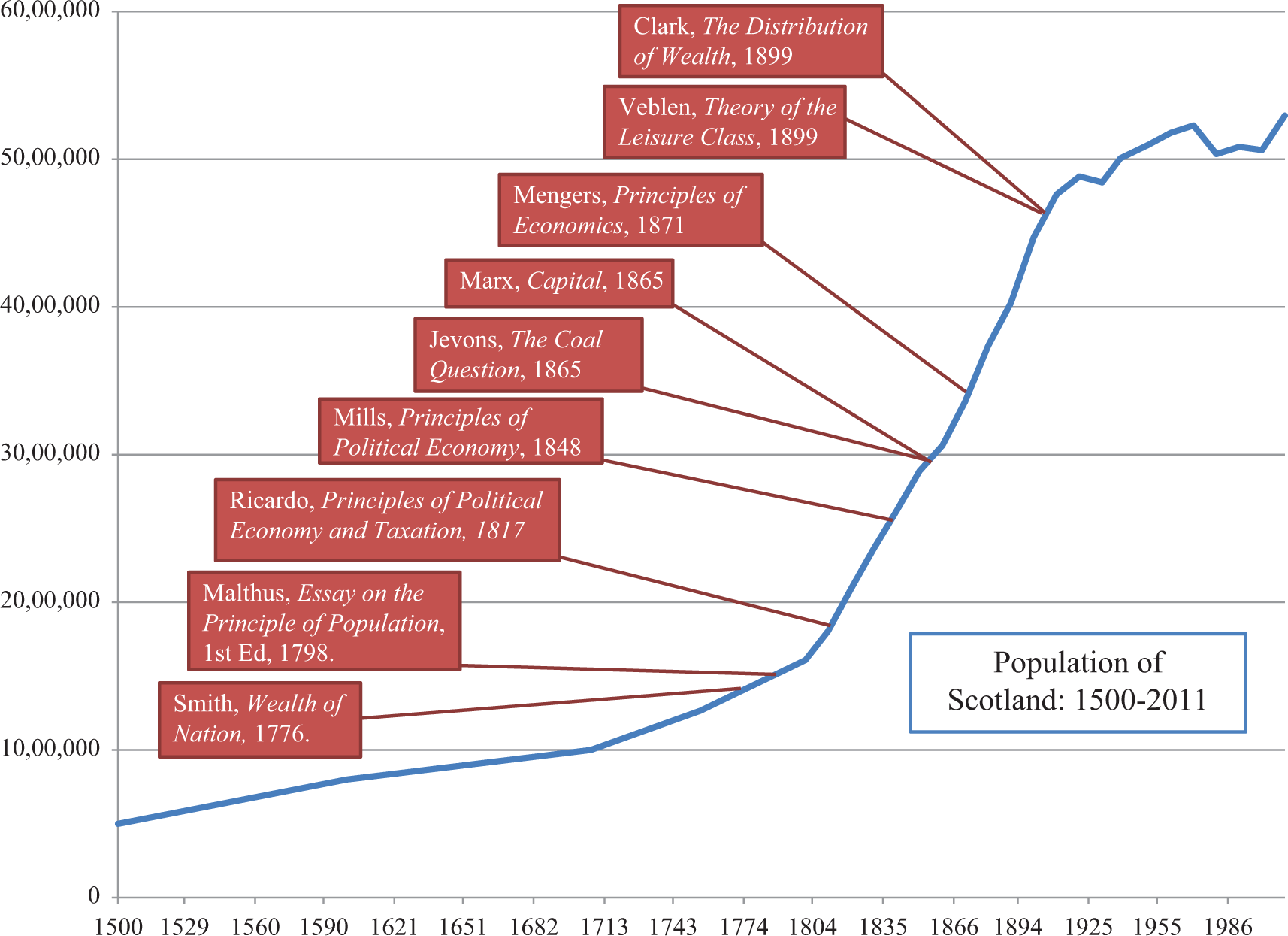
Demographic change and intellectual history, 1776–1899.
This is not to suggest that growing populations, in any straightforward way, determined the course and content of intellectual history for its 19th-century observers. The formation of classical economics itself heavily influenced state, colonial and mercantile policies of the period, from land acts and enclosures to industrial and public health interventions. These, in turn, changed the conditions for rural farms, households, and family decisions, with implications for family size. Demography and economic theory are not unidirectionally conjoined.
They are nevertheless inseparable; the major debates in classical political economy over questions of scarcity, labor, value, and power all occurred during a period of rural demographic growth, migration, and dramatically shifting pools of labor. Though not as dramatic an ‘explosion’ as would follow in the Global South during the 20th century, these dynamics would be critical to the history of areas in Europe that served as labor sources, exporting labor time and bodies to growing economies, with attendant matching gender politics, body politics, embodied nationalisms, and wage conditions.
At the same time, many of the elements of the ‘discursive’ constitution of parts of Europe – again notably including Scotland but also southern Europe – developed in precisely the same era. Concomitantly, the importance of these areas as sites, sources, and targets for global political economic theory wane precisely as their demographic growth ends. The implication is that core theories of political economy were forged both within a context of assumed growing capitalist expansion but also within a hidden bias of assumed constant and absolute growth.
The political and economic debates that would follow in the 20th century would also themselves be set amidst demographic change. In this case, the globalization of economic and development theory would occur amidst an attendant period of growth in the Global South. Consider the case of India, one among many. Its massive shift in demographic trajectory begins precisely when the globalization of the economic development machine, postcolonial intellectual hegemony, and theories of global development arise. These are accompanied by the deeply normative economic sciences of the era, in works spanning Shumpeter and Keynes, to Rostow and De Soto (Figure 2). This is not to dismiss or celebrate the theoretical debates of the era, but again to point to their position within two constants: a rate of annual demographic growth in developing contexts well in excess of 1.5% and a global capitalist, patriarchal, and postcolonial knowledge economy, often rooted either in Malthus or the refutation of Malthus.
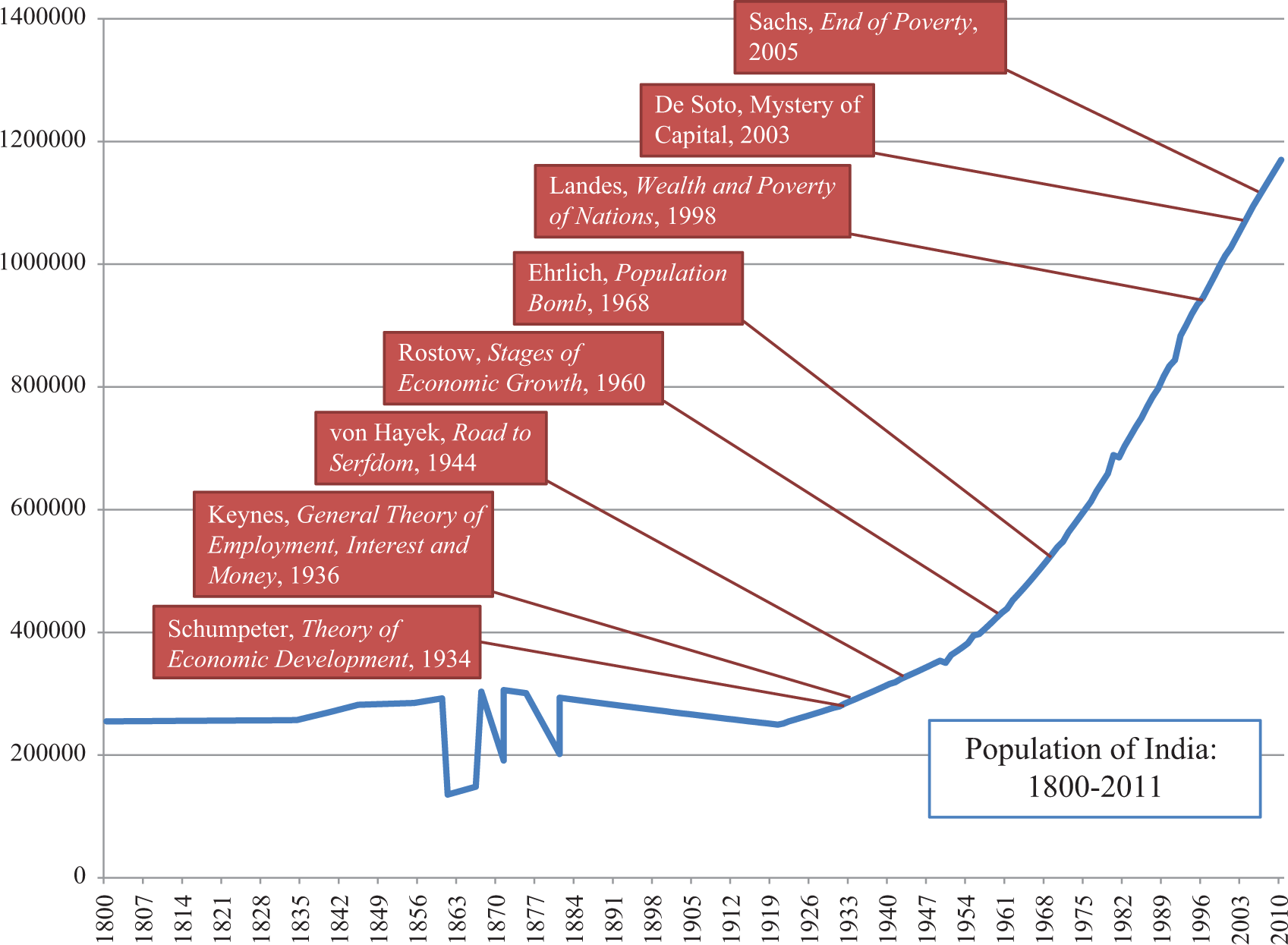
Demographic change and intellectual history, 1934–2005.
Consider debates about the status of surplus labor throughout development theory in the 20th century. Here, theory and research focused on how ever-growing rural populations did or did not impact the wage rate of urban workers. This was most effectively articulated by Arthur Lewis, the Nobel Prize-winning father of development economics and modernization theory, who posited that the conditions of economic development in underdeveloped nations benefited from the wage-reducing impacts of an ever-present and ever-growing reserve army of rural immigrants. Lewis further foresaw the cessation of demographic growth in many parts of the world, but the phenomenon concerned him, since he concluded it could put upward pressure on industrial labor costs, create a concomitant increase in rural farm prices, and slow economic growth (Lewis, 1954, 1955). This echoes Marx, notably, whose observation of surplus population in Europe a century earlier led him to conclude that the ‘industrial reserve army’ was a ‘lever of capitalistic accumulation’, maintained by Capital itself (Marx, 1990: 784).
Critiques of Lewis are many and varied, including those who might question the empirical record supporting the argument, given ongoing economic stagnation in many contexts of demographic growth. His inattention to informal sector employment, poverty and gendered labor conditions that might impact wages or migration has also been scrutinized (Fields, 2004), as has the thesis’s neglect of natural capital and the environment. This discussion remains lively in development economics and geography nevertheless; debates continue about whether China has transitioned through a ‘Lewis turning-point’ (Hahn, 2013), with implications for social conditions in both cities and the countryside.
Whatever its merits or flaws, the title of Lewis’s thesis really tells us all we need to know about its intellectual context: ‘Economic Development with Unlimited Supplies of Labor’. Modern development theory emerged in a period of demographic growth, with which it wrestled, around which it forecasted, and through which it directed state development investments. Such theory is turned on its head in a contemporary context where the rural countryside begins to lose momentum as a default source for surplus labor, not just in one regional market but at the scale of the global economy. Economic ideas develop in a demographic context, which is both ‘real’ and discursive, but certainly enveloping.
This condition of intellectual history, on reflection, makes the cessation of demographic growth worldwide a disorderly and opportune moment. Given the disruptive implications of demographic change for unwinding many widely (and unreflexively) accepted socio-economic theories, long-standing gaps in dominant thinking become more visible. Beyond the significance of demographic transition itself as a social change phenomenon worthy of exploration and explanation, this change creates openings in dominant assumptions about development, geopolitics, and environmental change, in which badly-needed critical interventions might occur. Thus, the banishment of high rates of demographic growth ironically means the return of population as a powerful tool with which to work, precisely in social and socio-environmental science where it has long been absent.
III Towards a political demography
Of course, whether in periods of demographic growth or decline, questions of fertility, reproduction, and the human body have always hinged on the relationship between culture, everyday life, state practice, and – as we argue below – geopolitics (see especially Ginsburg and Rapp, 1991 for work on this question). Making these links explicit, especially amidst a context of demographic flat-lining or decline, has indeed become a growing area of geographic research.
At the intersection between demography and anthropology, scholars such as Greenhalgh (1995, 2010) have grappled with the nuanced approaches to fertility that complicate the categories and definitions at the heart of demographic research. This research stresses the ways that population policy and demographic change are the complex and sometimes contradictory result of individual bodies, family aspirations, national discourses about science and modernity, and development goals (see also Riley and McCarthy, 2003). Even biological anthropologists have reached beyond their sub-discipline’s traditional approaches by integrating political, economic and other cultural anthropology-based theoretical frameworks, to ask ‘how sociocultural and political-economic processes affect human biologies, and then how compromised biologies further threaten the social framework’ (Goodman and Leatherman, 1998: 5).
In population geography, we find increasingly nuanced views of power and politics used to study health disparity, migration (Silvey, 2004, 2006) and mortality, but rarely fertility (with notable exceptions, such as Underhill-Sem, 2001). In 2004, a special edition of Population, Space, and Place (Graham, 2004; Pandit, 2004; Silvey, 2004) echoed and advanced discussions in demography that began in the 1990s (e.g. Greenhalgh, 1995; Kertzer and Fricke, 1997; Riley and McCarthy, 2003), calling for greater use of primary and qualitative data, more care to the socially contingent nature of demographic markers and factors, rejection of cultural determinism, and greater engagement with social theory.
Notably, in his recent reflection on 12 years of editing Population, Space and Place, Boyle (2014) tracks the decision to change the journal’s name from the International Journal of Population Geography, with the explicit intention of drawing a greater range of theoretical and methodological work and developing a more interdisciplinary audience. This demonstrates a greater openness among population geographers to engage with a range of methodological concerns. This has been realized in recent articles on masculinities and feminized migration (Elmhirst, 2007), gender studies, intersectionality, and migrant inequality (Bürkner, 2012), everyday spaces of adivasi migration in India (Chattopadhyay, 2010), Foucault’s population geographies (Legg, 2005; Philo, 2005), sexuality and the census (Brown and Knopp, 2006) and the effect of localized and transnational sexual cultures on behavior in Java (Ford et al., 2006).
Even so, more than 10 years after Boyle (2003) noted the importance of fertility decline to the subdiscipline, close survey reveals limited attention to the topic, with a few notable exceptions (Catney and Simpson, 2014; Sahu et al., 2012; Vignoli et al., 2013; Wesolowski, 2015, largely focused on how declining fertility impacts migration (Findlay and Wahba, 2013; Smith and King, 2012), explanation of fertility differences (Coleman, 2002; Lechner, 2001), and the meanings of maternal mortality (Underhill-Sem, 2001).
The potential for exploring such population decline in its political and economic context is demonstrated by the flurry of research in low fertility contexts (Billingsley, 2010; Thornton and Philipov, 2009). Promising small-scale investigations of low fertility suggest a range of explanatory factors, including environmental pollution in Ukraine (Wesolowski, 2015), crisis periods in and marriage rates in Tajikistan (Clifford et al., 2010), and men’s attitudes and fertility in Scotland (Jamieson et al., 2010).
In human geography more generally, the most promising developments bridging demography and social or political theory have focused on migration (Piper, 2006; Silvey, 2003, 2006), though there have been calls for attention to the study of fertility (Boyle, 2003; Graham, 2000) and for greater engagement of population geography with critical theory (Graham, 1999, 2000; Graham and Boyle, 2002; Halfacree and Boyle, 1993; Lawson, 2000; McKendrick, 1999; Ogden, 2000; White and Jackson, 1995).
Less commonly, explicit attention has been paid to the profoundly political nature of fertility and population changes (e.g. Bashford, 2014). Most promising, Nast (forthcoming) has explored the nexus of low fertility amongst the wealthiest slice of the global population, and the attendant consumptive turns that send this segment of the population ‘into the arms of dolls and dogs’. Even so, while there have been a handful of calls for ‘political demography’ outside the discipline (Winckler, 2005; Weiner and Teitelbaum, 2001; Weiner, 1983; Kligman, 1995; Goldstone et al., 2012; Demeny and McNicoll, 2006), these calls have focused heavily on the most overt political uses of demography, such as cases of demographic aggression through ethnic pronatalism. It is certainly crucial to study those points at which the political potential of the fertile body has been used in war or for state strategy, but we argue here that the machinations of the political and the demographic have often been overlooked within our discipline. The current baby bust provides an ideal opening for geographers to consider how our theories might be enriched by engaging with questions of population.
Continuing to follow that call, there remain frontiers where demographic change affords new thinking. We identify two specific areas where current and ongoing geographic research can inform understanding of global demographic change. These two areas together make up the balance of this paper, and include: Geopolitics: the racialized and nationalized ethnopolitics of demographics, evidenced in struggles over things ranging from sovereignty over indigenous territory to reproductive ethnonationalism accompanied by the intimate geopolitics of demographic decisions Political Economy and Ecology: the global economic geography of declining and moving surplus labor power, especially where it influences the geographies of aging, and the geographies of environmental change driven by repopulation of socio-environments long inhabited by people.
IV Geopolitics
Around the world, political struggles are being advanced by using bodies to make territories while simultaneously territorializing human bodies. Bailey’s (2005) recent overview demonstrates the potential for population geography to be at the forefront of political analysis through its treatments of the relationship between states and populations, and he also outlines work on topics such as genocide as part of the ‘geopolitics of population’.
To begin with, consider the recently flurry of reproductive anxieties, campaigns, and actions taken in association with perceived threats of demographic decline. Predictions of a non-white majority in the United States by 2043, notably, have instigated conversations in the popular and social media that reflect deep-seated racial anxieties with headlines proclaiming ‘Census: Minority babies are now majority in United States’ (Lichter, 2013; Morello and Mellnik, 2012).
Across the Atlantic, similar panic emerges in Europe as birth rates fall, revealing a ‘moral geopolitics of birth’, cast as white reproductive failure (Bialasiewicz, 2006: 702): ‘it is through ideas about reproductive practices and demographic threat that the “clash of civilizations” is being brought home, with women’s bodies becoming the new battleground for the preservation of the identity of the West.’
On the other side of the world, in Singapore, where the fertility rate has been under 1.3 for many years, the state has teamed up with a candy company to plea for successful citizens to reproduce. 1 This campaign focuses on ‘national night’ and urges its citizens to procreate as part of their civic duty. Meanwhile, the Singapore government conversely monitors and manages the fertility of immigrant domestic workers from Southeast Asia and laborers from South Asia, in order to deter growth (Chew, 2012; Graham et al., 2002; Huang and Yeoh, 2003; Oswin, 2010; Teo, 2009; Yeoh, 2006).
These stories reveal an anticipated baby scarcity, but, critically, they are consistently twinned with the specters of surplus. As Tyner (2013: 107) has argued through his discussion of surplus population, we must ‘consider the politics of fertility, mortality, and mobility from the standpoint of a layered demographic question: within any given place, who lives, who dies, and who decides?’ How are we to understand relationships between state power, state policy, and demographic shifts? And what are their territorial effects? Geographers and others have begun productive lines of inquiry into the bio(necro)politics that delineate populations and territories as subject to death (Nast, 2014; McIntyre and Nast, 2011; Mbembe, 2003; Berlant, 2007).
While we are witnessing the geopolitics of real and perceived fertility decline, counterintuitive stories of ‘demographic turnaround’ also hold geopolitical implications. Kendra McSweeney’s (2002, 2005; McSweeney and Arps, 2005) work on the recent rapid population growth of indigenous groups in Latin America demonstrates not only that many historic stories of cultural loss and indigenous decline are over-simplified, but also that population growth can be marshaled for political goals – in this case territorial consolidation in the form of reserves and increased political autonomy.
In the case of indigenous groups like the Tawahka of Honduras and the Miskito of Nicaragua, micro-scale demographic and ethnographic studies reveal trends running against the large-scale rapid demographic transition to low fertility across Latin America, but also the counterintuitive ways that population growth can be tied to better conservation outcomes, as indigenous groups’ greater political power may be linked to efforts to protect the environment (McSweeney, 2005). Just as significant, McSweeney and Arps (2005: 24) argue that this growth is engendered in part by a ‘communal memory of near-extinction’, and a self-consciously ‘ethnopolitically motivated pronatalism’. Similar complex racialized and indigenous politics and territorial claims have been observed elsewhere in Central America (Mollett, 2010, 2013) and, while not suggesting an intentional pronatalism, on the other side of the world Taylor (2011) has noted a similar shift amongst indigenous Australians.
Beyond the way in which fertility and reproduction here impinge on questions of sovereignty and governance – essentially extending the demographic into the political – the political pursuit of these logics also portends the reverse: the extension of political and ethnic struggle into the space of human reproduction. Specifically, differing fertility rates amongst religious or ethnic groups have provided fodder for mutual suspicion, political action, and violence (Allen, 1996; Djurdjev, 2000; Kanaaneh, 2002; Shiffman et al., 2002; Smith, 2012; Toft, 2002; Yuval-Davis, 1989).
Consider Ladakh, a region comprising the two districts of Leh and Kargil in India’s Jammu and Kashmir State, and home to ethnic and religious minorities. Here, tensions over territory foster an intimate geopolitics (Smith, 2012) in which the body’s capacity to desire and reproduce is marshaled for the purposes of commanding and defending territory through population numbers.
In January, 2015, the Ladakh Buddhist Association (LBA) wrote a letter to India’s new Prime Minister, Narendra Modi, accusing local Muslims of waging ‘Love Jihad’: a campaign of religious conversion through marriage, in the words of the LBA secretary Sonam Dawa, ‘luring Buddhist girls’ and converting them to Islam (Ashiq, 2015; Ul-Qamrain, 2015). The phrase ‘Love Jihad’, deployed for the first time in the public record in Ladakh in 2015, has been used across India since at least 2009 to denote a supposed campaign of demographic aggression on the part of India’s Muslims: conversion through inter-religious love marriages accompanied by conversion to Islam (Gupta, 2009; Mohan, 2011).
This rhetorical flourish appears in the wake of decadal releases of the Indian census, which reveal an ongoing shift in religious composition; Hindus fell from 80.5% to 78.4% between 2001 and 2011, while Muslims increased from 13.4% to 14.2%, although detailed district-wise data has still not been released (Ghosh and Singh, 2015; Jain, 2015). The rate of growth for Muslim Indians was 24%, down from 29%, but higher than the national average of 18% (Ghosh and Singh, 2015; Jain, 2015). These differences are most likely the result of economic disparity and complex social factors, but are often read pulled into nationalist political discourses (for discusion of these differences and their polticization see Dharmalingam and Morgan, 2004; Iyer, 2002a, 2002b; Jeffrey, 2002; Jeffrey et al., 2005)
These numbers and the idea of a Love Jihad, however, are used as part of a larger set of Hindu nationalist discourses of demographic decline and territorial loss going back decades (Hendre, 1971), echoing partition’s logic of bodies conflated with territory (Das, 1995; Ramaswamy, 2010). This is of course only one among many cases revealing the dangerous logic of creating, maintaining, or disturbing the ethnic composition of territory through the use of sexual violence (Allen, 1996; Korac, 2004; Mayer, 2004; Morokvasic-Müller, 2004). The discourse of a Love Jihad – romance in the service of demographic aggression – is a vivid reminder that at the heart of seismic demographic shifts are the most intimate of human experiences: sex, birth, and death.
The recent proliferation of feminist approaches to geopolitics and the incorporation of postcolonial and feminist approaches to political geography (e.g. Desbiens et al., 2004; Dowler and Sharp, 2001; Gilmartin and Kofman, 2004; Hyndman, 2004; Long, 2006; Secor, 2001; Staeheli and Nagel, 2006; Massaro and Williams, 2013; Pain and Staeheli, 2014) provide us with a wealth of other tools to further explore cases like these, including the relationship between embodied culture, everyday life, and politics (e.g. among many others Campbell, 2007; Kong, 2007; Marston, 2003; Mitchell, 1991; Painter, 2006; Thompson et al., 2007), ethnographic approaches to political geography (in particular see Dodds, 2001; Megoran, 2006) and, promisingly, increasing attention to questions of sexual citizenship (notably Bell and Binnie, 2006). In sum, demographic decline puts the concerns of demography and political geography in a state of urgent collision, and the expanding work on embodied, gendered, and intimate geopolitics presents a wide and growing range of tools for thinking about demographic transition in the 21st century.
V Political economy and ecology
Clearly, just as demographic change has unleashed a series of geopolitical struggles over bodies, struggles over the labor that these increasingly scarce bodies perform have become equally visible, along with the environmental changes occasioned by their absence. Returning to the Karnatakan coffee plantation that began this paper, a consideration of the demographics of labor opens onto such larger socio-ecological questions. Here, on a steep hill slope where coffee is produced in a complex agroecology, our farmer is presented with a set of urgent questions. Specifically, when faced with increasingly scarce labor in what has always been a labor-demanding production system with very tight margins, does he choose to abandon production and shift into other available household economies (like tourism) or, instead, replace the lost labor with chemicals or ecologically simpler, less energy-demanding agro-ecological systems? Does he diversify and disintensify production, and allow the land to develop into new kinds of ecosystems, or instead intensify production and create an increasingly industrialized production landscape?
These questions are themselves nested within a series of social and political ones. As the bargaining power of labor improves in this context, will the aspirations of workers for better health care and electrification be met through significant reinvestments in rural infrastructure or, instead, will importation of workers from other regions follow? What does the aging of this workforce mean for children of workers or for elderly migrants in either rural or urban economies amidst this demographic decline? What ecologies will emerge from lands abandoned, intensified, and resettled under conditions of a thinner and aging labor force? Such questions remind us that, despite a world of energy-based innovation and labor-saving technology, physical work associated with laboring bodies remains a core engine of economic value and a key instrument of ecological change.
The downstream impacts of labor scarcity on social and economic systems are difficult to determine, but historical cases provide some insights. In the 14th century, notably, depopulation occasioned by the bubonic plague and waves of sectarian violence all contributed to a scarcity of bodies to which has been attributed a ‘Golden Age’ for laborers; bargaining power for workers reached a temporary high-point thereafter with cascading impacts on social and economic innovation in Europe (Herlihy, 1997). 2 So too, the mass extirpation of native people of the Americas after contact at the end of the 15th century, coupled with the developing labor demands of colonial agro-commodity production, occasioned the horrors of the trans-Atlantic slave trade and the emergence of modern plantation agro-ecosystems (Crosby, 1986; Mintz, 1985). Scarcity of labor in Ireland in the wake of transatlantic migration in the late 19th century radically impacted wages and per capita income many years thereafter (Boyer et al., 1994), along with land use, cropping, and settlement patterns. Similar outcomes have been observed by migration researchers in more recent cases and contexts, including post-NAFTA Mexico (Mishra, 2007) and Honduras at the time of Hurricane Mitch (Gagnon, 2011).
More generally, the political economy of population abundance and scarcity has begun to rear its head in areas far beyond the context of labor economics. Technological innovation has historically been associated with the absence of workers in key sectors, although this effect is mediated by the specifics of production and the socio-political context (Acemoglu, 2010). The absence of a rural work force has been shown to stymie development plans of the modern state (Fenske, 2013) and to impact electoral upheavals and create new political cleavages (Ardanaz and Mares, 2014). Even so, despite a long-standing and lively debate about populations and economy and society, shrinking populations have received little attention, and the political economies and ecologies are not well researched.
Geographic insights into this process, directly and indirectly, however, are many and widespread, though they have not yet been gathered into a coherent dialogue. Clues to these futures lie amongst the geographies of aging, owing to changes in global population structures, as well as political ecologies of land change transition, owing to trends in the abandonment or repopulation of long-occupied socio-natures.
1 Geographies of aging in a global context
First among these are the implications of the changing age structures of global populations. Given the shift in the global population pyramid between now and the flat-lining of global population, and its slow tilt towards maturing populations, the geography of aging takes center stage. Since Harper and Laws (1995) laid down the challenge to adopt critical theoretical, feminist and political economic approaches to aging populations, this literature has exploded into a lively subfield, which has begun to significantly influence mainstream gerontology and health sciences (Andrews et al., 2007). The insights relevant to the aging of a global population are many and widespread, but include attention to several key processes, including changing spatial distribution and migration paths of aging populations (Shiode et al., 2014), the remaking of social space amongst aging populations (Schwanen et al., 2012), the relative independence and mobility of aging populations (Schwanen et al., 2012), and social and political economic relationships and inequality along the life-course (Bailey, 2009).
In particular, this final theme raises questions with specifically global implications. Consider the skew of the labor force in American and European elder care, for example, towards poorer, minority groups, and especially immigrant communities. As Datta et al. report (2010) for elder care in London, such a social and economic shift – rooted in a partly-demographic one – impact the most intimate experiences of care givers and receivers in an affective globalized economy (see also Bowlby, 2011; Cohen, 1998). This is further informed by emerging insights into the geography of care more generally (Lawson, 2007), but now occurs within an engine of ongoing aging that makes the impacts ubiquitous, accelerating, and a core part of global economic growth and change.
Admittedly, however, these areas of aging research have been geographically skewed somewhat towards historically ‘developed world’ contexts. This is in part a bias of research more generally, but also an inevitable product of the more recent aging of populations in parts of Latin America and Asia relative to North America and Europe. Some pioneering work on aging has been conducted elsewhere, however. Insights from China are most revealing, where geographers Feng et al. (2013) reveal the starkly negative health outcomes for older people without resources or family.
The justice implications of this finding, for a Chinese demographic profile that has begun to resemble an inverted pyramid, are enormous, and suggest quality of life challenges for hundreds of millions of people. So too, these changes have been shown to be highly differentiated by urban and rural populations, even as China seeks to move 200 million of its citizens to cities. One need only consider the equity, labor and care implications of a global dementia epidemic (Ferri et al., 2005), in which rates of increase in the condition are forecast to increase by more than 300% in India, China, and their south Asian and western Pacific neighbors by 2040. Clearly, the geography of aging contributes significant insights amidst global demographic shifts.
2 Critical land change science and global transitions
At the same time, the decline and aging of populations and the global labor force also portend ecological change, although with uneven and multi-directional implications. Although most studies of environmental change have focused on impacts of growing populations, as where population densities impact protected areas (Karanth et al., 2006) or water quality (Malmqvist and Rundle, 2002), a body of research has begun to grapple with the leveling or decline of populations, especially in rural and historically forested areas.
When rural populations begin to decline owing both to outmigration and urbanization or, more recently, to overall declines in reproduction, the available labor to maintain historical land uses becomes scarce. The trajectory of such changes, however, can cut in various directions. Specifically, scarcity of rural labor has been demonstrated to result in increases in forest cover in some contexts. In these cases, unmet labor demands for agriculture, especially on the periphery of development, in deep-forested or upland regions, lead to disintensification of production and, frequently, land abandonment. Abandoned lands, even in areas heavily modified by long-term human occupation, are often invaded by either indigenous or invasive growth, shrub and forest recovery, and undergo secondary succession: a ‘forest transition’ (Rudel et al., 2000, 2002, 2005; DeFries et al., 2010).
Political ecologists have stressed, however, that demography is rarely, if ever, the sole driver of any such change, or ‘forest transition’. State policy, remittances from migration, configurations of property, and systematic violence are typically favored drivers in explaining such changes (Hecht et al., 2014). Moreover, a simple linear relationship between depopulation and reforestation is not assured. Increasingly scarce household labor in the Yucatan, owing to outmigration, for example, has resulted in a decline of cropping, but this land use has only been replaced by ranching, with its significant land cover implications (Busch and Geoghegan, 2010). Feminist scholarship in land transitions, moreover, stresses that under conditions where women are left behind to manage the land in migrations streams, cultural expectations and differential norms may influence whether land is cultivated, put under pasture, or abandoned (Radel et al., 2010). Even where depopulation does lead to reforestation, the character and environmental quality of the resulting landscapes is by no means consistently predictable. Studying land abandonment in Mexico and India, Robson and Nayak (2010) suggest, for example, that decline in human disturbance may actually result in less, rather than more, biodiversity.
So, here again, geographic research shows population and labor scarcity mattering to complex geographical outcomes. Environmental change related to population decline can be predicted to be multi-directional and heavily mediated by social and political-economic conditions. As for the politics of reproduction, those of women’s bodies, and the aging of the work force, even a cursory review of a single issue of land cover dynamics suggests the demography of global environmental change stresses political dimensions.
VI Political demography in a world after absolute growth
And that’s as it should be. Entering a new demographic era causes us to consider the massive concomitant shifts that accompany the baby bust and the intellectual boundaries that must be superseded to comprehend it, but it cannot mean the end of population politics. As shown here, geographic research in feminist and critical geopolitics, the geography of aging, and land change science all suggest that depopulation marks the start of political struggles, not their end. Such a global shift, moreover, renders these fields of inquiry all the more urgent. It has not been our intention to exhaustively survey each and every one of these areas of geographic concern, a task best left to specialists from these fields. Rather, we have intended to show that demographic change demands a productive engagement with critical inquiry, a host of methods, and a wide range of theory in current human geography.
We have not argued here that high-density populations and their localized infrastructural, resource, and social challenges have vanished or will ever do so. The urbanization of the global population means that highly dense and demanding human populations will be a central challenge moving forward in the next century, no matter the overall rate of growth. Ten billion people will share the planet before all is said and done, and this marks its own challenge for the just provision of energy and food.
Nor have we argued that fertility rates will fall everywhere evenly and with the same implications. Indeed, as noted earlier, ongoing growth in places like Nigeria represents radically different geographic contexts than places like Singapore. Those differences continue to matter and demographic paths will be necessarily uneven.
What we have argued, however, is that a world with a mean fertility rate of 5 is different from one with a rate of 1.5. That difference, we insist, has implications for issues ranging from access to resources and power in the household, to struggles over bodies, populations, and resources. By admitting that this is true, and developing an empirical program to determine if, when, and how such differences matter, critical geographers pose themselves an exciting task. A science of critical population studies in geography is needed, therefore, one that simultaneously engages the modeling and measurement traditions of population geography with the theoretical and methodological tools of critical traditions.
Significant barriers remain, however. While this paper has stressed the significance for critical human geographers for topics and metrics in the traditional domain of population geography, a secondary conclusion must be that population geography, as a field of practice, requires a more explicit engagement with its own politics. Notably, in a paper on low fertility and state power, published in the population research outlet Population and Development Review, Peter McDonald (2006) recently wrote: ‘Governments of countries experiencing very low fertility can and should act to support family life and the bearing and raising of children’. In this otherwise rigorous review, McDonald carefully makes the jump from an is (that state policy can impact fertility) to an ought (and so it should). Without passing judgment on the specific editorial conclusions of the author (whose defense of intimacy amidst late capitalism is one for which we may or may not have strong sympathy), we would close with the following observation, based on this statement, which is unusual in its bluntness but which is largely unsurprising. There is a close relationship between observations of births, deaths and fertility and normative urges to govern these same things: population research is political research.
The gains to be made in this area, therefore, depend on a critical reflection on the inherently political nature of research and theorization of populations. In that sense, many of the important trends we have reviewed here – demographic transition, aging, economic trends across the life course – are indeed topics of lively research in population geography. That field, for all its enormous strengths in tracking global trajectories and their regional complexity and difference, historically has had somewhat less to say on questions of gender, power, justice, and capital. More fundamentally, as Jill Williams (2010: 102) suggests, feminism insists ‘on explicit discussion of the influence of power on knowledge production as well as the political nature of research. Therefore, melding feminism and demography involves a critical examination of the influence of power (or social position) on the creation of knowledge.’ It means, for Williams, a continued critique of demography, even as the field is embraced.
This presents a long-bemoaned challenge. Thorne and Stacy (1985) famously described demography as singularly resistant to feminist scholarly innovations, owing to its wholly biological view of gender as a natural, inevitable, and determinant category. Carole McCann (2009) even more strongly observed that the core concepts of 20th-century demography, including especially the demographic transition, were nothing short of orientalist and patriarchal models that together re-instantiate hegemonic masculinity. Merging demography and critical theory is not a simple matter of mix and match. It is for all these reasons that the term ‘feminist population geography’ is rarely invoked. There is work to be done in that field, therefore.
At the same time, however, we have tried to suggest that the insights of feminist theory, political economy, and political ecology are notably quiescent on the question of recent, major, quantified, population-scale trends in fertility. These fields, where the terms body, materiality, and reproduction are commonplace, are ones where quantified births and deaths rarely appear and where global scale processes are sometimes eschewed in exchange for keen local insight. Integration, in short, has been slow on all sides.
We have suggested, therefore, that though these historical divisions are rooted in deep epistemological divides, the bridging tools for productive dialogue lie in an examination of the observed phenomenon of fertility decline and the socio-political implications that follow from that observed change. These form the foundations of a critical geo-demographic science. Any such emerging conversation will have to proceed under the understanding that appeals to, explanations of, or investigations into population are political, bearing on the power people have over their bodies, their movement, and their aging. A critical political demography will be one steeped in self-scrutiny, and connected closely to feminist and colonial critiques of imperial and patriarchal logics in the history of demography. Such an approach, reconciled with the material fact that bodies matter, however, stands to make major contributions to human geography well in advance of the ever-nearing day when global population growth ends. Can one speak of population without speaking from a place of orientalist, capitalist patriarchy? We believe that we can and we must, because social, ecological, political and economic futures will always be entangled with birth, death, and the presence and absence of laboring bodies.
Footnotes
Acknowledgements
This paper is based on an invited lecture for Progress in Human Geography during the 2015 meeting of the Association of American Geographers in Chicago. Our thanks to Rob Kitchin and Noel Castree. Thanks to the anonymous reviewers for terrifically close reading and to Ed Carr for bringing the extraordinary work of Arthur Lewis to our attention.
Declaration of conflicting interests
The author(s) declared no potential conflicts of interest with respect to the research, authorship, and/or publication of this article.
Funding
The author(s) disclosed receipt of the following financial support for the research, authorship, and/or publication of this article: Research in India described in this paper was funded by the National Science Foundation (Grant #000419174).