







Abstract
Roderick Peattie’s book, Mountain Geography – A Critique and Field Study (1936), is a classic work that established a format for English-language books on the subject of mountain geography that largely persists to the present day. Peattie’s work was based primarily on an extended period of study in the mountains of western Europe. His book reflects a strong Eurocentric view of mountain landscapes that carries over into late-20th century and 21st century English-language books on mountain landscapes.
I Introduction
Not too long ago, when a classic textbook went out of print, scholars and bibliophiles had to scour the shelves of their favorite antiquarian bookshop to satisfy their need to read. For far too long, the field of Mountain Geography suffered this affliction, with Peattie’s Mountain Geography (1936) out of print. This concept is difficult for younger academics to visualize, i.e. a time when books had not been scanned and made available gratis or cheaply on-line. Peattie’s book is now easily available on the internet, as is the much rarer The History of a Mountain, by Reclus (1881). Even the much more recent Mountains and Man (1981) by Larry Price was also out of print by the 1990s and 2000s. Mountain geographers seeking a textbook for an upper division/seminar course on mountains, or desiring to complete their collections of classic books covering the field, were cursed or blessed (depending on whether one was allergic to dust, perhaps!) to endlessly wander the aisles of the aforementioned bookshops in search of copies that would then be surreptitiously copied for distribution to eager students.
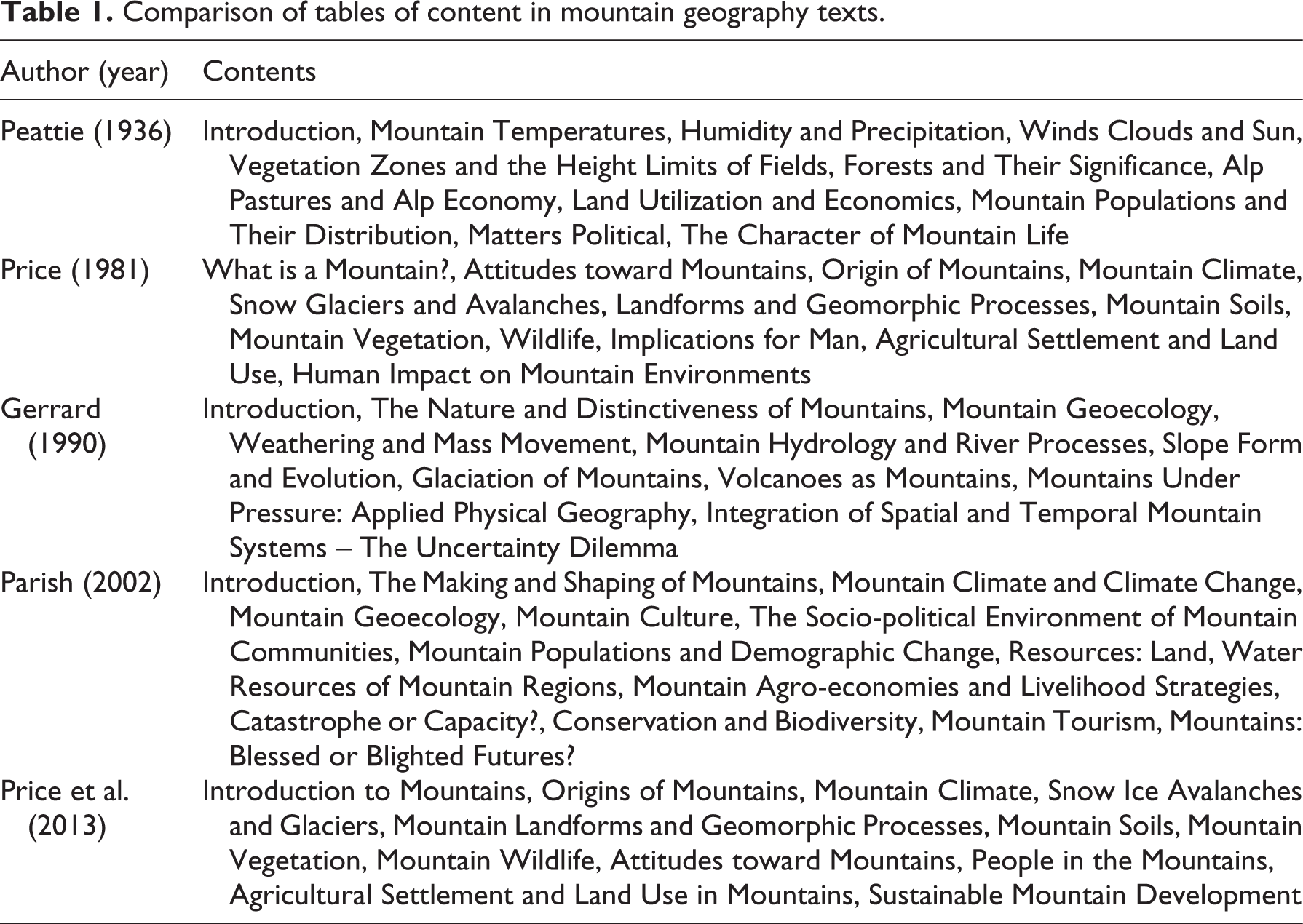
The release of Price et al.’s Mountain Geography: Physical and Human Dimensions in 2013 provided a multi-editor and multi-author update of Price’s (1981) book that could be used as a textbook. That book continues, however, a very Eurocentric view of mountains and mountain research (Sarmiento, 2014) that can be traced back to Roderick Peattie’s 1936 classic text. In fact, most recent books on the subject of mountain geography (e.g. Gerrard, 1990, and Parish, 2002) follow a somewhat standard pattern of topics used by Peattie (1936). Beginning with a discussion of what constitutes a mountain, and perhaps how mountains have been viewed by humans over the course of history and across a variety of cultures, a series of chapters follow presenting mountain climate, mountain geomorphology and soils, and mountain vegetation (Table 1), followed eventually by a discussion of humans and human land use in mountains. Obviously, each of these topics has one or more specialty books devoted specifically to them (e.g. Barry’s classic Mountain Weather and Climate, 1992, and Holtmeier’s 2009 examination of Mountain Timberlines), but those more specific texts are often “research-dense” tomes summarizing the career scientific output and perspective of an individual rather than an overview of mountain landscapes. General mountain geography books in the English language invariably largely invoke the spirit of the original, Eurocentric mountain view of Roderick Peattie’s 1936 classic Mountain Geography: A Critique and Field Study.
Comparison of tables of content in mountain geography texts.
II Roderick Peattie and Mountain Geography
In examining the life of Roderick Peattie (Figure 1), it is convenient that he is among the few geographers of that era for whom we have a published autobiography covering much of his life (Peattie, 1941). Peattie was born in the central United States, in Omaha, Nebraska, in 1891. While a young boy, his family moved to Chicago (Peattie, 1941; Smith, 1957), where he eventually enrolled in the University of Chicago and received his BS degree. At the University of Chicago, he studied geology with Wallace W. Atwood, Rollin D. Salisbury, and Thomas C. Chamberlin (Peattie, 1941). He followed his mentor Atwood to Harvard University, where he studied for his PhD in geography. He taught geology at Williams College in western Massachusetts in the 1919–1920 academic year, during which time he also completed his PhD under Atwood. In 1920 he accepted a position at Ohio State University, as an assistant professor of geology. In 1924 he was transferred to the geography department at Ohio State, where he spent the rest of his career (Smith, 1957).
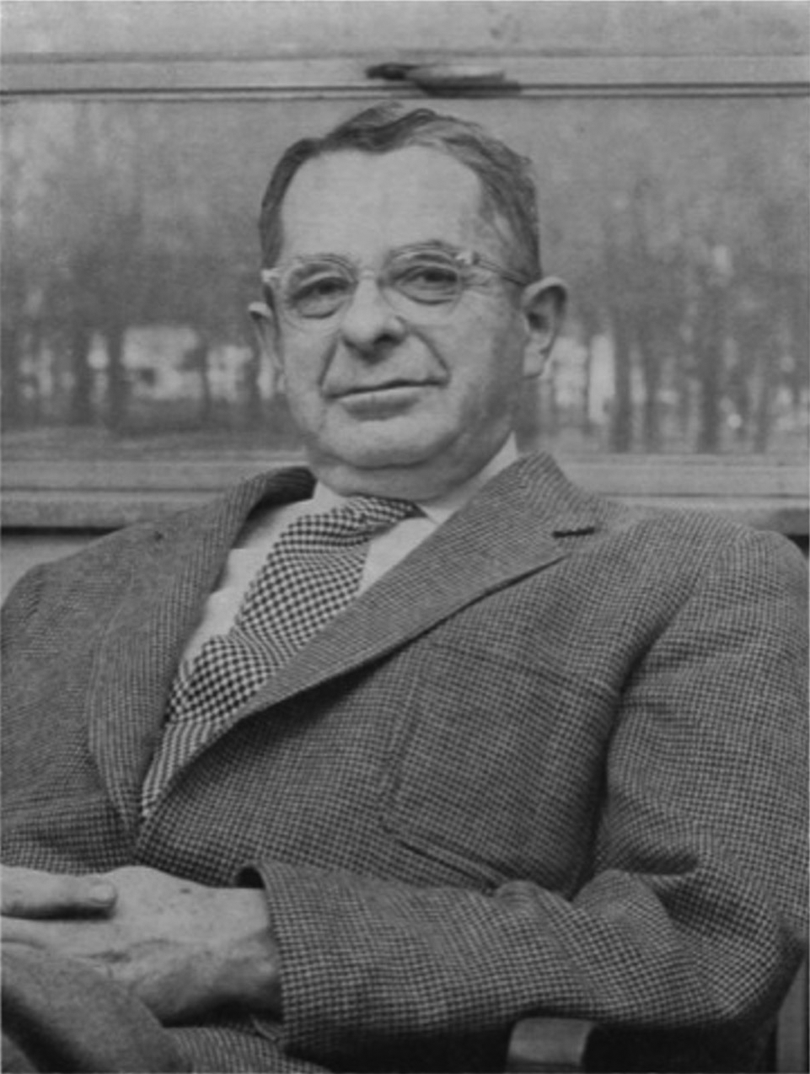
Photograph of Roderick Peattie, reprinted by permission of the American Association of Geographers, from Guy-Harold Smith (1957).
In 1927–28, Peattie and his family went abroad in Europe, studying mountains in preparation for an anticipated book on mountain geography. In Europe, Peattie visited or studied the Sierra Nevada, the Sierra de Guadarrama, the Pyrenees, the French Alps in Provence, Dauphine, and Savoy, and the Jura; in Switzerland the Valais, the Bernese Oberland, the St. Gotthard massif, Grisons, and Engadine; in Austria the Tirol, particularly the Stubaier Alps, the Salzburgkammer, the Tauren Alps, and the Karawankens of Carinthia; the Dalmatian Alps of Yugoslavia; the Trentino (Sud Tirol), the Apennines, and the Sicilian upland in Italy; the Bavarian Alps and the Black Forest (Peattie, 1936: vii).
In Mountain Geography, fully half the text (in terms both of chapters and pages) is devoted to the physical geography of mountain, setting the pattern for subsequent books written many decades later (Table 1). It is noteworthy that every single photograph in the book comes from European mountains, and nearly every line drawing is based on European examples as well, establishing a strong Eurocentric view of mountain landscapes. Peattie was clearly familiar with, and cited, North American literature, and had, as previously mentioned, traveled extensively in American mountains. His goal, however, was to inform a North American reading audience about the mountains of Europe in which he had spent a considerable amount of time and effort during his study abroad. In his autobiography (Peattie, 1941: 163), he noted that [t]he numbers of books and articles on mountains, unavailable in most American libraries, overwhelmed me. Then I discovered what my role should be: it was to conduct as many types of field studies as possible so that I should be qualified to read and be critical of these books; then I might build my experiences into a book in such a way as to bring home both a study of mountain geography and the technique of mountain studies.
III The lasting influence of Peattie’s Mountain Geography
The tables of content illustrated in Table 1 attest to the continuing influence of Peattie’s work and how western geographers conceptualize the study of mountain geography. His book also remains among the more widely cited mountain geography texts (Table 2), in spite of its age, third only to Price’s (1981) book and just behind Gerrard’s (1990) more physically oriented book. That is not to say that no progress has been made in expanding the view of mountain geography beyond western Europe and North America. The recent volume by Price et al. (2013) and the work by Parish (2002) include much good material on mountain landscapes, especially in central Asia from Afghanistan eastward to India and Nepal; Parish (2002) also extends discussions to, among others, the Atlas Mountains of North Africa and the mountainous regions of Thailand.
Citations of widely distributed general books on mountain geography*.
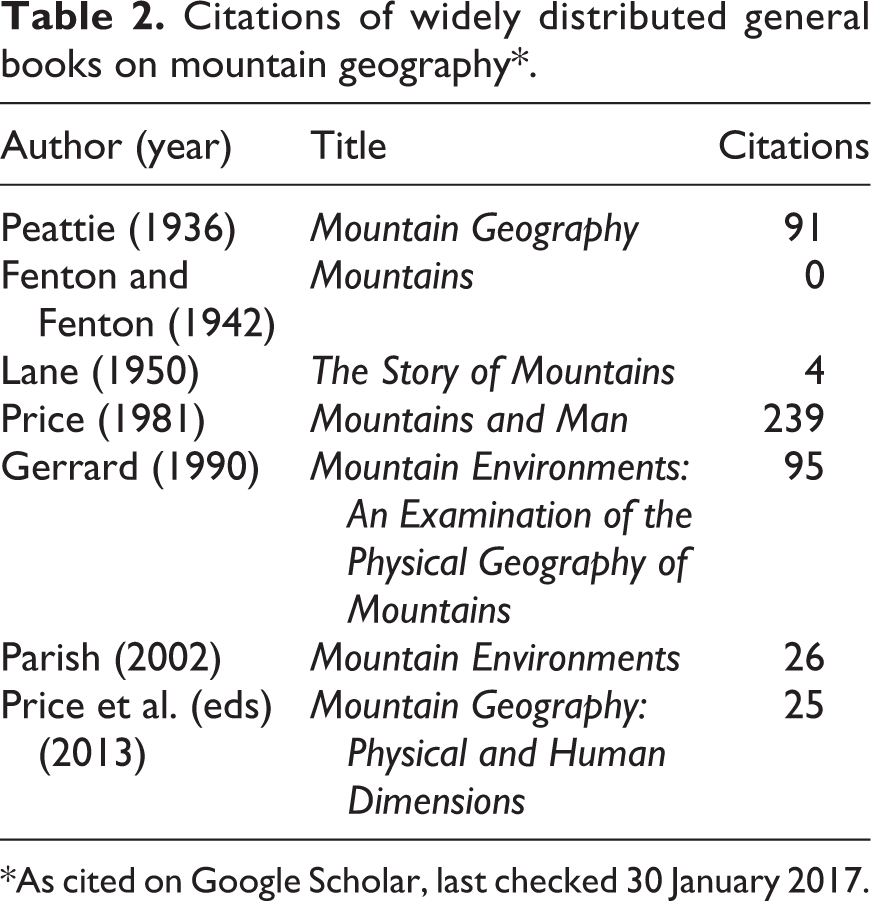
*As cited on Google Scholar, last checked 30 January 2017.
Nonetheless, as Sarmiento (2014: 180) noted in his review of Price et al. (2013), Despite many references to examples from the Himalaya and the Andes, for instance, the absence of authors affiliated to those regions and the positivistic narrative perpetuate hegemonic views and understandings about mountains from the binaries of the neocolonial global North and scientific knowledge.
Footnotes
Declaration of conflicting interests
The author declared no potential conflicts of interest with respect to the research, authorship, and/or publication of this article.
Funding
The author received no financial support for the research, authorship, and/or publication of this article.