







Abstract
Over the past 12 months, the journal has undergone some changes, and we are writing this short editorial to update our readers about these. The headlines are: (1) We have seen an increase in our journal Impact Factor in 2025 to 3.6. (2) We have experienced a strong upturn in submissions over the past two years which has generated a significant extra labour burden for our relatively small editorial board, necessitating a review of our board membership and breadth. (3) We recently advertised for new Editorial Board members, particularly seeking experts from underrepresented areas of the world, and to fill gaps in the disciplinary coverage of our existing board. We were overwhelmed with numerous applications from distinguished geography researchers. (4) We are pleased to report that five new full Editorial Board members and several further new Associate Editorial Board members have been appointed. We have also recruited a new board member who will manage our presence on social media – in particular managing a LinkedIn account for the journal. We look forward to working with these experts to further raise the profile of the journal. (5) We recognise the significant contribution made by Dr Sarah Praskievicz who stepped down from our Editorial Board at the end of 2024, and we pay tribute to her inspiring career.
Impact Factor
We received news in June that Progress in Physical Geography (PiPG) achieved a higher Impact Factor (IF) than last year, increasing to 3.6, with an improvement in our rankings to 15/67 in the Physical Geography category and 66/258 in the Multidisciplinary Geosciences category (Figure 1). We are happy to share this news and want to thank all of our contributing authors, editors, and reviewers. The calculation for PiPG’s impact factor in 2025, showing an increase to 3.6.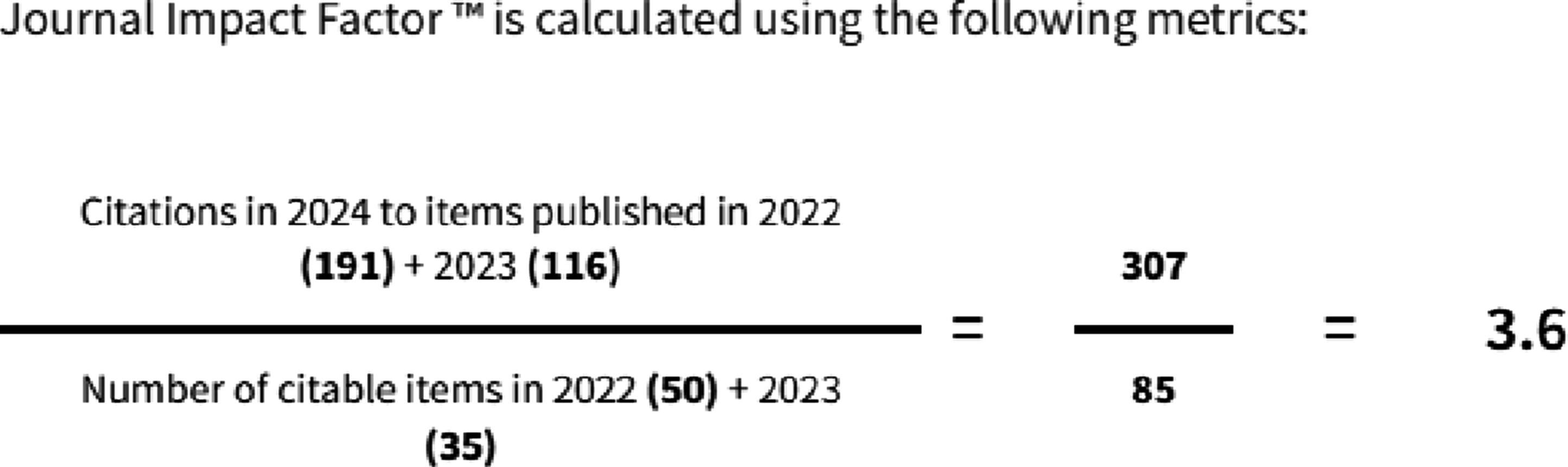
Changes in submissions
Recent submission statistics for PiPG.
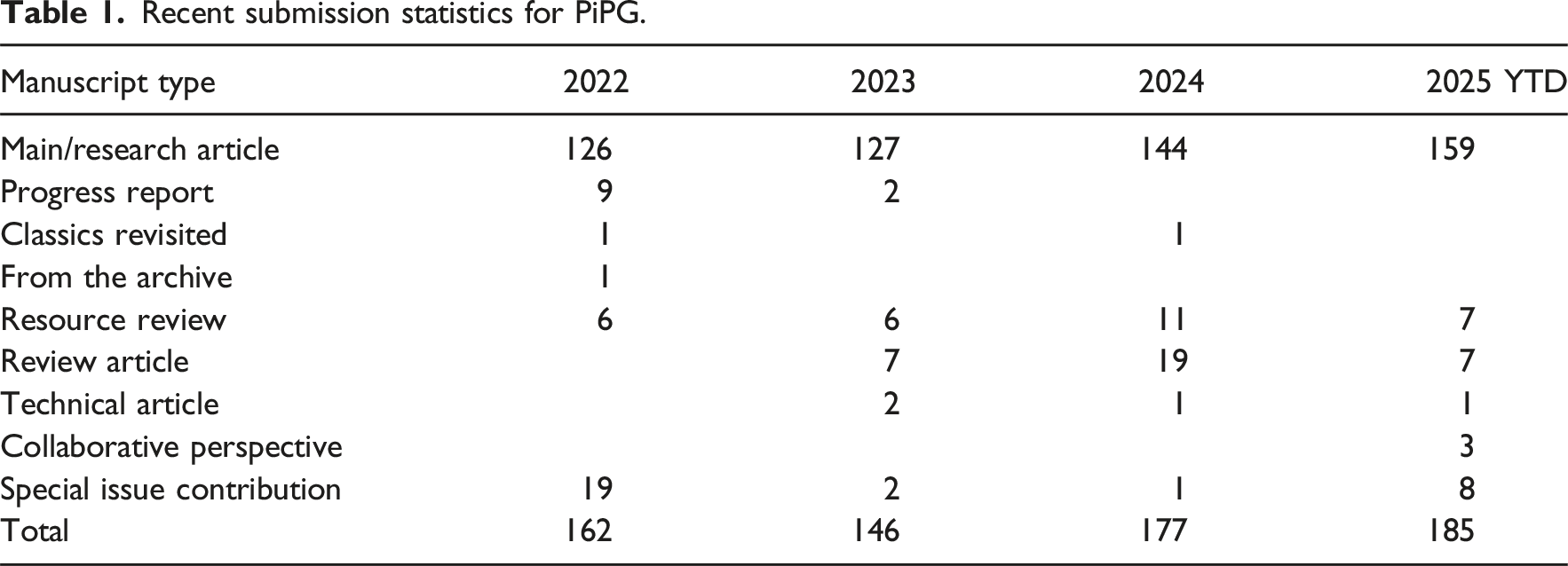
Although historically associated with the publication of review articles, over time, PiPG has published an increasing proportion of original research (Clifford and Malanson, 2019). Until 2023, both reviews and research articles were published under the same classification of ‘main articles’. Since then, however, they have become differentiated as ‘review articles’ or ‘research articles’, with the latter being the vast majority of what we receive.
Other changes in the types of articles submitted are evident from Table 1. These reflect the introduction of some new article formats in 2023, which aimed to encourage different types of discourse in PiPG (as discussed in Bareket-Shavit, 2024). It is pleasing to see these new submission types coming through; an example – a ‘technical article’ – is included in this issue (Wintzer, 2025). Further information about the criteria for these new formats can be found in the PPG submission guidelines.
Table 1 also shows that we have seen an upturn in the submission of ‘resource reviews’. This series was expanded by the outgoing/incoming Editors-in-Chief in 2019 to include coverage of other types of research resources beyond books (Clifford and Malanson, 2019). In spite of this change, the focus of this series has remained largely on books. Whilst we remain committed to the publication of critical book reviews, we wish to underline that we will not publish descriptive chapter-by-chapter accounts of texts, of which we receive quite a few.
Two recently published resource reviews (Alfaridzi et al., 2025; Anderson, 2025, this issue) provide exemplars of how book reviews can be written in an engaging and creative manner. We encourage new submissions of this variety, noting that ‘resource reviews’ need not be only of geographical textbooks but can engage a wide variety of literature. In this age of rapid environmental change, bookshops and libraries are replete with popular literature on topics of relevance to physical geographers. These book reviews need not take days to write and can be presented in a relatively short format or written from a personal perspective. We are open to your creative submissions!
Crucially, ‘resource reviews’ may also engage a diversity of research resources other than books, including new data sources and compilations (e.g. satellite data products, global biogeographic data, and climate data coverages), as originally intended by Clifford and Malanson (2019). With the rise of machine-learning-driven product development – particularly in geospatial sub-disciplines – the time is ripe for critical geographical attention to be turned to evaluate such products.
It is also worth noting from the submission statistics that we have only considered a limited number of special issue (SI) contributions in recent years. This is because, at PiPG, we are not keen on a model where we proliferate SIs, rather preferring targeted SIs that speak to new frontiers or interesting inter- or cross-disciplinary themes. Readers should note that we currently have two SIs in train – please see details below.
“Coding Earth: open-source solutions in Physical Geography” led by special editors Duccio Rocchini, Michele Torresani, and Jakub Nowosad.
“Earth, Water, and Resilience: Nature, Technology, and Governance for Sustainable Hydroscapes” led by special editors Gagan Matta and Rama Pal.
Please, if you have a proposal for a cutting-edge SI, send a 1-page proposal to the Editor-in-Chief, Karen Anderson. We are keen to run 1–2 special or themed issues per year.
Contribution of Dr Sarah Praskievicz to Progress in Physical Geography
We are grateful to Dr Sarah Praskievicz (Associate Professor; University of North Carolina, Greensboro), who stepped down from her position on the Editorial Board (EB) in 2024. At the time when Sarah stepped back from editorial duties, we knew that she was dealing with a new health diagnosis. Very sadly, as we were writing this editorial, we discovered the news that Sarah passed away in August 2025. We are absolutely devastated to learn of her death.
Her time on the board at PiPG was relatively short, but during that period she contributed greatly to the journal; overseeing many manuscripts that fell within the remit of her expertise in fluvial geomorphology, hydrology, and river science. Even after stepping back from full editorial board duties, Sarah continued to assist us with occasional reviews of manuscripts, never giving any hint that she was dealing with difficult personal circumstances behind the scenes. She was generous, kind, and professional and a pleasure to work alongside. Physical geography has lost a great scientist and educator.
We wish to put in writing that we appreciate your contributions, Sarah, and we are grateful to have had the opportunity to work with you, and thankful for your great service to the journal whilst you served on the board. We also wish to recognise Sarah’s great contributions to advancing understanding of fluvial processes, particularly in the North American geographical context. We share our condolences with Sarah’s family, friends, and colleagues.
Editorial Board members
Full Editorial Board, commencing January 2026.
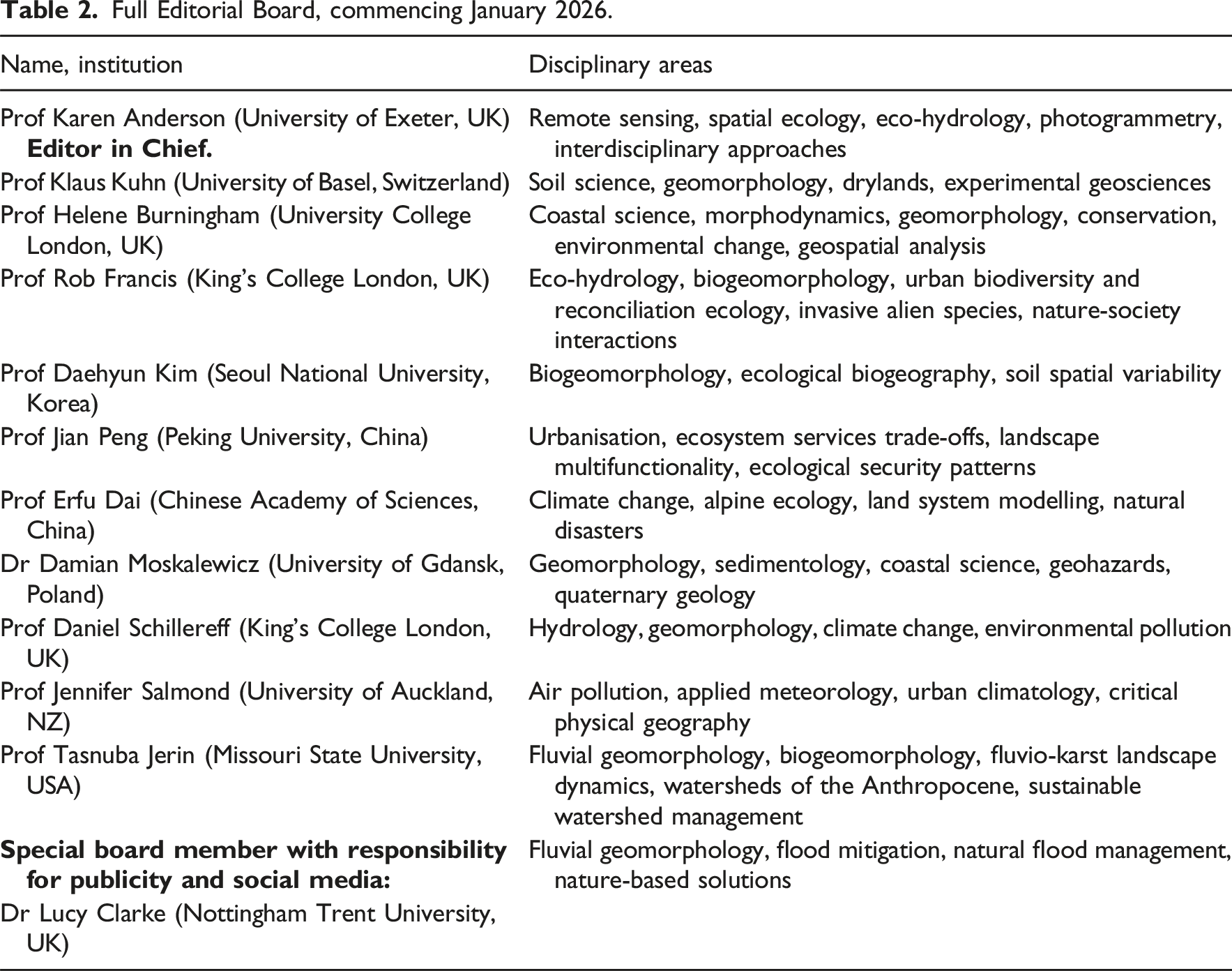
We are very grateful to all of those who applied. Those chosen to join us were selected on the basis of their geographical location and/or disciplinary expertise, plus any supporting evidence provided in their cover letters. Our enlarged editorial board (comprising one Editor in Chief, ten standard members, plus one special member (Lucy Clarke) as compared to a previous five) now covers the breadth of topics and research encapsulating the discipline of physical geography. We now have a truly international editorial board comprising members from Europe, Asia, USA, and Australasia. This is an exciting new chapter for the journal. The renewed board will commence January 2026.
Renewed Editorial Advisory Board
Some of the applicants from our EB recruitment process who did not secure positions as full board members have since accepted positions on our Editorial Advisory Board (EAB). We are very grateful to our EAB members, the names of whom are listed on the inside cover of the journal. These people are core to our reviewing operations. We welcome further applications for membership of our EAB from anywhere in the world and from any sub-discipline of physical geography. Please contact us if you would like to express your interest in joining the EAB.
New LinkedIn Account
In addition to our five new full EB members, we have also appointed Dr Lucy Clarke (Nottingham Trent University) to the board, with a special responsibility for journal publicity and social media. Lucy will hold the responsibility for sharing news about new papers and other related items through the journal’s new LinkedIn feed. You can expect this to be up and running from mid- to late-January 2026. We have taken the decision to abandon use of Twitter/X since this seems to be less widely used by academics at the current time. We hope that Lucy’s efforts will generate increased interest in PiPG articles and bring new audiences and potential writers to our journal.
In conclusion
We are confident that the rise in the IF of PiPG, combined with the increased rate of submissions and a rejuvenated and strongly international EB and EAB, places us in an excellent position to move the journal into the next, exciting phase in its development.