







Abstract
The marine areas hold a major interest regarding energy production, which is mainly divided into wind and tidal energy. In this context, wind energy from offshore platforms will be considered, as they provide a way to generate sustainable energy in places with deep waterways. Floating wind farms are growing quickly in Norway, Denmark, and the UK. Such farms, like Hywind Tampen, are already being run by Norway, and intends to focus entirely on floating projects in the future. In an effort to boost energy output from the water, Denmark is researching and laying the foundation for floating wind farms. The United Kingdom is also making investments in this technology, particularly in Scotland, where significant projects are anticipated in the upcoming years. Floating farms are seen as an essential component of the green transformation in all three nations.
Keywords
Introduction
The United Kingdom, Norway, and Denmark are among the north European nations that are the subject of the article. With cutting-edge technologies and notable projects already underway or in the works, these nations were chosen as leaders in the field of floating wind farms. In addition to offering commonalities in terms of the marine environment and regulatory methods, concentrating on these jurisdictions, enables a targeted examination in locations where expertise and laws regarding floating wind farms are more developed.
The above—selected North European Countries are acknowledged to be pioneers in relation to marine energy. Norway alone dominates the energy sector as it has established the first floating wind farm in its waters, and, with the cooperation of the UK particularly in the area of the Scottish Commonwealth, has installed the first floating wind turbine. At the same time, Denmark, the other pioneer in the field of energy, both on land and recently at sea, is preparing to put into operation two energy islands. One already physically existing while the other entirely artificial constructed. They both designed to meet the urban energy needs of Denmark, to support its heavy industry and to contribute to the needs of its neighbors in Europe.
The Norwegian State Oil Company named Statoil, has developed its own innovative floating wind turbine technology, which has been successfully evaluated for 6 years in a 2.5 MW pilot installation off the Norwegian island of Karmøy. Statoil’s technology is considered to be superior to alternatives to deep-sea offshore wind turbine designs in terms of simplicity, but also in terms of construction and installation costs. Statoil’s technology ensures a significant reduction in the per MW installation costs of the offshore wind farm units. Furthermore, marine locations deeper than 100 m can be exploited, as they have higher wind potential and less environmental disruption. In 2016, according to Equinor’s official report, Statoil made the decision to invest roughly NOK 2 billion (≈171.5 million €) in the building of the Hywind wind farm, located. 30 km off the coast of Peterhead, Aberdeenshire, Scotland, based on the experience acquired from the pilot project. The farm is located in a region with water depths between 95 and 120 m, covering 4.0 km2. This location experiences 10 m/s (36 km/h) wind speeds on average. The Hywind pilot wind farm is the first international project with floating wind turbines. It comprises a total capacity of 30 MW and consists of 5 Siemens units, each with a 6 MW capacity. It was anticipated to be completely operational in 2017. The electricity generated will cover the needs of 20,000 domestic consumers (Estimated production of 135 GWh per year). The huge floats were built at the Spanish Navantia Shipyard and transported by sea to the wind turbine assembly base in Stord, South West Norway. From there, the fully assembled turbines were towed vertically to their installation site on the wind farm. This new technology greatly expands the possibility for the development of offshore wind farms worldwide. Norway developed the largest floating wind farm in the world in the North Sea. According to the official report of Equinor, the Hywind tampen wind farm took roughly 7.4 billion kroner (≈629.95 million €) to build respecting the economic data of 2023. One important factor in the shift from fossil fuels to renewable energy sources is the potential of this technology. 11 wind turbines at the Hywind tampen plant, with a maximum output of 8.6 MW each, supply about 35% of the electricity required by five nearby oil and gas sites. About 140 km offshore, the project started producing electricity in late 2022. As the name implies, floating wind turbines are installed atop a floating construction that is secured to the seabed, in contrast to offshore wind turbines that are attached to the ocean floor. This allows them to be installed in areas with stronger and more stable winds, such as deeper waters and farther off from the coast. However, they cost more to construct, though. The state-owned oil companies Equinor and Petoro in Norway possess the project.
An ambitious plan to construct a sizable artificial island in Denmark that can supply three million households with “green” electricity has received preliminary approval. It is envisaged that the world’s first “energy island” will eventually be three times larger than its current size of 120,000 m2. Around 80 km off the shore of the Jutland peninsula, in the North Sea, lies an artificial island that will be partially owned by the private sector and at least half owned by the public. Not only will it supply electricity to Danmark, but also to the electrical grids of other nearby nations like the Netherlands, Germany, and Britain. Additionally, it will generate “green” hydrogen that may be used in heavy machinery, ships, aircraft, and other industries. In the Baltic Sea, a smaller energy island is already planned off the Danish Island of Bornholm. Agreements to supply electricity to Belgium, the Netherlands, and Germany have been signed in order to accomplish the already stated (Melissas, 2021). Norway states, that the schedule to be followed includes, the period between 2022 and 2023 where the North Sea energy island tender process will take place. Following that, during 2023–2025 early production and feasibility studies will take place. The North Sea Energy Island will be built between 2025 and 2028, where the power transmission grid will be installed between 2028 and 2031, and offshore wind farms (3 GW) will be built between 2031 and 2033. Construction of the next phase to build offshore wind farms (7 GW) is scheduled for 2033–2040.
From what has been said so far, this article aims to fill a gap created by a lack of diversity in the articles and presentations on the licensing process and legal framework in Norway, Denmark, and the United Kingdom in the Scottish region, regarding the installation of offshore wind farms. Norway was chosen, because it is a pioneering mechanical superpower in the field of renewable energy sources, while Denmark is aiming for an ambitious energy plan to support the majority of its territory with renewable energy sources. The United Kingdom was chosen because it is a strong economic power in the field of renewable energy sources. Since there were limited articles and sources available to compile a collection of presentations from these three pioneering countries, this article was chosen to fill this bibliographic gap through a collection of presentations of legislative content.
Methodology
A scoping review, a methodological framework for evidence synthesis created by official governmental policy, and an analysis of the laws of each chosen state were used to create the current paper. The best method for studying current, intricate, and varied subjects in the scientific realm of the renewable energy sector—and specifically regarding offshore wind parks—is ideally a scoping review. Many secondary concerns, including environmental constraints and maritime spatial planning, are appearing under this particular discipline. In general, the article’s goal is to give a summary of the existing studies, not to offer fresh data or conclusions about potential recommendations for the precise placement of offshore wind farms. The aim of this integrative study is to provide a concise yet thorough summary of the literature review, theoretical framework, and research background of these massive energy installations in the sea. The reference search, with last date on 23 October of 2025, yielded 286 articles from Scopus and 216 results from the internet. After filtering for English language articles published in the period 2100–2026, 19 records were excluded. Moreover, 61 sources were excluded after removing duplicate records with the help of Zotero. Of these, 261 records were excluded based on title and abstract screening. From the 161 eligible records, a full-text review revealed that only 49 met the inclusion criteria (Figure 1). PRISMA flow diagram form reference check.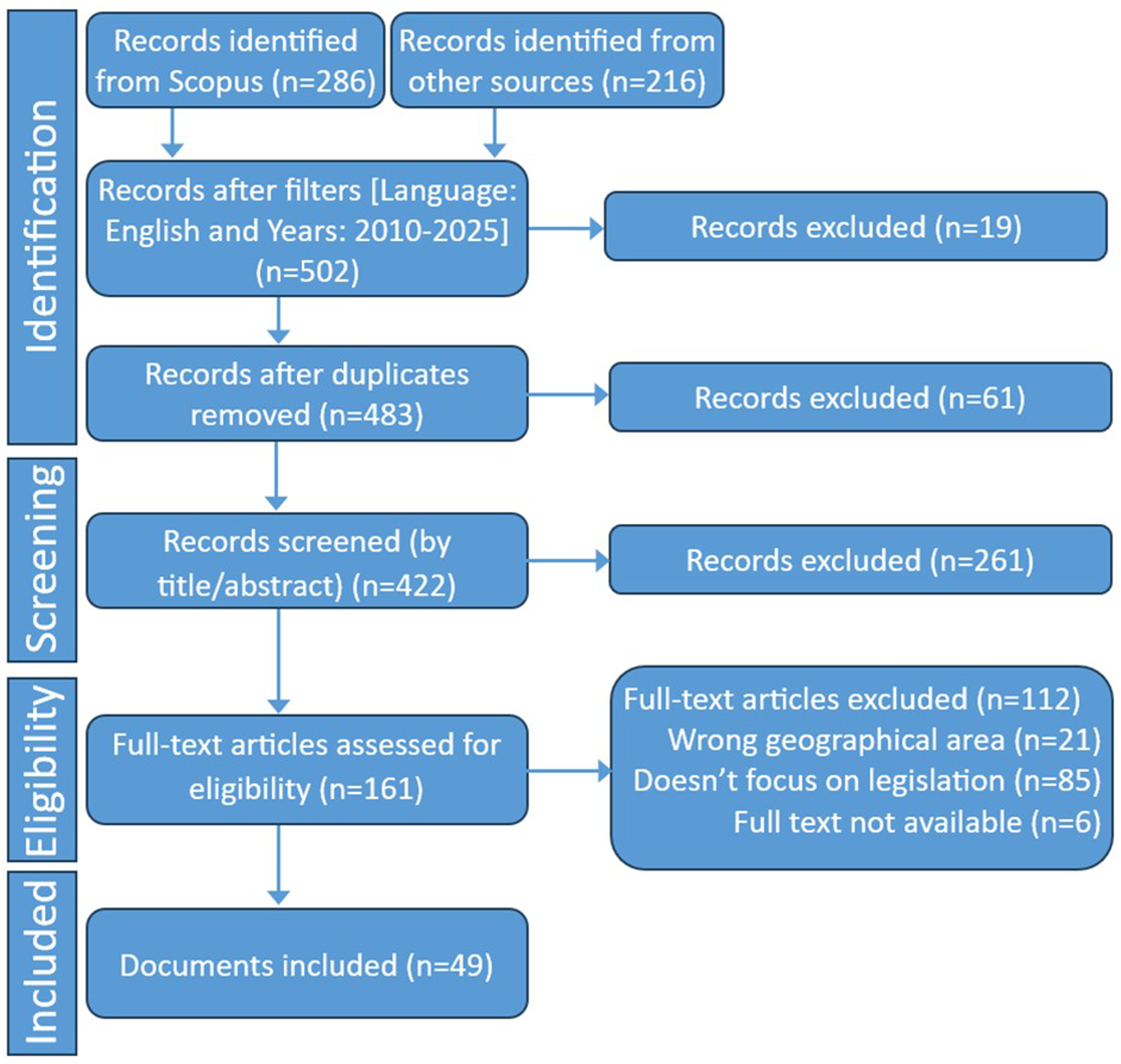
The case of the United Kingdom
The European Commission, in accordance with the Offshore Renewable Energy Strategy, predicts that offshore wind capacity will be increased eventually from 12 GW that is calculated today to 60 GW by 2030 and 300 GW by 2050. It is anticipated that offshore wind power would be the maximum source of electricity production in the European area in 2040. In Europe, currently the most important concept for a floating wind farm is currently located in Scotland. It is called, the Hywind project (Equinor, 2020), which uses the technology format of Norway’s Equinor (formerly Statoil) which includes five wind turbines with a total electric capacity of 30 MW.
Offshore wind park “Hywind”
Overall, the United Kingdom if it is not the largest offshore wind market globally, it is at least, the greatest market for offshore wind power in the European community area, with a capacity of 30 offshore wind farms including the type of floating wind farm. In the United Kingdom applies the decentralized model where the proper selection of the development of each wind farm is based on marine spatial plans and the provisions of environmental law. Based on a competitive process which is characterized by financial and technical criteria, the investors who will be selected, will acquire a preferred right for the construction of wind farms. Previously, there have been consultations and negotiations between the government sector and the private and investment one. The licensee is responsible for the design, technical studies, the specific location of the wind farms and wind turbines, the licensing process, the connection and the interaction of this project with the local authorities. Whether this project will ultimately be assigned to the specific investor depends on the economic benefit of the produced kW, because when the decentralized model is followed, the responsibility of placing the specific wind farm—both onshore or offshore—is charged on the private investors (Equinor, 2022).
Characteristics of the wind park
The Norwegian company Equinor, formerly Statoil (Equinor, 2023), led the way, by launching, the “Hywind Demo,” the first floating wind turbine in history, which was built in 2009 in the North Sea. For the aforementioned project, combined already known technologies, given the fact that the project was based on previous technologies derived from offshore oil and gas extraction. Nevertheless, the project followed an alternative concept in order to exploit the wind potential at great depths this time. The 120 m tall wind turbine with 2.3 MW power and a rotor diameter of 85 m was installed 10 km offshore in the Stavanger region of Norway at 220 m for a 2-year trial period. Over the course of its initial stage of operation, it exceeded expectations, as it produced over 60 GWh, surviving waves of over 20 m and high speeds of over 40 m/s. After a successful 5-year trial, throughout which it was proven technologically viable, it certified the Hywind Concept. This know-how that has been used in Hywind Scotland the world’s first wind farm and will equivalent be implemented in Hywind Tampen in an equivalent manner. Thoroughly about Hywind Scotland, since 2017, it has been the first fully equipped and operational unit to use totally floating wind turbines in order to generate electricity. Responsible for the project is the consortium Hywind Scotland Limited, founded in 2013 and whose purpose is the construction and operation of the Hywind Scotland Pilot Project. This joint venture is 100% owned by Statoil Wind Limited, whose business purpose is to foster renewable energy initiatives in the UK (Hywind, 2015). The floating wind farm is situated about 12 nm outside of Scottish territorial seas, at Peterhead in northeast Scotland, around 29 km off the coast of Aberdeenshire. The project spans 4 km2 with a usual wind potential speed of 10 m/s and a sea depth of 95 to 120 m. Six wind turbines with a combined output of 30 MW are located in the park, each one with a capacity of 6 MW (Equinor, 2020). Each unit is far apart from 750 to 1200 m and connected to the sea bottom by the spar-buoy system (Melissas, 2021).
Legislation and licensing
License procedure in scotland.

Environmental Impact Assessment
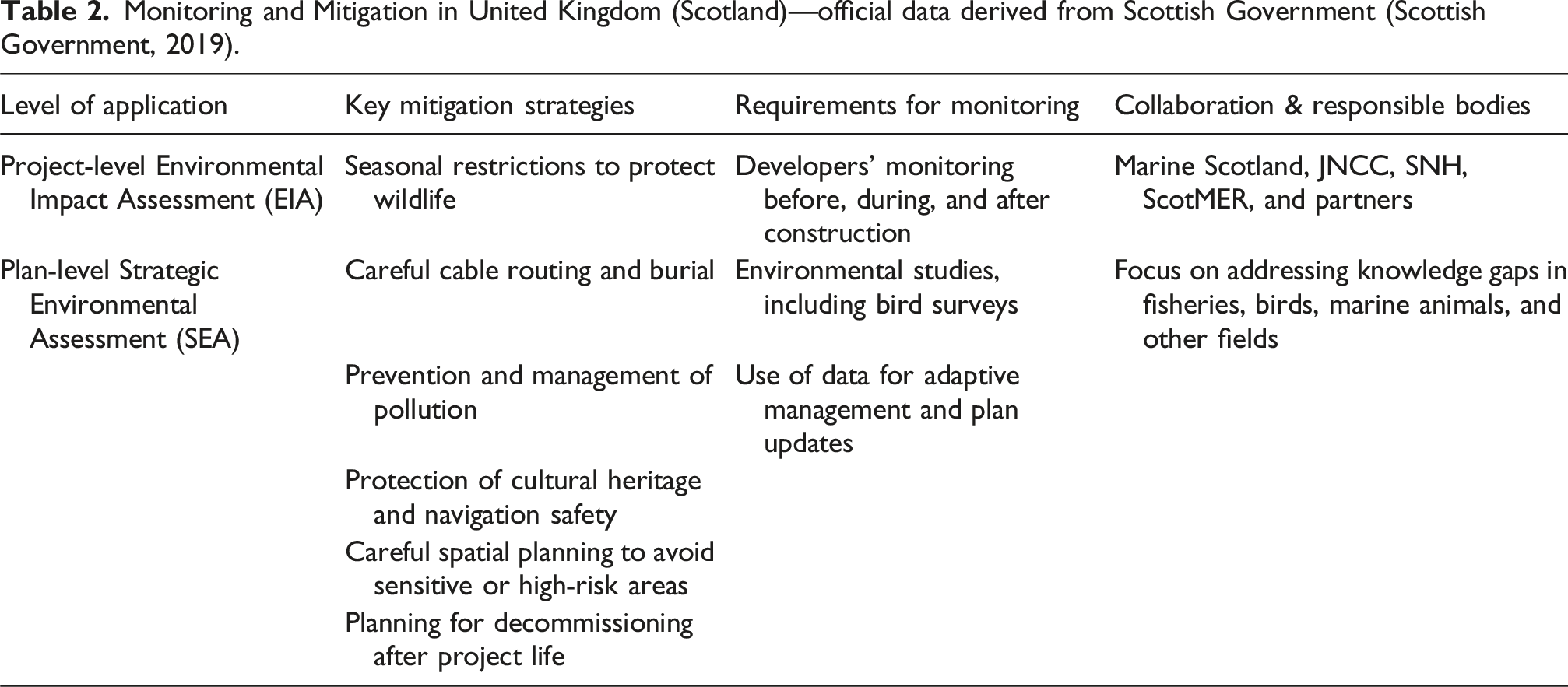
Monitoring and Mitigation in United Kingdom (Scotland)—official data derived from Scottish Government (Scottish Government, 2019).
Marine spatial planning and site selection
Regarding the selected area, the evaluation of potential areas began as early as 2009. Factors involved in this evaluation were the selection of the most suitable location, as floating wind turbines require depths greater than approximately 90 m. The evaluation additionally took into consideration the distance from land substation, in order to facilitate the export of energy without requiring an offshore substation or the conversion process. It also examined the proximity to a deepwater waterway, because the wind turbines, after their assembly, are brought in a perpendicular location to the installation area of the park. As a result, the path from the assembling area to the installation area must be of sufficient depth (Hywind, 2015). In addition, favorable bottom conditions are required to be able to facilitate the installation of wind generators on a smooth bottom with enough sand (Gao et al. (2024). According to the company’s estimates, two areas were deemed suitable for the installation of the wind turbines, as they met the above criteria. One site was at Minchoff Bay and the other at Buchan Deep in Peterhead (Equinor, 2015a). The second was chosen, as it was considered to be closer to the sea and to be an area with less environmental sensitivity.
As is deemed reasonable, in order to conduct the EIA (Equinor, 2015a), studies and investigations were prepared in the hope to examine the parameters for the construction of the project in the specific marine area. The effects were evaluated in a cumulative way, that is, in a manner considering the project’s phases, such as the planning, the licensing process and the operation of the park, but also in a combined way, that is, the combination of the effects generated by the operation of the park and the effects of other marine activities. Environmental impacts would include benthic and intertidal ecosystems, fish and shellfish, avian fauna, marine mammals, aviation and radar systems, commercial fishing, coastal shipping (short but and open sea), but also marine antiquities. It is clearly considered that the Environmental Impact Study will include the potential conflict of wind farms regarding with other offshore operations, including the production of oil and gas or the installation of submarine cables and possible unexploded ordnance or mines (UK legislation, 2017). The burning issue that concerns the avian fauna lies in the fact that five wind turbines were installed. This may have affected seabirds due to habitat loss, disorientation and fatal accidents owing to their collision with the rotor and blades of the wind turbines. Special ornithological surveys, such as the European Seabird at Sea Surveys (ESAS), were developed in order to record the affected bird species circulating in the area. The aforementioned investigations were initiated before the conclusion of the lease contract of the designated area for the installation of the project regarding the decision where the wind turbines will be placed. The areas of interest are categorized into an area for research (Exclusivity Area) and an area for lease (Area for Lease). The results showed that the number of birds that would be affected by the placement of the wind turbines was particularly low compared to the number of their species as a whole (Equinor, 2015b). In 2018, during the month of June, a 1 MW lithium battery system named Batwind was connected to store excess energy and feed it into the grid when needed. Through this gradual generation of energy, efficiency will be improved and the cost of generating wind energy will be reduced. This land-connected storage system was named as the first battery wind energy storage system applied to an offshore floating wind farm (ΟffshoreWIND.biz., 2018).
The case of Norway
The Norwegian project, called Hywind Tampen, is the most massive offshore floating wind farm in the world (Dominion, 2023) and the inaugural one that was properly designed to produce oil and gas in equivalent platforms. Its operation is only a year old, having started functioning in late August of 2023 (Offshore, 2023). It is moored to the Spar-Buoy system (Offshore, 2020). Five rigs in the Gullfaks and Snorre regions will receive 88 MW of power from the 11 wind turbines in the Norwegian North Sea, which are supported by moored permanent hulls (Equinor 2023; Offshore, 2023). This will cover 35% of the platforms’ yearly power requirements, with the possibility to raise that amount in the event of stronger winds. The completed offshore wind farm is due to transmit wind power around autumn 2022. The Norwegian government is increasingly pushing for the export of renewable energy to the principal offshore hubs of the nation. Thus far, this potential wind farm has been primarily powered directly from the coast via undersea power cords, but some parts of it are electrified when closer to shore.
Offshore wind farm—Hywind Tampen
The Hywind Tampen wind farm will be located 140 km out to sea, with a maximum depth of 300 m. Operator Equinor, the project’s contractor, estimates that the electricity generated will meet about 35% of the needs of the two regions. In water depths of less than 60 m, the majority of offshore wind turbines in operation today are supported by foundations buried in the seafloor. Since winds are stronger farther out to sea, it is anticipated that the next generation of floating wind turbines would function there as well. The design of the Hywind Tampen is based on a buoy. The 2000s marked the beginning of Norsk Hydro (which eventually merged with Statoil) work on the floating wind farm concept, including the drive control system, with research conducted in Norway (SINTEF, 2012). The Hywind technology was evaluated for the first time in 2005 at the Ocean Basin SINTEF facility in Trondheim. After 4 years, the Siemens 2.3 MW turbine with 85 m rotor blades was placed offshore at Karmøy as part of the Hywind Demo. It was attached to a narrow cylindrical infrastructure with three mooring lines. During 8 years of successful operation, this installation—the first floating turbine linked to the Norwegian grid—produced over 40 GWh with wind speeds of 40 m/s and wave heights of up to 19 m. Another feature is the High Wind Ride Through (HWRT) mechanism, which causes the turbines to typically shut down for self-protection when the wind speed reaches 25 m/s. However, with HWRT, the turbines gradually lower their output power, resulting in a more consistent and smoother output deterioration power grid (Offshore, 2020).
Legislation
In Norway, the Acts and Regulations (Norwegian Offshore Directorate, 2024a) applicable to wind energy (onshore and offshore) are structured (NLE, 1981) as follows: (1) Pollution control act (Forurensingsloven) (Normann, 2017), (2) Working Environment Act (Arbeidstilsynet, 2024), (3) The Planning and Building Act (Norway’s Governments, 2008) (“Plan - og bygningsloven”), (4) Regulations on systematic health, safety and environmental work in enterprises (Internal Control Regulations) (Norsk Industri, 2020), (5) Regulations on technical requirements for building works (Norwegian Building Authority, 2017), (6) Regulations relating to building applications (Norwegian Building Authority, 2010). “Byggesaksforskriften - SAK10,” (7) Act on supervision of electrical installations and electrical equipment (Electricity Supervision Act), (8) Regulations on electrical supply systems, (9) Regulations on low-voltage electrical systems, 10) Regulations on electrical equipment, 11) Regulations on safety when working in and operating electrical systems with guidance, Regulations on safety and emergency preparedness in the power supply (the emergency preparedness regulations) (NVE, 2013).
The “Havenergiloven” (the Offshore Energy Act/24/), establishes parameters for using renewable energy sources at sea (Chapter (2) (Norway’s Governments, 2020). The purpose of the Act, which came into effect in 2010, was to make it easier to employ offshore renewable resources in the Norwegian continental shelf. The rules outlined in the legislation are the responsibility of the Ministry of Petroleum and Energy, sometimes known as MPE,/46/. Furthermore, the Act’s goal is to guarantee that resource utilization and offshore technology development align with the goals and needs of society, accounting for competing business interests, environmental considerations, and the need for energy distribution. The Norwegian Offshore Directorate (NOD) (Norwegian Offshore Directorate, 2025) and the Norwegian maritime region outside the baseline (grunnlinjen) are covered by the Act (Norway’s Governments, 2017). According to the Act, producing facilities must have a license from the Ministry of Petroleum and Energy (MPE) in order to be constructed, owned, or run. An impact evaluation is completed prior to the selection of a site. Evaluations of the environmental and social effects of producing renewable energy, such as how other maritime operations may affect other commercial interests, are included in impact assessments.
On June 12, 2020, “Havenergiforskriften,” or “the Marine Energy Regulations,” were approved. They became operative on January 1, 2021/46/(Norsk Industri, 2021). In its memorandum, the MPE expressed the wish that the offshore form of wind energy exploitation should bear resemblances to the terrestrial licensing procedure. One of the main distinctions between offshore and onshore wind farms is that the state will determine which contractor, or corporation, is allowed to use specific regions, as there is no private ownership at sea. Beginning on January 1, 2021, the region of Utsira Nord and Sørlige Nordsjø II have been approved for the siting of offshore renewable energy (Norsk Industri, 2020; NTRANS, 2021). The authority to grant licenses for the installation of offshore wind turbines is MPE. In order to set a regulatory framework for offshore wind farms, the MPE typically develops a model. The project’s goal is to examine and assess the development of offshore wind resources lawfully, in the interest of society. When the overall framework for offshore wind energy is further developed, the MPE will take these proposals into consideration. In compliance with “Havenergiloven” (/24/) § 5.1 of the Renewable Energy Act, it was stated on August 17, 2020, that the Petroleum Safety Authority (PSA) had taken over oversight of safety, working conditions, and emergency response. The PSA will provide a special regulatory framework for HSE (Henriksen and Kristensen, 2015) in the offshore wind industry. The current procedure has revealed that the legislation would be predicated on operational standards, derived from principles cited in international standards and risk avoidance (BusinessNorway, 2024).
Legislative bodies
The following organizations oversee Norway’s onshore wind sector: (1) By the Norwegian Water Resources and Energy Directorate - The Norwegian Water Resources and Energy Directorate (NVE, 2025) oversees projects inside the “grunnlinjen” that are linked to the Norwegian electrical grid under The Energy Act (Energiloven). Onshore wind licenses are also managed by NVE. Every plant has more than five turbines, has an installed capacity of more than one MW, and requires a license. In addition, NVE is a regulatory agency that oversees environmental and energy transmission security matters. (2) The Norwegian Labour Inspection Authority (Arbeidstilsynet, 2025), which tracks an eye on compliance with the Working Environment Act and rules pertaining to health, safety, and the environment in businesses (Internal Control Regulations) (Norsk Industri, 2021). (3) The Directorate for Civil Protection and Emergency Planning (DSB) which monitors the supervision of electrical installations and electrical equipment (Act of Supervision Act). 4) The Norwegian Environment Agency (Miljødirektoratet), (Norwegian Offshore Directorate, 2024a), which monitors the compliance of the installations with the environmental requirements of the area. (5) Regulations pertaining to building applications (“Byggesaksforskriften - SAK10”) stipulate that wind turbine structures must undergo an impartial inspection. (6) Safety zones and marking are the responsibility of the Norwegian Coast Guard - Norwegian Coastal Administration (NCA), and they are governed by the regulation “Forskrift om merking av og etablering av sikkerhetssoner tilknyttet innretning for fornybar energiproduksjon” (/30/). A national organization for coastal management, marine safety, and readiness for marine pollution, is the NCA (/31/), which is under the Ministry of Transport and Communications. The Norwegian Maritime Authority - Norwegian Maritime Administration (NMA). (“Sjøfartsdirektoratet”) is responsible for administrative and supervisory matters pertaining to the environment, material values, health, and safety of life on Norwegian-flagged and foreign ships operating in Norwegian waters (32/). The legal protection of Norwegian-registered ships and the registered rights to such ships is another duty of the NMA. The Ministry of Trade, Industry, and Fisheries as well as the Ministry of Climate and Environment oversee the NMA. Laws, agreements, and political choices at national and international levels regulate their operations. In the consultation document released in June 2021, the Ministry of Petroleum and Energy made a number of recommendations to modify the Offshore Energy Act and the Offshore Energy Regulation (Thommessen, 2025).
Licensing
In summary, the licensing procedure for wind farms offshore is set out below. As a rule, the licensing process will start with the Ministry dividing each area according to Section 2-2 of the Offshore Energy Act into several smaller areas (Norway’s Governments, 2020). The Ministry proposes that a monetary fee may be required for the division of the area. As a general rule, there is economic competition when the size of the consideration is decided through an auction system. For floating wind farms, the criteria for selecting a site reflect the goal of technological development and cost reduction. The Department similarly proposes a pre-qualification process, to ensure that bidders meet the requirements advertised in Section 3-5 first paragraph of the Act for satisfactory technical competence and financial capability. They also should meet relevant health, environmental and safety requirements. The company that wins the competition for the allocation/allocation of a geographically defined area has the exclusive right to issue a notice and ultimately apply for a permit to develop the project. This area will then not be available to other entities that want to develop a wind farm project. The exclusive right is time-limited and failure to respect this limit may lead to the right to the assigned area being revoked. A tender-based licensing procedure, as proposed, is a new model for licensing in Norway (Figure 2). However, the Ministry has not developed the detailed content of the tender procedure, as it considers it vital for both Norway and the interested parties that the current framework is in place before the tendering process takes place. It is anticipated that the offshore wind farms in Norway would supply energy straight to domestic customers and customers on the European continent and in the UK, which will involve the construction of a new cable network and connection to electricity grids in different jurisdictions. These types of hybrid projects will affect the electrical system, power prices, power flow and interchange in other connections. Nevertheless, EU regulation on this point nevertheless remains under development (Landsværk, 2023). License procedure in Norway.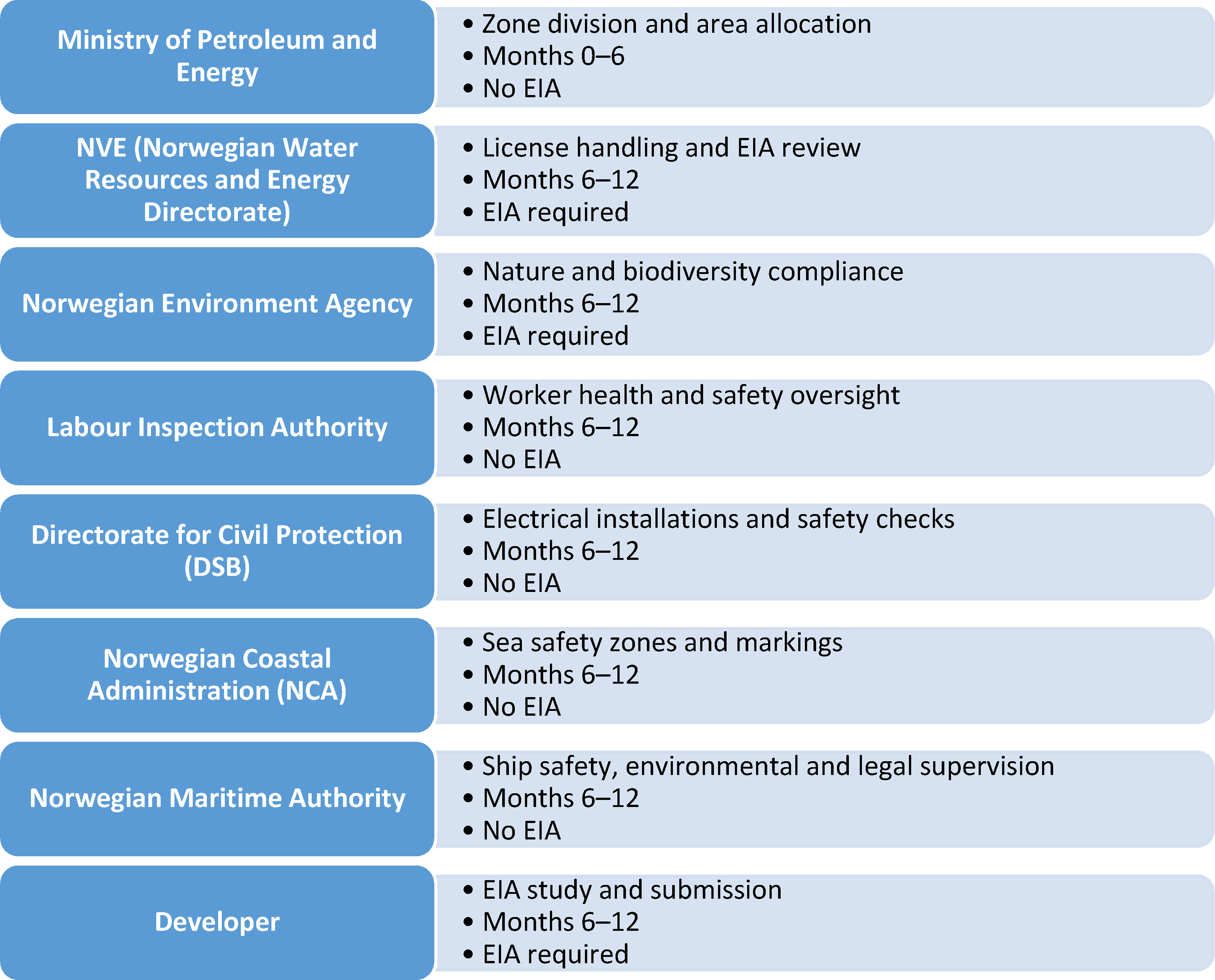
Environmental issues
Norway does not have a single plan for its entire EEZ but divides its EEZ into three areas: the Norwegian Sea, the North Sea and the Barents Sea, which together cover the entire Norwegian EEZ, that is, 2,385,000 km2 (Clement, 2014). The management plans outlined the general policies, the strategic framework, and the standards to be followed for the sustainable use and conservation of Norway’s marine areas (Norway’s Governments, 2016). Nature Diversity 2009 and the Marine Resources Act 2009 (Norway’s Governments, 2009a) establish the general legal framework (goals, objectives, and guiding principles) for the administration of maritime areas and management actions that must or may be implemented in accordance with legislation (CMS, 2009). Entrenched on the Barents Sea plan, a comprehensive ecosystem-based management plan for the Norwegian Sea was created between 2007 and 2009 and approved by Parliament in May of the same year. The proposal has nearly 1.2 million km2 coverage. It seeks to preserve the area’s high environmental value while adding benefit to the Norwegian economy (Clement, 2014). The strategy maintains the process of locating specifically designated regions in the Norwegian Sea, which have very significant natural resources that were introduced in the Barents Sea management plan (Platjouw, 2018). The sites were chosen mostly based on the importance of the region for biological production or biodiversity. On the contrary, scientific significance, as well as economic, social, and cultural significance were secondary criteria. The vulnerability of the 11 most important places in particular was determined.
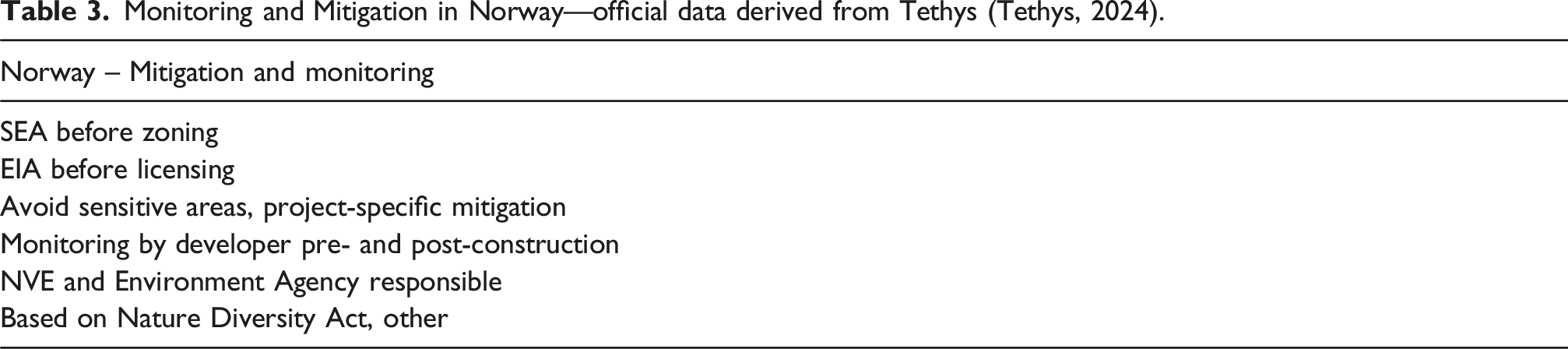
Monitoring and Mitigation in Norway—official data derived from Tethys (Tethys, 2024).
Marine spatial planning
One of the primary forces behind marine spatial planning in the North Sea is the growth of renewable energy, particularly offshore wind power (European Commission, 2015a). The generation of offshore wind energy requires a lot of land due to the possible environmental impacts are a crucial component in offshore wind farm allocation planning (OECD, 2020). The challenge for the North Sea countries is to coordinate trans-border collaboration, in an effective way in order to organize wind energy installations/areas with minimum adverse impacts on the ecosystem and other utilization of the sea environment. The SEANSE (Norway’s Governments, 2009b) project was intended to help the countries around the North Sea, deal with this issue (European Commission, 2015b) by supporting the implementation of marine spatial plans in accordance with the EU MSP. The Directive is the overarching goal of SEANSE. This project report develops and compares planning prerequisites for offshore wind energy allocation with the goal of exchanging knowledge on safety zones, existing standards, and various approaches to managing competing marine uses. This can help identify important design problems. SEANSE partners sampled and compared design criteria in concert for this baseline study on design prerequisites in the MSP (Norwegian marine waters, 2013). Norway uses SEA and MSP to manage the development of offshore wind farms and other uses of the sea. SEANSE is a European framework that seeks to help countries (such as Norway and its neighbors) resolve issues arising from these international collaborations and improve the implementation of SEA and MSP at the cross-border level. SEANSE promotes the collection and exchange of data between neighboring countries so that there is a common understanding of sea uses, environmental data and pressures. This reduces misunderstandings and facilitates coordination. With SEANSE, countries can harmonize SEA and MSP processes so that there are no conflicts between national maritime use plans. This allows for more coherent decision-making across neighboring areas. The programme encourages the creation of communication channels between public authorities, industry and local communities from different countries, preventing conflicts and achieving common solutions. It provides practical tools, guidelines, and examples of good practice for integrating cross-border parameters into MSP planning and SEA environmental assessments. First, a summary of offshore wind development and MSP in the North Sea nations is provided. Next, a comparison of generic location criteria is made. The description of the various sectoral laws for offshore wind farms in respect to other marine uses in the North Sea region constitutes the major focus of the report. Diverse rules concerning the use and preservation of maritime space might give rise to conflicts. These provisions mostly concern offshore wind farms, shipping routes, fisheries, flight safety, cables and pipelines, marine protected zones, and the preservation of species. Every nation around the North Sea has marine spatial plans or has begun the process of updating them. Due to the fact the MSP establishes spatial boundaries for renewable energy sources and transmission channels, it is crucial in the process of determining the location of offshore wind farms. The majority of nations designate regions for offshore wind energy, and these regions are chosen through official government or state tenders. The goals for national development that must be met take into account the necessity of offshore energy. Each nation’s present offshore energy status varies greatly, ranging from one turbine to 1500 turbines, or 6 MW to 6 GW. Today the North Sea has more over 13 GW installed in total, the majority of which is off the coast of the United Kingdom. In the case of Norway, it has been proposed by the government to open the two sites mentioned above, with an indicative capacity of up to 1.8 GW (Norway’s Governments, 2025).
The case of Denmark
Wind power helped Denmark to produce 42% of the total electricity consumed from wind turbines (Norway’s Governments, 2020; Johansen, 2021; Norway’s Governments, 2020; Bratvold, 2021). Denmark achieved the highest percentage of electricity generation from wind, according to official figures relayed by World Economic Forum. In particular, wind power helped Denmark generate 42% of the total electricity consumed from wind turbines. The achievement showed that the country’s goal of ending its dependence on coal by 2030 is achievable (IRENA, 2023), as is the gradual transition to renewables. Typically, between 1990 and 2015, CO2 emissions fell by 36%. While Denmark’s decision to adopt renewables is part of a wider global effort to phase out fossil fuels, the country has an economic interest simultaneously. The world’s most massive wind turbine manufacturer, Vestas Wind Systems, is based in Denmark (Danish Energy Agency, 2024), while the Danish government controls Orsted (formerly Dong), which is the largest offshore wind farm operator internationally.
The green “Deals”
Denmark has announced a checkmate move, with the launch of its largest ever tender for offshore wind farms. The Danish state will control 20% in each of the six wind farms to be built, while private investors will have to pay back the exploitation rights within 30 years without receiving any state subsidies. A minimum of 6 GW must be present in all wind farms capacity, (State Of Green, 2024), not excluding the possibility of reaching 10 GW. The wind farms must be completed by 2030, by which time Denmark aims to have 70% reduction in carbon emissions from 1990 levels. Combined with the 2.7 GW of existing installed offshore wind capacity, these new farms would adequately cover Denmark’s energy needs, and the surplus could potentially be exported to neighboring countries. Exports could also accelerate the payback period of such an investment, as the installation of 1 GW of offshore wind power costs around 2,1 billion € until today, according to the statal official economic data. This project intends to generate hydrogen and green fuel for ships and aircraft in addition to providing all of Denmark’s electricity needs with renewable energy. Denmark is certain that such large-scale projects may have a significant positive impact on the environment, not only nationally but also for the entirety of Europe (Danish Energy Agency, 2016).
The Danish initiative - The energy Islands
As a consequence of the bold initiatives regarding an eco-friendly environment, within the Danish territory, offshore wind turbine units are to be installed around the approved islands, by providing this way green electricity, with the potential to supply a range of five million residential units. This project is spearheaded by Danish Energy Agency. The energy islands hope to establish a sustainable energy source for Denmark’s electrical networks by ushering in a new era of offshore wind power generation. The islands are expected to take the lead in Denmark’s and, if successful, Europe’s phase-out of fossil fuel energy extraction in the near future, by establishing green power “factories” at sea. According to the concept, an artificial island will be built in the North Sea to serve as a center for offshore wind farms that can produce 3–4 GW of energy, with the potential to grow to 10 GW in the years to come (Nieuwenhout and Andreasson, 2023).
In the Baltic Sea, the first island that will serve as a model for deployment will be Bornholm, where the island’s electrical installations will act as a hub for offshore wind energy, generating 3 GW of energy. With a brief reference to the past, Denmark was a leader in offshore wind energy, having constructed the first offshore wind farm in history in 1991. Its name is Vindeby, located in the Lolland area, and it consisted of 11 turbines. Denmark therefore has both the know-how and both the development’s capacity to construct the energy island project (Ørsted, 2019).
But what constitutes the actual definition of energy islands? These artificial implantations are the answer to the riddle regarding the facilitation of the launching of renewable energy and the diminution of carbon emission, providing it to the surrounding and supporting nearby areas (Cost, 2023). The known as energy islands and their wind turbines are to be located further away from the coast and serve as energy hubs or green power stations for the purpose of distributing the energy they produce to the recipients. Initially, there is the phase of obtaining energy from the closest wind farms and subsequently the dispersal stage. This means that the energy generated by wind turbines is used as efficiently as possible in terms of electricity demand and redistribution. It also facilitates the best possible circulation of electricity from an area where wind farms are installed, or from areas with high energy reserves to areas with little or no reserves. Although not exactly the same, the two energy islands share a common technical foundation, with offshore wind farms connected by electro-technical infrastructure on the islands. The primary distinction is that Bornholm is intended to be the location of the energy island in the Baltic Sea. This means that the electro-technical apparatus, which is necessary for the gathering and distribution of energy from offshore wind turbines, will be situated on land. On the contrary the island to be established in the North Sea, situated on land, will be an artificial island constructed with the express intent of producing power (Danish Energy Agency, 2025). In February 2021, the decision was made to add a new, man-made island to the Danish map. The offshore wind farms surrounding the two Danish energy islands, for example, are designed to generate 6-7 GW of electricity, of which 3–4 GW will come from the North Sea and the remaining 3 GW from the Baltic Sea region, specifically Bornholm.
North Sea region
In the long term, it is envisaged that, as the artificial island has been built only to cover energy needs, the island in the North Sea will have a capacity of GW (Gorroño et al., 2018). The island in question has been designed about 100 km off the coast of Thorsminde, Jutland and it will have the electro-technical infrastructure needed to transfer electricity from the wind turbines to the power grid. Additionally, a port may be built in the future. The wind turbines, which will be erected on the island, are intended to be bigger than the existing offshore wind turbines. They will also be situated farther away from the sea than in the past—far enough away that it will be necessary to fly over the installation site rather than just view it from the ground. The sponsors of the island will decide on the layout and dimensions of it. In order to finance the island, the Danish State will engage with businesses in the private sector, and public procurement will be used to build the island. The majority stake of 50.1% of the island will be held by the Danish State as a major shareholder (Danish Energy Agency, 2021). As previously stated, the island that will be placed in the North Sea would initially have a capacity of 3 GW, which is equivalent to almost half of Denmark’s entire electricity consumption and twice the energy produced by all of the country’s offshore wind farms as of right now.
Baltic Sea region
In the Baltic Sea, electrical apparatus is about to be located on the island of Bornholm (European Commission, 2024), aiming to connect and channel the electricity from offshore wind farms the electricity supplied to the nation’s electrical systems by offshore wind farms. Different from the North Sea, the offshore wind farms are to be placed about 15 km off the coast. The wind turbine units off the shore of Bornholm, as previously reported, will have a wind capacity of 3 GW, or the electrical equivalent of 3,3 million urban dwellings. Similar to this, the project’s goal is to transform the electricity produced by offshore wind farms into alternate energy sources like Power-to-X.
The decision to create the two energy islands was taken on the basis of the policy and climate summit of 22 June 2020, which was attended by the Danish government and key political factors. To summarize, in broad terms, the purpose of developing the energy islands is the reason for developing the conversion of the electricity generated by offshore wind turbines and fed into the country’s electrical networks. In contrast to the North Sea, the offshore wind farms are to be situated roughly 15 km offshore. As previously reported, the wind turbine units off the coast of Bornholm will have a wind capacity of 3 GW, which is the electricity equivalent of 3,3 million homes. Similarly, the project aims to convert offshore wind farm electricity into other energy sources such as Power-to-X (Baltic Wind, 2024).
Legislation
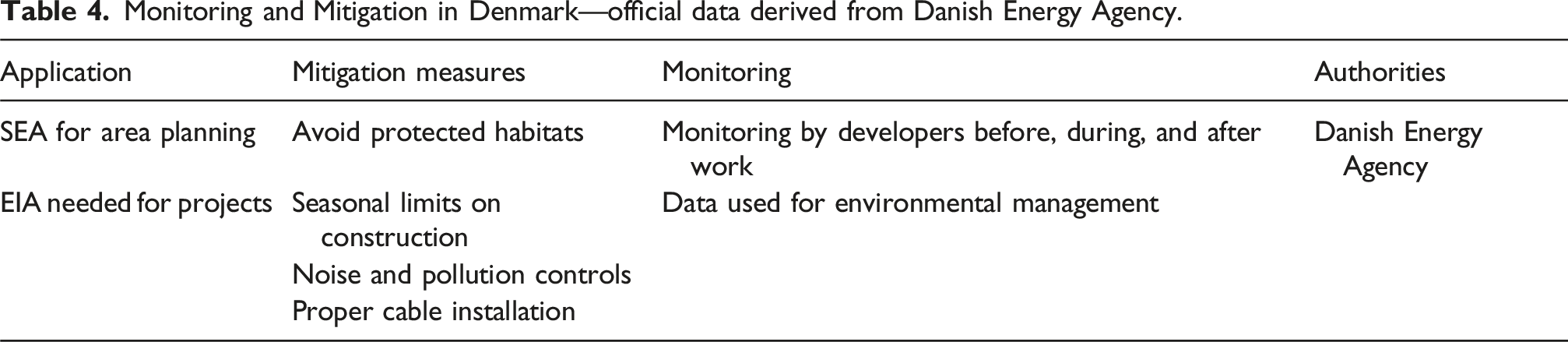
The laws pertaining to the development of renewable energy sources provide a summary of the requirements for the execution and building of offshore wind farms. According to Chapter 3 of the Danish Renewable Energy Act, the Danish State alone is entitled to use water and wind energy within the Danish maritime zone’s territorial seas and exclusive economic zone, which extends up to 200 nm. Consequently, each offshore wind farm in Denmark requires three specific licenses (Danish Ministry of Energy, Utilities and Climate, 2019). The above three permits are issued under the authority of the Danish Energy Agency, using the “one-stop shop” authority (Danish Energy Agency, 2016) acting for the developer of projects. The trio of permits (Danish Energy Agency, 2020) required are described below: (1) a permit to conduct preliminary research, (2) a permit to install the offshore wind generators (subject to the condition of granting only if the preliminary foundation investigations approve the compatibility of the project with the relevant economic and environmental marine interests), (3) a permit to exploit the wind energy for a specified period of time on approval of electricity generation (subject to the granting of adherence to the requirements of the project installation permit). The three permits are granted consecutively, and are issued only for a specific project, and not cumulatively for all wind farms in the territory. Furthermore, if an environmental impact is anticipated from the project, an EIA is required. For every offshore wind farm that exists in Denmark today, an EIA has been required thus far. The particular process for carrying out this environmental assessment is described in Executive Decree No 68 dated 26 January 2012 (Østergaard Nielsen and Hemmer, 2018), which specifically concerns offshore wind farms. In addition, the Danish Energy Agency has already developed proposed guidelines for the preparation of EIAs for wind farms offshore proposed for future construction (European Commission, 2020). These are exclusively concerned with issues pertinent to the sea environment. As previously stated, an open application process or a competitive tender is used to install offshore wind turbines. The project promoter must effectively acquire all three for both procedures, regarding the above-mentioned permits (UNEP-LEAP, 2021).
By wishing to attach due importance and lend weight to the extremely significant issue of licensing and legislation regarding the inauguration of offshore wind farms in the territorial waters of the Danish State, a brief but comprehensive overview of the legislative process will follow. This requires as a first stage the bet of siting offshore energy (Danish Energy Agency, 2016). In accordance with the Danish Renewable Energy Act 5 (Chapter 3 Section 25) (European Commission, 2020; ΙΕΑ, 2021), the Danish state has the option to permit private entities to utilize and access its territorial seas and the exclusive economic zone (EEZ) (Danish Energy Agency, 2016) for wind energy exploitation. The aforementioned Renewable Energy Sources Act serves as the primary legal foundation for the development and management of offshore wind farms.
Licensing
In Denmark, there are two distinct processes for acquiring licenses to build and run offshore wind farms. These are prima facie, the competitive state procedure, and the open application procedure, which will be developed in more detail below. In both procedures, the licensing process is identical and consists of the following four, which are structured as follows: (a) a license to conduct initial research, (b) a license to build the wind farm, (c) a license to use the wind energy produced by the wind farm, and (d) a license to produce electricity (Danish Ministry of Energy, Utilities and Climate, 2019). However, above, three licenses were referred to, not four. In this passage, the permit for electricity, (operation and generation), which consists of licensing and authorization will be dealt with separately. Pre-exploration licenses for building and electricity production are controlled by the RE Act. The permit to produce electricity is governed by the Danish Electricity Supply Act (par. 28, 30, 32). It is understandable that the aforementioned permits are issued separately as the project progresses and as each stage is legal and well underway (Danish Energy Agency, 2016). (a) Authorization to conduct preliminary investigations (Dahl et al., 2023): This permit, referred to, for brevity as a preliminary survey permit (European Commission, 2024), grants the permittee the right to proceed with surveys in relation to the erection of the offshore wind farm into the boundaries of the district for which the permit has been issued. The licensee is expressly not obliged to carry out the preliminary surveys, but the license shall be deemed to expire if the preliminary surveys if they are not carried out within the time limit specified in the license. After the exploration permission expires in a year, an EIA report needs to be completed and approved by the Danish Energy Agency. The Danish Energy Agency will then determine whether or not a complete impact assessment study is necessary, based on the EIA report. This suggests that if a project, either by itself or in conjunction with other projects, may influence specially designated habitat areas, bird protection areas, or Natura sites, a comprehensive impact assessment is necessary. If a clear separation is made between the environmental impact assessment report and the comprehensive impact assessment study, the assessment of potential consequences may be included in the EIA report. Before choosing whether to implement the EIA, the Danish Energy Agency, which is the most qualified authority, will submit the report for review to other governmental bodies. (b) Construction permit: with the help of this building permission, the licensee is able to build a wind farm on an authorized site. The permit also includes general requirements for the construction process and specifications for the foundation, towers, and wind turbines. This authorization is granted upon application by private factors, who are entitled to use the above-mentioned pre-exploration permit, since it implies that they possess the necessary know-how and economic power to install the wind farm. The construction permit shall expire at the same time as the third electricity production permit, which is set out below (Swedish Government Inquiries, 2024). (c-d) Power Generation License: the licensee is authorized to utilize wind energy and produce electricity through its use of this license. The license to produce electricity is granted only on condition that the applicant complies with the terms of the requested license and, at any stage, (European Commission, 2021) must have the necessary knowledge and resources to launch the wind farm. The license can be extended beyond the 25 years that it is currently valid for, starting from the day the wind farm is connected to the grid, or from the moment the first kWh is delivered to the communal power supply network.
Monitoring and Mitigation in Denmark—official data derived from Danish Energy Agency.
Competitive tender procedure
In order to attain the lowest possible cost, the majority of newly constructed offshore wind farms in Denmark are constructed after a new offshore wind farm tender. Political energy decisions serve as the basis for all tender decisions. The Danish Energy Agency invites tenders for a certain sea location for the construction of an offshore wind farm, as they are always strictly located in a certain geographical area defined by the tender, as well as a certain energy production potential, for example, 200 MW, which it will carry (Seas at Risk, 2021). In the context of the political agreement on the 6 GW, it was considered that two of the six upcoming tenders should include projects with a positive impact on the environment (World Economic Forum, 2021). For example, for some wind farms, not only is environmental neutrality required, but the establishment of a wind farm with a positive environmental impact is necessarily required for its approval. Such is the case with the offshore wind farms North Sea I A1, Kriegers Flak II, and Kattegat (Danish Energy Agency, 2016). The responsible contractor is required to adopt a design with a positive impact on nature at a cost of at least DKK 50 million for each project. The Danish Energy Agency has drawn up a list of the relevant environmental conditions required for each site to be built. The sponsoring entity can use the list as a reference when developing its designs by enclosing the design and adopting the pattern of the natural environment. However, the final design will always, in the last and main instance, be approved by the Danish Energy Agency (European Commission, 2023).
Open application procedure
In the open application process, the project sponsor adopts any kind of initiative for the establishment of an offshore wind farm. The developer must apply for a permit to accomplish preliminary surveys in a specific and defined area of interest (Canan, 2023). The proposal must include a description of the project, the extent of the preliminary surveys, the volume and efficiency of the prospective wind energy, the number of wind turbines that will be part of it, and the size of the possible wind energy potential, and the strict delimitation of the geographic boundaries of the project. It should be noted that in a project to be erected under the open application procedure, the project sponsor is in charge for the financial costs of connecting the grid of electricity to the land, unlike in a competitive procedure. As mentioned above, the Danish Energy Agency, operating under the concept of a one-stop shop authority, before proceeding with the project, initiates a hearing of all relevant governmental stakeholders. This hearing is held before the Agency begins to examine an application, in order to ascertain whether there are any competing significant public interests that would prohibit the project from being completed. The Danish Energy Agency decides whether or not the application site in question can be used for the construction of renewable energy sources based on the hearing’s outcome. If the answer is affirmative, the applicant is given permission to conduct the necessary preliminary investigations, including the Environmental Impact Study (European Commission, 2025). Figure 3 illustrates the license procedure in Denmark. License procedure in Denmark.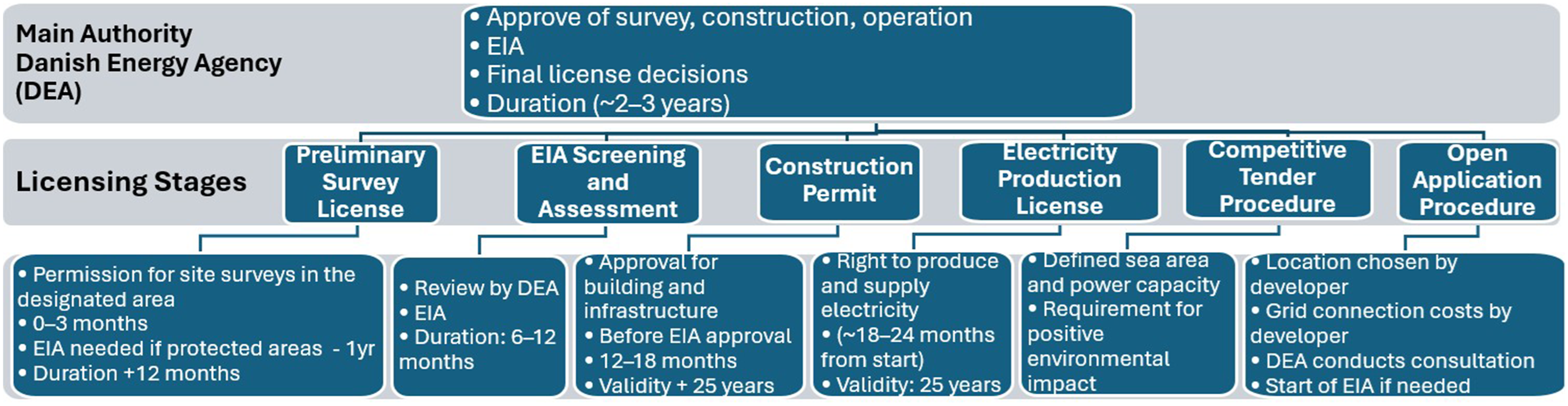
Maritime spatial plan
Maritime spatial planning identifies specific areas for the evolution of sources renewable energy (Danish Energy Agency, 2022), establishes boundaries for environmental preservation, encourages raw material exploitation, facilitates marine transportation, stores CO2, and so on. The first comprehensive planning document for the whole maritime region is the Maritime Spatial Plan of the Danish territory, which was discussed at seven regional meetings throughout the Danish territory in the summer of 2021. The provision for the establishment of energy islands is an important and pioneering project for maritime spatial planning. The initiative concerning the integration of marine spatial planning is part of the EU Directive 2014/89/EU (EUR-Lex, 2014) within the framework of marine spatial planning. The Danish plan regarding marine spatial planning states that: “the sea island areas are primary elements for the establishment of these energy islands and under the auspices of maritime spatial planning, a part of the sea area will be designated for renewable energy construction to create for the first time an opening for the establishment of new offshore wind farms on islands” (Danish Maritime Authority, 2021a). In parallel, the submission of the marine spatial planning plan, the Danish government agreed for consultation to the inclusion of 13 new marine protected areas. This agreement increased the protected Danish marine area from about 19% to about 30%, while being tasked to achieve optimal environmental protection (EUR-Lex, 2014) in the country’s marine areas (Danish Maritime Authority, 2021b).
Discussion and results
Throughout this article, tables are provided that distinguish between the authorities, legislation, and licensing procedures of the three countries. A distinction is made with regard to the ethical regulation of environmental issues, the involvement of stakeholders, and the examination of the scenario of transnational cooperation.
Comparative table of Licensing per Country.

Role of national entities in cross-border cooperation.

Sources derived from ofgem.gov.uk, Statnett.no, Energinet.dk.
Ethical/social aspect comparison.

Additionally, to the environmental requirements, in order to resolve issues between the construction of offshore wind farms and the preservation of marine ecosystems and economic operations like fishing, maritime spatial planning, or MSP, is essential. Although the intricacy of the approval procedure occasionally causes projects to lag, MSP is carefully regulated in Norway, where local communities are consulted in an effort to minimize disturbance to fisherman. Although MSP in Denmark is more focused on speedy licensing and economic development, it has trouble with protests from environmental and fishing groups. Although implementation is frequently delayed by the intricacy of procedures and legal obstacles, MSP in the UK aims to achieve a balance between environmental protection and economic objectives by combining central planning with wide stakeholder participation. All things considered, MSP is a crucial instrument for advancing sustainable development; nonetheless, its effectiveness hinges on continuous consultation, adaptability, and skillful handling of disputes between disparate interests.
Justification of the country model (Centralized/decentralized).

Sources are derived from Gov.uk, Danish Energy Agency and northwindresearch.no.
Stakeholder participation.

Sources are derived from Norwegian Ministry of Petroleum and Energy, Danish Energy Agency and the UK Department for Business, Energy and Industrial Strategy.
Involving bodies.
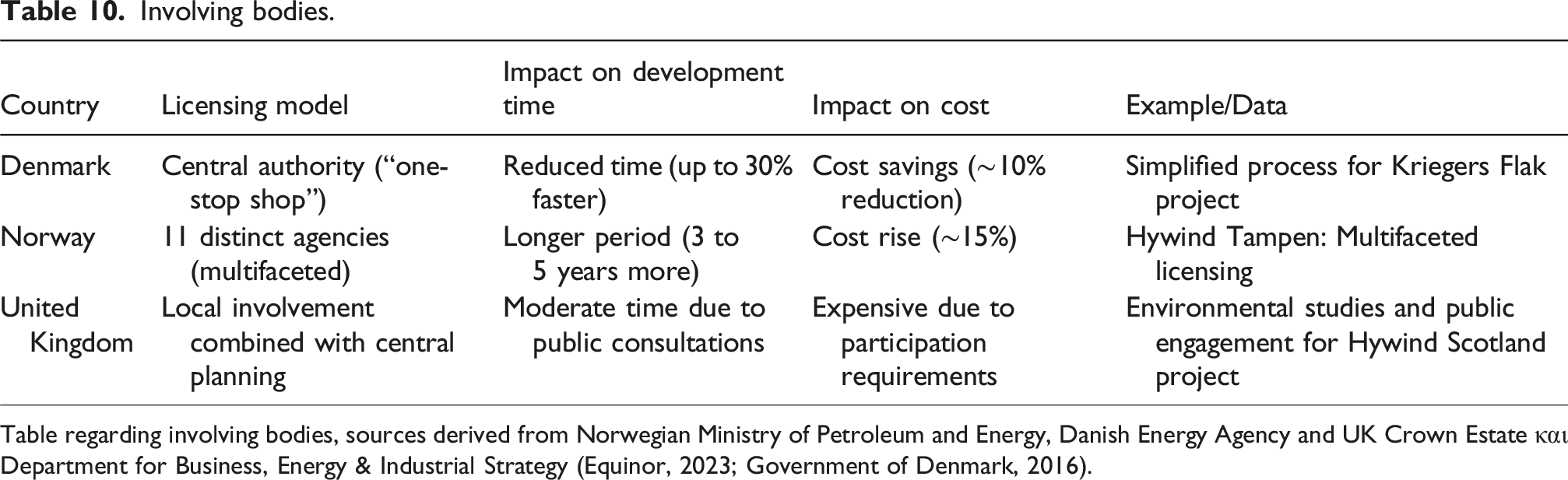
Table regarding involving bodies, sources derived from Norwegian Ministry of Petroleum and Energy, Danish Energy Agency and UK Crown Estate και Department for Business, Energy & Industrial Strategy (Equinor, 2023; Government of Denmark, 2016).
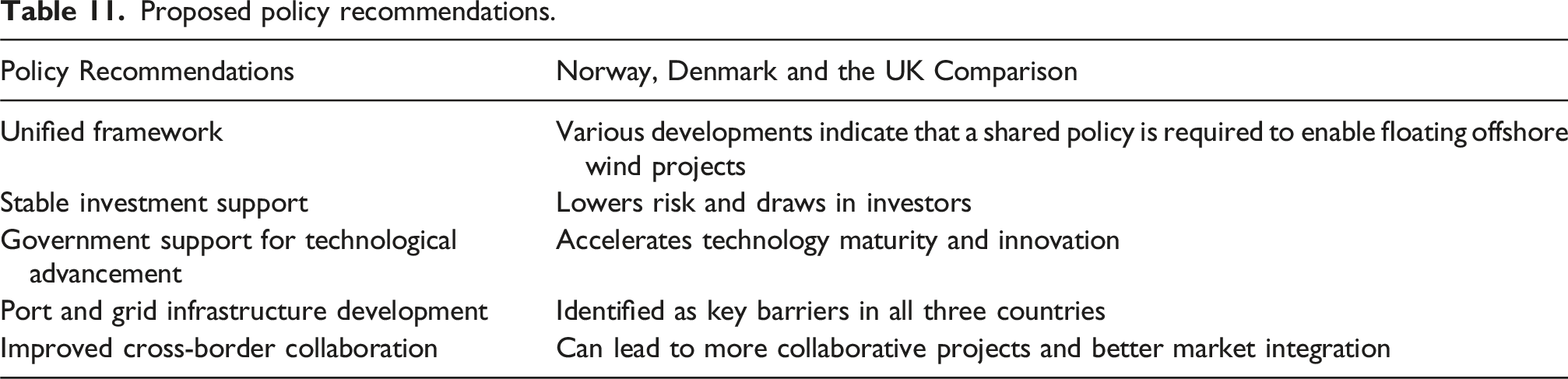
Proposed policy recommendations.
Conclusions
The conclusions that can be drawn regarding the promotion of European collaboration in the partnership of energy sources coming from renewable and offshore origins, is that the assurance of a rapid proposal for an “enabling framework” at Union level, for cross-border and other related national projects should be promoted with renewable energy sources, which are crucial for the EUs to climate neutrality by 2050. The integration of the internal energy market should be further supported by strengthening the interconnection between Member States, developing infrastructure and networks and solutions for storage of energy resources. This will be achieved by implementing more cross-border projects, which require a high level of security for investors. Northern European Member States agree that these technologies, embedded in a pan-European supply chain, can create business opportunities for European industries and contribute to the conclusion of the domestic energy market and ultimately help the EU achieve its climate ambitions of the climate and be exempt from carbon emissions by 2050.
Footnotes
Acknowledgments
The authors would like to thank the Editor and the anonymous reviewers for their valuable contribution.

Author contribution
Athina Danai Vardaka: Conceptualization, Investigation, Formal Analysis Methodology, Writing—Original Draft, Data Curation. Jacob G. Fantidis: Visualization, Writing—Review and Editing, Supervision.
Funding
The authors received no financial support for the research, authorship, and/or publication of this article.
Declaration of conflicting interests
The authors declared no potential conflicts of interest with respect to the research, authorship, and/or publication of this article.
Data Availability Statement
All data generated or analyzed during this study are included in this published article.
Appendix
Legal appendix 1: Applicable legislation per country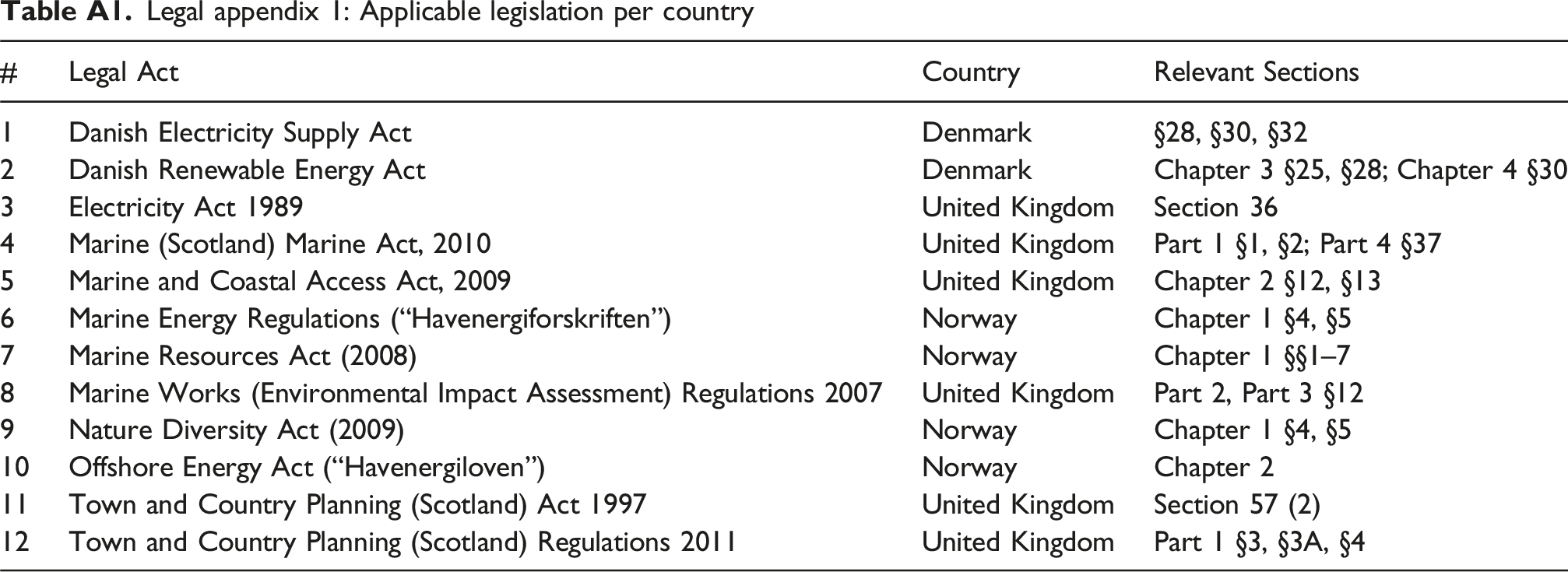
#
Legal Act
Country
Relevant Sections
1
Danish Electricity Supply Act
Denmark
§28, §30, §32
2
Danish Renewable Energy Act
Denmark
Chapter 3 §25, §28; Chapter 4 §30
3
Electricity Act 1989
United Kingdom
Section 36
4
Marine (Scotland) Marine Act, 2010
United Kingdom
Part 1 §1, §2; Part 4 §37
5
Marine and Coastal Access Act, 2009
United Kingdom
Chapter 2 §12, §13
6
Marine Energy Regulations (“Havenergiforskriften”)
Norway
Chapter 1 §4, §5
7
Marine Resources Act (2008)
Norway
Chapter 1 §§1–7
8
Marine Works (Environmental Impact Assessment) Regulations 2007
United Kingdom
Part 2, Part 3 §12
9
Nature Diversity Act (2009)
Norway
Chapter 1 §4, §5
10
Offshore Energy Act (“Havenergiloven”)
Norway
Chapter 2
11
Town and Country Planning (Scotland) Act 1997
United Kingdom
Section 57 (2)
12
Town and Country Planning (Scotland) Regulations 2011
United Kingdom
Part 1 §3, §3A, §4
Legal appendix 2: legal definition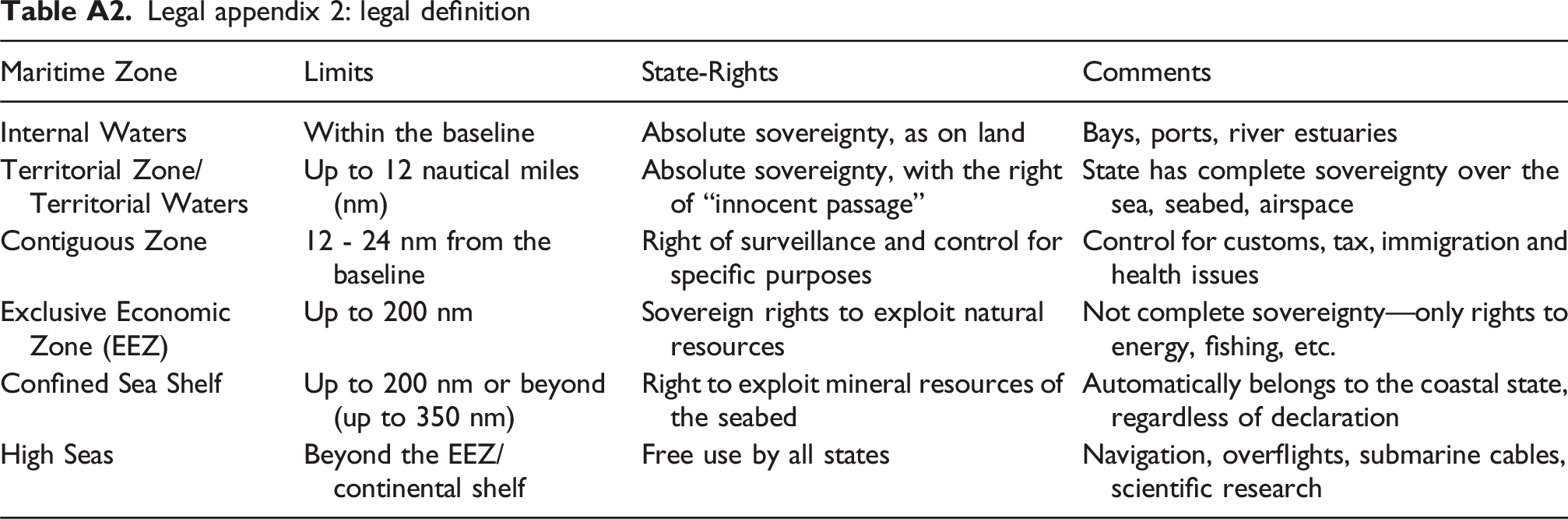
Maritime Zone
Limits
State-Rights
Comments
Internal Waters
Within the baseline
Absolute sovereignty, as on land
Bays, ports, river estuaries
Territorial Zone/Territorial Waters
Up to 12 nautical miles (nm)
Absolute sovereignty, with the right of “innocent passage”
State has complete sovereignty over the sea, seabed, airspace
Contiguous Zone
12 - 24 nm from the baseline
Right of surveillance and control for specific purposes
Control for customs, tax, immigration and health issues
Exclusive Economic Zone (EEZ)
Up to 200 nm
Sovereign rights to exploit natural resources
Not complete sovereignty—only rights to energy, fishing, etc.
Confined Sea Shelf
Up to 200 nm or beyond (up to 350 nm)
Right to exploit mineral resources of the seabed
Automatically belongs to the coastal state, regardless of declaration
High Seas
Beyond the EEZ/continental shelf
Free use by all states
Navigation, overflights, submarine cables, scientific research