







Abstract
This study critically explores Israel’s permanent war economy, examining its core principles and strategic impacts. It analyzes how the war economy is integral to Israel’s settler-colonial structures and functions, fulfilling various ideological, geopolitical, and financial goals through a sustained conflict footing, rather than being a transient occurrence. To this end, the study identifies and analyzes four key dynamics underpinning Israel’s war economy: First, acute societal militarism serves as an economic growth engine, nurturing skilled military capital and advanced technologies that feed the war economy system. Second, the role of American patronage is examined as a key enabler of the Israeli war economy. In the absence of a traditional colonial metropole, the United States functions as an imperial sponsor, providing extensive military aid, technological transfers, financial assistance, and diplomatic backing–without which Israel’s military posture would be inconceivable. Third, the article investigates Israel’s exploitation of the occupied Palestinian territories as a laboratory for testing, optimizing and marketing military systems’ performance to international clients. Fourth, examines how Israel’s arms export multiplies revenues for the Israeli war economy while also providing diplomatic leverage to advance Israel’s geopolitical agendas and foreign policy objectives.
Introduction
The 2023–2024 Israeli war on Gaza is unlike any war in modern history. The scenes of destruction and human suffering were nothing short of apocalyptic. The massive scale of civilian casualties, the wholesale destruction of entire cityscapes, and the displacement the majority of the population, who were left to grapple with hunger and disease, bear witness to the genocidal brutality of Israeli settler-colonial project. What also sets this war apart from other modern wars is the unsurprising revelation that Gaza served as a testing ground for the future of warfare, marking the world’s first ‘Artificial Intelligence (AI)-assisted genocide’ in history (Al Jazeera 2024). At the center of this AI-driven warfare is the fierce competition among various Israeli private and public military firms to showcase the efficacy of their AI-enhanced drones in real-world situations (Haaretz 2024). These drones have conducted lethal operations, including mass assassinations, extrajudicial executions, and indiscriminate killings, leading to the deaths of tens of thousands of Palestinian civilians. Each company ravenously sought to showcase the lethal prowess of their AI-empowered drones, turning the besieged enclave into a mass killing field in order to gain a competitive edge in the military technology market.
Xtend, a nascent Tel Aviv-based military start-up founded by former army officers in 2018, gained significant visibility during the war on Gaza. The company’s AI-driven drone and robot operating systems were deployed in a range of attacks, including dropping grenades, firing missiles, conducting suicide missions, and crashing into civilian infrastructure. Xtend’s technology is specifically designed to make operating drones as easy as playing a video game, allowing soldiers with limited experience to carry out complex and deadly missions. The performance of Xtend’s drones in Gaza yielded two significant outcomes for the company. First, it attracted new investment, with the company raising $40 million to further develop its technology and expand its global footprint. As stated by Xtend’s CEO, ‘before the war it was difficult to raise money but suddenly everything has opened up’ (Globes 2024b). Second, it earned Xtend recognition as one of the most promising Israeli startups of 2024 (Globes 2024a). Xtend’s network of partners and investors reflects the intricate web of interests involved in the development and deployment of autonomous weapon systems. It has been funded by the EU Horizon fund, its top partners include Tel Aviv University, and its investor base comprises various financial actors, including Israeli venture capital firms such as TAU Ventures and I3 Equity, as well as the US-based NFX. These firms are backed by major American and Western conglomerates including Microsoft, Nvidia, General Electric, and Barclays, among others. Beyond the Israeli domestic market, Xtend’s client base includes the US Defense Department.
When the dust of the war settles, the case of Xtend may appear to be a minor detail in the grand scheme of things. However, a closer examination of the company’s rapid rise to prominence reveals that it is, in fact, a microcosm of the broader dynamics at play within Israel’s permanent war economy. This economy is underpinned by four main pillars: pervasive societal militarism, unwavering American support, the exploitation of occupied Palestinian territories (oPt) as testing grounds for new weapons, and the leveraging of arms export for geopolitical influence.
First, the hype surrounding Xtend is deeply rooted in the militaristic ethos that permeates Israeli society which uncritically celebrates advancements in the war machine (Ben-Eliezer 2019). The military background of the company’s founders embodies the close ties between Israel’s military establishment and its technology sector. This symbiotic relationship, along with the backing Xtend has received from Tel Aviv University and VC firms, highlights the self-perpetuating cycle of militarization that characterizes Israel’s social institutions and economic landscape. Militarism in Israel is not merely a response to security concerns but rather a backbone of its settler-colonial structure, which necessitates the constant mobilization of society and resources to maintain a permanent state of conflict (Hever 2017). The most extreme manifestation of this worldview is evident in the genocidal rhetoric that has gained traction within Israeli political and military discourse, ranging from calls for a ‘second Nakba’ to propositions of dropping a nuclear bomb on Gaza (Times of Israel 2023). This troubling trend is further corroborated by public opinion polls, which indicate that a substantial segment of Israeli society endorses these extreme positions (Abraham 2023a) and overwhelmingly supports the continuation of the war (The Israel Democracy Institute 2024).
Second; the rise of Xtend is also inextricably linked to the unwavering American support that underpins Israel’s war economy. The company’s ability to attract significant investments from US-based venture capital firms and its ties to major American corporations and the US Defense Department demonstrate the deep entanglements between Israel’s military-industrial complex (MIC) and the United States. This support not only sustains Israel’s war economy but also serves to provide impunity and normalize its actions on the global stage. The United States has played a central role in perpetuating the Gaza war, without which Israel would have been unable to bear the costs alone. The United States has delivered over 100 separate lethal aid packages to Israel since the war began on October 7, amounting to thousands of advanced weapons, bombs, and munitions (Reuters 2024). This material support has been accompanied by unwavering diplomatic backing in the UN and other supranational institutions, effectively obstructing any initiatives for a ceasefire.
Third; the capacity of Xtend to optimize its products by deploying them against Palestinian civilians in real-world scenarios is enabled by the elimination logic of Israel’s settler-colonialism, which dehumanizes Palestinians and treats their lives as disposable in the pursuit of ideological and financial objectives. This practice perpetuates the cycle of violence and oppression while fueling Israel’s booming arms industry, which heavily relies on the ‘combat-proven’ branding of its products (Abdelnour 2023; Loewenstein 2023; Musleh 2018). Thus, without facing an international arms embargo, Israeli military companies are poised to experience a significant surge in global weapons sales following the war. By showcasing the lethal capabilities of their battle-tested technologies, these firms are likely to secure lucrative new deals and partnerships while simultaneously contributing to fueling conflicts in other regions around the world through proliferating arms exports.
Fourth, Xtend’s expanding global footprint and its ability to leverage its ‘combat-proven’ products in Gaza into international contracts and partnerships highlight the geopolitical dimensions of Israel’s war economy. The company’s ties to the US Defense Department demonstrate how Israel’s MIC is deeply embedded in global networks of power and influence. By marketing itself as a trailblazer in the creation of advanced military technologies, Israel seeks to bolster its geopolitical leverage while also reinforcing its lucrative deals in the global arms market. Israel strategically utilizes these global arms networks for geopolitical influence, establishing backdoor diplomatic channels with countries that may not maintain formal bilateral ties with Tel Aviv, or supporting friendly regimes and armed militias engaged in internal suppression and violent conflicts.
While war economies are common across the world, observable in countries like the United States, Russia, China, and many European nations, Israel’s war economy is distinctively shaped by its unparalleled status as ‘the world’s last remaining unresolved instance of settler colonialism’ (Bishara 2022: 6). This fact has far-reaching implications for the nature of Israel’s settler-colonial project and, by extension, the function of its war economy.
On one hand, Israel represents a historical extension of past colonial projects, rooted in the systematic use of structural violence and the constant mobilization of wartime resources to expand and entrench its control over Palestinian lands and resources. Colonial powers have historically employed genocidal acts, forced displacement, and cruel experiments under the guise of Western modernity and technological progress to target colonized regions and peoples (Dwyer & Nettelbeck 2017). These brutal practices have catalyzed innovations in military arsenals, army structures, and warfare strategies (Zureik 2015). Israel’s settler-colonial project extends these historical patterns, developing innovative methods of violence, dispossession, and subjugation to maintain its domination over Palestinians.
On the other hand, unlike the French and British empires which directed their colonial endeavors from distant metropolitan centers, Israel has developed its own distinct form of settler colonialism without a traditional metropolitan core (Bishara 2022). Instead, Israel has emerged as a manifestation of Western imperialism with unique, Zionist characteristics. By initially aligning with British colonial interests and later forging a deep, lasting alliance with the United States, Israel has effectively established a proxy metropole to support its colonial ambitions (Atran 1989; Capasso & Kadri 2023). This strategic partnership provides Israel with a steady stream of capital, military resources, and diplomatic support, bolstering its settler-colonial project with far-reaching regional and global implications.
This study is divided into five sections. The first section comparatively introduces concepts of war economy, the MIC and militarism. The second section traces the historical evolution of Israel’s war economy, examining its integral role in the settler-colonial state formation in Palestine. The third section explores the pervasive militarism in Israeli society and its contribution to sustaining the war economy. The fourth section investigates Israel’s exploitation of Palestinian spaces as testing grounds for advanced military systems, which are then marketed globally as battle-tested products. The fifth section highlights the vital role of American support in underpinning Israel’s war economy. Finally, the study examines the financial and geopolitical dimensions of Israel’s military exports and their strategic role in advancing foreign policy objectives.
War economy, MIC and militarism
War economy broadly refers to an economic system primarily oriented toward “producing, mobilizing, and allocating resources to sustain violence” (Le Billon 2005: 288). However, this broad definition can be applied to virtually every state and non-state actor engaged in wartime activities. To capture the specific and persistent nature of war economies, even during times of relative peace, the concept of a “permanent war economy” is particularly useful. Developed by Walter J. Oakes, the term suggests that the war economy had become an integral and enduring feature of American capitalism after World War II, blurring the lines between wartime and peacetime economies. Oakes (1944: 12) defined the permanent war economy as a situation in which “the government’s expenditures for war (or “national defense”) become a legitimate and significant end-purpose of economic activity”.
This entrenched phenomenon is upheld by two interconnected pillars: the MIC as the institutional driver, and the normalization of societal militarism as the social foundation. On one hand, The MIC represents the systemic network of vested interests, relationships and power dynamics linking armed forces, military industries, and political establishments into a cohesive force shaping national priorities (Dunne & Skons 2014; Roland 2021; Rosen 1973). On the other hand, militarism is ‘the material and ideological justifications for domination through hierarchy, obedience, and the use of force’ (Elveren 2022: 389). In other words, militarism is ‘the social relations of military power’ (Shaw 2013: 23).
The war economy creates an overarching structure that enables the growth and entrenchment of both the MIC and societal militarism. It provides the necessary conditions for the expansion of the MIC and the normalization of militarism, while these pillars, in turn, reinforce and perpetuate the war economy by generating a constant demand for military goods and services and by providing societal legitimization for, and active participation in, the expansion of military-related activities.
While major powers like the United States, Russia and European NATO members share some commonalities in their war economies–such as elevated defense spending, embedding military interests in decision-making processes, and promoting militaristic values to varying degrees–Israel’s manifestation is exceptionally acute and fundamentally shaped by its unique origins and perpetuation as an active settler-colonial project.
The very foundations of Israel’s existence lie in the violent dispossession and displacement of the indigenous Palestinian population to establish an exclusionary Jewish nation-state. This founding through settler-colonial conquest created an inherent dynamic of conflict, occupation, and resistance that became institutionalized into Israel’s socio-economic fabric. Such a foundational context renders perpetual war economy an existential imperative, fundamentally shaping Israel’s economic priorities, political decision-making, cultural narratives, social relations, and worldview in a manner unparalleled globally. In sum, Israel’s permanent war economy is a byproduct of an intrinsic existential necessity deeply hardwired into Israel’s raison d’être as a settler-colonial state.
This differs fundamentally from war economies of major powers like the United States, Russia and European NATO members which primarily serve more conventional state interests like economic gain, resource extraction, geopolitical positioning and great power rivalries. While the United States was indeed established through settler-colonial conquest and displacement of Native Americans, its contemporary permanent war economy did not directly emerge from or hinge on actively perpetuating that same violent indigenous subjugation. The US permanent war economy crystallized in the post-WW2 era around rivaling the Soviet Union and projecting global hegemony (Best & Wheatcroft 2020; Brunton 1988). Russia’s case is more akin to the United States, where geopolitical ambitions and great power rivalries drive its war economy, not an originating ethnic supremacy agenda to displace and subjugate communities within its territorial bounds through military occupation and apartheid policies (Cooper 2016). Former European colonial powers like Britain and France were rooted in indigenous subjugation abroad, but their modern permanent war economies revolve around power projection, economic interests, nationalist pride and neocolonial interventions rather than solidifying settlers’ repressive rule and supremacy over native populations at home.
The MICs in major powers like the United States and Russia demonstrate significant yet constrained influence within their political economies. In the U.S., the MIC primarily operates through defense contractors and their specialized supply chains, with direct influence channeled through lobbying efforts and the “revolving door” between military industry executives and government positions. Russia’s military industry holds particular importance as a major source of export revenue, especially following international sanctions that limited other economic sectors. However, a crucial distinction emerges in these major powers: the presence of diverse economic sectors acts as a counterbalance. Their large economies encompass powerful non-military industries—from technology and finance to energy and consumer goods—each with their own political interests and influence. The scale of these countries’ economies provides multiple growth drivers and revenue sources independent of military spending. This economic diversification inherently limits MIC dominance, creating a more distributed power structure compared to smaller economies where military industries might hold proportionally greater sway. Thus, while MICs remain influential actors in major powers, their impact is moderated by the pluralistic nature of large, diversified economic systems.
In Israel, however, MIC is the central organizing principle of its political economy, rendering it an exceptionally dominant force. Remarkably, an article published by the military studies department of the Israeli army acknowledges that the networks of military industries and arms exports are ‘a necessary condition for the continued existence of the entire system’ (Hania 2016: 46). This has had a deterministic effect on the very structure, evolution and geographical distribution of Israeli industry, resulting in industrial activity that is to a large extent dependent on military production unusal for a small country (Gradus et al. 2006). With a population of just 9 million and a gross domestic product (GDP) of around $500 billion, the military-related economic activity accounts for a disproportionate share of industrial output, R&D spending, and political capital compared to other Western economies. Besides the core activity of manufacturing arms and related technologies, Israel’s MIC palyed an instrumental role in shaping the civilian economy, for example, high-tech industry. Moreover, sectors like agriculture, construction, technology, and even academia are directly or indirectly tied to MIC.
Moreover, Israel’s occupation of Palestinian territories serves not just as a captive market but a crucible for field-testing weapons later exported globally (Abdelnour 2023; Loewenstein 2023; Musleh 2018). Such a dynamic is absent in the war economies of the United States, Russia or Europe which lack direct and permanent military rule over populations. Thus, the occupation bolsters Israel’s MIC by providing a constant local demand, lucrative export opportunities, and an environment to pioneer oppressive technologies.
Even more distinct is the pervasiveness of militarism across Israeli society. From commemoration rituals to educational curricula, the glorification of military power and violence-inuring practices are unmatched among other Western societies. While the United States does promote military values and reverence for armed forces through channels like patriotic entertainment media and some educational programs, this type of militaristic indoctrination exists alongside competing societal narratives. Significant segments of American society actively question and critique U.S. militarism, imperialism and interventionist foreign policies (Christiansen et al. 2020). The plurality of perspectives creates a push-and-pull dynamic. European states with long-standing military traditions like France and Britain have also experienced fluctuations over time in societal embrace of militarism. Periods of heightened militaristic nationalism have waxed and waned based on changing threat perceptions, leadership ideologies and public sentiments around military interventions.
However, Israel’s reality as an enduring settler-colonial state facing perpetual existential threats has fostered a profound, multi-generational normalization of militarism across nearly every institutional sphere. A ubiquitous climate of insecurity and conflict has sustained a degree of societal militarism simply unmatched in other contemporary contexts. Widespread conscription, securitization discourses from childhood, and cultural mythologies celebrating military conquest provide powerful ideological fuel. This dynamic provides Israel’s permanent war economy with profound societal legitimization and a consistent supply of human resources dedicated to military activities.
A historical overview of Israel’s permanent war economy
The origins of Israel’s war economy can be traced back to the pre-state Zionist colonization of Palestine, during which different factions within the Zionist movement converged on the idea that military force was strategically necessary for establishing a Jewish national homeland. Ze’ev Jabotinsky (1923), the leader of Revisionist Zionism, advocated for the ‘Iron Wall’ doctrine, which emphasized the need for an impenetrable military power to support the Zionist project of creating and maintaining a Jewish state in Palestine, a process he described as the ‘colonization of Palestine’. David Ben-Gurion, Israel’s first Prime Minister and a key Zionist leader, developed a military doctrine that prioritized achieving military supremacy, laying the foundation for a core principle of Israel’s grand military strategy. Chaim Weizmann, head of the World Zionist Organization and later Israel’s first president in 1949, promoted the integration of scientific and technological advancements into the Zionist military framework while securing Western financial, military, and diplomatic support to strengthen the institutional foundation of the Zionist endeavor.
Pre-state militarized institution-building laid the foundation for Israel’s war economy in five key areas. First, the Israeli army, established in 1948, emerged from Zionist militias like the Haganah, Lehi, and Irgun. These militias, formed in Mandatory Palestine by Jewish immigrants, carried out the ethnic cleansing of Palestinian towns and villages during the 1948 Palestinian Nakba. Second, the militias obtained advanced weapons through various means, including imports from Europe, seizing equipment from British military bases in Palestine, and local arms production (Perman 2010: 95). Secret weapons workshops in the 1920s and 1930s, known as TAAS, supplied Zionist militias with small arms and ammunition. These workshops later evolved into the state-owned Israel Military Industries (IMIs). Third, intelligence activities combined traditional espionage with scientific and technological elements. The Haganah’s intelligence branch, Shai, conducted spying and espionage, while the Science Corps (later known as Rafael Advanced Defense Systems Ltd) led the development of arms technology in the army (Perman 2010: 52). Fourth, civilian institutions, such as the Hebrew University of Jerusalem, the Technion, and Hadassah Hospital, were heavily involved in supporting military activities of the Zionist militias (Nevo 2018). Finally, Zionist leaders understood the importance of external support. The British colonial administration (1921–1948) provided political and military cover for the Zionists to develop their military infrastructure.
With the creation of Israel in 1948, the pre-state militarized multi-sectoral assets became institutionalized within the emergent war economy. The Israeli army rapidly ascended as the primary force shaping Israel’s identity and strategic direction. Centralized state economic planning was instrumental in this evolution, as it fostered bargaining with and coordinating across public, private, and labor sectors to align output with military demands. Thus, the evolution of the Israeli MIC is a key factor in understanding the state’s political economy. It reveals the extent to which military considerations are embedded within the settler-colonial state-building/nation-building processes, influencing a broad spectrum of societal aspects. The military’s role in shaping economic policy has led to the distribution of political power, increasingly favoring officials and interest groups with military-oriented agendas. In addition, these policies have had a profound impact on social structures and class dynamics, contributing to the growth of the middle class (Carmi & Rosenfeld 1989).
The rise of the military had tangible economic implications: the army’s increasing need for advanced domestic military production capabilities became a key driver of Israeli policies, fostering a military-focused economic model. This model required high defense spending, significant foreign investment, and aid, to sustain Israel’s ongoing state of military readiness. Military spending consumed an increasingly large portion of Israel’s GNP, accounting for 10% during the early years and rising to 20% by 1968 (Carmi & Rosenfeld 1989: 27). As a result, a self-reinforcing cycle emerged, in which military demands increasingly dictated industrial priorities and shaped the trajectory of industrial development (Mintz 1985a). Over time, this led to a deep integration of military objectives within the industrial landscape, tailoring industrial capacity to meet the evolving needs of military strategies. In turn, advancements in industrial capabilities further expanded the scope and ambition of military objectives, creating a feedback loop that reinforced the mutual influence between the military and industrial sectors.
The commanding heights of the military production were dominated by state-owned companies like IMIs and Israel Aerospace Industries (IAIs), which drove early military-industrialization and constituted important sources of public revenue, employment, and economic growth. Concurrently, state agencies like Rafael Advanced Defense Systems and Unit 8200 served as military research hubs and technological training. Private military manufactures crystallized in the 1960s with firms like Elbit Systems Ltd. carving out niches in diverse domains such as electronic warfare, aerial systems, and intelligence technologies. Israel’s military-industrial expansion also featured unorthodox actors, most notably the Histadrut labor federation, which channeled major capital investments into military firms through its holding company and subsidiaries, forging subcontracting bonds with state-owned arms giants. (Mintz 1985b: 11). This blend of managed capitalism fostered a robust labor-state-private sector alliance centered on military development as the cornerstone of the state-building process.
Despite significant military investments, Israel’s domestic military-industrial base was relatively underdeveloped before the 1967 war, relying heavily on Western assistance. France, a key colonial power then, was Israel’s main supplier of military hardware and even contributed to its early nuclear development (Kahana 2006: 216). Israel also received military equipment and funding from the United States, United Kingdom, and West Germany. For these Western states, supporting Israel served two strategic purposes: countering Arab nationalism and communist expansion in line with Cold War goals, and establishing Israel as a well-armed proxy in the Middle East to extend their influence in a region of critical geostrategic value.
From the 1960s to the 1980s, Israel’s war economy underwent a transformative second phase, shaped by the confluence of geopolitical factors that profoundly escalated Israel’s militarized economic priorities, industrial base, labor market, and technological advancement. The 1967 and the 1973 wars served as catalysts for a profound shift in resource allocation and a dramatic increase in military spending. The French arms embargo, imposed on the eve of the 1967 war, underscored Israel’s need for a more loyal Western sponsor to provide substantial military aid and promote its own military production. Against this backdrop, the United States emerged as a key supporter, offering crucial technical, technological, and financial assistance. As will be discussed in section five, the deepening of U.S.-Israeli military ties not only bolstered Israel’s war economy but also had far-reaching implications for its regional power projection and global arms trade. The access to advanced American technologies and the financial backing provided by the United States enabled Israel to develop its military industries and promote its position in the global arm market.
The aftermath of the 1967 war saw military expenditures skyrocket to over 20% of Israel’s GDP, while arms imports doubled to approximately 10% (Zeira 2021: 107). Nearly half of Israel’s industrial capital was redirected toward military projects (Mintz & Ward 1989: 523). Much of this increased military investment was directed toward maintaining the vast territories occupied after 1967: the West Bank, Gaza Strip, Egyptian Sinai, and Syrian Golan Heights.
The 1973 war further intensified Israel’s focus on military spending, with expenditure surging by 77% to around 31% of GDP. This financial commitment had far-reaching repercussions, particularly in the labor market. Military employment increased by 50% in 1975 alone. By the 1980s, nearly half of the workforce was directly or indirectly tied to the MIC (Mintz 1985a: 628). The allocation of resources for military purposes was also evident in research and development (R&D), with the military sphere commanding 65% of funding compared to a mere 13% for civilian projects (Peled 2001).
Since the mid-1980s, Israel has undergone a neoliberal shift from a protectionist economy to a model more integrated into the global economy. This transition was marked by widespread privatization initiatives that restructured industries formerly under state control (Nitzan & Bichler 1996). However, the military sector remained an exception to this trend, with the state maintaining a firm grip on the military-industrial landscape. Unlike in the United States, where minority shareholders direct mega-contractors, government conglomerates continue to steer Israel’s MIC, despite market reforms in other sectors. While some minor instances of military asset sales have occurred, such as the spin-off and rebranding of Israel Military Industries’ Magen subsidiary into the private Israel Weapons Industries (IWI), these have been selective rather than systemic. Despite periodic rhetorical intentions to privatize portions of the state-owned IAI and Rafael Advanced Systems (Cohen & Scheer 2014), substantive large-scale privatization has not materialized. This persistence of state dominion in the military domain signals a deliberate policy that goes beyond mere economic maneuvering, underscoring the symbiotic nexus between the state and its war economy apparatus. The duality of the state as both the principal proprietor and the chief consumer of the military sector speaks to a deeper, strategic orchestration of market principles within the confines of a war economy.
In contrast to the military sector, privatization has been remarkably evident in Israel’s security industry, although the blurring of the line between military and security has existed since the Israel’s founding in 1948 (Hever 2017). The post-9/11 era has witnessed Israel’s emergence as a ‘unique global exemplar of urban militarism and securitization’, positioning Israel as a pivotal node in the global trend of securitization and militarization of policing practices (Zureik et al. 2011: 143). Israeli security companies have capitalized on its decades-long experience in occupying the Palestinian territories, which has served as a laboratory for developing and refining technologies and tactics suited to the new paradigm of counterinsurgency, surveillance, and border securitization. These firms have particularly benefited from the U.S.-led ‘War on Terror’ and its convergence with counterinsurgency doctrines honed through the suppression of Palestinian resistance. In this global context, Israel has strategically rebranded itself as an indispensable, battle-hardened ally, marketing its expertise in policing, intelligence gathering, population control, and counterterrorism techniques (Grassiani 2018). The resulting synergy has not only boosted Israel’s domestic security industry but has also shaped the discourse and praxis of global security in the twenty-first century.
Figure 1 shows that Israel’s military spending has experienced a consistent upward trend in absolute terms over the past six decades, indicating a growing investment in military capabilities. However, when examined as a percentage of GDP, military spending has experienced gradual fluctuations, with a general downward trend since the late 1970s.
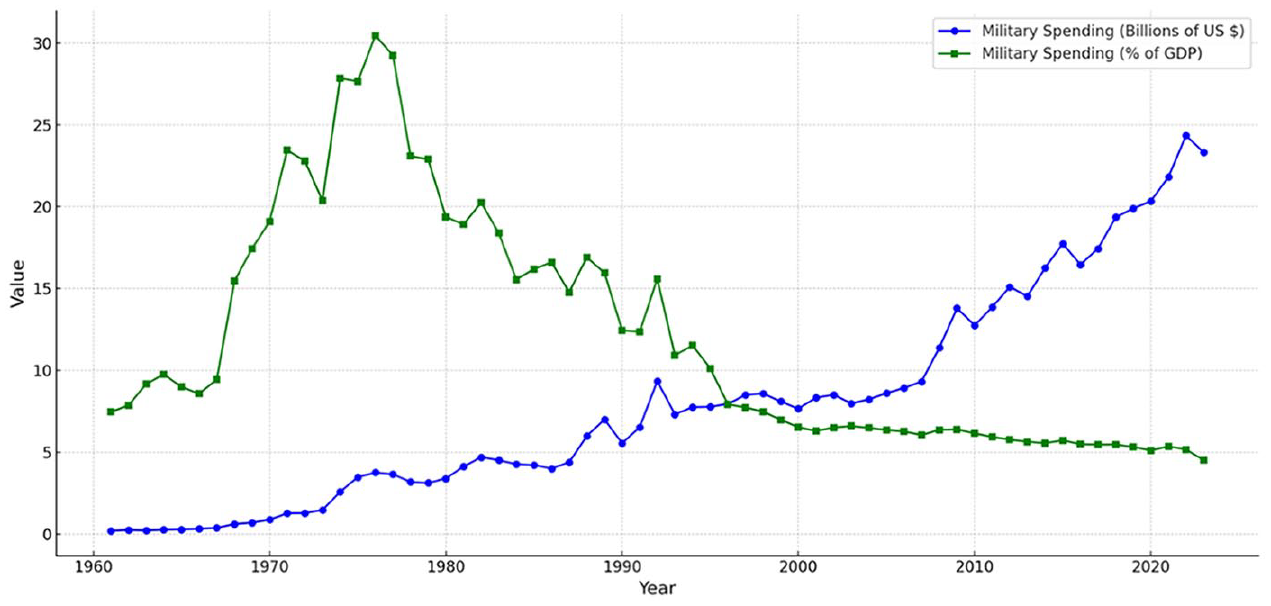
Israeli military spending: US Dollars (constant) and percentage of GDP (1960–2022).
The decrease in Israeli military spending as a percentage of GDP, despite the consistent increase in absolute spending, can be attributed to two factors that are closely linked to its military sector. First, Israel has received substantial economic and military aid from the United States, which has effectively subsidized 15%–20% Israel’s defense spending, allowing it to maintain a high level of military expenditure, and to channel other financial resources to stimulate growth across other sectors (see section five). Second, Israel’s military sector has acted as a catalyst for the diversification of its economy, particularly in the expansion of the high-tech industry (18% of GDP). The high-tech sector, while contributing to economic diversification, remains structurally dependent on the military sector, with many successful technology companies having their roots in defense-related research and development. As a result, the military sector’s role in fostering economic growth and diversification has led to a faster expansion of Israel’s GDP compared to its military spending, leading to a decrease in military expenditure as a percentage of GDP. Moreover, it should be noted that despite the decrease in military spending as a percentage of GDP over time, Israel still maintains one of the highest levels of military expenditure relative to its GDP globally, particularly when considering its relatively small size and population.
Societal militarism
Israel was built on a paradigm that closely interweaves militarism and nationalism, forging a militarized social contract between the state and citizens. Compared to other countries formed in the aftermath of World War II, Israel’s army holds an unusually prominent position, wielding significant influence not just in matters of state security and war-making activities but also in the economic, social and cultural domains. Unlike conventional theories of civil-military relations, which often anticipate clear boundaries between military and civilian spheres in terms of structure, function, and symbolism, the Israeli case exhibits a far more porous delineation. In fact, the military institution serves as a primary channel for socialization and societal engagement, shaping areas as diverse as education, the judiciary, settlement construction, media, economic development, and the integration of Jewish immigrants, or as Baruch Kimmerling (1993; see also 2001) terms it, the ‘central organizing principle’ permeating collective consciousness (p. 199). Fundamentally, militarism is not a byproduct of classical military junta, but a deeply rooted conviction among the majority of Israeli Jews (Bresheeth-Zabner 2020: 140). Militarism became deeply ingrained as an innate value system and unquestioned belief within the ideological foundations of Israeli society and as an existential necessity for the perpetuation of the Israeli system in its entirety. (Ben-Eliezer 1998, 2019). As a result, Israel has consistently been ranked as the world’s most militarized society (Global Militarization Index 2021).
Various Israeli institutions contribute to the promotion of militarism. A prominent example is how the Israeli army and universities are entangled in a complex academic-military web in preparing Israelis from a young age to take an active part in the war economy (Wind 2024). An important byproduct of this symbiotic relationship is the hi-tech industry. Israel’s high-tech sector has emerged as a direct outgrowth of the military laboratories into globally exported consumer products and services (Swed & Butler 2015). This process involves the transfer of processes, technologies, and expert pools from Israel’s permanent war footing to the civilian economy. First, the high-tech industry benefits materially from its enduring military ties, securing lucrative procurement contracts, engaging in joint ventures, and gaining access to investment capital attracted by the potential of dual-use applications. As a result, a symbiotic infrastructure persists at multiple levels, with capital and innovations flowing recursively across the porous boundaries that separate military branches, startups, and established military and security companies. Second, the high-tech sector further benefits from state support in the form of tax incentives and grants, creating a favorable environment for their development and expansion. Third, the influx of venture capital into these military-related sectors not only fuels their growth but also leads to the development of cutting-edge technologies that are subsequently reabsorbed by the military, creating a self-sustaining cycle of innovation and investment. This cyclical process ensures that the military remains at the forefront of technological advancement, while simultaneously providing a steady stream of new products and services of dual use in the civilian market. As a result of this massive investment, the high-tech sector is a critical driver of Israel’s economy, contributing 18.1% to its GDP and employing about 14% of its workforce (Israel Innovation Authority 2023).
Israel’s system of mandatory military service requires most Jewish citizens to serve in the army for a minimum of 2–3 years upon reaching the age of 18 to ensure that most of the population are directly involved in military activities during their formative years. After completing their mandatory service, Israeli soldiers are transferred to the reserve forces, where they remain liable for periodic call-ups for several weeks of active duty each year until they reach the age of final discharge, which typically occurs well into their middle age. Such a significant period in military service allows the Israelis to undergo intense military socialization, sustaining direct and continuous militarism exposure across public life.
During their mandatory service, conscripts are exposed to a wide range of advanced technologies and hands-on experience in fields such as cybersecurity, AI, robotics, and data analysis. Elite technological units, such as Unit 8200, are widely regarded as an incubator for future expertise in the hi-tech field. Alumni of Unit 8200 have gone on to establish numerous startups and assume key positions in Israel’s leading technology companies. Beyond elite units, the army offers specialized job placement programs that aim to streamline the veterans’ transition from the military to the private hi-tech sector (i24NEWS 2022).
From their inception, Israeli universities across disciplines have been mobilized to sustain and perpetuate the settler-colonial project (Wind 2024). As central agents in promoting militarism and producing skilled individuals to serve the war economy, universities play a crucial role in the complex web of relationships that underpin Israel’s MIC. Israeli universities are actively engaged in developing combat technologies, providing specialized training for military high-tech careers, and even conducting tailored courses on arms marketing strategies, thus effectively shaping the human capital that sustains Israel’s war economy (Taraki 2015).
The Talpiot program, hosted by the Hebrew University of Jerusalem and implemented jointly with the Israeli army, aims to supply the military with specialized expertise and leadership in research and development (R&D). Graduates of the program often assume key positions in the army’s elite technological units or in the private military firms. Similarly, the Havatzalot program, hosted by the University of Haifa, serves the specific needs of Israel’s Military Intelligence Directorate, focusing on training students in intelligence gathering, analysis, and cyber warfare. Collaboration also extends to partnerships with major Israeli military companies, such as Rafael, IAI, and Elbit Systems (Wind 2024). These companies provide grants to universities to conduct research in fields with military applications, offer scholarship programs to talented students, and provide access to advanced laboratories and equipment, facilitating the seamless integration of graduates into the military-technological workforce. For example, The Weizmann Institute of Science has established a high-tech science park called Kiryat Weizmann near its main campus. This science park serves as a hub for collaborative research and product development, fostering partnerships between the institute and various security companies and weapons manufacturers such as Rafael Advanced Defense Systems and El-Op, a subsidiary of Elbit Systems specializing in electro-optic systems.
Palestine laboratory
Israel’s use of its military occupation regime and frequent wars as a selling point for its new weapons has received increasing attention in recent years by academics, human rights organizations, journalistic investigations, and anti-war campaigns which produced compelling evidence on the darker aspects of this phenomenon (Abdelnour 2023; Bresheeth-Zabner 2020; Cook 2013; Dana 2020; Loewenstein 2023; Musleh 2018). Israel has cultivated a notorious reputation for producing and testing lethal products on the captive Palestinians population, a practice that has been dubbed the ‘Palestine laboratory’ in some scholarly circles (Abdelnour 2023; Bresheeth-Zabner 2020). These works shed light on Israel’s weapon technologies, including LAWS and AI-driven weapons, are marketed as ‘battle-tested’ and proven effective in real-life situations, a claim that, while commercially attractive, is deeply rooted in the brutal realities of colonial experimentation and perpetuation of violence, effectively turning the suffering and death of Palestinians into a lucrative business opportunity.
Since the imposition of the Israeli blockade in 2007, Gaza has become a stark embodiment of Israel’s hyper-militarism and a crucible for the development and testing of new military technologies. While Israel has frequently tested its weapons in the oPt, Syria, and Lebanon over the past 50 years, the frequent wars waged on Gaza throughout the past decades have transformed the besieged strip into a microcosm of Israel’s war economy, where colonial violence and warfare are repurposed for both operational and commercial ends. Operationally, Gaza serves as a brutal biopolitical laboratory, where Israel tests and refines a wide array of new weapons systems, surveillance tools, and methods of population control. In this context, Palestinians in Gaza are treated as disposable test subjects, their lives and well-being subordinated to the imperatives of colonial domination by the Israeli state and the interests of weapons manufacturers. Commercially, Gaza functions as a ‘showroom’ for Israeli military companies to demonstrate their new products (Musleh 2018: 41). The showcasing of battle-tested technologies in the market drives a cycle of continuous conflict in Gaza, facilitating both the development of new military technologies and their subsequent commercialization. By validating these technologies in real-world conditions, Israeli companies gain a significant competitive edge in the international arms trade. This dynamic has created a perverse incentive structure, where the continuation of the conflict and the perpetuation of violence against Palestinians become essential for the success and growth of Israel’s war economy.
Israel heavily relies on the development, deployment, and global proliferation of drones. Israeli- produced drones reportedly accounts for over 60% of global drone exports as of 2017 (Royal United Services Institute [RUSI], 2018). The Israeli drone sector, comprising more than 50 firms, is dominated by Elbit Systems, which produces 85% of the drones made in Israel. Drones export constitute 25% of total military export, which is expected to grow to around a third of Israel’s military export by 2025.
The advancement of Israeli drone technology is closely tied to operational trials conducted on Palestinian populations (Dana 2020). Lethal drones have been a cornerstone of Israeli military strategy in every war against Gaza from 2008 through 2023–2024. These wars have seen extensive testing of drone technologies by the Israeli army, resulting in a vast number of assaults, missile launches, and extrajudicial killings, causing indiscriminate devastation to civilian infrastructure, private and public buildings, hospitals, and schools.
For example, in its 2014 war against Gaza, which claimed the lives of 2,240 Palestinians, including 164 children (Defense for Children International 2015), the Israeli army tested the Hermes 900 drone, manufactured by Elbit Systems and equipped with advanced features like self-guiding Spike missiles. The war’s aftermath saw a surge in the fortunes of drone manufacturers, with Elbit Systems’ market value growing by 6.1%, nearing its highest point since 2010 (Bloomberg 2014). The Israeli daily Haaretz (2014) reported that ‘from a business point of view, the operation was an outstanding thing for the defense industries’. Another recent example is the retesting of the Orbiter 4 drone, nicknamed Spark, which is part of a top-secret Israeli drone program called Storm Clouds, run by the state-owned Aeronautics Defense Systems. The Orbiter 4 drone was previously tested during the 2021 war in Gaza and subsequently sold internationally. At the beginning of the 2023–2024 war, the Israeli army retested a refined version of the Orbiter 4 drone to carry out direct strikes, espionage, and assassination missions. Later, it was reported that the Orbiter 4 drone appeared at the World Defense Show 2024 in Riyadh in early February (The New Arab 2024).
Beyond drones, the most chilling revelations of the Israeli 2023–2024 genocidal campaign in Gaza involve the way in which Israel has subjected the civilian population to the testing of dehumanizing AI technology for massive bombing purposes. A joint investigative report by the Israeli outlets + 972 Magazine and Local Call exposed an institutionalized targeting doctrine prioritizing attacks on civilian sites to sow fear among the population, creating what a former intelligence officer calls a ‘mass assassination factory’ (Abraham 2023b). The exposé reveals that Israel’s military apparatus deliberately brands high-rises, residential towers, universities, and government offices as bombing targets, euphemistically dubbed ‘power targets’. The Israeli military employed two AI algorithmic systems, Project Habsora ‘The Gospel’ and Lavender, to generate target lists and guide their operations. Project Habsora rapidly produces hundreds of locations daily through automated analysis of surveillance inputs, resulting in the indiscriminate killing of a large number of Gaza’s civilian population. Lavender played a central role in the unprecedented bombing of Palestinians, especially during the early stages of the war. According to military sources, the AI machine’s influence on military operations was so significant that its outputs were treated ‘as if it were a human decision’ (Abraham 2024).
Such horrifying war crimes should not come as a surprise for those familiar with Israel’s strategic maneuvering to reshape the legal, ethical, and operational frameworks of contemporary warfare. Israel’s efforts in this regard aimed to influence the global discourse on the use of controversial weapons systems in order to legitimize its illegal practices and to secure larger share in the global arms market. At the 2014 Convention on Conventional Weapons (CCW) in Geneva, Israel stood alone in defending LAWS and opposed an international treaty proposal that sought to limit or prohibit fully autonomous weapons (Campaign to Stop Killer Robots 2014; Human Rights Watch 2020). This position clearly demonstrates Israel’s intent to normalize the use of AI-driven weapons systems and to remove any legal or ethical barriers to their deployment.
In stark contrast to this stance, the international community has expressed grave concerns over the legal and ethical implications of LAWS and their potential impact on warfare. Thousands of prominent scientists, academics, UN officials, and human rights groups have warned of the risks posed by these technologies, including their potential use for ‘assassinations, destabilizing nations, subduing populations and selectively killing a particular ethnic group’ (Future of Life Institute 2015). Even major robot companies have publicly opposed the weaponization of robots, recognizing the inherent dangers and moral hazards associated with the development of autonomous weapons systems (Boston Dynamics 2024). The UN Secretary-General António Guterres labeled these systems as ‘politically unacceptable and morally repugnant’ (United Nations 2019) while the UN Human Rights Council (2016: 15) has called for a ban on weapons systems that lack meaningful human control.
The American enabler
The US–Israel partnership is underpinned by a strategic patron–client relationship, where Israel serves American grand strategic objectives in the Middle East in exchange for substantial economic, military, and diplomatic support from Washington. This strategic closeness is further strengthened by ideological bonds, with some scholars highlighting the shared settler-colonial roots of both countries as a key factor in their alliance (Chomsky & Pappé 2015). Religious beliefs, such as those held by Christian Zionists and certain Protestant traditions that support Jewish restoration in the Holy Land, also play a considerable role in influencing US foreign policy toward Israel (Kiracofe 2009). In addition, pro-Israel lobbying groups, such as the American Israel Public Affairs Committee (AIPAC), wield significant agenda-setting power regarding Israel policy within Washington to shield the United States support to Israel from internal and external scrutiny (Mearsheimer & Walt 2007).
Israel’s military infrastructure and regional posture are heavily dependent on American aid. As Figure 2 shows, from 1946 to 2023, the United States provided a total of $158.665 billion in aid to Israel. This includes $114.406 billion in military assistance, $34.348 billion in economic assistance, and $9.911 billion in missile defense assistance (Sharp 2023). This aid is crucial for Israel’s economy and military, making up 3% of its total state budget, 1% of its GDP, 20% of the total defense budget, 40% of the army’s budget, and almost the entire procurement budget (Freilich 2017).
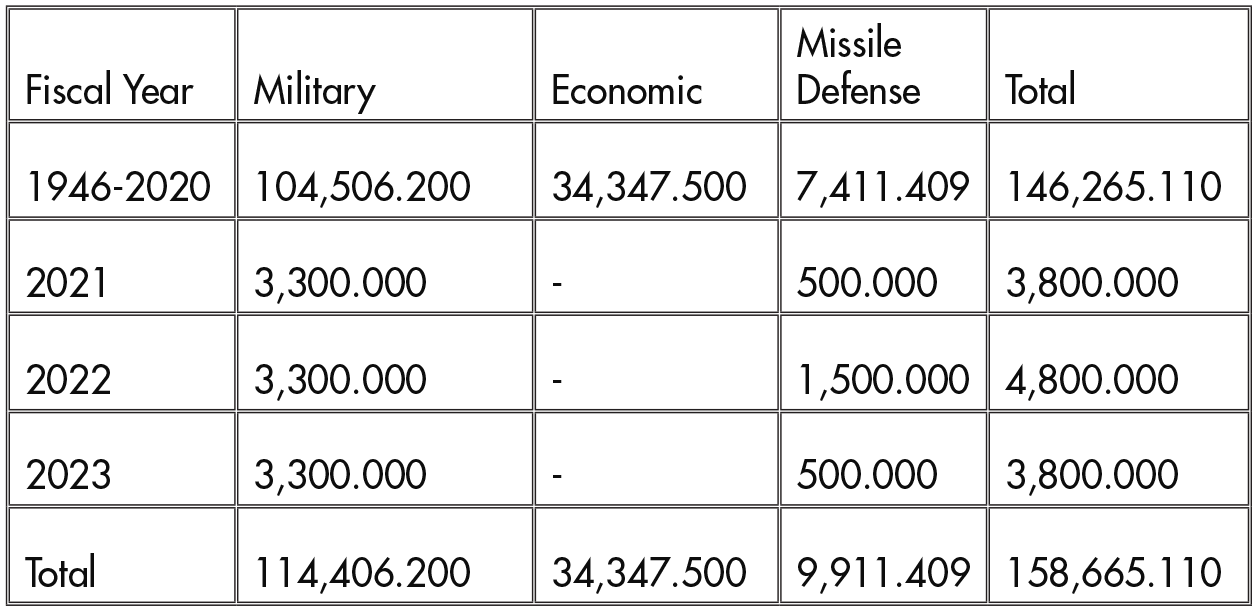
Total US foreign aid to Israel (1946-2023), Current US$ in millions.
The U.S. increases its aid to Israel during times of crises. During the 2023–2024 Israeli war on Gaza, the Biden administration provided Israel with a substantial amount of military aid, consisting of more than one hundred transfers of advanced weapons and ammunitions. In April 2024, the Biden administration considered new military transfers to Israel, estimated to be worth over $18 billion. The scale and consistency of this aid have made it a cornerstone of Israel’s national security strategy while also providing ancillary economic, technological, and geopolitical benefits for Israel’s regional and global military posture. As highlighted by a Congressional report, U.S. aid has ‘helped transform Israel’s armed forces into one of the most technologically sophisticated militaries in the world’ and has ‘helped build its domestic defense industry, which now ranks as one of the top global arms exporters’ (Sharp 2020: 12). Central to the U.S. commitment to Israel’s military superiority is the Qualitative Military Edge (QME) policy, which ensures Israel’s technological and operational advantage over other regional actors. The QME policy, formally codified into U.S. law in 2008, underscores the long-term strategic importance of Israel’s military superiority to American foreign policy in the Middle East.
The strategic alliance between the United States and Israel can be traced back to the founding of Israel in 1948, but it was the geopolitical dynamics following the 1967 War that significantly intensified the relationship into its current form. This coincided with the Nixon Doctrine of 1969, which aimed to empower key regional allies, designated as ‘regional influentials’, to serve as bulwarks of American geopolitical interests by outsourcing critical functions to aligned regional proxies. In the context of the Middle East, the U.S. support aimed at position Israel as a crucial counterbalance to pan-Arabism and Soviet influence (Quandt 1977: 106). This policy aligned seamlessly with Israel’s own strategic need for an imperial protector to fill the void left by the absence of a colonial metropole, which would ensure a consistent inflow of capital, military resources, and diplomatic support. As a result, U.S. military aid to Israel escalated dramatically, from $360 million in 1968 to $1.5 billion by the 1973 Arab Israeli War, and further increased to around $2.6 billion annually (Mark 2005: 13). In addition, the U.S. granted Israel access to private capital and advanced technological ecosystem to modernize its military arsenal, and several major American corporations became shareholders in Israeli military companies as a result, further intertwining the permanent war economies of the two countries.
The Reagan administration (1981–1989) designated Israel as a ‘major non-NATO ally’ (Cobban 1989: 5). As a result of this classification, Israel was allowed to participate in the Strategic Defense Initiative (SDI), also known as ‘Star Wars’, which significantly expanded its access to advanced military technology and R&D funding, amounting to $2.9 billion (Halper 2015: 49). By the early 1980s, Israel’s military industry had become structurally dependent on American military and technological support. According to the U.S. Government Accountability Office (GAO) ‘Israel’s technological exports are heavily dependent on foreign components . . . Almost every Israeli arms production effort includes a U.S. input’ (Comptroller General of the United States 1983).
A major development in American military aid occurred during the Obama administration, which signed a landmark agreement in 2016 agreement pledging Israel the ‘single largest pledge of bilateral military assistance in U.S. history’ (White House 2016). The deal raised annual U.S. military aid to Israel from $3.1 billion to $3.8 billion over a 10-year period from 2019 to 2028, constituting more than one-fifth of Israel’s entire military budget (Haaretz 2016). The aid package was divided into two main components: $33 billion allocated for foreign military financing and $5 billion earmarked specifically for missile defense support. The deal uniquely allowed Israel to allocate 25%–30% of funds for domestic arms purchases, contrasting starkly with rules mandating all other aid recipients spend solely on U.S. products. Moreover, the deal did not restrict Israel from requesting additional congressional aid for issues like tunnel defense or cyber security development.
Nevertheless, what may outwardly appear as Israeli leverage in the American military sphere is indeed reflective of an underlying reality of structural dependency on the United States. Israel’s heavy reliance on U.S. military aid and systems significantly fosters power imbalances and dependency relationships that shape interactions between Israeli firms and their larger, more resourceful American counterparts with extensive supply chains and economies of scale. Facing these challenges, many Israeli companies find themselves relegated to subcontractor roles, specializing in niche electronic components and services that enhance U.S.-manufactured systems (Hever 2017). These include global positioning system (GPS) and navigation technologies, training programs, optical equipment, and cybersecurity solutions. Rather than full-scale system manufacturing, Israeli firms often occupy supporting roles integrating their specialized products into the wider American military-industrial ecosystem they depend upon.
The dependency dynamic is evident across nearly every major Israeli military brand. For instance, the Arrow anti-ballistic missile system -a joint project between IAI and Boeing: while IAI leads integration, Boeing provides crucial components and technical assistance, with the U.S. offering significant annual funding. Another example is Israel’s attempt to develop its own Lavi fighter jet in the 1980s, which aimed at reducing reliance on American-made F-16s. This project ultimately failed precisely due to the heavy dependence on U.S. technology for avionics and engine design. Financial pressures and direct American opposition led to the Lavi’s cancelation in 1987, forcing continued dependence on U.S. fighter jets. Even the ostensibly domestically-designed Merkava tank incorporates key American-made components like its engine, transmission and fire control systems. This suggests Israel’s ability to maintain and upgrade the Merkava without U.S. support and technology transfer is severely limited, if not impossible.
The power imbalance evident in these examples highlights the deep-rooted dependency of Israel’s war economy on the broader American MIC. With their vast financial and technological resources, the U.S. government and military contractors wield significant influence, setting agendas and dictating terms of engagement. Israeli firms find themselves in a subordinate position–compelled to align strategies, technologies and operations with American requirements and objectives.
The geopolitics of Israel’s permanent war economy
There are roughly 1,200 registered military exporters in Israel, consisting mostly of small and medium-sized companies, according to the Israeli Ministry of Defese. With the exception of major government-controlled military companies like Rafael and IAI, as well as the private Elbit Systems, data regarding the production and sales figures for military-related products and services from most other Israeli firms are generally not publicly available. These top three manufacturers are ranked among the 100 largest arms-producing companies worldwide according to SIPRI in 2022. With 75% of its arms production exported internationally and only 25% consumed domestically, the military export sector accounts for over 10% of Israel’s total exports, excluding exports of security technologies. Such figures demonstrate how global arms trade is central to Israel’s economic prosperity and international standing as a major player in the arms market.
From 2000 to 2022, Israel’s military exports have experienced an upward trajectory, as depicted in Figure 3. In this 22-year period, Israel’s military exports have surged nearly five-fold, from $2.67 billion in 2000 to an all-time high of $12.56 billion in 2022. This substantial growth has propelled Israel into the ranks of the world’s top ten arms exporters, accounting for 3.1% of global arms exports between 2014 and 2018 (Wezeman et al. 2020).
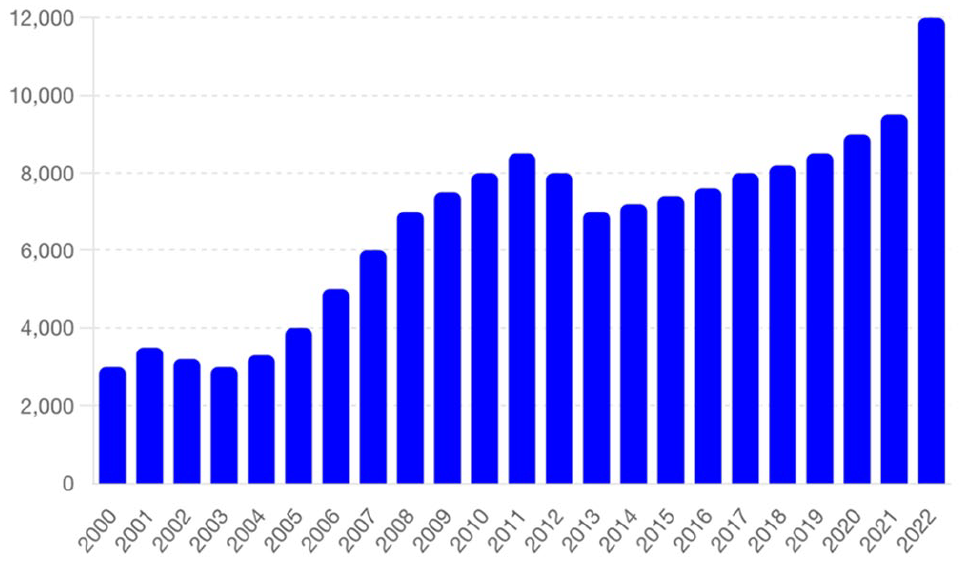
Israeli military exports (2000–2022), in millions of US dollars.
A significant factor contributing to the recent surge in Israeli arms sales is the signing of the Abraham Accords in 2020 between Israel and some regional states including the UAE, Bahrain, and Morocco. Prior to the Accords, Israeli defense exports had already reached a significant level, peaking at $7.2 billion in 2019. However, the newfound access to Arab state markets facilitated an exponential increase in arms sales. In 2021, Israeli military exports reached a record high of $11.3 billion, and further increased to $12.5 billion in 2022. Remarkably, 24% of the total export amount in 2022 was sold to Arab customers (Reuters 2024).
Beyond immediate financial gains, Israel deploys arms sales as a major foreign policy instrument for achieving key strategic objectives to influence geopolitical dynamics and international relations. This arms trade-linked diplomacy centers twin priorities – broader normalization and ally enablement. Both encapsulate the essence of Israel’s militarized international relations.
First, arms exports provide an avenue for Israel to normalize its settler-colonialism and to overcome its diplomatic isolation through recognition by and partnerships with governments that were previously non-aligned or hesitant to openly normalize diplomatic relations with Israel. This is particularly evident in dealings with regional authoritarian regimes that display keen interest in Israeli security technologies designed for internal policing and repression. These technologies, which are often tested in the Palestinian context, include sophisticated surveillance systems and population management tools, along with advanced military hardware. The surge in Israeli military and security exports following the Abraham Accords underscores how arms dealings serve as conduits for both strategic influence and financial windfalls. Within just 2 years of signing, the Accords unlocked a $3 billion influx of Israeli military and security technology transfers alongside new joint ventures. According to an Israeli contractor, Arab signatories rushed to procure from Israeli firms ‘everything from advanced radar technology to cybersecurity systems’ (WSJ 2022). This arms bonanza prompted some observers to deem the Abraham Accords essentially an ‘arms deal’ (Goldberg 2020).
The Abraham Accords have translated into significant geopolitical leverage for Israel, recasting it as a formidable regional military power able to reshape Arab geopolitical dynamics to serve its strategic interests. A key aspect of this newfound clout is Israel’s ability to stoke arms races and drive militarization across the region, deliberately altering balances of power between rival Arab states. A prime example is the escalating rivalry between Morocco and Algeria in the wake of Morocco’s security pact with Israel. After acquiring Israeli weapons systems and establishing an drone production facility in partnership with the Israeli BlueBird Aero Systems, tensions with Algeria spiked sharply amid fears that heightened militarization could precipitate open armed conflict between the neighboring North African states.
Second, Israel has a long history of leveraging arms exports to empower friendly fragile regimes facing internal unrest or external threats. This strategy has been a key feature of Israeli foreign policy, involving direct military support, the provision of mercenary warfare elements, and extensive intelligence assistance. During the 1970s and 1980s, Latin America and Central America were the primary markets for Israel’s arms industry, accounting for 50 to 60 percent of its total military exports (Bahbah & Butler 1986). Israel capitalized on Cold War ideological binaries, channeling substantial weapons flows to prop up right-wing military dictatorships and associated militias that were actively suppressing popular uprisings and leftist dissidents. In many cases, Israeli arms played a crucial role in sustaining brutal regimes responsible for atrocities and war crimes through deliberate internal repression and ruthless civil war campaigns. Well-documented examples include, but not limited to, the Somoza regime in Nicaragua, the military-dominated regime in Honduras, the Nicaraguan Contras, military juntas in Guatemala, Videla’s military regime in Argentina, and Guatemala’s counterinsurgency campaigns by successive military dictatorships against indigenous Mayans from 1978 onwards (Bahbah & Butler 1986; Metz 1993; Munck & Pozzi 2019). Another example was Israel’s close military and diplomatic cooperation with apartheid South Africa which lasted until the regime’s fall (Polakow-Suransky 2011). A critical aspect of this relationship was bilateral nuclear cooperation, whereby Israel provided South Africa with technology and expert guidance to advance its nuclear weapons program, while South Africa supplied Israel with raw uranium and testing grounds for its own secretive nuclear development efforts in the 1960s and 1970s.
Israel’s arms industry and military-security trade flourished in the post-Cold War era. Many of its deals raised seruios concerns as Israeli weapons and technologies were repeatedly linked to regimes and militias complicit in grave war crimes, ethnic cleansing, and other severe violations of international law (Halper 2015). The examples are numerous and egregious. During the ethnic cleansing of Rohingya Muslims in Myanmar from 2016–2017, the military employed Israeli-made rifles and rockets (Haaretz 2017). Israeli military companies also supplied the Rwandan extremist militias who carried out the 1994 genocide against the Tutsi minority, providing them with armored vehicles and assault rifles among other weapons. In the Darfur crisis in Sudan, Israeli automatic rifles ended up in the hands of the janjaweed militias who systematically executed entire villages.
A significant aspect of Israel’s security-technology trade that has attracted scrutiny involves the export of sophisticated spyware and cyber-surveillance systems to authoritarian governments. Investigative reports have uncovered how private Israeli cyber-intelligence companies like NSO Group, Candiru, and Cellebrite have provided repressive digital tools to regimes known for human rights violations. NSO’s Pegasus spyware, for example, was sold to Saudi Arabia, UAE, Bahrain and other states who used it to hack phones of dissidents and journalists. Similarly, Candiru’s ‘DevilsTongue’ exploit was utilized by governments to illegally monitor activists. Israeli companies Verint and Narus played a central role in facilitating illegal mass surveillance and wiretapping of American citizens by U.S. intelligence agencies. Their systems were employed by major telecommunications providers AT&T and Verizon to unlawfully monitor virtually all phone calls and Internet communications, feeding that data directly to the National Security Agency (NSA) without proper legal warrants or court oversight.
Conclusion
The 2023–2024 Israeli genocidal campaign on Gaza is a stark reminder of the ongoing, systemic nature of violence and displacement that underpins Israel’s settler-colonial foundations. This recent episode is not an isolated event but rather part of a continuum that traces back to the 1948 Nakba’s ethnic cleansing of Palestine. The relentless drive to erase Palestinian presence has been a consistent thread throughout decades of Israel’s settler-colonial venture. Episodes of overt carnage, be it the Gaza 2023–2024 war or previous wars, are visible manifestations of a deeper ideological pursuit. This pursuit is militarily, economically and politically facilitated by the Israeli war economy, a key enabler and beneficiary of the settler-colonial project.
The article argued that Israel’s war economy operates as a multifaceted, deeply entrenched mechanism that transcends conventional military-industrial frameworks. Its distinctive characteristics stem from Israel’s context as a settler-colonial state, where the intertwining of military, economic, and political strategies is fundamental to its existence and expansion. Central to Israel’s permanent war economy is the concept of societal militarism, which permeates every facet of Israeli life. This societal militarism serves as a growth engine, nurturing skilled military capital and advanced technologies that are pivotal to the sustenance and advancement of the war economy. The societal impact of this militarism is profound, shaping public opinion, education, and cultural norms to align with and support the war economy’s objectives. Another key pillar of Israel’s war economy is its strong alliance with the United States, marked by substantial military, diplomatic, and economic support. This relationship has provided Israel with the resources and technological capabilities necessary to modernize and expand its MIC. The United States’ unwavering support, especially in terms of military aid and diplomatic backing, has been instrumental in bolstering Israel’s global standing in arms exports and its overall strategic military capabilities. The exploitation of the oPt as a ‘laboratory’ for testing and optimizing military systems has been a cornerstone of Israel’s war economy. This practice not serves operational objectives and commercial interests, as it allows Israeli military companies to market their products as ‘combat-proven’, thus enhancing their appeal in the global arms market. Israel’s thriving arms export industry illustrates how the war economy also plays a defining role in shaping Israel’s foreign relations and geopolitical stance. Arms exports have become a key tool for diplomatic influence, allowing Israel to forge and strengthen alliances, particularly with repressive regimes that value the advanced military and security technologies that Israel offers.
The article makes a powerful case for international accountability through arms embargoes, corporate boycotts, and legal action. Ultimately, the weight of the historical record and empirical data presented conveys the urgency of rejection of the Zionist ethno-nationalist ideology and the dismantling of Israel’s permanent war economy–not only for the oppression of Palestinians but for fueling repression and conflict around the world.
