






Abstract
This paper examines how neoliberal restructuring has reshaped agrarian inequality in West Bengal by altering patterns of differentiation among rural households. It addresses two questions: how neoliberal policies have altered the distribution of access to various means of production, and how these inequalities are reproduced through land ownership, operational holdings, and tenancy arrangements. The analysis combines secondary data from the Agricultural Census and the National Sample Survey Office’s Survey of Land and Livestock Holdings with primary evidence from a 2020–2021 field survey of 200 cultivator households in Bankura district. Households are classified using both acreage-based categories and Patnaik’s Labour Exploitation Criterion (E-criterion), which distinguishes economic position through labour absorption rather than land size alone. The findings show that productive resources, non-land assets, and operational control over land are increasingly concentrated among labour-hiring households, while labour-selling households rely heavily on leasing in land to sustain cultivation. Tenancy thus emerges as a key mechanism through which agrarian inequality is reproduced under contemporary conditions. The study demonstrates the analytical value of a class-based approach for understanding agrarian change in West Bengal in the neoliberal era.
Introduction
This paper examines how neoliberal restructuring of agricultural policy and institutions has deepened agrarian inequality in West Bengal by intensifying class differentiation among cultivators. The analysis concentrates on disparities in landholding and operational holdings. The study’s central objective is to assess the extent to which neoliberal reforms have concentrated productive resources and operational control in the hands of richer peasants, while simultaneously rendering small and marginal farmers increasingly vulnerable.
The paper addresses two central research questions. First, how has neoliberalism reshaped patterns of agrarian differentiation in rural West Bengal, particularly with respect to the access of various means of production? Second, how are these differentiated positions reproduced through land ownership, operational holdings, and tenancy arrangements under contemporary agrarian conditions?
In West Bengal, successive land-reform phases shaped agrarian change. Initial ceiling laws of the 1950s–1960s were followed by a major redistributive wave under the Second United Front (1969–1970), driven by peasant mobilisation (Dasgupta, 1984; Ruud, 1994). The Left Front after 1977 extended these measures through Operation Barga and further redistribution.
Yet, as Byres (1991), Bagchi (1982), and Bhattacharyya (2003) emphasised, these reforms were not revolutionary ruptures but capitalist nation-state measures comparable to post-war reforms in Japan, Taiwan, and South Korea. In Marxist terms, land reform carried out within the framework of private property cannot eliminate class differentiation but only alter its form and trajectory. This legacy of small and marginal holdings continues to define the agrarian structure within which new forms of neoliberal differentiation unfold.
Official assessments echo this interpretation. The West Bengal Human Development Report (Government of West Bengal, 2004) documents that while land reforms significantly reduced landlordism and expanded access to land, the limited quantum of surplus land resulted in the proliferation of very small holdings and did not eliminate agrarian inequality. The report notes the persistence of tenancy beyond formal registration and highlights that control over productive resources continued to be unevenly distributed, shaping new patterns of differentiation in the post-reform period. This unevenness was also mediated institutionally. The Mukharji and Bandyopadhyay (1993) Committee Report on Panchayati Raj in West Bengal highlighted substantial inter-district variation in administrative capacity, implementation of reforms, and local mediation of state policies. This suggests that the distributive outcomes of land reform and rural programmes depended not only on policy design but also on the strength of local institutions, creating uneven agrarian trajectories across regions.
Following the neoliberal turn of the 1990s, institutions such as the World Bank and the International Monetary Fund (IMF) reframed rural society as a homogeneous peasantry, replacing class analysis with concepts such as ‘social capital’ and ‘community-driven development’. In doing so, the World Bank and IMF sidestepped acute class inequality, presenting poverty primarily as a problem of individual households rather than of historically constituted agrarian class relations. Neoliberal reforms similarly promoted financial inclusion through microfinance and market-based solutions, while weakening earlier redistributive agendas associated with land reform (Bhattacharyya, 2007; Patnaik, 2007; World Bank, 2001).
Following the introduction, the paper revisits the mode of production debate to clarify its analytical relevance for understanding agrarian change under contemporary neoliberal conditions. It then outlines the methodological framework, explaining the use of Patnaik’s Labour Exploitation Criterion (E-criterion) and its particular relevance in the context of West Bengal’s smallholder agrarian structure. The analysis subsequently combines secondary evidence with primary field-survey data from Bankura district to examine differentiated access to various means of production, namely, land, labour, credit, and output across rural households. Building on these findings, the paper analyses land ownership, operational holdings, and tenancy arrangements to show how agrarian differentiation is reproduced through everyday practices of cultivation and leasing. In doing so, the study links broader structural transformations to concrete village-level outcomes, demonstrating how neoliberal restructuring channelled through pre-existing agrarian arrangements.
Capitalist development and peasant differentiation: Mode of production debate revisited
The earlier mode of production debate in India was rooted in the agrarian structures of Punjab and Haryana, where large landlords dominated and capitalist tendencies were explicit. Revisiting this debate in the West Bengal context is important not because the structures are identical, but because they are distinct. Land reform and redistribution in West Bengal created a predominance of small and marginal holdings, shaping a unique path of agrarian change. In the neoliberal era, however, even this redistributed agrarian structure has experienced renewed differentiation. Situating the analysis within the mode of production debate thus enables examination of how agrarian class relations evolve under varied structural conditions, and how neoliberalism reshapes accumulation and differentiation across regions.
The classical mode of production debate in India asked whether agrarian relations were moving towards capitalism or remained semi-feudal. Emerging in the late 1960s, it drew together Marxist economists such as A. Rudra, Utsa Patnaik, and Amit Bhaduri. Rudra (1970, 1971), using data from Punjab, found no consistent correlation among capitalist features like hired labour, mechanisation, and profitability and concluded that capitalist farming had not yet emerged. Patnaik (1971, 1972) countered that this view was ahistorical, arguing that capitalist relations develop unevenly within non-capitalist structures and that post-1950s agriculture already displayed distorted forms of accumulation. Bhaduri (1973), examining eastern India, identified a semi-feudal equilibrium sustained by tenancy, indebtedness, and landlord control. The debate thus turned on whether capitalist tendencies were advancing, emerging unevenly, or structurally blocked. Revisiting this lineage in the context of West Bengal enables an examination of how class differentiation and accumulation operate within a predominantly smallholder agrarian structure under neoliberalism, where capitalist relations advance unevenly alongside non-capitalist arrangements (Thorner, 1982) 1 .
Recent critiques of agrarian transition in India stress that neoliberal reforms have not generated a clear trajectory of capitalist development in the countryside. Instead, they have entrenched a dual economy: on one side, a precarious and expanding rural labour force; on the other, fragmented and often informal processes of accumulation that bypass the classical agrarian question (Campling and Lerche, 2016; Lerche, 2013). Banerjee (2017) further highlights how such accumulation is crisis-driven, reproducing inequality while failing to secure stable conditions of reproduction for most cultivators. Lerche (2021) situates the Farm Laws struggle as a rare instance of cross-class, caste-spanning mobilisation against neoliberal dispossession, underscoring the persistence of agrarian class tensions. Together, these perspectives show that neoliberal restructuring deepens dispossession without resolving the contradictions of agrarian capitalism.
Recent debates on agrarian transition thus raise a methodological problem central to this paper: how should capitalist development be analysed in agrarian contexts where large-scale capitalist farming has not emerged, yet differentiation and exploitation clearly persist? Classical Marxist debates offer a way of resolving this problem by shifting the focus from the form of farming to the process of differentiation within the peasantry. Lenin’s engagement with the Russian Narodnik 2 provides a methodological framework for analysing how capitalist relations can advance through differentiation of the peasantry even in the absence of large-scale capitalist farming. In The Development of Capitalism in Russia, Lenin demonstrated that capitalist dynamics were already restructuring the countryside by differentiating peasants into labour-hiring and labour-selling class despite the persistence of apparently pre-capitalist forms of production (Bhattacharyya, 2003). This directly challenged the Narodnik conception of a homogeneous peasantry and established that differentiation arises from unequal control over land and labour rather than from surface indicators of farm size or technique. Subsequent populist reinterpretations, most notably, those of A.V. Chayanov, reintroduced the idea of peasant homogeneity by attributing differentiation to demographic cycles, thereby obscuring the class relations embedded in differential access to the means of production.
This tendency to treat the peasantry as a homogeneous category reappears in several influential non-Marxist and neo-populist frameworks in agrarian economics and political economy. Lipton (1977) and Georgescu-Roegen (1960) advanced the argument that family-labour farms were more ‘efficient’ than capitalist farms employing wage labour. Easwaran and Kotwal (1989) pointed to uneven access to credit, but without situating it within broader structural relations, while Guha (1988) reduced rural society to a simple binary of elite and subaltern, thereby overlooking differentiation grounded in ownership of the means of production. Although influential, these frameworks tended to obscure relations of production and surplus appropriation that remain central to agrarian inequality. Against this backdrop, Bhattacharyya (2018) reasserts ownership of the means of production as the decisive foundation of class differentiation in rural society.
As Bhattacharyya (2018) shows, neoliberal restructuring has produced immiseration and the expansion of petty commodity production, alongside growing exploitation within the peasantry that takes the form of disguised proletarianisation 4 . This underscores the continuing relevance of Marxian class analysis for understanding agrarian change under neoliberal conditions. At the same time, neo-populist policy frameworks – exemplified by the World Bank’s emphasis on ‘social capital’ and community-based development (Bhattacharyya, 2007; World Bank, 2001) – recast rural society as an undifferentiated peasantry. By encouraging market-based instruments such as microfinance over state-led credit and agri-business integration in place of public procurement, neoliberal reforms shift attention away from historically constituted relations of production and unequal control over land, labour, and capital. In West Bengal, this dynamic is particularly important since the legacy of land reform’s smallholder structure now interacts with neoliberal restructuring to generate new forms of differentiation. Complementing this, Utsa Patnaik (2007) highlights how liberalisation produced an ‘arrested development’ of capitalism in agriculture, as declining state support, adverse terms of trade, and falling profitability curtailed accumulation. Together, these perspectives motivate a renewed, explicitly class-analytic approach to contemporary agrarian change.
These debates foreground a common problem for empirical analysis: how to identify agrarian differentiation in contexts where large landholdings are rare, yet inequality in control over production clearly persists. Addressing this problem requires careful attention to the criteria used to classify rural households.
Methodology – A study of inequality and relevance of E-criterion
The use of acreage groups as indicators of peasant economic status has important limitations. Official statistical classifications employed by agencies such as the Government of India and the National Sample Survey Office (NSSO) rely primarily on land size, which, while administratively convenient, does not fully capture underlying differences in labour use, tenancy relations, or access to productive resources. This limitation is particularly acute in West Bengal, where land reforms imposed ceilings on ownership and compressed holdings into small-size classes. As a result, the numerical dominance of marginal holdings may conceal significant inequalities in control over land and production.
Table 1 highlights the distinctive agrarian structure of West Bengal in comparison to the all-India pattern. Nearly 95% of cultivator households in the state operate marginal holdings below 2.5 acres, substantially higher than the national average of 72.6%. Unlike the national distribution – where marginal cultivators operate less than one-third of total land – marginal holdings in West Bengal account for nearly 78% of operated area. This reflects the legacy of land reform, which redistributed land and sharply reduced the numerical presence of large holdings while compressing ownership into small plots.
Composition of landholding pattern of farmers across different land sizes (in percentage).
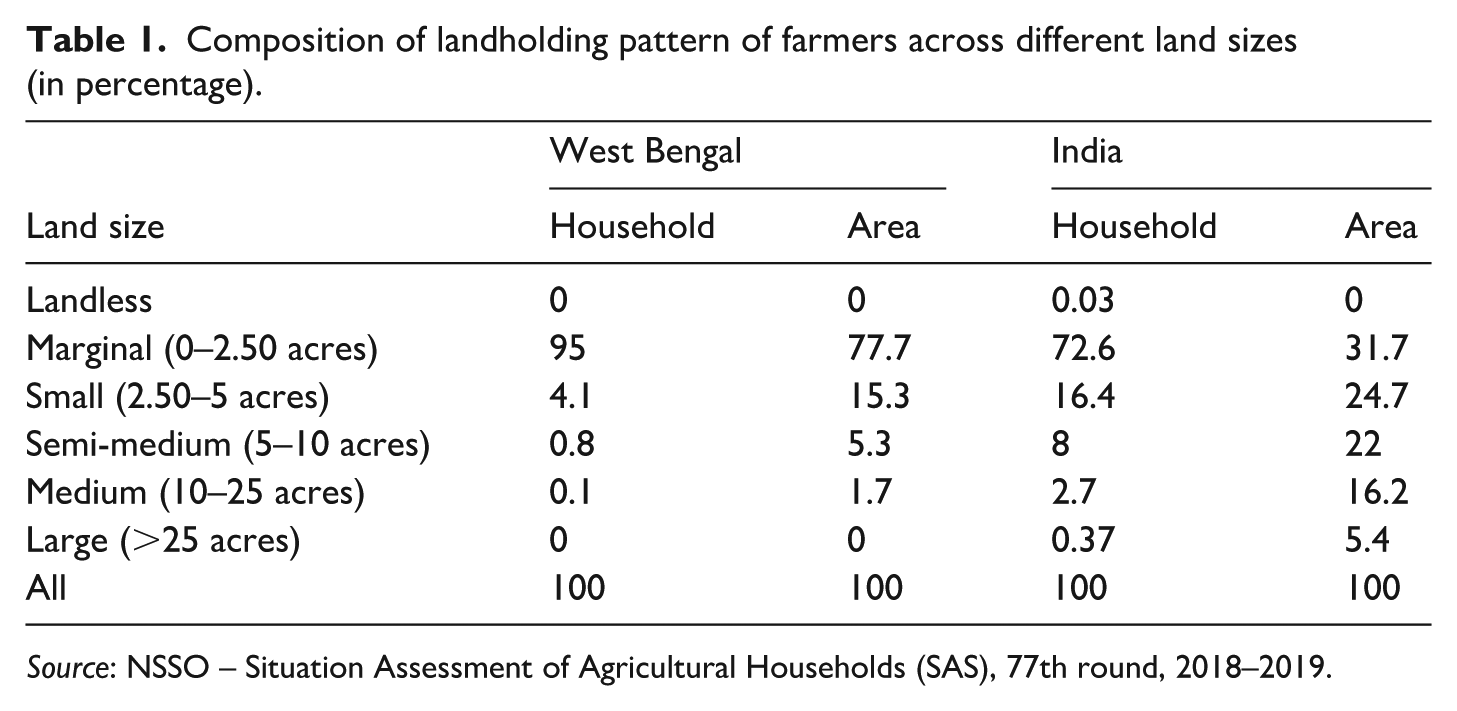
Source: NSSO – Situation Assessment of Agricultural Households (SAS), 77th round, 2018–2019.
When land distribution is examined through ownership quintiles rather than acreage categories, however, a contrasting picture emerges. Table 2 shows that land ownership remains highly concentrated both at the national level and within the Bankura field survey. In the present survey, the top 20% of households control nearly 60% of total land. This pattern closely mirrors national trends, where the share of land held by the top quintile increased from 67.8% in 1991–1992 to over 75% by 2018–2019, while the bottom 40% saw their already limited shares decline to near zero.
Overview of land inequality across quintiles of ownership holdings.
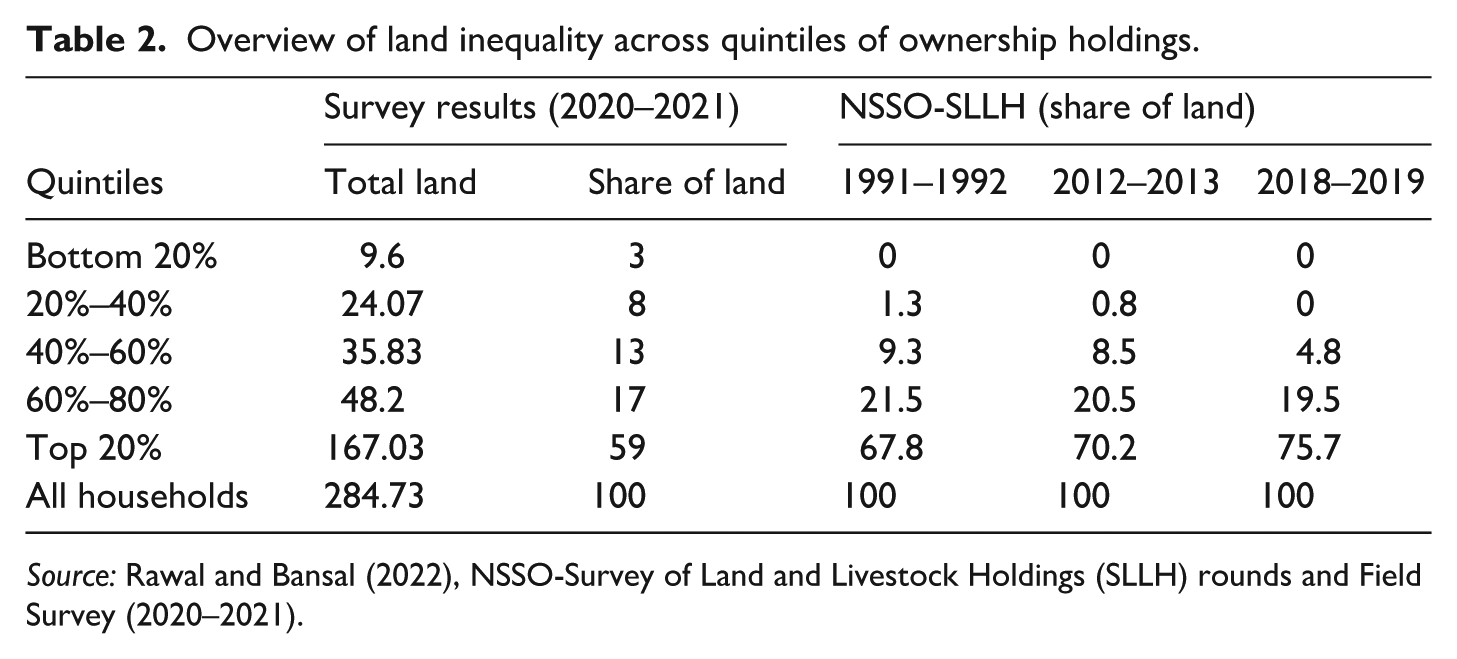
Source: Rawal and Bansal (2022), NSSO-Survey of Land and Livestock Holdings (SLLH) rounds and Field Survey (2020–2021).
Taken together, Tables 1 and 2 reveal a structural paradox: West Bengal appears simultaneously as a landscape dominated by marginal holdings and as one marked by pronounced land concentration. This paradox cannot be resolved through acreage-based classifications alone. While land reform compressed holdings into small-size categories and expanded access to land, it did not eliminate unequal control over land and production. Consequently, households with similar land sizes may occupy sharply different economic positions, depending on their access to labour, credit, and markets.
To examine how these aggregate patterns are reproduced at the local level, the study complements secondary evidence with a primary field survey conducted in Bankura district during 2020–2021. Bankura was chosen as the district of study because it represents a semi-arid, relatively less developed agrarian region where land-reform outcomes were partial and uneven, in contrast to agriculturally advanced districts such as Burdwan or Hooghly. The two blocks were selected purposively to capture variation in capitalist development: the advanced block was characterised by greater density of seed and fertiliser stores, higher irrigation coverage, more cooperative societies, and diversified crop production, whereas the backward block exhibited limited infrastructure, lower irrigation intensity, and fewer institutional supports (Block selection was purposive, based on indicators of capitalist development and social composition; see Appendix 1 for detailed criteria). This purposive design provides the basis for comparing agrarian differentiation across regions with distinct levels of capitalist development.
Field-survey evidence confirms substantial inequality even within this predominantly smallholder structure. Although over 90% of surveyed households operate marginal holdings (Table 3), the bottom 20% control only 3% of total land, while the top 20% hold nearly 60% (Table 2). From Figure 1, it can be seen that the Lorenz curve yields a Gini coefficient of 0.49 for the full sample, rising to 0.55 in the advanced region (AR) and falling to 0.44 in the backward region (BR). These results demonstrate that small average holding sizes coexist with significant concentration of land ownership at the village level.
Classifications of Patnaik’s exploitation criterion (sub-categories not specified).
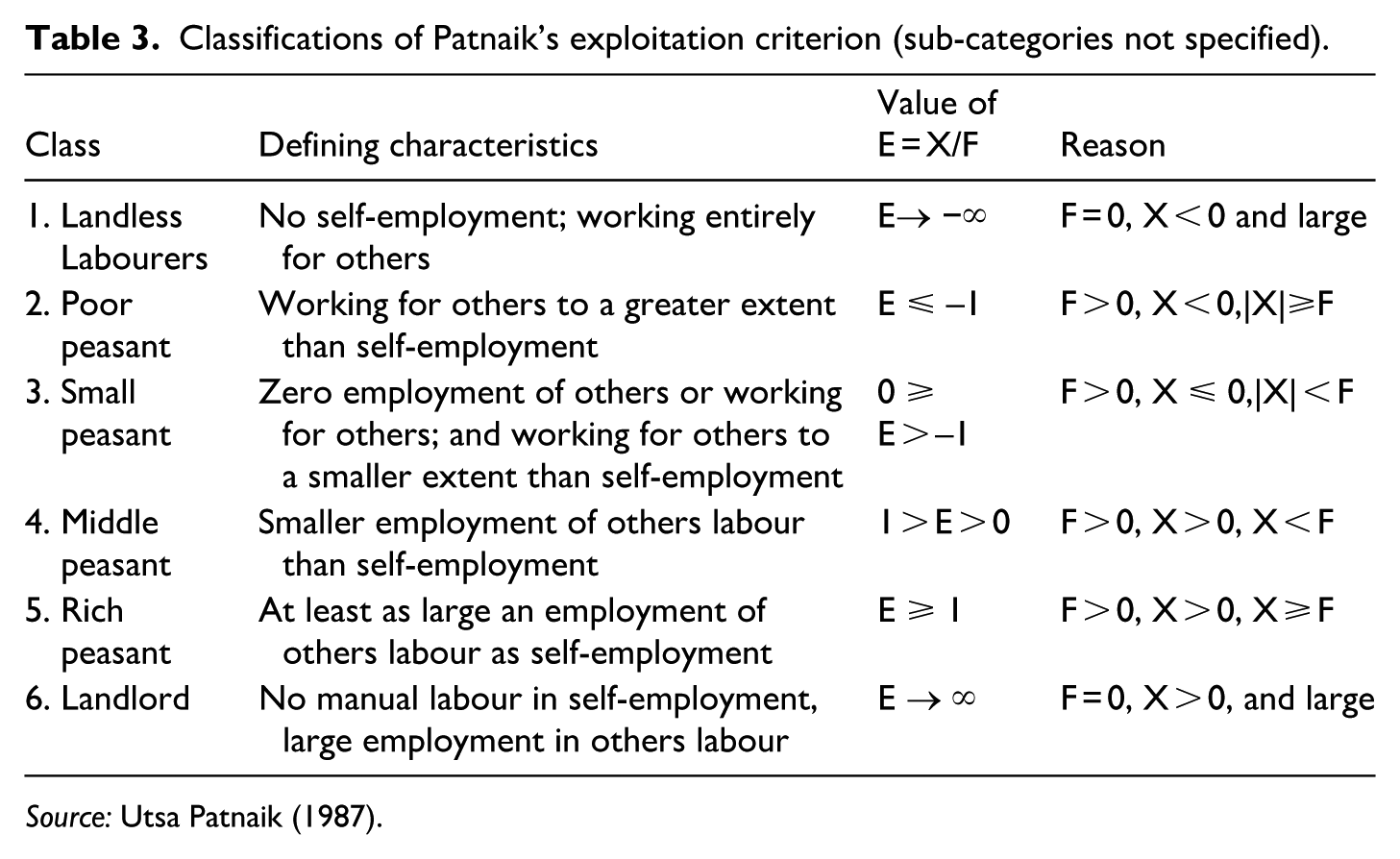
Source: Utsa Patnaik (1987).
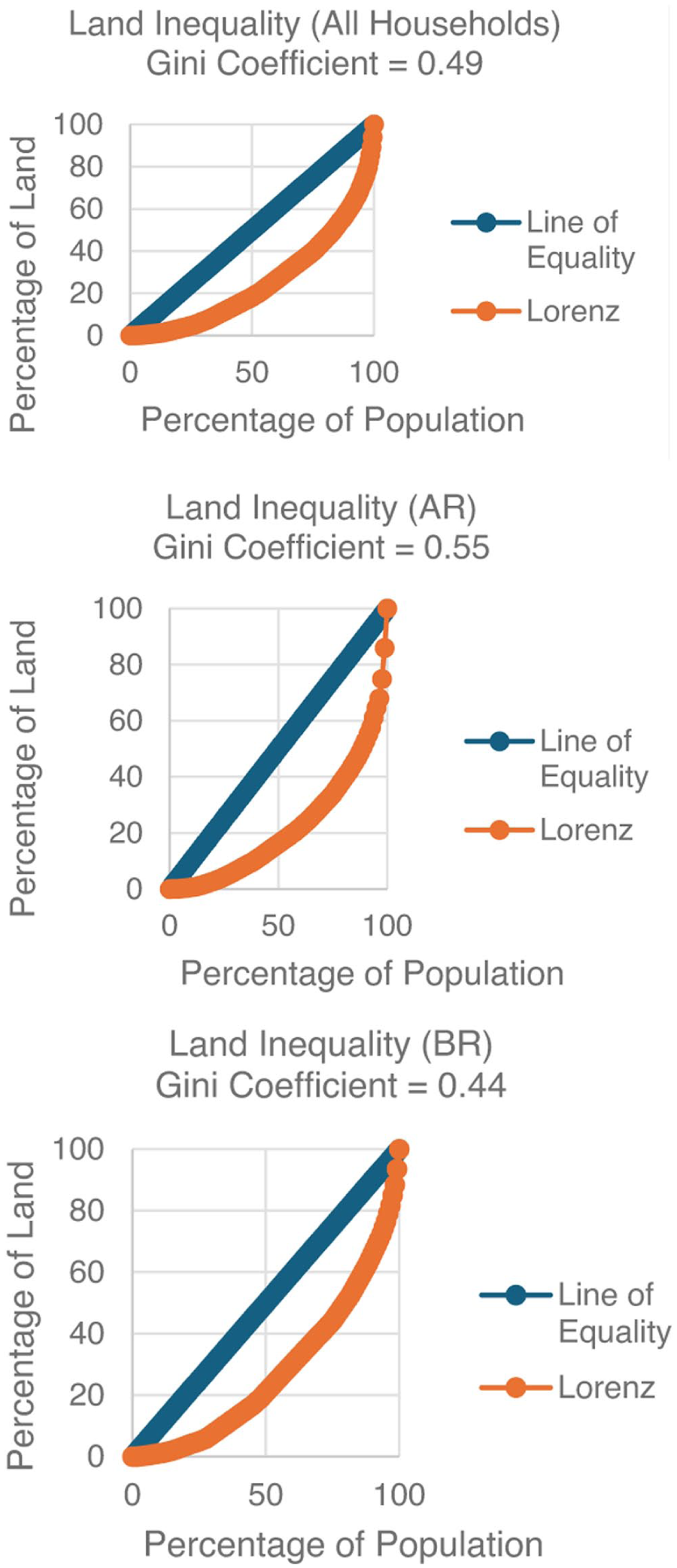
Lorenz curve of landholdings across regions.
While ownership quintiles capture the degree of concentration, they remain silent on the mechanisms through which inequality is reproduced. Neither acreage categories nor quintile measures adequately reflect differences in labour use, tenancy dependence, or surplus appropriation. As a result, they cannot explain how households with similar land sizes come to occupy divergent economic positions within the agrarian structure.
To address these limitations, the analysis classifies households using Patnaik’s (1987) E-criterion, which situates economic position according to net absorption of labour rather than land size alone. By distinguishing labour-hiring, self-employed, and labour-selling households, this framework provides a more precise basis for analysing agrarian differentiation in West Bengal. The application of the E-criterion underpins the subsequent examination of household composition, access to productive resources, and the reproduction of inequality in the study villages.
The E-criterion is defined as:
where Hᵢ = labour days hired in on the household’s operational holding; Hₒ = family labour days hired out (supplied to others); Lᵢ = labour days worked on leased-in land (by family or hired workers); Lₒ = labour days worked on land leased out by the household; and F = family labour days on the household’s own operational holding.
Marxist theory explains the differentiation of peasantry into distinct classes under the development of capitalism (Lenin, 1964; Patnaik, 1987). Within a regime of commodity production, the rich peasantry employs and exploits labourers in order to appropriate surplus. Poor peasants, by contrast, are compelled to sell their labour on others’ farms and are thereby subjected to exploitation. The self-employed peasantry occupies a vulnerable intermediate position: while a few manage to ascend into the ranks of rich peasants, most face the constant threat of downwards mobility. At the two extremes of the rural class structure are landlords and landless labourers. Landlords are characterised by their possession of substantial means of production and their non-involvement in manual labour, living instead by appropriating the surplus labour of others. Landless labourers, by contrast, possess negligible means of production and must survive entirely by selling their labour power.
The Labour Exploitation Index (E-criterion) offers an empirical approximation of household class status. Class position is determined by the extent to which a household hires in outside labour or, conversely, supplies labour to others, relative to its reliance on family self-employment. In effect, the index measures surplus labour appropriated or parted with in relation to surplus labour generated through self-employment. As Bhattacharyya (2003) observes, under simplifying assumptions, this operationalisation closely reflects the analytical concept of class differentiation within the peasantry.
On this basis, sample households are classified using Patnaik’s E-criterion. The index distinguishes whether a household is a net hirer of labour, a net seller of labour, or primarily reliant on family self-employment, thereby capturing relations of exploitation that acreage measures alone cannot reveal. The classification scheme employed in this study is summarised in Table 3.
The E-criterion produces a ratio that may be positive or negative depending on whether a household is a net employer of labour or a net seller of its own labour. Its values range from (+) infinity to (-) infinity, reflecting the two poles of the rural class structure. At one end, landlords possess such extensive resources that they perform no manual labour and live entirely from the surplus generated by others; at the other, landless labourers lack productive assets altogether and survive solely by selling their labour power (Patnaik, 1987).
Between these extremes lie four intermediate positions. Poor and small peasants are exploited insofar as they must supplement family farming with wage labour for others. Middle peasants are largely self-employed, relying on family labour for cultivation. Rich peasants and landlords together form the exploiting classes, as they hire in substantial amounts of wage labour. Table 3 summarises these six categories, which are used in this study to classify the Bankura households. With this framework in place, the analysis now applies the E-criterion to field-survey data to examine how rural households are distributed across class positions under neoliberal agrarian change.
Agrarian class structure and household differentiation
This section examines patterns of agrarian differentiation among rural households in the study villages, addressing the first research question concerning how neoliberal restructuring has reshaped access to productive resources in West Bengal. Using Patnaik’s E-criterion, it analyses household class positions in relation to landholding size, labour participation, access to institutional credit, and output. The central argument advanced here is that acreage-based classifications conceal sharp internal differentiation, which becomes visible only through a class-analytic framework.
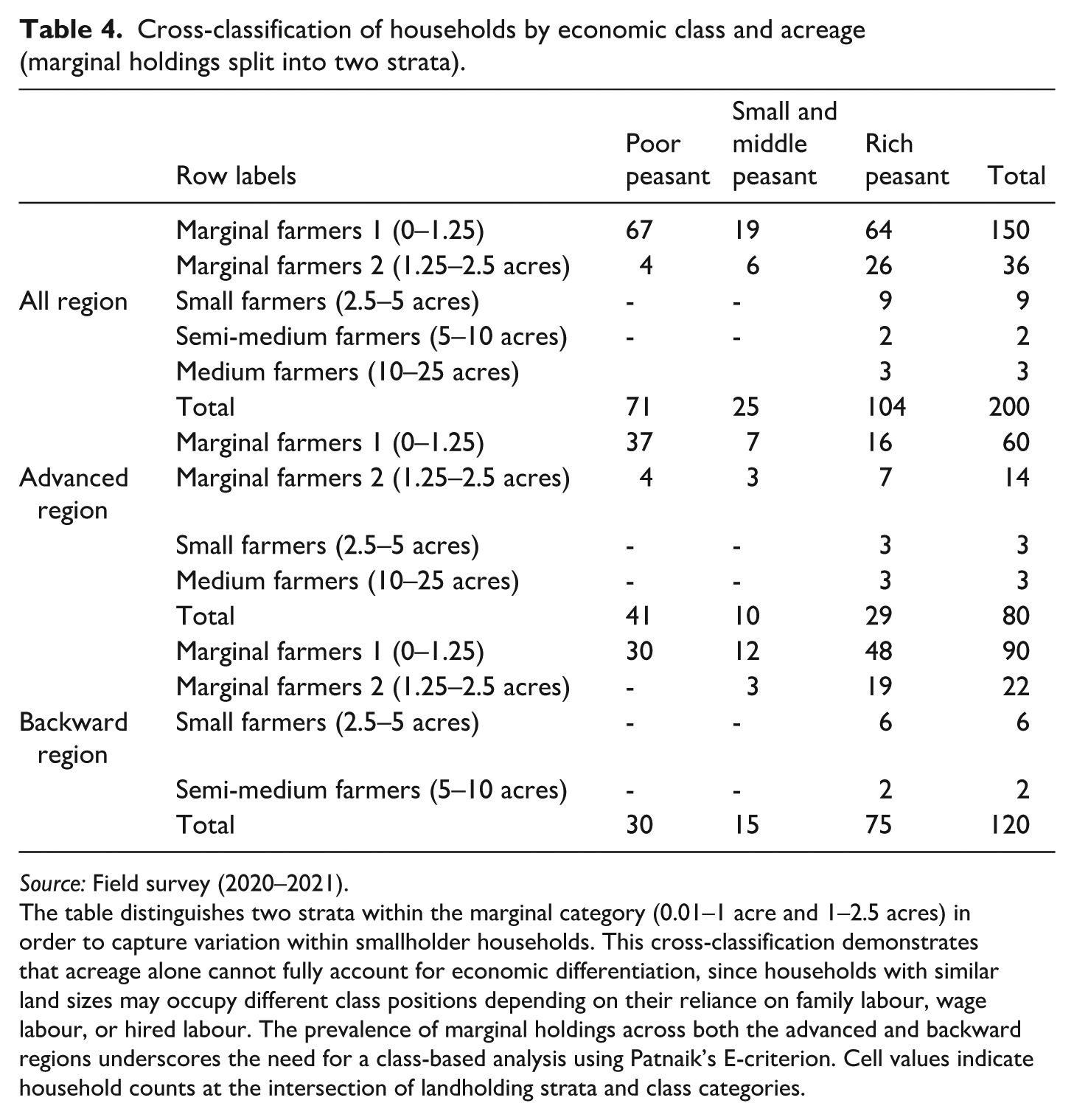
Within the 200 households that were surveyed, 80 were selected from the advanced region of the Bishnupur block and 120 from the backward region of Khatra. Table 4 gives us the cross-classification of households by landholding size and economic class. The majority – 186 households (93%) – are marginal farmers cultivating less than 2.5 acres, while only 14 households (7%) operate more than 2.5 acres: 9 are small farmers (2.5–5 acres), 2 semi-medium (5–10 acres), and 3 hold above 10 acres. No large farmers were identified in the sample villages. This dominance of marginal holdings is consistent across both regions, reflecting the legacy of land reform. Yet, substantial variation exists within the marginal category itself, underscoring the limits of acreage-based classifications and motivating the use of Patnaik’s E-criterion to capture class differentiation more precisely.
Cross-classification of households by economic class and acreage (marginal holdings split into two strata).
Source: Field survey (2020–2021).
The table distinguishes two strata within the marginal category (0.01–1 acre and 1–2.5 acres) in order to capture variation within smallholder households. This cross-classification demonstrates that acreage alone cannot fully account for economic differentiation, since households with similar land sizes may occupy different class positions depending on their reliance on family labour, wage labour, or hired labour. The prevalence of marginal holdings across both the advanced and backward regions underscores the need for a class-based analysis using Patnaik’s E-criterion. Cell values indicate household counts at the intersection of landholding strata and class categories.
Overall, 35% of households fall into the exploited class (poor peasants), while 52% belong to the exploiting class (rich peasants). The self-employed category accounts for only 12.5% of the sample. Notably, in the advanced region, poor peasants make up more than half of households, and rich peasants decline to around 36%, whereas in the backward region, the share of poor peasants drops to 25% and that of rich peasants rise to about 63%. As Table 4 shows, all 14 households with more than 2.5 acres of land fall into the rich peasant category, while the poor and small–middle peasants are concentrated entirely within the marginal strata.
Several points emerge from the household composition. First, the landlord class, as defined by Patnaik’s E-criterion, is entirely absent in the study villages. Land reforms in West Bengal fragmented large estates, while declining agricultural incomes have compelled even relatively well-endowed households to cultivate with family labour. Consequently, although many farmers are net hirers of labour power, they do not constitute a pure landlord class. This explains why the E-criterion distribution shows no landlords in the present sample.
Second, the survey indicates a contraction of the self-employed category. Patnaik (1987) defines small peasants as households with no use of hired labour or with some wage employment, but less than their self-employment (–1 < E < 0). Middle peasants are those who hire some outside labour but still rely primarily on family labour (0 < E < 1). Together these groups form the self-employed class. In the present sample, their numbers are limited, so small and middle peasants are combined into a single category.
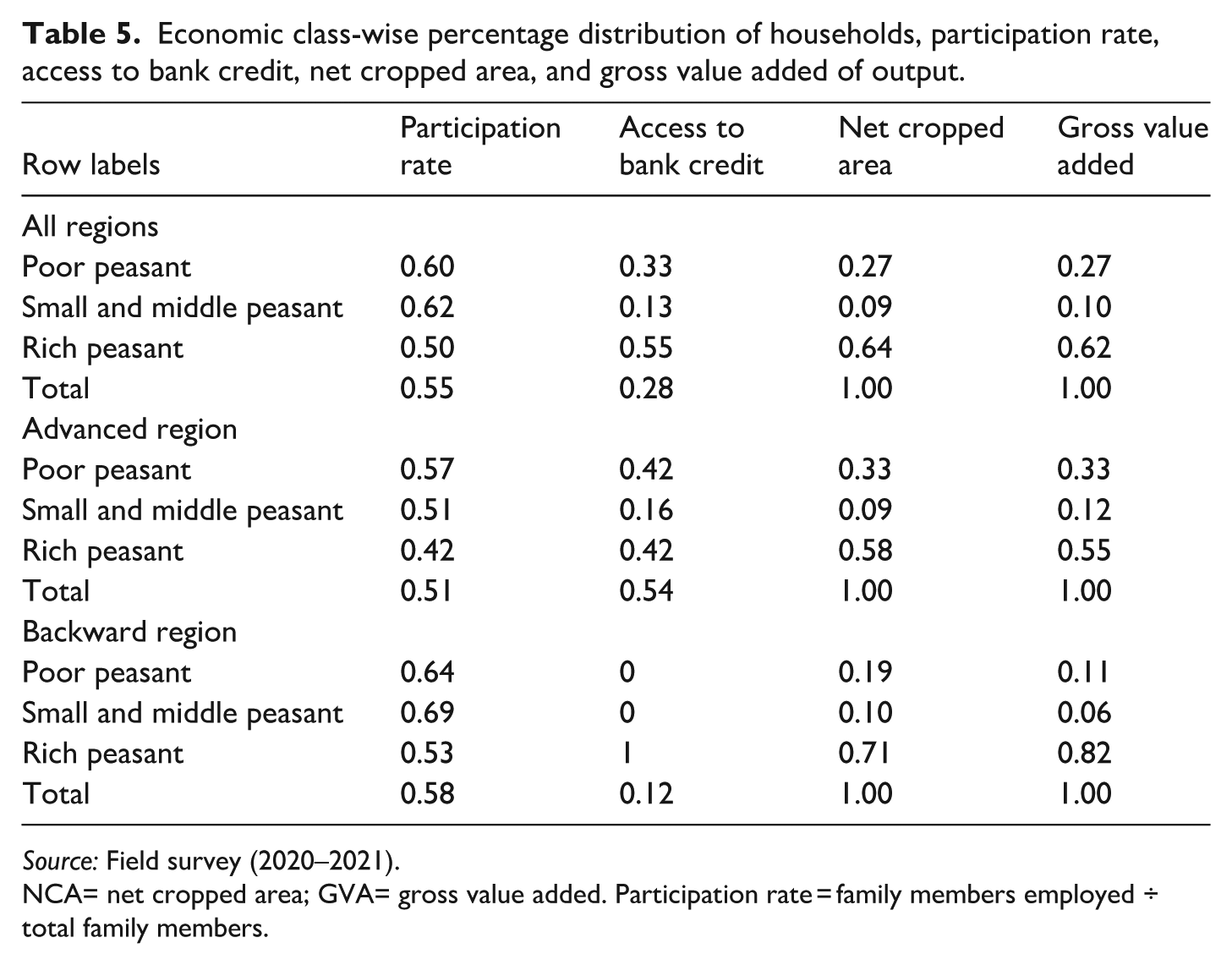
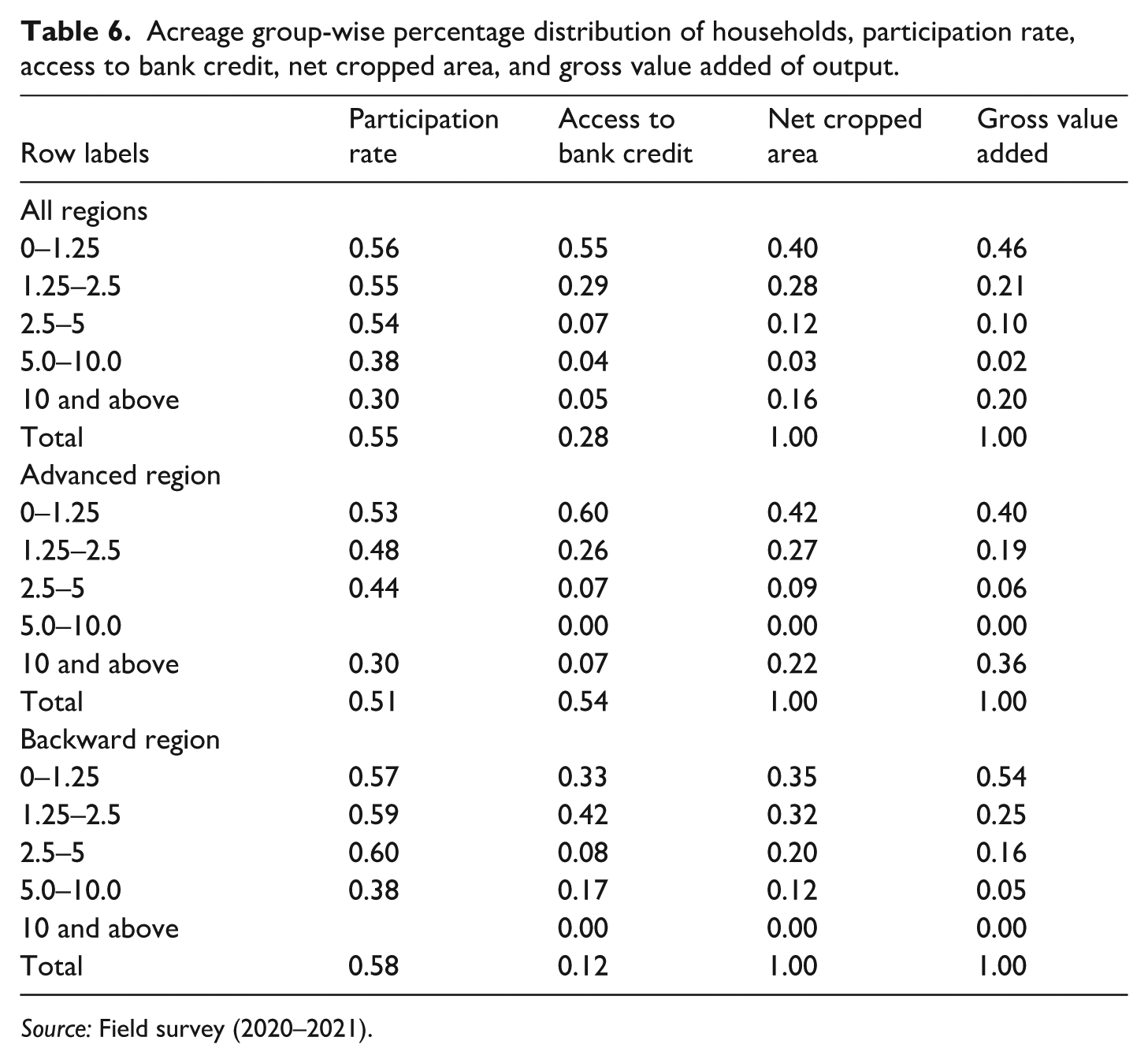
To assess the distribution of productive resources beyond simple acreage categories, proxies were constructed for land, labour, input, and output. Net cropped area (NCA) was taken as the proxy for land assets, since it captures net sown area without double-counting multiple cropping. Labour contribution was measured through the participation rate, defined as the ratio of family members employed to total family members. Access to institutional bank credit was used as a proxy for inputs given the sharp contrast in interest costs between subsidised bank loans (around 4%) and alternative sources such as microfinance, traders, or moneylenders (often exceeding 10%). While this is an indirect measure, it remains a meaningful indicator in the West Bengal context, where access to formal credit strongly conditions the ability to purchase fertiliser, seeds, or machinery. Finally, gross value added (GVA) was employed as a proxy for output, calculated as the value of agricultural production net of input costs (Bhattacharyya, 2018). Table 5 presents these indicators by peasant class, while Table 6 presents them by acreage group; both tables also report results separately for advanced and backward region. This dual classification makes it possible to compare how resources are distributed when households are grouped by class position versus by landholding size.
Economic class-wise percentage distribution of households, participation rate, access to bank credit, net cropped area, and gross value added of output.
Source: Field survey (2020–2021).
NCA= net cropped area; GVA= gross value added. Participation rate = family members employed ÷ total family members.
Acreage group-wise percentage distribution of households, participation rate, access to bank credit, net cropped area, and gross value added of output.
Source: Field survey (2020–2021).
Table 5 demonstrates that productive resources are disproportionately concentrated in the rich peasantry. Rich households account for the bulk of NCA, record substantially higher GVA, and enjoy much greater access to institutional bank credit than other groups. Poor peasants, by contrast, operate with negligible land and output and remain largely excluded from formal credit networks, while the self-employed occupy an intermediate but relatively minor position in the overall distribution. This pattern confirms that class categories capture the sharp differentiation within the peasantry that would otherwise be obscured by acreage-based groupings.
Table 6 presents the same indicators by acreage groups and illustrates the limits of land-size classifications. With nearly 90% of households falling into the marginal category, averages within this stratum conceal substantial internal variation. The apparent concentration of land, output, and credit among ‘marginal’ holdings is therefore an artefact of aggregation rather than an accurate reflection of class relations. In contrast, class-based categories reveal unequal command over land, output, and institutional finance that acreage groupings obscure.
Labour participation rates further corroborate this pattern of differentiation. Poor peasants exhibit the highest participation rates, while participation declines steadily among richer households as family members withdraw from manual work. A similar gradient appears across farm sizes, and regional differences show higher participation in the backward region, reflecting greater dependence on family labour where incomes are lower.
Across all other indicators – land assets (NCA), inputs (bank credit), and output (GVA) – rich peasants dominate. They control more than half of each variable in both regions despite their small numerical presence. While the advanced region shows somewhat broader access to institutional credit, the backward region is marked by near-complete exclusion of poor peasants from formal finance and extreme concentration of output among rich households.
These results show that land size alone provides only a limited view of agrarian inequality. Although marginal holdings dominate numerically, households occupying similar acreage positions differ sharply in their access to labour, credit, and output. As a result, acreage-based groupings obscure the underlying differentiation that structures rural livelihoods in the study area.
To capture this differentiation more precisely, the analysis employs Patnaik’s E-criterion, which classifies households according to their net use of labour rather than land size. This framework is especially relevant in West Bengal, where land reforms compressed ownership into small plots but did not equalise access to non-land resources. Households with comparable landholdings may therefore occupy distinct economic positions depending on whether they rely primarily on family labour, hire in labour, or sell labour power.
Seen against the longer trajectory of agrarian change in the state, the findings point to a narrowing of the self-employed class and growing insecurity among labour-selling households, alongside the consolidation of productive resources among labour-hiring households. While land reforms and state interventions mitigated some market pressures, they did not halt processes of differentiation that have intensified under conditions of technological change and market integration (Bhattacharyya, 2018).
In this sense, the E-criterion provides the analytical foundation for understanding agrarian inequality in the study villages. The differentiated household structure identified here sets the stage for the next section, which examines how these inequalities are reproduced through land ownership, operational holdings, and tenancy arrangements in everyday practices of cultivation and leasing.
Land and tenancy relations
Now we address the second research question by examining how differentiated agrarian positions are reproduced through land ownership, operational holdings, and tenancy arrangements in rural West Bengal. Building on the class structure identified in the previous section, it shifts the focus from household composition to the concrete mechanisms through which access to land is organised and mediated. By combining policy debates, secondary evidence, and field-survey data, the analysis shows that land concentration and tenancy do not disappear within a smallholder-dominated agrarian structure but instead operate as key channels through which inequality is sustained under neoliberal conditions.
This section analyses how land ownership, operational holdings, and tenancy relations reproduce agrarian class differentiation in West Bengal under neoliberal conditions. It first situates contemporary policy arguments on farm ‘viability’ and scale, then examines land concentration using field-survey evidence, and finally analyses tenancy as a class-mediated mechanism through which inequality is reproduced within a predominantly smallholder agrarian structure.
A recurrent policy view holds that land fragmentation has rendered small farms economically unviable, leading official reports to advocate consolidation through reverse leasing and market-mediated land transfers (Ahluwalia, 2011; Government of India, 2016; Government of India, 2018; NITI Aayog, 2015). Such arguments implicitly assume economies of scale in cultivation. However, extensive agrarian research challenges this premise. Land is largely scale-neutral: when farmers have access to irrigation, inputs, credit, and markets, small plots can be as productive as larger ones. As Bhattacharyya (2003) emphasises, agrarian inequality arises not from plot size itself but from class relations and unequal access to non-land resources. This distinction is crucial for West Bengal, where land reforms produced a landscape dominated by marginal holdings without eliminating differentiation.
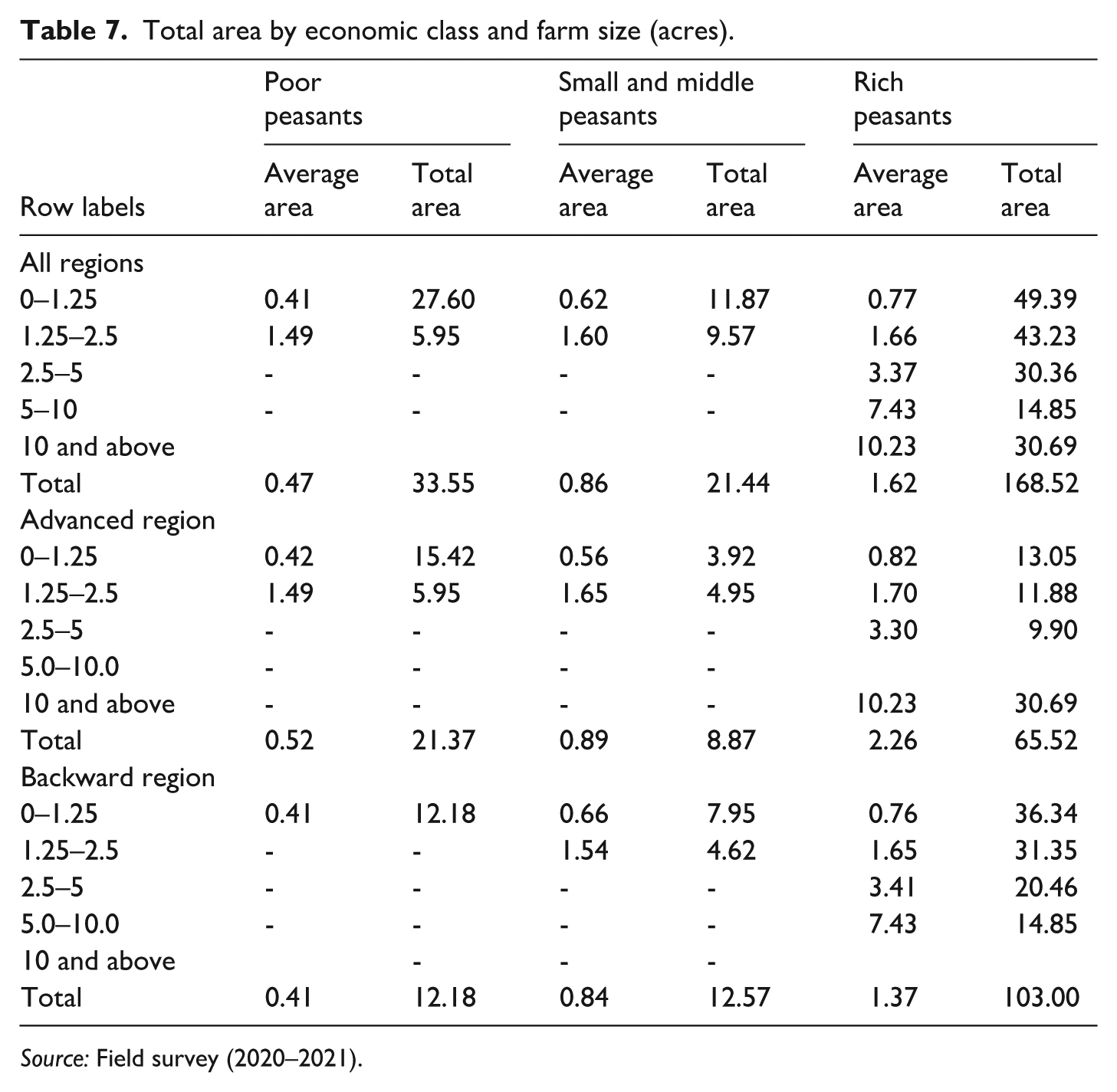
The persistence of marginal holdings therefore does not imply an egalitarian agrarian structure. Tables 7 – 9 present land distribution by economic class and acreage group, distinguishing between owned and operated area. The evidence reveals sharp concentration of land control despite the numerical dominance of smallholders, underscoring the need for class-based analysis.
Total area by economic class and farm size (acres).
Source: Field survey (2020–2021).
Economic class-wise percentage distribution of households, owned area, and operated area.
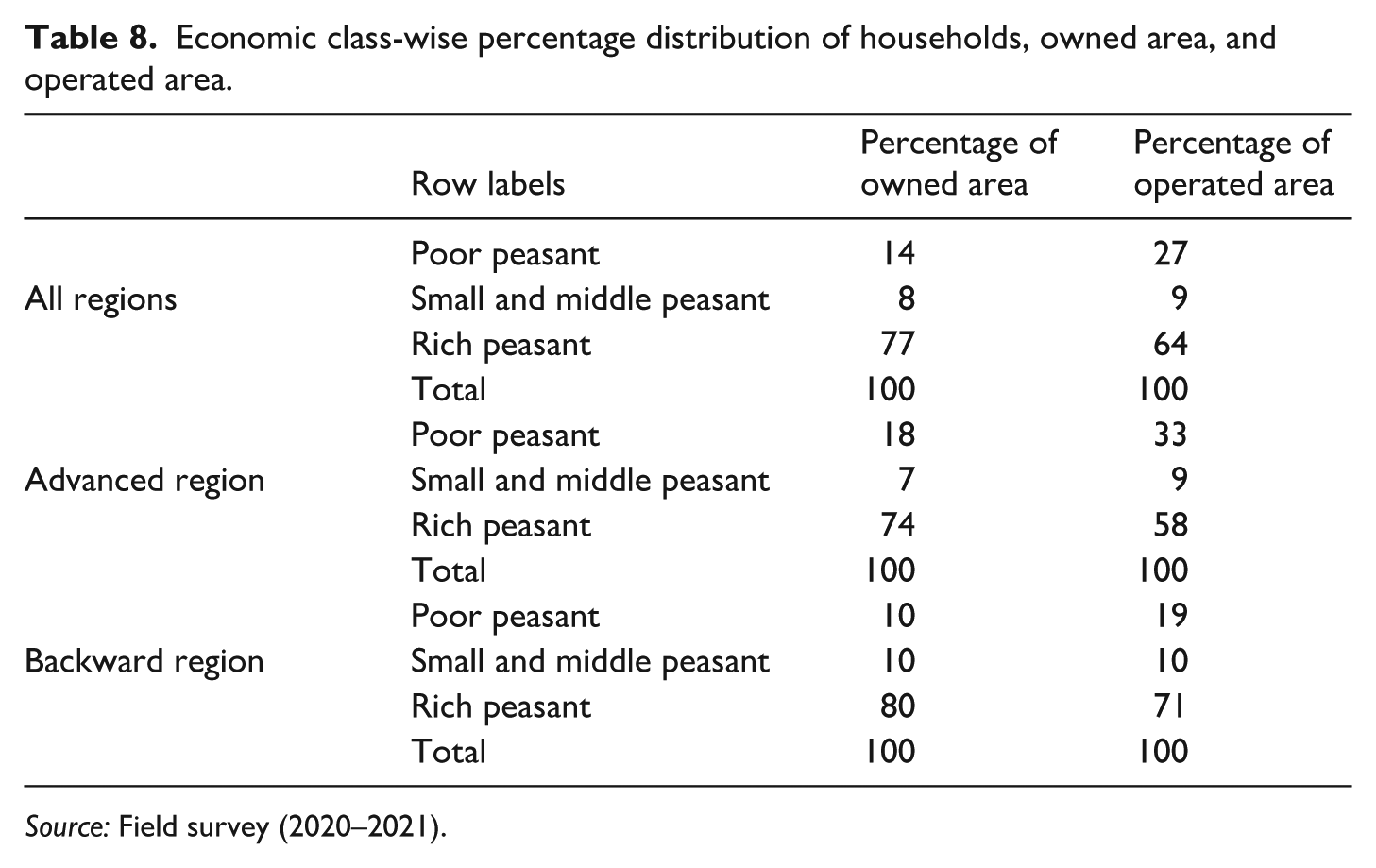
Source: Field survey (2020–2021).
Acreage group-wise percentage distribution of households, owned area, and operated area.
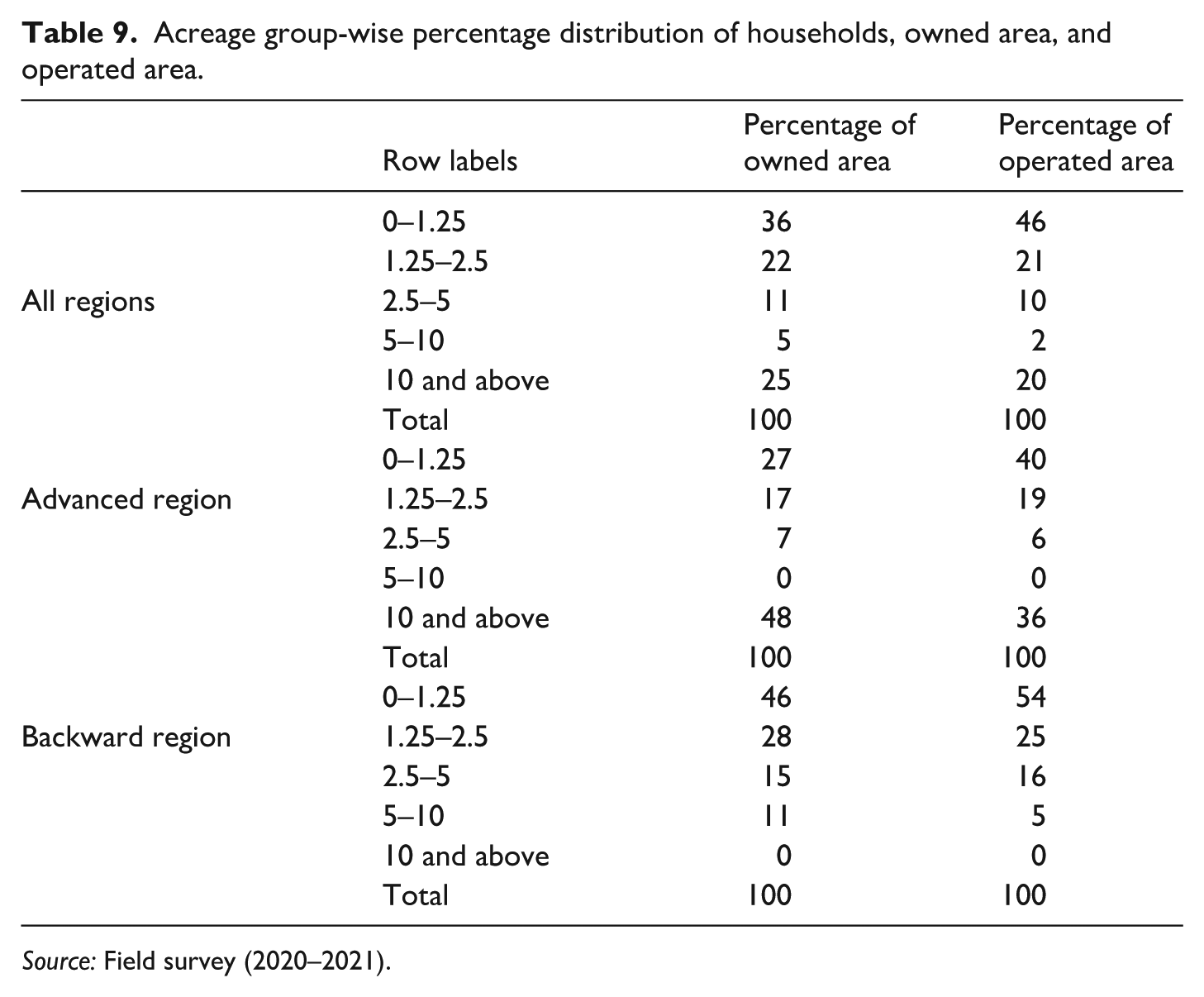
Source: Field survey (2020–2021).
Table 7 highlights stark land concentration across classes. Poor peasants together hold only 15% of total land, whereas rich peasants control 75%. Although only 7% of households possess more than 2.5 acres, they command one-third of total land. Regional contrasts further sharpen this inequality: in the advanced region, three households alone account for nearly half of total land, while no comparable holdings exist in the backward region. These patterns reflect a reconfigured agrarian hierarchy rather than disappearance of differentiation.
Tables 8 and 9 again demonstrate why acreage-based categories are analytically misleading. While marginal farmers dominate numerically, they control a disproportionately smaller share of owned and operated land. Rich peasants, by contrast, command over three-quarters of owned land and nearly two-thirds of operated land. In the backward region, their share of operated land exceeds 70%. Aggregation by acreage thus obscures class concentration and masks the unequal command over productive resources embedded within the marginal-farmer category.
If ownership alone does not capture land control, tenancy becomes central to understanding how differentiation is reproduced. In a smallholder economy, leasing mediates access to land and redistributes production risk across classes. The following analysis situates tenancy in West Bengal historically and examines its contemporary class direction using both secondary and field-survey evidence.
West Bengal’s tenancy structure was decisively shaped by Operation Barga, which formalised sharecropping contracts and enhanced tenant security. By registering over 1.5 million sharecroppers, the reform reduced concealed tenancy and altered bargaining relations (Bhattacharyya, 2003). Yet informal leasing persisted, and fixed-rent contracts have expanded in recent decades, producing a hybrid tenancy regime that combines legal recognition with new market pressures.
NSSO-Survey of Land and Livestock Holdings (SLLH) data confirm that tenancy remains more prevalent in West Bengal than nationally. Table 10 shows that nearly 30% of cultivator households in the state lease land, compared to 17.4% at the all-India level, and that leased-in area constitutes a larger share of operated land. While fixed-money contracts dominate nationally, West Bengal exhibits a higher incidence of fixed-produce and share-based arrangements, reflecting the enduring influence of its reform legacy.
Distribution of total leased-in area under various terms of lease in rural India and rural West Bengal (in percentage).
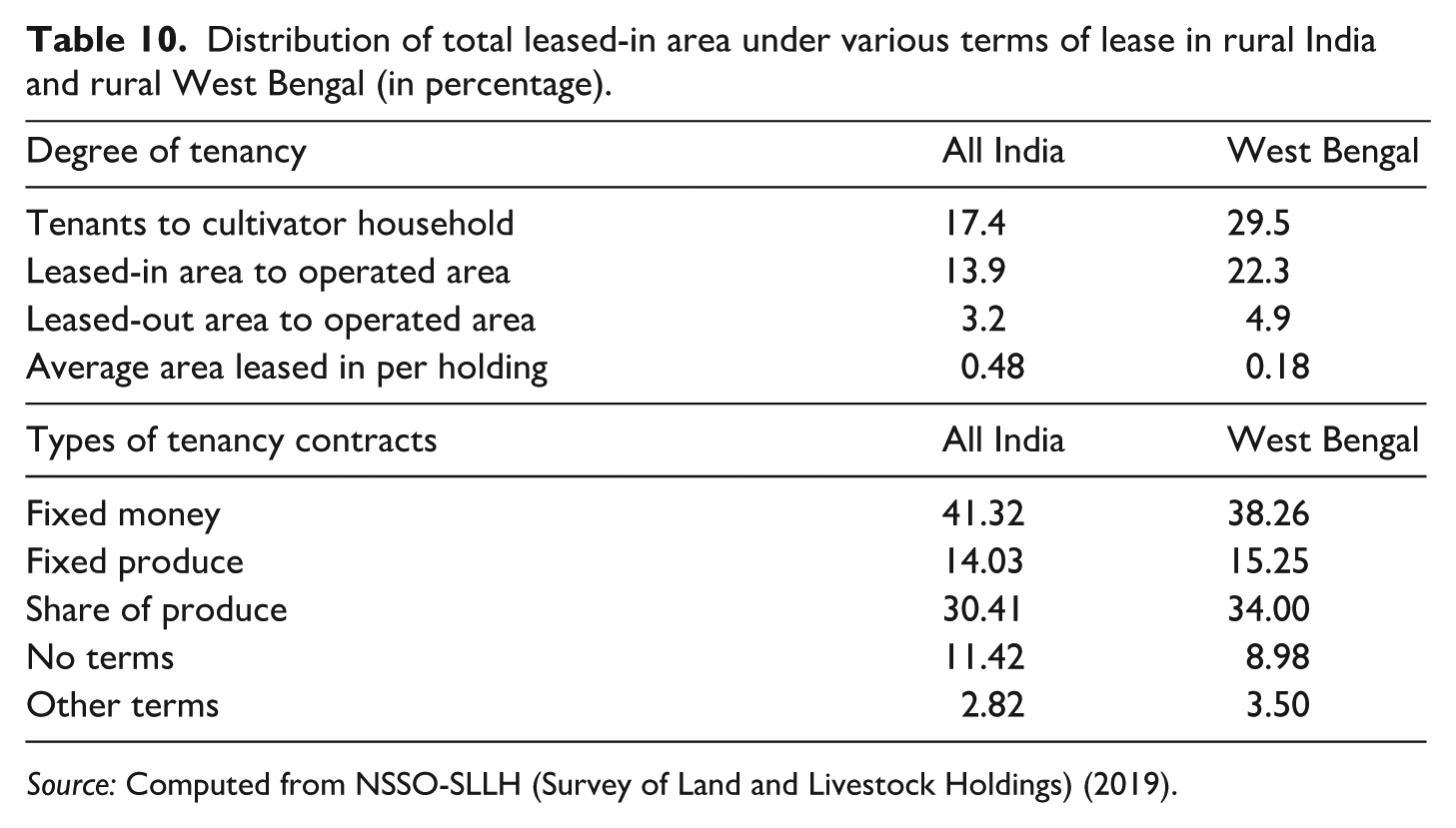
Source: Computed from NSSO-SLLH (Survey of Land and Livestock Holdings) (2019).
The field survey reveals sharp regional contrasts (Table 11). Tenancy is widespread in the advanced region, where 75% of households lease land under monetised contracts, reflecting deeper market integration. In the backward region, tenancy is far less common but relies predominantly on share-based or cost-sharing arrangements, indicating greater risk-sharing under conditions of limited liquidity.
Land tenure and class.
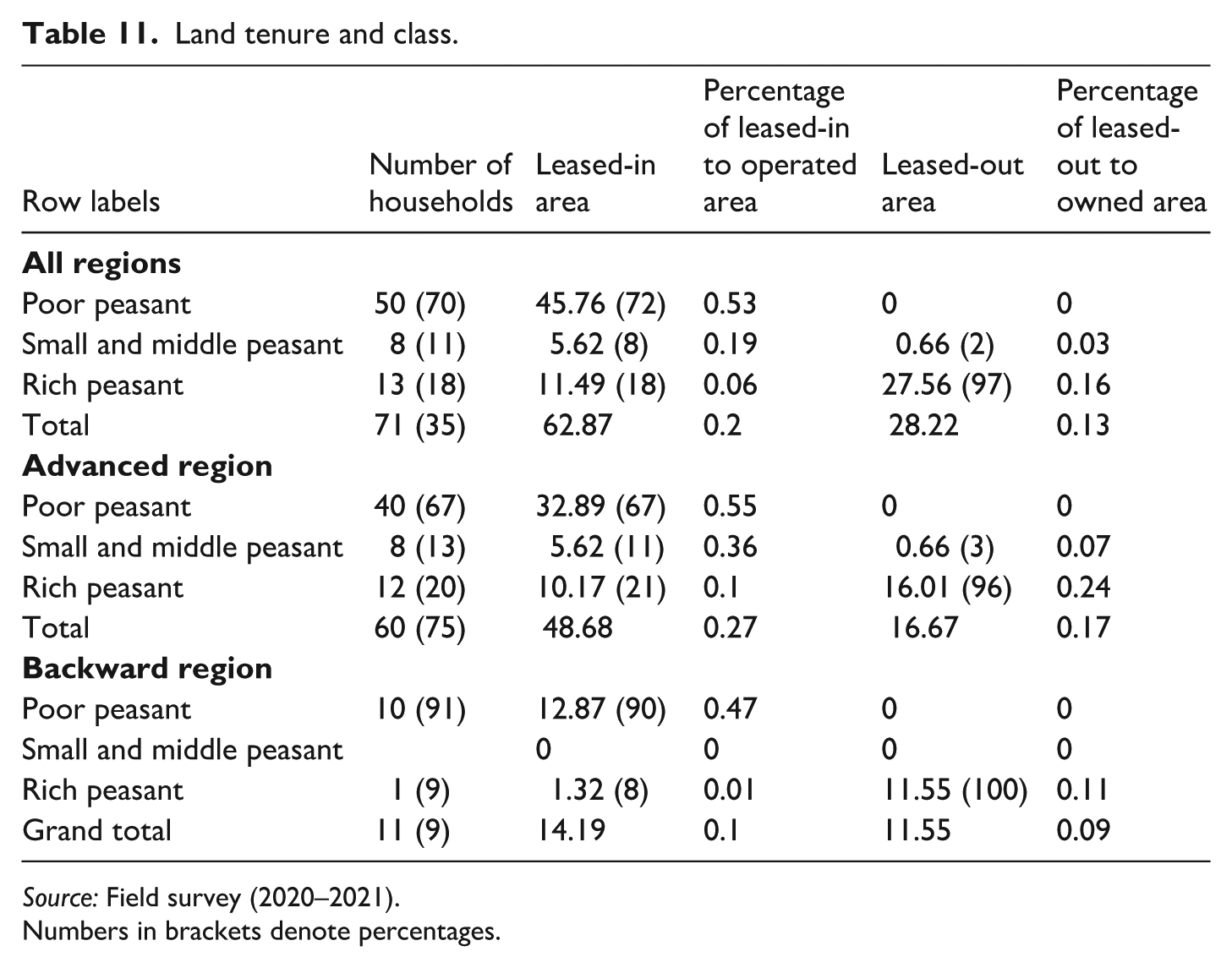
Source: Field survey (2020–2021).
Numbers in brackets denote percentages.
Table 11 reveals that tenancy is overwhelmingly a phenomenon of the labour-selling classes. Poor peasants account for over 70% of leasing households and nearly three-quarters of leased-in land, rising to over 90% in the backward region. Rich peasants lease in land far less frequently, confirming that tenancy functions primarily as a means of sustaining cultivation for asset-poor households rather than as a route to accumulation.
Leasing out follows the opposite logic. Of the total leased-out area, 96% originates from labour-hiring households, reaching 100% in the backward region. Although leased-out land constitutes a modest share of owned land overall, its class concentration indicates that better-off households appropriate rent while withdrawing partially from direct cultivation.
Table 12 confirms a strong inverse relationship between farm size and tenancy. Marginal farmers account for nearly 87% of leased-in land and lease in a substantial share of their operated area, while larger farms lease in very little land. Leasing out, by contrast, rises sharply with land size. This pattern reflects structural compulsion rather than choice: poorer households lease in land to maintain access to production, while larger landholders face no such constraint.
Land tenure and farm size.
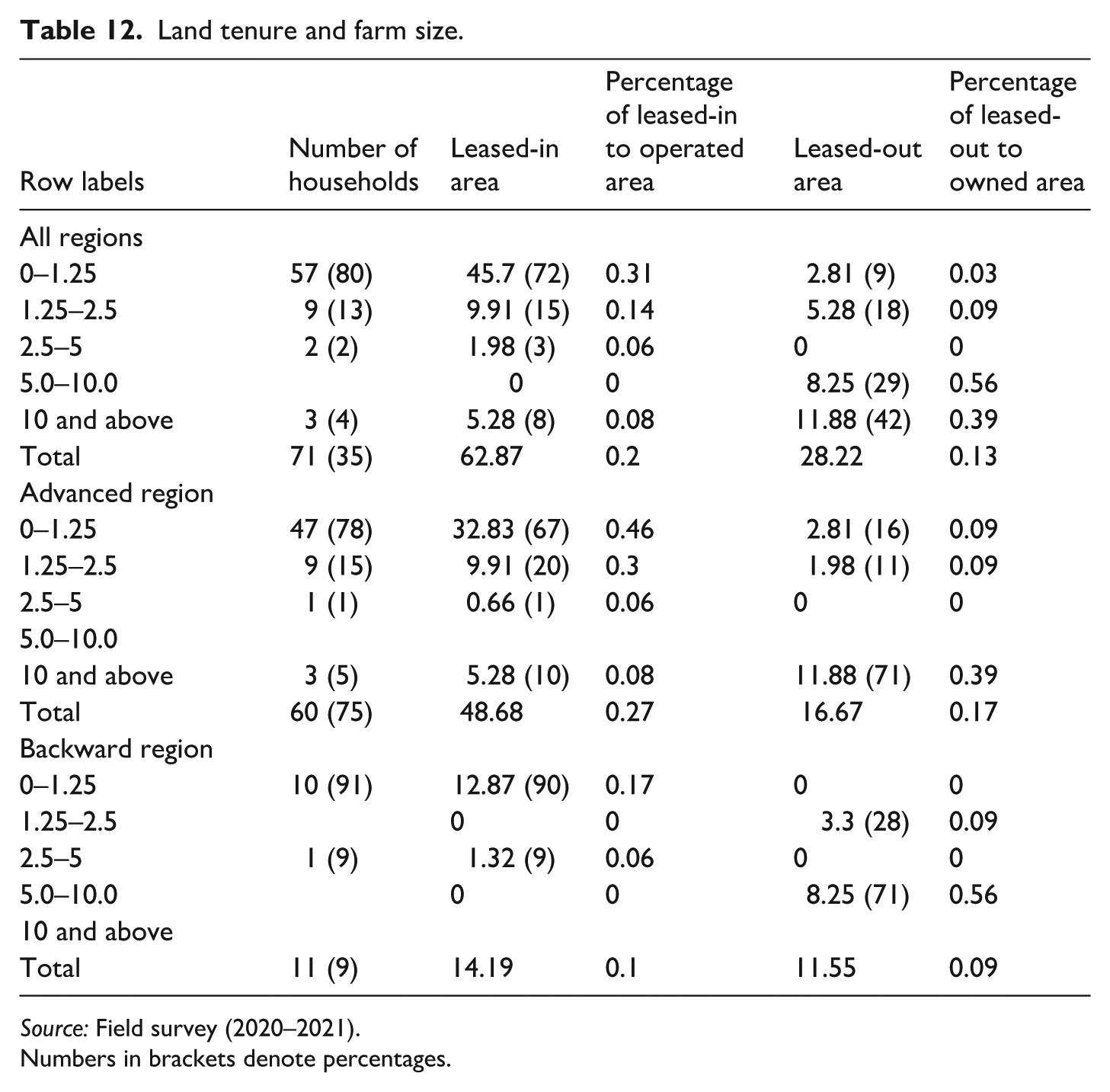
Source: Field survey (2020–2021).
Numbers in brackets denote percentages.
Taken together, the evidence shows that tenancy in West Bengal operates as a class-mediated mechanism of reproduction rather than a transitional feature of smallholder agriculture. Under neoliberal conditions, inequality is reproduced not through the re-emergence of large estates, but through unequal operational control and asymmetric leasing relations, in which risk is transferred downwards and rent is appropriated upwards. This reinforces the central claim that agrarian differentiation persists within a predominantly marginal-farmer structure and must be analysed through class relations rather than acreage alone.
In sum, the analysis demonstrates that land and tenancy relations continue to reproduce agrarian inequality in West Bengal. Despite the numerical dominance of marginal holdings, ownership and operational control over land are highly concentrated, while tenancy functions as a mechanism that reallocates risk downwards and rent upwards. Labour-selling households lease in land to sustain cultivation under constrained conditions, whereas labour-hiring households lease out land and appropriate income without equivalent exposure to production risk. These patterns indicate that neoliberal restructuring has not dissolved agrarian hierarchies but has reworked them through everyday practices of cultivation and leasing. Understanding agrarian change in West Bengal therefore requires attention not only to land size but also to the differentiated relations through which land is accessed and controlled.
Conclusion
The neoliberal reforms initiated in the early 1990s reshaped India’s agrarian economy by reorienting agricultural production towards market-mediated accumulation while withdrawing forms of state support that had previously stabilised small-scale cultivation. Increased exposure to price volatility, declining public investment, and uneven access to credit and inputs heightened production risks for cultivators and intensified inequality in access to productive resources. National-level evidence since the 1990s documents a simultaneous rise in landlessness and mounting pressure on small and marginal farmers, indicating that liberalisation altered the conditions of agrarian reproduction rather than resolving long-standing structural constraints.
West Bengal followed a distinctive historical trajectory shaped by extensive land reform and tenancy regulation. The redistributive interventions of the late 1970s and 1980s reduced landlordism, expanded access to land, and secured tenancy rights, temporarily strengthening labour-selling and self-employed households. However, these gains were not insulated from subsequent neoliberal restructuring. As market-led policies deepened and public support weakened, earlier redistributive outcomes were progressively eroded. The agrarian structure that emerged combines a predominantly smallholder landscape with renewed inequality in control over land, credit, and output, mediated by uneven institutional capacity and differentiated access to non-land resources.
The findings of this study address the two central research questions directly. First, neoliberal restructuring has reshaped patterns of agrarian differentiation in rural West Bengal by redistributing access to land, labour, credit, and output in ways that favour labour-hiring households. Despite the numerical dominance of marginal holdings, productive resources and operational control are increasingly concentrated among a relatively small stratum of cultivators, while poorer households remain dependent on family labour and precarious forms of reproduction. Second, these differentiated positions are reproduced through land ownership, operational holdings, and tenancy arrangements. Labour-hiring households increasingly lease out land and appropriate rent, while labour-selling households lease in land to maintain access to cultivation under conditions of heightened risk and insecurity.
The field evidence from Bankura underscores the analytical limits of acreage-based classifications. Land size alone obscures the concentration of operational control and surplus appropriation within the upper agrarian class. By contrast, Patnaik’s E-criterion reveals how differentiation operates through labour relations, showing that households with similar landholdings occupy fundamentally different positions within the agrarian structure depending on their engagement with hired labour and wage work. The persistence of small holdings, therefore, should not be mistaken for an egalitarian agrarian order; instead, it coexists with pronounced inequalities in command over land, output, and institutional finance.
Taken together, the study demonstrates both the historical achievements and the structural limits of land reform under neoliberal conditions. Redistribution created a broad base of small cultivators, but subsequent restructuring has reworked inequality through unequal operational control and asymmetric tenancy relations rather than through the re-emergence of large estates. Agrarian transformation in West Bengal thus proceeds not through a completed capitalist transition, but through an uneven process of differentiation embedded within a smallholder economy. Understanding contemporary rural change therefore requires sustained attention to relations of production and labour-mediated access to land, rather than reliance on land size or ownership status alone.
Footnotes
Appendix 1

Funding
The author received no financial support for the research, authorship, and/or publication of this article.
Declaration of conflicting interests
The author declared no potential conflicts of interest with respect to the research, authorship, and/or publication of this article.