






Abstract
This article examines the complexities of self-help in trade unions and the writing of Samuel Smiles. Trade unions are often assumed to be self-help institutions. Smiles is assumed to be a conservative individualist who wrote against trade unions. This article seeks to explore how far their ideas on self-help overlapped and where the divisions in their discourses were. This is undertaken through an examination of their texts quantitatively and qualitatively to explore how each approached self-help.
Introduction
Marxists have been interested in the role of trade unions in either stifling or promoting revolutionary activity. Commonly, this has been discussed through the lens of the labour aristocracy (Ackers and Reid, 2016), a framework that problematises the elitist or artisan class or labourers and their usage of trade unions to maintain their status, increase inequality between workers, and exclude the unskilled from contributory schemes (Hobsbawm, 2015; Hyman, 2001). Especially when discussing workers in the late 18th and early 19th centuries, the role of contributory schemes or early forms of welfare has drawn attention and been given the title of “self-help” to refer to the focus on individuals providing contributions from their savings to take part in insurance schemes often provided by trade unions or friendly societies (Boyer, 2004; Gosden, 1974). How far these activities are influenced by ideology or the middle class (Donajgrodzki, 1977; Thompson, 1981), or employers, is what has interested Marxists in exploring how far they limited worker solidarity or exacerbated it (Hyman, 2001; Lenin, 2012; Rimlinger, 1961). Self-help was encapsulated by Samuel Smiles’ famous works Self-Help (1866), Thrift (1977), and Character (1879). We have a clear picture of the “official” self-help ethos from Smiles’ prolific writings (Fielden, 1968; Jarvis, 1997; Rose, 2021). What remains unclear is how working-class institutions themselves, especially trade unions, interpreted and responded to these ideas. In other words, can we draw a line between what Smiles defined as self-help and how labour organisations understood self-help? Lenin read the Industrial Democracy by Sidney Webb and Beatrice Webb (1920), self-identified Fabian Socialists (Ackers and Reid, 2016), which he refers to as “opportunistic” in his work, What Is to Be Done (Lenin, 2012). He praises the insurance schemes of unions and the use of insurance experts (Lenin, 2012; Rimlinger, 1961). However, he viewed the trade union struggle as part of the economic, not the political project of the workers (Lenin, 2012). Therefore, the political perspective on self-help is made ambiguous by its support from different thinkers, requiring more empirical research into how trade unions interpreted this topic.
The complexity of this question is illustrated by a 20th-century irony: Prime Minister Margaret Thatcher’s invocation of Victorian “self-help” values. Thatcher championed self-reliance and a return to “Victorian values,” and one might ask, as Jarvis (1997) does, would Smiles have supported Thatcher’s agenda? It is an intriguing debate because Thatcher praised individual self-help, yet was famously hostile to trade unions. Historically, trade unions have often been described as “self-help institutions” for workers (Joyce, 1991; Thane, 1984; Van Leeuwen, 2012). How is it that Victorian self-help could be claimed as a conservative value in the 1980s, even as the organisations built on mutual aid and collective self-improvement (the unions) were demonised? This paradox underscores the need to disentangle the ideology of self-help from its diverse political uses.
This article argues that 19th-century trade unions did not simply reject Smilesian self-help values, but selectively incorporated them into a collective context. While Samuel Smiles presented self-help as an individual moral duty, trade unions adapted principles of thrift, education, and self-improvement to bolster group solidarity and mutual aid. By comparing Smiles’ writings with union records, the article explores the nuances of Smiles’ account of self-help and its overlap with the trade union perspective. Through undertaking an empirical analysis of documents from the National Boot and Shoe Union, this thesis adopts a “from below” Marxist approach to determine the complexities of trade union perspectives on self-help. Rather than judging self-help as inherently “good” or “bad” for workers, we approach it as a complex, contested terrain of ideas that both overlapped with and diverged from trade union ideology.
The discussion begins by examining Samuel Smiles and the ideology of self-help, outlining his key arguments and their Victorian context. Next, it explores the trade union perspective, focusing on how a major union of the era embraced or reshaped self-help ideals in practice. A comparative analysis then systematically contrasts Smiles’ outlook and the union’s approach across several themes: education and self-improvement, economic uplift (wages, thrift, and poverty), and gender roles. Finally, this article contributes to labour history by reframing how we understand the interplay between moral economy and working-class movements.
Smiles and the ideology of self-help
Samuel Smiles (1812–1904) is often identified as the quintessential proponent of Victorian “self-help” ideology (Boyer, 2019; Cordery, 2003; Prochaska, 2008). His book Self-Help (first published 1859) and its successors Character and Thrift laid out a creed of industry, frugality, and personal improvement that became influential (Chase et al., 2024). Smiles extolled the virtues of hard work, thrift, temperance, and perseverance as the path for the working man to better himself. Self-Help famously opens with the maxim that individuals must “help themselves” as the foundation of all real improvement. In Character, Smiles (1879) reiterates this moral message, “[i]t is idleness that is the curse of man – not labour” (p. 97). The conditions of labour are not a “curse.” Instead, labour is the cure to idleness which is identified as a prominent cause of social evils.
Although Smiles’ writings contain uplifting biographies and moral lessons (Briggs, 1969), his underlying social vision was mildly conservative (Pearson, 1982; Rose, 2021). Smiles (1879: 17) argues that “a condition of comparative poverty is compatible with character in its highest form.” Instead of poverty being viewed as a social evil, it is viewed as an opportunity for moral development. In Self-Help (Smiles, 1969), the focus is on how the poor can increase their social standing by educating themselves, saving their money, and behaving responsibly (Briggs, 1969). In Thrift (Smiles, 1977), the focus continues on saving money, avoiding strike activity and trade unions, and utilising self-help institutions. Self-Help (Smiles, 1969) focuses on cases of individual advancement, whereas Thrift (Smiles, 1977) focuses on presenting Smiles’ opinions in concert with examples. For example, in Thrift, Smiles (1977) argued that providing the poor with education and moral instruction would reduce drunkenness and lawlessness, as knowledge and virtue spread through society (p. 57). The message repeated throughout Thrift (Smiles, 1977) is that better behaviour by the poor, saving their wages, avoiding drink, educating themselves, would alleviate much of the suffering associated with poverty. This outlook aligned with a broader Victorian belief in moral reform and echoed religious ideas (Weber’s Protestant ethic) linking frugality and hard work to spiritual or earthly reward (Mayor, 1967; Weber, 2013). Unsurprisingly, Smiles’ (1977: 284) writing is explicitly religious, arguing that “there should be a class of men who live by their daily labour in every state is the ordinance of God[.]” Therefore, his protection of the status quo is justified in claiming it as God’s design.
Morris (1981: 108) summarises Smiles’ project as the “charter by which the lower middle and prosperous working classes might restore their self-respect after the defeats of the 1840s.” This helps to explain why Briggs (1969) positions Smiles on the side of the worker, or at least Briggs (1969) is acknowledging that this is how Smiles positions himself. Smiles does not claim the skilled workers are superior to the unskilled, as some trade unionist contemporaries would (Fraser, 1999). His conservatism arises from this defence of the status quo and interest only in individual advancement (Pearson, 1982; Rose, 2021). He does not support higher wages, but argues against them and organised labour throughout Thrift (Smiles, 1977). This conservatism will be further explored in the comparative analysis, with the arguments focusing on the nuances of Smiles’ individualism, criticism of unions, but also criticism of employers which portrays him as a mild conservative.
It is important to note that the concept of “self-help” did not originate with Smiles. Mutual aid traditions predated him: friendly societies, cooperative guilds, and other self-governing worker groups had long encouraged thrift and mutual support (Ackers and Reid, 2016; Cordery, 2003; Weinbren, 2007). Smiles drew on this tradition, focusing on social mobility and individual improvement (Morris, 1981; Prochaska, 2008). Unlike communal notions of mutual aid, Smiles’ version of self-help emphasised personal initiative and moral self-discipline. He praised institutions like Mechanics’ Institutes (with which he was involved) that allowed working men to educate themselves (Briggs, 1969), referring to them 12 times in Thrift. There are 14 references to “friendly societies” in Thrift (Smiles, 1977), but only 5 references to trade unions in Thrift, each negative. Self-help was support insofar as it is perceived as legal and not political, with trade unions finding themselves accused on both counts.
On the other hand, it is argued by Chase et al. (2024: 233) that “Smiles’ views were diametrically opposed to the individualism with which uncritical readings of his work habitually associate him.” It is rightly argued that Smiles’ association with working-class groups such as the Mechanics’ Institutes meant that referring to him either as middle class or elitist could be simplistic. To buttress Chase et al.’s (2024) argument, they refer to the only use of the term “collective” in either Self-Help or Thrift. Yet, individualism/individualist is referred to 7 times in Thrift and 5 times in Self-help. The ambivalence of his view is summarised in Thrift (pp. 155–156): He has sensibilities, sympathies, and aspirations, which should induce him to unite and cooperate with others in works for the common good. With unfettered individualism, there may, and there ought to be, beneficent cooperation for the general happiness.
Smiles, like Churchill (2007), associates collectivism with left-wing radicalism. Instead, self-help, as he defines it, is not collectivist but centred on the individual cooperating, pluralistically both fraternally and with elites. This positions Smiles in support of friendly societies, but not of collectivist political projects or trade unions which are accused of reducing the individual self into criminality.
Indeed, Smiles was suspicious of trade unions and Left-Wing radicalism. His political trajectory had begun in the 1840s with some sympathy for Chartism and popular education (Chase et al., 2024), but over time he embraced a more orthodox Victorian liberalism (Roberts, 2002; Travers, 1977; Tyrrell, 1970). In his later works, Smiles consistently portrayed labour unions and strikes in a negative light. In Thrift, for instance, he chastised unions for pushing wages above a “natural” level, claiming, “The times of high wages did not leave a very good impression on the public mind. Prices became higher, morals became lower, and the work done was badly done” (Smiles, 1977: 47; see also Boyer, 2019). In Smiles’ view, rising wages and successful strikes could harm workers’ characters—encouraging laziness or vice—while also hurting the economy. This logic, linking self-help to an almost ascetic distrust of “too much” prosperity, suggests that Smiles valued character over material gain. He believed the true route out of poverty was through frugality and virtue, not through agitating for higher pay.
Smiles advocated what he saw as cooperation and harmony between labour and capital, but by this he meant paternalistic schemes rather than union-led collective bargaining. For example, he lauded employer-sponsored friendly societies and profit-sharing schemes that depended on benevolent leadership (Dellheim, 1987; Freeman, 2020), and he opposed militant tactics like strikes (Smiles, 1977). In this, Smiles’ stance was similar to other Victorian industrial paternalists (such as the Cadbury family) who supported improving workers’ position but within a framework of class collaboration rather than class conflict (Ackers, 2001; Ackers and Reid, 2016; Dellheim, 1987). Smiles did endorse the idea of voluntary mutual aid as he spoke approvingly of friendly societies and savings banks where workers pooled their own resources for insurance against hard times (Boyer, 2019; Gosden, 1974). However, he drew a sharp line between such self-financed aid and any form of state support or labour agitation. Accepting poor relief or going on strike violated the spirit of self-help in Smiles’ eyes, because these actions implied dependence on others or coercion of employers, rather than independent virtuous effort.
Smiles’ work may overlap with the interests of Methodist and other Nonconformist trade unions (Ackers and Reid, 2016; Thompson, 2016). The question of how far trade unions or the working class were religious has been debated since Engels (1943) (Ackers and Reid, 2016; Hobsbawm, 2015). However, the presence of a Labour Church movement or more informal coalitions between religious leaders and trade unionists or religious trade unionists, is documented (Inglis, 1958; Mayor, 1967; Williams, 1962). Mayor (1967: 66) argues that the goals were the “emancipation of man from the tyranny both of his own half-developed nature and of those social conditions opposed to his higher development.” In contrast to Smiles, this pro-labour interpretation of Christianity would not rule out trade unions or socialism and often overlapped with Methodism (Robbins, 2008; Williams, 1962). On the other hand, Christian support for labour parties, often from non-conformists, sometimes associated with the Liberal Party, are often portrayed as moderating figures on the trade unions (Hobsbawm, 2015; Thompson, 1964; Williams, 1962). Thompson (2015) famously disparaged Methodism as a tool of discipline, with John Wesley complicit in framing free time as unnecessary for profit-making. While trade unions campaign for shorter working days, churches and the Methodists grew concerned that free time could lead to drinking and sloth (Thompson, 2015).
In summary, Smiles’ ideology of self-help can be seen as a conservative moral project. It championed the autonomy of the “deserving” individual and distrusted external assistance, whether from the state or from collectivist or left-wing movements. He could have been more conservative in his approach by never criticising employers. He also took a position that valorised the morals of the working class, alongside his radical background, leading some to position him as a radical (Briggs, 1969). He promoted a vision of social progress driven by personal character and incremental improvement, and he was critical of anything (like trade unions or expansive poor relief) that might encourage people to rely on collective power or public support. The following section turns to the trade unions themselves, to examine whether and how these working-class institutions engaged with the ideals of self-help, thrift, and self-improvement in their own policies and discourse.
The trade union perspective
If Samuel Smiles represented an elite formulation of self-help ideology, trade unions offered a grassroots perspective on self-help in practice. Many historians have noted that Victorian and Edwardian unions functioned as mutual aid organisations and have even called them a form of “self-help” for workers (Pelling, 2016; Thane, 1984; Van Leeuwen, 2012). In the late 19th century, British trade unions often provided their members with unemployment benefits, sickness insurance, and burial funds, services organised and funded by workers themselves. These unions emerged partly from the friendly society tradition, sharing an ethos of voluntary contribution and independence from charity (Gosden, 1974). To explore the union perspective on self-help, this article draws evidence from the National Union of Boot and Shoe Operatives (hereafter referred to as the Boot and Shoe Union), a prominent national union of the period. The Boot and Shoe Union, founded in the 1870s, was a “new model” industrial union containing some craft workers (Fox, 1958): centrally organised, respectable in its leadership, and concerned with improving members’ welfare within the existing socioeconomic system (Fraser, 1999; Webb and Webb, 1920). Its records provide a revealing case of how self-help ideals were integrated into trade union rhetoric and strategy.
Alan Fox (1958) wrote an official history of the Boot and Shoe Union, with a preface from the general secretary. This appears to have been an important document to the union, as my edition was a gift for 50 years of membership in 1968 to a local member. There is no overview of the sources used. However, Fox (1958) cites monthly reports, among academic texts, at least conferring some value on the monthly reports as useful reports, which he appears to have confirmed alongside interviews and letters. Fox (1958), therefore, is both a source to be used to confirm the information in the monthly reports and a source which confirms the value of the monthly reports in general. Moreover, Fox (1958: 36) claims that few read the monthly reports but that they held a significant influence among active and voting members. This is justified through two references to archival material from the 1870s, making it unclear whether this changed. Fox (1958) has an initial overview of the union’s structure but less of a detailed discussion of the union’s changes in structure, since he covers 80 years of history.
Boot and Shoe Union was chosen because it was a “new model” union and one which relied on geographic branches with different employers (Fox, 1958). Ackers (2016) identifies the Boot and Shoe Union as having an interest in self-help activity and workers’ cooperatives, making it a case likely to have features of self-help similar to Smiles. Equally, I was based in Northamptonshire, which was historically dominated by the shoe trade (Reed, 1992). It would be possible to utilise informal interviews and local archives beyond the University of Warwick’s Modern Records Centre (MRC). Trade unions often do not preserve their records effectively (Bell et al., 2005; Hobsbawm, 1960; Linkman and Williams, 1979; Webb and Webb, 1894), so this approach could explore missing data. In practice, I consulted a wide range of archives, both locally and nationally (Table 1).
Archival sources.
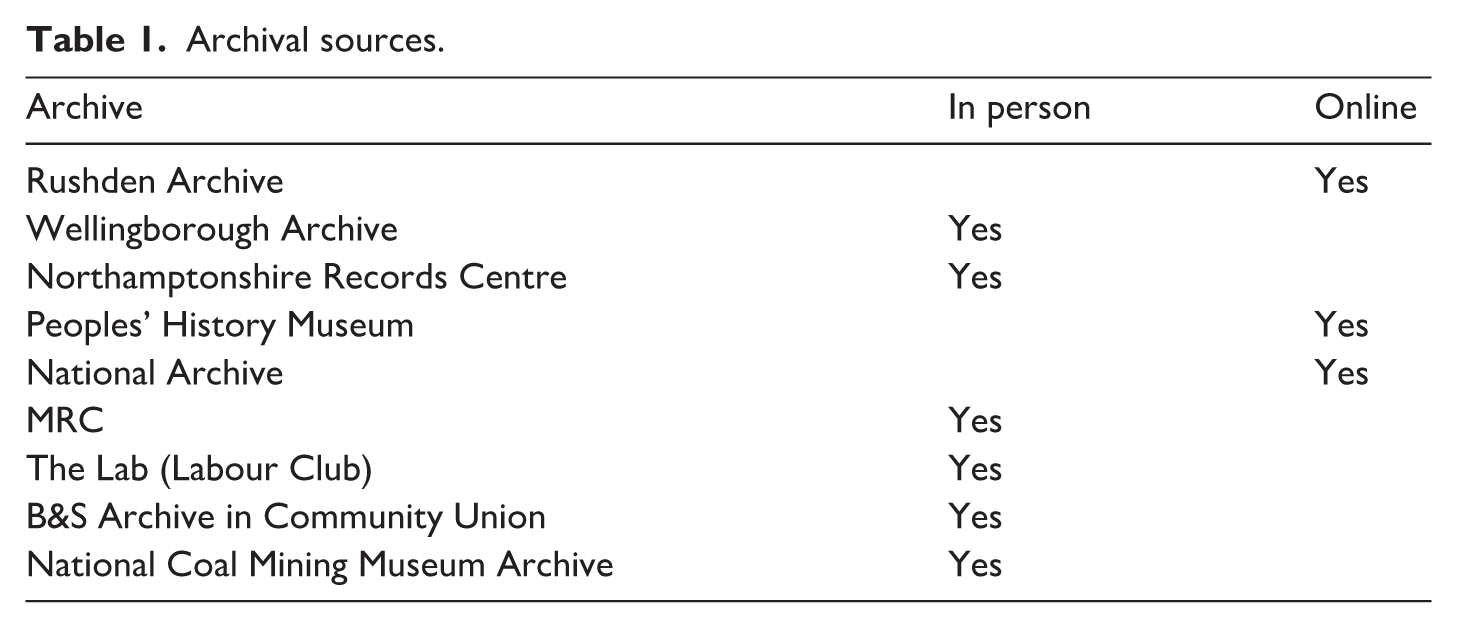
In exploring the reports from other unions, it was possible to contextualise the reports from the Boot and Shoe Union. While other union archives contained monthly reports, B&S appeared unique, containing well-preserved monthly reports in yearly compendiums. I selected the years 1920–1926 to explore how far unions were turning to self-help practices in the depression years of the 1920s. Moreover, this was a period where their “self-help” cooperative was active (Table 2).
Boot and shoe union MRC Materials.
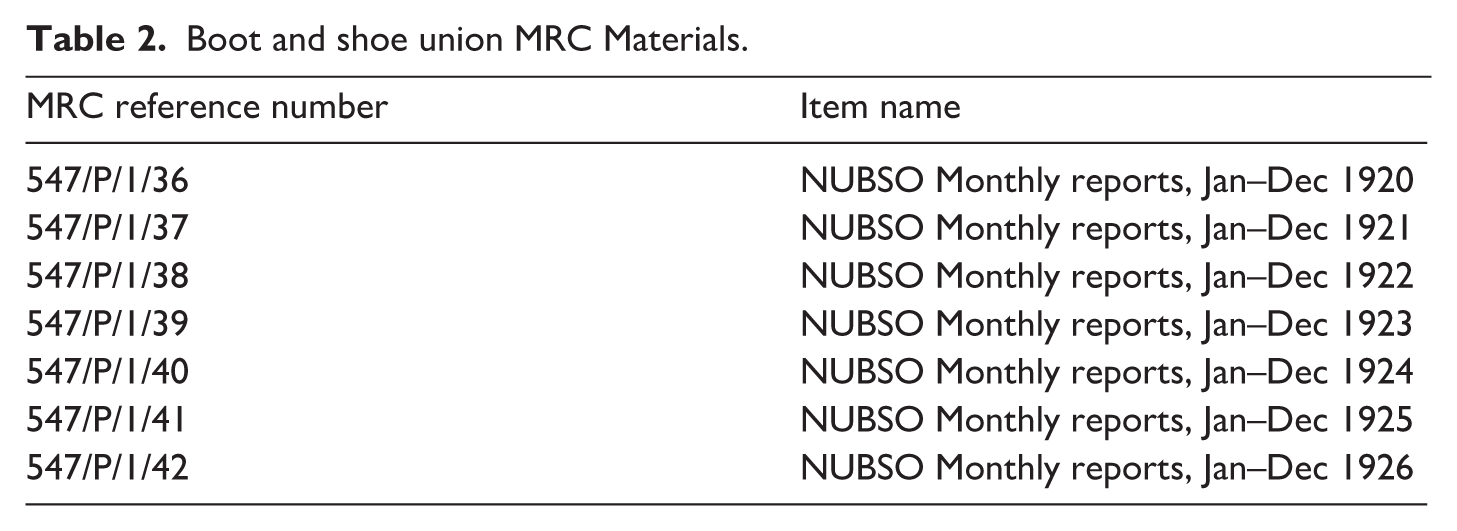
This corpus contains 1,851,031 words, providing a large sample size for analysis. The Boot and Shoe Union’s documents and publications show that the union consciously promoted values of thrift, education, and cooperation among its members. For example, one union organiser in 1925 outlined his hopes for younger members, urging them to participate in self-improving activities. He envisioned members “forming study groups, debating classes, speakers’ classes, and participating in all those joyous social activities which will make of our movement the real unifying and uplifting force in all that appertains to the lives of the peoples” (Boot and Shoe Union Monthly Report, 1925: 171). This exhortation strongly echoes the language of self-help. It emphasises study, moral uplift, and active participation. However, the goal here is explicitly collective, “our movement,” rather than individual advancement. The union was encouraging its members to better themselves not in order to escape their class, but to strengthen that class’s organisation and improve “the lives of the people” as a whole.
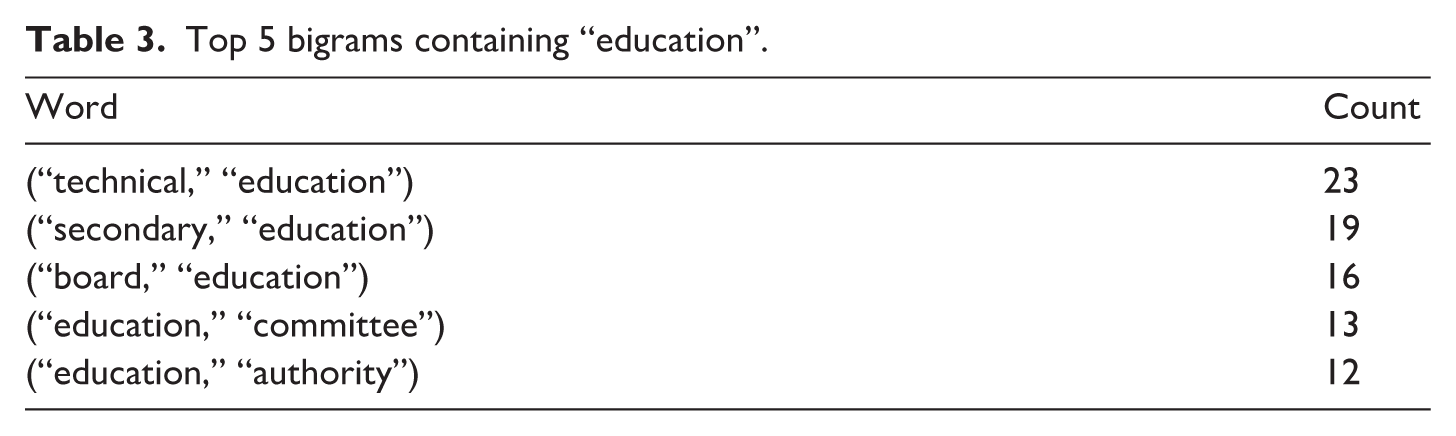
Table 3 suggests that the union was concerned with the education of young people, with particular interest in the technical (p. 23) education of apprentices. A frequency of 23 places “technical” and “education” in the 99.62nd percentile, making them comparatively high. This may be because the union was populated by skilled workers, interested in maintaining standards of quality within their profession. Words containing the root form (lemma) ‘educate’ total 783 (99.47th percentile). Moreover, “self” and “help” were not found as a bigram. While “self-help” appears in the text 7 times, it may be that this idea is present in the text if it is not explicitly mentioned.
Top 5 bigrams containing “education”.
Education was a particularly important theme in the union’s self-help efforts. The Boot and Shoe Union sponsored lectures, libraries, and even its own newspaper to inform and educate members. This emphasis parallels Smiles’ stress on self-education. Both Smiles and the union believed that working people should use their leisure time productively to gain knowledge. Yet the content and purpose of education differed. Smiles wanted working men to read improving literature and acquire moral instruction to become upstanding, self-reliant citizens (Smiles, 1977). The union, by contrast, encouraged education that would build awareness of the labour perspective as extolled by their organs, such as the Daily Herald, and practical skills. For instance, study groups might discuss labour history or public speaking skills for union meetings. Rather than teaching workers to “better themselves” out of their class, union education aimed to empower them within their class to make them more effective advocates for their rights and more informed participants in the labour movement (Royle, 1971).
Thrift and mutual aid were also central to union practice. Like most unions of its era, the Boot and Shoe Union managed benefit funds into which members contributed and from which they could draw in times of need (unemployment, illness, etc.). Such schemes were classic examples of working-class self-help. They reduced dependence on employers’ goodwill or public poor relief by providing a self-financed safety net. Union leaders often praised the virtues of prudent saving and foresight. They encouraged members to pay their dues to maintain strong funds and sometimes warned against extravagant habits (such as excessive drinking) that could undermine a family’s finances. In this respect, union rhetoric mirrored Smiles’ emphasis on sobriety and saving. Indeed, union activists frequently argued, much like Smiles, that indiscriminate charity could “sap self-respect” and that workers were better off helping each other through their union than relying on outside relief (Thane, 1984; Van Leeuwen, 2012). By pooling resources, union members practised self-reliance collectively.
Crucially, however, the union’s justification for thrift and mutual aid was more practical and less moralising than Smiles’. Union documents tended to frame benefit schemes as a way to protect workers from adversity and keep control in workers’ hands, rather than as a test of moral worthiness. For instance, the Boot and Shoe Union’s rules for its insurance funds emphasised that aid was for contributing members, not because outsiders were “undeserving,” but simply because the union’s duty was to its members and its funds were finite. There was little rhetoric about the non-members being morally deficient. Rather, the focus was on the fair administration of collectively gathered resources (Webb and Webb, 1920). This is a subtle distinction where Smiles might castigate those who failed to save as improvident, the union merely set membership-based conditions on relief, portraying it as a matter of organisational scope and fairness. In practice, both Smiles and the union upheld a principle that help should come from one’s own efforts (individually or collectively) and not from state charity. But the union’s stance was less judgmental; it was more about sustaining a solidarity fund than about teaching moral lessons.
Trade unions in the late 19th and early 20th centuries often opposed governmental social policy (Cordery, 2003; Thane, 1984). How far the Boot and Shoe union shared this view is unclear. Certainly, the union was party political, supporting the Labour Party. The General Secretary (monthly report 1926: 278) expressed his hopes that “the feasting of the rich by the robbery of the poor has killed Toryism in our land.” Therefore, their party politics may lead them to support the policies of the Labour Party and criticise the Conservatives more generally, as opposed to taking specific policy positions. Moreover, the union was happy to take advantage of new government social policy and provide state unemployment insurance. Therefore, their anti-statism or focus on independence may have been subordinate to their partisanship and pragmatic goals to provide as many funds to members as possible.
At the same time, moderate unions like Boot and Shoe did not advocate outright class warfare. They saw employers and the state as potential partners that needed moral suasion and reform, rather than as irreconcilable enemies. In union writings, social problems were often attributed to unethical employers or neglectful politicians, but not to the structure of capitalism per se. For example, union reports might blame low wages or unemployment on unscrupulous employers, bad trade policies, or government inaction, implying that if those in power behaved more responsibly, workers’ lives would improve. In this focus on moral shortcomings of individuals in authority (greedy employers, corrupt officials), the union shared a perspective with Smiles. Both tended to explain social ills in terms of personal morality. Smiles blamed intemperate workers, whereas the union blamed callous capitalists. Notably, a “respectable” union like Boot and Shoe did not frame its struggle as one of incompatible class interests. Instead, it sought cooperation with enlightened employers and social legislation that aligned with workers’ moral worth (Addison, 1983). This outlook meant that, just as Smiles did, the union believed societal progress required character and good conduct on all sides: workers should be sober and industrious, employers fair and benevolent.
However, there were limits and tensions in the union’s adoption of self-help principles. One revealing issue is the role of women in the union, which will be discussed in detail in the “Comparative analysis” section. Briefly, the Boot and Shoe Union’s ideology of self-help and mutual improvement largely excluded women from full participation, reflecting the prevailing gender norms among male unionists. The union’s leadership, while espousing uplift and fairness, was unwilling to support women members who organised for their own advancement (such as pushing for equal pay). This indicates that the union’s commitment to “self-help” had a significant blind spot. It championed self-help for working men but was uneasy about self-help initiatives led by women. Such contradictions underscore that unions, like Smiles, operated within Victorian social assumptions even as they tried to improve conditions.
In sum, the trade union perspective on self-help was one of selective adaptation. The Boot and Shoe Union and similar organisations embraced education, thrift, and mutual aid, core tenets of the self-help ethos, and wove them into the fabric of collective action. They promoted self-reliance, but on a group basis: workers should rely on their union and themselves, not on patrons or the state. They encouraged moral improvement, but primarily to strengthen the labour movement and the respectability of workers as a class. And while they shared Smiles’ disdain for dependency and disorder, they applied those ideas in a way that fostered solidarity rather than individual competition. To fully understand the nuances, we now turn to a direct comparison of Smiles’ ideology and the union’s approach across several thematic dimensions.
Comparative analysis
The following comparative analysis examines how Samuel Smiles’ self-help ideology and the Boot and Shoe Union’s practices converged or diverged on key themes. By looking at education and self-improvement, economic issues of wages/thrift/poverty, and gender roles, we can see more clearly where the union mirrored Smiles’ prescriptions and where it reinterpreted or resisted them. This thematic approach highlights that “self-help” was not a monolith, and its meaning and emphasis shifted between Smiles’ individualistic context and the union’s collective one.
Education and self-improvement
Education was championed by both Smiles and the union, but their aims differed. Smiles held an almost missionary belief in self-education as a moral imperative for the poor. In Thrift, he asserted that giving people knowledge and better education would diminish social evils like crime, drunkenness, and ignorance (Smiles, 1977: 57). To Smiles, libraries, evening classes, and Mechanics’ Institutes were tools to instil discipline and virtue (Briggs, 1969). Education was part of individual self-improvement, and each person had a duty to cultivate their mind, thereby becoming a responsible, “improved” member of society. Ultimately, Smiles saw education as enabling talented and hardworking individuals to rise in status, serving as a ladder for social mobility as well as a bulwark against vice.
The Boot and Shoe Union also promoted education, responding to the current lack of education for their members. The monthly reports of 1923 (p. 463) focused on young workers because they had left school at “14 or earlier.” This argument focuses on the need for workers to understand the “world and its problems.” Moreover, in the 1922 Annual Conference (p. 6), the resolution was received from the Kettering Branch, including the argument that “the development of Educational Classes and Study Groups will greatly strengthen the power and progress of the Union.” Union activists organised study groups and encouraged workers to read and debate, not just to refine their personal character, but to build an informed worker citizenship. Rather than urging workers to study biographies of great inventors (as Smiles might), the union’s recommended reading might include trade journals, pamphlets on political economy, or news from other unions. The goal was to empower workers to articulate their interests and engage in the union and community affairs. For instance, the Daily Herald, which represented the views of many trade unions and was invested in by the Boot and Shoe Union, provided analysis of labour issues, which helped educate members about their rights and the broader economic forces affecting their jobs. This is a different concept of “self-improvement.” Not focusing on achieving a new job or more social status but understanding the perspectives of organised labour. It can be aligned with the ideas of scientific socialism where workers only need to gain knowledge of the reality of their conditions to become invested in union affairs (see Webb and Webb, 1894). Both Smiles and the union did value the productive use of leisure time.
Smiles (1977: 292) encouraged men to “lead lives of peace, temperance, and virtue[.]” Temperance is mentioned 21 times in Thrift, but 11 times in the Boot and Shoe Union reports. This is despite Boot and Shoe reports having substantially more words. Drink is mentioned 33 times in the reports, with references to possible industrial accidents caused or tuberculosis risks. While the Boot and Shoe Union does not support temperance, it contains more pragmatic requests to decrease drinking, focusing on the risks associated. Whereas, Smiles (1977) focuses on the virtue of not-drinking, seeing temperance as a positive end-goal. Another difference is what was not emphasised. Smiles linked education to moral issues like crime prevention, as noted above. The Boot and Shoe Union’s records show little interest in teaching members how to be law-abiding or deferential. Presumably, that was taken for granted or seen as outside the union’s scope. Instead, union education efforts concentrated on topics directly relevant to workers’ lives, trade skills, the economics of their industry, or public speaking and literacy to better participate in union meetings. In short, Smiles saw education as a cure for vice and poverty at the individual level, whereas the union saw education as a tool for collective advancement and effective participation in the labour movement. Despite these differences, the common ground is notable: both promoted a culture of self-improvement through learning, reflecting a shared interest in the private provision of education as a means of remedying social ills.
Wages, thrift, and poverty
Questions of wages, thrift, and poverty relief reveal some of the sharpest contrasts between Smiles’ ideology and union perspectives, even as a few parallels exist. Smiles was a strong proponent of thrift, the careful saving and prudent use of money. He believed that even low-paid workers could accumulate modest wealth over time if they were frugal and abstained from wasteful habits. In his narratives, the virtuous poor man saves penny by penny and eventually rises to security, while the imprudent squander their wages and remain in want. This moral–economic outlook led Smiles to a controversial stance. He suggested that high wages could be detrimental if they encouraged complacency or vice. As mentioned, Smiles claimed that periods when workers earned more often saw a decline in morals and work quality (Smiles, 1977). Essentially, he feared that easier money would erode the incentive for self-discipline. Instead, Smiles almost valorised the idea of “earning one’s prosperity the hard way” through diligent work and scrimping.
This is likely why he adopts is anti-trade union position in Smiles (1977: 118): “At a time when there are no strikes, why should they not save as much money on their own account [?].” Smiles (1977) is sceptical of the value trade unions may bring to the workers and suggests contributions to strike funds and participation in strikes will only leave workers worse off (Smiles, 1977: 47). In fact, Smiles (1977) refers to strikes 26 times, each unfavourably. Smiles (1977: 91) argues that “work-people threw away half a million sterling during the Preston strike, after which they went back to work at the old terms.” In Smiles’ view, strikes can only lead to a loss of income, the worker should accept their rate of pay and choose to save it as opposed to agitating for more. If they do agitate for more, they will not receive it, as not a single one of his references to strikes accepts that strikes can increase wages for the workers.
Trade unions, by their very nature, exist to raise wages and improve working conditions. On the surface, this mission might seem fundamentally at odds with Smiles’ suspicion of wage increases. Indeed, in practice, the Boot and Shoe Union and others fought for higher wages when they could, and they certainly did not agree that high wages corrupt the worker. The General President argues, “[L]ow wages cut the throat of the consumer” (Monthly Reports, 1921: 865). From the union’s viewpoint, higher wages were an unambiguously positive goal and low wages could mean economic decline Moreover, their agreements to fix rates for workers are argued to “induce every operative to become a trade unionist” (Monthly Reports, 1921: 865). Therefore, the increasing of operatives wages is seen as the attraction of prospective members. It is difficult to see union leaders seeing higher wages as problematic. Smiles (1977: 46) argues that “high wages meant more idleness, more whisky, and more broken heads and faces.” Here, Smiles positions high wages as causing moral degradation. Instead, the workers should accept their low wages and save to gain moral advantage. Smiles focuses on the ascetic life, so it is not surprising he adopts this position and equally criticises employers “actuated by self-interest, or by blind impulse” (Smiles, 1977: 181).
Smiles and the unions portray employers ambiguously. Smiles (1977) argues (p. 152) that employers “can do a great deal towards promoting habits of thrift[.]” Employers are not inherently good, but Smiles’ 40 references to employers are mostly in positive contexts. Where they are negative, for example, is where the employer is not supporting savings banks (Smiles, 1977: 117). Therefore, Smiles would take the side of an employer in a strike, but does not inherently view employers as superior to the employed. This is why he supports industrial cooperation. The Bristol and Kingswood branch argued that the economic downturn was not experienced equally between employers and employees. The employers are viewed as “very comfortable” and that there is “sufficient” money within the boot and shoe trade to “satisfy the needs of all” (Monthly Report, 1921: 980). Employers are viewed negatively when they take advantage of the economic decline to reduce wages. At the same time, the union will mostly refer to trade being poor as opposed to outright blaming employers. Moreover, the union supported industrial cooperation in a similar vein to Smiles, with the Leicester Self-Help cooperative as an illustrative example.
In the 1926 Annual Conference (p. 54), the superannuation terms are discussed. The fund is for “FULL MALE MEMBERS” and for eligible members the scheme is “COMPULSORY” except for members over 65 on 1 January 1927. This scheme would encourage self-help via contributions from members as the opportunity for pensions. The scheme was exclusionary for women and those over 65, making it exclusionary and non-voluntary. One might think this decreases its relation to Smiles. In Thrift (Smiles, 1977: 106–107), Smiles opines on the values of superannuation schemes from friendly societies. Smiles (1977: 107) argues their virtue is that they keep the working man “independent of help from private charity or the poor rates.” Smiles (1977) approves of the exclusionary policies, acknowledging the issue with friendly society insolvency and identifying the generosity of provision as a cause. In this argument, Smiles is not highlighting their voluntary nature and nor is he interested in their traditions and club character (Cordery, 2003; Gosden, 1961; Ismay, 2018; Weinbren, 2011). Smiles appears most interested in the fact of their existence and how they relate to other institutions such as cooperatives and penny savings banks. Therefore, both the union and Smiles, when referring to superannuation schemes, are interested in the practicalities of their operation and the putatively necessary sacrifices which must be undertaken to ensure their financial stability (Fraser, 2022). Their presence is viewed as cultivating self-help and a positive for those to contribute to (Fraser, 2022), with little debate on how they can be differently operated. This is unsurprising as Webb and Webb (1920) argue that friendly benefits provided moral advantages to the trade unions legitimising them to employers and politicians (see also Fraser, 2022, 1999).
Gender and family roles
Issues of gender expose significant tensions in how self-help ideology was applied by Smiles versus by the union. Victorian self-help literature, including Smiles’, was overwhelmingly male-oriented in its examples and assumptions. Women’s role in Smiles’ framework was secondary, defined largely in relation to men. In Thrift, Smiles addressed women primarily as wives, mothers, or daughters whose duty was to support the men of the family (Smiles, 1977). He praised frugal housewives who managed household expenses wisely and extolled mothers who instilled habits of industry in their children. Women “helped themselves” mainly by being virtuous helpmates, maintaining the home, saving pennies from the household allowance, and encouraging their husbands’ and sons’ self-improvement. On occasion, Smiles did acknowledge that women, especially unmarried or widowed women, might need to be industrious and self-reliant too. But even then, his examples often portrayed women’s success in terms of sacrifice for family or in traditionally female trades. Overall, Smiles’ position was paternalistic as women were to practice self-help within the domestic sphere, and any benefits were ultimately reflected in their menfolk’s success. He did not advocate for women’s independence in the public realm. Their “independence” was about not being a burden, about managing and economising, not about leading or demanding change.
The Boot and Shoe Union’s stance on women was similarly constrained, despite the union’s ostensibly egalitarian goals for workers. Wrigley (2002: 19) highlights that female membership in unions was likely very low in the early 20th century, but does not have the figures for the 1920s. Wrigley (2002: 19) estimates the figure in 1935–1940 as a 5-year average of 12.3%. The Boot and Shoe Union in, 1925, had 53,138 males and 22,187 females, with a total of 75,325 (Monthly Report, 1925: 16). From this, I found 29% women and 71% men, which would make the proportion higher than average but not necessarily making this union unique for higher female membership. In Leicester, a branch was organised exclusively for women: [The Women’s Branch] have had to pay out of our branch funds, small as they are, to keep the children fed. As women we cannot see the children of widows going without food. We do not have much in our branch funds, but we hope to continue to do as we are doing. (Monthly Report, 1926: 91)
The women position themselves as beyond the self-help attitudes of the union as a whole, being willing to engage in charitable activity to support those the unions’ mutual contribution schemes would not.
Tensions arose between male and female workers in the 1922 conference. There is a section called “The Dangers of Sectionalism” (1922, Annual Conference: 18), written by the union’s council, which includes high-ranking figures. They claim a criticism has been raised that “officials generally are men, which acts as a deterrent against the women members.” After this, they argue that “women members’ interests are fully and adequately dealt with.” This is surprising to see in the same conference, on page 7 (1922 annual conference), the Wellingborough branch argued that the conference felt “Married Women (with husbands at work) should be the first to stand down.” Therefore, the union acknowledged women were sceptical of their male representatives in the union, but were not given the same opportunities to represent themselves as men were. One would imagine the principle of self-help would mean that women should represent themselves or gain a position of authority within the union, as opposed to passively waiting for the union to rectify inequalities.
Miss E. A. Timms from the Leicester Women’s branch responded to the wage reduction by stating that it has isolated their branch and accused the council of being “not at the back of us” (Annual Conference, 1922: 23). She states, “we shall have to do it for ourselves” (Annual Conference, 1922: 23). Importantly, the argument is not for equal pay for women; in this instance, the argument is that decreases in wages are uniquely impacting the female members, and the council is not working sufficiently to resolve the issue. One response from the council member, Mr C Bleakley (Annual Conference, 1922: 23), was that he was “sorry the members did not strike.” Again, the women are making specific claims to the issues faced by women, but are not being responded to in the same terms. There was no acknowledgement that this arrangement would impact the women worse. Finally, the debate escalated until the women’s branch member, Mrs M. J. Bell-Richards, responded to offers of sympathy with “[w]e don’t want your sympathy” (Annual Conference, 1922: 23). Bleakley is advocating a self-help approach as a defence from criticisms by the women, stating that their failure to resolve their own issues is the cause of their current difficulties.
The 1920 monthly reports included a section “Women Delegates,” encouraging women to participate in the conferences. This was not inconsistent in that the union refused to allocate seats for women delegates. By this, they mean they would not ringfence specific seats for women. However, they would encourage women to participate, stressing that “women members should be fully represented” (Monthly Reports, 1920: 5). On the other hand, M. J. Bell-Richards (1920 monthly reports, April: 319) attended the Labour Party’s women’s conference, reporting to the union that gender-specific conferences, “rather than causing friction between the sexes, would help to weld the two together for the benefit of the whole.”
Comparatively, Smiles “excluded” women in a conceptual way, by not making them protagonists of self-help except as supporters of men, while the union excluded women in a practical way, by limiting their avenues for self-advancement within the labour movement. Both Smiles and the union held to the conventional idea that a married woman’s proper place was in the home. Smiles openly wrote that a woman’s highest duty was to her husband and children (Smiles, 1977), and the union’s policies effectively tried to enforce that by pushing married women out of the labour market when convenient. Neither could be called progressive on gender issues by modern standards. However, there were subtle differences. The union, rooted in working-class experience, certainly had members and leaders who recognised women’s labour contributions and who, in some cases, supported women’s activism. The suppression of the women’s branch was not without controversy inside the union. In a sense, the union’s commitment to solidarity conflicted with women’s self-assertion. Union leaders feared that separate organising by women would fracture the unity of the workers’ cause, which they defined primarily around male workers’ interests. This was a shortcoming of the union’s application of self-help ideals, not truly universal in scope.
When comparing Smiles and the union on gender, one finds that Smiles could sound less overtly hostile to women’s paid work than the union men did. Smiles did not devote much energy to condemning women who worked. He simply assumed that if they did, it was to support their families, and he was sympathetic to their hardships. The Boot and Shoe Union, by contrast, actively argued at times that married women should not work outside the home if their husbands had jobs, framing it as unfair competition. Thus, Smiles did not really oppose women “helping themselves” in the marketplace, whereas the union sometimes did. But Smiles’ support was tepid and patronising, and the union’s opposition was born of economic self-interest, not pure ideology. Both perspectives presented women’s employment as problematic. Smiles saw it as an unfortunate necessity; the union saw it as something to be curtailed in favour of male employment. In summary, gender highlights a convergence of patriarchal values between Smiles and the union. Both relegated women to a secondary status in the narrative of self-help. The notion of self-help as empowering individuals was, for both, largely a male realm and the self in question was implicitly a male head-of-household. The union’s internal conflict over women’s activism demonstrates that even within an organisation founded on mutual aid and justice, traditional gender norms could override the rhetoric of equal self-improvement. This comparative insight underscores that the benefits of Victorian self-help ideology and mutualism were distributed unevenly, shaped by gender as well as class.
Limitations
Future research could target unions that have more comprehensive archives, including letters and personal effects. These could provide a broader perspective but may require a larger quantity of researchers able to visit more local archives and relationships with unions to gain access to private information. Therefore, the issue of incompleteness could be potentially reconciled, but the trade-off would be creating a more time and cost-intensive research project. Using exclusively the National Boot and Shoe Union provides a limited basis to generalise the findings. Either focusing on a smaller number of years in a larger number of union monthly reports could explore the relationship between Smiles and trade unions further.
Equally, an approach which focused on Leeds archives and the role of Smiles within the area could seek to look for any interactions between Smiles and the local unions. This could be useful in exploring whether Smiles debated any trade unionists, gave any lectures to their members, or attended local events and the local branches provided commentary. Based on the current data for the National Boot and Shoe union, these types of accounts from trade unionists are very plausible to find within monthly reports.
Conclusion
This study has shown that the relationship between Samuel Smiles’ self-help ideology and trade union practices was characterised by both surprising overlaps and critical divergences. On the one hand, Smiles and the Boot and Shoe Union shared certain ideas about hard work, thrift, education, and independence. The union would support ideas of self-help similar to Smiles, although it is not clear how far Smiles was an influence. It encouraged members to better themselves through learning, to be temperate and to rely on their mutual insurance schemes. The Boot and Shoe Union and Smiles were also similar in their focus on pragmatic self-improvement over political activity on day-to-day issues. While the union supported the Labour Party, they would not respond to social ills with calls to socialism. Instead, they focused on how to effectively manage their schemes and pragmatically negotiate with the employers, often leaving their female members minoritised.
On the other hand, the differences in context and purpose led to significant distinctions between Smiles’ vision and that of the union. Smiles conceived of self-help as an individual moral project aimed ultimately at personal advancement and social mobility (albeit within a framework of class hierarchy that he accepted). In contrast, the Boot and Shoe Union applied self-help principles as a collective strategy, a means for workers to uplift one another and improve their common conditions without leaving their class. Thus, what was a doctrine of individualism in Smiles’ case became a doctrine of solidarity in the union’s case. This divergence was evident in how each addressed key issues. Smiles saw education as polishing the individual’s character, whereas the union saw it as arming the group with knowledge. Smiles fretted that higher wages could lead to more issues than it might resolve; the Boot and Shoe Union would focus on securing high wages, but suffered wage cuts in some instances and was generally adverse to strike action. Both Smiles and the union shared scepticism towards female equality in practice. The union would refer to attempts at female wage equality as factionalism. Smiles viewed women as subordinate to men. Therefore, both shared ideals for the advancement of all through self-help. In practice, they did little to support this in all groups.
The Boot and Shoe Union refers to individualism as a problem in employers. Whereas, Smiles supports “unfettered individualism.” However, the Boot and Shoe Union does not necessarily support collectivism of left-wing ideas. Lenin (1960: 317) quotes a Prussian Minister, “[b]ehind every strike lurks the hydra [monster] of revolution [.]” Like many unions, the Boot and Shoe were adverse to industrial action and direct action, which can refer to political activities that disrupt society beyond the workplace. Direct action is referred to 11 times in the reports, with discussions of consequences such as the “greatest hardships” on the “class it was designed to benefit” and referred to as a “manifestation of weakness and futility.” In this, the Boot and Shoe Union are closer to Smiles than Lenin, providing a similar rhetoric that suggests any action taken to change the social system would result in more suffering.
Therefore, the respectable figures within the unions and the leadership may have been in a similar position as Smiles (Darlington and Upchurch, 2012). They advocated moderation and self-help, especially as a tool to decrease the putative viability of more disruptive political action. While they would both support general ideas of social progress, they did not represent the views of all workers and those with similar interests in increasing equality and the position for the working class.
Footnotes

Funding
The authors received no financial support for the research, authorship, and/or publication of this article.
Declaration of conflicting interests
The authors declared no potential conflicts of interest with respect to the research, authorship, and/or publication of this article.