







Abstract

Strengthening anaesthesiology systems worldwide has been identified as key in developing safe global surgical systems. 1 Although anaesthesiology is increasingly recognised to play an important role in global health, global health’s role in anaesthesiology, and particularly during anaesthesiology training, is poorly defined. Incorporating global health opportunities into postgraduate medical education has been found to broaden trainees’ scope of practice within the six Accreditation Council for Graduate Medical Education (ACGME) competency domains, 2 but literature on the specific impact on anaesthesiology training experience remains limited.
Prior studies have identified a strong interest amongst incoming anaesthesiology trainees, 3 but few have retrospectively assessed the role of global health opportunities for professional development during anaesthesiology training. We therefore designed a survey study hoping to understand better how such opportunities may impact the postgraduate training experience and academic choices made during this time, and how global health opportunities can best be incorporated into future anaesthesiology training curriculums.
A cross sectional study was designed consisting of 24 multiple-choice and open-ended questions directed at any resident physician or clinical Fellow enrolled in a postgraduate anaesthesiology training programme or any attending anaesthesiologist within five years of graduation from residency. After obtaining ethical approval (#13493, Tufts Health Sciences IRB, September 2019), the survey was distributed between December 2019 and April 2020 using an online software platform (Momentive, San Mateo, CA, USA) to programme directors at accredited US anaesthesiology residency and Fellowship programmes, inviting them to distribute the survey further to trainees and junior faculty. The data were statistically analysed in Microsoft Excel (Microsoft Corp., Redmond, WA, USA), and themes were developed from the open-ended questions. Due to the interruption of COVID-19, the data collection was terminated prematurely. However, the data were still considered valuable to inform future studies and are presented here as observational data to support any further research on the topic.
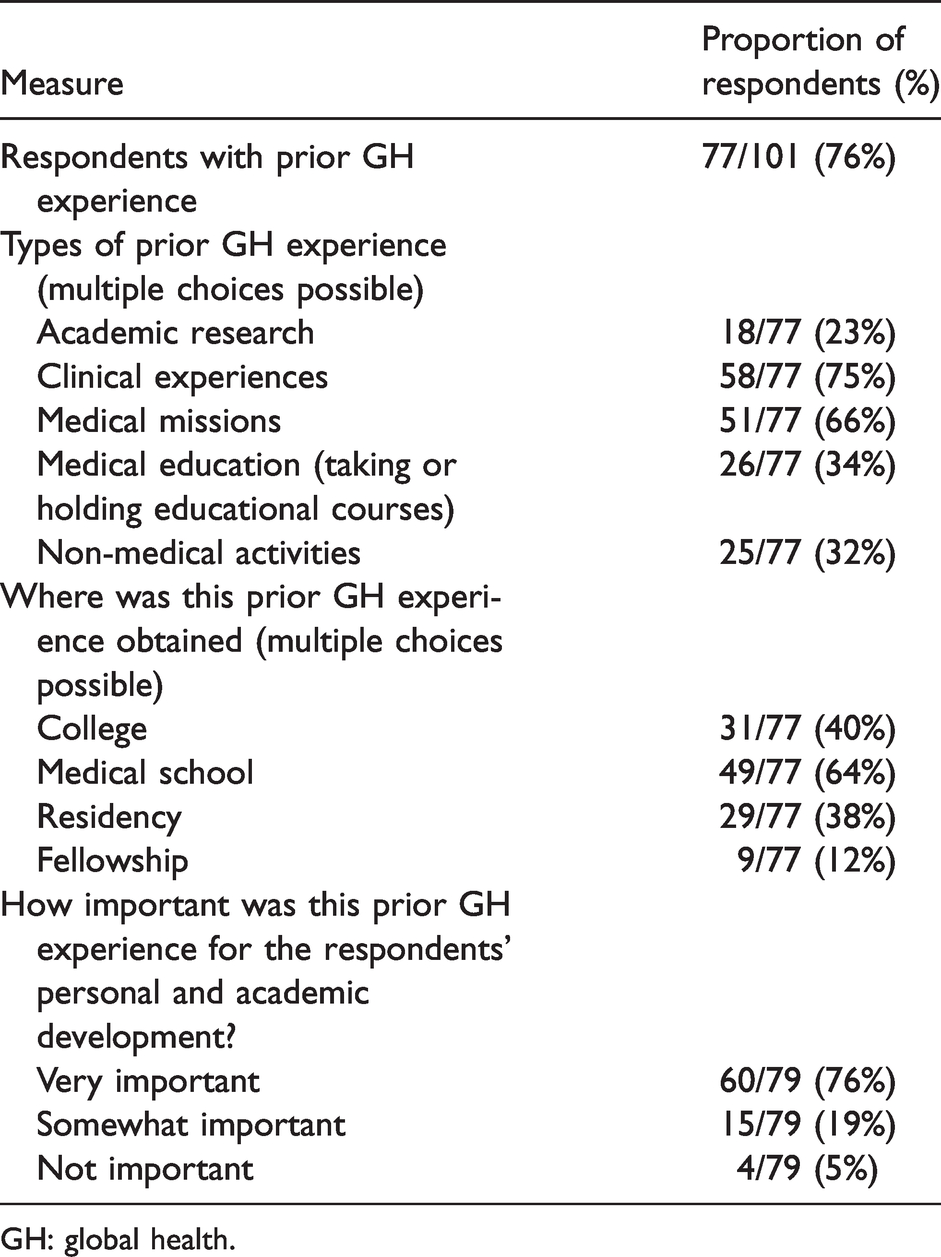
Of the 158 training programmes contacted, a few forwarded the survey to their trainees and recent graduates, ultimately reaching approximately 480 people; 101 responses were collected, giving a response rate of 21%. As shown in Table 1, most respondents (76%) had prior global health experience, and most considered it important for their personal and professional advancement.
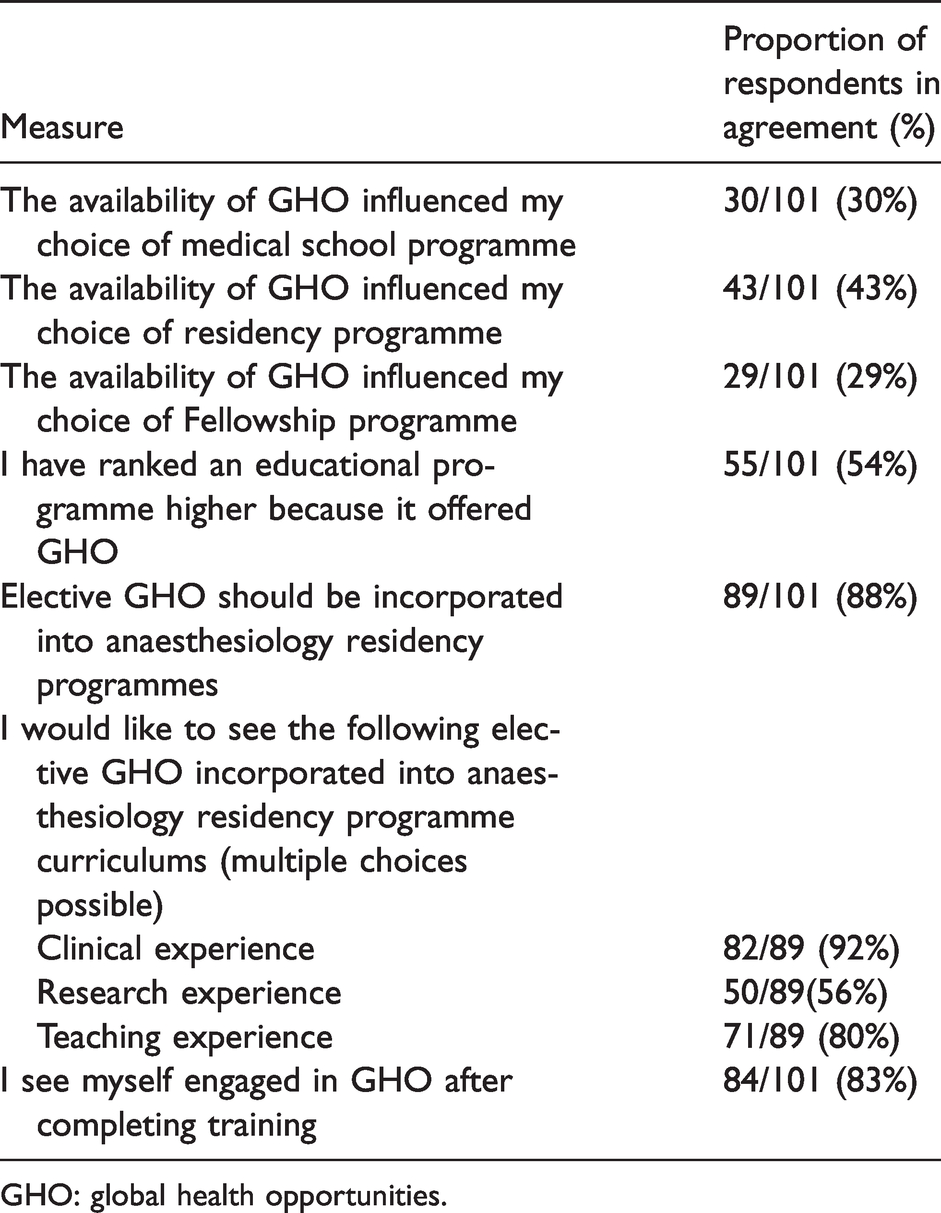
About one-third considered global health opportunities important when ranking medical school programmes compared to 43% for residency and 29% for Fellowship rank lists, as presented in Table 2. A total of 38% had ranked a programme lower for lack of global health opportunities. Most respondents (88%) supported incorporating global health opportunities into anaesthesiology residency programmes as clinical (92%), teaching (80%) and/or research (56%) opportunities. Two (33%) to four (66%) weeks’ duration was considered optimal.
GH experience amongst study participants.
GH: global health.
Role of GHO during training.
GHO: global health opportunities.
Most respondents (87%) also anticipated engaging in global health after completing training, citing ‘increased perspective’, ‘depth to our training’ and an ‘opportunity for growth’ as incentives. Some suggested that ‘understanding how to work in a low-resource setting could make anaesthesiologists more cognisant regarding conserving resources at home’ which might prove ‘useful during this COVID-19 pandemic where we are seeing shortages of drugs, equipment, personnel and experiencing firsthand such strains in our ability to provide medical care’. Difficulty scheduling electives and lack of funding were cited as barriers to expanding global health opportunities for trainees, with some suggesting clinical credits be made available as an incentive by the American Board of Anesthesiology and the ACGME. Those who did not support elective global health opportunities during training cited a lack of relevance, lack of interest, family commitments, and ‘questionable ethics behind a lot of medical mission trips’.
The number of global health tracks offered to prospective anaesthesiology trainees is steadily increasing, but the impact on trainee experience is not yet fully understood. This survey was conducted to inform future postgraduate education curriculums better, and its results confirm prior findings of strong interest in global health amongst trainees. 2 –4 Respondents reported that global health experiences had increased their clinical versatility and adaptability to unforeseen resource limitations, particularly appreciated during the COVID-19 pandemic, as it had prepared them to embrace resource limitations in their home practice. Most respondents reported having ranked a training programme higher for offering global health opportunities during training, demonstrating the strong appeal such opportunities may have in deepening the educational experience for trainees. In addition to clinical experience, the respondents demonstrated a comparable interest in global health opportunities promoting education and long-term research. Perhaps, considering recent critique towards purely clinical global health programmes, these results may reflect an increased awareness amongst trainees of the many pitfalls of unilateral engagements and the need for sustainable, meaningful exchange with academic institutions in low-resource settings. 5
This survey study had to be concluded prematurely due to the COVID-19 pandemic, limiting the applicability of the results. The targeted response rate was not achieved, and the survey responses are under-powered. For this reason, the results are instead presented here as observational data. In addition, the survey distribution method limited our ability to monitor the reach of the survey fully, as we were dependent on programme directors to forward it to their trainees. This is a relatively common issue for survey studies on medical education in the USA where list reserves are not publicly available. Although the study design may have led to some responder bias, we do believe that these results are representative of assumptions in this population and that they offer important insight into the role of global health for anaesthesiology trainees. We hope that the results of this study will inform future research on this topic and ultimately play a role in defining training curriculums for the next generation of anaesthesiologists.
The role of integrative global health is expanding rapidly across academic medical institutions worldwide, 6 and although this study was conducted in the USA, the findings may also apply to anaesthesiology programmes outside the USA looking to implement global health opportunities into their training curriculums. The results of this study suggest that global health opportunities can play an important role in promoting professional development during anaesthesiology training by offering trainees a more profound understanding of the world around them while decreasing the perceived void between high- and low-income clinical settings and promoting a global exchange of medical knowledge.
Footnotes
Author Contribution(s)
Declaration of conflicting interests
The authors have no conflicts of interest to declare.
Funding
The authors received no financial support for the research, authorship and/or publication of this article.

Appendix
Survey questionnaire
What type of training programme/practice are you currently enrolled in? Where were you born? Where did you go to medical school? Where did you rank your residency/Fellowship programme? How many accepted publications have you authored or co-authored (including original research, chapters, commentaries, editorials, etc.) in peer-reviewed journals? Did you pass the American Board of Anesthesiology basic exam on the first attempt? Did you pass the American Board of Anesthesiology advanced exam on the first attempt? Do you have any global health experience (such as exchange programmes, research, mission work or volunteering in developing countries)? If yes, what kind of experience do you have? When did you obtain this experience? How would you rank this experience in terms of importance to personal and academic development? How has this experience affected you personally and professionally? Did the availability of global health opportunities influence your rank list for medical school? Did the availability of global health opportunities influence your rank list for residency? Did the availability of global health opportunities influence your rank list for Fellowship? Have you ever ranked an educational programme higher because it offered global health opportunities? Have you ever ranked an educational programme lower because it offered global health opportunities? Do you think that some form of elective global health education should be incorporated into anaesthesiology residency programmes? If no, why not? If yes, why? What kind of global health experience would you want to see incorporated into anaesthesiology residency programmes? If clinical rotations in low-resource settings were to be included as Accreditation Council for Graduate Medical Education accredited electives during residency and/or Fellowship, how long do you think such a rotation should be? Why do you think it would be beneficial to incorporate global health into anaesthesiology residency and/or Fellowship training? Do you see yourself engaged in any form of global health activity (research, clinical practice, etc.) after completing your training?