







Abstract
The last decades of the 20th century saw a remarkable revolution in technology in the operating room, particularly with respect to general anaesthesia monitoring and delivery. Along with improvements in anaesthetic pharmacology (propofol, modern neuromuscular blockers and volatile anaesthetic gases with far better pharmacokinetics and pharmacodynamics than their predecessors) and the advent of the laryngeal mask airway, this period saw the gradual introduction into practice of technologies which made precise real-time monitoring of vital patient physiology an everyday reality. Pulse oximetry and capnography immediately changed numerous aspects of clinical anaesthesia practice. It seems likely that this contributed to a substantial reduction in risk of serious adverse anaesthesia related events and mortality. 1
While these technologies enabled real-time monitoring of cardiovascular and ventilatory function and stability, a further focus was to minimise the risk of accidental patient awareness under anaesthesia. Routine monitoring of tidal gas concentrations of inhalational anaesthetics (volatile agents and nitrous oxide) followed in the early 2000s, using similar versatile and robust infrared gas analysis technology to capnography. Visionaries in the field, such as Edmond ‘Ted’ Eger, had recognised early the value to clinical practice of this impending capability, and popularised the concept of minimum alveolar concentration (MAC) to provide a target value against which the measured alveolar or ‘end-tidal’ gas concentration for a given agent could be used as a quantitative monitor to help estimate anaesthetic depth. 2 Soon after, processed electroencephalography (EEG) devices became available, providing something closer to an ‘effect site’ depth monitor. Both technologies delivered a simple summary number to guide anaesthetic delivery.
Over the same period, the design of anaesthetic machines as robust devices for the safe delivery and monitoring of anaesthesia evolved enormously. Anti-hypoxic designs for flow meters, self-check algorithms, accurate calibrated and later electronic vaporisers, improved clinician interfaces and alarm settings, and exponential leaps in computing power dovetailed with these developments in routine patient monitoring to try to solve problems that had led to occasional disastrous failures, such as backbar leaks, agent exhaustion and circuit disconnections. Indeed, the modern generation anaesthetic machine is a product of decades of painful experience and learning from failures. Automated ‘target controlled’ inhalational anaesthesia delivery further exploited these capabilities, giving us the first widely used ‘closed loop’ anaesthesia delivery systems.
In recent years, rising concern about the contribution of inhalational anaesthetics to global warming has contributed to a seismic shift among many practitioners to total intravenous anaesthesia (TIVA) as their routine method of choice for delivery of general anaesthesia for a broad range of surgery. It is perhaps ironic that the same physicochemical properties that make anaesthetic gases readily measurable using infrared absorption techniques also make them relatively potent greenhouse gases. Devices for delivery of propofol have proliferated since the drug came off patent and their capabilities have increased, allowing choice of several different pharmacokinetic models for propofol, including algorithms targeting estimated plasma or effect site concentrations, or delivery of intravenous adjunct hypnotics and analgesics.
At the same time, there has been growing concern about a greater risk of accidental awareness in patients during surgery with TIVA in comparison with inhalational anaesthesia. The United Kingdom 5th National Audit Project (NAP 5) is, to date, the largest prospective study attempting to measure the incidence of awareness and its contributors, and it found that 18% of cases of unintended awareness occurred under intravenous anaesthesia, during a period where it was used in only 8% of cases. 3 The interpretation of these data is somewhat clouded by differences in the context of its use. TIVA was used more often in less controlled environments, such as in patient transport or anaesthetising locations external to the operating suite, where reliability of delivery is more challenging. NAP 5 was arguably done too early, before the enormous change in routine practice that we have witnessed had occurred, preventing us from accurately assessing the relative risk of awareness with TIVA and inhalational general anaesthesia today. A repeat of NAP 5 in the TIVA era may be too much to ask for, and we must instead await completion of the 13,000 patient multicentre THRIVE (Trajectories of Recovery after Intravenous propofol versus inhaled VolatilE anesthesia) randomised trial of post-surgical outcomes with TIVA versus inhalational general anaesthesia. While the primary trial endpoint in THRIVE is quality of recovery across a broad major surgery population, the primary safety outcome is the incidence of intraoperative awareness. 4
There are a number of contributors to this perceived problem. It is often pointed out that the pharmacokinetic models and estimated plasma or effect site concentrations for propofol are based on population means and ignore inter-individual variation. However, while these concerns are valid, they are shared to some extent by MAC targeting during inhalational anaesthesia, where an end-tidal concentration is only an indirect indicator of arterial and therefore of effect site partial pressures. 5 However, apart from route of delivery, an obvious difference between inhalational and intravenous anaesthesia reliability is in monitoring.
In this issue of Anaesthesia and Intensive Care, Taplin et al. 6 investigate progress in development of techniques for measurement of plasma propofol concentration, or its estimation using exhaled breath analysis, and describe the substantial challenges in developing a method for rapid and continuous measurement of compounds such as propofol. These challenges are only made more daunting by the ambition to achieve real-time monitoring of the delivery of TIVA with propofol comparable to what we have had available for inhalational anaesthetics for a generation.
Some recent encouragement comes from description by Meidert et al. 7 of a prototype photoacoustic system for propofol measurement in expired breath, which has advantages over the gold standard mass spectrometry in terms of size, stability, cost and potential scalability. In a sample of ten anaesthetised patients, the response time to changes in propofol at the effect site, as measured by processed EEG, was in the order of 1–2 min, which could make it clinically useful as a real time monitor. Measurements reflected mixed expired, as opposed to end-tidal concentrations, and were significantly affected by oxygen concentrations, the presence of common trace organic compounds such as acetone, and other compounds which affect sound conductance, including heavy molecules like volatile anaesthetics. Indeed, finding a competitor for our standard anaesthesia gas monitors seems an unfair contest, because our inhalational anaesthetic gases are present in clinically active concentrations in the lungs, measured in percent values, which are readily measurable using infrared detectors. In contrast, because of its very low volatility, measurable concentrations of propofol in the expired breath are in the order of parts per billion in anaesthetised subjects, and the process is complicated by filtering of exhaled propofol by heat moisture exchangers and adsorption by moisture and surfaces in breathing and sampling tubing.
Perhaps, however, when addressing anaesthesia delivery and safety we should instead consider something much simpler than anaesthetic monitoring technology. Since Morton’s first successful demonstration of the use of ether, the delivery of general anaesthesia was inextricably tied to ventilation of the lungs. As techniques for ensuring adequate ventilation and gas exchange progressed, through improved airway management techniques and devices for ventilation delivery and monitoring, so by default did the reliability of delivery of inhalational anaesthesia. TIVA exists outside of this profound nexus, and it is here that the contrast with the inhalational route is most stark, regardless of agent monitoring availability.
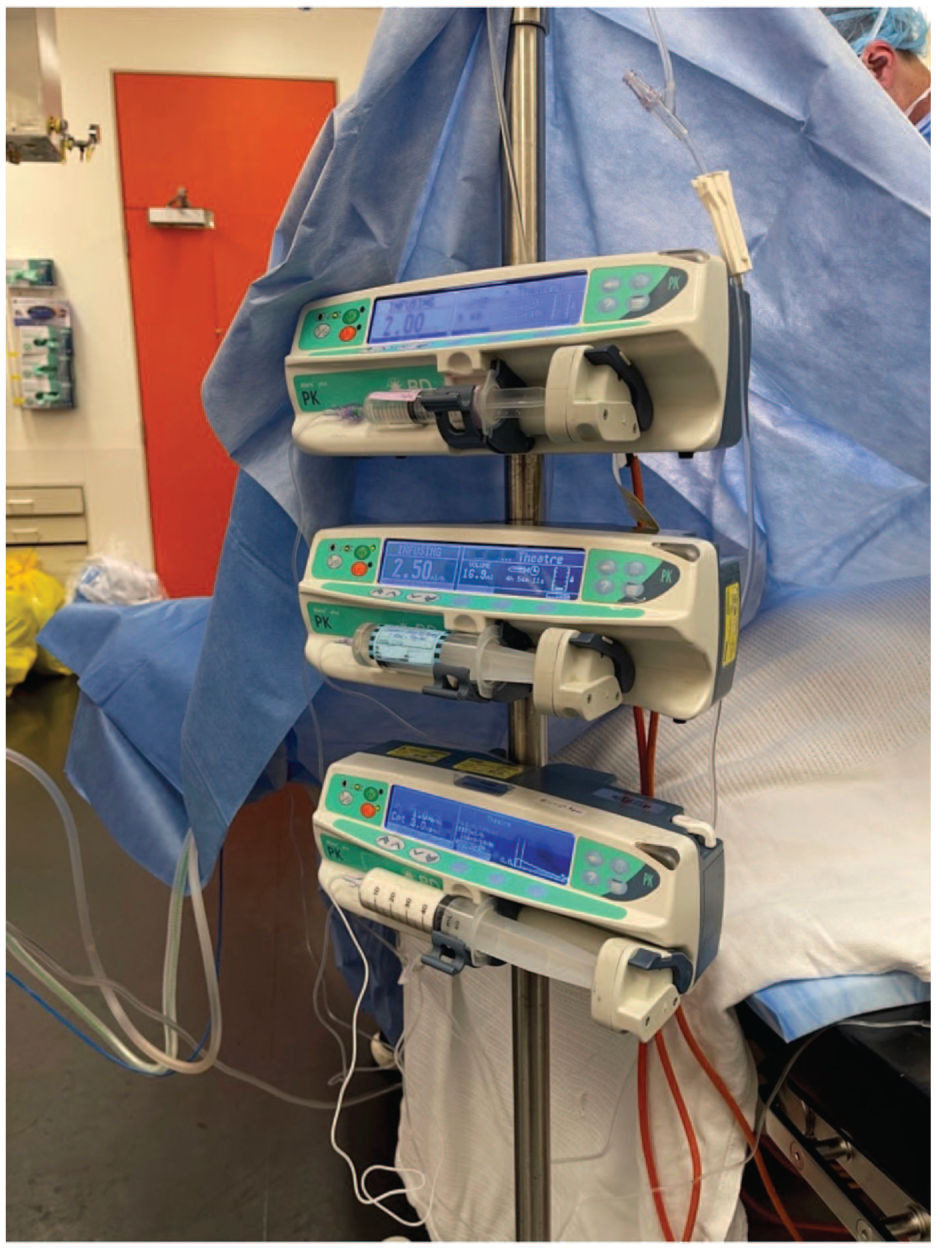
The risk of incorrect infusion pump programming further complicates the problem of ensuring reliable delivery of TIVA, and is worsened by the complexity of design of current generation infusion pumps (different models, input variables, multiple drug options leading to risk of confusion with other drugs), requiring multiple steps to initiate infusion. This again contrasts with the relative simplicity of activation and dose selection with vaporisers. Two-person checklists have recently been proposed as a routine mandatory part of TIVA use, and in the UK initiatives such as ‘PERUSE before you infuse’ and ‘PRESS to start’ have been promoted.8,9 As well as the machine settings, both these algorithms include visual checking of intended route and site of intravenous (IV) infusion, and the recommended design of equipment for reliable IV delivery, such as Luer lock connectors, is laid out in published guidelines on safe TIVA practice. 10 It should be borne in mind that, like many anaesthesia mishaps, drug delivery failure is most likely to occur during subsequent maintenance phase anaesthesia simply because most time is spent there, and might be hidden out of sight.
As the review by Taplin et al. 6 makes clear, hoping that a solution is around the corner in the form of reliable real-time propofol monitoring seems optimistic. For the foreseeable future, the elective choice of TIVA for routine provision of general anaesthesia presents an everyday challenge to the practitioner and to the specialty in general. Maintaining the same level of safety as has been achieved by modern inhalational anaesthesia requires an even greater daily level of care and vigilance, and might require departure from our traditional routines of practice in the operating room, such as adoption of two-person checks.
