







Abstract

Dear Editor,
We read with interest the report from Young et al on the use of a symbiotic culture of bacteria and yeast (SCOBY) as artificial skin in a front-of-neck access simulation model. 1 A recent publication outlines the use of SCOBY in intravenous (IV) line insertion simulations. 2 Simulation in teaching needling skills in regional anaesthesia has a history that mirrors the rise of ultrasound use in our specialty. Phantoms of various sorts constitute the cornerstone of teaching needle skills in simulation. Inspired by the work of Young et al, we set out to compare the realism and participant acceptability of a SCOBY phantom to the more commonly used phantoms of gelatin and agar.
Gelatin and agar phantoms were prepared in accordance with instructions on the packets of these products (see Appendix 1). The SCOBY phantom was grown in a rectangular container in accordance with previously described instructions. 1 The resulting byproduct of the fermentation process was then cut in half and placed in a 2-l ice cream container. Targets of dried pasta were placed in all three phantoms to provide targets for needling.
A convenience sample of 12 anaesthetists was assembled to trial the three different phantoms. Participants used Fujifilm Sonosite LX machines (Fujifilm Sonosite Inc., Worldwide Headquarters, Bothell, WA, USA) and Pajunk Sonoplex needles (PAJUNK® GmbH Medizintechnologie, Geisingen, Germany).
Their experience with use of ultrasound was recorded and participants then completed a four-question survey assessing the realism and acceptability of the different phantoms. The four questions were: 1) How similar is needling the phantom compared to human tissue? 2) How similar is the visibility of the needle in the phantom compared to human tissue? 3) How realistic is the ultrasound appearance of the phantom? and 4) Rate the overall realism of the phantom. For each of the four questions acceptability of the phantom was rated on a five-point scale (1 = worst, 5 = best).
Results were collated and compared with a Kruskal–Wallis test for comparing three or more groups with non-parametric data. An online Kruskal–Wallis calculator (https://www.socscistatistics.com/tests/kruskal/default.aspx) was used.
Seven participants had between five and 10 years of experience using ultrasound for procedures, the remaining five had over 10 years of experience with ultrasound. The results of the survey are presented in Table 1. The results showed a statistically significant difference between the groups for questions one, three and four (P = 0.0044, P = 0.007 and P = 0.0005 respectively). The difference between the groups was not statistically significant for question two (P = 0.144).
Comparison of the mean ratings for each phantom.
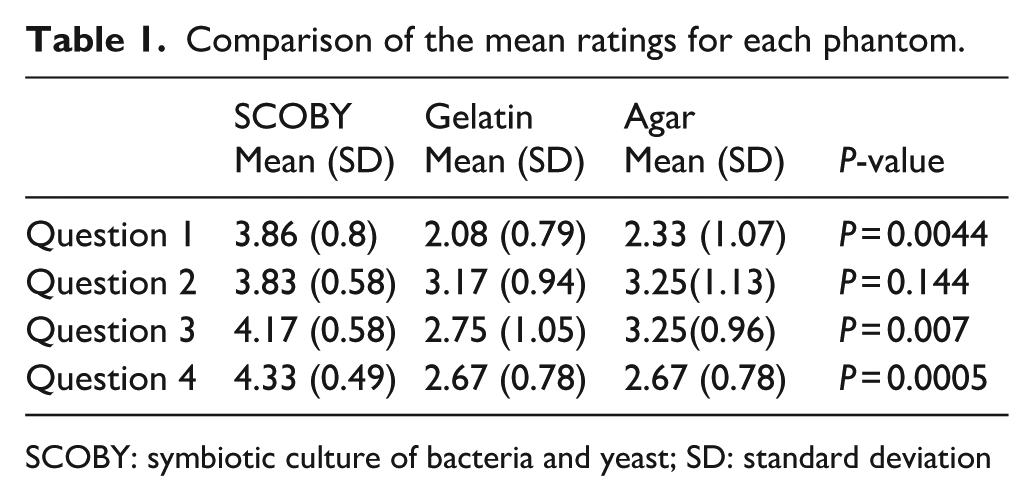
SCOBY: symbiotic culture of bacteria and yeast; SD: standard deviation
Despite a small sample size, we were able to show a statistically significant difference in realism and acceptability of different types of phantoms for simulation of regional anaesthesia. The SCOBY phantom was the preferred phantom in this comparison.
The use of a SCOBY phantom for regional anaesthesia simulation broadens the uses of SCOBY for simulation. In addition, to use as artificial skin in front-of-neck access 1 and IV cannula insertion simulation 2 SCOBY has also been used as a suturing trainer. 3
The benefits of using SCOBY for regional anaesthesia simulation are that it is cheap to produce, biodegradable, makes use of a byproduct of another process and avoids the need for use of meat-based phantoms. Whilst meat-based phantoms are likely to have comparable fidelity to the SCOBY phantom, there can be cultural concerns around their use and they represent a waste of what is otherwise a viable food product. Additionally, a SCOBY phantom will not degrade at room temperature or have the small, but possible, infective risk associated with meat-based phantoms.
The main disadvantage of a SCOBY phantom is the time taken to produce the phantom. In this experiment it took around one month to grow an adequate thickness and size of SCOBY to be useful as an ultrasound phantom.
Based on this trial, we would highly recommend the use of SCOBY phantoms for ultrasound-guided regional anaesthesia simulation.
Footnotes
Appendix 1. Preparation of the phantoms
Author contributions
Declaration of conflicting interests
The authors declared no potential conflicts of interest with respect to the research, authorship, and/or publication of this article.
Funding
The authors received no financial support for the research, authorship, and/or publication of this article.
