






Abstract
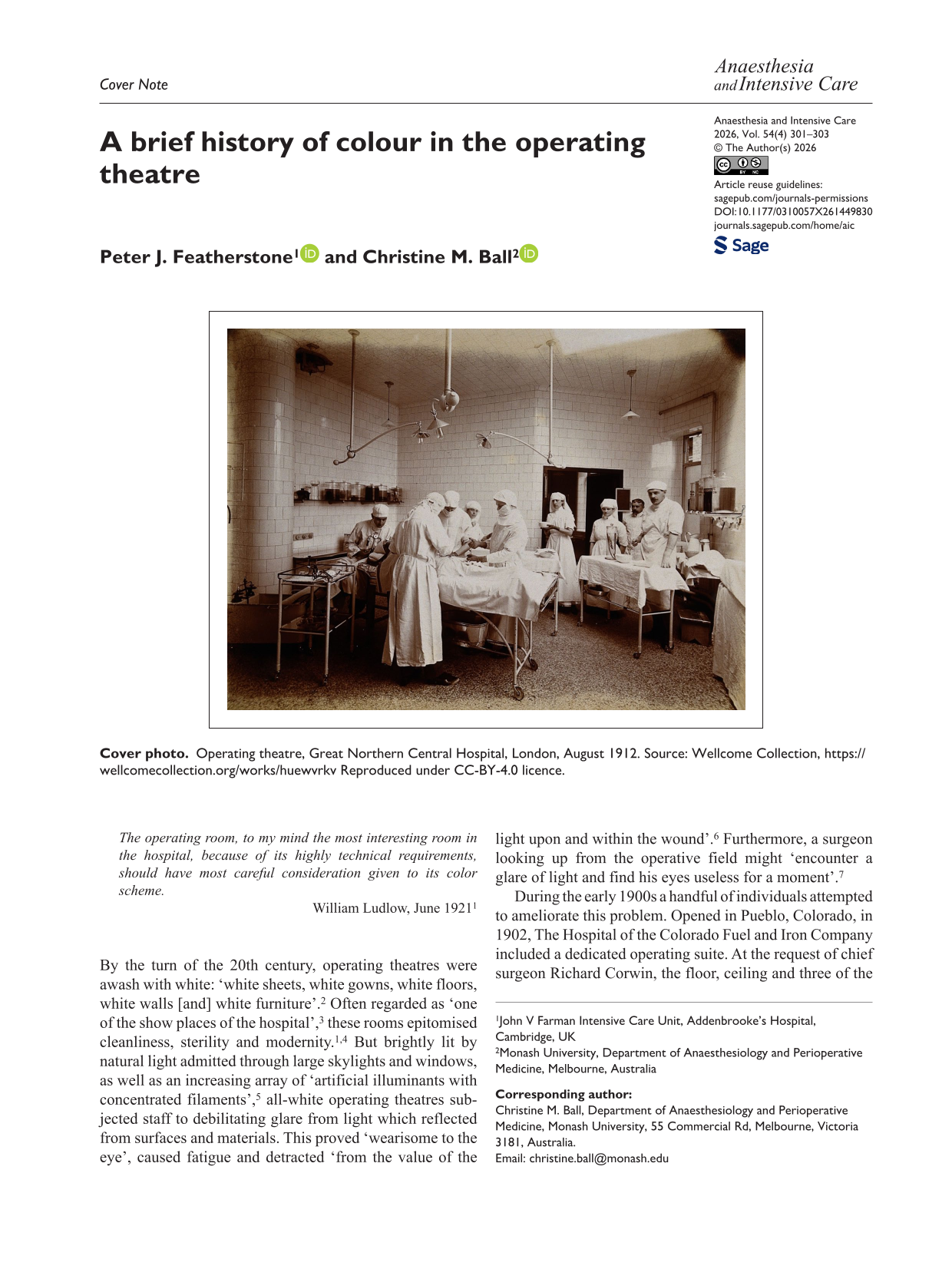
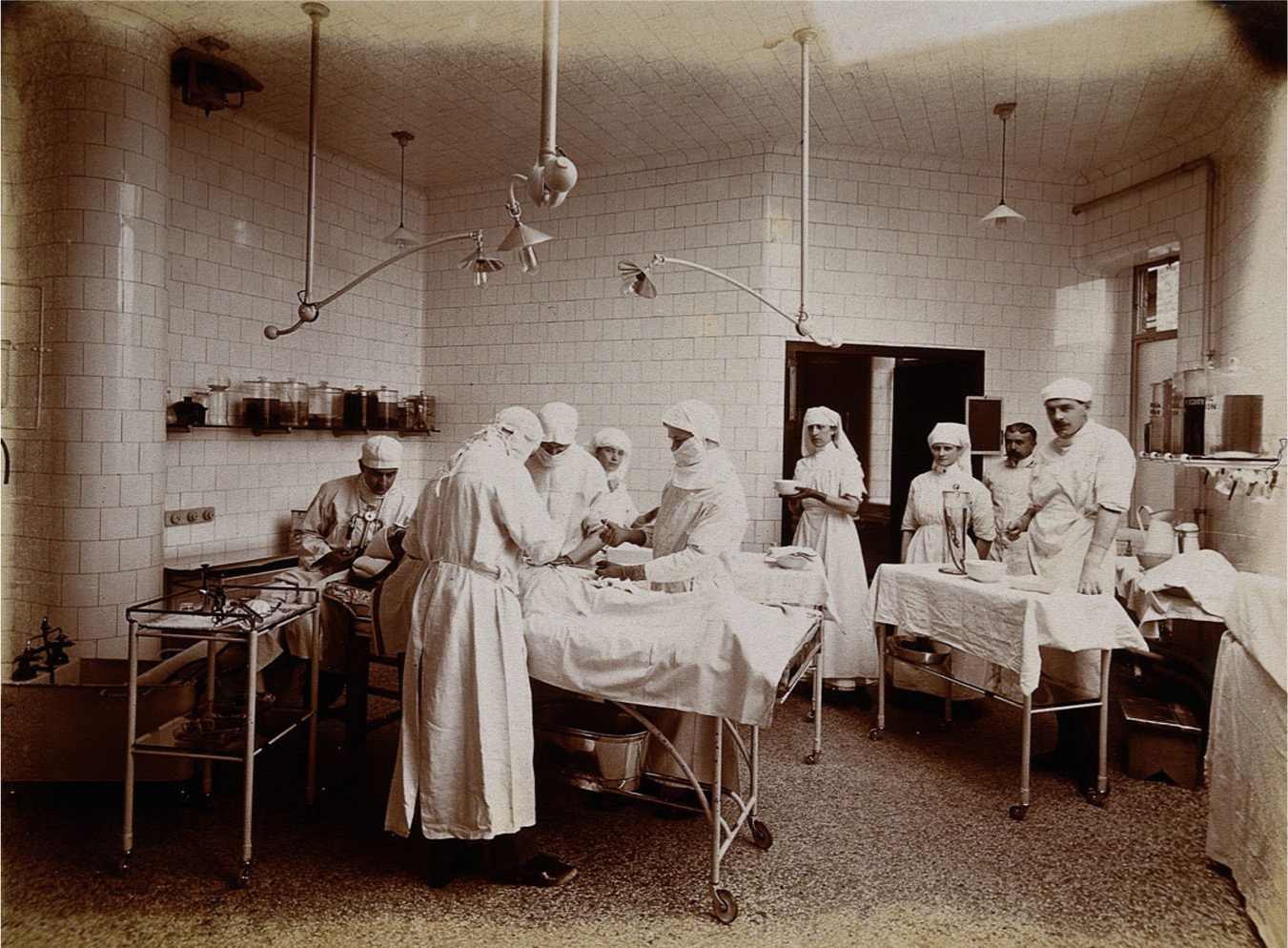
Operating theatre, Great Northern Central Hospital, London, August 1912. Source: Wellcome Collection, https://wellcomecollection.org/works/huewvrkv Reproduced under CC-BY-4.0 licence.
The operating room, to my mind the most interesting room in the hospital, because of its highly technical requirements, should have most careful consideration given to its color scheme.
William Ludlow, June 1921 1
By the turn of the 20th century, operating theatres were awash with white: ‘white sheets, white gowns, white floors, white walls [and] white furniture’. 2 Often regarded as ‘one of the show places of the hospital’, 3 these rooms epitomised cleanliness, sterility and modernity.1,4 But brightly lit by natural light admitted through large skylights and windows, as well as an increasing array of ‘artificial illuminants with concentrated filaments’, 5 all-white operating theatres subjected staff to debilitating glare from light which reflected from surfaces and materials. This proved ‘wearisome to the eye’, caused fatigue and detracted ‘from the value of the light upon and within the wound’. 6 Furthermore, a surgeon looking up from the operative field might ‘encounter a glare of light and find his eyes useless for a moment’. 7
During the early 1900s a handful of individuals attempted to ameliorate this problem. Opened in Pueblo, Colorado, in 1902, The Hospital of the Colorado Fuel and Iron Company included a dedicated operating suite. At the request of chief surgeon Richard Corwin, the floor, ceiling and three of the walls of the operating theatre were lined with sheets of lead to prevent the reflection of ‘cross-light, so annoying to a surgeon’. The fourth wall was almost entirely occupied by a large sheet of plate glass through which the room was illuminated. 8 Meanwhile at the Rockefeller Institute in New York, Alexis Carrel adopted the use of black surgical gowns and drapes ‘to cut down glare and give better visibility to the tissues upon which he performed his extremely delicate operations’. 9
In the aftermath of the 1906 San Francisco earthquake (which destroyed over 80% of the city, including many of its healthcare facilities) a small operating pavilion was erected in the grounds of St Luke’s Hospital. This provided orthopaedic surgeon Harry Sherman with the opportunity to assess the effects of applying ‘bright spinach green’ paint (selected as it was the complementary colour to the red of haemoglobin) to the floor and wainscot of one of the operating rooms. A second theatre was painted in white enamel. Surgeons utilising the pavilion quickly voted with their feet, and ‘no one who could get into the green room to do an operation ever went into the white room’. After several months ‘the point was accepted as settled sufficiently to warrant the innovation of a room similarly colored in the operating suite in the new hospital’. Completed in 1913, this incorporated a dark green tiled floor and six-foot green wainscot. Above this, white encaustic tiling stretched to the ceiling, which was finished in a bright buff. According to Sherman this arrangement imitated ‘the optical environment out in the fields or among low bushes, where the ground of the surroundings, to above the level of the eyes is green, and the sky overhead is full of white daylight’. To further eradicate the reflection of light, the patient and instrument trolleys were covered with black drapes, and the entire theatre team dressed in black gowns, hats and face coverings. 7 Around the same time at the University of Leeds, Sir Berkeley Moynihan, Professor of Clinical Surgery, painted the walls and floor of his operating theatre green, and began using towels and sheets made from green ‘casement cloth’. Their employment brought ‘great relief to the eyes’. 6
As news of these endeavours found its way into the medical press, a lively debate ensued.1–3,10–16 While some agreed that green walls were ‘restful’, others argued in favour of alternative colours, including ‘light tan’ and various shades of grey.1,11,15 A handful of individuals continued to vehemently defend the all-white operating theatre. In 1917, in Kerrville, Texas, William Secor wrote: ‘To tint the walls of an operating room not only does violence to the aesthetic and psychic effect of the pure white room, but makes it much more difficult to keep the room clean and sterile’. In addition, he viewed black theatre linen as depressing and ‘funereal’. Instead, Secor recommended a solution which he and his colleagues had developed to obviate the effect of glare: ‘we have used beaks on our caps, and on bright days large, amber-tinted spectacles are worn’.13,16
Seven years later in New York, anaesthetist Paluel Flagg reviewed the use of colour in the operating room, noting that the literature on the subject was ‘scanty’ and contained a ‘confusion of viewpoints’. Ignoring a novel suggestion from a local expert in stage lighting ‘that the operating table draperies, as well as the floor in the center of the room, should be ecru, changing to a delicate green as we approach and ascend the wainscoting’, Flagg instead sought a scientific solution.17,18 This first entailed the use of an ‘oxyhaemoglobinometer’ (which he had previously devised with assistance from Donald Van Slyke and Carl Binger at the Rockefeller Institute). 19 This comprised a coloured scale which allowed visual estimation of the oxygen saturation of blood escaping from the surgical incision. Judging that this was 80–90% saturated, he then turned to the Munsell system of colour notation to identify a ‘true’ complementary colour for the operative field. This proved to be a ‘peculiar bluish green’ which could be used on the walls and floor of the operating theatre, where it presented ‘a soft and rather soothing background’. The colour was commercially marketed as ‘Eyerest Green’ and made available in a range of intensities, ‘varying from a bright to a dark hue’. Following a long period of experimentation, Flagg succeed in creating an Eyerest Green fabric which was resistant to repeated steam sterilisation. This was used to produce drapes and gowns, which afforded ‘the greatest possible relief to the color fatigue arising out of constant gazing into the operative wound’.17,18
Concomitantly, a growing number of professional colour consultants began to study the physiological and psychological effects of colour on hospitalised patients.20,21 Having identified green ‘as one of the best of all hues, fresh in appearance and slightly passive in quality’, 22 the colour was increasingly utilised throughout hospitals and other public buildings during the mid-20th century. 23 However, many grew to find this ‘hospital green. . .unpleasant because of its institutional associations’. 24
Today research continues into the effects of hospital room colour on postoperative recovery, 25 and as scrub wear has become increasingly ubiquitous, some have investigated the association between patient perception of healthcare workers and the colour of their attire. 26
