







Abstract
In the context of an emerging market economy, this study examines the mediating role of marketing capabilities on the market orientation (MO)–performance relationship. Specifically, the authors investigate the roles of product innovativeness, customer relationship management (CRM) capability, research and development (R&D) integration and brand management capabilities in the institutionalisation of a MO culture and the implementation of MO behaviours. With data collected from 150 organisations, the authors find that MO behaviour fully mediates the effects of MO culture on product innovativeness and CRM capability, which in turn enhance firm performance. In addition, leadership quality facilitates the effect of MO culture on MO behaviour, and the effects of product innovativeness and CRM capability on firm performance are greater in the presence of R&D–marketing integration and brand management capabilities, respectively.
Keywords
1. Introduction
Delivering high-quality goods and services to customers remains an enduring challenge for both practitioners and scholars (e.g., Bitner, 1990) who wrestle with how an organisation can improve its responsiveness to evolving customer needs (Jaworski and Kohli, 1993). The ensuing market tracking and then organisational-level generation and dissemination of market intelligence, as well as the firm’s responsiveness to this intelligence, describe activities undertaken by a market-oriented organisation (Kohli and Jaworski, 1990; Narver and Slater, 1990). Market orientation (MO) has been on the scholarly agenda since at least the early 1990s, when the Marketing Science Institute accorded it top priority status (Deshpande and Farley, 1998).
Numerous studies confirm that MO drives superior firm performance (e.g., Kirca et al., 2005), in a relationship that appears to hold across various contexts (e.g., Mavondo and Farrell, 2000). However, most studies of this relationship focus on Western settings (Uncles, 2000). Despite longstanding interest in the applicability of such findings across various contexts, few studies address less developed or emerging markets, and those that do report mixed results for the MO–performance relationship, including evidence that it is weak, unsupported or moderated by environmental factors (e.g., Appiah-Adu, 1998; Au and Tse, 1995). The impact of the environment on MO in particular has not received sufficient attention in prior studies, even as modern organisations increasingly face challenges in the global markets in which they operate. Markets in developed countries are reaching saturation, so many organisations seek growth opportunities in emerging countries (London and Hart, 2004); the list of emerging market multinationals that dominate markets in various industries also is growing (Khanna and Palepu, 2013), such that 70 of the Fortune Global 500 are from emerging economies (The Economist, 2013). Forbes Magazine estimates that the focus on these markets will intensify, given their lucrative potential. Yet, because models from developed country markets cannot be applied without significant adjustment (Shenkar and Von Glinow, 1994), many executives struggle to develop successful strategies to compete effectively in emerging markets (Khanna et al., 2005; Ramamurti, 2012).
Committing resources to market-oriented activities is a risky allocation, because managers have limited know-how related to specific implementations of MO (e.g., Dawes, 2000). This knowledge gap results from the uncertainty imposed by the contextual factors and environmental contingencies that shape MO (e.g., Diamantopoulos and Hart, 1993). To make effective decisions, managers need to identify the likely benefits of their resource commitments to MO activities and tailor approaches that account for any moderating influences, such as market turbulence, competitive intensity and the environment (Diamantopoulos and Hart, 1993). Accordingly, we focus on emerging markets as a specific business environment, characterised by high competitive intensity, high market turbulence and heavily fragmented sub-markets that require specialised channels for value creation, delivery and capture. An emerging market provides a sound context for understanding and testing the inter-relationships between important constructs because the level of development of key constructs may be lower, and degree of variability higher, than in developed markets. This allows us to tease out the effects of MO on firm performance with greater precision and reliability. Thus, by investigating the operationalisation of MO in an emerging market, we provide implementation insights regarding the necessary resource allocations. In turn, managers can use the insights from this study to strengthen their marketing capabilities and performance in emerging country markets.
2. Emerging country markets
The top management teams of well-established, large organisations that succeed in developed country markets acknowledge that globalisation is their most critical challenge. Emerging country markets bring challenges including heterogeneity, governance structures, resource shortages, inadequate infrastructure and high-velocity change and hyper-competition (Sheth, 2011). These markets present radically different business landscapes than developed country markets (Khanna et al., 2005). Nevertheless, major global consultancies, including Accenture (2008), reiterate the attractive potential posed by these markets, as indicated by their exponential growth and resilience, even in times of global distress. For example, the International Monetary Fund estimates that by 2025, the pace of growth in emerging country markets will still be double that of developed country markets; the plentiful labour resources and population age profiles indicate that by 2020, the workforce in emerging country markets will be five times greater than that in developed country markets.
Accordingly, the opportunities available in emerging country markets are increasingly noticeable and appealing (London and Hart, 2004). Many multinationals expect to find up to 70% of their future sales in such markets, where more than 20,000 organisations already operate (Eyring et al., 2011). Because most research seeks to fit developed market business models with new markets though, the success strategies for emerging markets remain unclear (Peng, 2012). Emerging economy markets do not follow a Western-style path of economic development; they require vastly different strategies (e.g., Dawar and Chattopadhyay, 2002). Successful organisations have adopted specific business operations to navigate the turbulent and often volatile political and economic instability of emerging country markets. For example, successful firms embrace fast-changing demographic profiles and attempt to be constantly responsive to the solutions demanded by niche markets (Guillén and Garcia-Canal, 2012).
Vietnam, an emerging country market located in Southeast Asia, is one of the world’s fastest growing economies and is following a growth trajectory similar to that displayed by ‘emerged’ markets such as Hong Kong and Japan (Maruyama and Trung, 2012). Despite only recently having joined the World Trade Organization, it has demonstrated a unique capability to deploy its resources to achieve a better sustained growth rate than any other emerging Asian economy (World Economic Forum, 2006). It consistently ranks as one of Asia’s best investment destinations (Breu et al., 2012). Vietnam’s ambitious growth targets also indicate that it is prepared to create the stimulating, competitive conditions that will enable it to advance economically and reach industrial country status by 2020 (Serra and Stiglitz, 2008). Yet at the same time, Vietnam’s consumer market is similar to other emerging markets, characterised by large variations in income, literacy, social diversity and urbanisation (Shultz, 2012). These 90 million consumers demand innovative products, available at convenient distribution sites, with price points below those charged in developed markets (Choudhary et al., 2013). Its hypercompetitive and ever-changing nature increases the need for organisations seeking to compete in Vietnam to be innovative in both their strategic approaches and their product offerings. In these markets, constant, market-focused innovation is an indicator of the organisation’s agility and competence—and a critical means of differentiation (Awate et al., 2014).
3. Theoretical framework and hypotheses
Varied definitions and treatments of MO have led to inconsistent results in MO literature. At the crux of these differences is the very nature of MO, whether approached as a behavioural or a cultural orientation. Noting that a MO culture improves firm performance, as we depict in Figure 1, we postulate that it leads to increased MO behaviour, which enables the firm to improve its new product delivery in the marketplace, resulting in improved performance. Moreover, several variables should moderate these MO relationships. In particular, we expect that leadership quality enhances the extent to which MO culture leads to MO behaviours; research and development (R&D)–marketing integration increases the degree to which product innovativeness is associated with higher performance; and brand management capabilities moderate how much customer relationship management (CRM) capabilities affect performance.
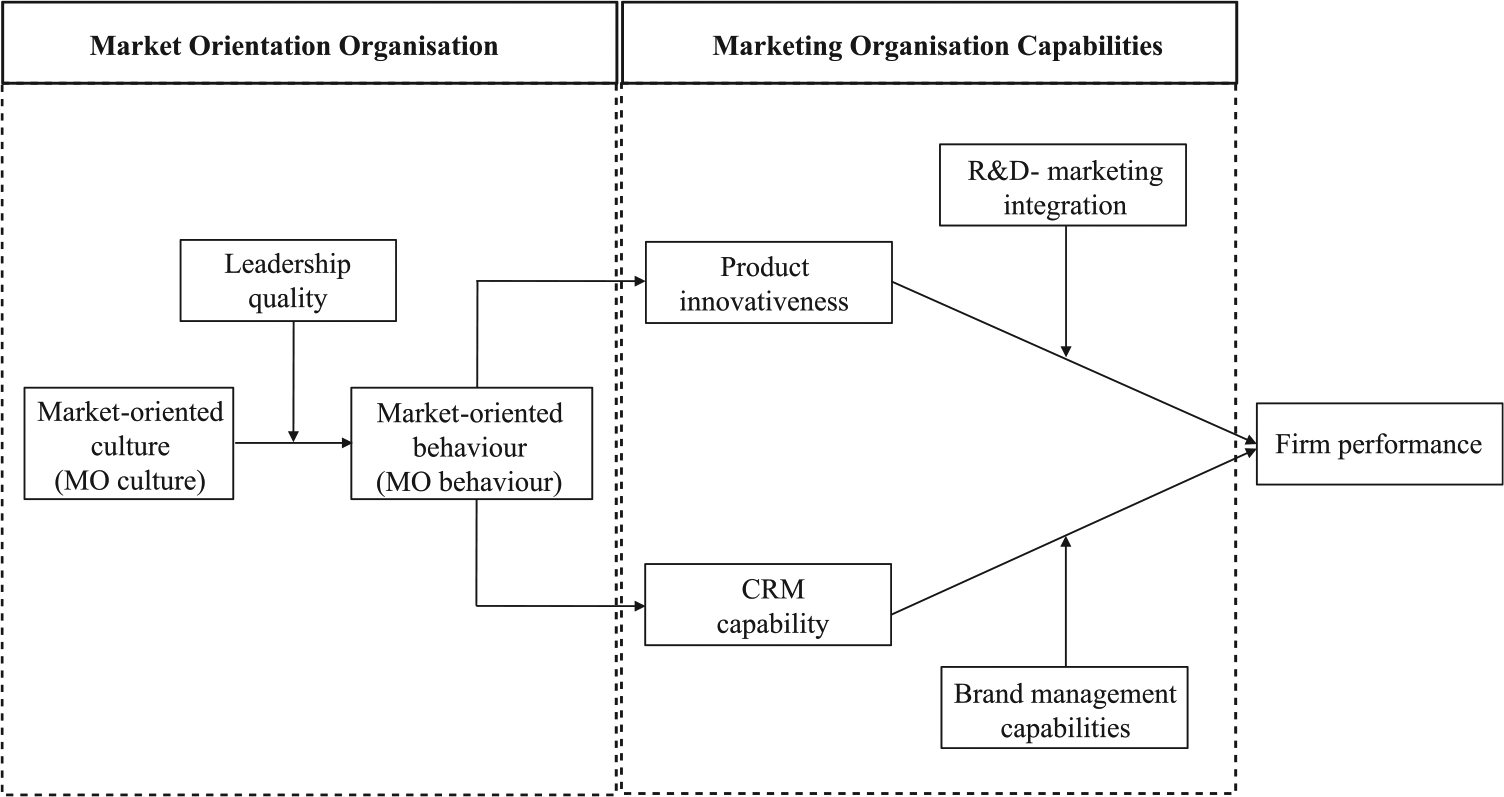
Conceptual model.
3.1. The need for the co-existence of MO culture and MO behaviour
An extensive debate regarding the nature of MO (behaviour-based versus culture-based) continues in the extant literature (Deshpande and Farley, 1998; Homburg and Pflesser, 2000; Narver and Slater, 1998). Deshpande and Webster (1989) argue that MO is a distinct organisational culture, created and maintained to provide individual norms for behaviours within organisations. This culture is a pattern of shared values and beliefs that explain why things happen the way they do (Deshpande and Webster, 1989). Similarly, Narver and Slater (1990: 21) argue that MO is ‘the organization culture that most effectively and efficiently creates the necessary behaviours for the creation of superior value for buyers and, thus, continuous superior performance for the business’. However, Jaworski and Kohli (1993) assert that MO is an organisational behaviour that pertains to a market intelligence process, which is composed of three sets of market-oriented activities: organisation-wide generation of market intelligence pertaining to current and future customer needs, dissemination of intelligence across departments and organisation-wide responsiveness to this intelligence (Jaworski and Kohli, 1993). Thus, behavioural MO describes knowledge-producing behaviours.
This dichotomous yet integrated view of MO, featuring both MO culture and MO behaviour, is receiving increasing scholarly attention (Gebhardt et al., 2006; Zhou et al., 2008). The key unanswered question concerns the coexistence and contribution of multiple components of MO—specifically MO culture and MO behaviour—to firm performance (e.g., Dwyer and Mellor, 1993). With the exceptions of recent work by Homburg and Pflesser (2000), Hult et al. (2005) and Zhou et al. (2008), prior MO research has adopted either a cultural or a behavioural operationalisation to examine the nature of MO and its performance implications. This convention may explain some of the inconsistencies regarding the magnitude and direction of the relationship between MO and firm performance (e.g., Atuahene-Gima et al., 2005; Diamantopoulos and Hart, 1993; Ketchen et al., 2007; Kirca et al., 2005). However, creating a market-oriented firm is a complex undertaking, and the greatest challenge is determining which behaviours align with the market (Gebhardt et al., 2006). Market-oriented behaviours do not consistently occur unless a complementary organisational MO culture supports them (Narver et al., 1998).
Although MO is intended to enable organisations to better understand and exploit opportunities in the market, integrating it into an organisation is complex, both culturally and behaviourally, and bears considerable risk. Prior literature suggests that the coexistence of MO culture and MO behaviour improves the effectiveness of market-oriented organisations, but MO alone is insufficient for success (e.g., Day, 1994). Instead, firms whose internal processes best match the demands of their environments achieve the best adaptation (Hult, 2011). Several authors also re-confirm an essential role of the marketing function, such that ‘to be profitable, firms must not only be market-oriented but also have a strong and influential marketing department’ (Verhoef and Leeflang, 2009: 15). Furthermore, ‘the marketing function can and should coexist with a market orientation’ (Moorman and Rust, 1999: 180). This theoretical perspective aligns closely with practice; a recent survey of 100 chief marketing officers and 100 chief financial officers confirmed the importance of the marketing function in general and identified product innovativeness (62%), customer connections (62%) and branding (80%) as its three most crucial activities (Argyriou et al., 2009). Another important responsibility of the marketing function is cross-functional integration with other departments, such as sales, R&D and finance (e.g., Griffin and Hauser, 1996; Song and Song, 2010). Among these options, researchers call for further investigations of R&D–marketing integration to support the further development of an influential marketing function (Leeflang, 2011). The current literature instead reveals a distinct gap with regard to how marketing capabilities (e.g., product innovativeness, CRM, branding and R&D-marketing integration) integrate most effectively with a MO organisation to affect organisational performance.
To advance this stream of marketing literature, we follow the lead of Zhou et al. (2008), who explicitly define MO as MO culture and MO behaviour, and we argue that MO and organisational culture are closely related, because organisational culture centres on embedded values and beliefs that guide behaviours (Noble et al., 2002). To be effective, MO culture must be manifested through MO behaviour (Zhou et al., 2008). Thus, MO behaviour emphasises the generation and dissemination of market intelligence and responsiveness to market changes, and MO culture creates and nurtures a setting that facilitates these behaviours.
Drawing on contingency theory (Drazin and Van de Ven, 1985; Venkatraman, 1989), we propose that to be effective, MO culture should not only be manifested through the implementation of MO behaviour but also fit the firm’s internal marketing processes to capitalise on market intelligence. Thus, customers receive priority, and the MO culture encourages value creation through both innovation (Han et al., 1998; Slater and Narver, 1995) and customer connections in the form of CRM (Bradley and Nolan, 1998; Tuominen et al., 2004). Product innovativeness and CRM capability therefore should be the two primary marketing activities needed for to institutionalise MO culture. Aligned with the fit-as-mediation view of contingency theory (Venkatraman, 1989), we argue that MO culture does not lead directly to product innovativeness and CRM capability; rather, MO culture provides a foundation for MO behaviour (Gebhardt et al., 2006) that enables organisations to innovate effectively and develop their CRM capability. The presence of MO behaviour is essential to institutionalising MO culture change, through product innovativeness and CRM capability, to centre on the application of market intelligence. Finally, MO behaviour accounts for a significant proportion of the relationship of MO culture with both product innovativeness and CRM capability. Thus, we hypothesise:
Hypothesis 1: MO behaviour mediates the effect of MO culture on (a) product innovativeness and (b) CRM capability.
A significant hurdle in promoting MO culture and implementing MO behaviour is a lack of sufficient internal political power to instigate cultural change, guide cultural change or distribute individual power (Gebhardt et al., 2006). Zhou et al. (2008) argue that leadership quality has an important role in breaking down the institutionalised power structure and facilitating MO culture and MO behaviour. In this context, firm leaders with transformational qualities to enable and energise can motivate their employees to embrace new values and undertake cultural changes (Zhou et al., 2008). Thus, we hypothesise:
Hypothesis 2: Leadership quality positively moderates the effect of MO culture on MO behaviour.
3.2. Mediating roles of product innovativeness and CRM capability
Research on MO also pays increasing attention to explicating the routes through which MO influences firm performance (Han et al., 1998; Hurley and Hult, 1998; Kirca et al., 2005; Noble et al., 2002). In this study, we argue that product innovativeness and CRM capability are key modi operandi through which a market-oriented firm capitalises on market intelligence to achieve superior firm performance. Firstly, product innovativeness is an important source of customer value creation (Kim and Mauborgne, 1997; Slater and Narver, 1995). It refers to the degree to which new features are updated or added to the firm’s products or services (Homburg and Stock, 2004). To achieve superior firm performance, firms must capitalise on their market and customer knowledge, through product innovativeness. As Slater and Narver (1995) argue, innovation is a core, value-creating capability that drives the relationship between MO behaviour and firm performance. Although MO behaviour provides an understanding of customers’ latent needs, product innovativeness stems from customer insights (Zhou et al., 2005). A market-oriented firm that can foster product innovativeness, centred on the use of insights into customers’ latent needs, thus should outperform its competitors.
Secondly, CRM capability enables firms to stay close to their customers and thus generate superior firm performance (Hendricks et al., 2006; Jayachandran et al., 2005; Mithas et al., 2005; Morgan et al., 2009; Reimann et al., 2010; Reinartz et al., 2004). A CRM capability is ‘the firm’s ability to identify attractive customers and prospects, and leverage these relationships into customer-level profits’ (Morgan et al., 2009: 286). At its heart, CRM capability is an understanding that not all existing customers are equally attractive, so the firm’s focus should be on those customers who are profitable or represent the highest potential for future profits (Bolton et al., 2004; Morgan et al., 2009). To develop effective CRM capabilities, firms must rely on their understanding of existing customers. A market-oriented firm that can foster CRM capability, centred on the use of insights about existing customers, then should outperform its competitors. We hypothesise:
Hypothesis 3: MO behaviour enhances firm performance through (a) product innovativeness and (b) CRM capability.
3.3. Complementary roles of R&D–marketing integration and brand management capabilities
Developing high levels of product innovativeness requires cross-functional collaboration between the R&D and marketing departments, which also may improve firm performance (Griffin and Hauser, 1996; Leenders and Wierenga, 2002). For this study, R&D–marketing integration refers to the degree to which marketing and R&D departments engage in open communication, information sharing, efforts to seek joint solutions and interfunctional relations (Song and Song, 2010). The contributions of product innovativeness to firm performance then might be contingent on the level of R&D–marketing integration. For firms with low R&D–marketing integration, interdepartmental conflicts and a lack of connectedness may affect the development of new products (Menon et al., 1997). In contrast, firms with high R&D–marketing integration likely can improve their productivity and the effectiveness of their new product development processes (Tjosvold, 1988). Thus, we hypothesise:
Hypothesis 4: The positive association between product innovativeness and firm performance is greater as R&D–marketing integration increases.
Prior CRM literature reveals the performance implications of CRM capability in specific circumstances (Reimann et al., 2010). The implementation of CRM practices in isolation does not guarantee superior firm performance though; approximately 70% of CRM projects result in losses or no improvements to firm performance (Reimann et al., 2010), leading to greater awareness that ‘CRM activities have a differential effect depending on the context where and when they are implemented’ (Boulding et al., 2005: 158). We argue that the relationship between CRM capability and firm performance is contingent on brand management capability, or ‘the ability not only to create and maintain high levels of brand equity but also to deploy this resource in ways that are aligned with the market environment’ (Morgan et al., 2009: 286). We regard CRM and brand management capabilities as complementary for the creation of superior firm performance. By establishing and maintaining brand awareness and perceived differentiation among customers, firms can leverage their brand assets to develop effective CRM programmes. We hypothesise:
Hypothesis 5: The positive association between CRM capability and firm performance is greater as brand management capabilities increase.
4. Research method
4.1. Sample and data collection
Vietnam is an appropriate context for this examination of the contribution of MO to business performance. It has gone through a major economic transition process and is among the most attractive destinations for foreign direct investment in the Asia-Pacific region (Meyer and Nguyen, 2005; Ngo and O’Cass, 2009; Nguyen et al., 2003; Schultz and Pecotich, 1997). In this emerging economy, business practices such as MO have become essential for business success.
The English version of a questionnaire was prepared and translated into Vietnamese, and then back-translated into English by two independent translators. A comparison between the two versions helped ensure conceptual equivalence. Throughout this backward-and-forward translation process, a bilingual researcher on the research team audited the translation accuracy. We conducted five in-depth interviews with marketing managers who had at least three years of business experience in Vietnam to assess informants’ understanding of the questionnaire items and their relevance. On the basis of these responses, we revised a few questionnaire items to enhance their clarity.
We identified potential respondents from a local business directory of the top 500 companies in Vietnam. Respondents were senior managers in marketing and non-marketing positions. We received responses from 150 firms, for a response rate of 30%. Of the 150 firms, 45% engaged in exporting, 50% were from manufacturing sectors and 90% had annual sales volumes of more than US$5 million.
Trained interviewers conducted onsite interviews for the data collection. This method is appropriate in high-context cultures such as Vietnam, where interpersonal interactions are preferred as modes of information exchange (Hofstede, 1980). In emerging economies, onsite interview methods also are essential for quality control and to ensure data reliability (Li and Atuahene-Gima, 2001; Zhou et al., 2005). Of the informants, 43% were from marketing and sales departments, and 57% were chief executive officers or general managers. The informants had a mean industry experience of 9.51 years and a mean firm experience of 7.71 years. We examined the quality of the respondents by asking them to indicate on a seven-point scale the extent to which they were knowledgeable (1 = not at all knowledgeable, 7 = extremely knowledgeable) about the issues being studied. The mean was 5.49 for this item, indicating their satisfactory knowledge level pertaining to the survey questions.
4.2. Measures of constructs and validation
Table 1 presents the measures, their sources and the validity analyses. On the basis of Narver and Slater’s (1990) research, we measured MO culture with eight items that asked respondents, for example, the degree to which their businesses focused on customer orientation, competitor orientation and interfunctional coordination. Borrowing from Jaworski and Kohli (1993), we measured MO behaviour with eight items that reflected the extent to which firms generated, disseminated and responded to market intelligence.
Measurement model results.
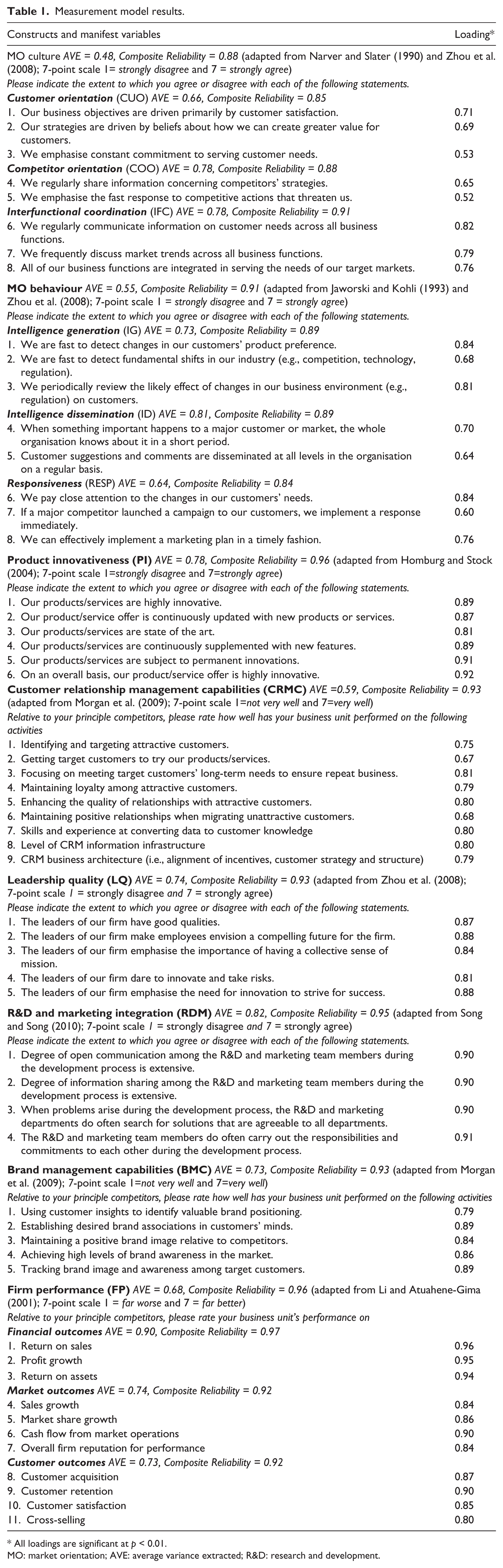
All loadings are significant at p < 0.01.
MO: market orientation; AVE: average variance extracted; R&D: research and development.
We measured product innovativeness with six items that addressed the rate of change in the products or services (Homburg and Stock, 2004). For CRM capabilities, we used nine items that reflected the extent to which firms identified attractive customers, initiated and maintained relationships with attractive customers and leveraged these relationships (Morgan et al., 2009). Following Zhou et al. (2008), we measured leadership quality with five items that addressed the envisioning and energising qualities of firm leaders.
We measured R&D–marketing integration with four items reflecting the degrees of open communication, information sharing, joint solutions and interfunctional relations (Song and Song, 2010). Similar to Morgan et al. (2009), we measured brand management capabilities with five items that represented the extent to which firms created and maintained brand equity and deployed this resource in ways aligned with the market environment.
Drawing on Li and Atuahene-Gima (2001), we measured firm performance with 11 items reflecting financial (three items), market (four items) and customer performance outcomes (four items). We followed Vorhies and Morgan (2005) and Reimann et al. (2010) in measuring firm performance as a three-dimensional, second-order, type I construct: reflective first-order, reflective second-order (Jarvis et al., 2003). In a synthesis of prior studies, Combs et al. (2005) show that these dimensions correlate highly.
To test the hypotheses, we controlled for firm size, age and ownership. We measured firm size with a logarithm of the number of fulltime employees; the logarithm of the number of years firms had been in operation indicated firm age. We measured firm ownership with a dummy variable (1 = state-owned; 0 = otherwise, such as privately owned or foreign capital).
As Table 1 shows, the item loadings for all constructs (range between 0.52 and 0.92) and the values of average variance extracted (AVE) were higher than the cut-off of 0.5 and significant (Hulland, 1999). We examined convergent validity according to composite reliability, drawing on the standardised loadings and measurement error for each item (Shook et al., 2004). As the second column of Table 2 shows, the composite reliability value were above the threshold of 0.70 (Nunnally, 1978).
Descriptive statistics and correlations.
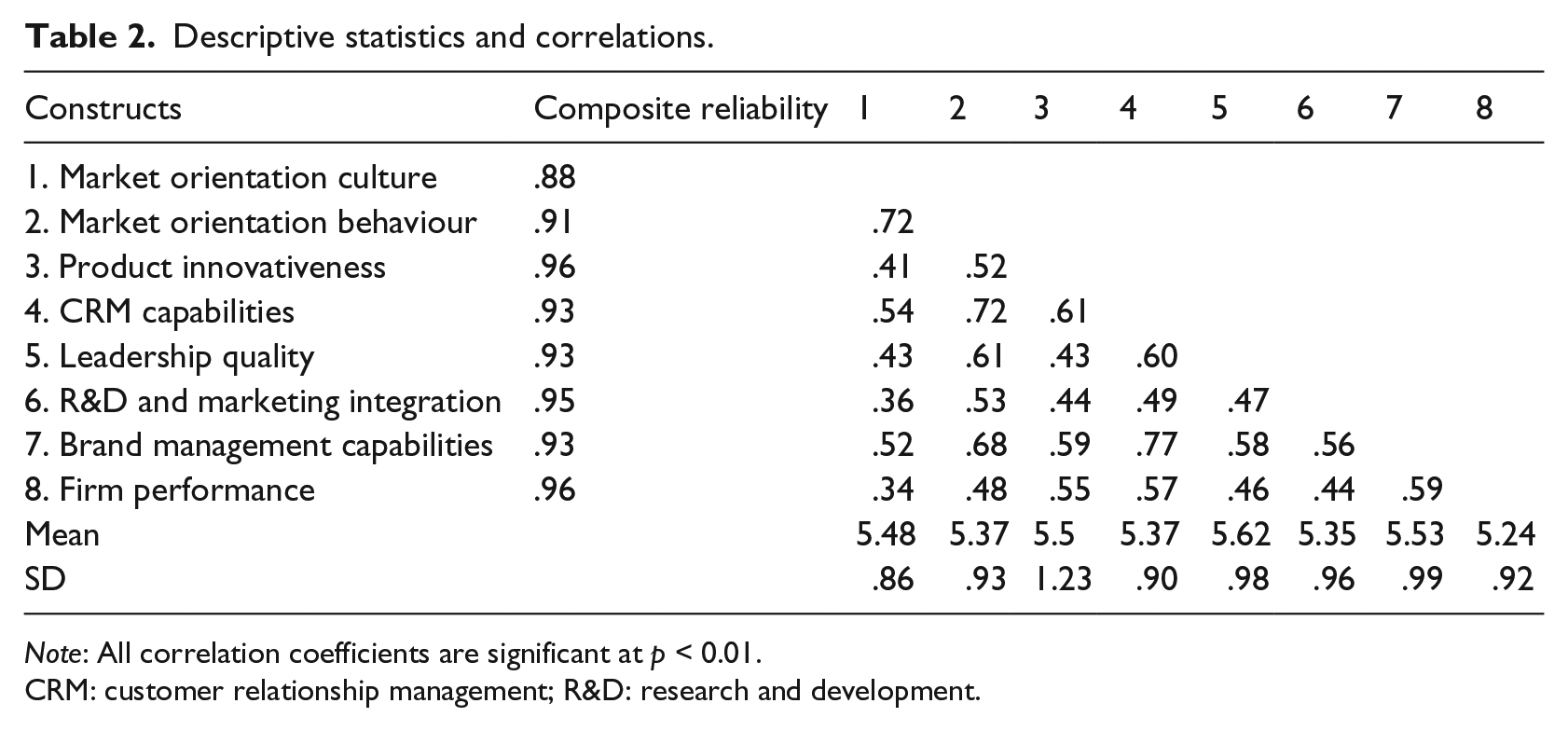
Note: All correlation coefficients are significant at p < 0.01.
CRM: customer relationship management; R&D: research and development.
To assess the discriminant validity of the eight constructs, we followed Fornell and Larcker’s (1981) recommendation, and found that the square roots of AVE of all constructs (from 0.69 to 0.91) were higher than all other correlations (except for MO culture—MO behaviour and brand management capabilities—CRM capabilities). We calculated the heterotrait-monotrait (HTMT) ratio (Henseler et al., 2014) and found that the highest upper confidence interval of all HTMT ratios was .92, indicating that the HTMT ratios are different from 1. In addition, we followed Gaski and Nevin’s (1985) recommendation and tested whether the correlation between any two constructs was higher than their respective reliability estimates. As Table 2 shows, no individual correlations (0.34–0.77) were higher than their respective reliabilities (0.88–0.96), thus indicating the satisfactory discriminant validity of all constructs.
4.3. Common method bias
Because the data in this study were obtained from a single survey, common method variance may have an impact on the findings. Following Podsakoff et al. (2003), we attempted to control for common method variance with both procedural and statistical remedies. With respect to procedural remedies, we protected respondent anonymity, reduced evaluation apprehension and improved item wording. We also used two statistical remedies to assess and mitigate the threat of common method bias. Firstly, Harmon’s single-factor test (Podsakoff and Organ, 1986) showed that no single factor accounted for the majority of the variance (the first factor accounted for 37.79% of explained variance). Secondly, we used the marker variable technique (Lindell and Whitney, 2001; Malhotra et al., 2006). We selected firm ownership as a marker variable to control for common method variance (rM = 0.09, p = 0.37). The mean change in the correlations of all constructs (rU – rA) after partialling out the effect of rM was 0.05, providing no evidence of common method bias.
5. Analysis and results
We applied partial least squares structural equation modelling (PLS-SEM) using PLSGraph 3.0, which is appropriate considering the small sample size relative to the number of estimated parameters and the non-normal distribution of the data in the sample, with model complexity. Not only is PLS-SEM less stringent when working with non-normal data, but it can be applied to much smaller sample sizes, even when the models are highly complex, and it generally achieves higher levels of statistical power and demonstrates better convergence behaviour than covariance-based SEM (Hair et al., 2012). To examine the mediating roles of MO behaviour, product innovativeness and CRM capability (Hypotheses 1 and 3), we followed the method recommended by Preacher and Hayes (2008) and Zhao et al. (2010), as outlined by Hair et al. (2014). In Hypothesis 1a, we predicted MO behaviour mediates the effect of MO culture on product innovativeness. According to the models in Table 3, MO culture positively affected both product innovativeness (Model 1, β = 0.42, t-value = 5.70) and MO behaviour (Model 2, β = 0.76, t-value = 21.93). In addition, MO behaviour had a positive effect on product innovativeness (Model 2, β = 0.51, t-value = 5.20). We compared Model 1 and Model 2 and found that the positive effect of MO culture on product innovativeness in Model 1 became insignificant in Model 2 (β = 0.02, t-value = 0.15). By calculating the variance accounted for (VAF), we sought to determine the size of the indirect effect in relation to the total effect, which was 0.95. That is, 95% of the total effect of MO culture on product innovativeness was indirect, so MO behaviour fully mediates the effect of MO culture on product innovativeness, in support of Hypothesis 1a.
Hypothesis 1, standardised path coefficients (t-values).
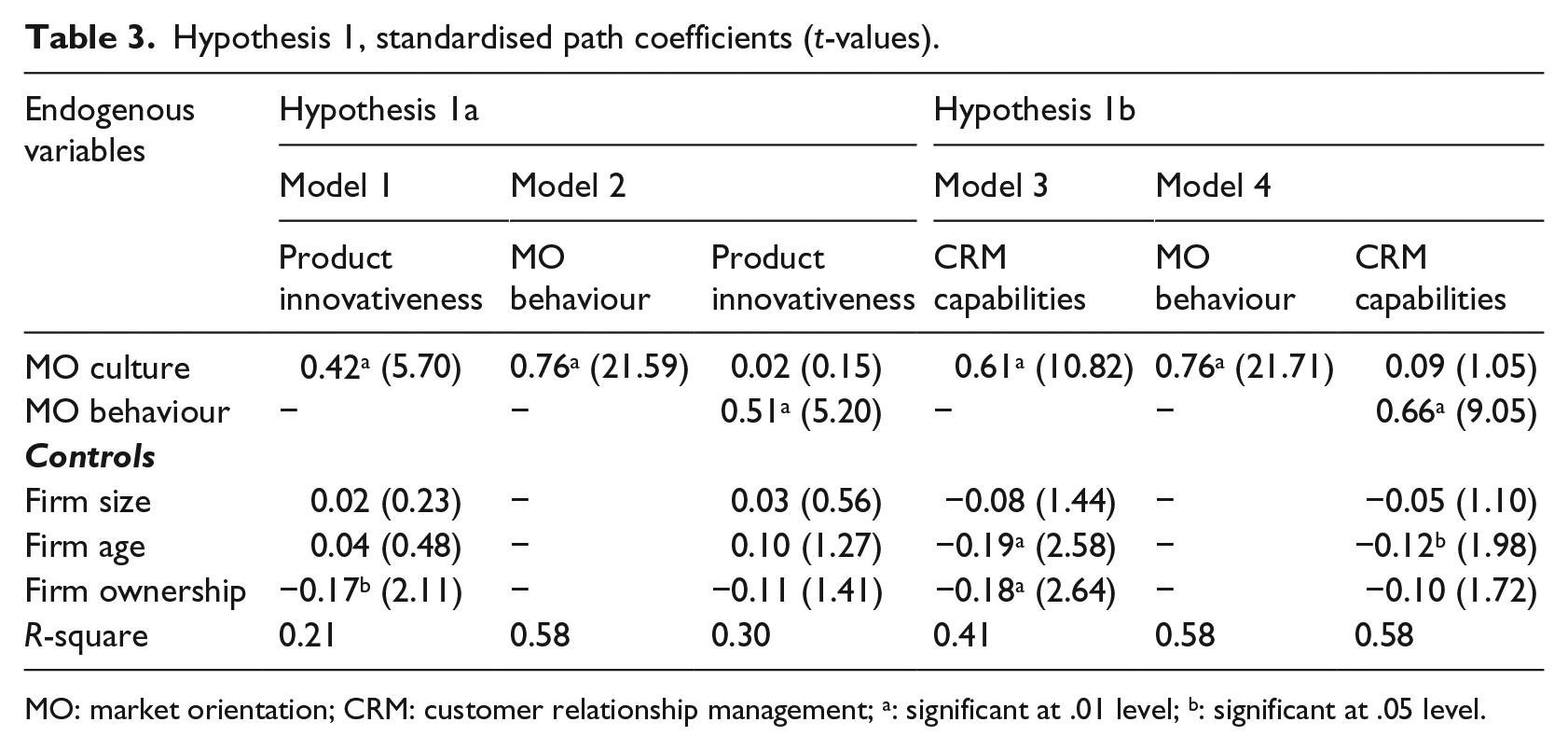
MO: market orientation; CRM: customer relationship management; a: significant at .01 level; b: significant at .05 level.
Similarly, to test Hypothesis 1b, in which we predicted that MO behaviour mediates the effect of MO culture on CRM capability, we developed Models 3 and 4. As Table 3 shows, MO culture positively affected CRM capability (Model 3, β = 0.61, t-value = 10.82) and MO behaviour (Model 4, β = 0.76, t-value = 21.71), which also had a positive effect on CRM capability (Model 4, β = 0.66, t-value = 9.05). The comparison of Models 3 and 4 showed that the positive effect of MO culture on CRM capability in Model 3 became insignificant in Model 4 (β = 0.09, t-value = 1.05). According to the VAF, the size of the indirect effect in relation to the total effect was 0.85, so 85% of the total effect of MO culture on CRM capability was indirect. In support of Hypothesis 1b, MO behaviour fully mediates the effect of MO culture on CRM capability.
With Hypotheses 3a and 3b, we predicted that MO behaviour should enhance firm performance through product innovativeness and CRM capability, respectively. We developed Models 5–7 to test these predictions. Table 4 shows MO behaviour had a positive effect on firm performance (Model 5, β = 0.48, t-value = 7.43) and product innovativeness (Model 6, β = 0.51, t-value = 5.07), which also revealed a positive relationship with firm performance (Model 6, β = 0.45, t-value = 4.49). Comparing Model 5 and Model 6, we found that the positive effect of MO behaviour on firm performance in Model 5 grew weaker in Model 6 (β = 0.48 vs. 0.24). The calculated VAF of 0.49 indicated that product innovativeness partially mediated the relationship between MO behaviour and firm performance.
Hypothesis 3, standardised path coefficients (t-values).
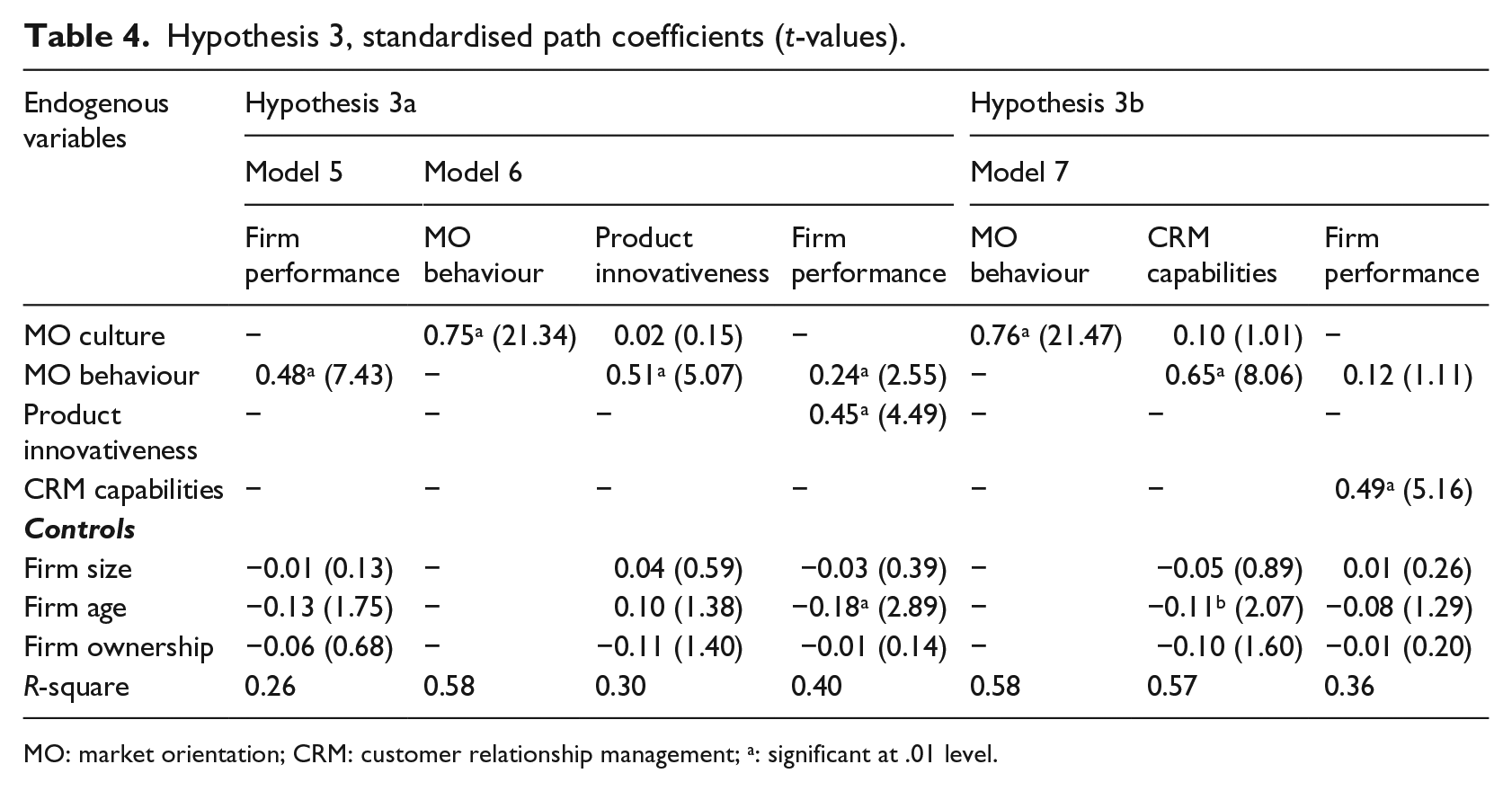
MO: market orientation; CRM: customer relationship management; a: significant at .01 level.
In relation to Hypothesis 3b, CRM capability had a positive effect on firm performance (Model 7, β = 0.65, t-value = 8.06). The comparison of Models 5 and 7 showed that the positive effect of MO behaviour on firm performance in Model 5 became weaker in Model 7 (β = 0.12, t-value = 1.11), in support of Hypothesis 3b. The calculated VAF of 0.73 indicated that CRM capability partially mediated the relationship between MO behaviour and firm performance.
To test Hypotheses 2, 4 and 5, we ran two additional models, Models 8 and 9, in which we added the interaction effects of MO culture and leadership quality, R&D–marketing integration and product innovativeness, and CRM capability and brand management capabilities. The results in Table 5 show that leadership quality moderated the relationship between MO culture and MO behaviour (β = 0.51, t-value = 4.72), in support of Hypothesis 2. As we expected, R&D–marketing integration moderated the relationship between product innovativeness and firm performance (Model 8, β = 0.31, t-value = 1.98), in line with Hypothesis 4. The relationship between CRM capabilities and firm performance was also moderated by brand management capabilities (Model 9, β = 0.51, t-value = 2.27), offering support for Hypothesis 5.
Hypotheses 2, 4 and 5, standardised path coefficients (t-values).
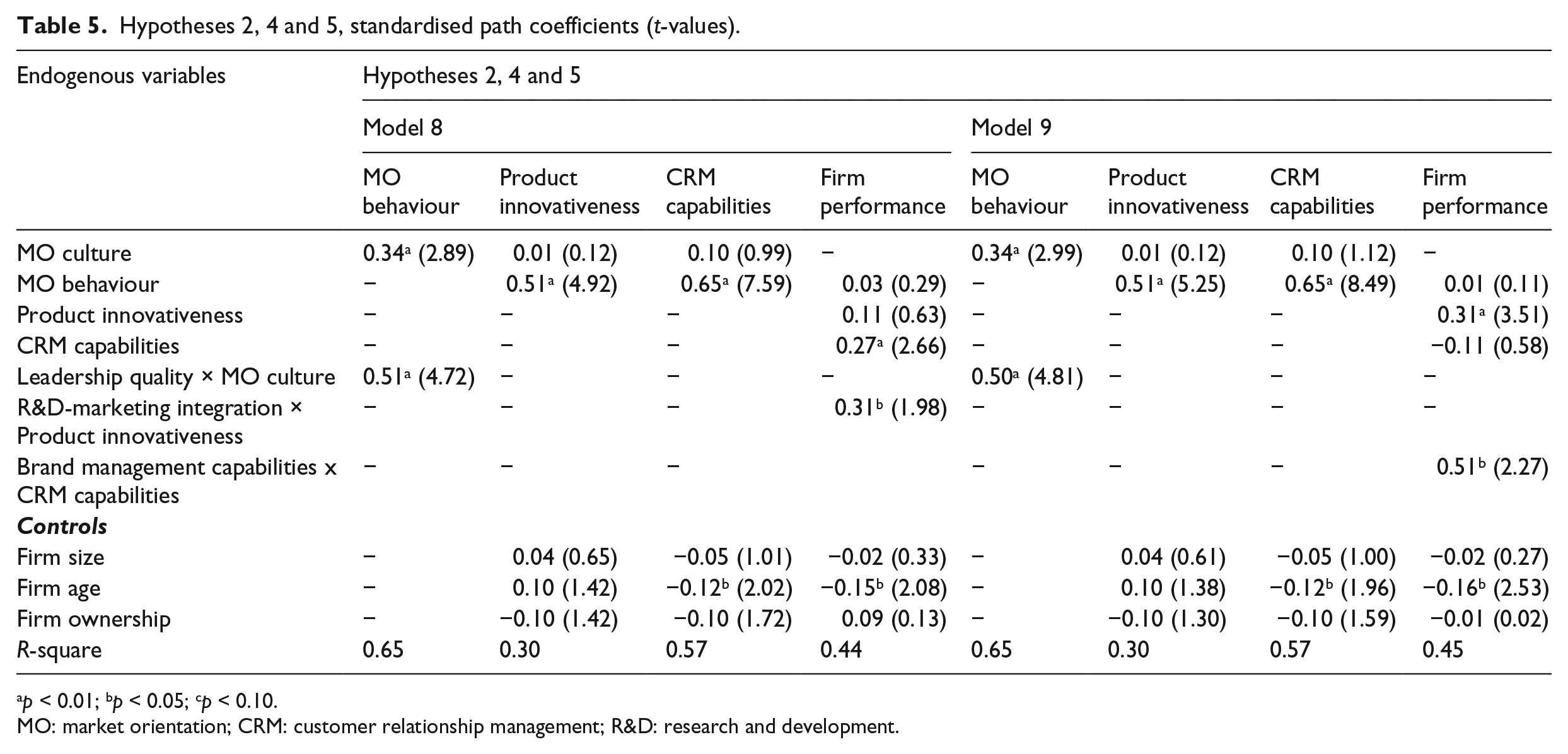
p < 0.01; bp < 0.05; cp < 0.10.
MO: market orientation; CRM: customer relationship management; R&D: research and development.
As robustness checks, we ran alternative models to examine the robustness of the proposed model. Firstly, we examined the moderating role of MO behaviour in the relationship among MO culture, product innovativeness and CRM capabilities. However, MO behaviour did not moderate the relationship between either MO culture and product innovativeness (β = −0.005, t-value = 0.055) or MO culture and CRM capabilities (β = 0.003, t-value = 0.040). Secondly, we ran a model in which we examined the moderating role of product innovativeness and CRM capabilities. The results showed that product innovativeness and CRM capabilities did not moderate the relationship between MO behaviour and firm performance. Thirdly, we re-estimated our proposed model without control variables. The estimates remained stable. Therefore, our proposed mediated model appeared more adequate than a moderated model.
6. Discussion
As long as delivering superior goods and services to customers remains a priority, marketing will continue to play a critical role in organisations. This role necessitates resource allocation decisions and entails related performance expectations. The emerging market setting (Vietnam) facilitated testing and understanding of the inter-relationship between different constructs postulated in the model. Specifically, we were able to explore the degree of variability in the key constructs, which are higher in emerging markets than in developed markets. This contextualisation permitted us to tease out the effects of MO on firm performance with greater precision and reliability. Our findings, thus, offer a better understanding of the two major components of MO—MO culture and MO behaviour—and their relative influence on performance, as moderated by marketing capabilities. The findings have practical relevance for resource allocation: structuring organisational assets into a process framework, as presented herein, delineates the cultural and behavioural roles that are important in a market-oriented organisation. In addition, we confirm the necessary mediation of quality leadership for operationalising and generating returns on marketing capabilities.
From a theoretical perspective, this study advances marketing literature by examining the interrelationships among MO culture, MO behaviour, product innovativeness, CRM capability, firm performance and the contingent effects of leadership quality, R&D–marketing integration and brand management capabilities. It sheds new light on the importance of MO behaviour for realising the potential value of MO culture and enhancing product innovativeness and CRM capability. The findings suggest that MO behaviour fully mediates the effects of MO culture on product innovativeness and CRM capability, in support of the view that MO behaviour, as an action component, is essential for capitalising on MO culture as a strategic resource. Furthermore, these findings affirm that MO comprises both cultural and behavioural components (Homburg and Pflesser, 2000; Ketchen et al., 2007; Zhou et al., 2008). In addition, our study supports the conceptual contention that both innovation and market-linking capabilities are critical for market-oriented firms to achieve competitive advantage (Day, 1994). The effectiveness of MO culture in connecting the firm to the market, through product innovativeness and CRM capability, depends on the effectiveness of its market-oriented behaviours. Echoing Zhou et al. (2008), our findings also demonstrate that effective configurations of MO culture and MO behaviour are contingent on leadership quality.
This study also extends a growing body of research that seeks to explicate the mediators of the MO–performance relationship (Han et al., 1998; Noble et al., 2002; Zhou et al., 2008). The findings show that MO behaviour is a necessary but not sufficient condition for superiority in firm performance; product innovativeness and CRM capability mediate the effect of MO behaviour on firm performance. This novel insight implies that the absence of product innovativeness and CRM capability might account for the unexpected and inconsistent findings regarding the MO–performance link in previous research (see Agarwal et al., 2003; Kirca et al., 2005). We also show that although product innovativeness accounts for a portion of the effect of MO behaviour on firm performance, CRM capability fully mediates this relationship. This new insight is especially important for firms operating in emerging economies, where CRM capability development may receive a greater emphasis than product innovativeness when they implement MO behaviour.
The findings from this study also contribute to understanding of the role of R&D–marketing integration and brand management capabilities in the relationship among product innovativeness, CRM capability and firm performance. Extant literature shows that R&D–marketing integration and brand management capabilities drive new product performance (Dahan and Hauser, 2002; Kahn, 1996; Lilien et al., 2002; Song and Song, 2010). The findings from this study provide new insights related to their performance implications. For managers, our findings suggest that they need to recognise that the performance implications of MO behaviour depend on the presence of product innovativeness and CRM capability. Managers should be aware of the importance of identifying attractive customers and prospects, initiating and maintaining relationships with attractive customers and leveraging these relationships into profits, if they hope to transform market-oriented behaviours into superior firm performance.
Customer needs and expectations in any market evolve constantly. In an emerging market though, they evolve at a rapid pace; delivering high quality and achieving consistent customer satisfaction demands ongoing intelligence gathering, dissemination, integration and responsiveness (Kohli and Jaworski, 1990). Deconstructing the marketing function in the manner we have suggested is practically useful for clarifying and justifying the need for continued resource allocations, and it also may reduce the risks associated with such decisions. For operations managers working in emerging markets, our findings indicate that they should focus on building market-oriented organisations. This investment will benefit both MO efforts and the operationalisation of marketing capabilities to lead to positive performance outcomes. An efficient resource allocation system also will enable practitioners to take advantage of existing assets, to reconfigure them into inimitable capabilities for sustained competitive advantages in the marketplace. Such understanding also is helpful to practitioners in terms of minimising uncertainty by structuring resource allocations appropriately to be market oriented and thus leveraging the opportunities of emerging country markets.
7. Limitations and directions for research
Several issues remain for further research. We used objective and subjective items to measure performance, but studying the impact of MO using financial measures of performance, such as Tobin’s Q, and adopting market-based absolute return models would be interesting. Although these measures are easy to calculate and obtain for publicly limited companies, their accessibility is limited for privately held companies.
We also used a single-informant, cross-sectional research design to test our hypotheses. Whereas the high-context cultural setting made the use of single-informant, onsite interviews appropriate, considering the nature of the required data collection, and this method also is consistent with prior studies in similar settings, alternative approaches, such as multi-informant studies, may deliver more robust results. In addition, inferences about causality in our study are limited by the cross-sectional nature of our data. Because developing the benefits of MO may take time, a longitudinal study could yield more complex layers of information, which may be insightful for longer-term strategy formulation with regard to MO in a fast-paced, emerging country market setting. Further research should compare and contrast the findings from longitudinal and cross-sectional research designs to better understand the potential differences and the effects, with regard to the study implications and recommendations.
Footnotes
Final transcript accepted 8 September 2015 by John Roberts (Guest AE Marketing).
Funding
The authors received no financial support for the research, authorship and/or publication of this article.