







Abstract
Prior self-service technology (SST) studies focus primarily on the initial adoption and its drivers. However, the long-term viability and success of an SST depend on regular and frequent usage. Therefore, this study draws on social psychology and information system/information technology literature to investigate the habit of SST usage and its driving forces. Using panel data pertaining to 626 Australian customers who used a supermarket self-checkout machine over 12 weeks, the results reveal a strong carryover effect of habit. Satisfaction and self-efficacy positively contribute to habit development. Past behavior exerts an impact through frequency and recency effects. Moreover, the driving forces of habit are more complicated for men than for women. The findings provide important implications for service providers planning technology upgrades. The results suggest that to prevent habit disruption, gradual improvements are a better and safer strategy than introducing a new, disruptive technology.
1. Introduction
In the past decade, consumers have increasingly used a range of self-service technologies (SSTs) across service sectors (Froehle and Roth, 2004; Salomann et al., 2006). The proliferation of SSTs, those “technological interfaces that enable customers to produce a service independent of direct service employee involvement” (Meuter et al., 2000: 50)—such as ATMs, Internet banking, self-check-in at airports, and self-checkout in supermarkets—revolutionized service delivery, as traditional high-touch, low-tech, interpersonal service encounters were supplemented by or even replaced with high-tech, low-touch, technological interfaces (Schumann et al., 2012).
For service firms, the introduction of an SST is often resource intensive in terms of both time and money (Bitner et al., 2002). In order for this investment to pay off, the initial adoption (while important) is just the first step, and the eventual success depends on regular and frequent usage (Bhattacherjee, 2001; Eriksson and Nilsson, 2007). That is, at least some customers need to use the SST regularly after adoption (i.e. make SST use habitual). Therefore, managers must understand what factors facilitate the development of a habit of SST usage.
However, in the extant literature, despite extensive research on SSTs in recent years, the focus remains limited mainly to understanding the initial adoption behavior, with adoption intentions as the focal variable of interest (e.g. Curran et al., 2003; Oh et al., 2013). With few exceptions (e.g. Eriksson and Nilsson, 2007; Wang et al., 2013), little has been done to understand customers’ post-adoption repeat behavior in an SST context and, in particular, the habit of SST usage. It is suggested that SST research has entered into a stage where the focus should be shifted from initial adoption to repeated use (Curran and Meuter, 2005; Meuter et al., 2005). Therefore, the primary purpose of this study is to investigate the drivers of the development of an SST usage habit. Drawing on social psychology and information system (IS)/information technology (IT) literature, this study identifies key antecedents of habit that are particularly relevant in an SST context. Panel regression is then used to examine the impact of these antecedents on habit in a retail setting (i.e. supermarket self-checkouts). Although supermarkets sell consumer goods, these grocery retailers and other retailers (e.g. department stores as clothing retailers) are essentially service firms in that they do not manufacture the products they sell but provide a distribution service to consumers. This study is conducted in a retail service context.
In addition, previous research suggests that men and women differ in their SST perceptions and behaviors (Ding et al., 2007; Nilsson, 2007). For example, Venkatesh and Morris (2000) find that men’s technology usage decisions depend more on their perceptions of usefulness, whereas women rely more on their perceptions of ease of use and subjective norms. Elliott and Hall (2005) indicate that men have a stronger desire to experiment with new SSTs, whereas women exhibit less confidence in making new SSTs work. Such evidence suggests that men’s and women’s habitual SST usage may reflect different drivers, with varying impacts. Therefore, apart from understanding habit development in general, the second purpose of this study is to investigate potential gender differences in habit development. Thus, conceptually, gender is modeled in this research as an observed individual heterogeneity variable rather than an additional antecedent variable. Methodologically, gender differences are examined by subgroup analysis—splitting the sample by gender and estimating the same habit model for males and females separately.
In achieving these research objectives, this study offers three important contributions. First, by focusing on habit and related drivers, the current SST study shifts the focus from initial adoption to repeated use. The concept of habit is not new (e.g. Aarts and Dijksterhuis, 2000a; Klockner et al., 2003), although this notion appears only rarely in the SST and marketing literature. Prior research indicates that in predicting repeated behavior, habit is more powerful than other variables, such as intentions or attitudes (Jolley et al., 2006; Verplanken et al., 1994). The relevance and importance of habit suggests modeling this variable as the focal-dependent variable in this study. By investigating the relationships between habit and its antecedents, this study sheds light on how different drivers contribute to habit development in an SST context. Second, in addition to examining the drivers of SST habit in general, this study also investigates potential gender differences, thus providing further insights into habit development. Finally, in terms of methodology, an econometric modeling approach serves to estimate three panel regression models (pooled ordinary least squares (OLS), fixed effects, and random effects). Compared with multiple regression analysis using cross-sectional data, econometric modeling has obvious advantages: panel regression models can account for unobserved heterogeneity (individual or time differences) using fixed or random effects (Chintagunta, 1993), which makes the results more robust across individuals and/or times.
The next section introduces the dependent variable (i.e. habit) and identifies key independent variables (i.e. antecedents of habit). After detailing the model development process, this article reports the empirical results. Finally, the authors discuss the findings and suggest directions for research.
2. Literature review
2.1. Habit: past behavior or state of mind?
In contemporary psychology, habit refers to learned sequences of acts that become automatic responses to specific situations and may function to obtain certain goals or end-states (Triandis, 1980; Verplanken et al., 1997). That is, habit is a goal-directed, automatic, behavioral tendency, with two key features for this study. First, habitual behaviors happen without a person’s awareness or consciousness, unlike intentional behaviors (Mittal, 1988). For example, by force of habit, a driver may put on a seat belt. Second, habit is goal-directed and thus differs from other automatic behaviors, such as body reflexes (Aarts and Dijksterhuis, 2000a; Aarts et al., 1998). For example, people do not automatically visit an ATM without a goal of obtaining cash.
Previous habit research shows that many early studies problematically present habit as equivalent to the frequency of past behavior (e.g. Bentler and Speckart, 1979; Landis et al., 1978; Wittenbraker et al., 1983). As Ajzen (2002) points out, “In the absence of an independent measure of the habit construct, using habit to explain the relation between prior and later behavior involves circular reasoning” (p. 110). The problem is, although a history of repetition remains a fundamental characteristic of a habit, it is not the recurrence of a behavior per se that constitutes a habit. Rather, a habit is created by frequently and satisfactorily pairing the execution of an act in response to a specific cue. This process results in a mental representation of an association between a goal and an action (the goal-directed feature of habit). Therefore, the habit construct should capture more than repetition, in particular the aspect of automaticity. Later psychology scholars acknowledged this problem and suggested that repeated occurrence is a prerequisite of habit formation but is not habit per se, instead, habit is a mental construct, not to be confused with prior behavior (e.g. Limayem and Hirt, 2003; Verplanken and Orbell, 2003). Accordingly, the present research also regards habit as a person’s state of mind, independent of past behavior. Thus, habit is a psychological construct, rather than simply past behavioral frequency.
Triandis’s (1977) model highlights the relevance of habit for determining repeat behavior, in that habit explicitly serves as a predictor of behavior as follows

where the probability of an act (Pa) is a weighted function of habit (H) and intention (I), multiplied by facilitating conditions (F) (e.g. ability to perform the act). In this model,
when a behavior is new, untried, and unlearned, the behavior-intention component will be solely responsible for the behavior, while, when the behavior is old, well learned, or overlearned and has occurred many times before in the organism’s life span, it is very likely to be under control of the habit component. (Triandis, 1977: 205)
As experience accumulates and learning occurs through repetition, behavioral performance becomes a matter of habit rather than a result of intentional reasoning. Empirical support in psychology confirms that habit is a powerful, and sometimes the only, determinant of repeated behavior (Jolley et al., 2006; Verplanken, 2006; Wittenbraker et al., 1983).
Recent development in IS/IT research also recognizes the important role of habit in a technology use context. The latest version of the Unified Theory of Acceptance and Use of Technology (UTAUT2) challenges the previous focus on behavioral intention as the overarching mechanism that drives behavior and incorporates habit as another key predictor of technology use (Venkatesh et al., 2012). According to this theory, in a use, rather than initial acceptance, context habit, rather than intentionality, is a critical factor predicting technology use. Therefore, in an SST usage context, as the current focus is on repeat use rather than initial adoption, habit rather than intention provides the focal-dependent variable in this study, which seeks to identify factors that affect the development of a habit. Empirical support can be found in Wang et al.’s (2013) study, which examines the relative impact of intention and habit on continued SST use and finds that habit has a much stronger impact.
2.2. Antecedents of habit
This study draws on social psychology and IS/IT literature to identify key antecedents of habit that are relevant to SST usage. As habit research is rooted and well studied in social psychology, this literature helps identify fundamental factors in any habit development. Extant research cites two major antecedents of habit: history of past behavior and satisfaction with past experience. Moreover, IS/IT literature is useful for identifying additional factors particularly important in developing an SST usage habit since SSTs are essentially a technology. Considering the specific nature of SSTs (Limayem et al., 2007), self-efficacy offers another possible antecedent of habit, because the use of an SST usually requires some skills and confidence (Van Beuningen et al., 2009; Zhao et al., 2008). By investigating these antecedents from both literatures, this study provides a theoretically sound and contextual specific account of habit development.
The history of past behavior comprises three aspects: frequency, length, and recency (Bagozzi and Warshaw, 1990). The role of frequency of past behavior in habit formation appears in previous habit studies (e.g. Mittal, 1988; Verplanken, 2006); the dominant view holds that repetition is a necessary but insufficient condition for habit formation. Recent empirical IT acceptance studies find that prior IT use (measured as frequency of past behavior) positively influences IT use habit (conceptualized as an automatic tendency to use the IT) (e.g. Lankton et al., 2010). Therefore, in the context of SST use, it is expected that the more frequent use in the past, the stronger the habit of using it.
Bagozzi and Warshaw (1990) also propose recency of past behavior as a direct influence on future behavior; similar to frequency, recency is also a necessary but insufficient condition for habit formation. Recently performed behaviors are salient and relevant, as well as more likely to grow routinized, than are behaviors performed long ago. Therefore, this study predicts a positive impact of recency on habit.
Length of usage history reflects insights from relationship marketing literature (e.g. Bolton et al., 2004; Dwyer et al., 1987; Prins and Verhoef, 2007). The need to distinguish length and recency effects can be illustrated with an example: a customer who recently migrated from telephone banking to Internet banking has a long, remote history of using telephone banking and a short, recent history of using Internet banking. A long history of performing a behavior usually is associated with accurate expectations, abundant experiences, and adequate repetition of the action, which leads to behavioral inertia and facilitates habitualization. Therefore, when a customer uses an SST for a longer period, he or she is more likely to use the SST habitually.
Prior satisfying (dissatisfying) experiences are also key to habit formation, by increasing the tendency to repeat the same course of action (Aarts et al., 1997). Thorngate (1976) summarizes the relationship between satisfaction and habit as follows: “If a response generated in an interaction is judged to be satisfactory, it will tend to be reproduced under subsequent, equivalent circumstances from habit rather than thought” (p. 32). This positive satisfaction–habit relationship has recently been examined in the IS/IT literature (e.g. Limayem et al., 2007). Lankton et al. (2010) suggest that as satisfaction results in individuals to continue using IT, there is likely to be a development of habit formation. Chiu et al. (2012) find that satisfaction is positively related to habit in the context of online shopping. This is because if an online buyer evaluates the shopping experience positively, it is likely that his or her willingness to shop online again will increase. Thus, in an SST context, past satisfying experiences using an SST should also increase the likelihood of repeat use, and thus contribute to habit development.
The adoption of SSTs often requires new skills from a customer (Van Beuningen et al., 2009; Zhao et al., 2008), so self-efficacy beliefs should also contribute to habit formation. By definition, habit is an automatic behavioral tendency to perform without deliberate thinking (Verplanken et al., 1997). To do so, a person must be confident and have no difficulty performing a specific task. The more confidence a person has about performing a task, the more likely he or she can undertake the necessary actions without anxiety. Usually repeating an action leads people to perform better (Ronis et al., 1989). Feelings of increasing competence then may contribute to intensified self-confidence with more frequent performance. Eventually, the self-efficacy cue responses become automatic (habitual) in nature. Wang et al. (2013) include self-efficacy as a cognitive driver of habit in the SST context and finds that self-efficacy is particularly important in the early stage of habit development. Therefore, self-efficacy is expected to have a positive effect on habit.
To sum up, this study views habit as a psychological construct, not simply past behavioral frequency. Through review of extant literature, five key factors are identified as possible antecedents of habit. They are frequency of past behavior, length of past behavior, recency of past behavior, satisfaction, and self-efficacy. While these variables have been examined separately in different studies (e.g. Bagozzi and Warshaw, 1990; Wang et al., 2013), together they provide a more complete picture of what and how different factors drive the development of a habit in an SST usage context.
3. Model development
3.1. Sample panel data
The data come from a consumer panel comprising 626 customers who shop regularly at an Australian supermarket chain (at least once a week) and use the self-checkout SST offered by the supermarket (at least once). The self-checkout SST enables customers to scan products, pack them, pay money, and checkout without a cashier. This relatively new SST, introduced in selected Australian supermarkets, offers an alternative to traditional checkout counters, and customers may choose either option.
Over a 12-week period, the consumer panel responded to three contacts (beginning, middle, and end of the 12 weeks) and reported SST perceptions and behaviors, with 6 weeks between each contact. Supermarket shopping is a relatively high-frequency household activity, and thus use of the self-checkout SST is likely to become a frequent, regular task for customers. Therefore, a 6-week interval is long enough for customers to use the SST at least several more times before the next contact, yet short enough for a longitudinal study and hence manageable in terms of time and cost. A problem with any panel study is attrition, with the average dropout rate being approximately 50% (Sudman and Wansink, 2002; Taris, 2000). In this study, the attrition rate was 44.4% between the first and second waves and 19.5% between the second and third waves, so the data set consists of 626, 348, and 280 consumers at waves 1, 2, and 3, respectively.
With many respondents and few time periods, this panel data set is short, which may have implications for the specification and estimation of panel models (especially fixed effects models; Greene, 2007). The number of observations varies in each time period due to attrition, so the panel also is unbalanced, which may create estimation issues, depending on the analysis software used (Park, 2009).
3.2. Variable specification
The measure of habit, the focal-dependent variable yit, uses a three-item, seven-point Likert-type scale, originally developed by Limayem and Hirt (2003) and then refined by Limayem et al. (2007) (see Appendix 1). This scale offers parsimony (three items), relevance (IS usage context), and recency (2007).
A three-item, semantic differential scale adapted from Spreng et al. (1996) captures satisfaction (x1it). This measure appears successfully in prior technology studies (e.g. Bhattacherjee, 2001; Bhattacherjee and Premkumar, 2004) and is relevant to the SST context. Self-efficacy (x2it) relies on a single-item, semantic differential scale, based on Bandura’s (1997) guidelines and adapted from Dabholkar and Bagozzi’s (2002) study. Respondents indicated their confidence about using the self-checkout SST, measured on a seven-point scale with “not at all confident/totally confident” as anchors.
The three aspects of past behavior, length, recency, and frequency of SST usage are denoted by x3it, x4it, and x5it, respectively. For the length measure, x3i1 refers to the first time respondents used the self-checkout SST in the supermarket. Because the SST is relatively new, respondents should find it relatively easy to recall their first use. For comparison and compatibility, all initial responses were transformed into weeks. For example, if consumer i refers to an event 2 months ago, x3i1 is 8.57 weeks ago ((2 × 30)/7). The larger the number, the longer the length. The time interval between any two contacts is 6 weeks, so x3i2 and x3i3 simply add 6 and 12 to x3i1, respectively, without requiring separate measures in the second and third waves.
Recency, x4it, indicates participants’ responses when asked about the last time they used the self-checkout SST in the supermarket. Similar to x3it, initial responses were transformed into weeks, such that if consumer i indicated 4 days ago at t = 1, x4i1 is 0.57 weeks ago. Here, x4it is a reverse-scaled variable, so a smaller value implies the consumer used the SST more recently.
Finally, the measure of frequency, x5it, includes two questions: how many times in the past 6 weeks customers shopped at a particular supermarket and what percentage of times these respondents used the self-checkout SST. The value of x5it derives from multiplying these responses. If consumer i, at t = 1, indicates nine times and 80%, then x5i1 equals 7.2.
For measures of individual heterogeneity, the survey gathered customer demographics and psychographics as control variables. Specifically, technology anxiety (h1i), need for human interaction (h2i), behavioral inertia (h3i), technology experience (h4i), and personal innovativeness (h5i) should be relevant for the use of SSTs and technology in general (Dabholkar, 1996; Meuter et al., 2005). The first three serve as inhibitors (i.e. negative influence on SST usage), whereas the latter two are accelerators. All measures used multi-item scales, adapted from existing literature (see Appendix 1). Personal traits are relatively stable and do not change over time, so only the first wave includes the individual difference variable measures. It should be noted that these five psychographic variables capture observed individual differences in SST usage and they should not be confused with the five antecedents of habit (x1 to x5).
3.3. Model estimation
The model estimation relies on LIMDEP 9.0, which does not require balanced panel data (Greene, 2007).
3.3.1. Establishing baseline models
The initial model is a pooled regression model based on OLS estimation, which is expressed as

where ε
it
is the error term, E(ε
it
) = 0 and Var(ε
it
) =
The fixed and random effect models then account for unobserved heterogeneity (Chintagunta, 1993). Of the various approaches to incorporate heterogeneity (Ailawadi et al., 1999), this study considers a fixed effect and a random effect specification, which represent two basic approaches. The form and estimation method for the fixed effect model depends on the structure of the data set. The data set for this study is short with many respondents and few time periods, so a one-way fixed time effect model is more appropriate than a one-way fixed group effect model. To avoid dummy variables, a within-effect estimation applies (Park, 2009). The one-way fixed time effect model is

where
A one-way random time effect model, as opposed to a one-way random group effect model, is

where ut is a random time effect with E(ut) = 0, Var(ut) = σu2, and Cov(ε it , ut) = 0.
3.3.2. Incorporating lagged variables
All three regression models are static, with no carryover effect incorporated in the equations. However, prior studies show that habitual behaviors are difficult to suppress, unless interventions disrupt the formation of deep, nonreflective mental scripts (Aarts and Dijksterhuis, 2000b; Jasperson et al., 2005). Put simply, habitual behaviors reflect mental inertia and enduring effect. That is, habit develops in a cumulative manner, and previous habit levels accumulate to determine current habit level. This is similar to the concept of cumulative satisfaction which is formed based on all prior experiences. Thus, previous habit (yi(t–1)) enters the model as an additional antecedent of current habit (yit), resulting in a respecification of equations (1) to (3) into three dynamic panel models



Note that the inclusion of yi(t–1) means that these model estimations start at t = 2. While the incorporation of previous habit may be conceptually intuitive, it is methodologically appealing. Prior research often uses cross-sectional data and hence is not able to incorporate previous habit. This may result in exaggerating the effects of the habit drivers under investigation. By accounting for the effect of prior habit, the models in this study can more accurately estimate the effects of the five antecedent variables.
3.3.3. Accounting for heterogeneity
The fixed effect model in equation (5) and random effect model in equation (6) account for time heterogeneity; the effects of observed individual heterogeneity emerge from including five customer psychographic variables in the models. They are technology anxiety h1i, need for human interaction h2i, behavioral inertia h3i, technology experience h4i, and personal innovativeness h5i. The final complete regression models are



After the estimation of the overall sample model (the first research objective), this study estimates equations (7) to (9) separately for men and women (the second research objective).
3.3.4. Model fit and comparison
The calculated F-values and adjusted R2 indicate overall model fit. The predictive validity of the regression model is assessed by the double cross-validation procedure. More specifically, the sample is randomly split into two sub-samples (approximately 50% in each), and each is used as a holdout for the other. The correlation of the actual and predicted values in the holdout sample indicates the predictive accuracy of the model. To investigate the time effect, two statistical tests compare the pooled OLS model in equation (7) with the one-way fixed time effect model in equation (8) (F-test) and the one-way random time effect model in equation (9) (Lagrange multiplier test) (Greene, 2008). A time effect exists if equations (8) and (9) outperform equation (7).
4. Empirical results
The initial 626 panel consumers consisted of 66.4% women and 33.6% men, which is reasonable because the research setting is self-checkout SST in supermarkets and women generally undertake more supermarket shopping than men. The panel covers a wide range of age groups: 19.9% between 15 and 24 years of age, 50.7% between 25 and 44 years, 25.9% between 45 and 64 years, and only 3.4% older than 65 years. This demographic split is consistent with prior SST research that indicates SST users tend to be younger (e.g. Nilsson, 2007; Simon and Usunier, 2007). Panel consumers also vary in education levels. More than half hold at least a university degree (53.4%), 24.9% have a community college degree, 20.2% earned a high school diploma, and the remaining 2.6% did not complete high school. Previous results concur that SST users generally have higher education levels (e.g. Greco and Fields, 1991; Meuter et al., 2003).
All consumers in the panel shop at least once a week in the selected supermarket, with an average of approximately 1.5 times a week. The majority (around 70%) might be considered loyal customers, because more than 60% of their monthly supermarket spending focuses on one particular supermarket brand. At the time of the survey, all consumers used the self-checkout SST at least once and averaged nine times, because the SST is relatively new to the market. The earliest first use was 2 years prior, and the average was approximately 10 weeks earlier. However, respondents indicated various product-norm experiences with SSTs in their daily lives, such as ATMs, online banking, online booking for travel, and ticket machines at railway stations.
4.1. Confirmatory factor analysis
Before panel regression analysis, composite measures of satisfaction, habit, and the five individual difference variables were developed. The confirmatory factor analysis (CFA) used AMOS 7.0 to assess measurement properties. While it was deemed acceptable to ignore missing data in this study because they were well under 10% overall (Hair et al., 2010), in order for AMOS to report all important fit indices, mean substitution was used to replace them before CFA. The measures of both satisfaction and habit occurred at t = 1, 2, and 3, so three measurement models resulted in the findings in Table 1.
CFA results for satisfaction and habit.
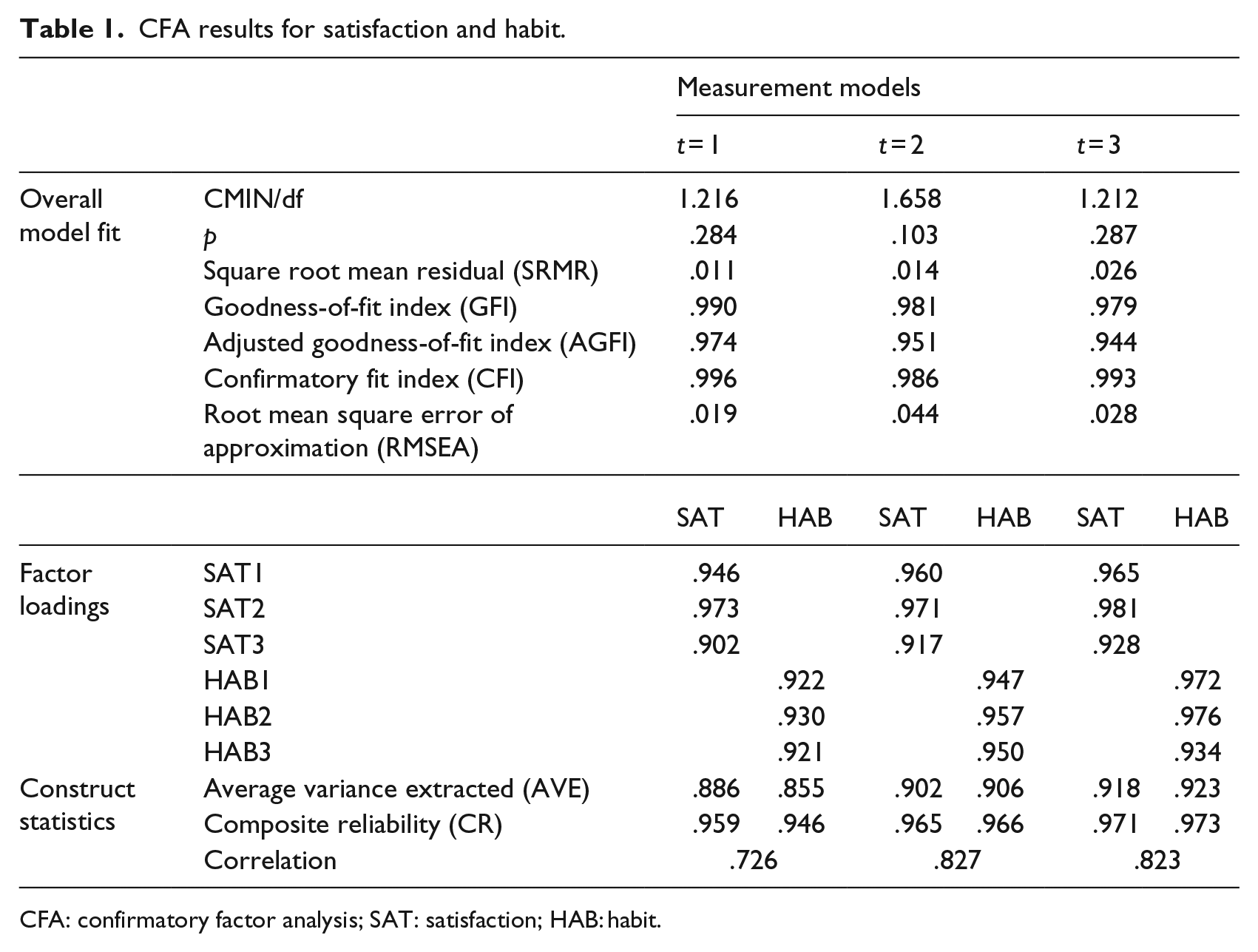
CFA: confirmatory factor analysis; SAT: satisfaction; HAB: habit.
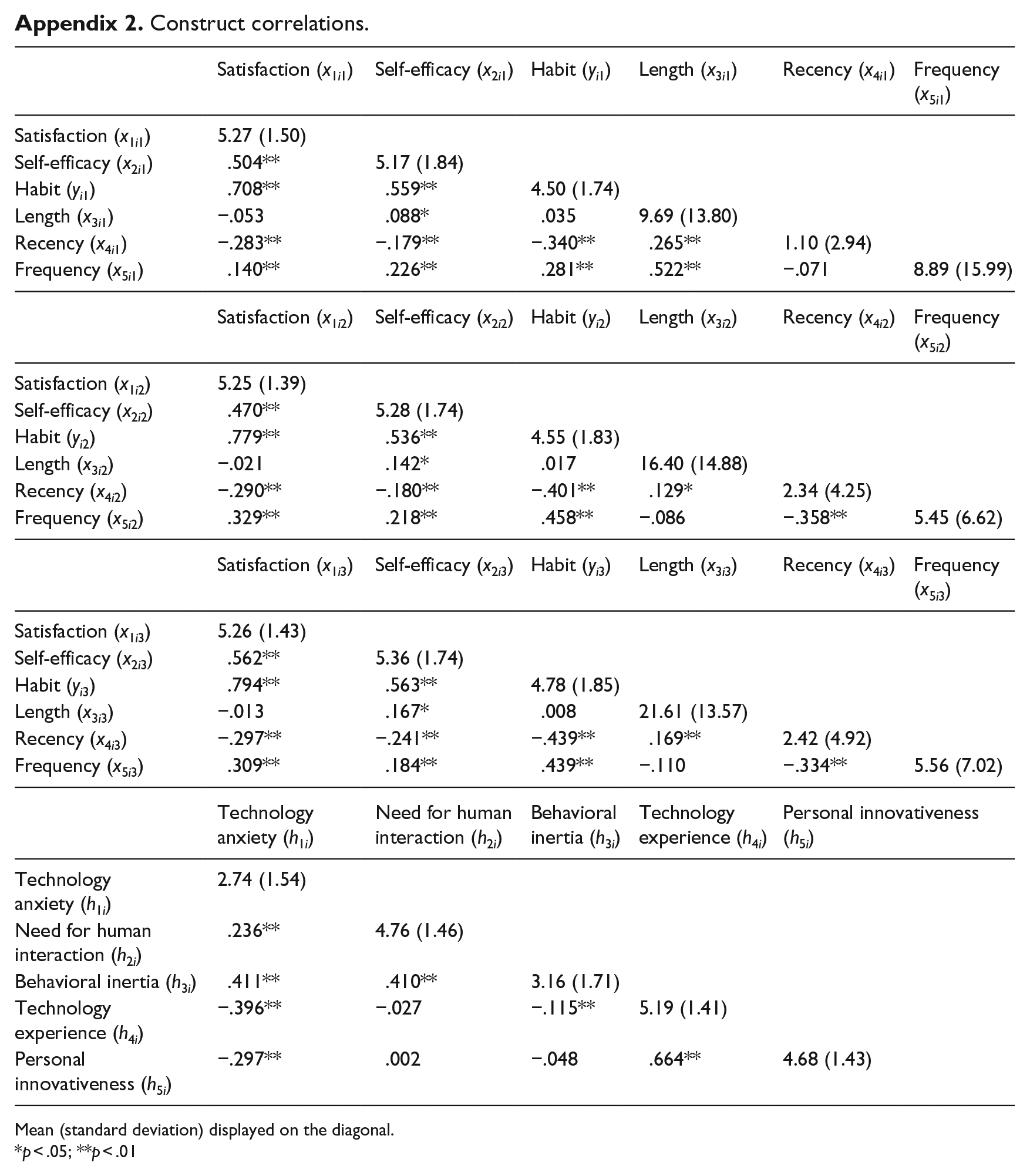
All three measurement models fit the data well (CMIN/df < 2; p > .05; goodness-of-fit index (GFI), adjusted goodness-of-fit index (AGFI), and confirmatory fit index (CFI) > .9; square root mean residual (SRMR) < .05; root mean square error of approximation (RMSEA) < .05) (Bagozzi and Yi, 2012; Hair et al., 2010). In addition, the factor loadings, composite reliability (CR), and average variance extracted (AVE), all above their recommended cut-off levels, provide strong, consistent evidence of convergent validity. The AVEs for satisfaction and habit are greater than the squared correlation between satisfaction and habit across all three measurement models, in support of discriminant validity (Fornell and Larcker, 1981). As the indicators load equally high on their own constructs, for ease of interpretation, the scales for satisfaction and habit are unweighted summated versions. The results of the CFA for the five individual difference variables also confirm the good fit of the measurement model and indicate good reliability and validity, as Table 2 summarizes. Furthermore, a full CFA including all the variables at t = 1 was conducted with results again indicating reasonably good model fit, providing additional confidence in measurement validity (CMIN/df = 2.082; p = .000; GFI = .906; AGFI = .864; CFI = .904; SRMR = .045; RMSEA = .042). Appendix 2 provides the correlation matrices of all variables in this study.
CFA results for individual difference variables.
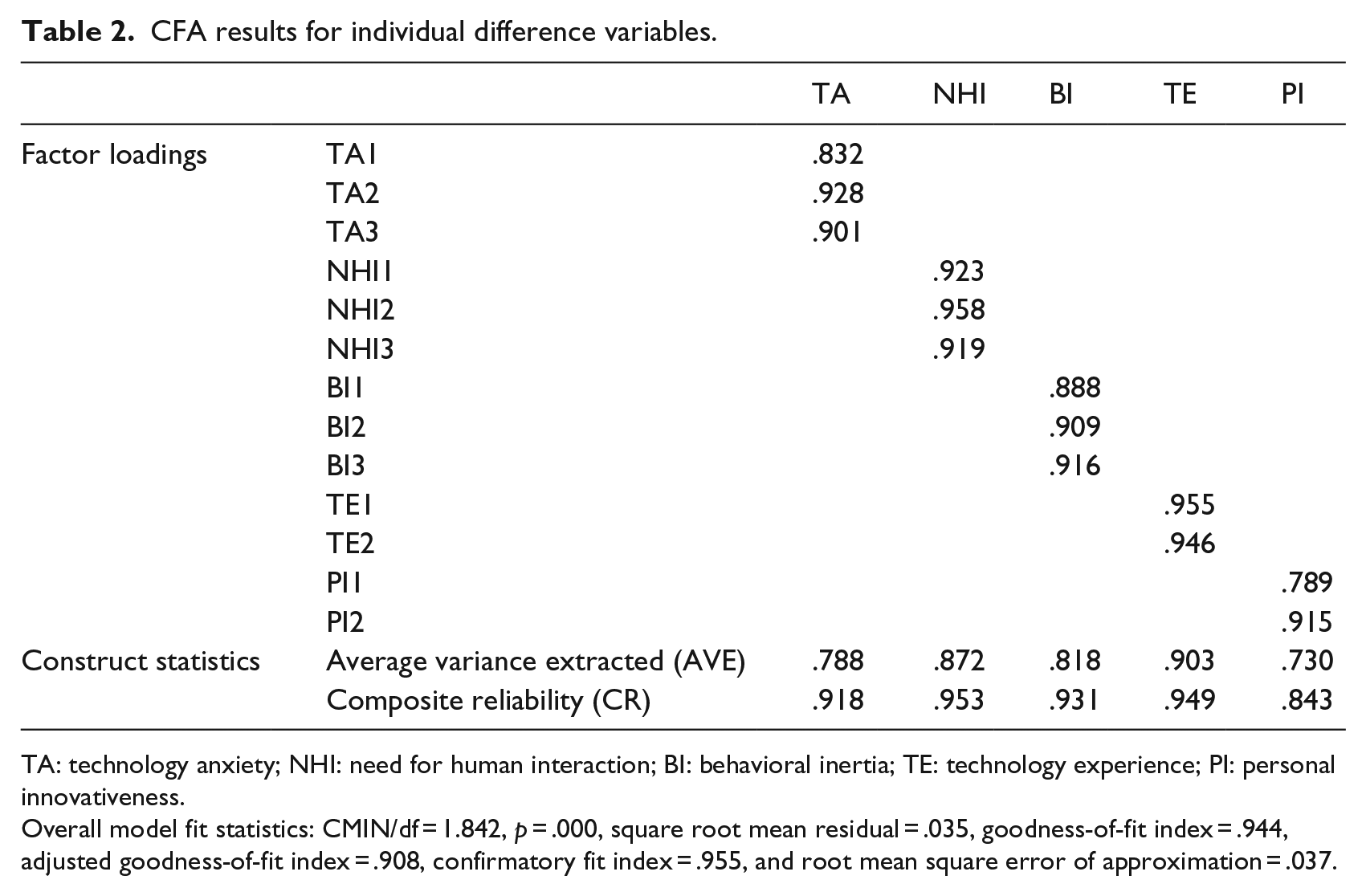
TA: technology anxiety; NHI: need for human interaction; BI: behavioral inertia; TE: technology experience; PI: personal innovativeness.
Overall model fit statistics: CMIN/df = 1.842, p = .000, square root mean residual = .035, goodness-of-fit index = .944, adjusted goodness-of-fit index = .908, confirmatory fit index = .955, and root mean square error of approximation = .037.
4.2. Panel regression models
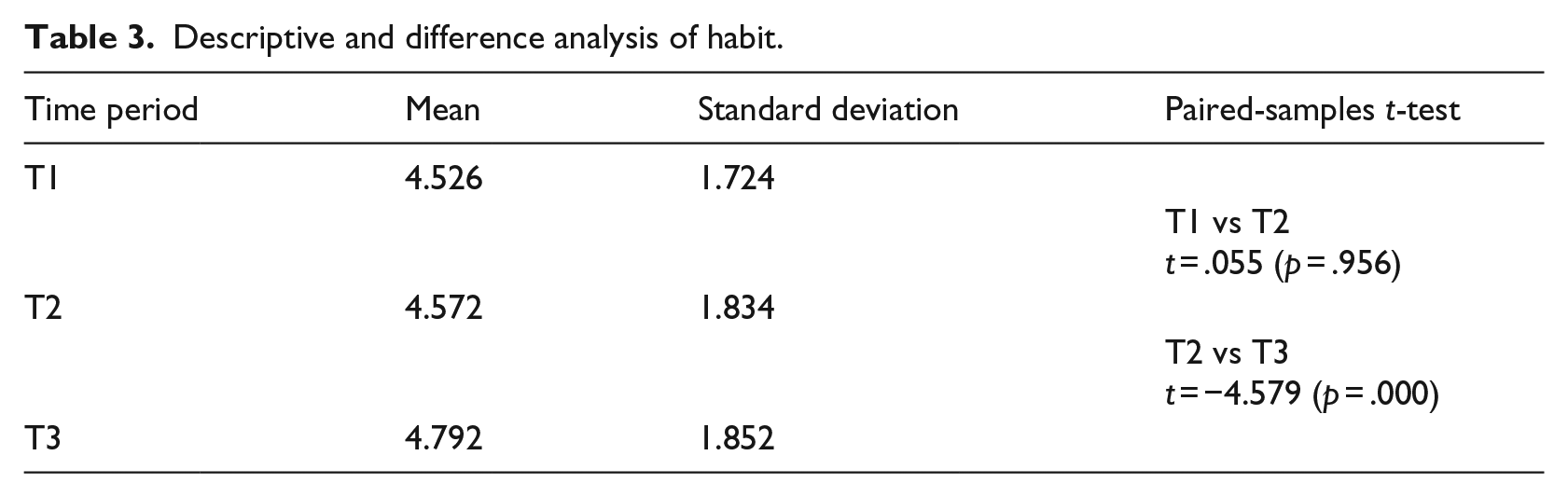
Table 3 shows the key descriptive statistics and difference analysis results of the dependent variable—habit. The sample had a moderate habit level at T1 with a mean of 4.526 out of 7. It slightly increased to 4.572 at T2 and grew to 4.792 at T3. Paired-samples t-tests indicate no significant change in habit from T1 to T2 (p > .05), but a significant increase from T2 to T3 (p < .05).
Descriptive and difference analysis of habit.
The estimates of the three panel regression models (equations (7) to (9)) using the whole sample produced the results in Table 4. Separate re-estimations of these models for male and female respondents produced the results in Table 5.
Summary of overall sample regression results.
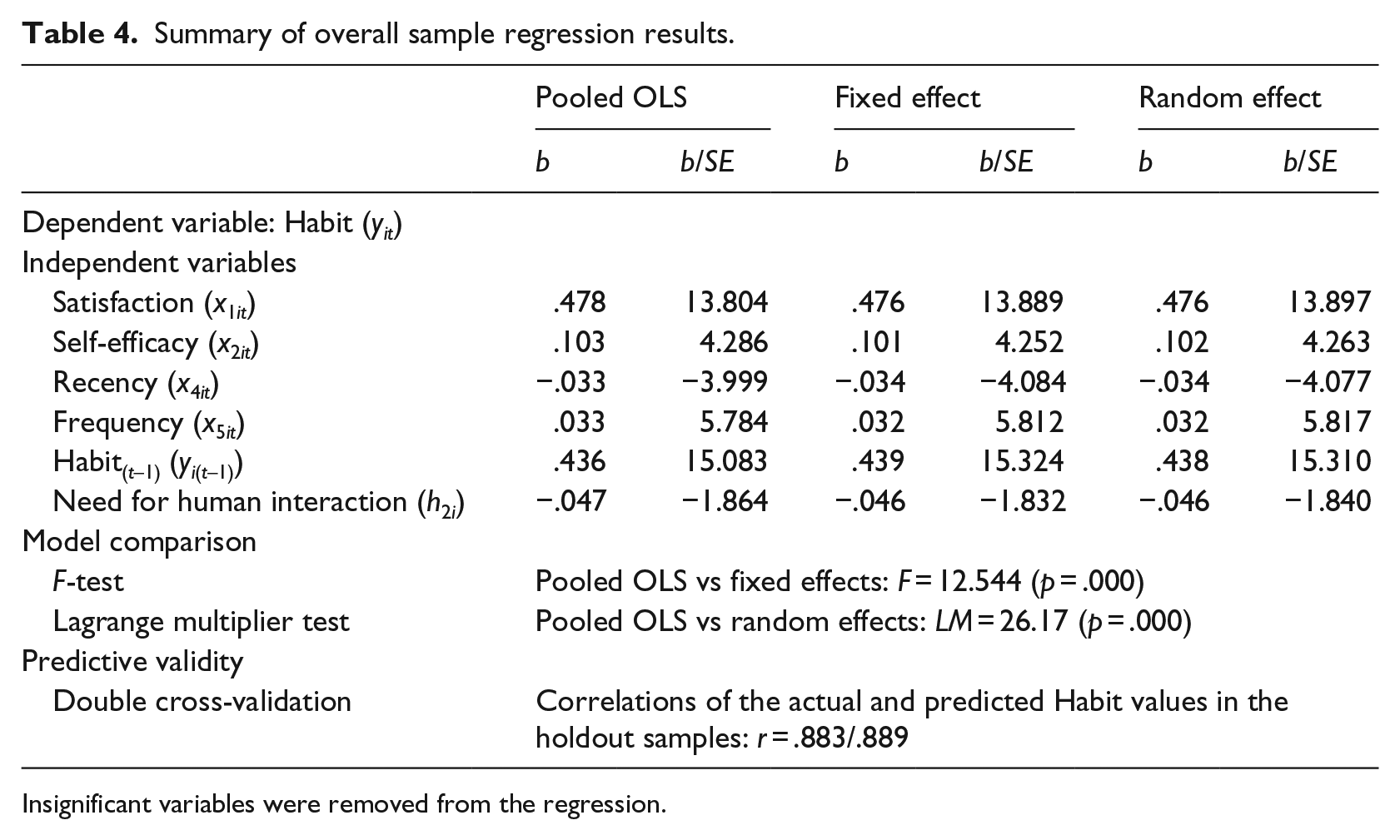
Insignificant variables were removed from the regression.
Summary of regression results by gender.
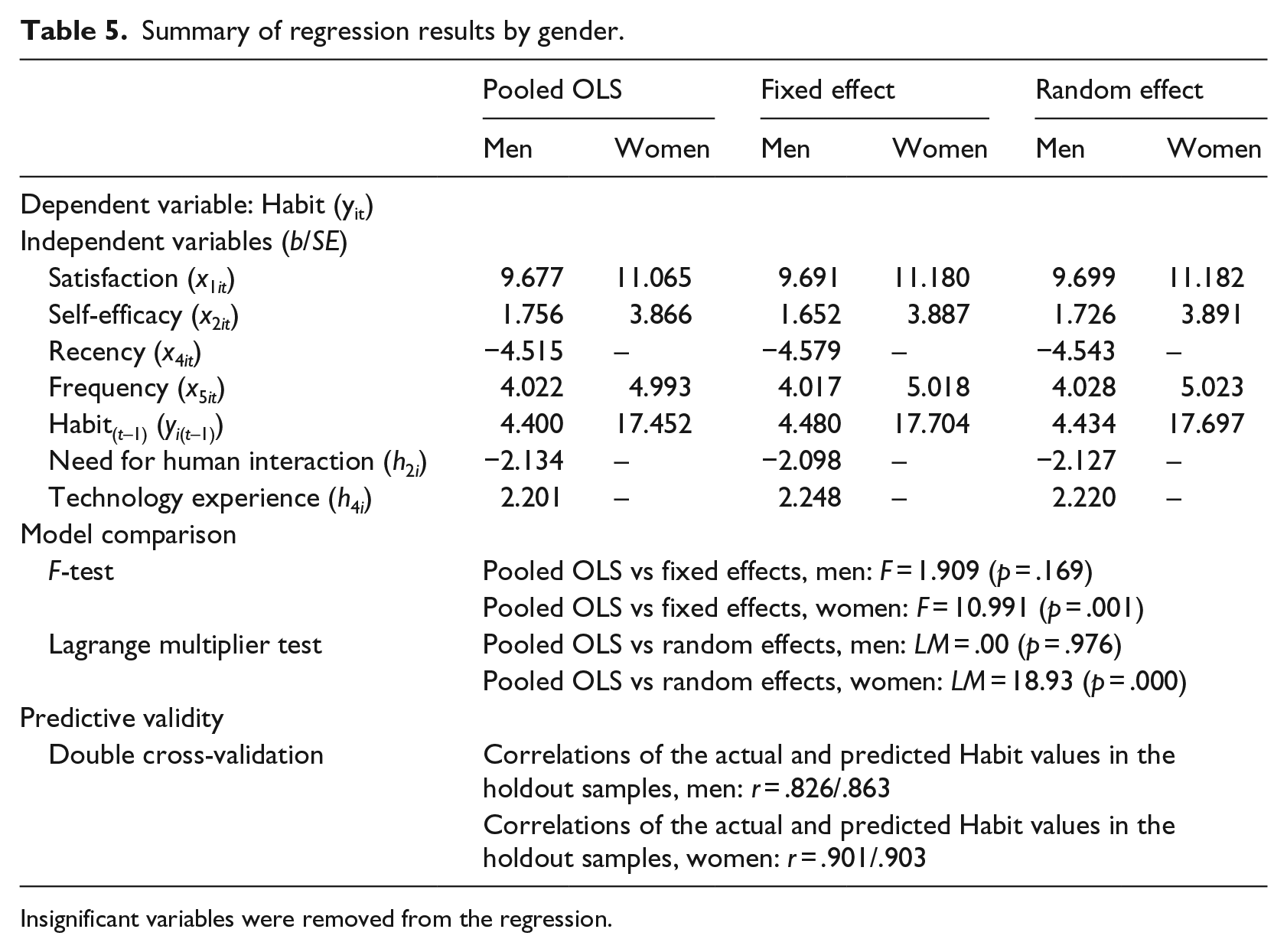
Insignificant variables were removed from the regression.
Across the three whole sample models (Table 4), accounting for the effects of unobserved time heterogeneity (fixed or random) improves overall model fit. The significant F-test (F = 12.544, p < .05) and Lagrange multiplier test (LM = 26.17, p < .05) confirm the appropriateness of the fixed/random effects model over the pooled OLS model. However, the pooled OLS model still fits the data well, as indicated by a significant F-value (F = 376.78, p < .05) and high adjusted R2 (adj. R2 = .794). Predictive validity is confirmed by the high correlations of the actual and predicted values in the holdout samples (r = .883/.889).
The effects of the six antecedent variables and five individual difference variables on habit remained highly consistent across the three models. Previous habit (yi(t–1)) is the most powerful predictor of current habit (b/SE > 15), followed by satisfaction (x1it; b/SE around 13.8 across all three models), then frequency (x5it), self-efficacy (x2it), and recency (x4it), all of which have significant positive impacts on habit formation (p < .05). That is, positive satisfaction, a feeling of confidence, frequent use of an SST, and more recent uses of the SST all help increase habit formation. Length (x3it) is the only antecedent with no influence (p > .05 in all three models). Thus, the models highlight the carryover effect of habit and provide robust support for the predicted effects, with the exception of length. Among the five individual difference variables, need for human interaction (h2i) is the sole significant variable, with a negative impact on habit (p < .05). That is, individual heterogeneity is significant only through the effect of need for human interaction, and the more a customer enjoys interacting with service staff during the service encounter, the less the use of the SST is likely to become habitual.
Prior to the subgroup analysis by gender, a series of chi-square tests were conducted to determine whether men and women differ in other demographics, such as age or education. The results indicate a similar age distribution (p = .068), although men and women differ in their education levels (p = .002), such that men have more education on average than women in this sample. Education thus may be a confounding factor, and any gender differences that arise in the subgroup analysis require cautious interpretation.
The subgroup regression analysis reveals some such differences (Table 5). As indicated by the F- and Lagrange multiplier tests, the pooled OLS model is preferable for the male group, whereas the fixed/random effect models work better for the female group. Unobserved time heterogeneity is significant for women but not for men. The results also indicate strong differences in terms of the number and strength of the antecedents that affect habit. For male respondents, five antecedent variables (satisfaction, self-efficacy, recency, frequency, prior habit) and two individual difference variables (need for human interaction, technology experience) exert significant impacts on habit development; satisfaction is the most powerful determinant. For female respondents, habit instead depends on four antecedent variables (satisfaction, self-efficacy, frequency, prior habit), with prior habit as the most powerful, and none of the five individual difference variables exerted a significant impact.
5. Discussion
This study aimed to understand habitual SST usage. Using a consumer panel data set that tracked the use of the supermarket self-checkout SST over a 12-week time period, the econometric modeling approach investigated relationships between habit and key antecedents. The results from three panel regression models are highly consistent.
5.1. Summary of findings
The primary purpose of this study is to investigate the drivers of the development of an SST usage habit. This is to contribute to the literature by shifting the focus from initial adoption to repeated use. Five of the six antecedents (i.e. prior habit, satisfaction, self-efficacy, recency, and frequency) have significant positive effects on habit, with prior habit(t–1) as the most powerful. No prior studies examine the carryover effect of habit, because the use of cross-sectional data makes such an investigation unfeasible. This study makes a methodological contribution to habit research by examining prior habit in a longitudinal context. Habitual behaviors embody mental inertia and are difficult to suppress (Aarts and Dijksterhuis, 2000b; Jasperson et al., 2005), so a positive carryover effect of habit seems reasonable. The panel data for this study demonstrate that prior habit level significantly affects the level of a current habit, more so than any other factor. Therefore, habit forms cumulatively, and quicker formation leads to a major influence. Although this finding is not very surprising, it provides important implications for managers (see Section 5.2).
In line with previous research (e.g. Limayem et al., 2007), satisfaction has an important role in habit development. The use of an SST likely becomes habitual if customers have a satisfying SST experience. Although prior studies typically ignore self-efficacy, the present research context suggests including this determinant, and the results confirm that higher self-efficacy belief is associated with increased levels of confidence using SSTs, which promotes habit formation (Van Beuningen et al., 2009; Zhao et al., 2008). Past behavior, in terms of both frequency and recency, is significant, but the length effect is not. The more frequently and recently a customer uses an SST, the more likely that SST use becomes habitual, consistent with previous findings (Bagozzi and Warshaw, 1990; Verplanken, 2006). The insignificant length effect might reflect the specific research setting, where the SST is just one of multiple service delivery options for customers. A customer might try the self-checkout SST a few times but then return to the traditional checkout counter, in which case the customer exhibits a long length but no habit of SST use. A length effect might emerge in settings in which the SST is the only service delivery method available.
This study included five individual difference variables to account for observed individual heterogeneity. The results show that only the need for human interaction has a significant—and in this case negative—effect on habit. The more a customer values the interpersonal aspect of the service encounter, the greater the preference for a non-SST service if possible, and the less a habit of using the SST service develops. The insignificance of the other four individual difference variables is not unexpected; previous research usually treats personal characteristics as control variables or moderators (e.g. Dabholkar and Bagozzi, 2002; Reinders et al., 2008), and their influences appear implicit and indirect.
The second purpose of this study is to investigate potential gender differences in habit development. Subgroup analysis demonstrates that the driving forces of habit are more complicated for men than for women, thus providing further insights into habit development in the context of SST use. Previous habit, satisfaction, self-efficacy, and frequency all affect habit for both genders, although the strength of these impacts varies. In particular, previous habit has a greater impact on women, which suggests that women’s habits form in a more cumulative manner, whereas men’s habits emerge in a usage-specific manner (similar to the difference between transaction-specific and cumulative satisfaction). This difference might also explain partially why the time effect is significant for women but not men. If women’s habits depend more on prior habit levels, this time-dependent variable changes, whereas men’s less cumulative habits may be relatively invariant. Self-efficacy also exerts a greater impact among female respondents, such that women exhibit less confidence in using technologies and derive habits more on the basis of perceptions of ease of dealing with the situation (Elliott and Hall, 2005; Venkatesh and Morris, 2000). Furthermore, the recency effect applies to men but not women, perhaps because women shop in supermarkets more frequently and have more chances to use these SSTs. The lesser variation in women’s recency scores then could result in a smaller recency effect, as indicated by the panel data. Men’s personal dispositions also have a strong influence: general technology experience enhances habit, whereas need for human interaction negatively affects habit. The former positive impact implies that for men, past experiences with similar technologies translate into favorable attitudes toward the focal SST and facilitate habit development (Wang et al., 2012). None of the five individual difference variables had a significant effect on female respondents. Women appear to rely primarily on experience with the focal SST to develop a usage habit; product-norm experiences and personal dispositions do not contribute.
5.2. Managerial implications
The results indicate a strong impact of prior habit, which is good news suggesting that a habit, once developed, strengthens and reinforces itself through a carryover effect. The implication for managers is that they should seek to facilitate initial habit development. The findings further suggest that this could be achieved through influencing satisfaction, self-efficacy, frequency, and recency. To increase customers’ confidence in using SSTs and provide a satisfying experience, current technologies should be improved to become more user-friendly and fun. When customers find the use of the SST easy and enjoyable, they will feel more confident and satisfied, which will increase the likelihood of habit formation. Specifically, in terms of self-efficacy, in the design stage, managers should pay special attention to “ease of use” through pretesting among target customers. Clear step-by-step instructions should be built into the SST. During the implementation stage, human assistance should be provided to help customers overcome technology anxiety and build confidence in their ability to use the SST. Retail banks have successfully used “greeters” in branches to instruct customers on how to use new technology interfaces, and some supermarkets have adopted this practice. Many airlines also have an assistant around to help with the check-in through the self-check-in kiosks at the airport. In-store promotion of SST use may be effective for strengthening frequency and recency effects, by promoting instant uses every time a customer visits the supermarket. This method may be especially useful during the launch period to encourage initial trial. A small gift (e.g. reusable grocery bag) could encourage checkout through the SST. A more extreme measure might force customers to use the SST by offering only SST service or a price differentiation between SST and non-SST service options. When customers must use the SST, habits likely develop. However, this measure demands caution, because forcing customers to use SSTs may have negative outcomes (Reinders et al., 2008).
However, the strong carryover effect of habit also suggests that radical behavioral changes can make prior habits irrelevant, which has implications for service providers that plan to upgrade their technologies. Occasional technological improvements are normal and necessary to enhance customers’ experience. However, a radical change to an SST creates the risk of disrupting customers’ already formed usage habits. In this situation, customers will regard an upgraded SST as a new technology, for which prior experience may not facilitate usage. Then, customers need extra time and effort to become accustomed to the new technology. Thus, a gradual improvement may be a better and safer strategy. Ensuring that the improved technology does not differ radically to the old one, from customers’ perspective, can help maintain customers’ already formed usage habits.
5.3. Limitations and further research
One limitation of this study is that it focuses on the SST option only and neglects the existence of alternative options. However, today many service firms provide multiple service channels and SST is just one of them. Therefore, it would be interesting to investigate how situational factors and customer experience with the alternative service option might impact customers’ habit of using the SST option. For example, would a customer still use a self-checkout by force of habit when there was a long queue there? Or would the customer break the habit and use the alternative checkout?
Accounting for unobserved heterogeneity is critical in many choice-modeling studies (e.g. Ailawadi et al., 1999; Harris and Uncles, 2007). This study incorporates heterogeneity by estimating a fixed effect model and a random effect model. However, the structure of the panel data and the goal of investigating the carryover effects of habit required a time effect model, rather than a group (individual) effect model. Therefore, this study fails to account for unobserved individual heterogeneity, although various measures seek to incorporate observed individual heterogeneity in the model (e.g. subgroup analysis by gender and five individual difference variables). Additional research should adopt a longer panel data set with more cross sections to facilitate the estimation of a fixed and/or random group effect model and account for unobserved individual heterogeneity.
Another possible extension could estimate a model with alternative specifications of the dependent and independent variables. This study focused primarily on the drivers of habit in absolute terms over time. However, rather than using magnitude, researchers could investigate changes in habit over time, to identify the drivers of such changes. That is, instead of using habit t as the dependent variable and satisfaction t , self-efficacy t , and so forth as independent variables, a new study could specify the dependent variable as (habit t − habitt–1) and the independent variables as (satisfaction t − satisfactiont–1), (self-efficacy t − self-efficacyt–1), and so on. In this situation, the relationships between variables may be complex and nonlinear, and an alternative model specification may be required.
Footnotes
Appendix
Construct correlations.
| Satisfaction (x1i1) | Self-efficacy (x2i1) | Habit (yi1) | Length (x3i1) | Recency (x4i1) | Frequency (x5i1) | |
|---|---|---|---|---|---|---|
| Satisfaction (x1i1) | 5.27 (1.50) | |||||
| Self-efficacy (x2i1) | .504** | 5.17 (1.84) | ||||
| Habit (yi1) | .708** | .559** | 4.50 (1.74) | |||
| Length (x3i1) | −.053 | .088* | .035 | 9.69 (13.80) | ||
| Recency (x4i1) | −.283** | −.179** | −.340** | .265** | 1.10 (2.94) | |
| Frequency (x5i1) | .140** | .226** | .281** | .522** | −.071 | 8.89 (15.99) |
| Satisfaction (x1i2) | Self-efficacy (x2i2) | Habit (yi2) | Length (x3i2) | Recency (x4i2) | Frequency (x5i2) | |
| Satisfaction (x1i2) | 5.25 (1.39) | |||||
| Self-efficacy (x2i2) | .470** | 5.28 (1.74) | ||||
| Habit (yi2) | .779** | .536** | 4.55 (1.83) | |||
| Length (x3i2) | −.021 | .142* | .017 | 16.40 (14.88) | ||
| Recency (x4i2) | −.290** | −.180** | −.401** | .129* | 2.34 (4.25) | |
| Frequency (x5i2) | .329** | .218** | .458** | −.086 | −.358** | 5.45 (6.62) |
| Satisfaction (x1i3) | Self-efficacy (x2i3) | Habit (yi3) | Length (x3i3) | Recency (x4i3) | Frequency (x5i3) | |
| Satisfaction (x1i3) | 5.26 (1.43) | |||||
| Self-efficacy (x2i3) | .562** | 5.36 (1.74) | ||||
| Habit (yi3) | .794** | .563** | 4.78 (1.85) | |||
| Length (x3i3) | −.013 | .167* | .008 | 21.61 (13.57) | ||
| Recency (x4i3) | −.297** | −.241** | −.439** | .169** | 2.42 (4.92) | |
| Frequency (x5i3) | .309** | .184** | .439** | −.110 | −.334** | 5.56 (7.02) |
| Technology anxiety (h1i) | Need for human interaction (h2i) | Behavioral inertia (h3i) | Technology experience (h4i) | Personal innovativeness (h5i) | ||
| Technology anxiety (h1i) | 2.74 (1.54) | |||||
| Need for human interaction (h2i) | .236** | 4.76 (1.46) | ||||
| Behavioral inertia (h3i) | .411** | .410** | 3.16 (1.71) | |||
| Technology experience (h4i) | −.396** | −.027 | −.115** | 5.19 (1.41) | ||
| Personal innovativeness (h5i) | −.297** | .002 | −.048 | .664** | 4.68 (1.43) | |
Mean (standard deviation) displayed on the diagonal.
p < .05; **p < .01
Final transcript accepted 25 February 2016 by Ashish Sinha (AE Marketing).
Funding
The author(s) received no financial support for the research, authorship, and/or publication of this article.