







Abstract
Evidence-based management (EBM) is a framework well-suited to improving decision-making amid the deluge of available information. However, little is known about the enablers of EBM, particularly with regard to organisational-level factors. Drawing on the absorptive capacity (AC) literature, we identify novel multi-level factors that are likely to enable EBM implementation. Specifically, we review the empirical literature on antecedents of AC and use meta-analyses to determine the relationship between these antecedents and AC. Findings highlight organisational-level enablers of EBM including information system capabilities, transformational leadership, available resources and collaboration. Individual-level enablers include prior related knowledge, motivation for learning and employee empowerment. We contribute to the literature by illustrating the importance of organisational-level enablers for EBM, advancing a research agenda on EBM and providing recommendations for practitioners.
JEL Classification:
1. Introduction
Information technologies have resulted in unprecedented amounts of data and relevant information that managers can collect and rely on to inform decision-making (Knippenberg et al., 2015). In parallel, rapidly growing fields such as artificial intelligence and machine learning are increasingly assisting in complex pattern recognition, facilitating a trend towards more informed decision-making across a wide range of applications (Jarrahi, 2018; Jordan and Mitchell, 2015; O’Leary, 2013). However, information technologies have also resulted in the need to filter a huge amount of irrelevant or misleading information. These changes present organisations with an opportunity to capture additional value and gain competitive advantage, provided they can cope with unprecedented information processing demands (Cheatham et al., 2019; Gupta and George, 2016; World Economic Forum, 2018). Making informed and accurate decisions will require formulating the right questions to collect and evaluate a growing body of evidence.
To improve decision-making and increase the chances of desired outcomes amid such complexity, scholars have proposed the evidence-based management (EBM) framework, whereby managers engage in conscientious, explicit and judicious use of the best available evidence to make decisions (Barends and Rousseau, 2018; Briner et al., 2009). Since its inception, the literature on EBM has mostly expanded through conceptual papers, advocacy articles and teaching related studies to help address the research-practice divide (Rynes and Bartunek, 2017). Building on this important work, there is little empirical research shedding light on the conditions that enable EBM. Research from the fields of medicine and psychology provide initial insights into individual-level factors that may foster EBM (e.g. Michie et al., 2005; Smith and Lilienfeld, 2015), yet organisational-level enablers have mostly been overlooked. Recent research in management has started to demonstrate that, in addition to these individual factors, organisational factors such as culture also impact EBM and are potentially more powerful predictors (Criado-Perez et al., 2020).
This article aims to highlight insights from organisational research regarding potential enablers of EBM and propose a future research agenda for this important framework. To do so, we will explore the construct of absorptive capacity (AC), which is one of the most influential constructs used to understand how organisations leverage available information within their environment (Camisón and Forés, 2010). As we will demonstrate, AC presents similarities with many key elements of EBM, and thus, we identify ways in which knowledge about enablers of AC could be applied to enhance EBM research and practice. Specifically, we conduct a literature review of the predictors of AC and determine their aggregate correlation with AC via a meta-analysis to extract evidence-based themes that EBM research can build upon. In this way, we provide a research agenda for future research on EBM and identify factors that can help organisations make the most effective use of evidence in the twenty-first century.
2. Decision-making in the era of information
The growing volume of information made available through computer technology and the Internet has revolutionised the nature of management decision-making across a wide range of industries. To illustrate this change, consider two examples from sectors that have traditionally differed in their dependency on timely information: supply chain management and the built environment. A supply chain manager is responsible for orchestrating the timely acquisition and movement of goods to facilitate an efficient production and delivery of end products. Information about demand, movement of stock, resource availability or the location of bottlenecks is essential to streamline an organisation’s supply chain. Not so long-ago managers in this position would struggle to gather this important data. Fast forward to today and the tables have turned. Enterprise resource planning (ERP) systems and radio frequency identification have enabled supply chain managers to monitor and forecast the demand for goods, movement of stocks, and predict the future workload to size their organisation accordingly. Furthermore, the development of communication technologies, artificial intelligence and the use of big data analytics are providing managers with the opportunity to benefit from unprecedented volumes of information, giving rise to a new era of industrial development (Lu, 2017; Roblek et al., 2016; Rossit et al., 2019). Yet, the vastness of available data can often be overwhelming and detrimental (Schwartz and Ward, 2004; Whelan and Teigland, 2013). Thus, selecting what information to focus on, and how to discern its meaning and validity is increasingly important.
The second example is a manager in the built environment sector. Until recently, building designers and facility managers had little information on how buildings were used. Learning from the performance of previous designs or fine-tuning the efficiency of an operational building was an arduous and unusual task (Duffy, 2012). Today the use of sensors and building management systems can give detailed real time occupancy information (e.g. energy use, indoor environment quality, usage of rooms and desks), providing an abundance of information related to the buildings performance and behavioural consequences (Duarte et al., 2013). If used wisely, this newly available data can help narrow the gap between the predicted and actual performance of buildings, as well as shed light on the complex relationship between design features and occupants’ well-being and satisfaction (Göçer et al., 2015). Built environment managers who capitalise on this opportunity can improve operating costs, employees’ well-being and productivity through an efficient customisation and a deeper level of expertise in their field.
The impact of the growing volume of information goes beyond supply chain management or the built environment and impacts most management roles across the organisation (e.g. HR, strategy, sales, finance). As a result, most managers will no longer struggle to collect information, but instead will have so much within reach that being selective and critical in making sense of the available evidence will be increasingly important. The vast amount of information available may look homogeneous to the untrained eye in terms of validity and applicability. In fact, nothing could be further from the truth. Management fads, fake news, and unfounded advice abound and intermingle with rigorous and trustworthy evidence. The validity of the information used to make strategic decisions is likely to influence whether the organisation achieves or steers away from competitive advantage. Furthermore, contradictory information stemming from different sources can place decisions-makers at a difficult crossroad, creating uncertainty that motivates them to rely on intuitive judgements instead (Sadler-Smith and Shefy, 2004). Hence, to benefit from the acquisition and exploitation of the available knowledge, managers must be able to discern weak from strong evidence to focus on leveraging the latter.
3. EBM: insights from AC
The EBM literature provides a framework to help practitioners navigate through the available information and make decisions based on the best available evidence. Barends and colleagues (Barends et al., 2014; Barends and Rousseau, 2018) define EBM as the judicious and conscientious use of evidence from multiple sources. It comprises the six following steps:
Asking: translating a practical issue or problem into an answerable question.
Acquiring: systematically searching for and retrieving the evidence.
Appraising: critically judging the trustworthiness and relevance of the evidence.
Aggregating: weighing and pulling together the evidence.
Applying: incorporating the evidence into the decision-making process.
Assessing: evaluating the outcome of the decision taken.
The purpose of the framework is to provide managers with a method to question their assumptions with evidence, apply this evidence to the managers’ specific context and learn from the implemented solutions (Barends et al., 2014; Briner et al., 2009). Despite the growing body of research on EBM, recent reviews of the EBM literature highlight a shortage of empirical work on the process of how to implement EBM (Rousseau and Gunia, 2016; Rynes and Bartunek, 2017). That is, little is known about what facilitates EBM implementation. Rousseau and Gunia (2016) started to address this gap by reviewing related literature on enablers of evidence-based practice in the fields of medicine and allied health. Evidence-based practice originated with the goal of training medical professionals to independently update their knowledge through the systematic use of scientific evidence (Barends and Briner, 2014). EBM evolved from this literature, thus relying on the best available evidence to make decisions, although it differs with regard to the context and nature of those decisions. Rousseau and Gunia (2016) drew on the ability–motivation–opportunity (AMO) framework to provide a theoretical mechanism to review the literature on evidence-based practice, incorporating multidisciplinary perspectives. Their core insights included the importance of foundational competencies (abilities) to support EBM adoption, the motivation to do so and the required support (opportunity) to overcome its barriers. As expected for a literature in its formative stages, there was a call for more empirical research, and of particular note and relevance for this article, a deeper understanding of organisational factors driving EBM was highlighted as critical.
Building on Rousseau and Gunia’s (2016) review paper, we draw on a different literature to identify multi-level factors that may facilitate EBM adoption. We ventured beyond the evidence-based practice literature and scanned fields of research such as organisational learning (e.g. Argote and Miron-Spektor, 2011), information seeking behaviour (e.g. Case and Given, 2016), behavioural decision research (e.g. Moore and Flynn, 2008) and human factors research (e.g. Stanton et al., 2017). Heeding calls for EBM to address organisational-level factors, we focus on AC because it examines the process through which firms identify and utilise knowledge in a way that is beneficial to organisational outcomes (Song et al., 2018). Next, we unpack the similarities and differences between EBM and AC to highlight why it is important to extrapolate learnings from AC since it is a more mature body of literature.
3.1. Comparison of EBM and AC
AC refers to the ability to identify, accumulate, process and use valuable new knowledge from external sources (Cohen and Levinthal, 1990; Van Doorn et al., 2017; Zahra et al., 2009). Terminology for AC dimensions or steps differ (Lane et al., 2006; Lewin et al., 2011; Todorova and Durisin, 2007; Zahra and George, 2002), and while there has been some debate over the different dimensions within AC, scholars most typically use the construct of AC and pay less attention to the process or dimensions (Song et al., 2018; Volberda et al., 2010). To address these issues, Song et al. (2018) argued there are three comprehensive dimensions of AC: absorptive effort, resembling the function of a radar to search for and acquire valuable external knowledge; absorptive knowledge base, to understand, adapt and exploit the acquired knowledge; and absorptive process to facilitate knowledge diffusion within the organisation.
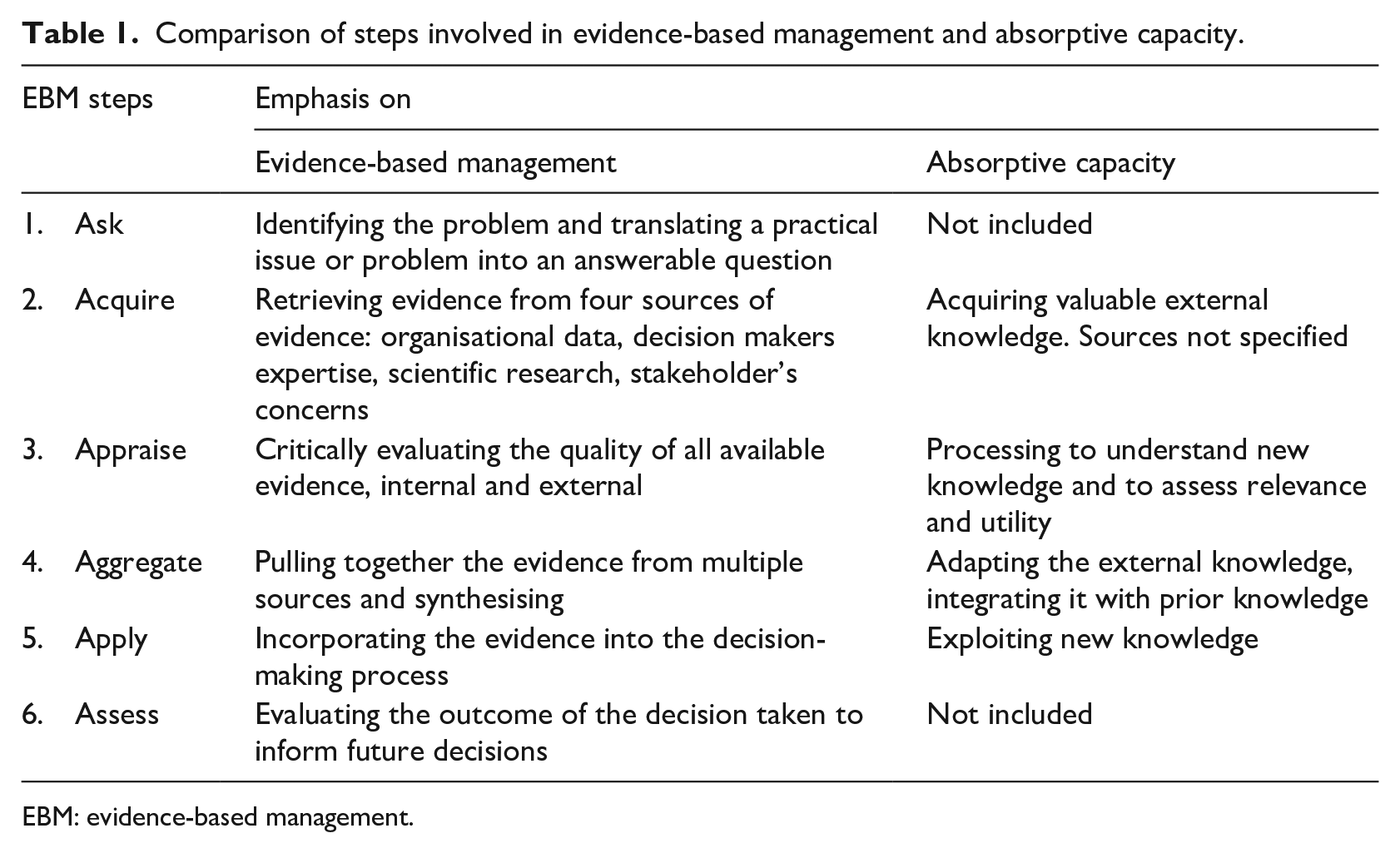
The constructs of AC and EBM are associated with different streams of research and to our knowledge have never been juxtaposed or combined. However, a close look at the building blocks of both constructs reveals many similarities. As illustrated in Table 1, steps 2 to 5 of the EBM framework parallel dimensions of AC. Specifically, there are four commonalities. First, both EBM and AC involve the acquisition and use of valuable knowledge with the aim of pursuing beneficial organisational outcomes. Second, EBM considers appraising quality of evidence collected (Barends and Rousseau, 2018), which is similar to how AC emphasises recognition of value during knowledge acquisition and consequent processing to assess relevance and utility (Lane et al., 2006; Song et al., 2018). Third, to synthesise and contextualise new knowledge, both EBM and AC ‘aggregate’ the available evidence (Barends and Rousseau, 2018) or ‘adapt’ the acquired knowledge by combining it with the accumulated knowledge held by the firm (Song et al., 2018). Fourth and finally, both EBM and AC describe the application or exploitation of the acquired knowledge as a subsequent step.
Comparison of steps involved in evidence-based management and absorptive capacity.
EBM: evidence-based management.
As seen in Table 1, the similarities between these two constructs are such that EBM appears to comprise all of the steps involved in AC, as well as two additional components, steps 1 and 6. In step 1, EBM includes the identification of a problem as an important starting point preceding the search for evidence. This stems from the framework’s conceptualisation as a general approach towards solving organisational problems and making decisions to increase the likelihood of the desired outcomes. However, AC focuses on the capability of a firm to learn from its external environment and exploit that novel knowledge to innovate, without necessarily focusing on an identified problem. In addition, EBM focuses on the collection of evidence from multiple internal and external sources and consequent aggregation (Barends et al., 2014). AC implies a similar process while focussing on acquiring new external knowledge and subsequently adapting it when combined with prior (i.e. internal) knowledge (Song et al., 2018; Zahra and George, 2002). In step 6, EBM underscores the importance of assessing the outcomes of the implemented solutions to generate and disseminate additional knowledge. Although Song et al. (2018) describe the dissemination of acquired knowledge as part of AC, none of the proposed definitions of AC refer to the collection and dissemination in terms of a feedback loop. Overall, our comparison of EBM and AC underscores some nuances regarding terminology and scope, yet also displays many similarities.
In summary, AC provides the organisational nuances which, we argue, can enrich the EBM literature. Whereas EBM is generally described as an individual-level construct adopted by managers, AC is a multi-level construct that has mostly been measured at a firm level to focus on organisational issues (Volberda et al., 2010). This difference is beginning to fade as researchers who study AC and its antecedents are more recently also focusing on the individual or team levels (e.g. Lowik et al., 2017; Ojo and Raman, 2016). We see this as an opportunity to broaden the current horizons of the EBM literature. As empirical research on the enablers of EBM is scarce, the AC literature provides a list of empirically supported enablers that could provide clues to the factors that enable EBM. From this perspective, we draw upon the construct of AC and empirical research on its multi-level antecedents to complement the EBM literature and highlight promising research avenues.
4. Antecedents of AC: a review and a meta-analytic consolidation
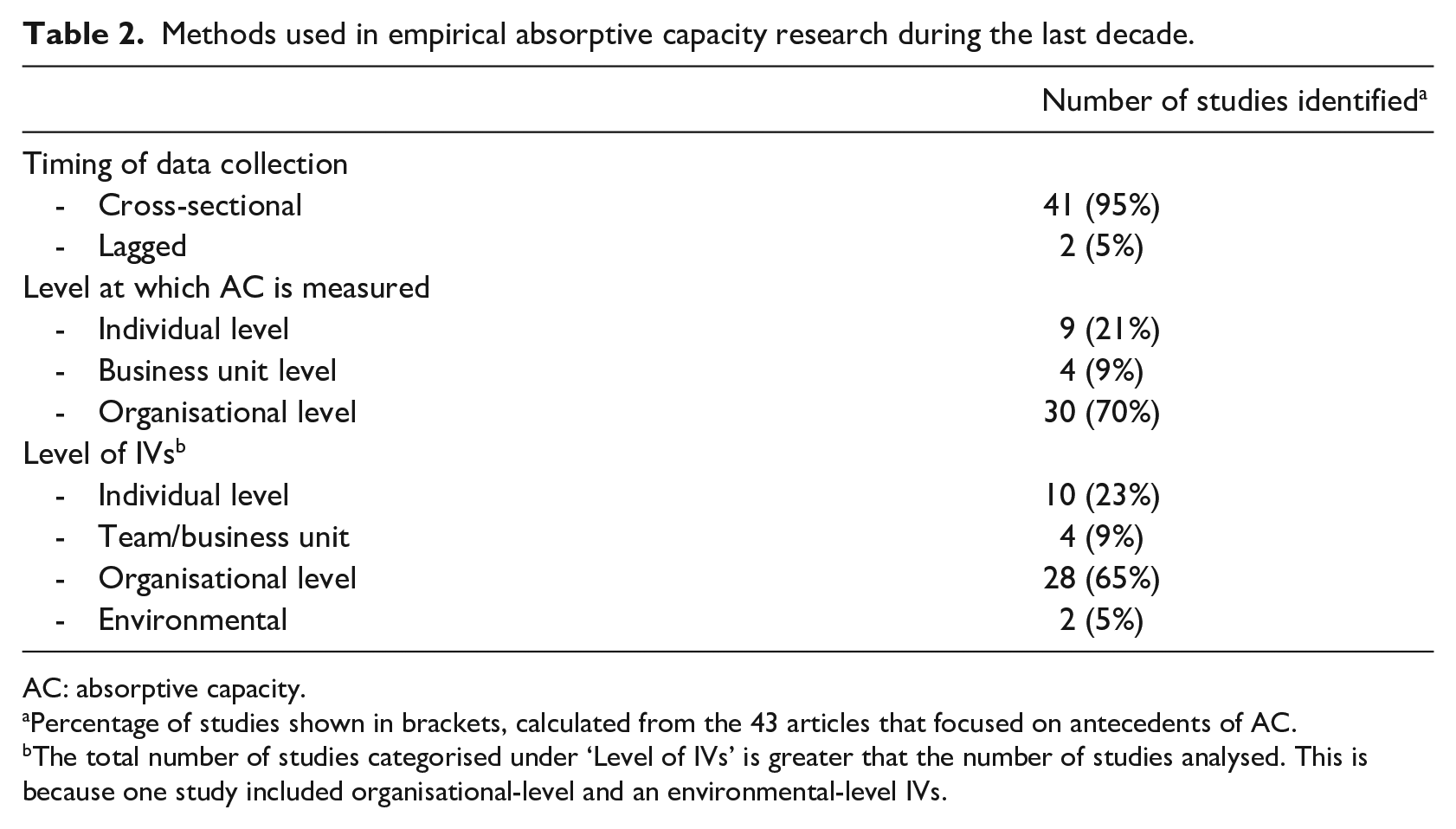
Volberda et al. (2010) reviewed the theoretical and empirical studies of AC to identify the conceptual gaps within the literature. The authors found that organisational- and individual-level antecedents have been mostly neglected and called for more empirical research on ‘macro-antecedents’ and ‘micro-antecedents’ of AC. Since then, more scholars have studied predictors of AC, but we have not found a systematic review of these findings. For example, Song et al.’s (2018) meta-analysis synthesises the empirical findings yet only covers the outcomes of AC. Therefore, to take stock of the empirical evidence regarding the antecedents of AC, we performed a literature review and drew on empirical studies from the last 10 years that examined the antecedents of AC in a management context. We searched for articles that included the term ‘absorptive capacity’ in the abstract and short-listed those including predictors of AC. We used the ProQuest and EBSCO databases to search for papers that met our criteria across management journals. This yielded a total of 95 articles which were scanned for relevance and coded for the following criteria: (1) how AC was operationalised; (2) empirically supported antecedents of AC; (3) whether these antecedents were individual, organisational or about the environment external to the organisation; and (4) whether data collected were cross-sectional or lagged. Out of the 95 articles initially identified, 43 tested for antecedents of AC. Table 2 provides a high-level summary of the included literature.
Methods used in empirical absorptive capacity research during the last decade.
AC: absorptive capacity.
Percentage of studies shown in brackets, calculated from the 43 articles that focused on antecedents of AC.
The total number of studies categorised under ‘Level of IVs’ is greater that the number of studies analysed. This is because one study included organisational-level and an environmental-level IVs.
Given AC is a concept from the strategy literature, empirical research on the antecedents of AC paid most attention to constructs at the organisational level. In fact, 70% considered and measured AC at the organisational level, and 65% of the studies focused on organisational-level antecedents. In contrast, less attention has been paid to antecedents at the individual level (23% of studies), team level (9%) and from the external environment (5%). What was reassuring from a construct validity perspective for the purpose of drawing parallels between AC and EBM, is that most articles operationalised AC through self-reported scales that built on seminal conceptual papers (e.g. Cohen and Levinthal, 1990; Todorova and Durisin, 2007; Zahra and George, 2002) to measure the ability to absorb, transform and exploit valuable external knowledge. Only 9% of the included studies relied on narrower proxies to measure AC such as the perceived internationalisation of innovation within a firm (Schubert et al., 2018), or through objective measures such as R&D expenditure and number of employees with bachelor degrees (Kostopoulos et al., 2011). Given most studies utilised measures with a comprehensive operationalisation of AC that reflect many aspects of EBM – the collection, evaluation and use of valuable knowledge – this enables us to explore the application of these findings to the EBM framework.
4.1. Consolidating the identified antecedents through a meta-analytic procedure
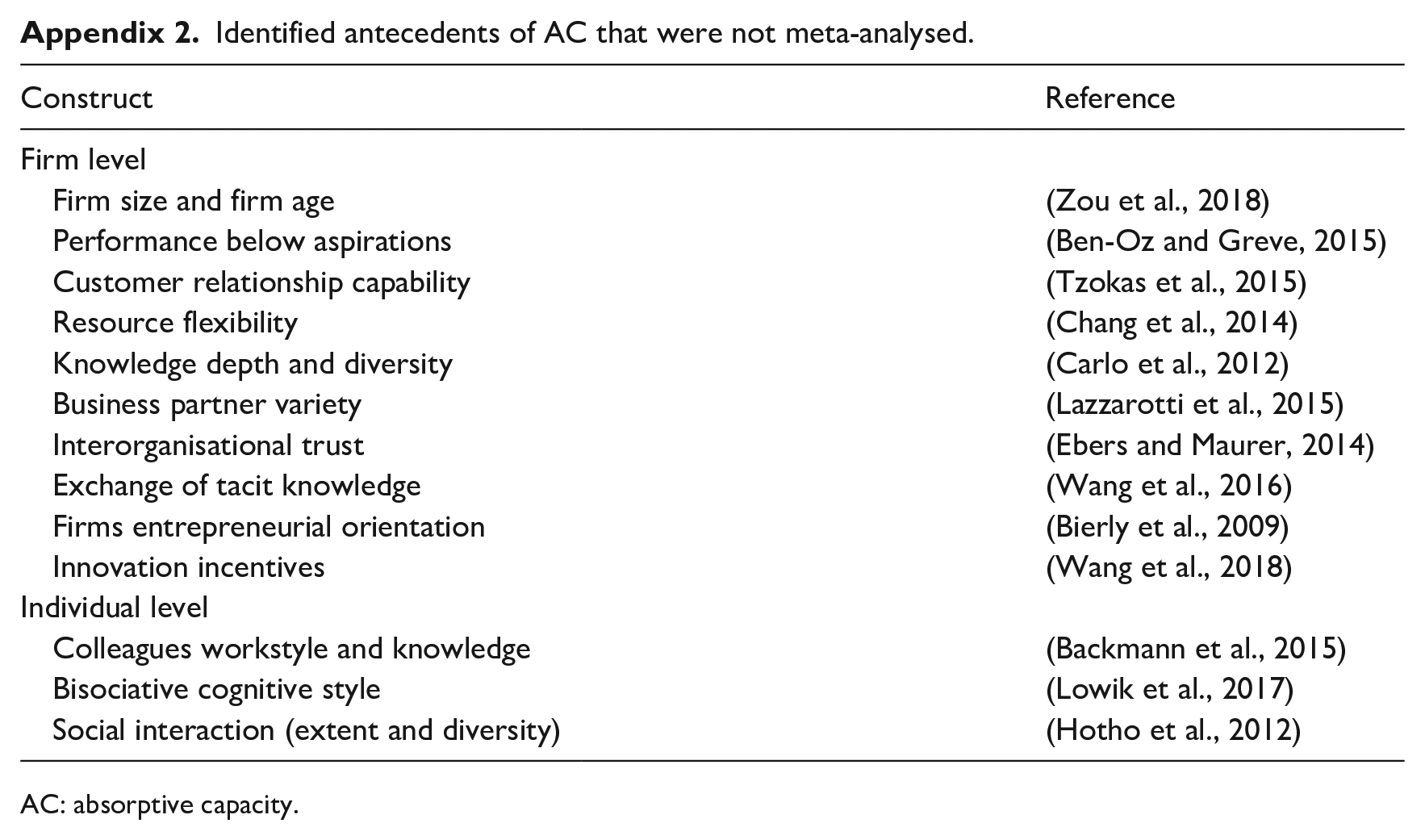
Our review identified over 70 antecedents of AC, yet this broad list of predictors did not consider the supporting evidence for each antecedent, nor does it consider predictive validity. Furthermore, many of the identified antecedents were comprised of closely related constructs (e.g. employee collaboration and teamwork); some of these antecedents were supported by several studies, while others were only supported by anecdotal evidence. Rather than provide an exhaustive list of predictors without evaluating their relevance, we aimed to identify the most viable antecedents of AC and their estimated effect sizes through a meta-analytic procedure. To do this, we condensed the list of potential antecedents by aggregating across highly similar constructs. Two coders – the first author and an independent researcher without knowledge of the purpose of the research – performed this aggregation by obtaining definitions of each antecedent from the original sources, then by matching antecedents with highly similar definitions under an overarching construct. For example, external knowledge inflows, interacting with the external environment, external openness and search breadth were grouped under the overarching construct labelled ‘external knowledge inflows’. This process resulted in an inter-rater reliability of 92%. Disagreements were resolved through further discussion after viewing scale items. Next, we selected the constructs that were measured in more than one study and calculated their meta-analytic correlation coefficients with AC, correcting for sampling error and measurement error. This procedure provides unbiased estimates of the relation between two constructs and helped us highlight the more promising predictors of AC (Hunter and Schmidt, 2004). Table 3 provides a summary of the results ranking the identified predictors based on their aggregated correlation with AC. The studies used to meta-analyse the constructs are provided in Appendix 1, followed by the list of constructs that were only identified in one study and therefore dropped from the analysis in Appendix 2.
Meta-analytic relationships between absorptive capacity and its antecedents.
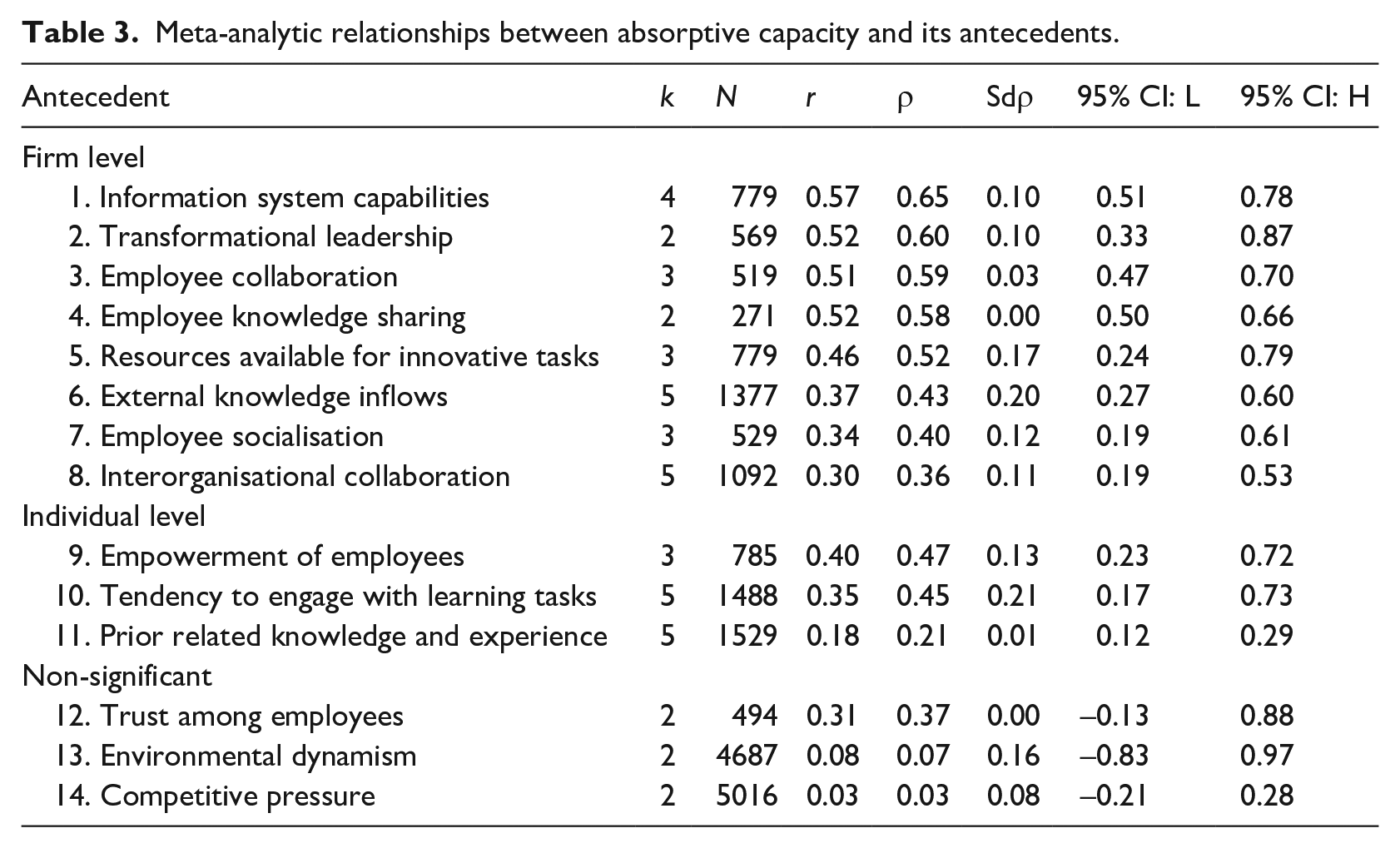
Effect sizes were interpreted based on Cohen (1992) and the recommendations by Bosco et al. (2015) for relations involving behaviour. Thus, we consider 0.35 to be a strong correlation, 0.2 to be moderate and 0.1 to be small. Out of the 15 constructs included in our meta-analysis, 11 resulted in significant aggregate correlations with AC ranging from moderate (ρ = 0.21) to large (ρ = 0.65). However, the constructs of trust, environmental dynamism and competitive pressure were not significantly associated with AC when aggregating the corresponding data. We discuss each of the constructs in relation to AC and EBM in the following paragraphs.
5. Mapping the antecedents of AC on to the EBM framework
We now analyse the most promising antecedents of AC (Table 3). Since the aim is to extrapolate how these findings apply to EBM, we examine the results about AC through the lens of EBM. We draw on Rousseau and Gunia (2016) as the most current and comprehensive review of enablers of EBM 1 and then examine the 11 constructs identified as significant predictors of AC in conjunction with the EBM enablers identified in the review paper.
5.1. Individual level
The review by Rousseau and Gunia (2016) concludes that ‘we have good evidence that effective evidence-based practice adoption depends on the ability, motivation and opportunity of the individual practitioners involved’ (p. 40). The authors draw on multidisciplinary research to further elaborate on each of these elements. In relation to ability, three elementary skills for EBM are proposed as key enablers, albeit to our knowledge not yet empirically investigated: expertise in the domain, critical thinking skills and the functional skills to implement each of the steps involved in EBM. With regard to motivation to adopt EBM, Rousseau and Gunia (2016) draw on the Theory of Planned Behaviour (Ajzen, 1991) to propose that the perceived norms regarding EBM, perceived barriers to implement it and the individual’s attitude towards its practice will predict its practice. Indeed, the predictive power of Theory of Planned Behaviour is supported by recent empirical research on EBM (Criado-Perez et al., 2020). Finally, regarding the factors that may enable EBM under the umbrella of opportunity, Rousseau and Gunia (2016) draw on nursing and healthcare research to suggest the following enablers: autonomy and flexibility, psychological safety, leadership support, time availability, and a cross-disciplinary involvement in decision-making.
Our meta-analysis provides further support from the AC literature for enablers in relation to an individual’s ability, motivation and opportunity. With regard to ability, prior related knowledge and experience was moderately correlated with AC (ρ = 0.21). This antecedent of AC provides some preliminary evidence that expertise in the domain is relevant to EBM as a knowledge base is required to understand the problem at hand, seek appropriate evidence and appraise its quality (Carlo et al., 2012). Our meta-analysis also provides evidence that an individual’s motivation to engage in learning tasks is strongly associated with AC (ρ = 0.45). The consequences of such a predisposition are a heightened likelihood of engaging with information seeking and striving towards continuous improvement (Cazan and Indreica, 2014; DeShon and Gillespie, 2005), which would likely impact the adoption of EBM (Criado-Perez et al., 2020). Finally, in relation to opportunity, our findings support a positive effect of employees’ empowerment on increased AC (ρ = 0.47). Employees’ discretion and involvement in decision-making is therefore strongly associated with the degree to which they identify and apply new valuable knowledge, suggesting that empowerment may be an important predictor of EBM.
5.2. Organisational and environmental level
Individual decision-making by managers does not happen in a vacuum, it is influenced by the broader organisational and environmental context (Johns, 2006; Kozlowski and Klein, 2000). As such, it is not surprising that managers implementation of EBM is also influenced by factors at the organisational and industry level (Criado-Perez et al., 2020). The only factors that Rousseau and Gunia (2016) identified in the literature as organisational-level enablers were organisational climate and leadership support, and importantly the evidence for the latter is particularly scarce and inconclusive (Reichenpfader et al., 2015). The authors concluded that little is known regarding organisational-level enablers and encouraged future research to draw their attention to this gap. The literature on AC provides extensive evidence supporting a wide range of organisational-level constructs as predictors of AC. Here, we will summarise the meta-analysis findings for higher level constructs related to AC in order from strongest to weakest.
Information systems capabilities – the firm’s ability to scan environments, access relevant information and manage knowledge – were identified through our meta-analysis to have the highest correlation (ρ = 0.65) with AC. This finding indicates the important role that information systems play in enabling an organisation to collect, store and share knowledge, permitting its exploitation, all of which are likely to be essential for an effective adoption of EBM.
Transformational leadership was also strongly correlated with AC (ρ = 0.60). This is consistent with the Rousseau and Gunia’s (2016) proposition that leadership support is important for EBM. Transformational leadership involves intellectual stimulation and encouraging followers to question long-held assumptions (Bass et al., 2003), both of which would encourage teams and individual employees to question their practices and seek the best available evidence.
An additional set of constructs related to collaboration and knowledge sharing were also identified as being strongly related to AC in the meta-analysis. These included employee collaboration (ρ = 0.59), knowledge sharing within the organisation (ρ = 0.58) and socialisation (ρ = 0.40). Collaborating and sharing knowledge across departments facilitates the identification and application of relevant knowledge and evidence across an organisation, thus are also likely to be relevant for EBM. Our review also identified constructs related to the collaboration and knowledge sharing with stakeholders outside the organisation as possible predictors of AC. External knowledge inflows and interorganisational collaboration were both strongly related to AC (ρ = 0.43 and ρ = 0.36, respectively). Both constructs provide ways to learn from the external environment, a fundamental requirement for both AC and EBM. This finding also illustrates that EBM research may need to develop domain knowledge of organisational and environmental enablers, including how to integrate insights from industry and wider level influencers.
Finally, resources available for innovative tasks were also strongly related to AC (ρ = 0.52). The firm’s ability to assign resources to novel value-creating opportunities impacts the capability employees have to identify and exploit innovative solutions (Bierly et al., 2009; Burcharth et al., 2015; Chang et al., 2014). Similar to AC, EBM adoption is likely to require available resources to think innovatively, identifying alternative solutions and experimenting to adapt them to their context (Tucker et al., 2007).
Our review identified additional organisational enablers of AC that were only included in one study, thus could not be included in our meta-analysis of AC. For example, customer relationship capability, flexibility in resource allocation and innovation incentives were found to have a positive significant effect on AC (Chang et al., 2014; Tzokas et al., 2015; Wang et al., 2018). Similarly, the firms knowledge base, their variety of business partners, the degree of interorganisational trust and the exchange of tacit knowledge were also found to be positively associated with AC (Carlo et al., 2012; Ebers and Maurer, 2014; Lazzarotti et al., 2015; Wang et al., 2016). While worth highlighting as potentially relevant factors for EBM, these constructs have been examined less in the AC literature and need further empirical testing before determining if they are promising enablers of AC and EBM.
In comparison to the individual-, team- and organisational-level enablers reviewed so far, environmental factors have received little attention in the EBM literature and in studies on AC. In fact, Rousseau and Gunia (2016) do not identify any environmental-level enablers of EBM besides suggesting that the support of institutions to curate and enable the access to knowledge would help facilitate EBM. Similarly, our review only identified two constructs as environmental factors related to AC: competitive pressure and environmental dynamisms, both of which resulted in a non-significant relation with AC when meta-analysed. Perhaps, these issues did not emerge as significant because they play a contingency role, moderating the link between enablers and AC (e.g. Ben-Oz and Greve, 2015).
6. Discussion
The opportunities and challenges in the workplace resulting from the overwhelming volume of available information exacerbate the need to study the enablers of EBM. This is not merely of academic interest; the effective use of the available evidence is becoming a capability of critical importance to managers and organisations. This article sought to understand enablers likely important for EBM by drawing on the related literature of AC. The results of our meta-analysis highlight 11 antecedents of AC, which are also potential enablers of EBM. At the firm level, this included information system capabilities, transformational leadership, employee collaboration, employee knowledge sharing, resources available for innovative tasks, external knowledge inflows, employee socialisation and interorganisational collaboration. At the individual level, this included empowerment of employees, a tendency to engage with learning tasks, and prior related knowledge and experience. These findings provide promising and actionable guidance for researchers and practitioners alike.
6.1. Implications for research
The findings from this study provide important insights for EBM that merit further examination. Most importantly, the conceptual overlap between AC and EBM presented in Table 1 requires empirical testing. What is the convergent and divergent validity of AC and EBM? Furthermore, future research needs to empirically test whether the AC antecedents identified in the meta-analysis are also important facilitating conditions for EBM, and the mechanisms through which they impact its practice. The empirical findings related to AC and the resulting aggregated correlations reported in Table 3 highlight promising multi-level enablers of EBM, and are especially helpful in pointing towards relevant organisational-level enablers. These have been largely overlooked in the EBM literature and require urgent attention. Understanding the enablers of EBM is important for the future workplace, so that the proliferation of information and emerging technologies such as AI can be harnessed for knowledge generation and creative problem solving.
Our study provides less guidance on factors external to the organisation that impact EBM adoption. These include institutional forces that impact management decision-making through coercive, normative or mimetic processes and hence influence which sources of evidence and decision-making processes are considered legitimate (See DiMaggio and Powell, 2000; as well as Palthe, 2014). For example, Criado-Perez et al. (2020) found that industry-wide routines and norms in the built environment sector favour experiential evidence over scientific research, a practice that restricts the sources of evidence managers draw on, thus putting boundary conditions on their capability to implement EBM. Moving forward, regulatory changes aimed at increasing transparency may encourage managers to seek for more reputable and systematic sources of evidence. The regulatory changes implemented in the European Union in the wake of the 2008 global financial crisis (see Wouters and Van Kerckhoven, 2012) and those recommended by the Haynes Royal Commission in Australia (see Deloitte, 2019) may provide interesting cases to study the effect on EBM adoption in the financial sector. Overall, exploration of the relationship between varied institutional arrangements and EBM adoption could clarify the effects of more distal forces and better convey the applications of our findings.
Given the theoretical overlap of AC and EBM, the findings of our study assist in identifying predictors of acquiring, appraising, aggregating and applying evidence. However, less is known about the steps of EBM that are not represented in AC. Each of these two steps – ‘ask’, which is about identifying a practical problem and ‘assess’, which involves evaluating the effectiveness of the implemented solution – could be driven by distinctive factors and are critical steps of EBM to understand. Thus, understanding the multi-level enablers of these steps is a high priority for researchers. The capability for employees to identify practical problems and challenge assumptions as part of the step ‘ask’, will likely be hindered by centralised organisational structures and a climate of low psychological safety (Anderson et al., 2014; Tucker et al., 2007). The ‘assess’ step may also be susceptible to the organisational climate of psychological safety and an individual’s curiosity (Harrison and Dossinger, 2017).
Building on the findings of this article, another area of research that requires prioritising is the development of skills necessary to adopt EBM, particularly the skills required for tasks unlikely to be accomplished by technology alone. Formulating the right questions or appraising the validity and applicability of evidence will likely require a skilled manager. Some tertiary education programmes are beginning to include EBM as a core element of their graduate management programmes (see Keating, 2016). Thus, opportunities for research will emerge to assess the efficacy of these programmes to develop evidence-based managers and the roles (i.e. top vs lower manager, specialist vs generalist, employee vs freelance) that are best positioned to maximise EBM adoption in an organisational setting. In addition, as technology uncovers the potential of monitoring further intangible factors in real time (e.g. the public’s sentiment towards a brand or product), the nature of available and relevant data will cross the traditional boundaries of management into new disciplines, calling for a wider range of expertise.
Finally, there are important implications for future research regarding research design and measurement. Our review of the AC literature uncovered a prevalence of cross-sectional studies (95%). We call for experimental designs and quasi-experimental field studies that can control for confounding factors and test for causal mechanisms, as well as longitudinal studies with multiple data points to understand the pattern of how the relationships unfold over time (Podsakoff and Podsakoff, 2019). Furthermore, as our study illustrates, EBM research will necessitate multi-level theorising. Future research would benefit from considering and justifying the level at which the mechanisms and EBM itself are being operationalised. In doing so, scholars will be more sensitive to the assumptions inherent to each level and avoid assuming similar relationships between constructs across different levels of analysis (Paruchuri et al., 2018). Cross-level designs will also examine how the effect of lower level enablers depend on higher level factors or vice versa. For example, collaboration between departments may prime individuals to question assumptions, enhancing EBM, but only if the individual employees are motivated to engage in learning tasks. Advanced methods of data analysis such as mixture modelling and latent class analysis can be helpful in exploring heterogeneous changes across time and discern the effect of group-level variables from individual-level variables.
Accurate measurement of EBM is also vital and requires further development. The time is ripe for the development and validation of a scale of EBM that comprises all six steps of the framework. For field studies, we recommend building on previously published scales (e.g. Criado-Perez et al., 2020; Jepsen and Rousseau, 2016) and adopting mixed methods to assess the level of EBM implementation. Recent research by Criado-Perez et al. (2020) found a substantial difference in the reported levels of EBM between survey responses and face-to-face interviews after some probing. Notably, the qualitative data illustrated the dissonance between academics and senior managers when referring to EBM, showing different expectations regarding the amount of evidence collected, and the reliance on personal experience over scientific research. Self-reported levels of evidence-based practice have also been found to overestimate its use in other disciplines (Adams et al., 1999), hence triangulation is important to improve the validity of the data collected. Relying solely on peer evaluations of EBM also presents limitations such as the potential lack of awareness about the degree to which their manager or colleague performed each of the steps involved in EBM. This can be particularly salient in hierarchical organisations where employees are not necessarily aware of the process that led to a particular decision. Laboratory studies provide many opportunities to measure EBM more accurately as they can include objective measures of EBM. Researchers can measure how effectively an individual diagnoses the problem, how much information an individual collects before making a decision, how the participant evaluates its quality, how effectively multiple pieces of evidence are aggregated and finally whether the final decision is in line with the strongest evidence that was available to them.
6.2. Implications for practice
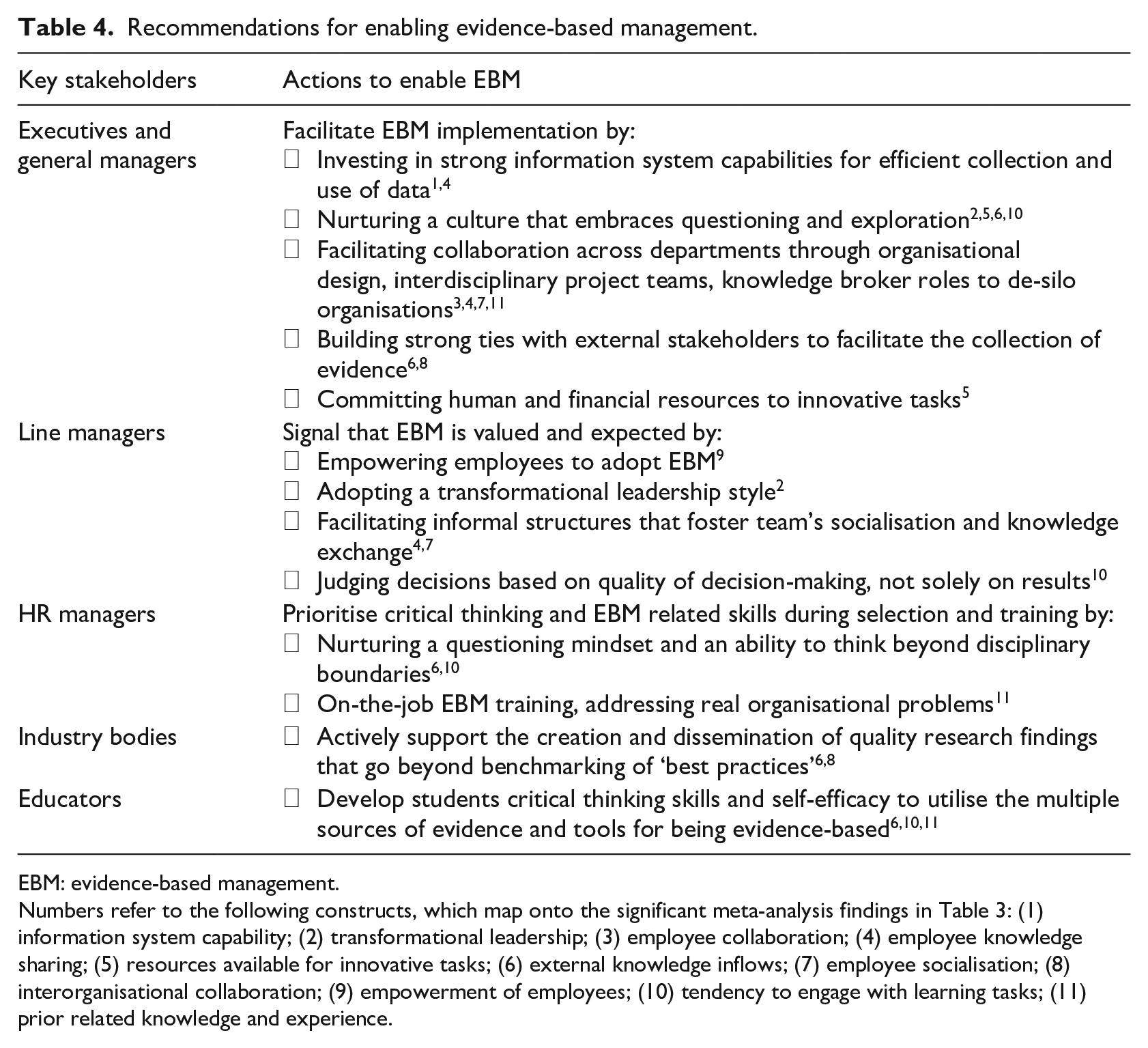
This study has identified promising enablers that are well worth employing to influence the adoption of EBM. The practical implications will differ for each of the major stakeholders involved within the business field. For each stakeholder, we draw on the findings from this study to create a checklist of actions that were supported by our meta-analysis and are likely applicable for EBM. This checklist is presented in Table 4. Note that it is premature to make bold statements about the effectiveness of the identified enablers given the boundary conditions of this study – we are drawing from insights about a meta-analysis on antecedents of AC in which most primary studies had a cross-sectional research design.
Recommendations for enabling evidence-based management.
EBM: evidence-based management.
Numbers refer to the following constructs, which map onto the significant meta-analysis findings in Table 3: (1) information system capability; (2) transformational leadership; (3) employee collaboration; (4) employee knowledge sharing; (5) resources available for innovative tasks; (6) external knowledge inflows; (7) employee socialisation; (8) interorganisational collaboration; (9) empowerment of employees; (10) tendency to engage with learning tasks; (11) prior related knowledge and experience.
Perhaps one of the most influential roles in creating a situational context that favours EBM is the top management of an organisation. Building on the potential enablers identified in this study, Table 4 highlights some of the actions and strategic decisions that can create a favourable organisational climate for EBM. Executives and general managers can facilitate EBM implementation within their organisation by investing in their information systems capabilities to enable efficient collection and storage of data, making it easily accessible across the organisation; in the digital era, this finding is of little surprise. Creating a work environment that fosters enquiry and exploration while having the time and resources to do so can also facilitate EBM, and perhaps this aspect is most crucial given the digital era seeks to drive efficiency and speed. Collaboration across functions and with stakeholders beyond the organisation can be fostered to facilitate access to novel knowledge. Launching multidisciplinary projects and sponsoring research projects in collaboration with universities can enhance the knowledge exchange required for EBM.
Line managers can also contribute to fostering EBM. Besides implementing EBM themselves, their team members may also feel motivated and courageous enough to question assumptions and apply EBM if they feel empowered and judged based on the quality of their decision-making, rather than solely on end results. Adopting informal structures and a transformational leadership style will also contribute to the level of socialisation and psychological safety required for knowledge exchange and EBM.
Finally, there are important implications for HR managers regarding recruitment and training. The findings suggest HR managers can consider an applicant’s skills for critical thinking and motivation to engage in learning tasks. Training provided to managers across the organisation that focuses on developing these skills would likely facilitate EBM implementation. To foster such motivation for learning, and embed EBM, EBM skills can be developed by tackling their own organisational problems with cross-functional teams rather than learning about decontextualised case studies with conclusions that may not apply to their context. By focusing on their own organisation, managers will have the domain knowledge required, and the exercise may result in an organisational improvement of the operational efficiency; furthermore, the training can provide a tangible exemplar to other employees of the decision-making norms embraced by management.
Industry bodies and regulators can also foster EBM by influencing the perceived meaning and value of its practice. Often seen as a reference for best practice, these organisations can become actively involved with universities to help develop and disseminate scientific research that is both rigorous and relevant to practice. In doing so, industry bodies and regulators help identify and promote evidence-based recommendations building on multiple sources of evidence, rather than solely relying on what is portrayed as best-practice by a particular organisation.
Finally, educators play an important role in developing students’ skills and self-efficacy for management decision-making. Particularly in a world with an overflow of information that includes unsubstantiated fads and fake news, it is fundamental that educators teach students how to acquire evidence from the multiple sources available, and how to think critically to make evidence-based decisions (see Dietz et al., 2014, as well as Erez and Grant, 2014). For example, academic assessments in courses that teach management skills may need to move away from closed book examinations testing knowledge and memorisation, to favour evaluations of problem-solving skills through a systematic and judicious use of the sources of information available in their future workplace.
7. Conclusion
To bolster our understanding of EBM and carve a roadmap for future research and practice, this article extracted insights from empirical research on the construct of AC. The resulting aggregated correlations highlight promising multi-level enablers of EBM. At a firm level, the importance of being able to store, access and share integrated and relevant information across the organisation was highlighted as a promising enabler of EBM. Our findings also suggest a transformational leadership style and the availability of resources for innovative tasks may influence EBM adoption. Finally, the constructs of employee collaboration, knowledge sharing, external knowledge inflows, socialisation and interorganisational collaboration were identified as potential enablers of EBM. It is noteworthy that this cluster of constructs about collaboration and knowledge exchange was a dominant theme for the potential enablers EBM implementation, and this underscores the critical role for multiple stakeholders needed to shift EBM practice in organisations. At the individual level, our findings support and extend prior work (Rousseau and Gunia, 2016) that an individual’s ability, motivation and opportunity to adopt EBM will also influence its adoption. Our review highlights each of these components providing evidence that prior related knowledge, a motivation to engage in learning tasks and employees’ empowerment are all associated with AC, and are likely important enablers of EBM. In conclusion, our study highlighted that we have much to learn from the AC literature. The findings provided help to prioritise the future research agenda on organisational enablers of EBM and provide advice for practitioners who strive to foster EBM in their work environment.
Key practical and research implications
The most promising organisational enablers of EBM identified in our meta-analyses are information system capabilities, transformational leadership, available resources, and a group of constructs related to collaboration and knowledge sharing (i.e. employee and interorganisational collaboration, employee knowledge sharing, external knowledge inflows, and employee socialisation). We encourage researchers to prioritise the study of these enablers.
As outlined in Table 4, different stakeholders have a unique contribution to make to enable EBM. For example, executives and general managers can facilitate collaboration across departments through organisational design, interdisciplinary project teams and knowledge broker roles to break down silos. Further recommendations are also provided for line managers, HR managers, industry bodies and educators.
Collaboration and knowledge sharing are a predominant theme among the identified enablers for EBM. Practitioners could start to change practice on these issues now. Researchers could work with these organisations to follow-up on the efficacy of such interventions with quasi-experimental research designs to move the EBM practice and literature beyond the predominant focus on individual decision-making to how evidence is meaningfully derived from collaboration and knowledge sharing across diverse stakeholders.
Although not the primary focus, insights about potential individual enablers of EBM were also identified: prior related knowledge, motivation for learning and employee empowerment. These enablers concur with insights from Rousseau and Gunia’s (2016) review of related multidisciplinary research.
Footnotes
Appendix
Identified antecedents of AC that were not meta-analysed.
| Construct | Reference |
|---|---|
| Firm level | |
| Firm size and firm age | (Zou et al., 2018) |
| Performance below aspirations | (Ben-Oz and Greve, 2015) |
| Customer relationship capability | (Tzokas et al., 2015) |
| Resource flexibility | (Chang et al., 2014) |
| Knowledge depth and diversity | (Carlo et al., 2012) |
| Business partner variety | (Lazzarotti et al., 2015) |
| Interorganisational trust | (Ebers and Maurer, 2014) |
| Exchange of tacit knowledge | (Wang et al., 2016) |
| Firms entrepreneurial orientation | (Bierly et al., 2009) |
| Innovation incentives | (Wang et al., 2018) |
| Individual level | |
| Colleagues workstyle and knowledge | (Backmann et al., 2015) |
| Bisociative cognitive style | (Lowik et al., 2017) |
| Social interaction (extent and diversity) | (Hotho et al., 2012) |
AC: absorptive capacity.
Acknowledgements
The authors thank Mahreen Khan, Amirali Minbashian, and our anonymous reviewers for their helpful comments.
Final transcript accepted 25 March 2020 by Joanne Earl (Editor, Special Issue).
Funding
The author(s) received no financial support for the research, authorship and/or publication of this article.
