







Abstract
Executive evaluative ambivalence influences how firms act and respond to strategic issues but research on what is associated with such ambivalence has languished. Prior research focused on perspective complexity to the relative neglect of diagnostic effort, leaving imbalanced our understanding of not only executive evaluative ambivalence, but also issue diagnosis and sensemaking in general. Considering factors relating to both the subject of diagnosis (executives) and the object of diagnosis (the strategic issue), we test our hypotheses with pre-existing data addressing how executives evaluated a period of economic environmental equivocality. We find that executive job demands and perceived issue time pressure exhibited inverted-U relationships, and that a higher proportion of external executives and a narrower target market focus exhibited positive relationships, with executive evaluative ambivalence. We also confirm and extend previous perspective complexity research and close by addressing implications for research and practice.
1. Introduction
How executives make sense of strategic issues, and the factors that influence such sensemaking, has long been of scholarly interest (Daft and Weick, 1984; Dutton et al., 1983; Thomas and McDaniel, 1990). While various frameworks have been used in such inquiry, opportunity-threat has emerged as most prominent (Anderson and Nichols, 2007; Konig et al., 2021). Although Jackson and Dutton (1988) noted that executives can assess issues as threats, opportunities, or both, early research focused on an either-or view wherein executives diagnosed issues along the opportunity–threat continuum as one or the other (Chattopadhyay et al., 2001; Thomas et al., 1993). Only more recently has research on evaluative ambivalence, 1 defined as “holding competing evaluations of an issue . . . [such as] a chief executive officer (CEO) [seeing] a change in the firm’s environment as both positive and negative” (Plambeck and Weber, 2010: 689), become more active (Ekberg, 2020; Yuan et al., 2017).
However, while research has established the relevance and importance of evaluative ambivalence by demonstrating its effects on a range of factors (Gilbert, 2006; Matsuno and Kohlbacher, 2019; Plambeck and Weber, 2009; Yuan et al., 2017), little research has focused on factors leading to it. This gap is further aggravated by the incompleteness of what little research has been done. Plambeck and Weber (2010) addressed two ways that contextual factors encourage executive evaluative ambivalence: perspective complexity (the elaboration, heterogeneity, and multiplicity of executive knowledge structures) and diagnostic effort (executive time and energy expended to search widely for information and investigate it thoroughly) (Plambeck and Weber, 2010). While they considered the perspective complexity factors of strategic orientation, related experience, and top management team (TMT) diversity, they only considered the diagnostic effort factor of controllability (Plambeck and Weber, 2010). Yet other diagnostic effort factors exist. As Plambeck and Weber (2010) noted, executives motivated to better understand an issue tend to expend greater effort to collect a wider range of information from distinct sources and consider it more carefully, which can lead to ambivalence (Barker and Hansen, 2005; Rudolph and Popp, 2007). Thus, we can benefit from not only knowing more about factors leading to executive evaluative ambivalence in general, but also about how diagnostic effort factors might do so, in particular. Our task is to begin to fill this gap.
Fundamentally, evaluation relates to two components: the evaluating subject (in our case, executives) and the evaluated object (in our case, the strategic issue). We theorize and empirically test two executive-related factors (job demands (assessed with firm growth) and upper echelon demography (assessed with proportion of externally oriented executives)) and two issue-related ones (strategic issue relevance (assessed with a firm’s target market focus) and issue immediacy (assessed through a survey)), arguing that they are associated with executive evaluative ambivalence through their effect on diagnostic effort.
We make use of a pre-existing data set addressing the strategic issue of uncertain US domestic economic conditions in 2003. This period featured positive indicators like rising gross domestic product (GDP) and falling ones like unexpectedly high jobless claims, as well as low interest rates combined with price uncertainty regarding critical economic resources (e.g. oil). Hence, multiple interpretations were possible for this complex and equivocal strategic issue. Such economic uncertainty frequently recurs and is happening as of this writing (The Economist, 2023a), demonstrating the data’s continued relevance. For example, the recent COVID-19 experience in Australia coupled a strongly negative stock market reaction with a significant counteracting government stimulus (Rahman et al., 2021), featured an economic downturn with significant new venture creation (Maritz et al., 2020), and confronted both retailers (Grimmer, 2022) and new ventures (Guckenbiehl and de Zubielqui, 2022) with both challenges and opportunities.
The economic uncertainty issue aligns well with other strategic issues used in previous research, such as European Union enlargement (Plambeck and Weber, 2009, 2010), population aging (Matsuno and Kohlbacher, 2019), and the economic disruption caused by the 2008 global financial crisis, in that all of these issues were broad, diffuse, and multi-faceted. Similar to other ambivalence research (Matsuno and Kohlbacher, 2019; Plambeck and Weber, 2010; Tang et al., 2010; Yuan et al., 2017), we use data based in part on a survey completed by the CEO. We find that diagnostic effort factors affect executive evaluative ambivalence at least at marginal levels: moderate job demands, a more externally oriented TMT, strategic issue relevance, and moderate issue immediacy are each associated with higher evaluative ambivalence. We also find support for the perspective complexity mechanism.
We thus provide three contributions to the literature. First, we conceptually elaborate research on executive evaluative ambivalence by further unpacking the diagnostic effort construct. Based on the subject/object distinction, we identify four new factors that capture evaluator time and energy allocated to issue diagnosis. Furthermore, we empirically demonstrate that factors associated with diagnostic effort are an important mechanism influencing ambivalence. Issue evaluation can thus be better pictured as involving both cognitive templates that executive evaluators bring to the diagnostic task (emphasized in previous research) and the cognitive energy that executives expend on this central activity. Finally, we establish the need for researchers to consider both evaluator complexity and effort. Doing so provides a more fully specified grasp of executive cognition that emphasizes how both the mental distillation of past experience (complexity) and executive motivation to allocate current attention toward an evaluative task should be considered.
2. Theory
Researchers have directed increased attention toward evaluative ambivalence, a subjective judgment producing competing assessments of a situation. While such research has addressed managers at all levels, it is at the upper echelons of an organization where evaluative ambivalence is likely to have its greatest effect, given the importance of strategic decisions that are made there and the interpretations and construals that lead to them (Daft and Weick, 1984; Hambrick and Mason, 1984). Executive evaluative ambivalence alters how sustainability issues are considered and addressed (Hahn et al., 2014), affects corporate entrepreneurship (Yuan et al., 2017), enhances the strength and flexibility of organizational responses (Gilbert, 2006), and produces broader, more novel, and riskier firm actions (Plambeck and Weber, 2009).
Given the importance of executive evaluative ambivalence, it is also important to know what is associated with its occurrence. Researchers have found interpretive ambivalence to be highest at moderate levels of firm domain orientation and sense of controllability (Plambeck and Weber, 2010) and at high levels of environmental state uncertainty (Matsuno and Kohlbacher, 2019). We know little beyond this.
As a starting point, Plambeck and Weber (2010) argued that an organization’s context influences executive evaluative ambivalence through two somewhat distinct mechanisms: the elaboration, heterogeneity, and multiplicity of executive knowledge structures, and executive time and energy spent gathering information to enable analysis from different angles. We characterize these as perspective complexity and diagnostic effort, respectively. They emphasized perspective complexity context factors by measuring strategic orientation, related experience, and diversity. More complex knowledge structures encourage considering things in multiple ways (Kiss and Barr, 2015; McNamara et al., 2002) and scholars have argued that the existence of multiple and simultaneous points of view can lead to higher ambivalence (Ashforth et al., 2014; Rothman et al., 2017). Yet, Plambeck and Weber (2010) found limited support for this mechanism: only one of their five perspective complexity variables was significant.
By contrast, these scholars examined the diagnostic effort channel in only one aspect, sense of organizational controllability, using a single variable (which was statistically significant). This imbalance highlights the need for additional consideration of diagnostic effort, given its relative neglect and the failure of most perspective complexity variables to show that they mattered.
2.1. Diagnostic effort
Executive evaluative ambivalence is likely to be triggered by strategic issues that are complex, broad, and/or ambiguous (Ashforth et al., 2014). Strategic issues are not easily assessed since they are often nonroutine and ill-structured (Lyles, 1981), as well as “broad, diffuse, and ill-specified,” while the diagnosis process through which executives make sense of them is “fluid, emergent, and dynamic” (Dutton et al., 1983: 308). Cognitive limitations impair executives’ ability to notice all relevant stimuli or to sustain attention to sufficiently process the often contradictory data they do notice (Dutton et al., 1983; Dutton and Jackson, 1987; Shepherd et al., 2017). Diagnostic effort is needed to deal with such limits as it focuses time, attention, and energy on particular strategic issues to the exclusion of others (Ocasio, 1997, 2011). It represents continued attentiveness to subtle cues in an organization’s environment and features a greater depth and breadth of information search and processing (Rudolph and Popp, 2007). This is similar to the “search intensity” of Li et al. (2013) who emphasized cognitive effort and persistence, as well as the “constrained cognitive effort” addressed in Bacon-Gerasymenko and Eggers (2019).
Executive evaluative ambivalence is likely to be higher when an issue undergoes extensive and nuanced consideration (Rudolph and Popp, 2007). Diagnostic effort allows executives to access a greater number of issue aspects, many of which may be distinct and varied, and to consider more carefully each one (Linville, 1982; Shepherd et al., 2017). Appraising a wider range of characteristics adds nuance to what may otherwise be a one-sided analysis (Judd and Lusk, 1984). Thus, what initially appears univalently in positive or negative terms may, on more extensive data gathering and deeper analysis, be considered more nuanced, multi-faceted, and ambivalent (Barker and Hansen, 2005; Plambeck and Weber, 2010; Rudolph and Popp, 2007).
Executive scanning, interpretation, and decision-making are susceptible to various contextual influences (Ocasio, 1997, 2011). Situational factors that promote diagnostic effort are likely to increase the occurrence of executive evaluative ambivalence, all else equal, and those that decrease such effort are likely to decrease it (Plambeck and Weber, 2010). Strategic issue evaluation fundamentally involves two such entities, the evaluating executives (Cho and Hambrick, 2006), and the evaluated issue (Dutton et al., 1983), reflecting the long-standing subject–object distinction in philosophy (Bliss, 1917). We thus direct our inquiry at these two elements, considering two aspects of each: job demands and externally oriented functional interests in relation to the evaluators (subjects) and issue relevance and immediacy in relation to the evaluated issue (object).
3. Hypotheses
3.1. The subject: evaluating executives
3.1.1. Job demands
Executive job demands are important to upper echelon sensemaking given that they can cognitively overload boundedly rational managers (Hambrick, 2007; Hambrick et al., 2005; Wang and Yang, 2015). The effects of higher job demands are stark: under demanding conditions “the more remote strategic rationality becomes,” executives comprehend a “smaller proportion of the stimuli” and “cannot afford to be comprehensive,” and so they “take mental shortcuts,” “limit search,” and “economize” (Hambrick et al., 2005: 478). This results in less available attention or effort to allocate toward evaluating an additional strategic issue, and a decreased impetus to diagnose it.
To consider one such case, downsizing and restructuring absorb significant amounts of upper echelon attention. Executives are likely to think that they “cannot afford to be comprehensive,” and so “the more remote strategic rationality becomes” (Hambrick et al., 2005: 478). Stressed and overmatched executives tend to simplify, restrict search activities, and fall back on schema and interpretations that worked for them in the past (Hambrick et al., 2005; Ketchen and Palmer, 1999), rather than address current issue complexities. Such circumstances can lead to a focus on central or dominant cues at the expense of peripheral ones (Staw et al., 1981), diminishing available attention. Anxious and distracted executives may thus fail to notice a new issue or if they did, lack the impetus necessary to sustain diagnostic activities amid stressful firm size reductions.
Growth is also demanding, but in different ways. Firm growth, particularly when it is at higher levels, disperses finite upper echelon attention since it involves numerous activities (e.g. altering financial resource allocation, developing, and retaining human capital, pursuing new markets, adjusting supply chains, altering operating procedures, as well as addressing the unanticipated operational snags and misalignments that inevitably arise when changing components of a complex organization) (Smith et al., 1985). This array of activities can cognitively overload boundedly rational managers (Gavetti et al., 2012). Executives’ energy scatters across many activities, leading them to comprehend less, take shortcuts, and emphasize cognitive efficiency over effectiveness (Hambrick et al., 2005), leaving little free to allocate toward deep consideration of novel strategic issues (Baum and Wally, 2003).
Where executive job demands are lower given that the firm is neither growing nor downsizing, a TMT is likely to have higher levels of unallocated effort to focus on a strategic issue and uncover its nuances and seeming paradoxes. As pointedly put by Hambrick et al. (2005), “[E]xecutives whose jobs are less difficult will not encounter such information overload [and] can take advantage of greater available time, attention, and other resources to be comprehensive (pp. 478–479).” Our argument is not that stability has no job demands on its own, but that all else equal it is likely to have relatively lower job demands than is growth or downsizing. Thus, we anticipate an inverted-U (ꓵ) relationship between firm growth and evaluative ambivalence.
Hypothesis 1: The greater a firm’s growth strategy is focused on either restructuring or growth, the less ambivalently the firm’s upper echelon will evaluate the issue of domestic economic uncertainty.
3.1.2. Upper echelon demography
Executive demography also influences how upper echelons interpret strategic issues (Cho and Hambrick, 2006; Hambrick and Mason, 1984). Scholars have demonstrated how executive functional background produces distinct attention patterns (Ocasio, 1997; Ridge et al., 2017). Considered in the aggregate, a TMT’s functional breakdown in turn is likely to affect the collective attention pattern of the group (Tuggle et al., 2010) with important diagnostic consequences.
Externally oriented executives notice and are more receptive to different events and viewpoints due to their greater focus on the business environment (Birkinshaw et al., 2017; Ridge et al., 2017), and are more likely to adopt an externally oriented market orientation, regardless of their target market (Mavondo and Farrell, 2000). Given their functional responsibilities, externally oriented executives’ attention will be primarily directed toward markets, customers, and competitors. Issues relating to these factors draw a higher amount of attention when the proportion of such executives is high. Externally oriented executives are not only themselves likely to expend more diagnostic effort on external strategic issues but are also more likely to motivate other TMT members to do the same by introducing and emphasizing such concerns. Such TMTs would thus collectively engage in broader scanning that focuses more on the external environment (Hahn et al., 2014) and as a result generate richer issue-related information (Matusik and Heeley, 2005) than would otherwise be the case. Conversely, where the proportion of externally focused executives is low, executives will typically attend to throughput concerns, such as the mechanics of overseeing a manufacturing facility, office, or service provider facility, as well as internal procedures, policies, and compliance (Ridge et al., 2017).
Furthermore, if an issue does not relate to a TMT’s dominant functional responsibilities and area of focus, time spent understanding it is likely to be considered misallocated (e.g. McMullen et al., 2009; Ridge et al., 2017) and the TMT’s impetus to understand its nuances more fully will be diminished. Executives pay attention to areas that are familiar through frequent consideration (Piezunka and Dahlander, 2015) and this interest level increases the degree to which upper echelon members desire and are able to access the range of related information (Rhee and Leonardi, 2018). In this way, TMTs with more externally oriented members have a higher level of diagnostic motivation for external issues (Ridge et al., 2017). Thus, we posit the following.
Hypothesis 2: The higher the proportion of externally oriented executives in a firm’s upper echelons, the more ambivalently the firm’s upper echelon will evaluate the issue of domestic economic uncertainty.
3.2. The object: evaluated issue
3.2.1. Strategic issue relevance
Given that our strategic issue is domestic economic uncertainty, the geographic focus of the firm’s target markets, whether they be international or domestic, is an indicator of strategic issue relevance. Target market selection identifies which parts of the environment are relevant, directing executive focus toward some areas and away from others (Cho and Hambrick, 2006). Executives in internationally engaged firms are more likely to “invest time and effort in activities, communications, and discussions aimed at improving their understanding of the global marketplace” (Bouquet et al., 2009: 108). Upper echelon attention is a limited resource (Ocasio, 1997), so effort expended on the demanding task of understanding foreign economies (Brewer, 2007) cannot be allocated to domestic economic issues, lowering attentional availability for them. Furthermore, diagnostic motivation is lower since the domestic market is not the only arena in which the firm competes.
However, a domestic focus concentrates upper echelon attention on the home market, making more relevant issues emerging from the home nation. Scholars have argued that a firm’s domestic footprint affects their behavior through that footprint’s effect on attention (Hendriks et al., 2018). Furthermore, the motivation to diagnose is likely high since the domestic business represents the entirety of the firm’s commercial activity; issues associated with it therefore must be fully assessed and comprehended. Thus, we posit the following.
Hypothesis 3: The upper echelons of firms with a domestic targeting focus will evaluate the issue of domestic economic uncertainty more ambivalently than will those of firms with an international targeting focus.
3.2.2. Perceived issue immediacy
Issue perceptions vary across firms and matter to subsequent issue evaluations (Julian et al., 2008; Thomas et al., 1993; Thomas and McDaniel, 1990). Perceived issue time pressure, the benefit from acting quickly (Dutton et al., 1990), can influence the amount of attention available and the motivation to engage in issue analysis. Indeed, Rothman et al. (2017) argued that “not having to choose (p. 48),” a concept chronologically similar to (lack of) time pressure, is related to ambivalence.
Low issue time pressure is unlikely to motivate executives to direct attention toward it (Gan et al., 2015). In such cases, executives do not think that action on the issue, or even understanding it, is currently necessary (Ginsberg and Venkatraman, 1995). The diagnosis of the issue will be minimal and/or delayed since other, more pressing, tasks will replace it on their agenda (e.g. Julian et al., 2019). Such issues may be summarily diagnosed so executive awareness of their potential complexity is low.
On the other hand, when time pressure is high, the benefit for taking quick action is also high; early action is likely to be rewarded while waiting is risky (Dutton et al., 1990; Gan et al., 2015). The lack of time believed available limits the period of attentive consideration such that the number of factors considered declines and decision-making is impaired (Mann and Tan, 1993; Staw et al., 1981). Such cursory analysis is unlikely to uncover an issue’s nuances and ambiguities (Nadkarni et al., 2019; Plambeck and Weber, 2010). Executives facing time pressure are likely to be inflexible in their thinking and analysis (Gilbert, 2006) and, hence, issue interpretations are narrower and univalent.
However, at moderate ranges of issue immediacy, executives are both unlikely to assume they can just wait and are also free from perceived pressures to do something rapidly. They are thus likely to engage in the deeper and more extensive issue consideration associated with higher evaluative ambivalence. Thus, we anticipate an inverted-U (ꓵ) relationship between perceived issue immediacy and evaluative ambivalence.
Hypothesis 4: The greater the issue is perceived to be either low-time pressing or high-time pressing the less ambivalently the firm’s upper echelon will evaluate the issue of economic domestic uncertainty.
4. Method
We adapt a pre-existing data set on the economic uncertainty faced by Michigan firms in early 2003 (Julian and Ofori-Dankwa, 2008), the collection of which is detailed below. At that time, national economic prospects were improving by some measures, such as rising GDP growth and declining unemployment, and extant near-record low interest rates were likely to be economically stimulative. However, the economy was still suffering the after-effects of the stock market bubble and 9-11 terrorist attacks, some leading economic indicators were falling, jobless claims were unexpectedly high, and there existed continuing business uncertainty associated with war in the Middle East and the price of oil, a critical input for the domestic economy. Thus, the strategic issue of domestic economic uncertainty in early 2003 is quite suitable for our purposes. It was both ambiguous and equivocal, not clearly or readily diagnosable, and rather than offering either stark assurance or menace, encapsulated significant amounts of each. Thus, a range of alternative, contrary, and even competing issue interpretations was possible. The data set also has continued relevance since profound economic uncertainty is a recurrent issue, as is the case with the post-COVID inflationary economy in 2023 (The Economist, 2023a). For example, while consumer sentiment is currently high, other indicators such as bond yields and lending are projecting a recession (The Economist, 2023b).
Firms of 25 or more employees across a wide range of industries in the Midwestern state of Michigan had been identified. From this population, a random sample of 1800 firms was drawn from the Harris database of Michigan businesses. The survey was sent in early 2003 to the CEO who thus acted as a key informant, one with privileged access to information (Brown et al., 1992; Seidler, 1974). An initial notification letter and two rounds of surveys were sent. In total, 280 responses were returned, a 15% response rate. Firm age ranged from 3 to 178 years and firm size (measured by employees) ranged from 25 to 32,000; 42.5% of the sample was in manufacturing.
We correlated survey response time with each variable in our study on the assumption that late responders are more like non-responders (e.g. Hawes and Crittenden, 1984): any such differences could suggest the possibility of response bias. Using a median split and p = 0.10 cut-off, for the 14 variables used in this study, we found no significant relationships. Furthermore, given that both the dependent variable and one of the hypothesized variables were collected through survey, we addressed the possibility of common method variance (CMV) in several ways. Neither the Harman one-factor test (Podsakoff and Organ, 1986), running a regression including the first unrotated factor as a proxy for CMV (Podsakoff et al., 2003), nor the lowest correlation correction (Lindell and Whitney, 2001) indicated any potential issues. Missing data reduced the usable sample size to 241. The data set also contained archival variables from the Harris database.
4.1. Dependent variable
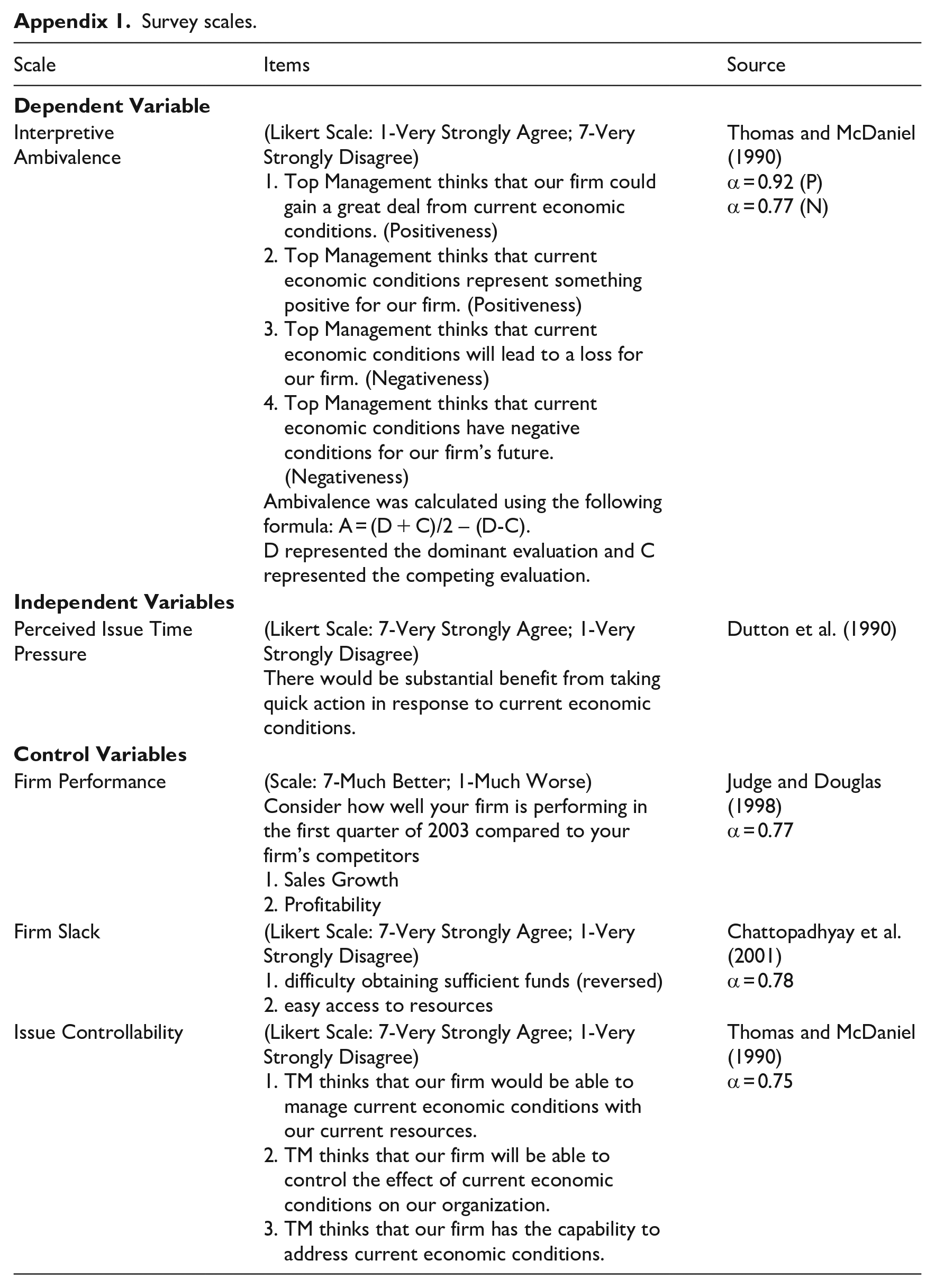
Evaluative ambivalence was measured by asking key informants to indicate their level of agreement with statements (some negative and some positive) that addressed the collective evaluations of the TMT. The items were drawn from Thomas and McDaniel (1990) to measure positive (2 items: positive and gain) and negative (2 items: negative and loss) assessments (see survey items in Appendix 1). Cronbach’s alpha was 0.92 for the positiveness scale and 0.77 for the negativeness one. In operationalizing evaluative ambivalence, as did Plambeck and Weber (2010), we used the similarity-intensity approach (Fong, 2006; Priester and Petty, 1996, 2001). We calculated ambivalence using the formula: A = (D + C)/2 – (D-C). D represented the dominant evaluation (whichever was larger between positive or negative) and C represented the competing evaluation (whichever was smaller). Plambeck and Weber (2010) standardized the raw scores of positiveness and negativeness before calculating ambivalence, and we did likewise. (Results with raw scores were unchanged.)
4.2. Independent variables
Relating to job demands, we measured firm growth strategy using archival data, the 1-year growth in a firm’s employees. This is a more decision-oriented variable than alternatives, such as growth in sales. This was drawn from the Harris database. Twenty-five percent of the firms in our sample were reducing their size and 25% were increasing it. Even so, this variable was not normally distributed, so we calculated the natural log after adding a trivial constant. We then winsorized at the 2% level.
To capture strategic issue relevance, domestic target market was measured dichotomously, as provided in the Harris database, with = 1 indicating a domestic-only target marketing strategy (no exports), and = 0 indicating pursuit of international markets through exporting. Seventy percent marketed only to the domestic market; 30% exported.
Assessing upper echelon demography, we measured externally oriented executives by using the proportion of marketing, distribution, and sales executives in the firm’s TMT. Data on functional backgrounds were drawn from the Harris database, which provides a listing of corporate officers for each firm. We assumed that only the most important positions would be listed and that these individuals comprised the TMT. This measure reflects the presence on the TMT of those with an externally, outwardly focused functional orientation. This number was divided by the total number of TMT members. The number of TMT members for TMTs without an externally oriented executive = 3, while for TMTs having at least one = 5.8 (p = 0.000). Sixty-four percent of TMTs had no external executive and the maximum number of such for any team = 3.
To capture issue immediacy, we measured perceived issue time pressure with a single survey item from the data set originally drawn from Dutton et al. (1990): “There would be substantial benefit from taking quick action in response to current economic conditions.”
4.3. Control variables
We controlled various extraneous influences that could threaten the adequacy of our statistical model. The effect of the proportion of external executives, for example, may be influenced by TMT diversity. Using the categories of marketing and sales; production; research and development and engineering; finance, accounting, and law; general; and purchasing, TMT functional diversity was calculated using Blau’s (1977) index. We also held constant TMT size by the total number of executives drawn from the Harris database (mean = 4).
As well, large firms may assume that their size will buffer them from strategic issues, while small firms may lack needed resources for much strategic issue diagnosis. We thus controlled for firm size by the log of the number of employees. Similarly, the broader conditions of industry munificence may cloud the effects of firm growth, so to refine our focus on the latter, we included the previous year’s 1-year rate of industry sales growth in our models. We also designated industry sector with a binary variable (manufacturing = 1), as did Plambeck and Weber (2010).
In addition, financial performance might confound executive evaluations of specific issues with how the firm is doing in general (Plambeck and Weber, 2010). Thus, we held constant firm performance which was measured using a two-item scale (Judge and Douglas, 1998) and had an α of 0.77. Firm slack refers to resources in excess of what the firm needs for its standard operations and may have complacency/rigidity effects similar to time pressure. Slack has often been found to have curvilinear effects (Pierce and Aguinis, 2013), so we held constant both slack and its square. Firm slack was measured with two survey items: difficulty obtaining sufficient funds (reversed) and easy access to resources (α = 0.78) (Chattopadhyay et al., 2001).
We also controlled for issue controllability, an important managerial factor (Schwarz et al., 2020) which Plambeck and Weber (2010) found was curvilinearly related to evaluative ambivalence. This was measured by three items drawn from Thomas and McDaniel (1990). Cronbach’s alpha for this scale was 0.75. We also included publicly traded status using a dichotomous variable where 1 = publicly traded.
Furthermore, we controlled for perspective complexity factors. Experience possessed by older firms facilitates the elaboration of a firm’s collective cognitive structures (Plambeck and Weber, 2010). Thus, we measured firm age as the natural log of the number of years since the firm was founded. We also controlled for firm diversification given that activity in multiple lines of business provides diverse experiences (Plambeck and Weber, 2010). The Harris database listed up to five 4-digit SIC industries in which each firm competed. We used a count variable of the number of industries which was normally distributed. Finally, given that more heavily populated localities expose executives to a wider range of viewpoints and ways of making sense, some of which could be contradictory, we held constant 2003 HQ county population in 2003.
To account for possible intra-industry correlation of errors, we used heteroskedastic-robust standard errors, clustering at the one-digit SIC level. Also, the highest variance inflation factor (VIF) was only = 1.72 and the average for all variables = 1.36, indicating no multicollinearity. We further employed Kalnins’ (2018) diagnostic criteria for a more rigorous multicollinearity assessment and found no problems.
5. Results
Descriptive statistics and correlations are presented in Table 1. Table 2 contains our hypothesis tests. For our curvilinear tests, we utilized the steps presented in Haans et al. (2016). We also employ the utest procedure in Stata to confirm the statistical significance of the upward and downward slopes of inverted-U (ꓵ) relationships (Lind and Mehlum, 2010). We further note that the residuals were uncorrelated with our independent variables (and the indicators we used to measure perspective complexity, as well: see below). This suggests a minimal likelihood that endogeneity biased our results. We further conducted an impact threshold of a confounding variable analysis (Frank, 2000) (konfound in Stata) which found little indication either from the partial correlation or % bias tests that we omitted a variable that could be an endogeneity threat.
Means, standard deviations, and correlation coefficients.
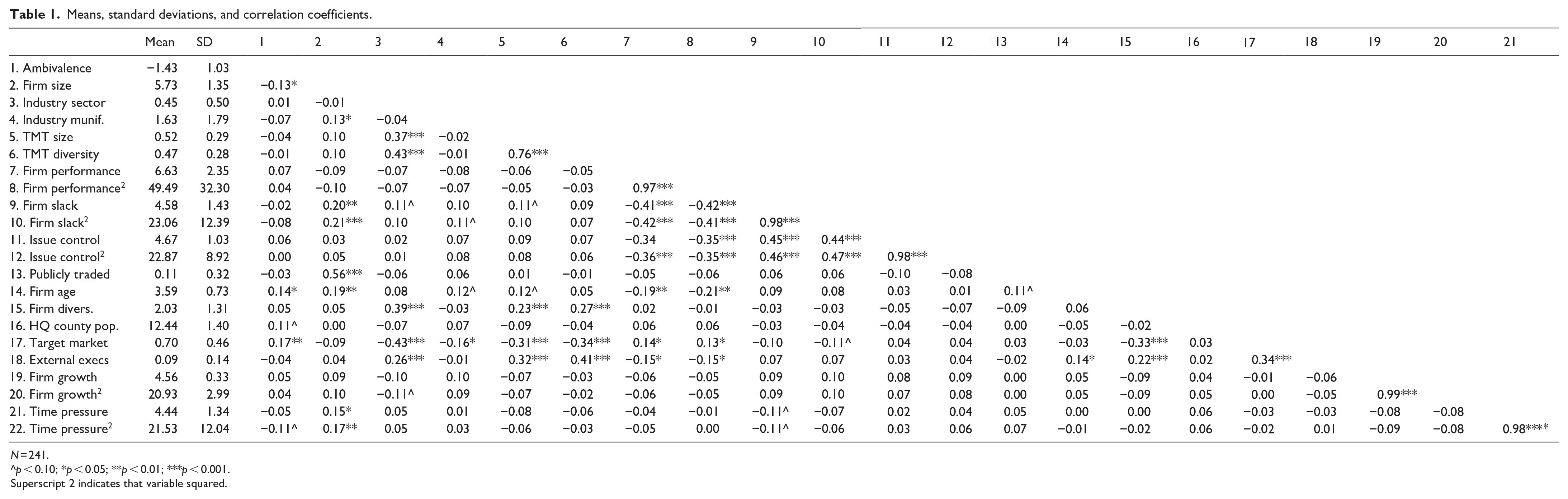
N = 241.
^p < 0.10; *p < 0.05; **p < 0.01; ***p < 0.001.
Superscript 2 indicates that variable squared.
OLS regression estimates—dependent variable: evaluative ambivalence.
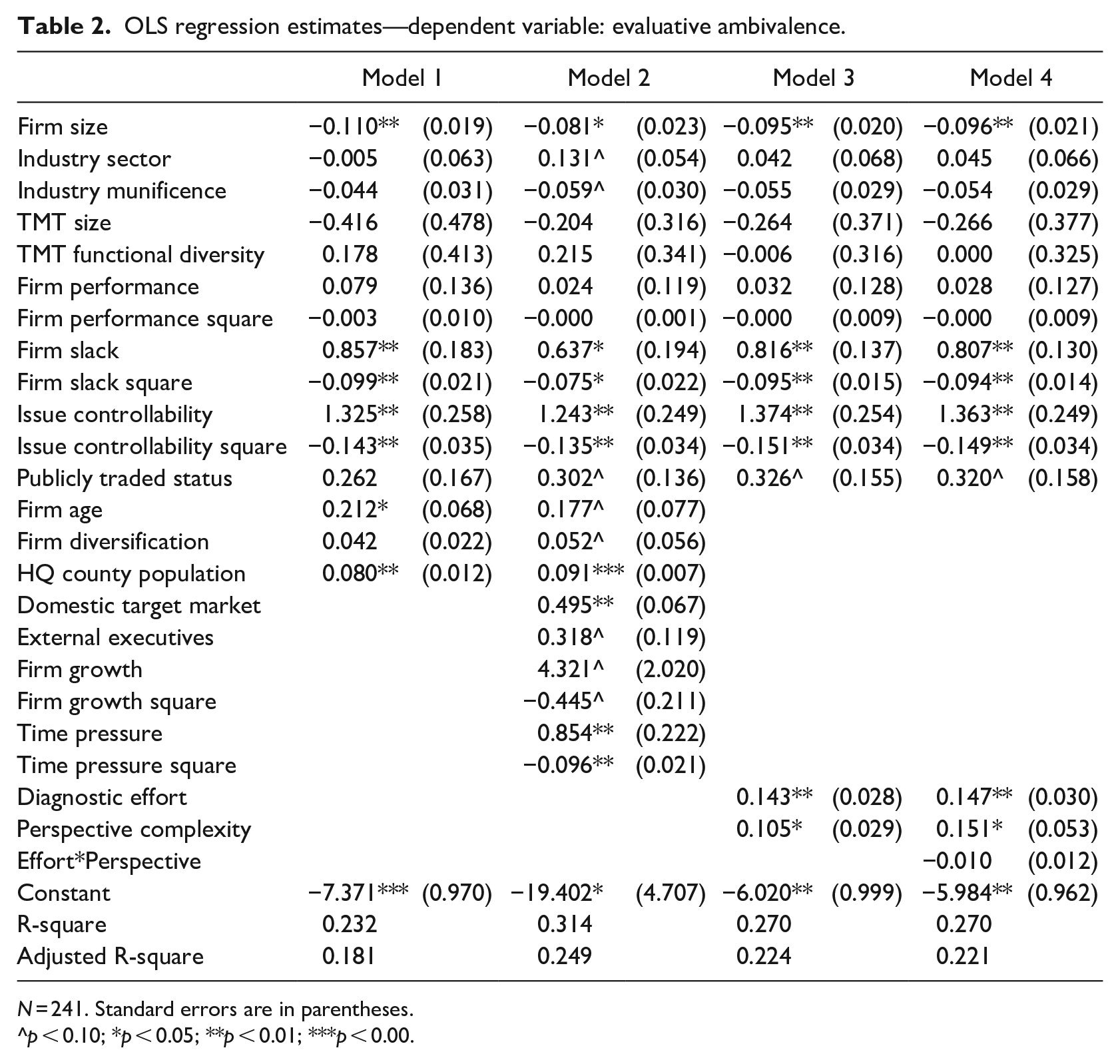
N = 241. Standard errors are in parentheses.
^p < 0.10; *p < 0.05; **p < 0.01; ***p < 0.00.
H1 predicted an inverted-U (ꓵ) relationship between a firm’s growth rate and upper echelon evaluative ambivalence. This was marginally significant in its linear (β = 4.321; p = 0.076) and curvilinear (β −0.445; p = 0.080) components, both with the expected sign. Ambivalence reaches its maximum at firm growth rate nl = 4.9, at the 91st percentile (corresponding to 40% growth). The utest procedure confirmed the inverted-U relationship at its lower (p = 0.030) and upper (p = 0.075) ends, with the overall test supporting an inverted-U shape (p = 0.075) (see Figure 1). Adding a cubic term caused the firm growth coefficients to become non-significant.
H2 predicted that the proportion of externally oriented executives in a firm’s TMT had a positive relationship with upper echelon evaluative ambivalence. We found support for this hypothesis in that the coefficient was positive and significant (β = 0.318; p = 0.037). A one standard deviation increase in this IV corresponds to a 2.6% standard deviation increase in ambivalence.
H3 predicted that TMTs of firms with a domestic target market evaluated domestic economic uncertainty more ambivalently than international firms. This was strongly supported: exporting status was negatively related to ambivalence (β −0.495; p = 0.002). Non-exporting firms had ambivalence scores that were 47% of a standard deviation higher than exporting ones.
H4 predicted that perceived issue time pressure had an inverted-U (ꓵ) relationship with upper echelon evaluative ambivalence. This was supported in its linear (β = 0.854; p = 0.008) and curvilinear (β = –0.096; p = 0.004) components, both with the expected signs. Ambivalence reaches its maximum at time pressure = 4.44, the 62nd percentile. The utest procedure confirmed the inverted-U relationship in its lower (p = 0.014) and upper (p = 0.009) ends, with the overall test supporting an inverted-U shape (p = 0.014) (see Figure 2). Adding a cubic term resulted in non-significance.
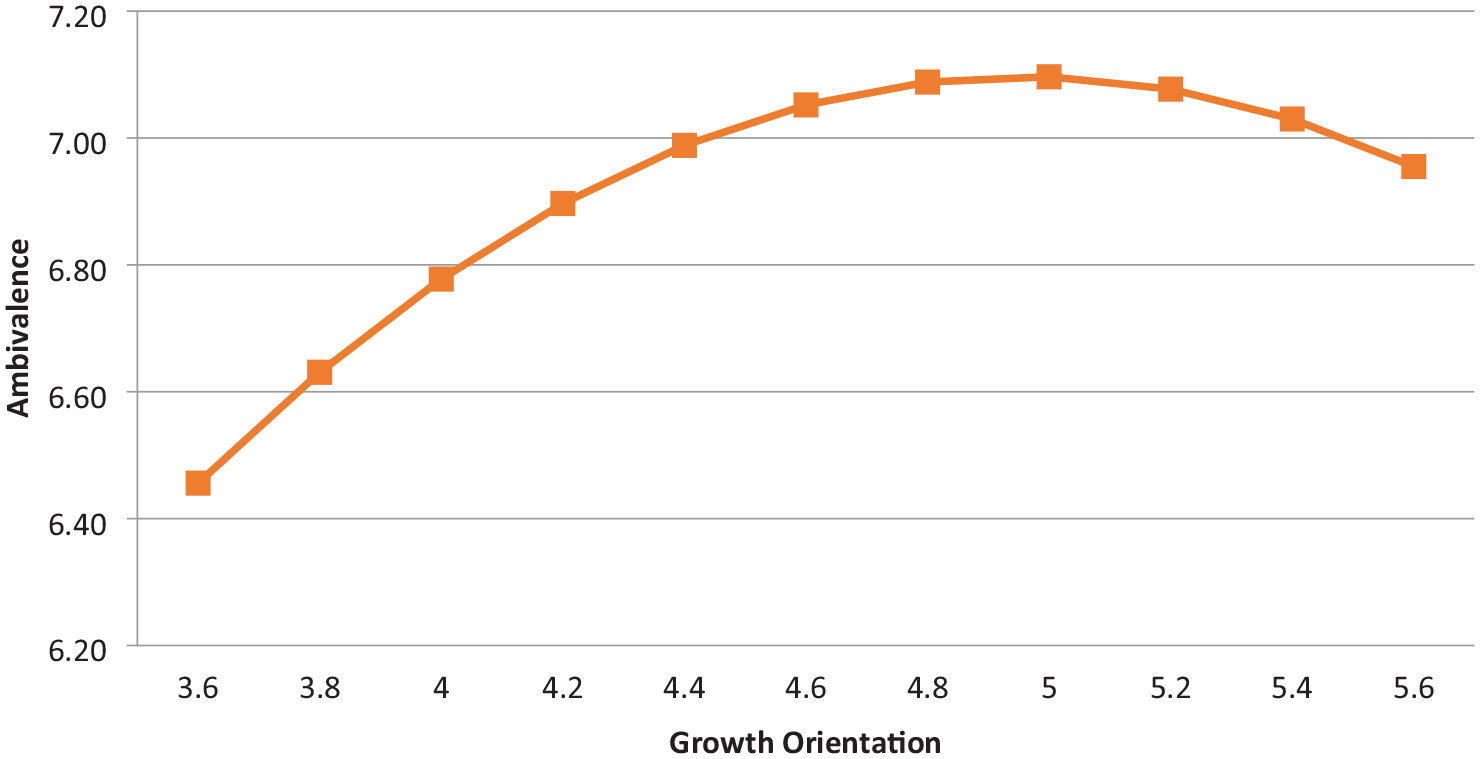
Firm growth strategy and ambivalence.
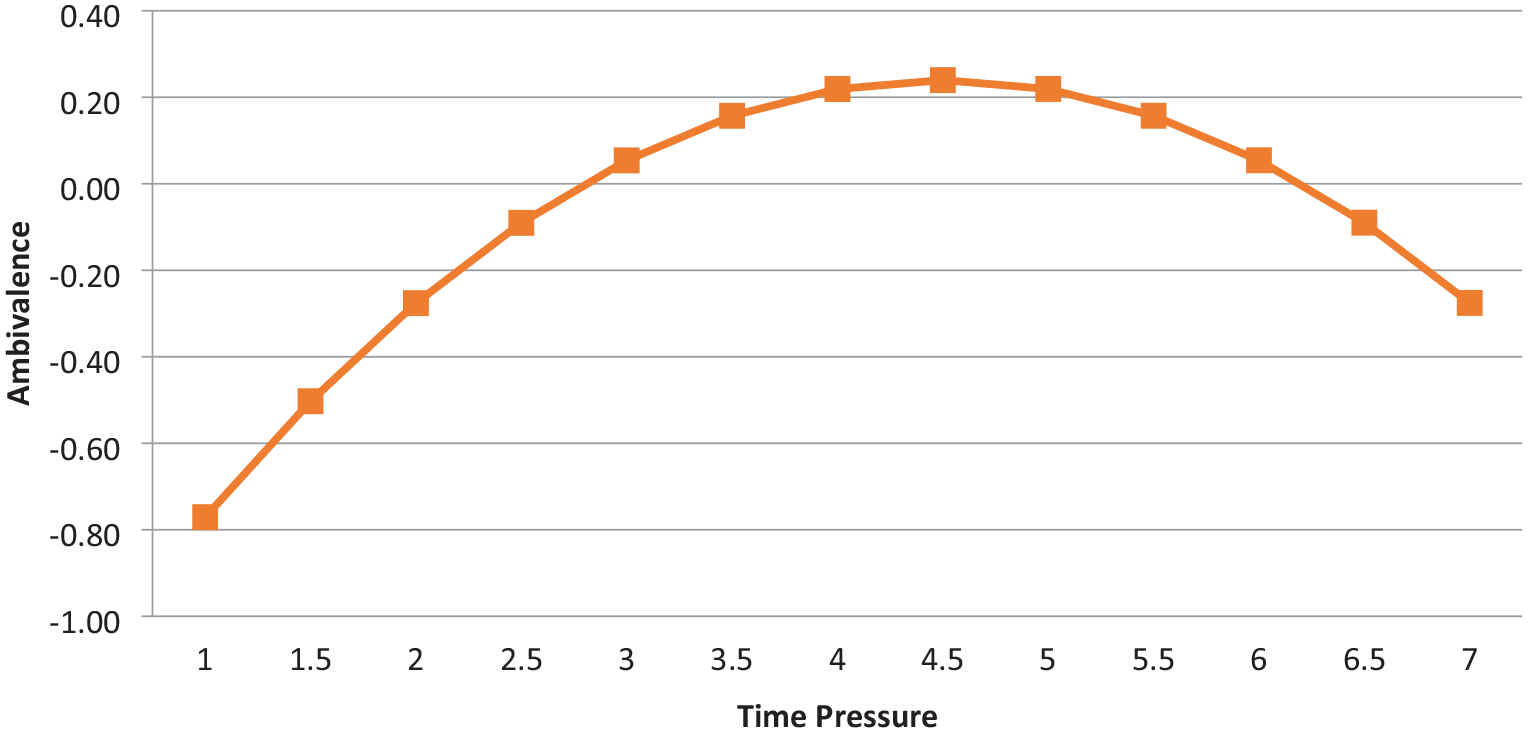
Time pressure and ambivalence.
5.1. Additional results
Plambeck and Weber (2010) found that perceived issue controllability was curvilinearly related to evaluative ambivalence. We replicate this result (Model 2) in both its linear (β = 1.243; p = 0.002) and curvilinear (β = –0.135; p = 0.008) components. Thus, we find additional support for the significance of the lone diagnostic effort variable they tested.
Regarding perspective complexity, these authors hypothesized that diversification and TMT diversity affect evaluative ambivalence but failed to find support for either one. By contrast, we found that diversification had the positive relationship with ambivalence that they hypothesized, though at marginal levels (β = 0.052; p = 0.086). However, TMT size and functional diversity were non-significant (β = –0.204; p = 0.544 and β = 0.215; p = 0.552), matching their results.
We also note two other controls that align well with perspective complexity logic but that were previously untheorized. While diversification above represents experiences across industries, the age of the firm captures experiences over time. We find evidence aligned with such logic as firm age is positively related to evaluative ambivalence (β = 0.177; p = 0.068).
Finally, this previous research included HQ city population as a control and found it non-significant. In contrast, we found that HQ county population was positively related to evaluative ambivalence (β = 0.091; p = 0.000). County population may be a superior way to capture the size of the immediate region in which an HQ is located (a smaller city may be part of a much larger metroplex, for example). Thus, we find stronger support for perspective complexity as pertinent to evaluative ambivalence than did Plambeck and Weber (2010).
5.2. Post hoc tests
Finding relationships between evaluative ambivalence and variables representing both the diagnostic effort and perspective complexity mechanisms raises interesting questions about their relative strength and potential interaction. We thus developed formative indicators of both sets of variables: our hypothesized variables as indicators of diagnostic effort and firm age, diversification, and HQ county population as indicators of perspective complexity. (The addition of still other variables in the future may be appropriate.) Formative indicators were better than reflective ones since our variables are not produced by an underlying construct but are independent factors that cumulate to produce different effects.
We could not simply sum the diagnostic effort variables since two of them had curvilinear relationships. Hence, for those variables, we took the absolute value of the difference between the inflection point of that variable’s relationship with evaluative ambivalence and each observation. We then reverse-scored this value given our arguments that evaluative ambivalence is highest at the mid-ranges of growth and time pressure; thus, the farther away a firm is from the inflection point, the lower will be that firm’s ambivalence.
Diagnostic effort and perspective complexity were both positively related to evaluative ambivalence (β = 0.143; p = 0.002 and β = 0.105; p = 0.011, respectively). Subsequent tests demonstrated that diagnostic effort adds more variance explained than does perspective complexity (ΔR2 = 0.042; ΔF = 25.56; p = 0.002 and ΔR2 = 0.027; ΔF = 13.24; p = 0.011, respectively). Thus, while diagnostic effort matters more, both are important. Further testing showed the lack of an interaction between the two, demonstrating that diagnostic effort and perspective complexity have independent relationships with ambivalence in that they neither substitute nor complement one another.
Finally, we reran our main analysis with manufacturing as the withheld category, using one-digit SIC code industries. We found that, in contrast to manufacturing firms which had higher ambivalence than the others (as seen in Model 2), it was agriculture, mining and construction, and finance firms who had lower evaluative ambivalence than manufacturing ones (all at p = 0.02 or better). Their sample sizes were small, though: agriculture = 6, mincon = 20, finance = 7. Our hypothesis results were unchanged.
6. Discussion
In this research, we have, first, improved our understanding of factors associated with upper echelon evaluative ambivalence by providing conceptual elaboration to research on executive evaluative ambivalence; second, empirically demonstrated that factors associated with diagnostic effort are an important mechanism influencing such ambivalence; and third, established the need for researchers of ambivalence, strategic issue diagnosis, and sensemaking more generally to consider both evaluator complexity and effort.
First, regarding conceptual elaboration, our core assertion is that evaluative ambivalence results from the diagnostic effort (Shepherd et al., 2017) directed toward a strategic issue. We found that diagnostic-related aspects of the evaluating TMT and the evaluated strategic issue were associated with evaluative ambivalence. Such ambivalence is unlikely unless executives extensively consider an issue (Ashforth et al., 2014; Rothman et al., 2017; Rudolph and Popp, 2007), thus implicating situations that facilitate or hinder such consideration. We thus elaborate previous research on executive evaluative ambivalence (Matsuno and Kohlbacher, 2019; Plambeck and Weber, 2010), strategic issue diagnosis and sensemaking more generally (Jackson and Dutton, 1988; Julian et al., 2008; Thomas et al., 1993), by showing that diagnostic effort (e.g. Bacon-Gerasymenko and Eggers, 2019; Li et al., 2013; Rudolph and Popp, 2007) matters to the evaluations that executives make of the environment and issues within it.
Second, as to our empirical findings, regarding the subject of evaluation (the TMT), we found that firm growth had an inverted-U association with evaluative ambivalence. We argued that executive job demands (Hambrick et al., 2005) at both positive and negative growth levels curtail the amount of effort allocated to issue diagnosis. Given its high inflection point, firm growth influenced evaluative ambivalence asymmetrically. Positive but not extreme growth may expand the pool of attention through the positive emotions associated with success, flipping the well-known threat-rigidity effect (Staw et al., 1981). However, our results show that even when the firm is stable, ambivalence is lower than when it is growing. This suggests that ambivalent evaluations, and by implication diagnostic effort, are quite robust to the demands of firm growth strategy. On the other hand, when the firm is experiencing negative growth, firms are likely in the greatest need of evaluating strategic issues closely. Yet, it is in these states where ambivalence (a result of such close attention) is lowest. Thus, ambivalent evaluation may be least likely when it is most needed.
Furthermore, upper echelon research has benefited from consideration of executive job demands (Neely et al., 2020) and can do so still further through a more nuanced consideration implied by our results. These findings suggest that not all demands are exclusively negative: while some tasks can be quite demanding, they can also be energizing and stimulating, such as those associated with fairly high firm growth. Furthermore, recent research has suggested that executives often react ambivalently to corporate sustainability demands (Slager and Gond, 2022) and that high job demands can hinder corporate sustainability performance (Popli and Raithatha, 2023). Yet, while firm growth can be seen as contrary to sustainability, our results imply that fairly high levels of it could increase the executive tendency to evaluate sustainability ambivalently and thus to respond to its demands in a broader, stronger, and more flexible fashion (Gilbert, 2006; Hahn et al., 2014; Plambeck and Weber, 2009).
We further found that upper echelon demography affected evaluative ambivalence in that more externally oriented TMTs had more of it. Upper echelons with a higher proportion of executives interested in external strategic issues have a higher interest and motivation to expend effort diagnosing them. This tendency can have outcome implications given that organizations with higher evaluative ambivalence are likely to take on riskier actions (Plambeck and Weber, 2009), both of which can increase a performance-boosting firm market orientation (Pulendran et al., 2000). Yet, even though it has often been shown to be an important upper echelon characteristic (Neely et al., 2020), we found that TMT diversity was not associated with interpretive ambivalence. This suggests that TMT demography matters (Cho and Hambrick, 2006; Hambrick and Mason, 1984), not based on the perspective complexity view (Plambeck and Weber, 2010), but in line with the diagnosis effort logic emphasized here; a dominance effect, not a diversity one. This is consistent with the insights of Blagoeva et al. (2020) who noted that functional proportional representation might be a more important aspect of upper echelon demography than diversity, and with Tuggle et al. (2010) who found that such proportions can affect attention patterns. We further note that seminal strategic issue diagnosis researchers had argued that externally oriented executives tend to collect more information and, as a result, have more favorable issue evaluations (Thomas et al., 1993; Thomas and McDaniel, 1990). Our findings go further given that ambivalence represents a high extent of both favorable and unfavorable assessment.
Furthermore, regarding the object of evaluation, strategic issue relevance (assessed by a firm’s domestic market focus for this domestically oriented issue) had a positive effect on evaluative ambivalence. TMTs of firms with a broader international market focus not only have their attention dispersed (e.g. Bouquet et al., 2009; Cho and Hambrick, 2006) but are likely to be less motivated to expend diagnostic effort on a narrower issue. Strategy can thus disperse attention away from an arena, sector, or locale most relevant to an object of interest (Hendriks et al., 2018), resulting in different issue evaluations for no other reason than the attentional pattern such strategies cause (Ocasio, 2011).
As well, we found that another variable related to the object of diagnosis, perceived issue immediacy (time pressure), had an inverted-U association with evaluative ambivalence. Low time pressure means a choice need not be made soon (Rothman et al., 2017), so executives are likely to temporally discount it (Gan et al., 2015), thus losing any motivation to analyze it. Yet, high time pressure leaves TMT members with little time for issue assessment (Nadkarni et al., 2019) since action must be taken sooner, reducing the amount of consideration they could allocate to it (Mann and Tan, 1993). Moderate immediacy provides executives with sufficient diagnostic effort to generate evaluative ambivalence. Since time pressure varies across strategic issues (Dutton et al., 1990), we can expect that evaluative ambivalence does too.
Third, beyond these results, we also provide clarity and substance to previous research by showing that perspective complexity factors (diversification, firm age, and HQ county population) are also associated with evaluative ambivalence. Given the weaker perspective complexity effects found in previous research (Plambeck and Weber, 2010), we more firmly establish and broaden previous inferences that both executive motivation (diagnostic effort) and mental models (perspective complexity) matter for executive evaluative ambivalence (Matsuno and Kohlbacher, 2019; Plambeck and Weber, 2010). By straightforward implication, this is also true regarding issue diagnosis more broadly (Jackson and Dutton, 1988; Julian et al., 2008; Thomas et al., 1993).
6.1. Limitations and future directions
Regarding study limitations, our basis for making causal claims lacks robustness as data that could have instrumented our independent variables were not available for the firms in our sample. Thus, similar to Plambeck and Weber (2010), we can only identify associations. On the other hand, the possible scenarios justifying reverse causality claims lack plausibility. For example, it may be that a TMT that tends to view issues ambivalently may also, over time, hire more externally oriented members, though it is not clear why. Furthermore, one might consider international involvement to be associated with a wider range of exposure to different stimuli and thus a greater capacity to view things ambivalently (Plambeck and Weber, 2010), yet we found the opposite.
Yet, we do not deny that ambivalence can influence subsequent behavior. For example, as a reviewer noted, executives strongly thinking that their firm could gain a great deal from an issue could alter subsequent perspective complexity and diagnostic effort. Indeed, this possibility is noted by Plambeck and Weber (2009) who argued that ambivalent issue interpretations could trigger increasingly complex search processes and also by Rothman et al. (2017) who discussed how ambivalence could influence cognitive breadth and scope of attention. Yet, since Plambeck and Weber did not actually test this relationship, and since most of the studies reviewed by Rothman et al. addressed emotional ambivalence, confirmation of such an effect with evaluative ambivalence, particularly of executives in actual organizational settings, has yet to occur. We encourage future research on this topic.
Furthermore, while the pre-existing data allowed for this research, the dated data set may limit temporal generalizability. Yet, as noted, the strategic issue of economic uncertainty is a perennial and current concern (The Economist, 2023a, 2003b), an example of which is Australia’s COVID-19 experience mentioned earlier (Grimmer, 2022; Guckenbiehl and de Zubielqui, 2022), and it is not clear what would have changed in the intervening time to invalidate the relevance of our results. As well, the geographic extent of the data was limited to a single American state, which may limit geographic generalizability. This is a more valid concern in the light of Plambeck and Weber’s (2010) German sample. Germany scores at the high end of uncertainty avoidance while the United States is below average (65 vs 46) (Hofstede, 2003), implying that the level of comfort with ambivalence may vary, as well. This also might explain differences between our results and theirs. As noted by Schwarz et al. (2020), better understanding of executive interpretation is likely to require studies in a variety of different contexts and environments. Along this line, considering the Australian context, researchers have noted that economic uncertainty has differing effects across industries (Burrell and Vespignani, 2021). Would evaluative ambivalence vary systematically across industry contexts, and would such a tendency be susceptible to cross-regional economic distinctions such as an emphasis on mining and raw materials in Australia? As well, the locus of uncertainty can be other than economic, such as from Australian government policy (Shams et al., 2022; Smales, 2021). Future research could consider how ambivalence is associated with various kinds of uncertainty.
We also note that it was somewhat surprising that the formative scales of diagnostic effort and perspective complexity did not interact, indicating that the former is associated with higher evaluative ambivalence even when the latter is low. Consider that for strategic issues high in equivocality, such as economic uncertainty, high diagnostic effort’s wider information search exposes executives to distinctive data, some of it more obviously positive and some more obviously negative. In such circumstances, executive evaluative ambivalence is likely to be high regardless of how elaborate are their knowledge structures. However, for less equivocal issues, this leaves the possibility that diagnostic effort’s influence on evaluative ambivalence would be high only when perspective complexity was high also.
Finally, regarding additional future directions, what other boundary conditions may exist? Would they apply equally well to narrow- as well as broad-based strategic issues or to issues that relate more directly to financial performance considerations? Future researchers could also examine multiple issues for differences in and across issues. As well, upheavals associated with the COVID-19 pandemic (e.g. Sharif et al., 2024) may also offer unique ways to examine antecedents to ambivalence given that even periods of historic uncertainty can offer opportunities as well as threats. Such an inquiry could form part of an effort to develop a cartography of objective issue characteristics which would prove useful in research on different kinds of strategic issues.
6.2. Practical implications
Regarding practical implications, executives should be aware of the unintended interpretive effects that different decisions have. Several factors such as TMT demography and firm strategy are choice variables. While it is unclear whether such actions should be pursued for their interpretational effects, executive decision makers should be mindful of the ways that these (and other) actions can relate to attentional availability and diagnostic impetus, as well as their ramifications. For example, CEOs that desire organizational decision makers to engage in more nuanced consideration should be aware of the situations where such assessment is least likely to occur, which paradoxically may also be where it is most needed. Furthermore, while not all of these factors are under immediate executive control, others may be. If an issue is seen as having extreme time pressure, executive sensegiving could nudge such impressions toward more multi-dimensional consideration.
Key practical and research implications
Interpretations affect decisions but some decisions can in turn affect interpretation. Choices regarding TMT membership and firm strategy are associated with evaluative ambivalence. A greater proportion of sales and marketing executives, a moderate sales growth rate, and a domestic market focus can all lead to more of such ambivalence. Firm decision makers should be aware that, since evaluative ambivalence can influence subsequent firm behavior, decisions involving TMT membership and firm strategy are likely to have follow-on affects regarding how a firm perceives and reacts to strategic issues.
Time pressure associated with a strategic issue is associated with evaluative ambivalence related to it, with the highest ambivalence at moderate levels. Given that ambivalence involves deeper and more well-rounded consideration, our finding that it occurs the least when executives are most likely to feel either complacent or rushed (in other words, when they are likely to ignore or overlook something potentially important) should alert decision makers of the need for greater diagnostic vigilance in such situations.
Future research could build on our current findings by investigating precursors to evaluative ambivalence using different strategic issues, such as broader versus narrow ones. As well, different national and economic contexts offer important variation to enable other questions such as the importance of raw materials in Australia relating to how evaluative ambivalence differs between industries. Other researchers could also further consider the possible interactions between diagnostic effort and perspective complexity which we surprisingly found to be absent.
Footnotes
Appendix
Survey scales.
| Scale | Items | Source |
|---|---|---|
|
|
||
| Interpretive Ambivalence | (Likert Scale: 1-Very Strongly Agree; 7-Very Strongly Disagree) 1. Top Management thinks that our firm could gain a great deal from current economic conditions. (Positiveness) 2. Top Management thinks that current economic conditions represent something positive for our firm. (Positiveness) 3. Top Management thinks that current economic conditions will lead to a loss for our firm. (Negativeness) 4. Top Management thinks that current economic conditions have negative conditions for our firm’s future. (Negativeness) Ambivalence was calculated using the following formula: A = (D + C)/2 – (D-C). D represented the dominant evaluation and C represented the competing evaluation. |
Thomas and McDaniel (1990) α = 0.92 (P) α = 0.77 (N) |
|
|
||
| Perceived Issue Time Pressure | (Likert Scale: 7-Very Strongly Agree; 1-Very Strongly Disagree) There would be substantial benefit from taking quick action in response to current economic conditions. |
Dutton et al. (1990) |
|
|
||
| Firm Performance | (Scale: 7-Much Better; 1-Much Worse) Consider how well your firm is performing in the first quarter of 2003 compared to your firm’s competitors 1. Sales Growth 2. Profitability |
Judge and Douglas (1998)
α = 0.77 |
| Firm Slack | (Likert Scale: 7-Very Strongly Agree; 1-Very Strongly Disagree) 1. difficulty obtaining sufficient funds (reversed) 2. easy access to resources |
Chattopadhyay et al. (2001) α = 0.78 |
| Issue Controllability | (Likert Scale: 7-Very Strongly Agree; 1-Very Strongly Disagree) 1. TM thinks that our firm would be able to manage current economic conditions with our current resources. 2. TM thinks that our firm will be able to control the effect of current economic conditions on our organization. 3. TM thinks that our firm has the capability to address current economic conditions. |
Thomas and McDaniel (1990) α = 0.75 |
Acknowledgements
The authors extend deep thanks to Joseph Ofori-Dankwa for critical assistance in data gathering and insightful comments on previous versions of this manuscript.
Final transcript accepted 27 July 2024 by Miles Yang (Deputy Associate Editor).
Funding
The author(s) disclosed receipt of the following financial support for the research, authorship, and/or publication of this article: Data collection was financially supported by a Faculty Research Grant from Saginaw Valley State University.
