






Abstract
This study systematically investigates the strategic mechanisms through which platform-dependent new ventures (PDNVs) overcome the liabilities of newness and smallness to achieve rapid growth. Through an analysis of a longitudinal dataset, this research systematically explores the dynamic mechanisms underlying entrepreneurial co-creation among platform-dependent entrepreneurs (PDEs), digital platforms, and user communities. It makes two key contributions to the entrepreneurship literature. First, it conceptualizes how PDNVs strategically leverage co-creation processes to mitigate resource constraints and legitimate deficits. Second, grounded in value rationality, this research explains the psychological mechanisms underpinning the evolution of entrepreneurial co-creation behaviours; in particular, it illustrates how key users transcend their traditional roles to become strategically integrated into the entrepreneurial core. Consequently, agile evolutionary growth logic is separated from the traditional linear accumulation growth logic commonly posited in former entrepreneurship research. Finally, the strategic role of digital platforms as foundational entrepreneurial infrastructure and the importance for platform-dependent entrepreneurs to foster a value-rational, co-created entrepreneurial vision with key co-creators to accelerate venture growth are emphasized.
Keywords
1. Introduction
Digital platforms have emerged as a novel form of entrepreneurial infrastructure (Nambisan, 2017; Palmer et al., 2022). In recent years, the rapid rise of digital platforms has led to a very large number of new ventures that leverage these platforms for product development and value creation. These entrepreneurs are termed “platform-dependent entrepreneurs” (PDEs) (Chandna and Salimath, 2022; Cutolo and Kenney, 2021; Tschang, 2021), and the new ventures that they establish are known as “platform-dependent new ventures” (PDNVs). In 2024 alone, more than 1 million PDNVs were launched on WeChat, the largest digital social media platform in China, with many evolving into unicorns valued at more than 1 billion USD. However, most traditional new ventures face the classic challenges of surviving the “Valley of Death” because of the liabilities of newness and smallness (Gimenez-Fernandez et al., 2020). Why are PDNVs able to substantially increase their survival and growth prospects? How do they overcome the liabilities of newness and smallness? These are compelling topics that warrant further scholarly investigation.
The liabilities of newness and smallness pose foundational challenges in the study of new venture growth (Aldrich and Auster, 1986; Gimenez-Fernandez et al., 2020). Scholars have explored the underlying drivers of these liabilities from diverse theoretical perspectives. Internally, drawing on organizational learning theory, Le Mens et al. (2011) suggest that limited learning capacity is a primary contributor. From the perspective of organizational design, Picken (2017) argues that the absence of mature processes and formalized structures is a key source of liabilities. Externally, building on the two foundational pillars of entrepreneurship theory, entrepreneurial opportunities and resources, a substantial body of literature has identified uncertainty and legitimacy as core drivers of the liabilities of newness and smallness (Nair et al., 2022; Usman et al., 2023; Zimmerman and Zeitz, 2002). Accordingly, scholars advocate approaches such as lean startups (Ghezzi and Cavallo, 2020) and business model experimentation (Bocken and Snihur, 2020) to mitigate uncertainty. In addition, new ventures are encouraged to build legitimacy through institutional conformity (Djupdal and Westhead, 2015), industry certification (She et al., 2020), and strategic alliances with incumbent firms (De Lange and Valliere, 2020) to gain resources.
Today, the emergence of digital platforms as a dominant entrepreneurial context has profoundly reshaped the external environment for new venture growth (Gala et al., 2024). In this transforming context, heightened uncertainty and intensified legitimacy scrutiny have become two critical barriers constraining the growth of PDNVs (Nambisan et al., 2018; Srinivasan and Venkatraman, 2018). On one hand, while digital platforms reduce entrepreneurial costs, they also heighten homogeneous competition, leading to sharply increased uncertainty among PDNVs (Nambisan, 2017). On the other hand, although platforms enable more direct engagement with stakeholders such as users (Stallkamp and Schotter, 2021), they also expose PDNVs to more frequent and potentially disruptive legitimacy scrutiny (Nambisan and Baron, 2021). Consequently, the key for PDNVs to overcome the liabilities of newness and smallness is to address the challenges of both uncertainty and legitimacy.
In fact, while the digital platform context amplifies entrepreneurial challenges, it also presents significant prospects for the growth of PDNVs (Etter et al., 2019; Nambisan, 2017), particularly in three dimensions. Digital platforms have radically redefined the role of users and have allowed new ventures to access and integrate a broader array of stakeholder resources and capabilities (Yao et al., 2022). Moreover, platforms facilitate and intensify real-time interactions between supply and demand, enhancing collaboration among PDNVs and stakeholders. Therefore, PDNVs can rapidly access market information to mitigate uncertainty. While also receiving continuous feedback beyond organizational boundaries, PDNVs can pre-empt and resolve legitimacy crises. However, the current literature on the liabilities of newness and smallness mainly focuses on non-digital platform entrepreneurial contexts, where new ventures lack effective direct interaction channels with other stakeholders. This makes it difficult for traditional strategies to challenge the underlying assumption of treating users and other stakeholders as external resource objects (Karami and Read, 2021; Nambisan, 2017), and existing studies have failed to adequately explain the unique phenomena within the digital platform entrepreneurial context.
Entrepreneurial co-creation theory offers substantial insight into how PDNVs overcome the liabilities of newness and smallness. This theory proposes that entrepreneurial firms trigger the activation of stakeholder resources and capabilities through continuous interaction, thereby fostering enterprise growth (Karami and Read, 2021; Shams and Kaufmann, 2016). It redefines the role of users and other stakeholders, positioning them no longer as external resource objects but as active co-creators who deeply engage in the entrepreneurial process and become core members of the entrepreneurial team (Karami and Read, 2021). Existing studies suggest that entrepreneurial co-creation provides a new way for new ventures to access stakeholder resources, significantly influencing their growth (Van Mumford and Zettinig, 2022). In addition, the dual constraints of uncertainty and legitimacy primarily stem from users and other stakeholders (Engel et al., 2017), while entrepreneurial co-creation facilitates PDEs in acquiring their diverse information and legitimacy recognition.
Although current research on entrepreneurial co-creation has laid a strong foundation for understanding how PDNVs overcome the liabilities of newness and smallness, there are still two key limitations. Existing studies often assume that co-creation actors engage in relationships characterized by symmetrical interdependence (Karami and Read, 2021). However, in the context of digital platform entrepreneurship, platforms function as foundational infrastructure, giving rise to asymmetric dependencies. Both PDEs and users rely disproportionately on platforms (Cutolo and Kenney, 2021). This calls for further examination of the distinctive role of platforms in shaping entrepreneurial co-creation dynamics. Moreover, current research suggests that economic incentives are the primary driver of stakeholders’ continued participation in entrepreneurial co-creation (Emami et al., 2021; Karami and Read, 2021). However, such a framing leans heavily on instrumental rationality (Van Mumford and Zettinig, 2022). In the digital platform entrepreneurial context, where intensive user interaction is a defining feature, the rationale behind entrepreneurial co-creation may extend beyond instrumental concerns. Alternative forms of rationality may underlie novel behavioural mechanisms of co-creation, but further exploration is needed. In summary, the following question is asked:
By conducting a longitudinal investigation, this paper reveals a phased evolutionary process that drives the deepening of entrepreneurial co-creation behaviours and distils the agile evolutionary growth logic that differs from the linear accumulation growth model of traditional new ventures. Therefore, a significant gap in the literature concerning the growth trajectory of PDNVs is addressed while also extending the theoretical boundaries and rational foundations of entrepreneurial co-creation theory. The following section provides a discussion of the theoretical background and research gaps, followed by the methodology and case analysis. Finally, we present a discussion, implications and future research directions.
2. Literature review
2.1. Digital platform entrepreneurial context
Digital platforms serve as foundational infrastructure for digital value creation, profoundly shaping entrepreneurship (Eckhardt et al., 2018; Nambisan, 2017). Consequently, an expanding body of research has begun to examine the entrepreneurial dynamics within digital platform contexts (Autio et al., 2018; Prashar and Prashar, 2024; Srinivasan and Venkatraman, 2018), with a focus on three main aspects. The first is platform user entrepreneurship. This stream originates from user entrepreneurship research and focuses on how users shift their roles to commercialize new products or services (Shah and Tripsas, 2016; Srivastava et al., 2025). The literature has extensively explored the drivers, process characteristics, and outcomes of user entrepreneurship in both conventional and digital contexts (Yu et al., 2023). As digital platforms increasingly shape user entrepreneurship practices, recent studies have investigated how platform users leverage digital platforms to reduce entrepreneurial costs, develop entrepreneurial identities, and collaborate with stakeholders to integrate resources and innovate business models (Park et al., 2021; Schiavone et al., 2020). The second aspect is platform-dominated entrepreneurship, which focuses primarily on digital platforms in terms of their role as coordinators of multi-sided connections. Early studies clarified the conceptual scope and operational boundaries of platform-dominated entrepreneurship (Nambisan and Sawhney, 2011; Srinivasan and Venkatraman, 2018) and examined the mechanisms through which such platforms generate indirect network effects (Ojala and Lyytinen, 2024). Building on this foundation, more recent research has incorporated a stakeholder perspective to investigate the collaborative innovation dynamics between platforms and their ecosystem users (Gawer, 2021; Zeng et al., 2023), as well as the governance mechanisms that underpin co-creation relationships (Chen et al., 2021).
Third, platform-dependent entrepreneurship focuses on ventures operating on the supply side of digital platforms and structurally reliant on platform environments. Early studies highlighted asymmetric power relations between PDEs and platforms (Cutolo and Kenney, 2021; Tschang, 2021) and explored how platform openness shapes PDEs’ role boundaries and strategic options (Nambisan and Baron, 2021). Later research examined the factors influencing their performance, such as managerial competence and innovation strategies (Chandna and Salimath, 2022; Donbesuur et al., 2023). More recently, scholars have turned to the phenomenon of star PDEs, emphasizing knowledge intensity as a critical contextual moderator (Gala et al., 2024). Collectively, this stream of research is establishing a theoretical foundation for understanding the behaviour of PDEs.
2.2. Liabilities of newness and smallness
The liabilities of newness and smallness are classic challenges in new venture growth research (Aldrich and Auster, 1986; Gimenez-Fernandez et al., 2020). Scholars have investigated the underlying drivers of these liabilities from diverse theoretical perspectives. Internally, drawing on organizational learning theory, Le Mens et al. (2011) suggest that limited learning capacity is a primary contributor. From the perspective of organizational design, Picken (2017) argues that the absence of mature processes and formalized structures is a key source of liabilities. Externally, building on the two foundational pillars of entrepreneurship theory, entrepreneurial opportunity and resources, many scholars have identified uncertainty and legitimacy as core drivers of the liabilities of newness and smallness (Usman et al., 2023; Zimmerman and Zeitz, 2002). Specifically, owing to their short founding time, it is difficult for new ventures to effectively identify and exploit entrepreneurial opportunities. Just like newborns, they must continually generate and validate opportunity hypotheses under conditions of high uncertainty (Drnevich and West, 2023; Shepherd et al., 2021). Accordingly, scholars advocate approaches such as lean startups (Ghezzi and Cavallo, 2020) and business model experimentation (Bocken and Snihur, 2020) to mitigate uncertainty. Meanwhile, the small scale of such ventures often limits their access to key resources required for growth. They must obtain organizational legitimacy to gain stakeholder recognition, thus unlocking resource acquisition (She et al., 2020). Hence, new ventures are encouraged to build organizational legitimacy through strategies such as institutional conformity (Djupdal and Westhead, 2015), industry certification (She et al., 2020), and strategic alliances with incumbent firms (De Lange and Valliere, 2020).
In today’s entrepreneurial landscape, the rise of digital platforms has profoundly reshaped the external environment for new venture growth (De Reuver et al., 2018; Sahut et al., 2021). On one hand, digital platforms reduce entrepreneurial costs by offering digital technologies and boundary resources that facilitate market entry, customer acquisition, and digital transactions (Srinivasan and Venkatraman, 2018; Xiong et al., 2024). However, they also accelerate the influx of competitors into similar market segments, intensifying homogeneous competition and dramatically increasing entrepreneurial uncertainty (Nambisan, 2017). On the other hand, while platforms foster interaction between PDNVs and stakeholders, they simultaneously expose PDNVs to more frequent and potentially damaging legitimacy scrutiny (Nambisan and Baron, 2021). These heightened legitimacy pressures compel PDNVs to monitor stakeholder evaluations in real time and prepare for quick responses to legitimacy crises. Thus, mounting uncertainty and legitimacy challenges have emerged as two primary barriers to PDNVs.
While the current literature offers important insights into overcoming the liabilities of newness and smallness, it is largely rooted in non-digital entrepreneurial contexts and does not sufficiently account for the distinct characteristics of the digital platform entrepreneurial context. In fact, while the digital platform context amplifies entrepreneurial challenges, it also presents significant prospects for the growth of PDNVs (Nambisan, 2017). Specifically, digital platforms have redefined the role of users, making them central actors in the entrepreneurial ecosystem (Karami and Read, 2021). They also enable new ventures to access a wider range of stakeholder resources, improving their ability to identify and exploit opportunities (Paynter and Samson, 2025; Yao et al., 2022). In addition, platforms enhance real-time interactions between supply and demand, fostering collaboration and positioning digital platforms as vital infrastructure in digital entrepreneurship (Chandna and Salimath, 2022; Wollborn et al., 2023). Therefore, PDNVs can rapidly access market information and pre-empt legitimacy crises. However, existing research mainly focuses on non-digital platform entrepreneurial contexts, making it difficult for traditional strategies to challenge the underlying assumption according to which users and other stakeholders are treated as external resources (Nambisan, 2017), as a result of which existing studies fail to adequately account for the unique phenomena associated with the digital platform entrepreneurial context. Thus, how PDNVs effectively overcome the liabilities of newness and smallness is the focus of this study.
2.3. Entrepreneurial co-creation
Entrepreneurial co-creation theory provides insights into how new ventures overcome the liabilities of newness and smallness. Research on entrepreneurship has adopted value co-creation theory and adapted it to the unique characteristics of entrepreneurial contexts, leading to the development of entrepreneurial co-creation theory (as shown in Table 1). This theory proposes that ventures trigger the activation of stakeholder resources and capabilities through continuous interaction, thereby fostering venture growth (De Silva and Wright, 2019; Shams and Kaufmann, 2016). It redefines the role of users and other stakeholders, positioning them no longer as external resource objects but as active co-creators who deeply engage in entrepreneurship and become core members of the entrepreneurial team (Karami and Read, 2021). Existing studies suggest that entrepreneurial co-creation provides a new way for new ventures to access stakeholder resources, significantly influencing their growth (Van Mumford and Zettinig, 2022).
Differences between value co-creation and entrepreneurial co-creation.
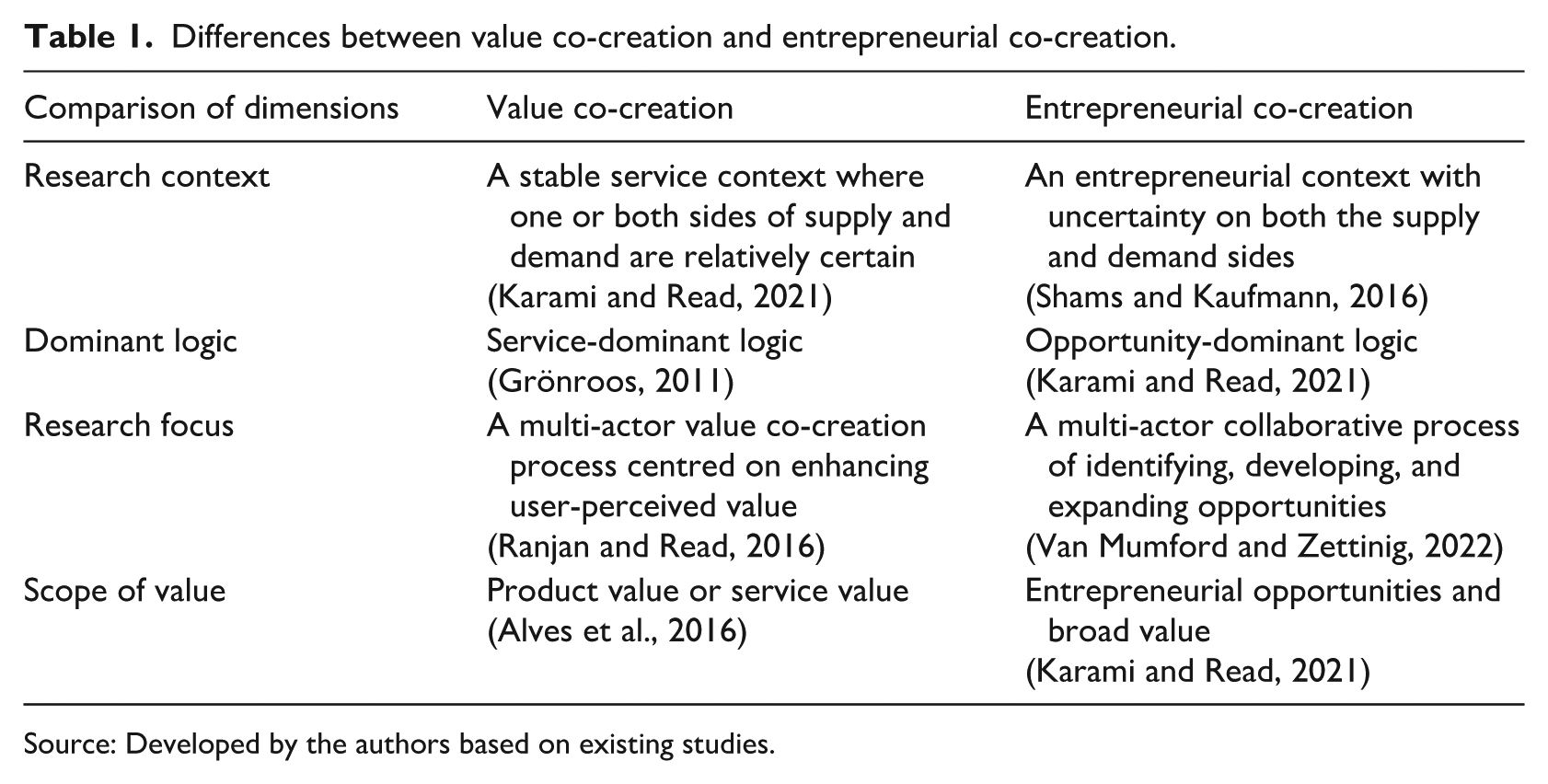
Source: Developed by the authors based on existing studies.
Current research on entrepreneurial co-creation focuses mainly on three aspects. The first is the social interaction of entrepreneurial co-creation. This aspect refers to the interactive behaviours among multiple actors aiming for a cooperative, win‒win outcome, enabling complementary resources and heterogeneous information to continually spill over (Yang and Leposky, 2022). This process helps new ventures obtain market insights (Barrett et al., 2021) and enhances their legitimacy by improving users’ understanding of these enterprises. The second aspect is the institutional iteration of entrepreneurial co-creation. This refers to the collaborative optimization of various institutions of entrepreneurial co-creation (Karami and Read, 2021). This accelerates information flow and helps address legitimacy crises. Finally, the generation of co-creation commitments is highlighted. From a psychological perspective, the formation of these commitments is crucial for facilitating entrepreneurial co-creation behaviours (Emami et al., 2021; Van Mumford and Zettinig, 2022). Consequently, new ventures can better tap into and secure stakeholder resources, thereby increasing their ability to overcome the dual challenges of uncertainty and legitimacy.
In addition, digital platforms provide a fertile context for the emergence and evolution of entrepreneurial co-creation. First, digital platforms enable direct connections between PDEs and users, as well as other stakeholders, offering a new infrastructural foundation for entrepreneurial co-creation (Park et al., 2021). Second, digital platforms significantly enhance the status and value-creating capacity of users, who have now become central actors in the co-creation process (Karami and Read, 2021). Finally, digital platforms offer new ventures diverse forms of digital empowerment and access to abundant boundary-spanning resources, facilitating efficient interactions and close collaboration among PDEs, users, and other stakeholders. This enables entrepreneurial co-creation to expand in terms of both depth and scope (Paynter and Samson, 2025; Yao et al., 2022).
While research on entrepreneurial co-creation has laid a strong foundation for understanding how new ventures overcome the liabilities of newness and smallness, there are still two key limitations. Existing studies often assume that co-creation actors engage in relationships characterized by symmetrical interdependence (Karami and Read, 2021). However, platforms function as foundational infrastructure, giving rise to asymmetric dependencies. Both entrepreneurs and users rely disproportionately on platforms (Cutolo and Kenney, 2021). This calls for further examinations of the distinctive role of platforms in shaping entrepreneurial co-creation dynamics. Moreover, current research suggests that economic incentives are the primary driver of entrepreneurial co-creation (Emami et al., 2021; Karami and Read, 2021). However, such a framing leans heavily on instrumental rationality (Van Mumford and Zettinig, 2022). In the digital platform entrepreneurial context, where intensive user interaction is a defining feature, the rationale behind entrepreneurial co-creation may extend beyond instrumental concerns.
2.4. Critical review and research framework
In summary, while current studies have laid an important foundation, two critical research gaps remain. First, most research on the liabilities of newness and smallness has been developed in non-digital platform contexts and fails to sufficiently account for the digital platform entrepreneurial context. Second, prior studies often assume symmetrical interdependence among co-creation actors (Karami and Read, 2021). However, digital platforms created pronounced asymmetries in the dependence among entrepreneurs and users (Cutolo and Kenney, 2021). Under these conditions, how digital platforms shape multi-actor collaboration is still poorly understood. Moreover, existing research on entrepreneurial co-creation identifies economic incentives as the primary factor driving the continued participation of co-creators (Emami et al., 2021; Karami and Read, 2021), which is largely based on an instrumental rationality perspective. However, in interactive digital environments, alternative forms of rationality may give rise to new mechanisms that support deeper and more sustained co-creation (Van Mumford and Zettinig, 2022). Nevertheless, this line of inquiry remains notably underdeveloped. Therefore, this paper asks the following question: How do PDNVs overcome the liabilities of newness and smallness through entrepreneurial co-creation?
Centring on this research question, we adopt an “antecedent–process–outcome” logic and propose a “liabilities–entrepreneurial co-creation–outcomes” conceptual framework (as shown in Figure 1). We begin by identifying the dual constraints of uncertainty and legitimacy that underpin the liabilities of smallness and newness and then analyse the entrepreneurial co-creation processes and outcomes within the digital platform context, guided by the foundational literature on entrepreneurial co-creation (Karami and Read, 2021; Van Mumford and Zettinig, 2022).
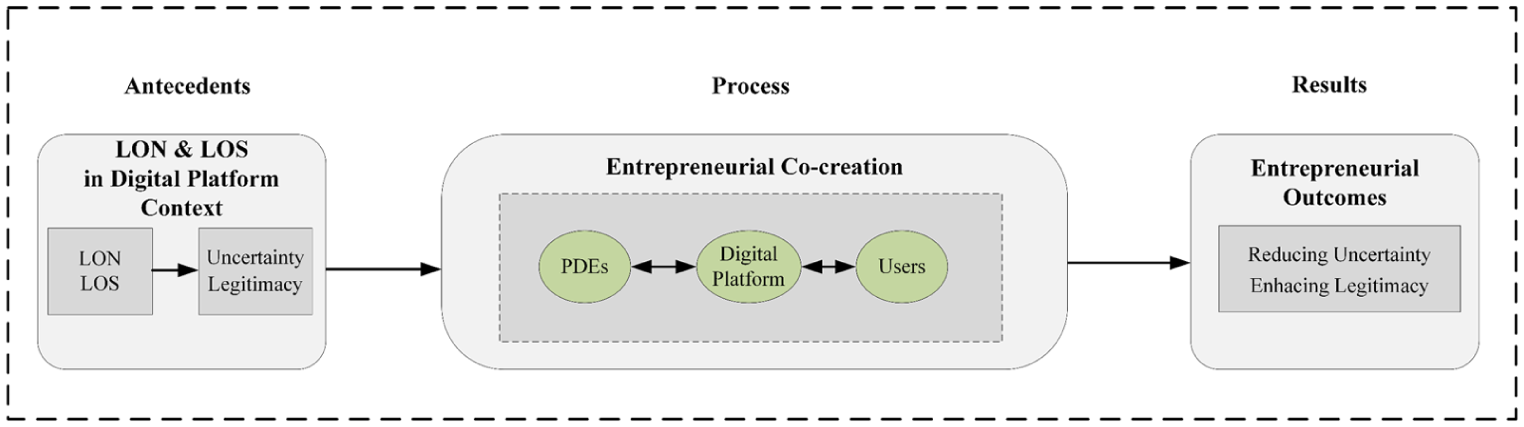
Research framework.
3. Methodology
3.1. Research method
The purpose of this study is to explore how PDNVs can overcome the liabilities of newness and smallness through entrepreneurial co-creation. To achieve this objective, this study adopts a longitudinal tracking approach for two key reasons. First, the research question is inherently exploratory and situated within the emerging domain of digital entrepreneurship, where theoretical development remains nascent. A sustained, in-depth investigation is therefore essential to uncover meaningful insights into dynamic growth mechanisms (Yin, 2013). Second, the research question involves both “how” and “why” aspects, characterized by strong contextual embeddedness and temporal evolution (Gioia et al., 2013). A longitudinal approach makes it possible to observe the dynamic interactions among multiple actors and captures the unfolding of entrepreneurial co-creation behaviours over time, thereby offering valuable empirical grounding for theory building and novel explanatory mechanisms.
3.2. Sample
This study selects Natural Workshop, which is based on the WeChat platform, as the research subject based on two primary considerations. First, WeChat is not only the largest social digital platform in China but also provides a network of acquaintances based on real-life social relationships, making it the core platform for managing private domain traffic in China. This feature enables PDNVs to engage in direct and efficient interactions with stakeholders. Natural Workshop primarily focuses on selling bamboo tissue products through digital platforms, which was founded in April 2015. During its growth, it also encountered the liabilities of newness and smallness. For instance, it faced uncertainty in user demand, as “new opportunity is hard to identify; over a year and more than 30 iterations were required to finalize product selections.” It also faced cognitive legitimacy issues, as “a small venture selling unique products was not well recognized by most users.”
Natural Workshop overcame these challenges by leveraging entrepreneurial co-creation with digital platforms and users, which enabled rapid identification of opportunities, efficient creation of popular products, effective integration of distribution and marketing channels, and joint entrepreneurship with user partners, leading to rapid growth. By the third year, Natural Workshop’s revenue surpassed 78.7 million USD, and by the fourth year, it had gained 27 million fans. Today, Natural Workshop is a leading brand of the bamboo tissue industry in China, with more than 32 million fans and annual revenue exceeding 282 million USD. It owns two wholly owned subsidiaries and has incubated 14 ecosystem-linked ventures, earning 15 public government recognitions.
3.3. Data collection
The data span from April 2018 to August 2024 and capture key aspects of the firm’s development. We first interviewed the CEO to trace the company’s growth, highlight the role of digital platforms and users, and define three phases: the identification of a single entrepreneurial opportunity, its development, and subsequent expansion into a portfolio of green consumer product ventures. We then interviewed middle and senior managers to validate this trajectory and gain functional insights. Focus groups with frontline employees were conducted to understand their behaviours and views on the entrepreneurial process. Interviews with key users explored their engagement as co-creation participants. One researcher also worked inside the firm, serving as a CEO assistant for 2 years and a product manager for one and participating in meetings and activities. Finally, we supplemented the primary data with business magazines, social media, internal documents, and online secondary sources. In total, we conducted 45 interviews, 6 focus groups, and 26 participant observations and collected 106 archival items and 78 secondary items. Table 2 provides a detailed overview.
Data sources.
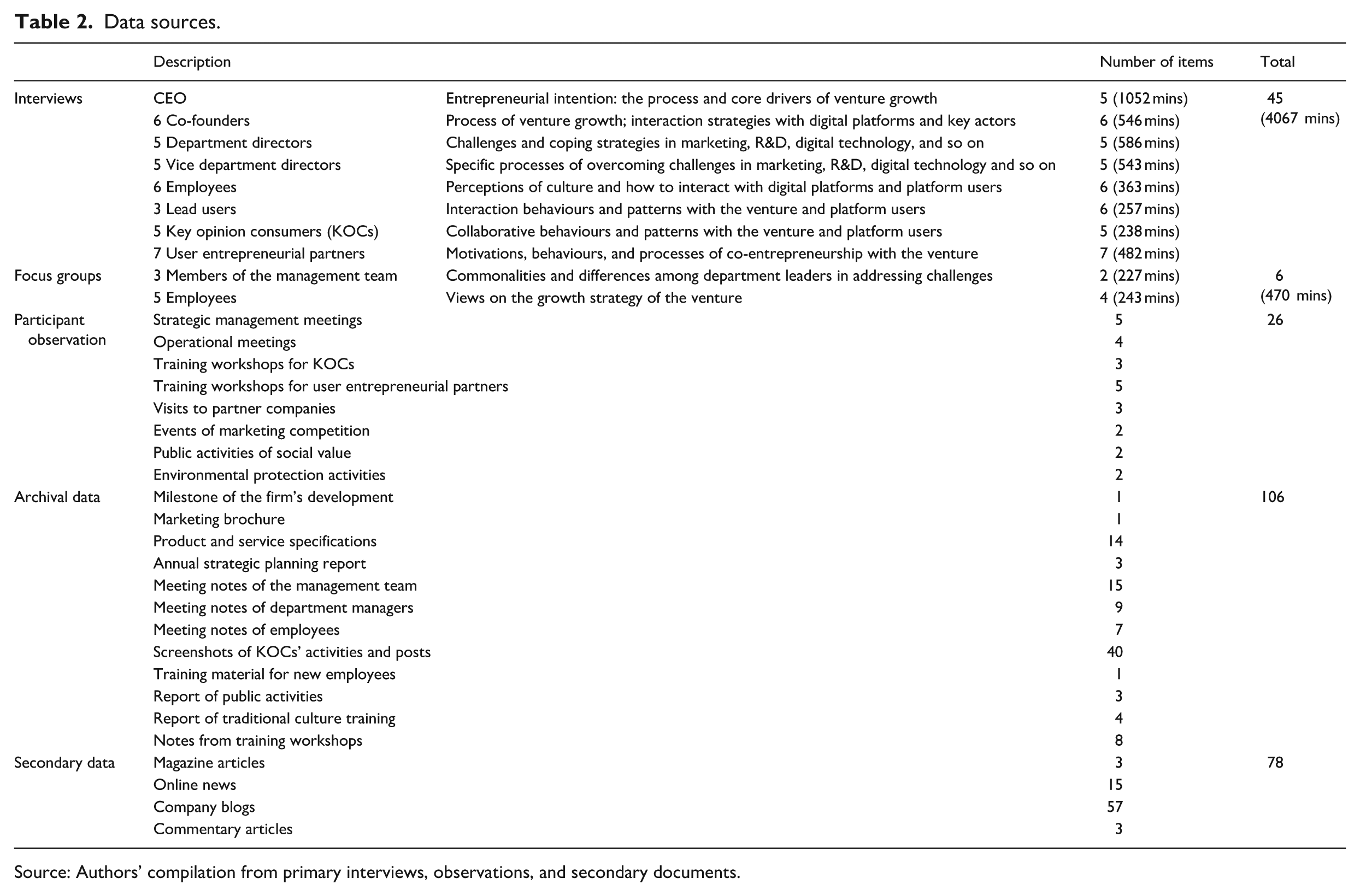
Source: Authors’ compilation from primary interviews, observations, and secondary documents.
3.4. Data analysis
This study follows the exploratory case study coding approach outlined by Gioia et al. (2013), creating a data structure as shown in Figure 2. Initially, the case data is coded at the first-order level; subsequently, related first-order codes are grouped and conceptualized to form second-order themes; and finally, these themes are reclassified based on the case data and relevant literature, resulting in the development of third-order aggregate categories. In cases of inconsistencies in coding results, researchers engage in repeated discussions to minimize subjectivity. The process is iteratively refined across these steps, with the validity and accuracy of the codes being tested through cross-validation using data from multiple sources. Any emerging issues during the coding process are addressed by supplementing the data, continuing this iterative cycle until theoretical saturation is reached.
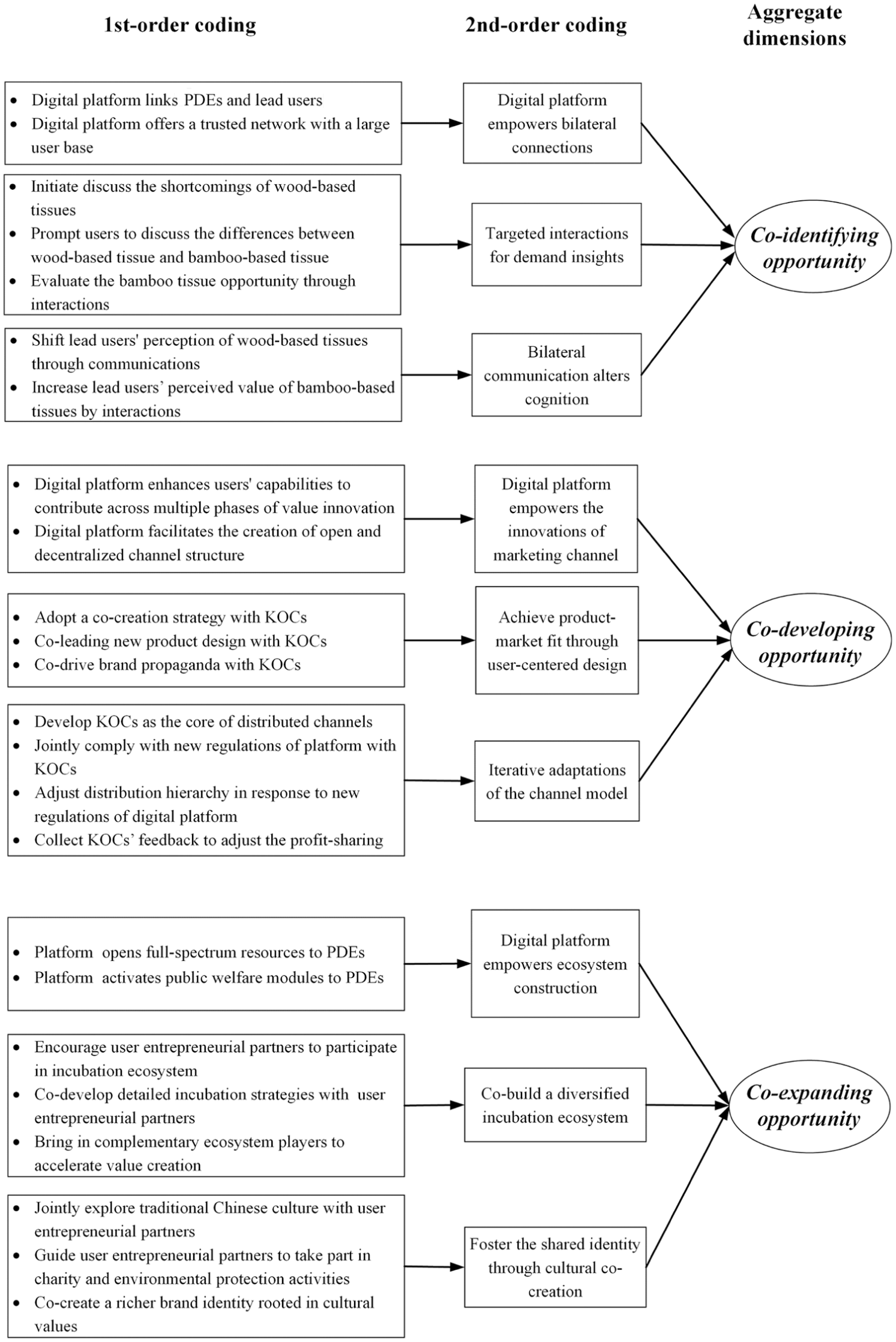
The structure of the data.
Prior to organizing the data structure, the research team articulated the study’s objective: to uncover the process mechanisms through which PDNVs leverage digital platforms to overcome the liabilities of newness and smallness. Accordingly, the coding process centred on identifying and interpreting breakthrough mechanisms. The researchers began by distilling the raw language of the interviewees and categorizing the data through iterative comparison, resulting in a set of first-order codes. These were then clustered based on their core meanings to generate second-order themes such as “digital platform empowers bilateral connections” and “targeted interaction for demand insights.” (The definitions of second-order themes can be found in Appendix A.) In line with established inductive coding practices (Suddaby, 2006), the team iteratively refined and reclassified these themes, further consolidating those with similar characteristics. This step led to the emergence of three aggregate dimensions that conceptualize the breakthrough process. Finally, the theoretical framework was developed from the data and theory to clarify the relationships among these aggregate dimensions.
4. Findings
4.1. Opportunity identification phase
4.1.1. Antecedent: Reducing the uncertainty of user demand and enhancing cognitive legitimacy
Natural Workshop faced two key constraints in this phase. First, through initial exploration, PDEs focused on the bamboo tissue market but encountered uncertainty about the target user segment. PDEs lacked clarity with regard to who the intended users were, and they had limited insight into their consumption motivations, making it difficult to identify concrete user needs. In addition, the product suffered from low levels of cognitive legitimacy. At the time, there was a widespread cognitive gap among users concerning bamboo tissues. The firm faced a situation in which most users were unfamiliar with its product, and some even held misconceptions, perceiving wood-based tissues as higher quality while viewing bamboo tissues as inferior.
4.1.2. Breakthrough strategy: Co-identifying opportunity
During this phase, the process of overcoming the dual constraints unfolded in three steps. First, the digital platform empowers bilateral connections. The platform, as the key co-creator, supported this process in two ways. It connected PDEs with lead users. As a one-to-many digital social network, WeChat enabled direct interaction. Users can share content via digital artefacts, named “Moments,” amplifying visibility and generating further user engagement. This significantly expanded the PDEs’ reach and facilitated a wider understanding of user profiles and preferences. Next, the digital platform offered a trusted network with a strong user base. Unlike other platforms, WeChat’s architecture is rooted in real-world relationships, enhancing trust. This trust led to high-quality responses and greater acceptance of the firm’s messages.
The second step was targeted interaction for demand insights. Natural Workshop chose to engage directly with lead users and shape a business model aligned with evolving market dynamics. First, believing that “the opportunity for bamboo tissue stemmed from the weaknesses of wood-based alternatives” (CEO), PDEs collected user complaints during interactions. The most frequently cited issues included concerns that wood tissues were non-sustainable, were overpriced, and posed health risks. In response to feedback, Natural Workshop created comparative images highlighting the respective advantages and shortcomings of both types, which sparked further in-depth discussion. As Co-founder 4 said, “Initially, we were just casually chatting on WeChat, but then we created a series of comparison pictures between bamboo and wood tissues to see who was engaging and what they were thinking.” And then, PDEs began to evaluate the bamboo tissue opportunity through interaction. It became clear that the most engaged participants were mothers of babies who were environmentally conscious, health-oriented, and socially active. Natural Workshop further analysed their needs centred on natural ingredients, eco-friendliness, and cost-effectiveness. The topic quickly gained traction, attracting more than 1200 participants within 2 hours. This led PDEs to view bamboo tissue, marketed via the WeChat platform, as a potential opportunity.
Third, bilateral communication alters users’ cognition. Natural Workshop established WeChat groups to bring more lead users into discussions around tissue-related topics. Within these groups, the firm shared videos and test reports from credible institutions that highlighted the health and environmental risks associated with wood-based tissues. These materials prompted an immediate change in perception among lead users. Next, Natural Workshop emphasized the key advantages of the product, while it also articulated its founding mission of “delivering green and healthy products to everyone.” Through a series of WeChat posts, the firm also conveyed the broader social and environmental value of bamboo tissue use.
4.1.3. Entrepreneurial outcomes
Natural Workshop recognized that its primary user base consisted of mothers of babies who were environmentally conscious, health-oriented, and value-sensitive. It further distilled that users’ core expectations for bamboo tissues centred on three attributes: natural composition, eco-friendliness, and affordability. Second, after learning about the risks of wood-based tissues and the benefits of bamboo alternatives, more than 1000 lead users prepaid for the new product via WeChat transfers, resulting in more than 20.6 thousand USD in immediate revenue. This provided direct evidence of the market’s potential and ultimately led to the formal identification of bamboo tissue, operated through the WeChat platform, as a viable entrepreneurial opportunity.
4.2. Opportunity development phase
4.2.1. Antecedent: Reducing product–market fit uncertainty and enhancing regulatory legitimacy
Diverging from most competitors who focused on distributing low-cost, low-quality products, Natural Workshop committed to developing a premium offering. However, it faced two challenges in this phase. First, product–market uncertainty centred on how to design a high-quality product that aligned with user expectations. Second, Natural Workshop struggled with deficits in regulatory legitimacy. Its limited operational experience led to accusations of misleading promotion. Production capacity shortfalls caused delivery delays, prompting user allegations of hunger marketing. These controversies quickly escalated on social media, fuelling public misunderstanding and driving the firm to the edge of bankruptcy.
4.2.2. Breakthrough strategy: Co-developing opportunity
In this phase, entrepreneurial co-creation primarily took the form of co-developing an opportunity. First, the digital platform-empowered marketing channel innovation. Digital platform enables the sharing of text, images, and videos. This feature such as public accounts and real-time livestreaming allowed for large-scale, instantaneous communication. It expanded the ability for users to actively participate in both product promotion and distribution. As Co-founder 4 explained, “WeChat gave users wings. When these voices came together, the impact was powerful. Just like a small spark can ignite a wildfire.” Furthermore, the inherent openness of platform allowed the firm to continuously engage with diverse stakeholders, encouraging dynamic participation in marketing innovation. Platform-based interaction enabled real-time, peer-to-peer communication across levels. This efficiency supported the emergence of flat and agile channel systems. Therefore, Natural Workshop was able to rapidly iterate its management routines and institutional arrangements.
Second, product–market fit could be achieved through user-centred design. They collaborated closely with key opinion consumers (KOCs) in terms of marketing innovation. PDEs subsequently issued a public invitation via WeChat, calling for user participation in product development. KOCs responded enthusiastically, offering design ideas and promotional strategies and inviting peers to join. Through iterative discussion, PDEs and KOCs finalized a concept focused on large, premium, healthy, and eco-friendly tissue. The brand launched with the slogan “Six boxes of tissue could save one tree.” And then, Natural Workshop positioned KOCs as central and introduced the value proposition of earning by sharing. Funds once allocated to intermediaries were redirected to KOCs, promoting the brand on WeChat. Earnings were based on orders via each KOC’s shared links. This unified platform model integrated sales and communication. As the CEO described, “Our model turned users into both promoters and distributors. It went viral instantly. Even midnight launches sold out in seconds.”
Finally, the channel model was iteratively adapted. Initially, to restore trust, Natural Workshop focused on enhancing the promotional and distribution capabilities of its KOCs. It organized online training using voice and video livestreaming to develop their marketing skills and launched offline initiatives such as the Workshop Academy and City Road selling. The company granted regional marketing rights to 25 of the KOCs, establishing them as core nodes in its digital distribution network. Livestreams conducted from within the production facility featuring these KOCs attracted more than 10 million cumulative views, helping dispel external scepticism. Moreover, following China’s mandate prohibiting more than three levels of platform-based distribution, Natural Workshop consulted regulations with WeChat. Then, it limited the distribution tiers to three. The company also integrated its backend system with WeChat to enable real-time audits and ensure ongoing regulatory compliance. And then, while the original incentive was high, it fostered passivity. Natural Workshop directly reduced payout rates, which triggered accusations of unfairness. In response, PDEs initiated direct conversations with KOCs and introduced a multi-tiered bonus system. This allowed for more customized, merit-based incentives. As Co-founder 6 explained, “We cut the bonuses significantly, which led to pushback and complaints. After listening to the voice of KOCs, we implemented a set of adjustments to refine the system.”
4.2.3. Entrepreneurial outcomes
The product received strong market validation. The product featured extremely low levels of carcinogens and harmful bacteria, exceeding national quality standards. It was certified as food grade by both the FDA and the EU standards, yet priced at only 70% of alternatives. Combined with their channels, user demand surged, and the revenue exceeded 78.7 million USD. In addition, Natural Workshop proactively engaged with stakeholders to address regulatory risks. These actions established the firm as a trustworthy, compliance-oriented enterprise. By the end of this phase, Natural Workshop had attracted more than 27 million fans, paid nearly 8.4 million USD in taxes, achieved a repurchase rate exceeding 70%, and received eight government honours.
4.3. Opportunity expansion phase
4.3.1. Antecedent: Reducing business growth uncertainty and enhancing regulatory legitimacy
During this phase, PDEs faced renewed expressions of liabilities. Specifically, they confronted a revenue plateau because of their reliance on a single opportunity. If the growth bottleneck remained unresolved, KOCs might gradually lose interest in co-creation. Moreover, the firm needed to strengthen its normative legitimacy. As co-creation deepened between PDEs and KOCs, a shared entrepreneurial ethos emerged as a defining feature of the firm’s development. The challenge, therefore, was how to institutionalize and reinforce this normative foundation to further unite co-creators around a common identity.
4.3.2. Breakthrough strategy: Co-expanding opportunity
In this phase, entrepreneurial co-creation was characterized by co-expanding opportunities. First, WeChat’s full-spectrum resource access facilitated Natural Workshop’s shift towards an ecosystem model. Through deepened cooperation with the platform, the firm secured not only broad user traffic but also advanced digital artefacts, such as analytics, dashboards and cloud-based services, laying a solid foundation for innovation ecosystem development. In addition, the activation of WeChat’s public welfare features fostered deeper collaboration among ecosystem participants. Noticing the firm’s engagement with Tencent’s 99 Charity Day, the platform offered expanded partnership collaborations. Tencent’s 99 Charity shared its knowledge and best practices in organizing social campaigns, enabling PDEs to co-host co-branded initiatives. These efforts significantly increased the level of engagement and motivation among both PDEs and user entrepreneurial partners.
Second, the diversified incubation ecosystem was co-built. Natural Workshop openly shared the firm’s incubation vision, inviting people to join the mission of building a “natural good product platform ecosystem” to fulfil the mission of “delivering green products to everyone.” Then, PDEs and user entrepreneurial partners co-developed incubation strategies. Natural Workshop adopted three key measures: (1) a shared-traffic and high-profit-sharing model, allowing partners to access its user base and earn 80% of profits once their incubated venture exceeded 13 million USD in revenue; (2) expanding from bamboo tissue to adjacent products – such as natural facial masks and unbleached towels – offered to user entrepreneurial partners; and (3) providing support through initial equity structuring and continuous knowledge transfer in product development and marketing. As the CEO explained, “The goal of building this incubation ecosystem is to realize our shared dreams. Many partners lack entrepreneurial experience, so we walk alongside them.” Natural Workshop partnered with a research institute under the Chinese Academy of Sciences and with Tencent’s 99 Charity, proactively connecting incubated startups with green product technologies.
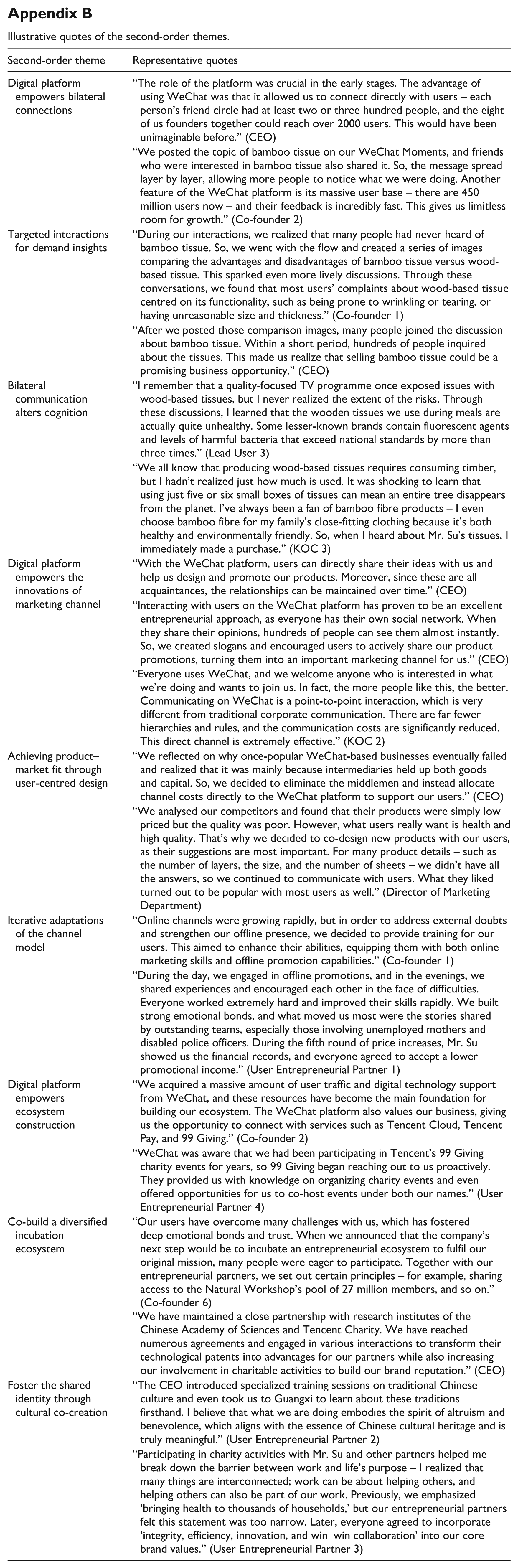
Third, shared identity was fostered through cultural co-creation. Initially, Natural Workshop and user entrepreneurial partners jointly explored traditional Chinese culture. It upgraded its co-learning framework by replacing general cultural courses with focused 3-day workshops. These sessions emphasized integrity, altruism, patriotism, and dedication; therefore, they reinforced shared beliefs and strengthened co-creative bonds. Subsequently, Natural Workshop guided partners to take part in charity activities. It mobilized them to participate in Tencent’s 99 Charity Day and co-organized more than 20 charity events, including charity donations and green village fundraising programmes. These initiatives directly engaged more than 80,000 users, enabling entrepreneurial partners to embody the shared identity in practice. Moreover, PDEs and partners co-integrated virtue, efficiency, innovation, and mutual benefits into its core values and drew on classics such as San Zi Jing and Di Zi Gui to co-develop blogs and animations. Inspired by Alipay’s interactive e-games, it launched a Spring Festival couplet-writing game combining the brand, the product and traditional culture, which attracted more than 10,000 participants and was widely shared. Some illustrative quotes of the second-order themes are shown in Appendix B.
4.3.3. Entrepreneurial outcomes
Ultimately, PDEs had founded 2 wholly owned subsidiaries and 14 ecosystem-linked firms, generating more than 282 million USD in revenue and attracting 32 million users. Natural Workshop became a leading player in China’s green consumer goods sector. Its normative legitimacy also strengthened, as reflected in the deep emotional and value-based bonds with user entrepreneurial partners who strongly identified with the firm’s mission.
5. Discussion
5.1. Theoretical model
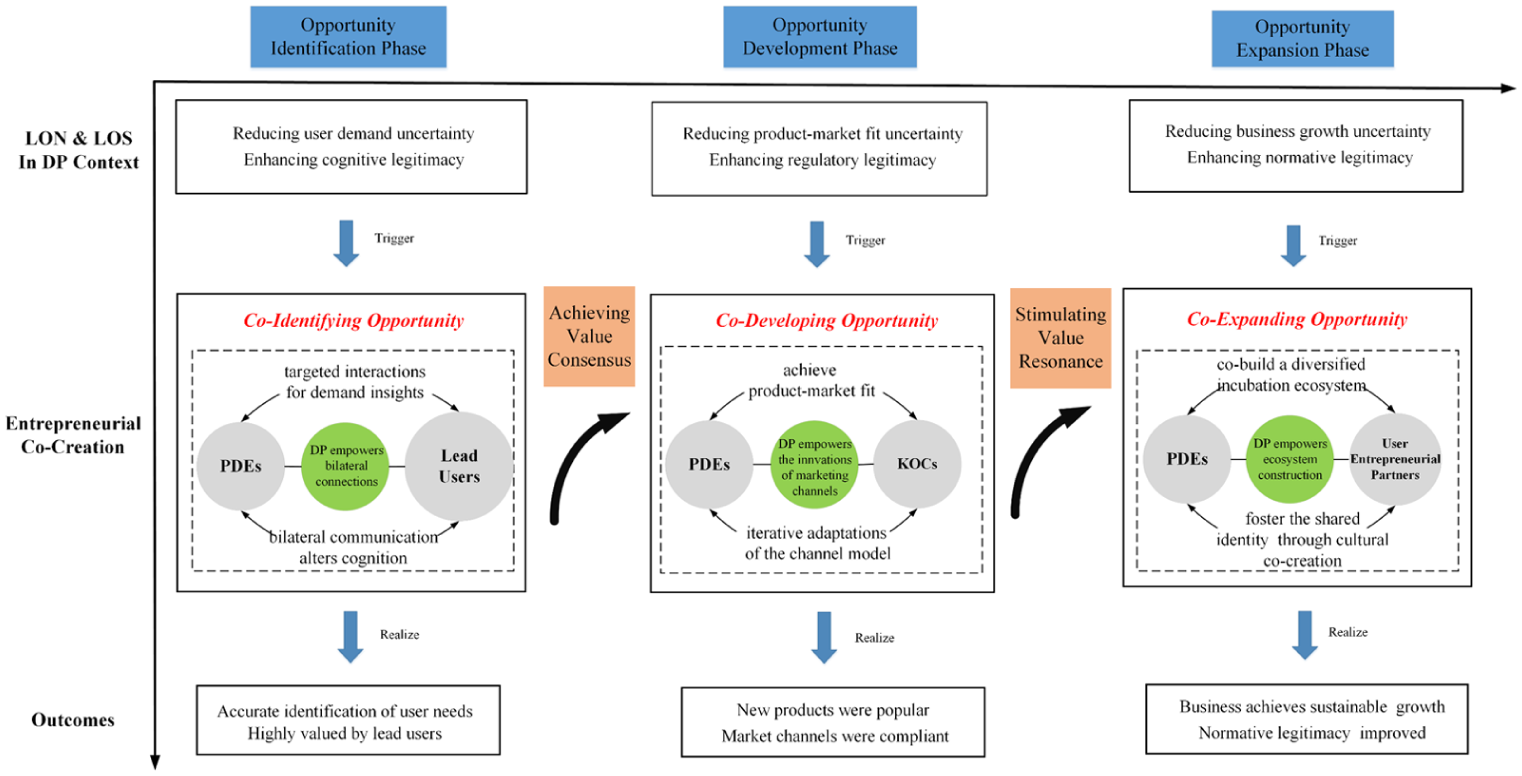
This study proposes a theoretical model (as shown in Figure 3) that explains how PDNVs operating in the digital platform context can overcome the liabilities of newness and smallness. Specifically, in the opportunity identification phase, the PDNV adopted a co-identifying opportunity strategy. The purpose of this strategy was to enable PDEs to directly access and activate lead users through the digital platform, thereby validating entrepreneurial hypotheses in real-time and identifying opportunities. Digital platform-empowered bilateral connections strengthened the linkage between PDEs and users, forming the foundation for high-frequency and continuous engagement. In this way, PDEs and stakeholders exchanged information about user demand and product knowledge through entrepreneurial co-creative processes, gradually reducing demand-side uncertainty and improving the cognitive legitimacy of new offerings.
Theoretical model of the PDNV growth process.
During the opportunity development phase, the PDNV adopted a co-developing opportunity strategy. Leveraging the digital platform enhanced users’ value creation capabilities while encouraging the participation of KOCs in value-creation activities. Specifically, platform-empowered marketing channel innovation strengthened the promotional influence of KOCs and supported collaborative marketing between PDEs and key users. Achieving product–market fit through user-centred design enabled PDEs to involve KOCs in product and channel development. Through iterative market validation, PDEs optimized value creation and delivery networks, thereby reducing product–market uncertainty and enhancing regulatory legitimacy. In the opportunity expansion phase, the PDNV adopted a co-expanding opportunity strategy. This strategy emphasized leveraging the ecological resources of the digital platform and joint venture efforts with user entrepreneurial partners. PDEs worked closely with their partners to realign the fit among teams, emerging opportunities, and critical resources, laying the groundwork for a platform-embedded incubation ecosystem. Simultaneously, they cultivated shared value commitments with user entrepreneurial partners, strengthening the cultural foundations of the ecosystem. Specifically, platform-enabled ecosystem construction empowered PDEs to innovate business models and reinforce shared beliefs. This, in turn, catalysed co-creators to collaboratively build a diversified incubation ecosystem.
5.2. Evolutionary mechanism of PDEs’ entrepreneurial co-creation
This paper draws on the theoretical view of entrepreneurial co-creation by Van Mumford and Zettinig (2022), which suggests that value rationality may serve as an alternative rational foundation of entrepreneurial co-creation. We adopt this insight to examine the two dimensions of value rationality – state belief and change belief – in an integrated manner. Focusing on the intrinsic value attributed to the beliefs formed through entrepreneurial co-creation behaviours at different phases, as well as the subjective intensity of motivations to realize such beliefs.
5.2.1 Mechanism of achieving value consensus
After identifying an opportunity, PDEs developed it by transforming ideas into products. As digital platforms enhance users’ value-creation capabilities, user-centred product development has become prevalent. To attract user participation, the PDNV used the platform to communicate entrepreneurial value beliefs, fostering alignment and engagement. Specifically, during co-identifying opportunity, PDNVs embedded the platform within social interactions that facilitated information and belief exchange, expanding communication and sustaining consensus building. They also disseminated their green entrepreneurial beliefs, to which lead users actively responded. Through agile interactions, users gradually developed a shared understanding of the entrepreneurial vision, perceiving its value and becoming motivated to engage in collaborative product development through social value incentives. Thus, value consensus functioned as the mechanism bridging identification and development, deepening co-creation and transforming lead users into KOCs.
5.2.2. Mechanism of stimulating value resonance
With KOCs central to product and channel design, the PDNV rapidly commercialized its bamboo tissue opportunity. To sustain growth, co-expanding opportunities became essential. KOCs embodied strong commitment and engagement in co-creation (Van Mumford and Zettinig, 2022). Extending this through value rationality, we posit that value resonance is a key driver of co-creation commitment. During co-developing opportunity, user-centred design involves not only material outputs but also the embodiment and transmission of shared values. PDEs conveyed these beliefs through actions, allowing KOCs to experience underlying values and form value resonance. By cultivating these users, PDEs encouraged the spread of inspirational stories shared by KOCs, deepening emotional attachment grounded in shared beliefs. When challenges arose, KOCs sometimes relinquished economic gains to support PDEs – moments reflecting affective value resonance. Through this process, the PDNV reinforced user beliefs and ignited users’ motivation to co-create, promoting their participation in ecosystem construction as co-creators. Hence, stimulating value resonance drives the evolution from development to expansion and the transformation of KOCs into user entrepreneurial partners.
5.3. Agile evolutionary growth logic of PDNVs
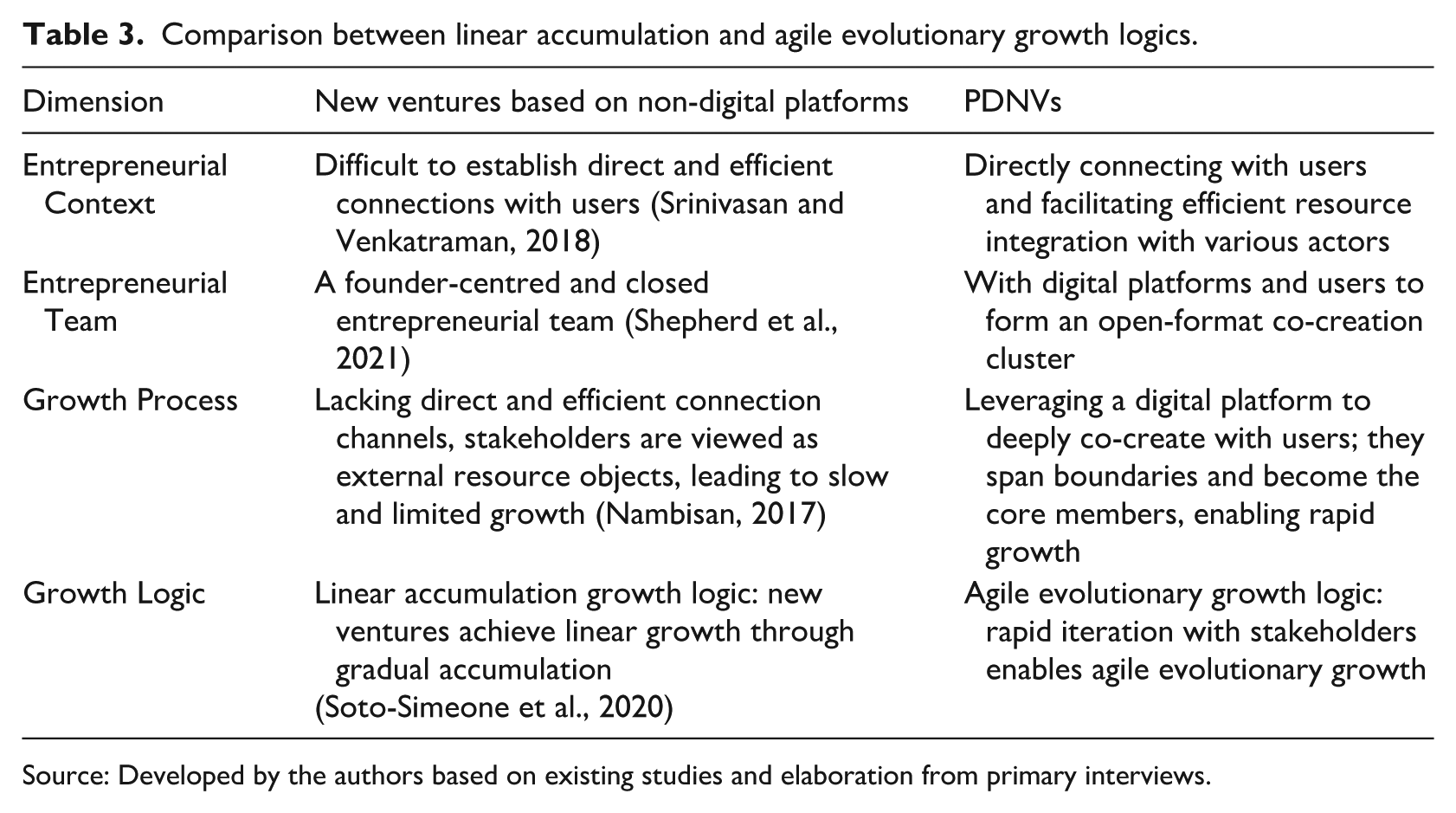
New ventures based on non-digital platforms typically follow a linear accumulation logic (Nambisan, 2017). The absence of direct and efficient user connection channels limits firms’ ability to engage in sustained, high-quality user interactions (Srinivasan and Venkatraman, 2018). Consequently, entrepreneurs rely primarily on their own knowledge and resource base to navigate uncertainty and legitimacy constraints (She et al., 2020; Shepherd et al., 2000). User involvement is typically limited to a few isolated points in the value creation process. As a result, the entrepreneur remains the central actor in the closed team, and deep engagement with users is rare, making it especially difficult for external actors to become part of the entrepreneurial team (Shepherd et al., 2021). Specifically, to cope with uncertainty, these ventures rely on internal knowledge and a few engagements with external resources to gather fragmented market signals (Nambisan, 2017). For example, through the lean start-up method, ventures iteratively test opportunities and refine products to uncover market needs. However, these approaches often entail long iteration cycles and high exploratory costs (Felin and Zenger, 2020), yielding only gradual information gains. In addressing legitimacy challenges, ventures typically seek to build legitimacy slowly through limited stakeholder interactions (Soto-Simeone et al., 2020). For instance, they obtain industry certifications or form alliances with incumbents. However, regulatory compliance offers only modest legitimacy returns, and an alliance strategy may entail significant risk exposure (Musarra et al., 2023; Soublière and Gehman, 2020).
In contrast, PDNVs follow the agile evolutionary growth logic. Since users are the primary source of both uncertainty and legitimacy constraints, PDNVs rely on digital platforms to directly access users and engage in efficient, continuous entrepreneurial co-creation. Through agile interactions with platforms and users, a multi-actor, collaboratively driven entrepreneurial process emerges. This process is characterized by platform empowerment and the transformation of key users into entrepreneurial partners. As a result, the agility of interaction inherent in digital platforms drives a fundamental shift in the composition of entrepreneurial teams. The team shifts from a founder-centred structure to a platform user co-creative nucleus, allowing innovative access to entrepreneurial opportunities and key resources. Consequently, PDNVs are better equipped to swiftly and effectively address the uncertainty and legitimacy challenges underlying the liabilities of newness and smallness. Across this co-creation process, as digital empowerment deepens and user roles evolve, multi-actor entrepreneurial co-creation continues to transform through agile interactions. Some information concerning the comparison between linear accumulation and agile evolutionary growth logics has been distilled into Table 3.
Comparison between linear accumulation and agile evolutionary growth logics.
Source: Developed by the authors based on existing studies and elaboration from primary interviews.
6. Implications
6.1. Theoretical implications
First, this paper contributes to gaining a systematic understanding of how PDNVs overcome the liabilities of newness and smallness. Prior studies, grounded mostly in non-digital platform settings, note that new ventures often take users as external resource objects (Karami and Read, 2021; Nambisan, 2017), rendering existing strategies less effective in addressing the challenges of uncertainty and legitimacy. Our paper reveals that PDNVs, by leveraging platform empowerment and focusing on entrepreneurial co-creation with users, can systematically mitigate constraints. Specifically, in the opportunity identification phase, PDNVs access real-time user feedback and platform-empowered connectivity with lead users, which helps reduce demand uncertainty and enhance cognitive legitimacy. In the opportunity development phase, PDNVs collaborate with KOCs in product design and decentralized marketing, thereby lowering market uncertainty and improving regulatory legitimacy. In the opportunity expansion phase, PDNVs utilize a platform ecosystem to mobilize user entrepreneurial partners, jointly develop a diversified incubation ecosystem, and co-create shared community values, therefore effectively reducing growth-related uncertainty and strengthening normative legitimacy. These findings directly respond to the research agenda proposed by Shepherd et al. (2021) and Gala et al. (2024), address a significant gap in our understanding of how new ventures can achieve rapid growth within the digital platform entrepreneurial context, and further advance the theory of new venture growth.
Second, this paper advances the theory of entrepreneurial co-creation by grounding it in the context of digital platform entrepreneurship. This study identifies the distinctive empowering role-played by digital platforms throughout the entrepreneurial co-creation process. In existing research, digital platforms are more often positioned as connection tools or distribution channels (Ojala and Lyytinen, 2024). Thus, digital platforms rarely function as active co-creation partners (Nambisan, 2017; Olan et al., 2024). However, this study reveals that digital platforms can become co-creators for PDEs. This is reflected in the joint optimization of marketing channels through ongoing interaction and, more notably, in the willingness of platforms to open all modular resources to PDEs to support the growth of PDEs. These platform resources form the foundation for deep co-creation between PDEs and their entrepreneurial user partners. Building on the premise of asymmetric dependence between PDEs and digital platforms (Cutolo and Kenney, 2021; Tschang, 2021), our findings show that platform empowerment not only facilitates efficient collaboration between PDNVs and users but also serves as a foundational condition for achieving deep co-creation. This responds to Srinivasan and Venkatraman’s (2018) call for more research on the unique role of digital platforms in shaping new venture growth. Our study also contributes to the literature on user entrepreneurship dynamics. As digital platforms continue to strengthen collaboration among actors, there is a growing need to open the “grey box” of collaborative process (Escobar et al., 2023). By examining the co-creation process between user entrepreneurs and PDEs within the digital platform context, our research demonstrates that PDEs’ activities – through both co-creation behaviours and beliefs – significantly drive user entrepreneurship on the platform, revealing the dynamic nature of their collaboration.
Furthermore, this paper adopts value rationality to identify the phase-based evolutionary mechanisms of entrepreneurial co-creation. Prior studies, grounded in the homo economicus assumption, emphasize that economic incentives are the central force for co-creation (Emami et al., 2021; Karami and Read, 2021). However, this instrumental view has been critiqued for being overly narrow (Van Mumford and Zettinig, 2022). This study reveals that the sustained evolution of entrepreneurial co-creation is driven by co-creators’ growing sense of meaning and purpose. Key users develop a deep value alignment with PDEs in achieving value consensus and stimulating value resonance. These mechanisms enable PDNVs and key users to engage in co-creation, thereby accelerating the process of overcoming the liabilities. The findings respond to the calls by Karami and Read (2021) and Van Mumford and Zettinig (2022) to explore the psychological underpinnings of entrepreneurial co-creation. Therefore, this paper offers a micro-level empirical explanation of why and how entrepreneurial co-creation continues to evolve.
6.2. Managerial implications
First, new ventures should strategically leverage digital platform empowerment. Doing so involves the use of platform tools to directly connect with lead users, generate data-driven insights, and establish efficient digital interactions. New ventures also need to adapt marketing and distribution strategies to fit platform dynamics and embed themselves deeply within the digital ecosystem to achieve scalable and sustainable growth. Second, new ventures should co-create with key users to grow rapidly in the digital platform context. By collaborating with lead users and KOCs in product design, channel development, and continuous iteration, PDNVs can align user values, unlock stakeholder resources, and ultimately overcome the liabilities of newness and smallness. This study also has implications for key platform users. As digital platforms reduce entrepreneurial barriers, empowered users play an increasingly important role in part-time and gig entrepreneurship. Beyond being consumers, they should act as active co-creators with PDEs across different stages, from opportunity identification to product development and marketing. By transforming their expertise and social capital into entrepreneurial resources, users can achieve both personal development and joint value creation.
7. Limitations and future research
First, regarding the diversity of digital platforms, this study focuses on a social media platform, which is characterized by strong social interaction attributes. Therefore, the research findings may not fully apply to other types of digital platforms. Second, regarding the diversity of entrepreneurial co-creation actors, this study examines the entrepreneurial co-creation process primarily among PDEs, digital platforms and users without considering other stakeholders, such as suppliers, investors, or regulatory bodies. Future research directions can focus on two aspects. The first is the “dark side” of digital platforms. While digital platforms facilitate PDNVs in overcoming the liabilities of newness and smallness, their asymmetric power and the over-dependence of PDEs on these platforms may hinder sustained growth. Therefore, PDEs face the paradox of “to be dependent or not to be dependent.” How can PDEs rely on digital platforms to access essential entrepreneurial resources while maintaining autonomy? Future research could explore the competitive and cooperative relationship between PDNVs and digital platforms. Second, industry heterogeneity should be taken into account. This study focuses on the growth trajectory of a PDNV in the bamboo tissue industry. However, new ventures in other sectors may follow different paths. Future research is encouraged to investigate how PDNVs grow in other industries.
Key theoretical and practical implications
Footnotes
Appendix
Illustrative quotes of the second-order themes.
| Second-order theme | Representative quotes |
|---|---|
| Digital platform empowers bilateral connections | “The role of the platform was crucial in the early stages. The advantage of using WeChat was that it allowed us to connect directly with users – each person’s friend circle had at least two or three hundred people, and the eight of us founders together could reach over 2000 users. This would have been unimaginable before.” (CEO) |
| “We posted the topic of bamboo tissue on our WeChat Moments, and friends who were interested in bamboo tissue also shared it. So, the message spread layer by layer, allowing more people to notice what we were doing. Another feature of the WeChat platform is its massive user base – there are 450 million users now – and their feedback is incredibly fast. This gives us limitless room for growth.” (Co-founder 2) | |
| Targeted interactions for demand insights | “During our interactions, we realized that many people had never heard of bamboo tissue. So, we went with the flow and created a series of images comparing the advantages and disadvantages of bamboo tissue versus wood-based tissue. This sparked even more lively discussions. Through these conversations, we found that most users’ complaints about wood-based tissue centred on its functionality, such as being prone to wrinkling or tearing, or having unreasonable size and thickness.” (Co-founder 1) |
| “After we posted those comparison images, many people joined the discussion about bamboo tissue. Within a short period, hundreds of people inquired about the tissues. This made us realize that selling bamboo tissue could be a promising business opportunity.” (CEO) | |
| Bilateral communication alters cognition | “I remember that a quality-focused TV programme once exposed issues with wood-based tissues, but I never realized the extent of the risks. Through these discussions, I learned that the wooden tissues we use during meals are actually quite unhealthy. Some lesser-known brands contain fluorescent agents and levels of harmful bacteria that exceed national standards by more than three times.” (Lead User 3) |
| “We all know that producing wood-based tissues requires consuming timber, but I hadn’t realized just how much is used. It was shocking to learn that using just five or six small boxes of tissues can mean an entire tree disappears from the planet. I’ve always been a fan of bamboo fibre products – I even choose bamboo fibre for my family’s close-fitting clothing because it’s both healthy and environmentally friendly. So, when I heard about Mr. Su’s tissues, I immediately made a purchase.” (KOC 3) | |
| Digital platform empowers the innovations of marketing channel | “With the WeChat platform, users can directly share their ideas with us and help us design and promote our products. Moreover, since these are all acquaintances, the relationships can be maintained over time.” (CEO) |
| “Interacting with users on the WeChat platform has proven to be an excellent entrepreneurial approach, as everyone has their own social network. When they share their opinions, hundreds of people can see them almost instantly. So, we created slogans and encouraged users to actively share our product promotions, turning them into an important marketing channel for us.” (CEO) | |
| “Everyone uses WeChat, and we welcome anyone who is interested in what we’re doing and wants to join us. In fact, the more people like this, the better. Communicating on WeChat is a point-to-point interaction, which is very different from traditional corporate communication. There are far fewer hierarchies and rules, and the communication costs are significantly reduced. This direct channel is extremely effective.” (KOC 2) | |
| Achieving product–market fit through user-centred design | “We reflected on why once-popular WeChat-based businesses eventually failed and realized that it was mainly because intermediaries held up both goods and capital. So, we decided to eliminate the middlemen and instead allocate channel costs directly to the WeChat platform to support our users.” (CEO) |
| “We analysed our competitors and found that their products were simply low priced but the quality was poor. However, what users really want is health and high quality. That’s why we decided to co-design new products with our users, as their suggestions are most important. For many product details – such as the number of layers, the size, and the number of sheets – we didn’t have all the answers, so we continued to communicate with users. What they liked turned out to be popular with most users as well.” (Director of Marketing Department) | |
| Iterative adaptations of the channel model | “Online channels were growing rapidly, but in order to address external doubts and strengthen our offline presence, we decided to provide training for our users. This aimed to enhance their abilities, equipping them with both online marketing skills and offline promotion capabilities.” (Co-founder 1) |
| “During the day, we engaged in offline promotions, and in the evenings, we shared experiences and encouraged each other in the face of difficulties. Everyone worked extremely hard and improved their skills rapidly. We built strong emotional bonds, and what moved us most were the stories shared by outstanding teams, especially those involving unemployed mothers and disabled police officers. During the fifth round of price increases, Mr. Su showed us the financial records, and everyone agreed to accept a lower promotional income.” (User Entrepreneurial Partner 1) | |
| Digital platform empowers ecosystem construction | “We acquired a massive amount of user traffic and digital technology support from WeChat, and these resources have become the main foundation for building our ecosystem. The WeChat platform also values our business, giving us the opportunity to connect with services such as Tencent Cloud, Tencent Pay, and 99 Giving.” (Co-founder 2) |
| “WeChat was aware that we had been participating in Tencent’s 99 Giving charity events for years, so 99 Giving began reaching out to us proactively. They provided us with knowledge on organizing charity events and even offered opportunities for us to co-host events under both our names.” (User Entrepreneurial Partner 4) | |
| Co-build a diversified incubation ecosystem | “Our users have overcome many challenges with us, which has fostered deep emotional bonds and trust. When we announced that the company’s next step would be to incubate an entrepreneurial ecosystem to fulfil our original mission, many people were eager to participate. Together with our entrepreneurial partners, we set out certain principles – for example, sharing access to the Natural Workshop’s pool of 27 million members, and so on.” (Co-founder 6) |
| “We have maintained a close partnership with research institutes of the Chinese Academy of Sciences and Tencent Charity. We have reached numerous agreements and engaged in various interactions to transform their technological patents into advantages for our partners while also increasing our involvement in charitable activities to build our brand reputation.” (CEO) | |
| Foster the shared identity through cultural co-creation | “The CEO introduced specialized training sessions on traditional Chinese culture and even took us to Guangxi to learn about these traditions firsthand. I believe that what we are doing embodies the spirit of altruism and benevolence, which aligns with the essence of Chinese cultural heritage and is truly meaningful.” (User Entrepreneurial Partner 2) |
| “Participating in charity activities with Mr. Su and other partners helped me break down the barrier between work and life’s purpose – I realized that many things are interconnected; work can be about helping others, and helping others can also be part of our work. Previously, we emphasized ‘bringing health to thousands of households,’ but our entrepreneurial partners felt this statement was too narrow. Later, everyone agreed to incorporate ‘integrity, efficiency, innovation, and win‒win collaboration’ into our core brand values.” (User Entrepreneurial Partner 3) |
Acknowledgements
The authors declared no potential conflicts of interest with respect to the research, authorship, and/or publication of this article.
Final transcript accepted on 14 March 2026 by Feifei Yang (AE – Strategy).

Funding
The authors disclosed receipt of the following financial support for the research, authorship, and/or publication of this article: This research was supported by the National Natural Science Foundation of China (72372162), the Natural Science Foundation of Hunan Province (2025JJ50437), the “High-End Think Tank” Special Project of Central South University (2022znzk04), and the Youth Fund Project for Humanities and Social Sciences Research of the Ministry of Education of China (25XJC630001).