






Abstract
Unethical pro-supervisor behavior (UPSB) represents a critical challenge for modern organizations. Past research notes that UPSB may develop due to close interpersonal relationships between leaders and subordinates. However, we have a limited understanding of whether employees’ perception of their relative closeness to the leader (compared to their peers) can also impact their participation in UPSB. Using social exchange theory, we plug this gap by examining the impact of leader–member exchange social comparison (LMXSC) perceptions on UPSB. We also explore the mediating role of felt obligation and the moderating role of ethical leadership. Results based on multisource, time-lagged data from 253 supervisor–subordinate dyads reveal that LMXSC is positively related to UPSB via felt obligation. The indirect relationship is weaker when ethical leadership is high. Implications for theory and practice are discussed.
1. Introduction
The business press is flooded with reports of corporate scandals across the world. Unsurprisingly, unethical employee behavior continues to represent a critical challenge for contemporary organizations. In response to this challenge, a growing body of research offers meaningful insights into how managers can reduce unethical employee behavior in the workplace (Arshad et al., 2024; Khan et al., 2025; Zahid et al., 2025). A considerable proportion of the existing literature reveals that employees pursue unethical activities either to serve their self-interests or to harm others, such as rivals or the organization (Cohen et al., 2013; Kilduff et al., 2016; Seuntjens et al., 2019). However, an emerging stream of research advocates that employees can also act unethically to help other individuals, such as their supervisors (Johnson and Umphress, 2019; Mesdaghinia et al., 2019). Media reports also highlight the prevalence of such misbehavior in organizations. For instance, the former representative director at Nissan has been found guilty of doing financial favors for his boss, the former chairman, by underreporting his pay (Press Trust of India, 2019). Likewise, the chief operating officer of Dole Food Company lied to the board of directors about the financial implications of certain business decisions (Frankel, 2015). He did so to keep the stock prices down so that his supervisor, the chief executive officer, could buy the stock at a lower price (Frankel, 2015).
Scholars refer to the aforementioned activities as unethical pro-supervisor behavior (hereafter, UPSB), which they define as “employee’s actions that further the interests of their leaders but violate ethical norms, values, or standards of proper employee conduct” (Mesdaghinia et al., 2019: 493). The UPSB encompasses acts of commission (e.g. inflating the supervisor’s performance to help him or her portray a desirable image) as well as omission (e.g. withholding information that may be damaging to the supervisor’s reputation) (Johnson and Umphress, 2019). Employee misbehaviors like UPSB are undesirable and problematic, as they entail perilous consequences not only for the actors but also for their organizations. For instance, the representative director at Nissan was ousted from the company and had to face imprisonment (Dooley, 2022). Simultaneously, the organization, Nissan, suffered financial losses worth as much as $84m over 9 years (Press Trust of India, 2019). On a similar note, the chief operating officer at Dole Food Company and his supervisor were ordered by the court to pay a sum of $148m to the shareholders (Frankel, 2015). The above examples elucidate that UPSB is injurious to organizations and their members from a financial, legal, and reputational standpoint. Individuals who participate in UPSB intend to advance the interests of their supervisors and may do so even at the expense of the organization. Therefore, it is imperative that practicing managers make conscious efforts to inhibit the prevalence of UPSB in their firms. To support such managerial efforts, management scholars have recently started examining the phenomenon of UPSB in the workplace.
Despite an emerging scholarly interest in this domain, research on UPSB is still in its infancy, and several important gaps remain. First, past studies have maintained that closeness in leader–subordinate relationships invokes subordinates to conduct UPSB (Bryant and Merritt, 2021; Li et al., 2022; Lim and Liu, 2017; Johnson and Umphress, 2019). However, contemporary research shows that employees rarely view their relationships with the leader in isolation (Vidyarthi et al., 2010). Instead, they assess how close they are to the leader in comparison to their peers (Vidyarthi et al., 2010). Past research is silent on how these social comparison processes (Festinger, 1954)—captured by subordinates’ perception of their relative standing in the leader–subordinate relationships—may encourage them to undertake UPSB. Only one recent study, to the best of the authors’ knowledge, has empirically uncovered that relatively low-quality leader–member exchange (LMX) relationships can elicit UPSB (Li et al., 2024). While this study documents the role of unfavorable social comparison (Li et al., 2024), there is a dearth of research that explores whether and how favorable social comparisons (captured by relatively high-quality LMX relationships) could also be responsible for employees’ participation in UPSB. Second, there is a shortage of research that delves into the boundary conditions under which the deleterious impact of antecedents on UPSB may be reduced. The few studies exploring the role of contingency variables have also focused largely on the facilitators of UPSB, such as Li et al. (2022) and positive reciprocity beliefs (Bryant and Merritt, 2021), while the deterrents of UPSB stand underresearched. Finally, it is noted that a majority of the UPSB research is based on North American samples (Bryant and Merritt, 2021; Johnson and Umphress, 2019; Lim and Liu, 2017; Mesdaghinia et al., 2019). Consequently, we have an insufficient understanding of why and how UPSB manifests in collectivist societies like Asia.
The present study attempts to address the above gaps. First, by utilizing multiwave, multisource data, this study is a pioneering attempt to examine whether leader–member exchange social comparison (LMXSC) perceptions can encourage subordinates to participate in UPSB. The LMXSC represents the extent to which employees perceive that they have a closer interpersonal relationship with their supervisors as compared to their peers (Vidyarthi et al., 2010). Thus, we explore whether favorable social comparison processes can induce employees to participate in UPSB. In doing so, we expand the antecedent pool of UPSB and complement the work of Li et al. (2024), who note that unfavorable social comparisons tend to produce UPSB among employees. Second, we try to illuminate the role of a boundary condition—ethical leadership (Brown et al., 2005)—in shaping the adverse impact of LMXSC on UPSB. In so doing, we contribute to the research that offers managerial advice on reducing UPSB in organizations. Finally, our research is an initial attempt to study the phenomenon of UPSB in a collectivist society like Asia, where power distance is high (Ghosh, 2011) and individuals generally seek proximity with their supervisors (Philip and Ganguly, 2014). Therefore, high LMXSC seems to be a pervasive phenomenon in the Asian context, and its possible effects on risky behaviors like UPSB remain unknown. A scientific inquiry is necessary from a theoretical as well as a managerial perspective to caution practitioners about the possible risks associated with high LMXSC relationships and to provide them with insights to counteract those risks.
2. Theory and hypotheses development
2.1. Unethical pro-supervisor behavior (UPSB)
The UPSB has been defined in the literature as “employee’s actions that further the interests of their leaders but violate ethical norms, values, or standards of proper employee conduct” (Mesdaghinia et al., 2019: 493).
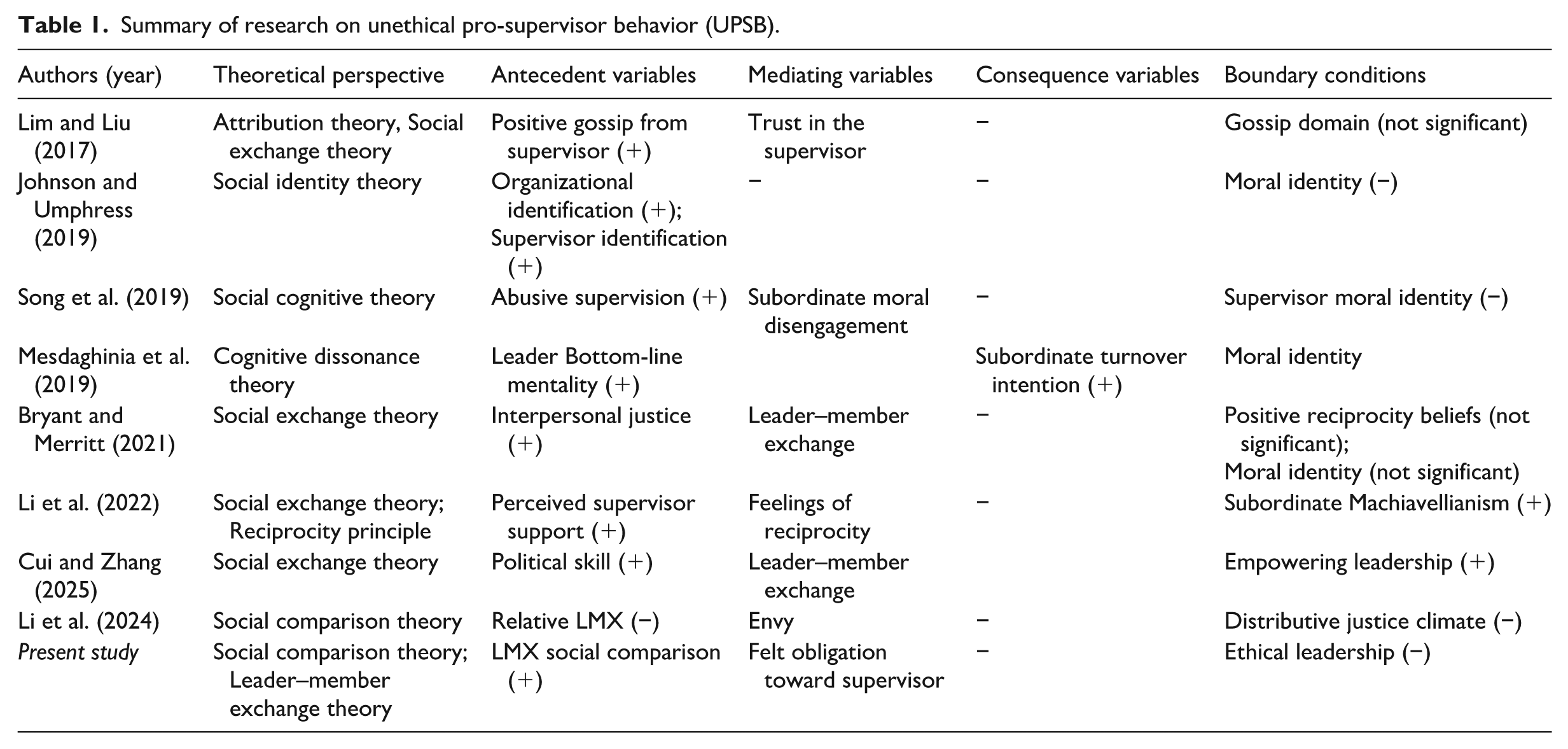
Table 1 provides a summary of the past research on UPSB. One study has observed that participants of UPSB are likely to quit the organization if they possess high levels of moral identity (Mesdaghinia et al., 2019). The remaining studies have mainly focused on uncovering the precursors of UPSB. Scholars draw on social exchange theory (Blau, 1964) to assert that functional social exchange relationships in leader–subordinate dyads can serve as the impetus for UPSB. Specifically, it has been noted that factors like positive gossip from the supervisor (Lim and Liu, 2017), interpersonal justice (Bryant and Merritt, 2021), and perceived supervisor support (Li et al., 2022) can trigger UPSB among subordinates. Drawing on social identity theory (Tajfel and Turner, 1979), scholars have noted that identification with the supervisor is another factor that can induce UPSB among subordinates (Johnson and Umphress, 2019). Furthermore, it has been observed that abusive supervision (Song et al., 2019), supervisors’ bottom-line mentality (Mesdaghinia et al., 2019), and political skill (Cui and Zhang, 2025) are other factors that tend to give rise to UPSB. Finally, building on social comparison theory (Festinger, 1954), a recent study has noted that employees in relatively poorer LMX relationships experience envy, which in turn triggers UPSB (Li et al., 2024). We intend to complement this study by examining whether and how employees in relatively superior LMX relationships can also indulge in UPSB.
Summary of research on unethical pro-supervisor behavior (UPSB).
2.2. LMXSC perceptions
The concept of LMXSC lies at the intersection of two critical theories, namely, the LMX theory and social comparison theory. The LMX theory suggests that leaders have limited resources (Graen and Uhl-Bien, 1995). Thus, they distinguish among their followers by forming low-quality transactional relationships (low LMX) with some and high-quality socio-emotional relationships (high LMX) with others in their work team (Graen and Uhl-Bien, 1995). Social comparison theory posits that individuals have an innate tendency to compare themselves to similar others to evaluate themselves (Festinger, 1954). Scholars have begun to integrate these two theoretical perspectives by extending the concept of LMX (quality) to workgroups (Henderson et al., 2009). The rationale behind such an extension is that employees rarely view their LMX in isolation. Instead, they evaluate their relationships with the leader only in comparison to others reporting to the same leader. Accordingly, scholars have conceptualized LMXSC as employees’ perception of relative standing in LMX relationships. The LMXSC has been defined as “the comparison between one’s own LMX and that of co-workers,” and it captures “employees’ subjective perceptions of the extent to which their LMX is different from that of other followers within the same group” (Vidyarthi et al., 2010: 850).
Extant research suggests that LMXSC perceptions can affect a variety of work outcomes. For instance, it is known that LMXSC positively impacts desirable outcomes such as organizational commitment, organizational citizenship behavior, and job performance (Lee et al., 2019; Vidyarthi et al., 2010). In contrast, LMXSC negatively impacts undesirable outcomes such as hostility, social undermining, and knowledge hiding (Pan et al., 2021; Tse et al., 2018; Weng et al., 2020). Building on this body of literature, the hypotheses to be tested in the current study are developed in the upcoming sections. Figure 1 contains the proposed conceptual model.
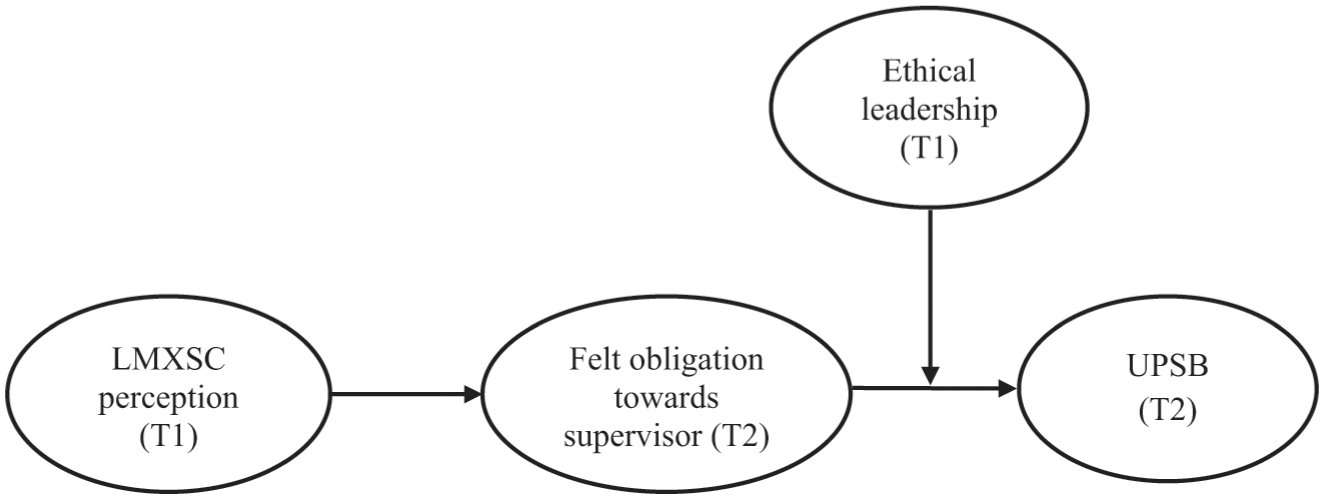
Hypothesized conceptual model.
2.3. LMXSC and felt obligation toward the supervisor
Contemporary research on LMX suggests that leaders formulate differentiated exchange relationships with subordinates who report to them directly (Henderson et al., 2009). Social comparison theory suggests that individuals compare themselves to other individuals to assess their capabilities (relative to others) and gain knowledge about themselves, which, in turn, shapes their attitudes and behavior (Festinger, 1954; Lapointe et al., 2020). Accordingly, the differentiation in LMX relationships within a work group triggers social comparison processes, wherein subordinates try to evaluate their relationship with the supervisor by comparing their upward relationship with that of others in the same workgroup (Vidyarthi et al., 2010). High LMXSC indicates that subordinates consider their relationship with the supervisor as better than that of their peers (Vidyarthi et al., 2010).
This study postulates that high LMXSC perceptions are likely to trigger a feeling of obligation toward the supervisor among followers. Social exchange theory suggests that social life consists of a series of transactions in which resources are exchanged, and each party tries to repay the benefits received from another party through the process of reciprocity (Cropanzano et al., 2017). Researchers theorize that scarcity is a critical factor that determines the quality of an exchange (Lee et al., 2019). There is only a limited value associated with a resource (like time, support, and attention) if a supervisor distributes it widely to a large number of subordinates versus if she offers it to a select few subordinates (Lee et al., 2019). We forward that the feeling of obligation toward the supervisor would be higher in the case where the employee is the exclusive recipient of the leader’s resources than when she is one of several such recipients. Thus, we propose that these feelings of obligation (induced by social comparison processes of LMXSC) would be over and above those that would be generated merely by the forces of social exchange (LMX). In view of the above, it is evident that the social comparison lens uniquely generates felt obligation beyond social exchange mechanisms. Hence, scholars rely on relative measures of LMX, that is, LMXSC perception, as they are considered to be stronger drivers of subordinate attitudes and behavior as opposed to absolute measures like LMX quality (Korman, 2025; Vidyarthi et al., 2010). Accordingly, high LMXSC prompts subordinates to believe that they are receiving a larger proportion of the leader’s resources (like care, rewards, position, status, attention, and opportunities for career progression) than others in the workgroup. Hence, due to norms of positive reciprocity (Gouldner, 1960), such followers are likely to feel obligated toward their supervisors for the benefits that they receive.
We finally contend that these feelings of obligation (arising out of high LMXSC) would normally be directed toward the supervisor and not the organization at large. Since the source of these resources (more time, attention, support, importance, etc. than colleagues) is the supervisor, we posit that the target of subordinates’ reciprocity would also be none other than the supervisor. Our contention is supported by past studies, which note that the receipt of resources from the organization generates organization-directed reciprocity (Caesens et al., 2016; Umphress et al., 2010) while the receipt of resources from the supervisor generates supervisor-directed reciprocity (Bryant and Merritt, 2021; Li et al., 2022). Therefore, it is only natural for us to anticipate that high LMXSC perceptions would allow subordinates to perceive a conspicuous sense of obligation toward their supervisor. Our proposition is backed by previous research, which has empirically demonstrated that high LMXSC subordinates develop feelings of obligation toward their leader (Lee et al., 2019). Thus, the following is hypothesized:
H1. The LMXSC perception is positively related to felt obligation toward the supervisor.
2.4. Felt obligation toward the supervisor and UPSB
Extant research suggests that feelings of obligation are generated by numerous factors and have the potential to produce a variety of work outcomes due to social exchange processes (Blau, 1964). For instance, scholars assert that group-focused and individual-focused aspects of transformational leadership foster feelings of obligation toward the workgroup, which subsequently trigger helping behavior and improved group performance (Lorinkova and Perry, 2019). Likewise, justice perceptions give rise to feelings of obligation, which, in turn, positively impact job performance and organizational citizenship behavior (Roch et al., 2019). Finally, scholars have observed that feelings of obligation also lead to voice behavior (Duan et al., 2022). So far, we have reviewed some of the studies that highlight the “bright side” of felt obligation in terms of its desirable outcomes.
However, it is noteworthy that feelings of obligation may also have a corresponding “dark side” associated with them. Feelings of obligation, if taken too far, may lead to detrimental consequences. For instance, recent studies have documented that employees’ feelings of obligation toward the organization push them to participate in unethical activities to promote the interest of the organization, that is, unethical pro-organizational behavior (UPOB) (Babalola et al., 2021; Wang et al., 2023). Building on this recent body of research, we similarly contend that feelings of obligation toward the supervisor are likely to drive subordinates to perform UPSB. Intense feelings of obligation toward supervisors are likely to encourage subordinates to make decisions that primarily promote the interests of their supervisors at the expense of other parties. While trying to actively advance the interests of their supervisors, subordinates may intentionally or unintentionally violate the interests of other parties that may be affected by the consequences of their actions, such as customers, the organization, or even society at large.
We clarify that subordinates experiencing feelings of obligation toward the supervisor are likely to participate in unethical behavior to further the interests of their supervisor and not the organization. Our expectation is in line with past studies, which have clearly explicated that “organization-directed” reciprocity prompts organization-focused behavior like UPOB (Wang et al., 2019) while “supervisor-directed” reciprocity leads to supervisor-focused behavior like UPSB (Bryant and Merritt, 2021; Li et al., 2022). Accordingly, we expect that feelings of obligation toward the supervisor would prompt subordinates to participate in UPSB. Thus, the following is hypothesized:
H2. Felt obligation toward the supervisor is positively related to UPSB.
2.5. Felt obligation toward the supervisor as a mediator
Thus far, we have postulated that LMXSC would generate feelings of obligation toward the supervisor among followers (H1). We have also advocated that feelings of obligation would stimulate followers to undertake UPSB to return the benefits that they have received from their supervisors (H2). Considering these arguments conjunctively, we propose that LMXSC would engender UPSB via the intervening role of felt obligation toward the leader.
Our proposition may seem to contradict past research, which has established that unfavorable social comparisons (operationalized by low relative LMX) may lead to UPSB (Li et al., 2024). However, we maintain that favorable social comparisons (operationalized by high LMXSC) may also trigger UPSB, albeit through very different psychological mechanisms. To explain these conflicting effects, we offer the following theoretical reconciliation. Li et al. (2024) rightly observe that employees who discover that their supervisor allocates fewer rewards and resources to them feel envious of their colleagues who receive more of such resources from the same supervisor. Consequently, to cope with the uncomfortable emotion of envy, such employees lower their ethical standards and resort to UPSB as a means to acquire more resources and rewards from the supervisor. We, on the other hand, draw on social exchange theory (Blau, 1964; Cropanzano et al., 2017) to contend that employees who receive a larger share of the supervisor’s rewards and resources would feel a heightened sense of obligation to the supervisor. We propose that this sense of obligation would, in turn, drive them to do everything possible to further the interests of the supervisor, even if it involves the use of unethical practices (UPSB). Past research has noted that employees who feel obligated to their organization similarly disregard ethical standards while trying to benefit their organizations (Wang et al., 2019). Thus, we synthesize that while unfavorable social comparisons generate UPSB due to feelings of envy (Li et al., 2024), favorable social comparisons produce UPSB owing to a sense of obligation toward the supervisor. Accordingly, we anticipate a positive relationship between high LMXSC perceptions and UPSB via the intervening role of felt obligation toward the supervisor. Thus, the following is hypothesized.
H3. Felt obligation toward the supervisor mediates the relationship between LMXSC perception and UPSB.
2.6. Ethical leadership as a moderator
Ethical leadership is defined as “the demonstration of normatively appropriate conduct through personal actions and interpersonal relationships, and the promotion of such conduct to followers through two-way communication, reinforcement, and decision-making” (Brown et al., 2005: 120). While we expect feelings of obligation to elicit UPSB in general, we simultaneously propose that followers of ethical leaders would be less likely to participate in UPSB in response to high LMXSC. Accordingly, we postulate that ethical leadership would weaken the positive impact of felt obligation on UPSB. Social learning theory suggests that leaders can influence the behavior of their followers through a process known as modeling, which involves vicarious learning through the observation and imitation of others’ behavior and its consequences (Bandura, 1977). Accordingly, followers of ethical leaders learn the kinds of behaviors that are desired, incentivized, and punished (Brown et al., 2005). Followers of ethical leaders are equipped with a clearer understanding that their leader endorses normatively appropriate conduct and would reprimand unethical activities like UPSB, even if such activities further the interests of the leader. Driven by this understanding, subordinates experiencing feelings of obligation would refrain from participating in UPSB. The reason behind this expectation is that such subordinates would be aware that engagement in UPSB is inconsistent with the leader’s beliefs and behavior and may attract a penalty rather than a reward from the leader. Furthermore, we posit that high LMXSC may generate feelings of obligation even among followers of ethical leaders. However, these feelings of obligation may not necessarily translate into UPSB among followers of ethical leaders, as such followers are fully aware that acts of UPSB would rather displease the ethical leader. Hence, ethical leadership is expected to weaken the relationship between felt obligation and UPSB and is accordingly positioned as a stage-two moderator. Our expectation is supported by past research, which has shown that ethical leadership weakens the impact of various antecedent variables on undesirable employee behavior in the workplace (Anand et al., 2023). Thus, we hypothesize the following:
H4. The relationship between followers’ felt obligation and UPSB is moderated by ethical leadership, such that the linkage is weaker when ethical leadership is high (than low).
So far, we have proposed that LMXSC perceptions trigger feelings of obligation among followers, which, in turn, evokes their participation in UPSB (H3). We have also proffered that ethical leadership would weaken the impact of felt obligation on UPSB (H4). We consider the above arguments collectively to contend that ethical leadership would also weaken the overall indirect relationship between LMXSC perceptions and UPSB through felt obligation. When high LMXSC followers deduce that their leaders are highly ethical, they are likely to abstain from participating in UPSB, as they would be cognizant that such unethical actions will undeniably attract the rebuke of their leader. Furthermore, participation in unethical activities to benefit an ethical leader is also likely to threaten the in-group position of high LMXSC followers. Due to the above reasoning, we advocate that the demonstration of ethical leadership would weaken the extent to which LMXSC translates into UPSB via felt obligation. Thus, we hypothesize the following:
H5. The overall indirect relationship between LMXSC perception and UPSB via felt obligation is moderated by ethical leadership. The indirect influence is weaker when ethical leadership is high (than low).
3. Method
3.1. Sample
We garnered data from 253 supervisor–subordinate dyads working in two large information technology (IT) organizations in India during May–August 2020. Data collection was carried out in two waves separated by a time lag of 8 weeks to reduce the possibility of common method bias (Podsakoff et al., 2012). Multisource data were garnered for the dependent variable to further eliminate this concern (Podsakoff et al., 2012). It was optional to take part in the survey. Furthermore, the participants received assurances that their answers would be kept private and utilized exclusively for scholarly research. At T1, 1000 questionnaires were distributed, which contained items on the independent variable, moderator, and control variables. Five thirty-four fully filled questionnaires were returned (response rate = 53.4%). A unique identifier code was printed on each questionnaire administered at time T1. The code was matched to the employee ID. At T2, this code allowed the authors to contact only those individuals who had responded to the survey at time T1. Eight weeks later, the 534 employees who had participated in T1 were contacted again and invited to answer a follow-up survey, which contained items on the mediator as well as the dependent variable. The supervisors of these employees were also requested to respond to a short survey containing the supervisor-rated measure of the dependent variable. The responses of the supervisors and subordinates were also matched using a unique identifier code. Accordingly, matched data from 289 supervisor–subordinate dyads were obtained at T2 (response rate = 54.1%). After removing incomplete responses, 253 supervisor–subordinate dyads were included in the final sample for this study (overall response rate = 25.3%). Subordinates were largely involved in technical entry-level roles, such as systems engineers, business analysts, developers, and data analysts, among others. Supervisors were generally occupying mid-level managerial positions, such as team leader, project leader, and product owner, among others. A majority of the sample was male (73.1%). The average age of the sample was 36.70 years (SD = 7.15). The mean tenure with the supervisor was 26.5 months (SD = 10.1).
3.2. Scales
All the items were measured on a five-point Likert-type scale where 1 = “Strongly disagree,” 2 = “Disagree,” 3 = “Neutral,” 4 = “Agree,” and 5 = “Strongly agree.”
3.2.1 LMXSC perception
At T1, LMXSC perception was assessed using the six-item scale developed by Vidyarthi et al. (2010). Followers were requested to respond to items such as “I have a better relationship with my manager than most others in my workgroup.” Cronbach’s α was 0.94.
3.2.2 Felt obligation toward the supervisor
At T2, felt obligation was assessed using the seven-item scale developed by Eisenberger et al. (2001). Consistent with past research (Duan et al., 2022), the scale was adapted to capture felt obligation toward one’s “supervisor” rather than “organization.” Followers responded to items such as “I feel a personal obligation to do whatever I can to help my supervisor achieve his (her) goals.” Cronbach’s α was 0.88.
3.2.3 Ethical leadership
At T1, ethical leadership was assessed using the 10-item scale developed by Brown et al. (2005). Followers were requested to respond to items such as “My supervisor disciplines employees who violate ethical standards.” Cronbach’s α was 0.95.
3.2.4 Unethical pro-supervisor behavior
At T2, self-rated UPSB was assessed by utilizing the six-item scale developed by Johnson and Umphress (2019). Followers were requested to respond to items such as “Because it benefited my supervisor, I have withheld negative information about my supervisor’s performance from others.” Multisource data were gathered for the dependent variable. Thus, the scale developed by Johnson and Umphress (2019) was adapted to capture the supervisory ratings of UPSB (Appendix 1). At T2, supervisors were requested to respond to items such as “To help me, my subordinate has exaggerated the truth about my performance or effectiveness to others.” Cronbach’s α of the self-rated and supervisor-rated measures of UPSB was 0.90.
3.2.5 Control variables
Consistent with past UPSB research (Johnson and Umphress, 2019; Mesdaghinia et al., 2019), we controlled for participants’ age (in years), gender (1 = male, 2 = female, 3 = other), tenure with the supervisor (in months), social desirability, and career self-interest. Social desirability was assessed by utilizing the 10-item impression management subscale developed by Paulhus (1984). Followers were requested to respond to items such as “I am always courteous, even to people whom I don’t like.” Cronbach’s α was 0.93. Career self-interest was assessed by utilizing the six-item scale developed by Collins (2006). Followers were requested to respond to items such as “I will do whatever it takes to enhance my reputation with my company’s executives.” Cronbach’s α was 0.93. Consistent with past LMXSC research, this study also controlled for LMX to observe the effects of LMXSC over and above LMX (Vidyarthi et al., 2010; Weng et al., 2020). We assessed LMX using the seven-item LMX-7 scale forwarded by Graen and Uhl-Bien (1995). Cronbach’s α was 0.95.
4. Findings
4.1. Descriptive statistics
Table 2 reports the means, standard deviations, and correlations among the study variables. In line with the generally accepted standards, the composite reliability (CR) values of all the constructs were above 0.7, and the average variance extracted (AVE) values were above 0.5 (Hair et al., 2006). Hence, we achieved convergent validity. Next, discriminant validity was also established using Fornell and Larcker’s (1981) criterion.
Descriptive statistics, composite reliability, and interconstruct correlations.
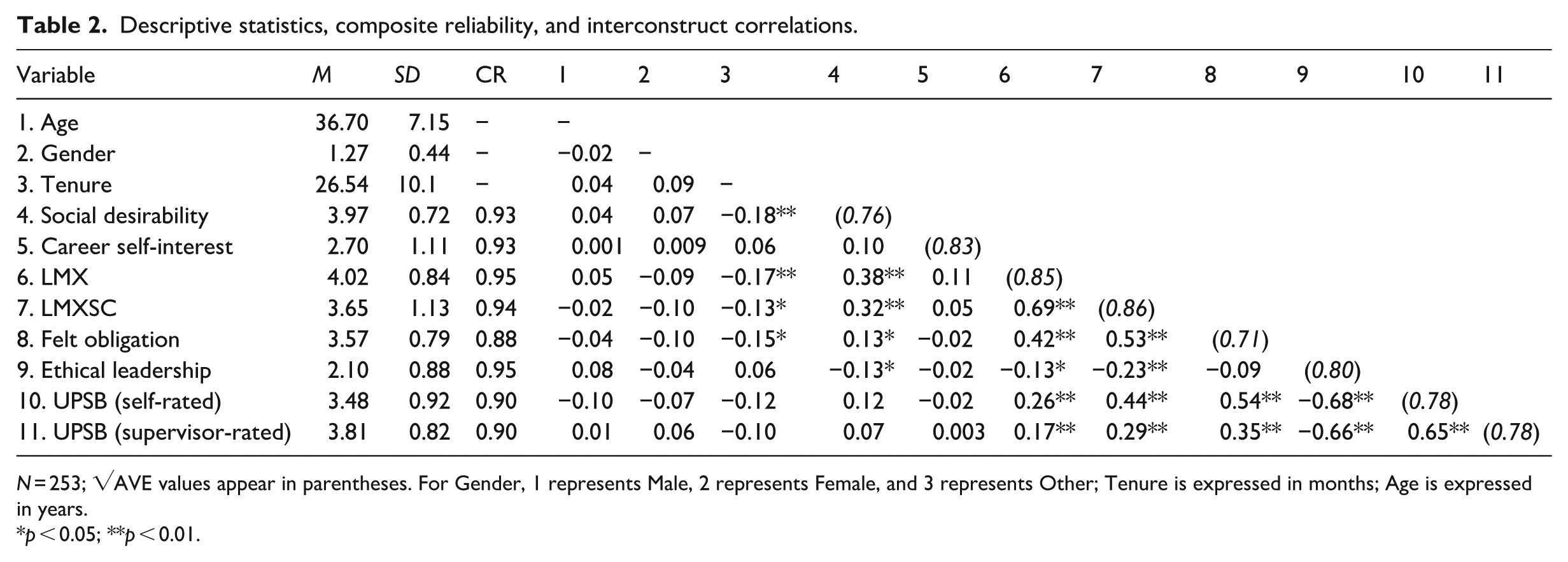
N = 253; √AVE values appear in parentheses. For Gender, 1 represents Male, 2 represents Female, and 3 represents Other; Tenure is expressed in months; Age is expressed in years.
p < 0.05; **p < 0.01.
4.2. Confirmatory factor analysis (CFA)
The CFA was performed using the Maximum likelihood estimator in AMOS (Version 19) to ensure that the constructs used in the present study were sufficiently different from each other. Comparisons were made among the fit indices of one-factor, two-factor, three-factor, five-factor, and eight-factor models. Among all these tested models, the proposed eight-factor model (LMXSC, felt obligation, ethical leadership, self-rated UPSB, supervisor-rated UPSB, social desirability, career self-interest, and LMX) was found to be the best fit with the data [χ2/df = 1.305, NFI = 0.84, CFI = 0.96, PRATIO = 0.95, RMSEA = 0.04, HOELTER = 210]. No cross-loadings were observed among any of the manifest variables. Hence, it was concluded that respondents could sufficiently distinguish among the different constructs.
4.3. Hypotheses testing
We tested the hypotheses proposed in the study using Hayes’ (2013) PROCESS Macro for SPSS (Version 24). Bootstrapping was performed to obtain 5000 bootstrap samples at 95% bias-corrected confidence intervals (Edwards and Lambert, 2007). Variables were mean-centered before the analysis to reduce multicollinearity.
First, we proceeded toward the test of H1–H3 using two separate model-4 commands (one for self-rated UPSB and the other for supervisor-rated UPSB). As expected, LMXSC was positively related to felt obligation (β = 0.32, t = 6.09, p < 0.001). Hence, H1 was supported. Next, we found that felt obligation was positively linked to self-rated UPSB (β = 0.50, t = 6.92, p < 0.001) as well as supervisor-rated UPSB (β = 0.29, t = 3.97, p < 0.001). Hence, H2 was fully supported. Furthermore, we tested the mediation hypothesis (H3). The direct relationship between LMXSC and self-rated UPSB was positive and significant (β = 0.24, t = 3.75, p < 0.001). The indirect relationship between LMXSC and self-rated UPSB through felt obligation was also significant (β = 0.16, SE = 0.04, LLCI = 0.08, ULCI = 0.25). On a similar note, the direct relationship between LMXSC and supervisor-rated UPSB was positive and significant (β = 0.16, t = 2.5, p < 0.05). The indirect linkage between LMXSC and supervisor-rated UPSB through felt obligation was also significant (β = 0.09, SE = 0.04, LLCI = 0.03, ULCI = 0.17). Hence, we find evidence for the partial mediating effect of felt obligation in the linkage of LMXSC with self-rated as well as supervisor-rated UPSB. Thus, H3 was fully supported.
Next, the moderation hypothesis (H4) was examined using two separate model-1 commands (one for self-rated UPSB and the other for supervisor-rated UPSB). As hypothesized, the interaction between felt obligation and ethical leadership on self-rated UPSB was negative and significant (β = −0.17, t = −5.01, p < 0.001), indicating the presence of negative moderation. The collection of supervisor-rated data for UPSB allowed us to perform additional analysis. However, the interaction between felt obligation and ethical leadership on to supervisor-rated UPSB was not significant (β = 0.01, t = 0.35, p = n.s). Hence, H4 was partly supported.
We conducted a simple slope analysis to determine the direction of the interaction effect (in the case of self-rated UPSB, where results were significant). We examined the simple slope of self-rated UPSB regressed on felt obligation at different levels of ethical leadership (Aiken et al., 1991; Preacher et al., 2006). The graphs of the simple slope analysis were plotted and are represented in Figure 2. Results revealed that at low levels of ethical leadership (1 SD below the mean), felt obligation is positively related to self-rated UPSB (β = 0.78, SE = 0.06, p < 0.001). However, at high levels of ethical leadership (1 SD above the mean), the linkage between felt obligation and self-rated UPSB gets weakened (β = 0.48, SE = 0.05, p < 0.001). Hence, it can be inferred that followers who feel obligated toward their supervisors are less likely to report participation in UPSB when their leaders are highly ethical.
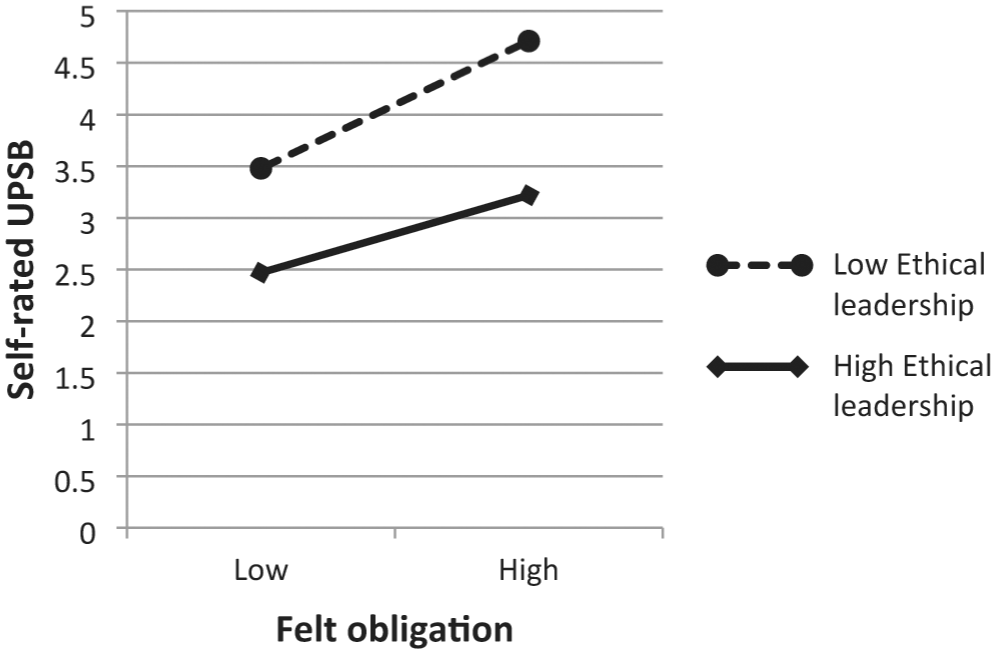
Interaction between felt obligation and ethical leadership on self-rated UPSB.
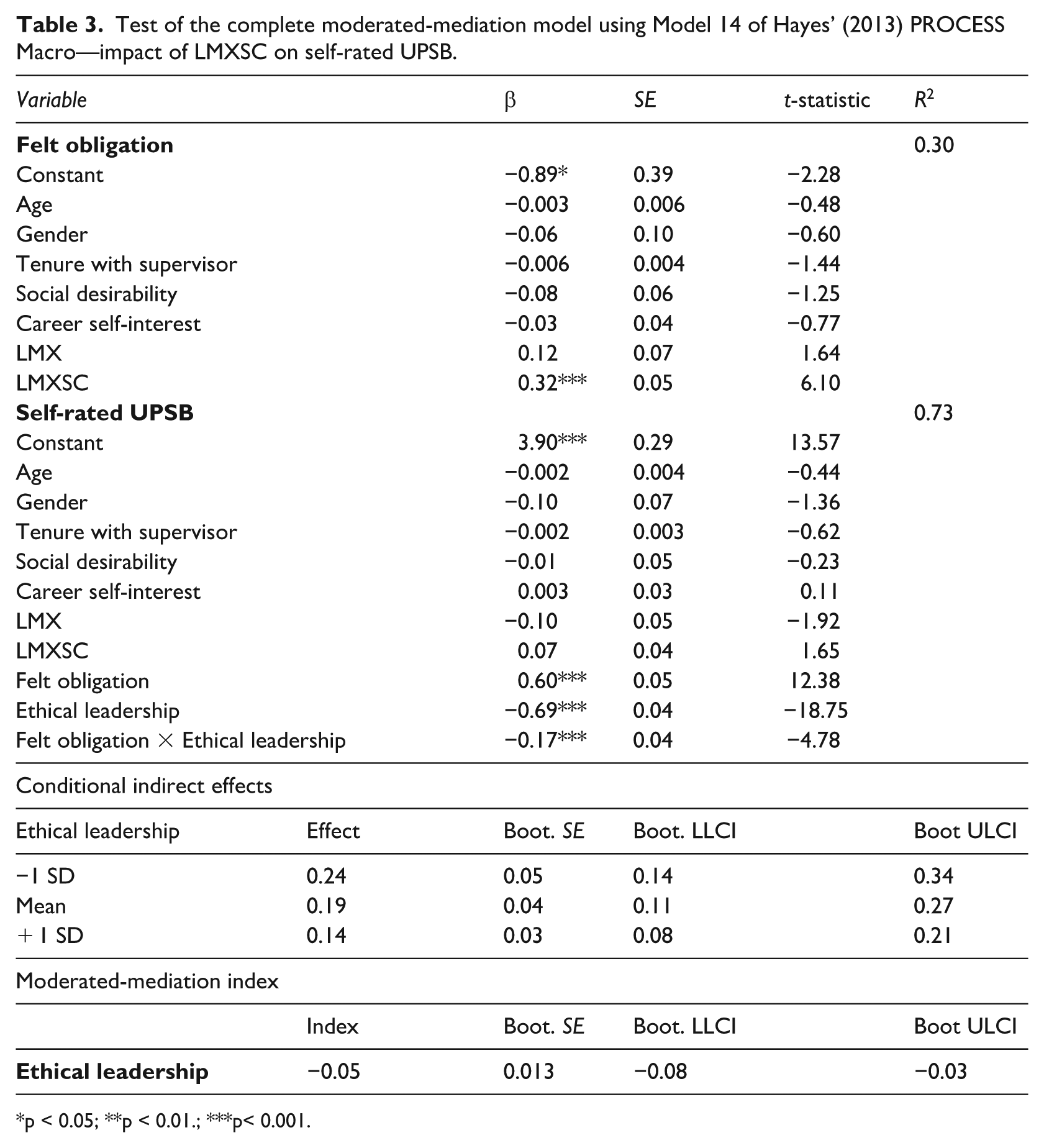
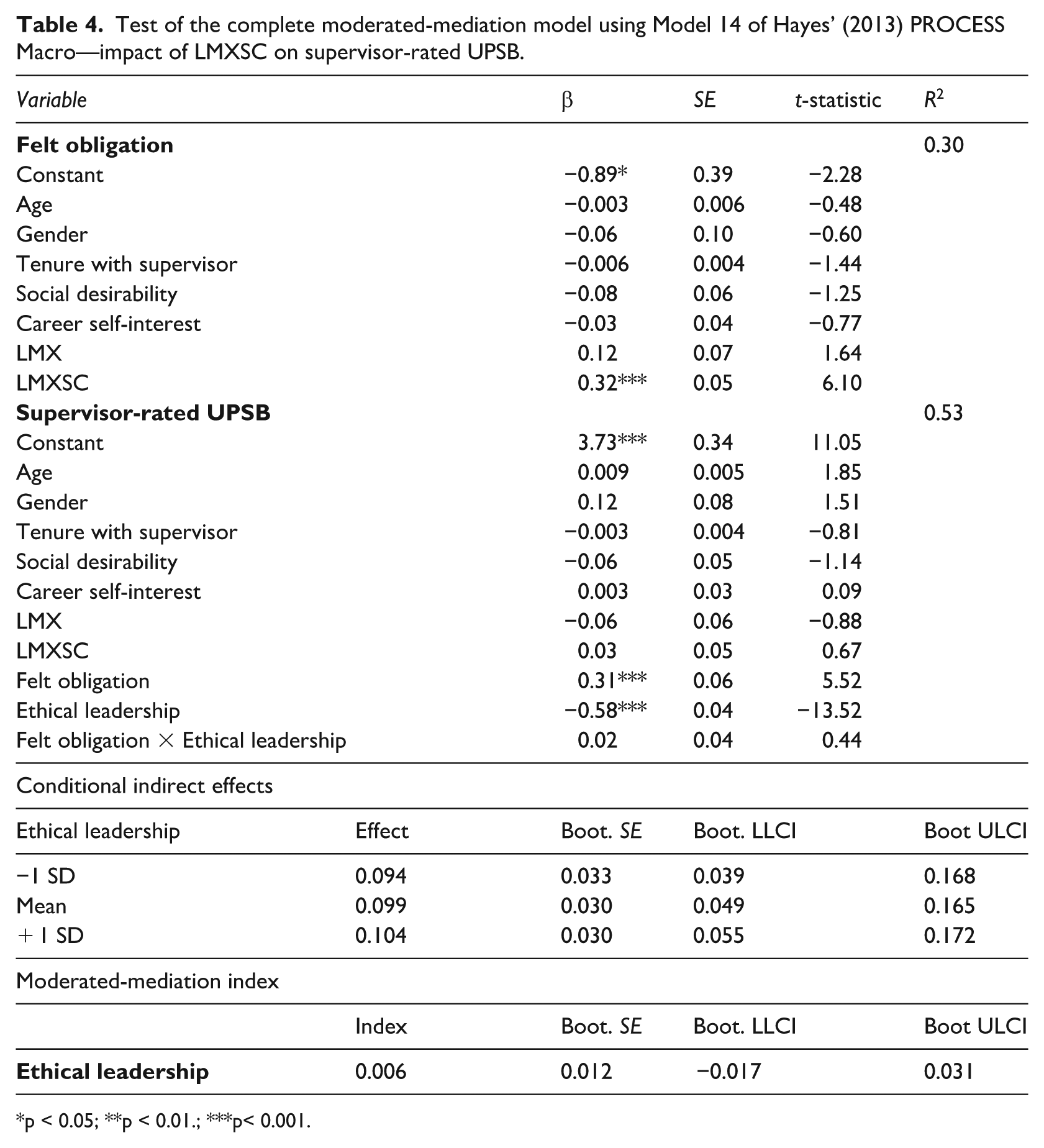
Finally, we went on to test the complete model comprising all the variables included in the study. A separate model-14 command was run to check the moderated-mediation hypothesis (H5). The results are presented in Table 3. As predicted, the moderated-mediation results were found to be significant (β = −0.05, SE = 0.01, LLCI = -0.08, ULCI = −0.03). Results revealed that the conditional indirect effect of LMXSC on self-rated UPSB through felt obligation was weaker at high levels of ethical leadership (β = 0.14, SE = 0.03, LLCI = 0.08, ULCI = 0.21) than at low levels of ethical leadership (β = 0.24, SE = 0.05, LLCI = 0.14, ULCI = 0.34). Due to the availability of supervisor-rated data, we were able to perform additional analysis. The results are presented in Table 4. We did not find support for this relationship in the case of supervisor-rated UPSB data. Thus, H5 was partly supported.
Test of the complete moderated-mediation model using Model 14 of Hayes’ (2013) PROCESS Macro—impact of LMXSC on self-rated UPSB.
p < 0.05; **p < 0.01.; ***p< 0.001.
Test of the complete moderated-mediation model using Model 14 of Hayes’ (2013) PROCESS Macro—impact of LMXSC on supervisor-rated UPSB.
p < 0.05; **p < 0.01.; ***p< 0.001.
5. Discussion
The UPSB is a pervasive phenomenon in contemporary organizations that is known to have severe financial, reputational, and legal ramifications for organizations. Hence, it is critical for practicing managers to take suitable measures to diminish the occurrence of UPSB in their organizations. Academic researchers have been trying to support such managerial efforts by unveiling why, how, and when employees participate in UPSB in the workplace. However, past research has generally been limited to the leader-subordinate relationship while identifying the antecedents of UPSB. Consequently, we have little understanding of whether the social context—captured by employees’ relative standing in the work group in terms of closeness with the leader—can also encourage UPSB among employees.
The purpose of this study, therefore, was to draw on social exchange theory to assess the impact of LMXSC on UPSB and the underlying process and boundary conditions. Results indicate that high LMXSC employees (i.e. employees who perceive more intimate relationships with their supervisors than their counterparts) are likely to feel obligated to their supervisors for the special treatment they receive. This feeling of obligation toward the supervisor, in turn, would drive high LMXSC employees to reciprocate through participation in acts of UPSB. Supervisor-rated data yielded consistent results. Findings also revealed that employees’ participation in UPSB (as a result of LMXSC and subsequent felt obligation) reduces if leaders exhibit an ethical leadership style.
5.1. Theoretical contributions
First, our findings extend the burgeoning literature on the antecedents of UPSB. Extant research has relied on the ideas of social exchange (Blau, 1964; Emerson, 1976) and social identity theories (Tajfel and Turner, 1979) to establish that proximity in leader–subordinate relationships is the primary antecedent to UPSB (Bryant and Merritt, 2021; Li et al., 2022; Lim and Liu, 2017; Johnson and Umphress, 2019). However, we knew little about the role of social comparison perceptions in encouraging UPSB among employees. In a novel attempt, the present study integrates the perspectives on social exchange and social comparison to add that favorable social comparisons (captured through LMXSC) influence feelings of obligation, which can serve as a precursor to employees’ participation in UPSB. In doing so, we bring in the idea that the social context surrounding a leader–subordinate relationship can also have a bearing on whether employees decide to pursue UPSB.
Second, we contribute to the literature on LMX differentiation (Henderson et al., 2009) by capturing how employees’ subjective perception of their relative standing in LMX relationships impacts their conduct in work settings. Scholars have noted that employees who perceive relatively closer interpersonal relationships with their supervisors (vis-à-vis their peers) exhibit desirable workplace attitudes and behaviors. For instance, scholars note that high LMXSC is generally associated with organizational commitment, organizational citizenship behavior, and job performance (Lee et al., 2019; Vidyarthi et al., 2010). Likewise, low LMXSC is associated with undesirable outcomes such as hostility, social undermining, and knowledge hiding (Pan et al., 2021; Tse et al., 2018; Weng et al., 2020). Contrary to the popular view, this study contributes by advancing that favorable social comparisons (high LMXSC) can produce consequences of an unethical nature in the workplace. In doing so, we make a novel contribution to the social comparison theory (Festinger, 1954), which generally positions favorable social comparisons as precursors to desirable consequences. In addition, this study uniquely adds to the burgeoning research that highlights the deleterious outcomes of high LMXSC, such as social undermining (Korman et al., 2024).
Third, we complement the work of Li et al. (2024), who note that unfavorable social comparisons—in terms of low RLMX—can trigger UPSB in the workplace. We reconcile how opposing variables, that is, unfavorable social comparisons (captured by low RLMX in the work of Li et al., 2024) and favorable social comparisons (captured by high LMXSC in our study), can both lead to UPSB, albeit through different mechanisms. On one hand, Li et al. (2024) note that employees in worse-quality LMX relationships use UPSB as a means to acquire more rewards and resources from the leader. On the other hand, we demonstrate that employees in better-quality LMX relationships perform UPSB to reciprocate the favorable treatment received from the leader. In sum, we highlight the dangerous implications of LMX differentiation (Henderson et al., 2009) because it encourages both “in-group” and “out-group” employees to perform unethical behaviors like UPSB, for altogether different reasons.
Fourth, our study unpacks the mechanism through which high LMXSC perceptions translate into UPSB by providing evidence for the mediating effect of felt obligation (Eisenberger et al., 2001) in the proposed relationship. In doing so, it offers an enhanced understanding of the psychological processes through which UPSB unfolds in organizations. Past research has noted that social exchange theory (Blau, 1964), social cognitive theory (Bandura, 1991), social identity theory (Tajfel and Turner, 1979), and cognitive dissonance theory (Festinger, 1957) are some of the key theoretical lenses through which the phenomenon of UPSB can be understood. Through this study, we weave the tenets of social exchange theory (Blau, 1964), LMX theory (Graen and Uhl-Bien, 1995), and social comparison theory (Festinger, 1954) to demonstrate the impact of LMXSC on UPSB via felt obligation. In doing so, we offer a fresh perspective as to why UPSB may occur in contemporary organizations.
Fifth, this study is one of the infrequent attempts to investigate the boundary conditions or contingency variables under which the incidence of UPSB gets mitigated. Such an investigation is necessary to assist managerial practice in diminishing the occurrence of undesirable behaviors like UPSB in the workplace. This study is probably the first to illuminate that ethical leadership (Brown et al., 2005) can serve as a critical contingency variable under which the adverse impact of LMXSC on UPSB gets attenuated. In doing so, it blends two important leadership theories—LMX theory (Graen and Uhl-Bien, 1995) and ethical leadership theory (Brown et al., 2005)—to propose that the inadvertent negative consequences of LMX differentiation can be counteracted to some extent by the principles of ethical leadership theory. In addition, this study adds to past research on UPSB (Bryant and Merritt, 2021; Li et al., 2022), which has largely focused on facilitators of UPSB. This study analyses and positions ethical leadership as a deterrent to UPSB and contributes to this underdeveloped domain of research.
Finally, this study complements past UPSB research based on North American samples (Bryant and Merritt, 2021; Johnson and Umphress, 2019; Lim and Liu, 2017; Mesdaghinia et al., 2019) by augmenting our understanding of why and how UPSB manifests in collectivist societies like Asia. Asian work cultures are characterized by high power distance (Ghosh, 2011), where individuals generally seek proximity with their supervisors (Philip and Ganguly, 2014). Therefore, high LMXSC seems to be a more pervasive phenomenon in the Asian context. Accordingly, a scientific inquiry was considered warranted to investigate whether LMXSC could impact risky behaviors like UPSB. The findings of this study confirm that there is a possible risk associated with high LMXSC insofar as it can prompt UPSB among employees. This study also offers insights to counteract those risks, which we discuss in the following section.
5.2. Managerial implications
Past research advocates that LMX differentiation—the process by which leaders develop superior-quality relationships with some followers and poor-quality relationships with others—generally yields positive outcomes for the “in-group” subordinates and negative outcomes for the “out-group” subordinates. Therefore, based on the findings of the existing research, practitioners generally focus on maximizing the positive outcomes that can be reaped from “in-group” subordinates while minimizing the harmful outcomes from “out-group” subordinates.
However, the current study’s findings go beyond the existing research by cautioning practitioners that LMX differentiation can have perilous consequences not just for the “out-group” subordinates but also for the “in-groups.” Past research suggests that individuals who perceive themselves to be closer to their supervisors than their peers are more committed to their organizations, perform well, and also participate in organizational citizenship behavior. However, the current study makes a substantive addition by informing that such subordinates are also likely to perform UPSB to reciprocate the preferential treatment they have received from the supervisor. Thus, LMX differentiation may inadvertently prompt undesirable behavior even among “in-group” employees. Past research has already highlighted that “out-group” employees indulge in UPSB as a means to gain resources from the leader (Li et al., 2024). Our study further adds that even “in-group” employees are likely to perform UPSB to return the leader’s favor. In sum, this study advances the view that LMX differentiation promotes UPSB among “in-groups” as well as “out-groups.” Therefore, leaders are advised to be extremely careful when they create such stark distinctions among their subordinates. Some specific HR interventions that can be taken in this regard are discussed as follows. First, organizations should formulate policies on UPSB and take serious steps to communicate and enforce these policies. Formal initiatives—such as policies—demonstrate the organization’s commitment to ethics and help employees make better decisions when confronted with ethical dilemmas. Second, mandatory ethics training needs to be provided to all subordinates when leaders practice high levels of LMX differentiation. High as well as low LMX employees should be required to go through a training module that sensitizes them about what constitutes UPSB, the actions that would be deemed as UPSB, and the likely punitive action upon undertaking those actions.
The findings of this study further highlight that high LMXSC employees are less likely to participate in UPSB if their supervisors exhibit an ethical leadership style. Therefore, leaders who choose to adopt LMX differentiation as a style of leadership are urged to couple it with an ethical leadership style. If leaders strongly differentiate among their followers, they must also ensure that they emphasize the value of ethics, especially to the followers who are closest to them. Leaders should make it clear to followers that they would not tolerate unethical behavior under any circumstances, even if such behavior is motivated by the intention to help the leader. If leaders stress the importance of ethics, followers close to them are likely to make better and more ethical decisions regarding competing priorities (i.e. to behave ethically and miss an opportunity to return the supervisor’s favor vs to benefit the supervisor using unethical ways). In the absence of ethical leadership, the possibility of participation in UPSB is dangerously high among followers who regard themselves as closest to the leader. Apart from leaders’ role in sensitizing their “in-group” subordinates, HR interventions could also be implemented to ensure that supervisors employing LMX differentiation strategies have adopted an ethical leadership style. Periodic pulse surveys could be administered to gather anonymous feedback about the leaders’ endorsement of ethical business practices and simultaneous aversion to acts of USPB. In organizations and industries where the stakes associated with UPSB are extraordinarily high, championing ethical behavior may also be included among the key performance indicators (KPIs) of relevant supervisors.
5.3. Limitations and future research
Despite its implications for academia and practice, the current study is not without some limitations. First, this study measured supervisor-rated UPSB by adapting the self-rated version of the UPSB scale developed by Johnson and Umphress (2019). Although we conducted a pilot study to confirm the psychometric properties of the supervisor-rated version of this scale, a full-fledged scale development study was not undertaken. Future research may undertake rigorous mathematical procedures to affirm the psychometric properties of the supervisor-rated version of UPSB. Second, we submit that we did not find support for some of our relationships when we used supervisor-rated data for our dependent variable (UPSB). The lack of availability of a well-established measure might have partly contributed to the inconsistency in the results. Furthermore, the correlation between self-rated and supervisor-rated measures of UPSB is only moderate (please see Table 2). The mean score on supervisor-rated UPSB is higher than that on self-rated UPSB, which indicates that subordinates might have underreported their acts of UPSB, given that employees are generally reluctant to report their participation in unethical activities. Alternatively, supervisors may have overestimated their subordinates’ participation in UPSB. Future research may, however, undertake replication studies to assess the nature of these relationships. Third, we acknowledge that the overall response rate in our study was low (i.e. 25.3%). While the response rates are typically low in social sciences research (Anseel et al., 2010), our findings need to be interpreted with caution, as there might be a possibility of non-response bias in our work. Future research may undertake steps (such as providing incentives to respondents) to improve the response rate and generalizability of the findings. Finally, a time-lagged survey research design was adopted to address the issue of common method variance bias (Podsakoff et al., 2012). However, we could not draw any inferences regarding causality. Therefore, longitudinal studies or experiments may be conducted in future research to make definite claims regarding causality. Scholars may also extend the conceptual model by examining the role of other contingency variables (apart from ethical leadership) under which the deleterious impact of LMXSC on UPSB gets reduced. Particularly, scholars may pay attention to individual-level variables such as moral efficacy in discouraging high LMXSC subordinates from participating in UPSB. We trust that our study will kindle additional research in this domain and help managers curtail the menace of UPSB in their organizations.
Key theoretical and practical implications
• As per leadership theory and practice, supervisors are known to undertake LMX differentiation—a process whereby they foster close interpersonal relationships with a chosen few subordinates and distant relationships with the remaining ones. It is known that subordinates are cognizant of such distinctions, and they appraise the quality of their relationship with the supervisor in absolute as well as relative terms.
• Past research has noted that subordinates who perceive relatively closer relationships with the supervisor demonstrate positive attitudes and behavior. Drawing on ideas of social exchange and social comparison, this study offers a fresh perspective by demonstrating that subordinates who consider themselves to be in such close relationships can also undertake unethical activities to further the interests of their supervisor. Such unethical activities are undesirable because they are known to compromise the interests of the organization in various ways.
• As executives try to reduce the menace of UPSB in their organizations, they are suggested to design appropriate interventions targeted toward employees who share relatively closer relationships with their supervisors. They are also advised to ensure that supervisors practice ethical leadership as a way to discourage UPSB among subordinates.
Footnotes
Appendix 1
Final transcript accepted 21 March 2026 by Melissa Wheeler (AE Organisational Behaviour).

Funding
The authors received no financial support for the research, authorship, and/or publication of this article.
Declaration of conflicting interests
The authors declared no potential conflicts of interest with respect to the research, authorship, and/or publication of this article.