







Abstract
The new Irish export-oriented foreign direct investment (FDI) regime of the 1950s was an inter-party government initiative that facilitated the later Whitaker and Lemass–led dismantling of protectionist trade barriers. The potential opposition of protectionist-era industry to the new FDI regime was defused by confining the new tax relief to profits derived solely from exports, by allocating new industrial grants only to firms that ‘would not compete in the home market with existing firms’, and by retaining the Control of Manufactures Acts of the 1930s that imposed restrictions on foreign ownership. The fact that the United States had overtaken the United Kingdom as the major global source of FDI made it easier to secure Fianna Fáil support. US firms were particularly interested in access to European Economic Community (EEC) markets, however, which was not within Ireland’s gift. The export processing zone at Shannon, which might be seen as Lemass’s response to the inter-party initiatives, proved to be of immediate appeal to them. US firms would come to predominate in the non-Shannon region only after Ireland’s entry to the EEC.
Keywords
Introduction
Import-substituting industrialisation tends to run into balance-of-payments problems once the ‘easy’ first stage – entailing the replacement of non-durable consumer goods imports – has been completed. 1 Managing the shift towards outward orientation can be hugely challenging, however, because of the vested interests that grow up around protected industries. 2 The difficulties of managing the transition are apparent from the experiences of developing economies that found themselves in crisis in recent decades, as Ireland had done in the 1950s. Trade liberalisation was a key component of the conditionality attached to the assistance offered by the World Bank and International Monetary Fund in these circumstances. With little ‘domestic ownership’ of the liberalisation process, developing economy reforms tended to be half-hearted and were frequently reversed once the immediate crisis had passed. 3 The Irish transition, by contrast, was managed in such a way that the veto of entrenched interests was avoided and the U-turn was effected without serious damage to policymakers’ credibility. Indeed, Seán Lemass – the architect of protectionism – became Taoiseach the year following the publication of the government white paper that heralded the onset of trade liberalisation. Fianna Fáil would remain in power uninterrupted until 1973.
A recent paper by Dani Rodrik – ‘When Ideas Trump Interests’ – offers a useful framework for analysing such outcomes. ‘New ideas about what can be done’, he suggests, can unlock what otherwise might seem like the iron grip of vested interests…Just as we think of technological ideas as those that relax resource constraints, we can think of political ideas as those that relax political constraints, enabling those in power to make themselves (and possibly the rest of society) better off without undermining their political power.
4
External context was crucial of course. Post-war pressures drew other small protectionist states into the Western European integration process at around the same time as Ireland: Portugal was a founder-member of the European Free Trade Association (EFTA) launched by the United Kingdom in 1960 and Finland signed a free trade agreement with EFTA in 1961. Ireland’s outward re-orientation followed a different path. The new foreign investment regime of the 1950s preceded – and, by providing an alternative source of job creation, would facilitate – the trade liberalisation of the following decades.
Our focus here is solely on the first stage of this two-stage process. The new foreign direct investment (FDI) regime was initiated by the inter-party governments of the era: the Industrial Development Authority (IDA) was established by the first Costello government in 1949, while the crucial financial incentives to support the new regime were introduced by the second inter-party government in 1956. Changing the FDI regime was an easier first step than liberalising trade. Fianna Fáil mistrust of external control applied particularly to British firms; a relaxation of attitudes was to be expected when US firms began to invest heavily in post-war Europe. The new Irish regime was not immediately successful in attracting US firms, however, as Lemass’s Shannon export processing zone (EPZ) initiative of a few years later would prove to be.
Ó Gráda and O’Rourke conclude that ‘policy-makers had simply been slow to learn that protection was mistaken’. 5 Where, though, did the new ideas come from? Adopting Rodrik’s schema we analyse both the demand-side and the supply-side of the market for new policy ideas. The demand was triggered by crises – the dollar crisis of the immediate post-war era and the later balance-of-payment crisis of the mid-1950s – and by the renewed political competition of the period. The supply of new ideas was stimulated by institutional developments within the bureaucracy and by the foreign policy interests of the United States.
The next section of the article shows that Irish mistrust of FDI up to the 1950s primarily related to British firms. Attitudes would change when the United States overtook the United Kingdom as the major global source of FDI in the post-war period. The following sections chart the developments that impacted on the market for new policy ideas in Ireland up to the mid-1950s and the final sections focus on the slightly later Shannon initiative. The article closes with some concluding comments.
Attitudes Towards Foreign Direct Investment Prior to the 1950s
There were relatively few externally controlled manufacturing firms in the twenty-six counties at independence. By far the largest was Henry Ford & Son, which commenced tractor production in Cork City in 1919. The establishment of the Free State and the moderate protectionism of the Cumann na nGaedheal governments led to some large British firms establishing in Ireland to avoid tariffs and excise taxes. Seán Lemass – who would serve as Minister for Industry and Commerce in most Fianna Fáil administrations from 1932 until 1959 – stated prior to taking office in 1932 that ‘unless we can ensure that the benefits derived from the imposition of protection are reserved for [Irish manufacturers] it is a dangerous policy to embark on’. 6 Legislation to control foreign ownership was introduced under the Control of Manufactures Acts (CMA) of 1932 and 1934. Licences granted under the Acts could be subject to onerous restrictions on matters such as location, mandated production and domestic content requirements.
This two-pronged economic strategy, of trade protection and foreign-ownership restrictions, would come to typify the stance of many later post-colonial economies. In many such cases, however, as in Ireland, the ownership restrictions were not strictly enforced as governments came to realise the value of the employment, capital and expertise that tariff-jumping enterprises could provide. 7 The Acts nevertheless gave the government a degree of leverage over the activities of foreign firms and were not fully repealed even when export-oriented FDI began to be actively pursued in the mid-1950s.
The restrictions on foreign ownership were enacted specifically to keep British firms at bay. As Lemass explained in the Dáil in 1948, ‘our particular concern at that time was the prospect that the imposition of protective duties here would lead to industrial development solely in the form of branch factories of British firms’. 8 This was an issue that he had first raised in 1929 when he warned that they would ‘undoubtedly render it difficult to adopt measures designed to protect national interests when those interests are in conflict with their own’. 9 These sentiments towards British firms contrast with the attitudes expressed towards Ford. Since Henry Ford’s ancestors had come from Ireland, the company was regarded in many quarters as quasi-Irish. 10 In the 1929 document cited above, Lemass exempted Ford from his criticism that much of the foreign capital operating in Ireland was of little value to the nation. 11 Curran notes that the Fianna Fáil newspaper, the Irish Press, ‘consistently promoted the Ford enterprise in Ireland’. 12 A Canadian entrepreneur too reported in 1935 that he had found de Valera ‘cordial to the project of bringing Canadian capital’ to the country. 13
Irish governments, furthermore, were much more open to advice from the United States than from the United Kingdom on industrial development policy. 14 The first major external report – the ‘Stacy May’ report of 1952 – was commissioned from New York firm IBEC Technical Services. Though it was paid for from Marshall Aid funds, the following three reports – the confidential 1960 report of New York-based Business International, the 1967 report of Massachusetts firm Arthur D. Little and the 1982 review of industrial policy by Ira Magaziner’s Telesis Group – were also all commissioned from US firms. 15 As O’Halpin notes, ‘new states generally sought to bypass old masters when seeking technical guidance on industrialisation and development’. 16 Ireland’s more benign attitude towards the United States was an influential component in the politics of the change in FDI strategy in the 1950s.
Post-War Europe and the Outward Reorientation of the Economy
By 1948, Éamon de Valera had been Taoiseach for sixteen years, making him one of the longest serving heads of government in Europe. Unlike Stalin, Franco and Salazar, however, de Valera was reliant on a democratic mandate. Post-war austerity saw Fianna Fáil displaced from power by coalition governments under the leadership of John A. Costello in 1948 and again in 1954. This resurgence of electoral competition combined with economic crises to stimulate the search for new policy ideas. 17 Though Lemass would later admit only that ‘it was not until our second period in opposition that we really got down to…preparing our minds for a comprehensive approach to [the post-war economic problems of the country]’, McCarthy convincingly portrays how policymakers of all parties inched each other towards the new economic strategies of the 1950s. 18
Among the economic pressures faced by the first inter-party government of 1948–51 was the prevailing dollar shortage. While it would take the balance-of-payments crisis of 1955–56, in the words of Honohan and Ó Gráda, to force a ‘comprehensive and epochal reassessment of economic policy, shifting the emphasis to an outward-looking view’, the dollar shortage too forced a reappraisal of Ireland’s trading position. 19 The share of Irish imports coming from the United States had doubled from eleven per cent in 1938 to twenty-two per cent in 1947. The limiting of sterling convertibility in August of that year meant that payments to the dollar area could no longer be made through sterling. Imports of wheat, maize, motor vehicle parts and tobacco were difficult to source from outside the dollar area however, and the dollar shortage was only partially alleviated by Marshall Aid inflows. 20 The first inter-party government responded by setting up the Dollar Exports Advisory Committee (DEAC) in 1950.
The first report of the DEAC led to the establishment of the Irish Export Board in October 1950 (incorporated as Córas Tráchtála Teoranta in 1951). Its second report, issued in August 1950, recommended the granting of a tax concession on export profits generating dollar earnings for the country, though this proposal was rejected in the face of vigorous opposition from the Department of Finance and the Revenue Commissioners. 21 The inter-party government had also, in 1949, established the IDA. The government had given the IDA the mandate to oversee tariff policy which had formerly been within the remit of the Department of Industry and Commerce. Fine Gael, the majority party in the new government, wanted to see the cost implications of protection and the consequences for downstream industries assessed more carefully and viewed Industry and Commerce as overly mired in protectionist thinking. Fianna Fáil was strongly opposed to the new body and, upon returning to office in 1951, brought these functions back into the department. 22
Though the Department of Industry and Commerce had also been opposed to the establishment of the IDA, its Secretary – John Leydon – rapidly came to appreciate the value of having his department’s voice strengthened by the support of outside agencies. The IDA, the DEAC and Córas Tráchtála would all support the department’s proposals for export profits tax relief (or ‘export sales relief’) – the origin of Ireland’s low corporation tax regime. The measure was eventually introduced by the second inter-party government, in the face of continuing opposition from the Department of Finance, in 1956. 23
The IDA had also been given the mandate to initiate proposals for the development of new industries. By 1955, this had largely come to mean new export-oriented foreign industries. A change in FDI strategy would face far fewer roadblocks than liberalising trade. Between 1938 and 1950, the United States overtook the United Kingdom as the major global source of outward FDI, and US industrial investments in Europe ratcheted sharply upwards in the 1950s.
24
This would make it easier for Fianna Fáil to accept the policy shift, as highlighted by Horgan: The shift in policy may have been motivated less by any objective view about the trustworthiness or otherwise of British capitalists and more by a recognition that if traditional policy was to be altered, Fianna Fáil’s traditional value system was more politically reconcilable with an opening to the west than with one to the east.
25
The possibility of attracting new US investment was recognised already in Ireland by 1948. From the opposition benches, Lemass asked Daniel Morrissey, the new Minister for Industry and Commerce, about reports that the US government’s European Recovery Programme planned to encourage US business investments in Europe. In Lemass’s words, suspicions pertaining to British FDI ‘do not necessarily apply to capital from other countries’, and he and Morrissey agreed that American investments were to be encouraged. 26
While the early literature on the FDI regime change concentrated on exploring developments within Ireland, a number of recent contributions have drawn attention to the role of the United States as supplier and promoter of many of the new policy ideas. 27 US foreign policy interests clearly played a significant part in shaping the agenda in Ireland – as elsewhere in Western Europe – though writers such as O’Hearn and Jacobsen arguably go too far in writing domestic agency and ‘ownership’ out of the picture. 28 Paying attention to both the demand and supply sides of the market for ideas allows a more nuanced picture to emerge. Irish and American interests were not perfectly aligned. The US authorities believed that ‘Ireland’s main contribution to European recovery will take place through the production of more food for export’. 29 Criticism from within Ireland led to a tiny amount of the country’s Marshall Aid allocation being directed to industrial development. 30 The ‘Stacy May’ report was commissioned from this tranche of funds before Ireland’s unwillingness to join NATO saw aid flows terminated in 1951. 31 The report, furthermore, which was published in 1952, was rejected by both the Departments of Agriculture and of Finance. It was only an apparently casual reference to the experience of Puerto Rico that would prove influential. 32
Just as Ireland has occasionally been portrayed as a testing ground for British colonial policy, Puerto Rico – a US protectorate since 1898 – has been described by some as a laboratory for US initiatives to address the challenges of Cold War decolonisation. 33 ‘Operation Bootstrap’ was launched in the late 1940s under the tutelage of the Boston consultancy company Arthur D. Little in an attempt to reduce the island’s dependence on sugar production. The programme exploited the island’s tariff-free trade relations with the United States to attract light manufacturing firms through tax holidays and exemptions from excise duties on machinery and raw materials. 34 One page of the 100-page Stacy May report drew attention to the success of the Puerto Rican initiative: real per-capita incomes on the island had risen by seventy per cent over the decade to 1950. Though the report made ‘no suggestion that the particular formula adopted by Puerto Rico is relevant to Ireland, since the differences in the two situations are far more impressive than their similarities’, the parallels between the two cases cannot have gone unnoticed by its Irish audience. 35
The report referred to Puerto Rico’s ‘favoured position’ of being inside the US trading market while outside its tax system. Under the terms of the 1938 and 1948 Anglo-Irish trade agreements, almost all Irish industrial products were guaranteed duty-free entry to the British market while, in cases where they were dutiable, they generally enjoyed preferential rates equivalent to those accorded to Commonwealth countries. 36 In line with the Ottawa Agreements of 1932 (subsequently much amended), they also had preferential access to varying degrees in Commonwealth markets. 37 Puerto Rico’s favourable tax concessions would appear prominently in the 1956 IDA report on its recent visit to the United States, which noted that many US firms had enquired whether any such concessions were available in Ireland. 38
Costello, Norton, Lemass and the new FDI regime
Both Lemass and Morrissey, as we have seen, had agreed in 1948 that American investments were to be encouraged. In 1953, when Lemass was back in office, he delivered speeches in Ottawa and New York encouraging North American enterprises to invest in Ireland. Horgan quotes him as saying to the chief executive of Córas Tráchtála on this trip that ‘I’ve just written a policy for the party’. 39 As Bew and Patterson note, however, Lemass would continue to ‘ruminate rather indecisively in public on the possible role of foreign capital in the Irish economy’. 40 Fine Gael and Labour were more fully committed to the emerging new FDI regime and in favour, initially at least – before the political economy requirements of managing the transition intruded – of more comprehensive change.
By 1948, Costello was castigating the CMA as ‘outmoded and outdated’.
41
In the Fine Gael 1953 document Blueprint for Prosperity, he argued that the sole consequence of the present statutes is that the best type of foreign enterprise is kept out while any slick merchant who wishes to do so can adopt any one of one hundred legal devices of overcoming the statutes. We should make the economy an attractive ground for the employment of capital no matter who subscribes it.
42
William Norton – Labour Party leader and Minister for Industry and Commerce in the second inter-party government – deserves much of the credit for driving the FDI initiative forward. 43 He requested the IDA in 1955 to initiate discussions with the Federation of British Manufacturers to induce British firms to establish in Ireland. While tariff-jumping FDI remained acceptable so long as the goods were not already produced in Ireland, export-oriented FDI was now explicitly targeted. Advantages advertised to new investors included both the ‘closely protected home market’ and preferential access to British and Commonwealth markets. 44 During Norton’s tenure in office, the IDA conducted missions to Sweden, Germany and Belgium in 1955 in pursuit of new investments, and to Britain and the Netherlands in 1956. 45
Fianna Fáil leaders including Lemass attacked the new strategy publicly over those years.
46
The Statist, a leading British news weekly, commented on the ‘disquieting inference’ to be drawn from Lemass’s interventions, noting that they were ‘not likely to encourage British or American investors to take up Mr Norton’s invitation, especially in view of the fact that Mr Lemass is the most likely man to succeed Mr de Valera’.
47
This disquiet was shared by the US authorities. Groutel has recently unearthed from the US archives the following despatch to Washington dated January 1956: Although obviously speaking partly for political purposes, these comments…are indicative of the fact this party does not fully share the present Coalition Government’s policy of actively seeking foreign investment in Ireland. As far as can be ascertained from its rather nebulous recent economic proposals, its basic attitude is unchanged. As it is not at all unlikely that Fianna Fáil may return to power in the future all of this sounds a note of caution that the present favorable attitude toward foreign investment in Ireland may be altered if a change of Government occurs.
48
At least one US investment project appears to have been jettisoned at this time when the investor was informed that a change of government could lead to a less favourable attitude towards FDI. 49
Finally, in October 1956, after almost ten years of debate within the bureaucracy, Costello announced the introduction of both export profits tax relief and a new nationwide industrial grants scheme.
50
His speech – which is one of the most important economic policy speeches in the history of the state – was carefully crafted to avoid raising the hackles either of Fianna Fáil or of protectionist industry. Draft notes for the speech, thought to have been written by Alexis FitzGerald, contain the following revealing passage:
51
I would visualise that many English manufacturing concerns would find it worth their while to open businesses, i.e. trading companies in Ireland, and so fix their prices that their real profits or exports were made here to benefit from the favourable rate (italics added).
52
The speech as delivered made no mention of potential British investments. Fianna Fáil was free to assume that the initiative was targeted towards American firms. The need to placate domestic industry presented more complicated challenges. There was no explicit linkage between export profits tax relief and inward FDI in the initiative as announced – the new schemes were to be available to both domestic and foreign firms – though, as Garret FitzGerald would recognise, the tax relief was likely to be much more significant for foreign investors. 53
Crucially, the CMA, which imposed restrictions on foreign ownership, were to be retained.
54
While the Department of the Taoiseach, the Department of Finance and the Governor of the Central Bank all favoured repeal, retention of the Acts was necessary to avoid triggering the hostility of protectionist industry. The Department of Industry and Commerce warned that repeal ‘would permit of the unfettered investment of outside capital in unsuitable as well as suitable cases’.
55
In the end, Norton – adopting the position of his department – won the debate within the government, arguing that repeal would be ‘a breach of faith towards those who have set up factories on the basis of the existence of the Acts’.
56
The new industrial grants scheme also presented obstacles. Hence, a convention was adopted which had always been accepted by the grant-giving bodies although it is not expressed in any of the legislation. This was that grants were only to be given to new firms which would not compete in the home market with existing firms.
57
A final problem was that the new tax relief appeared to be in breach of an OEEC agreement reached in January 1955 that member countries would by the end of the year discontinue artificial aids to exporters, including the remission of direct taxes. This was a source of worry for both Whitaker and the Minister for External Affairs, Liam Cosgrave. The position adopted by government was that economic stability constituted one of the ‘reasons of national importance’ by which the agreement could be waived. In the event, the OEEC reacted with approval to the signal of a shift towards outward orientation. 58
The Department of Industry and Commerce, in arguing for retention of the CMA, admitted that the provision of the acts might look formidable to an outsider and ‘might tend to frighten off, for example, American groups contemplating establishment of a unit in Europe’. It advocated that it be brought home to potential foreign investors that the Acts were not operated in a restrictive manner. William Taft, the American Ambassador to Ireland, was sceptical, since ‘such a law remains on the books’.
59
An example of the government’s struggle to reassure outside investors is provided by a contemporary memorandum from the Department of External Affairs to the US authorities. It stated that: The Minister for Industry and Commerce has power…to authorise the establishment of industries under foreign control where he is satisfied that this course is not harmful to existing Irish industry. The Minister’s power in this regard has been exercised liberally. In the 20 years since the Acts were passed some 240 industries controlled externally have been set up. No sound proposal for the establishment of an industry new to this country has been turned down merely because control would rest in the hands of non-nationals.
60
With Fianna Fáil afforded little opportunity for controversy, the logjam preventing the introduction of the new policy was breached. Lemass now attacked the government from the opposite flank. Having criticised it in June 1956 for overemphasising the role that foreign capital could play, he now argued that the concessions were insufficiently generous. 61 Once it had been shepherded through by the inter-party government, Fianna Fáil threw itself behind the new policy with gusto. In 1958, it expanded the tax remission from fifty to 100 per cent and the tax exemption from five years to ten. By the end of 1958, however, it was clear that the new FDI regime had achieved little success in attracting American firms to the country. 62
The Shannon Initiative
The role of the Shannon initiative of 1958 in the Irish transition has received little attention. We believe that it can be seen as a component of Lemass’s response to the policy innovations of the inter-party governments. Lemass had a well-known fascination with air travel. After his retirement, he told a journalist that the creation of Aer Lingus was the decision for which he would most like to be remembered. 63 He had been infuriated by the decision of the first inter-party government to sell off the airplanes that his government had purchased in order to initiate transatlantic operations. Horgan describes Shannon as one of the enterprises closest to Lemass’s heart: ‘His vision of Ireland linked, through Shannon, to the United States and the rest of the world was a powerful and compelling one and prompted some of his most imaginative decisions’. 64
The first mention of what would emerge in the late 1950s as the Shannon initiative was in a 1953 Industry and Commerce minute. Following a discussion of the possibility of developing manufacturing industry in the area of the Customs Free Airport, the embassy in London was requested to seek details from the Panamanian authorities of a similar recent initiative. 65 Two years later, US Commerce Department officials would also propose that consideration be given to ‘the establishment of a free port or bonded zone where manufacturing, assembling and processing operations could be carried out without payment of import duties on materials or parts and with a minimum of customs formalities’. 66 By the late 1950s, with the development of newer long-range transatlantic aircraft, the future of Shannon airport was in question. An EPZ would not only secure the future of the airport but could also help to resolve the problem that US companies were particularly interested in accessing the Common Market, which was not within Ireland’s gift. 67
Much of the running on Shannon was made by Brendan O’Regan. A civil servant would later comment on ‘the extraordinary level of support [he] was able to command in government circles because effectively he had his mandate from Sean Lemass’. 68 Having received a contract from Lemass to open a restaurant at the Foynes terminal in 1943, he went on to establish the world’s first duty-free shop at the airport in 1947. O’Regan convinced the Department of Industry and Commerce to engage UK consultants Urwick Orr and Partners, who had conducted research for his Sales and Catering division, to explore the possibilities for sustainable development at the airport. 69 Suggesting – rather prematurely – that national programmes had been ineffective, the Urwick Orr report of May 1957 recommended developing the airport as a freight trans-shipment centre, promoting industrial projects as an integral part of airfreight development and establishing an independent ‘Shannon Development Authority’ to run the project. 70 While debate continued over whether or not the project should be run from within the department, O’Regan sets up a ‘Shannon Free Airport Development Authority’ as a unit of his Sales and Catering division. The body at this stage had no formal legal existence. Lemass duly submitted a memorandum to Government proposing to reconstitute the new body as a limited liability company. 71
The Customs Free Airport (Amendment) Act of 1958 established the EPZ at Shannon while the Finance Act of the time introduced a twenty-five'-year exemption for qualifying companies (at a time when the national tax exemption was for ten years). The OEEC once again reacted with equanimity, its 1958 report on Ireland simply noting the development and commenting that further export expansion was hoped for. 72 The embryonic authority became the Shannon Free Airport Development Company (SFADCo) in January 1959. O’Regan initially had the Panamanian model of a combined seaport and airport in mind, and one of the SFADCo’s two new appointments was a Spanish speaker who was tasked with translating the laws relating to the Colón Free Zone. 73 By the time of the authority’s second report in 1959, however, airfreight-able manufacturing had become the main focus. 74
SFADCo and Shannon, on the one hand, and the IDA and export profits tax relief on the other hand, were clearly separate initiatives, both temporally and politically, though the former built on the latter. Lemass’s 1958 memorandum to government had downplayed the potential for difficulties between the two agencies, suggesting that there was no overlapping of functions. 75 Then head of the IDA, J.P. Beddy, by contrast, was concerned about the possibility of conflict from the start. 76 Relations between the two agencies would in fact prove problematic for decades to come. Pádraic White, Managing Director of the IDA from 1981 to 1990, characterised the competition between the two agencies as ‘a complete disaster and a complete waste of money’. 77 Relations would become particularly fraught in the 1980s when SFADCo opened an office in New York and sent personnel to Germany and Japan. Then Minister for Industry and Commerce, Desmond O’Malley, reported on an episode in the late 1980s where ‘I came out of a meeting with a certain company having talked about Ireland and there sitting at the door waiting to go in was a Shannon representative.’ 78 Eventually, in 1990, O’Malley granted all overseas responsibility for industrial development to the IDA and returned responsibility for overseas industry already located in the mid-west region to that body. 79
One of the earliest manifestations of the turf war was the commissioning by the newly established SFADCo of a report on Ireland’s attractiveness to US firms. The confidential report was produced by Business International (BI), a New York-based company with a network of overseas correspondents that assisted US companies in their international investment, licensing and trading decisions. 80 Interestingly, given its origins, the report noted that separate promotional efforts ‘might be a source of confusion to the American investor and a wasteful duplication of efforts for the Irish’. The consultants appear to have confined their attention to Shannon and to have been largely unaware of the activities and plans of the IDA, of past and ongoing debates within the bureaucracy and of domestic political considerations. The government response was that the conclusions by and large ‘contained nothing of value in the circumstances obtaining in this country’.
The report described the restrictions represented by the CMA as ‘most detrimental’ and ‘difficult to understand in light of Ireland’s drive for US investments’. The acts, it argued, represented a form of continued protectionism while efficiency required further competition, including from newly establishing foreign companies. These issues, as seen above, had already been extensively discussed in Ireland. Competition would indeed improve efficiency, but the domestic firms to gain would be of a future post-protectionist generation. The political economy requirement, however, was to defuse the opposition of existing firms, which was why the Acts had been retained. Business International – though believing it to be ‘a matter of some delicacy’ – recommended that an Irish promotional campaign should highlight Ireland’s access to United Kingdom and Commonwealth markets. This was already a key element in the IDA’s campaign. 81
The report also drew attention to the Puerto Rican model, of which the IDA was by now well aware. Puerto Rico had built up ‘a compelling image of a virile nation whose self-respect would not permit it to solve its basic economic problems by demanding direct aid from United State taxpayers’, while there was a need to correct ‘erroneous impressions of Ireland and the Irish’, to which end the consultants recommended ‘a campaign playing up Ireland’s close relationship with Protestant countries…and the fact that its Government and people are very much in step with modern industrial and commercial thought and practice’. 82
A major theme of the BI report was the need for more active promotion of the new FDI regime. By 1958, however, the IDA already had a branch office in New York and brochures and booklets had been prepared and distributed in the United States outlining the attractions of Ireland as a location for industry. IDA advertisements appeared regularly in US trade journals, official publications and in the American press. Long before Time Magazine in July 1963 featured Seán Lemass on the front cover under the heading ‘New Spirit in the Ould Sod’, the Wall Street Journal had covered the story under the title ‘Why Irish Eyes are Smiling’. 83
Nor was the IDA campaign confined to the United States. By 1960, it had a permanent representative in Bonn. 84 Its activities were written up in a report in Der Spiegel entitled ‘Foreign Subsidiaries: The Green Wave’ in April 1960. 85 Among the attractions Ireland offered to German firms, Der Spiegel noted, were the low cost and plentiful supply of labour, a good energy supply and transportation infrastructure, industrial grants and export profits tax relief and customs-free access to the United Kingdom and Commonwealth markets. 86 The promotional activities of the IDA would expand considerably over the coming years of course, across both Europe and the United States – a development that would surely have occurred independently of the Business International report.
There were two items of value in the report however. The first was its explanation of the intricacies of international tax laws and how arrangements might be made with other countries to maximise the attractions of the new Irish tax regime. Among its recommendations was that Ireland should seek a particular ‘tax sparing’ concession from the US government. As this was available only to developing countries however, it conflicted with Ireland’s need to be considered an advanced country if full rather than merely associate membership of the EEC – to which Ireland applied in 1961 – was to be achieved. 87 The other item of value in the report pertained specifically to Shannon. While noting that ‘much will have to be done to overcome the resistance of potential investors worried by the fact that Ireland is not a party to either the EEC or EFTA’, it made the point that Shannon as a manufacturing base offered the advantage of being linked by air to world markets. It also noted its potential ‘as a site for the production of components and finished goods to be shipped back to the United States to enable US firms to lower their costs’. 88
Outcomes of the IDA and Shannon Initiatives
There was substantial contemporary research conducted on the progress of the IDA and Shannon initiatives. The various studies differed in their methodologies however, making comparison difficult. Most were surveys as opposed to censuses of the population of new firms and while some focused on plants or firms others focused on projects, of which there could be many per firm and even per plant. Accordingly, we report here on a database which we have compiled from contemporary reports of An Foras Tionscal, SFADCo and the IDA, supplemented by newspaper reports.
Our database contains 359 new foreign-owned manufacturing plants that were in receipt of grants at any time between 1955 and 1972. 89 Of these, seventy-three had closed by 1972 and employment and closure details are unavailable for a further thirty. We include grants under three schemes: (i) the ‘undeveloped area’ scheme introduced in 1952, which was not initially designed as a broader industrial development tool; (ii) the ‘new industry’ scheme that dated from 1956 and (iii) the ‘SFADCo’ scheme. SFADCo grants were initially paid to plants establishing at Shannon but from 1968 were extended to the wider Mid-West area. 90
From the beginning, the share of US plants in the SFADCo scheme was higher than in the non-SFADCo cases. By 1972, US plants comprised around two-thirds of the SFADCo and Shannon cohorts, a substantially higher share than prevailed in the rest of the country (Table 1).
Numbers of new foreign plants remaining alive in 1972 (by Grant Type).
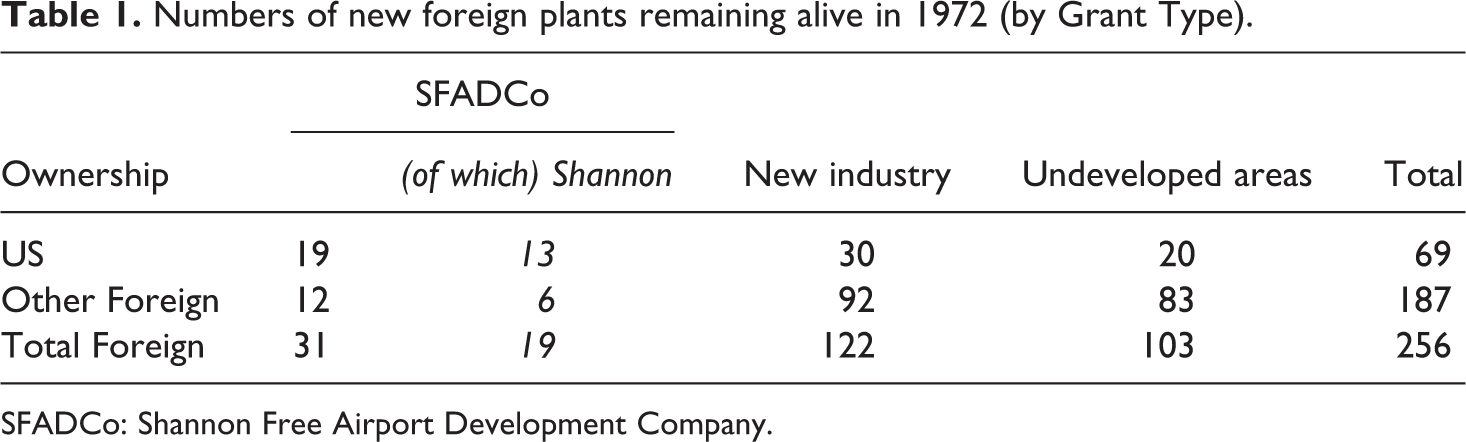
SFADCo: Shannon Free Airport Development Company.
Shannon, and the SFADCo area generally, also proved to be relatively more attractive to large employers. Thirty-two per cent of Shannon plants and twenty-five per cent of SFADCo plants had 250 employees or more in 1972, compared to thirteen per cent of plants with ‘new industry’ grants and only six per cent of those with ‘undeveloped area’ grants.
The first major anchor tenant at Shannon was the Pennsylvania firm Standard Pressed Steel, which opened in 1960 and airfreighted all of its production abroad, primarily to the United States. 91 It employed almost 400 workers in 1961. 92 Among the largest of the ‘new foreign industry’ employers across the entire country in 1972 was the US fashion-garment producer Lana-Knit, which had been at Shannon since 1960. 93 Another was the General Electric subsidiary known as ‘EI’, which had been at Shannon since 1962. 94 It employed 1,200 workers by 1966. 95
Table 2 shows the employment levels in 1972 for the 256 new foreign-owned plants in our database that survived until then and for which employment data are available. In this respect also, US firms comprised a significantly higher proportion of the SFADCo cohort, and a far higher proportion of the Shannon cohort, than was the case elsewhere in the country.
Total employment in new foreign manufacturing plants in 1972 (by Nationality and Grant Type).
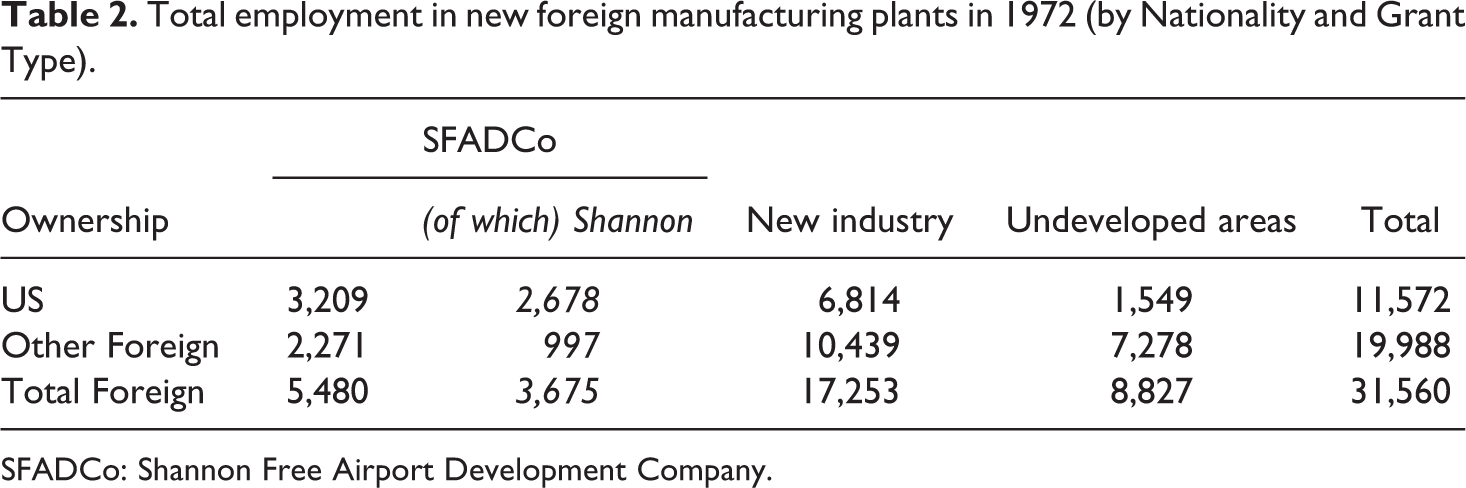
SFADCo: Shannon Free Airport Development Company.
Shannon achieved rapid success. By 1967, it accounted for thirty per cent of Ireland’s manufactured exports of £110 million, up from ten per cent of the much smaller figure of £50 million in 1963. By 1973, industrialisation had spread and Shannon’s share was back down to around ten per cent of the total, which had by now grown to £430 million. 96
Shannon’s portfolio of export destinations also differed dramatically from that of the rest of the economy, as seen in Table 3. Lemass’s scheme to attract US firms even before EEC membership had been attained had paid dividends.
Share of manufactured exports (from Shannon and Ireland) by destination, 1973.
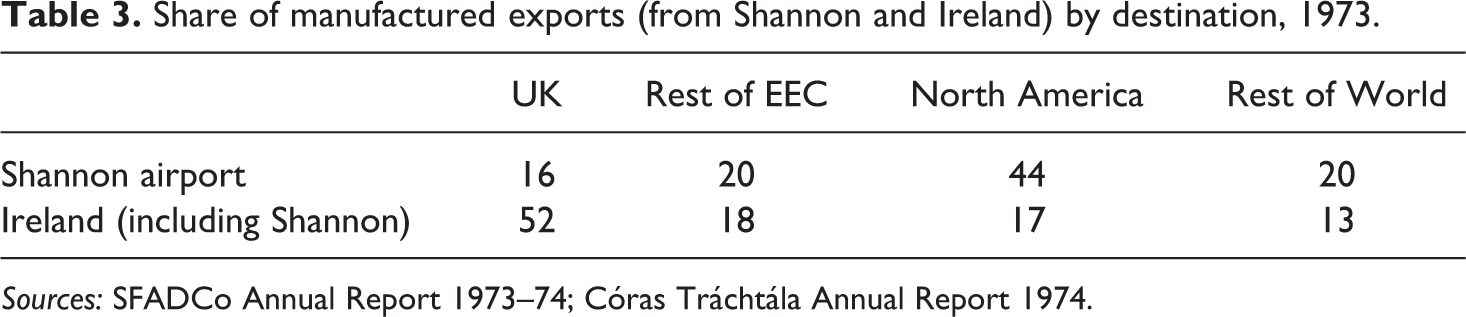
Sources: SFADCo Annual Report 1973–74; Córas Tráchtála Annual Report 1974.
Concluding comments
By developing an alternative source of job creation, the new export-oriented FDI regime instituted in the 1950s facilitated the later Whitaker and Lemass–led dismantling of protectionist trade barriers. This article has focused on where the ideas for the new FDI regime came from, how they worked their way to the top of the policy agenda and how the political obstacles facing their introduction were surmounted. One facilitating factor was that the United States had overtaken the United Kingdom as the major global source of FDI in the post-war world. Fianna Fáil was particularly favourably disposed towards US investment. Indeed the Shannon initiative was particularly appealing to US firms, who would come to predominate in the non-Shannon region only after EEC membership had been attained. US interests played a role in alerting Ireland to newly emerging possibilities and opportunities but domestic ‘ownership’ and management of the transition was critical to its widespread acceptance.
The major financial incentives that would prove attractive to foreign firms were introduced in 1956. These included export profits tax relief and a nationwide rolling-out of an industrial grants scheme that had heretofore been confined to ‘undeveloped areas’. Ideas for the export profits tax relief initiative had been under discussion within the Irish system since the dollar shortage of the immediate post-war period. By the time it was introduced, it was understood that it could make a significant contribution to Ireland’s ability to attract export-oriented foreign firms.
The main political difficulty facing the inter-party government in implementing its 1956 initiative was how to avoid triggering the opposition of protectionist-era industry. The financial incentives introduced were remarkably well designed to achieve this goal. The new tax relief applied only to profits deriving from new exports, while the industrial grants were by convention allocated only to ‘new firms which would not compete in the home market with existing firms’. The final protection afforded was the retention of the CMA. Though this made the task of the FDI promotion agencies more difficult, it hugely facilitated political acceptance of the new regime. The potential objections of the OEEC were overcome when the new policy was accepted as evidence of movement towards an outward reorientation of the economy.
Lemass was clearly wrong-footed by the inter-party initiative. His public criticism of what he had himself announced years earlier as a ‘new policy for the party’ showed evidence of what John Horgan, a favourably disposed biographer, has characterised as ‘tortured logic’. 97 Lemass’s public pronouncements may have had a dampening effect on the initial impact of the regime shift. It has been well documented how Irish policymakers of all parties inched each other towards the new economic strategies of the 1950s. It seems natural, in this light, to view Shannon as Lemass’s response to the inter-party initiative. His support for the establishment of SFADCo as a separate organisation from the IDA created problems that would manifest themselves for decades to come. Shannon made its mark very rapidly however, and the initiative succeeded in attracting a strong coterie of US firms long before Ireland joined the EEC.
Footnotes
Acknowledgements
This article is dedicated to the memory of Brendan Walsh, whose chance remark to Frank Barry one evening on Nassau Street – that Ireland’s openness to America saved the country from intellectual isolation, even when it appeared to desire it – proved an important stimulus to the ideas presented here. We are grateful to the journal’s referees for their valuable comments and suggestions.
Declaration of conflicting interests
The author(s) declared no potential conflicts of interest with respect to the research, authorship and/or publication of this article.
Funding
The author(s) received no financial support for the research, authorship and/or publication of this article.