







Abstract
Infanticide reached record levels in Ireland in the mid-nineteenth century. Although the rising population and increasing poverty provided the essential precondition for this, the sharp rise in the practice identified by contemporaries in the 1820s and 1830s might not have taken place had the Dublin and Cork Foundling Hospitals continued to assume responsibility for the care of foundling children. But once they were no longer available to receive them, the women who give birth to the children that society identified as illegitimate chose to terminate their lives in record numbers in an attempt to avoid the severe stigma that this brought and the practical difficulties of taking care of a child alone. Using the cases that came before the coroners court and the crime figures assembled by the Royal Irish Constabulary from the 1830s, this article combines the quantitative analysis of the practice that this permits with a reliance on the qualitative approach that informed a previous investigation of the phenomenon in the eighteenth century to track its evolving trajectory, to identify its main features and to explain how it had arrived at a point by the 1840s when it exceeded homicide as the primary cause of violent death.
Infanticide emerged as a response to the problem of unwanted pregnancy in Ireland in the eighteenth century. 1 It is not possible to demonstrate this statistically because the state did not collect relevant data prior to the 1830s, but the pattern of reported instances is consistent with the conclusion that neonaticide (the killing of newly born infants) was more frequently resorted to in the second half of the eighteenth century than previously. 2 Indeed, the state’s priority, as the adoption by the Irish legislature in 1707 of the English law (of 1624) which denominated infanticide a capital offence attests, was to legislate the practice out of existence. 3 The increasing number of cases is illustrative of the ineffectiveness of legal sanction, but the fact that a change to the law, which provided for a less proscriptive legal environment from 1803, also failed to discourage the practice supports the conclusion that the determining influence was not the law but social and economic forces. 4 In keeping with this, and with the demographic and economic environment that provide the context for the phenomenon during the first half of the nineteenth century, infanticide was resorted to not only by single women and sex workers in an attempt to evade the negative societal and economic consequences of giving birth to and raising an illegitimate child but also by a proportion of married women and, in a handful of case, by promiscuous males. The implication of sex workers is unsurprising, given their involvement in the eighteenth century. But the evidence of the greater involvement of men, widows and deserted wives in the nineteenth century suggests that the more censorious moral atmosphere that came to prevail was an increasingly compelling influence. It was not the only factor. Notable institutional changes (the closure of the Foundling Hospitals above all) were also crucial because they deprived the population of the option of seeking institutional care for unwanted children at a time when the rise in the number of unwanted pregnancies that flowed inevitably from the rise in population from c. 4.42 million in 1791 to 8.175 million in 1841 and the intensifying economic problems the country experienced from 1815, provided a context for the striking increase in infanticide that was a feature of the second quarter of the nineteenth century. 5 What this meant in practice was that having increased to a point when (according to the 1840 census) it was second only to murder among those whose ‘death [was] caused by violence, neglect, evil intent or design’, it remained at this high level for the duration of the Great Famine. Indeed, when taken together with figures for concealment of birth and infant desertion, which were de facto synonyms in a high proportion of cases, infanticide exceeded homicide then and during the 1850s and 1860s as the primary cause of violence-induced death. 6 If it is important, for this reason, that the history of infanticide in the early nineteenth century is explored, it is also desirable to address a lacuna in the history of the phenomenon that – the recent surge in interest in the subject notwithstanding – remains unfilled. 7
Infanticide in the Early Nineteenth Century, 1800–30
Based on the information that can be gleaned from the reportage of the phenomenon in the press, which is a more consistent source of information than the fragmentary archive of the state, the conduct of infanticide in Ireland in the first quarter of the nineteenth century mirrored the manner in which it was pursued during the final decades of the eighteenth century. 8 The comparable ways in which newborn infants were deprived of life constitute the most striking manifestation of this, for though newspaper reports are seldom sufficiently forthcoming to permit the cause of death to be identified with medical precision, there is no occluding the fact that it was commonly the outcome of violent intervention. This assumed different forms. The most common was drowning, usually in rivers, for the simple reason that if conducted efficiently it permitted the person responsible to commit neonaticide and to dispose of the body in one action. Moreover, any river would do, which accounts for the recovery of infant bodies from the Liffey (at Dublin), the Shannon (at Limerick), the Nore (at Kilkenny), the Suir (at Clonmel), the Blackstaff and Blackwater (at Belfast) and the Inch (near Ennis) during the first two decades of the century. 9 However, because virtually any significant pool of water would suffice to deprive an infant of its life, if not always to dispose of its securely, the bodies of children were located in the Grand and Royal Canals (at Dublin and Mullingar); in quarries (at Kilkenny and Lisburn); in marl holes (at Ballycanew, county Wexford); in ‘watering slips’, ‘sink’ and ‘dirtholes’ (in Dublin and Durrow); in bog holes (at Ballymagarrick, county Down and Tureen, county Clare), moss-holes (at Magheramore, county Antrim), wells (at Drumbeg, county Armagh), privies (Carrickfergus, Derry) and sewers (Waterford). The sea was also resorted to on occasion by those in its vicinity; for example, in November 1821, ‘the body of an infant child, secured carefully in a small box, was discovered within the sea water mark near Sandymount’, county Dublin, where it had been left ‘for the purpose of being carried off by the next tide’. 10
In keeping with the fact that this child was dead when it was encountered, the infants that were recovered in water did not invariably die as a result of immersion. Some bodies were taken from watery locations ‘dreadfully mangled’. Others were recovered with a cord or rope around their neck and with a stone or piece of lead attached consistent with the conclusion that they had been killed elsewhere. 11 In the latter instances, it is reasonable to conclude that the person (or persons) responsible consigned the body to a moving body of water in anticipation that it would be both concealed from view and conducted away from the place at which the child’s life was extinguished. In a majority of such cases, the child was strangled, either manually or with the assistance of a cord, before it was committed to water but they do not observe any identifiable pattern. Some infants were despatched clinically with a minimum of visible injury; 12 the marks on others are consistent with a brutal and possibly inefficiently administered killing. This was the misfortune of the ‘new born infant’ that was found ‘in a coffin’ in St Andrew’s Church Yard, Dublin, in the spring of 1801 with ‘its skull fractured in a shocking manner and all its bones broken’. 13 As well as fracturing the skull of the female child which she disposed of in a ‘sink [hole] for filth’ at Durrow, Queen’s county, in 1816, Eleanor Blair ‘wrenched round the head’ in order, presumably, to hasten its demise. 14 Other bodies were discovered mutilated, consistent with the conclusion that they were killed with the assistance of a tool or weapon. This was unambiguously the case with respect to ‘the infant, a few days old’ who was found ‘with its throat cut’ by ‘some boys looking for worms on Clarke’s Marsh’, Cork in 1812, and ‘the newborn infant’ from Mather’s Fort, county Down, whose head was ‘literally’ severed from its body with ‘a reaping hook’ in 1826. 15 Dislocated bones are more problematical, given the susceptibility of the newborn to such injuries, but the frequency with which they were encountered in cases of neonaticide is consistent with the conclusion that many of those who committed infanticide employed greater force than necessary to accomplish their goal. 16
This was not true of all, however. While it is difficult to argue that infants that were discovered naked, or with the minimum in the way of clothing or covering, were perceived of as other than a problem requiring urgent resolution by any possible means, others were treated with a measure of dignity. This is true of those infants that were found sewn ‘in a bag’; wrapped in a cloth, ‘apron’ or ‘piece of canvass or sail cloth’; placed ‘carefully’ in a box; or, in the case of the female child of two or three months discovered at Ballycanew, county Wexford, in 1807, wearing ‘a neat white muslin jacket and a good flannel petticoat’. 17 It is reasonable also to conclude that a majority of those who chose to forsake a child, alive, at or near a public space did so because they could not bring themselves to kill or because they retained some hope that the child might be rescued and cared for by another. This happened on occasion. There are instances where children who were left at the entrances to public buildings or in the porch or halls of houses in Dublin and Belfast were taken up by caring individuals. In some cases, children encountered in public spaces were saved from premature death from hypothermia or from hunger by their rescuers, but they were unusual. 18 A majority of the infants that were abandoned were dead when they were deposited or died as a result either because they were secreted in a little frequented location or because they were left without appropriate protection. 19 This was the fate, certainly, of the ‘newborn child’ that was found in February 1806 ‘with only a dirty rag about it’ in a ditch at the back of Charles Street, Summerhill, Dublin, where it had ‘lain…under the snow [for] some days’, and the ‘male infant, a few days old, who was exposed…at a door in Abbey Street’ in the same city in December 1822. 20 Others were simply abandoned to their fate at a variety of locations. The infant disinterred by a dog in a potato garden in the vicinity of Milltown, county Clare, in April 1807, was ‘delivered on the spot where the dog scented it’. 21 A comparable conclusion was arrived at with respect to the female child that was stumbled upon in a ‘field joining a public pathway leading from Portobello Bridge’ in Dublin in 1817. 22 These were opportunistic and, possibly, unplanned infanticides. Mothers with a little more time might bury the child or convey it to consecrated ground in anticipation that the local vestry might do the necessary. This was, one can assume, the intention of the persons responsible for conveying ‘the body of a new born infant…into St Andrew’s Churchyard’ in the centre of Dublin in 1801; for leaving ‘a dead infant…at the door of St Peter’s Church’, Aungier Street in 1806; and for the partially buried ‘body of a child…discovered in the center of St Kevin’s Churchyard’, also in Dublin, in 1816. 23 But, as was the case with the infant ‘found under some earth’ in Cork in 1812; the ‘body of a child taken out of the waste ground near the wind-mill barrack’ in Limerick in 1816; the ‘new-born child…buried in a potato field near Richmond Barracks’, Dublin, in 1827; and the ‘male child found buried under a heap of stones in the vicinity of Kilrush’, county Clare, in 1825, the hurried manner in which these children were interred facilitated their discovery. 24
This outcome was still more likely in those cases in which perpetrators contrived to conceal the body at their place of abode. One of the most ill-judged instances involved a young woman from county Down who sought in 1826 to hide the body of her child ‘under a few sods at the fire-side’. This was only marginally less secure than the interment in 1828 by Margaret Nowlan, a maid servant resident on New Dominick Street, Dublin, of ‘the body of an infant…beneath a quantity of coals’. 25 By comparison, the disposal of the body in a privy was more commonplace, and if it was one of the first locations that suspecting employers and family members chose to investigate, it was one of the options favoured by female servants. 26
Such incidents indicate the lengths to which a woman felt obliged to go ‘to conceal her shame’. 27 They are also helpful, when the reports are accompanied by the names and occupations of those suspected of involvement, in providing an insight into the social status and outlook of a minority of those responsible. It is notable in this context that the profile of those dating from the first decades of the nineteenth century mirrors that of those who had recourse to infanticide in the eighteenth century, with servants and those involved in the textiles trade, the sex trade and lower class occupations featuring disproportionately. 28 It is more difficult to secure insight into their psychological state at the time, though glimpses are occasionally available, which suggest that they range from the contrite to the callous. In the case of the former, one may instance Rebecca Tolan, a ‘good looking young woman’ from Carrigans, county Donegal, who was employed as a servant in the residence of James Hammett of Derry when, in November 1827, she was detected attempting to dispose of the male infant, which she had contrived to deliver secretly, in a privy. The child was rescued and Tolan, who was held in high regard by her employer and genuinely remorseful for what she had attempted to do, commenced breastfeeding, which augured well for the child’s survival. 29 By contrast, Bridget Stack, who strangled the male child to which she gave birth at Ennistymon, and buried it in a ‘potatoe garden’ in 1818, not only obstructed inquiry into the child’s fate, she showed no remorse when challenged. It may be that this can be accounted for by reference to her family history; her sister Nell (Ellen) Stack was executed in 1812 for the murder of an infant she had undertaken to convey to Cork Foundling Hospital. 30
Interestingly, the father of Rebecca Tolan’s child – her second cousin James Callaghan of Carrigans, a weaver, who ‘had solemnly pledged to make her his wife’ – was not present to assist her negotiate the birth of her child because, other than those cases involving ‘the nymphs’ who purveyed sex, some of whom could call on a supportive female network, women generally negotiated these episodes alone. Indeed, they were more likely to be handed over to the authorities by those in their circle than assisted to pursue their chosen course of action. 31 Fathers were largely conspicuous by their absence, and other males were rarely involved other than as law officers or agents of the court. Furthermore, when women looked to the father to provide support (which was sufficiently common then and later to make it clear that they believed men should not be allowed to evade their responsibility), they were as likely as those women who absconded when suspicion fell on them to make themselves scarce, to deny their involvement or to commit infanticide. 32 The latter response was not common, but the decision of John Power of Waterford to ‘make away’ with his three-week old son when its mother, Mary Gram of Kilbarry, deposited the child at his house demonstrated that males could be ruthless when faced with the prospect of caring for an illegitimate child. 33
Be that as it may, the prevailing view of the patriarchal order in church and state was that infanticide was a woman’s crime, and that those responsible were, in the language of the day, ‘unnatural parents’. 34 When it was clear that an identifiable woman was responsible, reports were generally more revealing of the gendered assumptions that informed public attitudes. Thus, the women who had resort to infanticide were routinely denominated ‘unnatural’ or ‘inhuman mothers’ and, on occasion, ‘monsters’. This was consistent with the observation of the eminent lawyer Richard Lalor Sheil (1791–1851) that infanticide was ‘the most horrible crime which it is possible for women to commit’. 35 Other male observers were equally severe and, by implication, unpersuaded by the suggestion, which had acquired purchase in the late eighteenth century, that infanticide, like suicide, was a product of a ‘dereliction’ of reason’. 36 It was, the Freeman’s Journal pronounced in 1810, an offence contrary to the ‘laws of nature and God’. The Ennis Chronicle was hardly less censorious; it headlined its report of an infanticide in county Clare in 1818 with the words ‘shocking depravity’. 37 And yet, despite the societal readiness to condemn those responsible for the offence, the courts maintained the disinclination to sanction severely those that were brought to trial that they had demonstrated during the final decades of the eighteenth century. 38 This did not mean that nobody was found guilty of the offence, but their number was small, and, prior to the change in the law in 1803, which permitted women to be charged with the lesser offence of concealing pregnancy, those women and men who were found guilty of infanticide evaded an encounter with the gallows. 39 This continued to be the case thereafter although the slowly expanding reach of the state meant there was an observable increase in the frequency with which coroner’s juries were assembled, with the result that the deceased were no longer interred without the semblance of an investigation. The coroner’s courts had no hesitation in recommending that bills of indictment should be issued against women ‘for the murder of [a] new born child’ in such instances, but the number brought to trial did not increase, and when trials were held, the courts displayed a comparable readiness to acquit those charged with the offence. 40 The most striking exceptions to this pattern were the minority of egregious cases in which the perpetrator was perceived to have exceeded the boundaries of what was tolerable. This is illustrated by Mary M’Garry, who was tried at the county Down assizes in March 1819 for poisoning her ‘infant child’ with ‘corrosive sublimate’ 41 in the residence of her aunt where she had given birth. Found guilty by the jury, she was sentenced to death and executed on 29 March, though the fact that she ‘made no public confession of her guilt’, allied to her disturbed mental state, gave grounds for doubt as to the propriety of the verdict. 42
This outcome notwithstanding, the recommendation of the jury (which was rejected by judge James McClelland 43 ) that Mary M’Garry was a fit subject for ‘mercy on account of her youth’ demonstrated that those brought to trial could anticipate a sympathetic hearing. This was the case during the 1800s and 1810s, when the number of infanticides was of the same order as it had been in the final decades of the eighteenth century. The rise in the number of cases in the 1820s prompted an increase in the willingness of juries to bring in ‘guilty’ verdicts but, as in England, they were usually of the lesser offence ‘of concealing birth’ for which the preferred penalty was six or twelve months in jail (two years was the maximum permissible). Even then, the number of such verdicts is not significant statistically. 44 Moreover, when, as happened at the spring assizes for county Tipperary in 1829, a jury returned a capital verdict against Alice Mulcahy for infanticide, she was promptly reprieved. 45 This was a feature of the wider pattern of sentencing in cases of child death in the early nineteenth century. Comparable leniency was manifested in Carrickfergus a year later when William McIlveen, who had struck and killed his two-year-old son while drunk, was adjudged to have committed manslaughter rather than murder; and at Tralee assizes in 1826 when (on the instruction of the judge) the jury returned a ‘not guilty’ verdict against Ann Roche for the mercy killing (by drowning) of her four-year-old grandson, because she believed he was ‘fairy struck’. 46 It is clear from the report of this trial that the case prompted a degree of uneasiness in the court room. And it is noteworthy that the extenuation manifested on this occasion was not extended to Mary McGrath, who was of a similar age, who was sentenced to death at Louth assizes in 1828 for killing a foundling child she undertook to bring to the Dublin Foundling Hospital. 47 Indicatively, when Rose Kelly was tried at Dublin Commission of Oyer and Terminer in February 1802 for the murder of Mary-Anne Murphy, a child of five years, whom she had tempted with the promise of ‘cakes in order to strip her of her clothing’ she was also sentenced to death. 48 It is probably significant that Mary McGrath’s argument in her defence that the child ‘was near dead when I got it’ was weak, but this case and that of Nell Stack of Ennistymon, county Clare, in 1812 is a reminder that the history of infanticide in eighteenth- and early nineteenth-century Ireland is bound up with that of the Foundling Hospital. 49
The Foundling Hospital and Infanticide 1815–35
Although the regular presence of reports in the press sustained the impression that infanticide raged in Ireland in the late eighteenth and early nineteenth centuries, the reality was that it was kept at an artificially low level by the existence of the Dublin Foundling Hospital. 50 As the institution charged with providing for orphaned and unwanted children, the Foundling Hospital admitted c. 80,000 infants in the seventy years between its inception and its restructuring in the late 1790s. 51 Moreover, it was not the only institution of its kind on the island. The Cork Foundling Hospital, which was established in 1735, operated on a more modest scale, but when combined with the orphaned and abandoned children who were cared for temporarily by parish vestries, it is likely that the number of unwanted births sustained an upwards trajectory comparable to that of the kingdom’s population, which grew from c. 2.57 million in 1753 to c. 4.4 million in 1791, and that the total number of children requiring care in the eighteenth century may well have exceeded 100,000. 52 Moreover, as the admission of 52,150 infants by the Dublin Foundling Hospital between 1796 and 1826 attests, the problem of unwanted pregnancies continued to grow, which in the absence of profound attitudinal change to illegitimacy meant inevitably that so too did the number of infanticides. 53
This was not how contemporary commentators and opinion formers perceived the matter, of course. Although few who possessed more than a passing acquaintance with the history of the Dublin Foundling Hospital can have been unaware of its serious administrative and organisational failings, or of the fact that the mortality rate among those admitted to its care reached 90 per cent on occasion in the eighteenth century, the belief that by their existence such bodies precluded the need for infanticide was firmly anchored. It was, for example, visible in the response to the discovery of the body of a ‘three day old infant’ in 1801 when, it was observed righteously, ‘such atrocity, in a city where ample provision is made for the protection and support of children without distinction, well deserves the most condign punishment’. 54 If, as this comment suggests, there were those who were convinced that infanticide could be prosecuted out of existence, more pragmatic counsels prevailed. As a result, support for the Foundling Hospital was affirmed when, following on the inquiry spearheaded by the former chief secretary, Sir John Blaquiere (1732–1812), the unwieldy board of the institution was slimmed down and a new nine-person body took charge in 1798. 55 This was a necessary and well-intended reform, and it might, in other circumstances, have constituted the first step in a fundamental rethink in the manner in which the institution, and by extension the state, provided for the near 2,000 children admitted to the Hospital annually from the mid-1780s. However, the new board devoted more energy to moral formation and religious instruction than to the well-being of those in their charge. 56 This reflected the evangelical Protestant sensibilities that acquired increasing influence in the public sphere in the early nineteenth century, but it meant that a disquieting 79.6 per cent (41,524 of 52,150) of those admitted between 1796 and 5 January 1826 died prematurely. 57 Although not exceptional by international standards, it testified to the board’s failure to establish an efficient and caring regime providing for the several thousand children a year that, with infanticide, were the most visible consequences of unwanted pregnancy. Indeed, they contrived to make an already bad situation worse when, beginning in 1815, they suspended admissions between 1 February and 1 April annually.
Although the board was prompted to do so by the wish to reduce child mortality among those newly admitted to the institution, which traditionally reached its seasonal peak in the spring, the controversy that followed the imposition of a seasonal moratorium on admissions demonstrated that it was ill-conceived. 58 But instead of reversing the decision, the board was impelled by the mounting fiscal challenge of providing for a rising number of children (which stood at an unprecedented 8,740 in 1819) to support the ratification in 1822 of the Dublin Foundling Act which relieved them of the responsibility of receiving children from outside Dublin. Children from outside the county were only admitted to the Hospital thereafter on the payment of £5 for each child and the submission of a certificate from its parish of origin indicating that the child had been abandoned and was at risk of dying. 59 The Hospital did not want for champions, some of whom insisted doubtfully that board’s approach was justified on the grounds that it must contribute to ‘the prevention of the horrible crime of infanticide’. But the tocsin of criticism pointing out that the new strategy was having the opposite effect rang louder. Moreover, it acquired traction as ‘the great increase in the destruction of infants’ that was observed from the early 1820s, and that was particularly marked in the countryside, was attributed unhesitatingly to ‘the restricted action of the Foundling Hospital’. As a result, the policy was denounced extravagantly in one quarter ‘as cruel as any decree which has been issued against unfortunate children since the days of Herod’. 60 Some practical efforts were made in 1825 to alleviate the financial challenge the new regulation posed vestries by authorising parishes ‘to levy the sums requisite for the maintenance of the [deserted] child until transmitted to the [Foundling] Hospital’, 61 but this did not address the nub of the issue, which was the precipitous decline in the annual rate of admission to the Foundling Hospital ‘from nearly 2,000 to less than 500’. 62 This trend was welcomed by the managers of the Hospital because it moderated the number in their care but it exacerbated the problem of ‘the maintenance of illegitimate children in Ireland’. 63 As a result, although ministers, and those who continued to support the Hospital, had recourse to increasingly thin arguments to justify the annual vote of £34,000 that was assigned to the institution by parliament, there was an acceptance that it was necessary. There was a contrary view, of course, but Thomas Spring Rice, the MP for Limerick, was a lone voice when he advised the House of Commons in May 1827 that to vote ‘to continue this hospital would be to establish infanticide by act of parliament’. 64
Few members of parliament equated the mortality that was an unintended result of the defective modus operandi of the Foundling Hospital then, or in the eighteenth century when it was still higher, with the deliberate killing of children. Many were also unyielding in their refusal to accept the argument that the 1822 act had inadvertently prompted ‘an increase of infanticide’, but in truth it mattered little, as the perception that the Hospital was no longer fit for purpose had already taken firm hold. 65 The decision of the governors on 24 September 1829 to announce that ‘the Hospital will be finally closed against the admission of deserted infants on the first day of January 1830’ signalled the beginning of the end for a flawed institution that had occupied a key space on the Irish landscape for a century. 66 Few lamented its passing as the government’s vision for the future mirrored the increasingly powerful hold of laissez faire thinking in the corridors of power and the expanding commitment to moral reform. 67
The government rationalised the closure of the Foundling Hospital by claiming that the expanding voluntary and charitable sector would take its place. 68 One of the organisations they identified was the Dublin Mendicity Association (1818), which occupied a prominent space in the firmament of Irish charities that were expected to take the lead in dealing with ‘the shocking practice of child dropping and infanticide’. 69 It was, in point of fact, less well-positioned to respond to the problem than parish vestries, although they encountered strong resistance among the public across the island to their efforts to assign funds (approximately £5 per child annually) for ‘the support of deserted infants’. 70 The crux of the matter, as both made clear, was that their efforts were simply insufficient, in the absence of ‘legislative provision for the destitute’ and ‘a law to compel the male parent to support his illegitimate offspring,…to guard against the crime of infanticide’. Edward Southwell Ruthven (1773–1836), MP for Dublin, advised the House of Commons to this effect in August 1833. 71 Thomas Spring Rice demurred. But his observation in 1834 that ‘if some slight increase of infanticide had been the result’ it did not mean the legislature had erred anticipated what was soon generally avowed. Indeed, interests as diverse as the Howard Society, MPs of all political hues, magistrates and other officials, and communities in counties Kerry, Donegal, Londonderry and Dublin were at one in acknowledging that the closure of the Foundling Hospital, while justifiable in its own terms, had exacerbated an already grave problem. 72 The result was a surge in infanticide cases, which is amenable to statistical illustration for the first time because both the Census Commissioners and the Royal Irish Constabulary (RIC) sought, using different methodologies, to measure its extent.
The Expanding Pattern of Infanticide, 1830–68: A Statistical Perspective
It is safe to assume that the statistics gathered by and on behalf of the state are incomplete because infanticide was necessarily conducted secretly. Be that as it may, data tabulated from inquest reports assembled for inclusion in the 1841 census endorsed the contemporary contention that the 1830s witnessed a distinct increase in its frequency. 73 Although the absence of a benchmark against which the order of the increase might be measured diminishes its comparative value, the censal data indicate that there was a minimum of c. ninety identifiable infanticides annually in Ireland during the ten years 1831–40. Calculated by combining the inquest figures for ‘infanticide’ and for ‘desertion and exposure’ (Tables 1 and 2), it does not include the category of ‘unknown infants’, which embraced a still larger number for whom no cause of death was assigned, and, it is necessary to bear in mind, the unknown number of infants that were killed and disposed of undetected. Because there is no basis upon which to estimate the proportion of ‘unknown infants’ that were ‘still born’ or to assess the number of ‘unknowns’ that were killed to whom no cause of death was assigned, there are legitimate grounds for revising upwards William Wilde’s conclusion, which he advanced in his ‘Table of Deaths’ in 1841 that ‘nearly one-fourth’ of the known non-accidental deaths involving children ‘were infanticides’. 74 They certainly exceeded the number of adolescents and adults ‘murders’ though it is noteworthy that the ratio of males to female infanticides was closer to the demographic norm than it was in the case of homicide where the ratio was of the order of almost 6:1.
Irish inquests, 1831–June 1841: Infanticide, deserted/exposed infants, infanticide and murder.
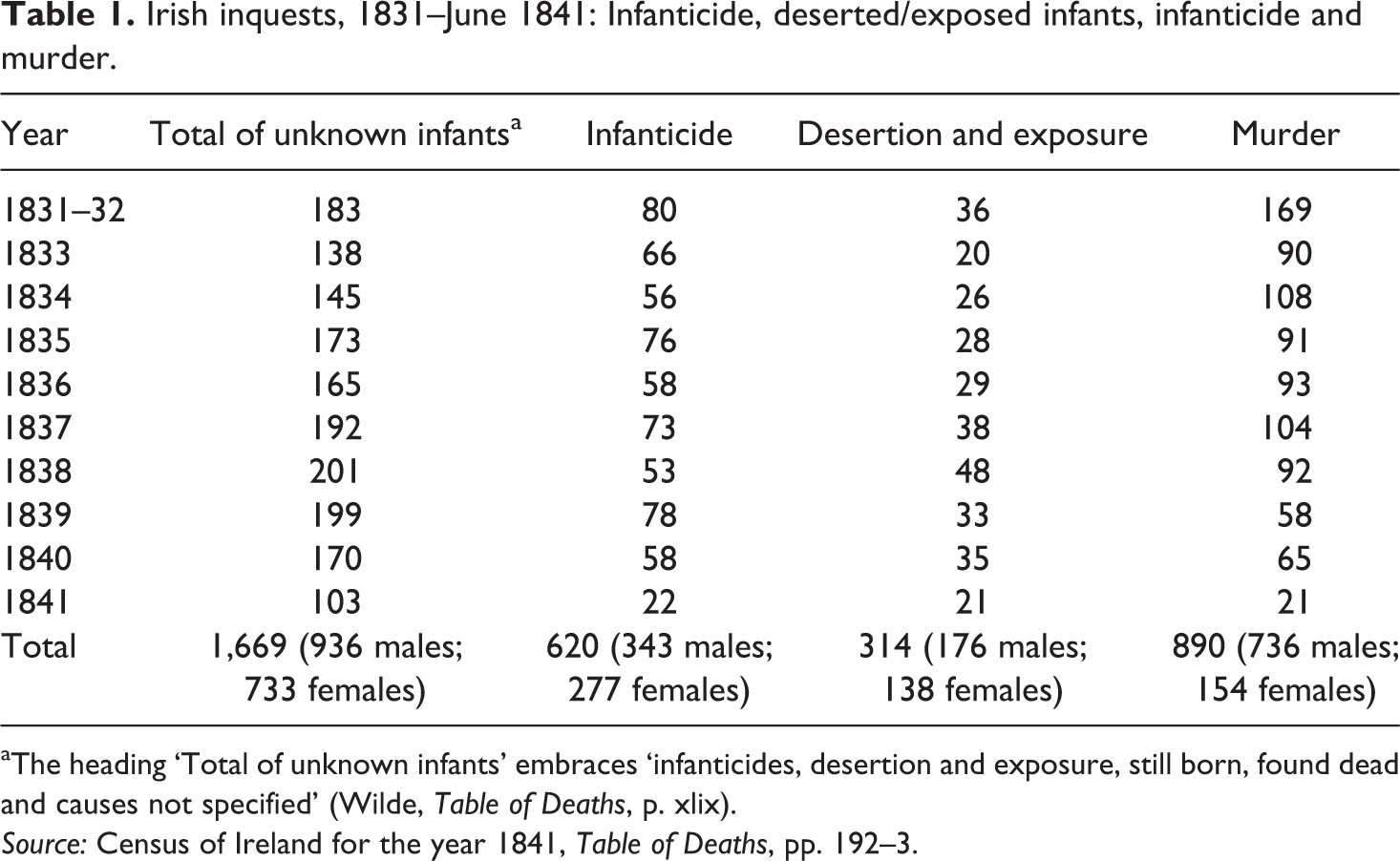
aThe heading ‘Total of unknown infants’ embraces ‘infanticides, desertion and exposure, still born, found dead and causes not specified’ (Wilde, Table of Deaths, p. xlix).
Source: Census of Ireland for the year 1841, Table of Deaths, pp. 192–3.
Irish inquests, 1831–41: Infanticide, deserted/exposed infants and homicide (by province).
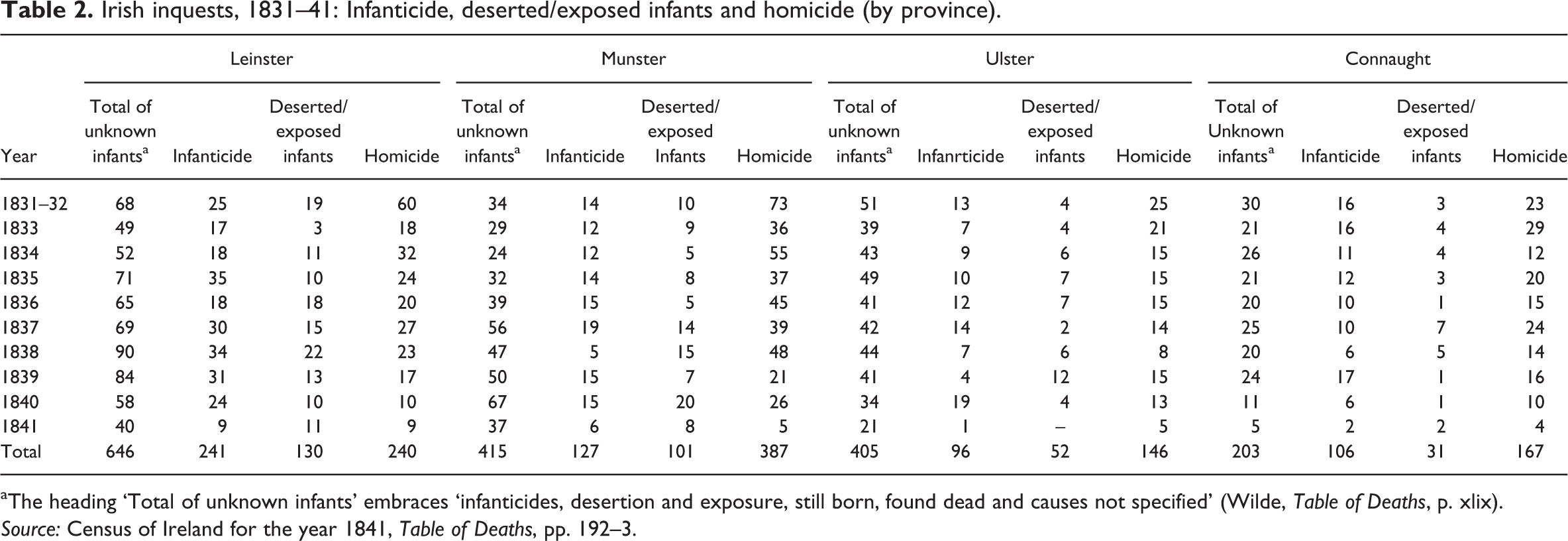
aThe heading ‘Total of unknown infants’ embraces ‘infanticides, desertion and exposure, still born, found dead and causes not specified’ (Wilde, Table of Deaths, p. xlix).
Source: Census of Ireland for the year 1841, Table of Deaths, pp. 192–3.
Infanticide in the 1830s bears geographical comparison with homicide in that statistically ‘deaths from these causes were double in the rural what they were in the civic district’. 75 This suggests that the primarily urban origins of the sample of cases that informed an attempt to reconstruct the phenomenon in the eighteenth century may not reflect the full reality. 76 It does not mean that the 1841 censal data offer an infallible guide to the geography of the practice, however, because of the inherent limitations of these statistics, but they do offer a regional perspective, its rural concentration notwithstanding, which suggests that neonaticide continued to be more prevalent in Dublin than in any other city or county during the decade 1831–41. Further, this provided the foundation for the numerical predominance of the province of Leinster, though the number of instances of infanticide and child abandonment per county was, Queen’s and Meath excepted, less than thirty reported cases. Elsewhere, counties Antrim and Down in Ulster, counties Tipperary and Cork in Munster and county Sligo in Connaught produced the largest number of instances. By comparison, the relatively small number of reports of ‘desertion/exposure’ from counties Mayo and Galway in Connaught, Armagh in Ulster and Carlow and King’s in Leinster may mask the scale of the problem of infanticide in those counties and in counties Limerick, Kildare and Westmeath. The statistical preference for exposure manifested in counties Waterford, Wicklow and Kerry certainly bucked the national trend (Table 3). 77
The geography of infanticide and desertion/exposure inquests, 1831–41 (number by province and county).
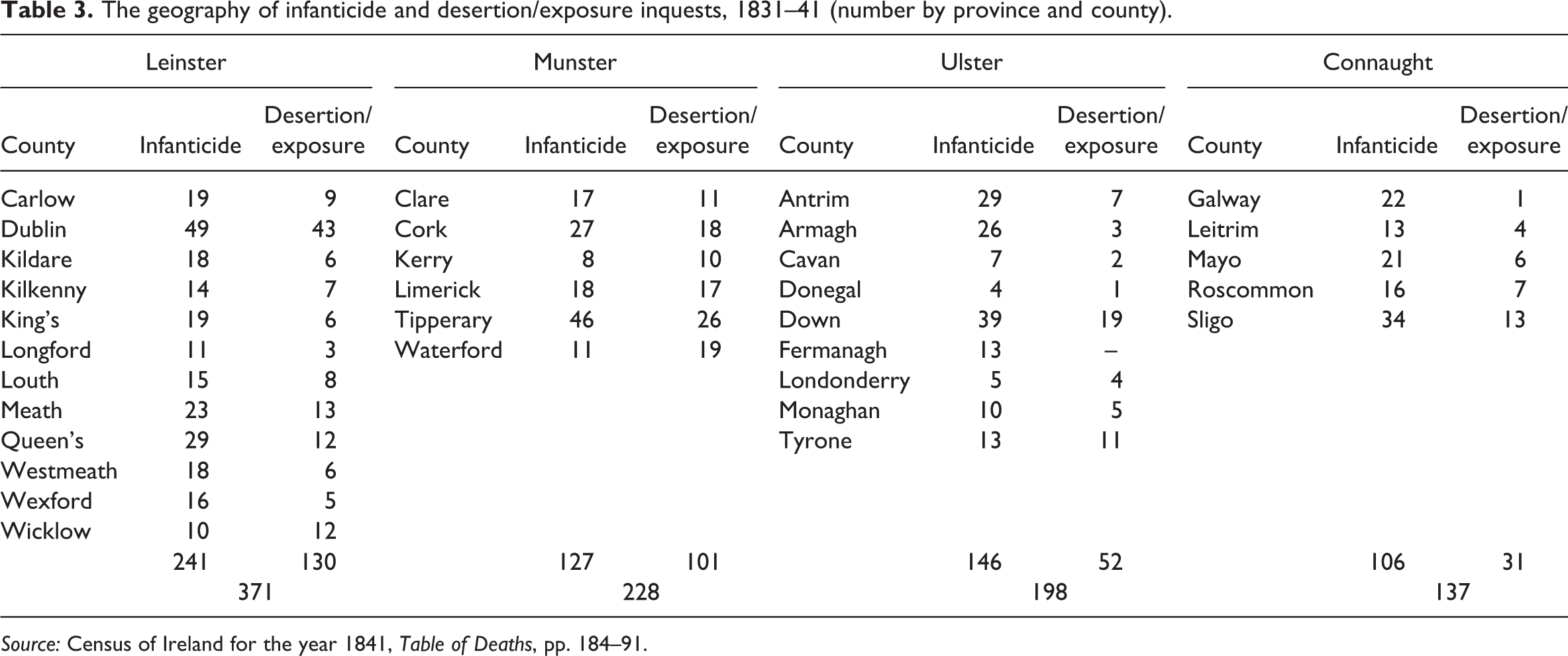
Source: Census of Ireland for the year 1841, Table of Deaths, pp. 184–91.
In any case, a county-based analysis of the inquest data for the 1830s reinforces as well as amplifies the impression provided by the reconstruction of the pattern at provincial level that infanticide was a national phenomenon, with regional features. Moreover, because these were not linked to economic, demographic or behavioural patterns that were specific to a particular time or place, they were prone to change, and the crime figures published by the Constabulary Office from the mid-1840s (with incomplete retrospective returns dating back to 1837) (Table 4; Figures 1 to 4) not only confirm the upwards trend observable in the 1841 Census data but also that this was accompanied in the 1840s by a perceptible shift in the geography of the phenomenon. The most notable regional change revealed by the regional statistics (which are available from 1846) was the replacement of Leinster by Munster as the province with the largest number of infanticides and cases of concealing birth (Tables 5 and 6). Based on the number of reported cases, Cork (which eclipsed Dublin as the county with the highest number of cases), Tipperary, which had the second highest, and Down, which was third, were the only counties with more than one hundred reported instances of infanticide between 1846 and 1860. Counties Limerick, Galway, Antrim and Armagh, with between seventy-eight and eighty-seven cases each, existed in a category of their own, well above that of the generality of counties where the more usual return was between twenty-five and fifty, though the fact that county Carlow, which was the county with the fewest number, reported sixteen instances underlines the extent to which infanticide and the allied offence of concealing birth were island-wide phenomena (Tables 5 and 6).
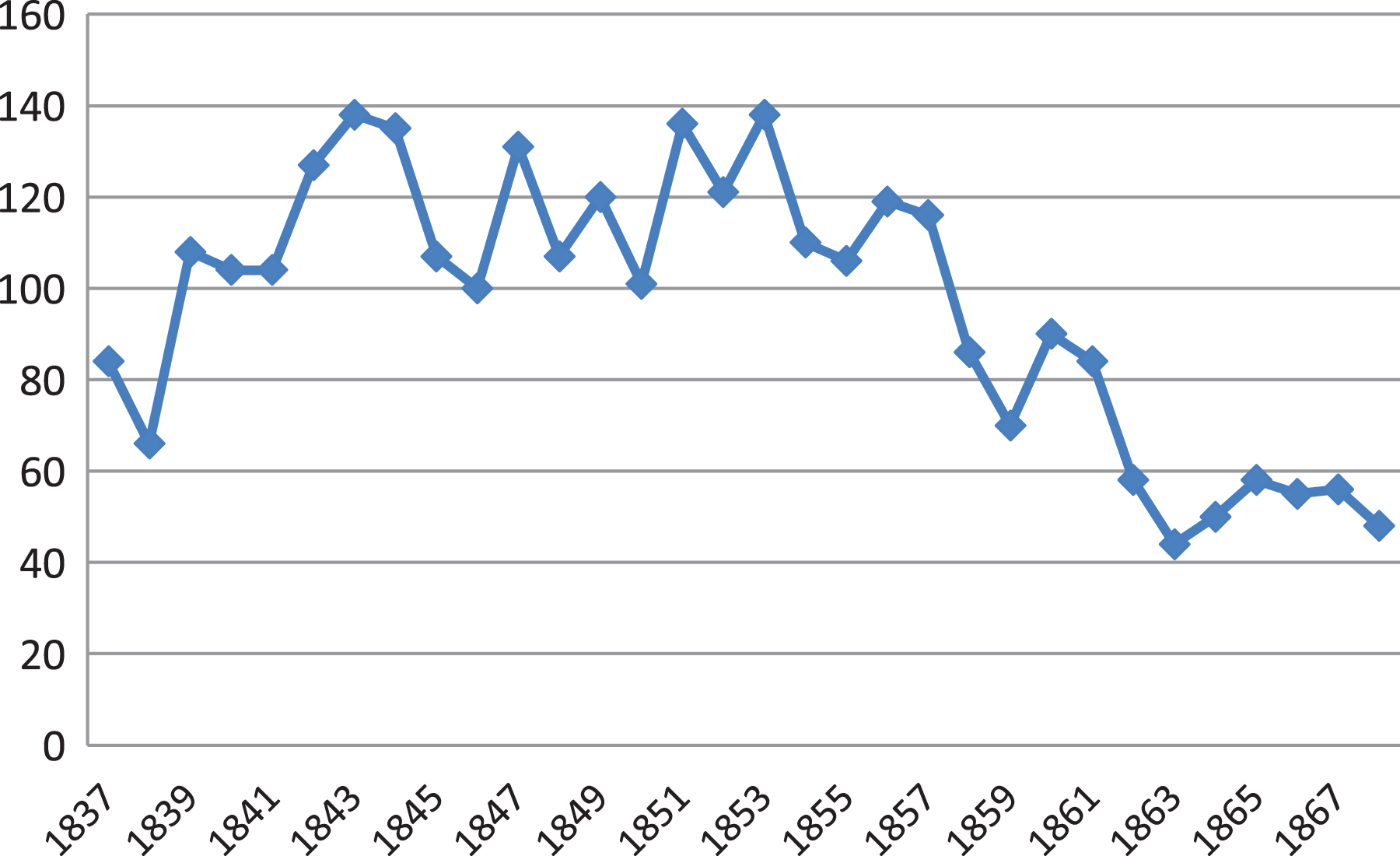
Infanticide, 1837–68. Source: See Table 4.
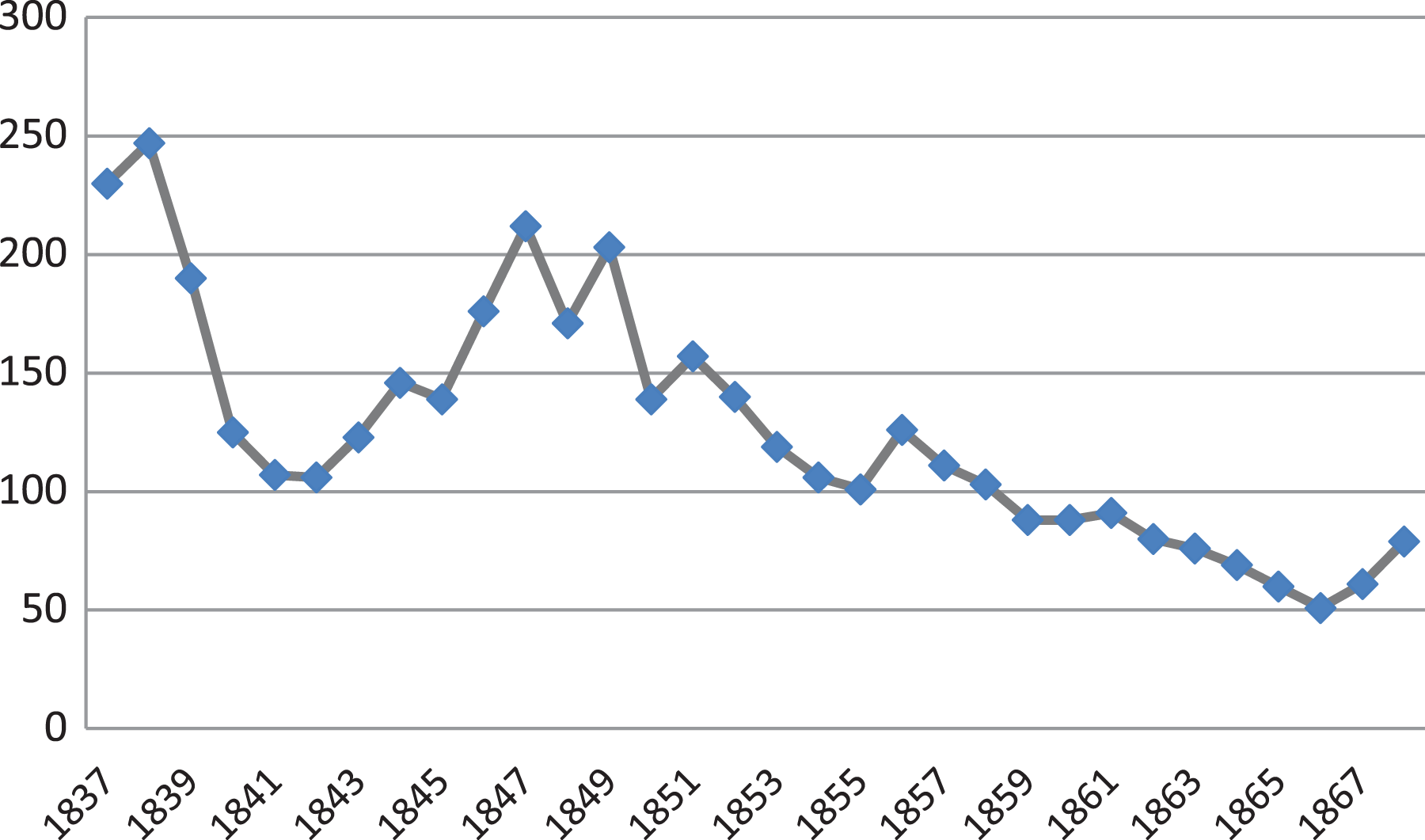
Homicide, 1837–68.
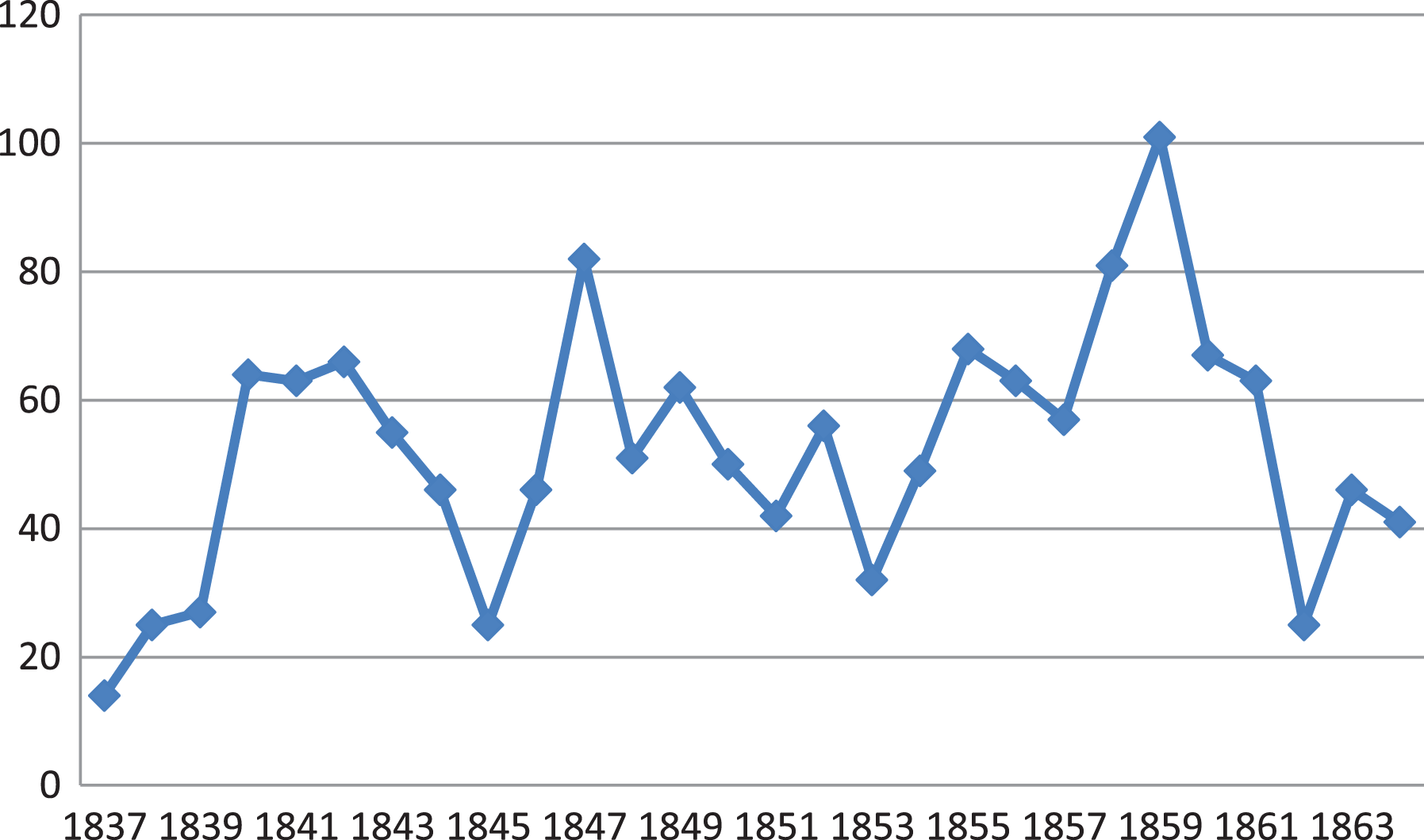
Concealing birth, 1837–68. Source: See Table 4.
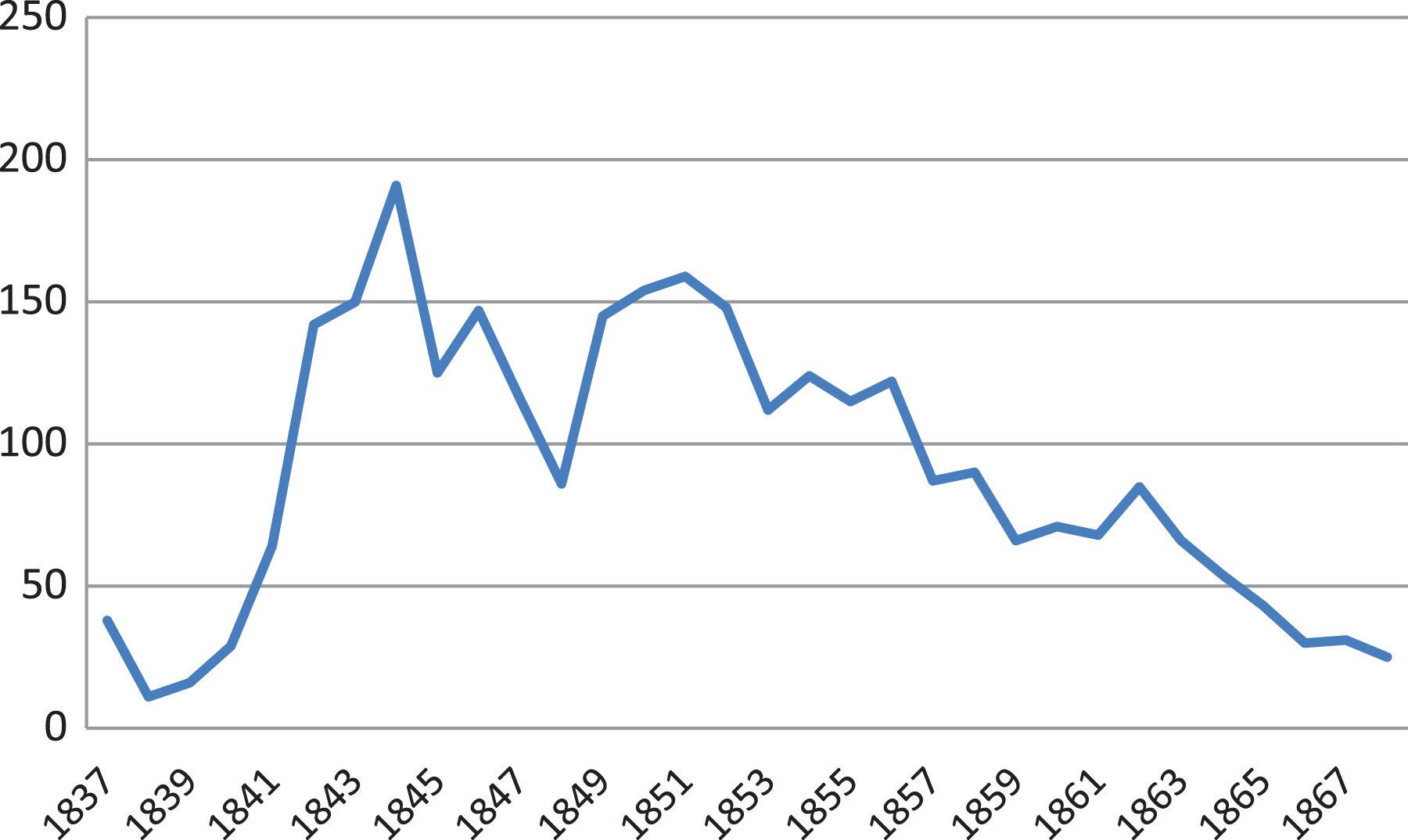
Child desertion, 1837–68. Source: See Table 4.
Infanticide and related offences, 1837–68 (Constabulary Office returns).
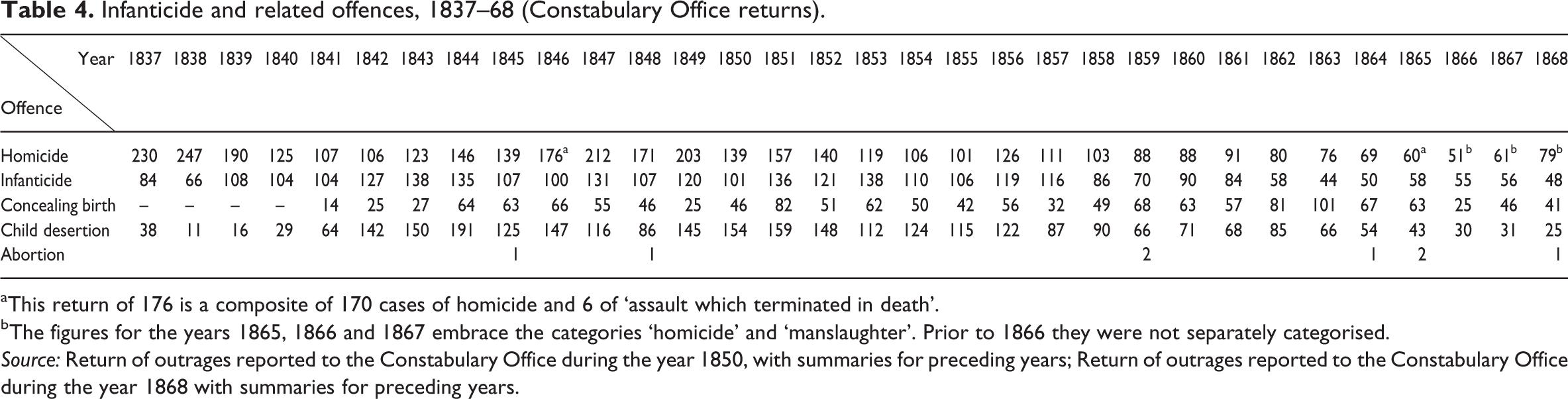
aThis return of 176 is a composite of 170 cases of homicide and 6 of ‘assault which terminated in death’.
bThe figures for the years 1865, 1866 and 1867 embrace the categories ‘homicide’ and ‘manslaughter’. Prior to 1866 they were not separately categorised.
Source: Return of outrages reported to the Constabulary Office during the year 1850, with summaries for preceding years; Return of outrages reported to the Constabulary Office during the year 1868 with summaries for preceding years.
Infanticide, 1846–60: By province and county (CSO figuresa).
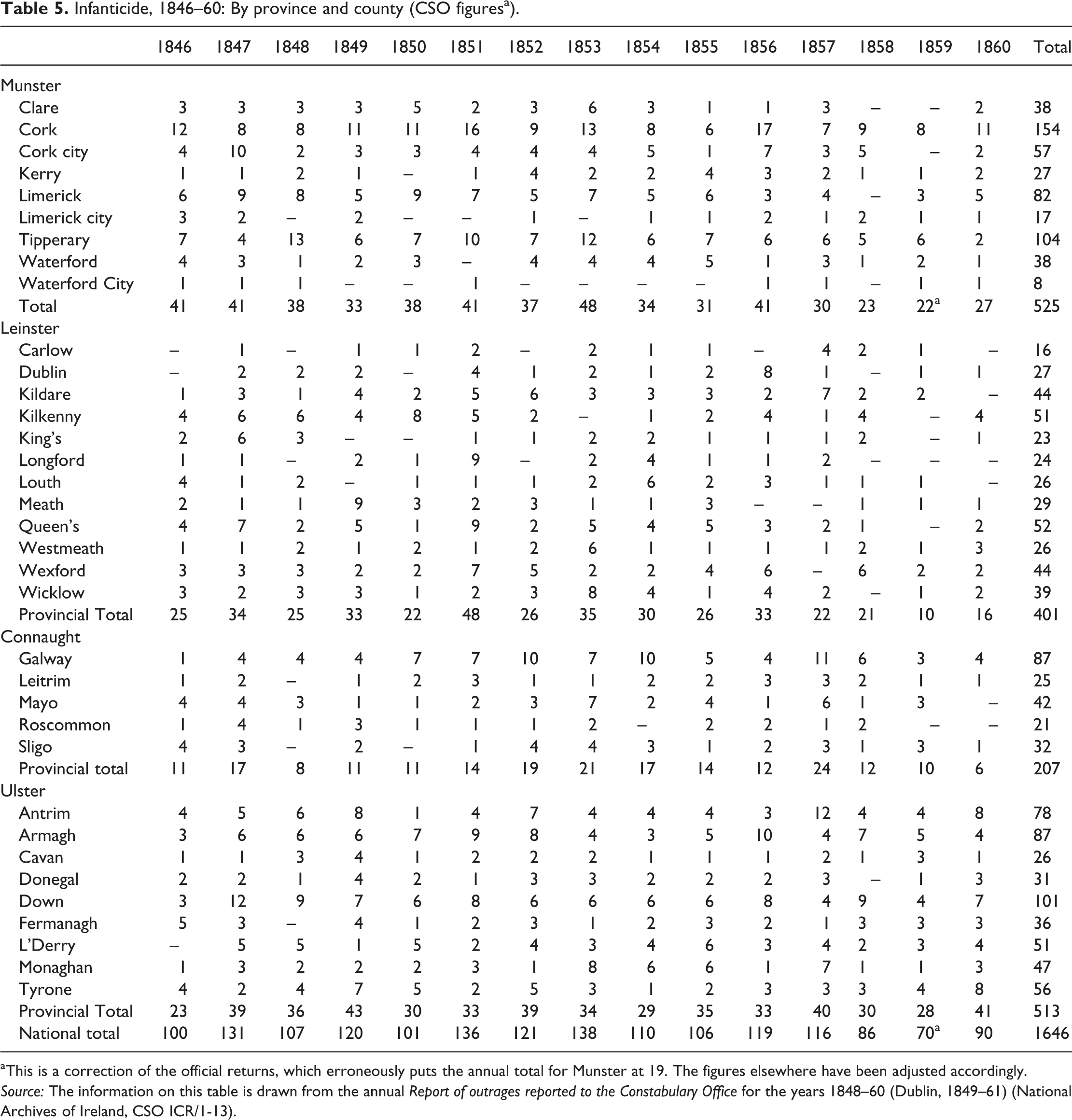
aThis is a correction of the official returns, which erroneously puts the annual total for Munster at 19. The figures elsewhere have been adjusted accordingly.
Source: The information on this table is drawn from the annual Report of outrages reported to the Constabulary Office for the years 1848–60 (Dublin, 1849–61) (National Archives of Ireland, CSO ICR/1-13).
Concealing birth: By county and province, 1846–60 (CSO figuresa).
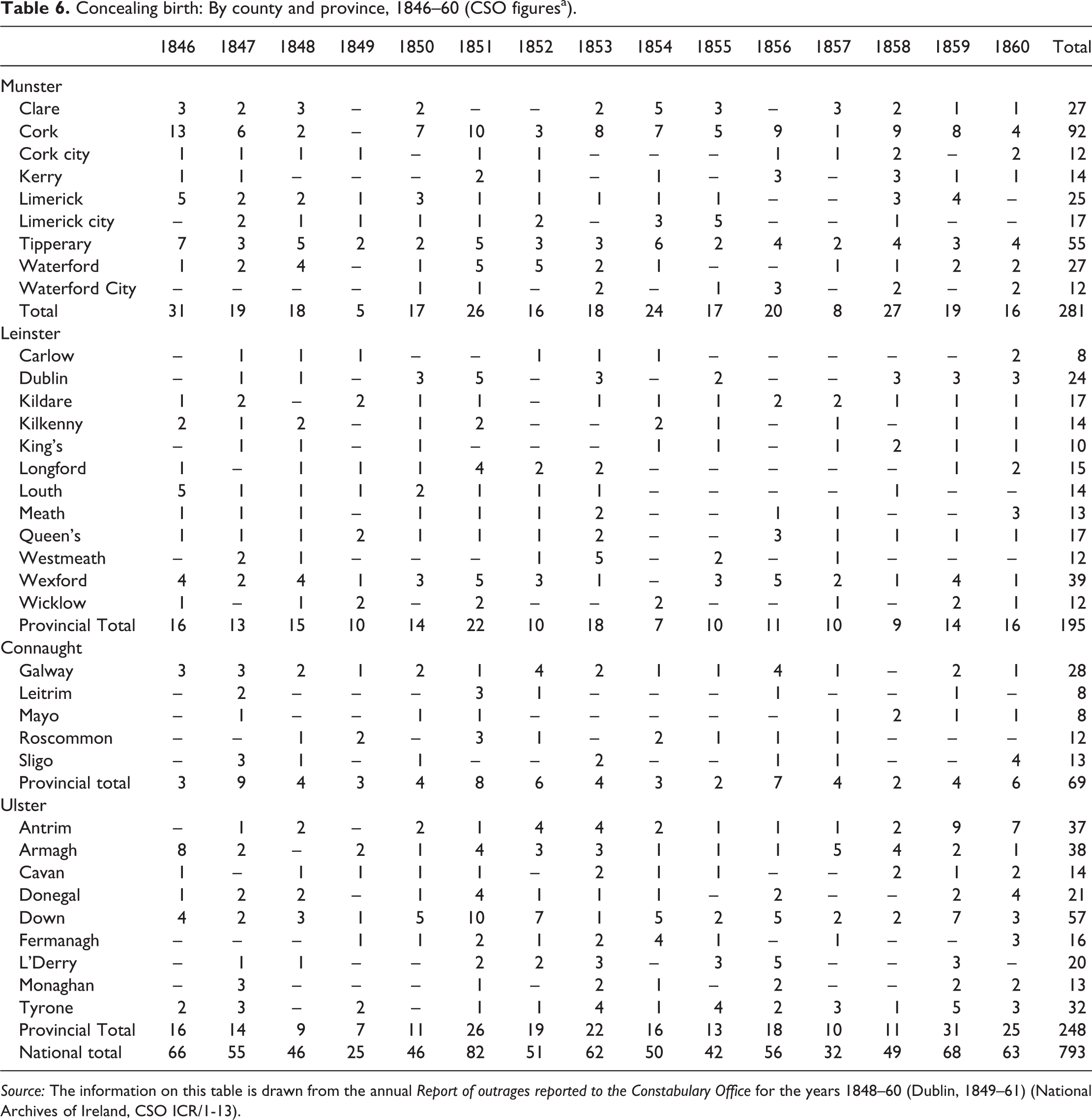
Source: The information on this table is drawn from the annual Report of outrages reported to the Constabulary Office for the years 1848–60 (Dublin, 1849–61) (National Archives of Ireland, CSO ICR/1-13).
It was possessed of a distinctly local footprint, however, and this pattern can be drawn more precisely by calculating the rate of infanticide for each county using the county population figures from the 1841 census returns for the years 1846–50 and the 1851 returns for 1851–60 to establish the relative rate of infanticide (Table 7). This permits the thirty-two counties to be assigned to bands, which indicate that the frequency of the practice was no respecter of provincial and historical boundaries. And yet, the prominence of counties Limerick, Queen’s county, Tipperary, Cork, Kilkenny, Kildare and Wicklow in the returns for both 1846–50 and 1851–60, and, at a somewhat lower level, of the Ulster counties of Down, Armagh, Fermanagh permits the conclusion that infanticide was more usually resorted to in those communities where the social structure sustained a high degree of sensitivity to reputation and family honour. The implication that this was less firmly policed in the western seaboard counties of Kerry, Mayo, Donegal, which were among those counties with the smallest number of cases per capita, is certainly tantalising (Table 7). 78 But it is broadly consistent with the fact that Munster and Ulster were the provinces that contributed the largest number of instances and Connaught the smallest (see Table 5).
Relative rates of infanticide in Ireland, 1846–60 (per 1000).
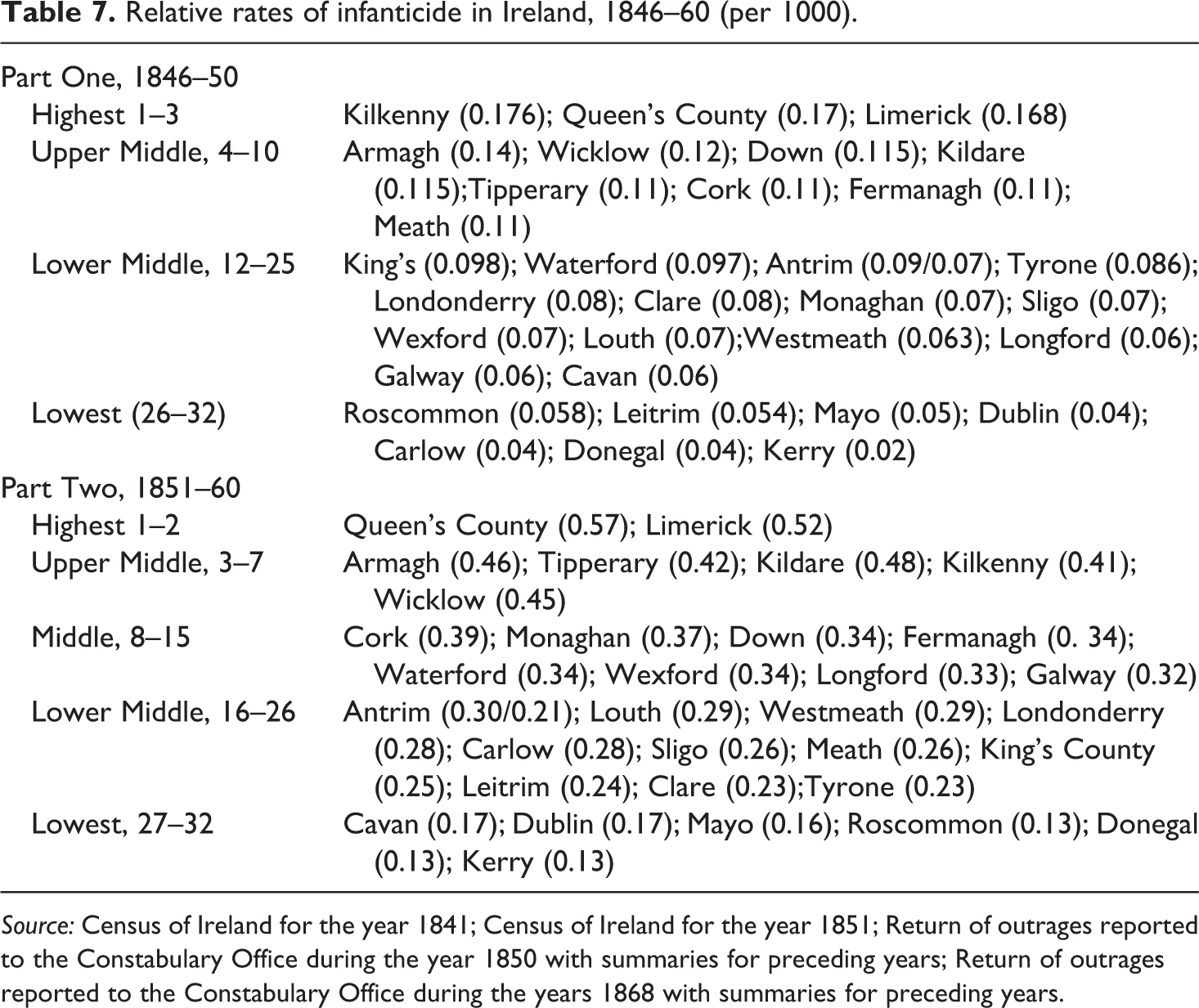
Source: Census of Ireland for the year 1841; Census of Ireland for the year 1851; Return of outrages reported to the Constabulary Office during the year 1850 with summaries for preceding years; Return of outrages reported to the Constabulary Office during the years 1868 with summaries for preceding years.
This matter requires closer investigation. What is apparent is that the statistical data assembled on behalf of the census commissioners and the constabulary echo the contemporary perception that infanticide not only increased during the 1840s, and peaked in the early 1850s, but also that it continued at a high level through the 1850s (Table 4; Figure 1). 79 There was, as one might anticipate, a contraction in the frequency with which it was resorted to as a consequence of the decline in population from 8.175 million in 1841 to 5.8 million in 1861, but though infanticide (measured by the combined number of identified cases of child-murder and concealed pregnancy) had reverted by the early 1860s to the level witnessed in the early 1840s, it did not return to the numerical level at which it stood in the 1830s until the late 1860s. The Constabulary Office returns suggest that the number of cases per annum rose from c. 90 in the late 1830s to c. 160 in the 1840s and 1850s, before decreasing to c. 93 in the 1860s. While these figures must be regarded with some caution, the fact that the total number of incidents between 1837 and 1868 numbers 4,537 (3,077 cases of infanticide and 1,460 cases of concealing pregnancy) (Table 4; Figures 1 and 3) and that this is merely a hundred less than the number of cases identified by Elaine Farrell for the whole of the second half of the nineteenth century is a measure of how prevalent the practice had become since the 1830s. Moreover, if one adds the nearly three thousand (2,947) cases of child desertion (Figure 5) that took place during the same time period, as Judge Robert Torrens (1775–1856) recommended in the summer of 1855, it is clear that the demographic crisis that gripped Irish society during these years, peaking with the Great Famine and its immediate aftermath, had many different and distinct registers. 80 Infanticide and allied practices were not only a response to the pre-famine and Great Famine crisis, it is clear. But the surge in infanticide indicated by the numbers required a rising population and the intensification of the economic travails indicated by the expanding number of poor that were defining features of this crisis. 81 And yet, it was first and foremost a response to unwanted pregnancy in a society that, by identifying children born out of wedlock as illegitimate, felt entitled to manifest its disapproval by stigmatising such children, their mothers and, increasingly, their families. This helps to explain why a practice that took shape before the Famine, not only negotiated the crisis and the resulting fall in population but also, as the increased rate per capita attests (Table 7) may have put down still firmer societal roots. This would hardly have been the case if infanticide in Ireland was not impelled by a code of morality that privileged reputation over life. In an environment, where abortion was not an option (Table 4), 82 women with an unwanted pregnancy felt that they had no alternative but to kill or to abandon the children that society looked upon with such disapproval. The statistical evidence suggests they did so in unprecedented numbers.
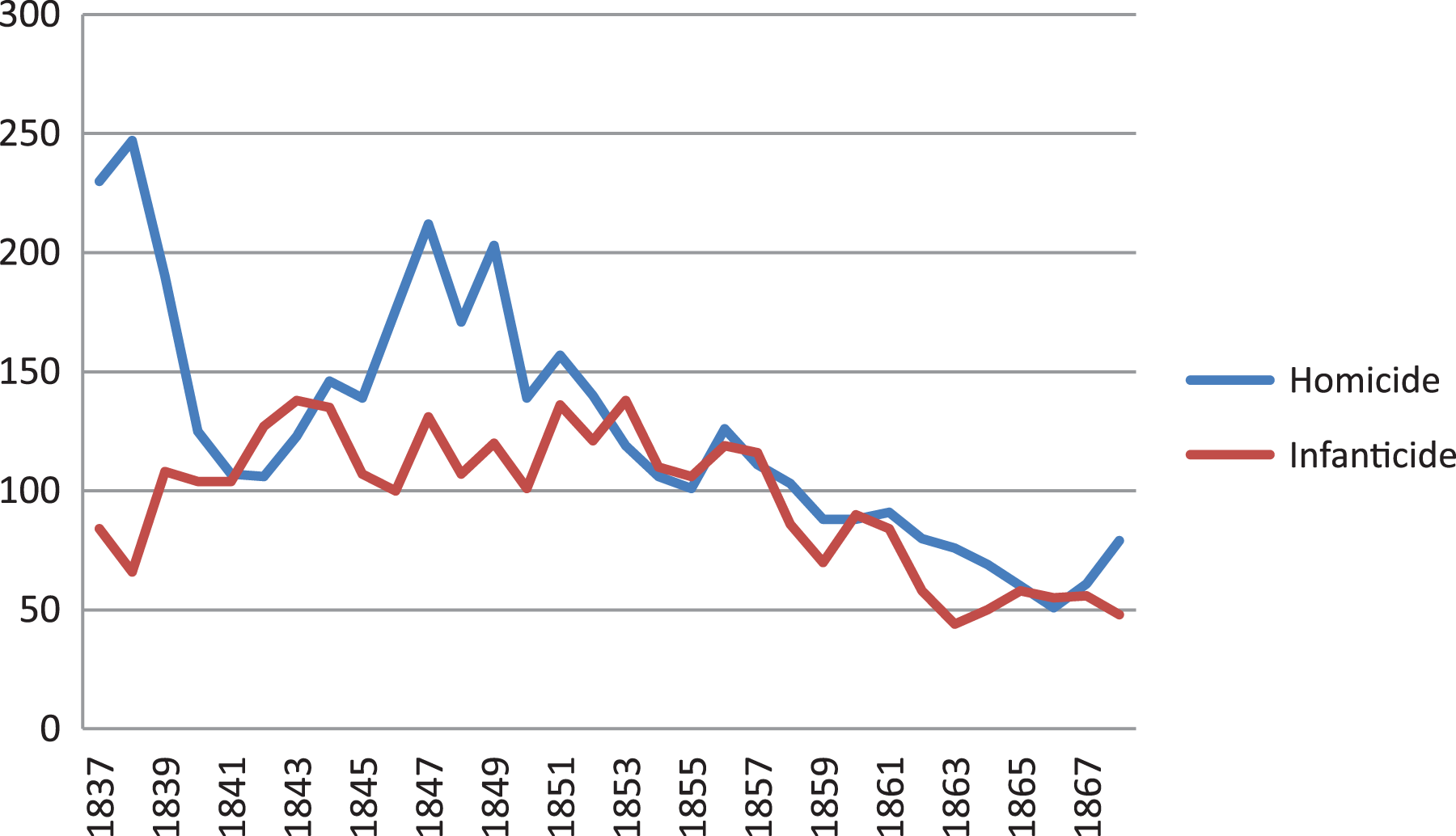
Homicide and infanticide, 1837–68. Source: As Table 4.
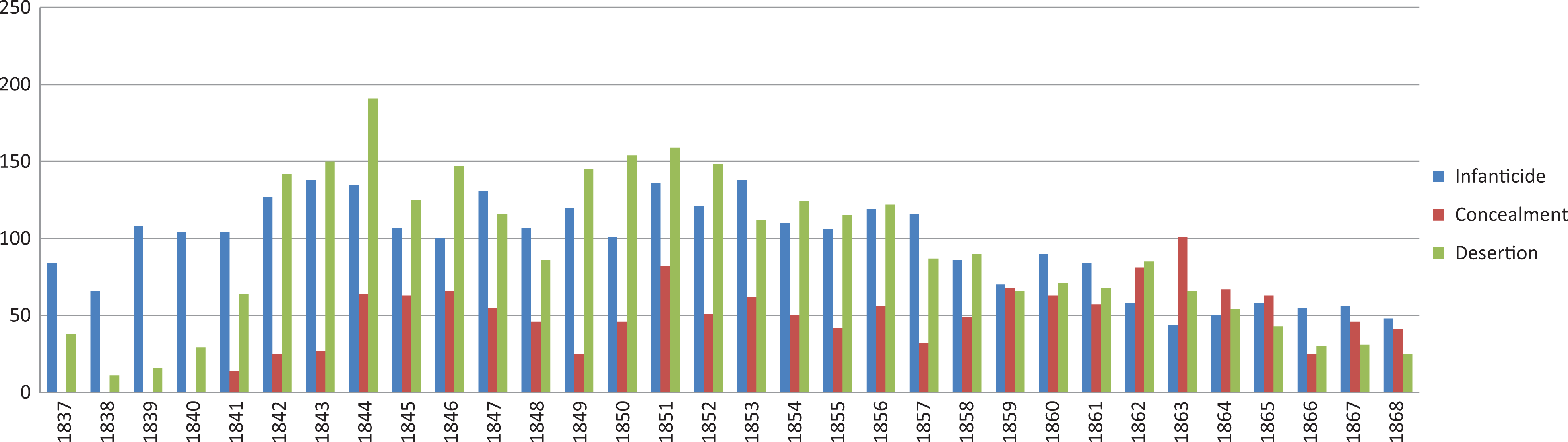
Infanticide, concealment and desertion 1837–68. Source: As table 4.
The Practice and Pursuit of Infanticide in the 1830s and 1840s
Although it was avowed in the press that a ‘nation’ that tolerated infanticide was ‘diseased even in its very heart’, and that infanticide was a ‘social evil’ beyond the capacity even of the law ‘to cure’, the plethora of reports of the discovery of children’s bodies were a constant reminder of its prevalence in the years leading up to the Great Famine. 83 Ireland was not unique in this respect, of course. In England, mounting concern at the rising cost led to the enactment of the ‘new Poor Law’ of 1834, as a result of which out relief was suspended for unmarried women and (its critics contended simplistically) ‘the support of illegitimate children was…transferred from the father to the mother’ with the result that the infanticide rate surged. 84
Consistent with the pattern previously identified, a majority of infanticide victims in Ireland in the 1830s and early 1840s were born to unmarried women, 85 experiencing their first pregnancy, 86 who, driven by the compulsion ‘to conceal their guilt and shame’, the ‘desperation of lost honour’ and the ‘desire to appear virtuous’, sought to evade the implications of motherhood by killing their newborn child. 87 This accounts for the continuing presence of female servants, shop workers and those engaged in the urban retail economy on the short list of instances in which the occupation of the neonaticide can be identified. But the dishonour and disgrace associated with sexual activity outside marriage was not reserved to women in paid employment. 88 Rural women were as susceptible as their urban equivalents to reputational loss and the attendant social sanction. As a result, farmers’ daughters as well as farm servants are commonly encountered among those who had resort to infanticide. The compelling power of reputation in this sector of society is highlighted by Rose M’Gorry, who lived with her mother and two sisters ‘in rather comfortable circumstances’ in Dromgoon parish, county Cavan. Having given birth to an ‘illegitimate child’ that she had conceived with a ‘servant boy’ in 1842 when she was some twenty years of age, the child was handed over to a local woman named Catherine Smyth who nursed and cared for it. This arrangement lasted for five years when as a result of a financial difference with the carer the child was returned to its mother, who did not want it and who contrived, with the assistance of her mother and sisters, to deprive it of nourishment and, in effect, to starve it to death. 89
The perception that one was justified in getting rid of an illegitimate child was not exclusive to the unmarried, moreover. Widows who conceived, and deserted wives and married women who conceived with a man other than their husband were no less susceptible to the potentially devastating reputational damage that would ensue if it became known that they gave birth to an ‘illegitimate’ child. They account for a small proportion of cases, but they provide a further illustration of the pressure women were under to be seen to behave virtuously. It was, for example, sufficient to induce Jane Charters of Donegore, county Antrim, whose ‘people were very respectable’, to suffocate the male child she had conceived with a man other than her husband (he was ‘now in America’) and to deposit the body in a sewer in 1832. 90 A woman named Tobin, whose husband ‘left her, and has been in America for…ten years’ sought unsuccessfully to conceal the body of her female child in a coal hole in the house of her employer in Fermoy in 1835; while other cases involving married women in Dublin in 1835; in Gallen barony, county Mayo, in 1840; and in Ballymacaquim, Killahan, east Kerry, in 1842 in which infants were killed bear equally vivid witness to the compelling power of reputation. 91 As Mary Leavy, a widow with three children who resided at Croboy (Hill of Down) in county Meath, explained with arresting directness when facing the prospect of giving birth to an illegitimate child: ‘she would see…it d[amne]d first before she would rear Jack Quinn’s [the child’s father] bastard, disgracing herself and her children’. 92
In view of the magnitude of what was at stake, and the reputational damage that would be experienced by the family of which they were a member, it is unsurprising that some women who gave birth to an illegitimate child were assisted by family members (mothers and sisters mainly), though those who did so ran the risk of prosecution if they were found out. 93 When Peggy and Mary Shine rallied to support their unmarried sister Biddy by smothering and burying in Roosky bog the child to which she gave birth, the three sisters were committed to trial at Roscommon assizes by the coroner’s court, which investigated the death. 94 In the case of five-year-old John M’Gorry of Dromlun, county Cavan, who died of emaciation in 1847, there were four defendants – Rose, the child’s mother, Catherine, the grandmother and Ally and Dolly, who were Rose’s older sisters. 95 The number of mothers who were prosecuted exceeded the number of siblings, however, and the humiliation they experienced is hinted at in the report of the case of Judith Bedelia Mackie and her daughter Susan, who were tried (and acquitted of infanticide) at the county Tipperary assizes in March 1839, as the report of the case specifically mentioned that the younger woman was ‘attired in a respectable manner much above that of the persons by whom she was surrounded in the dock’. 96
Juries and judges were predisposed to look with sympathy on defendants such as Susan Mackie – ‘a handsome and interesting girl’ – who did not did not conform to the enduring stereotype of the ‘unnatural mother’, but empathy was not reserved for the respectable. It was also forthcoming in cases where the person responsible was revealed to have been overwhelmed by her predicament. When Eliza Cavanagh left the new-born child of her daughter Hester in an archway in Dublin city in 1839, both she and her two daughters, Hester and Anne, escaped punishment because the jury was moved by Eliza’s ‘extreme poverty’. 97 By extension, it was less in evidence in those instances in which mothers were seen to have had recourse to unnecessary violence or to have taken a leading part in the suppression of life. One may instance Anne M’Glave whose advice on overlying was crucial in the premature termination of the life of the child born to her daughter, Catherine, near Castlewellan, county Down, in 1840; Mary Collins, who may have strangled the child to which her daughter Catherine gave birth near Ballina in 1842; Catherine Wright, a midwife, who assisted her daughter Ellen to asphyxiate and bury her newborn child in the townland of Salters Grange, county Armagh in 1849; and, more unusually, the mother of ‘a young man named Fox’, who combined with her son in 1846 to kill and bury the child he had fathered with a married woman named M’Nulty, whose husband was in America. 98
Although it is evident from the support female family members sometimes provided young women that emotional solidarity was as pertinent as reputational concern in accounting for their involvement, fewer children would have died if the stigma of illegitimacy had not possessed such a compelling hold. Next to infanticide itself, the most compelling index of this is provided by the continuing refusal of fathers to accept any responsibility for the children that some determined women went so far as to lay at their door. 99 This is consistent with the pattern observable with respect to infanticide in most jurisdictions and the trend observed by Elaine Farrell in Ireland in the second half of the nineteenth century. Moreover, even when men could not avoid involvement, support was rarely forthcoming. 100 A small number participated in the killing and disposing of the child’s body in a (vain) attempt to protect their reputations. 101 The most high profile was William Long, ‘a gentleman and the father of a grown family’ from Ernehills, county Kildare, who was charged in July 1846 with the murder of the ‘illegitimate child’ he had conceived with Bridget Malone, who lived with him as a servant. Long was fortunate to be found ‘not guilty’ when the case went to trial since it was he, and not the mother, who deposited the body in the house privy, but the medical evidence, which suggested that ‘the child died from loss of blood from the umbilical cord’, was sufficient to persuade a sympathetic court, and he was let off. 102
Long had the wherewithal to provide well for the child had he been prepared to do so. The situation was obviously different for those of limited means, who were responsible for a majority of infanticides. When Michael Cody of Limerick was committed to jail in 1837 for drowning his ‘illegitimate child’, it was confidently reported that he did so for financial reasons; the woman who nursed the child and identified the body maintained that he wanted ‘to save the expense of its nursing’. 103 And yet, his motives were hardly more base than those of Charles Evans, a married man of stature in the community, who orchestrated the death of a child born to Mary Nolan at Castlebar in 1836 in order to safeguard his reputation and was found not guilty when he and his accomplices were tried for infanticide at county Mayo assizes a year later. 104 It so happened that Mary Nolan was warned in advance of the trial that she ‘would get no justice’ if she pursued a case against Evans, and while the versions of events presented the court are so contradictory it is impossible to establish precisely what transpired, the case is a useful illustration of the abiding fact that the manner in which infanticide was pursued and judged in the eighteenth and nineteenth century was not only irremediably gendered but also (like the judicial system) irrevocably tilted in favour of those with power, who were invariably male. Seen from this perspective, infanticide might even be interpreted as a case of women striking back, albeit indirectly and in a draconian manner, against the prevailing patriarchal moral, legal and social order.
Its increased frequency notwithstanding, most neonaticides forfeited their lives in the 1830s and 1840s in the same way as their eighteenth and early nineteenth-century predecessors. Most were killed within a short compass – minutes rather than hours or days – of being born, and the methods employed ranged from the bloody to the quietly efficient. In the case of the former, the use of a utensil or tool to assist with the decapitation or disarticulation of the body was the most extreme, but the degree of violence that was resorted to varied according to what was deemed necessary to achieve the required result and the effectiveness with which it was administered. 105 The deprivation of life by drowning – in a river, canal, millstream, lake, pond, pool, bog or in a privy or water closet – was the preferred choice of a large number of offenders because moving water provided offenders with the opportunity to put some distanced between themselves and their dead infant, though this consideration now took second place to the attempt to submerge the body with the aid of weights, which was not always achieved successfully. 106 The small number of instances in which poison was resorted to, which was a novel strategy when it was first encountered in the case of Mary M’Garry 1819, would indicate that this was not an efficient way of achieving the desired outcome; but so too was the failure, reported in a variety of instances, to tie the umbilical cord properly if at all and to decline to nurse or to care for the child in any way. 107 Death by neglect was the anticipated, and usual, outcome in the latter instances. It was more commonly the adventitious consequence of exposure, which, in the absence of the Foundling Hospital, was the fate of a large number of infants that were born to mothers – unwilling or unable to kill their child – that were deposited alive in public places. Since these embraced the roadside, public spaces, gardens, fields, the halls of multi-occupant buildings, even the lawn of Leinster House, it seems reasonable to conclude that the persons responsible may have hoped the child would be discovered and cared for. 108 This happened on occasion. 109 But because even responsible parish vestries found it challenging to provide for the abandoned children that came their way, the absence of institutional provision fostered an attitude of mind where people, on encountering an abandoned infant on waste ground, on a street, road, entry or hallway, were as likely as not to walk by lest they might be left to care for it sine die if they intervened. This was, it was acknowledged by the constabulary, by members of the judiciary and by certain parish vestries, an undesirable state of affairs, but it was an inevitable outcome of the absence of appropriate institutional provision between the announcement that the Foundling Hospital would accept no further admissions from January 1830 and the establishment in the 1840s of a network of workhouses arising from the enactment in 1838 of the Irish Poor Law. 110 Meanwhile, the victims of infanticide continued to be located in record numbers whether they were forsaken naked, or inadequately wrapped, in the fields, gardens or waste grounds on which they were born; deposited in a pig house, buried in a coal hole, beneath at bedroom floor or under a ‘heap of stones’; placed ‘neatly dressed’ in a coffin and interred in consecrated ground, or otherwise disposed of. 111
Although the state had contributed – albeit unintentionally – to bring this about, the statistics that were assembled by and on its behalf attested to greater official engagement with the phenomenon. This assumed many forms. The usual first line of inquiry, once the police had concluded their (generally) routine investigation, was a coroner’s inquest. Although of limited value if the body was discovered in an advanced state of putrefaction, its utility was further diminished when the available information – both medical 112 and biographical – was insufficient to allow the jury to return a verdict other than ‘wilful murder against some person or persons unknown’ which was the standard response in a large proportion of instances. 113 Although lamented by some, it dovetailed with the direction to coroners ‘to tell the jury, where there is not the most clear and decisive proof that the child was born alive that they ought never to think of returning a verdict of wilful murder against the mother’. As a result, only a minority of suspected offenders were recommended for trial, because judges, in turn, habitually advised the grand juries, which determined the calendar of cases to be heard at the courts of assize, not to find bills ‘without clear proof of guilt’. 114 There was sufficient to ensure that infanticide maintained a presence on the list of cases presented for trial, but the numbers heard typically amounted to no more than one or two (the five scheduled at Roscommon assizes in 1849 was exceptional). 115
Consistent with the direction given in July 1847 by Louis Perrin (1782-1864), a justice of the Court of King’s Bench, that juries in infanticide cases should not find against defendants ‘unless you are convinced it was intentionally done’, a significant proportion of those who were tried for infanticide in the 1830s and 1840s were acquitted or found ‘not guilty’ for want of ‘clear proof’. 116 The grounds for these decisions varied. They range from ‘the evident sympathy’ manifested for Ellen Lavelle at county Mayo assizes in 1839 when it emerged that the primary source of evidence against her was a woman who bore her ‘feelings of the most bitter hostility’ to the calculated manner in which Charles Evans sowed the seeds of doubt in the minds of the jurors who tried him and his retainers for ‘choking’ the child he had purportedly fathered with Mary Nolan in 1837. 117 These were singular episodes, but the success with which counsel for defendants in infanticide cases challenged the prosecution’s case attests to the readiness with which juries were disposed to favour the defendant. Thus, in the case of Catherine M’Glave who was tried in 1840, it was sufficient to query the reliability of the hydrostatic lung test as an indicator that the child that was the focus of attention was born alive. One might reasonably query how equipped jurors were to assess testimony of this nature, but jurors were not uneducated, and it was a well-judged defence tactic as it dovetailed with another favoured approach, which was to maintain that there was no case to answer because the child was still born. An alternative strategy was to challenge the security of the chain of evidence linking the child with the accused, while lawyers also contrived successfully to sow doubt by claiming that the child had died of exposure, had been killed by animals, or by instancing the fact that there were ‘no marks of violence’ on the body as evidence that there was no charge of infanticide to answer. 118
It is not always possible given the brevity of most court reports to identify the issue that swung the outcome in the favour of the accused, but the speed with which some juries arrived at their decision is consistent with the conclusion that the public believed that ‘humanity…triumphed over barbarism’ when the courts declined to deliver a capital verdict in an infanticide case. 119 This did not mean that juries could or would be permitted by judges to disregard the evidence that was presented. But because most of those who were accused of infanticide in the 1830s and 1840s were also charged with the 1803 offence of concealing birth, jurors frequently opted for the latter and returned ‘a verdict of guilty of concealing the birth of a child’ in those cases that were heard. 120 The usual sanction in that eventuality was incarceration. The length of time to which offenders were sentenced varied according to the evidence presented against the accused. Twelve months was common, but it is notable that the two years’ imprisonment to which Honora Bunnion was sentenced at Kerry assizes in 1842 was deemed light because the child she was accused of killing had been decapitated with a ‘knife or other sharp instrument’. 121 Bunnion was fortunate. But as the preparedness now to invoke puerperal insanity as an explanation as to why women killed their infant charges attests, the courts seized upon such exculpatory considerations when they allowed them to opt for the lesser offence. As a result, ‘insanity’, whether fuelled by hunger, ‘a sudden fit of delirium’, ‘the devil’ or a congenital condition was sufficient to protect a woman, against whom the evidence was otherwise compelling, from the death penalty in the 1830s and 1840s. 122
The invocation of the charge of manslaughter served the same purpose. Resorted to in the 1840s in a variety of instances in which infanticide occurred ‘through want of care, and not through malice, or intentionally’, it offered jurors an option with a comparable custodial prospect to that invoked in cases of concealment without requiring them to overlook the fact that a child had died. 123 A ‘manslaughter’ verdict was also a reminder to the public at large that there was no relenting in the official position that infanticide was a grave offence. This certainly was the intent when in the 1840s two women who were found guilty of manslaughter were ordered for transportation for life, while five others were ordered for transportation for terms ranging from ten years to life. 124 But it was conveyed still more explicitly by the fact that a significant twenty-one defendants who were tried for infanticide between 1830 and 1850 were sentenced to death. Because the juries that returned these verdicts attached a recommendation that the guilty party should be treated mercifully, the expectation was that the death sentence would be commuted to transportation for life, which is what happened. The pattern was inaugurated in 1832 when the death sentence imposed on Jane Charters at the County Antrim assizes was commuted by the lord lieutenant in response to the high-profile campaign organised on her behalf. It was imputed in certain quarters that Charters was given the opportunity to embark on a ‘virtuous and religious’ path because the courts were unwilling to execute a woman ‘of property and respectability’ who had succumbed to the strain of ‘insanity’ that (those who championed her cause asserted) afflicted her family, when her social standing had little real bearing on the outcome. 125 This was made clear three years later when the revulsion that greeted the news that Catherine Harrington, who attempted to bury her unwanted child alive in Kilflynn graveyard in north county Kerry, as a result of which the child died, did not deter the jury who found her guilty from recommending her as a fit subject for mercy or the authorities from commuting her death sentence to transportation for life. 126 As a result, it was a matter of no surprise when Ann Myles/Mills, who was sentenced to be hanged in 1839 for drowning her day old child in a ditch, was also ordered for transportation or that this became normative thereafter. 127
Seventeen women were sentenced to death for infanticide in the 1840s as the authorities responded to the rise in the phenomenon to new record levels by taking more women to trial. 128 All avoided an encounter with the gallows (and, it was pointed out, the additional humiliation of the anatomist’s knife) for though most were deemed more than ordinarily culpable by reason of their age and marital status (three of the seventeen were married and four were widowed), it was simply not deemed appropriate to take their lives. 129 Moreover, though there were those who believed differently, the fact that Mary Leavy, a widow with three children; Rose McGorry, who starved her five-year-old son; and Mary Brown, who was from ‘a very industrious family of small farmers’, were ordered for transportation meant that they did not escape punishment; each was subject to a life-changing sanction. 130 It was not sufficient to prevent infanticide, of course, but it echoed the considered opinion in church and state that (in the words of the influential Catholic bishop of Kildare and Leighlin) it was a crime as well as a sin ‘to check by artifice the legitimate procreation of…human kind’. 131
Infanticide During and After the Great Famine, 1845–60
Although the trajectory of the linked practices of infanticide, concealing birth and child desertion had already arrived at or were close to their statistical peak in advance of the start of the Great Famine, it remained at this high level for duration of the crisis and beyond. 132 The most striking illustration of this is provided by the fact that, 1848 excepted, the number of recorded incidents hovered at c. 300 annually between 1845 and 1853 (Table 4). Since the cumulative number of instances in 1844 (390) exceeded that identified in any year during the Great Famine, one must be cautious in making a causal connection. However, the number of financially dependent young women who committed the offence during these years indicates that the link between poverty and infanticide, which was a feature of Irish life in advance of the Great Famine, was even more firmly fixed when the country was in its grasp.
In keeping with the severity of the Great Famine, some of the women (and men) who engaged in infanticide, concealing birth and child desertion in the late 1840s, did so in direct response to the difficulties they experienced. 133 One possible manifestation of famine-induced infanticide is provided by a number of instances in which married couples, who were reduced to ‘utter wretchedness’, killed their children. The county Cavan couple, Bessy and James Hagerty, who were tried, and acquitted, for murdering their ‘infant child’ in 1848, are a case in point. 134 Another is provided by those incidents in which women, who were deserted by their partners, either killed or abandoned a child because they were simply ‘unable to support it’. 135 If it could be shown to have taken place, cannibalism would represent a further, still more extreme, manifestation of the dehumanising effect of acute distress but there is no evidence to suggest it was resorted to and still less that children were targeted. 136 The incident, widely reported when the Great Famine was at its most intense in the summer of 1847, to the effect that William Darmody, an ex-soldier resident at Birdhill, county Tipperary, was caught ‘in the act of roasting the murdered body of his own child’ so he could consume its flesh, has no basis in fact. Darmody’s explanation that he was burning a ‘witch or a devil’ when he put the body of his three-year-old daughter, whom he had previously stabbed, on the fire is disturbing, but it raises more questions about his mental well-being than his nutritional needs, and the jury which heard the case concurred; they returned a ‘not guilty verdict – [he] being at the time of unsound mind’ – when he was brought to trial in March 1848. 137 Saliently, not only is there no case to be made that infanticide was resorted to as a source of adult alimentation – the opposite is true. Children were facilitated to die into the 1850s because mothers, who were unable ‘to procure…sustenance or shelter’, conceived of it as a release from the grim reality of their existence. It is debatable if such cases should be regarded as infanticide as it is generally defined though one ‘poor mother’ was tried for infanticide for this reason at Queen’s county assizes in 1854. By comparison, those cases in which infants were deprived of nourishment by mothers for whom they were an ‘incumbrance’ – an obstacle in the way of their travelling to America – pose less difficulty. 138
One other aspect of the infanticide phenomenon that assumed visible form during the Great Famine derived from the number of pregnant women who took up residence in one of the country’s fast expanding network of workhouses. Although self-evidently better than starving, the workhouse was an unwholesome location in which to give birth. As a result, it garnered a reputation for high child mortality, prompting one disaffected ratepayer to observe in 1859 that ‘a more wholesale system of infanticide it would be difficult to establish if the object were the destruction of the infant population’. 139 Although this intervention mirrored the partisan (and increasingly influential) perception ‘that women bearing illegitimate children, admitted to the shelter of the workhouse, scarcely ever bring their offspring out with them’, it derived its moral impetus from the conclusion that infanticide was a moral ill of recent generation and that the ‘Poor Law, like a foul and cancerous ulcer, brought among us immoralities and abominations heretofore unknown in Ireland’. 140 This was plainly untrue, but the fact that many children born in the workhouse in the 1840s and afterwards were identified as ‘illegitimate’ gave the claim traction with the workhouse’s many critics, and it was a tempting interpretative leap from there to the false conclusion that infanticide was ‘scarcely known in Ireland before the Poor Law was introduced’. 141 Indeed, in a manner not dissimilar to the Foundling Hospital, the linkage of the workhouse with infanticide invigorated the combination of hostility and disgust that had long defined the attitude of the respectable to the practice. 142 Further, it acquired additional impetus from an unexpected quarter – from the fast emerging Catholic nationalist outlook that conceived of it as non-Catholic. This perception received its strongest expression in Archbishop John MacHale’s extraordinary public letter to the Earl of Derby, of September 1852, in which he identified ‘infanticide by unmarried females…[as] the spontaneous fruits of that Protestant system which they [the authorities] are labouring…in vain to propagate in Ireland’. 143 This was an objectionable intervention on many grounds, not least the gratuitously sectarian note it introduced into the debate on the subject. But it was taken up and echoed by champions of Catholic-nationalism such as William O’Neill Daunt (1807–94) who pronounced in 1859 not only that ‘our religion has prevented infanticide’ but also that it was ‘a crime heretofore foreign to the Irish race’. 144
This was an unwarranted denial both of the historical and contemporary record, but it was of a piece with an appreciating disposition to regard those who committed infanticide as moral deviants. One of the ways in which this goal was advanced was by melding promiscuity, unmarried motherhood, illegitimacy, the Poor Law and infanticide in an interpretative paradigm that received its clearest expression in infanticide reports involving a current or past resident of a workhouse. 145 Reports of this ilk in the 1850s were not always accompanied by an explicitly negative commentary on the Poor Law system, but this was implicit, and it reinforced the hostility towards infanticide and the workhouses that the respectable endorsed. 146 Moreover, it was of a piece with the mounting preoccupation of the Irish press with infanticide in England and with demonstrating that it was more common there than it was in Ireland. 147 This tendency had no identifiable impact on the manner in which infanticide was conducted in Ireland, but it mirrored the proclivity, observable in the fast expanding press of the 1850s, to report the phenomenon in a slightly more sanitised form than the facts warranted.
For those who took note of such matters, it may have seemed that the balance had shifted since the 1830s in favour of shorter accounts which concentrated on identifying where the body was located, the ostensible cause of death and who, if anyone, had been identified as the likely cause. They might, if they looked closely, have noted that the reports were less inclined to ascribe responsibility to the child’s ‘unnatural mother’ (resort to this formulation diminished in tandem with the readiness of coroner’s inquests either to identify the person responsible or to attribute responsibility to some ‘person or persons unknown’). 148 This did not mean that infanticide reports conformed to type, but since it continued to be perpetrated in the main by single women, who were as determined as ever to evade ‘the shame of having given birth to an illegitimate offspring’, there was little that was novel or new about either the content or the format of a majority of reports. 149 Moreover, a majority of those that gave up their life did so in the same manner as those that had preceded them. 150 The most observable difference was the greater involvement of the RIC and medical practitioners in the inquiry that inevitably followed. Because the RIC was more firmly anchored in the community in the 1850s than was the case a generation earlier, they assumed an increasingly higher profile in investigating these cases. They were heavily reliant on information from family, friends and acquaintances who, suspecting a woman was enceinte, alerted the authorities to their suspicions, with the result that the percentage of neonaticides that were linked successfully to recently delivered mothers was not high. 151 The Constabulary could, and did, appeal for medical assistance, and they were enabled with advice to link victims with their mothers in a proportion of instances, but, once the inquest was concluded, a majority were sent for anonymous burial. 152
It is apparent, based on the difference in the number of inquests that were heard and the number of persons that were brought to trial, that a majority of those who committed infanticide in the 1850s escaped sanction as their predecessors had done over nearly a century and a half. This did not mean that individuals who were tried and found guilty were not penalised. Judges continued to point out that the concealment of a birth and the desertion of a child were ‘heinous offences’, while acknowledging, with Judge Thomas Lefroy at Kildare assizes in Athy in 1851, that infanticide was ‘a charge that is seldom realized’. 153 Since the number sent for trial at a county assize still rarely exceeded two or three, the number of individuals sentenced to prison for the offence in a given year were small. 154 This prompted criticism, from those who continued to believe in the power of punishment to deter the practice. They were particularly critical of ‘the unwillingness of juries to convict’, and allegations to the effect ‘that the law is inadequate to check or punish the offence, owing to the reluctance of tender-hearted…jurors to convict in such cases, however clear the evidence is’ met with a receptive response. 155 They were also ill-informed. Guilty verdicts were delivered, and several offenders were sentenced to death. To be sure, the decision to commute the death sentence imposed by Dublin County and City Commission on Catherine Skelly for drowning her child in 1859 to a mere eighteen months imprisonment seemed lenient, but it must be set beside the fact that both Margaret M’Kergan, who was tried at Londonderry assizes on 25 July 1853 and Charlotte Jane Gribben at the county Antrim assizes four days later had their death sentences commuted to the severe sanction of ‘transportation for life’. 156 At any event, more offenders were found guilty of manslaughter than of murder, in which case they were usually given brief custodial sentences – typically 12 months; this was the sentence imposed on Elizabeth Ferguson, who was found guilty of manslaughter for suffocating her male child at Craignageeragh, county Antrim on St Patrick’s Day in 1852. 157 By comparison, the life sentence imposed at Waterford Court in 1855 on Margaret Payne might seem draconian but then she was found guilty of murder. 158 Further she was unusual. Most of those who were suspected of infanticide in the 1850s were effectively acquitted on the grounds that they were insane when they committed neonaticide or they were found guilty of the lesser charge of concealing a birth, in which case custodial sentences of between three and twelve months were the norm. 159 It was not a situation with which the public at large, and still less the opinion formers in the public realm (religious and secular) judged acceptable. The nine months custodial sentence with hard labour imposed on Brigid McAllister in 1856 was memorably condemned as ‘a violation of decency as well as justice’, 160 but though there were those who continued to contend that ‘a dreadful example is much needed to check the practice’ in England as well as Ireland, there was no appetite for this. 161 It was not that the public was reconciled to the phenomenon. Infanticide was regarded with varying degrees of disfavour across society. But the increased resort that had been made to it over six decades attested to the fact that for many in that situation it had represented a solution to the problem presented by an unwanted pregnancy.
Conclusion
The first half of the nineteenth century was a pivotal phase in the history of infanticide in Ireland. Fuelled by demographic growth, as a result of which the population expanded from an estimated 4.4 million in 1791 to 7.7 million in 1831, neonaticide grew at a steady if indeterminable rate during the three quarters of a century spanning the second half of the eighteenth century and the first two decades of the nineteenth. It was kept within bounds then by the existence of the Foundling Hospital. For though the appalling mortality among the infants it admitted suggests that any attempt to quantify infanticide during the century that it was operational must take cognisance of the conclusion, contentiously advanced when the institution was already scheduled for closure, that it amounted to a system of state sponsored infanticide. As a result, when no adequate alternative was put in place to deal with the problem of unwanted pregnancy, which it had failed to address, infanticide surged to record levels. Although this development was linked to the decision of the Board of the Foundling Hospital in 1822 to levy a charge (£5) on parishes outside Dublin which had traditionally consigned orphaned and abandoned children to its care, it did not acquire its distinct character until the Hospital closed its door to new admissions in January 1830.
Based on official inquest statistics (Table 1), the number of infanticide cases per annum approached one hundred per annum in the 1830s, but it was well in excess of that figure if, as one is warranted in doing, the figures are calibrated to take cognisance of the number of infants that died as a result of ‘desertion and exposure’ (see Table 2). Moreover, this was only the first phase of this surge as the crime figures assembled by the Constabulary from 1837, which provide a fuller perspective on the predisposition towards infanticide, indicate that the number of infant victims not only continued to rise but also that the appreciation accelerated markedly in the early 1840s. Indeed, assuming the police statistics accurately capture the trend (if not the precise number), it reached its numerical peak on the eve of the Great Famine (in 1844). If so, the modest softening in the level that was a feature of the Famine years was sustained until the mid-1850s, and it was not until the 1860s that the number approached the level previously encountered in the 1830s (Table 4). Moreover, because the population was already firmly embarked by that date on the pattern of decline that defined it for nearly a century, the reduced figures for the 1860s provide as misleading perspective as the raw figures mask the fact that there was no decline in the proportionate rate of infanticide (Table 7). At any event, the phenomenon was by then so firmly embedded it was destined to remain a feature of Irish life until well into the twentieth century. 162
The second quarter of the nineteenth century might not have seen the number of infanticides reach this level in Ireland if the emphasis on female virtue had not possessed such a commanding hold of the population. The extent to which this may have intensified over time is difficult to measure but one could suggest that the rising level of infanticide represents a useful ‘proxy’ for its embrace during the eighteenth and the first half of the nineteenth centuries. Moreover, it should be noted, it was frequently perceived as a commendable feature of Irish society. There were many, visitors as well as residents, who revelled in their ability to record that ‘young [Irish] women are modest’. 163 The problem with this was that most of those who perceived of this as a laudable attribute failed to advert to the ruthless manner in which it was sustained or to link it to infanticide. Writing at the beginning of the nineteenth century, a member of the Shackleton family of Ballitore observed approvingly that a ‘young women’ who ‘makes a false step’ had ‘no chance of a husband: gold…would hardly induce the meanest of our peasants to unite with a woman whose chastity was sullied. She therefore generally goes to some place where she is not known’. 164 What this and other authors for whom sexual virtue was an unconditional good chose to overlook was that a woman who became pregnant as a result of a ‘false step’ seldom forsook the family home of her own volition; she did so in order not to bring shame on her family, or more specifically her ‘father’, who defined the patriarchal order that made it necessary in the first place. This was precisely the situation faced by the ‘fine young women’ that the travel writer James Hall encountered in 1813. 165
The fact that women committed infanticide in appreciating numbers in the early nineteenth century is testament to the command that the prevailing patriarchal order possessed, as well as to the lengths to which the women that were caught in its web were prepared to go to escape the lifelong sanction that was the price for its defiance. It might be concluded in this context that there was little to distinguish between the fate of those infants who died as a consequence of the administrative, medical and other failings of the Foundling Hospital and those who died at the hand of their desperate mothers. But this would be to give no credit to the motives of those who believed that the Hospital by its very existence was a solution because it negated the need for any women with an unwanted child to commit infanticide. They were wrong of course because they ignored the realities of life for those who were burdened with an unwanted pregnancy. Furthermore, they declined to interrogate either the morality that informed such attitudes and to challenge the prejudices that guided them. They were not unique in so doing of course. People had thought thus to a greater or lesser extent for centuries, but what gave the early nineteenth century in Ireland its particular character was the fact that it occurred at a time of rising population, rising poverty and a moral sensibility, guided by both evangelical religion and laissez faire economics, that extolled personal self-discipline. The frequency with which infanticide was resorted to suggests that this was beyond the capacity of many for the simple reasons that the biological impulse to engage in sexual intercourse was stronger. As a result, infanticide grew in the course of a half century from an occasional event to what one English contemporary described as a ‘social habit’. He used the term in the course of a newspaper column urging that infanticide was checked. 166 This was not especially constructive, but the fact that it was made and that the column was reprinted in a major Irish newspaper is testament to the tension that existed between the vision of the respectable of a disciplined populace and the messy reality of human sexuality. It also cautions against assuming that the eventual triumph of the former was assured as, based on the example of infanticide, the population of nineteenth-century Ireland was less disciplined in this sexual conduct and more ruthless in its engagement with the consequences of unwanted pregnancy, than it is often assumed. 167
Footnotes
Declaration of conflicting interests
The author(s) declared no potential conflicts of interest with respect to the research, authorship, and/or publication of this article.
Funding
The author(s) received no financial support for the research, authorship, and/or publication of this article.