







Abstract
What was more important to consumers in seventeenth-century Ireland: the fashion or the function of their silver? This article disentangles the multiple and complex motivations informing the robust acquisition and consumption by individuals and institutions of a wide-ranging assortment of silverwares. Using the body of extant plate and a large array of documentary sources, this article poses and addresses several questions that have hitherto received little or no attention in the literature: How was silver used in seventeenth-century Ireland? Can we dismiss or prioritise the use value of items ostensibly acquired for symbolic, ceremonial or commemorative purposes? Did design and decoration matter? And, if so, how did this impact on value and utility? By answering these questions, this article evaluates plate as a material simultaneously facilitating functional purposes and expressing taste. This article uses these conclusions to generate a greater understanding of early modern Irish consumer society and the role of silver within this society.
Introduction
In early seventeenth-century Ireland, numerous royal warrants were issued to peers and other members of the aristocracy concerning their silver. These writs, of which there are seventeen corresponding to the reigns of James I and Charles I, related specifically to the individuals’ desires to transport their silver from England to their homes in Ireland. 1 Richard Nugent, Lord Delvin was permitted to bring £200 worth of silver gilt and silver home ‘for his own use’ in 1620. William Fleming, Lord Slane was licensed to bring two dozen silver trencher plates and one sugar box in 1637 and, the following year, six pairs of silver candlesticks, a silver voyder 2 and a voyding knife ‘for his necessary use’. Ulick Burke, earl of Clanricarde, wanted to bring one basin, two tankards, one ewer, two pots and a salt cellar ‘for his own use’, also in 1638, and in 1639 one John Hatton gave a bond to the customs officers that the flagons, sugar box, spoons and other items of silver weighing 400 ounces would only be brought to Ireland and that these items, too, would be for ‘his own use’. The careful specification of these warrants made it clear that the owners were not permitted to give away, repurpose or sell these items, that they were the custodians of these wares which were for personal use only. This directive stemmed from the unique position of silver’s inextricable connection to specie. As early modern European currency was based on a system that equated value with the weight of silver coin, the intrinsic worth and physical properties of wrought sterling silver (or plate) meant it could be readily repurposed as cash. Such an unpredictable afterlife for silver in a country bedevilled by fluctuations in the availability of specie was not to be encouraged. 3 And so, we are left to imagine that individuals like Delvin, Slane, Clanricarde, Hatton (and many others) were expected to diligently use the silver they petitioned to transport. In this article, the many aspects of this use will be examined. This is encouraged by Sara Pennell’s assertion that ‘what consumers did with the goods they consumed’ is a necessary cornerstone of our understanding of consumption and that this needs to be heard alongside the predominant discourse associated with the twin consumption themes of presentation and perception. 4 Equally, by employing Douglas and Isherwood’s definition that consumption is the ‘use of material possessions that is beyond commerce and free within the law’, we can expand on the limiting constraints of understanding a world of early modern luxury consumption that is solely driven by status seeking and measured by acquisition. 5
Silver is often singled out in the socio-economic histories of early modern Ireland as a signifier of wealth and legitimacy or, indeed, the desire to project wealth and legitimacy during a uniquely turbulent period which saw three diverse ethnic groups – the Gaelic Irish, ‘Old’ English and ‘New’ English – grapple for dominance. 6 Silver, along with jewellery, expensive fabrics and clothing, furnishings, paintings and books, features prominently in the capital, personal and domestic expenditure of the aristocracy in seventeenth-century Ireland, according to Jane Ohlmeyer who examined this conspicuous consumption as a visible feature of Ireland’s Anglicisation in this period. 7 Raymond Gillespie observed that, in the second-half of the seventeenth century at least, alongside a growth in luxury imports, silver and paintings became more common in large households. 8 Material culture historians of Ireland Susan Flavin and Toby Barnard have broken new ground and have drawn a more complex picture of early modern Ireland in which goods, mundane and magnificent, were threaded into the fabric of day-to-day life. 9 Flavin has used sixteenth-century port records to show that Irish consumers were actively consuming a range of perishable and material goods facilitated through merchant trade with British and continental ports. Barnard’s articulation of the landscape of consumption in seventeenth- and eighteenth-century Ireland, meanwhile, frequently emphasises its multilayered profile, whether it was cheap or expensive, useful or ornamental, new or second-hand. With his comprehensive methodology, he pursues an object-centred course of analysis: ‘the intention is to establish the ubiquity of objects, next to return them to the contexts in which they were made and used, and then to ponder the values that led to their being constructed, traded, treasured and discarded.’ 10 Among these objects, silver enjoyed a unique position. 11 The studies devoted to Irish silver, meanwhile, offer little insight into its consumption in the seventeenth century, focusing instead on the aesthetic appraisal of the body of extant items. 12
With its unique connection to capital and its physical resilience and malleability, silver offers a special case study regarding seventeenth-century luxury consumption in Ireland. The symbiotic forces of increasing consumer demand and the eventual steady supply of plate through the concerted organisation and regulation of the goldsmiths’ guild in Dublin have been addressed elsewhere. 13 The conspicuous role of silver within personal, domestic and institutional contexts remains to be explored. Documentary sources, though disparate and challenging to recover from this period in Irish history, and the survival of over 1,000 domestic, ecclesiastical, civic and ceremonial pieces supplies a starting point from which to appreciate its multifunctions, aesthetic varieties and symbolic qualities. 14 The questions this article will pose, therefore, are tangled into its physical, aesthetic, symbolic and intrinsic properties: How was silver used in seventeenth-century Ireland? Can we dismiss or prioritise the use value of items ostensibly acquired for symbolic, ceremonial or commemorative purposes? Did design and decoration matter? And, if so, how did this impact on value and utility? By answering these questions, we can evaluate plate as a material simultaneously facilitating functional purposes and expressing taste. But which of these achieved and deserved primacy? This article aims to use these conclusions to generate a greater understanding of early modern Irish consumer society and the role of silver within this society.
Domestic Utility
Several instances in the remembrances compiled by the first earl of Cork, Richard Boyle (1566–1643), along with his surviving correspondence, are illustrative of a social milieu where the demand for plate was often regarded as an urgent need rather than a desired trinket or aspirational status symbol.
15
This is particularly evident with his children, well used as they were to comfortable living; by the late-1630s, Cork’s income was the greatest enjoyed by all of Charles I’s subjects.
16
In March 1639, his daughter Joan, Lady Kildare, wrote to her father. Pregnant and desperate ‘for want of moneys to pay our depts [sic]’ she asked for his permission to sell the manor of Moylagh in County Meath, part of the Kildare Estate (Joan’s husband George FitzGerald, sixteenth earl of Kildare, was also a ward of Richard Boyle). In addition, she asked her father to lend her three christening bowls – silver or silver gilt, though this is not specified – ‘because I shall want them much when I lye in’.
17
The following year, Joan’s sister Lettice, Lady Goring, wrote to her father from London. Expressing delight with his plan to spend the ensuing winter in her home, she was nevertheless concerned with her household’s shortcomings, specifically the quantities of plate she had: and for plate, we have but a dossen of Dicches [dishes], wherof I have but 3 heare…if your lordship Please I desier you would Bring with you a Dossen and halfe of the veray Biggest Disches you have, and no littell ones, too dossen of plate, too Baccon [basin] and youers [ewers] and 3 payer of silver Candelsticks: for I have but one payer, and too voyder.
18
The seventeenth century witnessed the development of the manufacture of domestic silverwares from a rather limited suite of vessels and utensils more associated with display in the Elizabethan period – standing salt cellars, large covered cups, ewers and basins – to extensive sets of tableware, toilet services, tea and coffee equipage, lighting devices, furniture, personal decoration and apparel produced and widely consumed by the height of the Stuart period in the final decades of the seventeenth century. 20 This was facilitated by several factors, not least the exponentially increased availability of silver bullion from Central and South America, augmented numbers of skilled, mobile goldsmiths, the introduction of new commodities such as tea, coffee and chocolate and social changes to domestic customs in dining and entertaining. Furthermore, there was a growing awareness regarding the health benefits to be gained from using drinking vessels made of silver or silver gilt; in 1602, a Doctor Vaughan published his Fifteen Discourses for Health which advised: ‘The cups whereof you drink should be of silver or silver and gilt’. 21 In certain social environments in Ireland, and, to an extent within the country’s civic and institutional contexts, this prolific use of silver transformed its status from that of desired luxury to one of normalised expectation. Elite Irish consumers were undoubtedly emulating their English counterparts, in upgrading their tableware and investing in silver, to showcase their wealth and civility. 22 Like English and European consumers, the Irish gentry and aristocracy utilised a range of vessels, dishes and utensils in the serving and consumption of food and drink. 23 In the absence of extant items – remarkably few belonging to the pre-Restoration period survive – the documentary source material relating to private individuals and their homes supplies proof regarding its ubiquitous use from the century’s early decades. Evidence contained in wills, inventories, diaries, letters and the depositions made by individuals claiming loss to their property in the aftermath of the 1641 Rebellion all challenge the assumption that Irish consumers were slow to acquire and accumulate domestic silver prior to the latter half of the century. 24 Items ranged from the common spoon to more valuable suites of silver gilt vessels and the social station of their owners spanned yeomen, merchants, gentry and members of the aristocracy.
Spoons and sets of spoons were standard in early modern Ireland. There are many examples of this: the Dublin merchant Robert Fitzsymons’ household inventory lists a dozen silver spoons in 1600, and the 1628 inventory of Geashill Castle, County Offaly, included a set of ten. 25 The first earl of Cork noted in his diary that he acquired a dozen in 1619 and again in 1624. Art Bryan, a yeoman from Wexford, was entrusted with half a dozen spoons belonging to a Mrs Alcocke, when they were plundered from him in December 1641, while William Walsh, a gentleman from County Sligo, claimed that among the goods taken from him that year were a dozen and a half silver spoons. 26 Other silver utensils – forks and silver-hafted knives – became more commonplace in the Restoration period. The earliest extant forks were produced in the 1690s but they were certainly produced earlier than this given that by 1694 they were the second most numerous item of plate submitted by goldsmiths to the Dublin Goldsmiths’ Company assay master after the spoon. 27 The earl of Kildare listed a set of twelve knives in a 1663 inventory of plate and, in 1681, John Morphy, a Dublin lawyer, left his cousin, Mrs Sullivan, a case of knives. 28 A total number of 123 hafts were assayed in Dublin in the six-month period of 1694 indicating their established presence on dining tables by the end of the century. 29 Sets of silver plates or ‘trencher’ plates are found in Ireland well before matching sets of silver flatware and cutlery were acquired, suggesting that for many decades food was eaten by hand or spoon, combined with knives of base metals, from silver plates by wealthy Irish consumers. Richard Boyle purchased four dozen in 1633. 30 His friend Lady Clayton was the recipient of a set of twelve in 1635 and at Bunratty Castle there were two dozen trencher plates, half of which, the inventory detailed, were made in Dublin. 31
Clues to how these and other items of tableware were regarded and used is to be found in the documentary evidence. Sir Richard Shee of Kilkenny bequeathed to his grandson a vessel described as a ‘double gilt bowl of plate, with its cover’ in 1603 which, he added, ‘wherein I commonlye drincke aquavitae and clarett wyne’. 32 In his 1608 will, Sir Geoffrey Fenton instructed that his wife was to receive, among other items, ‘a silver salt with the trencher salt used dayly at the table’. 33 Robert Blake, a Galway merchant, bequeathed to each of his seven sons ‘one jug of silver for bere and one cup of silver for wine’ in 1616. 34 Some of Richard Boyle’s numerous consignments of dining silver were described by him as having a particular culinary function, suggesting that they were acquired to serve specific dishes, such as salads, boiled and roasted meat and game, and delicacies of native and exotic fruits. In August 1624, he acquired six ‘Sallett’ [salad] dishes and six ‘Sawsers’, 35 while the plate which he purchased from Viscount Ranelagh in 1631 included a ‘boat Rabbett dishe’, two ‘boylde meat’ dishes and four small salad dishes. 36 Six fruit dishes were included in his will. 37 The earl of Thomond also had fruit dishes – six in total – along with six ‘boats for vinegar’. 38 These ‘boats’ were early cruets, which, towards the end of the century, were paired with oil and used to dress salad. 39 Chafing dishes (stands with burners designed to maintain the temperature of hot dishes at the table), though not a seventeenth-century innovation, were also considered novel and necessary. 40 Boyle both gave and received silver chafing dishes as gifts. His own, he noted, came ‘with a stool in it’ which housed the burner. 41 They became a popular dining table accessory in the later decades of the century: Lord Kildare listed in his 1663 inventory of plate ‘1 Close Stoole & pan’ 42 and the 1675 Kilkenny Castle/Dublin Castle inventory of plate listed one large and six small chafing dishes. 43
Other new culinary and dining conventions requiring specific vessels or implements were also produced in silver. Among these were mazarin dishes – a platter with a pierced upper layer designed for the straining of poached or stewed fish and meat which were served at the table – nutmeg graters, skillets, apple corers, pap spoons and preserving spoons. The nomenclature of these culinary vessels, apparently derived from their habitual and required use in the kitchens and on the dining tables of the elite, goes some way towards addressing the lacuna of scholarship into the dishes and recipes favoured by early modern aristocratic Irish consumers, particularly in the pre-Restoration period. 44 Dublin’s goldsmiths’ submission of vessels, occasionally recorded by type, to the Dublin Goldsmiths’ Company assay master in the period 1638–49 supports this (Figure 1). 45 The lists of items are illustrative of a growing and sophisticated palate for which drinking vessels and tableware with specific functions were deemed necessary: fruit dishes, caudle cups, ‘sawsers’, porringers, sugar boxes, salt cellars and chafing dishes were among the dining vessels listed while the drinking vessels listed included ‘cans’ (a type of beer mug), wine cups, beer bowls, aqua vitae cups and dram cups. 46 Certainly, this proliferation of tableware was not unique to silver; the increasing specialisation of other crafts responding to a growing consumer society and alert to the commodification of domestic materials, resulted in parallel developments in the production of ceramics, glass, pewter and brass. 47 But, rather than undermining the unique ubiquity and utility of silver, this concurrent production of cheaper domestic wares underlined the necessity for the aristocracy to visibly utilise their silver and, thus, advertise their social position and capital.
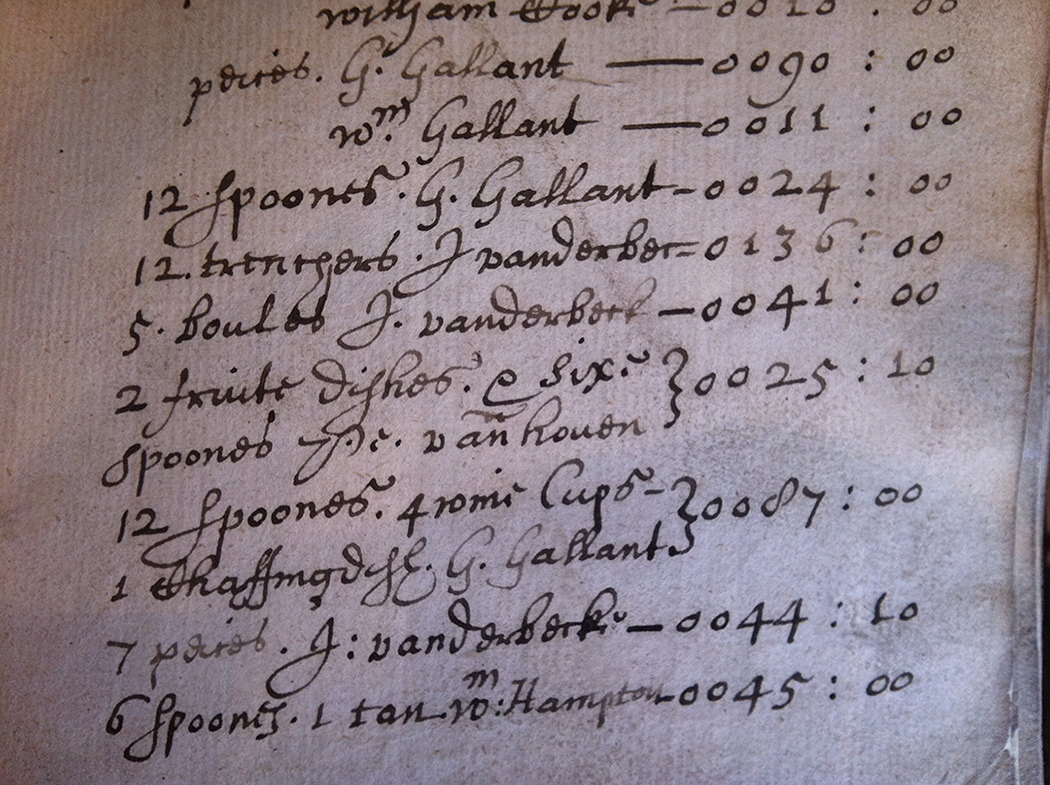
Dublin Goldsmiths’ Company Assay Record, 1638, Photograph © The Company of Goldsmiths of Dublin.
The Intersection of Symbolism and Utility: Institutional Directives
The records and surviving pieces and collections belonging to civic and religious institutions offer additional evidence on the regular and widespread use of silver. For the churches, communion vessels of silver, at the very least, were prescribed. The Roman Catholic, Anglican and Presbyterian churches all celebrated the sacrament of Holy Communion with varying degrees of frequency in this period. They each ordained that the central act of worship required a cup of precious metal. Base metals or wood could taint or, worse, absorb the precious contents. Visitations carried out by the Church of Ireland Archbishop of Cashel, Thomas Fulwar, in c.1662, for example, asked of churchwardens in every parish: ‘[H]ave you a fair Communion Table, a Chalice with a Cover of silver, a stoope or Flagon of Pewter (if not of purer metal) for the celebration of the holy Communion.’ 48 Anglican churches were expected to stock chalices (also called communion cups) and flagons which were used to replenish the chalice. By the end of the century, it was common for these churches to have suites of altar silver, extending to silver bread plates, alms dishes and candlesticks. Presbyterian churches acquired and used silver communion cups, often in sets, to accommodate multiple, concurrent communion tables during a service. Roman Catholic dioceses also enforced a uniformity of silver equipage. John Brenan, Archbishop of Cashel observed during his diocesan visitations in the late-1670s that some parishes had only pewter chalices which he declared he would no longer consecrate and were to be replaced by ones of silver. 49 Such enforcement was effective. The ecclesiastical silver associated with the Catholic Church in this period is evidence of the many sacred functions fulfilled by plate: extant chalices, of which there are just over 250, 50 and other items of recusant plate – monstrances, patens, pyxes, ciboria, crosses, censers, cruets, and sanctuary lamps – are proof of the endurance of the Catholic Church during a period in which it operated as an officially outlawed religion. 51
Many of the monasteries, abbeys and convents of the Catholic religious orders from the period recorded sets of chalices, sometimes several dozen: in 1629, the Jesuits’ recently constructed Kildare Hall in Dublin listed eleven silver chalices in a report. 52 The Franciscans at Kilconnell Abbey in County Galway despatched three silver gilt and one silver chalice to Louvain in 1654 and, in 1689, the abbey listed in an inventory twenty-seven silver and silver gilt chalices and a ciborium, perhaps in anticipation of the coming war. 53 In 1698, following the banishment act, they listed nearly fifty chalices, some of which were still in the abbey’s possession and others with their benefactors. 54 The papers of the Franciscan Meelick Abbey, also in County Galway, include an inventory from the same year which included fourteen silver and silver gilt chalices. 55 The Dominicans at the Claddagh in Galway also listed their valuable materials in 1698 which included ten silver chalices ‘whereof four are gilted w[it]h gould’. 56 Certainly, these large collections of chalices symbolised the wealth, patronage and status enjoyed by the various orders, but it was also understood that each chalice served a purpose within the institution, as Malgorzata Kranodebska-D’Aughton explains with regard to the Franciscans in this period: ‘friars used chalices both at the daily conventual Mass and at the private Masses celebrated by each friar-priest, which explains the need for a number of chalices in each friary.’ 57
This intersection of symbolic-function and use-function is also evident in Ireland’s city and town corporations which, along with urban guilds, comprised other important institutional consumers of silver in the seventeenth century. Corporations equipped their offices with silver insignia and used maces and swords for decorating ceremonial occasions and, like the churches, this became a prescribed necessity. Waterford city’s 1626 charter, for example, articulated the city’s right to employ four sergeants-at-mace who were to ‘carry gilded or silver maces, engraved and adorned with the sign of our arms’.
58
A preoccupation with displaying civic authority and legitimacy was a motif of many civic corporations whose status was established or reasserted in this period of urban creation and expansion.
59
Over time, additional items of silver insignia were acquired in increasing quantities by municipal corporations. They included seal matrixes, smaller maces for sergeants-at-arms, pocket maces, water-bailiff ‘oars’ and chains of office.
60
The emblematic role of these items is evident from their primarily ceremonial function, as articulated in several civic corporation minute books, such as the port town of Youghal, County Cork in 1685: Ordered, that to-morrow, 23 April, being the day of the Coronation of our Sov. Lord King James the Second, &c., Mr Mayor, Recorder, and Ballives [sic], being attended by the Aldermen, Burgesses and Freemen do walk in their gowns, &c., with the Sword, Maces, and the Constables before them to the Church.
61
Use, Misuse and Reuse
Though favoured by consumers for its durability, wrought silver was not immune to wear and tear which could occur as a matter of course through daily usage or due to misuse. Dublin Corporation’s Assembly noted in October 1633 that the city plate was ‘much broken and defaced…[and that] so much of it as is unserviceable or unrepaired to cause to be amended or altered’. 62 It would seem that little was done to improve the collection because seven years later the Assembly declared that ‘this cities plate is altogether out of repaire and is nowise serviceable’. 63 Richard Boyle complained in 1631 that his son-in-law Lord Kildare had ‘battered & abused my silver trencher plates’ by ‘knocking marybones [marrowbones] uppon them’. 64 Replacement was often pursued for split and dented wares or for resoldering components, but arranging for repairs, particularly items of symbolic or sentimental importance, was commonplace. As Donald Woodward has argued, the reuse of durable goods (achieved through recycling and repair) was widespread in pre-industrial Europe due to ‘pervasive poverty’, a status that certainly aligns with the straitened resources of Irish municipal corporations and churches from this era. 65 In Waterford, reparations to civic plate were undertaken in a cost-effective manner. Peter Madden was paid just 4s 6d. in 1662 for mending a sergeant’s mace and later that year the sheriff agreed with a cutler and goldsmith for mending the city sword ‘as cheape as they cann’. 66 The corporation of the town of Trim in County Meath noted that its ‘high mace’ was ‘oute of repaire’ in 1674 and that six days’ work was needed to mend it. 67 A goldsmith’s expertise and materials, particularly when re-gilding was required, could be costly: in 1683 the great mace of Dublin Corporation was found to be ‘much broken, out of order, and the gilding worn off’. The goldsmith Edward Harris petitioned Dublin Corporation for the large amount of £27 17s in payment for the repairs he carried out. 68 Harris, like many other goldsmiths, relied on the revenue generated by the repair and re-gilding of silverwares and these tasks constituted an important aspect of how they acquired, cultivated and maintained their clientele. 69 Other tasks such as burnishing, re-chasing, engraving and cleaning were also regularly carried out by goldsmiths. The Dublin goldsmith John Pennyfather was engaged by Kilkenny Corporation in 1702 and paid 15s for ‘worke done to, & cleansing of, ye Large Mace’ and in 1706 three of the city’s smaller maces required the addition of silver in parts of considerable wear, a task for which they employed the city’s resident goldsmith Mark Kelly. 70 Swords, too, required ongoing maintenance: in Dublin in 1609 an order was issued for a pommel and cross to be ‘newly sett on the king’s sworde dayly carried before mr maior’ at a cost of £7 15s. 71 In 1681, the goldsmith John Cope petitioned the Corporation for payment for the ‘gold, silver, fashion, guilding and graveing’ which he added to the sword, reparation tasks which amounted to £6 9s. 72 Eleven years later, William Drayton made a new scabbard and carried out repairs to the city’s sword (presumably the same one) due to ‘the silver being much worn and broken and some pieces lost’, underlining the wear and tear to which the much-used sword underwent in a relatively short period of time. 73
The churches equally resorted to repair rather than replacement in the maintenance of their much-used altar wares. This was driven as much by the veneration of a vessel’s consecrated status as it was by parish thrift. This is apparent in many instances within the Church of Ireland in the period. St John’s parish in Dublin paid for the mending of its communion cup in 1623 and, in 1637, 6d was spent mending two ‘Dishes for ye Comm table’ and 1s for mending one candlestick. 74 Christ Church Cathedral, also in the capital city, regularly disbursed funds for the maintenance of its growing collection of plate, spending 3s 6d for mending a candlestick in 1632, £2 for gilding a chalice in 1674 and 2s 2½d in 1684 to a goldsmith for mending and weighing the cathedral plate. 75 In 1693, the cathedral paid another goldsmith £1 3s for burnishing its plate. 76 On two separate occasions in 1690, Dublin’s St Catherine and St James’s parish paid 4s for the mending of the parish communion cups. 77 The Church of Ireland also maintained its plate through routine cleaning and careful storage. At St Catherine and St James’s in 1663, 11s 6d was paid to the individual responsible for ‘cleaning ye Candlestick & cleaning ye flagons & cupps for [the] whole yeare’ and again in 1666 one Mary Phillips was paid 18s 6d for menial tasks which included ‘Scouring ye Cups, flaggons, & Candlestick’. The vestry records detail this disbursement continued up to 1679. 78 Boxes and cases were procured specifically for the safekeeping and storage of these ‘scoured’ altar wares: Christ Church spent £5 in 1664 on the construction of bespoke cases for ‘ye two sorts of Comunion [sic] Plate’ which they had repaired in 1680–81. The proctor purchased a canvas bag for other altar silver items the following year, presumably in an effort to minimise dents and damage. 79 St Mary’s in Dublin had a wainscoted cupboard with ‘Convenient Presses’ constructed for its altar wares in 1706. 80
Repair, Refashion or Replace: Considering Design and Decoration
Repairs were also sought by consumers of domestic wares. In August 1641, the earl of Cork paid a London goldsmith £24 for ‘mendings of plate’ but he also used the opportunity to exchange old pieces for new. 81 This was not unusual: in November 1620, Boyle sent a voyder to London to be exchanged for a new one and, in March 1626, he noted a consignment of ‘owld silver vessells’, weighing just over 600 ounces was likewise to be sent by an agent to be ‘exchanged into new dishes’. 82 This practice of mending well-used silver and the exchanging/acquiring of new, more fashionable plate facilitates analysis of the concurrent forces of function and fashion in the consumption of plate at this time. Refashioning and repurposing plate was not uncommon among the Irish elite. Boyle’s son Lord Orrery sent silver to the Limerick goldsmith John Bucknor in 1666, among which were four large flagons, to be remade into dinner plates, communion chalices and a powder box for his wife. 83 The second duke of Ormonde, on succeeding to the title in 1688, inherited his grandfather’s plate, a collection which, undoubtedly, expressed the aesthetic taste of an older generation. Accordingly, in January 1690, he traded in 2,500 oz of old silver, an enormous volume, for 2,100 oz of new plate which he received over two years later. The new collection included sets of candlesticks described as ‘pillared’, the fashionable fluted column patterns of French and Dutch influence in this early-Williamite period and trencher salts described as ‘knurled’, indicating the popular embellishment of semicircular gadroons chased on domestic silver in the late seventeenth century. 84 ‘Fashion’, a loaded word, was synonymous in this period with current aesthetic taste and practice as well as the application of expertise and time spent by the goldsmith in crafting the object. The more decorative a piece, using techniques such as chasing, engraving or casting, the more expensive it would be. Thus, the duke lost 400 oz worth of the silver he exchanged in 1690 due to the expensive process of re-crafting his inherited wares and because he opted for decorative items in his new dining service.
Early modern consumers understood the power and price of fashion as a means of exhibiting refinement and taste. They realised that the superior form and style of a piece was dependent on its conspicuous use and display by those who ‘mattered’ and vice versa. Such transient social and psychological factors were important in determining the creation of fashion, as Berg and Clifford have articulated: Fashion was…conveyed not just by the object but by those who possessed or displayed an object. It was a quality endowed by association with the high ranking or the rich. It was manners, gestures and style as much as the physical attributes of the object itself which lent it fashion.…Fashion thus changed continuously.
85
The surviving specimens of Irish-made silver produced in the seventeenth century show that Irish goldsmiths and their consumers engaged with a wide-ranging aesthetic palate which kept pace with British and European styles and techniques. French, Spanish and Dutch-inspired elaborately chased and embossed decoration is evident in altarwares and tableware dating from the Restoration and Williamite periods (Figures 2 and 3). Continental influence is also to be found in vessels and utensils decorated with specialist techniques such as cut-card and precision stencil work (Figure 4). Flat-chased chinoiserie scenes and figures are decorated on domestic vessels dating to the period 1680–90 (Figure 5). And, throughout the period, engraved heraldry displayed varying attitudes to fashions ranging from the very simple to elaborate expressions of Baroque style (Figure 6). These engraved arms or crests frequently adorned austerely plain vessels and utensils. Given the higher costs associated with decoration, it is unsurprising that a large portion of extant Irish silver is plain (Figure 7). Such economically sensible vessels and utensils were arguably more likely to be among the more utilised items within a domestic collection if we can presume that highly decorative standout wares, such as an expensive Spanish-fashioned salt cellar, were primarily acquired for their expression of status and taste. That is not to say that plain silver lacked visual appeal but it does highlight the varying financial and social motivations behind acquisition and consumption and the role of fashion at the heart of this.
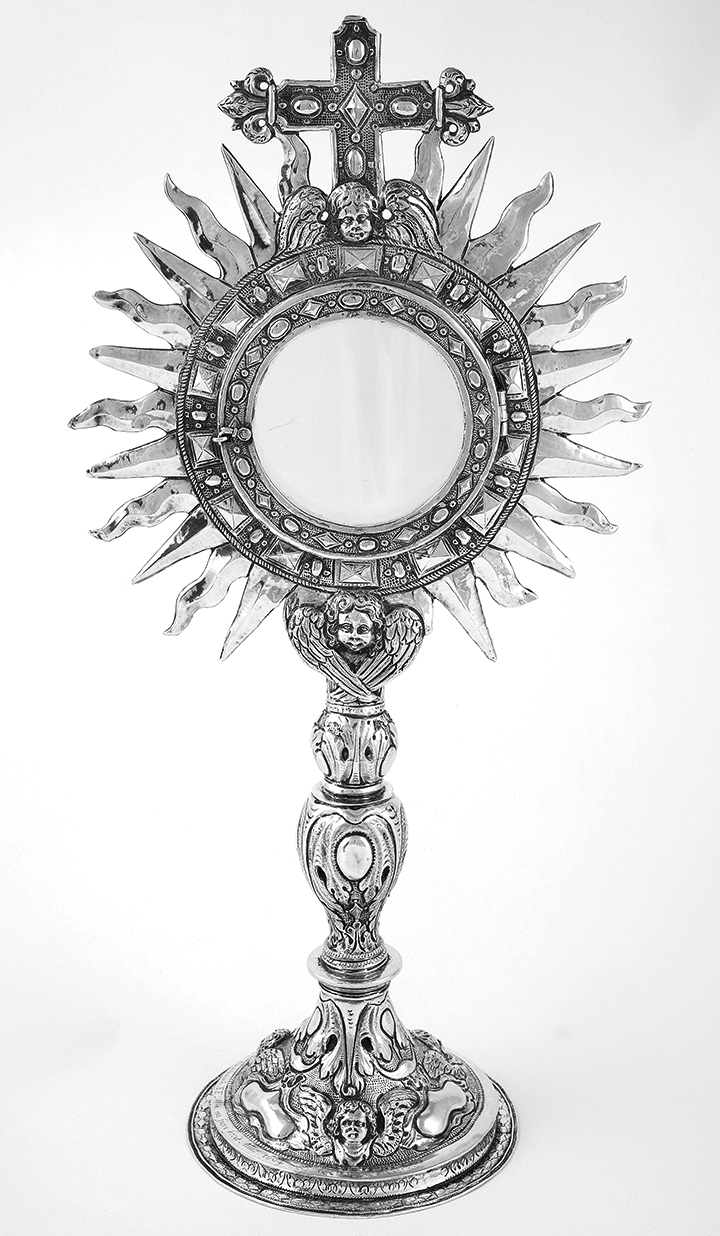
The ‘FitzSymon’ monstrance, maker unknown, Dublin, c.1664, The Franciscan Order of Ireland, Photograph © National Museum of Ireland.
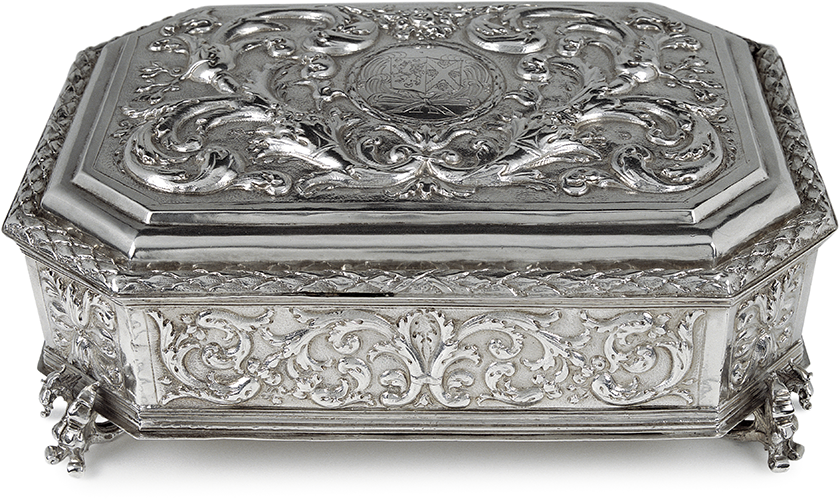
Toilet casket with the mark of John Philips, Dublin, 1680–83, Photograph © National Museum of Ireland.
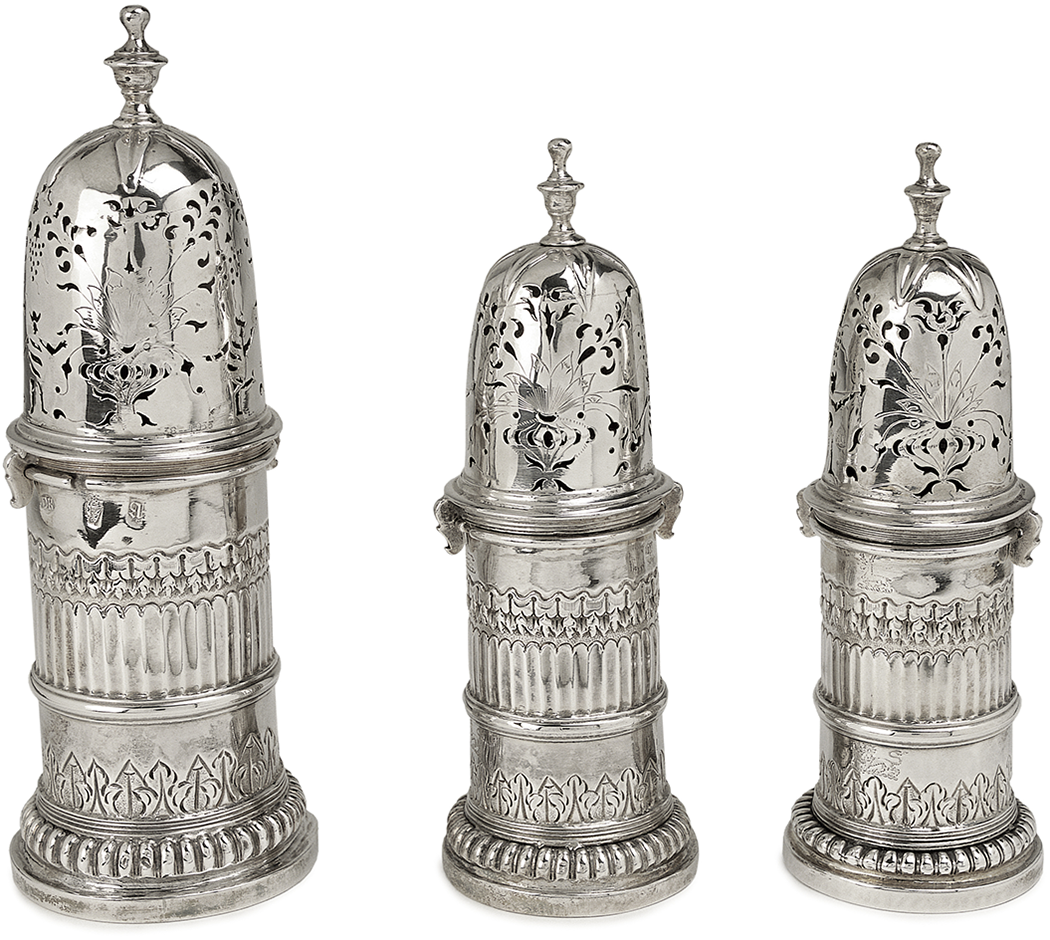
Set of casters with the mark of David King, Dublin, 1699, Photograph © National Museum of Ireland.
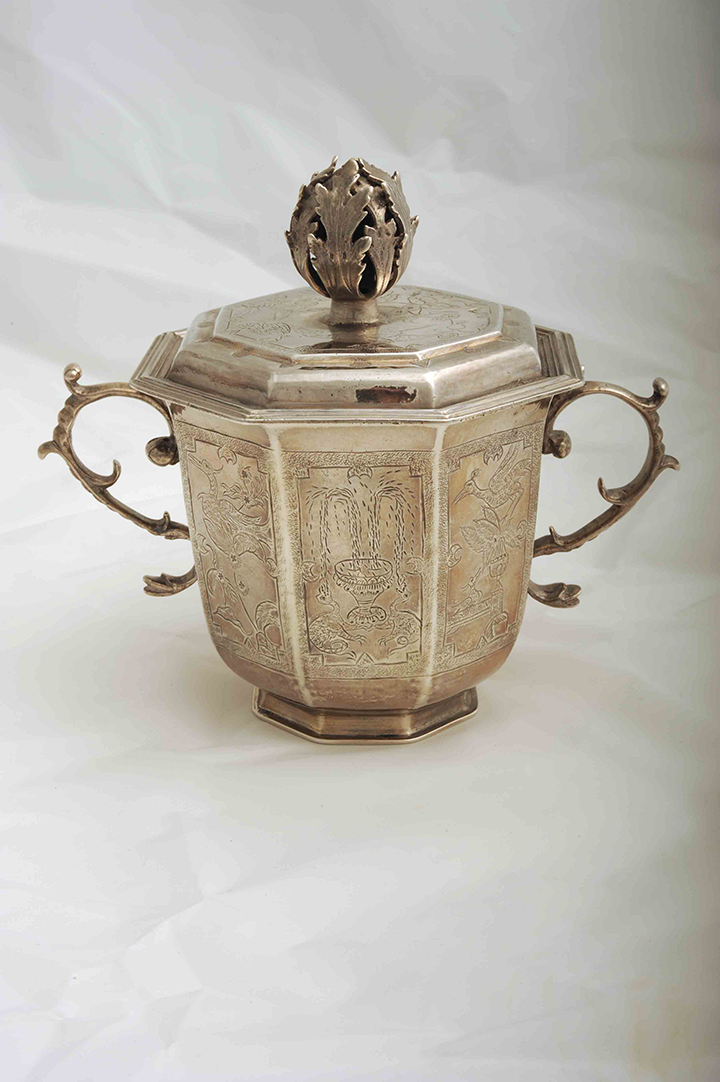
Two-handled covered cup with the mark of John Cuthbert, Dublin, 1685–87, Photograph © National Museums of Northern Ireland.
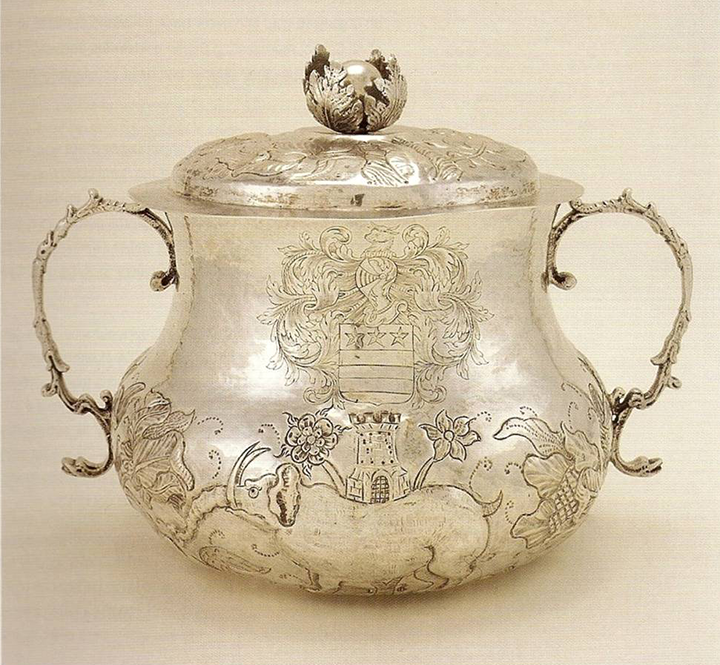
Two-handled porringer cup with the mark of Richard Smart, Cork, c.1680, Photograph © National Museum of Ireland.
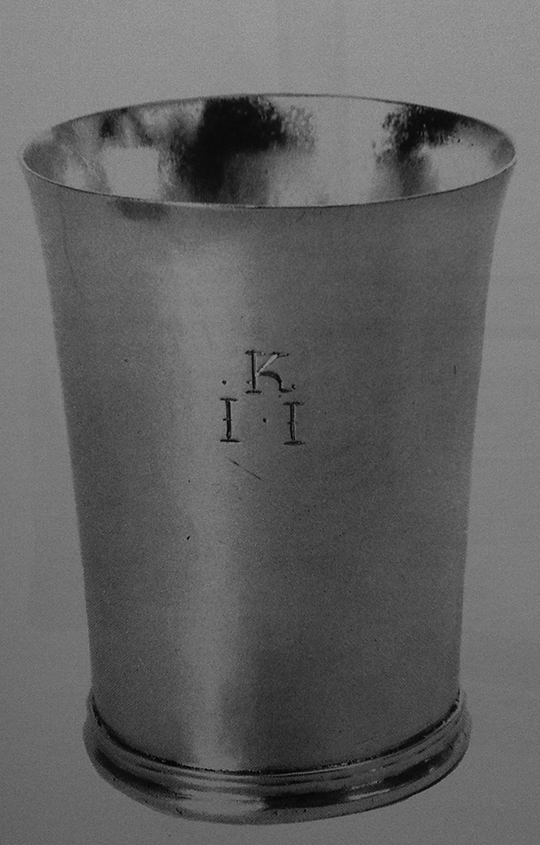
Beaker with the mark of Francis Coffey, Dublin, 1663–69, Photograph © National Museum of Ireland.
Social Mechanisms: Gift-Giving and Presentations
The social motivations of consumption acquire additional resonance when broader societal mechanisms unique to this period are taken into consideration. Philippa Glanville’s analysis of the ‘sociology of silver’ recognised the prominence of plate in domestic and institutional contexts when gifted and bequeathed. 88 Similarly, with regard to eighteenth-century silver, Alison FitzGerald has recognised the ‘social currency’ of silver in Ireland, articulating a less tangible, but nonetheless essential, facet to its acquisition, presentation and display. 89 The creation and maintenance of relationships and the honouring and commemorating of individuals and events was frequently facilitated with (and embellished by) silver. Portable luxury objects were considered entirely suitable for initiating and sustaining relationships, enriching and flattering recipients and reflecting the wealth and generosity of the donor in the early modern period. For ambitious individuals such as the earl of Cork, the presentation of domestic plate to family members, peers, superiors and political figures was, generally, driven by a desire for personal gain. 90 In January 1629, he listed his New Year’s gifts, documenting the full extent of his extravagance and his desire to compliment important individuals who included the Lord Treasurer, Lord Privy Seal, the earl of Pembroke and the Lord High Steward. In all he gave six large silver gilt covered cups, a ‘great cream bowl guylt’, a silver chafing dish, two silver standishes, two pairs of silver snuffers and a silver candlestick. 91 Like many of his contemporaries, Boyle was mirroring the behaviour at royal courts when, particularly on the occasion of the New Year, gifts were presented by those seeking to ingratiate themselves into the king’s favour, a custom which can be dated to the early sixteenth century and which lasted until the last quarter of the seventeenth century. 92 Gifted silver or silver gilt objects were undoubtedly appreciated for their monetary and aesthetic worth, but their principal value was in their symbolic function inasmuch as they reflected on the status of the relationship at the centre of the exchange. In addition, the gifting of objects was not simply a symbol of the message of admiration, support or affection; the object constituted the information itself, for without them the intercourse between both parties ceased to exist: ‘In being offered, accepted, or refused, they either reinforce or undermine existing boundaries.’ 93 The physical function of items of plate in these contexts and their consumption thereafter, therefore, was of great significance. This went both ways: when a gift was rejected, an equally powerful message resonated representing, as Zemon Davis has observed, ‘distance, a cool zone…not favour and communication’. 94 Such a snub was directed at the earl of Cork who recorded that same New Year that the silver standish he gave to Sir John Denham was not accepted. 95
Within institutions in seventeenth-century Ireland, particularly municipal corporations, the presentation of plate functioned primarily as a form of flattery and commemoration but, like domestic gift-giving, created and maintained a relationship of mutual obligation in an instrumental and effective way. The earliest instances can be found with Dublin Corporation which, in 1656 on the birth of Henry Cromwell’s son and amidst much public celebration, presented three ‘fair pieces of plate’ to the infant on the occasion of his baptism in the city. 96 A few years later, in 1662, in acknowledgement of the duke of Ormonde’s favour to the city, the corporation presented him with a gold cup, along with his freedom of the city enclosed in a gold box, costing the enormous sum of £371. Such a gift, they believed, had a dual function in that it ‘may aunswere the dignities of his place and the honnor of this cittie’. 97 Provincial cities soon followed Dublin’s lead in their presentation of plate to the monarch’s representatives. Cork Corporation presented the duke of Ormonde with an engraved silver box in 1666. 98 Waterford Corporation agreed to spend £16 on a piece of plate to be presented to the Lord Lieutenant’s secretary in 1669. 99 City guilds imitated these strategic gestures, though it was in their interest to bestow such gifts on their municipal leaders. On numerous instances throughout the 1650s, Dublin’s guild of tailors presented the city mayor with items ranging in cost from £1 1s to £2 7s and which were described as either a piece of plate or a silver cup. 100 Dublin’s merchant’s guild raised the bar a good deal higher than the tailors and, between 1668 and 1700, presented thirteen successive city mayors with a piece of plate ranging in value from £20 to £50. 101 In this same period, both guilds and corporations expressed their gratitude and desire for patronage from prominent individuals through the presentation of silver boxes which, because they were often framed within the context of the award of honorary civic or guild freedom, became known as ‘freedom boxes’. 102 The primary function of these boxes was in creating and maintaining political alliances.
Strategic gift-giving frequently went hand-in-hand with the desire to create a personal legacy. This is particularly evident in the donations of silver altar wares. When plate was donated to churches or religious orders by benevolent or pious individuals, it was commonplace for the donor to ensure their generosity was visible. Engraved inscriptions, usually in Latin or English, occasionally in Irish on Catholic pieces, ensured items of communion silver remained a constant reminder of this. Nearly eighty per cent of extant chalices from the period were donated and inscribed accordingly, proving the strong patronage among Irish Catholics towards their church and their desire to maintain a level of prominence in local society. 103 The Church of Ireland’s patrons, consisting mainly of converted Old English families and New English settlers, were equally motivated to assert or maintain their social prominence. Like their Catholic counterparts, they were keen to maintain a level of social visibility through their association with their church and used altar silver to advertise their status and generosity, with detailed inscriptions and engraved heraldry prominently decorating cups, flagons and plates. The vestry records for some Church of Ireland parishes provide further evidence of the social opportunism of certain individuals and the means by which church plate donations facilitated mutually advantageous exchanges. St Peter’s Parish in Dublin, whose benefactors were listed as contributing towards the church building work in 1686 and included notable elites such as the lord archbishop of Dublin and the primate of Ireland, also noted the donations received in kind by its less-prominent parishioners. These included a silver flagon given by a Madam Savage and a silver plate from one Madam Ward who were subsequently assigned moderately conspicuous seats seven years later when the refurbished pews were allocated. 104 At the Cork parish of Innishannon, a comparable exchange took place where the vestry recorded in 1700 that Gershom Herrick Esquire donated a silver flagon for the church’s use. In exchange, at the request of Mr Herrick, the vestry granted him and his family a pew. 105 Using the reverence and importance with which altar plate was regarded, much like the domestic and institutional contexts where boxes, cups and other presentation pieces were deployed, silver uniquely facilitated social transactions and enabled individual gain.
Conclusion
Fashion or function? Which was more important to seventeenth-century Irish consumers when it came to their acquisition or presentation of silver? Is it possible to separate the appeal of a vessel or utensil’s form, weight, style and decoration from its function? Conversely, is it useful to identify an object’s function(s) in isolation from its aesthetic or symbolic value? Furthermore, was an object’s symbolic-function as ‘useful’ as its utility-function? This article has shown that in seventeenth-century Ireland there were numerous, concurrent strategies of consumption of silver in domestic and institutional spheres. Though undeniably a favoured status symbol of wealthy consumers, numerous instances recorded in depositions, wills and inventories support the argument that less-affluent consumers were also consuming plate in this period. These consumers, like the elite in their society, recognised and utilised plate’s numerous attractive features in advertising capital, fulfilling practical functions, creating and maintaining social bonds and articulating taste and civility. Rather than prioritising or grading their consumption strategies, however, it has been found that cost, utility, symbolism and decoration were each at play in varying degrees in the acquisition and use of silver by the different consumer groups, both domestic and institutional. Each of these factors informed their decisions regarding the type, weight, size and style of the plate they purchased, supplying, therefore, a wide-ranging and aesthetically diverse legacy of extant Irish seventeenth-century silver.
Silver’s ubiquitous and increasing prominence in and of itself complicates a linear understanding of its role in this period. The routine utility of silver among domestic and institutional consumers cannot be separated from sociopolitical and religious contexts where expectations, needs and uses had embedded silver within day-to-day social intercourse. That these expectations, needs and uses arose from, and co-existed with, silver’s ability to exhibit symbolic forms and devices and to express taste through ornament does not simplify or segregate the functional and the aesthetic. Far from it, the evidence suggests this was proof of its multidimensional appeal. The matter becomes even more complex when it is considered that so widespread was the acquisition of silver in Irish society by the second quarter of the century that certain individuals like the status-conscious earl of Cork opted to distinguish themselves from their contemporaries (and keep pace with society’s most important fashionistas) by prioritising decoration over utility and budget. They knew that the majority of their consuming peers were more cautious (less ‘brave’) and sought plain, unornamented wares. Ultimately, however, while silver ably responded to diverse stylistic trends and forms, it was its universally regarded multifunctionality, incorporating changing aesthetic tastes, which characterised its consumption in seventeenth-century Irish society.
Footnotes
Acknowledgement
The author would like to sincerely thank Alison FitzGerald and Susan Flavin for reading earlier versions of this article and for providing their invaluable feedback and encouragement.
Declaration of conflicting interests
The author(s) declared no potential conflicts of interest with respect to the research, authorship, and/or publication of this article.
Funding
The author(s) disclosed receipt of the following financial support for the research, authorship, and/or publication of this article: The author wishes to acknowledge the financial support received from Maynooth University’s John & Pat Hume Postgraduate Scholarship Award and the Irish Research Council's Government of Ireland Postgraduate Scholarship.
