







Abstract
This article provides the first comprehensive study of the early development of telephony in Ireland. It begins by exploring the technology's promotion, highlighting that this drew on a much older tradition of public displays of electricity often for educational and recreational purposes. The article builds on this overview of electrical display to discuss early telephone users and the establishment of the Telephone Company of Ireland in 1882 to expand telephone provision in the three southern Irish provinces of Leinster, Connaught and Munster. In doing so, it demonstrates that like telephone development elsewhere the company initially focused on businesses but was quick to realise the importance of residential customers. In tracing the history of the company, the article seeks to explore the difficulties it faced in securing sufficient investment to promote this revolutionary technology and expand the nascent telephone network. It shows that ultimately the failure to do so lead to its purchase by the British-based National Telephone Company in 1893.
Introduction
The telegraph is already, in fine, very much of a discredited old worldish arrangement, and the Telephone asserts instead its new and mysterious superiority. It remains to be seen to what numerous uses it can be applied, and evidently very little time will now be lost in bringing it into play for every purpose of business between country and country, in spite of all obstacles of language or any physical or artificial barrier.
Irish Times, 18 July 1882
In the 1870s a new technology emerged that challenged the electric telegraph's dominance of rapid communication: the telephone. The telephone signified numerous things: for some modernity, for others business opportunities in selling or utilising it, for the Post Office a threat to the financial viability of the inland telegraph network which it had purchased and restructured at considerable expense in 1870. While initially the distribution of the telephone was carried out by small firms, its networked nature meant that these were quickly replaced by companies licensed to operate the patent rights of the main telephone inventors. This article focuses on the early diffusion of the telephone in Ireland, and the establishment and development of the Telephone Company of Ireland (TCI).
The study of the development and impact of infrastructure and technology in nineteenth-century Ireland is an increasingly active field of scholarship. Recent work has highlighted that many viewed infrastructure and engineering projects as playing a pivotal role in transforming Ireland and, as such, were important tools of governance. 1 Richard Butler's recent work directly connects infrastructural development to potential economic, cultural and social benefits. 2 In doing so, Butler highlights the ‘connections between technology, statecraft, and economic development in early nineteenth-century Ireland’. 3 The history of Irish telecommunications has also received recent attention with particular focus on telegraphy. Like studies of other aspects of Irish infrastructure, this work has demonstrated that telegraphy was not only an important tool of the state but also impacted other areas of Irish life such as newspapers. 4 Despite the continuing importance of the telephone to modern Irish society, the study of its historic development has received relatively little attention. Of the publications exploring the development of the telephone, most provide little information on the early development of telephone networks in Ireland. Those that do are in no way comprehensive, nor do they seek to interpret the factors that influenced these developments. 5 Nevertheless, the telephone has proven to be a fruitful topic of research in other national and international contexts, which demonstrated its importance as an economic, social and political tool. 6 In particular, studies of the patenting of telephones and subsequent legal disputes between telephone creators and promotors have proven to be a particularly rewarding focus of this work. 7 Consequently, the early period covered by this article represents a particular lacuna in Irish historiography. As well as expanding this emerging body of literature, this study also explores the reaction of Irish investors to this revolutionary technology and provides insights into the appetite for such investments in late nineteenth-century Ireland.
The article traces the international, UK and Irish factors that shaped the development of telephony in Ireland. These include political, social and economic factors but another important aspect of this are users; the type of user, their location and the purpose of their use were central to shaping a networked technology such as the telephone. By exploring these several influences, this article will add to our understanding of the multifaceted factors that shaped the development of Irish infrastructure in the nineteenth century. 8 It also highlights that while there where many similarities to telephone development elsewhere, for example the United States and Britain, Ireland also offers up many points of contrast.
Development of the Technology
Alexander Graham Bell is credited with inventing the telephone, transmitting the first voice electronically in 1876. Bell's telephone used a soft-iron diaphragm; this vibrated to soundwaves causing disturbances in the magnetic field of a bar magnet but, crucially, did not break the circuit as early apparatus had done. These disturbances created a fluctuating electric current in the copper wire wrapped around the magnet, which was then transmitted to a receiver which transformed it back into soundwaves. 9 Bell's telephone was to be quite useless until the development of the electromagnetic microphone by David Edward (D.E.) Hughes in 1878. This device amplified the weak signals produced by Bell's telephone, allowing for its commercial use. 10 In the United States the telephone quickly emerged as a tool of urban business. 11
The telephone was introduced into the United Kingdom in 1876, but the public was slow to embrace the new technology. Early telephones could only operate over short distances. In addition, the Post Office – in order to protect telegraph revenue – used its monopoly on inland electric communication to restrict the laying of trunk lines between telephone exchanges. Due to these restrictions, the telephone was initially used as a replacement for private telegraphs. 12
Private telegraph circuits had been installed by various businesses for internal communication between offices, buildings, workshops and so on. The relatively small number of transmissions on such circuits meant that it was not practicable to employ a telegraph clerk. The Wheatstone ABC apparatus, which did not use a code, was slow but ideal for these circuits. The operator pressed the correct letter on the communicator and cranked the handle attached to the ‘generator’ to transmit the letter. This was then received by another Wheatstone ABC which pointed a needle to the correct letter on an ‘indicator’. The telephone was much easier to use and provided more rapid communication than the Wheatstone ABC apparatus, which it quickly began to replace. Thus, the telephone not only supplanted the private telegraph but also surpassed it in terms of utility. Irish cities did not have a significant number of private telegraph wires, with only thirty-one private renters in 1872. 13 Thus, as the primary customers for these early telephones were those who had switched from ABC telegraphs, the technology was denied this early foothold on the island.
Bell's telephone was introduced to the United Kingdom in 1876 when William Thomson, the future Lord Kelvin, demonstrated it at a meeting of the British Association (the British Association of the Advancement of Science or BAAS). 14 In 1878, the Treasury gave the Post Office approval to hire out telephones. However, in the same year, The Telephone Company was formed to operate Bell's patent. 15 This effectively established the company as a rival to any potential Post Office telephone service. In 1879 a challenger to the Bell company emerged when a telephone designed by Thomas Edison was brought to Britain and demonstrated in London by Professor William Fletcher (W.F.) Barrett, of Dublin's College of Science. In the same year the Edison Telephone Company of London was formed with a capital of £100,000. 16 The introduction of the Edison telephone, with separate patents, brought significant challenges for the (Bell) Telephone Company. Up until this point, due to its patents, it had been the only company in the United Kingdom able to offer telephonic communication. Indeed, the company was very protective of the rights provided by its patents, this being essential for attracting capital investment. 17
Arapostathis and Gooday's seminal work on nineteenth-century electrical patents demonstrates that inventions, such as the telephone, are socially constructed and as such the final artefact is normally the culmination of the work of many individuals. In other words, often the antithesis of the types of priority claims supported by patents. Yet, patents were important business assets, control of which allowed for market dominance ‘or even monopoly’. Thus, the outcome of priority disputes – where individuals challenged existing patents by claiming they were the first to invent a technology – could bring significant financial rewards. 18
For the Post Office the opening of telephone exchanges was a natural continuation and expansion of its private telegraph business. Renting a Post Office telephone would cost £14 10s. within half a mile, and £18 within one mile, of the telephone exchange, with proportionate charges for distances exceeding this. Users of the postal telephone system could also ‘send messages by wire to the telegraph office to be thence transmitted at the ordinary charge to other towns’. In addition, the Post Office was ‘ready to make arrangements for the establishment or continuance of systems of intercommunication by existing private companies’. 19 In December 1880 the courts ruled that the telephone was to be considered a telegraph under the criteria of the 1868 Electric Telegraph Act. This gave that the Postmaster General a monopoly over all telephonic as well as telegraphic communication within the United Kingdom. 20 Following the decision of the Post Office to pursue a monopoly over telephonic communication the Bell and Edison companies merged to form the United Telephone Company (UTC). 21
The Post Office's offer to provide telephonic communication led to direct confrontation with the United Telephone Company which quickly published its response in national newspapers. This stated that the ‘patent rights in this country of Professor Grahame [sic] Bell and Mr Thomas Alva Edison are the exclusive property of the United Telephone Company (Limited)’. The advertisement was also quick to threaten legal action against anybody who used ‘any form of carbon transmitter, or any form of magneto or electro chemical receiver’ which it had not authorised, even if this was supplied by the Post Office. 22 The Post Office had overcome its patent difficulties by purchasing telephones from the Gower-Bell Company, which had been licenced by the [Bell] Telephone Company Ltd. in 1879 to sell telephones in the United Kingdom. 23
This opposition – and the inability of the Post Office to secure a sufficient number of Gower-Bell telephones – combined with memories of the financially disastrous inland telegraph nationalisation, 1870, meant that the Treasury was reluctant to sanction serious expenditure on a postal telephone system. Added to this, a carefully orchestrated press campaign was initiated by the UTC, which sought to remove Post Office restrictions on its activities. Edmund (E.D.) Gray, owner of the Freeman's Journal, M.P. for County Carlow and a future chairman of the TCI, contributed to this campaign by raising the telephone companies’ concerns in parliament. He argued that the Post Office's restrictions were not only harming the profitability of the telephone companies but also hindering the development of an important service for the public. 24
The call for a free-market approach to telephone development suited the laissez-faire thinking of the Postmaster General, Henry Fawcett, who liberalised the telephone licence system in 1882. 25 The Post Office had previously refused to issue new licences. This had the dual effect of ensuring that new companies were not formed and restricted the activities of existing ones to named urban areas. However, the issuing of ‘Fawcett Licences’ reversed this policy, allowing existing companies to operate across the whole of the United Kingdom. 26 The new licences would expire on 31 December 1911, with the option of state purchase in 1890, 1897 and 1904. 27 This changing approach to telephone companies was mimicked elsewhere such as Spain where the government granted licences to telephone companies in 1882 but its interest in and regulation of telephony was an important feature of developments there. Due to the unforeseen cost brought by a ten per cent royalty payment to the Post Office, the UTC decided to establish companies outside of London to promote telephony, while focusing its resources on the capital. 28
Promoting and Displaying Telephony in Ireland
As historian of science and technology Iwan Morus has demonstrated, there was much popular interest in electricity in nineteenth-century Britain and it became a ‘symbol of Victorian progress’. 29 As science is a cultural practice, electrical displays allowed the audience insights into broader discussions surrounding electricity, providing them with an opportunity to find a place in, and understanding of, this world. 30 In the first half of the century displays of electricity were primarily performed by instruments designed for that purpose. 31 However, technologies such as the telegraph and telephone proved useful tools with which to visually explore and marvel at this strange ‘fluid’. These technological displays, which were part showmanship and part educational, were driven by patrons who sought elucidation on the role that electricity and machines were playing in the transformation of society. 32 In turn, the organisers of such displays had many motivations ranging from immediate financial gain, in the form of gate receipts, to more long-term objectives, such as proving the reliability of technologies. Thus, exhibitions were often central to the promotion of new technology through the display of its usefulness, ingenuity and reliability. While the large industrial exhibitions of the mid-nineteenth century, including those in Cork, 1852, and Dublin, 1853, can be viewed as the apex of such displays, smaller-scale public exhibitions and lectures on electricity remained popular in Ireland throughout the century. 33
In Britain, Alexander Graham Bell embarked on a series of public lectures in 1877 to promote his invention. The telephone was displayed in August 1877 at the British Association meeting (Plymouth). 34 William Thomson (later Lord Kelvin), who described the telephone as ‘the most wonderful invention of the age’ 35 read a letter which noted Bell's arrival in Glasgow. There Bell demonstrated his telephone at use through a replicated 100 miles of Atlantic cable and the ‘equivalent of between 2,000 and 3,000 miles of land-line’. 36 These experiments and Bell's subsequent attendance at the British Association meeting allowed him to promote his interests by demonstrating the telephone's practicality. 37 This was done not by an appeal to commercialism but rather by expounding his invention as a scientific and technical marvel. Historian Raymond Feuerstein and others have highlighted that Bell's efforts did not focus solely on learned societies but also public exhibitions. While exhibiting and lecturing on the telephone, Bell carefully outlined the commercial uses of the device in the United States, combining public displays of science with commerce in the process. In doing so, he was able to maintain the aura of being a gentleman of science rather than a businessman. 38
The telephone also featured prominently in many Irish technological and scientific exhibitions. In March 1879 the Royal Dublin Society (RDS) hosted a lecture by Professor W.F. Barrett (Royal College of Science, Dublin) on newly developed telephones, including that of Edison. Elites also saw a telephone on display at a viceregal garden party in August 1878. At a more popular level in the same year the Rotunda's exhibition room, Dublin, held ‘a most interesting and instructive modern entertainment, by J. R. Chislett, of London’; among the objects on display was a telephone. Such exhibitions continued throughout the telephone's infancy with displays of ‘electric domestic apparatus, telegraphy, and the telephone’ taking place daily at the Cork Exhibition of 1883. 39 Accordingly, the modern marvel of the telephone proved a powerful attraction to those seeking to use electricity for entertainment and education and reciprocally these exhibitions provided useful venues at which to promote the telephone.
Belfast witnessed a number of such exhibitions during the 1870s and 1880s. Prominent amongst those demonstrating the telephone was John (J.H.) Greenhill. 40 His displays provided the audience with an insight into a device that was ‘creating so much discussion in the scientific world’. 41 However, Greenhill's demonstrations had motivations beyond the scientific enlightenment of his audience. His telephones were supplied by Colonel William Reynolds, Bell's representative in the United Kingdom, who had a vested interest in not only promoting the telephone but Bell's telephone. Thus, Greenhill's displays tied together the worlds of science and commerce. He lectured on Bell's telephone at a number of institutions, such as the Natural History and Philosophical Society, at the Belfast Museum. There he was quick to warn the audience against using unpatented non-Bell telephones, thus reinforcing the perception of Bell's telephone as the telephone. 42
These sophisticated promotional tactics were necessary due to the telephone's simple design. Once aware of its basic construction it was easily reproduced. For example, W.F. Barrett had displayed such a telephone in January 1878. Due to this, Bell promoted his device by not only emphasising its patent but also its reliability and highlighting experiments that proved its dependability. In 1878, Greenhill was quick to point out that the latest Bell ‘box’ telephone had successfully communicated between Dublin and Holyhead, thereby demonstrating its technological superiority. While admitting that other telephones had been invented, Greenhill insisted that ‘the telephone, par excellence, was Bell's [emphasis in the original]’. 43
For the public, the telephone was a new and exciting technology that could be put to a multitude of uses and change how society operated: What opportunities of intercourse will not the immediate future bring to lovers, conspirators, and men of business! A score of private drawing-rooms may join at a concert of the first singers of the world; the popular preacher may preach to his study walls and electrify as many congregations as will hitch themselves on to his wire; the college lecturer may stand with his back to his own fire place and instruct the young idea wherever it is gathered.
44
The possibilities presented by the telephone seized the public imagination. Though the electrical current that transmitted speech operated at the same speed as the telegraph, the point-to-point nature of the technology meant that users were in near instantaneous contact. Owners of ships and horses desiring to emphasise the speed of their charges quickly adopted the name of what had become the fastest means of communication: telephone. On 25 February 1878 a new Irish steamer was christened ‘telephone’ and in the same year a horse named ‘telephone’ raced at the Curragh. 45 By using this name, the owners demonstrated that the race-going public and ship-using merchants grasped the implications concerning the speed of their charges.
Initially the telephone was used within business premises to improve internal communication without providing access to an outside exchange, often replacing a Wheatstone ABC telegraph apparatus which served the same purpose. For example, in 1878 telephones were installed at premises across Dublin, including the Midland Great Western Railway offices at Broadstone station. 46 The (Bell) Telephone Company (owned and operated from London) opened Dublin's first exchange, located at 8 Grafton Street, in March 1880. 47 Its business office was in the Commercial Buildings, Dame Street which was a centre for wholesale merchant transactions and was located close to the Royal Exchange and the Bank of Ireland. 48 This was an ideal position from which to attract the type of business and financial customers that had been central to the technology's success in other countries, where the telephone had quickly emerged as a tool of urban business. 49 This mimics developments elsewhere, such as Italy where business, in addition to public bureaucracies, were important early users of the telephone. 50 Due to the lack of long-distance telephone trunk lines, this was exactly the type of urban setting that would provide users for telephony – the Post Office, in order to protect telegraph revenue, used its monopoly on inland electric communication (granted upon the nationalisation of the UK's inland telegraph network in 1870) to restrict the laying of trunk lines needed to connect telephone exchanges.
In May 1880 the Bell and Edison companies merged to form the UTC in response to competition from the Post Office. The company's Dublin exchange had thirty-two telephone subscribers at this point. 51 Most of these belonged to either the company or its shareholders – such as E.D. Gray, and his Freeman's Journal newspaper and Alderman Valentine Blake (V.B.) Dillon, 52 both of whom would later become directors of the TCI. Newspapers were early converts to telephony with the Freeman's Journal installing a number of telephones in 1880, followed by the Irish Times in 1882. 53 In August 1880 the UTC, anxious to expand its network, offered Dublin Corporation a twenty-five per cent reduction in the price of telephone rental in exchange for ‘permission to carry their wires over the houses and streets of the city’. 54 Such a wayleave would remove a significant barrier to the company's expansion, allowing it to erect wires on an ad hoc basis rather than seeking permission for each line. 55
In Ulster the diffusion of telephony proceeded in a similar manner. By May 1880 the Scottish Telephone Exchange Company had offices in Belfast. 56 Competition was introduced a few months later with the founding of an exchange by the UTC. However, the two systems had no interconnectivity, which was a serious drawback for subscribers. In 1881 the UTC decided that it would concentrate on the development of its network in London and form subsidiaries to run telephone operations throughout the United Kingdom. The National Telephone Company (NTC), established on 10 March 1881, assumed responsibility for the development of the telephone in Yorkshire, Nottingham, the whole of Scotland and Ulster. 57
The Telephone Company of Ireland
On 26 June 1882 the UTC announced the establishment of the TCI. The company would provide exchange telephony in Dublin and promote telephone development in the provinces of Leinster, Munster and Connaught – the NTC assumed responsible for Ulster. The founding of such regional companies points to the UTC's realisation of the importance of local notables in encouraging subscribers from industrial, mercantile, and financial sectors and securing wayleaves for its lines. 58 Such important local figures were also vital in negotiating wayleaves for lines with local authorities. The TCI hoped to raise £200,000 in capital, divided into 25,000 preference and 175,000 ordinary shares of £1 each. The UTC accepted its patent rights payments in ordinary shares and an annual royalty of £2 for each set of instruments (telephone apparatus). 59 The company stated that this was ‘a test of the confidence which may be reposed in this company’ and was likely a tactic to encourage investors by reducing the TCI's expenditure. 60 The UTC's involvement would also be beneficial to the TCI by promoting the interests of the telephone companies in Britain, particularly against the Post Office's efforts to reduce potential competition for its telegraph network. 61
The TCI's need to encourage investors was understandable given the reluctance of Irish financiers to fund local industry and infrastructural projects. While there were substantial sums of money deposited in Irish banks and Irish residents were actively investing capital in various projects, there was a lack of confidence on their part in Irish investments. While banks were active in providing short-term loans, this had been curtailed significantly during the 1877–79 recession. Joseph Lee has noted an aversion to risk amongst Irish investors, noting the role of British investors in stimulating Irish interest. Also affecting the capitalisation difficulties of Irish enterprise was the fact that Irish banks channelled most of the money they held on deposit out of the country; this was particularly true of the 1870–80s when the TCI was attempting to attract investment. This ingrained conservatism had the potential to hamper the TCI. As well as the cautiousness of Irish investors, the sums on deposit in Irish banks were reduced from a figure of £33 million in 1876 to £28 million by 1881. Due to industrial and agricultural difficulties during the 1880s, savings did not reach 1876 levels again until 1890. 62 Hence, the prospects of the TCI were not as bright as they first appeared. The company, promoting a revolutionary and relatively untested technology, would be reliant on local investment in a country with a traditionally conservative outlook following a period of economic depression. Despite traditional conservatism amongst investors, interest in the company appeared high: the application list for shares was closed, on the 30 June, after only four days. 63 With funds secured the company next needed to attract customers.
As the telephone is a networked technology it was natural for the first exchanges in Ireland to open in the larger cities. The technology was expensive and primarily of interest to commerce which meant that only large urban areas with sufficient numbers of professionals, merchants and industrialists would ensure its profitable operation. In a European context, cities with large financial and commercial sectors experienced more growth in telephone use and provision. Dublin, with its large population, was a candidate for such a networked telephone system but its industrial base was underdeveloped in comparison to other UK cities. This impacted the density and extent of the network. 64
Initially the new company showed much promise. By 1882 the Dublin telephone exchange had expanded to include 166 subscribers. As was the case in the rest of the United Kingdom these Irish subscribers were mostly legal professionals and merchants. By June 1882 Dublin Corporation was actively considering the installation of telephones to connect its premises, including fire brigade stations, to the central telephone exchange. 65 The UTC, encouraged by Bell, had advertised the telephone not only to businesses but also ‘police offices, fire stations, hospitals, railways, retailers, water companies and newspaper offices’. 66 The UTC (whose activities had now been taken over by the TCI) had tendered ‘for erecting and maintaining communications between the several departments of the [Dublin] corporation, including the maintenance of communication, both day and night, with all Fire Brigade stations’ and this was accepted by the Corporation in September of that year. This benefited the TCI in two ways. Firstly, it gave the TCI permission to erect telephone lines at will and, secondly, enhanced the telephone's appeal by expanding the network to important public utilities. 67
Other institutions in Dublin, such as the South Dublin Union, also saw the benefits of adopting the telephone. For the sum of £12 per annum the Union would be connected to the ‘police, fire brigade and various parts of the city’. 68 This sum compared favourably with the £20 per annum charge in London, Manchester, Liverpool and Glasgow. 69 Captain Boyd of the South Dublin Union Board of Guardians felt the telephone would reduce the use, and cost, of cars by the union's master and officers. In his opinion ‘£12 per annum was a mere bagatelle for such a convenience as the telephone would be’ and the board approved its installation. This highlights that connection to services, such as the police and fire brigade, were strong motivating factors for telephone subscribers, demonstrating that as a networked system the more connections it provided, the more popular it would become. Other users also realised the technology's utility, including fertiliser importers, stockbrokers and the RDS. 70 However, rental costs, while acceptable to large institutions, public bodies, businesses and extremely wealthy individuals, restricted the telephone's customer-base.
On the 19 May 1883 the TCI held its first shareholders’ meeting presided over by its new chairman E.D. Gray, who is a prime example of the role of notable locals in advancing the cause of telephone. As owner of the Freeman's Journal he was a figure of considerable influence and was a prominent promoter of the telephone until his death in 1888. He used his parliamentary seat to promote the interests of the new industry. For example, he forcefully argued against the Post Office's restrictions on telephone development contending that these not only harmed the telephone companies’ profitability but also hindered the development of an important public utility. 71 Gray ‘took a very active part on a special committee ordered by parliament to consider the position of telephone interests with regard to a Bill giving them a power of wayleave’. 72 He was vocal in the British press, highlighting the difficulties the TCI had encountered when it sought to open public call-offices in postal telegraph offices. 73 It is also likely that the, unsuccessful, parliamentary intervention of Charles Stewart Parnell on behalf of the TCI's application for a licence to open an exchange in Cork was due to Gray's membership of the Irish Home Rule party. 74
At the shareholders’ meeting Gray was able to report that on 31 January 1883 the company had a single exchange in Dublin with 301 customers, up from eighty-seven the previous year, and 105 renters of private wires, up from sixty-four. On 18 May, 4,200 telephone calls had been made, an average of eleven calls per subscriber. 75 From its revenue the company paid the Postmaster General £133 for royalties and the UTC £329 for the purchase costs, royalties and rents for telephones. The ongoing difficulties with the Post Office were also discussed. The TCI had applied for a licence to open an exchange in Cork, but the Post Office attempted to use this request to pressure the company into selling it telephone apparatus in order to supplement its inadequate supply of Gower-Bell instruments. Such sales were prohibited by the UTC, which was using the supply of telephones as a bargaining tool in its ongoing negotiations to liberalise the telephone market. In the short term this impasse meant that the TCI was unable to establish exchanges outside of Dublin. 76
Throughout the TCI's early years of operation, there was a steady increase in subscriber numbers (Figure 1). In Dublin it continued to expand its system and by September 1884 had connected City Hall, the Mansion House, fire brigade stations, most of the significant Corporation buildings and ‘nearly all the Dublin hospitals’. The hospitals in particular found the telephone useful in co-ordinating their activities. Mercer's Hospital, Dublin, installed a telephone in order to liaise with other institutions in case of a cholera outbreak, demonstrating that the telephone was becoming increasingly integrated into systems of management and control. 77 The city's exchange began operating twenty-four hours a day; this, combined with connectivity to a wide range of important services, encouraged subscribers. 78 In comparison to the development and extent of the British telephone system, the TCI's network was relatively small. 79
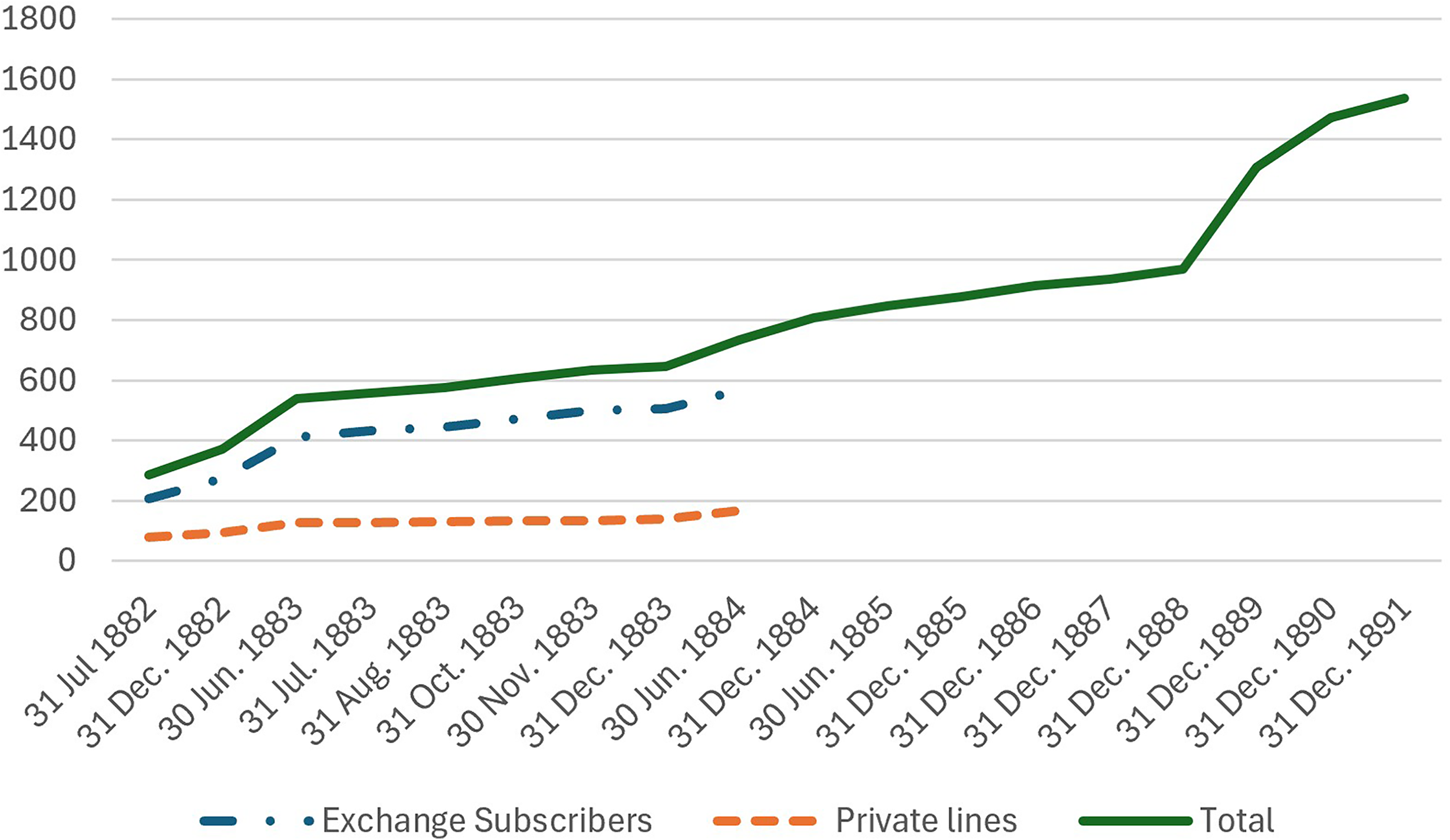
Numbers of exchange and private line subscribers of the Telephone Company of Ireland, 1882–91 (Note: the TCI stopped recording exchange and private lines separately in 1884). Source: Compiled by the author from Director's reports and statements of the accounts of the Telephone Company of Ireland, in Irish Times, 4 Apr., 10 Oct. 1884, 3 Apr. 1886, 1 Apr. 1887, 29 Mar. 1888, 25 Mar. 1889, 28 Apr. 1890, 22 July 1891, 9 Aug. 1892.
The continued restriction of the TCI's Dublin operations to a five-mile radius of the General Post Office (GPO) presented a considerable impediment to expanding its business. While telephone trunk lines were at this point in use in England, connecting cities such as London to Brighton and Manchester to Liverpool, they were erected by the Post Office – who charged the telephone companies for their use. In 1884 the Post Office began issuing its new ‘Fawcett Licences’ which allowed the TCI to operate over any distance, open public call-offices and construct its own trunk lines. Under the terms of this new licence, the Post Office was guaranteed ten percent royalty on the TCI's gross revenue over £8,000 per annum. The general perception that this new regulatory regime would increase the TCI's profitability was reflected in increased trading of the company's shares. 80
With its new licence the TCI entered a period of rapid expansion. In preparation, the company had constructed a telephone trunk line, along the Dublin, Wicklow and Wexford railway line, connecting Dublin to an exchange in Kingstown. This line was finished by October 1884 and with its licensing difficulties overcome, the TCI was offering to connect any premises in Kingstown, and within a mile of the railway line, to the exchange in Dublin. It also planned to extend its network to other areas and villages surrounding Dublin. 81 This push to the suburbs must be understood in the context of the spatial distribution of Dublin's middle-class. With the growth of tenement dwelling in the city, bound by the Grand and Royal canals, new suburban areas were developing beyond. These were primarily inhabited by the better-off. For example, by 1891 Dublin's population had grown to 349,594. This included 44,881 labourers and their dependents, yet only 8,952 of these lived beyond the canals. 82 These new suburbs allowed for the greater segregation of classes demanded by increased social stratification of Irish society. 83 This process led to concentrations of middle- and upper-class residents and such suburbs offered the potential for a healthy return on the outlay for telephone trunk lines. Thus, with the central business districts serviced, the TCI's next important customers were in the wealthy suburbs.
Using its new licence, the TCI opened six telephone call-offices, 84 allowing those unable to afford the annual subscription fee access to the telephone network. 85 Mr Joseph Bond Morgan (the UTC's representative on the TCI's board of directors) felt that a charge of 3d. per call in Dublin's suburbs and 6d. in Kingstown would be acceptable, with existing subscribers having free use. 86 In May 1888, the Dublin Chamber of Commerce discussed its ‘dissatisfaction with the new regulation imposed by the telephone company, by which members who are not subscribers to the telephone exchange are prevented from using the instruments without a payment of 3d for each time’. Such criticism highlights the utility of these offices to nonsubscribing businesses. Given the high cost of telephone rental, which was a complaint across the United Kingdom, such offices were the only way many could access this service. This is a reminder that subscriber numbers do not provide a complete picture of the telephone's infiltration and use. 87
The year 1885 saw continued expansion of the TCI's network. By October it had constructed a trunk line to Bray via Dalkey and Killiney and opened a branch exchange there to complement its existing exchange in Dame Street and branch exchanges in Rathmines, Blackrock, Kingstown and Dalkey. A call office in Bray attracted just the type of well-heeled ‘summer visitors [who] at a small charge could avail themselves of the advantage of the telephone in communication with other places while enjoying the fresh air’. 88 Thus, the enlarged middle class who emerged in the nineteenth century, fuelling the growth of Bray as a holiday resort, were important users of the telephone system. 89
The subscription rate for those within the four-mile city radius was £12 per annum with an additional charge of £3 per annum for communication to and from places outside of this, for example Kingstown. 90 The criteria for erecting local trunk lines were based purely on their ability to produce profit. While the TCI quickly developed lines ‘to the principal suburbs around Dublin’, wires to other areas would only ‘be erected as circumstances may justify the necessary outlay’. 91 The expansion of the service was to see moderate increases in turnover, reaching £3,985 2s. 1d. in 1887. 92 However, such sums did not match the considerable construction expenditure and the company needed to maintain a tight grip costs.
The construction of new lines presented the TCI with the opportunity to encourage telephone subscription from surrounding areas. For example, while erecting a line to the premises of Dr Eustace at Hampstead and Highfield, north of the city in Drumcondra, it quickly offered a telephone connection to the township commissioners. Despite their refusal, in 1890 the good doctor again highlighted the benefits of telephony to the commissioners. The area around Drumcondra had several institutions, as well as Dr Eustace's Private Lunatic Asylum. These included: St. Joseph's Asylum for the Male Blind; St. Mary's Asylum, St. Joseph's Reformatory, High Park Convent and the new (Roman Catholic) Archbishop's Palace. Eustace pointed out the benefits of telephony to such institutions, including rapid communication with the fire brigade, and the offer of a reduced subscription charge of £13 per annum if there were enough subscribers. This type of incentive made existing customers active agents in the recruitment of new subscribers. Despite such efforts the network's development was slow and restricted mainly to urban areas in this period. For example, by 1888 there were only 500 lines in Dublin. 93
In 1885, the TCI renegotiated its contract with the UTC, substituting payment from a percentage of its earnings to a standard charge per instrument. 94 The directors intended to use the money this saved to encourage private subscribers to the service. A reduced subscription rate would aid its push to the suburbs where these private, middle-class subscribers were located. As business subscribers made more use of the telephone, and hence ‘required a larger staff to serve them’, it was felt that the introduction of a reduced £10 per annum charge for private houses would not only prove profitable but also encourage subscribers. 95 The Irish focus on private households as an important customer base represents an interesting comparison to Britain and the United States where businesses were the primary users in the early years of development. Given the comparatively lower levels of such opportunities, the TCI was quick to seize on the potential of private as well as commercial clients, something that happened later in both North America and Britain. 96
The central drawback with the telephone system was the lack of long-distance trunk lines. In an effort to overcome this the TCI requested permission for direct telephonic connection to the GPO from where messages could be relayed using the national and international telegraph networks. 97 However, the high charges sought by the Post Office – £200 for a single wire and £300 for two – dashed such hopes. The ongoing erection of a telephone trunk line to Dundalk (with plans to connect to Belfast) would go some way to addressing such needs. 98 The first exchange established, by the TCI, outside of Dublin and its suburbs was opened in Dundalk in April 1886. This exchange operated ‘a call-fee system’ with subscribers charged per call rather than a set annual subscription charge. Within a year the company's directors announced that revenue at this exchange was covering operating expenses, and they were contemplating opening ‘exchanges in other towns upon the same system’. 99 The TCI's expansion continued and it opened an exchange in Cork city on 1 January 1889. Trunk lines were also constructed that year connecting Cork to outlying suburbs, including Queenstown, and the company was actively considering additional lines. Its directors were hopeful for the exchange's prospects. It had twenty-four subscribers upon opening but by 31 December 1889 this number had risen to 295. This was in stark contrast to the Post Office's telephone exchange in the city which despite operating for the previous three years had never gained more than thirty subscribers at any one time. The success of the Cork exchange encouraged the TCI to open a further exchange in Limerick, which was under construction by March 1889. 100
Telephone Trunk lines
Experimentation in long-distance telephonic communication continued throughout the early years of the technology's development. At a British Association meeting in July 1882 William Preece, the Post Office's chief engineer, highlighted the difficulties faced: while telephone conversations had been undertaken from Dover to Calais, they had not been possible over more than 100 miles of submarine cable. Preece was a central figure in the story of the telephone and telegraph in this period. His role in the Post Office provided him with extensive practical knowledge and the resources to engage in experimentation with new telephonic devices, publishing two books on the subject in 1889 and 1893. While Oliver Heaviside argued from 1887 that the clarity on telephone (and telegraph) lines could be improved with extra inductance, Preece dismissed this as a mathematic solution without practical application (this was the method later used to much success by American engineers). 101
In 1878, W.F. Barrett experimented with long-distance telephony between Norwich and London. It was obvious to Barrett that the barrier to communicating long distances was induction, particularly when telephone lines were in the proximity of telegraph lines. 102 Induction is produced when an electric current running through a wire in proximity to a telephone line causes it to mimic the current in the adjacent wire; reports of hearing other calls during a telephone conversation were evidence of this. For example, when the Royal Dublin Society tested an early telephone, a loud ticking was heard on the line. This was caused by the general electric clock system of the city. A similar problem had been experienced with long-distance telegraph lines, particularly submarine cables. 103 Induction was to be a serious problem for the early Bell telephone until Thomas Edison invented the carbon transmitter, which used a battery to power the telephone reducing the amount of current used and in tandem the amount of induction. However, difficulties continued with long-distance lines. 104 These technical issues combined with Post Office restrictions on trunk-line construction, led to the isolation of urban telephone exchanges.
With the removal of restrictions on telephone trunk-line construction in 1884, use of the technology for long-distance communication was becoming more realistic. The Irish Times as early as December 1884 was hopeful of the early establishment of a trunk line between Dublin and Belfast. Such a line would enable ‘communication between the Irish metropolis and the commercial capital of the country’. 105 Another ambition, expressed by J.B. Morgan, the UTC's managing director in 1884, was that ‘soon … they would be able to speak from Dublin or Kingstown to London’. 106 Such a service would provide Irish telephone subscribers with rapid access to that centre of political and financial information.
It would be 1890 before the TCI and NTC (which controlled telephony in Ulster) agreed to jointly construct a Dublin to Belfast telephone trunk line. However, the TCI had expended a great deal of its reserves developing Cork's telephone system and replacing iron wires with copper in Dublin. The drain on the company's finances was such that it could only pay the dividend on preference shares that year. 107 Thus, with its coffers depleted the TCI needed to raise extra capital to fund the proposed trunk line. There was little interest from existing shareholders and the directors were forced to turn to borrowing. 108 Despite the Postmaster General's insistence in April 1891 that ‘no public demand for a telephone service between Dublin and Belfast has hitherto been made to the Post Office’, the two private companies proceeded with the line. 109 In anticipation of increased traffic the TCI acquired a site for a new, larger telephone exchange from Dublin Corporation. 110
Ireland's first long-distance telephone trunk line, establishing an eastern telephone corridor from Dublin to Belfast (via exchanges at Dundalk, Drogheda and Balbriggan), was opened on 5 April 1892. Inauguration ceremonies were held in all the towns connected by the new line. Dublin's took place at the Chamber of Commerce, where several telephones were installed for the event. As well as directors of the TCI, several local notables and politicians were in attendance, with many taking advantage of the opportunity and exchanging ‘several messages’. A similar scene was witnessed in Belfast where the mayor presided over the ceremony. New call-offices at the company's headquarters in the Commercial Buildings, Dame Street and the Four Courts, as well as at all interconnecting telephone exchanges would further enhance access to this service. 111 While the rates for transmission were high – 1s. between Dublin and Belfast and 6d. from Dublin to the other towns – the line represented a tremendous opportunity to increase commerce between Ireland's two largest cities. V.B. Dillon, by then TCI chairman, during a short speech highlighted that such lines were commonplace in Britain. Dillon – well aware of the poor state of the TCI finances – stated his hope that the Post Office would provide Dublin with the same telephonic facilities as Paris, namely connectivity to London, as well as truck lines to major Irish cities. Such connectivity would allow Dublin's merchants to ‘communicate direct with their agents and representatives in London’ and to ‘receive replies in one moment from London, Liverpool, Manchester, Leeds, Bradford, and every important town in England’. 112
Developments in Britain
In April 1889 the three main British telephone companies, the UTC, the NTC, and the Lancashire and Cheshire, merged. The new company, retaining the name NTC, held a virtual monopoly over telephonic communication in Britain. 113 The new company would remain a significant TCI stockholder. Nonetheless, the TCI's chairman, V.B. Dillon, felt that ‘practically the work of this company [TCI] would for the present continue the same’. 114 In December and July of 1890 two of the NTC's patents expired, reducing the TCI's royalty payments. This obviously alleviated some financial pressures as the TCI stated its hope to reduce charges on customers when the rest of the NTC's patents expired in 1893. 115
By 1892 Irish telephony under the TCI had progressed significantly. It had exchanges in Dublin, with connections to many of the city's suburbs, Cork and Limerick. It also provided trunk-line connectivity between Dublin, Belfast, Dundalk, Balbriggan and Drogheda. The Post Office, having nationalised the telephone trunk lines that year, planned to construct a network of trunk lines throughout the United Kingdom, including a submarine connection between Ireland and Britain. 116 The TCI's directors placed much optimism in these developments, hoping to open exchanges in cities ‘such as Waterford, Kilkenny, Galway, &c’ if and when the ‘government carried out their proposals’. 117 The directors’ hopes highlights the need for state support for any future expansion of telephone provision in Ireland. Without government-funded trunk lines, exchanges in many cities would not be viable. Nevertheless, such direct state investment was a strong possibility (particularly given the similar outlay in purchasing and upgrading the island's telegraph network in 1870). Despite these hopes, the TCI's board of directors realised that even with Post Office trunk lines the company faced an uncertain future as it could not generate the capital required to fund its proposed expansion. In 1891 the company's efforts to expand and upgrade its network and the construction of a trunk line to Belfast had been funded by dividends and loans. The following year the company was again forced to postpone payment to shareholders. These funding difficulties continued into 1893 when there was a ‘large expenditure on capital account’ for maintenance and expansion. Added to this work, the TCI needed to upgrade its network and exchanges in Dublin, Cork, Limerick, Dundalk and Drogheda, in preparation for the laying of trunk lines by the Post Office. 118
Interestingly, little of the conversation about the expansion of telephony and the construction of trunk lines centred on its importance for the governance of Ireland. This is in strong contrast to the telegraph which was seen as an important ‘tool of empire’. 119 Telegraph development in Ireland was strongly influenced by the potential of connectivity via the island to North America and the imperial advantages that would bring. Within Ireland telegraph development and use, even when privately controlled in the period prior to 1870, was seen not just as a commercial development but also as a tool of the state. 120 The presence of the telegraph, its geographical reach across the island, and its extensive links to Britain and internationally meant the telephone could not match its utility in this regard. 121
By 1893 the TCI was in a precarious position, it had been unable to pay ordinary shareholders for a number of years and there was little appetite amongst these to provide additional capital with which to take advantage of any future trunk-line construction by the Post Office. While Irish banks did enter into longer term credit arrangements, there was a general reluctance to provide long-term loans. This could only add to the company's funding difficulties and in any case, borrowing was not a solution to long-term funding needs. The director's solution was a takeover by the NTC. This would provide the capital requirements for future expansion, while also being advantageous to TCI shareholders. 122 Such an agreement was also important to the NTC. One of the stipulations set down for trunk-line nationalisation was that the NTC would purchase all the telephone licences in the United Kingdom. This placed the TCI in a good bargaining position, for example the NTC purchased the Thanet Telephone Company for £20,100 even though its only asset was a five-mile private telephone line between Margate and Ramsgate. 123
A provisional agreement was reached in 1892, whereby the NTC would purchase the entire assets of the TCI for £81,300 and waive its right, as an ordinary shareholder, to any of this money. This would allow the TCI to repay its debts of £15,000 and pay £46,197 to preference shareholders and £20,103 to ordinary shareholders. 124 A final agreement between the two companies, dated 11 May 1893, was passed by TCI shareholders on 29 May 1893. V.B. Dillon highlighted the TCI's financial position: despite the generation of £6,000 in revenue the company had no money to pay shareholders. In Dillon's view ‘the shareholders were not prepared to find any further capital’ to fund the expansion and upgrading of the TCI network, demonstrated by the cancellation of a planned exchange in Waterford. The company had only been able to continue its upgrading work through the appropriation of the ordinary share dividend. The NTC, which owned half of the TCI's ordinary shares, was financially sound and could drive telephone expansion in Ireland. The shareholders were therefore left with the choice of continuing to deprive themselves of dividends in order to underfund the upgrading and expansion of the TCI's network or to sell their shares, recoup their unpaid dividend and allow the NTC to properly fund telephone services. Logic won the day and the shareholders agreed to sell the company to the NTC, for just over £98,000. The transaction was completed in April 1893. The directors of the TCI would be retained as a new Dublin board of the NTC, thus retaining local influence. 125 There appears to have been little nationalistic desire to retain the company or this board, and this was more about ensuring a local presence to aid in the smooth running of its operations in Ireland. (The NTC's purchase of the Home Telephone Co., Limited, in the same month completed the consolidation of the United Kingdom's telephone companies.) 126
Following the purchase of the TCI, the NTC entered into a period of aggressive expansion, during which it opened telephone exchanges and call offices in a number of towns. Between 1893 and 1903 telephony in Ireland under the NTC's guardianship made considerable advances. In Ulster a number of new offices opened with an improved trunk system providing greater connectivity between towns and cities. In the rest of Ireland, the telephone network also underwent significant improvements. Exchanges opened in many towns and trunk lines now connected many of the larger municipal centres to exchanges in outlying towns. For example, Cork city was connected to Queenstown (Cobh), Middleton, Blackrock and Passage. New telephone exchanges had been established in Galway and Limerick, with connections to other newly established exchanges in Tralee, Castleconnel and Roxborough. Significant progress had also been made in the continuation of the Dublin to Kilcock trunk line which now ran as far as Mullingar. In line with this physical expansion, its customer base increased from 2,837 to 9,985 in the same period. 127
Conclusion
Irish telephonic development was shaped by a multitude of technological, political, economic and social factors. While these were influenced by and mimic international and UK-wide developments, there was also much that was unique to the island in why and how telephony and the telephone system developed. The initial promotion of this novel technology drew on well-worn tactics, tapping into pre-existing interest in the spectacle of electricity to promote not just general telephonic technology but also specific brands. Given the relative simplicity of design and similarity of performance this was an important consideration for budding telephone entrepreneurs. Likewise, telephone promotors did not attempt to create a new market, for example selling it as a tool of domestic communication but rather looked to the users of the existing telegraph as its natural customers. Given the initial difficulties with communicating over distance – caused by technological limitations but also the monopoly on electronic inland telecommunications granted to the Post Office following telegraph nationalisation in 1870 – the telephone became popular as a replacement for short-distance communication within firms, replacing the pre-existing Wheatstone ABC telegraph. Likewise, the development of urban telephone exchanges to service business customers mimics developments in Britain and other countries and was permitted by the Post Office as it did not impact telegraph revenue. Despite similarities with such developments elsewhere, Ireland does represent an interesting case study.
The establishment of the TCI by the UTC points to the need for local political and commercial influence. Given the need to attract customers, including local government, police, other public institutions, and private businesses, the company's founding brought to the fore those who had the types of connections needed to pursue such customers. Likewise, establishing exchanges and erecting numerous telephone cables required negotiation with local government particularly the requirement for wayleave for cables. Thus, local notables were essential to driving the adoption and expansion of the telephone network. The relatively sparse business base (in comparison to places such as England and the United States) was to spur an early focus on residential users. The push to the Dublin suburbs was essential not only to connect potential businesses there but also to access the middle class. As the restrictions on trunk lines slowly lessened this trend continued with the laying of such cables to places like Bray.
While the TCI had some success, opening exchanges in a number of urban areas and their surrounding suburbs and laying a substantial trunk line along the east coast of the island, its eventual absorption by the NCT points to the difficulties the firm faced as it attempted to promote such a novel technology in nineteenth-century Ireland. While the funds raised from investors were sufficient for the company's initial needs, they were not adequate in the medium-to-long term. The TCI's failed request for additional capital from its investors to construct the Dublin-to-Belfast trunk line is indicative of this and the wider conservatism of Irish investors. The company continued to generate sufficient revenue to meet its operating costs. However, the proposed development of Post Office trunk lines would require the TCI to significantly upgrade its own infrastructure. These upgrades alongside the further expansion such trunk lines would bring could not be funded by continued borrowing. The only alternative to the continued underfunding of the telephone system and the denial of shareholder's dividends was to sell the company to the NTC, which was completed in 1893. The NTC's formation in 1889 and the decision of the Post Office to assume responsibility for trunk-line telephony would have a dramatic impact on Ireland's telephone network. It points to the maturing of this technology which was increasingly seen as an alternative to telegraphy for longer distance as well as urban communication. Indeed while the use of telegraphy for international communication would remain strong, by the early twentieth century telephony was beginning to impact the volume of inland telegrams transmitted. 128 The impact of telephony on telegraph revenue and the increasing utility of the telephone (which like the telegraph was coming to be seen as an important public utility) led to the eventual nationalisation of the NTC's operations in 1911.
Footnotes
Acknowledgements
The author would like to thank Dr Jacinta Prunty (Department of History, Maynooth University) for all her assistance and perseverance is reading drafts of this work. Thanks are also extended to the editors Dr Juliana Adelman and Dr Sarah Roddy for their support and the anonymous reviewers for their considerate and constructive feedback.
Funding
The author disclosed receipt of the following financial support for the research, authorship, and/or publication of this article: This work was supported by the Irish Research Council.
Declaration of Conflicting Interests
The author declared no potential conflicts of interest with respect to the research, authorship, and/or publication of this article.
