






Abstract
Economic developments within Ireland from the opening of the second millennium to the early fourteenth century are discussed within the context of the European commercial revolution, which, across the same period, promoted exchange at all levels before succumbing to a prolonged and deepening recession. The reversal of trends from expansion to contraction began earlier and was more pronounced in Ireland than in Europe's core commercial regions, partly because of the higher transaction costs consequent upon its peripheral geographical location but more particularly due to its susceptibility to surplus extraction by outsiders: the Papacy, English Crown, and overseas merchants, financiers and shippers. The systemic under-investment and indebtedness consequent upon these unequal relationships conspired to depress domestic demand and reinforce an over-dependence upon primary production. When compounded, within the areas subject to English rule, by weakening central and local government, this created a heightened vulnerability to food shortages, to which a resort to violence by both the Irish and the degenerate English became an ever more standard response. A vicious circle was thereby set in train which entrapped the English Crown's once-prosperous Irish lordship in a self-perpetuating state of impoverishment and under-development.
Introduction: Ireland and the European ‘Commercial Revolution’
Between c.1190 and 1265 – the period spanned by the remarkable Dublin Guild Merchant Roll – men from as far away as Aachen and Cologne in Germany, Antwerp and Bruges in Flanders, Paris, Dinan, Bordeaux, Toulouse and Lyons in France, Pamplona and Cordova in, respectively, northern and southern Spain, and Lucca and Prato in central Italy were admitted to Dublin's merchant guild. 1 All came from a wide commercial orbit focused on the North Sea and Atlantic which, by the opening of the thirteenth century, had developed to become the westernmost link in a chain of commercial circuits spanning the whole of Eurasia, from east to west, to form an inter-connected Old World system of trade (Figure 1). 2 These developments were several centuries in the making and in Europe constituted what has become known as the Commercial Revolution. 3 One measure of that revolution's progress is the more than doubling of the number of European cities with populations of at least 10,000 from 81 in 1000 to 172 in 1300 and an aggregate growth in the numbers dwelling in them from 1.75 m. to 4.37 m., with the largest cities of all increasing in size until the five largest each supported 100,000 or more inhabitants. 4 Nowhere was that urban growth more pronounced than in European commerce's twin nerve centres of Italy and Flanders, whose commercial tentacles extended as far as Ireland.
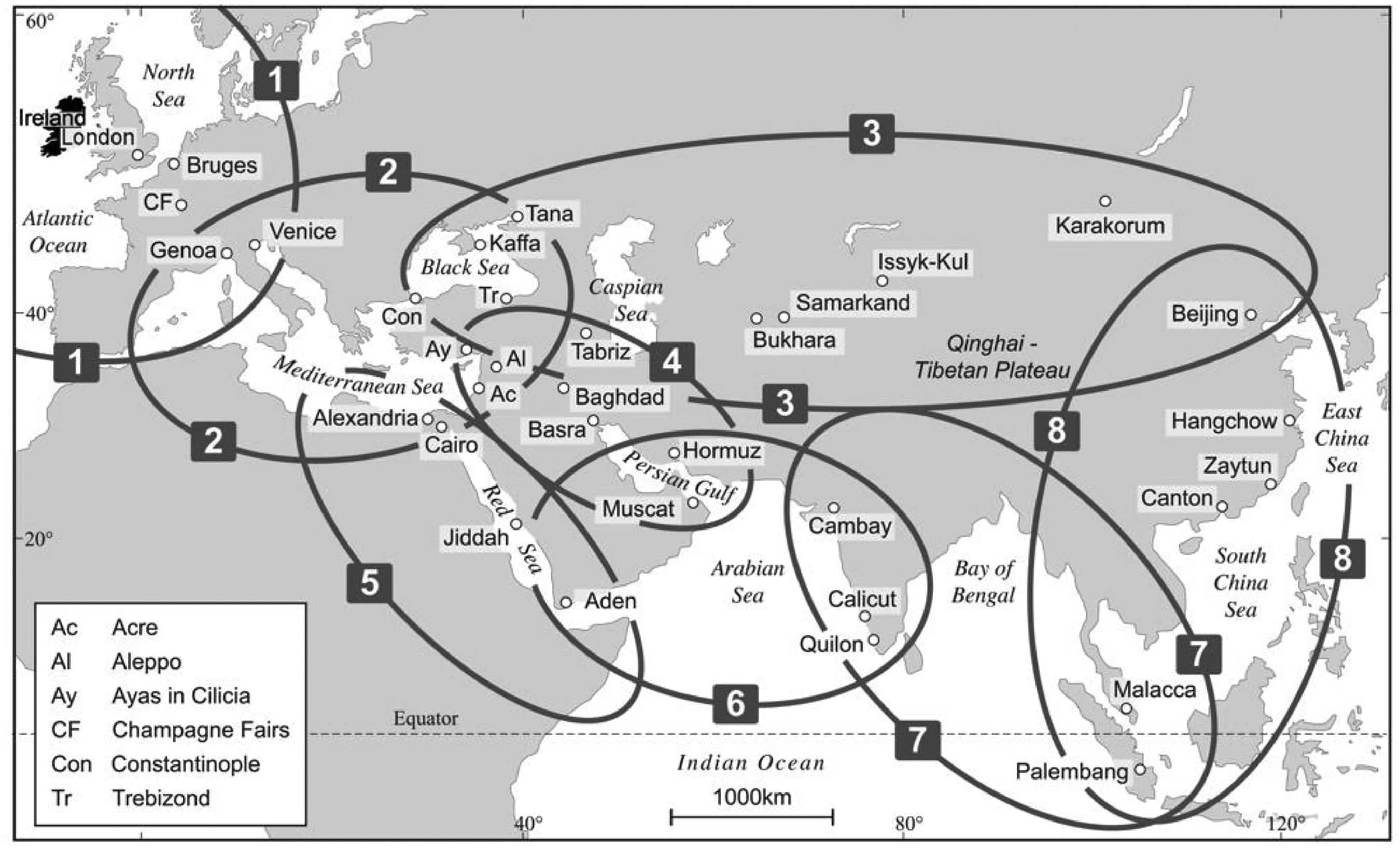
Ireland's place within the thirteenth-century world system of exchange. Source: Bruce M. S. Campbell, The Great Transition: Climate, Disease and Society in the Late-Medieval World (Cambridge, 2016), p. 32; based upon Janet L. Abu-Lughod, Before European Hegemony: The World System A.D. 1250–1350 (Oxford, 1989), p. 34.
It was when the centrifugal tendencies engendered by this commercial revolution were at their strongest that the English invaded Ireland, leading to creation of the Lordship of Ireland, held as a papal fief from Rome. After more than a century of conquest and colonization, almost two-thirds of the land of Ireland and a somewhat larger share of its population (boosted by significant immigration) had been brought under English rule. Divided into shires and liberties administered by sheriffs and seneschals, this was the area whose revenues were accounted for at the Dublin exchequer. It encompassed the hinterlands of all the customable ports, from Carrickfergus in the northeast round to Galway in the west, within which the cattle and sheep were reared whose hides, fleeces and wool constituted the chief dutiable exports. 5 The dioceses within the Lordship contributed over 80 per cent of the revenues raised by the Pope Nicholas’s taxation of 1303–06 and natives and newcomers alike paid tithes and other dues to the Church. 6 Here, too, lived the bulk of all Irish townspeople. 7 At the height of English power, the Lordship probably accounted for at least two-thirds and possibly as much as three-quarters of all Irish economic activity and within it occurred the lion's share of all commercial and almost all monetized exchange. Gaelic society, both inside and outside the Lordship, was not untouched by commerce, but its fortunes were less bound up with those of the wider European commercial system.
Since the beginning of the second millennium, Ireland had become increasingly exposed to external cultural and commercial influences and following the English invasion, during the boom years of the European Commercial Revolution, they lent added momentum to Ireland's own commercial efflorescence. While the wider European economy prospered and external demand for Ireland's staple products grew in strength, the Lordship's fortunes remained buoyant, and its ports became integrated into developing networks of maritime trade. But when, towards the end of the thirteenth century, progress began to falter and a profound commercial recession took hold, Ireland was one of the first regions to feel the squeeze and the revenues yielded by the Lordship to the English Crown entered terminal decline. 8 The worsening international situation exacerbated mounting domestic difficulties to the disadvantage of both natives and newcomers.
The Rising Tide
By 1169, when the vanguard of Richard de Clare's (alias Strongbow's) forces invaded Ireland, and 1171, when Henry II intervened, economic activity and populations had been expanding throughout Christendom for the better part of 150 years and were on a powerful upward trajectory. In the process, the terms on which people made their living were being transformed. Everywhere, more people were becoming more dependent upon the market for more of their livelihoods as trade at all levels – locally, regionally, nationally and internationally – expanded. 9 Seventy years after the Invasion, it was via these multiple trade linkages that the sultan of Babylon obtained the Australasian yellow-crested white cockatoo that he gifted to King Frederick II of Sicily. 10 Cargoes of silks, ceramics, spices, dyestuffs and precious pigments reached Europe by a similar route as well as, from the 1230s, by caravan across inner Eurasia, once the creation of the Mongol Empire had reopened the Silk Road. A trickle of these exotic commodities eventually travelled as far west as Ireland, to be retailed, no doubt, by the merchants, mercers, spicers and haber-dashers listed in the Dublin Guild Merchant Roll. 11 The island's own chief contribution to this international exchange of merchandise was the low-grade wool from seigniorial and peasant flocks which found its way into the cheap, light sayetteries and other draperies legeres which, for long, were the staple of the Flemish textile industry. Once dyed and finished in Italy, these colourful and affordable textiles were marketed in quantity in southern European and Levantine markets. 12
To offset its trade imbalance with Asia and fund the growing monetization of transactions, Europe required increasing supplies of silver which it obtained by opening and exploiting mines in, successively, northern England, Saxony, Bohemia, Sardinia and the Balkans. 13 The rising output from these mines – a proxy for the expansion of Europe's monetized commercial economy – is witnessed by increased levels of lead pollution preserved in thirteen accurately dated ice cores from Greenland and Severnaya Zemlya in the Russian high Arctic. 14 After a temporary upturn at the end of the tenth century, significantly elevated levels of pollution prevailed from the early twelfth century, with a notable peak in the 1180s and 1190s, and then a more sustained rise from the 1250s until the 1320s, when the main sources of silver ore became exhausted (Figure 2). As the amount of silver currency per head rose, so, in place of barter, more complex patterns of multi-lateral exchange were able to evolve.
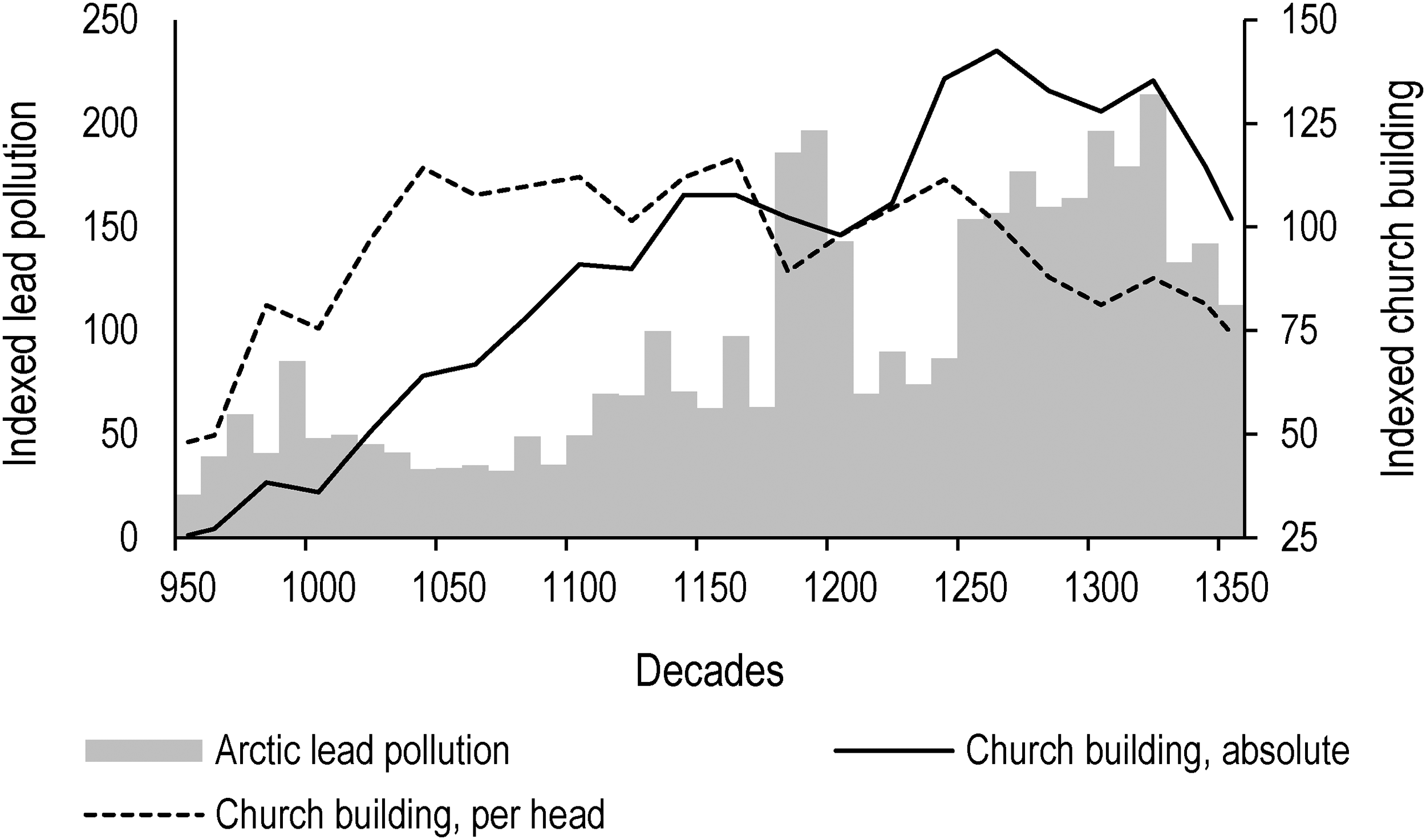
Indexed Arctic lead pollution from European silver mining and urban church building in seven European countries, 950–1350 CE (100 = mean 1000–1350 CE). Sources: Joseph R. McConnell, Nathan J. Chellman, Andrew I. Wilson et al., ‘Pervasive Arctic Lead Pollution Suggests Substantial Growth in Medieval Silver Production Modulated by Plague, Climate, and Conflict’, Proceedings of the National Academy of Sciences, 116:30 (2019), 14910–15; Eltjo Buringh, Bruce M. S. Campbell, Auke Rijpma and Jan Luiten van Zanden, ‘Church Building and the Economy During Europe's “Age of the Cathedrals”, 700–1500 CE’, Explorations in Economic History, 75:2 (2020), 119–30.
In a devoutly Christian age, one of the most conspicuous manifestations of the prosperity generated by these developments was a widespread building boom and especially, as towns proliferated, expanded and grew, in the erection of ever-larger urban churches – episcopal, conventual and parochial. Because the foundation and erection of churches is so well recorded and their different building phases can be dated architecturally with reasonable accuracy, church building is one of the most measurable manifestations of the Commercial Revolution. 15 Figure 2 reports the estimated total volume of church building per decade for the seven core European countries of Italy, Switzerland, France, Germany, the Netherlands, Belgium and Britain across the 700 years from c.750 to 1450 CE. Whether measured absolutely, in terms of the cubic volume of devotional space added per decade, or relatively, per head of total population, or per head of the estimated urban population, the sustained upturn in building activity that set in from the end of the tenth century is clear. Until the 1140s, church building rose both absolutely and relatively for decade upon decade, without interruption, to levels three to four times those prevailing at the start of the boom. After a lull, church building then rose further to an absolute peak in the 1260s, spurred in part by the innovative architectural opportunities created by the new Gothic style. In contrast, from the 1150s, church building per head ceased to increase, as new construction activity was matched by the growth of population. Thereafter, from the 1260s, a clear and prolonged contraction in church building per head set in, as living standards eroded and prosperity ebbed away, reinforced from the 1320s by a sharp decline in the absolute volume of church building as the deepening commercial recession tightened its grip. 16
A rising tide lifts all ships, and from the 1020s, there is evidence that Ireland, too, was becoming drawn into the quickening tempo of economic life evident in so much of the rest of Europe and sustained by the dynamism of its twin commercial hubs in central and northern Italy and Flanders. In fact, Benjamin Hudson believes that, independently of these developments on the continent, already by the end of the tenth century, the newly established Hiberno-Norse fortified trading towns, led by Dublin, had acquired fleets, asserted their control of maritime commerce, and in the case of Dublin established a mint.
17
In his view, so precocious were these commercial developments within the Irish Sea province that it took until the end of the eleventh century for the rest of North Atlantic Europe to catch up, from which point developments in Ireland proceeded at ‘the general rate of economic change found elsewhere in Europe’.
18
Andrew Woods has drawn upon numismatic and archaeological evidence to summarize what this meant for Dublin: The earliest coin from Dublin dates to the late ninth century and there was a peak in coin-use in the middle of the eleventh century. It is likely that this represented both an expanding economy and an increasingly monetized environment. Other archaeological proxies suggest that the eleventh century was a boom time for the town. It roughly doubled in size between 1000 and 1100, several churches were founded and there is archaeological evidence for economic specialization. Occurring alongside this economic growth was the emergence of a monetary mentality within the town.
19
Dublin was no doubt exceptional, but the vibrancy of the age was by no means confined to the coastal towns, for Tomás Ó Carragáin has detected a notable upturn in references to churches in the Irish Annals after c.1010, and especially to churches constructed of stone, of which there are many extant remains. 20 Most were rural churches and decidedly modest in scale but, as Figure 3 shows, the parallel between this Irish church-building chronology and the post-millennium boom in church building elsewhere in Europe is uncanny. Similarly, dendrochronologically dated Irish oak samples, many of them from excavations conducted in the former Hiberno-Norse coastal towns of Dublin, Wexford, Waterford and Cork, identify onset of a 200-year building boom from the 1040s (Figure 4). This shows up as increasing numbers of oaks being felled for construction and a widening excess of end over start dates, as is consistent with a pattern of net woodland depletion. 21 On this evidence, the Irish building boom in oak which began in the mid-eleventh century reached its peak on the eve of the English invasion in the mid-twelfth century. 22 Thereafter, felling at these high rates proved unsustainable, which is why depletion rates subsequently diminished, although it would be another 200 years before net depletion gave way to regeneration. These trends also help to explain why twelfth-century church builders increasingly switched from wood to stone as their preferred construction material (Figure 3).
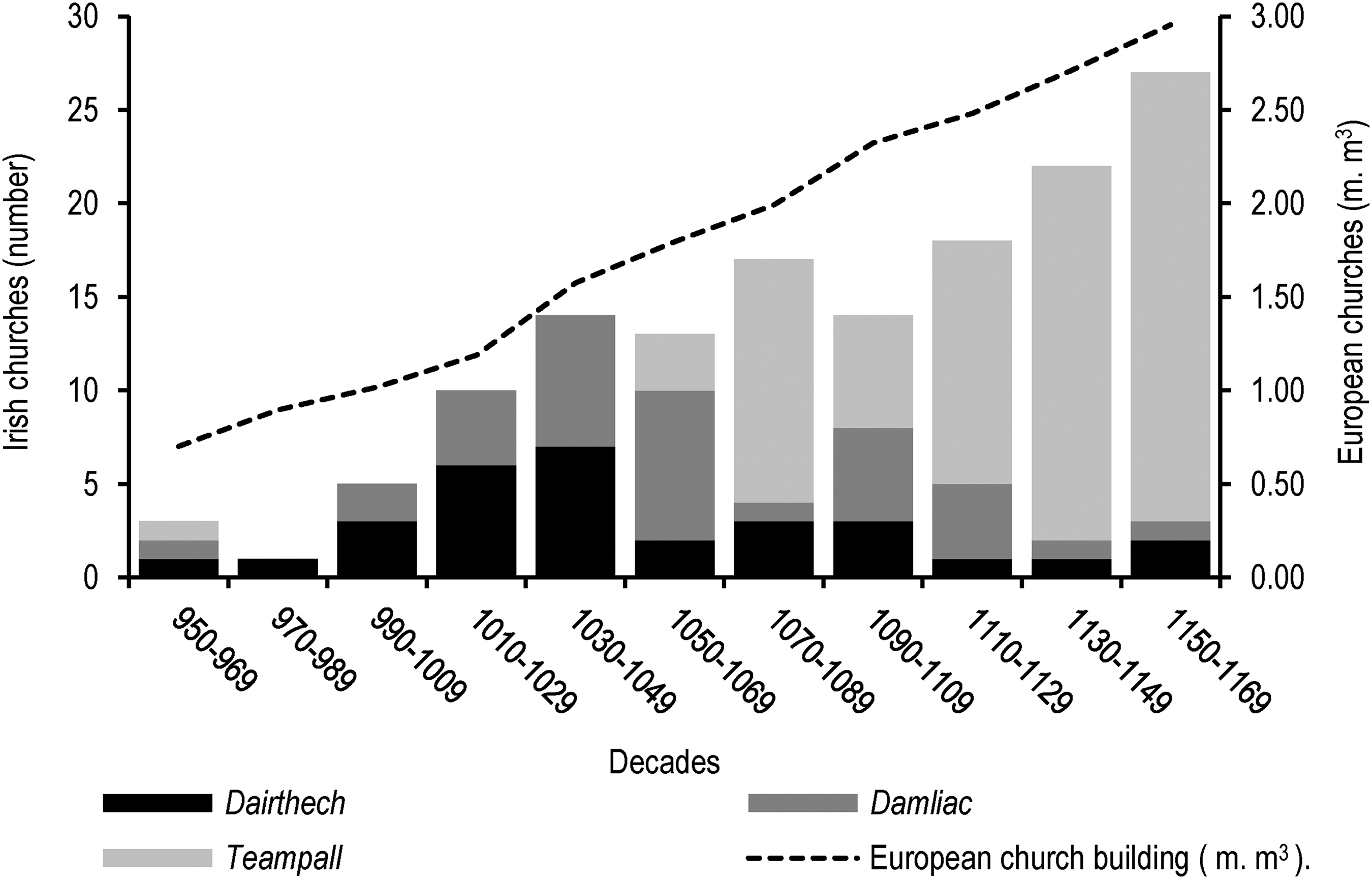
References to churches in the Irish Annals and the aggregate volume (in millions of cubic metres) of urban church building in seven European countries, 950–1169 CE. Sources: Tomás Ó Carragáin, Churches in Early Medieval Ireland: Architecture, Ritual and Memory (New Haven and London, 2010), p. 111; Figure 2, above.
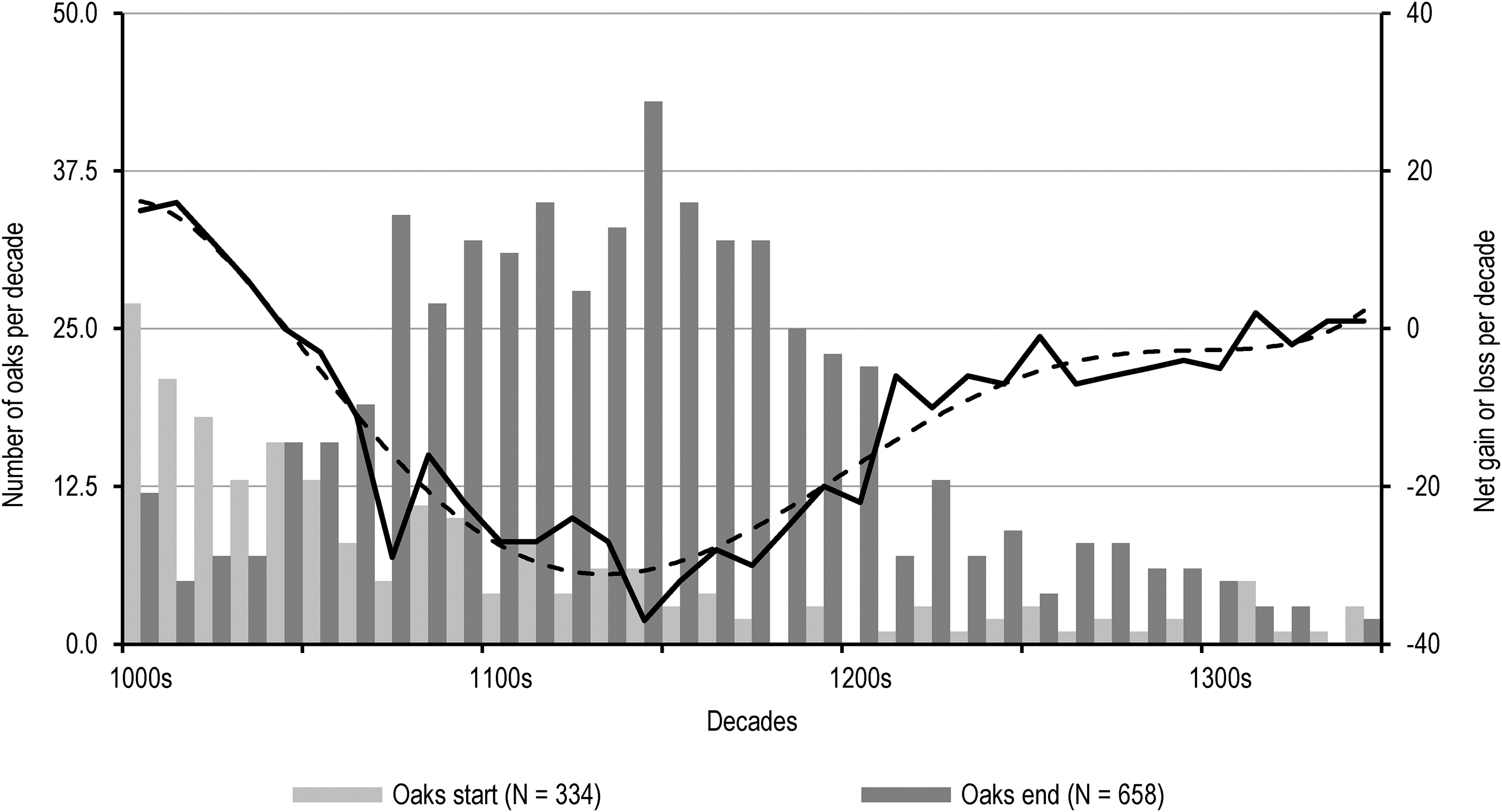
Dendrochronological evidence of the post-1050 CE net depletion of Irish oak woodland. Source: Oak sample data supplied by David Brown of the Queen's University of Belfast dendrochronology laboratory.
Taken together, the numismatic evidence from Dublin and the more general chronologies of church building and oak felling and depletion are symptomatic of a Gaelic society which for a hundred years or more prior to the English invasion was anything but static. 23 From early in the twelfth century, significant political developments were also afoot, with the emergence of dynastic kingship, enhancement of royal powers and the redefinition of lordship. 24 At the same time, efforts began to bring the Irish Church more into line with that of Rome and, in a telling indication of Ireland's increasing openness to European influences, in c.1127, 1139 and 1142, the first religious houses belonging to the continental Savignac and Cistercian orders were founded. 25 This chimes with the picture now also emerging of Ireland's expanding economy.
Parallel developments had been taking place in England whose larger population, unified Roman Church, more centralized state, developed feudal structure and fuller exposure to continental influences lent them greater momentum. 26 With the descendants of the new post-conquest Norman lords now securely established on their estates, the middle decades of the twelfth century stand out as a particularly dynamic period. A wave of new monastic foundations, many belonging to the new reformed religious orders, notably the Augustinian canons, the Cistercians, and the Knights Hospitaller and Templar, reflected the religious and crusading fervour of the age. 27 Meanwhile, ‘commerce increasingly pervaded everyday life’, spurred on from the 1130s by the opening of silver-bearing ores in northern England and rising money supply per head. 28 This bore fruit in an upsurge of newly chartered boroughs, followed, a generation later, by the active foundation of markets and fairs. 29 In the north of England, the lands so ruthlessly wasted by William the Conqueror were actively being resettled with the encouragement of those with estates within the region, in East Anglia the low-lying silt fens were being drained and settled by an enterprising and fast-growing population of free tenants, and the lords of the Welsh Marches were aggressively pushing west, deeper into Wales, with colonists following in their wake. 30 Similar colonizing movements were taking place elsewhere in Europe as powerful centrifugal forces generated by the Commercial Revolution thrust people and merchants outwards into Europe's geographically peripheral regions in a quest for land, markets, and supplies of cheap foodstuffs and raw materials. 31 The opening of fresh silver-bearing ores at Freiberg in Germany from 1168 provided a further monetary stimulus to this expansion. 32 It was as this economic wave reached its crest that, with fortuitous timing, the English invasion of Ireland was launched.
The Invasion's principal protagonists – Richard de Clare and his comrades in arms, Robert FitzStephen, Maurice de Prendergast and Maurice FitzGerald – were greater in ambition than in means and were therefore incapable of invading Ireland in support of the deposed Diarmait Mac Murchada without significant financial assistance. 33 Because the risks were high, and ships, provisions, men, and arms were all needed and were costly to obtain, Mac Murchada and de Clare turned to Christian and Jewish financiers to back their enterprise, not least Robert fitz Harding of Bristol. 34 From the outset, therefore, commercial ambition and opportunism – of the backers if not necessarily of the combatants – were key ingredients of the project and overrode whatever ethical scruples those involved may have had about the invasion of a fellow Christian country.
Once Henry II chose to become personally involved, the endeavour became an even more expensive undertaking. According to the Pipe Rolls, £2,852 – a colossal sum by the values of the day and given the overall resources of the English economy – was spent transporting the king, his retinue, and 500 knights and their followers, horses and equipment to Ireland, and there were additional costs on top of that. 35 Clearly there was an expectation that commercially as well as politically the venture was worth the expenditure. Since a fleet of 400 ships was required, Bristol's practical support is, again, likely to have been critical. Jewish money lenders also provided finance, and a levy was imposed upon the city of London. 36 Payback came in the form of trading concessions and privileges, ‘with Dublin itself ceded to the king's men of Bristol as a colonial outpost’, and from plunder and booty, as in the case of the sacking of Limerick in 1175. 37 The spoils of conquest could be lucrative and, as the success of the First Crusade 70 years earlier had so dramatically demonstrated, once the conquest had been secured, there was the further lucrative prospect for those with a stake in the project of a steady flow of revenues from the profits of trade, tolls, taxes, rents, and much else. 38
High Tide
The methods used to consolidate control of the conquered territories were similar to those recently employed in Wales by the territorially expansionist Marcher lords and were characteristic of these commercializing times. 39 Defence was an immediate priority, manifest in a widespread programme of castle building, starting with simple earthwork and timber castles, backed up in due course by stone castles at strategic sites. 40 Furtherance of Church reform followed, to bring Ireland institutionally more fully into alignment with the rest of Christendom, as also to help legitimize the conquest and, on Gerald of Wales's questionable account, recompense the Papacy for approval of the venture. 41 This included the foundation and re-foundation of large numbers of religious houses, with the Cistercians, in particular, being used as colonizers of inferior land and as politically neutral buffers in contested frontier zones. With the exception of Wexford, swiftly regranted by Henry II to Richard de Clare, the fortified Hiberno-Norse towns of Dublin, Waterford, Cork and Limerick were absorbed into the royal demesne and incorporated by the grant of royal charters specifying the rights, freedoms and privileges subsequently so prized by these municipalities. 42 In addition, as was characteristic of other contemporary colonization movements, a raft of new towns was founded: ‘not the castellum only but the bourg, not garrison colonies only but colonies of chapmen; garrison and market towns, were the Norman instruments to quell and to civilise the troubled or thinly occupied region’. 43 Towns, in fact, were an intrinsic part of the whole colonial enterprise and, since Ireland had so few to begin with, were one of its most transformative consequences. They, and the privileged burgess tenure and status which they offered, helped recruit colonists imbued with a commercial ethos. 44 The success of this policy is evident in the steady stream of men, often from urban backgrounds, who came to Dublin from all over Britain and beyond and enrolled in its merchant guild so that they might practise their trades and crafts without let or hindrance. 45
Agricultural production nevertheless remained fundamental to the viability of the whole colonial enterprise. The land itself was divided into lordships held from the Crown by feudal tenure and then further subdivided and subinfeudated into lesser estates, with manors providing the local units, whereby an immigrant population from Wales and England was settled on the land. 46 Many were lured to Ireland by the prospect of larger holdings held on more generous terms, usually unencumbered by servile status, than they could have obtained at home in Britain. Unsurprisingly, the density of colonization varied a great deal geographically, with the abundance of alternative opportunities providing prospective settlers with a great deal of choice about where they went, although with such decisions shaped in part by whence they had come. 47 Those taking ship from Bristol or one of the south Welsh ports were most likely to enter Ireland via one of the country's south-coast ports, whereas those coming from Chester or any of the other north-western ports were more likely to disembark at Dublin or one of the other east-coast ports. 48
Because the Lordship was established as a satellite of the kingdom of England, it was early provided with a government structure modelled on that of Westminster and serviced by the relevant bureaucracy, with an exchequer and treasury based in Dublin, which became the Lordship's political capital and the base from which its peripatetic administration operated. 49 Its officials were appointed by the Crown and by the Crown's representative in Ireland, the justiciar, and financially, the administration was accountable to London. The net revenues of the Lordship provided a lucrative source of income to the Crown, along with the rights to levy taxes and purvey goods. A portion of these revenues were generated by the administration of justice and a further component of the colonial project was the imposition of a legal system modelled on that in England, headed by the justiciar, from which, divisively and at some financial sacrifice, the native Irish population was nevertheless excluded. 50 A reliable silver coinage, minted under licence from the Crown, was fundamental to the effective operation of all these administrative activities, as it was to the conduct of trade at all levels. Early on, therefore, the Lordship was provided with its own sterling coinage and by the mid-thirteenth century it had become integrated into a Sterling Area encompassing, de facto, the whole of the British Isles, within which coins minted in England, Scotland and Ireland circulated freely. 51 The Invasion may have originated as an unscrupulous armed land grab but swiftly, once Henry II became involved, it was transformed into something altogether more ambitious and enduring. Once the political status of the conquered territories had been settled, Henry's intention, as manifest in his immediate self-interested treatment of the Hiberno-Norse towns, was to facilitate and promote domestic and international trade with all the material benefits for those within its compass which this was likely to yield.
Collectively, these institutional initiatives and innovations changed the character of the economic expansion already under way in Ireland and lent added impetus to it, integrating Ireland in general and its English lordship in particular more firmly and fully into the widening orbit of European and especially British commerce. 52 On the principle of violence first and clemency after, once the initial destructive shock of conquest had been absorbed, the substantial injections of enterprise, organization, know-how, manpower and capital that followed generated a veritable economic boom. ‘Prosperity’, as James Lydon observed, was evident: ‘Ireland was now beginning to show a return on the heavy investment made by the first generation of settlers’. 53 A dynamic new economic order had been created, and for a time, until the stimulus of these investments and innovations wore off, the Lordship prospered much as G. H. Orpen, so influentially, believed that it did. 54 It was a prosperity from which none were excluded but in which the English and Gaelic Irish shared unequally.
Quantitative measures of Orpen's ‘manifest progress and prosperity’ are nevertheless elusive. Almost alone in their chronological precision are the foundation dates of religious houses, as compiled by Aubrey Gwynn and Neville Hadcock. 55 These highlight the surge in the foundation of abbeys and priories that followed the Invasion, which peaked in the opening years of the thirteenth century and then continued at a diminishing rate until the 1220s, when the initiative passed to the mendicants (Figure 5). Some of these were native foundations and continued the trend begun decades earlier, but most originated as foundations endowed by Ireland's new territorial lords, as was exclusively the case of the crusading orders of Knights Templar and Hospitaller. It was a boom which post-dated that of England by half a century and which, in the case of monastic houses, had largely run its course by the 1240s. It was prolonged into the 1260s by the continued foundation, mostly in towns, of the friaries, by which time the Lordship was well provided with religious houses of all types. 56 By its very nature, this chronology of foundation must have been accompanied by a corresponding construction boom, for the planning and erection of a standard Cistercian or Augustinian house, comprising both the church and its considerable conventual buildings, were a substantial and protracted undertaking. The utilitarian architectural design and execution of portions of these buildings implies that, with so many projects simultaneously going forward, skilled stone masons, initially mostly recruited from England, were in short supply and were often reserved for the most prestigious parts of the monastic church and complex.
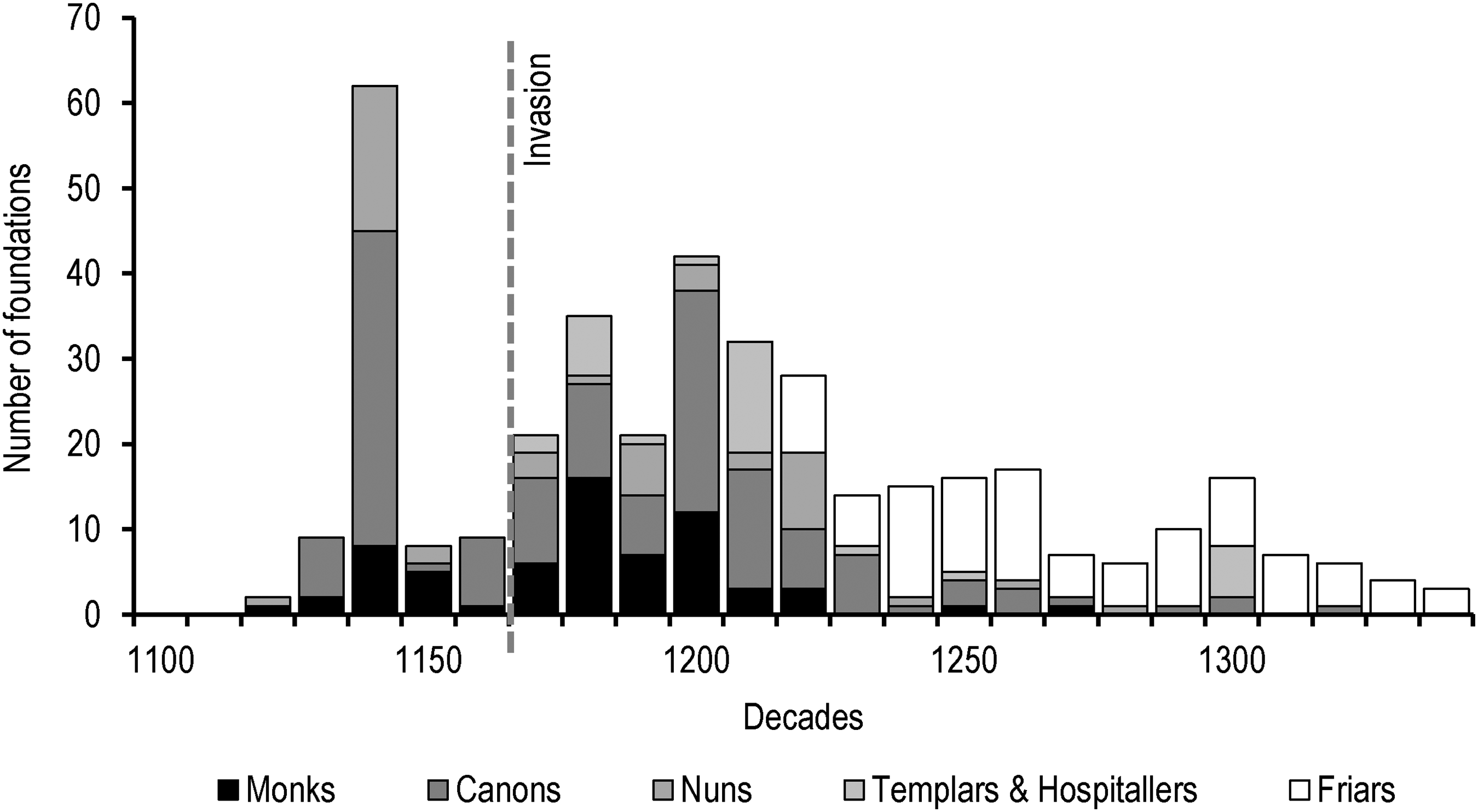
The chronology of Irish religious foundations, 1100–1349 CE. Source: Aubrey Gwynn and R. Neville Hadcock, Medieval Religious Houses: Ireland: With an Appendix to Early Sites (London, 1970).
At the same time, the great project to provide the Lordship with a network of towns was actively being pushed forward. Due to the paucity of extant relevant documentation, Irish urban historians have concentrated more upon locating and mapping places which possessed some semblance of urban status than, as in England, tracking the dates at which they were founded. 57 Nonetheless, it is plain that the bulk of the places which eventually evolved into functioning towns had been granted their borough status well before 1250. What became the thriving twin borough of Drogheda and second city of the urban system headed by Dublin was granted its first municipal charter in 1194 (to Drogheda in Co. Meath) and its second in 1229 (to Drogheda in Co. Louth). 58 The freedoms granted to the citizens of Drogheda were modelled on those of the Norman town of Breteuil, as was the case of numbers of other boroughs founded by lords with estates in Wales, where these laws had been introduced by William FitzOsbern, earl of Hereford. 59 These were based upon those of his hometown of Breteuil in Normandy. 60
Kilkenny, which received its foundation charter in 1207 and eventually became the Lordship's most important inland town, was another urban success story. 61 Fethard, Co. Tipperary, founded at about that time by William de Briouze, was far smaller but proved equally enduring. 62 By 1227, when the borough of Rindoon, Co. Roscommon, was founded in a politically advanced and militarily exposed position, on the western shore of Lough Ree adjacent to one of the royal castles that defended the Lordship's western frontier, the peak in borough foundation had probably passed, especially in the, by then, more settled lands to the east of the River Shannon. 63 Significantly, of those first charters published by Gearoid Mac Niocaill, more date from the opening quarter of the thirteenth century than at any other time between 1171 and 1300. 64 Many of the newly founded boroughs remained boroughs in little more than name and status but the most successful, like Drogheda, Kilkenny and Fethard, put down firm roots, became nodes in a developing urban network, prospered and endured. 65
By and large, however, it was the former Hiberno-Norse trading towns, all coastal, most of them advantageously located, and all but Wexford privileged by permanent incorporation into the royal demesne, that flourished most, once they had recovered from being sacked by the English invaders. Waterford's post-Invasion growth, no doubt bolstered by significant immigration from Britain and underpinned by a thriving export trade in which alien merchants played a prominent role, was accommodated by the addition of a spacious planned walled extension to the west of the original Viking longphort, which more than doubled the city's area. 66 Later, the city's walls were extended even further to incorporate a former suburb to the south.
Dublin's growth was also impressive, as the city thrived on its newly enhanced political and administrative status. It soon outgrew even its enlarged walled area and spawned extramural and trans-pontine suburbs where many of its displaced pre-Invasion inhabitants relocated. 67 The 1220s was a boom decade for Dublin: its walls, towers and gates and imposing royal castle were completed; work began on the new Dominican friary of St Saviour and a new church for the Augustinian priory of St Thomas; and a start was made on erection of the new cathedral church of St Patrick, constructed on a grand scale and in the Gothic style. 68 For some time, admissions to the city's merchant guild had been averaging over 110 a year, as men from far and wide, both from within Ireland but more commonly from outside, flocked to the city to do business. Then, in 1225–6, admissions rose to a peak of 224, never again to be exceeded, although lesser peaks followed in 1232–3 and 1237–9. 69 Such elevated numbers of admissions imply that commercial optimism must have been running at a high level, as the city grew in importance, reputation, size and appetite. At that time, Dublin's future prosperity, along with that of the Lordship of which it was the political and de facto ecclesiastical capital, must have seemed assured. Yet within another generation, it was becoming clear that the initial post-Invasion burst of creative energy and surge of commercially driven growth had largely run its course. Expansion ceased, and it was only a matter of time before contraction set in.
The Tide Turns
Mary Donovan O'Sullivan, writing in 1962 and in a major revision to the view advanced by Orpen in 1911, was in no doubt that the decisive turning point in the Lordship's fortunes came in the 1280s:
70
…as far back as the 1280s, in the early years of Edward I's reign, the process of decay had begun and was daily extending throughout the whole system. … A steady drain of men, money, and supplies to the English armies weakened the Norman settlement both at the administrative centre and throughout the whole country. Edward I, in particular, made such heavy demands upon Ireland that before the end of his reign he left the treasury empty, immense debts unpaid, and the government in Dublin virtually bankrupt. … Edward II continued the process of exploitation in the most reckless manner … Eventually, about 1312 [i.e., before the 1315 Scottish invasion] the point was reached when the Irish government, once so prolific of its resources in the service of the Crown, found itself dependent upon the English exchequer for survival.
71
Corroboration of her verdict is provided by H. G. Richardson and G. O. Sayles’ reconstruction from the English public records of Irish net government receipts. 72 These demonstrate that the healthy annual surplus of income over expenditure, which had averaged over £7,600 between 1278 and 1284, had more than halved to £3,414 by 1310–14 and then halved again to £1,623 in the early 1340s (Figure 6). Summary customs receipts from each of Ireland's customable ports tell a similar story and were a component of these declining revenues (Figure 6). 73 Customs receipts peaked at approximately £1,600 in the early 1280s, when, with English wool yields depressed by a nationwide outbreak of sheep scab, Irish wool exports were riding high, and then slid down to less than £850 in the early 1310s, before collapsing to barely a quarter of their initial level in the early 1330s. 74 Part of the problem may have been the growing administrative difficulty of collecting these revenues, especially at a distance from Dublin; nonetheless, on these figures, it is hard to resist the conclusion that Ireland's overseas export trade was in steep decline. That contraction was most pronounced in the case of the four customable south-coast ports of Cork, Youghal, Waterford and New Ross, whose collective contribution shrank from almost £1,200 to barely £360 and from 80 to 55 per cent of Irish customs revenues within the space of 20 years, with the clear implication that the agrarian economies of their extensive hinterlands in south Leinster and east Munster, with their mixed populations of natives and newcomers, must have been hit particularly hard.
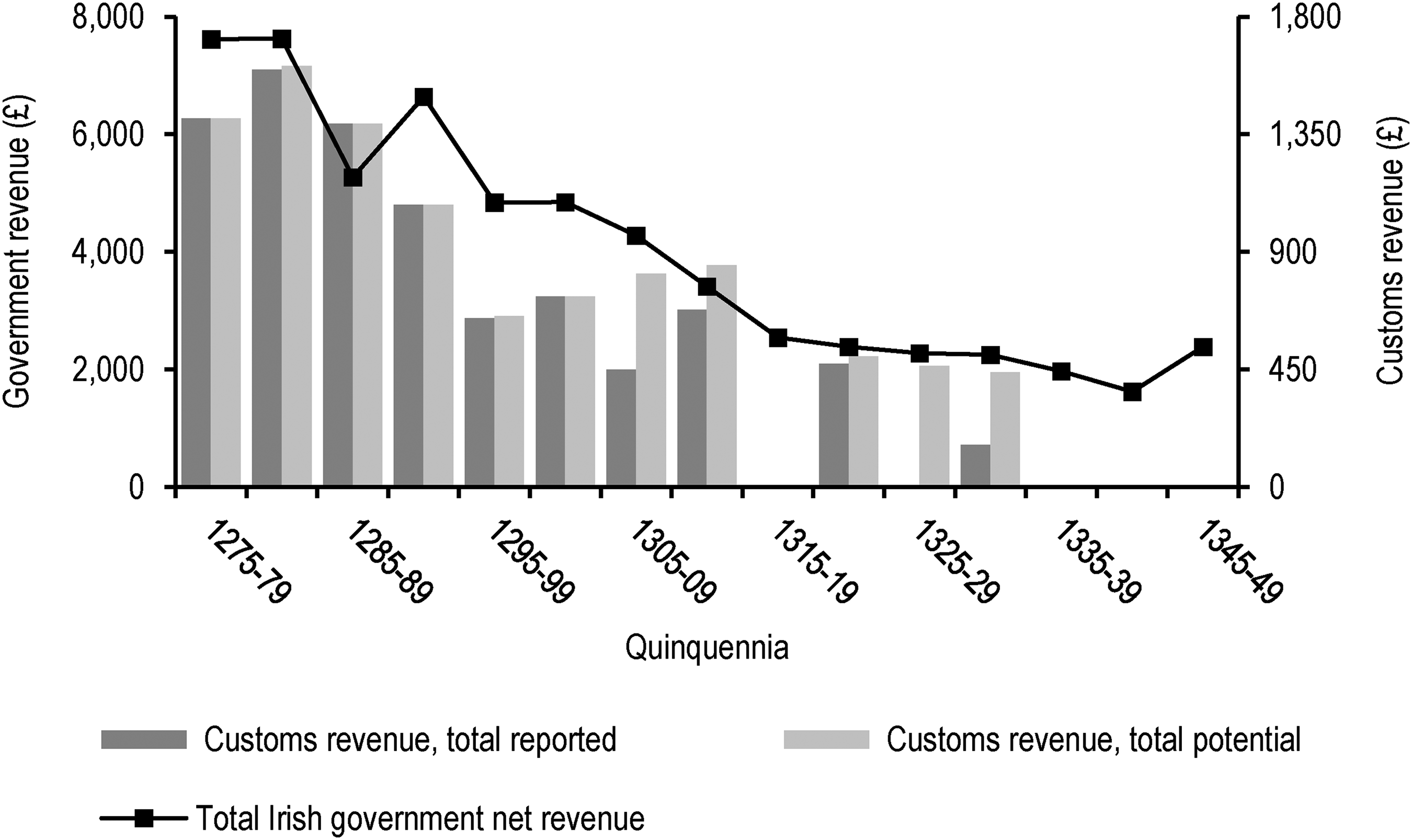
Irish net government revenues and Irish customs revenues, 1275–1349 CE. Notes and sources: reported customs revenue is that received and accounted for; potential customs revenue takes account of omitted ports. H. G. Richardson and G. O. Sayles, ‘Irish Revenue, 1278–1384’, Proceedings of the Royal Irish Academy, 62C (1961–3), 99–100; T. E. McNeill, Anglo-Norman Ulster: The History and Archaeology of an Irish Barony, 1177–1400 (Edinburgh, 1980), pp. 132–35.
Graphic illustration of these general trends is provided by the progressive impoverishment of the small south-eastern port of Wexford, as documented by detailed Inquisitiones post mortem extents drawn up in 1307 and 1324. 75 It had been the first of the Hiberno-Norse trading towns to capitulate to the English invaders, had subsequently hosted Henry II and his entourage prior to their departure from Ireland, and had been regranted by Henry to the renowned ‘Strongbow’. In the port's thirteenth-century heyday, it had boasted 365½ burgages, each contributing an annual rental of 12 pence and generating a potential gross income to the earldom of Pembroke of £18 5s. 6d. 76 By 1307, however, 35 per cent of these burgages were vacant and rendering no rent, and by 1324, only 144 remained occupied and the rents paid had slumped by a further 40 per cent, to £7 4s. 0d., amounting to a collective decline of 61 per cent. Furthermore, receipts from the prise of ale had also shrunk from £15 to £10 and income from the town's tolls and mills had halved. 77 Experiencing such conspicuous decline must have been demoralizing for the town's inhabitants, the more so as Wexford was located well within Orpen's Pax Normannica and was remote from the contested military frontier with the Gaelic-controlled lands of the north and west. Equally, it lay well out of range of raids launched from the Irish enclave in the Wicklow Mountains. Early in the colony's existence, it had been the port of entry for Welsh and English immigrants who had settled in significant numbers within its hinterland and whose distinctive Yola dialect survived into the eighteenth century. 78 Their farmlands supplied the grain surpluses shipped from Wexford up and across the Irish Sea. 79 Thus advantaged, the town's fortunes should have been secure. Instead, its failing fortunes indicate that it, too, was succumbing to the profound downturn in economic activity that by the opening of the fourteenth century was becoming general throughout the Lordship. 80
The Ebbing Tide
What went wrong? What, after its promising start, caused this brave new commercializing world, endowed with its new structures, rules, institutions, contacts and personnel, to falter and then founder? The nature of Ireland's international comparative advantage, the failure of domestic and overseas demand to grow, the drying up of innovation and investment, and an endemic scarcity of cash are a large part of the explanation.
Ireland's geographically peripheral location relative to Europe's core economic regions of Flanders and Italy imposed high shipping costs on all exported bulk commodities, except those merely crossing the Irish Sea. Its international comparative advantage therefore lay in extensive grass-based and low-cost production of hides, fleeces and wool for export to distant markets and grain, fish and lumber for sale in neighbouring British markets. 81 Apart from the small-scale craft production characteristic of the larger towns and exemplified by the range of manufacturing occupations recorded in Dublin's guild merchant roll, plus milling, smithing, and localized pottery and iron working, there was little development of industrial and other value-added activities. 82 Certainly, there was no Irish counterpart to the large-scale urban textile industries supplying national and overseas markets that had developed in England and especially Flanders and central Italy. What could not be manufactured locally was mostly obtained from abroad, sometimes trans-shipped via Bristol, together with luxury wares, spices, the essentials of wine and salt, and initially much semi-worked building stone from the Dundry quarries outside Bristol, probably shipped as ballast. 83 Unsurprisingly, therefore, the overwhelming majority of the population lived and worked on the land.
Cheap Irish land and labour, the latter underpinned by low living costs, were vital to the viability of Ireland's export trade, given that Irish wool was inferior in quality and price to the rival English product, which was the finest and most sought-after in Europe. 84 Irish wool was deemed suitable only for manufacture of the lighter, cheaper and coarser cloths in which, fortunately, the Flemish textile industry specialized for much of the thirteenth century. In contrast, Irish wool was spurned by Flemish and Italian manufacturers of the quality woollens which commanded the highest prices on international markets. When, in the fourteenth century and in response to rising transaction costs in international trade, Flemish producers switched to the exclusive manufacture of fine woollens, their demand for Irish wool fell away, as is reflected in falling customs revenues from the 1290s (Figure 6). 85
Given the inferior quality and often hilly character of much of the land granted to many of the newly founded Cistercian monasteries, in combination with their limited access to labour provided by their lay brothers, numbers of these houses developed the bulk production of wool as a staple of the monastic economy, with wool sales, often made in advance of the annual clip, a vital source of cash. 86 Tithe wool was similarly vital to the economies of many of Ireland's numerous Augustinian priories. Cattle, mostly kept and reared out of doors, were a more general and established feature of the pastoral economy and clearly yielded hides in excess of domestic requirements. Delivered to the ports and assembled into consignments, these were shipped out for processing at leather-working centres closer to the sources of demand, with livestock-deficient Flanders and northern France providing a ready market for Irish hides. 87 This was, therefore, at core and in the countryside, a commercial subsistence economy, rooted in production of staple foodstuffs for immediate household consumption and local markets, and primary raw materials for export and processing and consumption elsewhere. 88 On these commercial terms, the opportunities and incentives to diversify into other branches of economic activity, including service-sector activities, was limited, other than those such as milling, smithing and building required to sustain the subsistence economy.
Paradoxically, given the central importance of towns to the entire colonization and commercializing project, such an overwhelmingly agrarian and strongly pastoral economy, with the relatively low rural population densities which it supported, had neither the need nor the capacity to support more than a modest urban sector. Of the many places granted borough status, few grew to any size or developed more than the most rudimentary urban functions. 89 By the close of the thirteenth century, towns of all sizes most likely contained fewer than 100,000 people and probably only 5 per cent of the Lordship's population lived in the seven towns – all, apart from Kilkenny, on the coast – with at least 2,000 inhabitants. 90 Dublin, the largest, had a population of 10–15,000 and was no larger than provincial Bristol, England's third largest city, but neither Dublin nor Bristol ranked as particularly large by contemporary European standards. 91 Waterford, the Lordship's next largest city, was probably on a par with Gloucester (population c.7,200 in 1290), as Kilkenny, Drogheda, Cork, Limerick and New Ross were with the equivalent Irish Sea and south-coast ports of Chester, Cardiff, Bridgwater, Plymouth and Exeter. 92 Each was fit for purpose but, like their English counterparts, lacked, as yet, any good reason to grow larger.
Even after a century of growth and development, concentrated urban demand of the sort generated by such populous northern European cities as London, Ypres, Bruges, Ghent, Lille and Paris (all at least five times larger than Dublin), and capable of stimulating specialization, investment and innovation over a wide area, was conspicuously absent from both the Lordship and the immediately neighbouring parts of Britain. 93 Dublin's provisioning needs were barely felt beyond a 50-mile radius of that city, except in the grain-growing coastal lowlands of east Co. Down, Fingal and southeast Co. Wexford, where convenient access to coastal shipping kept transport costs down. 94 The locally significant but nationally modest export trade in grain, which these environmentally favoured and politically secure coastal areas developed, would subsequently be exploited and disrupted by the royal purveyors in their quest to divert victuals to English armies and garrisons in Gascony, Wales and Scotland. 95 More significant in scale and value were the export trades in skins, hides, fleeces and wool supplied from the Lordship's pastoral and more thinly peopled interior and demanded in bulk by the leather and textile industries of the continent and England, which had become dependent upon external sources of these staple raw materials.
Pastoral products capable of withstanding significant costs of storage and transportation are the characteristic specialisms of land-extensive agricultural regimes, employing low-intensity methods of stock management, and operating under conditions of low economic rent at some geographical distance from their main centres of demand. 96 They were the commercial lifeline of a Lordship lacking its own strong and dynamic urban centres of demand. For, after an initial burst of growth during the optimistic and innovative early decades of the Lordship, there is little to suggest that the leading towns’ momentum of expansion was sustained. Thus, in Dublin's case, the key innovations which had underpinned the city's early growth under English rule – charters of rights and privileges, instruments of self-government, improved urban defences, a merchant guild, foundation of monastic houses, arrival of the mendicant orders, a major construction boom, establishment of a civil service, operation of a royal mint and of royal courts of justice, provision of a fresh water supply – had all mostly been put in place by the middle of the thirteenth century. 97 Thereafter, it is difficult to point to developments that would have sustained further population growth and physical expansion. Certainly, assertion of its primacy as the first city of an increasingly integrated Irish urban hierarchy was not one of them, for by the 1250s that had got as far as it was going to. 98 Of course, the city continued to attract guildsmen in considerable numbers but, significantly, without any tendency for recruitment to increase, as ought to have been the case had the city been thriving, expanding and growing in influence. Indeed, compared with the situation before 1225, international enrolments in the guild dwindled, and in the 1250s, total guildsmen admissions actually drifted downwards. 99
Nor, away from the coastal towns, was Ireland's ranching economy a stimulus to urban growth or economic diversification: periodic markets, seasonal fairs and itinerant pedlars and dealers were well able to cope with the exchange requirements – much of it conducted by barter and therefore bilateral in nature – of the thinly spread rural population. 100 This included the bulk of the Gaelic-controlled areas little touched by English settlement and effectively outside the reach of English rule. In contrast to them, the trading which economically really mattered took place within the more densely populated mixed-farming hinterlands of the coastal ports, and it was only here, where domestic and overseas commerce intersected, that substantial permanent urban populations could be supported. Even so, although sufficient for their purpose, none was large in absolute size and the Irish urban sector as a whole remained small and, from the mid-thirteenth century, largely devoid of dynamism. In contrast to the vanguard European economies of Italy and Flanders, with their populous cities, substantial urban sectors and comparatively advanced manufacturing and service sectors, Ireland was a weakly urbanized society, which implies that per capita demand for goods and services was limited, GDP per head was low, and the economy, rooted in primary production, was underdeveloped. 101
Surplus Extraction
To progress and develop, the territories encompassed by the Lordship needed investment: in essential infrastructure, fixed and working capital, human capital formation, improved technology, and – given the perpetual frontier and security problem – defence. Yet from the outset, investment capital had been in short supply, for those who came to Ireland were more likely to be seeking, than possessed of, fortunes. Moving to and setting up in a foreign land also probably drained most colonists of what little they had and the lords who recruited them most likely were similarly circumstanced. Over time, of course, the revenues generated by the fledgling Lordship should have provided the investment capital needed to grow the economy. The problem was that a substantial and increasing share of these were expropriated by the external authorities of Church and State and by the Italian merchant bankers who served as agents of both. Under the pressure of these external demands, indebtedness became endemic. Even the lion's share of the profits of Ireland's overseas trade, especially that which extended beyond the Irish Sea, is likely to have accrued to the non-native merchants and shippers who, seemingly, handled most of it, rather than their Irish counterparts whose shares were undoubtedly smaller. 102
Ireland may have offered a wealth of potentially rewarding investment opportunities, but outsiders who dealt with the country were more likely to be interested in extracting than creating wealth. Over time, this had a progressively impoverishing effect upon the Lordship, depressing consumer spending power, financially weakening government, and depriving the administration of the resources needed to maintain security in a land still riven by frontiers. In this vicious circle, every failure of defence then exposed existing investments in fixed and working capital to wanton pillaging and destruction, thereby further reducing resources and discouraging investment.
For as long as the Irish Church remained autonomous, it was largely able to keep its considerable resources to itself. That changed with the far-reaching Church reforms set in train during the twelfth century which brought Ireland under papal jurisdiction. Irrespective of the authenticity of the papal letter Laudabiliter, supposedly issued in 1155 in the name of Pope Adrian IV (r.1154–9), its stated aspirations to enlarge the borders of the Church and levy St Peter's Pence upon every household in Ireland were consistent with papal policy at that time. 103 Once much of Ireland was subjected to the authority of the Roman Church, its clergy became liable to the normal array of papal levies and the Papacy's organized system of collecting revenues and transferring them to Rome was extended to Ireland. 104 Payment was usually accompanied by much grumbling, but default was deterred by enforcement of severe ecclesiastical penalties, including, when necessary, excommunication. To meet these obligations, the Irish clergy often had little option but to borrow substantial sums, and each new demand typically made further borrowing necessary.
The most burdensome of these levies were periodic taxes on clerical incomes. According to Donovan O'Sullivan, these began with the clerical fortieth of 1199 and continued with the triennial twentieth of 1215, the tenth of 1228, triennial thirtieth of 1238, triennial twentieth of 1245 and sexennial tenth of 1274. 105 Her list is not, however, exhaustive and excludes the best known of these taxes, the clerical tithe granted in 1291 by Pope Nicholas IV (r.1288–92) to Edward I (r.1272–1307) to finance a proposed crusade. 106 The extant Irish returns date from 1303 to 1306 and indicate that at that date, when revenues of all sorts were in decline, the Irish Church's combined income from spiritualities and temporalities was assessed at just under £12,600, of which one tenth was due to the king as tax (although the actual yield is likely to have been a good deal lower). 107 Other levies included the ‘voluntary’ subsidies or aids (six were requisitioned from Ireland during the reign of Henry III (r.1216–72)), payments for the redemption of crusaders’ vows, and the obligatory servitia (customarily one third of annual income) paid by archbishops and certain bishops, abbots, and heads of protected monasteries on their appointment to office by the pope. Usually discharged in person in Rome with the help of a loan, servitia entrapped those liable, such as the archbishops of Armagh, in a recurrent cycle of debt, since each new appointee was responsible for the debts of his predecessor. 108 Finally, since the time of King John (r.1199–1216) in 1213, English kings were supposed to pay a yearly tribute of £200 in acknowledgement of holding their Irish Lordship as a papal vassal, although payments lapsed from 1282. 109
To collect and transfer these revenues, great reliance was placed on trusted and experienced Italian merchants, notably the Spini merchants of Florence and the Papacy's favourite bankers, the Bonsignori family and their Gran Tavola bank of Siena. Use was also made of the Knights Templar, whose arrival in Ireland had followed the Invasion and who provided an effective international security service for the safe delivery of substantial quantities of cash. To begin with, the sums involved could be enormous, although later they diminished. For example, in 1252, at a time of peak papal demands and after almost seven years of diligent revenue gathering in Ireland, papal nuncio Master John de Frusinone had assembled almost £27,000 for export to Rome from legacies, the redemption of crusaders’ vows and the crusading triennial twentieth granted at the Council of Lyons in 1245. 110 This was more than three times the value of net Irish government revenues in the late 1270s and double the country's much reduced total ecclesiastical wealth in 1303–6. No economy as small and undeveloped as Ireland's could have haemorrhaged capital on this scale without becoming debilitated. Nor could Irish churchmen stay on the right side of Rome and honour their financial obligations without incurring substantial debts, borrowing from Italian merchants so that they might pay the pope's Italian revenue collectors what they owed. Repeated papal demands deprived them of the funds which might otherwise have been deployed to aggrandize their mostly modest churches, improve their estates, or raise the skill level of their workforces.
Where the attitude of the Papacy towards Ireland was rapacious, that of successive English kings was downright exploitative. Following John's expeditionary visit in 1210, undertaken to rally support at the height of his standoff with Pope Innocent III, English monarchs remained resolutely absentee (an intended visit by Henry III, in anticipation of which a new great hall was built at Dublin castle, never materialized). Rather than reinvesting in Ireland the net income generated by their Irish Lordship (from exercise of their feudal rights, rents of assize mostly from the royal demesne, the profits of the county courts and of justice), it was invariably exported and spent elsewhere. 111 Thus, Henry III drew heavily upon Ireland for men, provisions and money during his Welsh campaigns of 1241 and 1245 and the Gascon campaign of 1242 and then again, financially, during his great dispute with the Papacy in the 1250s. 112 These levies were borne without evident strain but those of his son, the future Edward I, who had received the Lordship as a wedding present in 1254, became much more onerous. 113
Irish revenues helped underwrite Edward's costly 1271–2 crusade to the Holy Land and then, upon his return, Edward made full use of Irish money, men, ships and provisions to advance his military campaigns in Wales (1277–83), Gascony (1294–1303) and Scotland (from 1296). Since these were expensive and prolonged enterprises, he augmented his normal sources of revenue from Ireland with customs duties imposed upon exports of wool, wool fells and hides, two grants of a crusading tenth of clerical incomes negotiated with the Papacy, and requests for feudal aids. He also made full and often punitive use of his prerogative right to purvey and requisition victuals and other provisions (first exercised in Ireland by Henry III in 1244) to support his armies and garrisons in Wales, Gascony and Scotland. 114 This caused significant disruption to the established conduits of commerce, was often to the financial disadvantage of those on the receiving end of these compulsory purchases, and, ultimately, was at the expense of the Irish exchequer. 115 Nor did he hesitate to demand troops, irrespective of whether they could be spared from garrison duty in Ireland. Edward I's demands upon the Irish exchequer fluctuated with his military needs. At their most extreme, as in 1305, when as much as £11,000 was drawn from Ireland, they forced the Irish administration ‘to incur an expenditure of a kind it could not really afford and put future revenue in pawn’. 116
Like the Papacy, Edward I came to rely heavily upon Italian merchants – chiefly the Ricciardi company of Lucca, and the Frescobaldi, Bardi and Peruzzi companies of Florence – to act as collectors of his Irish revenues. 117 In that role, they oversaw the customs and were in charge of the mint. Their active involvement in Irish financial affairs at this time is a reminder that the country had become fully engaged in Europe's commercial and business revolutions. Nevertheless, although these companies were pioneers of the most advanced accounting and business methods, their object in deploying them was to enrich themselves and their overseas clients, not Ireland. 118 All were prominent in the export and import trades and were particularly interested in supplying the Flemish and Florentine textile industries with wool. In the latter capacity, they and the lesser Italian merchants who traded in Ireland often made bulk purchases in advance of the annual wool clip. Numbers of sheep-farming monastic houses were tempted to enter into such contracts, fraught though they were with risk. Any shortfall in the clip, or failure to deliver, landed them heavily in debt and so tempted them to repeat the mistake and, in their pressing need for cash, sell the next year's clip in advance on the gamble that it would meet the target. Baltinglass, Graiguenamanagh and Jerpoint were among the Cistercian houses which became thus ensnared, Athassel an Augustinian house which became similarly compromised. 119 They and others were on a slippery slope, mortgaging future output to meet present needs, and eventually the Italians who had advanced the money had little choice but to sue the defaulting producers. 120 Estates thus financially compromised were hardly in a position to embark upon significant programmes of investment and improvement or major new building projects.
Led by the insatiable financial demands of the Papacy and Crown, compounded by the improvidence and misfortune of some lords, and promoted by the opportunistic business methods and money-lending activities of the Italians, indebtedness, from the 1240s, was the growing canker at the heart of the Lordship's economy. Debt deprived lords, both lay and ecclesiastical, of the capacity to invest in the development and improvement of the estates they had too often mortgaged as security.
121
It eroded their purchasing power and thereby denied the fledgling commercial economy the stimulus of strong domestic demand. It enriched those outside Ireland at the expense of those within and, most seriously, it left those charged with defence of the Lordship and the maintenance of law and order with inadequate means to uphold them. The insecurity which resulted then provided a further disincentive to investment and required the prioritization of expenditure on defence and protection over that on the advancement of production. As Donovan O'Sullivan so astutely observed in 1949, when, in the final analysis, the reasons for the breakdown of the Norman experiment in Ireland are to be sought, the burden of debt with which so many of the settlers found themselves overwhelmed must take its due place in the reckoning.
122
Scarce Money
The export of revenue from the Lordship of Ireland acted as a brake upon the growth of a fully monetized economy and, with it, evolution of more sophisticated forms of multi-lateral exchange of the sort that were central to the commerce of towns. Pre-Invasion Ireland, outside the Dublin region, had been effectively coinless and by the mid-twelfth century, Dublin's own coinage had become debased. 123 One of John's first acts as Lord of Ireland c.1185 was therefore to establish an Irish coinage, with royal mints at Dublin and, intermittently, at Waterford and Limerick. Twenty years later, as king of England, he reformed that coinage to ensure that coins minted in Ireland were interchangeable with those minted in England. This may have been done with the ulterior motive of augmenting his own inadequate money supplies with cash from Ireland, but John's reform also had the effect of integrating Ireland into the Sterling Area. 124 As the composition of coin hoards and of the growing numbers of single coin finds demonstrates, Irish coins thereby came to circulate in Britain, as, to a lesser extent, English and Scottish coins did in Ireland. The strong outflow of Irish coins was therefore, at least partially, offset by a compensatory inflow of British coins, especially during the first 50–60 years of the colony's existence when its new lords were actively developing their estates and founding boroughs, fairs and markets to service the newly semi-monetized exchange economy. 125 The upshot was that by 1251–4, on Martin Allen's estimation, the Irish coinage was worth at least £43,000, in comparison with a Scottish coinage of £50–60,000 and English coinage of £357–387,000. 126
Ireland's was the youngest and smallest of these three sterling currencies and had been created virtually from scratch, so its growth to c.£43,000 within the space of barely fifty years is likely to have transformed the character of commercial exchange. Nevertheless, this was too small a sum to achieve the transition to a fully cash-based economy, for which further strong monetary growth was required. That, however, was not forthcoming, for the healthy balance of trade surplus originally generated by the export of primary produce was increasingly offset from the mid-thirteenth century by continuous and heavy external transfers of revenue and cash. From the 1290s, this was then further compounded by a marked decline in export earnings (Figure 6), as changing overseas demand hit wool exports hard. On currently available estimates, although the Lordship's money supply did not cease to grow, from the 1250s it grew but sluggishly – at a time when European silver output was rising strongly (Figure 2) – at less than half the annual rate of the Sterling Area as a whole (Table 1). In fact, Ireland had the slowest growing money supply in the Sterling Area, mainly because cash was constantly leaching away to England and Wales, whose money supply grew the fastest. Tellingly, sovereign Scotland, shielded from the kinds of external demand to which colonial Ireland was so debilitatingly exposed, also experienced strong monetary growth between c.1250 and c.1290 (Table 1).
Martin Allen's 2017 estimates of the money supplies of Ireland, Scotland, England and Wales and the Sterling Area, c.1250–c.1290.
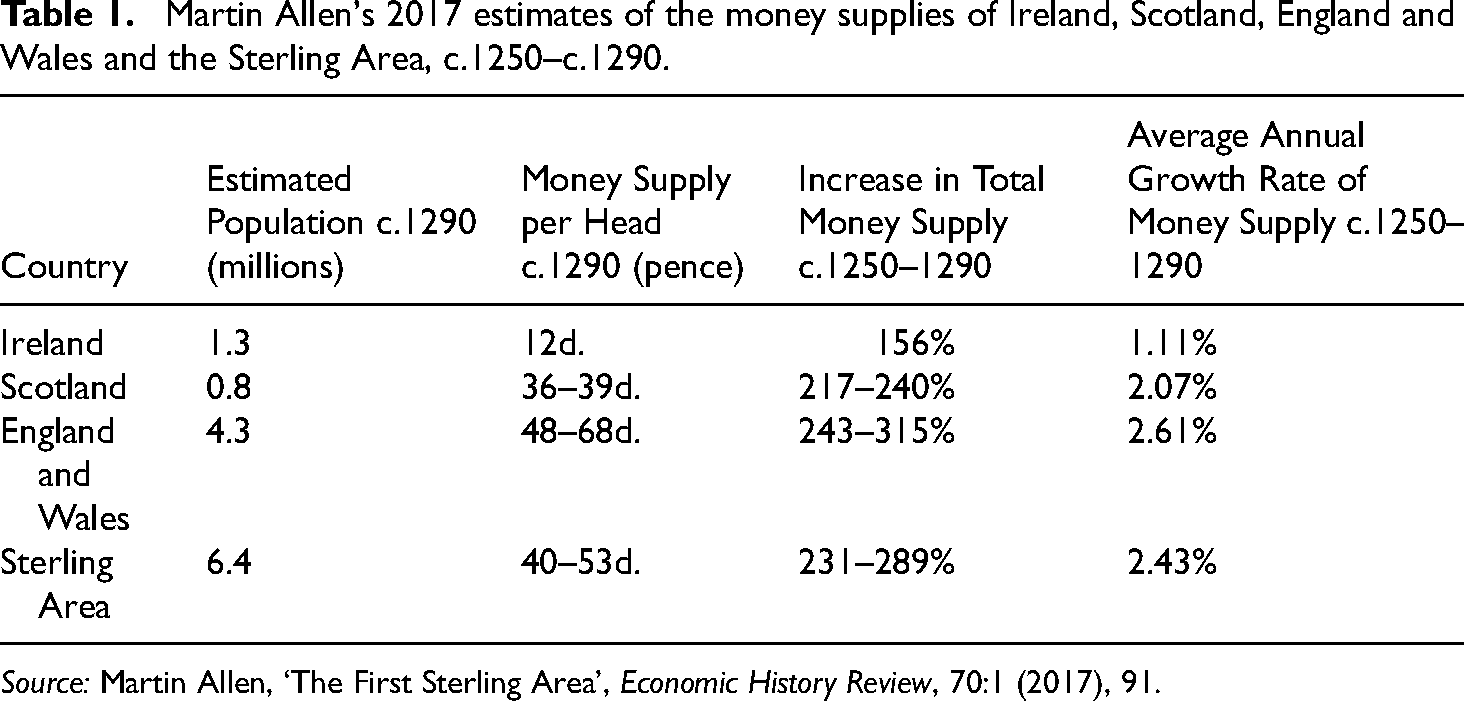
Source: Martin Allen, ‘The First Sterling Area’, Economic History Review, 70:1 (2017), 91.
The upshot was that by 1290 Ireland lagged far behind all other parts of the Sterling Area in money supply, with a mere 12 pence per head in comparison with Scotland's 36–39 pence and England's 48–68 pence (Table 1). This was too low to sustain a fully monetized exchange economy, especially outside the towns, where barter must have remained the basis of most trading and, consequently, production for subsistence is likely to have prevailed over production for exchange. Without a more adequate supply of money, it was difficult for the economy to develop and become more diversified, or for markets, fairs and boroughs to prosper and gain in business. Ireland's absolute and relative scarcity of money was therefore both a symptom and a contributing cause of the country's relative underdevelopment. The tardiness of monetary growth from the mid-thirteenth century also helps explain why, after the self-evident dynamism of the Lordship's first 70 years, there was subsequently such a profound loss of economic momentum over the next 70 years. On this measure, Ireland was falling behind rather than keeping abreast of concurrent commercial developments taking place in Europe and especially elsewhere in the Sterling Area. In effect, for want of sufficient money, the Lordship's economy was becoming anaemic.
Scarcity and the Resort to Violence
The absence of any real economic growth and the erosion of the Irish administration's financial resources compounded two inherent weaknesses of the Lordship, namely, poor food security and a predisposition towards lawlessness. Both problems predated the Invasion, neither was resolved by it, and each reinforced the other. That the severity of both tended to grow rather than diminish as the thirteenth century drew to a close is hardly consistent with Orpen's view that English rule had delivered a significant improvement in the material conditions of life. 127
Had the Lordship developed more efficient and integrated markets capable of exercising more effective market arbitrage, had there been greater investment in the infrastructure of roads and bridges, in wheeled transport, and in storage facilities of all sorts, had the economy developed, diversified and grown to become richer, had charity and alms-giving been more generously endowed and firmly embraced, had law and order been more rigorously enforced, and had central and urban governments learnt to deal more effectively with scarcity, then the country would have been less prone to subsistence crises and famines. 128 Yet, on the evidence of the Irish Annals and the less well-preserved Latin chronicles of the English Lordship, it seems that between the English invasion of 1169 and the Scottish invasion of 1315, and the greatest of all famines from 1315 to 1318, famine visited Ireland on at least four occasions: in 1203–7, in the 1220s, in 1270–1, and from 1294 to 1296. 129 Neighbouring England was not spared the bad weather responsible for these four food crises, nor did it escape their escalation into serious subsistence crises, but it does seem to have been spared the Gorta mhór, alias great famine, with its clear implication of hunger-related excess mortality, described by the Irish annalists.
The first of these crises lasted on and off for seven years and coincided with serious weather-induced harvest failures in England. 130 The setback to the newly established Lordship must have been significant although in due course this was overcome. Problems began in the ‘cold, foodless’ opening year of the new century, when the colony's first generation of settlers were still finding their feet, and then deteriorated further in 1203 when the Annals of Lough Cé and of Clonmacnoise recorded, respectively, ‘great famine [Gorta mhór] in all Erinn generally in this year’ and ‘infinite numbers of the meaner sort perished for want’. 131 After a particularly hard winter in 1205, the crisis ended with the ‘great destruction of people and cattle’ reported by the Annals of Ulster in 1207. 132
Eighteen years later serious problems returned, for in 1225 the harvest was late and over the next two years the situation again deteriorated to the point where the Annals of Boyle, of Lough Cé and of Connacht all refer to the ‘Great famine [Gorta mór] throughout Ireland this year, and much sickness and death among men from various causes: cold, famine and every kind of disease’. 133 A cold summer followed and in Connacht war compounded the adverse effects of the weather and further prolonged the crisis. 134 The situation then eased until 1236 when the Annals of Lough Cé reported ‘great rain, and bad weather, and war in this year; famine, and scarcity of food and clothing’. 135 These accounts come from the Gaelic-controlled lands of the midlands and west and whether these problems extended further east to include the settled lands of the Lordship is, unfortunately, unrecorded.
For the next thirty years, with the exception of 1263 in Ulster, the Annals are more-or-less silent on the subject of food crises notwithstanding some years of notably abnormal weather. Then, in 1270, following the severe winter and wet spring noted by English chroniclers and hard on the heels of the imposition upon Irish clerical incomes of a tax of one tenth, the Annals of Ulster, of Lough Cé and of Connacht all reported ‘great, unbearable famine in all Ireland’.
136
This was the first year of a deadly back-to-back crisis, for in 1271, in an unusually detailed entry, the Inisfallen annalist noted very bad weather in that year, and general warfare between the foreigners [English] and Gaedil of Ireland; and there was a great famine in the same year so that multitudes of poor people died of cold and hunger and the rich suffered hardship.
137
This combination of bad weather, famine, war, and economic hardship proved deadly and subsequently, as the grip of the administration upon the Lordship weakened, would become all too familiar. 138
The thirteenth century then ended, as it had begun, with another extended food crisis, which this time appears to have been worst in the east than the west of Ireland. For three consecutive years, according to the Anglo-Irish Annals, from 1294 to 1296, persistently inclement weather ruined crops and led directly to ‘great dearth’ and ‘many deaths from hunger’. 139 Within the heart of the Lordship, Friar John Clyn of Kilkenny described ‘the greatest scarcity’ and many dying of hunger, with ‘pestilence’ adding to the death toll. 140 To underscore the horror of the times, the records of Christ Church Cathedral, Dublin, noted that ‘people ate the corpses of those who had been hanged at the crossroads’. 141 Wheat prices in the Dublin region provide a more dispassionate measure of market conditions and were 80 per cent above average in 1294–5 and 1295–6. 142 Prices rose even higher in commercialized England, where harvests were as adversely affected by the bad weather as in Ireland, with the potentially damaging effect of inducing the export of grain desperately needed in Ireland across the Irish Sea. To compound matters, further supplies were commandeered by the royal purveyors and diverted to the army being mustered by Edward I for his intended invasion of Scotland. Then, to complete the misery, the Munster-focused Annals of Inisfallen reported ‘a great murrain of cattle’ in 1297. 143 Bad as the situation was in England, on the limited available evidence, there is good reason to suppose that it was even worse in Ireland, where the impact of this food crisis was probably more serious than that of any of its three thirteenth-century predecessors. 144 What made the difference was less the greater inclemency of the weather than the reduced resilience of those on its receiving end, for by the 1290s the Lordship was politically, fiscally and militarily in decline and within 20 years would be bankrupt. 145
The difficulty of coping with each of these crises was compounded by the constant challenge presented to the Lordship's administration by the incompleteness of the conquest itself, the persistence of enclaves of Gaelic resistance within the fastnesses of mountains and bogs, and the real risk that scarcity would induce raids and attacks upon the Lordship's settled lowlands. Lydon clearly recognized this connection, for he believed that it was the combination of scarcity and opportunity that prompted the Irish of the Wicklow Mountains to raid the neighbouring lowland manors of the vacant archdiocese of Dublin in 1270–1 and considered it ‘no coincidence that when [in 1294] Gaelic Leinster once more rose in rebellion, it was in the year of another great famine’. 146 On the latter occasion, further problems were created by the bitter feud which broke out between the earls of Kildare and Ulster. 147
The stage had been reached in the Lordship's development whereby output shortfalls invariably elicited raiding and plundering, which, in turn, destroyed capital stock, deterred investment, aided and abetted lawlessness, heightened insecurity and thereby eroded society's resilience to further output shortfalls. 148 Even in relatively law-abiding societies, significant output failures, such as those of 1294–6, prompted resort to crime, protest, riot and violence. 149 When moral economies of charitable giving and mutual social support broke down and, as in Ireland, public authority failed, there was an even greater danger that those with the necessary armed might would take advantage of the situation and prey upon those weaker than themselves. 150 Eventually, almost nowhere was safe. For instance, by 1324, even the earl of Pembroke's great castellated manor of Ferns, Co. Wexford, which was valued at £38 16s. 6d. in 1307, had been rendered almost worthless ‘due to the war of the Irish and because the lands have been destroyed by Irish felons’. 151
Well before the double disaster of invasion and famine in 1315–18, the famines of 1270–1 and 1294–6 had brought the economic, financial, political and military shortcomings of the Lordship to the fore. On the one hand, hardship born of scarcity stoked Irish hostility towards the English and provided a powerful economic incentive to raid, rustle and plunder. On the other hand, output failures left vulnerable lowland manors open to attack and reduced their capacity to defend themselves. With each crisis, the situation got worse, owing to the destruction of capital assets and the deterrent that mounting lawlessness posed to renewed investment. Under these circumstances, the export of revenues from the Lordship was reckless in the extreme, since the resources needed to counter Irish aggression and that of the hibernicized and ‘degenerate’ English were being eroded at the very time when the need for greater defence expenditure by central and local government was growing. 152 The Lordship could not prosper if it could not be effectively protected, as was increasingly the case once Edward I, first as prince and then as king, began wringing from it all that he could extract.
Low Tide
Once the dust of conquest had settled, the economic boom that followed creation of the Lordship of Ireland sprang from the superimposition of English institutional and commercial innovations upon a society already caught up in the tide of change set in motion by establishment of the Hiberno-Norse trading towns and reinforced by the wider transformations embodied in the European Commercial Revolution. In a commercializing age, conquest and colonization themselves became commercial ventures. 153 Unsurprisingly, under English rule, Ireland's institutionally and demographically reinvigorated port towns attracted a growing stream of traders and merchants from northern Europe's core economic regions of southeast England, northern France, Flanders and Italy, where the demand for food and raw materials was beginning to outstrip their supply. All were intent upon making good these deficiencies with bulk purchases of Irish grain, fish, timber, hides, wool, woolfells, and sundry other primary products. 154 Here, too, they found a ready market for the quality manufactured goods and luxury wares which were increasingly sought after by the Lordship's high-status aristocratic, religious and bourgeois households. 155 These ports therefore became the vital interface between Ireland's surplus-producing agrarian interior and the culturally vibrant and commercially opportunistic outside world, with its links south across the Alps to the Mediterranean and east to the Levant and Asia.
At this stage, Ireland probably enjoyed a significant balance of trade surplus, which boosted the inflow of silver to the newly established royal mints. The lure of cheap land, favourable tenures and expanding commercial opportunities attracted a substantial inflow of colonists accustomed to commercial exchange, whose active involvement in the developing market nexus underpinned seigniorial foundation of the boroughs, fairs and markets which was such a striking feature of the first half of the thirteenth century. 156 Stimulated by the shock of the new, briefly, the Lordship's economy flourished. All, it would seem, augured well, except that this fragile prosperity remained heavily dependent upon the buoyancy of overseas demand for Irish raw materials and, at home, the continued enterprise of the second and third generations of colonists, combined with effective support and enforcement of the new institutions and continued maintenance of the military upper hand by individual lords and the central administration. For as long as these conditions held, as they did until the middle years of the thirteenth century, the political and economic status quo could be maintained and the semblance of prosperity preserved. 157
Nevertheless, there can be no escaping the fact that this was a materially poor society or that, for the Lordship's economy to achieve any real growth and thereby deliver higher living standards and provide a greater resilience to natural hazards, it was necessary to raise output per head. This, in turn, was contingent upon sustained investment in fixed and working capital, promotion of human capital formation, and greater diversification of economic output through the growth of value-added manufacturing and service-sector activities, none of which was forthcoming to any sufficient extent. As a result, the domestic Irish market remained limited, weak and dispersed, as witnessed by the modest size and circumscribed distribution of its towns and failure of a single well-integrated urban system to evolve. 158 Dublin may have been the Lordship's political and administrative capital, but in its limited size, the circumscribed extent of its hinterland, and the selectiveness of its interactions with the other leading Irish towns, it remained essentially a modestly sized provincial capital. 159 Rather than functioning as spearheads of growth, these coastal entrepots provided the bridgeheads from which the Lordship was exploited by powerful external vested-interest groups – the Papacy, the English Crown, Italian financiers, and overseas shippers and merchants – intent upon enriching themselves by syphoning resources out of the country. 160 Over time, the cumulative effect of their collective actions was to deprive Ireland of potential investment capital, engender systemic indebtedness, and entrap the country in a state of underdevelopment characterized by scarce money, limited urbanization, an overdependence upon primary production, weak food security, and a permanent and worsening security problem.
All these shortcomings came increasingly to the fore from the 1250s, when the Papacy's financial demands were at their peak, Henry III was politically at his weakest and most impecunious, Gaelic resistance was stiffening, and the future Edward I was granted the Lordship's revenues. By then the possibility that English rule might make Ireland prosperous had passed. A plateau had been reached and for the next quarter of a century, although there was no reversal in the Lordship's fortunes, the failure to build upon earlier achievements is unmistakable. 161 The Irish administration's inadequate responses to a series of factional struggles between leading magnates, and raids by, amongst others, the emboldened Wicklow Irish, did not help. 162 When coupled with an increasing number of absentee landlords, this contributed to ‘a gradual decline in the colony and an increase in lawlessness’. 163 In Europe, too, the extended boom of the Commercial Revolution had almost run its course, as, with the sack of Baghdad by the Mongols in 1258, established flows of international trade experienced the first of a series of profound dislocations. 164 The powerful commercial tide which, since c.1000, had lifted the entire European economy was on the turn and would soon begin to ebb. When, following the fall of Acre in 1291, it did so, geographically and commercially peripheral Ireland would be one of the first regions to become exposed to the ensuing international recession. 165
As Figure 7 illustrates, Ireland's difficulties were far from unique, for by the end of the thirteenth century, problems were mounting almost everywhere. Across the Irish Sea in England, urban church-building per head was in decline from the 1250s, the daily real wage rates of adult males plunged to the second lowest point on record in the 1270s, and GDP per head hit an all-time low in the 1280s when a sheep-scab epizootic simultaneously depressed agricultural output, cloth production and wool exports. 166 English administrative, legal and commercial institutions undoubtedly had their merits, but even in England, they failed to avert a significant decline in economic performance and deterioration in standards of living. 167 Over this same period, business slumped at the leading international fairs of St Giles (Winchester) and St Ives, as, from the 1290s, it did at the once pivotal Champagne fairs in north-central France (Figure 7C). This was also partly because, in response to the increasingly risky trading environment, merchants were changing how they conducted business. 168
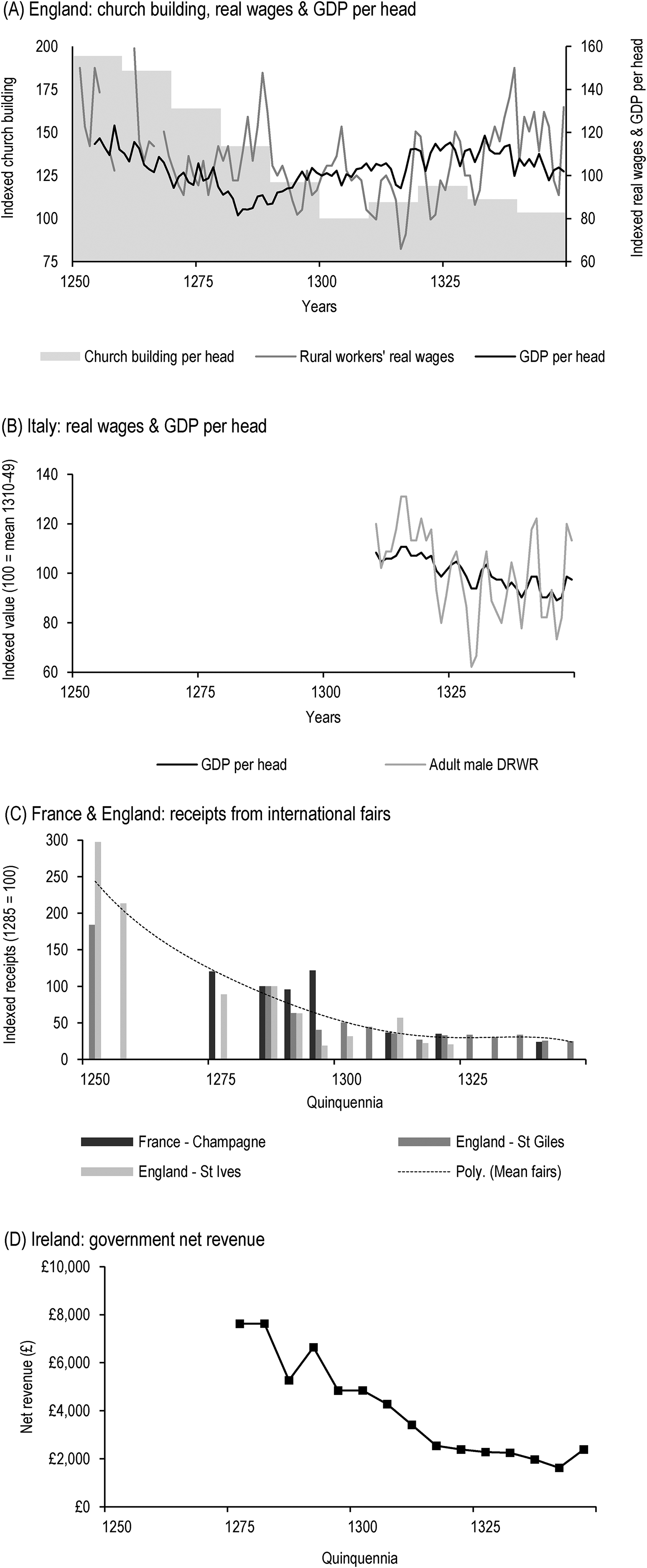
(A–D) English, Italian, French and Irish evidence of the end of the European Commercial Revolution, 1250–1349 CE. Sources: Eltjo Buringh, Bruce M. S. Campbell, Auke Rijpma and Jan Luiten van Zanden, ‘Church Building and the Economy During Europe's “Age of the Cathedrals”, 700–1500 CE’, Explorations in Economic History, 75:2 (2020), statistical supplement; Bruce M. S. Campbell, The Great Transition: Climate, Disease and Society in the Late-Medieval World (Cambridge, 2016), pp. 144, 146, 162, 167, 173; Figure 6, above.
Developments in Europe's commercial core regions had particularly serious consequences for Ireland. Thus, the advanced and urbanized manufacturing economy of Flanders was particularly hard hit by the political actions which precipitated the demise of the Champagne Fairs, as well as by deteriorating security and rising transport costs on the vital trans-Alpine transport routes, and the loss of Mediterranean markets for the cheap, light, coloured cloths in whose manufacture it had long specialized. 169 The switch that resulted to the manufacture of fine woollens better able to bear these costs and be sold at a distance for a profit drastically curtailed Flemish demand for Irish wool, which was no match for that of England in quality. 170 Hence, the dramatic slump in customs revenues received from Ireland's premier wool-exporting ports of Cork, Youghal, and especially Waterford and New Ross from the 1290s. 171
By the opening of the fourteenth century, decline had become general. 172 Even central and northern Italy, which had long been at the forefront of both the commercial and business revolutions, was facing economic difficulties (Figure 7). Most conspicuously, from 1298, beginning with the collapse of the Sienese Gran Tavola bank of the Bonsignori, its mercantile banking sector was in serious trouble. Over-extended and undone by bad debts and a worsening international commercial situation, all of the great Sienese and Florentine super companies failed over the course of the next 50 years (although no doubt to the relief of numbers of their Irish debtors). 173 Unsurprisingly, this had a negative impact upon Italian GDP per head, which, from at least 1310, was sliding steadily down, dragging wage rates and living standards with it. A succession of serious harvest failures, triggered by a series of extreme weather events, also weighed negatively upon output and placed urban administrations and finances under great strain. 174
An Impoverished Lordship
In Ireland, the turning point came comparatively early, in the late 1280s. 175 It was then that customs receipts and net government revenues began their ineluctable downward slide which culminated in the effective insolvency of the Irish administration some 25 years later (Figure 6). These were the years when Edward I's demands bore most heavily upon the Lordship, leaving the Irish administration with inadequate means to defend the frontier and uphold law and order. As revenues and commercial opportunities shrank, those with the necessary military means made increasing resort to plundering, rustling and raiding as methods of securing resources. Economic decline and growing lawlessness thereby became inextricably linked, hence the ‘degeneracy’ complained of by the Irish parliament of 1297 and documented by the calendars of the justiciary rolls for 1295–1314. 176 The double blow of Edward Bruce's Scottish invasion and attempted conquest of 1315–18 and onset of the prolonged weather anomaly responsible for the Great Northern European Famine of 1315–18 then delivered the final coup de grace to the failing Lordship, transforming it from an asset to a liability to the English Crown. 177
Yet, in truth, the Lordship of Ireland had never been an unqualified economic success story. At the beginning, there had plainly been an established momentum of growth to build on. Thereafter, the brave new world which the advent of English rule had appeared to promise barely outlasted the first two generations of colonists. Its prosperity was too shallowly based, was overly dependent upon external demand which eventually proved fickle, was compromised by scarce capital and sustained under-investment, was debilitated by the constant export of revenues and deficiency of money, and, in a divided land, was too easily undermined by the failure to maintain security. Once the false dawn of the new regime's opening decades had passed, when the economy had benefited from significant but transitory injections of labour, capital and enterprise, the Lordship lapsed into a self-perpetuating state of chronic underdevelopment. Further aggravating factors were the incompleteness of conquest, discrimination between of Gaels and Galls, and consequent failure to extend the underpinning commercial institutions across the whole of society and entire island. In its thirteenth-century heyday, the Lordship consequently displays all the hallmarks of a materially poor and underdeveloped economy trading at a comparative disadvantage with Britain and the rest of Europe. Once the European economy went into recession, its fate was sealed.
Footnotes
Acknowledgments
This is the text of the 2020 Edwards Lecture, postponed by the COVID-19 pandemic and delivered at the University of Glasgow on St Patrick's Day 2022. I am grateful to the Glasgow History Department for the honour of the invitation to present it. A preliminary version was given at the ‘Invasion 1169’ conference hosted by Peter Crooks and Seán Duffy at Trinity College Dublin in May 2019. The text has benefited from helpful comments made by Professor Steve Rigby and two anonymous referees.
Data Availability Statement
All data sources are fully acknowledged, and their sources are cited.
Declaration of Conflicting Interests
The author declared no potential conflicts of interest with respect to the research, authorship, and/or publication of this article.
Ethical Approval and Informed Consent Statement
There are no human participants in this article, and informed consent is not required.
Funding
The author received no financial support for the research, authorship, and/or publication of this article.
