







Abstract
This paper describes the local literacy environment in Lesotho and plots the efforts to create effective and sustainable school and community libraries through professional development both in literacy education and librarianship. A library effectiveness survey was distributed to the 170 1,000-book school and community libraries started since 2008 by communities in partnership with United States Peace Corps and the African Library Project. These targeted sites remain some of the only libraries in the country. In response to this survey, a team of 13 Peace Corps Lesotho volunteers, Basotho teachers, librarians, principals, and district resource teachers came together to create and lead a workshop series to guide local library leaders. Piloted in September 2010 and revised with feedback, this workshop series was intended to aid the creation of 32 new libraries in 2011 by focusing on topics most relevant to the developing culture of reading in Lesotho.
Introduction
Current research confirms that access to books directly relates to literacy (Neuman 1999). However, in a small, rural country that lacks a substantial reading culture, access to books is just the beginning. Libraries in public primary and secondary schools are uncommon in Lesotho as is research on the contributions of libraries, the training of teacher-librarians, and the effects libraries have on the communities they serve. This paper looks at the current literacy environment in the sub-Saharan African country of Lesotho and at an effort to improve the process of starting libraries in schools where there have been none and developing those libraries to the point of sustainability.
English education in Lesotho
In Lesotho, traditional literacy begins in the school system. It is rare for households to own books or speak English (Sesotho is the national language.) English is the official language; it is the only language spoken in the country’s higher educational institutions and most governmental and business work is done in English. For students to advance to the next grade/standard in primary school, they must pass in English. For completion of high school and entrance to the National University of Lesotho, a pass in English is mandatory (Seelen 2002). This makes the case for school libraries to contain books in English and to look at English achievement scores as an indicator of literacy. In 2010, 57.3 percent of students passed their high school external exams. Table 1 shows the performance averages of Basotho Standard 7 students in English between 2003 and 2006 inclusive. Data after 2006 are not published. English instruction is critical to the academic success of Basotho. Many Ministry of Education officials, teachers, and students are interested in having English libraries to supplement their literacy instruction.
Report on subject norms for Primary Standard Level Examination
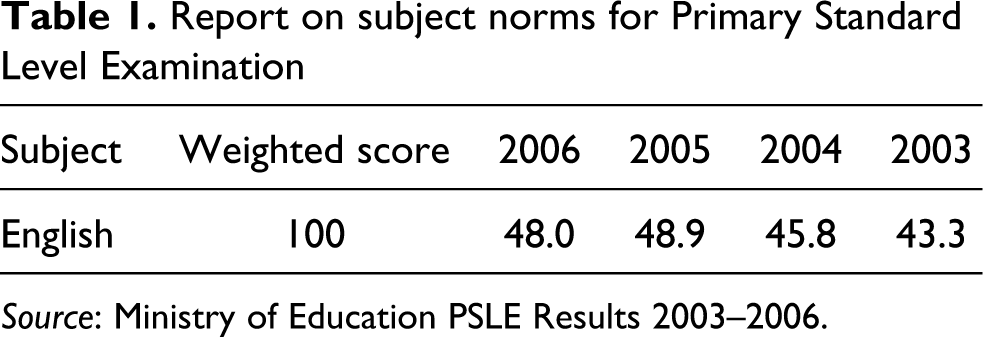
Source: Ministry of Education PSLE Results 2003–2006.
Table 2 shows the total pass rates for the last 8 years. With a mean of 85.8 percent, a range of 5 percent and a standard deviation of 1.7, there is no discernible trend up or down in performance regardless of the educational-political climate or initiatives of the time.
Total Primary Standard Level Examination pass rates
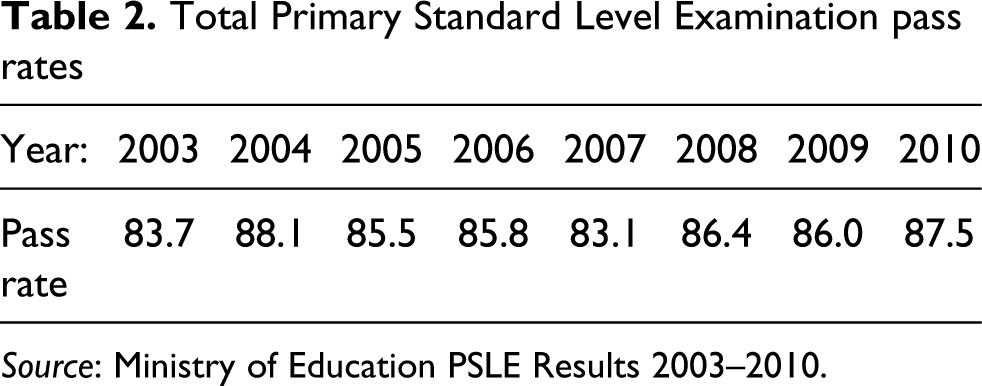
Source: Ministry of Education PSLE Results 2003–2010.
Libraries in Lesotho
The National Library Serice of Lesotho has developed nine public libraries located in the camp-towns in nine of the 10 districts in Lesotho, three of which were established within the last 2 years. However, at all of these libraries, patrons are prohibited from borrowing books.
The Director of Library Services is one of two library professionals employed by the State Library Service, the other serving as the Senior Librarian at the National Library in the capital city. The Schools Library Service aids in the advisement of secondary school libraries in the area of the capital, Maseru. In the past, they have been involved in teacher-librarian training workshops. These workshops were terminated in 2009 due to lack of trained personnel.
In addition to the nine branches of the National Library Service, 170 small, school and community-based libraries have been initiated in collaboration with the African Library Project, the US Peace Corps, and individual schools and communities since 2008. The African Library Project is an American NGO that connects individual communities in Lesotho to a community donor in America. The American donor collects 1,000 gently used children’s books for their Lesotho community or school and ships them to the African Library Project site in New Orleans. Staff and volunteers then fill a shipping container with these donated books and send them by ship, train, and truck to Maseru, Lesotho where they are organized and distributed to the schools and communities that applied for the libraries. The African Library Project currently works with nine African countries to develop these small school and community libraries.
The results of the library implementation, especially at the primary level, are promising. Table 2 shows the average change in Standard 7 English scores for all schools with at least 2-year-old libraries compared to all primary schools in Lesotho.
This data illustrates the position of the International Reading Association on classroom libraries:
Children become fluent readers when they have opportunities to practice reading. Without appropriate access to books, children will be taught to read, but will not develop the habit of reading. If schools fail to provide children with an opportunity to practice skills in the meaningful context of literature, substantial numbers of children will choose not to read for pleasure or for information on their own (Holdaway 1979). Additionally, research has found a relation between the amount of time that children read for fun on their own and reading achievement (Greany 1980; National Assessment of Educational Progress 1996; Taylor, Frye and Maruyama 1990).
In 2010, 93.7 percent of all Standard 7 students at schools with African Library Project libraries passed their external exams in comparison to the average 87 percent pass rate of all other schools (Ministry of Education Primary Standard Level Exam Results 2010) One community of three primary schools in Thabana Morena, and Mafeteng had a 100 percent English pass rate 2 years after the implementation of their classroom libraries. The oldest ALP primary school libraries have seen an average pass rate increase of 7.9 percent from 2008 to 2010 (Ministry of Education Primary Standard Level Exam Results 2008–2010). Table 3 shows the difference in pass rates in 2010 for the three external exams students take, at standard seven, and Forms C and E. “Passing” is earning at least 40 percent in most subjects. Now, this data is not conclusive on the correlation between ALP libraries and test performance but the preliminary data is promising and as libraries and more data are analyzed, a more complete picture will be seen.
Pass rates for schools with ALP libraries compared to the national average

Source: Data taken from Ministry of Education PSLE, JC, and COSC Results 2010.
Current challenges
Given this success, there are still concerns that these resources are under-utilized. Initially, Peace Corps volunteers were living near these schools and communities and aided in the set-up and development of these 1,000 book libraries. However, a volunteers’ service rarely exceeds 2 years, and without their help, some libraries had closed down. Often volunteers, excited about starting a new library, stopped there and visited only a few times a month and held minimal trainings or no trainings at all. Some received the books 1.5 years into their 2-year service, leaving only 6 months for development. Unless a local host country national had attended college or been fortunate enough to be raised near one of the nine state libraries, they would have little to no background with libraries and traditional library procedures. In fact, based on personal interviews, it is a belief in many Lesotho villages that the Basotho people do not have a reading culture; others explain that the Basotho don’t believe in books.
Basotho teachers, librarians, and American volunteers shared the challenges facing libraries in Lesotho in a focus group discussion. Challenges included the lack of a ‘reading culture’, collection relevancy, librarian/teacher training, security of the libraries, and patronage.
A survey of library effectiveness was then distributed to a broad sample of school and community libraries. Forty-three responded within one week. The main concern expressed by community members and library committees was the lack of education in librarianship of the Basotho in charge of the libraries. Primary and secondary school teachers are commonly selected for this role. This paper will now report on the effort from 2009–2011 to increase library effectiveness in school libraries through library-leader education of the basics in library set up and continual library development.
Developing libraries in Lesotho
To address the concerns raised in the focus group, a set of Peace Corps Volunteers, Basotho classroom teachers, school principals, district resource teachers, librarians, and the director of the National Library Service came together at the Ministry of Education in the northern district of Butha-Buthe in August of 2010. These volunteers and stakeholders shared success stories as well as library failures they had experienced. They developed a list of knowledge and skills that teacher-librarians needed to adequately set up, develop, and increase patronage with a new library (Baird 1994). The participants then created lesson plans aimed at teaching new library leaders the information they deemed important. The sessions they came up with included Library Organization, Book Basics, Library Procedures, Using the Library for Instruction, Student-Librarians, Sharing Information with Students and Colleagues, and Fundraising for Library Maintenance. 1
A month later, five of the group participants came back to pilot these sessions with a group of sixty Butha-Buthe primary and secondary school teachers from 30 schools with newly established libraries over a span of two days. A trained Mosotho librarian discussed topics related to library organization, including space set-up and book classification. She referenced the VSO book, Setting up a School Library (Baird 1994), which is distributed to all African Library Project aided libraries in Lesotho. The librarian stressed that at the primary school level, a classroom library approach is most likely to ensure usage because of the lack of specific library building facilities or funds for a full-time librarian. Each classroom then would need to have a small set of shelves where a variety of level-appropriate books would be stored. Months later on in the process, teachers expressed the need for training on how to know the level of the books and how to choose books for different classes. This will be included in later workshops and resources. Next, a primary school principal who has been developing and promoting her school’s 3-year-old successful library, led a session on Book Basics discussing the parts of the book (and how to teach them to your students/patrons), caring for the books, and repairing damaged books. Then, three Peace Corps Volunteers, all former teachers or trained in education, split the participants up into groups and held sessions on developing library rules, check-out procedures, and library hours with supervision, including the use of student-librarians. By the end of this session, teachers, working with their colleague, developed a list of rules, practiced using a basic check-out sheet, and wrote tentative library hours and a supervision schedule. The longest session focused on integrating the library books into teachers’ instruction. Groups discussed using the books to introduce a lesson for a variety of subjects, to read aloud for comprehension activities, to develop writing topics based on read library books, to use the books as a reference for both teachers and students, and to help inspire discussion on life skills topics. Participants also discussed other ideas on how to use the library: for free reading, as extension activities for high achievers, and as a time-filler for when students finish work early or lessons end early. The final portion of the workshop focused on how to disseminate the day’s learned information and a lively discussion on fundraising ideas for library upkeep.
The immediate data from evaluations showed that a vast majority felt that learning how to use the library in their classroom instruction was most useful in motivating the teachers to be involved in the continuing development of their libraries. This also connected to issues of book relevancy brought up by established library leaders in earlier stages of the process (Coles et al. 2002).
Some organizations are currently engaging in book writing projects that will also help with the relevancy of these library collections. Peace Corps, in connection with the Presidents Emergency Plan for AIDS Relief (PEPFAR), developed a system whereby libraries could apply for African-written books that relate to life skills education. The books are of varied levels and subjects – some are even in Sesotho – and all feature African themes, settings, and characters.
In the following years, all participants will be asked to again evaluate their progress based on the information learned from the workshop; individual libraries will be visited by a trained librarian to help with continued development.
The session plans piloted with the schools of Butha-Buthe along with hand-outs, tips sheets, example forms, and success stories were compiled into a booklet entitled Developing Libraries in Lesotho: A Workshop Series and printed with the help of funding from the Friends of Lesotho through the Peace Corps Partnership Program. Participants also expressed interest in a visual representation of what successful school and community-based Lesotho libraries look like and how they function, so a video project was launched to address these needs. A local Mosotho filmmaker trained at the University of Cape Town worked with librarians from different parts of the country to create a bilingual video to aid in library set-up and development.
Next steps
In 2013, 54 new small libraries will be established in primary and secondary schools throughout the country. Peace Corps Volunteers helping with these new libraries have been trained to lead the sessions developed by other volunteers and Basotho experts. Each new library will receive a copy of the handbook Developing Libraries in Lesotho: A Workshop Series as well as the finished film, Reading. The goal is to inspire local library leaders to create and maintain effective small libraries for the educational benefit of the students and community members of Lesotho.
Recommendations
The Ministry of Education should support the development and security of school libraries in all registered schools.
School and community libraries should engage in both pre-service and professional development activities for their library-leaders in a variety of formats including workshops, videos, discussion groups, and trips to successful libraries.
Resource materials should be developed in collaboration with local professionals to be sure to adhere to unique local challenges.
Locally written books in both Sesotho and English should be a part of all libraries.