







Abstract
The paper highlights a comparative analysis of the national policies pertaining to digital content within 10 countries, in addition to the European Union (EU), that were divided into two groups: Arab and non-Arab (Global Group). A prototype model of Policy Assessment Criteria (PAC) was developed to help enhance the quality of the national digital content policies that are mainly under construction. Based on 56 variables included in the PAC, a prototype model of a statistical indicator called Policies Quality Indicator (PQI) was also developed in order to measure the quality of the policies themselves, or, in other words, to identify the quality level of the conceptual framework of digital content policies that may be used on a global scale. In addition to developing both the PQI and the PAC, this paper sheds light on the global strategic planning trends in the field of Digital Content, especially through the comparison of a number of Arab policies to those of a set of developing and developed countries around the world.
Introduction
Over the past two decades many countries around the world recognized the importance of being part of the global Information Society, given the conversion of human society towards different economic organization based on knowledge and services, not on production and goods. Consequently, numerous countries around the world headed towards the formulation of national policies and strategic plans to cover the major two components of the Information Society in sequence: 1: digital infrastructure; 2: digital content. Thus, the vast majority of national efforts were invested at the beginning – in the 1990s – in developing the digital infrastructure and then, at a later stage during the 21st century, efforts were redirected to Digital Content (DC) and the Digital Content Industry (DCI).
However, the national strategic planning in the field of DC, and in particular, the standardization of national policies through the adoption of certain criteria and the creation of adequate statistical indicators by which these policies can be measured and enhanced, were not adequately addressed by research on local, regional or global scales. Therefore, the absence of these criteria and indicators justifies the significance of the current study.
Although the focus of this study falls within Arab and non-Arab countries, where the non-Arab countries serve as the model, this diverse mix of countries helps to shed light on the DCI strategic planning, not only within the context of these specific countries, but also on a global scale. It also helps to explore the nature of efforts that policy makers make in order to cope with the global information society.
Additionally, results of this study can be considered as a road map for the Arab countries in particular and the developing countries in general, in order to enhance their capabilities in tackling the global information society, and obtaining an active participation within the future of the global DCI.
Objectives
This study aims to develop Policy Assessment Criteria (PAC) for enhancing digital content policies that are under construction. The study also aims to develop a prototype model of a statistical indicator called Policies Quality Indicator (PQI) for evaluating existing policies. In addition to developing both the PAC and the PQI, this paper compares a number of Arab policies to those of a set of developing and developed countries around the world.
In addition, the PQI can be considered as a prototype statistical indicator which is expected to undergo more development in the future in order to help policy makers measure the conceptual quality of the national DC policies. Moreover, both the PAC and the PQI aim to assess the maturity and coverage of the policies themselves within their theoretical framework and do not assess the performance or implementation frameworks of the chosen countries with respect to these policies. Consequently, the ranking of each country according to the current method is not indicative of the country’s performance with respect to the DCI.
Methodology
The proposed Policy Assessment Criteria (PAC) and the Policy Quality Indicators (PQI) within this study are based on a thorough comparative analysis of corresponding policies of 10 countries around the world, in addition to the European Union (EU). These countries were divided into two groups: A – 7 Arab Countries (Arab Group); B – 3 Non-Arab Countries in addition to the EU (Global Group).
This comparative analysis is designed to extract constructive components of the policies in order to create both the PAC and then the PQI – as a prototype statistical indicator – depending on the variables of the PAC. Both the PAC and the PQI are designed in order to boost the DC in terms of the strategic planning process and the conceptual framework of the national policies.
Accordingly, this study comes under two levels: 1– The PAC for strategic planning purposes in the field of DCI, where policy makers can be guided towards the best practices and trends in the world and seek standardization and enhancement of the national DC policies; 2– The PQI for rating the DCI policies of each country under study, which will provide us with further comparative indications with respect to the Arab DC policies against the Global DC policies.
This study was conducted over a period of January – December 2011. It was intended at the beginning of this study to select all the 22 Arab countries, however, this approach proved to have several difficulties that prevented access to information and data required in relation to many Arab countries. Eventually, it was decided to carry out the study according to only seven Arab countries as follows: Jordan, Saudi Arabia, Syria, Palestine, Lebanon, Egypt, and Morocco, which seem to be socially and economically diverse (see Annexure 1 for details regarding sources of information).
As opposed to the Arab Group, selecting countries within the Global Group proved to be quite a simple practice, given the online availability of the vast majority of the required information with respect to many countries around the world. In addition, the selection process was based on certain criteria that were agreed upon in advance, such as, but not limited to: the selected global countries should not have been the subject of intensive study and review previously in the Arabic literature, especially France, Ireland, Malaysia, Korea, India, Israel; these countries should be leading in the global information society according to their global reputation; they should occupy a distinctive ranking according to the latest Networked Readiness Index of the Global Information Technology Report (1); they should reflect diverse economical and social conditions. Consequently, the following countries were selected: Japan, Brazil, and South Africa, in addition to the EU (see Annexure 2 for details regarding sources of information).
It is crucial to note that although the EU comprises 28 countries, the object of comparison is the policies of EU pertaining to digital content which are applied to each member country and not the performance of the EU as a whole. Hence, it is valid to compare these policies to policies of other countries based on the conceptual framework of the policies.
Policy Assessment Criteria (PAC)
Although some guidelines and instructions in respect to the structure of strategic policies of the information society in general, do exist, it was confirmed by different experts that currently there are no similar assessment criteria or statistical indicators in the field of DCI, either on local, regional or global levels (personal communications, see Annexure 3).
Developing a set of assessment criteria within the PAC model, through conducting a comprehensive analytical comparison to digital content policies of countries under study, is necessary to do the following:
Improve the conceptual quality of strategic planning when these qualitative criteria are followed during the formulation process.
Develop the PQI as a relevant statistical indicator in order to measure the quality of the existing policies.
This criteria scheme model consists of 56 variables detailed below along with their description. These variables are divided into five main pillars according to their relation to each other and to the general framework of strategic planning in the field of DCI.
1st Pillar: Policy Formulation Features
1.1 Building on a comprehensive understanding of the current local status
That the process of strategic planning is subsequent to an extensive study and analysis of the current situation, and a detailed collection of relevant data and information. The policies formulation comes in light of the results of those operations and the availability of an accurate understanding of the local background and requirements.
1.2 Identifying constraints and opportunities
Identifying existing constraints and opportunities, not only in the local context, but also in the regional and international contexts as well. This should be coupled with the creation of various mechanisms to overcome those obstacles and invest in those opportunities, within the framework of policies.
1.3 Emphasizing the role of digital content in achieving sustainable development
Having policy makers who are aware of the importance of the DCI in supporting sustainable development efforts in various sectors, especially economic and social development, should be ensured through the strategic framework of policies.
1.4 Policy formulation in coordination with various stakeholders
That the government institution in charge of policy development calls various local parties and other stakeholders to participate actively in the policy formulation process and the shaping of the components of the national strategic plan; particularly the private sector, civil society, regional institutions and international organizations.
1.5 Integration with local policies in various sectors
That the generated policies complement various other policies for different local sectors and are not isolated from them. Such as: education, health, corporate development, research, foreign affairs, or other sectors, as necessary.
1.6 Linking with national objectives and/or national mega-projects
That policy-makers might set comprehensive national goals and challenging elements for the local community and/or mega-projects, which would genuinely attract the attention of the local community, in the framework of the objectives of the digital content policy. This trend can mobilize all local resources available to achieve objectives and improve the current status, for example: 1– to follow success stories from a developed country in the information society sector and consider them as a prime competitor, as is the case in the policies of Japan that considered USA as a prime competitor, 2– to accelerate the dissemination of Information and Communication Technology (ICT) for the reception of a global event to be organized locally, as is the case in the policies of Brazil’s organizing the prospective Football World Cup.
1.7 Development of alternative unconventional solutions for the deployment of digital content
Adopting ready-made solutions or initiatives is not a guaranteed successful approach in overcoming local obstacles. Instead, policy makers should work to find alternatives and creative solutions that stem from local conditions and available resources, for example; 1– the initiative of Computer Refurbishment in the case of Brazil; 2– the religious Fatwa that have been issued against digital piracy in the case of Saudi Arabia; 3– the computer leasing and loaning in the case of Syria.
1.8 Looking towards the regional digital content market
That policies target not only the local market but also the regional market, and strive to play a leading role in it, and achieve a competitive position, by taking into account the digital content needs of the surrounding states in order to increase the demand for local content and support local content developers.
1.9 Looking towards the global digital content market
Creating digital content products that exceed the needs of the local and regional markets and target the global market as well, and striving to establish a presence in the framework of global competitiveness, while highlighting the local agenda for DCI in the context of the global information society.
1.10 Looking towards an active role in the future of the global DCI
Policies that go beyond the present conditions associated with the DCI by seeking to influence the future and contribute in the formation of its prospective dimensions, future technologies, and dissemination of the ubiquitous networking and use of digital content in all aspects of life.
2nd Pillar: Policy Implementation Features
2.11 Transparency in presenting policies
There should be no reservations among policy makers regarding policy dissemination through various channels; policies should not be restricted, but shared at the local, regional and international levels, whether government or public. Periodical performance reports and actual progress data should also be publicized by the government relevant arms and made available to other parties within the local community.
2.12 Seeking the involvement of various “local” stakeholders in the implementation process
Implementation efforts must not be restricted to the official government institutions alone; the policy directions and strategic goals can be reached through the engagement of diverse groups of stakeholders, each as per the nature of the required task, especially the private sector.
2.13 Seeking the participation of various “regional” stakeholders in the implementation process
Making use of all possible regional channels to support local efforts to implement the policies, and move the focal point of cooperation outside the limited territorial scope, such as, but not limited to: the cooperation with companies and countries within the regional borders, and the cooperation with regional non-governmental institutions.
2.14 Seeking the participation of various “international” stakeholders in the implementation process
Making use of all available international channels in supporting local efforts to implement the policies. Such as, but not limited to: the cooperation with international software companies, and of exchange experiences with some other countries outside the regional limits.
2.15 Providing an opportunity for civil society to monitor and redirect the operational performance
The government should allow members of the local civil society to monitor policy implementation, and redirect performance according to the level of satisfaction of citizens with it, in an interactive framework between the government sector and the community. In addition to a bilateral symbiotic relationship among policy makers and members of the community, by communicating reports, changes in policies and new governing acts, and performance indications through websites, public media and other communication channels, aiming to explore the views of civil society around them and to receive feedback in order to act upon them.
2.16 Raising community awareness of the strategic policies
Policy-makers should consider the implementation of some activities and events aimed at raising awareness among community members and institutions, both of policy content and the importance of national involvement. Also the expected impact of policies should be highlighted in the aim of increasing the level of participation in the implementation process.
2.17 Taking into account the safe disposal of digital waste (e-Waste)
Reducing the negative impact of digital content deployment and associated hardware on the local environment and decreasing the expected harm, and ensure the safe disposal of the communication and technological equipment that is deemed harmful to the environment, as per international standards.
3rd Pillar: Policy Implementation Requirements
3.18 Establishing an effective governance body
Policies should cover the development of local governance associated with them, in a way to ensure effective operational performance, clearly defined responsibilities and objectives, and a monitoring role. The supreme organizational structure of the governance body should consist of prominent figures and high level – well-regarded – government officials, such as having the head of state at the top of the organizational structure.
3.19 Enhancing the capacity of the local digital workforce
Take all possible measures to develop local human resources associated with every aspect of digital content and relevant sectors, through continuous training and follow-up according to new international trends. Also, it is necessary to develop specialized academic programs and the dissemination of education in the areas of math and science, as well as education in foreign languages, especially English because of its wide use in the global digital content.
3.20 Improving the leadership resources (e-Leaders)
Policies should take into account the restructuring of executive bodies or sectors responsible for achieving their objectives, as well as developing the leadership skills within them. It is also crucial to improve leaders’ work environments, and to provide ongoing training for them according to the latest international developments in their related sectors, in addition to an ongoing follow up of the latest developments in the global information society. Given that those in leadership are the driving force and the starting point for all directions and initiatives, the improvement of their performance increases the chances of achieving the desired objectives.
3.21 Inclusion of the national expertise of the digital content currently in the diaspora
Linking the local digital content workforce with national experts working in the DCI outside the country, and bridging them, and making use of all their potential to support the targets and orientations of local policies, in their local and international aspects. It is also important to encourage the national experts in the field to return home and play a role in the implementation of local policies.
3.22 Engaging the local expertise in the digital content field in order not to emigrate
Providing all possible resources to motivate national expertise not to emigrate, and creating an environment of local competitiveness to minimize the digital brain drain, is a crucial element of the enabling environment. Given that this is one of the major obstacles that is facing the developing countries, where local experts usually follow better opportunities in the developed countries.
3.23 Attracting international digital content experts to the local market
Bridging the deficiency in local capacity, whether quantitative or qualitative by attracting international experts in the field to contribute to support policy implementation.
3.24 Attracting foreign investment to the local market
Overcoming all the obstacles that prevent the flow of foreign investments and venture capitals to the domestic market and identifying the requirements of global investors, mainly large software companies, and making them available. Also, strengthening the elements of the enabling environment, in particular the review of investment organizing acts and the reduction of custom taxes, and facilitating the procedures for establishing businesses.
3.25 Supporting Small and Medium Entities (SMEs) as well as Micro-entities
Recognizing the importance of small, medium and micro companies in the promotion of DCI, and take the necessary measures to strengthen them and provide their needs in terms of finance, lower taxes, customs, sponsoring them in their early stages and supporting their innovative projects.
3.26 Standardizing the industrial component of the digital content
Continued development of standards of the DCI in consistency with international schemes is vital in order to cover all existing gaps and to support the value chain and the competitiveness of the digital content products. Consequently, this will enhance the DCI potential not only in the local market, but also in both regional and global markets.
3.27 Providing the necessary financial resources
Ensuring the readiness of government institutions to spend in areas related to the DCI, and providing the necessary funding in different ways, such as the creation of local funding. In addition to seeking potential global funding resources, and promoting venture capital to support the digital content projects owned by the private sector.
3.28 Supporting innovation and creativity within the local environment
Recognizing the importance of local innovation and creativity in generating an added value to the content products and in genuinely enhancing the DCI. It is also important to enhance the provision of the DCI, embrace the local talents, incorporate innovation aspects in the local education, reduce the existing restrictions in relation to creativity and innovation, in addition to other associated procedures.
3.29 Supporting academic research in the digital content field
Linking DCI to academic research schemes, and making use of their potential in the promotion and the development of DCI, and strengthening the academic research on one hand and the private sector and services on the other
3.30 Supporting the incubation of digital content projects
Providing resources necessary to support technology incubators in the field of DCI, and developing the process of embracing small projects and creative ideas, and developing them according to certain measures and global standards.
3.31 Supporting the hosting services for the local digital content
Ensuring availability of hosting services and maintaining the local digital content through local Internet Service Providers (ISP) reduces the potential risks that threaten it and enhances the content’s security level. This is also important in terms of tackling the extension of digital content hosting-service outside the national geographical boundaries, and the massive flow of the global digital content towards the developed world for hosting purposes, especially Europe and the United States, and increasing the financial returns of the DCI as well
3.32 Deployment and continuous enhancement of Internet services
Connecting isolated and remote areas to the Internet and ensuring delivery to all members of the community, with a continuous expansion and improvement of its performance in line with international standards. Increasing the penetration rates of the Internet services might lead to higher rates of the digital content use and accessibility.
3.33 Deployment of mobile phone services
Connecting isolated and remote areas to mobile telephone networks with a continuous development in line with the latest standards available worldwide, which could increase the penetration rates of content services.
3.34 Deployment of computers amongst citizens as well as institutions
Recognizing the positive relationship between the availability of computers in the local community and the accessibility rates of digital content is vital. Policy makers should take into account a range of initiatives that provide certain facilities in order to make computers available to the vast majority of individuals and institutions, and making it easier to families in particular to obtain computers, in addition to building up the local capacity of manufacturing and assembling computers.
3.35 Reducing the cost of access to digital content
Policy makers should take into consideration reducing the cost of access to digital content, ICT tools and the digital infrastructure, especially the Internet and mobile networks, through competitive pricing regulations and reduction of local taxes. This initiative is necessary to enhance the local penetration rates of digital content and to increase the market demand of digital content.
3.36 Deployment of skills to use digital content (e-skills) in the local society
Raising computer literacy and awareness among various segments of the local society is also important, especially with a focus on skills to use the content effectively in order to generate an added value.
3.37 Enhancing the level of digital security and digital confidence within the local society
Policy makers should consider cyber crime and the deployment of digital security as well as building up confidence between both users and vendors, especially through binding digital acts and legislation, taking strict actions against digital piracy, reducing the level of cyber crime and in particular raising awareness of digital security in the local society. In addition to many other procedures that would build up an effective use of digital content and enhance its industry.
4th Pillar: Digital Content Pathways
4.38 Digital content to satisfy the actual local needs
Policy makers should link digital content and its industry to the needs of the local community, attempt to overcome the limitations and shortage of the locally available content to bridge the gap and take into consideration the distinctiveness of the local context, thereby not allowing the digital content production-lines to operate in isolation from market demands and aspirations.
4.39 Ensuring equal accessibility to digital content across all social strata
This comes within the framework of knowledge democratization, where digital content should be made available to all individuals regardless of socioeconomic, cultural, racial, religious, or geographic backgrounds, instead of being restricted to certain community groups.
4.40 Ensuring freedom of access and use of digital content
Lifting all restrictions that prevent the transmission of digital content, and its accessibility, according to governing laws set by the local authority.
4.41 Highlighting the national and cultural identity in the context of local digital content
Recognizing the role of digital content in the preservation of national and cultural identity by leading the production lines of digital content in this direction and also increasing the quantity and enhancing the quality of local digital content. This is in order to help reduce the negative impact of globalization on local identity.
4.42 Addressing the linguistic challenges that hinder the use of local digital content on a large scale
Taking into account the constraints associated with the local language/languages, and addressing solutions to overcome them, within the strategic framework of policies. These are mainly the constraints that hinder the use of local digital content: including, for example, 1– the multiplicity of local languages used, as is the case in South Africa; 2– the isolation of the local language, as is the case in Japan; 3– the minimal spread of foreign languages within the local society, as is the case in Brazil.
4.43 Taking into account the linguistic and cultural diversity in the local digital content
Diversity mainly aims at not only producing content in the local language/languages, but also at targeting international users by producing content in other languages, especially English being a universal language. For example: the wide spread of foreign languages and cultures in the cases of Jordan and Lebanon, should be respected and taken into consideration in the DCI policies.
4.44 Supporting the efforts to overcome the local social problems
Exploiting the potential of digital content in overcoming some of the social problems, including for example: 1– avoiding conflicts and supporting the national structure, as is the case in the Lebanese policies; 2– overcoming the problem of geographical divide and isolation, as is the case in Palestinian politics; 3– supporting the housewives that have limited work opportunities to work from home, as is the case in the Saudi policies; 4– supporting elderly people, as is the case in the Japanese policies.
4.45 Supporting the efforts to overcome global environmental problems
Recognizing the importance of digital content and also information and communication technology in overcoming environmental problems, as is the case of the reduction of energy consumption and global warming in the European union’s policies.
5th Pillar: Digital Content Scope
5.46 Developing software to address the automation problems of the local language
Supporting efforts of finding solutions to the technical problems associated with the production of digital content in local language, for example the problems of Automatic Translation Software, Automatic Speech Recognition (ASR), Text to Speech (TTS), and Optical Character Recognition (OCR).
5.47 Supporting translation efforts of digital content from and to the local language
Supporting efforts of the local enrichment of digital content through translation into other languages, and translation of the content of foreign languages into the local language, to meet the deficiencies and shortage in the local digital content.
5.48 Diversification of the local digital content applications
Supporting efforts of producing digital content application in several fields including: health, culture, learning, agriculture, science, and other areas.
5.49 Production of free digital knowledge
Supporting efforts of producing free digital content, thereby covering domestic needs in general and needs of groups with limited purchasing power in particular, leading to the use of content on a larger scale. For example, through enhancing the public domains that contain free content in terms of quality and quantity, launching different initiatives to release free of charge information, music, movies, encyclopedias, wikis, educational materials, digital libraries and other sources of knowledge.
5.50 Production and dissemination of digital heritage
Supporting efforts of digitization of the local heritage whether cultural or natural, and also publishing it through multiple channels. The digitization of heritage includes but is not limited to: collections of national libraries, museums, national archives, natural reserves, archaeological areas, art works and other heritage resources
5.51 Supporting e-government and online public services
Policy makers should take into consideration enhancing the accessibility of governmental and public services over the Internet in particular, automating the governmental processes and minimizing the digital divide between both citizens and government institutions.
5.52 Deployment of mobile-content services
Making use of the existing high penetration rates of mobile phone subscriptions in disseminating mobile-content services, such as: mobile banking service, mobile TV and others.
5.53 Integration of traditional content production in an effort to reinforce digital content
Seeking the support of the traditional content production to promote digital content, such as, but not limited to: paper publishers to release online summaries and bibliographic records for their publication, and scholars to release digital copies or at least abstracts of their scientific researches, and encouraging publishers to migrate to the digital environment instead of the print environment.
5.54 Deployment of Open Source Software (OSS)
Ensuring the required support for the provision of OSS, and the development of free local software that meets local needs.
5.55 Supporting the outsourcing industry
Providing the necessary elements to support the outsourcing sector and call centre services. In particular, improving the required digital infrastructure, and reducing the implementation cost and providing the required workforces in this sector and enhancing their capacity in terms of quality and quantity.
5.56 Transition to digital broadcasting
Encouraging the transition to digital radio and digital TV, instead of analogue broadcasting. In addition to reducing the service cost and raising the awareness of it.
The Policy Quality Indicator (PQI)
The PQI as a statistical indicator comes in light of the PAC’s variables, which can be considered, in turn, as qualitative assessment variables. Thus, the following PQI statistical rating of countries under study reflects the extent to which policies are consistent with the variables of PAC.
Moreover, the PQI helps achieve several key objectives in relation to the national policies as follows:
Recognize the major trends and processes are followed by policy makers during the policy formulation.
Pinpoint weaknesses in the planning, as well as strengths.
Identify the common factors between these policies, and their presence or absence in each country.
Compare the Arab policies to their global counterparts.
PQI comparative rating for countries of both Arab and Global Groups (3).
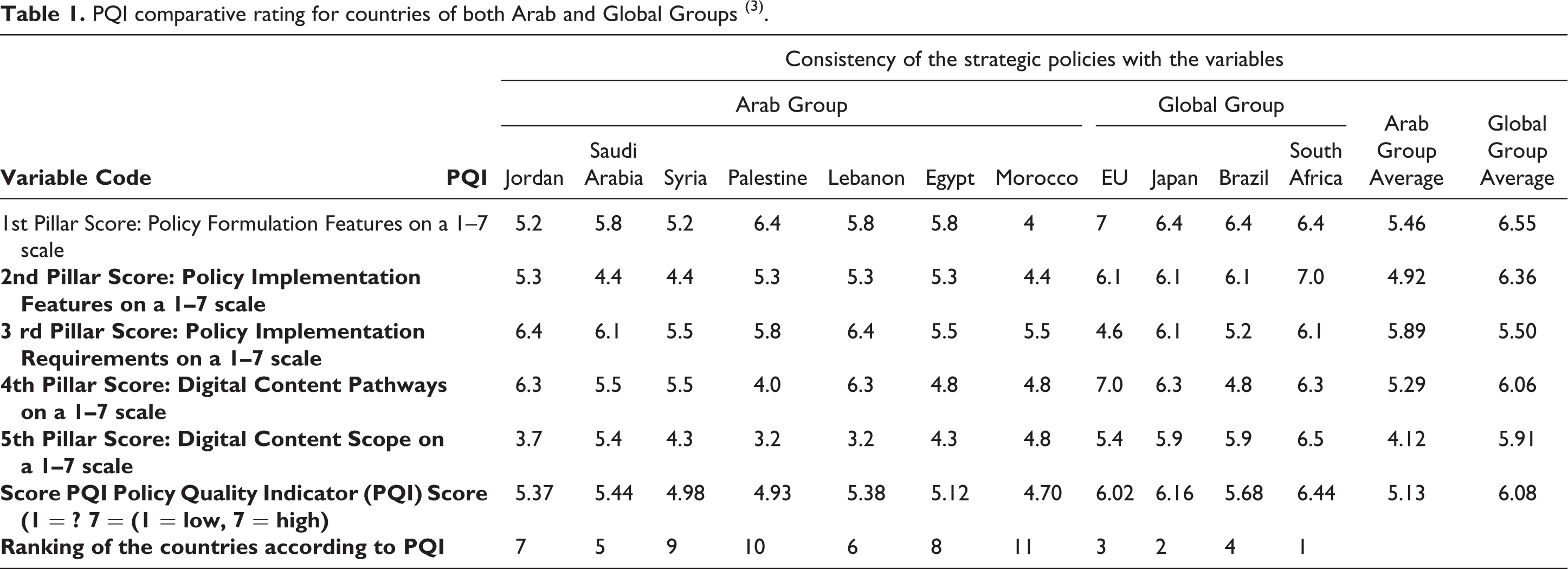
The main results related to the above comparative rating according to the PQI can indicates that the policies of the Global Group compared to the Arab Group came on top, as South Africa ranked first, followed by Japan in the second rank, the EU came in third, and Brazil came fourth. While Saudi Arabia, Lebanon and Jordan followed in the fifth, sixth and seventh place respectively. Egypt came in the eighth rank, followed by Palestine in the ninth rank, and Syria in the tenth rank, while Morocco occupied the last rank (see Figure 1).
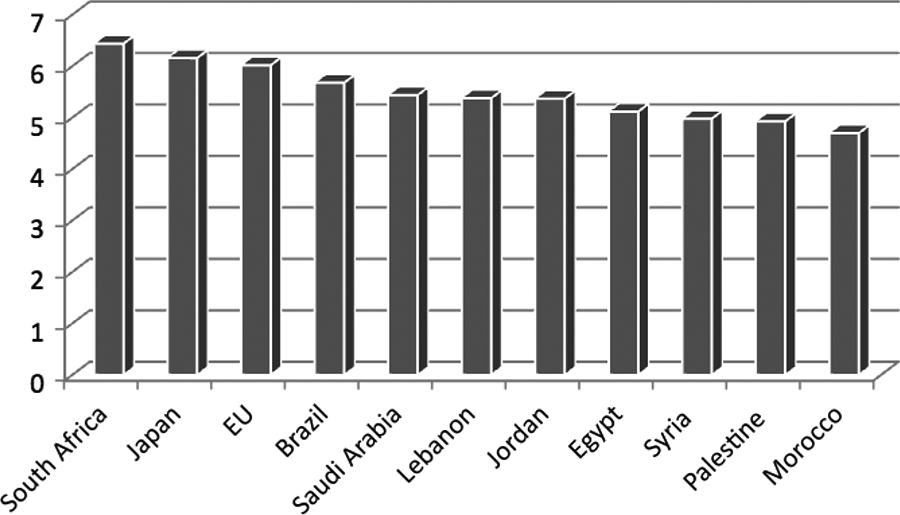
A descending order of countries according to the PQI score.
In the context of variables of the 1st Pillar (Policy Formulation Features), the most common variables that were covered in the policies of both country groups, were each of the following(2): Identifying constraints and opportunities; Emphasizing the role of digital content in achieving sustainable development; Integration with local policies in various sectors; Looking towards the regional digital content market.
Within the context of variables of the 2nd Pillar (Policy Implementation Features), the most common variables among both groups were the following: Seeking the participation of various regional and international stakeholders in the implementation process of the policies.
Within the 3rd Pillar (Policy Implementation Requirements), the variables most commonly addressed in the national policies were the following: Enhancing the capacity of the local digital workforce; Supporting Small and Medium Entities (SMEs) as well as micro-entities; Providing the necessary financial resources; Supporting innovation and creativity within the local environment; Supporting innovation and creativity within the local environment; Deployment and continuous enhancement of Internet services; Deployment of mobile phone services; Reducing the cost of access to digital content; Deployment of skills to use digital content (e-skills) in the local society.
Within the 4th Pillar (Digital Content Pathways), the variables most commonly addressed in the national policies were the following: Digital content to satisfy the actual local needs; Ensuring equal accessibility to digital content across all social strata; Supporting the efforts to overcome the local social problems.
Within the 5th Pillar (Digital Content Scope), the variable most commonly addressed in the national policies were the following: Diversification of the local digital content applications; Supporting e-government and online public services.
As for the most significant shortcomings in national policies of the Arab Group, in particular, in comparison to the Global Group, it seems that the Arab Group did not look toward an active role in the future of the global DCI. The results showed an interest in this issue by developed countries, in particular EU and Japan, while the Arab Group and developing countries within the Global Group seemed not to look forward to being part of the global DCI in the future.
Also, countries of the Arab Group did not provide the civil society with an opportunity to monitor the performance of the policies and redirecting it accordingly, which is an issue that was addressed by both Brazil and South Africa in particular and led to a quite satisfactory performance that put both of them amongst the leading countries in the global market of DCI.
The Arab Group, comparing to the Global Group, did not take the environmental issues into consideration, especially the safe disposal of e-waste, with the exception of Jordan within the Arab group, while the Global group showed significant commitment to this issue within their national policies. This might reduce the market potential of the Arab DCI in the future, due to the increasing awareness of the impact of related equipments on the environment, especially in the developed countries. Therefore, Arab governments should give it a priority in order to obtain a competitive role in the global DCI.
It seems also that the Arab Group did not focus on the creation of an effective policy governance body in the cases of Saudi Arabia, Syria and Palestine, while this was not the case for the rest of both Arab and Global groups. Undoubtedly, a well-structured governance body leads to successful policies where responsibilities are accurately specified and a regular monitoring takes place in order to improve performance accordingly.
Policies of the Arab group, with the exception of Saudi Arabia, seem to be not keen on attracting international experts and non-local digital workforces to fill the gap in some local aspects. However, in the Global Group, both Japan and South Africa were keen on this issue, which might be considered as one of the successful approaches that puts them in the top rank within both groups in terms of performance.
The Arab Group did not also focus on providing hosting services to the local digital content, with the exception of both Saudi Arabia and Egypt, while local hosting could boost the local DCI and should be taken into consideration by Arab policy makers in the near future, in order to ensure a maximum security level for the local DC assets.
Moreover, the Arab Group did not take into consideration, while creating policies, the support of DC to overcome environmental problems, like controlling global warming and reducing energy consumption. This was the case in both the Arab Group and the developing countries in the Global Group as well, while Japan and the EU seemed to be keener on this issue. The reason behind this tendency is related to the variation in priorities of local governments being developed or developing due to many other social and economic problems that are faced. It is also because of the high level of awareness of environmental and social responsibility issues in the developed countries compared to the developing countries.
The policies of the Arab Group did not support the efforts of translating digital content from and to the Arabic language, with the exception of national policies of Saudi Arabia, which seemed to be more cautious on this issue as it seeks to deploy Arab and Islamic culture on a global scale. It might be important to mention that translation could be a significant aspect in order to increase the local content and to highlight the local identity and culture in the global knowledge society. However, Arab efforts in this regard are still below expectations, given a lack of accurate auto-translation tools in addition to major challenges in sophisticated linguistic digitization that needs massive development in order to be resolved.
In addition, the Arab Group did not support the efforts of deploying Open Source Software (OSS) in the local society, with the exception of Saudi Arabia and Syria, that were as interested in this issue as all countries of the Global Group. Given the fact that the vast majority of software users in the Arab countries lack the financial resources to purchase costly content of the international giant developers in addition to the relatively high piracy rates, OSS should be given more concern by policy makers. Thus, giving a free of charge alternative content/software to a certain layer of the society with low purchasing power will protect the local DCI, increase its income and enhance its potential to address the global market.
Finally, enhancing the mobile-content services and the digital broadcasting services for audio and visual content, were not of interest to the Arab policies, with the exception of Jordan, while they were addressed in the Global policies. Moving towards mobile-content services and digital broadcasting is one step closer to a ubiquitous networked society, which is the core of the information society. Therefore, Arab policy makers should consider incorporating both issues in current policies and spend more efforts in order to make these digital content services available to the vast majority of citizens.
Conclusion
It is believed that the Arab world in particular is more involved in the consumption of global digital content rather than its production, however, it is also believed that this part of the world has a great potential to tackle the global DCI. Mainly, this is because of the large size of the market with a population of over 300,000,000, in addition to the unification of the Arabic language of this massive population.
Consequently, the Arab countries have to focus on developing more integrated national plans in the field of DCI in particular, instead of general policies and digital strategies with a too broad focus. At a later stage, it is believe that Arab countries have to develop a regional strategic plan in order to group all the local efforts in one area rather than scattering them and also to benefit from the massive market population, geographical position and unification of language.
Thus, the prospective Arabic regional strategic plan should not only take into consideration the massive leaps in the structure of the information society, but also to actively contribute to its future development. The vision of this regional plan is expected to be based on a comprehensive survey of the actual local needs, and consider the local, regional and global mutual cooperation. It should also be expected to enhance the local public awareness and skills of digital content, inject creativity and innovation in the local community, support the local Research and Development (R&D) initiatives, reconstruct and unify the digital acts and legislations, and develop more academic programs in relation to the DCI. Moreover, it should reduce the cost of access to the digital content, focus on the outsourcing and off-shoring industry, respect the cultural diversity in the local societies, share resources through a structured joint work, give better opportunities to SMEs and civil society in particular in the early planning stages, bypass governmental bureaucracy, and start from where others have stopped without duplicating previous efforts and learn from the mistakes of the past.
Additionally, building up confidence in the local workforce and expertise, especially the young e-leaders is also a vital element, as local expertise is often more familiar with the local capabilities, resources and needs. It is worth that developing competitive standards for the digital content industry and ensure compliance with international standards.
The international society and the giant digital content developers should enhance their efforts to support individual end-users in developing countries in particular. No doubt, this approach will have a positive impact, not only on the local communities but also on the developers themselves, especially in terms of reducing piracy rates and increasing awareness of DC which, in turn, will increase its use.
Also, developing countries in general, and Arab countries in particular, should exploit the existing high level of penetration of mobile services in reinforcing the local DCI, taking into consideration the relatively high cost of obtaining computers or other devices that provide accessibility to DC.
It is important to stress the fact that policy makers should not adopt other policies without tailoring them to the local context. Furthermore, policies that proved to be successful do not necessarily meet the requirements of other countries.
Finally, this study extends an invitation to the concerned national and international bodies in order to consider both the PAC and the PQI, for adoption and further development.
Footnotes
Notes
Annexure (1): Sources of Information of the Arab Group
Country
Sources of Information
Jordan
Information Technology Association Int@j and Ministry of ICT Jordan (2007) National ICT Strategy of Jordan 2007 – 2011. 59 p. Available at: http://www.intaj.net/sites/default/files/National-ICT-Strategy-of-Jordan-2007-2011_0.pdf (accessed Jan. 2011).
Ministry of ICT Jordan (2007) Wathiqat Al Seyasa Al A’mmah Lelhokoma fi Qita’at Al Etisalat wa Technolojia Al Ma’lomat wa Al Barid 2007, (In Arabic), Jordan, 2008, 48 p.
Ministry of ICT Jordan (2008) Al Khotah Al Estrategeyah Lewazarat Al Etisalat wa Technolojia Al Ma’lomat 2008 – 2001, (In Arabic), Amman, Jordan, 2008, 18 p.
Saudi Arabia
Ministry of ICT Saudi Arabia (2006) Al Khotah Al Wataneyah Leletisalat wa Technolojia Al Ma’lomat 1426 H [2006]: Al Ro’ia Lebena’ Mojtama’ Al Ma’lomat, (In Arabic), Saudi Arabia, 2006, 111 p. Available at: http://www.mcit.gov.sa/NR/rdonlyres/4622EB71-2937-48D3-B30E-CA738CAD0374/0/NICTP.pdf (accessed Jan. 2011)
Syria
Ministry of Communication and Technology Syria (2004) Istrategeyat Teqanat Al Etisalat wa Al Ma’lomat Leltanmeya Al Eqtisadeya wa Al Egtina’eya fi Soreya [2004 – 2013]: Al Montataqat Al ‘Amah wa Al Siyasat (In Arabic), Damascus, 2004, 15 p.
Ministry of Communication and Technology Syria (2004) Istrategeyat Teqanat Al Etisalat wa Al Ma’lomat Leltanmeya Al Eqtisadeya wa Al Egtina’eya fi Soreya [2004 – 2013]: Al Tawajohat Al Istrategeiah (In Arabic), Damascus, 2004, 40 p.
Ministry of Communication and Technology Syria (2004) Istrategeyat Teqanat Al Etisalat wa Al Ma’lomat Leltanmeya Al Eqtisadeya wa Al Egtina’eya fi Soreya [2004 – 2013]: Baramej Al ‘Amal wa Al Khotat Al Tanfizeyah, (In Arabic), Damascus, 2004, 11 p.
Palestine
Ministry of Telecom & Information Technology (0211) Al Istrategiah Al Wataneyah Letoknolojia Al M’alomat wa Al Etisalat wa Al Baried fi Falasteen 2011 – 2013: Al Mosawadah Al Ola, (In Arabic), Palestinian National Authority, Ramallah, 2011, 27 p. Available at: http://www.pmtit.ps/ar/cp/plugins/spaw/uploads/files/strategy%20final.pdf (accessed Jan. 2011).
Lebanon
Ministry of State for Administrative Reform Lebanon (2003) The National e-Strategy for Lebanon: Document 1: Executive Summary, Prepared by Akram Najjar, Salam Yamout and Kamal Siblini, 8 p. Available at: http://www.omsar.gov.lb/ (accessed Jan. 2011).
Ministry of State for Administrative Reform Lebanon (2003) The National e-Strategy for Lebanon: Document 2: The National e-Strategy for Lebanon, Prepared by Akram Najjar, Salam Yamout and Kamal Siblini, 44 p. Available at: http://www.omsar.gov.lb/ (accessed Jan. 2011).
Ministry of State for Administrative Reform Lebanon (2003) The National e-Strategy for Lebanon: The Cover Document, Prepared by Akram Najjar, Salam Yamout and Kamal Siblini, Oct. 2003, 8 p. Available at: http://www.omsar.gov.lb/ (accessed Jan. 2011).
Ministry of State for Administrative Reform Lebanon (2003) The National e-Strategy for Lebanon: Document 4: ICT Policies, Prepared by Akram Najjar, Salam Yamout and Kamal Siblini, Oct. 2003, 28 p. Available at: http://www.omsar.gov.lb/ (accessed Jan. 2011).
Egypt
Ministry of Communications and Information Technology Egypt (2007) Egypt’s ICT Strategy 2007 – 2010, May 2007, 50 p. Available at: http://www.mcit.gov.eg/Upcont/Documents/Egypt-ICT-Strategy.pdf (accessed Jan. 2011).
Morocco
Ministry of Industry, Trade and New Technologies Morocco (2009) Digital Morocco 2013: the National Strategy for Information Society and Digital Economy [2009 – 2013], Morocco, 2009, 102 P.
Annexure (2): Sources of Information of the Global Group
Country
Sources of Information
European Union
European Commission (2010) EU Digital Agenda, Directorate-General for the Information Society and Media, Brussels, Aug. 2010, 41 p. Available at: http://ec.europa.eu/information_society/digital-agenda/index_en.htm (accessed Jan. 2011).
European Commission (2009) Revising Europe’s ICT Strategy, ISTAG’s Report on Revising Europe’s ICT Strategy, Final Version, Information Society Technology Advisory Group ISTAG, Feb. 2009, 34 P.
Mario Monti (2010) A New Strategy for the Single Market: at the service of Europe’s economy and society: Report to the President of the European Commission, European Commission, Brussels, May. 2010, 107 p.
Lucilla Sioli (2011) Interview with Lucilla Sioli, Head of Unit – Economic and Statistical Analysis – Directorate General of Information Society DG INFSO. Available at: http://www.weforum.org/videos/global-information-technology-report-2011-Lucilla-Sioli (accessed Jan. 2011).
Japan
Teruyasu Murakami (2005) Japan’s National IT Strategy and the Ubiquitous Network. Nomura Research Institute, NRI Papers, No. 97, Nov. 1, 2005, 22p.
Prime Minister of Japan and His Cabinet Japan (2001) e-Japan Strategy, IT Strategy Headquarters, Jan. 22, 2001. Available at: http://www.kantei.go.jp/foreign/it/network/0122full_e.html (accessed Jan. 2011).
Toshiaki Ikoma (2003) Ubiquitous e-Japan: Industrial & Technological Foresight in the Information & Communication Area, The 2nd International Conference on Technology Foresight, Tokyo, Feb 2003.
Ministry of Internal Affairs and Communications Japan (2010) Information and Communications in Japan 2010 (summary), Economic Research Office, ICT Strategy Policy Division, Global ICT Strategy Bureau, Tokyo. 67p. Available at: http://www.soumu.go.jp/johotsusintokei/whitepaper/eng/WP2010/2010-index.html (accessed Jan. 2011).
Ministry of Internal Affairs and Communications Japan (2010) Contributing to Future Development of e-Japan Strategies. Available at: http://www.soumu.go.jp/menu_seisaku/ict/u-japan_en/new_outline01.html (accessed Jan. 2011).
Ministry of Internal Affairs and Communications Japan (2010) Structure of the “u-Japan Policy Package”. Available at: http://www.soumu.go.jp/menu_seisaku/ict/u-japan_en/new_plcy_pckg.html (accessed Jan. 2011).
Ministry of Internal Affairs and Communications Japan (2010) The National ICT Strategies in Japan are Evolving from “e” (electronic) towards “u” (ubiquitous) Available at: http://www.soumu.go.jp/menu_seisaku/ict/u-japan_en/new_outline01b.html (accessed Jan. 2011).
Ministry of Internal Affairs and Communications Japan (2010) The u-Japan Concept. Available at: http://www.soumu.go.jp/menu_seisaku/ict/u-japan_en/new_outline03.html (accessed Jan. 2011).
Ministry of Internal Affairs and Communications Japan (2011) what life will be like when u-Japan becomes a reality: u-Japan in our everyday life. Available at: http://www.soumu.go.jp/menu_seisaku/ict/u-japan_en/j_r-menu_u.html (accessed Jan. 2011).
Brazil
Gisele Craveiro (2010) Brazil, GISW 2010 Report: ICTs and Environmental Sustainability, Research Group on Public Policies for Access to Information – University of São Paulo. Global Information Society Watch GISW. pp. 99–100. Available at: http://www.giswatch.org/sites/default/files/gisw2010_en.pdf (accessed Jan. 2011).
Pablo Ortellado (2009) Brazil, GISW 2009 Report: Access to Online Information and Knowledge, Research Group on Public Policies for Access to Information – University of São Paulo. Global Information Society Watch GISW. pp. 95–97. Available at: http://www.giswatch.org/sites/default/files/GISW2009.pdf (accessed Jan. 2011).
Pablo Ortellado (2008) Brazil, GISW 2008 Report: Access to Infrastructure, Research Group on Public Policies for Access to Information – University of São Paulo. Global Information Society Watch GISW. pp. 89–91. Available at: http://www.giswatch.org/sites/default/files/gisw2008.pdf (accessed Jan. 2011).
Carlos Afonso (2007) Brazil, GISW 2007 Report: Focus on Participation, Rede de Informações para o Terceiro Sector (RITS) – Núcleo de Pesquisas, Estudos e Formação (NUPEF). Global Information Society Watch GISW. pp. 119–125. Available at: http://www.giswatch.org/sites/default/files/gisw_2007.pdf (accessed Jan. 2011).
Frederick S. Tipson and Claudia Frittelli (2003) Global Digital Opportunities: National Strategies of “ICT for Development”, Markle Foundation, Dec. 2003. 57 p. Available at: http://www.policyarchive.org/handle/10207/bitstreams/15542.pdf (accessed Jan. 2011).
Darcilene Magalhães, Peter Knight and Eduardo Moreira Da Costa (2009) Will the Soccer World Cup of 2014 Help Bridge the Social Gap through the Promotion of ICT and E-government in Brazil?. The Global Information Technology Report 2008–2009, World Economic Forum and INSEAD (The Business School of the World), Geneva, 2009 pp. 133–143.
Instituto Brasileiro De Geografia e Estatística – IBGE (2009) O Setor de Tecnologia da Informação e Comunicação no Brasil 2003–2006, estudos and pesquisas, informação económica, Rio de Janeiro, 2009. 82 p.
South Africa
Lebogang Marishane and Sally-Jean Shackleton (2009) South Africa, GISW 2009 Report: Access to Online Information and Knowledge, Women’s Net. Global Information Society Watch GISW. pp. 197–200. Available at: http://www.giswatch.org/sites/default/files/GISW2009.pdf (accessed Jan. 2011).
David Barnard and Jan Moolman (2008) South Africa, GISW 2008 Report: Access to Infrastructure. Global Information Society Watch GISW. pp. 175–177. Available at: http://www.giswatch.org/sites/default/files/gisw2008.pdf (accessed Jan. 2011).
Department of Communication South Africa (2011) Strategic Plan 2011 – 2014, Pretoria, Mr. Radhakrishna L. Padayachie (Minister of Communications), Mr. Obed Bapela (Deputy Minister of Communications) and Dr. Harrold Wesso (Acting Director-General). 74 p. Available at: www.info.gov.za/view/DownloadFileAction? id=144159 (accessed Jan. 2011).
Department of Communication South Africa (2010) Annual Report 2009–2010: Making South Africa a Global Leader in Harnessing ICT’s for Socio-economic Development, Dr. Harold Wesso, Pretoria, South Africa, 31 August 2010. 232 p. Available at: http://www.info.gov.za/view/DownloadFileAction? id=137236 (accessed Jan. 2011).
Annexure (3): Personal Communications
Abed Shamlawi, 2011, email communications with Mr. Abed Shamlawi, Chief Executive Officer, Information Technology Association Int@j, Amman, Jordan. Ahmed Alhefnawy, 2011, Skype meeting with Mr. Ahmed Alhefnawy, Senior Advisor for Arab States, International Telecommunication Union (ITU), Cairo, Egypt, Nov. 20, 2011. Alexander Felsenberg, 2011, Skype meeting with Mr. Alexander Felsenberg, Board Member of the UN-World Summit Award (WSA), Chairman of the national pre-selection WSA-Germany, Dusseldorf, Germany, Nov. 15, 2011. Nibal Idlibi, 2011, email communications with Dr. Nibal Idlibi, Head of ICT Applications, UN Economic and Social Commission of Western Asia (ESCWA), Beirut, Lebanon. Susan Teltscher, 2011, email communication with Dr. Susan Teltscher, Head of ICT Data and Statistics Division, Telecommunication Development Bureau, International Telecommunication Union ITU, Geneva, Switzerland, Nov. 23, 2011. Vincenzo Spiezia, 2011, email communications with Mr. Vincenzo Spiezia, Senior Economist, Directorate for Science, Technology and Industry, Economic Analysis and Statistics, Organization of Economic Co-operation and Development OECD, Paris, France, Nov. 21, 2011.
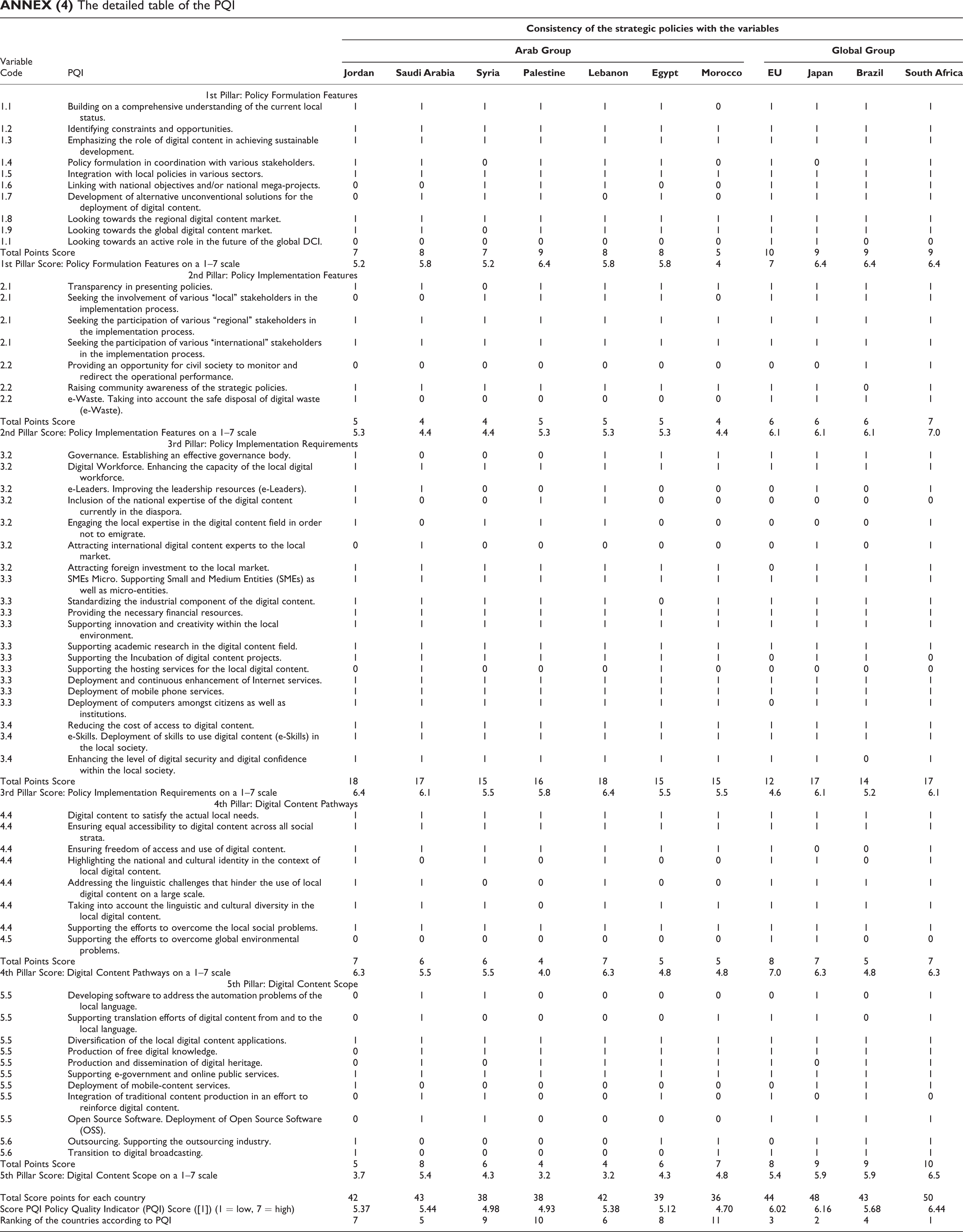
The detailed table of the PQI
Variable Code
PQI
1st Pillar: Policy Formulation Features
1.1
Building on a comprehensive understanding of the current local status.
1
1
1
1
1
1
0
1
1
1
1
1.2
Identifying constraints and opportunities.
1
1
1
1
1
1
1
1
1
1
1
1.3
Emphasizing the role of digital content in achieving sustainable development.
1
1
1
1
1
1
1
1
1
1
1
1.4
Policy formulation in coordination with various stakeholders.
1
1
0
1
1
1
0
1
0
1
1
1.5
Integration with local policies in various sectors.
1
1
1
1
1
1
1
1
1
1
1
1.6
Linking with national objectives and/or national mega-projects.
0
0
1
1
1
0
0
1
1
1
1
1.7
Development of alternative unconventional solutions for the deployment of digital content.
0
1
1
1
0
1
0
1
1
1
1
1.8
Looking towards the regional digital content market.
1
1
1
1
1
1
1
1
1
1
1
1.9
Looking towards the global digital content market.
1
1
0
1
1
1
1
1
1
1
1
1.1
Looking towards an active role in the future of the global DCI.
0
0
0
0
0
0
0
1
1
0
0
Total Points Score
7
8
7
9
8
8
5
10
9
9
9
1st Pillar Score: Policy Formulation Features on a 1–7 scale
5.2
5.8
5.2
6.4
5.8
5.8
4
7
6.4
6.4
6.4
2nd Pillar: Policy Implementation Features
2.1
Transparency in presenting policies.
1
1
0
1
1
1
1
1
1
1
1
2.1
Seeking the involvement of various “local” stakeholders in the implementation process.
0
0
1
1
1
1
0
1
1
1
1
2.1
Seeking the participation of various “regional” stakeholders in the implementation process.
1
1
1
1
1
1
1
1
1
1
1
2.1
Seeking the participation of various “international” stakeholders in the implementation process.
1
1
1
1
1
1
1
1
1
1
1
2.2
Providing an opportunity for civil society to monitor and redirect the operational performance.
0
0
0
0
0
0
0
0
0
1
1
2.2
Raising community awareness of the strategic policies.
1
1
1
1
1
1
1
1
1
0
1
2.2
e-Waste. Taking into account the safe disposal of digital waste (e-Waste).
1
0
0
0
0
0
0
1
1
1
1
Total Points Score
5
4
4
5
5
5
4
6
6
6
7
2nd Pillar Score: Policy Implementation Features on a 1–7 scale
5.3
4.4
4.4
5.3
5.3
5.3
4.4
6.1
6.1
6.1
7.0
3rd Pillar: Policy Implementation Requirements
3.2
Governance. Establishing an effective governance body.
1
0
0
0
1
1
1
1
1
1
1
3.2
Digital Workforce. Enhancing the capacity of the local digital workforce.
1
1
1
1
1
1
1
1
1
1
1
3.2
e-Leaders. Improving the leadership resources (e-Leaders).
1
1
0
0
1
0
0
0
1
0
1
3.2
Inclusion of the national expertise of the digital content currently in the diaspora.
1
0
0
1
1
0
0
0
0
0
0
3.2
Engaging the local expertise in the digital content field in order not to emigrate.
1
0
1
1
1
0
0
0
0
0
1
3.2
Attracting international digital content experts to the local market.
0
1
0
0
0
0
0
0
1
0
1
3.2
Attracting foreign investment to the local market.
1
1
1
1
1
1
1
0
1
1
1
3.3
SMEs Micro. Supporting Small and Medium Entities (SMEs) as well as micro-entities.
1
1
1
1
1
1
1
1
1
1
1
3.3
Standardizing the industrial component of the digital content.
1
1
1
1
1
0
1
1
1
1
1
3.3
Providing the necessary financial resources.
1
1
1
1
1
1
1
1
1
1
1
3.3
Supporting innovation and creativity within the local environment.
1
1
1
1
1
1
1
1
1
1
1
3.3
Supporting academic research in the digital content field.
1
1
1
1
1
1
1
1
1
1
1
3.3
Supporting the Incubation of digital content projects.
1
1
1
1
1
1
1
0
1
1
0
3.3
Supporting the hosting services for the local digital content.
0
1
0
0
0
1
0
0
0
0
0
3.3
Deployment and continuous enhancement of Internet services.
1
1
1
1
1
1
1
1
1
1
1
3.3
Deployment of mobile phone services.
1
1
1
1
1
1
1
1
1
1
1
3.3
Deployment of computers amongst citizens as well as institutions.
1
1
1
1
1
1
1
0
1
1
1
3.4
Reducing the cost of access to digital content.
1
1
1
1
1
1
1
1
1
1
1
3.4
e-Skills. Deployment of skills to use digital content (e-Skills) in the local society.
1
1
1
1
1
1
1
1
1
1
1
3.4
Enhancing the level of digital security and digital confidence within the local society.
1
1
1
1
1
1
1
1
1
0
1
Total Points Score
18
17
15
16
18
15
15
12
17
14
17
3rd Pillar Score: Policy Implementation Requirements on a 1–7 scale
6.4
6.1
5.5
5.8
6.4
5.5
5.5
4.6
6.1
5.2
6.1
4th Pillar: Digital Content Pathways
4.4
Digital content to satisfy the actual local needs.
1
1
1
1
1
1
1
1
1
1
1
4.4
Ensuring equal accessibility to digital content across all social strata.
1
1
1
1
1
1
1
1
1
1
1
4.4
Ensuring freedom of access and use of digital content.
1
1
1
1
1
1
1
1
0
0
1
4.4
Highlighting the national and cultural identity in the context of local digital content.
1
0
1
0
1
0
0
1
1
0
1
4.4
Addressing the linguistic challenges that hinder the use of local digital content on a large scale.
1
1
0
0
1
0
0
1
1
1
1
4.4
Taking into account the linguistic and cultural diversity in the local digital content.
1
1
1
0
1
1
1
1
1
1
1
4.4
Supporting the efforts to overcome the local social problems.
1
1
1
1
1
1
1
1
1
1
1
4.5
Supporting the efforts to overcome global environmental problems.
0
0
0
0
0
0
0
1
1
0
0
Total Points Score
7
6
6
4
7
5
5
8
7
5
7
4th Pillar Score: Digital Content Pathways on a 1–7 scale
6.3
5.5
5.5
4.0
6.3
4.8
4.8
7.0
6.3
4.8
6.3
5th Pillar: Digital Content Scope
5.5
Developing software to address the automation problems of the local language.
0
1
1
0
0
0
0
0
1
0
1
5.5
Supporting translation efforts of digital content from and to the local language.
0
1
0
0
0
0
1
1
1
0
1
5.5
Diversification of the local digital content applications.
1
1
1
1
1
1
1
1
1
1
1
5.5
Production of free digital knowledge.
0
1
1
1
1
1
1
1
1
1
1
5.5
Production and dissemination of digital heritage.
0
1
0
1
1
1
1
1
0
1
1
5.5
Supporting e-government and online public services.
1
1
1
1
1
1
1
1
1
1
1
5.5
Deployment of mobile-content services.
1
0
0
0
0
0
0
0
1
1
1
5.5
Integration of traditional content production in an effort to reinforce digital content.
0
1
1
0
0
1
0
1
0
1
0
5.5
Open Source Software. Deployment of Open Source Software (OSS).
0
1
1
0
0
0
0
1
1
1
1
5.6
Outsourcing. Supporting the outsourcing industry.
1
0
0
0
0
1
1
0
1
1
1
5.6
Transition to digital broadcasting.
1
0
0
0
0
0
1
1
1
1
1
Total Points Score
5
8
6
4
4
6
7
8
9
9
10
5th Pillar Score: Digital Content Scope on a 1–7 scale
3.7
5.4
4.3
3.2
3.2
4.3
4.8
5.4
5.9
5.9
6.5
Total Score points for each country
42
43
38
38
42
39
36
44
48
43
50
Score PQI Policy Quality Indicator (PQI) Score ([1]) (1 = low, 7 = high)
5.37
5.44
4.98
4.93
5.38
5.12
4.70
6.02
6.16
5.68
6.44
Ranking of the countries according to PQI
7
5
9
10
6
8
11
3
2
4
1
Annexure (5): The method used for the calculation of the PQI
In light of the variables/criteria devised for the PAC, a matrix was created where a national policy would be awarded one point in the event of its consistency with a certain variable, thereby setting the maximum score at 56 (the total number of variables used). On the other hand, the value of zero is accorded to a country in two cases: the lack of consistency with an evaluation criteria or the lack of information regarding it (= -). These variables or individual indicators were then grouped into five pillars/sub-indicators composites according to the expected relationship between them.
To obtain the calculated score for the pillars/sub-indicators, the points of the variables within the sub-indicators were summed and converted to a 7-point scale (minimum = 1, maximum = 7) using a similar formula to that used in the Global Information Technology Report of the World Economic Forum (WEF) (see Figure 2).
Finally, the value for the PQI was obtained through the computation of the mean of scores for all 5 sub-indicators after their conversion to the 7-point scale (see Figure 3).