







Abstract
The potential which open access offers to Caribbean scholarly communication in general, and science and technology specifically, is an opportunity to shift the focus from one which has been publisher driven to one which is research driven. However, for this to become a reality, both the university and faculty will need to break free of the practices surrounding traditional publishing, tenure and promotion. In an attempt to assess readiness among science faculty at The University of the West Indies to make this transition, this exploratory study analyses their perceptions, knowledge and use of open access. The results revealed significant gaps in knowledge about, and minimal engagement with open access as a publication modality among this cohort.
Keywords
Introduction
Prior to 2000 commercial publishers were de facto necessities of the paper centric scholarly publishing landscape. Today, as a result of developments in information communication technologies (ICT), digital scholarship has become ubiquitous. In response, commercial publishers, cognizant of the potential effect this development could have on information dissemination, reengineered their companies in an effort to become market leaders in this emerging global information economy. These companies accomplished this through a series of mergers, the acquisition of smaller publishing houses and through assuming responsibility for the publishing of journals of some professional societies. Companies like Elsevier and Springer, two of the major publishers of scientific literature, led this movement to market domination. The net result of this consolidation was a rapid increase in journal prices which outstripped the rate of inflation. Already impacted by shrinking budgets, academic libraries as the primary access providers to the scholarly literature were left to grapple with how best to continue to provide the level of access required to support academic research, scholarship and teaching.
The ensuing crisis forced the scholarly community to begin to investigate alternative modalities which could facilitate wider dissemination of their output, and this ultimately led to the emergence of the open access (OA) model. But, through their mergers and a strategy commonly referred to as ‘bundling’, commercial publishers continued to tighten their stranglehold on libraries, thereby making it harder for libraries who had subscribed to their packages to drop a title even if an OA title was assessed to be either similar or greater in value to a subscribed title. If institutions in the developed world were struggling under the pressure of these practices, it is not difficult to imagine what the impact would be on the situation in the developing world where financial resources are substantially more limited. For scholars from the English-speaking Caribbean the move to OA offers the opportunity to counter this disadvantage either through the publication of their research papers in OA journals or by self-archiving in an institutional or subject repository. In particular, OA can provide opportunities by virtue of wider availability of information for scholars to advance socioeconomic development within the region and increase the global visibility of their work and their institutions.
Background
The University of the West Indies (UWI) established in 1948 is today the premier research university serving the English-speaking Caribbean. With three physical campuses located in Jamaica, Trinidad and Barbados and one virtual campus, the university’s offerings include first degrees, higher degrees and advanced diplomas. The mission of the UWI is to advance education and create knowledge through excellence in teaching, research, innovation, public service, intellectual leadership and outreach in order to support the inclusive (social, economic, political, cultural, environmental) development of the Caribbean region and beyond. Against this background, this study focuses on science academic staff inclusive of the faculties of Science and Technology, Agriculture and Engineering at the three physical campuses at Mona in Jamaica, St Augustine in Trinidad and Tobago and Cave Hill in Barbados. The objective of the study is to analyse the perception, knowledge and use of OA by the academics that make up this cohort.
Literature review
The role of reputation in academia undergirds what research and scholarship is produced, distributed and consumed and it is into this environment that OA journals and archives were catapulted. Since scientists produce this scholarship with the expectation of some ‘beneficial impact’ on their disciplinary area rather than financial gain, the thinking was that with the advent of digital technologies and the opportunities they afforded, there would no longer be any reason for this body of literature to be available only through a toll access modality (Harnad, 1999). However, the initial reaction from academia to the research produced and distributed using this platform was that it lacked credibility and therefore could not add any reputational value to an author (Willinsky, 2006). With the introduction of the article processing charges (APC) model there was a further equating of OA with vanity publishing with the view being expressed that publishers could increase their acceptance rates, an approach which would generate more revenue but potentially result in a lowering of the quality of published articles (Fullard, 2007; Walters, 2007).
Advocates like Peter Suber (2009) countered these arguments by affirming that OA has never been ‘…about bypassing peer review. The OA movement focuses on OA for peer review literature. The goal is to remove access barriers, not quality filters’. Kelty (2014: 206) argued further that the continued reliance on publications and publications counts as criteria for rewarding faculty demonstrates a lack of understanding of how value and quality work within academia. According to him, OA presents opportunities for experimentation with publishing different kinds of content as well as other methods of validation for recognizing this content, but like Suber he concludes that OA is no different from traditional publishing in that its ultimate objective is also the preservation of quality and authoritativeness. However, this is where the similarity between the two modalities ends because, as Suber (2008) further advances, while there is an unquestionable relationship between publishers and scholars, the relationship in the reverse is not the same. He posits that toll access publishers cannot generate output unless there are scholars who will be authors, referees and editors whereas scholars’ need of publishers is only contingent on the perceived value of the services offered. And, he concludes that scholars have the ability to provide such services for themselves at a lower cost using the digital technologies. In spite of this, however, he acknowledges that it is the dominance of the existing prestigious journals which hinders both researchers and their institutions from severing their relationships with the toll access publishers.
Studies which explore researcher engagement with OA appear to uphold Suber’s conclusion and many of these consistently point to the influence of certain factors which impact publication choices. The quality of the outlet as represented by journal reputation, topic relevance, audience and impact factor have emerged as the strongest reasons for researchers not to choose the freely available potential offered by OA journals when compared to their subscription counterparts (Doty, 2013; Harley et al, 2010; Moore, 2011; Rowlands and Nicholas, 2006; Warlick and Vaughn, 2007). Citing possible reasons for this, Park and Qin (2007) advance that because the current academic reward system links journal reputation to career advancement then less weight is likely to be given to articles published in OA journals when compared to non-open access journals, a position supported by the results of the study by Mann et al. (2008). In their study of 481 researchers only one-quarter of the respondents had actually used OA as a publication option, 61% indicating that they feared it would jeopardize their chances for promotion and tenure, and 60% indicating that they felt the impact factors of this medium were insufficient. Underpinning these reputational factors is the critical role of peer review, a criterion which has been a longstanding measure for quality, and a benchmark which researchers in two separate studies unanimously ranked highly. In the early study of international researchers conducted by Rowlands and Nichols (2006) 96% of the respondents ranked peer review as either very or quite important. Five years later in a study of faculty at the University of Toronto, peer review was ranked as very important by 93% of the respondents and, specifically, fewer scientists compared with their counterparts in the humanities and social sciences ranked peer review as ‘not important’ (5% compared to 10% and 8% respectively) (Moore, 2011).
The current research literature still reveals that there is limited knowledge among scholars about OA (Kochken and Wical, 2013; Mischo and Schlembach, 2011) as well as limited awareness of the existence of institutional repositories at their respective institutions (Creaser, 2010; Cullen and Chawner, 2011; Kim, 2011; Yang and Li, 2015). Even when there was an awareness of the existence of a repository, reasons cited for not depositing included: fear of plagiarism concerns about the value to career advancement long term feasibility of the repository ability to publish elsewhere at a later date. (Kim, 2011; Yang and Li, 2015)
Additionally, as a result of the limited knowledge about OA the degree of uptake of OA as an alternative/additional outlet for publishing is not what was expected, given the general support by scholars for it as a modality for providing easier access to scientific literature especially for researchers in developing countries (Mann et al., 2008; Moore, 2011). A closer examination of the literature, however, reveals that limited knowledge, while a contributor, is not the only reason for this low uptake. Even when knowledge about OA is evident there does not appear to be a positive correlation with the degree of engagement. And, underlying this reluctance are the attitudes and perceptions of many scholars, whose views range from: The APC model is an incentive for journals to accept papers of lesser quality in exchange for money; OA journals are not properly archived; OA journals are of lower reputation and prestige; Promotion and tenure committees won’t give weight to a journal charging authors fees; OA won’t lead to an improvement in the quality of articles. (Harley et al., 2010)
These perceptions, in conjunction with the academic reward system, are strong motivators which are seemingly inhibiting many authors from fully embracing OA as a publication option. As readers however, there appears to be a dichotomous relationship between their roles as authors and that of reader with several studies showing that scholars extensively use OA media when conducting their own research, an indication that the evaluative criteria for publishing does not apply to access (Mann et al., 2008). The challenge which remains for OA advocates, librarians and universities is how to expand engagement beyond access to publishing. In this regard, the findings of both the University of California and the University of Toronto studies suggest a potential role for senior faculty in achieving this goal. The University of California study results suggest that innovation is more likely to come from senior faculty than from their junior counterparts because the former are not constrained by concerns of tenure and therefore may be more willing to experiment (Harley et al., 2010). And, similarly the University of Toronto study concludes that professors and assistant professors were more likely to be more positive in their response to change associated with OA (Moore, 2011).
The research literature on OA from the developing regions of the global South, specifically Africa, Latin America and the Caribbean has centred more on how OA has changed the research landscape. However, there are some studies which speak to knowledge, attitudes and perceptions among the research communities. Fullard (2007) in her study on the South African response to OA publishing revealed a 61% awareness of OA the concept, and registered positive results of the respondents’ perceptions about the benefits of OA relative to providing increased access to scholarly literature (62%), advancing scientific knowledge (56%) and promoting engagement with global science (54%). But, like their counterparts from the global North, these respondents had reservations about the peer review process and concerns about the relationship/correlation between APC and the rate of article uptake by publishers. In Eastern Africa, a study of Tanzanian public universities conducted between 2007 and 2010 revealed a 72% awareness of OA among the 544 researchers but a significantly low uptake of this method for disseminating their research (<20%). However, there was evidence of the use of OA content for research purposes, (62%), and positive opinions on the standards of quality and academic merit of OA publications, (82%) (Dulle et al., 2010).
Four years later, Lwoga and Questier’s (2014) study of Tanzanian health sciences universities also revealed similar levels of awareness (94%) on OA issues, and a satisfactory response (64%) to the use of OA for research dissemination. These high ratings for awareness, uptake and the quality of OA publications are reflective of a regional scenario which is being driven by a need to redefine the research landscape through the growth of indigenous OA journals. And this is evident from the existence of portals like AJOL which facilitates access to 464 African journals, 150 of which are OA, and SCIELO-SA which was launched with 26 South African OA titles and is expected to eventually host 180 of South Africa’s 300 titles (Poynder, 2013a). Michelle Wilmers in an interview on the state of OA opines that it is the challenges caused by massification and global competition and the imperative to respond to the educational needs of the continent which have influenced the nature of OA (Poynder, 2013a). Regardless of the underlying reasons and the many challenges however, the significant research output emanating from South African scholars ‘has become a beacon of hope’ for advancing development in OA in Africa (Raju et al., 2012: 2).
Research studies on OA from the Latin American and Caribbean (LAC) region have also centred more on how it has changed the research landscape and less on faculty perceptions and attitudes. Delgado-Troncoso (2012) opines that in the LAC region there has been an increase in growth both qualitatively and quantitatively of referred journals over a 20-year period. This he attributes primarily to the development of OA repositories like SCIELO and RedALyC, which began as local initiatives and have since expanded to become regional OA portals. As evidence of this growth, a survey to identify institutions from the LAC region ‘with the largest volume of scientific output and most exposure of their output on the web’, revealed that universities from Brazil, Mexico, Colombia, Argentina, Chile and Venezuela were leaders in this regard, with universities from Ecuador, Peru, Costa Rica and Uruguay having a limited presence (Babini, 2012). And, by 2013, the number of Latin American OA journals hosted on the SCIELO platform accounted for 1033 titles (Poynder, 2013b).
What is significant about the two aforementioned studies is the use of the phrase ‘Latin America and the Caribbean’ in both the titles and text of these papers, because what is being privileged in the discourse are developments that have taken place in Latin America. The Caribbean is an area represented by four geo-linguistic sub-regions – English, Spanish, French and Dutch – and, as it relates to the literature on OA from the LAC region, compared to Latin America there is a paucity of research which exists on OA. Consequently, what the research literature is highlighting is the growth of OA and portals like SCIELO in the Latin American countries of the LAC region. Alperin et al (2011) credit this success to the ‘overriding objective of providing visibility to the research produced regionally’, rather than to the advocacy surrounding OA. And, as the authors opine, the SCIELO initiative was not just a response to provide a portal to enable full text access. In addition, it exposed citations to Latin American publications and in so doing extended the reach to a research audience beyond the boundaries of the region. In a sub-region in which two-thirds of the investment in research and development is funded by state resources (Unesco, 2010) and in which there are over 1000 Latin American OA journal titles, there can be little doubt as to the attitudes, perceptions and knowledge about OA of scholars in the Spanish/Portuguese areas of the LAC region.
To date there have only been a limited number of studies addressing OA issues from an English-speaking Caribbean perspective. Two of these studies focus on researchers at the St Augustine campus of the UWI, one specific to engineering faculty and the other across all disciplines (Papin-Ramcharan and Dawe, 2006; Winter and Sandy, 2012). The earlier study conducted among 112 engineering researchers revealed a 22% awareness of OA but only two researchers had published in an OA journal. The later study with a 32% response rate from a population of 358 revealed that 66% were aware of the OA concept and 21% of that population had published in an OA journal. Not unlike other studies, impact factor, peer review and audience emerged as important factors influencing publication choice, ranking well over the 70 percentile as compared to journal reputation which ranked the lowest at 7%. And some of the reasons for not choosing OA as a publication outlet included concerns about copyright, perceived low prestige of OA journals, inability to identify OA journals in which to publish, lack of knowledge on OA and APC.
The six-year interval between the two studies conducted at the St Augustine campus has not shown there to be any substantive progress made in terms of a real transitioning to an OA modality. In its 2012–2017 strategic plan the UWI articulated a vision of a ‘university acknowledged by its peers in the global higher education community as a leading contributor in research, teaching and learning and knowledge creation on Caribbean, small states and developing country issues’ (UWI, 2013: 21). Many of these issues are impacted by the ability of Caribbean states to adequately address social and economic problems and many have their foundation in the need to advance research in science and technology. OA as a means of increasing access to a wider body of research and enhancing exposure to Caribbean research offers scientists an ideal platform to ‘jumpstart’ the university’s journey towards becoming recognized as a centre of excellence.
Research problems
The research problems which will be addressed in this paper are: To assess the level of usage of OA by the science academic staff for the publication of research findings; To identify the perceived benefits of OA by the science academic staff; To assess the level of importance given to peer review in the scholarly publishing process by the science academic staff; To identify the critical factors in the decision of science academic staff of where to publish.
Analytical approach and data
To investigate the use and perception of OA by the science academic staff a questionnaire was developed and pretested in January 2013. The questionnaire sought to identify the respondents that used OA to publish their research findings, the factors critical in the decision of where to publish, the benefits of using OA and some demographics of the respondents. The respondents were also asked to rank the importance of peer review to the scholarly publishing process on a scale of 1 to 5, where 1 was not important and 5 extremely important.
A convenience sample was drawn from the science faculty email directories of the three campuses. A total of 250 persons were non-randomly selected from the three campuses. Questionnaires were administered to prospective respondents via the Internet using Survey Monkey. A total of 72 usable questionnaires were obtained when the survey was closed in December 2013 giving a response rate of 29%. The relevant data was analysed using SPSS version 20.
Results
The majority of the respondents (81%) were from the Faculty of Science and Technology. For purposes of this study the faculty was placed into two broad categories: Junior academic staff – assistant lecturers and lecturers. Senior academic staff – senior lecturers and professors.
The junior academic staff category accounted for 63% of the respondents. With the majority of the sample belonging to this category the number of respondents who had 10 or fewer years of service not unexpectedly were also in the majority, accounting for the same 63%.
As a publication choice OA was not used by a large percentage of the respondents to disseminate their research findings, with only 25% of the respondents indicating that they had published in an OA journal (Figure 1).
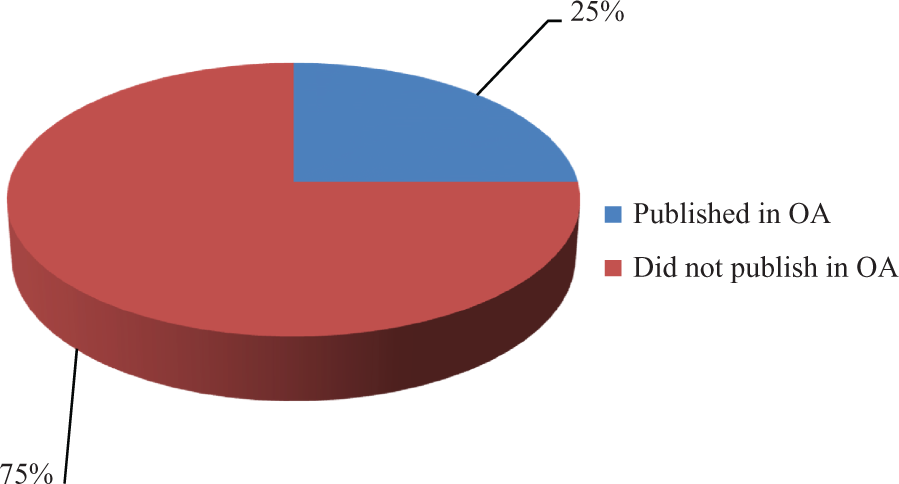
Usage of OA to publish by the respondents.
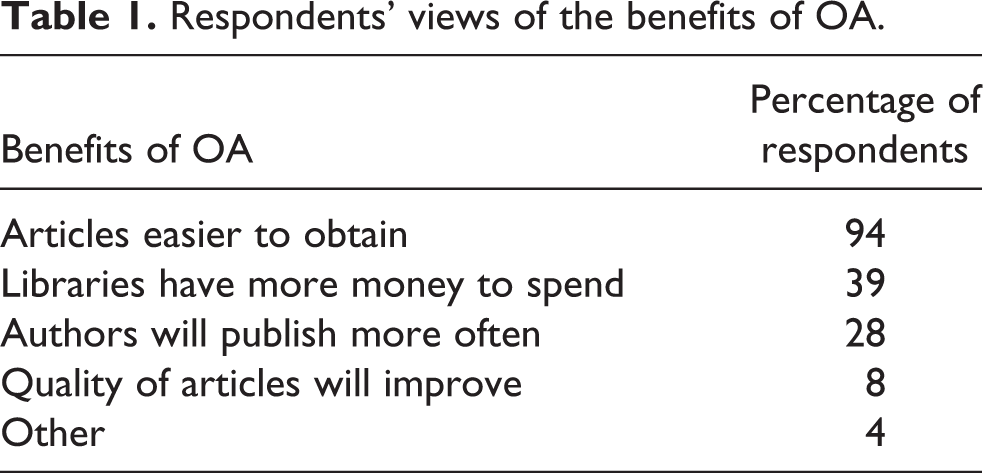
Based on the following statements: ‘articles easier to obtain, libraries have more money to spend, authors will publish more and quality of articles will improve’ the respondents were asked to provide their opinions on the benefits of OA. The primary benefit of OA identified by the respondents (Table 1) was that articles will be easier to obtain. None of the other benefits was identified by 50% of the respondents, which suggests that they might not be perceived as a benefit of OA.
Respondents’ views of the benefits of OA.
Using a Likert scale of 1 to 5 where 1 was not important and 5 extremely important, respondents were asked to rank the importance of peer review to scholarly publishing (Figure 2). None of the respondents selected the ‘of little importance’ category. Further, 89% of the respondents considered peer review very important and extremely important.
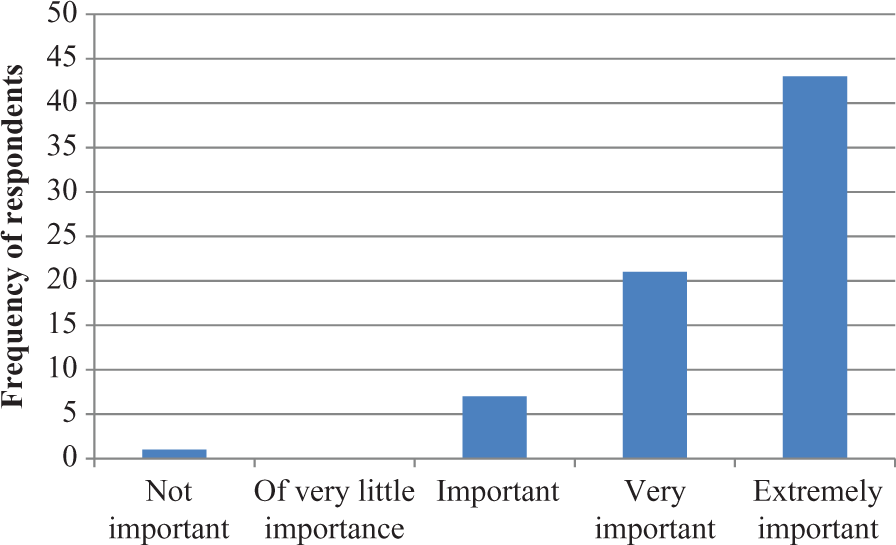
Frequency rankings of importance of peer review to the scholarly publishing process.
Table 2 illustrates the percentage responses from a list of factors which were the most important in the respondents’ decision on where to publish. Only two factors, reputation and topic were selected by more than 50% of the respondents, with reputation of the journal being ranked as important by 75% of the respondents. All of the pertinent OA factors – permission to post pre-print, post-print and retain copyright – received the lowest ranking, 0%, 3% and 3% respectively.
Factors influencing decisions of where to publish.

The investigation into article metrics used a five point Likert Scale, where 1 was strongly disagree, and 5 strongly agree, to garner perceptions about downloads and citations as indicators of usefulness to research. Figure 3 provides a combined chart of the results. In relation to downloads, a large percentage of the respondents were unsure (30.6%), while 17% disagreed and 1% strongly disagreed that they were a good measure of usefulness in the research process. In total, 49% of the respondents were not in the agreement categories, while 51% thought that downloads were a good measure of the usefulness to research. As was expected, a larger proportion of the respondents were in the agreement categories (71%), that is, agree and strongly agree, for citations compared to downloads. These results provide an interesting insight into the respondents’ perceived credibility of the newer metric of article downloads for usefulness when juxtaposed to the traditional metric of article citations.
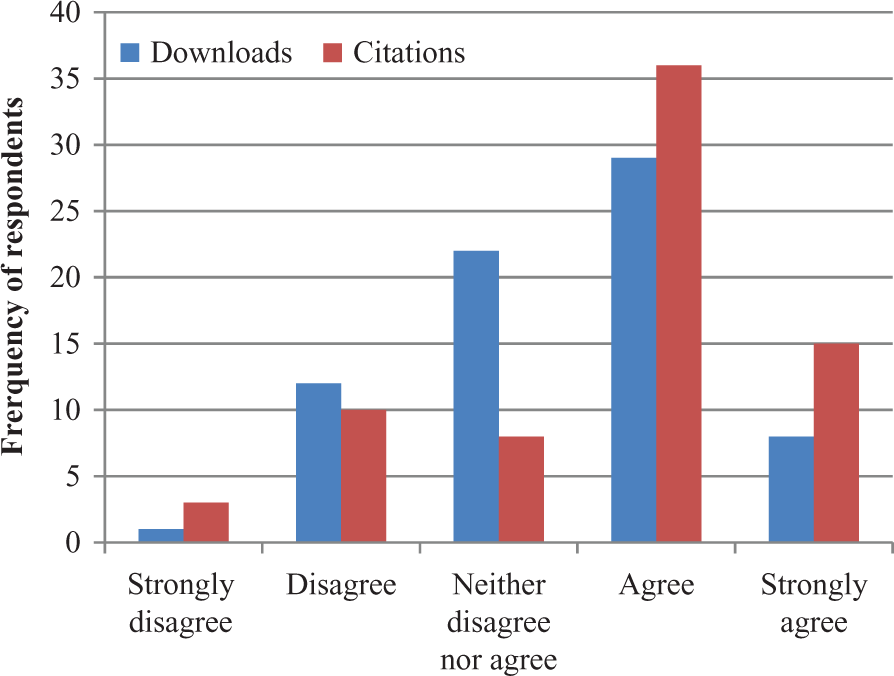
Ranking for downloads and citations as a good measure of the usefulness to research.
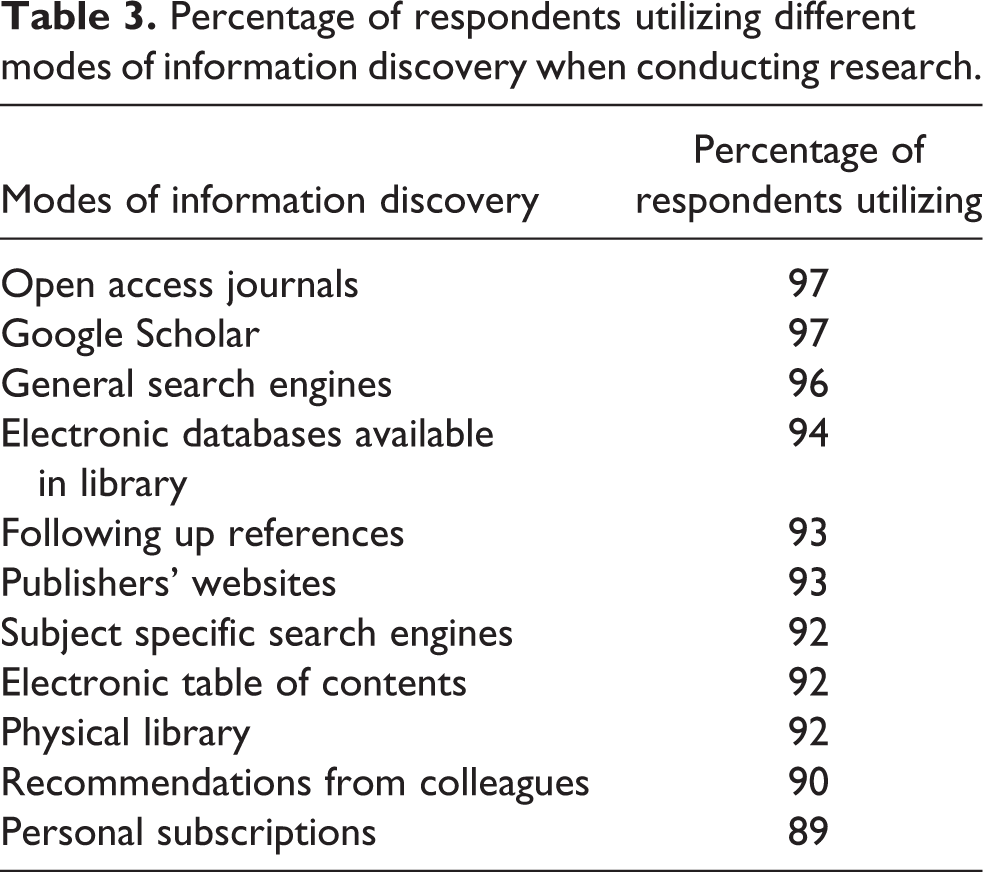
While traditional metrics ranked highest in decisions among the respondents of where to publish, the principal mechanisms used for discovery when conducting research were OA journals and Google Scholar, each receiving a 97% rating (Table 3). General search engines, electronic databases and following up cited references accounted for 96%, 94% and 93% respectively.
Percentage of respondents utilizing different modes of information discovery when conducting research.
To determine the respondents’ knowledge of OA, they were asked to rank their knowledge of institutional repositories. Figure 4 displays the respondents’ rankings on a scale from 1 to 5, where 1 is none at all and 5 is very knowledgeable. The results revealed that 78% of the respondents had very little or no knowledge of institutional repositories.
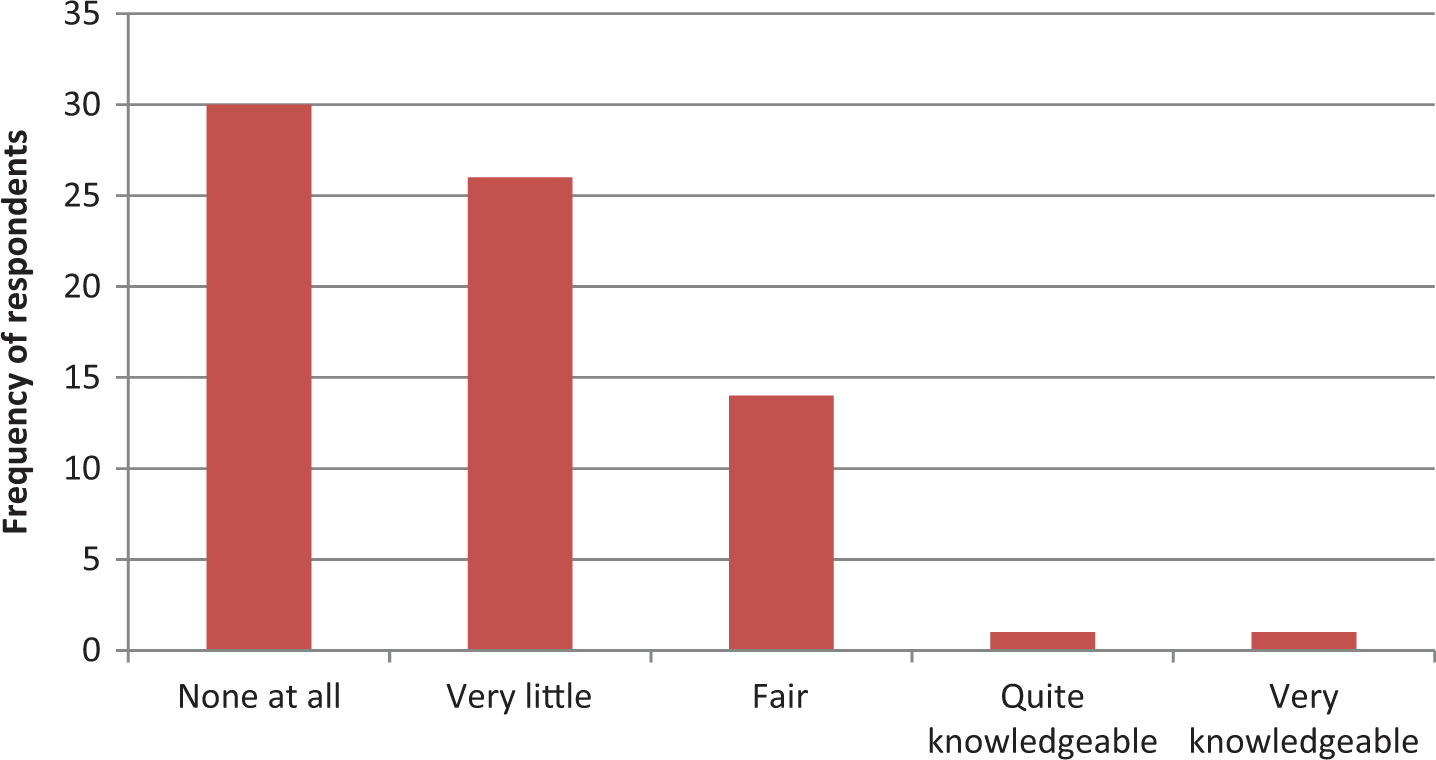
Rankings of knowledge of institutional repositories by the number of respondents.
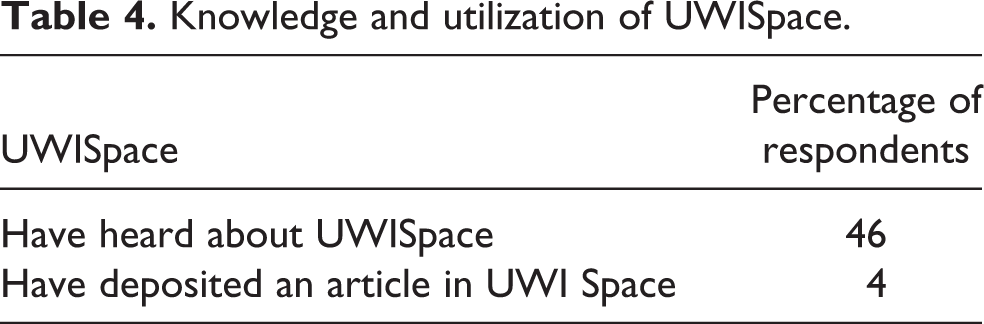
Similarly, fewer than half of the respondents, 46% (Table 4) acknowledged that they were aware of the university’s institutional repository, UWISpace, and only 4% had actually deposited in the repository. In addition respondents were asked about their awareness of the option to negotiate author rights, and whether or not they had ever done so. Of the 31% who indicated their awareness of this option, only 6% had done so.
Knowledge and utilization of UWISpace.
Discussion
A limitation of this study is the low response rate obtained, which does not permit generalizations. Also noticeable is the poor response representation by some science faculties, Engineering 11% and Agriculture 8% compared to Science and Technology 81%. In the two previous studies on the UWI the response rates were also very low, suggesting that responding to questionnaires is not high on the agenda of academic staff and this is a major challenge for Caribbean researchers undertaking evidenced-based research. The results of this study do not reveal any significant increase (4%) in the use of OA among UWI academics since the Winter and Sandy study (2012) and similarly, the 25% result obtained for usage was significantly below that of a similar study among biomedical researchers where 79% of the respondents had published in an OA journal (Warlick and Vaughn, 2007). In spite of this, however, the study does offer some insight into the perception, knowledge and use of OA among the specialized population of science academics. And, given the potential of science and technology for development in the region, the importance of having a sense of the practice of this sub-population as a precursor to transitioning into an OA modality cannot be underestimated.
In order for there to have been evidence of an OA culture, factors such as free access, permission to retain copyright and to post post-print should have received a higher ranking by the respondents. Instead, the low ranking accorded these factors juxtaposed to the 97% who use OA media for discovery in support of research gives credence to the contention made in other studies that while behaviours reflect an increasing use of OA literature, attitudes to the use of OA for publishing research have not undergone a similar change. The high ranking of factors such as journal reputation, (75%), reinforces the continued privileging of the traditional metrics as benchmarks for achieving and maintaining academic reputation, a situation which is still very evident from the behaviour of scientific researchers from the global North. In this regard, the results of this study align with those of Warlick and Vaughn (2007) where biomedical researchers identified impact factor as a primary element influencing decisions of where to publish, the authors concluding that OA journals will need to establish similar levels of credibility in order to be considered viable publication options. And, in another study of physical scientists over half of the respondents had published more than 10 articles over a five-year period in traditional peer reviewed journals (Moore, 2011). For the UWI a recent directive from the university Appointments Committee (UWI Office of University Registrar, 2013) advising that applications for promotion to the level of professor must include impact factors for journals and citation indices represents a further solidification of this culture in the psyche of faculty. And that decision has the potential to place the UWI on the periphery of the scientific research landscape as well as impact efforts to create the kind of environment necessary for fostering the development of OA within the academy.
Christopher Kelty (2014: 215) argues that OA ‘is best seen not as a solution to a problem’ but rather as a means of reshaping the scholarly environment, an approach which has contributed to OA development in countries like India, where the existence of a number of institutional repositories and indigenous journals, particularly in the sciences, has enabled that country to increase its scientific research output (Ghosh and Das, 2007). While the evidence from other developing regions like Latin America and Africa (Alperin, 2011; Babini, 2012; Raju et al., 2012) also demonstrates that this is possible, from the English-speaking Caribbean perspective the lack of awareness on such critical aspects of OA as the ability to negotiate author rights as evidenced by the 69% response is testimony to the fact that the sub-region is still at the ‘solution to a problem’ phase. It is therefore not surprising that the attention to access among the UWI faculty appears to be one sided, highlighting the dichotomous relationship between their roles as authors and readers. As readers, the belief that one of the major benefits of OA is its ability to provide easier access to articles is very evident in practice, as indicated by 94% of the respondents, in the choice of resources for discovering material to support their own research. And while some of the research findings from the developed world reflects a similar relationship among researchers (Mann et al., 2008) the underlying reason(s) are not the same. For the English-speaking Caribbean what these results underscore is the importance of the interrelationship between costs and access, a situation that will continue to prevail as long as OA continues to be viewed against an economic background of spiraling journal costs and shrinking financial resources.
In spite of the fact that the university’s institutional repository (UWISpace), has been in operation since 2008, only 46% of the respondents indicated they were aware of its existence and only 4% had deposited research output. The latter result mirrors that of a recent study conducted at Texas A&M university where deposits were 7% and the level of awareness of the existence of the institution’s repository was 27% despite the fact that it had been established since 2004 (Yang and Li, 2015). But while there may be some correlation between unawareness of the institutional repository’s existence and the low level of deposits at Texas A&M, at the UWI, lack of knowledge about the concept, 78% indicating very little or no knowledge, may be also a reason for the low participation, despite the fact that just under half of the respondents knew about the existence of UWISpace. Creaser (2010) posits that in general academics possess limited knowledge on the concept institutional repository, but with the recognition that science and technology are critical drivers for advancing all aspects of development in developing countries, this evidence highlights the urgent need for education on all aspects of OA. And from a strategic perspective the success of the OA repository SCIELO provides an opportunity for the UWI to leverage its achievements to help foster greater understanding about institutional repositories and OA among UWI stakeholders. SCIELO’s achievements are testimony to the fact that within the developing regions of the global South, OA has the potential to impact both the presence and quality of the research output generated by researchers from within this region, as well as facilitate South to South flows of information. Further, the fact that SCIELO has been able to achieve this without the need to adopt the APC model will be a factor that has the greatest appeal to UWI academics who often cite APC as one of the mitigating factors affecting their decision to publish OA.
Having been given the mandate to formulate an institutional OA policy, UWI librarians will be tasked to initiate and lead the discussion on such issues as modifying tenure and promotion practices, faculty copyrights, funding for OA publishing, new forms of publications, publishing contracts negotiation and the creation of a suite of local OA titles. And this will require the recruitment of advocates for OA. One of the suggestions, based on the findings of the University of California study was that senior faculty may be more open to innovation because they were already on tenure and therefore under less pressure compared to their junior colleagues (Harley et al., 2010). Unfortunately, the results of this survey do not appear to support such a probability as only 15% of this cohort had published in an OA journal. In contrast, 41% of their junior counterparts had published in an OA journal making them a more likely prospect for fulfilling the role of advocacy. However, while an advocacy programme is an imperative for building OA awareness it is also important for creating an awareness of the interrelated issues which underpin access to information for the English-speaking Caribbean scholar, student and the public. A critical component of that awareness has to be dialogue on information relevance especially as it impacts teaching and research. Access to the research findings of scholars from the global North do not always mirror English-speaking Caribbean realities and the continued privileging of the toll access international journals by UWI scholars potentially excludes a large portion of the university’s own student population from having the ability to interrogate relevant scholarship.
Conclusion
In spite of the fact that it is now two decades since the emergence of the first OA journal, that concerns about quality have lessened, that many OA titles are now being indexed by major citation indexes like Web of Science and Scopus, OA in the English-speaking Caribbean is still at infancy level. Irrespective of the similarities in findings on some of the issues between UWI researchers and some of their counterparts from the global North, there is clearly a difference in the infrastructure which exists to support research and development in the global North as compared to the global South. The existence of two OA models, one in the global North where the gold APC approach dominates, the other in the global South where, at least within Latin America the approach is one of free to publish free to access underscores a financial reality that transcends any similarities in attitudes, perceptions and knowledge on OA between the scholars from each of these geographical regions.
The global South’s free to publish free to access purer form of OA did not develop solely because of the serials crisis. Equally important was the need to raise the visibility of research from within the region, a need which grew out of the perception among developing country scholars that their research was considered of lesser quality and value by the commercial publishers of the global North. In Latin America these were the circumstances that led to the creation of a platform to index the content of local journals which later evolved into a number of successful OA platforms which functioned as repositories and publishing portals. But what are the factor(s) which have enabled OA in Latin American to gain traction but that have eluded the English-speaking Caribbean? OA could not have gained traction in Latin America without the presence of a body of literature which could be made available, an outcome that was possible as a result of Latin America’s response to the expansion of ICT and a strategic focus among universities supported by national policies to make research and entrepreneurship central to the academy. That strategic focus also resulted in an increase in post-graduate degrees being granted, the result of which was the development of a cadre of researchers who were capable of growing the body of research literature (Alperin et al, 2011). These are critical drivers absent from the English-speaking Caribbean landscape. The UWI is also a research-focused institution as are other universities within this sub-region, but in addition to an enabling infrastructure, Latin American universities also outnumber those in the sub-region. Consequently the English-speaking Caribbean cannot match Latin America’s capacity for research output, a situation which provided their catalyst for finding a solution to the problem of access.
The inability of the English-speaking Caribbean to achieve a critical mass is also a consequence of the unavailability of adequate pubic funding at the national level, the absence of a regional funding mechanism for science and technology and the non-existence of national and regional systems based on private/public sector collaboration (Carrington et al., 2012). It is the convergence of these factors which has enabled the status quo to prevail, and which, if allowed to remain the dominant modality, will result in the exclusion of the English-speaking Caribbean from the mainstream of scientific research of the global South. This will impact this sub-region’s ability to be part of the scientific community that contributes to providing solutions to the many developmental problems facing the wider region. The UWI, as the primary regional research university in the English-speaking Caribbean, must therefore seek to extend its engagement beyond publishing in the international arena and aggressively focus its efforts on the creation of a sustainable indigenous OA journal regime in tandem with support for OA publishing among its researchers. This is critical in order to facilitate greater access to, and increase output of, scholarship from the English-speaking Caribbean. This study represents an important input for understanding the nature and extent of the challenges the UWI will have to address as it seeks to formulate the institutional OA policy required to support the transformation.
Footnotes
Declaration of Conflicting Interests
The author(s) declared no potential conflicts of interest with respect to the research, authorship, and/or publication of this article.
Funding
The author(s) received no financial support for the research, authorship, and/or publication of this article.