







Abstract
This paper compares the 2012 International Federation of Library Associations and Institutions’ Code of Ethics for Librarians and Other Information Workers and the 2013 Data Science Association’s Data Science Code of Professional Conduct and discusses the disjuncture and related considerations that might strengthen practical understandings of the implications of ethics in library and information professional practice. This paper cautions against conflating a data scientist’s ethical framework with those of the traditional librarian and supports the development of a more robust framework for library and information ethics and a more comprehensive and inclusive framework for thinking about and conceptualizing data ethics.
Keywords
Introduction
Data is a multi-faceted and complex concept that makes data studies and data research interesting, challenging and interdisciplinary. Evidence of the multifaceted nature of data can be found in prior research (Shiri, 2014) that delineates the different aspects and facets of data, such as by creation, by nature, by context, by creator, by processing, by publication, by structure, by format, and by access. A depiction of various data facets can be found in Figure 1.
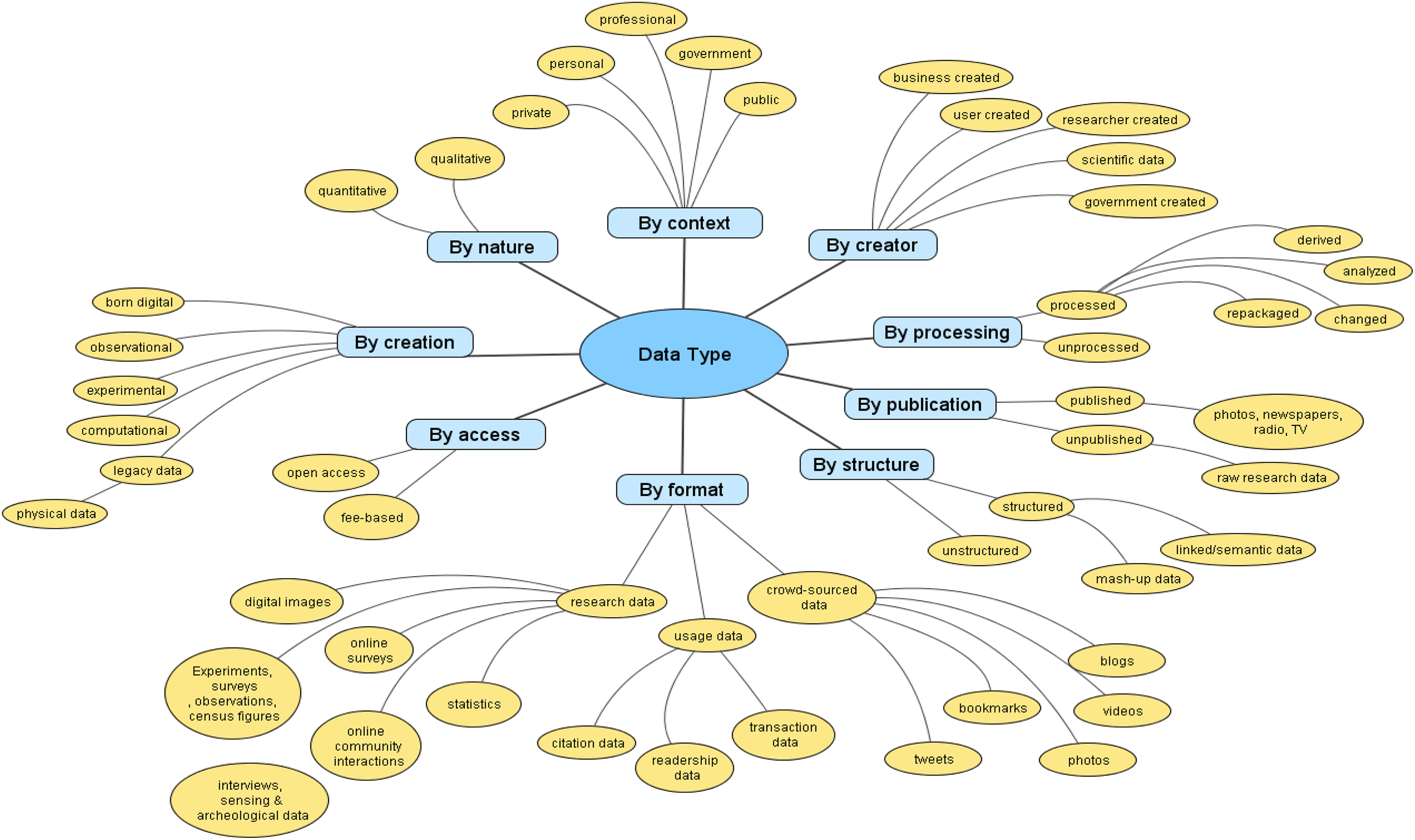
Facets of data.
It is vital for the library and information science community to provide coherent and critical perspectives of data science, data research and data studies in order to offer a framework of thought, research and practice. Given the long-standing contribution of information science to the conceptualization and understanding of the nature of data, information and knowledge by authors such as Zins (2007), Rowley (2007) and Badia (2014), it is reasonable to assume that disciplinary traditions and methodological and theoretical approaches and frameworks have the potential to shed light on the new ways of addressing, researching and making use of data in a wide variety of activities, disciplines and contexts. This kind of research may call for cross-disciplinary examination of the ways in which the data science community and the library and information studies community conceptualize, address and operationalize ethics.
In his paper entitled ‘Information ethics in the twenty first century’, Paul Sturges (2009) posits information ethics, in the context of discourse of information science, ‘has tended to grow out of discussion of the ethics of librarianship’ (2009: 242). He explains this ‘professional convergence, driven by the growth of the Internet and digital access, shifts emphasis, but there is a core of intellectual freedom issues, privacy and secrecy, concerns with social equity and justice and matters regarding ownership of information that show differing faces across all of the domains’(2009: 242). More recently, Luciano Floridi and Mariarosaria Taddeo’s (2016) pre-print entitled ‘What is data ethics?’ discusses how data ethics has emerged in the broader ethics ethos, most recently building on computer and information ethics. They suggest ‘the shift from information ethics to data ethics is probably more semantic than conceptual’. In both scenarios, they note, interest is in moral dimensions and problems and corresponding practices and solutions (Floridi and Taddeo, 2016). This angle generated our interest in professional codes and labour rights and responsibilities.
This paper builds on previous scholarship and examines the emergence of data ethics through a library and information ethics perspective. The main objectives of this paper are to provide a comparison of the 2012 International Federation of Library Associations and Institutions (IFLA)’s Code of Ethics for Librarians and other Information Workers (2012) and the 2013 Data Science Association (DSA)’s Data Science Code of Professional Conduct (2013) and to discuss the disjuncture and related considerations that might strengthen practical understandings of the implications of ethics in library and information professional practice. This kind of comparative content analysis grounds ethical considerations in practical terms and ties into a myriad of professional challenges in critical decision-making for contemporary library and information workers. Examples may include ethical dilemmas presented by access to information, the right to know, the right to be forgotten, privacy and confidentiality, intellectual property, and data protection. With the emergence of data ethics, and the quest to explore an ethos of library and information ethics to data ethics, this paper cautions against conflating a data scientist’s ethical framework with those of librarians and other information workers. The paper also reinforces the need for attention to librarians and other information workers, as well as data scientists, in labour studies. As a disclaimer, this short and focused paper is a treatment of ethics, but not justice, information justice or data justice.
The comparison of the two codes is a valuable experimental endeavour for identifying and informing critical considerations and nuances in exploring data ethics versus library ethics. However, it is a limited scholarly enterprise focused on just two different documents. Professional decision-making may be guided by codes of ethics, but not necessarily enforced, as is the case with IFLA’s code. Codes of conduct, on the other hand, especially those imposed by an employer, may look relatively different and may be enforceable within labour terms. To illuminate how our comparison can be developed into other information ethics lanes, we complement our two-document analysis with concise mention of sister documents produced by the Association for Computing Machinery (ACM) and the Association of Records Managers and Administrators (ARMA).
Materials and methods
This paper uses a combination of qualitative and quantitative analysis methods to map the DSA’s Data Science Code of Professional Conduct (2013) to the IFLA’s Code of Ethics for Librarians and Other Information Workers (2012).A quantitative approach using an Excel spreadsheet was used to compare and contrast the terms and themes in the two codes on a clause-by-clause basis, layered with a semantic analysis of the words to further ascertain common and different themes and topics.
The rationale for the choice of IFLA’s Code of Ethics for Librarians and Other Information Workers and the DSA’s Data Science Code of Professional Conduct is twofold. First, IFLA – formed 1927 and currently reporting 1400 members (associations and institutions) in over 140 countries – is one of the long-standing library and information associations in the world that for decades has developed codes of ethics for library and information professionals (IFLA, 2019). Its 2012 Code of Ethics for Librarians and other Information Workers represents an established ethos of articulating ethics for the global information professions, transcending the limits of national library and information bodies and boundaries. As such the IFLA code is an obvious and useful reference point for emergent rhetoric across the global information professions. Second, with the rise of data-related developments, including data studies, data science, data librarianship, and data ethics, it is timely to select the DSA as a comparative case in order to identify similarities and differences between the two professional codes and the ways in which these two different communities conceptualize and formulate ethical considerations around data in this increasingly digital and data-intensive environment. For a full comparison on a clause-by-clause basis, see Appendix 1.
Table 1 provides a comparative overview of the six thematic sections featured in IFLA’s Code of Ethics for Librarians and Other Information Workers (2012) and the eight rules introduced by the Data Science Code of Professional Conduct (2013).
Comparison of code of ethics and code of conduct.
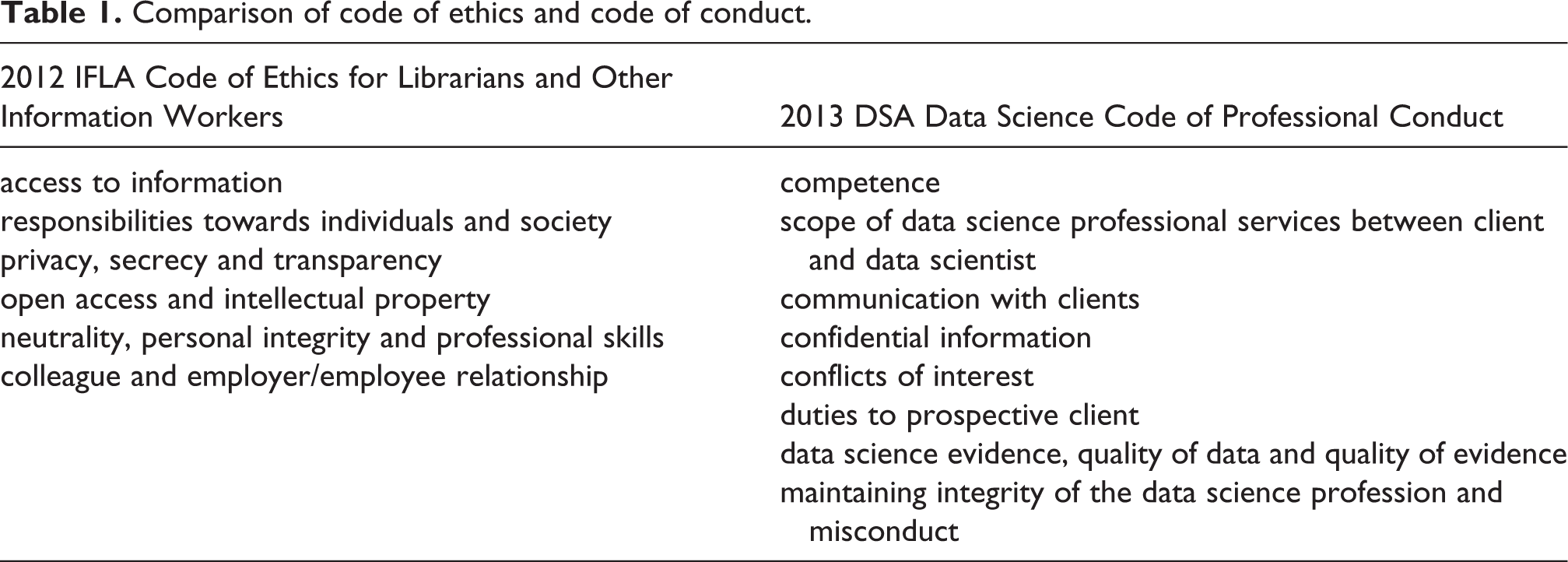
Using the range of elements found in these frameworks, the comparative content analysis data was further analysed for commonalities and differences. The analysis shows some overlaps by concept (e.g. professionalism, confidentiality). Following on Floridi and Taddeo’s paper (2016), mutual attention to these concepts shows how emergent data ethics can bridge from library and information ethics in terms of categories on professional documents. We also identified critical content gaps. For example, free speech in the workplace and whistleblowing, two significant labour considerations in the 21st century on a global scale, only appear in the IFLA code. Following on Sturges (2009), this illustrates an incomplete flow of library and information ethics forward into data ethics.
Results
The emergent gaps between the two codes expose key differences between the professional work of data scientists and librarians and other information workers. Particularly notable is the impact that the expectation of advocacy plays in distinguishing between the two.
Librarians and other information workers are urged to strive for transparency of information. This directive teases out an active advocacy responsibility that is not apparent in the DSA code and this is not surprising. Directives around advocacy in a code of conduct would have to be very prescriptive. The Library and Archives Canada, Code of Conduct: Values and Ethics (2013) originally framed librarians and archivists speaking at conferences and teaching as so-called ‘high risk’ activities (McGrath, 2013).
The combination of no enforcement authority coupled with the expectation of advocacy results in vulnerability for librarians and other information workers who go out on a limb with their commitment to professional ethics. As an example, librarians and other information workers who express their intellectual freedom through workplace speech or engage in whistleblowing as encouraged by the IFLA rhetoric could actually put themselves in peril with their local communities and administrations. A code of ethics without a defence structure is debilitating. The restrictive nature of the DSA’s Code of Professional Conduct (2013) does not invite this problem.
The IFLA code is framed as permissive by listing things one is encouraged to do. On the other hand, the DSA code is framed as cautionary by listing things one should refrain from doing. IFLA encourages non-enforceable compliance as a positive act. DSA discourages non-compliance by making it grounds for misconduct, a negative act. In the specific context of our very small-scaled analysis, we would suggest we do not see data ethics as automatically growing out of library and information ethics. What we can see, though, is problematic for an unregulated profession. And this raises important questions about violations of ethics and related due process. Implications for this work transcend an interest in data and extend into scholarship in the professions and labour studies.
Findings
Our analysis concentrates on the differences between the two codes because they are significant. The discussion is organized into key themes that emerged in the literature and in the analysis, and which tease out some important differences in understanding the professional work of data scientists and librarians and other information workers. These are: data vs. information; clients vs. users; private vs. public; exclusivity vs. inclusivity; information as a strategic asset vs. as a public good; and, cautionary vs. permissive approaches to professionalism.
Data vs. information
The DSA (2013) defines data as: a tangible or electronic record of raw (factual or non-factual) information (as measurements, statistics or information in numerical form that can be digitally transmitted or processed) used as a basis for reasoning, discussion, or calculation and must be processed or analyzed to be meaningful.
Interestingly, the DSA Code of Professional Conduct (2013) defines ‘data’ and ‘knowledge’ but not information. Knowledge is information backed by scientific evidence that creates meaning. In this realm, it is the role of the scientist to make meaning of raw data that is available; the client is dependent on the manipulation and interpretation of the scientist. In the library realm, however, librarians and other information workers provide access to final form information, including helping to find/source it, but the user is responsible for interpreting the meaning that is attributable to it. The data scientist provides a ‘value-added’ service to data; librarians and other information workers connect the user to data/information, but do not enhance/interpret it in any way – in fact, are expected to refrain from judgement.
Clients vs. users
IFLA/librarians use the term ‘users’; the data science code refers to ‘clients’. What, if anything, does this imply about fundamental differences in duty, confidentiality and commodification of underlying data/information? The broader literature suggests ‘customer service’ and ‘value-added’ are contemporary phrases that are in common use in both publicly funded and not publicly funded library and information organizations and settings.
Private vs. public
The data scientist is dealing with datasets that are not necessarily publically available, often private (this may shift as more research data is available with open access or potentially hacked). While confidentiality of information is conditional for a data scientist, librarians and other information workers are accessing information that is ‘publicly’ available (or within the realm of the institute under consideration), and therefore do not have a confidentiality issue with the information itself (although there is a responsibility not to identify the user with the information).
Exclusivity vs. inclusivity
A significant portion of the DSA Code of Professional Conduct (2013) is dedicated to conflict of interest provisions. The data scientist is in a contractual relationship (which may be explicit or implicit), which may specify or impose a level of exclusivity. The DSA code further imposes exclusivity provisions. A librarian (especially in the traditional setting where access to information is not exclusive) is not subject to such restraints – in fact, acts as a public resource connecting all users, on an equitable basis, to any information that is available. The librarian is not subject to conflict of interest concerns.
Strategic asset vs. public good
In the data science world, data may be owned and capitalized upon for profit-maximization; the scientist’s services are a value-added commodity to be marketed. Ownership of specific data and/or the ability to manipulate can be a strategic asset to be offered to the marketplace. Librarianship advocates for universal access whenever possible.
Cautionary vs. permissive
The data scientist has a duty of care as a professional; within the DSA code, the data scientist is held to the standard of reasonableness and the code provides a number of specifics about how one’s duties should be executed. Failure to adhere to the code is considered professional misconduct. There is an element of protection of the integrity of the profession implicitly imposed on the data scientist. Reflected in the wording of the IFLA code, librarianship (arguably) does not operate as a true and ‘regulated’ profession. There are no competency requirements to represent oneself as a librarian. Librarians and other information workers do not have an enforceable duty, nor can they be subject to sanctions or expulsion. (Although this could occur within specific employment contracts.)
With no enforcement authority, this reduces the IFLA code to persuasion and consensus building and aspirational rhetoric. For context, the world’s oldest and largest library association, the American Library Association (ALA), developed a statement entitled Questions & Answers on Enforcement of the Code of Ethics. It states: As a voluntary membership organization, ALA does not enforce the Code of Ethics for a variety of reasons. As a non-licensing professional society, the ALA would have two possible actions in response to a violation of the Code of Ethics: Suspend or expel a member from membership, or admonish or censure an individual or institution, publicly or privately. (American Library Association, 2009)
Discussion
The International Centre for Information Ethics (n.d.) affirms the value of information ethics for information specialists, including: …to be able to recognize and articulate ethical conflicts in the information field; to activate the sense of responsibility with regard to the consequences of individual and collective interactions in the information field; to improve the qualification for intercultural dialogue on the basis of the recognition of different kinds of information cultures and values; [and,] to provide basic knowledge about ethical theories and concepts and about their relevance in everyday information work.
Information ethics can be applied to different information professions, including librarianship, archives, data science, records management, journalism, and so on. Exploring information ethics within and across information fields helps information specialists sharpen their individual and collective awareness about power structures, ambiguities and intents with respect to the development of ethical conflicts (new and old) in information work. For members of IFLA, for example, to be encouraged to contextualize its 2012 code alongside emergent sister codes can foster the necessary proactive approach to professional development in librarianship and, perhaps most importantly, to its critical commitments within the broader landscapes and matrices of information societies and the individuals who interact with information and data in those societies. IFLA has a core audience defined by its membership, which cuts across a political spectrum. The implications of IFLA’s permissive rhetoric transcend it in the expansive information and data landscape, including in the labour market where information rights and responsibilities come under both intramural and extramural scrutiny.
Conclusion
People with an interest in the information professions should be careful not to reductively conflate terms, titles and professional commitments. Our rationale is informed by thinking of the traditional ‘librarian’ providing publicly available information to an arms-length client. This seemed to be the targeted audience for the IFLA code. A more expansive consideration of an information worker in a private setting may be more aligned with the data scientist.
While IFLA’s Code of Ethics for Librarians and Other Information Workers (2012) is permissive, the DSA’s Data Science Code of Professional Conduct (2013) is cautionary. Ideally the discussion offered here will support the development, through an open task, of a more robust framework for library and information ethics and a more comprehensive and inclusive framework for thinking about and conceptualizing data ethics.
Prospective library and information students, information professionals and educators in the field and related fields should not conflate a data scientist’s conduct framework with those of the librarians and other information workers. The implications of our analysis transcend an interest in data and extend into scholarship in the professions and labour studies. As well, implications of our findings have the potential to be infused into a critical contemporary global discourse of the knowledge economy and ‘ways of knowing’, currently heightened by post-truth realities, realities which increasingly indicate workplace speech and whistleblowing across industry sectors and fields need to be addressed. Analysis of codes of ethics alongside codes of conduct can benefit the endeavour. Ultimately a career can be made or lost in the critical decision to do or not to do (or say or share) something.
Future inquiry
In 2013, the IGP Code of Ethics applicable to Information Governance Professionals (ARMA, 2013) was adopted by ARMA, replacing their 1992 code. Like the current IFLA code, the 1992 ARMA code was persuasive using language such as ‘increasing the awareness of ethical concerns’ and ‘to guide…in the reflection, decision making, and action in two broad areas of ethical concern: society and the profession’ and generically targeted to an undefined group (information and records management professionals) within the larger, but also undefined information profession (ARMA, 1992). The current code of ethics is much more directed in its application using the word ‘shall’ to direct IGP-certified individuals to adhere to the code as a condition of maintaining certification and includes the provision for investigation and sanctions where there is a suspected violation. Also notable in the updated code is the expansion of recipients to be considered in the professional’s ethical decision realm to include the public, somewhat reflective of the ‘public good’ language found in the IFLA and 2018 ACM codes (to be discussed in the next paragraph).
More recently, the drafting evolution of the 2018 rewrite of the ACM Code of Ethics and Professional Conduct (2018), adopted in June 2018, is illustrative. The first draft was notable because of the addition of ‘public good’ as a primary ethical consideration in its preamble and within the code (ACM’s Committee on Professional Ethics (ACM COPE), n.d.,a). By the third draft, the ‘public good’ consideration was strengthened to ‘computing professionals must always support the public good’ (ACM COPE, n.d.,b) and moved to the first line of the preamble to provide emphasis to this ‘highest principle and main purpose of the Code’(ACM COPE, n.d.,c). Other important changes as well bring it even closer into alignment with LIS-based documents. First, the scope has been widened to include ‘all current and aspiring computing practitioners, instructors, influencers, and anyone who uses technology in a meaningful way’ not strictly ACM members. (This mirrors librarianship, where there is no professional hurdle for members to be considered part of the profession, but digresses from the ARMA model which tightened up application to a professional membership group.) ACM members are to encourage adherence by all computing professionals and have a duty to take action. Second, imperatives have now become principles through the use of ‘should’ rather than ‘must/shall/will’ language, with the intent that there is room for judgement in decisions. (This highlights a code of conduct vs. a code of ethics and prescription vs. aspirational and again, digresses from the trajectory of the ARMA code changes.) Third, the legal focus has shifted to more of an ethically based focus for intellectual property rights. Furthermore, there is language that indicates there should not be unreasonable opposition of use of someone’s own intellectual property for public good. (This underscores the paramount nature of public good considerations.) Monitoring the ethos of this rhetoric is valuable for imagining future inquiry lines around both data diffusion and the building of barriers to data. Such inquiry lines inevitably hinge on the nature of property rights in society (e.g. democratic, oligarchic). Any international rhetoric, like that of IFLA, demands diverse comparisons.
Footnotes
Declaration of Conflicting Interests
The author(s) declared no potential conflicts of interest with respect to the research, authorship, and/or publication of this article.
Funding
The author(s) received no financial support for the research, authorship, and/or publication of this article.

Appendix 1
Table 2 provides a side-by-side comparison of the 2012 IFLA Code of Ethics for Librarians and Other Information Workers presented, in its entirety, with the 2013 Data Science Association Code of Professional Conduct Code slotted in where appropriate.