







Abstract
Rural farmers make up the majority of crop producers in any developing economy. Their level of access to agricultural information stems from the knowledge and skills they possess. This article aims to identify the sources of agricultural information and the level of knowledge and skills rural farmers possess for accessing such information in South-East Nigeria. A structured interview schedule and focus group discussions were used to collect relevant data. The method of analysis involves frequency counts, percentages and means. The study reveals that 41.7% of the respondents were between the ages of 41 and 50, while 62.6% were married, 84.8% were Christians and 29.8% had no formal education. The major source of agricultural information was through friends and co-workers, while the knowledge and skills they possessed for accessing agricultural information were generally low. The work provides an objective framework and measure of the existing competencies, and identifies the need for further skills acquisition.
Keywords
Introduction
Farmers who live in rural areas are generally referred to as rural farmers. Umebau (2008) stated that, historically, ‘rural’ referred to areas with low population density and relative isolation, where one major economic activity is agricultural production and the people are relatively homogenous in their values, attitudes and behaviour. Obidike (2011) stated that rural farmers form the majority of the population in Nigerian agricultural production. According to the Federal Office of Statistics (2004), agricultural activities in Nigeria are predominant in rural areas, where more than 86.5% of the households participate in agriculture, compared with only 14% in urban areas. The chronic food deficits experienced in most developing countries are a result of the lack of capacity of rural farmers to produce enough food for the population. Agricultural information is one of the prerequisites for agricultural production.
Agricultural information can be defined as specialized information if it is situation-specific, such as the result of a soil test or the identification of a new market (Zezza, 2002). Zezza (2002) further stated that, in other situations, it can be general information designed to improve existing production practices, farm management, marketing and processing activities. Ballantyne (2005) stated that agricultural information on modern systems of farming can reduce costs and provide incentives for expanding agricultural production. He added that it helps to open up and provide opportunities for poor farmers to shape their lives and reduce vulnerability. There are various categories of agricultural information, including information attached to machines, biotechnological information, chemical information, agronomic information and climatic information. If such sources of information are not accessed, it will adversely affect rural farmers’ lives and the level of agricultural production.
Some authors (for example, Ferris et al., 2008; Gakuru et al., 2009; Heeks, 2007; Karamagi-Akiiki, 2006) have written that to facilitate the sharing of new knowledge, innovations and technology, players in the public and private sectors have used various information and communications technologies (ICTs), such as radio, television, mobile phones and the Internet. Jones and Garforth (1998) enumerated the sources of agricultural information as books, journals, popular as well as scholarly theses, dissertations and conference proceedings, research reports or technical bulletins by experimental stations, maps and aerial photographs. Nossal and Lim (2011) noted that farmers have not acquired sufficient agricultural information to maintain agricultural production, resulting in the slowing down of growth over the previous decade. The main reason given by Chaudhary (1997) for low agricultural production in Pakistan compared to its potentials is that farmers lack access to current agricultural information and technology.
In recognition of the challenges that rural farmers face, Mchombu (2001) stated that there is a need to develop an information provision model that addresses the felt needs and circumstances of this important target group. Access to agricultural information has been a key driver to improvements in the growth of the agricultural sector in many countries. Adomi et al. (2003) noted that farmers need to access agricultural information if their efforts to improve agricultural production are to be realized. This is as a result of the importance of agricultural information in the battle to achieve food security and fight poverty. An improved information and knowledge flow to, from and within the agricultural sector is a key component in improving small-scale agricultural production and linking increased production to remunerative markets (Lwoga et al., 2011). Rural farmers require agricultural information on the supply of farm inputs, new technologies, early warning systems, credit and market prices. Munyua (2000) maintains that the Green Revolution in Asia and the Near East is an indication of the importance of access to knowledge, information and technology in expanding and energizing agriculture.
The agricultural sector will deteriorate in the hands of rural farmers if attention is not given to them. The negative impact that can result from the lack of access to agricultural information includes poor health conditions of rural farmers, low income, an inadequate supply of raw materials to the industrial sector, and a reduction in employment and foreign exchange earnings. Factors such as the treatment of soil, determining weather conditions, and biochemical products and their application will not be facilitated to improve the agricultural sector. The absence of agricultural information brings the nation’s agricultural output below expectations. This has been observed in food deficits and the upward trend in the price of foodstuffs over the years (Igwe and Esonwune, 2011). The natural resources base underpinning agricultural production will be under threat. Crop intensification, which enables an increase in food production, will be slowed. It can also result in rural farmers lacking negotiating powers.
The question is: What knowledge and skills do these rural farmers possess to access agricultural information? Much of this knowledge and many of these skills may be learnt informally over the years and are seldom reflected in an individual’s qualifications. Knowledge is an organized set of statements, facts and ideas. A knowledgeable person can seek information with reasoned judgement. According to Paul (2007), knowledge is a familiarity, awareness or understanding of someone or something, such as facts, information, descriptions or skills, which is acquired through experience or education by perceiving, discovering or learning. On the other hand, skills can be said to be of productive value; they can be acquired by training or development and are socially determined. Ryu (2017) states that skill is an ability and capacity acquired through deliberate, systematic and sustained effort to smoothly and adaptively carry out complex activities or job functions involving ideas, things and/or people. UNESCO’s (2012) Education for All Global Monitoring Report identifies three main types of skills: foundation skills, transferable skills, and technical and vocational skills. The skills considered in this study involve some aspects of these categories, which are transferable and needed by rural farmers to adapt to their work environment. They are an informally acquired ability by rural farmers to determine their information needs and access and evaluate them to accomplish a specific purpose in agricultural production.
The conceptualized variables for knowledge and skills are supported by Leta et al. (2018), who asserted that farmers acquire knowledge through social networks by means of communication, observation, collective labour groups, public meetings, sociocultural events and group socialization. UNESCO’s (2014) Education for All Global Monitoring Report emphasizes the need for young people to learn not only foundation skills, but also transferable skills as part of becoming ‘responsible global citizens’. Reflecting on post-2015 education, UNESCO (2013; p. 2) proposed a strengthened and broadened Education for All vision as an integral part of the broader international development framework, highlighting ‘equitable access to lifelong learning opportunities to develop skills and competencies for life and work’ as a focus. The Organisation for Economic Co-operation and Development (2013), in the results from its Survey of Adult Skills, also underlines the need to move from a reliance on initial education towards fostering lifelong skills-oriented learning. It is against this background that knowledge and skills possessed by rural farmers for accessing agricultural information need to be studied.
The general purpose of this study is to investigate the knowledge and skills of rural farmers in South-East Nigeria with regard to accessing agricultural information. The specific objectives are to determine the major sources of agricultural information utilized by rural farmers and to ascertain the knowledge and skills possessed by them for accessing agricultural information.
Literature review
In research carried out by ETC East Africa (2000) and Hoffmann et al. (2007), it was concluded that knowledge and skills are essential resources for farming, and studies of the ways in which farmers obtain and share knowledge could be valuable to farming system research and extension, informing policy and leading to more efficient farming. According to Siyao (2012), a lack of knowledge and skills for accessing agricultural information is the main barrier experienced by small-scale sugar-cane growers. Robinson-Pant’s (2016) study provides strong evidence that rural farmers learn traditional and new knowledge and skills informally within their communities through interaction and observation, and that the older generation modelled practice for their peers and children. Onu et al. (2018) carried out a study to determine the essential theoretical knowledge and skills required by rural farmers in making mobile phones effective for boosting agricultural production in Enugu State, Nigeria. They identified some knowledge and skills in the use of mobile phones for boosting agricultural production. Fonseca et al. (2018) stated that people must have basic ICT competences that allow them to access knowledge and permit them to benefit from those sources by recognizing their quality and reliability. Nicholas-Ere (2018) designed and developed an improved ICT solution that would provide rural farmers with agriculture-related information and improve farmers’ knowledge of current agricultural practices.
Some development partners, such as the Food and Agriculture Organization (2001, 2003), have also set up a number of initiatives, projects, networks and systems that use modern ICTs to improve linkages and flows for agricultural knowledge and information. In addition, a number of public access centres and telecentres have been established in the rural areas of developing countries, including Kenya, South Africa and Uganda, to improve access to agricultural information and enhance agricultural production (Benjamin, 2001; Karamagi-Akiiki, 2006; Ochieng and Waema, 2009; Stilwell and Munyua, 2009). The Food and Agriculture Organization and World Bank (2000) stated that, except in extremely remote areas, most rural people have access not only to national radio, but increasingly also to local community-based radio stations. They further stated that access to telephones has increased spectacularly, particularly in very poor countries. Ezeh (2013) noted that although many ICT facilities existed in his study area, the radio, television and telephones were sourced personally from the open market and were the most readily available ICT facilities accessed and utilized by farmers for improving their agricultural knowledge.
A study carried out by Omoregbee et al. (2013) in Nigeria revealed that the Ministry of Agriculture, friends and neighbours, and radio and television were the major sources of agricultural information. The results further highlighted the importance of the Ministry of Agriculture as a major source of information for cassava farmers, although the credibility of friends and neighbours as a source of information for farmers was not in doubt. Uzuegbu (2016) identified six major channels through which rural information delivery is generally anchored: the mass media, information service systems, education and training programmes, change agents, personal contacts and miscellaneous channels. Adetimehin et al. (2018) revealed that the key sources of information used by rice farmers in Ondo State, Nigeria, were friends or relatives and the radio. This is supported by Opara (2008), who stated that most information reached farmers through interpersonal or expert sources.
Rehman et al. (2013) found that print media and fellow farmers were the major sources of information for farmers in their study area. Ajani and Agwu (2012) determined that the majority of farmers used the radio and television, and owned mobile phones and video recorders. The level of access showed the low frequency of computer-based ICTs and video recorders. Mwombe et al. (2013) discovered that the majority of their respondents accessed agricultural information through the radio, followed by mobile phones and then television, and that most farmers lacked the requisite skills and physical access to the Internet and computer-related services.
In the same vein, Lwoga et al. (2011) and Adio et al. (2016) found that the major sources of agricultural information were neighbours, friends and family; agricultural input suppliers; village meetings or farmer groups; personal experiences; village leaders; livestock herders; agricultural shops; non-governmental organizations; cooperative unions; religious groups; and public extension officers. They further stated that, with respect to access to agricultural information and knowledge through ICTs, the majority of farmers used the radio, which was rated highest, followed by mobile phones and television. Similarly, Ngimwa et al. (1997) established that modern mass media had a low response rate as a first source of information because the use of mass media was not popular. They attributed it to a lack of finances and time, illiteracy, cultural barriers and religious beliefs. They also found that the media available was diverse, with radio scoring highest and television lowest.
Mokotjo and Kalusopa (2010) found that information provided by the Agricultural Information System was of fairly good quality in terms of relevancy and currency, and had improved productivity, but was not easily accessible to most farmers. They stated that most farmers did not possess the necessary skills for accessing agricultural information.
Jiyane and Ocholla (2004) observed that farmers were not satisfied with the information they obtained, noting that it was either not relevant to their needs or not helpful, and that friends, neighbours and relatives were their sources of information. Akanda et al. (2012) carried out a study of the agricultural information literacy of farmers in the northern region of Bangladesh. The analysis of the survey revealed that they sourced information from established information centres, while the majority of the farmers did not have the sufficient skills to evaluate and use the information. Adamides and Stylianou (2013) attempted to investigate the current situation regarding the use of mobile phone as a means of information-sharing among Cypriot farmers. The findings revealed that the majority of farmers in Cyprus used mobile phones as a source of agricultural information, and the most frequently used mobile phone application was voice calls, followed by text messages. Nenna (2012) noted that young, married, experienced women with no formal education learnt about fisheries technologies from their fellow fisherwomen, friends or relatives, their husbands, farmer organizations, radio or television, agricultural shows, and magazines or journals.
Faborode and Ajayi (2015) discovered that most of the technologies developed by research institutions were not accessed by farmers but remained with the researchers. This finding points to a gap in communication and linkage between research, extension and farmers, despite the conceptualization of research-extension-farmer-input linkage system (REFILS) as a multidimensional change agent in the generation, development, dissemination and use of innovations within the agricultural technology system. The finding equally shows that the major sources of information for the majority of farmers were the state extension units of the Agricultural Development Project. Oluwasusi and Akanni (2014) state that fellow farmers had the highest percentage as sources of access to information, followed by the radio, extension agents, television, e-wallets, newspapers and the Internet. Ofuoku et al. (2012) revealed that sources of information on fish farming included extension agents, fellow farmers, fish farmer groups, universities, research institutes and non-governmental organizations.
In summary, the literature has identified the major sources of agricultural information for rural farmers and the lack of knowledge and skills for accessing it. It has further established that basic knowledge and skills are the key to accessing agricultural information, with some technical skills being possessed by farmers. Despite outlining the sources of agricultural information and the need for relevant knowledge and skills, or the lack thereof, none of the literature reviewed has related the identified sources of information to the requisite knowledge and skills. This has strengthened the need to examine the knowledge and skills possessed by rural farmers to access agricultural information successfully.
Methodology
This study adopted a mixed-methods approach involving a structured interview schedule (see Appendix 1) and focus group discussions. The study looks at South-East Nigeria, which covers an area of about 76,358 square kilometres and is located east of the Lower Niger and south of the Benue Valley. The region is heavily populated, considering the land mass. According to Enete et al. (2011), the region has a population of 31,371,941 and an average population density of 416 persons per square kilometre. Okoye et al. (2010) noted that 60–70% of the inhabitants of South-East Nigeria are engaged in agriculture – mainly crops and animal rearing.
A list of 121,953 registered contact farmers was obtained for the five states under study Agricultural Development Project (ADP, 2016). The sample size was obtained using Dusick’s (2015) sample calculator formula. The default settings were used to calculate the sample size, with a 5% margin of error, 95% confidence level, population size of 121,953 and response rate of 50%. This resulted in a sample size of 383 registered farmers from the five states.
Proportional allocation was used to determine the number of respondents in each state. The ratio of the sample size allocation according to the number of registered farmers in the states of Ebonyi, Abia, Anambra, Imo and Enugu is 99:74:80:72:58. The multi-stage sampling technique involving simple random sampling in each stage was used to draw a portion of the population in this study, so that all possible samples of fixed size n had an equal probability of being selected (Kerlinger, 1973). In stage one, two agricultural zones were selected from each of the states. Stage two involved the random selection of one local government from each zone followed by the selection of two agricultural farm communities. The third and final stage was the random selection of the study’s respondents using the list of registered farmers.
The structured interview schedule was prepared in English (see appendix 1) and given to enumerators who had been trained on how to conduct the exercise of data collection. They were responsible for interpreting the questions for the respondents and completing the schedule. This was handled as an interview schedule or non-self-administered questionnaire in situations where the farmers could not read or write English (Opara, 2008). In each state, three enumerators were recruited on the basis of their experience in data collection, with a focus on rural farmers and knowledge of the terrain. The fieldwork lasted for two weeks. This was followed by post-survey clarifications, data cleaning, coding, analysis, interpretation and report-writing. The responses were rated as 4: Very high, 3: High, 2: Low and 1: Very low, giving an overall average of 2.5.
A focus group discussion guide was used by the enumerators to collect the required information from the respondents. Twenty-five focus group discussions, made up of ten farmers per session and lasting for about an hour each, were organized. The topics moderated for discussion were the major sources of agricultural information and the knowledge and skills possessed by the rural farmers. The responses sometimes led to further probing in an attempt to find out their satisfaction levels. The data collected from both methods was combined and used in the analysis.
Findings and discussion
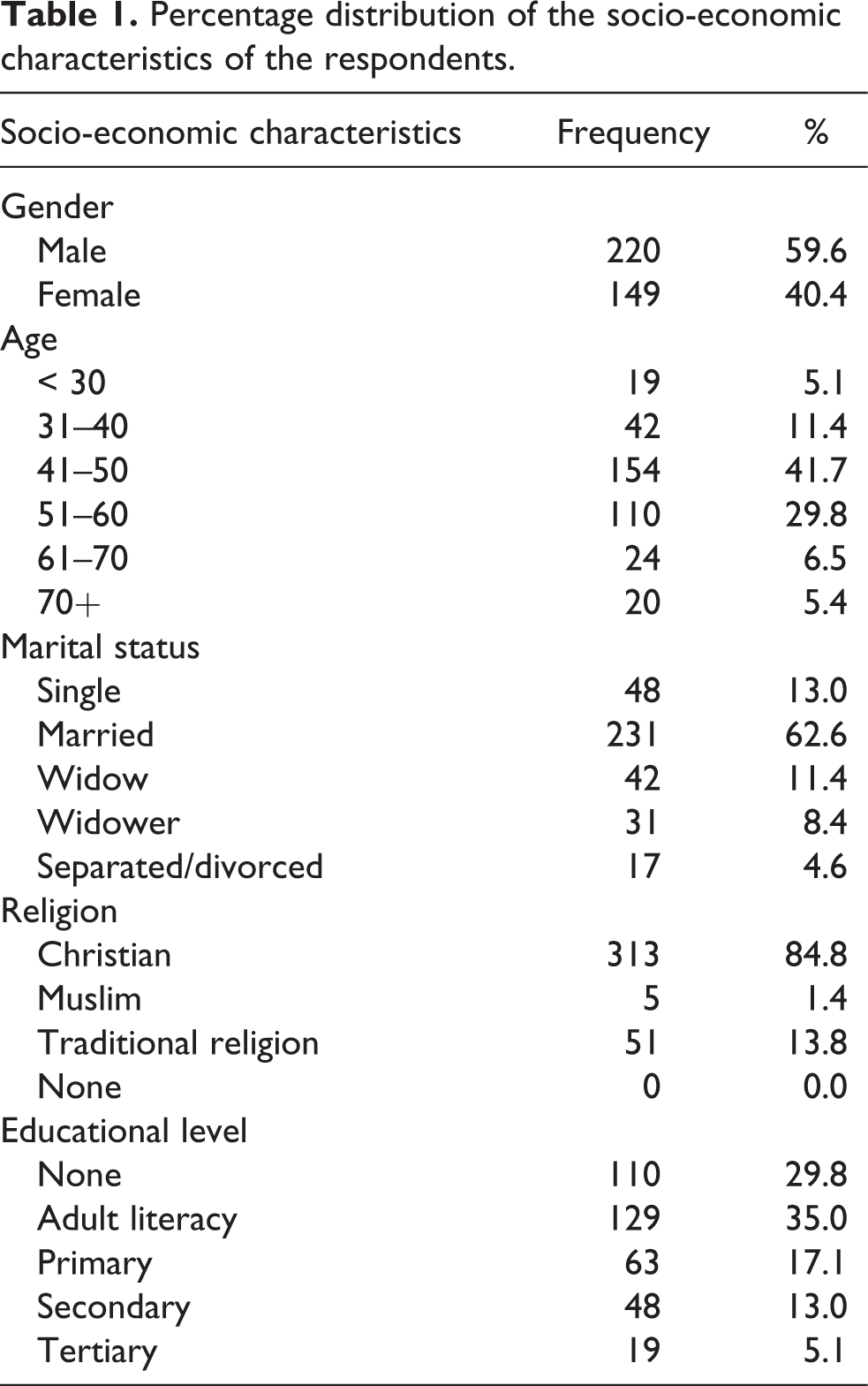
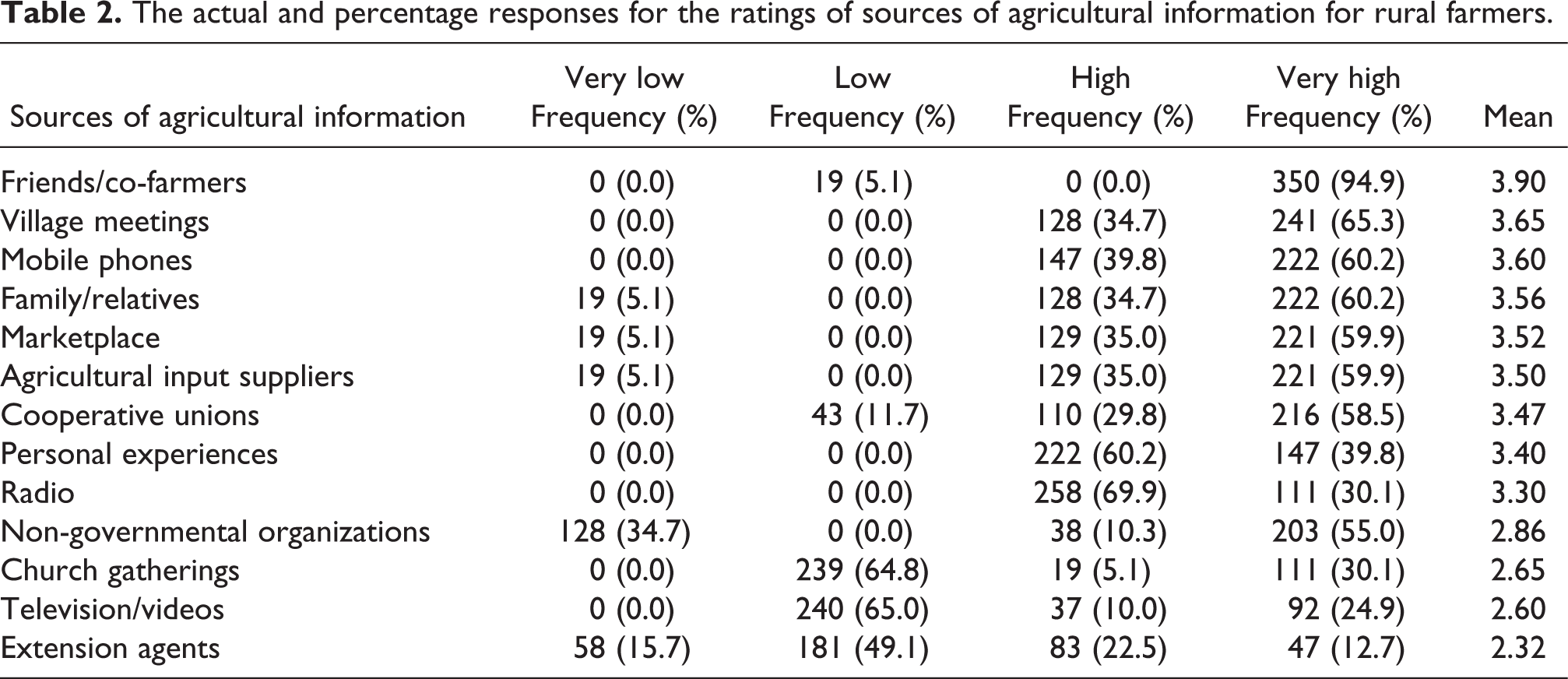
The data collected was analysed using the Statistical Package for the Social Sciences version 21 and the frequency counts, percentages and means of the responses were obtained. Table 1 shows the percentage distribution of the socio-economic characteristics of the rural farmers. The mean rating of the level of access to agricultural information was obtained and ranked in order to identify the major sources of agricultural information (Table 2). We went further to identify the key knowledge and skills possessed by the rural farmers using the mean response (see Table 3).
Percentage distribution of the socio-economic characteristics of the respondents.
The actual and percentage responses for the ratings of sources of agricultural information for rural farmers.
The ratings of the knowledge and skills possessed by the rural farmers for accessing agricultural information.
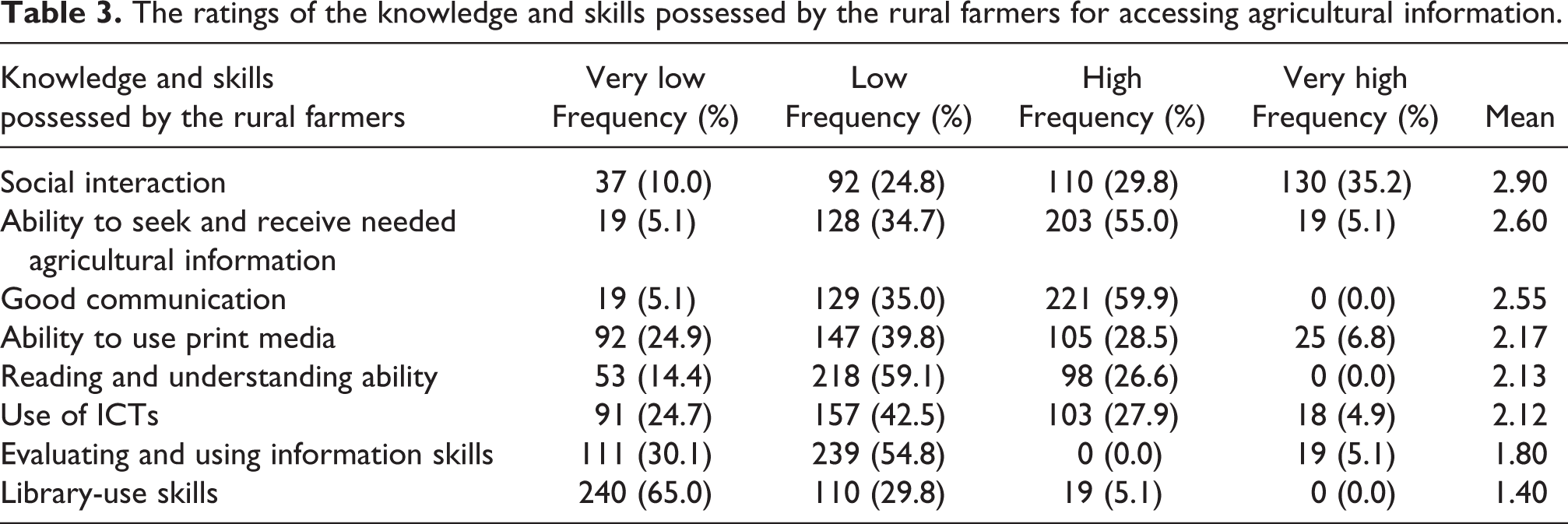
Table 1 shows the socio-economic characteristics of the rural farmers in South-East Nigeria. It shows that about 60% of the respondents were male, while 41.7% of the respondents fell within the 41–50 age group. Approximately 62.6% were married, while 13.0% were single. The majority of the respondents (84.8%) were Christians and about 29.8% had no formal education.
Table 2 shows the identified major sources of agricultural information utilized by the rural farmers. The respondents were asked to rate the sources as Very high, High, Low or Very low. The results indicate that the major sources were friends or co-farmers (94.9%), village meetings (65.3%) and mobile phone (60.2%), agreeing with the mean ratings, which identify these as the major sources of agricultural information for rural farmers. Other sources include: family/relatives, agricultural input suppliers, marketplaces, cooperative unions, personal experiences, radio, non-governmental organizations, church gatherings and television/videos. These results agree with the findings of Lwoga et al. (2011), Oluwasusi and Akanni (2014), Adio et al. (2016) and Adetimehin et al. (2018).
This was corroborated by the focus group discussions, where the rural farmers stated that they got more information by relating with each other, in discussions with friends, fellow farmers and relatives, than through mobile phones or radio programmes. This agrees with the report of the Food and Agriculture Organization and World Bank (2000) on the use of phones and the radio. It is clear that extension agents were not among the major sources of agricultural information for the rural farmers, even though they are meant to act as a link between researchers and rural farmers. It was established that anything that brought rural farmers together created an opportunity to source agricultural information.
The preponderance of informal sources over formal sources could be attributed to the illiteracy rate of the rural farmers; financial difficulties; the distance from rural areas to urban centres; and the unavailability of agricultural information centres to rural farmers when they are in need of information. The formal ways of accessing agricultural information need to be largely utilized to achieve the desired results in agricultural production.
Table 3 shows the knowledge and skills possessed by the rural farmers for accessing agricultural information, presented in descending order of the means. The respondents were asked to rate each category as Very high, High, Low or Very low. The results indicate that the key knowledge and skills with mean scores greater than or equal to 2.5 are: social interaction, ability to seek and receive needed agricultural information, and good communication.
Observe that the rural farmers to a large extent did not possess skills that would enable them to source agricultural information. This is because the majority of the mean ratings of the skills possessed by the rural farmers are below average. The focus group discussion results showed that the rural farmers learned more by interacting among themselves in the vernacular, given their low levels of literacy. This result agrees with the findings from the literature that rural farmers lack the knowledge and skills to access agricultural information.
The generally low ratings in Table 3 show that the knowledge and skills possessed by the rural farmers for accessing agricultural information are generally low.
One of the obvious implications of the results is that, with social interaction as a major skill for accessing information among the rural farmers, these results point to earlier studies which found that rural farmers preferred ‘interpersonal means’ of accessing information (Opara, 2008), and it thus increases the need for public libraries to restrategize their philosophy towards adopting social-interaction-based services for rural farmers. Furthermore, with friends or co-farmers as the major sources of agricultural information, it reinforces the fact that social interaction skills need to be enhanced.
Conclusion
The findings of this study indicate that rural farmers in South-East Nigeria rely heavily on informal sources to access agricultural information. This implies that either there is no relationship between research extension and farmers or that it is having a minimal effect. Extension agents are not doing their job of relating their research findings to rural farmers. By extension, this might be one of the reasons why there is a decline in agricultural production in Nigeria, and the south-east in particular. Equally, too, the library-use skills of rural farmers in South-East Nigeria are very low, probably because the expected role of librarians in repackaging information and sending it to rural farmers is not efficient.
The knowledge and skills possessed by the rural farmers in this study area are below average. This has resulted in poor access to agricultural information, especially in highly technical areas like ICT. In any life endeavour, knowledge and skills are required to create an impact. These rural farmers need training workshops, seminars and adult education, among other efforts, to update their knowledge and skills on the ways they can access agricultural information. This study has provided an objective framework and a measure of the existing competencies, and identified the need for further skills acquisition.
The major obstacle encountered in this study is infrastructural deficiency, such as poor access roads and a lack of networks for telecommunication among farming communities. Future studies should consider how to improve the knowledge and skills of rural farmers and how to reposition libraries to ensure their work extends to rural farmers.
Footnotes
Appendix 1
Declaration of conflicting interests
The author declared no potential conflicts of interest with respect to the research, authorship and/or publication of this article.
Funding
The author received no financial support for the research, authorship, and/or publication of this article.
