







Abstract
Crises often spur societies to rethink their structures to meet immediate needs and prepare for the future. While the COVID-19 pandemic led public libraries to rethink how they serve their communities, there is sparse literature exploring how opportunities from the pandemic can be leveraged. This article examines such opportunities from the COVID-19 pandemic as described by African public librarians. The authors conducted virtual interviews with 11 head librarians in nine African countries and analyzed the data using inductive thematic analysis. It was found that many librarians improved their digital skills. Some libraries who hitherto did not have computers and Internet connectivity were provided with such digital tools. Also, most of the librarians leveraged low-cost digital platforms like WhatsApp to share information. Their experiences are used to think about how public librarians can leverage opportunities from the pandemic to meet the information needs of their communities.
Introduction
Crises are bound to happen in human lives. While we cannot predict most of these crises, we can mitigate these unforeseen situations by taking immediate steps to overcome the situation and think about possible futures, opportunities, and action plans (Hines and Bishop, 2015; Van Der Laan, 2021). Public institutions have a key role in helping their communities prepare for and respond effectively to emergent and unforeseen crises (Phillips et al., 2016; Tyler and Sadiq, 2018). When COVID-19 struck, the goal of public institutions at the peak of the pandemic was to keep people safe and continue offering services as best they could.
As access points to information, libraries—especially public and community libraries—played a significant role (both information- and non-information-related) during the pandemic to meet the urgent needs of their communities (Bugre et al., 2023; Chase, 2021; Chigwada, 2021; Guo et al., 2022; Robert et al., 2021). For instance, some small and rural public libraries from developed countries like the USA collaborated with other departments to serve as childcare facilities for essential workers during the pandemic (Chase, 2021). Some public libraries in Africa also scanned and shared learning materials with students using WhatsApp—a multimedia messaging application—to support their preparation towards their final examinations (Bugre et al., 2023).
However, for most public and community libraries in Africa, the virtual transition was either impossible or very difficult. This was because, first, most public and community libraries in Africa do not have the resources (Elbert et al., 2012) to provide digital information services. Second, many communities in Africa have no or a poor Internet connection, or are not even connected to electricity (Joel and Camble, 2021; Kardefelt-Winther et al., 2022; Majola and Mudau, 2022). So, people cannot access virtual services seamlessly. Similarly, the illiteracy rate among adults (over the age of 15) in Africa is on average around 25.96%, compared to 7.62% for the rest of the world (Galan, 2025). This means that Africa has a high adult population who cannot read in any language, which can affect their ability to browse virtual information services.
Given the above challenges, one wonders how public and community libraries in Africa managed to meet the information needs of their community members during the COVID-19 pandemic. What did they learn from these challenges, and what opportunities from the pandemic can they seize to continue to support their community members with their information needs now and during possible future crises? Such insights will be relevant to low-resourced libraries and contribute to the library and information science literature on library information services arising from the COVID-19 pandemic. The COVID-19 pandemic also provides an important case study in understanding how libraries can utilize their existing resources to address information needs during crises. To this end, we investigate the following research questions:
What were the opportunities from the COVID-19 pandemic for public and community libraries in Africa? Which of the opportunities can they seize to continue to serve their communities now and in future crises?
We answer the first research question through interviews we conducted with head librarians in nine African countries, purposively sampled across the five subregions of Africa: Northern, Southern, Western, Eastern, and Central Africa (African Union, n.d.). Based on inductive thematic analysis (Braun and Clarke, 2006, 2021) of the interviews, we answer the second research question by proposing recommendations, which suggest that libraries could focus on their existing strengths to meet the information needs of their communities. The recommendations are framed through the asset-based community development (ABCD) model (Kretzmann and McKnight, 1993; Russell and McKnight, 2022; Williment, 2009).
The remainder of this article is organized as follows: (1) a brief literature review related to public and community libraries’ management of the COVID-19 pandemic globally and the ABCD model; (2) the research methods, detailing how the research was conducted; (3) a presentation and discussion of the findings, which examines how low-resourced libraries can strategically leverage opportunities arising from their pandemic experiences to serve the information needs of their communities now and during future crises; and (4) a conclusion, which proposes a research agenda to further explore how libraries can use the asset-based approach in solving challenges that they encounter.
Literature review
Public and community libraries’ innovative services during the COVID-19 pandemic
Following the declaration of COVID-19 as a pandemic and the subsequent stay-at-home orders announced in most countries, the operations and service delivery of many public and community libraries around the world became very challenging (Alajmi and Albudaiwi, 2021; Freudenberger, 2020; Smith, 2020; Wang and Lund, 2020). However, when the initial stay-at-home orders were eased, some public libraries found innovative ways to support their patrons in navigating the pandemic. For instance, some libraries in China set up book corners in isolation centers for COVID patients (Guo et al., 2022; Kou et al., 2021; Xin, 2022). Other public libraries in the USA and elsewhere organized online yoga and virtual live music concerts, and made their Wi-Fi accessible outside the library building for patrons (Chase, 2021; Freudenberger, 2020; Goddard, 2020; Goek, 2021; Lenstra and D’Arpa, 2022; Syn et al., 2023; Wilson, 2021). In the USA, public libraries adapted their regular services using social media platforms like Facebook Live to host virtual events, bookmobiles to deliver Wi-Fi access, and their spaces as vaccination clinics (Syn et al., 2023). Rural and low-resourced libraries utilized outdoor areas to host programs such as walking exercises, painting, and agricultural activities to support their communities while following public health guidelines (Lenstra and D’Arpa, 2022). Examples from other countries, including Canada (Dalmer and Griffin, 2022; Intahchomphoo and Vellino, 2024; Roberts and Clarke, 2024; Rosales, 2021), Portugal (Alvim et al., 2020), Serbia (Pesic and Tanasijevic, 2022), Indonesia (Srirahayu et al., 2023), and Australia (Smith, 2020; Wakeling et al., 2022), showcase a variety of similar adapted services undertaken by public libraries. For instance, some public libraries in Toronto allowed their spaces to be used as community food banks and assigned library staff members to make care calls to vulnerable community members to address social isolation (Roberts and Clarke, 2024). Generally, COVID-19 highlighted existing global disparities in library resources but also sparked innovative solutions, regardless of the resources available, to address digital divides and help people navigate the pandemic.
There are fewer studies on innovative public and community library services related to the pandemic in developing countries. Systematic reviews of libraries’ initiatives during COVID-19 focus largely on academic libraries and rarely mention public libraries from developing countries (Ayeni et al., 2021; Kostagiolas and Katsani, 2021). The limited studies from countries such as Sri Lanka (Dilrukshi et al., 2021), Indonesia (Srirahayu et al., 2023), and Serbia (Pesic and Tanasijevic, 2022) show that, while resources were limited, libraries also tried to use the resources already available to them to serve their communities during the pandemic. In the Indonesian example, public librarians initiated innovative reading tours. They went to schools to bring students to the library when the COVID-19 stay-at-home protocols were relaxed (Srirahayu et al., 2023). In Serbia, a librarian delivered library materials to elderly inhabitants of a village by bicycle, as well as medicines to meet their urgent health needs (Pesic and Tanasijevic, 2022).
Likewise, across Africa, for libraries that did not have the means (Shonhe, 2022) to provide similar services to their counterparts in developed countries, the pandemic encouraged other forms of innovation—for example, empathetic services to assist patrons in ways not traditionally associated with African public libraries, such as meal services and sharing scanned library materials with patrons through WhatsApp (Bugre et al., 2023; Chigwada, 2021; Chisita and Ngulube, 2022; Joel and Camble, 2021; Shonhe, 2022). Other community libraries delivered books to rural areas by local means, such as using camels in Ethiopia (Save the Children, 2020). In a nutshell, the above initiatives were not only crucial in addressing the needs of communities during the pandemic, but were also largely based on resources that the libraries already had at their disposal.
Conversely, some public and community libraries in Africa could not provide any support to their community members because of challenges such as a lack of digital technologies, no Internet connection, electricity issues, the high cost of Internet data, and the non-existent or poor digital skills of staff and people in the community (African Library and Information Associations and Institutions, 2020; Chigwada, 2021; Otike et al., 2021; Shonhe, 2022). “Digital skills” refers to the ability to use digital devices and networks to create, share, and find information (UNESCO, 2023). Perhaps because of the worldwide transition to digital solutions during the stay-at-home period of the COVID-19 pandemic, some librarians thought that the only way they could support patrons was via digital services. This perception illustrates the understandable challenge for libraries who did not have the tools to facilitate the virtual dissemination of information during the COVID-19 stay-at-home period. However, it also suggests the possible deficit mindset of many libraries, who, even after the end of the stay-at-home orders, still felt that they could not provide any information services to their communities without virtual tools.
There are many examples of libraries, as illustrated above, that initiated services during the pandemic that were not digital solutions. For instance, some libraries in China specifically chose books for hospital patients and staff to ease panic and promote mental health (Xin, 2022). Indonesian librarians accompanied children from school to public libraries to encourage reading after the lockdown (Srirahayu et al., 2023). These examples highlight the unique opportunities available to libraries to assist their communities in times of crisis, with or without virtual tools, by using the resources at their disposal.
Therefore, we ask: How can librarians leverage their experiences from the pandemic to assist their communities now and in possible future crises? Given that many African libraries lack resources (Elbert et al., 2012), we examine the asset-based approach: the ABCD model. This model provides insights into how institutions can capitalize on their existing resources and strengths to serve the needs of their clients. We start by looking briefly at what a community-led public library approach entails to demonstrate the importance of running library services that meet the needs of the community. Then we focus on the ABCD model and how it can assist low-resourced libraries. Given that, as noted above, some libraries demonstrated how they could mobilize their existing resources to support their communities during the pandemic, the following review provides theoretical background to the second research question, which looks at the opportunities from the COVID-19 pandemic that public and community libraries can seize to continue to serve their communities now and in future crises.
Conceptual framework
Community-led public library approach
A community-led public library approach is the idea that everyone in the community should be able to access their information needs at the library and influence the services that the library provides, as well as its future direction (Hussey, 2021). A community-led public library approach revolves around the idea of offering services not just based on what librarians think patrons may need, but on what the community members or patrons actually need (Pateman and Williment, 2016). This involves working with community members to identify and satisfy their information needs, and not merely in the community (Campbell, 2005).
Nonetheless, libraries cannot afford what they do not have. Therefore, a community-led library service, especially for less-resourced libraries, should focus on the existing resources that libraries have at their disposal and how to use those resources to implement the information services needed by their communities. This type of community-led service delivery, which focuses on an entity's existing resources as well as the collective efforts of community members in creating and running the service, is referred to as the ABCD model (Kretzmann and McKnight, 1993; Russell and McKnight, 2022). Using this approach to deliver services and engage community members offers promise for less-resourced libraries to capitalize on whatever existing resources they have at their disposal to serve their communities.
The ABCD model
The ABCD model is an approach that assesses an institution's strengths and resources to solve problems. The ABCD approach was pioneered by John P. Kretzmann and John L. McKnight (Edwards et al., 2013). Both Kretzmann and McKnight are urban studies scholars and community development experts. The ABCD model is the result of the lessons they learned by studying successful community activities led by low-resourced organizations in many impoverished communities across the USA (Kretzmann and McKnight, 1993). The ABCD model focuses on the belief that an institution and the community where it is situated have the gifts, talents, resources, and strength of individuals or groups to solve its problems and initiate solutions (Kretzmann and McKnight, 1993; McKnight and Russell, 2018). It minimizes the expectation that the only way to solve problems is to have more resources from others. It involves asking questions such as: What resources and abilities do we have in the institution and/or community right now to address this problem ourselves (Kretzmann and McKnight, 1993)?
This model has been applied successfully by some public libraries in sustainable development and community engagement initiatives (Hapel, 2020). For instance, Hapel (2020) points out that Dokk1 in Aarhus—a world-class library in Denmark—is based on the ABCD model. During the planning stage, the architects and the planning board focused on the expertise and experiences of both the library and its community members. Community members, including elementary schoolchildren, were involved in the planning and design of the library building as co-creators. Similarly, even before Dokk1, Hapel recalls how he successfully employed the ABCD model to provide services for immigrants and refugees in North Jutland. He focused on resources such as the expertise, talents, experiences, and passion of library staff and the immigrants and refugees. He was interested in what could support the delivery of the library service rather than what the library did not have or the perceived deficiencies of the immigrants and refugees. This is captured in the following lines: In my early experiences with collaborative library work with immigrants and refugees in North Jutland, we were always looking for assets in the community that could help us create high-quality and relevant programs and services, and it was amazing to see how resourceful people could be. Even those without monetary means or formal education could contribute significantly if the framing was right. (Hapel, 2020: 406)
The ABCD model, first and foremost, invites institutions such as libraries to look at the current skills, talents, and experiences of library staff and ask each individual staff member what they can do with what they have to run a library service, utilizing the assets of each individual. Second, it invites libraries to look at the local associations that library staff members are involved with, such as churches, youth groups, and football clubs, and ask how the library can collaborate with these local associations so that they can support each other in developing the community. Third, it invites libraries to see how they can collaborate and ensure that services and resources from institutions of government, local businesses, and international organizations meet the needs of the library and its community. Fourth, it invites libraries to examine how they can take advantage of their own physical assets, such as buildings, land, furniture, computers, and books, to serve the needs of their community members. Finally, it invites libraries to examine how to leverage resources outside the community to support locally driven development (Kretzmann and McKnight, 1993; McKnight and Russell, 2018; Russell and McKnight, 2022).
The ABCD model underscores that it is only when institutions help to solve the needs of their communities that communities, in turn, will invest their resources to support the institution so that both the community and the institution can prosper. Nonetheless, Kretzmann and McKnight (1993) also stress that even though the ABCD model focuses on local assets, this does not mean that institutions do not need additional or external support. The ABCD model, in fact, helps the institution to fully mobilize resources within the institution and to identify accurately the additional or external resources required through partnerships and collaborations. However, despite the huge potential benefits of the ABCD model for libraries, there is sparse literature on its application within African public and community libraries. Second, although there is some literature on African libraries related to the COVID-19 pandemic, which shows that many of them used social messaging applications like WhatsApp to engage patrons and deliver information (Bugre et al., 2023; Chigwada, 2021), there is little to no literature on how African libraries intend to leverage these opportunities to engage and serve their community members now and in future crises. This article examines the experiences of African public and community libraries during the COVID-19 pandemic and the opportunities that they can leverage to serve their community members.
Methods
We conducted virtual interviews (De Villiers et al., 2022) with African librarians to address the research questions of this study, which focused on opportunities from the COVID-19 pandemic for public and community libraries.
Recruitment and procedure
We conducted one-on-one semi-structured interviews (Adams, 2015) with 11 heads of public and community libraries across the five subregions of Africa. The interviews were conducted online using Zoom (Oliffe et al., 2021) from March to April 2023. Each interview lasted on average 60 minutes. Semi-structured interviews were appropriate because they allowed each participant to respond in an open-ended fashion based on their particular experience, and also permitted us to probe for further depth and clarifications, which contributed to the richness of the data (Adams, 2015; Rubin and Rubin, 2011). We purposively sent 28 emails to potential participants who could speak English from a mailing list of African librarians that we had worked with in the past. Potential participants were also identified through snowballing (recommendations from the research participants). Purposive sampling (Campbell et al., 2020) was relevant for this study because we were targeting library heads who were responsible for the day-to-day functioning of a library and had additional administrative responsibilities for other libraries. We wanted these head librarians to narrate not only their direct or individual experiences, but also the experiences of the other libraries. The snowballing (Sadler et al., 2010) helped us to reach participants from subregions where we did not have any prior contacts and subregions where those we initially emailed did not respond. For the statistics on our call for participation, see Figure 1.
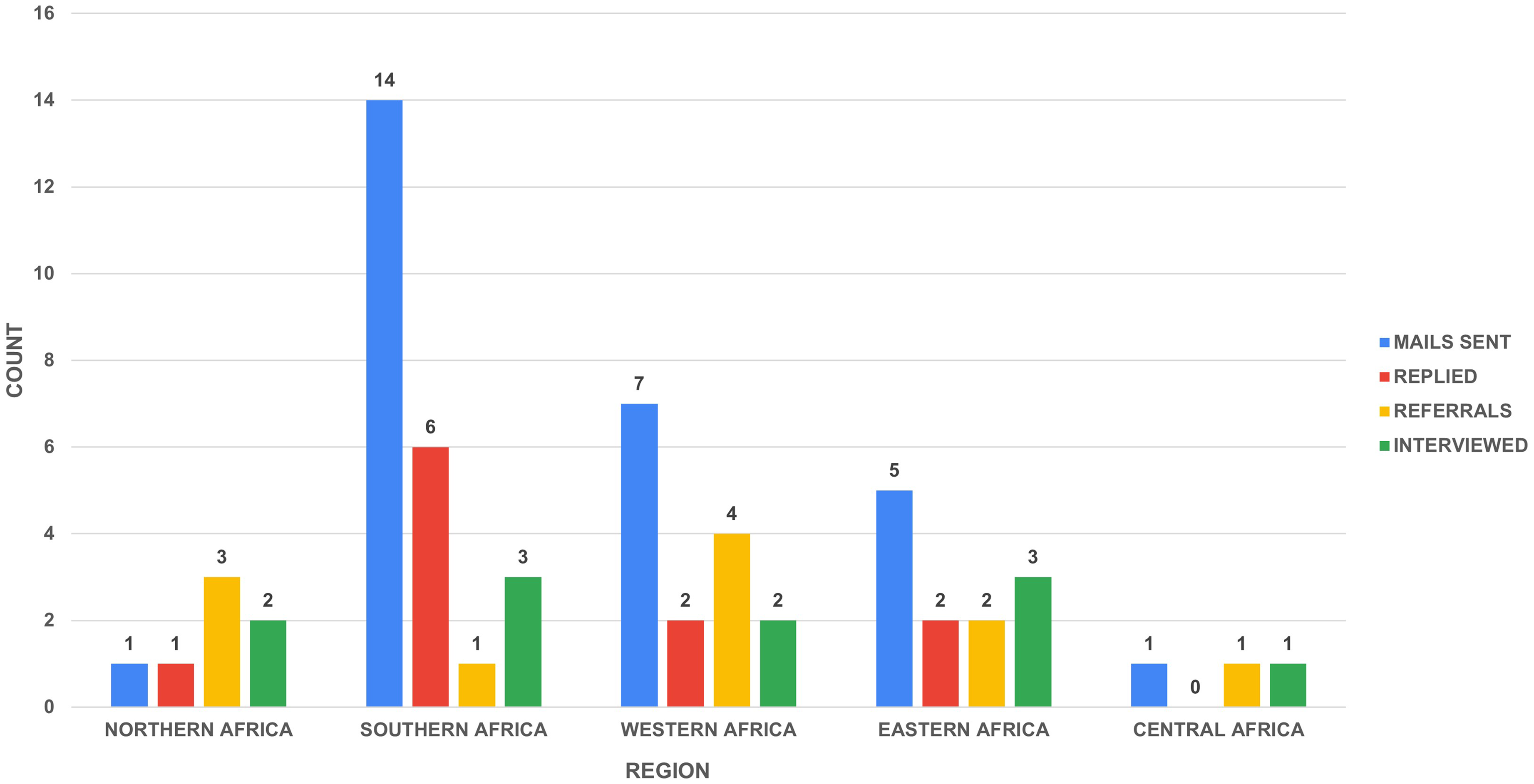
Number of emails sent, replies, referrals and participants interviewed.
Figure 1 shows the number of emails we sent to each subregion and the replies and referrals we had, as well as the number of interviews conducted. As shown in the figure, we sent fewer emails to Northern Africa and Central Africa because those regions are not predominantly English-speaking, and we only had one or two contacts from those regions who could communicate in English. We interviewed at least two participants from each subregion, except for Central Africa, where we had only one participant.
Figure 2 shows the specific countries where we interviewed librarians. We interviewed heads of libraries from Sierra Leone, Ghana, Nigeria, Egypt, Democratic Republic of the Congo, Uganda, Kenya, Zimbabwe, and South Africa.
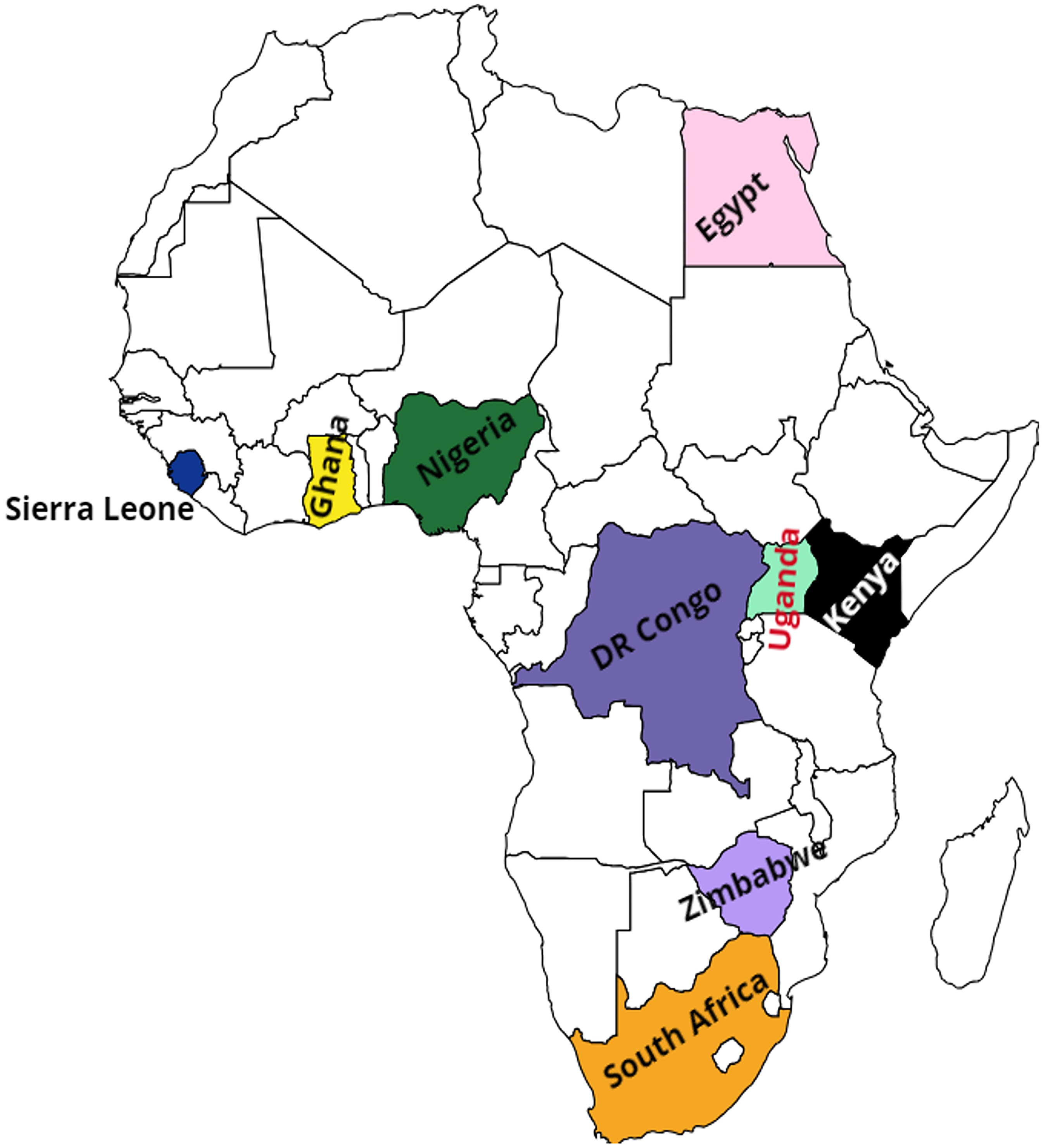
Locations of heads of libraries interviewed.
While the data is not fully representative of all libraries across Africa, we tried to sample different library funding models to get a deeper sense of individual experiences so that the insights gained may be transferable (Guba, 1981; Tobin and Begley, 2004) to other contexts or settings. Six of the librarians were from regional/county-level libraries that are heavily dependent on central government funding and donors for books and learning materials. For the other five libraries, one has multiple sources of funding, such as the county, central government, and companies in its locality. Two of the libraries have partnerships with US, Danish, and German international organizations. The remaining two public libraries are quite unique. They have strong centralized national public library authorities that coordinate funding from the government and other sources. Thus, while these libraries themselves are not representative of the diversity among these institutions across the continent, they represent a purposeful variety in terms of funding models and governance systems.
Similarly, in terms of the credibility and dependability of our findings (Guba, 1981; Tobin and Begley, 2004), we sought participants who could serve as key informants in their contexts. Four of the participants interviewed were heads of the community and of public libraries associations in their provinces, and the rest of the participants were either regional or provincial head librarians who oversaw all public libraries within their province or region. For instance, one of the participants was the head librarian for the second-largest province in their country. Thus, although the study relies on the experiences of individual librarians, the librarians we interviewed had oversight responsibilities for other libraries and librarians, which we believe increases the credibility and dependability of our findings because the sources had a broad view of library initiatives in their contexts, as well as extensive practical knowledge in the library and information science field. We also shared the audio-recording transcripts with the participants as a means of member-checking in order to increase the credibility of their responses (Birt et al., 2016).
Interview instrument
The interview instrument was reviewed by eight Master of Library and Information Science students, two senior information science research scientists, and two Master of Library and Information Science instructors, and piloted with two librarians. The interview guide sought to ask the librarians questions related to their experiences and opportunities as a result of the COVID-19 pandemic, such as: Has your library changed the way it operates since the emergence of the COVID-19 pandemic? What tasks or services was your library able to do when it was closed or restricted to the public due to the pandemic? What were the tasks or services your library initiated that it was not previously doing prior to the pandemic? What challenges did your library face? What has your library or librarians themselves gained from the pandemic? What opportunities can you derive from the pandemic? These questions were meant as a guide, and the researchers asked follow-up questions based on the direction of the conversation.
Data analysis
All of the interviews were recorded with the participants’ permission, transcribed using Otter.ai, cleaned manually, and coded using Atlas.ti. After cleaning the transcripts, we sent them to the participants to ask whether there was anything that had not been captured or they did not feel comfortable about being cited (Birt et al., 2016). The transcripts were then coded and analyzed using an inductive thematic analysis approach (Braun and Clarke, 2006, 2021). We identified and interpreted patterns and interesting insights across the data sets (Braun and Clarke, 2006). We employed the inductive approach to ensure that the codes and themes reflected the accounts of the participants from the interview data (Braun and Clarke, 2006). The analytic approach was situated within an interpretive constructionist framework (Berger and Luckmann, 2016; Rubin and Rubin, 2011), which allowed us to examine the COVID-19 pandemic experiences of the librarians and identify opportunities for library services and other similar crises in the future. This approach was appropriate because, as indicated by Rubin and Rubin (2011), the interpretive constructionist approach allows researchers to elicit the views of participants about their world and work, as well as events they have experienced or observed (Rubin and Rubin, 2011). Rubin and Rubin (2011) explain further that, often, participants’ views are expressed and interpreted based on their society and professional, political, or cultural assumptions. Nonetheless, the interpretive constructionist approach also recognizes the role of researchers in influencing the interpretation of the data and directing the research. We tried to interpret the data within the context of the participants based on our experiential knowledge of Africa. The primary researcher has worked as a librarian in Ghana and the other three researchers have also visited different African countries for various library projects.
Braun and Clarke (2006, 2021) outline a six-step thematic analysis process as follows: (1) familiarizing oneself with the data and taking notes; (2) systematically coding the data; (3) generating initial themes from the coded and collated data; (4) developing and reviewing the themes; (5) refining, defining, and naming the themes; and (6) producing a report. First, we read the transcripts while listening to the recorded audio files to familiarize ourselves with the data and correct parts that had not been transcribed very well; we wrote short notes and made a record of potential codes during this step. Second, the first author read each transcript more closely, highlighting and labeling interesting ideas and patterns related to the research questions with short phrases or keywords. Third, the rest of the research team met to discuss the codes generated and identified some initial themes, such as opportunities, fortunes/gains, initiatives, challenges, and needs. Fourth, these initial themes were further reviewed and summarized into two categories in relation to our research questions: (1) opportunities from the pandemic and (2) lessons from the pandemic. Fifth, we searched among the codes under each theme to identify the relevant participant quotes that could best articulate these themes. Finally, we defined each theme and considered the relationship between the themes in order to write up the findings.
We report the findings of the interviews without individual or institutional identifiers to protect the interviewees’ privacy. Moreover, the main goal of this study is to highlight the opportunities for public and community libraries following the emergence of the COVID-19 pandemic and not to report on specific libraries or countries. We simply refer to the interviewees by identifiers that we randomly assigned to the transcripts, such as Participant 1, Participant 2, and so on. Some quotes have been revised for clarity and to preserve anonymity. The modified portions are enclosed in square brackets.
Findings
Based on our analysis of the interviews conducted, we identified that the impact of the COVID-19 pandemic on libraries was initially negative but later created some opportunities and spurred the evolution of services, which suggests potential for community-based services now and in the future. These opportunities include improved digital skills among staff, increased access to information technology (IT) equipment, and the initiation of new library services. We present our findings with illustrative examples.
Improved digital skills of library staff: “COVID forced some of us to learn the computer”
We found that despite the challenges that libraries faced from the onset of the pandemic, such as few or poor digital skills among library staff—which mirrors the findings of previous studies (African Library and Information Associations and Institutions, 2020; Chigwada, 2021; Joel and Camble, 2021; Otike et al., 2021; Shonhe, 2022)—many of the librarians improved their digital skills. Digital skills such as using teleconferencing and office applications to work virtually became a necessity during the COVID-19 pandemic. Unfortunately, from our interviews, many African public and community library staff did not initially have the required digital skills to navigate virtual services. So, during the peak, stay-at-home period of the pandemic, most of the librarians took advantage of that time to upgrade their skills by enrolling on online office application courses. They also attended online training workshops related to media literacy and misinformation. Many of these online tutorials were facilitated by their country’s library board in collaboration with online education providers such as the Commonwealth of Learning, Coursera, and Udemy. For instance, Participant 1 revealed that they “learnt how to use Zoom, Google Meet, Microsoft Teams, and other free online courses.” Similarly, Participant 2 told us that the pandemic gave them “the opportunity to distinguish between fake and real news” from attending a workshop. Participant 4 confessed that the pandemic pushed (“forced”) librarians to improve their digital skills. The rest of the participants expressed similar experiences, which demonstrates that the pandemic gave public and community librarians in Africa ample time and motivation to access online learning platforms and pursue courses related to the acquisition of digital skills.
These digital skills have benefited not only individual librarians, but also their libraries. For instance, the librarians indicated that the skills they had learned and their exposure to virtual interaction software had saved them money because most of their libraries had now adopted virtual meetings. As Participant 7, from an Eastern African country with a vibrant national library authority, revealed: Before the pandemic, we used to go [to the headquarters] for physical meetings. So, [due to] the pandemic, the meetings were [held] online. So, there are a lot of online meetings [now]. And we can save some resources. Like, we [no longer] use transport to [go to meetings]. Most of our meetings were in [the capital city]. So, there is no longer shuttling and paying for transport. We only use data to access the meetings. I’ve created so many workshops via, via Zoom. This is an opportunity that I took. There's no need to go, have in person, like workshops and things in house. I mean, now people are saving, saving petrol money. We’re also saving money on the food, the snacks, refreshments. We are saving money on travel, and the actual venue. So, I mean, this is the best opportunity that has come out [of the pandemic].
Library access to IT equipment: “now all libraries have Internet”
We also identified that the COVID-19 pandemic presented African public and community libraries with an opportunity to improve their existing IT equipment or acquire new equipment. Some of the libraries that hitherto did not have computers received computers from their government, non-governmental institutions or even individuals. Some of those that already had computers had their Internet connectivity or power supply improved. For instance, Participant 4, a regional librarian from the southern province of a Western African country, disclosed: “It was after COVID that the government brought in the Internet to the library … So, now all libraries have Internet.” Similarly, Participant 2, a librarian from the second-largest province of a Southern African country, revealed that one of the libraries under her supervision was very lucky because it received “30 laptops from an aspiring community leader.” Participant 1, a librarian working in an internationally supported library in a Western African state, added: One of the benefits and I know within the library we [had] two Wi-Fi [routers]. But now we have about five Wi-Fi [routers] along … the library premises, ground floor, second floor, third floor, and first floor, we have all Wi-Fi … we [have also tried] to develop a kind of solar electricity system in the library for us to overcome the issue of power, electricity … we have five departments in the library and two departments are now powered with solar systems.
Opportunity to initiate new library services: “had to think out of the box”
The librarians also mentioned that the pandemic presented them with some opportunities to initiate new and innovative library services. For instance, Participant 5, from a Northern African country, revealed that, as a result of the pandemic: We had to think out of the box … so we ordered three mobile libraries [bookmobiles]. As a result of the outstanding work during the COVID, we are expanding. We are about to finish the procedure of buying extra three mobile libraries [bookmobiles]. Actually, our executive director started putting something together. That is the app[lication] development way back before the COVID set in. So, when the COVID set in, there was like an added advantage for us to just build on it and let it stay. Because now we wanted it badly. (Participant 6)
These testimonies demonstrate that the pandemic created several opportunities for African public and community libraries to introduce new and innovative library services. These services helped to meet the various information needs of their communities during the COVID-19 pandemic. The pandemic also helped accelerate opportunities to expand existing initiatives and services. While these discoveries were born out of the challenges faced during the pandemic, the opportunities and wisdom gained can be amplified using the ABCD model to serve communities now and in future crises, as will be discussed in the next section.
We noticed that one messaging application—WhatsApp—was commonly used in an innovative and proactive manner to facilitate information exchange among the librarians themselves and their patrons due to the absence of virtual service tools in many of these libraries. For instance, Participant 8 revealed to us that, as chair-elect for the library association of a province in their country, they used WhatsApp to keep in touch with their members: I am the chair-elect for our association. So, I formed a WhatsApp group with all the librarians in our province and we started hosting workshops. That was the cheapest means. So basically, I got people to come up with various topics. And the reason I did this was to keep people still updated and not getting brain dead sitting at home and doing absolutely nothing. It was wonderful because at a certain point we had 169 participants on that WhatsApp group. And we had topics such as, you know, like dealing with professional development … human-centered management, just good topics to keep people updated and refreshed.
Discussion
This article looks at the opportunities created by the COVID-19 pandemic as described by African head librarians. Our findings suggest that the impact of the pandemic on African libraries was initially challenging but later spurred the evolution of innovative services, mostly using existing resources. The challenges presented by the COVID-19 pandemic also significantly pushed African librarians to learn new digital skills (e.g. how to use teleconferencing and office application software). Similarly, the pandemic pushed some African governments and stakeholders to provide more IT tools (e.g. donate computers and extend Wi-Fi capabilities) for African public and community libraries in order to integrate virtual services into their operations. Again, some African libraries used existing mobile application platforms to deliver their services in innovative ways (e.g. introducing mobile money payments for paid library services, storytelling and sharing student materials via WhatsApp, and using WhatsApp for professional connection and development). Generally, the findings mirror those of previous studies (African Library and Information Associations and Institutions, 2020; Bugre et al., 2023; Chigwada, 2021) but the novelty and significance of this study relates to how librarians can extend the COVID-19 pandemic opportunities by leveraging their existing resources and experiences, as they did during the pandemic, to serve the information needs of their users now and in future crises. In this study, we focus on how librarians drew on their existing strengths and took advantage of opportunities presented by the pandemic to assist their community members. While the innovative services they initiated were born out of the challenges during the pandemic, the opportunities and wisdom gained can be amplified using the ABCD model so that they can continue to serve and share information with their community members now and in future crises.
In this discussion, we look at four broad areas that public libraries should consider as they strive to take advantage of the opportunities and resolve the challenges they encountered during the pandemic. First, we discuss how librarians can leverage the digital skills and resources acquired during the COVID-19 period to address gaps in mobile-phone digital skills, since mobile phones are one of the most accessible digital tools in low-resourced environments. Participant 8 mentioned access to phones in the following terms: “this is a very poor community but many of the households here have phones. Phones are more important than food.” Second, we discuss the need for improved and increased digital infrastructure, as signaled by the pandemic, but advocate a holistic approach. Third, we consider, in relation to the holistic approach, the need for digital security in the wake of increased cyberattacks. Finally, we highlight the relationship of the ABCD model to the experiences of our research participants and encourage librarians to do the same when faced with challenges. As illustrated above, the librarians initiated both digital and non-digital strategies during the pandemic, but we limit our discussion to the digital initiatives since the COVID-19 pandemic presented a strong case for virtual solutions. However, we argue that libraries should be mindful as they lobby for or roll out digital solutions.
Leverage acquired digital skills and mobile phones to address digital skills gaps among library staff and users
A major opportunity from the pandemic, as shared by our participants, was the opportunity for librarians to improve their digital skills and improve existing or acquire new digital tools. We believe that this is an opportunity that librarians can leverage to further advance their own digital skills and build the digital skills of their communities. The need for digital skills in communities was raised by Participant 3: “Many people in our communities have smartphones, but how to use it [them] profitably is still a big challenge.” However, as expressed in other studies on the COVID-19 experiences of public librarians, many of them are not fluent in digital skills themselves (Shonhe, 2022). Nonetheless, public librarians are invited to educate the public on digital skills and digital misinformation (Kostagiolas and Katsani, 2021)—false, manipulated, or inaccurate information. We believe that, since the pandemic exposed librarians to so many free online digital skills learning platforms, they can take advantage of them to further advance their skills and better support their community members. If both library staff and the broader community have a greater level of digital competence, they will be better able to take advantage of technology-based tools now and during future crises. These skills will also help communities to navigate the everyday challenges of IT, such as misinformation. For instance, African public and community libraries can initiate mobile-phone digital skills training services to build the resilience of their community members against misinformation. Misinformation is a global problem. Social media and mobile phones are largely the tools that are used to spread misinformation narratives (Wasserman, 2011). Misinformation drawn on illiteracy tends to thrive (Joel and Camble, 2021) and could lead to worsening political tensions and ethnic conflicts in Africa since democracy is still fragile across the continent (Mustapha, 2022) and illiteracy rates are high (Galan, 2025). Thus, public libraries are an important site of community intervention against misinformation (Chisita and Ngulube, 2022; Joel and Camble, 2021; Young et al., 2021). They can share audio or video tutorials via WhatsApp or other social media platforms, as they did during the pandemic, to reach adult populations who may not be able to use in-person library services.
Improve digital infrastructure but adopt a holistic approach
The COVID-19 pandemic highlighted a strong case for virtual operations to be integrated in public libraries, as expressed by Participant 2: “the lessons we learned was that we really need to computerize yesterday … If you’re, if you’re closed for six months, and you’re not giving any service, really, are you necessary in a community?” This need is echoed by previous studies (Ayeni et al., 2021; Bugre et al., 2023; Chigwada, 2021; Shonhe, 2022). But virtual capabilities are not a fix-all solution. As in the case of bookmobiles (Participant 5) and other examples from the literature (Roberts and Clarke, 2024), non-digital services can still be innovative and vital for communities. Additionally, while funding for expanding IT became more available because of the pandemic in some cases, studies in similar contexts cite an ongoing lack of policy or funds to support online services for public libraries (Dilrukshi et al., 2021) and the lack of information and communications technology infrastructure (Shonhe, 2022), which may be barriers to scaling pandemic innovations. Public and community libraries will have to continue to be inventive in analog ways. For example, if a library does not have the Internet to host virtual storytelling for children (Participant 8), it may be able to send a trusted staff member to escort children to the library for storytime sessions (Srirahayu et al., 2023) or offer its outdoor space for art or exercise activities (Lenstra and D’Arpa, 2022) in order to continue to benefit its patrons.
Thus, based on the lessons learned from the pandemic, we encourage library heads and policymakers to strive to go beyond simply trying to solve the library digital infrastructure challenges that were encountered during the pandemic and fortify their responses to meet current and future needs. They need to holistically build resilience for possible future crises, which may be like the pandemic or different. One such holistic strategy could be looking at how libraries can continue to serve their patrons or communities using their current assets (Kretzmann and McKnight, 1993; McKnight and Russell, 2018; Russell and McKnight, 2022) in the event of possible crises. These assets may include their space, staff expertise, partnerships, and community relationships. Examining how libraries can depend on their current assets to meet the essential needs of community members in times of crisis is more crucial than ever because the COVID-19 pandemic signaled that there could be times in our lives when, even if we have the means to acquire more resources, we cannot get anything elsewhere, and we have to depend solely on what we have at hand. Participant 2 echoed this: “It was just, it was not possible to acquire anything because you want to acquire this, but that factory or industry is closed because of COVID.” Libraries therefore need to take stock of what resources they have that could be used in a crisis. The most important thing to note, as advised by Campbell (2005), is that libraries should work with their patrons and not think for them.
Be mindful of cyberattacks as digital services are rolled out
Libraries should avoid merely installing information systems and introducing virtual services without putting in place effective processes to minimize the effects of IT challenges such as cyberattacks. It is understandable that the goal at the peak of the pandemic was to keep people safe and continue offering services as best possible. Thus, the emphasis and recommendation for libraries without digital tools to acquire and install such tools to facilitate virtual services (Chigwada, 2021) was appropriate. However, based on recent events—the massive Internet outage in Ghana, South Africa, Liberia, Ivory Coast, and Burkina Faso in March 2024 due to submarine cables breaking (Booty and Garzeawu, 2024); the ransomware attacks on libraries in locations such as the UK (British Library, 2024), California (Fox-Sowell, 2024) and Seattle (Enis, 2024); and the global software outage that grounded planes, affected hospitals, and disrupted critical public services (Satariano et al., 2024)—public and community libraries have to be mindful of the risks associated with the use of digital services. Apart from implementing techniques to avoid cyberattacks, they should put mechanisms in place whereby they can serve their communities in the event of cyberattacks or technology breakdowns. Bookmobiles and curated materials for hospital patients (Xin, 2022) are examples that show how libraries were able to meet their communities’ needs at a specific moment in time without relying on technology. While it is tempting to see IT as the only route to innovation, these examples show the value of maintaining a variety of resources and the insight to use them creatively.
Always start with what there is at your disposal
Finally, drawing from the interviews, many of the participants showed that depending on their current assets to meet essential needs during a crisis is possible. For instance, many of the libraries successfully provided valuable information services to their users notwithstanding their challenges by thinking outside the box: “Like sending information to people on WhatsApp” (Participant 3). This resonates with previous research, which reveals that libraries used WhatsApp and mobile-phone cameras to send scanned sections of documents to patrons such as students and researchers who needed them urgently when libraries were closed (African Library and Information Associations and Institutions, 2020; Bugre et al., 2023; Chigwada, 2021), and similar low-cost platforms such as Facebook to disseminate information to library users (Joel and Camble, 2021). While other platforms may be useful, the participants reinforced that WhatsApp is the most advantageous due to its low data requirements, ease of use, and popularity across Africa. The librarians were able to offer services based on their existing assets, such as their personal mobile phones, the library's information resources, their reputation in the community as a vital resource for students and researchers, and their interpersonal relationships with community members, which allowed those in need to reach out to them. All these are assets highlighted by the ABCD model (Kretzmann and McKnight, 1993; McKnight and Russell, 2018; Russell and McKnight, 2022), which libraries can explore and take advantage of to serve their community members now and in future crises. Nonetheless, libraries need to be mindful of copyright issues when they share information via social media (Smith, 2020).
Limitations and recommendations for further study
This study was limited to public librarians who could speak English. Although we tried to enhance the inclusivity by recruiting participants who could speak English from non-English-speaking African regions (e.g. Egypt and the Democratic Republic of the Congo), further studies are needed to account for the experiences and initiatives of non-English-speaking librarians during the COVID-19 pandemic. This study is also limited by the sample size of 11 librarians. Although, to account for the limited sample size, we tried to recruit participants from different countries covering all five subregions, we recognize that this might not capture the full spectrum of the experiences and initiatives of public and community libraries across Africa; other studies could thus expand the sample size to remedy this limitation. Moreover, while virtual interviews are cost-effective for the researcher and convenient in terms of privacy for the participants (Oliffe et al., 2021), there are some limitations pertaining to the use of virtual interviews. For instance, some of our participants had unstable Internet connectivity. This affected the smooth flow of the conversation with them and made some of them inaudible, which affected the quality of the recordings. However, we mitigated this by sharing the transcripts with the participants to cross-check and fill in the gaps. In addition, while qualitative data provided rich insights, similar studies could be enhanced with quantitative data such as statistics on user engagement or the reach of virtual services.
Conclusion
This article has looked at the opportunities from the COVID-19 pandemic as shared by African head librarians using online semi-structured interviews and inductive thematic analysis. The study focused on opportunities identified by African public and community librarians, and how those opportunities can be leveraged to initiate or expand information services to their communities drawing on the ABCD model. We have observed that some libraries successfully provided valuable information services to their users notwithstanding their challenges. Based on recent events such as ransomware attacks, global software glitches, and Internet interruptions, we argue that librarians should focus on holistic solutions as they think about and plan for future possible crises like the COVID-19 pandemic.
However, these insights are limited to the cross section of African public librarians that we interviewed. More research is needed to explore how libraries can use the ABCD model to serve their community members now and in possible future crises to shift the deficit mindset that low-resourced libraries may have. This is critical since one of the lessons that the COVID-19 pandemic has taught us is that there can be times in our lives when we cannot get anything elsewhere and have to depend solely on what we have at hand. Therefore, library heads and policymakers should go beyond simply trying to solve the library challenges that were encountered during the pandemic. They should explore both technological and non-technological solutions to current community issues using the ABCD model. The ABCD model provides insights in terms of how to adequately serve the needs of communities by focusing on the library and its neighborhood's assets. Focusing on an institution's assets does not mean that institutions do not need additional or external support. But rather the ABCD model helps institutions to fully mobilize the resources that they already possess before looking outside to identify any additional external resources that may be required to meet their needs.
Footnotes
Acknowledgements
We extend our gratitude to the 11 anonymous librarians who shared their experiences and insights. We also thank the students in the Future of Libraries Master of Library and Information Science class of spring 2023 at the Information School, University of Washington, who reviewed the interview guide for this study. We would also like to thank Cindy Aden, Chance Hunt, Alyssa Deutschler, and Emily Keller for reviewing the interview guide and providing guidance.
Declaration of conflicting interests
The authors declared no potential conflicts of interest with respect to the research, authorship, and/or publication of this article.
Funding
The authors disclosed receipt of the following financial support for the research, authorship, and/or publication of this article: This project was funded by a gift from the Bill and Melinda Gates Foundation (Investment ID: OPP1130103).
